Isaiah 10:17

Hebrew (Westminster Leningrad Codex) Isaiah 10:17 appears in the Hebrew Old Testament. The text above is from the Westminster Leningrad Codex. Each word links to its Strong’s number, a concise gloss, and parsing drawn from the Open Scriptures Hebrew Bible morphology. Click any word for its full Brown-Driver-Briggs (BDB) entry.
Download image
Cite this verse

Isaiah 10:17 (World English Bible). Public Domain. Lemma interlinear Bible study tool, https://lemma.gebible.app/v/isaiah/10/17.

Show BibTeX & RIS
BibTeX
RIS
English Translation
The light of Israel will be for a fire, and his Holy One for a flame; and it will burn and devour his thorns and his briers in one day.
World English Bible · Public Domain
Download a study sheet

One document with this verse’s original text, its word-by-word gloss line, the meaning frame, cross-references with their text, attributed commentary, and full source and license credits — printable, and it pastes into notes with its structure intact.

This verse Autodidact and up

Study sheet (.html) Plain text (.txt)

A passage Seminary Student

Up to 50 verses in one chapter. A passage sheet keeps up to 6 commentary sources and 12 cross-references per verse, in the order this page ranks them, and says so on the sheet whenever that leaves anything out. Ask for a single verse and you get the Autodidact verse sheet above.

Everything on this page stays free to read, with no account — the sheet is a download of what is already on screen, not access to it.

Want to remove ads? Support Godless Engineer
Compare translations 3

The same verse in 3 English versions, stacked beneath the original-language interlinear above. Click any original word for its lexicon entry.

Each is an independent rendering of the whole verse — the interlinear is not word-aligned to these translations.

Highlighted words mark where these versions differ — a whole-verse word diff, not a word-by-word alignment.

  • World English Bible Public Domain
    The light of Israel will be for a fire, and his Holy One for a flame; and it will burn and devour his thorns and his briers in one day.
  • King James Version Public Domain
    And the light of Israel shall be for a fire, and his Holy One for a flame: and it shall burn and devour his thorns and his briers in one day;
  • unfoldingWord Literal Text CC BY-SA 4.0
    And the light of Israel will become a fire, and his Holy, a flame, and it will burn and consume his thorn and his briar in one day.

unfoldingWord Literal Text — © unfoldingWord, licensed CC BY-SA 4.0. Word-aligned USFM3 via Door43 (git.door43.org/unfoldingWord/en_ult).

Versions to compare (up to 4)

3 of 4 selected

Show all 18 translations

Every available English version of this verse, each an independent rendering of the whole verse.

  • World English Bible Public Domain
    The light of Israel will be for a fire, and his Holy One for a flame; and it will burn and devour his thorns and his briers in one day.
  • Berean Standard Bible Public Domain
    And the Light of Israel will become a fire, and its Holy One a flame. In a single day it will burn and devour Assyria’s thorns and thistles.
  • Majority Standard Bible Public Domain
    And the Light of Israel will become a fire, and its Holy One a flame. In a single day it will burn and devour Assyria’s thorns and thistles.
  • King James Version Public Domain
    And the light of Israel shall be for a fire, and his Holy One for a flame: and it shall burn and devour his thorns and his briers in one day;
  • American Standard Version (1901) Public Domain
    And the light of Israel will be for a fire, and his Holy One for a flame; and it will burn and devour his thorns and his briers in one day.
  • Revised Version (1885) Public Domain
    And the light of Israel shall be for a fire, and his Holy One for a flame: and it shall burn and devour his thorns and his briers in one day.
  • Geneva Bible (1599) Public Domain
    And the light of Israel shalbe as a fire, and the Holy one thereof as a flame, and it shall burne, and deuoure his thornes and his briers in one day:
  • Douay-Rheims (1899) Public Domain
    And the light of Israel shall be as a fire, and the Holy One thereof as a flame: and his thorns and his briers shall be set on fire, and shall be devoured in one day.
  • Young's Literal Translation Public Domain
    And the light of Israel hath been for a fire, And his Holy One for a flame, And it hath burned, and devoured his thorn And his brier in one day.
  • Literal Standard Version CC BY-SA 4.0
    And the light of Israel has been for a fire, || And his Holy One for a flame, || And it has burned, and devoured his thorn || And his brier in one day.
  • Unlocked Literal Bible CC BY-SA 4.0
    The light of Israel will become a fire, and his Holy One a flame; it will burn and devour his thorns and briers in one day.
  • unfoldingWord Literal Text CC BY-SA 4.0
    And the light of Israel will become a fire, and his Holy, a flame, and it will burn and consume his thorn and his briar in one day.
  • Darby Bible Public Domain
    and the light of Israel shall be for a fire, and his Holy One for a flame; and it shall burn and devour his thorns and his briars in one day,
  • World Messianic Bible Public Domain
    The light of Israel will be for a fire, and his Holy One for a flame; and it will burn and devour his thorns and his briers in one day.
  • Webster's Bible Public Domain
    And the light of Israel shall be for a fire, and his Holy One for a flame: and it shall burn and devour his thorns and his briers in one day;
  • Free Bible Version CC BY-SA 4.0
    Israel's light will become a fire, and his Holy One will become a flame. It will burn up his thorns and brambles in just one day.
  • Bible in Basic English Public Domain
    And the light of Israel will be for a fire, and his Holy One for a flame: wasting and burning up his thorns in one day.
  • JPS Tanakh (1917) Public Domain
    And the light of Israel shall be for a fire, and his Holy One for a flame; and it shall burn and devour his thorns and his briers in one day.

Literal Standard Version (2020), Covenant Press — licensed CC BY-SA 4.0. Text via the HelloAO Bible API (eBible.org). Unlocked Literal Bible (unfoldingWord) — licensed CC BY-SA 4.0. Text via the HelloAO Bible API (eBible.org). unfoldingWord Literal Text — © unfoldingWord, licensed CC BY-SA 4.0. Word-aligned USFM3 via Door43 (git.door43.org/unfoldingWord/en_ult). Free Bible Version, Dr. Jonathan Gallagher — licensed CC BY-SA 4.0. Text via the HelloAO Bible API (eBible.org).

Word by word

More ways to search: Search by grammar → Find every occurrence → Compare this word →

Practice this passage: Drill this verse → Learn its vocabulary →

שִׁית֥וֹ
shayith
H7898
“thorn bushes · his”
Noun, Common, Masculine, Singular, Construct + Suffix, Personal, 3rd Person, Masculine, Singular
Part of Speech
Noun
Type
Common
Gender
Masculine
Number
Singular
State
Construct
Full BDB Definition

Origin: from H7896

TWOT: 2380c

thorn bushes
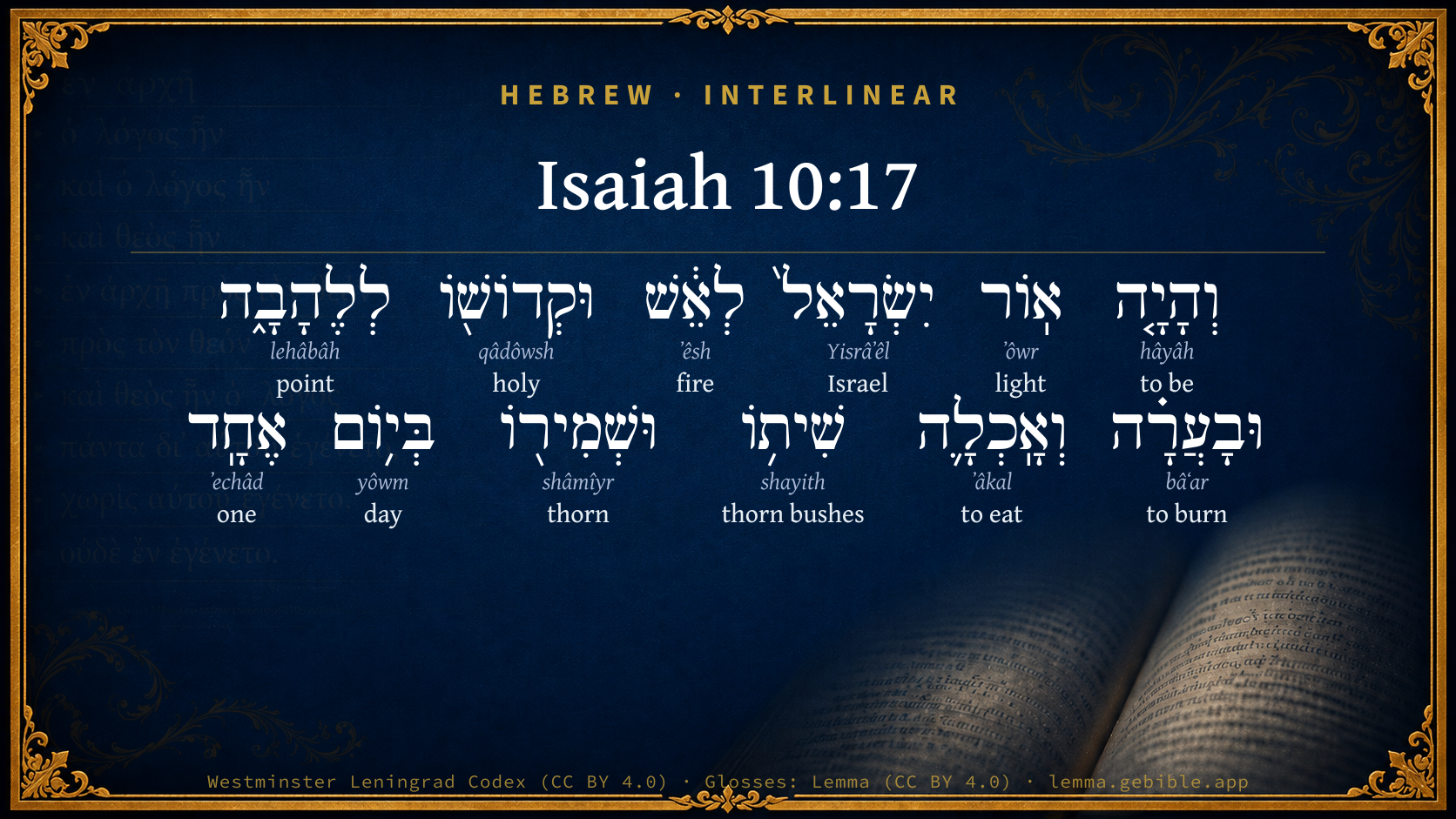
  1. וְהָיָ֤ה hâyâh H1961 “and · to be” Conjunction + Verb, Qal, Sequential Perfect, 3rd Person, Masculine, Singular
  2. אֽוֹר ʼôwr H216 “light of” Noun, Common, Both, Singular, Construct
  3. יִשְׂרָאֵל֙ Yisrâʼêl H3478 “Israel” Noun, Proper
  4. לְאֵ֔שׁ ʼêsh H784 “to/for · fire” Preposition + Noun, Common, Both, Singular, Absolute
  5. וּקְדוֹשׁ֖וֹ qâdôwsh H6918 “and · holy · his” Conjunction + Adjective, Adjective, Masculine, Singular, Construct + Suffix, Personal, 3rd Person, Masculine, Singular
  6. לְלֶהָבָ֑ה lehâbâh H3852 “to/for · point” Preposition + Noun, Common, Feminine, Singular, Absolute
  7. וּבָעֲרָ֗ה bâʻar H1197 “and · to burn” Conjunction + Verb, Qal, Sequential Perfect, 3rd Person, Feminine, Singular
  8. וְאָֽכְלָ֛ה ʼâkal H398 “and · to eat” Conjunction + Verb, Qal, Sequential Perfect, 3rd Person, Feminine, Singular
  9. וּשְׁמִיר֖וֹ shâmîyr H8068 “and · thorn · his” Conjunction + Noun, Common, Masculine, Singular, Construct + Suffix, Personal, 3rd Person, Masculine, Singular
  10. בְּי֥וֹם yôwm H3117 “in/at · day” Preposition + Noun, Common, Masculine, Singular, Absolute
  11. אֶחָֽד ʼechâd H259 “one” Adjective, Cardinal number, Masculine, Singular, Absolute

About this verse

These counts appear in no published source. They are computed here, from the morphology-tagged text and Lemma’s own curated glosses. What Lemma adds →

12
words
12
distinct lemmas
Prophets
section

Notable vocabulary

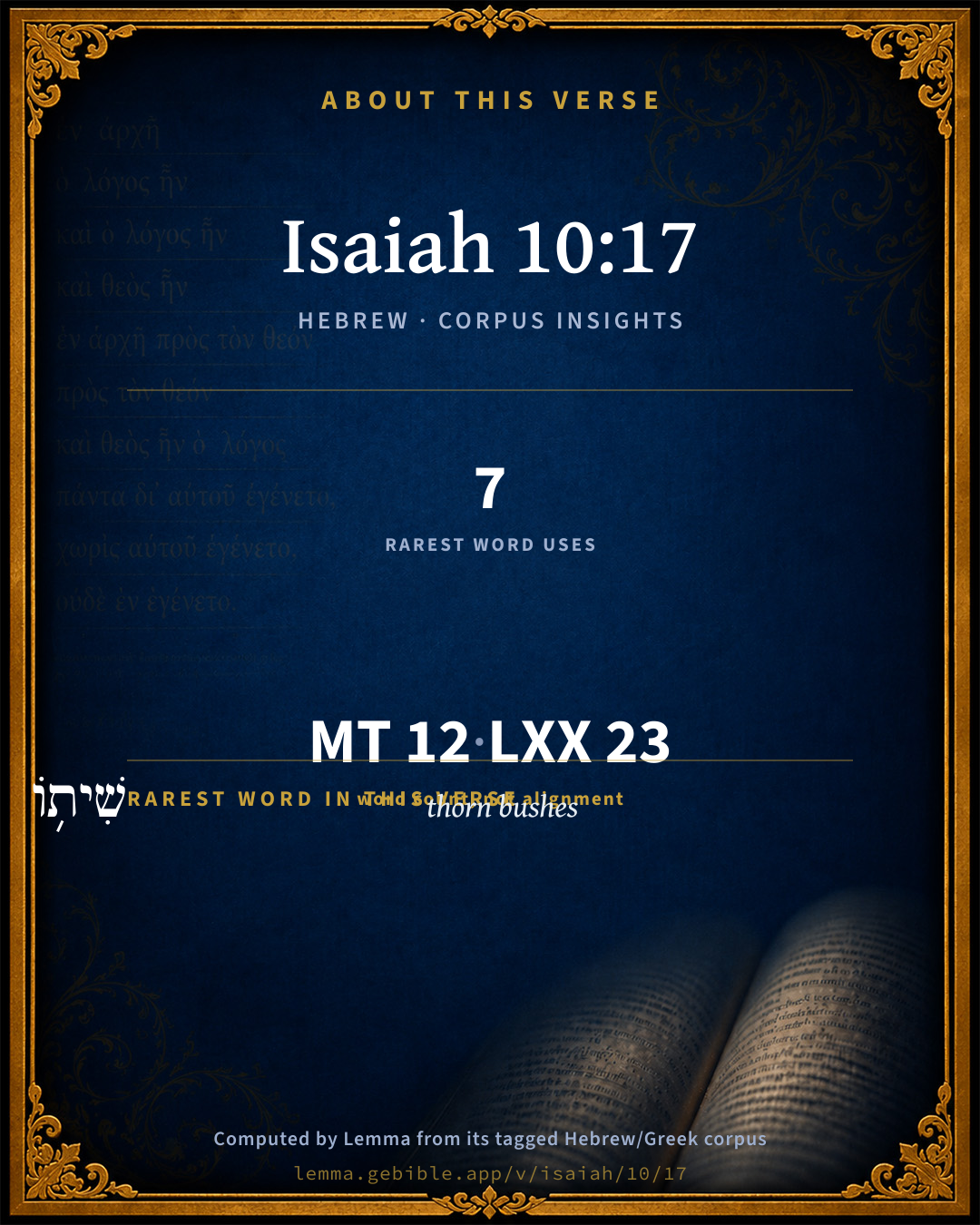
The rarest word here is שִׁית֥וֹ thorn bushes H7898 — appearing just 7 times in the whole Hebrew Bible.

Shared distinctive vocabulary

שִׁית֥וֹ thorn bushes H7898 occurs in 7 verses of the Hebrew Bible. Also found in:

Grammatical profile

  • 3 verbs
  • 7 nouns
  • 2 adjectives

Verb forms

  • וְהָיָ֤ה Qal · Sequential Perfect
  • וּבָעֲרָ֗ה Qal · Sequential Perfect
  • וְאָֽכְלָ֛ה Qal · Sequential Perfect

Hebrew & Septuagint length

In English translation the verse runs 30 words from the Hebrew and 26 from the Septuagint (LXX English) — closely comparable.

A rough comparison of the two English renderings, which tokenize alike — not a word-level alignment.

Word counts can differ between the Hebrew and the Greek without any difference in meaning — e.g. the Hebrew direct-object marker אֵת has no separate Greek word, and Greek often adds the article ὁ.

In the original languages it is 12 Hebrew tokens and 23 Greek tokens — but the two are counted differently (Hebrew bundles its prefixes and suffixes into one token; the Greek is in lemma form), so that isn’t a like-for-like length.

Cross-references

30

Topical passages linked to Isaiah 10:17 in the Treasury of Scripture Knowledge — connected by theme and wording, ordered by reader-vote popularity; previews shown in the World English Bible.

  • Isaiah 27:4 Wrath is not in me: would that the briers and thorns were against me in battle! I would march on them, I would burn them together.
  • Numbers 11:1–3 The people were as murmurers, [speaking] evil in the ears of Yahweh: and when Yahweh heard it, his anger was kindled; and the fire of Yahweh burnt among them, and devoured in the uttermost part of the camp.
  • Numbers 16:35 Fire came forth from Yahweh, and devoured the two hundred fifty men who offered the incense.
  • Isaiah 37:23 Whom have you defied and blasphemed? and against whom have you exalted your voice and lifted up your eyes on high? [even] against the Holy One of Israel.
  • Jeremiah 4:4 Circumcise yourselves to Yahweh, and take away the foreskins of your heart, you men of Judah and inhabitants of Jerusalem; lest my wrath go forth like fire, and burn so that none can quench it, because of the evil of your doings.
  • Jeremiah 7:20 Therefore thus says the Lord Yahweh: Behold, my anger and my wrath shall be poured out on this place, on man, and on animal, and on the trees of the field, and on the fruit of the ground; and it shall burn, and shall not be quenched.
  • Nahum 1:10 For entangled like thorns, and drunken as with their drink, they are consumed utterly like dry stubble.
  • Revelation 22:5 There will be no night, and they need no lamp light; for the Lord God will illuminate them. They will reign forever and ever.
  • Psalms 18:8 Smoke went out of his nostrils. Consuming fire came out of his mouth. Coals were kindled by it.
  • Psalms 21:9 You will make them as a fiery furnace in the time of your anger. Yahweh will swallow them up in his wrath. The fire shall devour them.
  • Psalms 27:1 Yahweh is my light and my salvation. Whom shall I fear? Yahweh is the strength of my life. Of whom shall I be afraid?
  • Psalms 50:3 Our God comes, and does not keep silent. A fire devours before him. It is very tempestuous around him.
  • Psalms 83:14–15 As the fire that burns the forest, As the flame that sets the mountains on fire,
  • Psalms 84:11 For Yahweh God is a sun and a shield. Yahweh will give grace and glory. He withholds no good thing from those who walk blamelessly.
  • Psalms 97:3 A fire goes before him, And burns up his adversaries on every side.
  • Isaiah 9:18 For wickedness burns as the fire; it devours the briers and thorns; yes, it kindles in the thickets of the forest, and they roll upward in a column of smoke.
  • Isaiah 30:27–28 Behold, the name of Yahweh comes from far, burning with his anger, and in thick rising smoke: his lips are full of indignation, and his tongue is as a devouring fire;
  • Isaiah 31:9 His rock shall pass away by reason of terror, and his princes shall be dismayed at the ensign, says Yahweh, whose fire is in Zion, and his furnace in Jerusalem.
  • Isaiah 33:14 The sinners in Zion are afraid; trembling has seized the godless ones: Who among us can dwell with the devouring fire? who among us can dwell with everlasting burning?
  • Isaiah 37:36 The angel of Yahweh went forth, and struck in the camp of the Assyrians one hundred and eighty-five thousand; and when men arose early in the morning, behold, these were all dead bodies.
  • Isaiah 60:19 The sun shall be no more your light by day; neither for brightness shall the moon give light to you: but Yahweh will be to you an everlasting light, and your God your glory.
  • Isaiah 64:1–2 Oh that you would tear the heavens, that you would come down, that the mountains might quake at your presence,
  • Isaiah 66:15–16 For, behold, Yahweh will come with fire, and his chariots shall be like the whirlwind; to render his anger with fierceness, and his rebuke with flames of fire.
  • Isaiah 66:24 They shall go forth, and look on the dead bodies of the men who have transgressed against me: for their worm shall not die, neither shall their fire be quenched; and they shall be an abhorring to all flesh.
  • Nahum 1:5–6 The mountains quake before him, and the hills melt away. The earth trembles at his presence, yes, the world, and all who dwell in it.
  • Malachi 4:1–3 "For, behold, the day comes, it burns as a furnace; and all the proud, and all who work wickedness, will be stubble; and the day that comes will burn them up," says Yahweh of Hosts, "that it shall leave them neither root nor branch.
  • Matthew 3:12 His winnowing fork is in his hand, and he will thoroughly cleanse his threshing floor. He will gather his wheat into the barn, but the chaff he will burn up with unquenchable fire."
  • 2 Thessalonians 1:7–9 and to give relief to you that are afflicted with us, when the Lord Jesus is revealed from heaven with his mighty angels in flaming fire,
  • Hebrews 12:29 for our God is a consuming fire.
  • Revelation 21:23 The city has no need for the sun, neither of the moon, to shine, for the very glory of God illuminated it, and its lamp is the Lamb.

Cross-references courtesy of OpenBible.info (CC BY 4.0).

Hebrew and Greek witnesses Masoretic Hebrew ↔ Greek Septuagint

The same verse in the two great witnesses to the Old Testament, shown verse-for-verse.

These are two independent witnesses, not word-aligned to each other, and the Septuagint is shown in lemma (dictionary) form.

Hebrew Isaiah 10:17 Masoretic · Westminster Leningrad Codex

וְהָיָ֤ה אֽוֹר יִשְׂרָאֵל֙ לְאֵ֔שׁ וּקְדוֹשׁ֖וֹ לְלֶהָבָ֑ה וּבָעֲרָ֗ה וְאָֽכְלָ֛ה שִׁית֥וֹ וּשְׁמִיר֖וֹ בְּי֥וֹם אֶחָֽד

The light of Israel will be for a fire, and his Holy One for a flame; and it will burn and devour his thorns and his briers in one day.

World English Bible · Public Domain

Greek LXX Isaiah 10:17 Septuagint · lemma form

καί εἰμί ὁ φῶς ὁ ἰσραήλ εἰς πῦρ καί ἁγιάζω αὐτός ἐν πῦρ καίω καί ἐσθίω ὡσεί χόρτον ὁ ὕλη ὁ ἡμέρα ἐκεῖνος

And the light of Israel shall be for a fire, and he shall sanctify him with burning fire, and it shall devour the wood as grass.

LXX2012 (modern English Septuagint) · Public Domain

On this verse, Adam Clarke's Commentary discusses the Septuagint’s reading. Read the note in Commentary ↓

Hebrew: Westminster Leningrad Codex (CC BY 4.0). Greek: Septuagint (public domain); English from LXX2012 (modern English Septuagint) (Public Domain). How the Septuagint differs from the Hebrew →

Targum (Aramaic paraphrase)

1

The Targum is the ancient Jewish Aramaic paraphrase of the Hebrew Scriptures — an interpretive translation, not the Hebrew text itself. Onkelos (literal) and Pseudo-Jonathan (expansive) render the Torah, and Jonathan the Prophets. Coverage is partial: where no permissively-licensed English translation exists for a verse, only the Aramaic is shown. This is verse-level text, not a word-by-word alignment to the Hebrew.

  1. Targum Jonathan Prophets (Joshua–Malachi)
    וִיהֵי מָרֵי נְהוֹרֵיהּ דְיִשְׂרָאֵל וְקַדִישֵׁיהּ מֵימְרֵיהּ תַּקִיף כְּאֶשְׁתָּא וּפִתְגָמוֹהִי כְשַׁלְהוֹבִיתָא וְיִקְטוֹל וִישֵׁיצֵי שִׁלְטוֹנוֹהִי וְטוּרְנוֹהִי בְּיוֹמָא חָד:

    And there shall be the Lord, the Light of Israel, and His holy one, His word, strong as fire, and His word as a flame; and it shall slay, and make an end of his rulers and of his governors in one day.

    Targum Jonathan — Aramaic: “Mikraot Gedolot” (public domain). English: “Sefaria Community Translation” (CC0 1.0 (public-domain dedication)); “London "Chaldee Paraphrase," 1871” (public domain). Text via Sefaria.

Commentary

Notes on Isaiah 10:17 from classic Christian and Jewish commentators (each source and its license shown beneath its notes). The classic Christian expositions comment on the surrounding passage and are grouped to its opening verse, so a note may address several verses; the Jewish commentaries on the Tanakh (Rashi and others) are per-verse, so they appear only where the commentator wrote on this verse.

Lemma curates 59 commentaries, every one of them public domain or Creative Commons licensed, each selected and text-cleaned for this edition rather than reprinted as found. About our sources →

Trapp's Complete Commentary

John Trapp

Isa 10:17 And the light of Israel shall be for a fire, and his Holy One for a flame: and it shall burn and devour his thorns and his briers in one day;

Ver. 17. And the light of Israel shall be for a fire.] To Israel he shall be a comfortable light - to their enemies a consuming fire, as Exo 14:24. Ecce idem iustis et fidelibus suavis, impiis autem gravis.

His thorns and his briers.] His army, which is so troublesome and vexatious to Israel. God will "go through them, he will burn them {a} together." {Isa 27:4}

In one day,] i.e., In one night, being part of the natural day. So the Spanish Armada was quickly dispersed, which had been so many years in rigging and setting forward.

{a} Assyrios, quibus ut sentibus vepribusque cohorrebat terra. - Jun.

John Trapp, A Commentary or Exposition upon All the Books of the Old and New Testament (1647–1656) — public domain. Text from a community e-Sword module.

The Biblical Illustrator

Joseph S. Exell

Isa_10:17

And the light of Israel shall be for a fire

The light of Israel

A name of Jehovah, who was represented by the Shekinah glory.

(B. Blake, B. D.)

The collapse of the Assyrian enterprise

Isaiahs genius supplies him with a splendid figure under which to depict the collapse of the Assyrian enterprise. The serried battalions of Assyria appear to his imagination as the trees of some huge forest, irresistible in their strength and countless in their number; but the Light of Israel kindles majestically into a flame; and at the end of a single day a child may count them. (Prof. S. R. Driver, D. D.)

The Biblical Illustrator, edited by Joseph S. Exell (c. 1880s–1900s) — public domain. Text from a community e-Sword module.

MacLaren's Expositions of Holy Scripture

Alexander MacLaren

Isaiah

LIGHT OR FIRE?

Isa 10:17.

With grand poetry the prophet pictures the Assyrian power as a forest consumed like thistles and briers by the fire of God. The text suggests solemn truths about the divine Nature and its manifestations.

I. The Essential Character of God.

Light and Holiness are substantially parallel. Light symbolises purity, but also knowledge and joy. Holiness is Separation from Creatures, but chiefly from their Evils.

II. The Different Attitudes which Men assume to that Character.

‘Light of Israel’: ‘His Holy One.’

God becomes ours, and we have an interest in that radiant Personality if we choose to claim it by faith, love, and obedience. We are free to accept God as ours or to reject Him.

III. The Opposite Aspects which that Character accordingly assumes.

{a} The self-same divine Character has two effects according to the character of the beholder.

To those who respond to God’s love it is-heaven. To those who are indifferent or alienated it may be pain, and will harm them if they see it and do not yield to it.

God’s holiness is not retributive justice but moral perfectness, which to a good man will be joy, and to a bad man, intolerable.

The light which is gladsome to a healthy eye is agony to a diseased one.

{b} All the manifestations and operations of that divine Character have a twofold aspect. Christ is either a stone of stumbling or a sure foundation. Men are either the better or the worse for Him. The Gospel is the savour of life unto life or of death unto death. The tremendous ‘either-or.’ The Cross rejected harms the moral nature, hardens conscience, deepens condemnation.

All divine operations are necessarily on the side of God’s lovers and against those who love Him not. They are contrary to Him, therefore He is so to them. ‘With the froward Thou wilt show Thyself froward.’

The final Judgment will be either rapture or despair, like the coming of a bridegroom, or the fiery rain that burnt up Sodom.

The very dew of Heavenly Bliss would be corroding poison to a godless spirit.

Alexander MacLaren, Expositions of Holy Scripture (1904–1910) — public domain. Text from a community e-Sword module.

Geneva Bible (1599)

Geneva Bible translators

That is, the Assyrians.

Meaning, that God is a light to comfort his people, and a fire to burn his enemies.

Geneva Bible (1599) marginal notes — public domain. Text via Bolls.life.

Jamieson, Fausset & Brown

Robert Jamieson, A. R. Fausset & David Brown

light of Israel--carrying out the image in the end of Isa 10:16. Jehovah, who is a light to Israel, shall be the "fire" (Deu 4:24; Heb 12:29) that shall ignite the "thorns," (the Assyrians, like dry fuel, a ready prey to flame).

Jamieson, Fausset & Brown — Commentary Critical and Explanatory on the Whole Bible (1871) — public domain (CC PDM 1.0). Text via the HelloAO Bible API.

Adam Clarke's Commentary

Verse 17. And it shall burn and devour his thorns - "And he shall burn and consume his thorn."] The briers and thorns are the common people; the glory of his forest are the nobles and those of highest rank and importance. See Clarke on Isa 9:17, and compare Eze 20:47. The fire of God's wrath shall destroy them, both great and small; it shall consume them from the soul to the flesh; a proverbial expression; soul and body, as we say; it shall consume them entirely and altogether; and the few that escape shall be looked upon as having escaped from the most imminent danger; "as a firebrand plucked out of the fire," Am 4:11; ὡς δια πυρος, so as by fire, 1Co 3:15; as a man when a house is burning is forced to make his escape by running through the midst of the fire.

I follow here the reading of the Septuagint, כמאש נסס kemash noses, ὡς ὁ φευγων απω φλογος χαιομενης, as he who flees from the burning flame. Symmachus also renders the latter word by φευγων, flying.

Adam Clarke's Commentary on the Bible (1810–1826) — public domain. Text from a community e-Sword/MySword module.

Ellicott's Commentary for English Readers

(17) And the light of Israel shall be for a fire.—The Divine glory, which is as a consuming fire (Isa_27:4) to the enemies of Israel, is to Israel itself as the very light of life. The “briars and thorns” (we note the recurrence of the combination of Isa_9:18) are the host of the Assyrian army (comp. 2Sa_23:6; Eze_2:6), as “the glory of his forest” in the next verse are the captains and princes. The emphatic “in one day” points to some great catastrophe, such as that which afterwards destroyed the army of Sennacherib.

A Bible Commentary for English Readers, edited by Charles John Ellicott (1878–1897) — public domain. Text from a community e-Sword module.

John Gill's Exposition

And shall consume the glory of his forest,.... The Assyrian army is compared to a "forest", for the number of men in it; and for the mighty men in it, comparable to large and tall trees, such as oaks and cedars; and like a wood or forest a numerous army looks, when in rank and file, in proper order, and with banners, and having on their armour, their shields, spears, bows and arrows; and the "glory" of it intends either the princes and nobles that were in it, the principal officers, generals, and captains; or the riches of it, the plunder of the Egyptians and Ethiopians, as Kimchi observes, which were all destroyed at once:

both soul and body, or "from the soul even to the flesh" (o); which denotes the total consumption of them, nothing of them remaining; the Targum is,

"the glory of the multitude of his army, and their souls with their bodies, it shall consume;''

and so some understand this of the eternal destruction of soul and body in hell: the Rabbins are divided about the manner of the consumption of the Assyrian army; some say their bodies and souls were both burnt, which these words seem to favour; and others, that their souls were burnt, and not their bodies, their lives were taken away, and their bodies unhurt; which they think is favoured by Isa 10:16 where it is said, "under his glory", and not "his glory" (p):

and they shall be as when a standardbearer fainteth; who when he fails, the whole company or army is thrown into confusion, and flees; and so the Targum,

"and he shall be broken, and flee.''

Some render it, "as the dust of the worm that eats wood" (q); so Jarchi; signifying that they should be utterly destroyed, and become as small as the dust that falls from a worm eaten tree; which simile is used, a forest being made mention of before.

(o) "ab anima usque ad carnem", V. L. Montanus, Piscator. (p) T. Bab. Sabbat, fol. 113. 2. & Sanhedrin, fol 94. 1, 2. See Kimchi in loc. (q) "at pulvis teredinis", Tigurine version.

John Gill's Exposition of the Whole Bible (1746–1763) — public domain (CC PDM 1.0). Text via the HelloAO Bible API.

Albert Barnes' Notes on the Bible

And the light of Israel - That is, Yahweh. The word “light” here, אור 'ôr, is used also to denote a “fire,” or that which causes light and heat; see Eze 5:2; Isa 44:16; Isa 47:14. Here it is used in the same sense, denoting that Yahweh would be “the fire” אור 'ôr that would cause the “flame” (אשׁ 'êsh) which would consume the Assyrian. Jehovah is often compared to a burning flame, or fire; Deu 4:24; Deu 9:3; Heb 12:29.

Shall be for a fire - By his power and his judgment he shall destroy them.

His Holy One - Israel’s Holy One; that is, Yahweh - often called in the Scriptures the Holy One of Israel.

And it shall burn - That is, the flame that Yahweh shall kindle, or his judgments that he shall send forth.

And devour his thorns and his briers - An expression denoting the utter impotency of all the mighty armies of the Assyrian to resist Yahweh. As dry thorns and briers cannot resist the action of heat, so certainly and speedily would the armies of Sennacherib be destroyed before Yahweh; compare the note at Isa 9:18. Lowth supposes, that by ‘briers and thorns’ here, the common soldiers of the army are intended, and by ‘the glory of his forest’ Isa 10:18, the princes, officers, and nobles. This is, doubtless, the correct interpretation; and the idea is, that all would be completely consumed and destroyed.

In one day - The army of Sennacherib was suddenly destroyed by the angel; see the notes at Isa 37:36.

Albert Barnes' Notes on the Bible (1834–1885) — public domain. Text from a community e-Sword/MySword module.

Haydock's Catholic Bible Commentary

Light. God. (Haydock) --- Thorns. Private soldiers. (Calmet)

George Leo Haydock (1774–1849), Haydock's Catholic Family Bible and Commentary, 1859 edition — public domain. Excludes Psalms (Douay-Rheims chapter numbering differs from Protestant) and Deuterocanonical books (Catholic canon only).

Matthew Poole's English Annotations

The light of Israel, that God who is and will be a comfortable light to his people,

shall be for a fire to the Assyrians who shall have heat without light, as it is in hell.

His thorns and briers; his vast army, which is no more able to resist God, than dry thorns and briers are to oppose the fire which is kindled among them.

Matthew Poole's English Annotations on the Holy Bible (1683–1685) — public domain. Text from a community e-Sword/MySword module.

Whedon's Commentary on the Bible

Daniel D. Whedon

17. The light of Israel — The word “light,” means light, whether literal or figurative. Here it is figurative, and applies to God as the enlightener of Israel by his word and Spirit, and as having possible allusion to the pillar that guided Israel through the desert.

Shall be for a fire — While he is a “light” to Israel, he is a “fire” to Assyria.

His Holy One for a flame — Israel’s “Holy One,” often called the Holy One of Israel.

Shall burn — This fire and flame shall fall in consuming judgment upon his thorns and his briers. (The Assyrian’s army so denoted.)

In one day — That is, very suddenly.

Daniel D. Whedon (gen. ed.), Commentary on the Old and New Testaments (1874–1909) — public domain. Text from a community e-Sword module.

The Pulpit Commentary

The light of Israel. A new name of God. The idea on which it is based may be found in the Psalms, (Psa_27:1 Psa_84:11) and again in Isaiah. (Isa_60:19) God enlightens his people, cheers them, comforts them spiritually, as the light of the sun enlightens, cheers, and comforts men physically. Christ, as true God, is "the true Light, which lighteth every man that cometh into the world". (Joh_1:9) Shall be for a fire. As the same material fire which gives light, warmth, and comfort may burn and destroy, so the spiritual light, finding fit material, scorches and consumes. The fire which devours Assyria is to be kindled by God. His Holy One; i.e. "the Holy One of Israel". (see Isa_1:4) It shall burn and devour his thorns and his briers. The destruction of Assyria shall resemble that of Israel, in which Assyria was the instrument. (Isa_9:18) It shall be as complete, as terrible, and as final. In one day. Scarcely "in one battle" (Cheyne); for the destruction of Assyria was effected by many battles, many sieges, and much exhausting ravage. "In one day" rather means "at one and the same time," "within a brief space." It is not to he taken literally.

The Pulpit Commentary (1880–1919), ed. H.D.M. Spence-Jones & Joseph S. Exell — public domain. Text from a community e-Sword module.

John Wesley's Explanatory Notes

The light - That God who is and will be a comfortable light to his people. A fire - To the Assyrians. Thorns - His vast army, which is no more able to resist God, than dry thorns and briars are to oppose the fire.

John Wesley, Explanatory Notes Upon the Whole Bible (1754–1765) — public domain. Text via the GEBible commentary corpus.

Keil & Delitzsch

C. F. Keil & F. Delitzsch

"And the light of Israel becomes a fire, and His Holy One a flame; and it sets on fire and devours its thistles and thorns on one day." God is fire (Deu 9:3), and light (Jo1 1:5); and in His own self-life the former is resolved into the latter. Kâdōsh (holy) is here parallel to 'ōr (light); for the fact that God is holy, and the fact that He is pure light, are essentially one and the same thing, whether kâdash meant originally to be pure or to be separate. The nature of all creatures, and of the whole cosmos, is a mixture of light and darkness. The nature of God alone is absolute light. But light is love. In this holy light of love He has given Himself up to Israel, and taken Israel to Himself. But He has also within Him a basis of fire, which sin excites against itself, and which was about to burst forth as a flaming fire of wrath against Asshur, on account of its sins against Him and His people. Before this fire of wrath, this destructive might of His penal righteousness, the splendid forces of Asshur were nothing but a mass of thistles and a bed of thorns (written here in the reverse order peculiar to Isaiah, shâmı̄r vâshaith), equally inflammable, and equally deserving to be burned. To all appearance, it was a forest and a park, but is was irrecoverably lost.

Keil & Delitzsch — Biblical Commentary on the Old Testament (1861–1891) — public domain (CC PDM 1.0). Text via the HelloAO Bible API. (Old Testament only.)

J. A. Alexander on Isaiah

Joseph Addison Alexander

“And the Light of Israel shall be for a fire (i.e., shall become one, or shall act as one), and his Holy One for a flame, and it shall burn and devour his (the Assyrian’s) thorns and briers in one day (i.e., in a very short time).” The Light of Israel is no doubt intended as an epithet of God Himself, so called because He enlightened Israel by His Word and Spirit, and cheered them by the light of His countenance. There may be an allusion to the pillar of the cloud, and some think to the angel of God’s presence who was in it. The thorns and the briers are explained by most interpreters as a figure for the whole body, either in allusion to their pointed weapons or to the malice and vexation of the Jews, or to their combustible nature and fitness for the fire. Here, as in the foregoing verse, fire is mentioned as a rapid and powerful consuming agent, without express allusion to the manner or the means of the destruction threatened.

Joseph Addison Alexander, The Prophecies of Isaiah (1846–1847; New York: Scribner, 1870–1878) — public domain. Text from a community e-Sword module.

unfoldingWord translationNotes

Door43 World Missions Community

The light of Israel will become a fire

The phrase "light of Israel" refers to Yahweh. It is unclear whether Yahweh or Isaiah is speaking. AT: "I, Yahweh, the light of Israel, will become like a fire, able to destroy everyone that does not honor me" (See: Metaphor)

his Holy One a flame

"I, Yahweh, the Holy one of Israel, will become like a flame." See how you translated "Holy One" in Isaiah 1:4.

it will burn and devour his thorns and briers

"The fire will burn and devour the king of Assyria's thorns and briars." The speaker compares the king of Assyria's army to thorns and briers. This emphasizes how easily God will destroy them. AT: "I will destroy the Assyrians like a fire burning thorns and briers" (See: Metaphor)

thorns ... briers

The words "briers" and "thorns" both refer to useless, thorny plants; they can be translated using one expression. See how you translated these words in Isaiah 7:23. AT: "thorn bushes" (See: Doublet)

Yahweh will consume the glory of his forest and of his fruitful land

Possible meaning are 1) "Yahweh will destroy the great forests and farmlands in the nation of Assyria" or 2) "Yahweh will destroy the army of Assyria as a fire burns up great forests and farmlands." (See: Metaphor)

both soul and body

Possible meanings are 1) this emphasizes that God will completely destroy the forests and farmlands. AT: "completely" or 2) this means God will completely destroy the people of Assyria. The phrase "soul and body" refers to the spiritual part and the physical part of a person. (See: Merism)

it will be like when a sick man's life wastes away

This compares either the forests and farmlands of Assyria or the army of Assyria to a sick man as he lies in bed dying. This emphasizes how something so great can become weak and dying. AT: "they will be like a sick man who grows weak and dies" (See: Simile)

The remnant of the trees of his forest will be so few

"What remains of the trees in the king's forest will be so few"

translationWords

light

Israel

fire

Holy One

Yahweh

glory

soul

remnant

unfoldingWord translationNotes — © Distant Shores Media and the Door43 World Missions Community, licensed CC BY-SA 4.0. Source: git.door43.org/Door43/en_tn.

Rashi

Rabbi Shlomo Yitzchaki (Rashi)

the light of Israel The Torah in which Hezekiah engages shall become fire for Sennacherib.

and his holy one The Holy One, blessed be He. Alternatively, “And his holy one,” refers to the righteous of the generation.

his thorns and his worms [They symbolize] his nobles and his heroes.

Rashi on the Tanakh — English translations: “The Judaica Press complete Tanach with Rashi, translated by A. J. Rosenberg” (CC BY 4.0); “Pentateuch with Rashi's commentary by M. Rosenbaum and A.M. Silbermann, 1929-1934” (public domain); “The Metsudah Tanach series, Lakewood, N.J” (CC BY 4.0); and “The Book of Joshua, Metsudah Publications, 1997” (CC BY 4.0). Text via Sefaria.

Ibn Ezra

Rabbi Abraham ibn Ezra

The light of Israel. God. Shall be a fire. This refers to the angel that destroyed the Assyrian camp.

His thorns and his briers. The wicked.

Ibn Ezra on the Tanakh — English translations: “Sefaria Community Translation” (CC0 1.0 (public-domain dedication)); “Yalkut, Sifsei Chachomim Chumash, Metsudah Publications, 2009” (CC BY 4.0); and “Commentary of Ibn Ezra on Isaiah - trans. by M. Friedlander, 1873” (public domain). Text via Sefaria.

Lesson kit

Teaching starters — assembled from the data on this page, not authored interpretation. Every prompt links to the verse data it draws on. Edit before teaching.

Isaiah, in the Prophets, opens this verse with 12 words (12 distinct Hebrew lemmas). Its most distinctive word is shayith (“thorn bushes”). A historical commentator’s framing appears above. Read the whole chapter for the surrounding context.

Discussion questions

  1. What does “thorn bushes” (shayith) contribute to the verse as a whole?
  2. Isaiah 5:6 shares the word «thorn bushes» with this verse. How do the two illuminate each other?
  3. The translations on this page render this verse differently — a whole-verse word diff, not a word-by-word alignment. What might account for the different wordings?
  4. The verb «וְהָיָ֤ה» is Qal Sequential Perfect. How does its form color the action?
  5. Reading how Trapp's Complete Commentary and The Biblical Illustrator read this verse, where do the two commentators agree and where do they part?

Things to notice

Reading settings

Reading text

Shown beneath each verse's original-language words.

Old Testament
Old Testament edition

Read the OT as the Masoretic Hebrew (MT) or the Greek Septuagint (LXX).

English shown for the Greek Septuagint (in the Hebrew ↔ Greek comparison).

Comparing translations? Open the Compare panel on any verse page to stack up to four side by side.