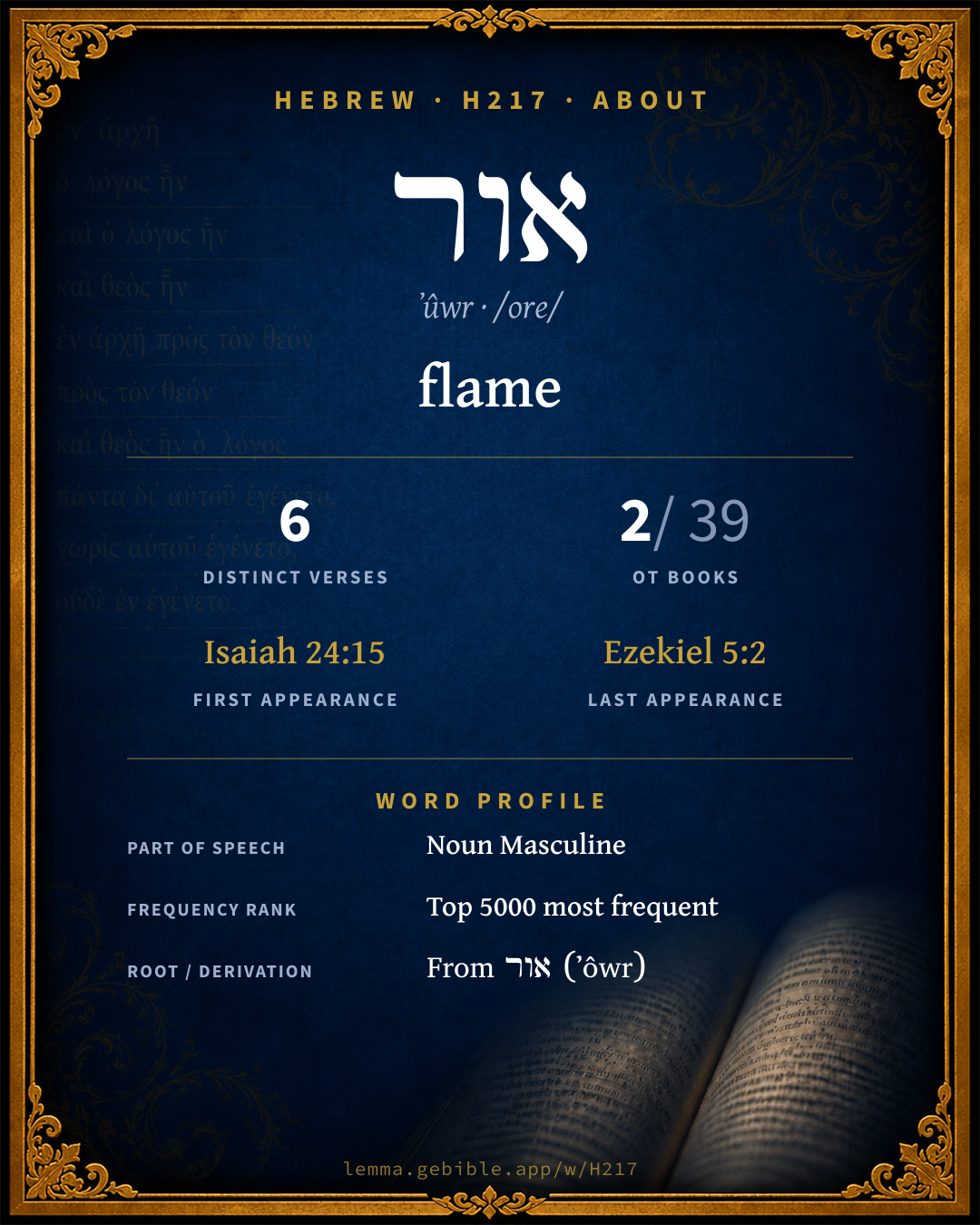
אוּר
flame
Full lexicon entry — Brown-Driver-Briggs (BDB)
From Brown-Driver-Briggs (BDB)
Where this word appears
See every Absolute-state word in the Hebrew Bible →
Grammar key — what these labels mean
Part of speech
- Noun
- A naming word — a person, place, thing, or idea.
Noun type
- Common
- A common noun — a general class of person, place, or thing (“king,” “city,” “water”), not a specific name.
State
- Absolute
- The independent form of a noun, not bound to a following word.
- Construct
- A noun bound to a following noun in a possessive / “of” relationship (the construct chain).
Gender
- Masculine
- Grammatically masculine.
Number
- Singular
- One.
- Plural
- More than one (in Hebrew, generally three or more).
Grammatical forms
- Noun, Common, Masculine, Singular, Absolute 4 times (67%)
- Noun, Common, Masculine, Singular, Construct 1 time (17%)
- Noun, Common, Masculine, Plural, Absolute 1 time (17%)
Parsed forms decoded from the imported morphology (morphhb / Westminster Leningrad Codex — WLC text public domain, morphhb tagging CC BY 4.0), counted across 6 parsed occurrences — not distinct verses.
Every verse where H217 appears — 6 distinct verses across 2 books. Click any verse to open its interlinear word-by-word view. Verse text shown in the World English Bible for context — . Each verse’s Hebrew form is shown with its reference; the English is not keyword-highlighted, since the data carries no word-level English alignment. Use “Compare translations” on any verse to read it across multiple English versions. This concordance covers the Hebrew Bible; Septuagint (Greek Old Testament) occurrences are not indexed here.
Isaiah 5 verses
- Isaiah 24:15 בָּ/אֻרִ֖ים prep det + n c mp Therefore glorify Yahweh in the east, even the name of Yahweh, the God of Israel, in the isles of the sea!
- Isaiah 31:9 א֥וּר n c ms His rock shall pass away by reason of terror, and his princes shall be dismayed at the ensign, says Yahweh, whose fire is in Zion, and his furnace in Jerusalem.
- Isaiah 44:16 אֽוּר n c ms He burns part of it in the fire; with part of it he eats flesh; he roasts roast, and is satisfied; yes, he warms himself, and says, Aha, I am warm, I have seen the fire.
- Isaiah 47:14 א֖וּר n c ms Behold, they shall be as stubble; the fire shall burn them; they shall not deliver themselves from the power of the flame: it shall not be a coal to warm at, nor a fire to sit before.
- Isaiah 50:11 בְּ/א֣וּר prep + n c ms cs Behold, all you who kindle a fire, who gird yourselves about with firebrands; walk you in the flame of your fire, and among the brands that you have kindled. This shall you have of my hand; you shall lie down in sorrow.
Ezekiel 1 verse
About this entry
At a glance — auto-summarized from this page’s data, not written by a person. Every figure links to its source below. This summary describes the numbers; it doesn’t interpret them.
The Hebrew noun אור centers on the idea of “flame.” Isaiah dominates its distribution — 5 of 6 verses. The Hebrew Bible uses it across 6 verses — uncommon. First canonically at Isaiah 24:15, it enters the text early. Related forms include אור, אור and מאור. For the data behind this summary, explore the sense tree and the renderings breakdown below.
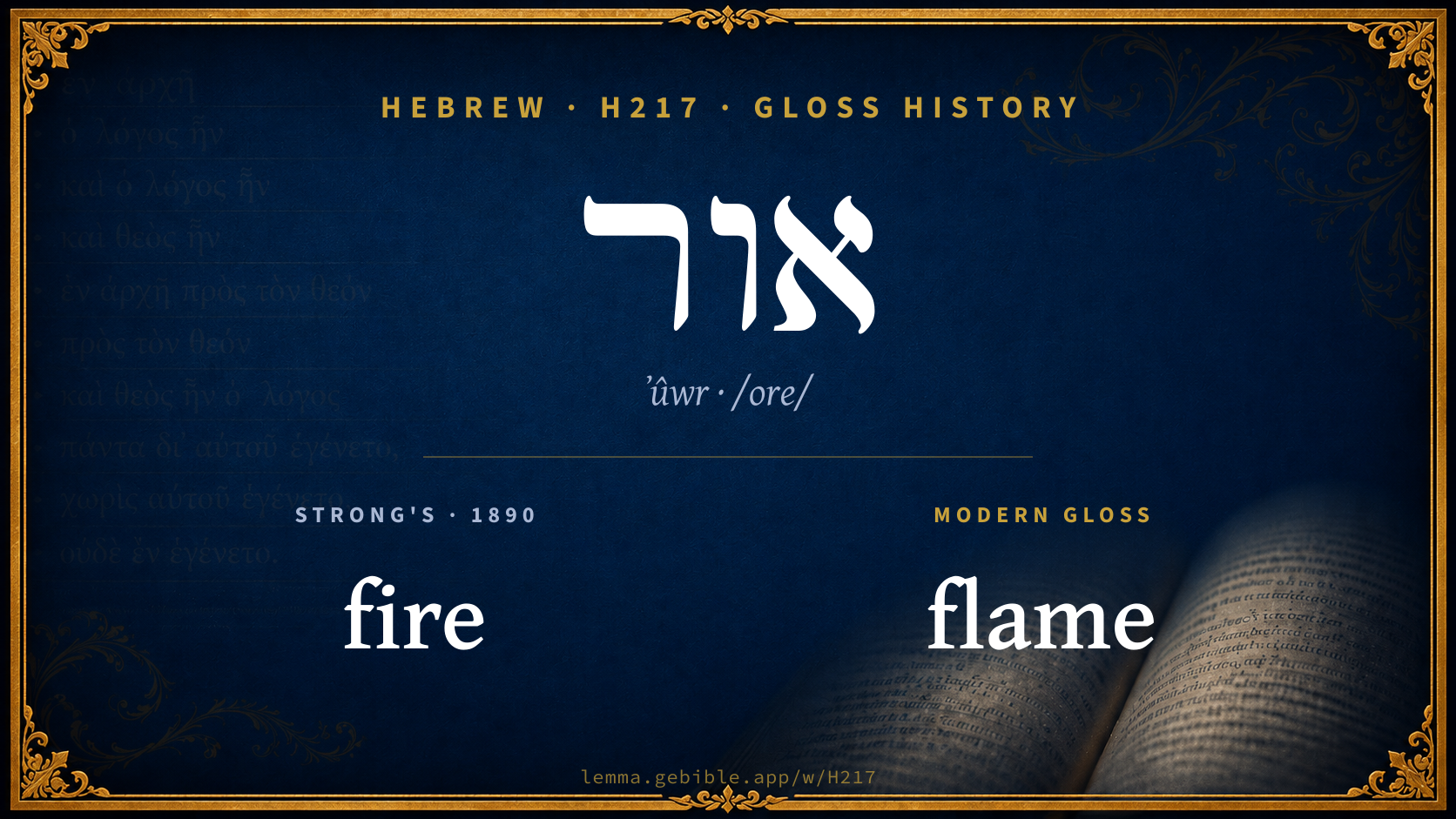
Gloss history
Strong's 1890 vs modern scholarship
About this word
Strong's H217 catalogs a Hebrew word from the Hebrew Old Testament.
These counts are not copied from any lexicon or concordance. They are computed here, from the morphology-tagged Hebrew Old Testament. What Lemma adds →
- 6
- distinct verses
- The word appears in 6 distinct verses.
- 2 / 39
- OT books
- The word appears in 2 of 39 Old Testament books.
- #3,040
- by frequency
- Top 5000 most frequent Hebrew words (rank 3,040 of 8,640 Hebrew words by occurrence).
View all 6 occurrences in the concordance →
By traditional corpus
Conventional, traditional groupings — biblical authorship is debated, so this is a traditional corpus grouping, not an authorship claim. Each share is this word’s portion of its verses in that division of the Hebrew canon. Each figure is a share of the word’s 6 distinct verses.
- Prophets (Nevi'im) 6 verses · 100%
How translations render this word
Counts come from each version’s own published word-to-Strong’s tagging or interlinear alignment — an approximate guide to how each version renders this word, not a word-level alignment the data otherwise carries. Because each total is that version’s own tagged count, the per-version totals vary from one another and need not match the appearance or distinct-verse counts above. These counts may also differ from a printed concordance because Lemma counts each distinctly tagged rendering and does not collapse phrase taggings into a single head-word total. This is a fixed set of word-tagged versions (KJV, ASV, BSB, ULT) and does not change with the reading translation you choose elsewhere. Each version’s license is shown beside its name below (and on Sources).
BDB lists this Strong’s number as 3 distinct words (homographs). Each count above pools all of them and is not split by sense — see the Senses section below. A low-frequency rendering may belong to a different one of those words, not the primary meaning.
- King James Version†: Fire 4×
- American Standard Version†: Fire 3×
- Berean Standard Bible†: Fire 2×
- unfoldingWord Literal Text†: Fire 3×
King James Version Public Domain
Renders H217 across 6† tagged occurrences — most commonly:
Plus 2 renderings that appear only once — usually multi-word phrases or single function words the recovered tagging swept in, not distinct renderings.
American Standard Version Public Domain
Renders H217 across 6† tagged occurrences — most commonly:
Plus 3 renderings that appear only once — usually multi-word phrases or single function words the recovered tagging swept in, not distinct renderings.
Berean Standard Bible Public Domain
Renders H217 across 5† tagged occurrences — most commonly:
Plus 3 renderings that appear only once — usually multi-word phrases or single function words the recovered tagging swept in, not distinct renderings. Not rendered by a distinct English word in 1 further occurrence.
unfoldingWord Literal Text CC BY-SA 4.0
Renders H217 across 6† tagged occurrences — most commonly:
Plus 3 renderings that appear only once — usually multi-word phrases or single function words the recovered tagging swept in, not distinct renderings.
Senses in the full BDB
What do BDB’s symbols mean?
BDB uses these scholarly abbreviations:
| Symbol | Meaning |
|---|---|
| 𝔊 | the Septuagint (the ancient Greek translation, LXX) |
| 𝔙 | the Vulgate (the Latin translation) |
| 𝔖 | the Syriac version (the Peshitta) |
| 𝔗 | the Targum (the Aramaic translation) |
| ψ | the Psalms |
| √ | root (the underlying root or stem) |
| ‖ | parallel passage (a synonymous or contrasted parallel) |
| † | the dagger: every passage where the word occurs is cited |
The 0 senses and sub-senses the full Brown-Driver-Briggs lexicon distinguishes for this word, in lexicon order (not ranked by frequency), with BDB’s own verbatim wording and sub-sense lettering. Shown in Hebrew script with BDB’s own scholarly abbreviations. The condensed entry is in the Lexicon Entry tab. See also the Forms in the corpus table below.
אור I flame. לְכוּ בְאוּר אֶשְׁכֶם walk in the flame of your fire Is 50
אור II m. (flame) father of one of David’s heroes 1 Ch 11
אור III loc. Ur (Bab. Uru
Senses from the full Brown-Driver-Briggs lexicon (Brown, Driver, Briggs; Oxford 1906 — public domain), digitized via Sefaria, supplemented by the OpenScriptures HebrewLexicon (CC BY 4.0). Full attribution on Sources.
Word origin
I. n.m. flame. לְכוּ בְאוּר אֶשְׁכֶם walk in the flame of your fire Is 50:11, & so fire itself, whose light & flame were seen 44:16; 47:14—exile Is. + 31:9 & Ez 5:2 (Co אשׁ).
II. n.pr.m. (flame) father of one of David’s heroes 1 Ch 11:35 (iii. אוּר n.pr.loc. v. infr.)—iii. אוּר in אוּר כַּשְׂדִּים. Ur of the Chaldees Gn 11:28, 31; 15:7 Ne 9:7.
III. n.pr.loc. Ur (Bab. Uru; seat of moon-god worship; hence Eupolemos in EusebPraep. Ev. ix. 17 says Καμαρίνῃ ἥν τινας λέγειν πόλιν Οὐρίην), ancient city in Southern Babylonia; OT always אוּר כַּשְׂדִּים, i.e. Ur of the Kasdim (Chaldeans) v. כַּשְׂדִּים sub כשׂד; home of Terah, Abram’s father, & A.’s point of departure for Mesopotamia & Canaan Gn 11:28; 15:7 (both J), & hence Ne 9:7; also Gn 11:31 (P);—mod. Muqayyar, south of Euphrates, c. 150 miles SE. of Babylon; v. KG94 f DlPa 226 f COT on Gn 11:28.
— Brown-Driver-Briggs (Oxford 1906, public domain), digitized via Sefaria, supplemented by the OpenScriptures HebrewLexicon (CC BY 4.0). See Sources.
Derived from אור (ʼôwr) (H215) — to shine.
Jastrow Dictionary
A second Hebrew/Aramaic lexicon for comparison, covering Aramaic and post-biblical (Talmudic, Targumic, Midrashic) usage that the biblical-Hebrew BDB does not. Matched by lemma rather than by Strong’s number, so a lemma may carry more than one Jastrow headword (shown separately below), and the entries cover usage well beyond the Bible.
אוֹר I
- to perforate, break through, shine.—Denom. אַוִּיר, מְאוּרָה &c.
- to be broken through, grow light. Y. Ber. I, 2ᶜ משיֵאוֹר המזרח from the time the Eastern horizon is broken through, grows light.
- 1. (neut. v.) (neut. v.) to break through, shine. Y. ib. III, 6ᶜ bot. open thy lips ויָאִירוּ דבריך and let thy words come forth, speak out boldly. Yoma III, 1 ה׳ פני כל וכ׳ it has grown light all over the Eastern horizon.—פנים מֵאִירוֹת bright countenance. Num. R. s. 11; a. e.
- 2. (act. v.) to enlighten, brighten, make shine. Y. M. Kat. III, 83ᵇ ה׳ עיניו וכ׳ (the teacher had opened his (Samuel’s) eyes &c. B. Mets. 33ᵃ. Num. R. l. c. Ib. המזבח מֵאִירִים את (fr. Mal. I, 10) making the altar bright (with fire), feeding the fire on the altar. Yoma 73ᵇ, v. אוּר. e.g. Malachi 1:10
אוֹר
- Part. pass. נָאוֹר clear. Targ. Prov. IV, 25 נְאוֹרָן, נְאֹרָן, v. חֲוַר.
אוֹר II
- foreg.) breaking forth (cmp. Is. LVIII, 8) whence e.g. Isaiah 58:8
- 1. break of day, light, day; fire; trnsf. rise, glory, power, happiness. Ber. 2ᵇ ביאת אוֹרוֹ the entrance of his day-break (dawn of his eighth day; Tosaf. a. l. the sunset of his seventh day). Y. Pes. I, beg. 27ᵃ א׳ החמה sun-light. Ib. א׳ הנר candle light. Keth. 111ᵇ א׳ תורה light of the Law. B. Bath. 4ᵃ אוֹרוֹ של עולם intellectual light of the wold (a great man; the Law). Num. R. s. 15 אור של מעלן the celestial fire (believed to be the source of all light and fire); a. v. fr.
- 2. (breaking in of night) twilight, evening. Pes. I, 1 לארבעה וכ׳ א׳ on the evening (eve) of the fourteenth day of Nissan; v. discussion ibid. 2ᵃ sq., about the meaning of our w. R. Hash. 22ᵇ; Snh. 70ᵇ לא׳ עיבורו the evening following the eventual intercalation, i.e. the evening from the thirtieth of the past to the first of the beginning month.
- 3. (homil. = אוֹרָה II) rue. Gen. R. s. 20 in the Pentat. of R. M. it read כתנות אור וכ׳ (in place of עור Gen. III, 21) this alludes to the garments of Adam resembling the rue, wide below and narrow above; Ar. (Rashi diff.). e.g. Genesis 3:21
אוּר I
- foreg.) prop. light, flame; esp. Pl. אוּרִים ותומים the Urim and Tummim in the High-priest’s breast-plate. Yoma 73ᵇ א׳ שמאירים את דבריהם they are called Urim because they give their decisions in a clear way (not ambiguous as the oracles); cmp. Y. ib. VII, end, 44ᶜ. Sot. IX, 12. Y. Kidd. IV, beg. 65ᵇ
*אוּר II
- (= עוּר q. v.) chaff. Y. Ab. Zar. II, 40ᵈ א׳ דשערין chaff of barley; (Y. Sabb. XIV, 14ᵈ עור דסערין).
A Dictionary of the Targumim, the Talmud Babli and Yerushalmi, and the Midrashic Literature (Marcus Jastrow; London, Luzac, 1903) — Public Domain. Digitized via Sefaria. Digitized via Sefaria. Full attribution on Sources.
Forms in the corpus
The 6 distinct written forms H217 takes in the Hebrew Bible, most frequent first — each parse links to that state’s occurrences in the concordance. Hebrew forms include their vowel points and cantillation, so a single lemma takes many written forms.
| Form | Parsing | Example | Uses |
|---|---|---|---|
| א֖וּר | Noun, Common, Masculine, Singular, Absolute | Isaiah 47:14 | 1 |
| א֥וּר | Noun, Common, Masculine, Singular, Absolute | Isaiah 31:9 | 1 |
| אֽוּר | Noun, Common, Masculine, Singular, Absolute | Isaiah 44:16 | 1 |
| בְּ/א֣וּר | Noun, Common, Masculine, Singular, Construct | Isaiah 50:11 | 1 |
| בָּ/א֤וּר | Noun, Common, Masculine, Singular, Absolute | Ezekiel 5:2 | 1 |
| בָּ/אֻרִ֖ים | Noun, Common, Masculine, Plural, Absolute | Isaiah 24:15 | 1 |
Same root — word family
Other BDB entries built from the same root as H217, grouped by Strong’s listed origin. These share a root / origin per the lexicon — not necessarily a shared meaning. Each links to that word’s own entry.
Derives from
Shares the same root
Proper names from this root
People and places named from this root — a name, not an additional meaning of the word.
- יאיר Yâʼîyr H2971 Jair
- אור ʼÛwr H218 Ur
- אורי ʼÛwrîy H221 Uri
- אוריאל ʼÛwrîyʼêl H222 Uriel
- אוריה ʼÛwrîyâh H223 Uriah
- אורים ʼÛwrîym H224 Urim
Compare all same-root words → Showing 4 of 11 — not the complete family. 6 of the same-root words are proper names (people or places). They share a root, not necessarily a meaning.
Septuagint verse parallels
This word appears in 6 verses that also exist in the Greek Old Testament (Septuagint), out of the 6 Hebrew verses it occurs in. You can read those verses in Greek by switching the Old Testament edition to the Septuagint.
Read these verses in the Septuagint
This is a verse-level parallel only — the same verses exist in both the Hebrew and Greek Old Testaments. No word-level Hebrew↔Greek correspondence is claimed: the data carries no such alignment, so no Greek word is shown as this Hebrew word’s translation. Coverage is not total — the Septuagint omits the deuterocanon and renumbers the Psalms, so some Hebrew verses have no direct Greek parallel.