
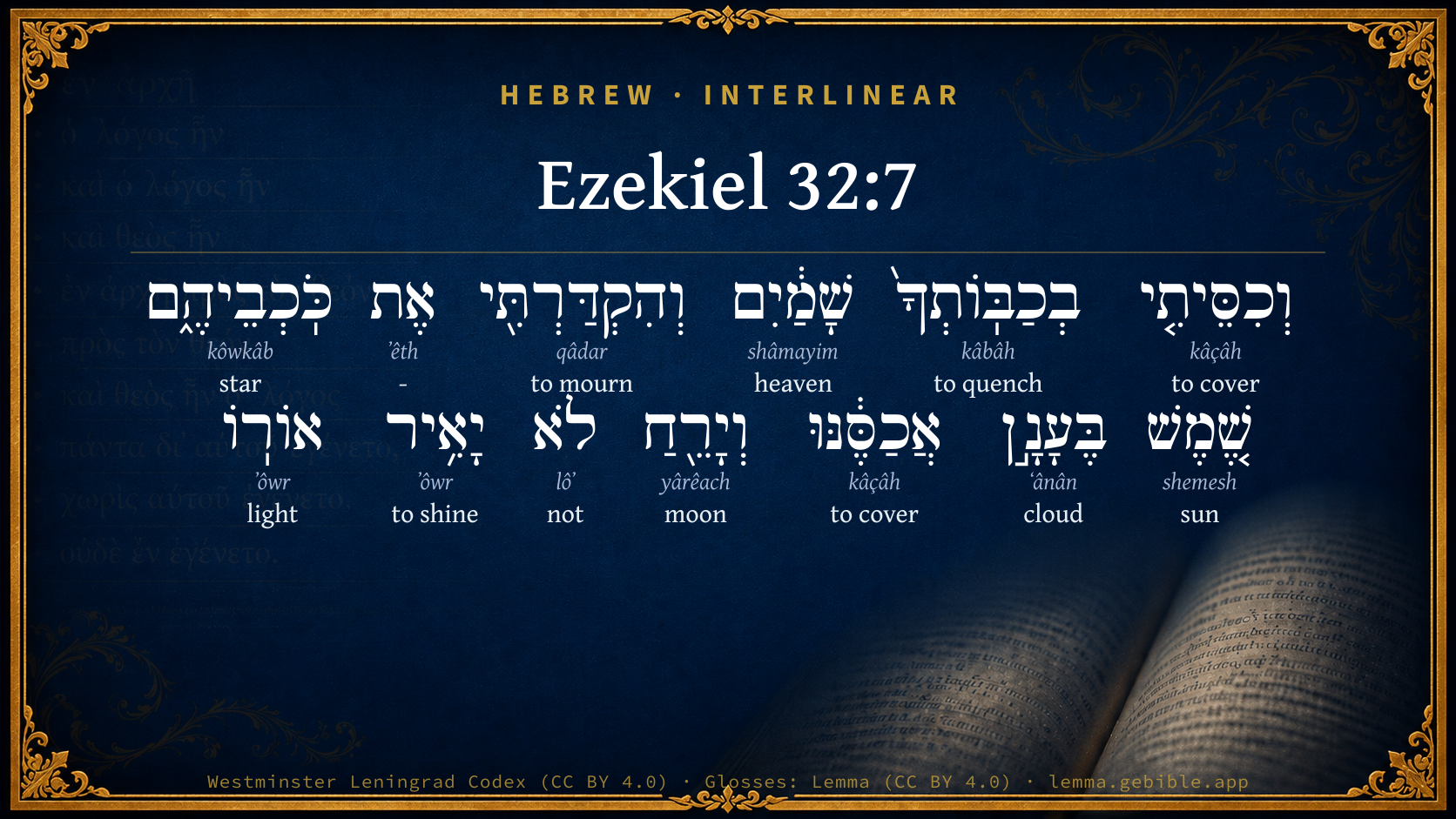
Ezekiel 32:7

Hebrew (Westminster Leningrad Codex) Ezekiel 32:7 appears in the Hebrew Old Testament. The text above is from the Westminster Leningrad Codex. Each word links to its Strong’s number, a concise gloss, and parsing drawn from the Open Scriptures Hebrew Bible morphology. Click any word for its full Brown-Driver-Briggs (BDB) entry.
Download image
Cite this verse

Ezekiel 32:7 (World English Bible). Public Domain. Lemma interlinear Bible study tool, https://lemma.gebible.app/v/ezekiel/32/7.

Show BibTeX & RIS
BibTeX
RIS
English Translation
When I shall extinguish you, I will cover the heavens, and make the stars of it dark; I will cover the sun with a cloud, and the moon shall not give its light.
World English Bible · Public Domain
Download a study sheet

One document with this verse’s original text, its word-by-word gloss line, the meaning frame, cross-references with their text, attributed commentary, and full source and license credits — printable, and it pastes into notes with its structure intact.

This verse Autodidact and up

Study sheet (.html) Plain text (.txt)

A passage Seminary Student

Up to 50 verses in one chapter. A passage sheet keeps up to 6 commentary sources and 12 cross-references per verse, in the order this page ranks them, and says so on the sheet whenever that leaves anything out. Ask for a single verse and you get the Autodidact verse sheet above.

Everything on this page stays free to read, with no account — the sheet is a download of what is already on screen, not access to it.

Want to remove ads? Support Godless Engineer
Compare translations 3

The same verse in 3 English versions, stacked beneath the original-language interlinear above. Click any original word for its lexicon entry.

Each is an independent rendering of the whole verse — the interlinear is not word-aligned to these translations.

Highlighted words mark where these versions differ — a whole-verse word diff, not a word-by-word alignment.

  • World English Bible Public Domain
    When I shall extinguish you, I will cover the heavens, and make the stars of it dark; I will cover the sun with a cloud, and the moon shall not give its light.
  • King James Version Public Domain
    And when I shall put thee out, I will cover the heaven, and make the stars thereof dark; I will cover the sun with a cloud, and the moon shall not give her light.
  • unfoldingWord Literal Text CC BY-SA 4.0
    Then when I extinguish you, I will cover the heavens and darken their stars; I will cover the sun with clouds, and the moon will not shine its light.

unfoldingWord Literal Text — © unfoldingWord, licensed CC BY-SA 4.0. Word-aligned USFM3 via Door43 (git.door43.org/unfoldingWord/en_ult).

Versions to compare (up to 4)

3 of 4 selected

Show all 18 translations

Every available English version of this verse, each an independent rendering of the whole verse.

  • World English Bible Public Domain
    When I shall extinguish you, I will cover the heavens, and make the stars of it dark; I will cover the sun with a cloud, and the moon shall not give its light.
  • Berean Standard Bible Public Domain
    When I extinguish you, I will cover the heavens and darken their stars. I will cover the sun with a cloud, and the moon will not give its light.
  • Majority Standard Bible Public Domain
    When I extinguish you, I will cover the heavens and darken their stars. I will cover the sun with a cloud, and the moon will not give its light.
  • King James Version Public Domain
    And when I shall put thee out, I will cover the heaven, and make the stars thereof dark; I will cover the sun with a cloud, and the moon shall not give her light.
  • American Standard Version (1901) Public Domain
    And when I shall extinguish thee, I will cover the heavens, and make the stars thereof dark; I will cover the sun with a cloud, and the moon shall not give its light.
  • Revised Version (1885) Public Domain
    And when I shall extinguish thee, I will cover the heaven, and make the stars thereof dark; I will cover the sun with a cloud, and the moon shall not give her light.
  • Geneva Bible (1599) Public Domain
    And when I shall put thee out, I will couer the heauen, and make the starres thereof darke: I will couer the sunne with a cloude, and the moone shall not giue her light.
  • Douay-Rheims (1899) Public Domain
    And I will cover the heavens, when thou shalt be put out, and I will make the stars thereof dark: I will cover the sun with a cloud, and the moon shall not give her light.
  • Young's Literal Translation Public Domain
    And in quenching thee I have covered the heavens, And have made black their stars, The sun with a cloud I do cover, And the moon causeth not its light to shine.
  • Literal Standard Version CC BY-SA 4.0
    And in quenching you I have covered the heavens, || And have made their stars black, || I cover the sun with a cloud, || And the moon does not cause its light to shine.
  • Unlocked Literal Bible CC BY-SA 4.0
    Then when I extinguish you, I will cover the heavens and darken their stars; I will cover the sun with clouds, and the moon will not shine its light.
  • unfoldingWord Literal Text CC BY-SA 4.0
    Then when I extinguish you, I will cover the heavens and darken their stars; I will cover the sun with clouds, and the moon will not shine its light.
  • Darby Bible Public Domain
    And when I shall put thee out, I will cover the heavens, and make the stars thereof black; I will cover the sun with a cloud, and the moon shall not give her light.
  • World Messianic Bible Public Domain
    When I extinguish you, I will cover the heavens and make its stars dark. I will cover the sun with a cloud, and the moon won’t give its light.
  • Webster's Bible Public Domain
    And when I shall extinguish thee, I will cover the heaven, and make the stars thereof dark; I will cover the sun with a cloud, and the moon shall not give her light.
  • Free Bible Version CC BY-SA 4.0
    When I put out the light of your life, I will cover the heavens and darken their stars. I will use a cloud to cover the sun, and the moon will stop shining.
  • Bible in Basic English Public Domain
    And when I put out your life, the heaven will be covered and its stars made dark; I will let the sun be covered with a cloud and the moon will not give her light.
  • JPS Tanakh (1917) Public Domain
    And when I shall extinguish thee, I will cover the heaven, and make the stars thereof black; I will cover the sun with a cloud, and the moon shall not give her light.

Literal Standard Version (2020), Covenant Press — licensed CC BY-SA 4.0. Text via the HelloAO Bible API (eBible.org). Unlocked Literal Bible (unfoldingWord) — licensed CC BY-SA 4.0. Text via the HelloAO Bible API (eBible.org). unfoldingWord Literal Text — © unfoldingWord, licensed CC BY-SA 4.0. Word-aligned USFM3 via Door43 (git.door43.org/unfoldingWord/en_ult). Free Bible Version, Dr. Jonathan Gallagher — licensed CC BY-SA 4.0. Text via the HelloAO Bible API (eBible.org).

Word by word

More ways to search: Search by grammar → Find every occurrence → Compare this word →

Practice this passage: Drill this verse → Learn its vocabulary →

וְהִקְדַּרְתִּ֖י
qâdar
H6937
“and · to mourn”
Conjunction + Verb, Hiphil, Sequential Perfect, 1st Person, Common, Singular
Part of Speech
Conjunction + Verb
Stem
Hiphil
Form
Sequential Perfect
Person
1st Person
Gender
Common
Number
Singular
Full BDB Definition

Origin: a primitive root

TWOT: 1989

to mourn, be dark - (Qal) to be dark - (Hiphil) - to darken - to cause to mourn - (Hithpael) to grow dark
  1. וְכִסֵּיתִ֤י kâçâh H3680 “and · to cover” Conjunction + Verb, Piel, Sequential Perfect, 1st Person, Common, Singular
  2. בְכַבּֽוֹתְךָ֙ kâbâh H3518 “in/at · to quench · you” Preposition + Verb, Piel, Infinitive Construct + Suffix, Personal, 2nd Person, Masculine, Singular
  3. שָׁמַ֔יִם shâmayim H8064 “heaven(s)” Noun, Common, Masculine, Plural, Absolute
  4. אֶת ʼêth H853 “-” Particle, Direct Object
  5. כֹּֽכְבֵיהֶ֑ם kôwkâb H3556 “stars · their” Noun, Common, Masculine, Plural, Construct + Suffix, Personal, 3rd Person, Masculine, Plural
  6. שֶׁ֚מֶשׁ shemesh H8121 “sun” Noun, Common, Both, Singular, Absolute
  7. בֶּעָנָ֣ן ʻânân H6051 “in/at the · cloud” Preposition, Determined + Noun, Common, Masculine, Singular, Absolute
  8. אֲכַסֶּ֔נּוּ kâçâh H3680 “to cover · him” Verb, Piel, Imperfect, 1st Person, Common, Singular + Suffix, Personal, 3rd Person, Masculine, Singular
  9. וְיָרֵ֖חַ yârêach H3394 “and · moon” Conjunction + Noun, Common, Masculine, Singular, Absolute
  10. לֹא lôʼ H3808 “not” Particle, Negative
  11. יָאִ֥יר ʼôwr H215 “to shine” Verb, Hiphil, Imperfect, 3rd Person, Masculine, Singular
  12. אוֹרֽוֹ ʼôwr H216 “light · his” Noun, Common, Both, Singular, Construct + Suffix, Personal, 3rd Person, Masculine, Singular

About this verse

These counts appear in no published source. They are computed here, from the morphology-tagged text and Lemma’s own curated glosses. What Lemma adds →

13
words
12
distinct lemmas
Prophets
section

Notable vocabulary

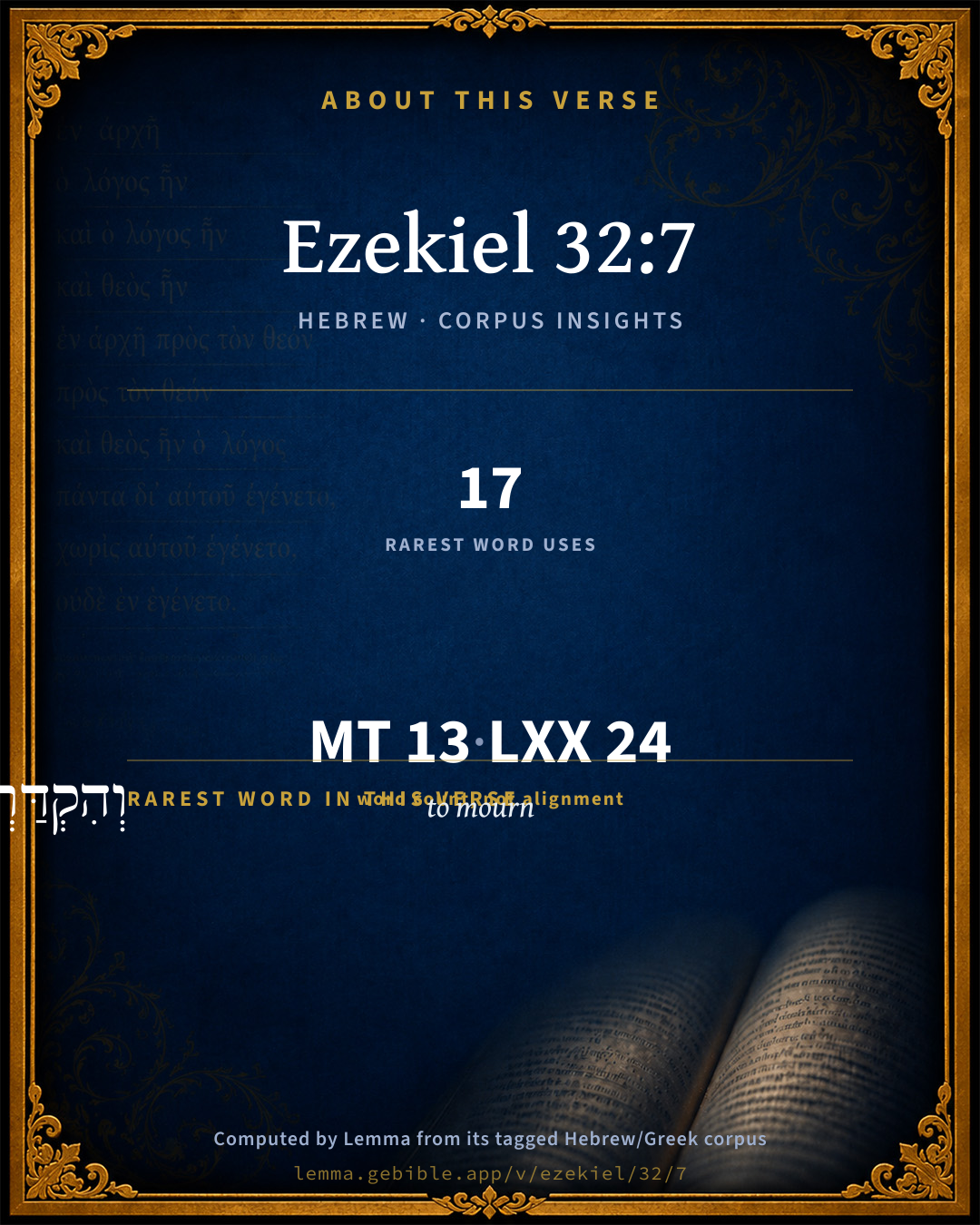
The rarest word here is וְהִקְדַּרְתִּ֖י to mourn H6937 — appearing just 17 times in the whole Hebrew Bible.

Shared distinctive vocabulary

וְהִקְדַּרְתִּ֖י to mourn H6937 occurs in 17 verses of the Hebrew Bible. Also found in:

Grammatical profile

  • 5 verbs
  • 6 nouns
  • 2 particles

Verb forms

  • וְכִסֵּיתִ֤י Piel · Sequential Perfect
  • בְכַבּֽוֹתְךָ֙ Piel · Infinitive Construct
  • וְהִקְדַּרְתִּ֖י Hiphil · Sequential Perfect
  • אֲכַסֶּ֔נּוּ Piel · Imperfect
  • יָאִ֥יר Hiphil · Imperfect

Repetition

A word recurs within this verse — often emphatic in Hebrew:

  • וְכִסֵּיתִ֤י to cover H3680 ×2

Hebrew & Septuagint length

In English translation the verse runs 33 words from the Hebrew and 32 from the Septuagint (LXX English) — closely comparable.

A rough comparison of the two English renderings, which tokenize alike — not a word-level alignment.

Word counts can differ between the Hebrew and the Greek without any difference in meaning — e.g. the Hebrew direct-object marker אֵת has no separate Greek word, and Greek often adds the article ὁ.

In the original languages it is 13 Hebrew tokens and 24 Greek tokens — but the two are counted differently (Hebrew bundles its prefixes and suffixes into one token; the Greek is in lemma form), so that isn’t a like-for-like length.

Cross-references

16

Topical passages linked to Ezekiel 32:7 in the Treasury of Scripture Knowledge — connected by theme and wording, ordered by reader-vote popularity; previews shown in the World English Bible.

  • Joel 2:31 The sun will be turned into darkness, And the moon into blood, Before the great and terrible day of Yahweh comes.
  • Matthew 24:29 But immediately after the oppression of those days, the sun will be darkened, the moon will not give its light, the stars will fall from the sky, and the powers of the heavens will be shaken;
  • Isaiah 13:10 For the stars of the sky and the constellations of it shall not give their light; the sun shall be darkened in its going forth, and the moon shall not cause its light to shine.
  • Isaiah 34:4 All the host of the sky shall be dissolved, and the heavens shall be rolled together as a scroll; and all their host shall fade away, as the leaf fades from off the vine, and as a fading [leaf] from the fig tree.
  • Ezekiel 30:3 For the day is near, even the day of Yahweh is near; it shall be a day of clouds, a time of the nations.
  • Joel 2:2 A day of darkness and gloominess, A day of clouds and thick darkness. As the dawn spreading on the mountains, A great and strong people; There has never been the like, Neither will there be any more after them, Even to the years of many generations.
  • Joel 3:15 The sun and the moon are darkened, And the stars withdraw their shining."
  • Exodus 10:21–23 Yahweh said to Moses, "Stretch out your hand toward the sky, that there may be darkness over the land of Egypt, even darkness which may be felt."
  • Job 18:5–6 "Yes, the light of the wicked shall be put out, The spark of his fire shall not shine.
  • Proverbs 13:9 The light of the righteous shines brightly, But the lamp of the wicked is snuffed out.
  • Jeremiah 13:16 Give glory to Yahweh your God, before he cause darkness, and before your feet stumble on the dark mountains, and, while you look for light, he turn it into the shadow of death, and make it gross darkness.
  • Ezekiel 30:18 At Tehaphnehes also the day shall withdraw itself, when I shall break there the yokes of Egypt, and the pride of her power shall cease in her: as for her, a cloud shall cover her, and her daughters shall go into captivity.
  • Amos 8:9 "It will happen in that day," says the Lord Yahweh, "That I will cause the sun to go down at noon, And I will darken the earth in the clear day.
  • Mark 13:24 But in those days, after that oppression, the sun will be darkened, the moon will not give its light,
  • Revelation 6:12–13 I saw when he opened the sixth seal, and there was a great earthquake. The sun became black as sackcloth made of hair, and the whole moon became as blood.
  • Revelation 8:12 The fourth angel sounded, and one third of the sun was struck, and one third of the moon, and one third of the stars; so that one third of them would be darkened, and the day wouldn't shine for one third of it, and the night in the same way.

Cross-references courtesy of OpenBible.info (CC BY 4.0).

Hebrew and Greek witnesses Masoretic Hebrew ↔ Greek Septuagint

The same verse in the two great witnesses to the Old Testament, shown verse-for-verse.

These are two independent witnesses, not word-aligned to each other, and the Septuagint is shown in lemma (dictionary) form.

Hebrew Ezekiel 32:7 Masoretic · Westminster Leningrad Codex

וְכִסֵּיתִ֤י בְכַבּֽוֹתְךָ֙ שָׁמַ֔יִם וְהִקְדַּרְתִּ֖י אֶת כֹּֽכְבֵיהֶ֑ם שֶׁ֚מֶשׁ בֶּעָנָ֣ן אֲכַסֶּ֔נּוּ וְיָרֵ֖חַ לֹא יָאִ֥יר אוֹרֽוֹ

When I shall extinguish you, I will cover the heavens, and make the stars of it dark; I will cover the sun with a cloud, and the moon shall not give its light.

World English Bible · Public Domain

Greek LXX Ezekiel 32:7 Septuagint · lemma form

καί κατακαλύπτω ἐν ὁ σβέννυμι σύ οὐρανός καί συνσκοτάζω ὁ ἄστρον αὐτός ἥλιος ἐν νεφέλη καλύπτω καί σελήνη οὐ μή φαίνω ὁ φῶς αὐτός

And I will veil the heavens when you are extinguished, and will darken the stars thereof; I will cover the sun with a cloud, and the moon shall not give her light.

LXX2012 (modern English Septuagint) · Public Domain

Hebrew: Westminster Leningrad Codex (CC BY 4.0). Greek: Septuagint (public domain); English from LXX2012 (modern English Septuagint) (Public Domain). How the Septuagint differs from the Hebrew →

Targum (Aramaic paraphrase)

1

The Targum is the ancient Jewish Aramaic paraphrase of the Hebrew Scriptures — an interpretive translation, not the Hebrew text itself. Onkelos (literal) and Pseudo-Jonathan (expansive) render the Torah, and Jonathan the Prophets. Coverage is partial: where no permissively-licensed English translation exists for a verse, only the Aramaic is shown. This is verse-level text, not a word-by-word alignment to the Hebrew.

  1. Targum Jonathan Prophets (Joshua–Malachi)
    וְתַחֲפִינָךְ עָקָא בְּאַכְהָיוּתִי יַת זִיו יְקַר מַלְכוּתָךְ מִן שְׁמַיָא יִזְעֲרוּן עִם מַשִׁרְיָתָךְ דַהֲווֹ סַגִיאִין כְּכוֹבְיַיָא מְלַךְ בְּמַשִׁרְיָתֵיהּ יַחֲפִינָךְ בַּעֲנָנָא דְסָלֵיק וְחָפֵי יַת שִׁמְשָׁא וּכְסִהֲרָא בִּימָמָא לָא מַזְהַר נְהוֹרֵיהּ:

    (no public-domain English translation for this verse)

    Targum Jonathan — Aramaic: “Mikraot Gedolot” (public domain). English: “Sefaria Community Translation” (CC0 1.0 (public-domain dedication)); “London "Chaldee Paraphrase," 1871” (public domain). Text via Sefaria.

Commentary

Notes on Ezekiel 32:7 from classic Christian and Jewish commentators (each source and its license shown beneath its notes). The classic Christian expositions comment on the surrounding passage and are grouped to its opening verse, so a note may address several verses; the Jewish commentaries on the Tanakh (Rashi and others) are per-verse, so they appear only where the commentator wrote on this verse.

Lemma curates 59 commentaries, every one of them public domain or Creative Commons licensed, each selected and text-cleaned for this edition rather than reprinted as found. About our sources →

Trapp's Complete Commentary

John Trapp

Eze 32:7 And when I shall put thee out, I will cover the heaven, and make the stars thereof dark; I will cover the sun with a cloud, and the moon shall not give her light.

Ver. 7. And when I shall put thee out.] Or, Extinguish thee, who art for thy power and glory as one of the world’s great luminaries.

I will cover the heaven, {a} &c.] So great a fume, or rather so vile a snuff, shall exhale, that the heavens shall seem to be muffled, &c. It shall be once again deep darkness over all the land of Egypt; another hyperbole.

{a} Hypallage poetica.

John Trapp, A Commentary or Exposition upon All the Books of the Old and New Testament (1647–1656) — public domain. Text from a community e-Sword module.

Joseph Benson's Commentary

Eze 32:7-10. And when I shall put thee out — When I shall cast thee down from thy power, and extinguish all thy glory. I will cover the heaven, and make the stars thereof dark — It is well known that the downfall of states and kingdoms, kings and princes, is often expressed in the Scriptures by these or such like metaphors: see notes on Isa 13:10; Isa 24:23; Isa 30:26. But here the expressions may mean, I will make every thing look sad and dismal, or will cause a universal sorrow; for to men amidst great calamities and afflictions every thing appears dark and gloomy, and even the light itself seems little different from darkness; and therefore it is usual to express a state of great sorrow by the heavens being covered, and the stars darkened. All the bright lights of heaven will I make dark over thee — I will involve thy whole land in trouble and distress, making every thing in it look dismal. I will vex the hearts, &c., when I shall bring thy destruction among the nations — When thy exiles shall be dispersed into foreign countries, (see Eze 29:12,) and relate the miserable circumstances of thy destruction, it shall cause grief and consternation in all that hear it. Yea, I will make many people amazed at thee, and their kings, &c. — The kings and princes of Africa, who lay near to Egypt, seem here to be spoken of; for the destruction of Egypt could not but fill them with fear for themselves, lest the victor should make them suffer the same fate.

Joseph Benson's Commentary on the Old and New Testaments (1811–1818) — public domain. Text from a community e-Sword module.

Tyndale Open Study Notes

Tyndale Open Resources

32:7-8 As in the previous chapter, Pharaoh’s downfall would be accompanied by global darkness and widespread mourning. These images were commonly associated with the day of the Lord (cp. Joel 2:30). In this case, the darkness would also remind the Egyptians of the plague on Egypt at the time of the Exodus (Exod 10:21-22).

Tyndale Open Study Notes — © Tyndale Open Resources, licensed CC BY-SA 4.0. Text via the HelloAO Bible API.

Geneva Bible (1599)

Geneva Bible translators

The word signifieth to be put out as a candle is put out.

Geneva Bible (1599) marginal notes — public domain. Text via Bolls.life.

Jamieson, Fausset & Brown

Robert Jamieson, A. R. Fausset & David Brown

put thee out--extinguish thy light (Job 18:5). Pharaoh is represented as a bright star, at the extinguishing of whose light in the political sky the whole heavenly host is shrouded in sympathetic darkness. Here, too, as in Eze 32:6, there is an allusion to the supernatural darkness sent formerly (Exo 10:21-23). The heavenly bodies are often made images of earthly dynasties (Isa 13:10; Mat 24:29).

Jamieson, Fausset & Brown — Commentary Critical and Explanatory on the Whole Bible (1871) — public domain (CC PDM 1.0). Text via the HelloAO Bible API.

Adam Clarke's Commentary

Verse 7. I will cover the heaven] Destroy the empire.

Make the stars thereof dark] Overwhelm all the dependent states.

I will cover the sun] The king himself.

And the moon shall not give her light.] The queen may be meant, or some state less than the kingdom.

Adam Clarke's Commentary on the Bible (1810–1826) — public domain. Text from a community e-Sword/MySword module.

Ellicott's Commentary for English Readers

(7) Make the stars thereof dark.—This verse follows very closely Isa_13:10, spoken of Babylon. In this and the following verse the judgments of God are described in the common prophetic figure of changes in the heavenly bodies. (See Note on Eze_30:18, and references there.)

A Bible Commentary for English Readers, edited by Charles John Ellicott (1878–1897) — public domain. Text from a community e-Sword module.

The Cambridge Bible for Schools and Colleges

gen. ed. J. J. S. Perowne

7. put thee out] i.e. extinguish thee. Pharaoh is regarded as a brilliant luminary; cf. Isa_14:12, “How art thou fallen from heaven, O shining one, morning star!” It is doubtful if there is any ref. to the constellation of the dragon. The dragon (Job_3:8; Job_9:13; Job_26:12) is not a constellation but a purely ideal representation of the eclipse or the storm-cloud which swallows up the lights of heaven. The phenomena in the verse are those usually characteristic of the dissolution of nature on the day of the Lord (Isa_13:10; Joe_2:31; Joe_3:15; Amo_8:9); but here they express rather the shock which creation receives when one so great meets with destruction.

The Cambridge Bible for Schools and Colleges (gen. ed. J. J. S. Perowne; Cambridge University Press, 1878–1918) — public domain. Text from a community e-Sword module.

John Gill's Exposition

And when I shall put thee out,.... As a candle is put out, or some great light or blazing torch is extinguished; such was the king of Egypt in his splendour and glory; but now should be like a lamp put out in obscure darkness, and all his brightness and glory removed from him, Job 18:5,

I will cover the heaven, and make the stars thereof dark; with the smoke that should arise at the extinguishing of this lamp; or they should be covered with mourning, or clad in black, at the destruction of this monarch and his monarchy:

I will cover the sun with a cloud, and the moon shall not give her light; all which figures are sometimes made use of to denote the dissolution of kingdoms and states: the "heaven" being an emblem of a kingdom itself; the "sun" of an emperor or king, or kingly power; the "moon" of the queen, or of the priesthood; the "stars" of nobles, princes, counsellors, and such like eminent persons, useful in government; who being destroyed or removed, the light and glory, the prosperity and happiness of a kingdom, are gone; see Isa 13:10. The Targum is,

"tribulation shall cover thee when I shall extinguish the splendour of the glory of thy kingdom from heaven; and the people of thine army shall be lessened, who are many as the stars; a king with his army shall cover thee as a cloud that ascends and covers the sun, and as the moon, whose light does not shine in the day.''

John Gill's Exposition of the Whole Bible (1746–1763) — public domain (CC PDM 1.0). Text via the HelloAO Bible API.

Haydock's Catholic Bible Commentary

Out, like a candle, by death; extinctus. (Haydock) --- The glory of Egypt was so great, that at its fall the light of heaven seemed diminished. (Worthington) --- Great desolation is thus intimated. --- When, &c., is not is some Latin copies, nor in Hebrew, &c. (Calmet)

George Leo Haydock (1774–1849), Haydock's Catholic Family Bible and Commentary, 1859 edition — public domain. Excludes Psalms (Douay-Rheims chapter numbering differs from Protestant) and Deuterocanonical books (Catholic canon only).

Matthew Poole's English Annotations

Put thee out; as a torch is extinguished, Isa 43:17, so I will put out thy light, and turn thee into darkness.

Cover the heaven; either by dark vapours that arise from blood and putrefying carcasses, which darken the heavens; or it is a description of great sorrows, fears, troubles, and perplexities; or else it may intimate particularly the total ruin of the whole kingdom, in which the best, greatest, and noblest parts are; as heaven suppose the government, the sun the king, the moon the queen, the stars the princes and nobles, bright lights the most eminent of the subjects for wisdom and understanding, and then the land the common people: all shall be covered with clouds, and darkness of misery first, and sorrow next. Or it is possible that some unusual darknesses might be seen in the heavens and on the earth about that time.

Matthew Poole's English Annotations on the Holy Bible (1683–1685) — public domain. Text from a community e-Sword/MySword module.

Whedon's Commentary on the Bible

Daniel D. Whedon

7, 8. Instead of dark read “black.”

Put thee out — That is, extinguish. This imagery of calamity and sorrow is very common among all oriental nations. (See especially Joe_2:10; Joe_2:13; Joe_3:15; Amo_8:9.)

Daniel D. Whedon (gen. ed.), Commentary on the Old and New Testaments (1874–1909) — public domain. Text from a community e-Sword module.

The Pulpit Commentary

When I shall put thee out; better, with the Revised Version, extinguish. The verb is used of lamps in 2Ch_29:7. The change of metaphor is at first startling, but I follow Ewald, Hitzig, and Smend, in thinking that there is a traceable sequence of ideas. The "dragon of the Egyptian waters" suggested the "dragon" which was conspicuous between Ursa Major and Minor among the constellations of the heavens, and the name of which, probably derived by the Greek astronomers from a remote past, suggested that of an enemy of God. (comp. Isa_51:9) So taken,the new comparison finds a parallel in that of the King of Babylon to Lucifer, the morning star, in Isa_14:12. Upon this there follows naturally the imagery of Eze_30:18; Isa_34:4. As the othertrees of the forest had mourned for the cedar, (Eze_31:15) so the other lights of heaven mourn for that particular star which has been quenched for ever. (comp. for the general imagery. Isa_13:10; Joe_2:10 Joe_3:4, Hebrew "English version, Eze 2)

Vers. 7-10. The sympathy of nature and of man with a fallen people.

The greatness of the catastrophe by which Egypt is to be overwhelmed is depicted by the prophet in a strikings, and poetical manner. It is represented that an impression is made thereby upon the heavenly bodies by which the earth is illumined, and upon the nations and kings who are astonished witnesses of the overthrow of one of the greatest monarchies of the world.

I THE LUMINARIES OF THE DAY AND OF THE NIGHT VEIL THEIR SPLENDOUR AND WITHDRAW THEIR SHINING. The Scriptures teach us that all nature is a vehicle for the manifestation of Divine attributes, and that creation, in a very real sense, is one. Hence the sympathy appointed between nature and humanity. When men"s sins are grievous, the floods cover the earth and sweep its guilty inhabitants into destruction. When the children of light strive in battle with the children of darkness, the sun stands still to prolong the hours of victory and pursuit. When the Savior expires upon the cross, it is amidst thick darkness. When the Holy Spirit is given, it is with the rush of wind and with lambent flames. These are but some instances of the part which nature plays in human history. No wonder, then, that when the Almighty, by the hand of his servant Nebuchadnezzar, smites Egypt to its fall, the sun, the moon, and the stars should be represented as withholding their light, as weeping over the calamities of one of the greatest of human powers.

II THE PEOPLES AND THEIR KINGS ARE AMAZED AND TREMBLE AS FOR THEIR OWN SAFETY.

1. They experience a natural compassion for fallen greatness; it is a spectacle fitted to melt every heart. Envy and hatred vanish in the presence of misfortune so appalling.

2. They feel themselves in the presence of a supernatural power, which is righteousness taking the form of judicial interposition. The consciousness of the nearness and action of such a power is enough to rouse any nation from insensibility, secularity, and unspirituality. The hand of God is seen and the voice of God is heard. The Lord himself is near.

3. They mingle with the general apprehension of the activity of supernatural justice a certain apprehension and fear with regard to themselves. Have they not shared in some measure Egypt"s sin? Have they not reason to dread Egypt"s punishment? Who are they that they should be exempt from the retributive justice of the Eternal? The sword is brandished before them: may it not smite them? They tremble every man for his own life. T.

The Pulpit Commentary (1880–1919), ed. H.D.M. Spence-Jones & Joseph S. Exell — public domain. Text from a community e-Sword module.

John Wesley's Explanatory Notes

Put thee out - As a torch is extinguished. Cover the sun - Probably some unusual darkness was seen in the heavens, and on the earth, about that time.

John Wesley, Explanatory Notes Upon the Whole Bible (1754–1765) — public domain. Text via the GEBible commentary corpus.

unfoldingWord translationNotes

Door43 World Missions Community

General Information:

Yahweh continues telling Pharaoh what he will do to Egypt.

when I extinguish you

It was common to speak of a person's life as if it were a lamp that could be put out. AT: "When I destroy you" (See: Metaphor)

I will cover the heavens

Yahweh speaks of making the stars dark as if he were putting a cover over the sky. AT: "I will make everything in the sky go dark" (See: Metaphor)

I will put darkness over your land

Darkness is spoken of as if it were something that someone could spread over everything. AT: "I will make it dark in your land" (See: Metaphor)

this is the Lord Yahweh's declaration

Yahweh speaks of himself by name to express the certainty of what he is declaring. See how you translated this in Ezekiel 5:11. AT: "this is what the Lord Yahweh has declared" or "this is what I, the Lord Yahweh, have declared" (See: First, Second, or Third Person)

translationWords

heaven

light

darkness

Lord Yahweh

declare

unfoldingWord translationNotes — © Distant Shores Media and the Door43 World Missions Community, licensed CC BY-SA 4.0. Source: git.door43.org/Door43/en_tn.

Rashi

Rabbi Shlomo Yitzchaki (Rashi)

And with your smoke I will cover the heavens [Heb. בְּכַבּוֹתְךָ, lit. with you extinguishing.] When your conflagration will be extinguished, the smoke will rise and cover the sky and darken the luminaries; i.e., all who hear the news of what happened to you will mourn and be astonished, because everyone will worry about himself, saying, “The destroyer will stand up over us as well.”

Rashi on the Tanakh — English translations: “The Judaica Press complete Tanach with Rashi, translated by A. J. Rosenberg” (CC BY 4.0); “Pentateuch with Rashi's commentary by M. Rosenbaum and A.M. Silbermann, 1929-1934” (public domain); “The Metsudah Tanach series, Lakewood, N.J” (CC BY 4.0); and “The Book of Joshua, Metsudah Publications, 1997” (CC BY 4.0). Text via Sefaria.

Lesson kit

Teaching starters — assembled from the data on this page, not authored interpretation. Every prompt links to the verse data it draws on. Edit before teaching.

Ezekiel, in the Prophets, opens this verse with 13 words (12 distinct Hebrew lemmas). Its most distinctive word is qâdar (“to mourn”). A historical commentator’s framing appears above. Read the whole chapter for the surrounding context.

Discussion questions

  1. The word qâdar carries the sense “to mourn.” How does it shape the verse?
  2. How does 1 Kings 18:45, which shares the word «to mourn», read alongside this verse?
  3. What does the repetition of “to cover” (2× in this one verse) do in this verse?
  4. The translations on this page render this verse differently — a whole-verse word diff, not a word-by-word alignment. What might account for the different wordings?
  5. «וְכִסֵּיתִ֤י» is a Piel Sequential Perfect verb. How does that grammatical form shape the action described?
  6. Compare how Trapp's Complete Commentary and Joseph Benson's Commentary read this verse. Where do they agree or differ?

Things to notice

Reading settings

Reading text

Shown beneath each verse's original-language words.

Old Testament
Old Testament edition

Read the OT as the Masoretic Hebrew (MT) or the Greek Septuagint (LXX).

English shown for the Greek Septuagint (in the Hebrew ↔ Greek comparison).

Comparing translations? Open the Compare panel on any verse page to stack up to four side by side.