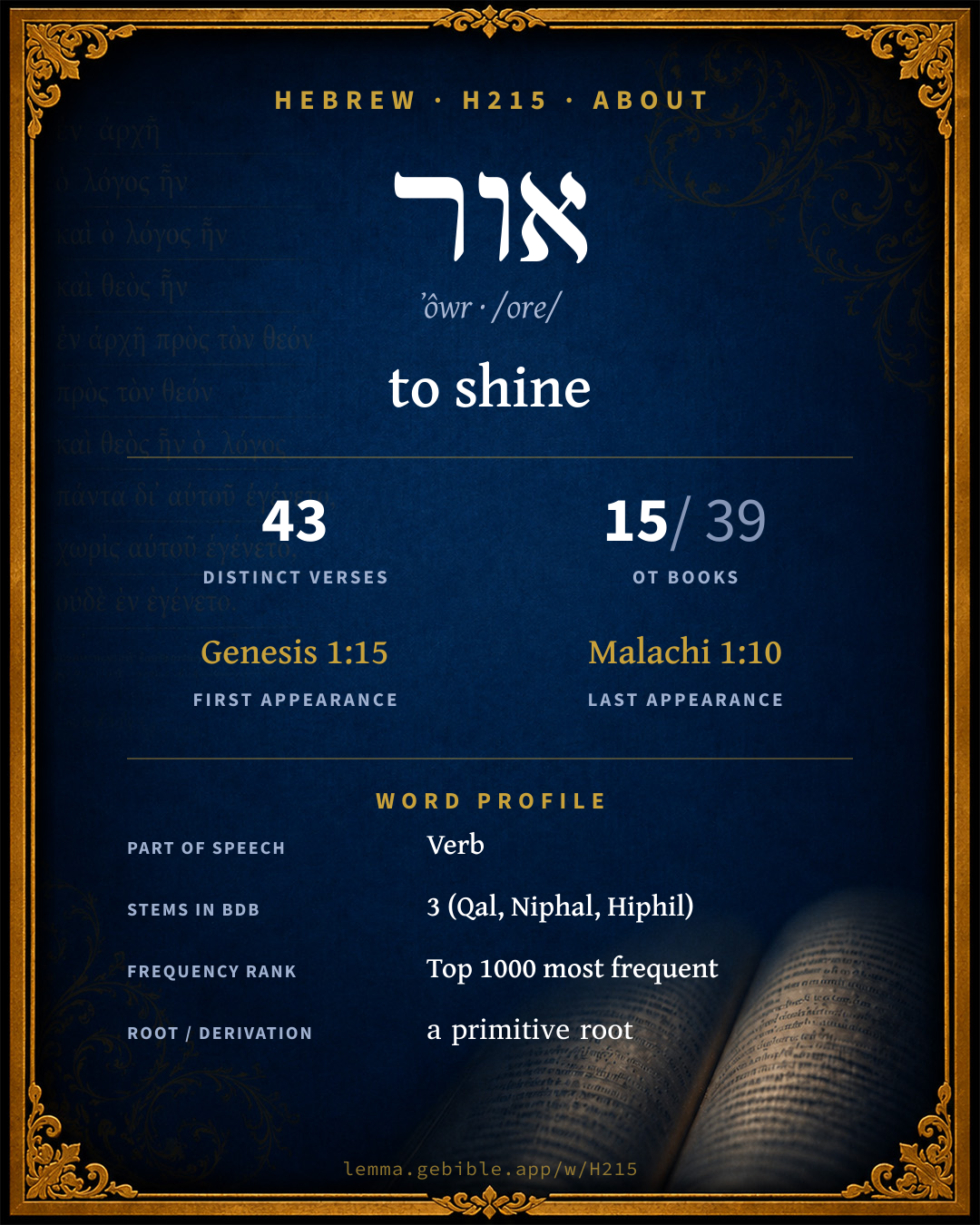
אוֹר
to shine
‘to shine’ is one of 11 main senses fuller range ↓
Full lexicon entry — Brown-Driver-Briggs (BDB)
From Brown-Driver-Briggs (BDB)
Where this word appears
See every Hiphil verb in the Hebrew Bible →
Grammar key — what these labels mean
Part of speech
- Verb
- An action or state-of-being word.
Stem
- Hiphil
- The causative active stem (“he caused / brought about”). Here: ‘give light’
- Qal
- The basic, simple active stem — the plain form of the verb (“he wrote”).
- Niphal
- Usually the simple passive or reflexive of the Qal (“he was written”).
Form
- Infinitive Construct
- A bound verbal noun, frequently with prepositions (“to write / in writing”).
- Imperfect
- An incomplete, ongoing, or future action (“he will / would write”).
- Imperative
- A direct command (“write!”).
- Sequential Imperfect
- An imperfect with prefixed waw — the standard past-narrative form (waw-consecutive imperfect).
- Jussive
- A third- or second-person volitional form expressing wish or command (“let him write”).
- Perfect
- A completed action or state — Hebrew marks aspect (completeness) more than strict tense (“he wrote”).
- Sequential Perfect
- A perfect with prefixed waw continuing a preceding imperfect or command (waw-consecutive perfect).
- Participle Active
- A verbal adjective expressing ongoing or characteristic action (“writing / one who writes”).
State
- Absolute
- The independent form of a noun, not bound to a following word.
- Construct
- A noun bound to a following noun in a possessive / “of” relationship (the construct chain).
Person
- 3rd Person
- The one spoken about (“he / she / it / they”).
- 2nd Person
- The one addressed (“you”).
Gender
- Masculine
- Grammatically masculine.
- Common
- Either gender — not distinguished for this form.
- Feminine
- Grammatically feminine.
Number
- Singular
- One.
- Plural
- More than one (in Hebrew, generally three or more).
Grammatical forms 24 distinct
- Verb, Hiphil, Infinitive Construct 7 times (16%)
- Verb, Hiphil, Imperative, 2nd Person, Masculine, Singular 7 times (16%)
- Verb, Hiphil, Imperfect, 3rd Person, Masculine, Singular 5 times (12%)
- Verb, Hiphil, Sequential Imperfect, 3rd Person, Masculine, Singular 2 times (5%)
- Verb, Hiphil, Jussive, 3rd Person, Masculine, Singular 2 times (5%)
- Verb, Hiphil, Perfect, 3rd Person, Common, Plural 2 times (5%)
- Verb, Hiphil, Sequential Perfect, 3rd Person, Masculine, Singular 1 time (2%)
- Verb, Qal, Sequential Perfect, 3rd Person, Masculine, Singular 1 time (2%)
+16 more forms (16 occurrences)
Parsed forms decoded from the imported morphology (morphhb / Westminster Leningrad Codex — WLC text public domain, morphhb tagging CC BY 4.0), counted across 43 parsed occurrences — not distinct verses.
Every verse where H215 appears — 43 distinct verses across 15 books. Click any verse to open its interlinear word-by-word view. Verse text shown in the World English Bible for context — . Each verse’s Hebrew form is shown with its reference; the English is not keyword-highlighted, since the data carries no word-level English alignment. Use “Compare translations” on any verse to read it across multiple English versions. This concordance covers the Hebrew Bible; Septuagint (Greek Old Testament) occurrences are not indexed here.
Genesis 3 verses
- Genesis 1:15 לְ/הָאִ֖יר prep + Hiphil inf.cs and let them be for lights in the expanse of sky to give light on the earth," and it was so.
- Genesis 1:17 לְ/הָאִ֖יר prep + Hiphil inf.cs God set them in the expanse of sky to give light to the earth,
- Genesis 44:3 א֑וֹר Qal pf 3ms As soon as the morning was light, the men were sent away, they and their donkeys.
Exodus 3 verses
- Exodus 13:21 לְ/הָאִ֣יר prep + Hiphil inf.cs Yahweh went before them by day in a pillar of cloud, to lead them on their way, and by night in a pillar of fire, to give them light, that they might go by day and by night:
- Exodus 14:20 וַ/יָּ֖אֶר conj + Hiphil wimpf 3ms It came between the camp of Egypt and the camp of Israel; and there was the cloud and the darkness, yet gave it light by night: and the one didn't come near the other all the night.
- Exodus 25:37 וְ/הֵאִ֖יר conj + Hiphil wpf 3ms You shall make its lamps seven, and they shall light its lamps to give light to the space in front of it.
Numbers 2 verses
1 Samuel 3 verses
- 1 Samuel 14:27 וַ/תָּאֹ֖רְנָה conj + Qal wimpf 3fp But Jonathan didn't hear when his father charged the people with the oath: therefore he put forth the end of the rod who was in his hand, and dipped it in the honeycomb, and put his hand to his mouth; and his eyes were enlightened.
- 1 Samuel 14:29 אֹ֣רוּ Qal pf 3cp Then said Jonathan, My father has troubled the land. Please look how my eyes have been enlightened, because I tasted a little of this honey.
- 1 Samuel 29:10 וְ/א֥וֹר conj + Qal wpf 3ms Therefore now rise up early in the morning with the servants of your lord who have come with you; and as soon as you are up early in the morning, and have light, depart.
2 Samuel 1 verse
Ezra 1 verse
Nehemiah 2 verses
- Nehemiah 9:12 לְ/הָאִ֣יר prep + Hiphil inf.cs Moreover in a pillar of cloud you led them by day; and in a pillar of fire by night, to give them light in the way in which they should go.
- Nehemiah 9:19 לְ/הָאִ֣יר prep + Hiphil inf.cs yet you in your manifold mercies didn't forsake them in the wilderness: the pillar of cloud didn't depart from over them by day, to lead them in the way; neither the pillar of fire by night, to show them light, and the way in which they should go.
Job 2 verses
Psalms 16 verses
- Psalms 13:3 הָאִ֥ירָ/ה Hiphil impv 2ms + sfx h Behold, and answer me, Yahweh, my God. Give light to my eyes, lest I sleep in death;
- Psalms 18:28 תָּאִ֣יר Hiphil impf 2ms For you will light my lamp, Yahweh. My God will light up my darkness.
- Psalms 19:8 מְאִירַ֥ת Hiphil ptcp.act fs cs Yahweh's precepts are right, rejoicing the heart. Yahweh's commandment is pure, enlightening the eyes.
- Psalms 31:16 הָאִ֣ירָ/ה Hiphil impv 2ms + sfx h Make your face to shine on your servant. Save me in your loving kindness.
- Psalms 67:1 יָ֤אֵ֥ר Hiphil juss 3ms May God be merciful to us, bless us, And cause his face to shine on us. Selah.
- Psalms 76:4 נָ֭אוֹר Niphal ptcp.act ms Glorious are you, and excellent, More than mountains of game.
- Psalms 77:18 הֵאִ֣ירוּ Hiphil pf 3cp The voice of your thunder was in the whirlwind. The lightnings lit up the world. The earth trembled and shook.
- Psalms 80:3 וְ/הָאֵ֥ר conj + Hiphil impv 2ms Turn us again, God. Cause your face to shine, And we will be saved.
- Psalms 80:7 וְ/הָאֵ֥ר conj + Hiphil impv 2ms Turn us again, God of hosts. Cause your face to shine, And we will be saved.
- Psalms 80:19 הָאֵ֥ר Hiphil impv 2ms Turn us again, Yahweh God of hosts. Cause your face to shine, and we will be saved.
- Psalms 97:4 הֵאִ֣ירוּ Hiphil pf 3cp His lightning lights up the world. The earth sees, and trembles.
- Psalms 105:39 לְ/הָאִ֥יר prep + Hiphil inf.cs He spread a cloud for a covering, Fire to give light in the night.
- Psalms 118:27 וַ/יָּ֪אֶר conj + Hiphil wimpf 3ms Yahweh is God, and he has given us light. Bind the sacrifice with cords, even to the horns of the altar.
- Psalms 119:130 יָאִ֗יר Hiphil impf 3ms The entrance of your words gives light. It gives understanding to the simple.
- Psalms 119:135 הָאֵ֣ר Hiphil impv 2ms Make your face shine on your servant. Teach me your statutes.
- Psalms 139:12 יָאִ֑יר Hiphil impf 3ms Even the darkness doesn't hide from you, But the night shines as the day. The darkness is like light to you.
Proverbs 2 verses
Ecclesiastes 1 verse
Isaiah 3 verses
- Isaiah 27:11 מְאִיר֣וֹת Hiphil ptcp.act fp When the boughs of it are withered, they shall be broken off; the women shall come, and set them on fire; for it is a people of no understanding: therefore he who made them will not have compassion on them, and he who formed them will show them no favor.
- Isaiah 60:1 א֖וֹרִי Qal impv 2fs Arise, shine; for your light is come, and the glory of Yahweh is risen on you.
- Isaiah 60:19 יָאִ֣יר Hiphil impf 3ms The sun shall be no more your light by day; neither for brightness shall the moon give light to you: but Yahweh will be to you an everlasting light, and your God your glory.
Ezekiel 2 verses
- Ezekiel 32:7 יָאִ֥יר Hiphil impf 3ms When I shall extinguish you, I will cover the heavens, and make the stars of it dark; I will cover the sun with a cloud, and the moon shall not give its light.
- Ezekiel 43:2 הֵאִ֥ירָה Hiphil pf 3fs Behold, the glory of the God of Israel came from the way of the east: and his voice was like the sound of many waters; and the earth shined with his glory.
Daniel 1 verse
Malachi 1 verse
About this entry
At a glance — auto-summarized from this page’s data, not written by a person. Every figure links to its source below. This summary describes the numbers; it doesn’t interpret them.
The Hebrew verb אור centers on the idea of “to shine.” First canonically at Genesis 1:15, it enters the text early. It turns up in 43 verses across 15 books, a moderately common footprint. The word gravitates to Psalms (37%), then Genesis and Exodus. The verb spans 3 stems, from Qal to Niphal. The sections below give every sense, occurrence, and version rendering.
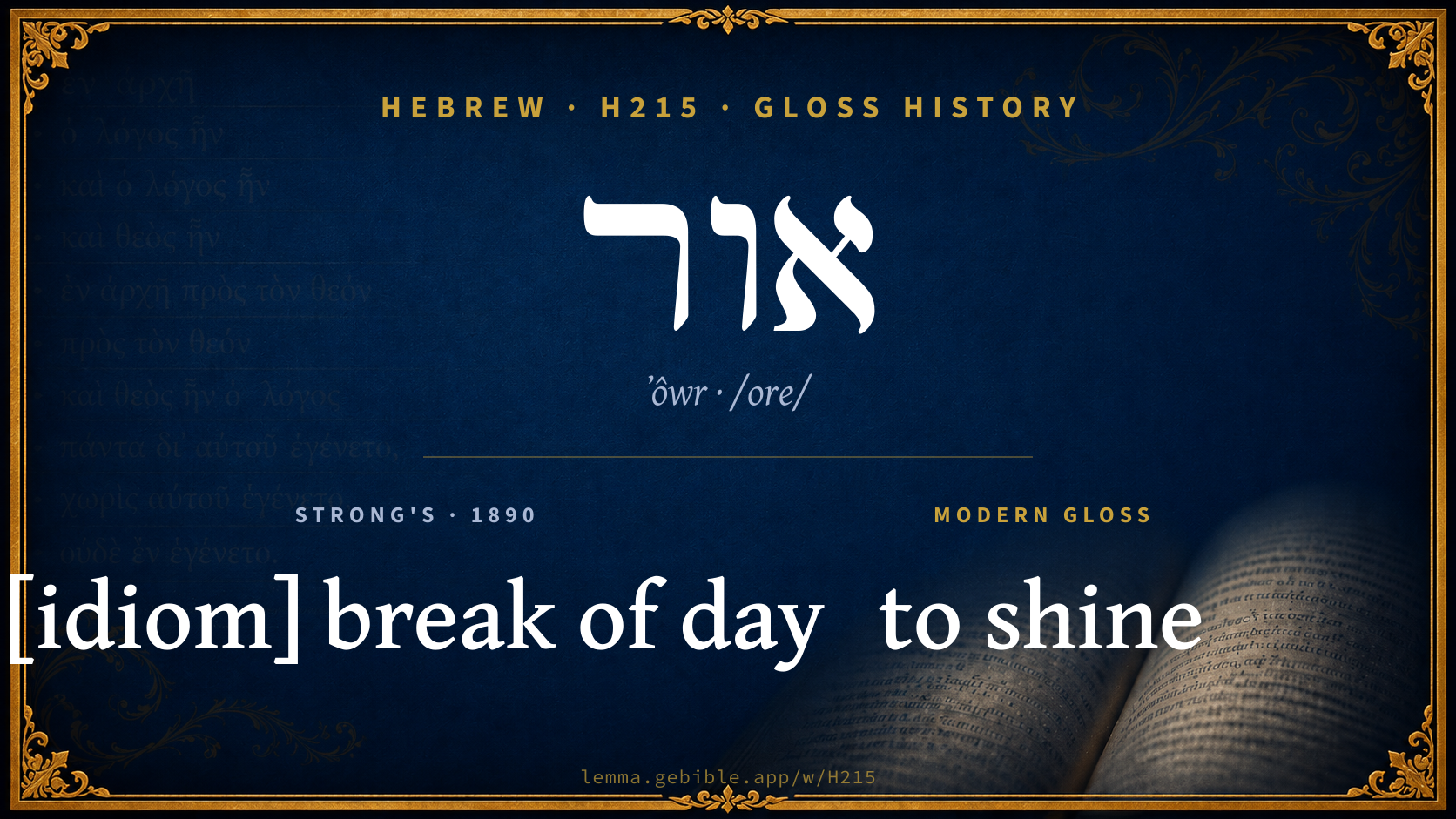
Gloss history
Strong's 1890 vs modern scholarship
About this word
Strong's H215 catalogs a Hebrew word from the Hebrew Old Testament.
These counts are not copied from any lexicon or concordance. They are computed here, from the morphology-tagged Hebrew Old Testament. What Lemma adds →
- 43
- distinct verses
- The word appears in 43 distinct verses.
- 15 / 39
- OT books
- The word appears in 15 of 39 Old Testament books.
- #837
- by frequency
- Top 1000 most frequent Hebrew words (rank 837 of 8,640 Hebrew words by occurrence).
View all 43 occurrences in the concordance →
By section of the Old Testament
By traditional corpus
Conventional, traditional groupings — biblical authorship is debated, so this is a traditional corpus grouping, not an authorship claim. Each share is this word’s portion of its verses in that division of the Hebrew canon. Each figure is a share of the word’s 43 distinct verses.
- Writings (Ketuvim) 25 verses · 58%
- Prophets (Nevi'im) 10 verses · 23%
- Torah (Pentateuch) 8 verses · 19%
How translations render this word
Counts come from each version’s own published word-to-Strong’s tagging or interlinear alignment — an approximate guide to how each version renders this word, not a word-level alignment the data otherwise carries. Because each total is that version’s own tagged count, the per-version totals vary from one another and need not match the appearance or distinct-verse counts above. These counts may also differ from a printed concordance because Lemma counts each distinctly tagged rendering and does not collapse phrase taggings into a single head-word total. This is a fixed set of word-tagged versions (KJV, ASV, BSB, ULT) and does not change with the reading translation you choose elsewhere. Each version’s license is shown beside its name below (and on Sources).
BDB lists this Strong’s number as 2 distinct words (homographs). Each count above pools all of them and is not split by sense — see the Senses section below. A low-frequency rendering may belong to a different one of those words, not the primary meaning.
- King James Version†: Shine 11×, Give light 3×, Give them light 2×
- American Standard Version†: Shine 10×, Give light 3×, Give them light 2×
- Berean Standard Bible†: Shine 8×, Light 3×, Shine upon us 3×
- unfoldingWord Literal Text†: Shine 15×, Make 7×, Became light 2×
King James Version Public Domain
Renders H215 across 43† tagged occurrences — most commonly:
Plus 25 renderings that appear only once — usually multi-word phrases or single function words the recovered tagging swept in, not distinct renderings.
American Standard Version Public Domain
Renders H215 across 43† tagged occurrences — most commonly:
Plus 26 renderings that appear only once — usually multi-word phrases or single function words the recovered tagging swept in, not distinct renderings.
Berean Standard Bible Public Domain
Renders H215 across 40† tagged occurrences — most commonly:
Plus 22 renderings that appear only once — usually multi-word phrases or single function words the recovered tagging swept in, not distinct renderings. Not rendered by a distinct English word in 2 further occurrences.
unfoldingWord Literal Text CC BY-SA 4.0
Renders H215 across 58† tagged occurrences — most commonly:
Plus 30 renderings that appear only once — usually multi-word phrases or single function words the recovered tagging swept in, not distinct renderings.
19 senses and sub-senses in the full BDB
Hebrew verbs can shift meaning by stem (binyan): Qal is the basic action, Niphal is often passive or reflexive, Piel often intensifies or makes it factitive, and Hiphil is typically causative. The senses below are grouped under the stem BDB assigns to each.
What do BDB’s symbols mean?
BDB uses these scholarly abbreviations:
| Symbol | Meaning |
|---|---|
| 𝔊 | the Septuagint (the ancient Greek translation, LXX) |
| 𝔙 | the Vulgate (the Latin translation) |
| 𝔖 | the Syriac version (the Peshitta) |
| 𝔗 | the Targum (the Aramaic translation) |
| ψ | the Psalms |
| √ | root (the underlying root or stem) |
| ‖ | parallel passage (a synonymous or contrasted parallel) |
| † | the dagger: every passage where the word occurs is cited |
The 19 senses and sub-senses the full Brown-Driver-Briggs lexicon distinguishes for this word, in lexicon order (not ranked by frequency), with BDB’s own verbatim wording and sub-sense lettering. Shown in Hebrew script with BDB’s own scholarly abbreviations. The condensed entry is in the Lexicon Entry tab. See also the Forms in the corpus table below.
אור I be or become light (cf. Arabic أَوَّرَ enkindle, Aramaic (Nasar.) ܐܘܪ Aph. illumine, & deriv. in Assyrian)
Qal
- Pf. אוֹר Gn 44:3 +; אֹ֫רוּ 1 S 14:29; Impf. 3 fpl. וַתָּאֹרְנָה 1 S 14:27 Qr; Pt. אוֹר Pr 4:18 (Ges§ 72 R. 1); Imv. fs. א֫וֹרִי Is 60:1;—become light, shine of sun (especially in early morn.) Gn 44:3 (J) 1 S 29:10 Pr 4:18 Is 60:1; of eyes (owing to refreshment) 1 S 14:27(Qr) 29. e.g. Genesis 44:3
Niphal
- Impf. וַיֵּאֹר 2 S 2:32; Inf. c. לֵאוֹר Jb 33:30; Pt. נָאוֹר ψ 76:5—become lighted up of day-break 2 S 2:32; by light of life, revival Jb 33:30; by light of glory, enveloped in light ψ 76:5. e.g. 2 Samuel 2:32
Hiphil
- Pf. וְהֵאִיר Ex 25:37, etc.; Impf. יָאִיר Jb 41:24 +; יָאֵר Nu 6:25 +; וַיָּ֫אֶר ψ 118:27 +, etc.; Imv. הָאֵר ψ 80:20 +, הָאִ֫ירָה ψ 31:17 +; Inf. הָאִיר Gn 1:15 +; Pt. מֵאִיר Pr 29:13; מְאִירַת ψ 19:9; מְאִירוֹת Is 27:11— e.g. Exodus 25:37
- 1. give light, of sun, moon & stars Gn 1:15, 17 (P), of moon Is 60:19; of pillar of fire (sq. ל) Ex 13:21; 14:20 (both JE) ψ 105:39 Ne 9:12, 19; of sacred lamp Ex 25:37 Nu 8:2 (both P); fig. of the words of God ψ 119:130. e.g. Genesis 1:15
- 2. lightup, cause to shine, shine, sq. acc. הֵאִירוּ בְרָקִים תֵּבֵל lightnings lighted up the world ψ 77:19; 97:4; abs. הָאָרֶץ הֵאִירָה מִכְּבֹדוֹ Ez 43:2; the earth shined with his glory (of theophany); of leviathan, which makes path shine behind him Jb 41:24; לַיְלָה כַּיּוֹם יָאִיר night shineth as day ψ 139:12. e.g. Psalms 77:19
- 3. light a lamp ψ 18:29; wood Is 27:11; altar(-fire) Mal 1:10. e.g. Psalms 18:29
- 4. lighten, of the eyes, הָאִיר עֵינַיִם, subj. י׳, his law, etc. Pr 29:13 ψ 13:4; 19:9 Ezr 9:8. e.g. Proverbs 29:13
- 5. make shine, of face of God יָאֵר י׳ פָּנָיו אֵלֶיךָ Yahweh make his face shine upon thee Nu 6:25 (priest’s blessing), reappearing ψ 31:17 (sq. עַל־), 67:2 (sq. אֶת־), 80:4, 8, 20; 119:135 (sq. ב), Dn 9:17 cf. ψ 4:7; without פָּנִים (sq. ל) ψ 118:27; once, of face of man, Ec 8:1 חָכַמַת אָדָם תָּאִיר פָּנָיו the wisdom of a man lighteth up his face. e.g. Numbers 6:25
אור II
- 1. light as diffused in nature, light of day Gn 1:3, 4, 5 (P) Jb 3:9; 38:19 +. e.g. Genesis 1:3
- 2. morning light, dawn, אוֹר הַבֹּקֶר light of the morn. Ju 16:2 1 S 14:36; 25:34, 36 2 S 17:22 2 K 7:9 Mi 2:1; א׳ בֹּקֶר 2 S 23:4 (poem of David); עַד־הָא׳ Ju 19:26 (cf. עַד־הַבֹּקֶר v 25); לָאוֹר Jb 24:14; מִן־הָאוֹר עַד מַחֲצִית הַיּוֹם from dawn till mid-day, Ne 8:3 cf. Pr 4:18. e.g. Judges 16:2
- 3. light of the heavenly luminaries; א׳ הַלְּבָנָה, ‖ א׳ הַחַמָּה moonlight & sunlight Is 30:26; כּוֹכְבֵי אוֹר stars of light ψ 148:3; מְאוֹרֵי אוֹר luminaries of light Ez 32:8; אוֹרִים = מְאוֹרִים ψ 136:7; so עֲלֵי־אוֹר in sunshine Is 18:4; the sun itself Jb 31:26. e.g. Isaiah 30:26
- 4. daylight אוֹר רְשָׁעִים light of the wicked Jb 38:15 (their work-day being the night); יוֹם אוֹר a day of light Am 8:9 (= a clear, sunshiny day). e.g. Job 38:15
- 5. lightning Jb 36:32; 37:3, 11, 15 cf. Hb 3:11. e.g. Job 36:32
- 6. light of lamp Pr 13:9 Je 25:10; of crocodile’s hot breath Jb 41:10. e.g. Proverbs 13:9
- 7. light of life א׳ חַיִּים Jb 33:30 ψ 56:14; cf. אוֹר Jb 3:16, 20. e.g. Job 33:30
- 8. light of prosperity Jb 22:28; 30:26 ψ 97:11 La 3:2. e.g. Job 22:28
- 9. light of instruction נֵר מִצְוָה וְתוֹרָה אוֹר Pr 6:23 the commandment is a lamp and instruction a light; so the Messian. servant is אוֹר גּוֹיִם Is 42:6; 49:6; cf. א׳ עַמִּים Is 51:4; the advent of Mess. is shining of great light Is 9:1(×2). e.g. Proverbs 6:23
- 10. light of face אוֹר פָּנִים = bright, cheerful face (of men) Jb 29:24; betokening king’s favour Pr 16:15 (cf. א׳ עֵינַיִם ψ 38:11); of God = his shining, enlightening, favouring face ψ 4:7; 44:4; 89:16. e.g. Job 29:24
- 11. Yahweh is א׳ יִשְׂרָאֵל Is 10:17, as source of enlightenment & prosperity; light & salvation ψ 27:1; light to guide Mi 7:8 cf. ψ 43:3; everlasting light of Zion, instead of sun & moon Is 60:19, 20; house of Jacob is to walk in his light Is 2:5. e.g. Isaiah 10:17
Senses from the full Brown-Driver-Briggs lexicon (Brown, Driver, Briggs; Oxford 1906 — public domain), digitized via Sefaria, supplemented by the OpenScriptures HebrewLexicon (CC BY 4.0). Full attribution on Sources.
Word origin
I. vb. be or become light (cf. Arabic أَوَّرَ enkindle, Aramaic (Nasar.) ܐܘܪ Aph. illumine, & deriv. in Assyrian)—
II. אוֹר121 f. Jb 36:32; Je 13:16; cf. Gn 1:3 light (Assyrian urru = ûru DlW)—abs. Gn 1:3 +; cstr. Ju 16:2 +; sf. אוֹרִי ψ 27:1, etc.; pl. אוֹרִים ψ 136:7;—
— Brown-Driver-Briggs (Oxford 1906, public domain), digitized via Sefaria, supplemented by the OpenScriptures HebrewLexicon (CC BY 4.0). See Sources.
Origin: a primitive root
Jastrow Dictionary
A second Hebrew/Aramaic lexicon for comparison, covering Aramaic and post-biblical (Talmudic, Targumic, Midrashic) usage that the biblical-Hebrew BDB does not. Matched by lemma rather than by Strong’s number, so a lemma may carry more than one Jastrow headword (shown separately below), and the entries cover usage well beyond the Bible.
אוֹר I
- to perforate, break through, shine.—Denom. אַוִּיר, מְאוּרָה &c.
- to be broken through, grow light. Y. Ber. I, 2ᶜ משיֵאוֹר המזרח from the time the Eastern horizon is broken through, grows light.
- 1. (neut. v.) (neut. v.) to break through, shine. Y. ib. III, 6ᶜ bot. open thy lips ויָאִירוּ דבריך and let thy words come forth, speak out boldly. Yoma III, 1 ה׳ פני כל וכ׳ it has grown light all over the Eastern horizon.—פנים מֵאִירוֹת bright countenance. Num. R. s. 11; a. e.
- 2. (act. v.) to enlighten, brighten, make shine. Y. M. Kat. III, 83ᵇ ה׳ עיניו וכ׳ (the teacher had opened his (Samuel’s) eyes &c. B. Mets. 33ᵃ. Num. R. l. c. Ib. המזבח מֵאִירִים את (fr. Mal. I, 10) making the altar bright (with fire), feeding the fire on the altar. Yoma 73ᵇ, v. אוּר. e.g. Malachi 1:10
אוֹר
- Part. pass. נָאוֹר clear. Targ. Prov. IV, 25 נְאוֹרָן, נְאֹרָן, v. חֲוַר.
אוֹר II
- foreg.) breaking forth (cmp. Is. LVIII, 8) whence e.g. Isaiah 58:8
- 1. break of day, light, day; fire; trnsf. rise, glory, power, happiness. Ber. 2ᵇ ביאת אוֹרוֹ the entrance of his day-break (dawn of his eighth day; Tosaf. a. l. the sunset of his seventh day). Y. Pes. I, beg. 27ᵃ א׳ החמה sun-light. Ib. א׳ הנר candle light. Keth. 111ᵇ א׳ תורה light of the Law. B. Bath. 4ᵃ אוֹרוֹ של עולם intellectual light of the wold (a great man; the Law). Num. R. s. 15 אור של מעלן the celestial fire (believed to be the source of all light and fire); a. v. fr.
- 2. (breaking in of night) twilight, evening. Pes. I, 1 לארבעה וכ׳ א׳ on the evening (eve) of the fourteenth day of Nissan; v. discussion ibid. 2ᵃ sq., about the meaning of our w. R. Hash. 22ᵇ; Snh. 70ᵇ לא׳ עיבורו the evening following the eventual intercalation, i.e. the evening from the thirtieth of the past to the first of the beginning month.
- 3. (homil. = אוֹרָה II) rue. Gen. R. s. 20 in the Pentat. of R. M. it read כתנות אור וכ׳ (in place of עור Gen. III, 21) this alludes to the garments of Adam resembling the rue, wide below and narrow above; Ar. (Rashi diff.). e.g. Genesis 3:21
אוּר I
- foreg.) prop. light, flame; esp. Pl. אוּרִים ותומים the Urim and Tummim in the High-priest’s breast-plate. Yoma 73ᵇ א׳ שמאירים את דבריהם they are called Urim because they give their decisions in a clear way (not ambiguous as the oracles); cmp. Y. ib. VII, end, 44ᶜ. Sot. IX, 12. Y. Kidd. IV, beg. 65ᵇ
*אוּר II
- (= עוּר q. v.) chaff. Y. Ab. Zar. II, 40ᵈ א׳ דשערין chaff of barley; (Y. Sabb. XIV, 14ᵈ עור דסערין).
A Dictionary of the Targumim, the Talmud Babli and Yerushalmi, and the Midrashic Literature (Marcus Jastrow; London, Luzac, 1903) — Public Domain. Digitized via Sefaria. Digitized via Sefaria. Full attribution on Sources.
Forms in the corpus
The 36 distinct written forms H215 takes in the Hebrew Bible, most frequent first — each parse links to that stem’s occurrences in the concordance. Hebrew forms include their vowel points and cantillation, so a single lemma takes many written forms.
Same root — word family
Other BDB entries built from the same root as H215, grouped by Strong’s listed origin. These share a root / origin per the lexicon — not necessarily a shared meaning. Each links to that word’s own entry.
Derived from this word
Proper names from this root
People and places named from this root — a name, not an additional meaning of the word.
Compare all same-root words → Showing 4 of 6 — not the complete family. 1 of the same-root words is a proper name (a person or place). They share a root, not necessarily a meaning.
Septuagint verse parallels
This word appears in 35 verses that also exist in the Greek Old Testament (Septuagint), out of the 43 Hebrew verses it occurs in. You can read those verses in Greek by switching the Old Testament edition to the Septuagint.
Read these verses in the Septuagint
- Genesis 1:15
- Exodus 13:21
- Numbers 6:25
- 1 Samuel 14:27
- 2 Samuel 2:32
- Ezra 9:8
- Job 33:30
- Psalms 13:3
- Proverbs 4:18
- Ecclesiastes 8:1
- Isaiah 27:11
- Ezekiel 32:7
This is a verse-level parallel only — the same verses exist in both the Hebrew and Greek Old Testaments. No word-level Hebrew↔Greek correspondence is claimed: the data carries no such alignment, so no Greek word is shown as this Hebrew word’s translation. Coverage is not total — the Septuagint omits the deuterocanon and renumbers the Psalms, so some Hebrew verses have no direct Greek parallel.