
Malachi 1:10

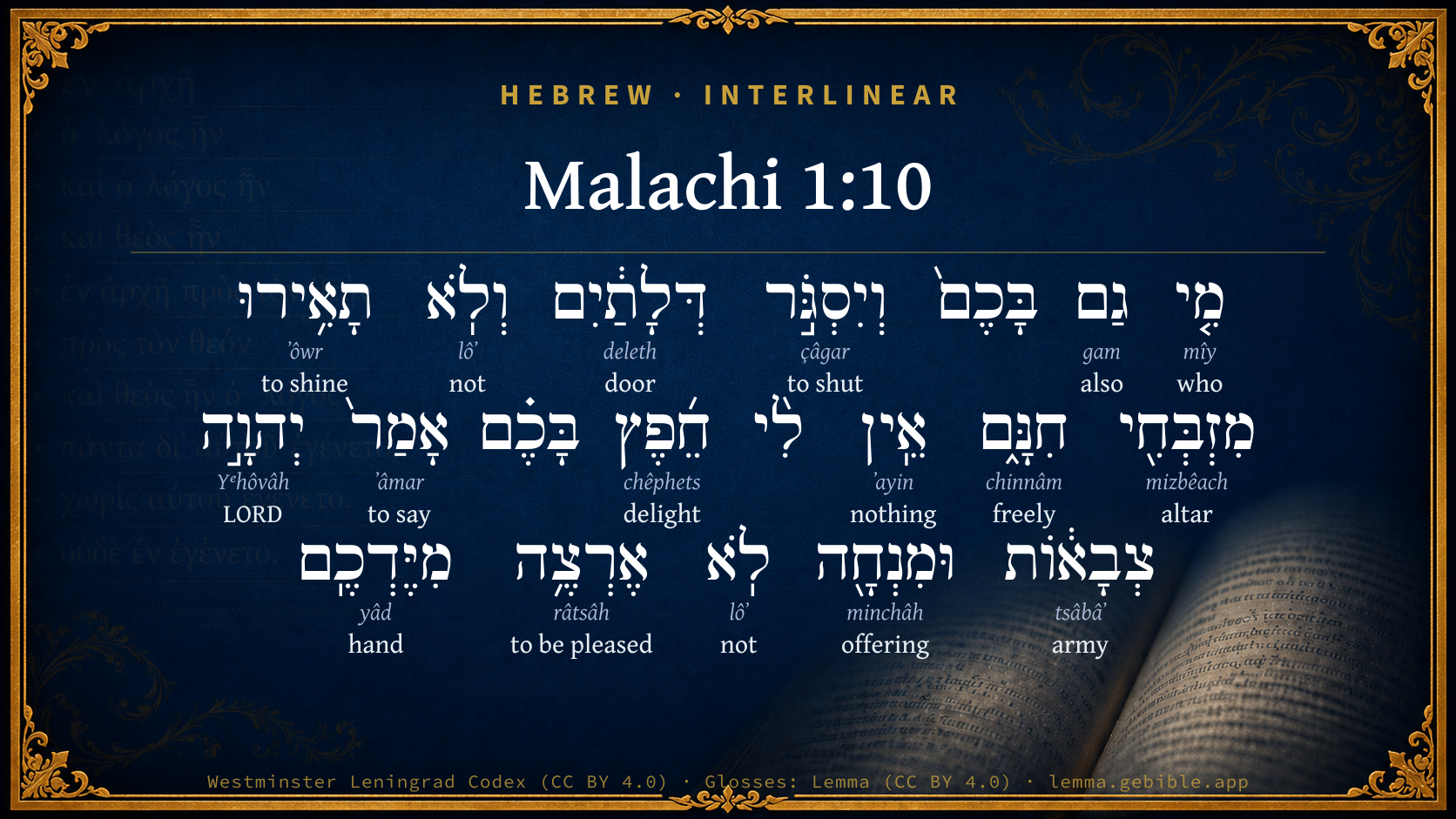
Hebrew (Westminster Leningrad Codex) Malachi 1:10 appears in the Hebrew Old Testament. The text above is from the Westminster Leningrad Codex. Each word links to its Strong’s number, a concise gloss, and parsing drawn from the Open Scriptures Hebrew Bible morphology. Click any word for its full Brown-Driver-Briggs (BDB) entry.
Download image
Cite this verse

Malachi 1:10 (World English Bible). Public Domain. Lemma interlinear Bible study tool, https://lemma.gebible.app/v/malachi/1/10.

Show BibTeX & RIS
BibTeX
RIS
English Translation
"Oh that there were one among you who would shut the doors, that you might not kindle fire on my altar in vain! I have no pleasure in you," says Yahweh of hosts, "neither will I accept an offering at your hand.
World English Bible · Public Domain
Download a study sheet

One document with this verse’s original text, its word-by-word gloss line, the meaning frame, cross-references with their text, attributed commentary, and full source and license credits — printable, and it pastes into notes with its structure intact.

This verse Autodidact and up

Study sheet (.html) Plain text (.txt)

A passage Seminary Student

Up to 50 verses in one chapter. A passage sheet keeps up to 6 commentary sources and 12 cross-references per verse, in the order this page ranks them, and says so on the sheet whenever that leaves anything out. Ask for a single verse and you get the Autodidact verse sheet above.

Everything on this page stays free to read, with no account — the sheet is a download of what is already on screen, not access to it.

Want to remove ads? Support Godless Engineer
Compare translations 3

The same verse in 3 English versions, stacked beneath the original-language interlinear above. Click any original word for its lexicon entry.

Each is an independent rendering of the whole verse — the interlinear is not word-aligned to these translations.

Highlighted words mark where these versions differ — a whole-verse word diff, not a word-by-word alignment.

  • World English Bible Public Domain
    "Oh that there were one among you who would shut the doors, that you might not kindle fire on my altar in vain! I have no pleasure in you," says Yahweh of hosts, "neither will I accept an offering at your hand.
  • King James Version Public Domain
    Who is there even among you that would shut the doors for nought? neither do ye kindle fire on mine altar for nought. I have no pleasure in you, saith the LORD of hosts, neither will I accept an offering at your hand.
  • unfoldingWord Literal Text CC BY-SA 4.0
    “Who even among you will shut the doors, that you might not kindle on my altar in vain? Pleasure in you is not to me,” says Yahweh of Armies, “and I will not accept an offering from your hand.

unfoldingWord Literal Text — © unfoldingWord, licensed CC BY-SA 4.0. Word-aligned USFM3 via Door43 (git.door43.org/unfoldingWord/en_ult).

Versions to compare (up to 4)

3 of 4 selected

Show all 18 translations

Every available English version of this verse, each an independent rendering of the whole verse.

  • World English Bible Public Domain
    "Oh that there were one among you who would shut the doors, that you might not kindle fire on my altar in vain! I have no pleasure in you," says Yahweh of hosts, "neither will I accept an offering at your hand.
  • Berean Standard Bible Public Domain
    “Oh, that one of you would shut the temple doors, so that you would no longer kindle useless fires on My altar! I take no pleasure in you,” says the LORD of Hosts, “and I will accept no offering from your hands.
  • Majority Standard Bible Public Domain
    “Oh, that one of you would shut the temple doors, so that you would no longer kindle useless fires on My altar! I take no pleasure in you,” says the LORD of Hosts, “and I will accept no offering from your hands.
  • King James Version Public Domain
    Who is there even among you that would shut the doors for nought? neither do ye kindle fire on mine altar for nought. I have no pleasure in you, saith the LORD of hosts, neither will I accept an offering at your hand.
  • American Standard Version (1901) Public Domain
    Oh that there were one among you that would shut the doors, that ye might not kindle `fire on' mine altar in vain! I have no pleasure in you, saith Jehovah of hosts, neither will I accept an offering at your hand.
  • Revised Version (1885) Public Domain
    Oh that there were one among you that would shut the doors, that ye might not kindle fire on mine altar in vain! I have no pleasure in you, saith the LORD of hosts, neither will I accept an offering at your hand.
  • Geneva Bible (1599) Public Domain
    Who is there euen among you, that would shut the doores? and kindle not fire on mine altar in vaine, I haue no pleasure in you, sayeth the Lord of hostes, neither will I accept an offering at your hande.
  • Douay-Rheims (1899) Public Domain
    Who is there among you, that will shut the doors, and will kindle the fire on my altar gratis? I have no pleasure in you, saith the Lord of hosts: and I will not receive a gift of your hand.
  • Young's Literal Translation Public Domain
    Who `is' even among you, And he shutteth the two-leaved doors? Yea, ye do not kindle Mine altar for nought, I have no pleasure in you, said Jehovah of Hosts, And a present I do not accept of your hand.
  • Literal Standard Version CC BY-SA 4.0
    “Who [is] even among you, || And he shuts the double doors? Indeed, you do not kindle My altar for nothing, || I have no pleasure in you,” said YHWH of Hosts, || “And I do not accept a present of your hand.
  • Unlocked Literal Bible CC BY-SA 4.0
    “Oh, if only there were one of you who would shut the temple gates, so that you might not light fires on my altar in vain! I have no pleasure in you,” says Yahweh of hosts, “and I will not accept any offering from your hand.
  • unfoldingWord Literal Text CC BY-SA 4.0
    “Who even among you will shut the doors, that you might not kindle on my altar in vain? Pleasure in you is not to me,” says Yahweh of Armies, “and I will not accept an offering from your hand.
  • Darby Bible Public Domain
    Who is there among you that would even shut the doors? and ye would not kindle [fire] on mine altar for nothing. I have no delight in you, saith Jehovah of hosts, neither will I accept an oblation at your hand.
  • World Messianic Bible Public Domain
    “Oh that there were one among you who would shut the doors, that you might not kindle fire on my altar in vain! I have no pleasure in you,” says the LORD of Hosts, “neither will I accept an offering at your hand.
  • Webster's Bible Public Domain
    Who is there even among you that would shut the doors for nought? neither do ye kindle fire on my altar for naught. I have no pleasure in you, saith the LORD of hosts, neither will I accept an offering at your hand.
  • Free Bible Version CC BY-SA 4.0
    I really wish one of you would shut the Temple doors to stop you lighting pointless fires on my altar! I am not pleased with you, says the Lord Almighty, and I will not accept offerings from you.
  • Bible in Basic English Public Domain
    If only there was one among you who would see that the doors were shut, so that you might not put a light to the fire on my altar for nothing! I have no pleasure in you, says the Lord of armies, and I will not take an offering from your hands.
  • JPS Tanakh (1917) Public Domain
    Oh that there were even one among you that would shut the doors, that ye might not kindle fire on Mine altar in vain! I have no pleasure in you, saith the LORD of hosts, neither will I accept an offering at your hand.

Literal Standard Version (2020), Covenant Press — licensed CC BY-SA 4.0. Text via the HelloAO Bible API (eBible.org). Unlocked Literal Bible (unfoldingWord) — licensed CC BY-SA 4.0. Text via the HelloAO Bible API (eBible.org). unfoldingWord Literal Text — © unfoldingWord, licensed CC BY-SA 4.0. Word-aligned USFM3 via Door43 (git.door43.org/unfoldingWord/en_ult). Free Bible Version, Dr. Jonathan Gallagher — licensed CC BY-SA 4.0. Text via the HelloAO Bible API (eBible.org).

Word by word

More ways to search: Search by grammar → Find every occurrence → Compare this word →

Practice this passage: Drill this verse → Learn its vocabulary →

חִנָּ֑ם
chinnâm
H2600
“freely”
Adverb
Part of Speech
Adverb
Full BDB Definition

Origin: from H2580

TWOT: 694b

freely, for nothing, without cause - gratis, gratuitously, for nothing - for no purpose, in vain - gratuitously, without cause, undeservedly
  1. מִ֤י mîy H4310 “who” Particle, Interrogative
  2. גַם gam H1571 “also” Adverb
  3. וְיִסְגֹּ֣ר çâgar H5462 “and · to shut” Conjunction + Verb, Qal, Jussive, 3rd Person, Masculine, Singular
  4. דְּלָתַ֔יִם deleth H1817 “doors” Noun, Common, Feminine, Dual, Absolute
  5. וְלֹֽא lôʼ H3808 “and · not” Conjunction + Particle, Negative
  6. תָאִ֥ירוּ ʼôwr H215 “to shine” Verb, Hiphil, Imperfect, 2nd Person, Masculine, Plural
  7. מִזְבְּחִ֖י mizbêach H4196 “altar · my” Noun, Common, Masculine, Singular, Construct + Suffix, Personal, 1st Person, Common, Singular
  8. אֵֽין ʼayin H369 “nothing” Particle, Negative
  9. חֵ֜פֶץ chêphets H2656 “delight” Noun, Common, Masculine, Singular, Absolute
  10. אָמַר֙ ʼâmar H559 “to say” Verb, Qal, Perfect, 3rd Person, Masculine, Singular
  11. יְהוָ֣ה Yᵉhôvâh H3068 “LORD” Noun, Proper
  12. צְבָא֔וֹת tsâbâʼ H6635 “armies” Noun, Common, Both, Plural, Absolute
  13. וּמִנְחָ֖ה minchâh H4503 “and · offering” Conjunction + Noun, Common, Feminine, Singular, Absolute
  14. לֹֽא lôʼ H3808 “not” Particle, Negative
  15. אֶרְצֶ֥ה râtsâh H7521 “to be pleased” Verb, Qal, Imperfect, 1st Person, Common, Singular
  16. מִיֶּדְכֶֽם yâd H3027 “from · hand · your” Preposition + Noun, Common, Both, Singular, Construct + Suffix, Personal, 2nd Person, Masculine, Plural

About this verse

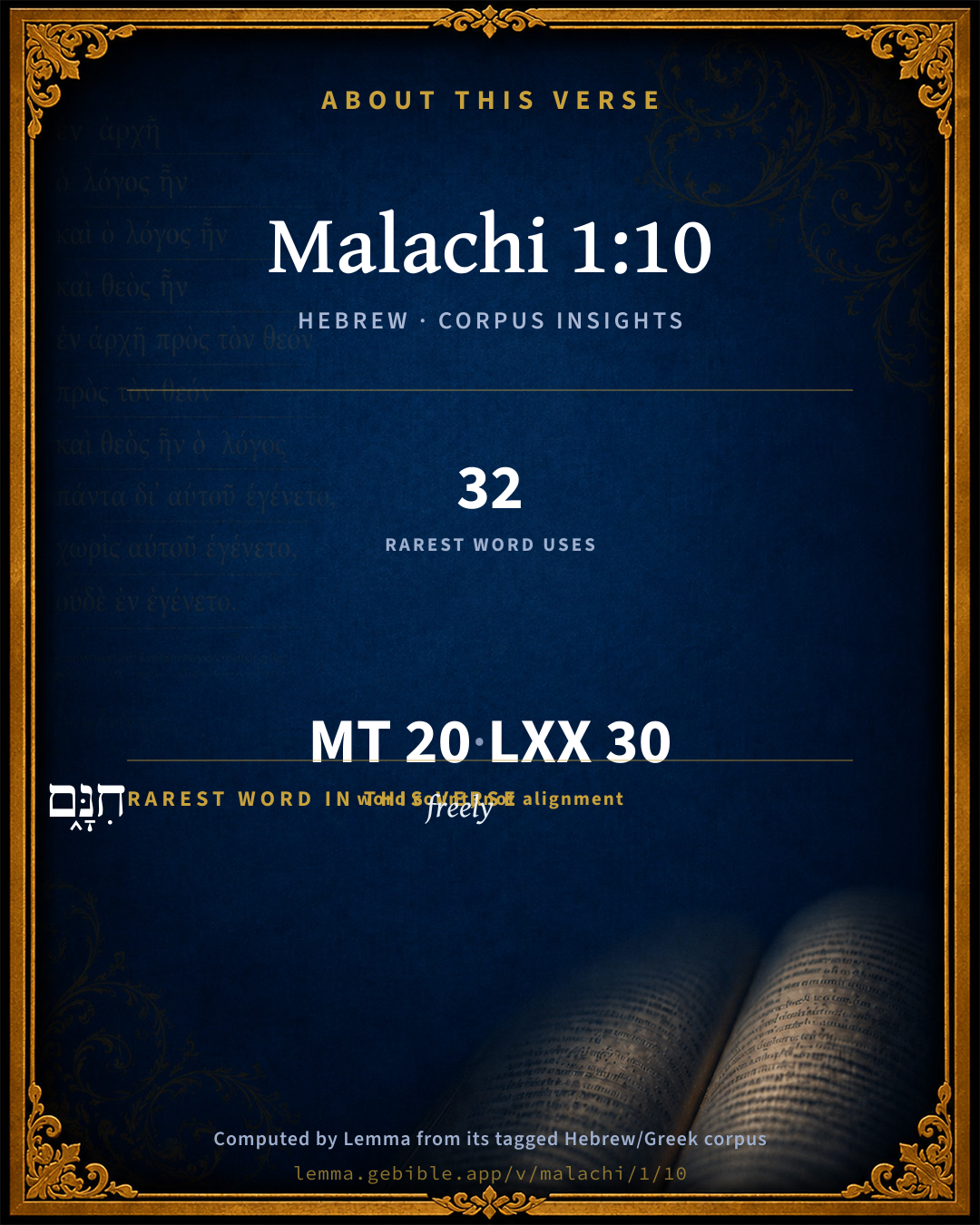
These counts appear in no published source. They are computed here, from the morphology-tagged text and Lemma’s own curated glosses. What Lemma adds →

20
words
16
distinct lemmas
Prophets
section

Shared distinctive vocabulary

חִנָּ֑ם freely H2600 occurs in 31 verses of the Hebrew Bible. Also found in:

Grammatical profile

  • 4 verbs
  • 7 nouns
  • 3 prepositions
  • 2 adverbs
  • 4 particles

Verb forms

  • וְיִסְגֹּ֣ר Qal · Jussive
  • תָאִ֥ירוּ Hiphil · Imperfect
  • אָמַר֙ Qal · Perfect
  • אֶרְצֶ֥ה Qal · Imperfect

Repetition

A word recurs within this verse — often emphatic in Hebrew:

  • וְלֹֽא not H3808 ×2

Hebrew & Septuagint length

In English translation the verse runs 42 words from the Hebrew and 41 from the Septuagint (LXX English) — closely comparable.

A rough comparison of the two English renderings, which tokenize alike — not a word-level alignment.

Word counts can differ between the Hebrew and the Greek without any difference in meaning — e.g. the Hebrew direct-object marker אֵת has no separate Greek word, and Greek often adds the article ὁ.

In the original languages it is 20 Hebrew tokens and 30 Greek tokens — but the two are counted differently (Hebrew bundles its prefixes and suffixes into one token; the Greek is in lemma form), so that isn’t a like-for-like length.

Cross-references

15

Topical passages linked to Malachi 1:10 in the Treasury of Scripture Knowledge — connected by theme and wording, ordered by reader-vote popularity; previews shown in the World English Bible.

  • 1 Peter 5:2 Shepherd the flock of God which is among you, exercising the oversight, not under compulsion, but voluntarily, not for dishonest gain, but willingly;
  • Jeremiah 6:20 To what purpose comes there to me frankincense from Sheba, and the sweet cane from a far country? your burnt offerings are not acceptable, nor your sacrifices pleasing to me.
  • Hosea 5:6 They will go with their flocks and with their herds to seek Yahweh; But they won't find him. He has withdrawn himself from them.
  • Amos 5:21–24 I hate, I despise your feasts, And I can't stand your solemn assemblies.
  • Micah 3:11 Her leaders judge for bribes, And her priests teach for a price, And her prophets of it tell forturnes for money: Yet they lean on Yahweh, and say, Isn't Yahweh in the midst of us? No disaster will come on us.
  • Isaiah 1:11–15 "What are the multitude of your sacrifices to me?," says Yahweh. "I have had enough of the burnt offerings of rams, And the fat of fed animals. I don't delight in the blood of bulls, Or of lambs, Or of male goats.
  • Jeremiah 8:10 Therefore will I give their wives to others, and their fields to those who shall possess them: for everyone from the least even to the greatest is given to covetousness; from the prophet even to the priest every one deals falsely.
  • Jeremiah 14:12 When they fast, I will not hear their cry; and when they offer burnt offering and meal-offering, I will not accept them; but I will consume them by the sword, and by the famine, and by the pestilence.
  • Job 1:9–11 Then Satan answered Yahweh, and said, "Does Job fear God for nothing?
  • Isaiah 56:11–12 Yes, the dogs are greedy, they can never have enough; and these are shepherds who can't understand: they have all turned to their own way, each one to his gain, from every quarter.
  • John 10:12 He who is a hired hand, and not a shepherd, who doesn't own the sheep, sees the wolf coming, leaves the sheep, and flees. The wolf snatches the sheep, and scatters them.
  • 1 Corinthians 9:13 Don't you know that those who serve around sacred things eat from the things of the temple, and those who wait on the altar have their portion with the altar?
  • Philippians 2:21 For they all seek their own, not the things of Jesus Christ.
  • Hebrews 10:38 But the righteous will live by faith. If he shrinks back, my soul has no pleasure in him."
  • Jeremiah 6:13 For from the least of them even to the greatest of them everyone is given to covetousness; and from the prophet even to the priest everyone deals falsely.

Cross-references courtesy of OpenBible.info (CC BY 4.0).

Hebrew and Greek witnesses Masoretic Hebrew ↔ Greek Septuagint

The same verse in the two great witnesses to the Old Testament, shown verse-for-verse.

These are two independent witnesses, not word-aligned to each other, and the Septuagint is shown in lemma (dictionary) form.

Hebrew Malachi 1:10 Masoretic · Westminster Leningrad Codex

מִ֤י גַם בָּכֶם֙ וְיִסְגֹּ֣ר דְּלָתַ֔יִם וְלֹֽא תָאִ֥ירוּ מִזְבְּחִ֖י חִנָּ֑ם אֵֽין לִ֨י חֵ֜פֶץ בָּכֶ֗ם אָמַר֙ יְהוָ֣ה צְבָא֔וֹת וּמִנְחָ֖ה לֹֽא אֶרְצֶ֥ה מִיֶּדְכֶֽם

"Oh that there were one among you who would shut the doors, that you might not kindle fire on my altar in vain! I have no pleasure in you," says Yahweh of hosts, "neither will I accept an offering at your hand.

World English Bible · Public Domain

Greek LXX Malachi 1:10 Septuagint · lemma form

διότι καί ἐν σύ συνκλείω θύρα καί οὐ ἀναἅπτω ὁ θυσιαστήριον ἐγώ δωρεά οὐ εἰμί ἐγώ θέλημα ἐν σύ λέγω κύριος παντοκράτωρ καί θυσία οὐ προςδέχομαι ἐκ ὁ χείρ σύ

Because even among you the doors shall be shut, and one will not kindle the fire of my altar for nothing, I have no pleasure in you, says the Lord Almighty, and I will not accept a sacrifice at your hands.

LXX2012 (modern English Septuagint) · Public Domain

On this verse, Keil & Delitzsch discusses the Septuagint’s reading. Read the note in Commentary ↓

Hebrew: Westminster Leningrad Codex (CC BY 4.0). Greek: Septuagint (public domain); English from LXX2012 (modern English Septuagint) (Public Domain). How the Septuagint differs from the Hebrew →

Targum (Aramaic paraphrase)

1

The Targum is the ancient Jewish Aramaic paraphrase of the Hebrew Scriptures — an interpretive translation, not the Hebrew text itself. Onkelos (literal) and Pseudo-Jonathan (expansive) render the Torah, and Jonathan the Prophets. Coverage is partial: where no permissively-licensed English translation exists for a verse, only the Aramaic is shown. This is verse-level text, not a word-by-word alignment to the Hebrew.

  1. Targum Jonathan Prophets (Joshua–Malachi)
    מַן אַף הָכָא בְּכוֹן וִיגוּף דָשֵׁי בֵית מַקְדְשִׁי וְלָא תִקְרְבוּן עַל מַדְבְּחִי קָרְבָּן מְרָחַק לָא רַעֲוָא קֳדָמַי בְּכוֹן אֲמַר יְיָ צְבָאוֹת וְקוּרְבָּן לְרַעֲוָא לָא אֲקַבֵּל מִיֶדְכוֹן:

    (no public-domain English translation for this verse)

    Targum Jonathan — Aramaic: “Mikraot Gedolot” (public domain). English: “Sefaria Community Translation” (CC0 1.0 (public-domain dedication)); “London "Chaldee Paraphrase," 1871” (public domain). Text via Sefaria.

Commentary

Notes on Malachi 1:10 from classic Christian and Jewish commentators (each source and its license shown beneath its notes). The classic Christian expositions comment on the surrounding passage and are grouped to its opening verse, so a note may address several verses; the Jewish commentaries on the Tanakh (Rashi and others) are per-verse, so they appear only where the commentator wrote on this verse.

Lemma curates 59 commentaries, every one of them public domain or Creative Commons licensed, each selected and text-cleaned for this edition rather than reprinted as found. About our sources →

Trapp's Complete Commentary

John Trapp

Mal 1:10 Who [is there] even among you that would shut the doors [for nought]? neither do ye kindle [fire] on mine altar for nought. I have no pleasure in you, saith the LORD of hosts, neither will I accept an offering at your hand.

Ver. 10. Who is there among you that would shut the doors] To be a doorkeeper in God’s house, to have any the lowest employment about him, David (though destined to a diadem) looked upon as a high preferment. Those Nethinims, mentioned in Ezra and Nehemiah, were none other but the Gibeonites, who were made drawers of water to the temple, as a kind of punishment. God, who is a liberal paymaster, made this cross a mercy. Their employment, so near the house of God, gave them fit occasion to be partakers of the things of God. The Lord did wonderfully both reward and honour them. So he did all others, though but porters, that had any office about his house. "Know ye not," saith Paul, "that they which minister about holy things live with the things of the temple? and they which wait at the altar" (though but to kindle a fire upon it) "are partakers with the altar? Even so hath the Lord ordained that they which preach the gospel should live by the gospel," 1Co 9:18; 1Co 9:14; should have, if not tithes, as they had, yet honorary stipends, double honour, 1Ti 5:17, duplex, id est, multiplex (Calvin), as Isa 40:1-2 Jer 17:18. Or, double, comparatively, to that of widows indeed, 1Ti 5:3, which yet was honourable maintenance, Et ex publico alebantur. The priests of the Old Testament were plentifully provided for by tithes and other revenues appointed them by God. True it is, that in the captivity little commodity was made of the priesthood; whereupon some priests, who had married themselves into the noble family of Barzillai, took scorn to be in the priest’s register, but called themselves after the family of their wives. Now after the return to Babylon the priesthood grew into some gain and grace again; and then those degenerate priests would fain have thrust in among the priests of the Lord; but the Tirshatha would not suffer them, Ezr 2:62. Howbeit, those priests that had stuck to their offices, and been faithful in them, did not serve God on freecost; neither was he behindhand or in arrears with any of them, as appears by this text; but as they did their work, so they had their wages. God put into the heart of good Nehemiah to take order that these tithes were duly paid in to the treasurers for that purpose appointed, Neh 13:10-11. What reason had these priests, therefore, to be so gripple and greedy of filthy lucre, as to take such lame and lean sacrifices of the people, for if fat and good, to change them for the worse ones among their own, as holding anything good enough for God? which, because they did,

I have no pleasure in you, saith the Lord of hosts, neither will I accept an offering at your hands] I care not for your persons, I respect not your performances. The Lord had respect, first to Abel, and then to his offering, Gen 4:4 Psa 4:3 "But know" (saith David, to those that abused him) "that the Lord hath set apart him that is godly for himself"; and this he makes the ground why his prayer should be heard. The blood of a swine may look better and brighter than the blood of a sheep; yet might it not be offered unto the Lord, because it was of a swine. Sordet in conspectu iudicis, quod fulget in conspectu operantis. A piece of wood may shine in the night from its rottenness; and that be fair in the sight of men that is abomination before God, Luk 16:15. The swan was rejected for sacrifice because of his black skin, notwithstanding his fair feather, Lev 11:18. The wicked man’s incense stinks of the hand that offereth it; and all his devotion is but a beautiful abomination. There is in Lombard this sentence quoted out of Augustine, Omnis vita infidelium peccatum est: et nihil bonum sine summo bono The whole life of unbelievers is sin, neither is there any good without the chiefest good. Ambrose Spiera, the expositor, saith, Crudelis est illa sententia, This is a cruel sentence. But saith not the holy Scripture the very same in effect? Pro 15:8 Heb 11:6 Joh 15:5. What though Papists talk much of Opus operatum? and teach that good works, by whomsoever performed, are accepted of the Lord, as justice in an atheist is a good and acceptable work to him? St James assures us that it is "the effectual fervent prayer of a righteous man" only, and of one reconciled to God, that "availeth much," Jas 5:16. And, "for this shall every one that is godly pray unto thee," saith David, Psa 32:6. The leper’s lips should be covered, according to the law. And to the wicked God saith, "What hast thou to do?" &c., Psa 50:16. It is said of witches and their good prayers (as they call them), Si magicae, Deus non vult tales: si piae, non per tales, If those prayers be abused to witchcraft, God will have none of them; and if they be never so good, God will not have them from such kind of people. Before they pray men should see whether they are persons fit to pray; for God accepts not a good motion from an ill mouth, Jer 11:10-11 Joh 9:31 1Jn 3:22 Psa 66:16. A wicked man lacks contrition, humility, faith, hope, feeling, fervency; he hath not a spirit of grace and supplication to indite his prayers; he hath not an intercessor in heaven to present and perfume his prayers. The breath wherein our prayers ascend should be like pillars of smoke perfumed with Christ’s myrrh and incense. Otherwise our words will be like the Egyptian pots, reeking out the strong smelling onions and garlic of our own corruption, such as God can take no pleasure in, neither will he accept such an offering at our hands.

John Trapp, A Commentary or Exposition upon All the Books of the Old and New Testament (1647–1656) — public domain. Text from a community e-Sword module.

The Biblical Illustrator

Joseph S. Exell

Mal_1:10-14

Who is there even among you that would shut the doors for nought?

Wrong worship

1. Wrong worship is worse than no worship at all.

2. Wrong worship will one day be practically repudiated.

3. Wrong worship is sometimes rendered even by the religious teachers of mankind. These priests made worship appear contemptible and burdensome.

4. Wrong worship evermore incurs the just displeasure of heaven. (Homilist.)

A sordid religion

I. It is common. Who is there even among you that would shut the doors for nought?

II. It is God-displeasing. I have no pleasure in you, saith the Lord of hosts, neither will I accept an offering at your hand. It is displeasing to Him--

1. Because it is repugnant to love. Something like this a noble father would say to his son who paid him attention only for what he could get, a true husband would say to the wife who did the same. Genuine love sickens at such service, disdains and refutes it. Pure love in man is the same as pure love in God. It is displeasing to Him--

2. Because it is opposed to happiness. It is an eternal law of mind, that it can never be happy in self-seeking. He who searches for happiness as an end will never find it. It will always be to him a mirage; as he thinks i.e. approaches it, it will vanish into thin air. Gods great law in His spiritual universe is this--that souls shall only get happiness as they pursue goodness. When goodness is pursued as an end, full happiness gushes up at every step in the march. (Homilist.)

The Biblical Illustrator, edited by Joseph S. Exell (c. 1880s–1900s) — public domain. Text from a community e-Sword module.

Whedon's Commentary on the Bible

Daniel D. Whedon

10. The translators of A.V. misunderstood the force of 10a. R.V. expresses the thought much more clearly, though in some respects it is less literal than A.V.: “Oh that there were one among you that would shut the doors, that ye might not kindle fire on mine altar in vain!” The sense of the passage is: It were better that the doors of the temple be closed, and that sacrifices would cease entirely, than that the present condition be continued. Oh that there were one (R.V.) — Literally, Who is there even among you? This question has the force of a wish (compare 2Sa_15:4; Psa_4:6): Is there not even one among you? — Would that some one were among you (G.-K., 151a)!

Shut the doors — Of the temple, so that all worshipers will be excluded, and in consequence all sacrifices will cease.

Kindle fire on mine altar — Literally, light my altar, with sacrificial fires (Isa_27:11; Isa_50:11). In vain (R.V.) — To no purpose, for it does not secure for them the divine favor (Mal_1:9).

I have no pleasure in you — Primarily the priests, but also the worshipers in general, because they leave undone the things pleasing to him, and for the things which they do he does not care (compare Isa_1:10-17; Amo_5:21-24).

An offering — The word is ordinarily used to denote the meal offering (see on Joe_1:9); here it stands for sacrifice or offering of every sort (compare Zep_3:10).

Daniel D. Whedon (gen. ed.), Commentary on the Old and New Testaments (1874–1909) — public domain. Text from a community e-Sword module.

Keil & Delitzsch

C. F. Keil & F. Delitzsch

Mal 1:10. "O that there were one among you, who would shut the doors, that ye might not light mine altar to no purpose! I have no pleasure in you, saith Jehovah of hosts, and sacrificial offering does not please me from your hand. Mal 1:11. For from the rising of the sun to the setting thereof my name is great among the nations, and in every place incense is burned and sacrifice offered, and indeed a pure sacrifice to my name; for my name is great among the nations, saith Jehovah of hosts. Mal 1:12. And ye desecrate it with your saying: the table of Jehovah, it is defiled, and its fruit - contemptible is its food. Mal 1:13. And ye say: behold what a plague! and ye blow upon it, saith Jehovah of hosts, and ye bring hither what is robbed and the lame and the sick, and thus ye bring the sacrificial gift; shall I take pleasure in this from your hand? saith Jehovah." The construction מי בכם ויסגּר is to be explained in accordance with Job 19:23 : "Who is among you and he would shut," for "who is there who would shut?" and the question is to be taken as the expression of a wish, as in Sa2 15:4; Psa 4:7, etc.: "would that some one among you would shut!" The thought is sharpened by gam, which not only belongs to בּכם, but to the whole of the clause: "O that some one would shut," etc. The doors, the shutting of which is to be desired, are the folding doors of the inner court, in which the altar of burnt-offering stood; and the object of the wish is that the altar might no more be lighted up, not "by lights which burned by the side of the altar" (Ewald), but by the shining of the sacrificial fire which burned upon the altar. חנּם, in vain, i.e., without any object or use, for Jehovah had no pleasure in such priests or such worthless sacrifices. Minchâh here is not the meat-offering as distinguished from the slain-offering, but sacrifice generally, as in Sa1 2:17; Isa 1:13; Zep 3:10, etc. Such sacrifices God does not desire, for His name proves itself to be great among all the nations of the earth, so that pure sacrifices are offered to Him in every place. This is the simple connection between Mal 1:10, Mal 1:11, and one in perfect harmony with the words. Koehler's objection, that such a line of argument apparently presupposes that God needs sacrifices on the part of man for His own sake, and is only in a condition to despise the sacrifices of His nation when another nation offers Him better ones, has no force, because the expression "for His own sake," in the sense of "for His sustenance or to render the perpetuation of His being possible," with the conclusion drawn from it, is neither to be found in the words of the text, nor in the explanation referred to. God does indeed need no sacrifices for the maintenance of His existence, and He does not demand them for this purpose, but He demands them as signs of the dependence of men upon Him, or of the recognition on the part of men that they are indebted to God for life and every other blessing, and owe Him honour, praise, and thanksgiving in return. In this sense God needs sacrifices, because otherwise He would not be God to men on earth; and from this point of view the argument that God did not want to receive the reprehensible sacrifices of the Israelitish priests, because sacrifices were offered to Him by the nations of the earth in all places, and therefore His name was and remained great notwithstanding the desecration of it on the part of Israel, was a very proper one for attacking the delusion, that God needs sacrifices for His own sustenance; a delusion which the Israelitish priests, against whom Malachi was contending, really cherished, if not in thesi, at all events in praxi, when they thought any sacrificial animal good enough for God. Koehler's assumption, that Mal 1:11 contains a subordinate parenthetical thought, and that the reason for the assertion in Mal 1:10 is not given till Mal 1:12, Mal 1:13, is opposed to the structure of the sentences, since it necessitates the insertion of "although" after כּי in Mal 1:11.

It is must more difficult to decide the question whether Mal 1:11 treats of what was already occurring at the time of the prophet himself, as Hitzig, Maurer, and Koehler suppose (after the lxx, Ephr., Theod. Mops., etc.), or of that which would take place in the future through the reception of the heathen into the kingdom of God in the place of Israel, which would be rejected for a time (Cyr., Theod., Jerome, Luther, Calvin, and others, down to Hengstenberg and Schmieder). Both of these explanations are admissible on grammatical grounds; for such passages as Gen 15:14 and Joe 3:4 show very clearly that the participle is also used for the future. If we take the words as referring to the present, they can only mean that the heathen, with the worship and sacrifices which they offer to the gods, do worship, though ignorantly yet in the deepest sense, the true and living God (Koehler). But this thought is not even expressed by the Apostle Paul in so definite or general a form, either in Rom 1:19-20, where he teaches that the heathen can discern the invisible being of God from His works, or in Act 17:23. in his address at Athens, where he infers from the inscription upon an altar, "to the unknown God," that the unknown God, whom the Athenians worshipped, is the true God who made heaven and earth. Still less is this thought contained in our verse. Malachi does not speak of an "unknown God," whom all nations from the rising to the setting of the sun, i.e., over all the earth, worshipped, but says that Jehovah's name is great among the nations of the whole earth. And the name of God is only great among the Gentiles, when Jehovah has proved Himself to them to be a great God, so that they have discerned the greatness of the living God from His marvellous works and thus have learned to fear Him (cf. Zep 2:11; Psa 46:9-11; Exo 15:11, Exo 15:14-16). This experience of the greatness of God forms the substratum for the offering of sacrifices in every place, since this offering is not mentioned merely as the consequence of the fact that the name of Jehovah is great among the nations; but in the clause before the last, "the latter is also expressly placed towards the former in the relation of cause to effect" (Koehler). The idea, therefore, that the statement, that incense is burned and sacrifice offered to the name of Jehovah in every place, refers to the sacrifices which the heathen offered to their gods, is quite inadmissible. At the time of Malachi the name of Jehovah was not great from the rising to the setting of the sun, nor were incense and sacrifice offered to Him in every place, and therefore even Hitzig looks upon the expression בּכל־מקום as "saying too much." Consequently we must understand the words prophetically as relating to that spread of the kingdom of God among all nations, with which the worship of the true God would commence "in every place." בּכל־מקום forms an antithesis to the one place, in the temple at Jerusalem, to which the worship of God was limited during the time of the old covenant (Deu 12:5-6). מקטר is not a partic. nominasc., incense, suffimentum, for this could not signify the burnt-offering or slain-offering as distinguished from the meat-offering (minchâh), but it is a partic. verbale, and denotes not the kindling of the sacrificial flesh upon the altar, but the kindling of the incense (suffitur); for otherwise מגּשׁ would necessarily stand before מקטר, since the presentation preceded the burning upon the altar. The two participles are connected together asyndetos and without any definite subject (see Ewald, 295, a). It is true that minchâh tehōrâh does actually belong to muggâsh as the subject, but it is attached by Vav explic. in the form of an explanatory apposition: offering is presented to my name, and indeed a sacrificial gift (minchâh covering every sacrifice, as in Mal 1:10). The emphasis rests upon tehōrâh, pure, i.e., according to the requirements of the law, in contrast to sacrifices polluted by faulty animals, such as the priests of that day were accustomed to offer.

(Note: In Mal 1:11 the Romish Church finds a biblical foundation for its doctrine of the bloodless sacrifice of the New Testament, i.e., the holy sacrifice of the mass (see Canones et decreta concil. Trident. sess. 22), understanding by minchâh the meat-offering as distinguished from the bloody sacrifices. But even if there were any ground for this explanation of the word, which there is not, it would furnish no support to the sacrifice of the mass, since apart from the fact that the sacrifice of the mass has a totally different meaning from the meat-offering of the Old Testament, the literal interpretation of the word is precluded by the parallel "burning incense" or "frankincense." If burning incense was a symbol of prayer, as even Reincke admits, the "sacrificial offering" can only have denoted the spiritual surrender of a man to God (Rom 12:1).)

In the allusion to the worship, which would be paid by all nations to the name of the Lord, there is an intimation that the kingdom of God will be taken from the Jews who despise the Lord, and given to the heathen who seek God. This intimation forms the basis for the curse pronounced in Mal 1:14 upon the despisers of God, and shows "that the kingdom of God will not perish, when the Lord comes and smites the land with the curse (Mal 4:6), but that this apparent death is the way to true life" (Hengstenberg).

To this allusion to the attitude which the heathen will assume towards Jehovah when He reveals His name to them, the prophet appends as an antithesis in Mal 1:12, Mal 1:13 a repetition of the reproof, that the priests of Israel desecrate the name of the Lord by that contempt of His name, which they display by offering faulty animals in sacrifice. Mal 1:12 is only a repetition of the rebuke in v.7. חלּל is really equivalent to בּזה שׁם and גּאל in Mal 1:6 and Mal 1:7, and מגאל to נבזה in Mal 1:7, which occurs in the last clause of Mal 1:12 as synonymous with it. The additional words וניבו וגו serve to strengthen the opinion expressed by the priests concerning the table of the Lord. ניבו is placed at the head absolutely, and is substantially resumed in אכלו. ניב, proventus, produce, income; the suffix refers to shulchan Yehōvâh (the table of the Lord). The revenue of the table of the Lord, i.e., of the altar, consisted of the sacrifices offered upon it, which are also called its food. The assumption is an erroneous one, that the sentence contains any such thought as the following: "The revenue drawn by the priests from the altar, i.e., the sacrificial flesh which fell to their share, was contemptible;" according to which the priests would be represented as declaring, that they themselves could not eat the flesh of the sacrifices offered without disgust; for they could not possibly speak in this way, since it was they themselves who admitted the faulty animals. If the flesh of blind, lame, or diseased animals had been too bad for food in their estimation, they would not have admitted such animals or offered them in sacrifice (Koehler). Even in Mal 1:13 this thought is not implied. מתּלאה is a contraction of מה־תּלאה (cf. Ges. 20, 2, a): What a weariness it is! The object, which the priests declare to be a burdensome and troublesome affair, can only be inferred from the following expression, vehippachtem 'ōthō. Hippēăch signifies here to blow away, like הפיח ב in Psa 10:5, which is radically connected with it, i.e., to treat contemptuously. The suffix אותו does not refer to אכלו, but to שׁלחן יי. The table of Jehovah (i.e., the altar) they treat contemptuously. Consequently the service at the altar is a burden or a trouble to them, whereas this service ought to be regarded as an honour and a privilege. Jerome thinks that instead of אותו, we might read אותי, which is found in a good number of codices; and according to the Masora, אותו has found its way into the text as Tikkune Sopherim (compare the remarks at Hab 1:12 on the Tikkune Sopherim). But in this case also the reading in the text is evidently original and correct. They manifest their contempt of the altar by offering in sacrifice that which has been stolen, etc. (cf. Mal 1:8). The first הבאתם is to be understood as referring to the bringing of the animals upon the altar; and והבאתם את־המּנחה is to be interpreted thus: "And having brought such worthless animals to the slaughter, ye then offer the sacrificial gift." There is indeed no express prohibition in the law against offering gâzūl, or that which has been stolen; but it was shut out from the class of admissible sacrifices by the simple fact, that robbery was to be visited with punishment as a crime. The reproof closes with the question, which is repeated from Mal 1:8 (cf. Mal 1:10), whether God can accept such sacrifices with pleasure. The prophet then utters the curse in the name of God upon all who offer bad and unsuitable sacrifices.

Keil & Delitzsch — Biblical Commentary on the Old Testament (1861–1891) — public domain (CC PDM 1.0). Text via the HelloAO Bible API. (Old Testament only.)

Geneva Bible (1599)

Geneva Bible translators

Because the Levites who kept the doors did not try whether the sacrifices that came in, were according to the Law, God wisheth that they would rather shut the doors, than to receive such as were not perfect.

Geneva Bible (1599) marginal notes — public domain. Text via Bolls.life.

Jamieson, Fausset & Brown

Robert Jamieson, A. R. Fausset & David Brown

Who . . . for naught--Not one even of the least priestly functions (as shutting the doors, or kindling a fire on the altar) would ye exercise without pay, therefore ye ought to fulfil them faithfully (Co1 9:13). DRUSIUS and MAURER translate, "Would that there were absolutely some one of you who would shut the doors of the temple (that is, of the inner court, in which was the altar of burnt offerings), and that ye would not kindle fire on My altar in vain!" Better no sacrifices than vain ones (Isa 1:11-15). It was the duty of some of the priests to stand at the doors of the court of the altar of burnt offerings, and to have excluded blemished victims [CALVIN].

Jamieson, Fausset & Brown — Commentary Critical and Explanatory on the Whole Bible (1871) — public domain (CC PDM 1.0). Text via the HelloAO Bible API.

Adam Clarke's Commentary

Verse 10. Who is - among you] From this we learn that there was not one sincere or honest priest among them. They were selfish and worldly; and so basely so, that not one of them would even kindle a fire on the hearth of the altar unless he were paid for it.

Adam Clarke's Commentary on the Bible (1810–1826) — public domain. Text from a community e-Sword/MySword module.

John Calvin's Commentaries

He goes on with the same subject, — that the priests conducted themselves very shamefully in their office, and that the people had become hardened through their example, so that the whole of religion was disregarded. Hence he says, that the doors were not closed by them. Some interpreters connect the two things together — that they closed not the doors of the temple, nor kindled the altar for nothing; and thus they apply the adverb, חנם, chenam, to both clauses; as though he had said, that they were hirelings, who did not freely devote themselves to serve God, but looked for profit and gain in everything: and this is the commonly received explanation. But it seems better to me to take them separately and to say, Who does even shut the doors? not however for nothing, and the copulative, ו, vau, as in many other places, may be rendered even: and yet ye kindle not for nothing my altar; as though God had said, “I have fixed your works; ye are then to me as hired servants; and now since I have ordered a reward to be given to you whenever ye stand at my altar, why do ye not close my door?” Some render חנם, chenam, in vain, and give this explanation “Who closes the doors? then kindle not afterwards in vain my altar;” as though God rejected the whole service, which had been corrupted by the avarice or the sloth of the priests, and by the presumption of the people.

It is indeed certain that it is better to separate the two clauses so that the adverb, חנם, chenam, may be confined to the letter; but there may yet, as I have said, be a two-fold meaning. If we render, חנם, chenam, in vain the import is that the Prophet declares that they labored to no purpose while they thus sacrificed to God contrary to his law for they ought to have attended especially to the rule prescribed to them: as then they despised this, he justly says, “Offer not to me in vain;” and thus the future tense is to be taken for the imperative, as we know is the case sometimes in Hebrew.

But no interpreter seems to have sufficiently considered the reason why the Prophet speaks of not closing the doors of the temple. The priests, we know were set over the temple for this reason — that nothing polluted might be admitted; for there were of the Levites some doorkeepers, and others stood at the entrance; in short, all had their stations: and then when they had brought in the victim it was the office of the priests to examine it and to see that it was such as the law of God required. As then it was their special office to see that nothing polluted should be received into the temple of God, he justly complains here that they indiscriminately received what was faulty and profane: hence he rightly declares (for this seems to me to be the true exposition) “Offer not in vain.” He then draws the conclusion, that the priests lost all their labor in thus sacrificing, because God would not have his name profaned, and justly preferred obedience to all sacrifices. He therefore denies that they did any good in slaying victims, because they ought in the first place to have attended to this — not to change anything in God’s word and not to deviate from it in the least. But I cannot now proceed farther.

John Calvin's Commentaries (1540-1563) — public domain. Text from the Calvin Translation Society English edition (1840s-50s) via the Christian Classics Ethereal Library (ccel.org). Calvin's coverage is partial (roughly two-thirds of the Bible); uncommented books and verses are honest gaps, never fabricated. The 19th-century editor's footnotes and remarks are omitted so the notes are faithfully Calvin's own voice.

Ellicott's Commentary for English Readers

(10) The prophet is now supposed by many commentators to say that the Temple might as well be closed, as far as concerns any pleasure the Lord takes in their offerings.

Who is there even among you . . . doors . . . altar for nought.—Those that take the above-mentioned view of the passage would render, O that there were one among even you who would shut the doors, that ye might not light mine altar to no purpose. “To no purpose,” like δωρεάν (Gal_2:21). The rebuke contained in this verse is, according to this interpretation, very similar to that of Isa_1:11-15. But the word “even,” which can only refer to “you” (Keil thinks differently), seems to us almost fatal to this interpretation. For we could only explain its use in the forced sense of: “Would that some one, among even you (who ought to be the promoters of God’s service), would (since His service has now become a mockery) shut, &c.” We are therefore inclined to retain the simple rendering of our venerable English Version. In that case, “even among you” (perhaps better, among even you) would mean: “even among you whose duty it is, and chief pleasure it ought to be, to minister unto Me,” which, in that context, so far from being forced, would be most natural.

For nought.—Comp. the attitude of the priests in 1Sa_2:13-16.

A Bible Commentary for English Readers, edited by Charles John Ellicott (1878–1897) — public domain. Text from a community e-Sword module.

The Cambridge Bible for Schools and Colleges

gen. ed. J. J. S. Perowne

10. Who is there even &c. Rather, with the majority of modern commentators and with R.V. Oh, that there were one among you that would shut the doors, that ye might not kindle [fire on] my altar in vain!

Better no sacrifices at all than such sacrifices as these. Better a Temple closed than a Temple profaned. Comp. Isa_1:12-13.

the doors] not of the Sanctuary or Temple proper (ναός), but either of the inner court in which the altar stood, or perhaps of the whole sacred inclosure (ἱερόν). Comp. 2Ch_28:24; 2Ch_29:3; Act_21:30.

an offering] The Hebrew word (minchah) is that commonly used for vegetable, as distinguished from animal sacrifices (Psa_40:7; Jer_17:26; Dan_9:27). Here however, as elsewhere (Gen_4:4-5; 1Sa_2:17; Zep_3:10), it has the more general sense of offerings of any kind. The proper meaning of the word, with which this general sense most nearly accords, is a gift. See Gen_32:14; Gen_32:19; Gen_32:21; Gen_43:11.

The Cambridge Bible for Schools and Colleges (gen. ed. J. J. S. Perowne; Cambridge University Press, 1878–1918) — public domain. Text from a community e-Sword module.

John Gill's Exposition

Who is there even among you that would shut the doors for nought?.... Either of the temple, as the Targum and Jarchi; for at each of the gates of the temple there were porters appointed in David's time, Ch1 26:1 and who were paid for their service: or of the court, as Kimchi; the court of the priests where the offerings were brought. The words "for nought" are not, in the original text, at the end of this clause, but at the end of the next; and are by some referred to both; and by others restrained to the latter; and who give this as the sense of the words, "who is there", or "would there were any among you?" (f) any good man that would shut the doors of the temple, that so a man might not bring an abominable offering; intimating, that the priests or Levites however, who were porters, ought to shut the doors against such persons; and this way go Jarchi, Kimchi, and Abarbinel; to which the Chaldee paraphrase inclines; which is,

"who is there among you that will shut the door of the house of my sanctuary, that ye may not offer on mine altar an abominable sacrifice?''

but the same writers, out of an ancient book called Torath Cohanim, observe a sense that agrees with ours,

"a man says to his friend, shut this door for me, he desires nothing for it; light me this candle, he asks no reward for it; but as for you, who is there among you that will shut my doors for nought? or kindle a fire on mine altar for nought? and how much less will ye do freely those things which used to be done for reward? therefore I have no pleasure in you.''

There were four and twenty porters to open and shut the doors of the mountain of the house, or the temple, and the court of women in the daytime; six on the east side; four on the north; four on the south; at Asuppim two and two, four in all; four on the west, and two at Parbar (g): here they attended in the daytime, to keep the place pure and peaceable; and there seems to have been one over all the rest, whose business was to see that the doors at evening were shut by them: in the Misnah (h) we are told that Ben Geber was appointed over the shutting of the gates, i.e. of the temple; and at night there were four and twenty guards also that kept watch; the priests kept guard in three places; in the room "abtines", in the room "nitsots", and in the fire room; and one and twenty Levites; five at the five gates of the mountain of the house, or the compass of the temple; four at the four corners within; five at the five gates of the court; and four at its four corners without; one at the chamber "Corban"; one at the chamber over against the vail; and another behind the most holy place; and there was one that was called the man of the mountain of the house, who every night went through every ward with torches burning before him; and he had power to beat those he found asleep in their watch, and to burn their garments (i), to which the allusion is, Rev 16:15, and these guards, as Bartenora (k) observes, were not on account of thieves and robbers, but for the honour of the house; and these, neither the one by day, nor the other by night, did their work for nought, but had a maintenance allowed them for it:

neither do ye kindle fire upon mine altar for nought: and this was done every morning, for though, as one of the Jewish writers says (l), fire came down, from heaven, it was ordered that they should bring of common fire; and there were three piles or rows of fire made every day upon the altar; the first was a large one, on which they offered the daily sacrifice, with the rest of the offerings; the second was on the side of it, a little one, from whence they took fire in the censer to burn incense every day; the third had no other use for it but to confirm the command concerning fire; as it is said, "the fire shall ever be burning", Lev 6:13 (m) and this fire was kindled to burn the sacrifices, the daily sacrifice, and other burnt offerings, for which they were paid out of the tithes, and other oblations; see Co1 9:13 this was an aggravation of their negligence and carelessness about what offerings were brought and sacrificed; seeing they were so well taken care of, and such a sufficient maintenance provided for them; so that they did not the least piece of service in the temple but they were fully rewarded for it; even not so much as to shut a door, or kindle a fire; and therefore it is no wonder their conduct should be resented, as follows:

I have no pleasure in you, saith the Lord of hosts; neither in your persons, nor in your offerings:

neither will I accept an offering at your hand: the "minchah" or meat offering, any meat offering, particularly that which was offered morning and evening with the daily sacrifice, Exo 29:40 and it is sometimes used particularly for the evening meat offering, Kg2 16:15 or rather, "a wheat" or "bread offering"; since this offering was made of fine flour, with oil poured upon it, and frankincense put upon that, Lev 2:1 hence mention is made of "incense" in the next verse Mal 1:11; and it was either baked in an oven, or fried in a pan; and either way, when it was brought to the priest, it was burnt on the altar, and was an offering by fire to the Lord, and of a sweet savour to him, when rightly performed; and was a figure of the sacrifice of Christ, which is of a sweet smelling savour to God; and this passage respects Gospel times, as appears from the following verse Mal 1:11, when Christ's sacrifice would be offered up, and so the oblation or meat offering made to cease, Dan 9:27 hence God would not accept of it any more; or else because not rightly offered, as it was not when any leaven was mixed with it, or that and honey were burnt with it; signifying it should be offered with sincerity, and without hypocrisy, and other carnal lusts; and indeed no legal sacrifices were acceptable to God but such as were offered up in the faith of Christ, and with a view to his sacrifice, without trusting to, and depending upon, the outward offering, as hypocrites and carnal persons did: wherefore to this is opposed a pure "minchah" or meat offering in the next verse Mal 1:11; which designs spiritual sacrifices, such as are now offered up under the Gospel dispensation; when offering and sacrifice of a ceremonial kind God desires not; he will have no more offered up; he takes no pleasure in them; they are not acceptable to him, being superseded by the sacrifice of his Son, they were types of; see Psa 40:6 and agreeably to which passages the words may be understood, as expressing the Lord's rejection of legal sacrifices in general among the Jews, which he would have no longer continued than till the Messiah came; by whose sufferings and death the daily sacrifice was caused to cease, Dan 9:27 when sacrifices of another kind should be offered up in the Gentile world, through every part of it, as in the following verse Mal 1:11.

(f) "utinam vestrum aliquis", Gataker, Drusius. (g) Kimchi in 1 Chron. xxvi. 1. (h) Shekalim, c. 5. sect. 1. (i) Misn. Middot, c. 1. sect. 1, 2. (k) In Misn. ib. (l) Baal Hatturim in Lev. vi. 13. (m) Maimon. Hilchot Tamidin, c. 2. sect. 4.

John Gill's Exposition of the Whole Bible (1746–1763) — public domain (CC PDM 1.0). Text via the HelloAO Bible API.

Albert Barnes' Notes on the Bible

Who is there even among you? - This stinginess in God’s service was not confined to those offices which cost something, as the sacrifices. Not even services absolutely costless, which required only a little trouble, as that of closing the folding-doors of the temple or the outer court, or bringing the fire to consume the sacrifices, would they do without some special hire. All was mercenary and hireling service. Others have rendered it as a wish, “who is there among you!” i. e., would that there were one among you, who would close the doors altogether; so shall ye not kindle fire on Mine altar for nought, i. e., fruitlessly! But apart from the difficulty of the construction, it is not God’s way to “quench the smouldering flax.” He who bids, “Gather up the fragments that remain, that nothing be lost,” accepts any imperfect service rather than none. He does not break off the last link, which binds man to Himself. Then, if or when God willed His service to surcease, He would do it Himself, as He did by the destruction of the temple before the captivity, or finally by the Romans. It would have been an ungodly act (such as was only done by Ahaz, perhaps the most ungodly king of Israel) 2Ch 28:24, and one which especially called down His wrath 2Ch 29:8, to close the doors, and therewith to break off all sacrifice. Manasseh carried the worship of false gods into the temple itself; Ahaz, as far as in him lay, abolished the service of God. A prophet of God could not express a wish, that pious Israelites (for it is presupposed that they would do this out of zeal for God’s honor) should bring the service of God to an end.

He sums up with an entire rejection of them, present and future. “I have no pleasure in you;” it is a term of repudiation , sometimes of disgust “neither will I accept an offering at your hands.” He says not simply Jer 6:20, “your burnt-offerings are not acceptable, nor your sacrifices sweet unto Me, but, I will not accept it.” Such as they were, such they would be hereafter. God would not accept their sacrifices, but would replace them.

Albert Barnes' Notes on the Bible (1834–1885) — public domain. Text from a community e-Sword/MySword module.

Haydock's Catholic Bible Commentary

Gratis? Are you not well paid? Why then perform you not your duty exactly? (Calmet) --- Septuagint, "Wherefore also among you shall the doors be shut, and my altar is not enkindled for nought," (Haydock) as if God menaced the Jews with the rejection of the temple, as the sequel does. (Calmet) --- Pleasure. Many other prophets had foretold the reprobation of the synagogue, but none more plainly. The reason is also assigned, viz., the ingratitude and repeated sins of the people, on which account the Gentiles of all countries shall be chosen. (Worthington)

George Leo Haydock (1774–1849), Haydock's Catholic Family Bible and Commentary, 1859 edition — public domain. Excludes Psalms (Douay-Rheims chapter numbering differs from Protestant) and Deuterocanonical books (Catholic canon only).

Matthew Poole's English Annotations

Some make this verse to be a kind of wish that there were some among them that would shut up the doors of the temple, and keep out such sacrifices and sacrificers; it would be less displeasing to God, it were better not done at all that so ill done, and so long as it is so ill done God can have no pleasure in it or them. Others make it a reproof of the priests upbraided for their profane contempt of God, and for their inexcusable negligence, while they are so well paid for all their service, be it ever so little and inconsiderable, as the lighting a fire on the altar, or shutting the doors of the temple: Inexcusable dishonesty, to receive large wages, and neglect your work!

I have no pleasure in you; I cannot be pleased with such servants and services: or it is a meiosis, I am very greatly displeased with you.

Neither will I accept an offering at your hand; whilst you are thus profane and contemptuous, I will never accept your gifts, but reject you and them.

Matthew Poole's English Annotations on the Holy Bible (1683–1685) — public domain. Text from a community e-Sword/MySword module.

The Pulpit Commentary

The prophet continues his severe reprobation of the priests. Who is there even among you that would shut the doors for naught, etc.? Thus rendered, the passage rebukes the mercenary spirit of the priests, who would not even shut the temple door nor kindle the altar fire unless they were paid for it; or else it means that, though all the officers of the temple were remunerated for their most trivial services, yet they were remiss in attending to their duties, and neglected the law of sacrifices. The Latin Version omits the negative in the last clause, Quis est in vobis qui claudat ostia, et incendat altare meum gratuito? The LXX, with some little variation in the reading, renders, Dioti kai en umin sukleiyhsontai yurai kai ouk anaqetai to yusiasthrion, mou dwrean , , "Wherefore also among you the doors shall be shut, and my altar shall not be kindled for nothing," i.e. God threatens that the temple services shall wholly cease. But it is best to consider the passage as continuing the sarcastic strain of the preceding verse, and saying in effect that it would be better to have no pretence of worship at all than to have it thus profaned. Translate as in the Revised Version, Oh that there were one among you that would shut the doors, that ye might not kindle fire on mine altar in vain! The doors are those of the inner court of the temple, where the great altar stood; and the polluted sectaries is offered "in vain," because it offends God rather than propitiates him. An offering (minchah). Here not sacrifice in general, as many commentators suppose, because it would be unnatural to take the word in one sense in this verse, and in a different sense in the following, where it is confessedly used in its restricted signification. The term is applied technically to the offering of fine flour combined with off and frankincense, burnt on the altar; (Lev_2:1, etc.) though it is also occasionally used even of bloody sacrifices; e.g. of Abel"s. (Gen_4:4; comp. 1Sa_2:17) As liturgically employed, it denotes the unbloody offering. So in this verse we may note a kind of climax. God would not accept the victims sacrificed, no, nor even the meat offering, which was naturally pure and unpolluted.

Self-serving religion

"One of the works on which Nehemiah looked back with most satisfaction was that he had secured to the Levites the payment of a sufficient remuneration for their work. It was a right thing in itself. It asserted what we have learnt to call the principle of an "established" Church, and of a fair division of its income. But that spirit might easily pass, and had actually passed, into the temper which is always clamorous for rights and privileges, which will work only when those rights and privileges are secured. The spirit of the hireling takes the place of that of the worshipper. And so, amongst the foremost sins which the prophet is called on to condemn we find this, noted with special reference to the functions of those Levites over whose interests Nehemiah had been so watchful. "Who is there even among you," he asks, "that would shut the doors for naught?" And the hireling spirit, once fostered, showed itself, as it always does, in neglect, evasion, dishonesty" (Plumptre).

I THE WORKMAN IS WORTHY OF HIS HIRE. This sentence embodies a good working principle, which has its proper application in religious as well as in secular spheres. They who minister in spiritual things may reasonably claim to be ministered unto in carnal things. Clergymen share all common bodily and family wants; and we have no sympathy with those who talk as if some wrong were done when spiritual men are concerned for their material interests. Priests and Levites deserved their pay.

II THE WORKMAN IS WORTHY ONLY WHEN HE DOES NOT WORK FOR HIS HIRE. This is only true in a higher sense of the Levite; it is really true of every workman. A man is on a low plane when he works just for his wage. He is but a time server, a self-server. The best work never is done by such men; and their work is never the best blessing to them. A man must work for the love of his work if he is to do it nobly. A religious man must work for God if his work is to be acceptable.

Vers. 10-14. Wrong worship.

"Who is there even among you that would shut the doors for naught?" etc. The subject of these words is wrong worship, and they suggest the following remarks.

I THAT WRONG WORSHIP IS WORSE THAN NO WORSHIP AT ALL. "Who is there even among you that would shut the doors for naught? neither do ye kindle fire on mine altar for naught. I have no pleasure in you, saith the Lord of hosts, neither will I accept an offering at your hand." Keil gives a version mere in accordance with the original, "Oh that there were one among you who would shut the doors, that ye might not light mine altar to no purpose! I have no pleasure in you, saith Jehovah of hosts, and sacrificial offering does not please me from your hand." "As if," says Dr. Dods, "God were to say it were far better that the temple were shut than that such profane and fruitless worship were carried on in it. (Isa_1:12) Better that you and your offensive beasts be together shut out of the temple, and that no smoke ascend from the altar, since all such offerings as you present are offered in vain. The Hebrew word translated "for naught," is the etymological equivalent of "gratis;" but the meaning here is not "without reward," but the closely allied, secondary meaning "without result;" it is not the mercenary but the fruitless character of the services which is pointed at." There is a deal of wrong worship in the world, not only in heathen regions but in Christendom, not only in Popery hut in Protestantism, not only in the Church but in Dissent. Some of the hymns used are not only gross but blasphemous, and some prayers, too, are repugnant alike to reason and conscience. No worship is a thousand times better than wrong worship. Wrong worship insults the Infinite Father, and degrades the human soul.

II THAT WRONG WORSHIP WILL ONE DAY BE PRACTICALLY REPUDIATED. "From the rising of the sun even unto the going down of the same my Name shall be great among the Gentiles." A modern expositor expresses the idea thus: "Since ye Jewish priests and people "despise my Name," I shall find others who will magnify it. (Mat_8:11) Do not think I shall have no worshippers because I have not you, for from the east to the west my Name shall be great among the Gentiles, (Isa_59:19 Isa_66:19, Isa_66:20) these very peoples whom ye look down on as abominable. "And a pure offering," not the blind, the lame, and the sick, such as ye offer." "In every place" implies the catholicity of the Christian Church. (Joh_4:21-23 1Ti_2:8) The incense is figurative of prayer. (Psa_141:2 Rev_8:3) Sacrifice is used metaphorically of the offering of a "broken and contrite heart.

1. This period, though far in the future, is certain to dawn on the world. God hath promised it, and it is "impossible for him to lie." "And the Gentiles shall come to thy light, and kings to the brightness of thy rising Then thou shalt see, and flow together, and thine heart shall fear, and be enlarged; because the abundance of the sea shall be converted into thee". (Isa_60:3-5)

2. This period will exclude all false worship. It will he in "every place." No room for the knee in the temple of the false worshipper. Neither in this mountain nor in that mountain shall ye worship the Father. "God is a Spirit, and they that worship him must worship him in spirit and in truth.

3. In this period all human souls will be blended in love and devotion. No more divisions. "Thy Name shall be great among the heathen." He will be the great centre around which all souls will revolve, from which all will draw their heat, their light, their harmony.

III THAT WRONG WORSHIP IS SOMETIMES RENDERED EVEN BY THE RELIGIOUS TEACHERS OF MANKIND. "But ye have profaned it, in that ye say, the Table of the Lord is polluted; and the fruit thereof, even his meat, is contemptible." From these words we learn that these priests made worship appear:

1. Contemptible. Perhaps these priests did not literally say the Lords table was contemptible, but in their acts they declared it. Is the word "contemptible" here intended to express the feeling of the priests themselves? Some have considered it as referring to the revenue which the priests drew from their services at the altar. The beasts which were brought for offering were so lean, diseased, and wretched, that the flesh which fell to their share for food was so poor that they could not eat it, it filled them with disgust, it was contemptible. As if they had said, "The reward which we have for our services at the altar is truly contemptible." But this view can scarcely be adopted, inasmuch as they themselves accepted those worthless animals for sacrifice. It rather means that they had made worship appear contemptible to others, that their services had brought worship into contempt. How often do the religious leaders of mankind, by the crudity of their thoughts, the narrowness of their creeds, the worldliness of their spirits, bring religion into popular contempt!

2. Burdensome. "Behold, what a weariness is it!" etc. This is not, alas! an uncommon occurrence. Religious leaders, perhaps the majority of them, have in all ages, by their hoary platitudes, their vain repetitions, their long, dull prayers, their monotonous tones, their prosy twaddlings, made their hearers often exclaim, "Behold, what a weariness is it!" In truth, religious service is a weariness to all who have not their hearts in it. Dr. Pusey well remarks, "The service of God is its own reward. If not, it becomes a greater toil, with less reward from this earth than the things of this earth. Our only choice is between love and weariness.

IV THAT WRONG WORSHIP EVERMORE INCURS THE JUST DISPLEASURE OF HEAVEN. "But cursed be the deceiver," etc. He is here called the deceiver, who has the means of presenting a valuable sacrifice, and yet presents a worthless one. He "hath in his flock a male," something that is valuable. It is not the man who openly denies God, and who makes no pretence of serving him, that is here cursed, but the man who professes to serve him, and yet is destitute of the true spirit of devotion. He who offers to him the mere dregs of his time, his strength, his means, virtually presents that "polluted bread" upon the altar which is abhorrent to the Almighty.

CONCLUSION. Let all eschew vain worship, a worship that may be either the worship of a wrong god, some idol, or the worship of the right God in a wrong way. Let those of us who presume to be the religious leaders of our race take care that we do not bring public worship into contempt; and by our lack of spiritual vivacity and the exciting inspiration of true devotion, cause the people to exclaim, "Behold, what a weariness is it! D.T.

The Pulpit Commentary (1880–1919), ed. H.D.M. Spence-Jones & Joseph S. Exell — public domain. Text from a community e-Sword module.

Scofield Reference Notes

C. I. Scofield

Who is there

Or, I would that one among you would shut the doors of the temple that no more vain fire should kindle on mine altar. Cf. Isa 1:11-15.

The Scofield Reference Bible (1917 edition), notes by C. I. Scofield — public domain. Text from a community e-Sword module.

unfoldingWord translationNotes

Door43 World Missions Community

Oh, if only

This expresses great desire.

so that you might not light fires on my altar in vain

Here "light fires on my altar" stands for offering sacrifices on Yahweh's altar. AT: "so that you might not make fires to burn offerings that I will not accept" (See: Metonymy)

from your hand

Here "your hand" stands for "you." AT: "from you" (See: Synecdoche)

from the rising of the sun to its setting

This double expression means "everywhere." It is parallel to "among the nations" and "in every place" (See: Merism and Parallelism)

my name will be great among the nations

Here "my name" stands for Yahweh's reputation and honor. AT: "I will be honored in other nations" (See: Metonymy)

in every place incense and pure offerings will be offered in my name

This may be expressed in active form. AT: "in these nations people will offer incense and pure offerings to me in order to worship me" (See: Active or Passive)

in my name

Here "name" stands for Yahweh. AT: "to me" (See: Metonymy)

its fruit, its food

Possible meanings are 1) "the meat sacrificed on the altar from animals whose other parts the priests should eat" or 2) "the meat sacrificed on the altar."

translationWords

temple

sacrifice

name

nation

incense

pure

profane

unfoldingWord translationNotes — © Distant Shores Media and the Door43 World Missions Community, licensed CC BY-SA 4.0. Source: git.door43.org/Door43/en_tn.

Rashi

Rabbi Shlomo Yitzchaki (Rashi)

O that there were even one among you that would close the doors If only a good man would arise among you who would close the doors of My sanctuary so as not to allow this abominable sacrifice there.

and that you would not kindle fire on My altar in vain with fire offerings with which I am not placated, for I have no desire in you. And our Sages expounded in Torath Kohanim (7: 154): If a person says to his friend, “Close this door for me,” he does not demand compensation for it; [or if he says,] “Light this candle for me,” he does not request compensation for it. But you - who is there among you who closed My doors, gratis? Neither did you kindle fire on My altar gratis. Surely, things that are customarily done for compensation you did not do gratis. Therefore, I have no desire in you.

Rashi on the Tanakh — English translations: “The Judaica Press complete Tanach with Rashi, translated by A. J. Rosenberg” (CC BY 4.0); “Pentateuch with Rashi's commentary by M. Rosenbaum and A.M. Silbermann, 1929-1934” (public domain); “The Metsudah Tanach series, Lakewood, N.J” (CC BY 4.0); and “The Book of Joshua, Metsudah Publications, 1997” (CC BY 4.0). Text via Sefaria.

Lesson kit

Teaching starters — assembled from the data on this page, not authored interpretation. Every prompt links to the verse data it draws on. Edit before teaching.

Malachi, in the Prophets, opens this verse with 20 words (16 distinct Hebrew lemmas). Its most distinctive word is chinnâm (“freely”). A historical commentator’s framing appears above. Read the whole chapter for the surrounding context.

Discussion questions

  1. How does “freely” (chinnâm) shape what this verse is saying?
  2. How does Genesis 29:15, which shares the word «freely», read alongside this verse?
  3. What does the repetition of “not” (2× in this one verse) do in this verse?
  4. These translations render this verse differently. What is at stake in choosing one wording over another?
  5. «וְיִסְגֹּ֣ר» is a Qal Jussive verb. How does that grammatical form shape the action described?
  6. Compare how Trapp's Complete Commentary and The Biblical Illustrator read this verse. Where do they agree or differ?

Things to notice

Reading settings

Reading text

Shown beneath each verse's original-language words.

Old Testament
Old Testament edition

Read the OT as the Masoretic Hebrew (MT) or the Greek Septuagint (LXX).

English shown for the Greek Septuagint (in the Hebrew ↔ Greek comparison).

Comparing translations? Open the Compare panel on any verse page to stack up to four side by side.