
Job 17:12

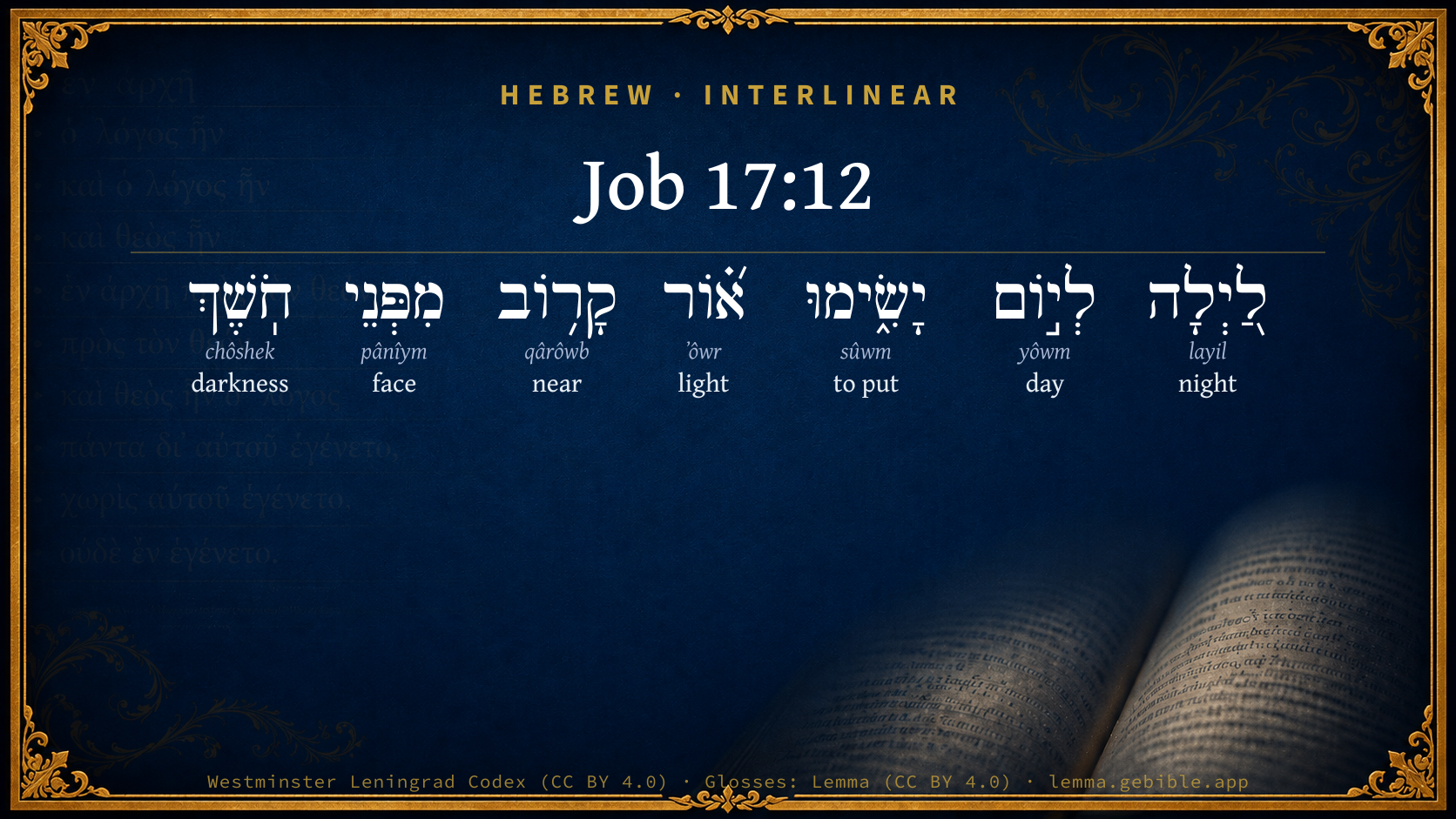
Hebrew (Westminster Leningrad Codex) Job 17:12 appears in the Hebrew Old Testament. The text above is from the Westminster Leningrad Codex. Each word links to its Strong’s number, a concise gloss, and parsing drawn from the Open Scriptures Hebrew Bible morphology. Click any word for its full Brown-Driver-Briggs (BDB) entry.
Download image
Cite this verse

Job 17:12 (World English Bible). Public Domain. Lemma interlinear Bible study tool, https://lemma.gebible.app/v/job/17/12.

Show BibTeX & RIS
BibTeX
RIS
English Translation
They change the night into day, Saying 'The light is near' in the presence of darkness.
World English Bible · Public Domain
Download a study sheet

One document with this verse’s original text, its word-by-word gloss line, the meaning frame, cross-references with their text, attributed commentary, and full source and license credits — printable, and it pastes into notes with its structure intact.

This verse Autodidact and up

Study sheet (.html) Plain text (.txt)

A passage Seminary Student

Up to 50 verses in one chapter. A passage sheet keeps up to 6 commentary sources and 12 cross-references per verse, in the order this page ranks them, and says so on the sheet whenever that leaves anything out. Ask for a single verse and you get the Autodidact verse sheet above.

Everything on this page stays free to read, with no account — the sheet is a download of what is already on screen, not access to it.

Want to remove ads? Support Godless Engineer
Compare translations 3

The same verse in 3 English versions, stacked beneath the original-language interlinear above. Click any original word for its lexicon entry.

Each is an independent rendering of the whole verse — the interlinear is not word-aligned to these translations.

Highlighted words mark where these versions differ — a whole-verse word diff, not a word-by-word alignment.

  • World English Bible Public Domain
    They change the night into day, Saying 'The light is near' in the presence of darkness.
  • King James Version Public Domain
    They change the night into day: the light is short because of darkness.
  • unfoldingWord Literal Text CC BY-SA 4.0
    They change night into day. Light is near from the face of darkness.

unfoldingWord Literal Text — © unfoldingWord, licensed CC BY-SA 4.0. Word-aligned USFM3 via Door43 (git.door43.org/unfoldingWord/en_ult).

Versions to compare (up to 4)

3 of 4 selected

Show all 18 translations

Every available English version of this verse, each an independent rendering of the whole verse.

  • World English Bible Public Domain
    They change the night into day, Saying 'The light is near' in the presence of darkness.
  • Berean Standard Bible Public Domain
    They have turned night into day, making light seem near in the face of darkness.
  • Majority Standard Bible Public Domain
    They have turned night into day, making light seem near in the face of darkness.
  • King James Version Public Domain
    They change the night into day: the light is short because of darkness.
  • American Standard Version (1901) Public Domain
    They change the night into day: The light, `say they', is near unto the darkness.
  • Revised Version (1885) Public Domain
    They change the night into a day: the fight, say they, is near unto the darkness.
  • Geneva Bible (1599) Public Domain
    Haue changed the nyght for the day, and the light that approched, for darkenesse.
  • Douay-Rheims (1899) Public Domain
    They have turned night into day, and after darkness I hope for light again.
  • Young's Literal Translation Public Domain
    Night for day they appoint, Light `is' near because of darkness.
  • Literal Standard Version CC BY-SA 4.0
    They appoint night for day, || Light [is] near because of darkness.
  • Unlocked Literal Bible CC BY-SA 4.0
    These people, these mockers, change the night into day; light is near to darkness.
  • unfoldingWord Literal Text CC BY-SA 4.0
    They change night into day. Light is near from the face of darkness.
  • Darby Bible Public Domain
    They change the night into day; the light [they imagine] near in presence of the darkness.
  • World Messianic Bible Public Domain
    They change the night into day, saying ‘The light is near’ in the presence of darkness.
  • Webster's Bible Public Domain
    They change the night into day: the light is short because of darkness.
  • Free Bible Version CC BY-SA 4.0
    They turn night into day, and say that daylight is close to darkness.
  • Bible in Basic English Public Domain
    They are changing night into day; they say, The light is near the dark.
  • JPS Tanakh (1917) Public Domain
    They change the night into day; the light is short because of darkness.

Literal Standard Version (2020), Covenant Press — licensed CC BY-SA 4.0. Text via the HelloAO Bible API (eBible.org). Unlocked Literal Bible (unfoldingWord) — licensed CC BY-SA 4.0. Text via the HelloAO Bible API (eBible.org). unfoldingWord Literal Text — © unfoldingWord, licensed CC BY-SA 4.0. Word-aligned USFM3 via Door43 (git.door43.org/unfoldingWord/en_ult). Free Bible Version, Dr. Jonathan Gallagher — licensed CC BY-SA 4.0. Text via the HelloAO Bible API (eBible.org).

Word by word

More ways to search: Search by grammar → Find every occurrence → Compare this word →

Practice this passage: Drill this verse → Learn its vocabulary →

About this verse

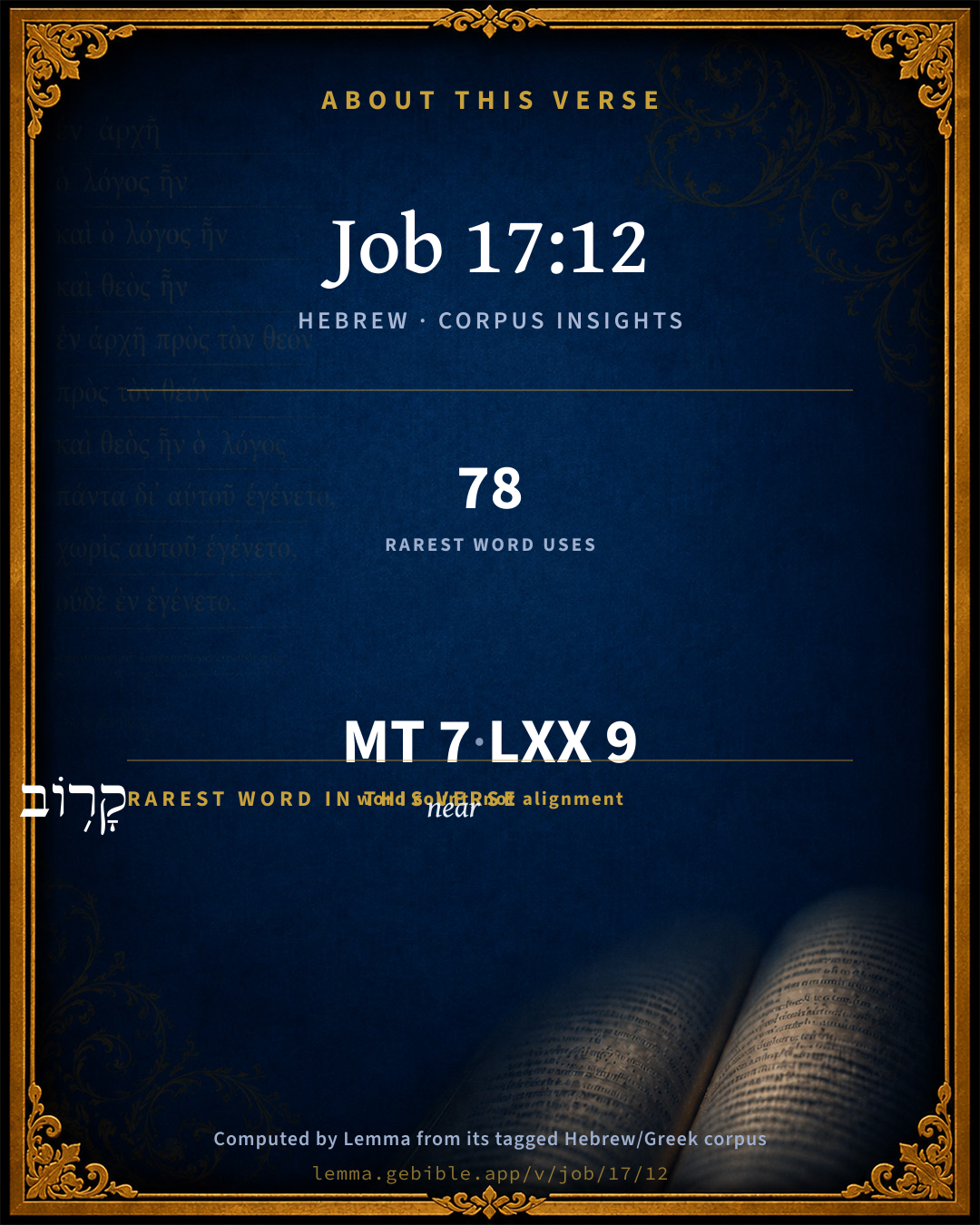
These counts appear in no published source. They are computed here, from the morphology-tagged text and Lemma’s own curated glosses. What Lemma adds →

7
words
7
distinct lemmas
Wisdom
section

Grammatical profile

  • 1 verb
  • 5 nouns
  • 1 adjective

Verb forms

  • יָשִׂ֑ימוּ Qal · Imperfect

Hebrew & Septuagint length

In English translation the verse runs 16 words from the Hebrew and 14 from the Septuagint (LXX English) — closely comparable.

A rough comparison of the two English renderings, which tokenize alike — not a word-level alignment.

Word counts can differ between the Hebrew and the Greek without any difference in meaning — e.g. the Hebrew direct-object marker אֵת has no separate Greek word, and Greek often adds the article ὁ.

In the original languages it is 7 Hebrew tokens and 9 Greek tokens — but the two are counted differently (Hebrew bundles its prefixes and suffixes into one token; the Greek is in lemma form), so that isn’t a like-for-like length.

Cross-references

4

Topical passages linked to Job 17:12 in the Treasury of Scripture Knowledge — connected by theme and wording, ordered by reader-vote popularity; previews shown in the World English Bible.

  • Deuteronomy 28:67 In the morning you shall say, Would it were even! and at even you shall say, Would it were morning! for the fear of your heart which you shall fear, and for the sight of your eyes which you shall see.
  • Job 7:3–4 So am I made to possess months of misery, Wearisome nights are appointed to me.
  • Job 7:13–14 When I say, 'My bed shall comfort me, My couch shall ease my complaint;'
  • Job 24:14–16 The murderer rises with the light. He kills the poor and needy. In the night he is like a thief.

Cross-references courtesy of OpenBible.info (CC BY 4.0).

Hebrew and Greek witnesses Masoretic Hebrew ↔ Greek Septuagint

The same verse in the two great witnesses to the Old Testament, shown verse-for-verse.

These are two independent witnesses, not word-aligned to each other, and the Septuagint is shown in lemma (dictionary) form.

Hebrew Job 17:12 Masoretic · Westminster Leningrad Codex

לַ֭יְלָה לְי֣וֹם יָשִׂ֑ימוּ א֝֗וֹר קָר֥וֹב מִפְּנֵי חֹֽשֶׁךְ

They change the night into day, Saying 'The light is near' in the presence of darkness.

World English Bible · Public Domain

Greek LXX Job 17:12 Septuagint · lemma form

νύξ εἰς ἡμέρα τίθημι φῶς ἐγγύς ἀπό πρόσωπον σκότος

I have turned the night into day: the light is short because of darkness.

LXX2012 (modern English Septuagint) · Public Domain

On this verse, Haydock's Catholic Bible Commentary discusses the Septuagint’s reading. Read the note in Commentary ↓

Hebrew: Westminster Leningrad Codex (CC BY 4.0). Greek: Septuagint (public domain); English from LXX2012 (modern English Septuagint) (Public Domain). How the Septuagint differs from the Hebrew →

Commentary

Notes on Job 17:12 from classic Christian and Jewish commentators (each source and its license shown beneath its notes). The classic Christian expositions comment on the surrounding passage and are grouped to its opening verse, so a note may address several verses; the Jewish commentaries on the Tanakh (Rashi and others) are per-verse, so they appear only where the commentator wrote on this verse.

Lemma curates 59 commentaries, every one of them public domain or Creative Commons licensed, each selected and text-cleaned for this edition rather than reprinted as found. About our sources →

Trapp's Complete Commentary

John Trapp

Job 17:12 They change the night into day: the light [is] short because of darkness.

Ver. 12. They change the night into day] i.e. My troubled thoughts render my nights restless, filling me with confusion. When the mind is unsettled the man cannot rest.

The light is short because of darkness] i.e. Comfort is long ere it cometh, and soon it expireth; Rara hora, brevis mora Rare the hour, short the delay (Bern.). The Vulgar, Post tenebras spero lucem, here, After darkness I hope for light (the ancient motto of the town of Geneva), is far fetched.

John Trapp, A Commentary or Exposition upon All the Books of the Old and New Testament (1647–1656) — public domain. Text from a community e-Sword module.

Joseph Benson's Commentary

Job 17:12. They change the night into day — My distressing thoughts, griefs, and fears, so incessantly pursue and disturb me, that I can no more sleep in the night than in the day. The light is short — The day-light, which often gives some comfort to men in misery, seems to be gone and fled as soon as it is begun; because of darkness — Because of my grievous pains and torments, which follow me by day as well as by night.

Joseph Benson's Commentary on the Old and New Testaments (1811–1818) — public domain. Text from a community e-Sword module.

Geneva Bible (1599)

Geneva Bible translators

That is, have brought me sorrow instead of comfort.

Geneva Bible (1599) marginal notes — public domain. Text via Bolls.life.

Jamieson, Fausset & Brown

Robert Jamieson, A. R. Fausset & David Brown

They--namely, "my friends."

change the night into day--that is, would try to persuade me of the change of my misery into joy, which is impossible [UMBREIT] (Job 11:17); (but) the light of prosperity (could it be enjoyed) would be short because of the darkness of adversity. Or better for "short," the Hebrew "near"; "and the light of new prosperity should be near in the face of (before) the darkness of death"; that is, they would persuade me that light is near, even though darkness approaches.

Jamieson, Fausset & Brown — Commentary Critical and Explanatory on the Whole Bible (1871) — public domain (CC PDM 1.0). Text via the HelloAO Bible API.

Adam Clarke's Commentary

Verse 12. They change the night into day] These purposes and thoughts are so very gloomy, that they change day into night.

The light is short because of darkness.] אור קרוב מפני חשך or karob mippeney choshek, "The light is near from the face of darkness." I have scarcely any light: what is called light is so near akin to darkness, that it is scarcely severed from it. There is either no light, or merely such as is sufficient to render darkness visible. A fine picture of the state of his mind-he was generally in darkness; but had occasional gleams of hope.

Adam Clarke's Commentary on the Bible (1810–1826) — public domain. Text from a community e-Sword/MySword module.

Ellicott's Commentary for English Readers

(12) They change the night into day.—Comp. Job_11:17. So little did his friends enter into his case that they wanted him to believe that his night of trial was the reverse of darkness, and that there was light at hand. This was to him only the more painful mockery, because of its contrast to his felt condition. He, on the contrary, says that his only hope is in the grave. “The light,” say they, “is near unto the darkness; that it is near before the darkness cometh; they try to persuade me that prosperity is close at hand.”

A Bible Commentary for English Readers, edited by Charles John Ellicott (1878–1897) — public domain. Text from a community e-Sword module.

The Cambridge Bible for Schools and Colleges

gen. ed. J. J. S. Perowne

12. This verse appears to be a description by Job of the delusive and foolish proceeding of his friends.

They change the night into day] The night of calamity and death in which Job is enveloped and into which he is entering more deeply they change into the day of life and renewed prosperity. While in truth the shadows of the final night encompass Job the friends are for ever pretending that the bright day of restoration is going to dawn (cf. ch. Job_5:17 seq., Job_8:20 seq. &c.). The second clause of the verse is obscure.

the light is short because of darkness] The meaning of the A.V. is not easy to perceive. The words most naturally continue Job’s account of the representations of his friends, and express what they hold out. The fair literal rendering is either, the light is near the face of darkness; or, the light is nearer than the face of darkness. The light, the same as the “day” of the first clause, is life and prosperity; this the friends make out to be near, close upon, the face of darkness—Job’s present condition of affliction. The other translation, “nearer than the face of darkness,” gives a fuller sense to the phrase face of darkness. By this expression Job means the darkness of death, whose face was visible and manifest, so close was it upon him.

The Cambridge Bible for Schools and Colleges (gen. ed. J. J. S. Perowne; Cambridge University Press, 1878–1918) — public domain. Text from a community e-Sword module.

John Gill's Exposition

They change the night into day,.... Meaning either his friends, by what they had said unto him, or the thoughts of his heart, which comes to the same sense; these being in the night season employed about what had been said to him in the day, insomuch that he could get no sleep, the night was as broad day unto him; or they put the day before the night, contrary to the order of nature, as Noldius (z) observes, whereas the night is before the day, Gen 1:5; his friends promising him long days, and an age clearer than noon day, as bright as the morning, Job 11:17; when the night of death was coming on, and he was hastening to the dark and silent grave:

the light is short because of darkness; the morning light, or light of the day, when that comes continues but for a short time, because of the darkness of the evening, which quickly follows; or because of the darkness of fiction, which fills it up, and makes it uncomfortable; or the light of prosperity, could it be enjoyed, is but short, because of the darkness of adversity; or "the light is near" (a), as in the original text; though Jarchi interprets the word "short" as we do; Noldius renders it, "the light is rather nearer than darkness" (b); after the night has been spent without sleep, the morning light is nearer than darkness; that may soon be expected, and so an end to sleep and rest.

(z) Ebr. Part. Concord. No. 1931. (a) "propinquam", Pagninus, Montanus; so Junius & Tremellius, Piscator, &c. (b) Ib. p. 642.

John Gill's Exposition of the Whole Bible (1746–1763) — public domain (CC PDM 1.0). Text via the HelloAO Bible API.

Albert Barnes' Notes on the Bible

They change - The word “they” in this place, some understand as referring to his friends; others, to his thoughts. Rosenmuller supposes it is to be taken impersonally, and that the meaning is, “night is become day to me.” Wemyss translates it, “night is assigned me for day.” So Dr. Good renders it. The meaning may be, that the night was to him as the day. He had no rest. The period when he had formerly sought repose, was now made like the day, and all was alike gloom and sadness.

The light is short because of darkness - Margin, near. The meaning is, probably, “even the day has lost its usual brilliancy and cheerfulness, and has become gloomy and sad. It seems to be like night. Neither night nor day is natural to me; the one is restless and full of cares like the usual employments of day, and the other is gloomy, or almost night, where there is no comfort and peace. Day brings to me none of its usual enjoyments. It is short, gloomy, sad, and hastens away, and a distressing and restless night soon comes on.”

Albert Barnes' Notes on the Bible (1834–1885) — public domain. Text from a community e-Sword/MySword module.

Haydock's Catholic Bible Commentary

Day. Sleep flees from me. (Menochius) --- All is in confusion. --- After. Hebrew and Septuagint, "light is near in the face of darkness." (Haydock) --- I still hope for relief.

George Leo Haydock (1774–1849), Haydock's Catholic Family Bible and Commentary, 1859 edition — public domain. Excludes Psalms (Douay-Rheims chapter numbering differs from Protestant) and Deuterocanonical books (Catholic canon only).

Matthew Poole's English Annotations

They; either,

1. My friends. Or,

2. My sorrows, of which he is here speaking. Or,

3. My thoughts, last mentioned. Possibly these words may be joined with them thus, The thoughts of my heart change the night into day.

Change the night into day; they do so incessantly pursue and disturb me, that I can no more rest and sleep in the dark and silent nights, than in the midst of the light and tumults of the day. Or,

they change the day into night, Heb. they put the night for or instead of (as the Hebrew lamed is elsewhere used) the day, i.e. they make the day as sad and dark as the night to me. So it seems best to agree with the following branch of the verse.

The light is short, i.e. the day-light, which ofttimes gives some little comfort and refreshment to men in misery, seems to be gone and fled as soon as it is begun.

Because of darkness, i.e. because of my grievous pains and torments, which follow me by day as well as by night.

Matthew Poole's English Annotations on the Holy Bible (1683–1685) — public domain. Text from a community e-Sword/MySword module.

Whedon's Commentary on the Bible

Daniel D. Whedon

12. Night into day — Literally, they put night for the day — That is, day hath become night to me. ישׂימו, is used impersonally. Conant’s rendering, “Night is joined to day.” is not sustained.

The light is short. — Among the various readings is that of Hahn and Zockler: “Light is near in the presence of darkness:” that is, such is the representation made by the friends when really there is nothing but darkness. Dillmann and Ewald make מן a comparative, nearer than — a feeble and inconsequential thought. The reading of Hengstenberg, the light is near to darkness, which substantially agrees with that of Evans, is decidedly to be preferred. The light of my life is near the darkness of death. The Latin language, like the Arabic, has a similar construction to express “nearness from” — prope abesse a. The full development of this thought, says Wordsworth, (following the first reading above,) is found in the sublime speech of the Christian martyr Saint Ignatius, on the eve of suffering, to his friends who persuaded him to sue for a prolongation of life: “My birth is at hand. O, my friends, do not hinder me from living. Do not desire that I should die. Let me have a sight of that pure light. Let me have a sunset to the world, that I may have a sunrise to God.”

Daniel D. Whedon (gen. ed.), Commentary on the Old and New Testaments (1874–1909) — public domain. Text from a community e-Sword module.

The Pulpit Commentary

They change the night into day. They, my detractors, who are also my so-called "comforters," pretend to change my night into day; assure me that the cloud which rests on me is only for a time, and will ere long give place to the brightness of day, to a glorious burst of sunshine. (see Job_5:18-26 Job_8:21, 22 11:15-19) The light (they say) is short because of darkness; or, rather, is near because of the darkness. To extreme darkness shows that dawn must be near, that the day must soon break when my sorrow will be turned into joy. Job had not found himself comforted by these assurances, which lacked the ring of sincerity, and could not be accomplished except by miracle, which he did not feel that he had any right to expect.

The Pulpit Commentary (1880–1919), ed. H.D.M. Spence-Jones & Joseph S. Exell — public domain. Text from a community e-Sword module.

John Wesley's Explanatory Notes

They - My thoughts so incessantly pursue and disturb me, that I can no more sleep in the night, than in the day. The light - The day-light, which often gives some comfort to men in misery, seems to be gone as soon as it is begun. Darkness - Because of my grievous pains and torments which follow me by day as well as by night.

John Wesley, Explanatory Notes Upon the Whole Bible (1754–1765) — public domain. Text via the GEBible commentary corpus.

Rashi

Rabbi Shlomo Yitzchaki (Rashi)

They turn night into day These mockers turn night into day for me, for I cannot sleep at night because of the trouble of the mockings.

the light is short lit. קרוב, near, and short for me because of the trouble of the darkness of the night. The light is short; when the sun sets, it appears to me as though a short time ago the day dawned, was shortened, and left. This is like (Gen. 19:20), “this city is recent (קרובה)” it was newly settled recently and like (below 20:5), “That the triumph of the wicked is short (מקרוב),” and like (Deut. 32:17), “new ones that came up of late (מקרוב).”

Rashi on the Tanakh — English translations: “The Judaica Press complete Tanach with Rashi, translated by A. J. Rosenberg” (CC BY 4.0); “Pentateuch with Rashi's commentary by M. Rosenbaum and A.M. Silbermann, 1929-1934” (public domain); “The Metsudah Tanach series, Lakewood, N.J” (CC BY 4.0); and “The Book of Joshua, Metsudah Publications, 1997” (CC BY 4.0). Text via Sefaria.

Lesson kit

Teaching starters — assembled from the data on this page, not authored interpretation. Every prompt links to the verse data it draws on. Edit before teaching.

Job, in the Wisdom, opens this verse with 7 words (7 distinct Hebrew lemmas). Its most distinctive word is qârôwb (“near”). A historical commentator’s framing appears above. Read the whole chapter for the surrounding context.

Discussion questions

  1. How does “near” (qârôwb) shape what this verse is saying?
  2. Deuteronomy 28:67 shares this passage’s theme. How do the two illuminate each other?
  3. These translations render this verse differently. What is at stake in choosing one wording over another?
  4. The verb «יָשִׂ֑ימוּ» is Qal Imperfect. How does its form color the action?
  5. Reading how Trapp's Complete Commentary and Joseph Benson's Commentary read this verse, where do the two commentators agree and where do they part?

Things to notice

Reading settings

Reading text

Shown beneath each verse's original-language words.

Old Testament
Old Testament edition

Read the OT as the Masoretic Hebrew (MT) or the Greek Septuagint (LXX).

English shown for the Greek Septuagint (in the Hebrew ↔ Greek comparison).

Comparing translations? Open the Compare panel on any verse page to stack up to four side by side.