
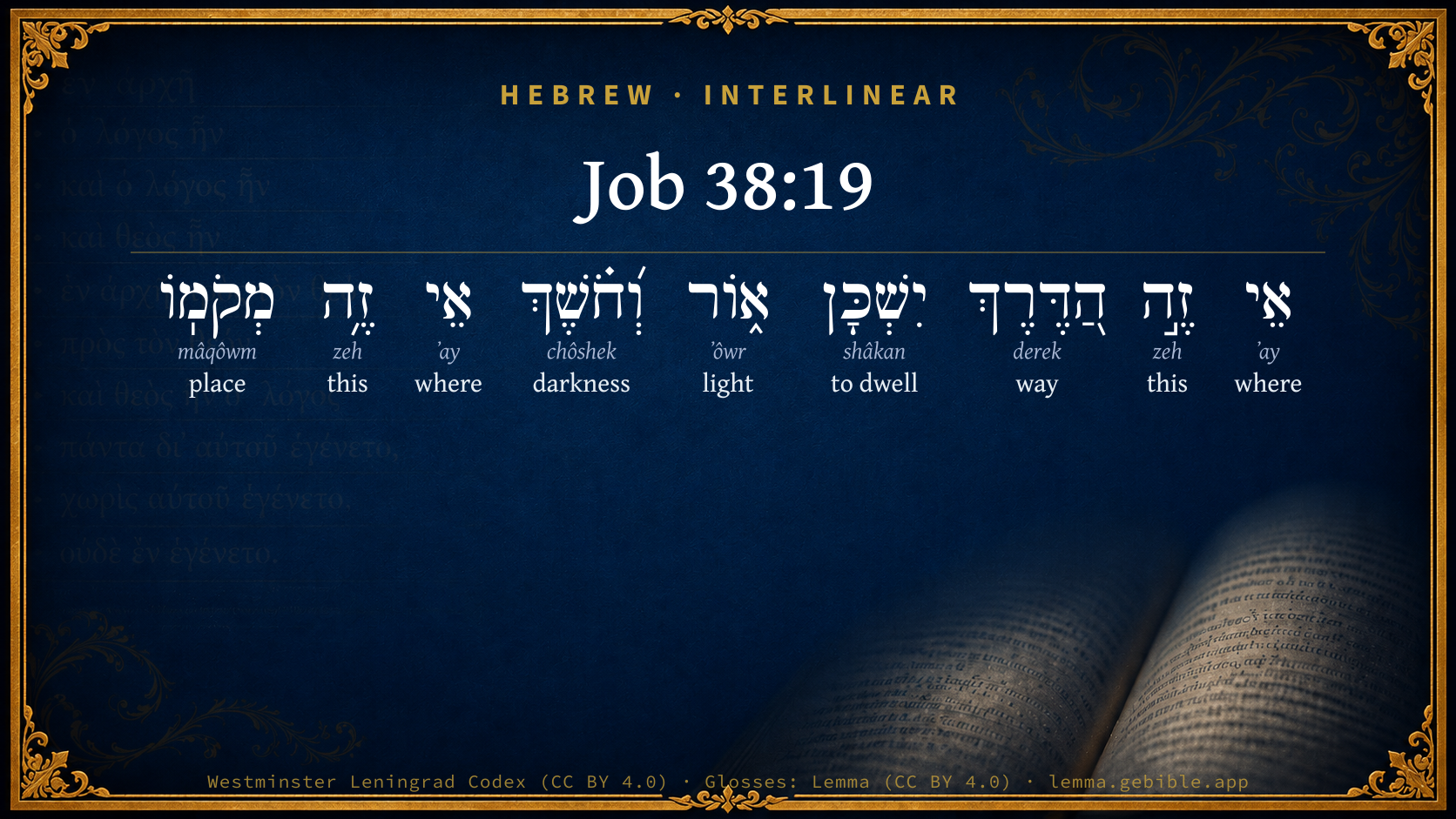
Job 38:19

Hebrew (Westminster Leningrad Codex) Job 38:19 appears in the Hebrew Old Testament. The text above is from the Westminster Leningrad Codex. Each word links to its Strong’s number, a concise gloss, and parsing drawn from the Open Scriptures Hebrew Bible morphology. Click any word for its full Brown-Driver-Briggs (BDB) entry.
Download image
Cite this verse

Job 38:19 (World English Bible). Public Domain. Lemma interlinear Bible study tool, https://lemma.gebible.app/v/job/38/19.

Show BibTeX & RIS
BibTeX
RIS
English Translation
"What is the way to the dwelling of light? As for darkness, where is the place of it,
World English Bible · Public Domain
Download a study sheet

One document with this verse’s original text, its word-by-word gloss line, the meaning frame, cross-references with their text, attributed commentary, and full source and license credits — printable, and it pastes into notes with its structure intact.

This verse Autodidact and up

Study sheet (.html) Plain text (.txt)

A passage Seminary Student

Up to 50 verses in one chapter. A passage sheet keeps up to 6 commentary sources and 12 cross-references per verse, in the order this page ranks them, and says so on the sheet whenever that leaves anything out. Ask for a single verse and you get the Autodidact verse sheet above.

Everything on this page stays free to read, with no account — the sheet is a download of what is already on screen, not access to it.

Want to remove ads? Support Godless Engineer
Compare translations 3

The same verse in 3 English versions, stacked beneath the original-language interlinear above. Click any original word for its lexicon entry.

Each is an independent rendering of the whole verse — the interlinear is not word-aligned to these translations.

Highlighted words mark where these versions differ — a whole-verse word diff, not a word-by-word alignment.

  • World English Bible Public Domain
    "What is the way to the dwelling of light? As for darkness, where is the place of it,
  • King James Version Public Domain
    Where is the way where light dwelleth? and as for darkness, where is the place thereof,
  • unfoldingWord Literal Text CC BY-SA 4.0
    Where this, the way light dwells, and darkness, where this, its place,

unfoldingWord Literal Text — © unfoldingWord, licensed CC BY-SA 4.0. Word-aligned USFM3 via Door43 (git.door43.org/unfoldingWord/en_ult).

Versions to compare (up to 4)

3 of 4 selected

Show all 18 translations

Every available English version of this verse, each an independent rendering of the whole verse.

  • World English Bible Public Domain
    "What is the way to the dwelling of light? As for darkness, where is the place of it,
  • Berean Standard Bible Public Domain
    Where is the way to the home of light? Do you know where darkness resides,
  • Majority Standard Bible Public Domain
    Where is the way to the home of light? Do you know where darkness resides,
  • King James Version Public Domain
    Where is the way where light dwelleth? and as for darkness, where is the place thereof,
  • American Standard Version (1901) Public Domain
    Where is the way to the dwelling of light? And as for darkness, where is the place thereof,
  • Revised Version (1885) Public Domain
    Where is the way to the dwelling of light, and as for darkness, where is the place thereof;
  • Geneva Bible (1599) Public Domain
    Where is the way where light dwelleth? and where is the place of darkenesse,
  • Douay-Rheims (1899) Public Domain
    Where is the way where light dwelleth, and where is the place of darkness:
  • Young's Literal Translation Public Domain
    Where `is' this -- the way light dwelleth? And darkness, where `is' this -- its place?
  • Literal Standard Version CC BY-SA 4.0
    Where [is] this—the way light dwells? And darkness, where [is] this—its place?
  • Unlocked Literal Bible CC BY-SA 4.0
    Where is the way to the resting place of light— as for darkness, where is its place?
  • unfoldingWord Literal Text CC BY-SA 4.0
    Where this, the way light dwells, and darkness, where this, its place,
  • Darby Bible Public Domain
    Where is the way to where light dwelleth? and the darkness, where is its place,
  • World Messianic Bible Public Domain
    “What is the way to the dwelling of light? As for darkness, where is its place,
  • Webster's Bible Public Domain
    Where is the way where light dwelleth? and as for darkness, where is its place,
  • Free Bible Version CC BY-SA 4.0
    In which direction does light live? Where does darkness dwell?
  • Bible in Basic English Public Domain
    Which is the way to the resting-place of the light, and where is the store-house of the dark;
  • JPS Tanakh (1917) Public Domain
    Where is the way to the dwelling of light, and as for darkness, where is the place thereof;

Literal Standard Version (2020), Covenant Press — licensed CC BY-SA 4.0. Text via the HelloAO Bible API (eBible.org). Unlocked Literal Bible (unfoldingWord) — licensed CC BY-SA 4.0. Text via the HelloAO Bible API (eBible.org). unfoldingWord Literal Text — © unfoldingWord, licensed CC BY-SA 4.0. Word-aligned USFM3 via Door43 (git.door43.org/unfoldingWord/en_ult). Free Bible Version, Dr. Jonathan Gallagher — licensed CC BY-SA 4.0. Text via the HelloAO Bible API (eBible.org).

Word by word

More ways to search: Search by grammar → Find every occurrence → Compare this word →

Practice this passage: Drill this verse → Learn its vocabulary →

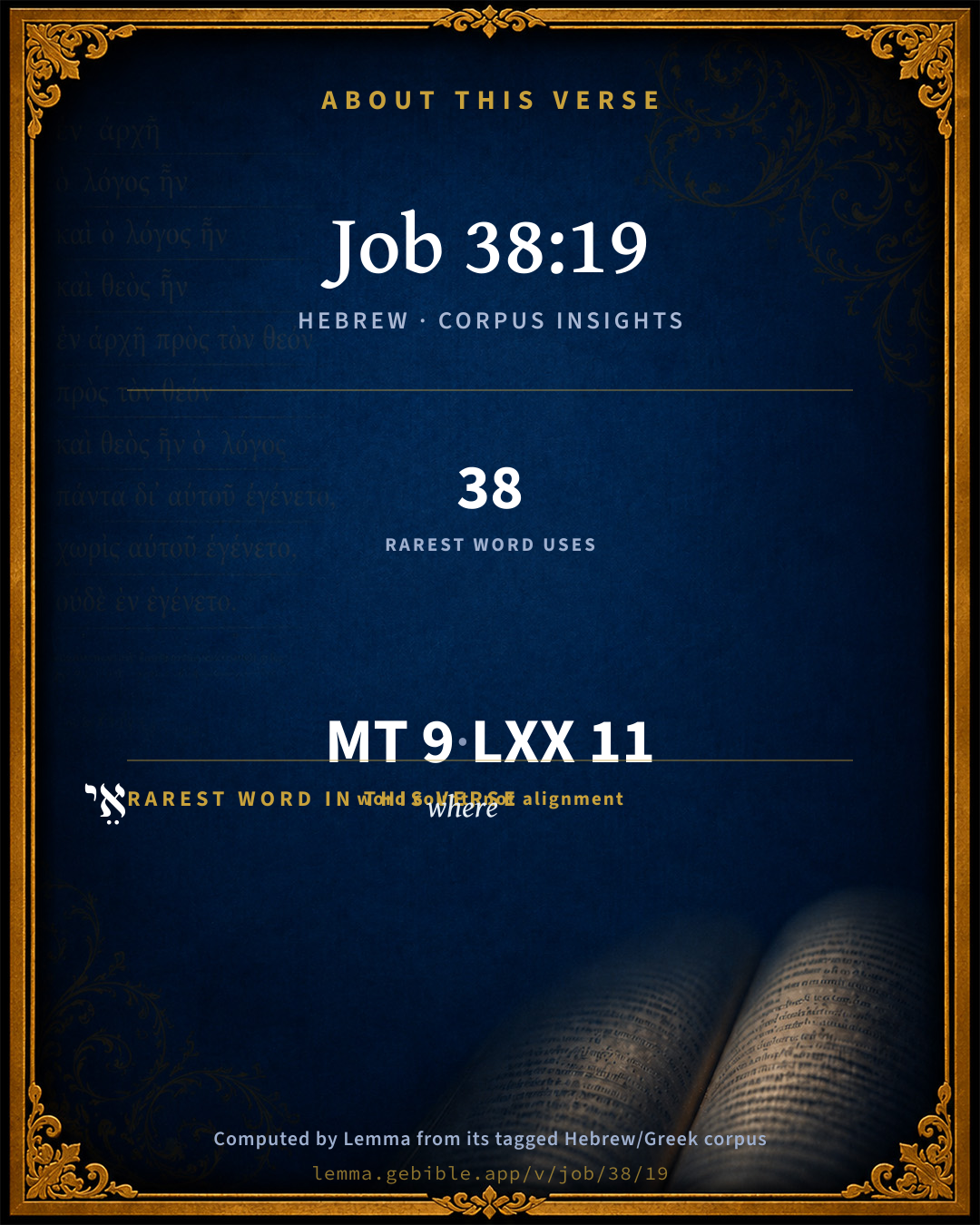
About this verse

These counts appear in no published source. They are computed here, from the morphology-tagged text and Lemma’s own curated glosses. What Lemma adds →

9
words
7
distinct lemmas
Wisdom
section

Shared distinctive vocabulary

אֵי where H335 occurs in 36 verses of the Hebrew Bible. Also found in:

Grammatical profile

  • 1 verb
  • 4 nouns
  • 2 pronouns
  • 2 particles

Verb forms

  • יִשְׁכָּן Qal · Imperfect

Repetition

Words recur within this verse — often emphatic in Hebrew:

  • אֵי where H335 ×2
  • זֶ֣ה this H2088 ×2

Hebrew & Septuagint length

In English translation the verse runs 18 words from the Hebrew and 20 from the Septuagint (LXX English) — closely comparable.

A rough comparison of the two English renderings, which tokenize alike — not a word-level alignment.

Word counts can differ between the Hebrew and the Greek without any difference in meaning — e.g. the Hebrew direct-object marker אֵת has no separate Greek word, and Greek often adds the article ὁ.

In the original languages it is 9 Hebrew tokens and 11 Greek tokens — but the two are counted differently (Hebrew bundles its prefixes and suffixes into one token; the Greek is in lemma form), so that isn’t a like-for-like length.

Cross-references

14

Topical passages linked to Job 38:19 in the Treasury of Scripture Knowledge — connected by theme and wording, ordered by reader-vote popularity; previews shown in the World English Bible.

  • Ezekiel 32:8 All the bright lights of the sky will I make dark over you, and set darkness on your land, says the Lord Yahweh.
  • Genesis 1:3–4 God said, "Let there be light," and there was light.
  • Genesis 1:14–18 God said, "Let there be lights in the expanse of sky to divide the day from the night; and let them be for signs, and for seasons, and for days and years;
  • Deuteronomy 4:19 and lest you lift up your eyes to the sky, and when you see the sun and the moon and the stars, even all the host of the sky, you are drawn away and worship them, and serve them, which Yahweh your God has allotted to all the peoples under the whole sky.
  • Job 38:12–13 "Have you commanded the morning in your days, And caused the dawn to know its place;
  • Psalms 18:11 He made darkness his hiding-place, his pavilion around him, Darkness of waters, thick clouds of the skies.
  • Psalms 104:20 You make darkness, and it is night, In which all the animals of the forest prowl.
  • Psalms 105:28 He sent darkness, and made it dark. They didn't rebel against his words.
  • Isaiah 45:7 I form the light, and create darkness; I make peace, and create evil. I am Yahweh, who does all these things.
  • Amos 4:13 For, behold, he who forms the mountains, And creates the wind, And declares to man what is his thought; Who makes the morning darkness, And treads on the high places of the Earth: Yahweh, the God of hosts, is his name."
  • Matthew 27:45 Now from the sixth hour there was darkness over all the land until the ninth hour.
  • Jeremiah 13:16 Give glory to Yahweh your God, before he cause darkness, and before your feet stumble on the dark mountains, and, while you look for light, he turn it into the shadow of death, and make it gross darkness.
  • John 1:9 The true light that enlightens everyone was coming into the world.
  • John 8:12 Again, therefore, Jesus spoke to them, saying, "I am the light of the world. He who follows me will not walk in the darkness, but will have the light of life."

Cross-references courtesy of OpenBible.info (CC BY 4.0).

Hebrew and Greek witnesses Masoretic Hebrew ↔ Greek Septuagint

The same verse in the two great witnesses to the Old Testament, shown verse-for-verse.

These are two independent witnesses, not word-aligned to each other, and the Septuagint is shown in lemma (dictionary) form.

Hebrew Job 38:19 Masoretic · Westminster Leningrad Codex

אֵי זֶ֣ה הַ֭דֶּרֶךְ יִשְׁכָּן א֑וֹר וְ֝חֹ֗שֶׁךְ אֵי זֶ֥ה מְקֹמֽוֹ

"What is the way to the dwelling of light? As for darkness, where is the place of it,

World English Bible · Public Domain

Greek LXX Job 38:19 Septuagint · lemma form

ποῖος δέ γῆ αὐλίζω ὁ φῶς σκότος δέ ποῖος ὁ τόπος

And in what kind of a land does the light dwell? and of what kind is the place of darkness?

LXX2012 (modern English Septuagint) · Public Domain

On this verse, Whedon's Commentary on the Bible discusses the Septuagint’s reading. Read the note in Commentary ↓

Hebrew: Westminster Leningrad Codex (CC BY 4.0). Greek: Septuagint (public domain); English from LXX2012 (modern English Septuagint) (Public Domain). How the Septuagint differs from the Hebrew →

Commentary

Notes on Job 38:19 from classic Christian and Jewish commentators (each source and its license shown beneath its notes). The classic Christian expositions comment on the surrounding passage and are grouped to its opening verse, so a note may address several verses; the Jewish commentaries on the Tanakh (Rashi and others) are per-verse, so they appear only where the commentator wrote on this verse.

Lemma curates 59 commentaries, every one of them public domain or Creative Commons licensed, each selected and text-cleaned for this edition rather than reprinted as found. About our sources →

Trapp's Complete Commentary

John Trapp

Job 38:19 Where [is] the way [where] light dwelleth? and [as for] darkness, where [is] the place thereof,

Ver. 19. Where is the way where light dwelleth?] These are poetic terms likewise; which signify, or mean nothing else, but that God alone, without any help or work of any man, appointed the various points of sunrising and sunsetting.

And as for darkness, where is the place thereof?] i.e. Little canst thou tell what is become of it, or where the sun setteth; by the absence whereof cometh darkness. The truth is, our reason is by original sin so darkened that we understand not these lesser and common matters. Those that are more high and hard we learn not but with much labour and long experience. As for the mysteries of God, and things pertaining to salvation, we cannot at all attain unto them by human reason, as is to be seen in Nicodemus, Joh 3:9-10 1Co 2:14

John Trapp, A Commentary or Exposition upon All the Books of the Old and New Testament (1647–1656) — public domain. Text from a community e-Sword module.

Joseph Benson's Commentary

Job 38:19. Where is the way — Or, rather, the place, as the next clause explains it; and, as the Hebrew דרךְ, derech, will bear, where light dwelleth — That is, hath its constant and settled abode. Whither goes the sun when he departs from this hemisphere? Where are the tabernacle and the chamber in which he is supposed to rest? And seeing there was a time when there was nothing but gross darkness upon the face of the earth, what way came light into the world? Which was the place where light dwelt at that time, and whence was it fetched? And whence came that orderly constitution and constant succession of light and darkness? Was this thy work? Or wast thou privy to it, or a counsellor, or assistant in it?

Joseph Benson's Commentary on the Old and New Testaments (1811–1818) — public domain. Text from a community e-Sword module.

Whedon's Commentary on the Bible

Daniel D. Whedon

β. He must also understand the cosmical phenomena of light and darkness; must not only know the paths to their house, but himself, venerable in years, must at some time have escorted them to their home, Job_38:19-21.

19. Way where light dwelleth — Neither does the corpuscular theory of Newton, nor Huyghens’ undulatory theory, account for the rise, the cause, or the source of light. Its dwelling place, “in what kind of land it dwells,” (Septuagint,) is an impenetrable mystery. “Ask of the learned THE WAY, the learned are blind.”

Speaking of light, Prof. Tyndall remarks: “We are here dealing, for the most part, with suppositions and assumptions merely. We have never seen the atoms of a luminous body, nor their motions. We have never seen the medium which transmits their motions, nor the waves of that medium.” — The Forms of Water, pp. 10, 12. And yet science has penetrated so far into the arcana of nature as to measure the magnitude of ‘the light waves’ by their effects, and to find them varying from one thirty thousandth to one sixty thousandth of an inch. “The whole of that region of space over which astronomers have extended their survey, and doubtless a region many millions of millions of times more extended, may be compared to a wave-tossed sea, only that, instead of a wave-tossed surface, there is a wave-tossed space. At every point, through every point, along every line, athwart every line, myriads of light waves are at all times rushing with the inconceivable velocity of 185,000 miles per second.” — R.A. Proctor. Science, instead of solving, is constantly adding to, its difficulties. Its tetra incognita — its land of the unknown — in an inverse ratio to the explorations made, is constantly enlarging. The most approved works of modern science, professedly clearing the way to the penetralia of nature, do but little more than open up a multitude of indeterminate problems. The haze that rests upon the nature of ultimate material causes — upon the beginning or essence of nature’s forces — is no less dense now than in the days of Job. The secret of this lies in the profound thought of Edmund Burke, that every subject we attempt to explore branches into the infinite. The most that philosophy does is to record the processes of nature — to peer a little into the infinite unknown, in which the primordia of nature DWELL. To make man sensible of his consummate ignorance, and to open up to him the essential finiteness of the human mind, is really the gist of these questions; questions which, though they he never so simple, philosophy will be powerless fully to unfold so long as mind is cased in flesh and blood. “As in Genesis i, the light is here regarded as a self-subsistent, natural force, independent of the heavenly luminaries by which it is transmitted; and herein modern investigation agrees with the direct observations of antiquity.” — Schlottmann. See an article entitled “Drifting Light Waves,” by R.A. Proctor, in Contemporary Review, 1877, 2. pp. 219-240. Also, “On the Place where Light Dwelleth,” in Eclectic Magazine, 1870, i, pp. 725-739; 2. 80-86, taken from the British Quarterly Review.

Daniel D. Whedon (gen. ed.), Commentary on the Old and New Testaments (1874–1909) — public domain. Text from a community e-Sword module.

Jamieson, Fausset & Brown

Robert Jamieson, A. R. Fausset & David Brown

The marvels in heaven. "What is the way (to the place wherein) light dwelleth?" The origin of light and darkness. In Gen 1:3-5, Gen 1:14-18, "light" is created distinct from, and previous to, light-emitting bodies, the luminaries of heaven.

Jamieson, Fausset & Brown — Commentary Critical and Explanatory on the Whole Bible (1871) — public domain (CC PDM 1.0). Text via the HelloAO Bible API.

Adam Clarke's Commentary

Verse 19. Where light dwelleth] What is the source of light? Yea, what is light itself? It is not in the sun, for light was before the sun; but what is light? It is no doubt a substance; but of what kind? and of what are its particles? As to darkness, what is IT? Is it philosophical to say, it is the mere privation of light? I shall think philosophy has made some advances to general accuracy and perfection when it proves to us what cold is, and what darkness is, leaving mere privations out of the question.

Adam Clarke's Commentary on the Bible (1810–1826) — public domain. Text from a community e-Sword/MySword module.

The Cambridge Bible for Schools and Colleges

gen. ed. J. J. S. Perowne

19. The first clause reads,

What is the way to where light dwelleth?

Light and darkness are here regarded as things independent of one another; they are both real agents, each of which has its place or abode, from which it streams forth over the earth, and to which it is again taken back (Job_38:20).

19–21. Light and darkness.

19–38. The wonders of the heavens.

The Cambridge Bible for Schools and Colleges (gen. ed. J. J. S. Perowne; Cambridge University Press, 1878–1918) — public domain. Text from a community e-Sword module.

John Gill's Exposition

Where is the way where light dwelleth?.... Or the way to the place where it dwells, and what that is;

and as for darkness, where is the place thereof? where these were placed when they were first separated at the creation? where light goes and dwells, when it departs from us at sun setting? and where the darkness betakes itself, and makes its abode at sun rising? What is the chamber of the sun, and the tabernacle of it? from whence it sets out, and whither it returns? And though these questions may be answered by geographers and astronomers in their way; yet they seem to respect chiefly the disposal of light and darkness, in such a manner as to cause the revolution of them, and the inequality of days and nights in different seasons and climates; and which is not in the power of men to effect, but depends on the sovereign will of God.

John Gill's Exposition of the Whole Bible (1746–1763) — public domain (CC PDM 1.0). Text via the HelloAO Bible API.

Albert Barnes' Notes on the Bible

Where is the way where light dwelleth? - Or, rather, where is the way or path to the place where light dwells? Light is conceived of as coming from a great distance, and as having a place which might be regarded as its home. It comes in the morning, and is withdrawn at evening, and it seems as if it came from some far distant dwelling-place in the morning to illuminate the world, and then retired to its home in the evening, and thus gave place for darkness to visit the earth. The idea is this, “Dost thou know, when the light withdraws from the world, to what place it betakes itself as its home? Canst thou follow it to its distant abodes, and tell where they are? And when the shadows of night come forth, and take its place, canst thou tell whence they come; and when they withdraw again in the morning, canst thou follow them, and tell where they are congregated together to abide?” The thought is highly poetic, and is not to be taken literally. The meaning is, that God only could know what was the great fountain of light, and where that was; and the question substantially may be asked of man with as much force and propriety now as in the time of Job. Who knows what is the great fountain of light to the universe? Who knows what light is? Who can explain the causes of its rapid flight from world to world? Who can tell what supplies it, and prevents it from being exhausted? Who but God, after all the discoveries of science, can fully understand this?

And as for darkness, where is the place thereof? - Darkness here is personified. It is represented as having a place of abode as coming forth to take the place of light when that is withdrawn, and again as retiring to its dwelling when the light reappears.

Albert Barnes' Notes on the Bible (1834–1885) — public domain. Text from a community e-Sword/MySword module.

Haydock's Catholic Bible Commentary

Darkness. The poetical style of this book represents these things as real beings, in the same manner (Calmet) as the house, (ver. 20) or palace of the sun, &c., are described by the ancients. (Haydock)

George Leo Haydock (1774–1849), Haydock's Catholic Family Bible and Commentary, 1859 edition — public domain. Excludes Psalms (Douay-Rheims chapter numbering differs from Protestant) and Deuterocanonical books (Catholic canon only).

Matthew Poole's English Annotations

The way; or rather, the place, as the next clause explains it, and the Hebrew phrase will bear.

Where light dwelleth, i.e. hath its constant and settled abode; for in the place where Job lived, and in most other parts of the inhabited world, it is like a traveller, that cometh and goeth continually every day. This may be referred either,

1. To the place under the two poles, where first the light, and then the darkness, continues for six months together. Or rather,

2. To the sun, the fountain of light. And as this is a poetical book, so this may be a poetical expression and question, Whither goes the sun, when it departs from this hemisphere? Where is the tabernacle and the chamber in which both sacred, as Psa 19:4,5, and profane poets suppose the sun to rest? Dost thou know the place where the sun when it sets may be found, and whence thou canst fetch it back again. For it is to be carefully observed, that he speaks not here of a bare and simple knowledge of this matter, which was plain and easy to Job, and many others, who were not ignorant that the sun was the fountain of light, from whose approach light comes, and by whose departure darkness is caused; but of an operative knowledge, even such as could and did enable him to take it to the bound thereof, as it follows, Job 38:20. And withal, he seems here to speak not only of the daily course and motion of the sun, and the vicissitude of day and night, but also and especially of the first production of the light, which was before Job was born, as is evident from Job 38:21. And this makes the question more difficult and more considerable, the sense whereof may be this: Seeing there was a time when there was nothing but gross and comfortless darkness upon the face of the earth, what way came light into the world? which was the place where light dwelt at that time, and whence it was fetched? and whence came that orderly constitution and constant succession of light and darkness? Was this thy work? or wast thou privy to it, or a counsellor or assistant in it? or was it not done by me alone long before thou hadst a being?

Matthew Poole's English Annotations on the Holy Bible (1683–1685) — public domain. Text from a community e-Sword/MySword module.

The Pulpit Commentary

Where is the way where light dwelleth? or, Which is the way to the dwelling-place of light? Where, i.e. does light dwell? What is its original and true home? Light is a thing quite distinct from the sun and moon and planets. (Gen_1:3, Gen_1:16) Where and what is it? Dost thou know the way to its dwelling-place? If not, why, once more, dost thou pretend to search out the deep things of God? And as for darkness, where is the place thereof? Darkness, too, light"s antithesis, must not that have a home a "place" of abode, as Job himself had postulated, when he spoke of "a land of darkness and the shadow of death, a land of darkness as darkness itself... Where the light is as darkness"? (Job_10:21, Job_10:22) If so, can Job point out the locality?

The Pulpit Commentary (1880–1919), ed. H.D.M. Spence-Jones & Joseph S. Exell — public domain. Text from a community e-Sword module.

John Wesley's Explanatory Notes

Dwelleth - Hath its constant and settled abode. Whether goes the sun when it departs from this hemisphere? Where is the tabernacle and the chamber in which he is supposed to rest? And seeing there was a time when there was nothing but gross darkness upon the face of the earth, what way came light into the world? Which was the place where light dwelt at that time, and whence was it fetched? And whence came that orderly constitution and constant succession of light and darkness? Was this thy work? Or wast thou privy to it, or a counsellor, or assistant in it?

John Wesley, Explanatory Notes Upon the Whole Bible (1754–1765) — public domain. Text via the GEBible commentary corpus.

unfoldingWord translationNotes

Door43 World Missions Community

Connecting Statement:

Yahweh continues to challenge Job.

General Information:

Yahweh uses three questions to emphasize that he understands light and darkness and Job does not. (See: Rhetorical Question)

General Information:

Each of these verses have two parallel phrases. (See: Parallelism)

Where is the way to the resting place of light—as for darkness, where is its place?

This question can be expressed as a statement. AT: "You do not know the way to the resting place of light or the place of darkness." (See: Rhetorical Question)

the resting place of light

"the dwelling of light." Light is spoken of as having a resting place from which it comes forth each day. (See: Personification)

light

"daylight" or "sunlight"

Can you lead light and darkness to their places of work? Can you find the way back to their houses for them?

These questions expect a negative answer. They can be expressed as statements. AT: "You cannot lead light and darkness to their places of work, or find the way back to their houses for them." (See: Rhetorical Question)

to their places of work

"to their territory." Light and darkness are spoken of as being led out and back each day to accomplish Yahweh's purposes. (See: Personification)

Undoubtedly ... so large

Yahweh uses mocking irony to emphasize that Job does not understand light and darkness. AT: "It is obvious that you do not know, because you were not born when I created them, and you are not very old" (See: Irony)

for you were born then

"for you were already living then." The word "then" refers to the time when light was created and separated from darkness. AT: "for you were already born when I created them"

the number of your days is so large

"you have lived so many years"

unfoldingWord translationNotes — © Distant Shores Media and the Door43 World Missions Community, licensed CC BY-SA 4.0. Source: git.door43.org/Door43/en_tn.

Lesson kit

Teaching starters — assembled from the data on this page, not authored interpretation. Every prompt links to the verse data it draws on. Edit before teaching.

Job, in the Wisdom, opens this verse with 9 words (7 distinct Hebrew lemmas). Its most distinctive word is ʼay (“where”). A historical commentator’s framing appears above. Read the whole chapter for the surrounding context.

Discussion questions

  1. The word ʼay carries the sense “where.” How does it shape the verse?
  2. Genesis 3:9 shares the word «where» with this verse. How do the two illuminate each other?
  3. “where” occurs 2× in this one verse. What is the effect of the repetition?
  4. The translations on this page render this verse differently — a whole-verse word diff, not a word-by-word alignment. What might account for the different wordings?
  5. The verb «יִשְׁכָּן» is Qal Imperfect. How does its form color the action?
  6. Reading how Trapp's Complete Commentary and Joseph Benson's Commentary read this verse, where do the two commentators agree and where do they part?

Things to notice

Reading settings

Reading text

Shown beneath each verse's original-language words.

Old Testament
Old Testament edition

Read the OT as the Masoretic Hebrew (MT) or the Greek Septuagint (LXX).

English shown for the Greek Septuagint (in the Hebrew ↔ Greek comparison).

Comparing translations? Open the Compare panel on any verse page to stack up to four side by side.