
Psalms 148:3

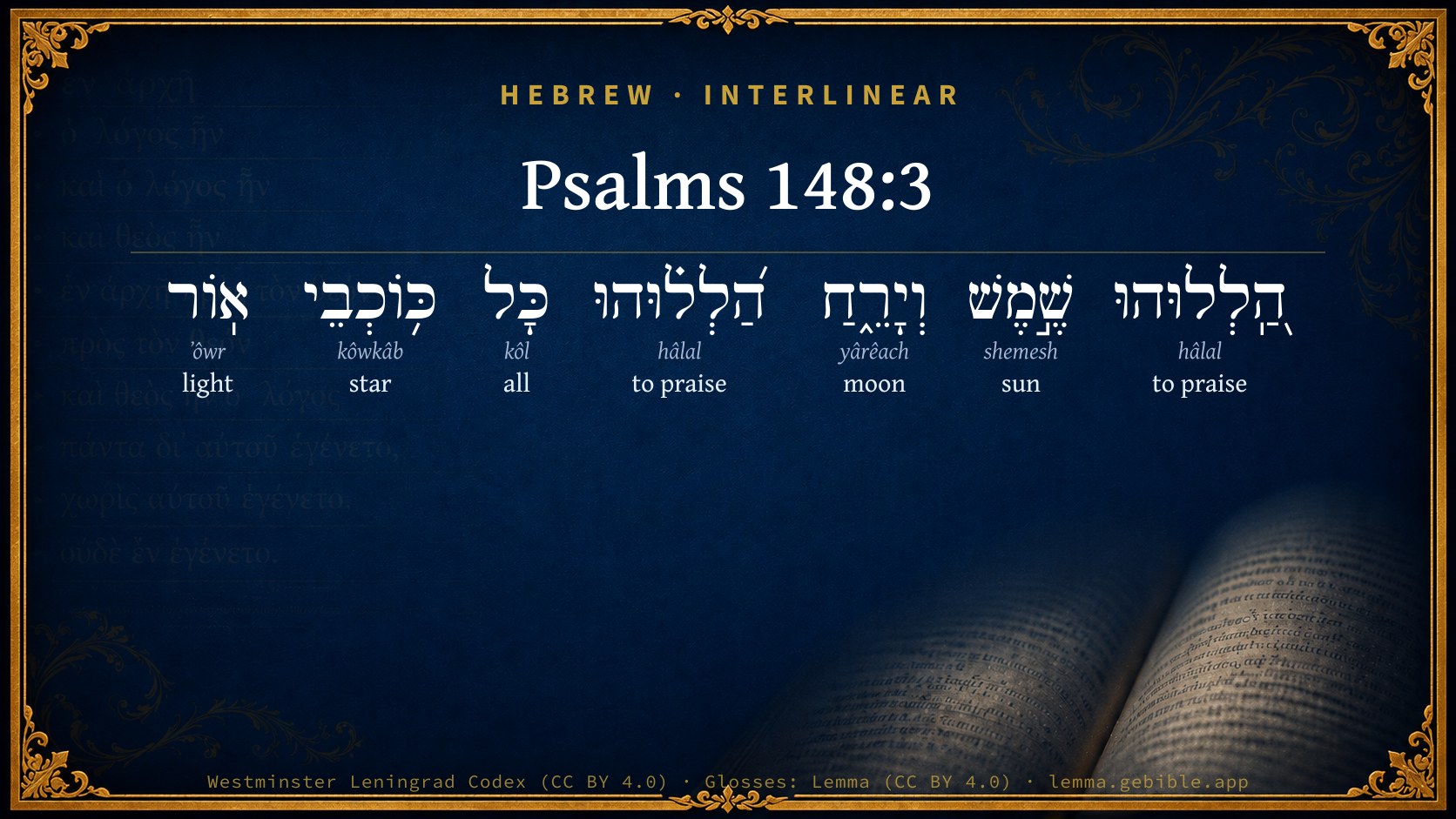
Hebrew (Westminster Leningrad Codex) Psalms 148:3 appears in the Hebrew Old Testament. The text above is from the Westminster Leningrad Codex. Each word links to its Strong’s number, a concise gloss, and parsing drawn from the Open Scriptures Hebrew Bible morphology. Click any word for its full Brown-Driver-Briggs (BDB) entry.
Download image
Cite this verse

Psalms 148:3 (World English Bible). Public Domain. Lemma interlinear Bible study tool, https://lemma.gebible.app/v/psalms/148/3.

Show BibTeX & RIS
BibTeX
RIS
English Translation
Praise him, sun and moon! Praise him, all you shining stars!
World English Bible · Public Domain
Download a study sheet

One document with this verse’s original text, its word-by-word gloss line, the meaning frame, cross-references with their text, attributed commentary, and full source and license credits — printable, and it pastes into notes with its structure intact.

This verse Autodidact and up

Study sheet (.html) Plain text (.txt)

A passage Seminary Student

Up to 50 verses in one chapter. A passage sheet keeps up to 6 commentary sources and 12 cross-references per verse, in the order this page ranks them, and says so on the sheet whenever that leaves anything out. Ask for a single verse and you get the Autodidact verse sheet above.

Everything on this page stays free to read, with no account — the sheet is a download of what is already on screen, not access to it.

Want to remove ads? Support Godless Engineer
Compare translations 3

The same verse in 3 English versions, stacked beneath the original-language interlinear above. Click any original word for its lexicon entry.

Each is an independent rendering of the whole verse — the interlinear is not word-aligned to these translations.

Highlighted words mark where these versions differ — a whole-verse word diff, not a word-by-word alignment.

  • World English Bible Public Domain
    Praise him, sun and moon! Praise him, all you shining stars!
  • King James Version Public Domain
    Praise ye him, sun and moon: praise him, all ye stars of light.
  • unfoldingWord Literal Text CC BY-SA 4.0
    Praise him, sun and moon; praise him, all of the stars of light.

unfoldingWord Literal Text — © unfoldingWord, licensed CC BY-SA 4.0. Word-aligned USFM3 via Door43 (git.door43.org/unfoldingWord/en_ult).

Versions to compare (up to 4)

3 of 4 selected

Show all 18 translations

Every available English version of this verse, each an independent rendering of the whole verse.

  • World English Bible Public Domain
    Praise him, sun and moon! Praise him, all you shining stars!
  • Berean Standard Bible Public Domain
    Praise Him, O sun and moon; praise Him, all you shining stars.
  • Majority Standard Bible Public Domain
    Praise Him, O sun and moon; praise Him, all you shining stars.
  • King James Version Public Domain
    Praise ye him, sun and moon: praise him, all ye stars of light.
  • American Standard Version (1901) Public Domain
    Praise ye him, sun and moon: Praise him, all ye stars of light.
  • Revised Version (1885) Public Domain
    Praise ye him, sun and moon; praise him, all ye stars of light.
  • Geneva Bible (1599) Public Domain
    Prayse ye him, sunne and moone: prayse ye him all bright starres.
  • Douay-Rheims (1899) Public Domain
    Who healeth the broken of heart, and bindeth up their bruises.
  • Young's Literal Translation Public Domain
    Praise ye Him, sun and moon, Praise ye Him, all stars of light.
  • Literal Standard Version CC BY-SA 4.0
    Praise Him, sun and moon, || Praise Him, all stars of light.
  • Unlocked Literal Bible CC BY-SA 4.0
    Praise him, sun and moon; praise him, all you shining stars.
  • unfoldingWord Literal Text CC BY-SA 4.0
    Praise him, sun and moon; praise him, all of the stars of light.
  • Darby Bible Public Domain
    Praise him, sun and moon; praise him, all ye stars of light.
  • World Messianic Bible Public Domain
    Praise him, sun and moon! Praise him, all you shining stars!
  • Webster's Bible Public Domain
    Praise ye him, sun and moon: praise him, all ye stars of light.
  • Free Bible Version CC BY-SA 4.0
    Praise him, sun and moon! Praise him, all you shining stars!
  • Bible in Basic English Public Domain
    Give praise to him, you sun and moon: give praise to him, all you stars of light.
  • JPS Tanakh (1917) Public Domain
    Praise ye Him, sun and moon; praise Him, all ye stars of light.

Literal Standard Version (2020), Covenant Press — licensed CC BY-SA 4.0. Text via the HelloAO Bible API (eBible.org). Unlocked Literal Bible (unfoldingWord) — licensed CC BY-SA 4.0. Text via the HelloAO Bible API (eBible.org). unfoldingWord Literal Text — © unfoldingWord, licensed CC BY-SA 4.0. Word-aligned USFM3 via Door43 (git.door43.org/unfoldingWord/en_ult). Free Bible Version, Dr. Jonathan Gallagher — licensed CC BY-SA 4.0. Text via the HelloAO Bible API (eBible.org).

Word by word

More ways to search: Search by grammar → Find every occurrence → Compare this word →

Practice this passage: Drill this verse → Learn its vocabulary →

About this verse

These counts appear in no published source. They are computed here, from the morphology-tagged text and Lemma’s own curated glosses. What Lemma adds →

7
words
6
distinct lemmas
Wisdom
section

Shared distinctive vocabulary

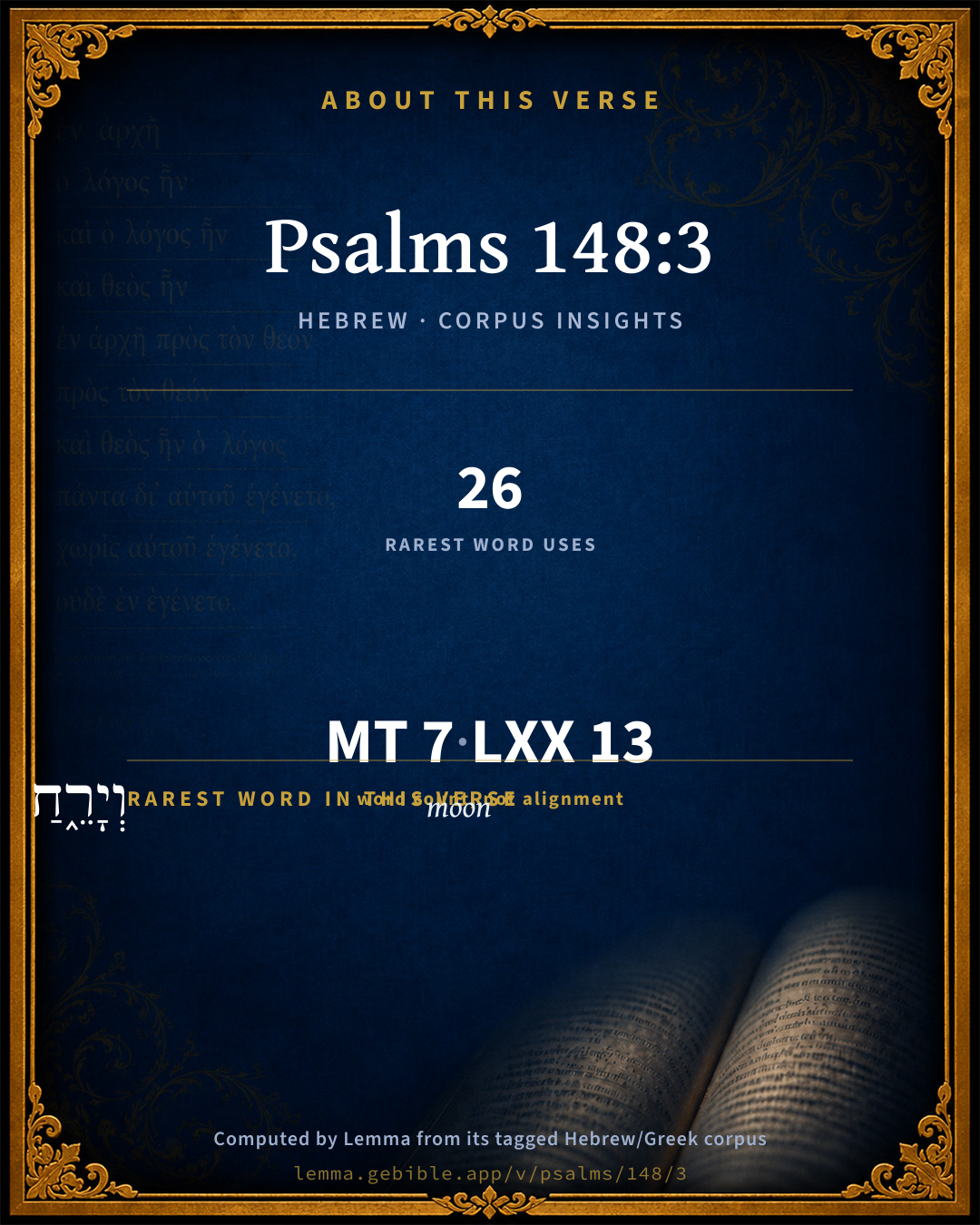
וְיָרֵ֑חַ moon H3394 occurs in 26 verses of the Hebrew Bible. Also found in:

Grammatical profile

  • 2 verbs
  • 5 nouns

Verb forms

  • הַֽ֭לְלוּהוּ Piel · Imperative
  • הַ֝לְל֗וּהוּ Piel · Imperative

Repetition

A word recurs within this verse — often emphatic in Hebrew:

  • הַֽ֭לְלוּהוּ to praise H1984 ×2

Hebrew & Septuagint length

In English translation the verse runs 11 words from the Hebrew and 12 from the Septuagint (LXX English) — closely comparable.

A rough comparison of the two English renderings, which tokenize alike — not a word-level alignment.

Word counts can differ between the Hebrew and the Greek without any difference in meaning — e.g. the Hebrew direct-object marker אֵת has no separate Greek word, and Greek often adds the article ὁ.

In the original languages it is 7 Hebrew tokens and 13 Greek tokens — but the two are counted differently (Hebrew bundles its prefixes and suffixes into one token; the Greek is in lemma form), so that isn’t a like-for-like length.

Cross-references

8

Topical passages linked to Psalms 148:3 in the Treasury of Scripture Knowledge — connected by theme and wording, ordered by reader-vote popularity; previews shown in the World English Bible.

  • Psalms 19:1–6 The heavens declare the glory of God. The expanse shows his handiwork.
  • Psalms 8:1–3 Yahweh, our Lord, how majestic is your name in all the earth, Who has set your glory above the heavens!
  • Psalms 136:7–9 To him who made the great lights; For his loving kindness endures forever:
  • Genesis 1:14–16 God said, "Let there be lights in the expanse of sky to divide the day from the night; and let them be for signs, and for seasons, and for days and years;
  • Genesis 8:22 While the earth remains, seed time and harvest, and cold and heat, and summer and winter, and day and night shall not cease."
  • Deuteronomy 4:19 and lest you lift up your eyes to the sky, and when you see the sun and the moon and the stars, even all the host of the sky, you are drawn away and worship them, and serve them, which Yahweh your God has allotted to all the peoples under the whole sky.
  • Psalms 89:36–37 His seed will endure forever, His throne like the sun before me.
  • Jeremiah 33:20 Thus says Yahweh: If you can break my covenant of the day, and my covenant of the night, so that there shall not be day and night in their season;

Cross-references courtesy of OpenBible.info (CC BY 4.0).

Hebrew and Greek witnesses Masoretic Hebrew ↔ Greek Septuagint

The same verse in the two great witnesses to the Old Testament, shown verse-for-verse.

You’re reading Greek Psalm 148 (Hebrew Psalm 148). The Septuagint counts the superscription, so verse numbers can differ from the Hebrew — chapter-level alignment, not verse-by-verse. Numbering follows Rahlfs.

These are two independent witnesses, not word-aligned to each other, and the Septuagint is shown in lemma (dictionary) form.

Hebrew Psalms 148:3 Masoretic · Westminster Leningrad Codex

הַֽ֭לְלוּהוּ שֶׁ֣מֶשׁ וְיָרֵ֑חַ הַ֝לְל֗וּהוּ כָּל כּ֥וֹכְבֵי אֽוֹר

Praise him, sun and moon! Praise him, all you shining stars!

World English Bible · Public Domain

Greek LXX Greek Psalm 148:3 Septuagint · lemma form

αἰνέω αὐτός ἥλιος καί σελήνη αἰνέω αὐτός πᾶς ὁ ἄστρον καί ὁ φῶς

Praise him, sun and moon; praise him, all you⌃ stars and light.

LXX2012 (modern English Septuagint) · Public Domain

On this verse, The Cambridge Bible for Schools and Colleges discusses the Septuagint’s reading. Read the note in Commentary ↓

Hebrew: Westminster Leningrad Codex (CC BY 4.0). Greek: Septuagint (public domain); English from LXX2012 (modern English Septuagint) (Public Domain). How the Septuagint differs from the Hebrew →

Commentary

Notes on Psalms 148:3 from classic Christian and Jewish commentators (each source and its license shown beneath its notes). The classic Christian expositions comment on the surrounding passage and are grouped to its opening verse, so a note may address several verses; the Jewish commentaries on the Tanakh (Rashi and others) are per-verse, so they appear only where the commentator wrote on this verse.

Lemma curates 59 commentaries, every one of them public domain or Creative Commons licensed, each selected and text-cleaned for this edition rather than reprinted as found. About our sources →

Trapp's Complete Commentary

John Trapp

Psa 148:3 Praise ye him, sun and moon: praise him, all ye stars of light.

Ver. 3. Praise ye him, sun and moon] These do, after a sort, declare the glory of God, Psa 19:1-2 Hab 3:3; not with mind and affection, as if they were understanding creatures (as Plato held, In Epimenide), but by their light influences, admirable motions, and obedience, whereby quasi mutis vocibus, by a dumb kind of eloquence, saith Nazianzen, they give praise to God, and bid check to us for our dulness and disorders.

Praise him, all ye stars of light] A light, then, they have of their own (besides what they borrow of the sun), which they withhold at God’s appointment, Isa 13:10, and influences they have which cannot be restrained or resisted, Job 38:31-32.

John Trapp, A Commentary or Exposition upon All the Books of the Old and New Testament (1647–1656) — public domain. Text from a community e-Sword module.

The Biblical Illustrator

Joseph S. Exell

Psa_148:3

Praise Him, all ye stars of light.

Lessons of the stars

1. One of the most impressive lessons we learn from a study of the stars is the immensity of creation. As they crowd the sky on a clear, bright night we see the beauty and force of the words employed of old to express the increase of Israel--God hath made thee as the stars of heaven for multitude. The distance between the furthest planet and the nearest star is twenty-one billions of miles. If we could travel as fast as light travels, we should go round the world four hundred and eighty times a minute; and yet, travelling at the same rate, it would take us three years and seven months to get to that nearest star. The distance of Sirius is so great that it would require a journey of twenty-one years to reach it. There is another star, visible by the naked eye, so far away that we could not cover the distance in less than seventy-two years. Travelling at the same rate, it would take seven hundred thousand years to visit the group, remote and cloudlike, which Sir William Herschell discovered with his telescope.

2. We learn from the stars the existence of abiding law and order in creation. The celestial bodies perform their revolutions in fixed periods; and though some seem an exception to this rule, yet they only exemplify it the more strikingly, for their irregularities, occurring at stated times, have as much method as their uniform movements. Byron sings of--

A pathless comet and a curse,

The menace of the universe.

But now it is known of some, and may be inferred of all, that they are as obedient to law as the planets themselves. Another illustration of law we have in the elliptic movements of the planetary bodies. We owe to Kepler the discovery of the fact that they all move in elliptic orbits--that if you draw a line from the planet to the sun, the areas described by that line in its motion round the sun are proportional to the times employed in the motion, and that the squares of the periodic times are as the cubes of the distance. The first of these is a law of forms, the other two are laws of numbers. By their mutual attractions the planets sometimes produce disturbance among themselves. Through observing the irregular movements of Uranus the astronomers discovered Neptune; yet even at such times order reigns. The primal law of gravitation, discovered by Sir Isaac Newton--that law which keeps all the stars in their places and regulates the descent of a snowflake--abides for ever. Law and order are seen in the motions of the double stars. In many parts of the heavens two or more stars are seen, apparently near each other, and mutually connected as part of a system. In some cases these companion stars revolve round each other; in other cases two or more revolve round a common centre. They are at a much greater distance from each other than the furthest planet of our system is from the sun. The period of their revolution varies from thirty to upward of seven hundred years. Yet they all travel according to fixed law. And this reign of law is observable in the most remote part of the heavens as much as in the nearer. Every fresh discovery reveals its existence and operation.

3. The stars remind us of the beauty and grandeur of creation. In the spheroid shape of the planets and their satellites we have beauty of form. Then we have degrees of magnitude and brightness. It requires the light of a hundred stars of the sixth magnitude to make that of one of the first magnitude. One star differeth from another star in glory. There is a variety of colour as well as of size and lustre. Through the clear, transparent atmosphere of a Syrian night, without any optical aid whatever, one star is seen to shine like an emerald, another like a ruby, a third like a sapphire, and a fourth like a topaz--the whole nocturnal heavens appearing to sparkle with a blaze of jewels. There are individual stars, each shining in a splendour all its own. There are starry clusters which hang in the heavens like fruit in the tree. Some are extremely irregular in shape, while others show regular forms of a round, spiral, or other tendency. The Great Bear is a grand and striking constellation. Pleiades glitters and quivers with radiance like a breastplate of jewels. Orion, with his brazen girdle, is not only the most glorious constellation in the heavens--he is also one of the few visible in all parts of the habitable globe.

4. The stars witness for God. An atheistic leader of the French Revolution said one day to a Christian villager: We are going to pull your church-tower down, so that you may have nothing left to remind you of God, or religion. You will not only have to pull down the church-tower, said the man, you will also have to blot out the stars before you can destroy all that reminds us of God. They speak to us of Him.

(1) They speak of His living, all-pervading presence; and so illustrate Christs words, My Father worketh hitherto. He upholds them by the constant acting of His power.

(2) They bear witness to Gods condescension and care. While they speak of His majesty and power, they speak at the same time of our littleness. Yet the power that made and upholds the stars made and upholds man. (W, Walters.)

The Biblical Illustrator, edited by Joseph S. Exell (c. 1880s–1900s) — public domain. Text from a community e-Sword module.

Joseph Benson's Commentary

Psa 148:3-4. Praise him, sun and moon, &c. — You were adored by the blind heathen for gods; you are but his creatures, and therefore would be obliged, if you were capable of it, to worship and praise him for your glorious light and powerful influences. “The material heavens, through their various regions,” says Dr. Horne, “with the luminaries placed in them, and the waters sustained by them, though they have neither speech nor language, and want the tongue of men, yet, by their splendour and magnificence, their motions and their influences, all regulated and exerted according to the ordinance of their Maker, do, in a very intelligible and striking manner, declare the glory of God; they call upon us to translate their actions into our language, and copy their obedience in our lives; that so we may, both by word and deed, glorify, with them, the Creator and Redeemer of the universe.” Praise him, all ye stars of light — Which bespangle the firmament, and constantly burn and shine to his glory, attracting, night after night, and from age to age, the attention, and exciting the admiration of every nation, and kindred, and tongue, and people. Praise him, ye heavens of heavens — Ye highest and most glorious heavens, the place of God’s throne, and glorious presence, as this expression seems to mean, Deu 10:14; 1Ki 8:27 : or, rather, the starry heavens, which also may be so called, because they are above the air, which is often called heaven in the Scriptures. And ye waters — Ye clouds, that be above the heavens — Above a part of them, above the aerial heavens: of which see note on Gen 1:7.

Joseph Benson's Commentary on the Old and New Testaments (1811–1818) — public domain. Text from a community e-Sword module.

J. A. Alexander on Psalms

Joseph Addison Alexander

3. (Psa 148:3) Praise ye him, sun and moon! Praise him, all ye stars of light! This is a specification of the general term, his hosts, in Psa 148:2. Stars of light is a beautiful poetical expression for bright or shining stars.

Joseph Addison Alexander, The Psalms Translated and Explained (1850) — public domain. Text from a community e-Sword module.

Geneva Bible (1599)

Geneva Bible translators

In that God’s glory shineth in these insensible creatures, this their beauty is as a continual praising of God.

Geneva Bible (1599) marginal notes — public domain. Text via Bolls.life.

Adam Clarke's Commentary

Verse 3. Praise ye him, sun and moon] The meaning of this address and all others to inanimate nature, is this: Every work of God's hand partakes so much of his perfections, that it requires only to be studied and known, in order to show forth the manifold wisdom, power, and goodness of the Creator.

Stars of light] The brightest and most luminous stars: probably the planets may be especially intended.

Adam Clarke's Commentary on the Bible (1810–1826) — public domain. Text from a community e-Sword/MySword module.

John Calvin's Commentaries

3. Praise him, ye sun and moon This passage gives no countenance to the dream of Plato, that the stars excel in sense and intelligence. Nor does the Psalmist give them the same place as he had just assigned to angels, but merely intimates that the glory of God is everywhere to be seen, as if they sang his praises with an audible voice. And here he tacitly reproves the ingratitude of man; for all would hear this symphony, were they at all attent upon considering the works of God. For doth not the sun by his light, and heat, and other marvelous effects, praise his Maker? The stars when they run their course, and at once adorn the heavens and give light to the earth, do they not sound the praises of God? but as we are deaf and insensible, the Psalmist calls upon them as witnesses to reprove our indolence. By the heavens of heavens he no doubt means the spheres. Eclipses, and other things which we observe, plainly show both that the fixed stars are above the planets, and that the planets themselves are placed in different orbits. “Que les estoilles sont plus haut que les planetes, et qu’icelles planetes sont situees en divers cercles ou spheres.” — Fr.

John Calvin's Commentaries (1540-1563) — public domain. Text from the Calvin Translation Society English edition (1840s-50s) via the Christian Classics Ethereal Library (ccel.org). Calvin's coverage is partial (roughly two-thirds of the Bible); uncommented books and verses are honest gaps, never fabricated. The 19th-century editor's footnotes and remarks are omitted so the notes are faithfully Calvin's own voice.

The Cambridge Bible for Schools and Colleges

gen. ed. J. J. S. Perowne

3. all ye stars of light] So the Heb. text. P.B.V. stars and light follows the LXX (Vulg.).

The Cambridge Bible for Schools and Colleges (gen. ed. J. J. S. Perowne; Cambridge University Press, 1878–1918) — public domain. Text from a community e-Sword module.

John Gill's Exposition

Praise ye him, sun and moon,.... The sun praises the Lord, the Creator of it, by doing the work constantly it is appointed to do; to rule by day, and give light and heat to the earth, and the inhabitants of it; and so is the cause of man's praising the Lord for the benefits they receive from it; for its enlightening, warming, and refreshing rays; and for the precious fruits brought forth by it and so the moon likewise doing its office, ruling by night, and reflecting the light of the sun upon the earth, and producing precious fruits, also praises its Maker, and is the occasion, of others praising him; see Psa 136:1;

praise him, all ye stars of light; which are very beneficial in the night season, especially to mariners and travellers, and shed their benign influences upon the earth and things in it; which are a means of praising the Lord, and in their way they do it, Psa 136:1. The Septuagint, Vulgate Latin, Syriac, Arabic, and Ethiopic versions, read it, "stars and light", wrongly; the stars are luminous bodies, and shine in their own light (c), though the moon with a borrowed light from the sun.

(c) Macrob. in Somn. Scipion. l. 1. c. 19, 20.

John Gill's Exposition of the Whole Bible (1746–1763) — public domain (CC PDM 1.0). Text via the HelloAO Bible API.

Albert Barnes' Notes on the Bible

Praise ye him, sun and moon - The most conspicuous and glorious objects in the heavens, as apparent to the eyes of people.

Praise him, all ye stars of light - A poetical expression to denote bright or shining stars. The phrase embraces all the stars as they strike the eyes of people. Each one has something special to it for which to praise God: and the entire groups - the immense multitudes, as such - should join in one chorus of praise.

Albert Barnes' Notes on the Bible (1834–1885) — public domain. Text from a community e-Sword/MySword module.

Matthew Poole's English Annotations

Sun and moon; you which are adored by the blind heathens for gods, you are but his creatures, and therefore were obliged, if you were capable, to worship and praise him for your glorious light and powerful influences.

Matthew Poole's English Annotations on the Holy Bible (1683–1685) — public domain. Text from a community e-Sword/MySword module.

The Treasury of David

Charles H. Spurgeon

Ver. 3. Praise ye him, sun and moon: praise him, all ye stars of light. The Psalmist enters into detail as to the heavenly hosts. As all, so each, must praise the God of each and all. The sun and moon, as joint rulers of day and night, are paired in praise: the one is the complement of the other, and so they are closely associated in the summons to worship. The sun has his peculiar mode of glorifying the Great Father of lights, and the moon has her own special method of reflecting his brightness. There is a perpetual adoration of the Lord in the skies: it varies with night and day, but it ever continues while sun and moon endure. There is ever a lamp burning before the high altar of the Lord. Nor are the greater luminaries allowed to drown with their floods of light the glory of the lesser brilliants, for all the stars are bidden to the banquet of praise. Stars are many, so many that no one can count the host included under the words, "all ye stars"; yet no one of them refuses to praise its Maker. From their extreme brilliance they are fitly named "stars of light"; and this light is praise in a visible form twinkling to true music. Light is song glittering before the eye instead of resounding in the ear. Stars without light would render no praise, and Christians without light rob the Lord of his glory. However small our beam, we must not hide it: if we cannot be sun or moon we must aim to be one of the "stars of light", and our every twinkling must be to the honour of our Lord.

Ver. 3. Praise ye him, sun and moon, etc. How does the sun specially praise Jehovah?

1. By its beauty. Jesus son of Sirach calls it the "globe of beauty."

2. By its fulness. Dion calls it "the image of the Divine capacity."

3. By its exaltation. Pliny calls it caeli rector, "the ruler of heaven."

4. By its perfect brightness. Pliny adds that it is "the mind and soul of the whole universe."

5. By its velocity and constancy of motion. Martian calls it "the Guide of Nature."

God the Supreme was depicted by the ancients holding in his hand a wreath of stars, to show the double conception, that they both obey and adorn him. Thomas Le Blanc.

Ver. 3-4. Let the sun, the fount of light, and warmth, and gladness, the greater light which rules the day, the visible emblem of the Uncreated Wisdom, the Light which lighteth every man, the centre round whom all our hopes and fears, our wants and prayers, our faith and love, are ever moving, let the moon, the lesser light which rules the night, the type of the Church, which giveth to the world the light she gains from the Sun of Righteousness, let the stars, so vast in their number, so lovely in their arrangement and their brightness, which God hath appointed in the heavens, even as he hath appointed his elect to shine for ever and ever, let all the heavens with all their wonders and their worlds, the depths of space above, and the waters which are above the firmament, the images of God's Holy Scripture and of the glories and the mysteries contained therein, let these ever praise him who made and blessed them in the beginning of the creation. J.W. Burgon.

Ver. 3-4.

Praise him, thou golden tressed sun;

Praise him thou fair and silver moon,

And ye bright orbs of streaming light;

Ye floods that float above the skies,

Ye heav'ns, that vault o'er vault arise,

Praise him, who sits above all height. Richard Mant.

Ver. 3.

1. God's praise continual both day and night.

2. Light the leading fountain of this praise.

3. Life behind all, calling for the praise.

Psalms 148:4*

Charles H. Spurgeon's The Treasury of David (1869–1885) — public domain. Psalms only. Text from a community e-Sword/MySword module.

Whedon's Commentary on the Bible

Daniel D. Whedon

3. Having spoken of the highest heaven, with its celestial dignitaries, the author descends to the region of the visible heavens.

Sun, moon… stars— The Hebrews were not acquainted with the relative distances of the heavenly bodies; and had they been, it were impossible to give a better classification, for our sun is but a star, and the stars are but suns. The language is comprehensive of all planetary and stellar worlds. Still descending toward our earth, he calls upon the waters that be above the heavens. These, according to the Hebrew meteorology, were above the lower heavens, that is, above the רקיע, (rakia,) “firmament,” (Gen_1:6-8,) in the superior region of the atmosphere. Here ends the enumeration of strictly celestial existences. They are called upon to praise God as their Creator.

For he commanded, and they were created—The instantaneousness of the act of creation was a cause of wonder, adoration, and praise. It is the sublimest conception of power that ever entered the human mind. See on Genesis 1, and Psa_33:6; Psa_33:9

Daniel D. Whedon (gen. ed.), Commentary on the Old and New Testaments (1874–1909) — public domain. Text from a community e-Sword module.

The Pulpit Commentary

Praise ye him, sun and moon. Objects of worship to most heathen nations, but here called upon to join in the chorus of praise to God. Praise him, all ye stars of light; i.e. ye brilliant stars, that light up the heaven at night.

The Pulpit Commentary (1880–1919), ed. H.D.M. Spence-Jones & Joseph S. Exell — public domain. Text from a community e-Sword module.

unfoldingWord translationNotes

Door43 World Missions Community

Praise him, sun and moon

The writer speaks to the sun and moon as if they were people and commands them to praise Yahweh. AT: "Praise Yahweh, sun and moon, as people do" (See: Personification)

praise him, all you shining stars

The writer speaks to the shining stars as if they were people and commands them to praise Yahweh. AT: "Praise Yahweh, shining stars, as people do" (See: Personification)

Praise him, highest heaven

The phrase "highest heaven" is an idiom that refers to heaven itself. The writer speaks to heaven as if it were a person and commands it to praise Yahweh. AT: "Praise Yahweh, highest heaven, as people do" (See: Personification)

you waters that are above the sky

The writer speaks to "the waters that are above the sky" as if they are people and commands them to praise Yahweh. The verbal phrase can be supplied from the previous line. AT: "praise him, you waters that are above the sky, as people do" (See: Personification and Ellipsis)

waters that are above the sky

The writer speaks of a place above the sky where water is stored and from which the rain comes.

translationWords

heaven

water

unfoldingWord translationNotes — © Distant Shores Media and the Door43 World Missions Community, licensed CC BY-SA 4.0. Source: git.door43.org/Door43/en_tn.

Rashi

Rabbi Shlomo Yitzchaki (Rashi)

stars of the night Heb. כוכבי אור, stars of the night.

Rashi on the Tanakh — English translations: “The Judaica Press complete Tanach with Rashi, translated by A. J. Rosenberg” (CC BY 4.0); “Pentateuch with Rashi's commentary by M. Rosenbaum and A.M. Silbermann, 1929-1934” (public domain); “The Metsudah Tanach series, Lakewood, N.J” (CC BY 4.0); and “The Book of Joshua, Metsudah Publications, 1997” (CC BY 4.0). Text via Sefaria.

Lesson kit

Teaching starters — assembled from the data on this page, not authored interpretation. Every prompt links to the verse data it draws on. Edit before teaching.

Psalms, in the Wisdom, opens this verse with 7 words (6 distinct Hebrew lemmas). Its most distinctive word is yârêach (“moon”). A historical commentator’s framing appears above. Read the whole chapter for the surrounding context.

Discussion questions

  1. How does “moon” (yârêach) shape what this verse is saying?
  2. Genesis 37:9 shares the word «moon» with this verse. How do the two illuminate each other?
  3. “to praise” occurs 2× in this one verse. What is the effect of the repetition?
  4. These translations render this verse differently. What is at stake in choosing one wording over another?
  5. The verb «הַֽ֭לְלוּהוּ» is Piel Imperative. How does its form color the action?
  6. Reading how Trapp's Complete Commentary and The Biblical Illustrator read this verse, where do the two commentators agree and where do they part?

Things to notice

Reading settings

Reading text

Shown beneath each verse's original-language words.

Old Testament
Old Testament edition

Read the OT as the Masoretic Hebrew (MT) or the Greek Septuagint (LXX).

English shown for the Greek Septuagint (in the Hebrew ↔ Greek comparison).

Comparing translations? Open the Compare panel on any verse page to stack up to four side by side.