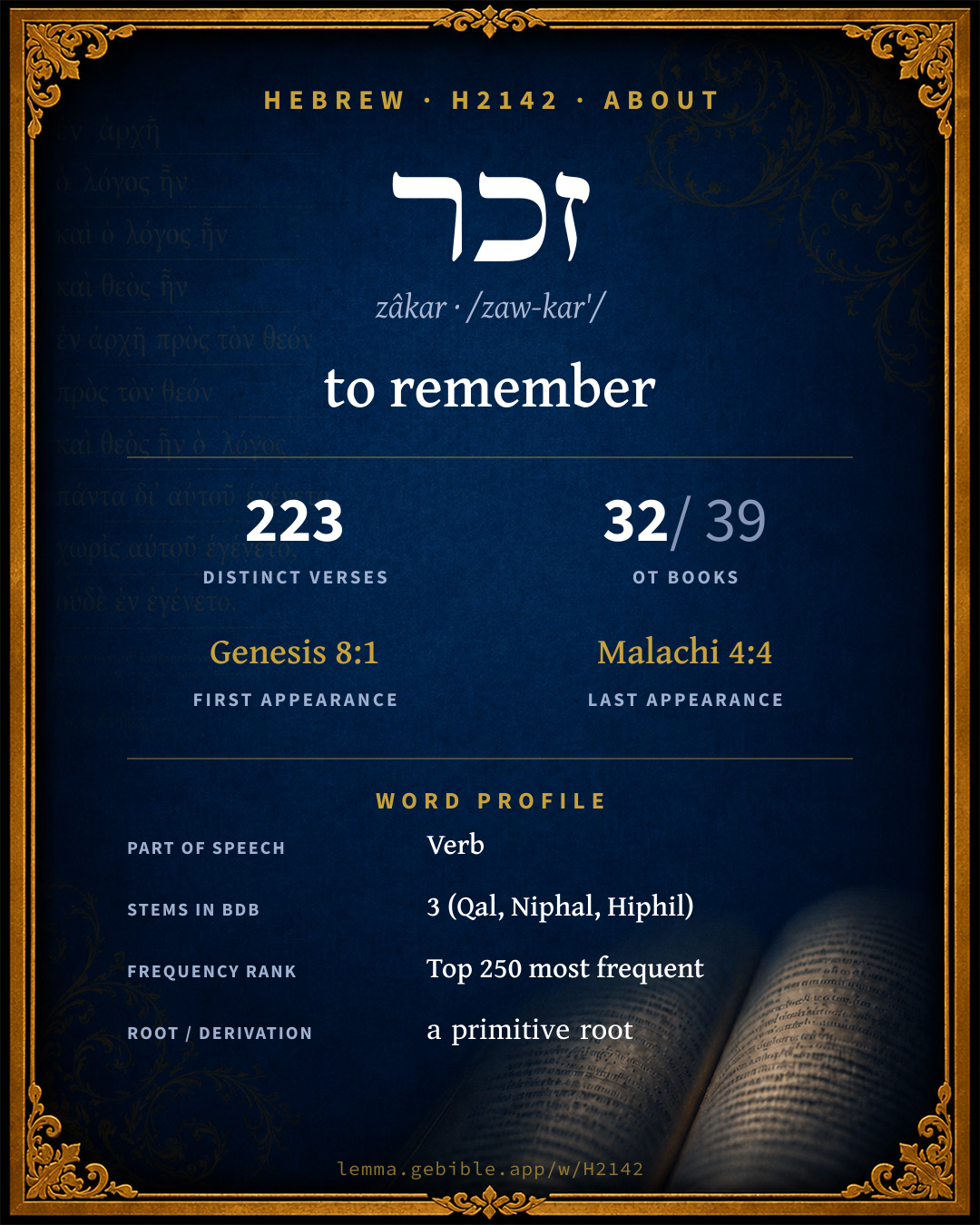
זָכַר
to remember
also: recall, call to mind fuller range ↓
Full lexicon entry — Brown-Driver-Briggs (BDB)
From Brown-Driver-Briggs (BDB)
Where this word appears
See every Qal verb in the Hebrew Bible →
Grammar key — what these labels mean
Part of speech
- Verb
- An action or state-of-being word.
Stem
- Qal
- The basic, simple active stem — the plain form of the verb (“he wrote”). Here: ‘human subj.’
- Hiphil
- The causative active stem (“he caused / brought about”). Here: ‘cause to remember’
- Niphal
- Usually the simple passive or reflexive of the Qal (“he was written”). Here: ‘be brought to remembrance’
Form
- Imperative
- A direct command (“write!”).
- Perfect
- A completed action or state — Hebrew marks aspect (completeness) more than strict tense (“he wrote”).
- Sequential Perfect
- A perfect with prefixed waw continuing a preceding imperfect or command (waw-consecutive perfect).
- Sequential Imperfect
- An imperfect with prefixed waw — the standard past-narrative form (waw-consecutive imperfect).
- Infinitive Absolute
- An unbound verbal noun, often intensifying or standing in for a finite verb.
- Participle Active
- A verbal adjective expressing ongoing or characteristic action (“writing / one who writes”).
- Imperfect
- An incomplete, ongoing, or future action (“he will / would write”).
- Infinitive Construct
- A bound verbal noun, frequently with prepositions (“to write / in writing”).
- Cohortative
- A first-person volitional form expressing wish or resolve (“let me / let us write”).
- Jussive
- A third- or second-person volitional form expressing wish or command (“let him write”).
- Participle Passive
- A verbal adjective expressing action received (“written”).
State
- Absolute
- The independent form of a noun, not bound to a following word.
- Construct
- A noun bound to a following noun in a possessive / “of” relationship (the construct chain).
Person
- 2nd Person
- The one addressed (“you”).
- 3rd Person
- The one spoken about (“he / she / it / they”).
- 1st Person
- The speaker (“I / we”).
Gender
- Masculine
- Grammatically masculine.
- Common
- Either gender — not distinguished for this form.
- Feminine
- Grammatically feminine.
Number
- Singular
- One.
- Plural
- More than one (in Hebrew, generally three or more).
10 verses where H2142 appears in the Qal stem in the Book of Ezekiel. Filtered view — show all forms. Click any verse to open its interlinear word-by-word view. Verse text shown in the World English Bible for context — . Each verse’s Hebrew form is shown with its reference; the English is not keyword-highlighted, since the data carries no word-level English alignment. Use “Compare translations” on any verse to read it across multiple English versions. This concordance covers the Hebrew Bible; Septuagint (Greek Old Testament) occurrences are not indexed here.
Ezekiel
- Ezekiel 6:9 וְ/זָכְר֨וּ conj + Qal wpf 3cp Those of you that escape shall remember me among the nations where they shall be carried captive, how that I have been broken with their lewd heart, which has departed from me, and with they eyes, which play the prostitute after their idols: and they shall loathe themselves in their own sight for the evils which they have committed in all their abominations.
- Ezekiel 16:22 זכרתי זָכַ֖רְתְּ Qal pf 2fs Qal pf 2fs In all your abominations and your prostitution you have not remembered the days of your youth, when you were naked and bare, and was weltering in your blood.
- Ezekiel 16:43 זכרתי זָכַרְתְּ֙ Qal pf 2fs Qal pf 2fs Because you have not remembered the days of your youth, but have raged against me in all these things; therefore, behold, I also will bring your way on your head, says the Lord Yahweh: and you shall not commit this lewdness with all your abominations.
- Ezekiel 16:60 וְ/זָכַרְתִּ֨י conj + Qal wpf 1cs Nevertheless I will remember my covenant with you in the days of your youth, and I will establish to you an everlasting covenant.
- Ezekiel 16:61 וְ/זָכַ֣רְתְּ conj + Qal wpf 2fs Then shall you remember your ways, and be ashamed, when you shall receive your sisters, your elder [sisters] and your younger; and I will give them to you for daughters, but not by your covenant.
- Ezekiel 16:63 תִּזְכְּרִי֙ Qal impf 2fs that you may remember, and be confounded, and never open your mouth any more, because of your shame, when I have forgiven you all that you have done, says the Lord Yahweh.
- Ezekiel 20:43 וּ/זְכַרְתֶּם conj + Qal wpf 2mp There shall you remember your ways, and all your doings, in which you have polluted yourselves; and you shall loathe yourselves in your own sight for all your evils that you have committed.
- Ezekiel 23:19 לִ/זְכֹּר֙ prep + Qal inf.cs Yet she multiplied her prostitution, remembering the days of her youth, in which she had played the prostitute in the land of Egypt.
- Ezekiel 23:27 תִזְכְּרִי Qal impf 2fs Thus will I make your lewdness to cease from you, and your prostitution [brought] from the land of Egypt; so that you shall not lift up your eyes to them, nor remember Egypt any more.
- Ezekiel 36:31 וּ/זְכַרְתֶּם֙ conj + Qal wpf 2mp Then shall you remember your evil ways, and your doings that were not good; and you shall loathe yourselves in your own sight for your iniquities and for your abominations.
About this entry
At a glance — auto-summarized from this page’s data, not written by a person. Every figure links to its source below. This summary describes the numbers; it doesn’t interpret them.
At its core, זכר (zâkar) means “to remember.” Scripture first uses it in Genesis 8:1. It appears 223 verses across 32 books of the Hebrew Bible, among its common vocabulary. Different stems carry different senses — BDB groups them under 3 stems, among them Qal and Niphal. It clusters with אזכרה, זכור and זכר under a shared root. Dig into 223-verse concordance and the renderings breakdown below.
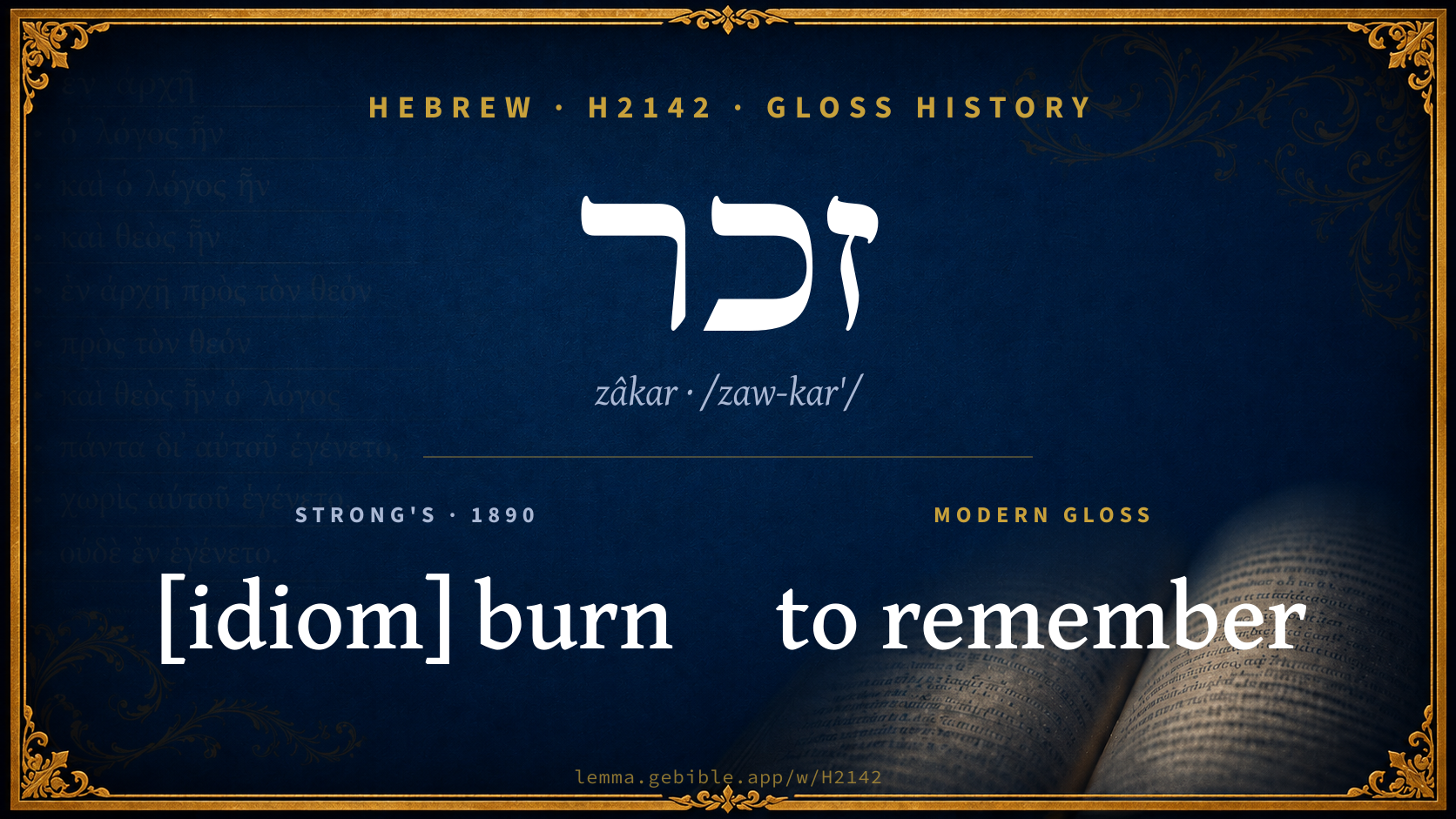
Gloss history
Strong's 1890 vs modern scholarship
About this word
Strong's H2142 catalogs a Hebrew word from the Hebrew Old Testament.
These counts are not copied from any lexicon or concordance. They are computed here, from the morphology-tagged Hebrew Old Testament. What Lemma adds →
- 223
- distinct verses
- The word appears in 223 distinct verses.
- 32 / 39
- OT books
- The word appears in 32 of 39 Old Testament books.
- #200
- by frequency
- Top 250 most frequent Hebrew words (rank 200 of 8,640 Hebrew words by occurrence).
View all 223 occurrences in the concordance →
By section of the Old Testament
By traditional corpus
Conventional, traditional groupings — biblical authorship is debated, so this is a traditional corpus grouping, not an authorship claim. Each share is this word’s portion of its verses in that division of the Hebrew canon. Each figure is a share of the word’s 223 distinct verses.
- Prophets (Nevi'im) 94 verses · 42%
- Writings (Ketuvim) 91 verses · 41%
- Torah (Pentateuch) 38 verses · 17%
How translations render this word
Counts come from each version’s own published word-to-Strong’s tagging or interlinear alignment — an approximate guide to how each version renders this word, not a word-level alignment the data otherwise carries. Because each total is that version’s own tagged count, the per-version totals vary from one another and need not match the appearance or distinct-verse counts above. These counts may also differ from a printed concordance because Lemma counts each distinctly tagged rendering and does not collapse phrase taggings into a single head-word total. This is a fixed set of word-tagged versions (KJV, ASV, BSB, ULT) and does not change with the reading translation you choose elsewhere. Each version’s license is shown beside its name below (and on Sources).
BDB lists this Strong’s number as 2 distinct words (homographs). Each count above pools all of them and is not split by sense — see the Senses section below. A low-frequency rendering may belong to a different one of those words, not the primary meaning.
- King James Version†: Remember 71×, Remembered 13×, Recorder 7×
- American Standard Version†: Remember 63×, Remembered 10×, Thou shalt remember 8×
- Berean Standard Bible†: Remember 73×, Be remembered 8×, Recorder 8×
- unfoldingWord Literal Text†: Remember 75×, Remembered 13×, Be remembered 10×
King James Version Public Domain
Renders H2142 across 235† tagged occurrences — most commonly:
Plus other, less common renderings. Plus 78 renderings that appear only once — usually multi-word phrases or single function words the recovered tagging swept in, not distinct renderings. Not rendered by a distinct English word in 1 further occurrence.
American Standard Version Public Domain
Renders H2142 across 232† tagged occurrences — most commonly:
Plus other, less common renderings. Plus 78 renderings that appear only once — usually multi-word phrases or single function words the recovered tagging swept in, not distinct renderings.
Berean Standard Bible Public Domain
Renders H2142 across 227† tagged occurrences — most commonly:
Plus other, less common renderings. Plus 61 renderings that appear only once — usually multi-word phrases or single function words the recovered tagging swept in, not distinct renderings. Not rendered by a distinct English word in 5 further occurrences.
unfoldingWord Literal Text CC BY-SA 4.0
Renders H2142 across 285† tagged occurrences — most commonly:
Plus other, less common renderings. Plus 78 renderings that appear only once — usually multi-word phrases or single function words the recovered tagging swept in, not distinct renderings.
53 senses and sub-senses in the full BDB
Hebrew verbs can shift meaning by stem (binyan): Qal is the basic action, Niphal is often passive or reflexive, Piel often intensifies or makes it factitive, and Hiphil is typically causative. The senses below are grouped under the stem BDB assigns to each.
What do BDB’s symbols mean?
BDB uses these scholarly abbreviations:
| Symbol | Meaning |
|---|---|
| 𝔊 | the Septuagint (the ancient Greek translation, LXX) |
| 𝔙 | the Vulgate (the Latin translation) |
| 𝔖 | the Syriac version (the Peshitta) |
| 𝔗 | the Targum (the Aramaic translation) |
| ψ | the Psalms |
| √ | root (the underlying root or stem) |
| ‖ | parallel passage (a synonymous or contrasted parallel) |
| † | the dagger: every passage where the word occurs is cited |
The 53 senses and sub-senses the full Brown-Driver-Briggs lexicon distinguishes for this word, in lexicon order (not ranked by frequency), with BDB’s own verbatim wording and sub-sense lettering. Shown in Hebrew script with BDB’s own scholarly abbreviations. The condensed entry is in the Lexicon Entry tab. See also the Forms in the corpus table below.
זכר I remember (Assyrian zikâru, name, mention, cf. n. zikru, Hptin KAT2Gloss. i LyonSarg
Qal
- Pf. 3 ms. ז׳ Gn 40:23 +; 3 fs. זָֽכְרָה La 1:7, 9; 2 ms. וְזָכַרְתָּ֫ Dt 5:15 +; sf. זְכַרְתַּנִי Gn 40:14 cf. 1 S 1:11, זְכַרְתָּם ψ 86:6; 2 fs. זָכַרְתְּ Is 47:7; 57:11 cf. 17:10 + Ez 16:22, 43 Qr (both Kt זכרתי), וְזָכַרְתְּ consec. Ez 16:61; 3 pl. זָֽכְרוּ Ju 8:34 +, etc.; Impf. 3 ms. יִזְכֹּר Ho 8:13 +; יִזְכָּר־ 2 S 14:11 Pr 31:7; וַיִּזְכֹּר Gn 8:1 +; sf. וַיִּזְכְּרֶהָ 1 S 1:19; 2 fs. תִּזְכְּרִי Is 54:4 + 2 times; 1 s. אֶזְכֹּר Lv 26:42(×2) Is 43:25 (ψ 77:12 Qr v. infra), אֶזְכָּר־ Je 31:34, וָאֶזְכֹּר Ex 6:5; sf. 2 ms. אֶזְכָּרְךָ ψ 42:7, sf. 2 fs. אֶזְכְּרֵכִי ψ 137:6 (v. Ges§ 58, 3, R, 1 Sta§§ 356, a, 2, 634 a, 2), etc.; Imv. ms. זְכֹר Ex 32:13 +; זְכָר־ ψ 25:7 +; זָכְרָה Ne 6:14 +; sf. זָכְרֵנִי Ju 16:28 + 2 times; mpl. זִכְרוּ Is 46:9 +, זְכֹ֑רוּ Ne 4:8; Inf. abs. זָכוֹר Ex 13:3 +; זָכֹר Je 31:30 +; cstr. לִזְכֹּר Gn 9:16 Ez 23:19, etc.; sf. כְּזָכְרֵנִי ψ 137:1; Pt. act. pl. cstr. וּלְזֹכְרֵי ψ 103:18; זָכוּר ψ 103:14 v. infr.— e.g. Genesis 40:23
- I. human subj.
- 1. remember, recall, call to mind, usually as affecting present feeling, thought, or action:
- a. remember past experiences (acc.) Gn 42:9 (E), 2 K 9:25 absol. imv. זְכֹר; sq. cl. with מִי Jb 4:7; things formerly known (acc.) Je 17:2; sq. cl. with כִּי Ju 9:2; with implied regret, longing Nu 11:5 (JE), ψ 42:5; 137:1 La 1:7 cf. ψ 77:7, neg. 137:6 (‖ שׁכח v 5); †so (sq. בְּ) Je 3:16 (‖ עלה על לב and פקד). e.g. Genesis 42:9
- b. recall past distress, etc.; obj. not expressed, La 3:20 (זכור זכר), Jb 11:16 (שׁכה in ‖ cl.); neg., sq. acc. Is 54:4 (‖ שׁכח), Pr 31:7 (‖ id.). e.g. Lamentations 3:20
- c. remember sins, (1) to repent of them Dt 9:7 (+ אל־תשׁכח, sq. cl. with את־אשׁר), elsewhere only Ezek., usually c. acc. Ez 16:61 (+ וְנִכְלַמְתְּ), v 63 (obj. not expressed), 20:43; 36:21; (2) to renew and repeat them Ez 23:19, neg. v 27. e.g. Deuteronomy 9:7
- d. especially remember the dealings of י׳, expressed in great variety of terms in acc., Dt 7:18; 8:2; 24:9; 32:7 (‖ בין), Is 46:9; 63:11 ψ 77:12 Qr (Kt Hiph. q.v.) v 12; 105:5; 143:5 (‖ הגיתי, אֲשׂוֹחֵחַ) 1 Ch 16:12; negatively, Is 43:18 (‖ אַל תִּתְבֹּנָ֑נוּ), Ez 16:22, 43 ψ 78:42; 106:7 Ne 9:17 (‖ וַיְמָאֲנוּ לִשְׁמֹעַ); obj. cl. with כִּי especially D, Dt 5:15; 15:15; 16:12; 24:18, 22 ψ 78:35. e.g. Deuteronomy 7:18
- 2. remember persons (human subj.),
- a. to their advantage:—sq. acc. Gn 40:14 (E), v 23 (E; neg., ‖ שׁבח), 1 S 25:31. e.g. Genesis 40:14
- b. to make use of them (acc.) Na 2:6. e.g. Nahum 2:6
- c. their acts (acc.), to their advantage 2 Ch 24:22, to their disadvantage 2 S 19:20 (neg.); to take vengeance Dt 25:17. e.g. 2 Chronicles 24:22
- d. remember human obligations, acc. rei: בְּרִית אַחִים Am 1:9; cf. perhaps Est 2:1 (acc. pers. and also of deed); neg. Ec 9:15 (acc. pers.), ψ 109:16 (sq. עשׂזת חסד). e.g. Amos 1:9
- 3. remember י׳:
- a. call him to mind 2 S 14:11 (i.e. recall a specific command of his). e.g. 2 Samuel 14:11
- b. recall, and (especially) keep י׳ in mind Dt 8:18 Je 51:50 Is 64:4 (‖ עשׂה צדק), Ez 6:9 Zc 10:9 Jo 2:8 ψ 42:7; 63:7 (‖ אהגה), 77:4 Ne 4:8; negatively Ju 8:34 Is 17:10 (opp. שׁכח), 57:11 (‖ לֹא שַׂמְתְּ עַל־לִבֵּךְ); cf. also ז׳ אֶת־בּוֹרְאֶ֑ךָ Ec 12:1, and (no obj. expressed) ψ 22:28 (+ וישׁובו אל י׳); remember י׳’s name ψ 119:55. e.g. Deuteronomy 8:18
- 4. remember:
- a. words of Moses Jos 1:13 (D) Mal 3:22; י׳’s instructions through prophet Is 44:21; 46:48 (‖ השׁיבו על לב), also Mi 6:5 (sq. cl. with מה). e.g. Joshua 1:13
- b. commandments of י׳ (so as to do them) Nu 15:39 (P, or H), v 40 (P; + ועשׂיתם), ψ 103:18 (+ לעשׂותם), 119:52 (משׁפטים); his covenant 1 Ch 16:15. e.g. Numbers 15:39
- 5. think of or on, call to mind something present or future;—sq. acc., issue of conduct Is 47:7, La 1:9 (end of Jerusalem); fight with crocodile Jb 40:32; obj. a general truth, prosperity of wicked Jb 21:6 (obj. not expr.); (fleeting) days of life Ec 5:19; (coming) days of darkness, 11:8; a duty Jb 36:24 (sq. cl. with כִּי). e.g. Isaiah 47:7
- 6. remember a day, to observe, commemorate it:—day of Exodus Ex 13:3 (J) Dt 16:3; sabbath Ex 20:8 (E; ‖ שׂמר Dt 5:12). e.g. Exodus 13:3
- 7. remember, with implied mention of, obj. י׳ Je 20:9 (‖ דִּבֶּר בִּשְׁמוֹ); מַשָּׂא י׳ 23:36. e.g. Jeremiah 20:9
- 1. remember, recall, call to mind, usually as affecting present feeling, thought, or action:
- II. Subj. י׳ (אלהים).
- 1. remember persons:
- a. individuals, with kindness, granting requests, protecting, delivering etc., c. acc. pers., Gn 30:22 (E), 1 S 1:11 (opp. שׁכח), v 19, Ju 16:28 (sq. וְחַזְּקֵנִי); Je 15:15 (‖ פָּקְדֵנִי), ψ 106:4 (‖ id.), Jb 14:13 (+ תשׁית לי חק), also Gn 8:1 (P), 19:29 (P); neg. ψ 88:6 (‖ מידך נִגְזָר֑וּ); sq. לְ pers. ψ 25:7 (yet cf. Che); sq. acc. rei + לְ pers. (dat. commod.) Ne 5:19; 13:14, 22, 31. e.g. Genesis 30:22
- b. individuals, to punish, sq. לְ pers. Ne 6:14; 13:29. e.g. Nehemiah 6:14
- c. his servants, people, the afflicted, (graciously) sq. לְ Ex 32:13 (JE), Dt 9:27 ψ 136:23; sq. acc. ψ 9:13 (opp. שׁכח), 74:2; 115:12 (sq. יְבָרֵךְ); cf. Je 31:20 (זכור זכר). e.g. Exodus 32:13
- d. his land Lv 26:42 (H), and neg. La 2:1 (his footstool). e.g. Leviticus 26:42
- e. mankind ψ 8:5 (‖ פקד). e.g. Psalms 8:5
- 2.
- a. remember the distress of his servants, La 3:19 (sq. cl. with מה), 5:1 (‖ הַבִּיטָ֯ וּרְאֵה). e.g. Lamentations 3:19
- b. their devotion, acc., ψ 20:4 Je 2:2 (+ לְ pers.), ψ 132:1 (+ id.); sq. cl. with את אשׁר 2 K 20:3 = Is 38:3. e.g. Psalms 20:4
- c. their intercession Je 18:20 (sq. inf. c. sf.) e.g. Jeremiah 18:20
- 3.
- a. remember his own covenant (with them), acc., Gn 9:15, 16 Ex 2:24: 6:25 (all P), Lv 26:42(×2) (H, as also) v 45 (+ לְ pers.); Je 14:21 (+ אַל־תָּפֵר), Ez 16:60 ψ 105:8, cf. v 42 (obj. דְּבַר קָדְשׁוֹ), and 119:49 Ne 1:8, ψ 106:45 (+ לְ pers.), 111:5. e.g. Genesis 9:15
- b. his mercy, etc., acc., ψ 25:6; 98:3 2 Ch 6:42 (ל); also Hb 3:2. e.g. Psalms 25:6
- c. extenuating circumstances, sq. cl. with בִּי, Jb 7:7; 10:9 ψ 78:39; 103:14 (זָכוּר bethinketh him, Che, cf. De Kö§ 20, 14 BaNB 175); also ψ 89:48 (sq. אֲנִי + epex. cl. with מה). e.g. Job 7:7
- 4. remember sins, idolatries etc., sq. acc., Ho 7:2; 8:13 (‖ פקד), 9:9 (‖ id.), Je 14:10 (‖ id.); neg. Je 44:21 (‖ עלה על לבו), Is 43:25; 64:8 ψ 25:7; 79:8 (+ לְ pers.); sq. לְ Je 31:34; also (obj. reproach) ψ 74:18, 22; 89:51; and (obj. day of Jerusalem) ψ 137:7 (+ לִבְנֵי אֱדוֹם, i.e. against them). e.g. Hosea 7:2
- 1. remember persons:
Niphal
- Pf. 2 mpl. consec. וְנִזְכַּרְתֶּם Nu 10:9; Impf. 3 ms. יִזָּכֵר Je 11:19 +; 3 fs. תִּזָּכֵר Ez 25:10, (תִּזָּכָר Ex 34:19 read הַזָּכָר v. זָכָר); 2 fs. תִּזָּכֵ֑רִי Is 23:16 Ez 21:37; 3 mpl. יִזָּֽכְדוּ Ho 2:19 +; 3 fpl. תִּזָּכַרְנָה Is 65:17 +; תִּזָּכַרְןָ Ez 3:20; Inf. cstr. sf. הִזָּכֶרְכֶם Ez 21:29 (om. 𝔖 Co); Pt. pl. נִזְכָּרִים Est 9:28.— e.g. Numbers 10:9
- 1. be brought to remembrance, remembered, thought of, usually c. neg.:—
- a. in general, subj. Baalim Ho 2:19 (+ בִּשְׁמָם), cf. Zc 13:2 (‖ אכרית); former heaven and earth Is 65:17 (‖ עלה על לב); (wicked) dead Jb 24:20 (‖ ישׁכחהו v a); coral (not to be thought of [others, be mentioned] in comparison with wisdom) Jb 28:18; of attention paid to Tyre under fig. of harlot Is 23:16 (opp. נשׁכחה). e.g. Hosea 2:19
- b. brought to י׳’s remembrance, subj. the people, (1) with gracious result Nu 10:9 (P; לפני י׳, ‖ וְנוֹשַׁעְתֶּם); (2) for judgment Ez 21:29 (om. 𝔖 Co). e.g. Numbers 10:9
- c. be remembered by י׳, neg. of deeds, as affecting י׳’s judgment, (1) righteous Ez 3:20; 18:24; 33:13 (sq. לְ of advantage, according to Co); (2) wicked 18:22 (sq. לְ, om. A B 𝔙 etc., Co) 33:16 (sq. לְ). e.g. Ezekiel 3:20
- d. be remembered אֶל־י׳ ψ 109:14 (‖ אַל־תִּמָּ֑ח). e.g. Psalms 109:14
- 2. neg. be not remembered = no longer exist, of name of Israel, as nation Je 11:19 (‖ נכרת), ψ 83:5 (‖ נַכְחִידֵם מִגּוֹי); of Ammonites Ez 21:37; 25:10. e.g. Jeremiah 11:19
- 3. be remembered, of particular days, in order to be observed, commemorated, Est 9:28 (sq. וְנַעֲשִׂים observe, celebrate). e.g. Esther 9:28
Hiphil
- Pf. 3 ms. הִזְכִּיר Is 49:1; 2 ms. sf. 1 s. זְהִזְכַּרְתַּנִי consec. Gn 40:14; Impf. 3 ms. יַזְכִּיר Is 19:17; 1 s. אַזְכִּיר Ex 20:24 +, etc.; Imv. ms. sf. 1 s. הַזְכִּירֵנִי Is 43:26; mpl. הַזְכִּירוּ Is 12:4 Je 4:16; Inf. cstr. (ל)הַזְכִּיר 2 S 18:18 +; sf. 3 ms. כְּהַזְכִּירוֹ 1 S 4:18; sf. 2 mpl. הַזְכַּרְכֶם Ez 21:29 (cf. Sta§ 245 Kö§ 29, 11); Pt. מַזְכִּיר Gn 41:9 +, etc.; fs. מַזְכֶּרֶת Nu 5:15;— e.g. Isaiah 49:1
- 1. cause to remember, remind, c. acc. pers. Is 43:26. e.g. Isaiah 43:26
- 2. cause to be remembered, keep in remembrance, c. acc. rei, a person’s name 2 S 18:18 ψ 45:18; of י׳, causing his name to be remembered, by some token, Ex 20:24 (JE). e.g. 2 Samuel 18:18
- 3. mention,
- a. sq. acc. pers. Gn 40:14 (E; sq. אֶל־ pers.), י׳, = call upon Is 62:6, name of י׳ 26:13; 48:1; also on name of other gods, neg., Ex 23:13 (JE; ‖ יִשָּׁמַע); sq. בְּשֵׁם Am 6:10, cf. ψ 20:8 (De Che al. boast of, praise, 𝔊 μεγαλυνθησόμεθα, whence Hup Bae proposes נַגְבִּיר = we display strength), neg. Jos 23:7 (D; ‖ ולא תשׁביעו), so באלהי ישׂראל Is 48:1 (‖ הַנִּשְׁבָּעִים בְּשֵׁם). e.g. Genesis 40:14
- b. sq. acc. rei: faults Gn 41:9 (E), the ark 1 S 4:18, land of Judah Is 19:17, Rahab (= Egypt) ψ 87:4, works of י׳ ψ 77:12 (Kt, Qr Qal q.v.), his righteousness ψ 71:16, lovingkindness, Is 63:7; human love Ct 1:4; also in technical sense, apparently = accuse before God, always sq. עָוֹן, 1 K 17:18 Nu 5:15 (P) Ez 21:28 v 29 (sq. בְּהִגָּלוֹת פִּשְׁעֵיכֶם), 29:16. e.g. Genesis 41:9
- c. sq. cl., with כִּי Is 12:4; no conjunction Je 4:16 (לְ indir. obj.; ‖ הַשְׁמיעו). e.g. Isaiah 12:4
- d. abs. commemorate, praise 1 Ch 16:4 (לְהַז׳, appar. Levitical function, sq. ולהודות ולהלל ליהוה), so perhaps also לְהַזְכִּיר in titles ψ 38:1; 70:1 (others sub 5). e.g. 1 Chronicles 16:4
- 4. record, only pt. מַזְכִּיר as subst. (title of public officer) = recorder Rather, probably, the (king’s) reminder, who brought important business to his notice: cf. EwGesch. iii. 365, H. iii. 267 Ke 2 S 8:16 BenzArch. 310 NowArch. i. 308 Kit 1 K 4:3. 2 S 8:16; 20:24 1 K 4:3 2 K 18:18, 37 = Is 36:3, 22, 1 Ch 18:15 2 Ch 34:8. e.g. 1 Kings 4:3
- 5. of sacrifice, make a memorial, i.e. offer an אַזְכָּרָה q.v.; sq. לְבֹנָה Is 66:3.—JPPetersJBL, 1893, xii, 58 reads אַזְכִּרָה ψ 42:5 (v. Qal I. 1), ‘let me make my azkara, and pour out libation for (עֲלֵי) my life.’ e.g. Isaiah 66:3
זכר II recorder, v. זָכַר Hiph.
Senses from the full Brown-Driver-Briggs lexicon (Brown, Driver, Briggs; Oxford 1906 — public domain), digitized via Sefaria, supplemented by the OpenScriptures HebrewLexicon (CC BY 4.0). Full attribution on Sources.
Word origin
I. vb. remember (Assyrian zikâru, name, mention, cf. n. zikru, Hptin KAT2Gloss. i LyonSarg; Zinj. זכר, Arabic ذَكَرَ, Aramaic דְּכַר, ܕܟܰܪ, Palm. דרכנא monument, VogNo. 36 b, דכיר memorial, VogNo. 62, Sab. in n.pr. ידֿכראל DHMEpigr. Denkm. 43, but Ethiopic ዘከረ )—
I. n.m. recorder, v. זָכַר Hiph.
— Brown-Driver-Briggs (Oxford 1906, public domain), digitized via Sefaria, supplemented by the OpenScriptures HebrewLexicon (CC BY 4.0). See Sources.
Origin: a primitive root
Jastrow Dictionary
A second Hebrew/Aramaic lexicon for comparison, covering Aramaic and post-biblical (Talmudic, Targumic, Midrashic) usage that the biblical-Hebrew BDB does not. Matched by lemma rather than by Strong’s number, so a lemma may carry more than one Jastrow headword (shown separately below), and the entries cover usage well beyond the Bible.
זָכַר
- [to mark,] to remember, mention; to celebrate (by a ceremony &c.). Pes. 106ᵃ (ref. to Ex. XX, 8 זכור) זָכְרֵהוּ על היין Ms. M. (ed. זוֹכְרֵהוּ) remember the Sabbath (distinguish it) by a benediction over wine; Bets. 15ᵇ זכרהו מֵאַחֵר שבא וכ׳ mark the Sabbath (by a ceremony) from another (Holy Day) which (preceding the Sabbath) may cause the neglect of it (Ms. M. לאחר, Rashi מֵאַחַר, v. אַחַר; v. R. Nissim a. l.). Men. 43ᵇ ראה … וזְכוֹר וכ׳ see this ceremony and be reminded of another &c.; a. fr.—Part. pass. זָכוּר, f. זְכוּרָה a) reminded, remembering, mindful.—ז׳ אני, contr. זְכוּרַנִי I recollect. Sabb. 115ᵃ ז׳ אני ב־ I recollect about &c.—Bets. 18ᵃ ז׳ היא she will remember. Snh. 52ᵇ; a. fr.—b) thought of, remembered. B. Mets. 11ᵃ ז׳ ולבסוף שכוח if the sheaf had been thought of and was afterwards forgotten.—ז׳ לטוב (abbr. ז"ל) remembered for blessing. Gen. R. s. 16 end אליהו ז"ל El. of blessed memory, v. זִכָּרוֹן.—Sabb. 13ᵇ, a. e., v. בְּרַם; a. fr.—Pl. זְכוּרִים. Pesik. R. s. 13, end; a. e. e.g. Exodus 20:8
- to be reminded, to remember (with accus.). Pes. 66ᵃ; Snh. 82ᵃ ראה מעשה ונ׳ הלכה he saw the practice and recalled the tradition. Yoma 38ᵃ כביד אבותי נִזְכַּרְתִּי I was thinking of the vanished glory of my ancestors. Ex. R. s. 45 הִזָּכֵר remember; a. fr.
- 1. to cause to be remembered, to recall. Ber. 55ᵃ, a. e. ג׳ דברים מַזְכִּירִים וכ׳ three occasions cause the sins of man to be remembered; a. fr.
- 2. to cite (as an argument), to take into account. Ib. 60ᵃ; a. e. אין מזכירין מ"נ miracles must not be cited as evidence. Kidd. 40ᵇ אין מזכירין לו שוב רשעו his wickedness is not counted; a. fr.
- 3. to recite (in prayer), quote. Hor. 14ᵃ ושמותם אין אנו מז׳ whose names we do not quote (as authorities). Ber. I, 5 מזכירין י"מ וכ׳ we must recite the going out from Egypt (Num. XV, 37 to 41) in night prayers; a. fr. e.g. Numbers 15:37
- to be mentioned. Kel. XVII, 5. Toh. VI, 6; a. e.—Part. מוּזְכָּר, f. מוּזְכֶּרֶת clearly defined. Kidd. 77ᵃ
זָכָר
- preced.) [v. זָכוּר,]
- 1. male (of man and animals), male child; opp. נקבה. Nidd. III, 7 תשב לז׳ וכ׳ she shall observe the laws as after the birth of a male child &c. (Lev. XII, 4). Ib. בריית הז׳ the formation of the male embryo. Y. B. Bath. IX, 16ᵈ bot. שמחת ז׳ the rejoicing over the birth of a boy; a. v. fr.—Pl. זְכָרִים. Nidd. 31ᵇ. Zeb. V, 3, a. fr. זִכְרֵי כהונה the male members of the priestly tribe.—Gen. R. s. 13, a. e. המים העליונים ז׳ וכ׳ the waters from above are the males (fructifiers), &c. e.g. Leviticus 12:4
- 2. (v. דְּכַר II) (של רחלים) ז׳ the male of the flock, ram. Bekh. V, 3; Yeb. 121ᵇ.—Shek. V, 3 ז׳ משמש עם וכ׳ that with the inscription ‘male’ was used only for libations connected with rams.—Pl. as above. R. Hash. III, 4, sq. בשל ז׳ with horns of rams; a. fr.
- 3. membrum (of animals). Tosef. Bekh. IV, 6, v. זוּבָּן.
- 4. (of inanimate objects) the thinner, pointed side of a double tool, v. זַכְרוּת. Kel. XIII, 2 הז׳ the pointed side of the cosmetic tube, contrad. to כף the broad part.
- 5. the marrow of horns, reeds &c. Tosef. Kel. B. Mets. VII, 12. [Ib. Par. II (I), 2, v. זַכְרוּת.]
- 6. (gramm.) לשון ז׳ masculine gender. Kidd. 2ᵇ אשכחן דרך דאיקרי ל׳ ז׳ we find (in the Bible) derekh in the masculine gender. Mekh. B’shall., Shirah 1 בל׳ ז׳ in the masculine form (שִׁיר); Cant. R. to I, 5; a. e.
זֵכֶר
- memorial, remembrance, symbol, mnemonical allusion. Succ. III, 12 ז׳ למקדש as a reminiscence of the Temple usages; Pes. 115ᵃ. Ib. 116ᵃ ז׳ לתפוח typical of the apple tree (Cant. VIII, 5; v. Sot. 11ᵇ); ז׳ לטיט typical of the clay (which the Israelites had to tread). Ber. 2ᵇ; Tosef. Sabb. VII (VIII), 4, a. e. אע"פ שאין … ז׳ לדבר although there is no proof for it (in the Bible), there is a mnemonical allusion to it; a. fr. e.g. Song of Solomon 8:5
A Dictionary of the Targumim, the Talmud Babli and Yerushalmi, and the Midrashic Literature (Marcus Jastrow; London, Luzac, 1903) — Public Domain. Digitized via Sefaria. Digitized via Sefaria. Full attribution on Sources.
Forms in the corpus
The 179 distinct written forms H2142 takes in the Hebrew Bible, most frequent first — each parse links to that stem’s occurrences in the concordance. Hebrew forms include their vowel points and cantillation, so a single lemma takes many written forms.
The 60 most common forms are shown; 119 rarer forms follow in the full concordance.
Same root — word family
Other BDB entries built from the same root as H2142, grouped by Strong’s listed origin. These share a root / origin per the lexicon — not necessarily a shared meaning. Each links to that word’s own entry.
Derived from this word
- אזכרה ʼazkârâh H234 memorial offering
- זכור zâkûwr H2138 male
- זכר zêker H2143 memorial
- זכר zâkâr H2145 male
- זכרון zikrôwn H2146 memorial
Proper names from this root
People and places named from this root — a name, not an additional meaning of the word.
Compare all same-root words → Showing 4 of 9 — not the complete family. 3 of the same-root words are proper names (people or places). They share a root, not necessarily a meaning.
Septuagint verse parallels
This word appears in 192 verses that also exist in the Greek Old Testament (Septuagint), out of the 223 Hebrew verses it occurs in. You can read those verses in Greek by switching the Old Testament edition to the Septuagint.
Read these verses in the Septuagint
- Genesis 8:1
- Exodus 2:24
- Leviticus 26:42
- Numbers 5:15
- Deuteronomy 5:15
- Joshua 1:13
- Judges 8:34
- 1 Samuel 1:11
- 2 Samuel 8:16
- 1 Kings 4:3
- 2 Kings 9:25
- 1 Chronicles 16:4
This is a verse-level parallel only — the same verses exist in both the Hebrew and Greek Old Testaments. No word-level Hebrew↔Greek correspondence is claimed: the data carries no such alignment, so no Greek word is shown as this Hebrew word’s translation. Coverage is not total — the Septuagint omits the deuterocanon and renumbers the Psalms, so some Hebrew verses have no direct Greek parallel.