

Lamentations 3:19

Hebrew (Westminster Leningrad Codex) Lamentations 3:19 appears in the Hebrew Old Testament. The text above is from the Westminster Leningrad Codex. Each word links to its Strong’s number, a concise gloss, and parsing drawn from the Open Scriptures Hebrew Bible morphology. Click any word for its full Brown-Driver-Briggs (BDB) entry.
Download image
Cite this verse

Lamentations 3:19 (World English Bible). Public Domain. Lemma interlinear Bible study tool, https://lemma.gebible.app/v/lamentations/3/19.

Show BibTeX & RIS
BibTeX
RIS
English Translation
Remember my affliction and my misery, the wormwood and the gall.
World English Bible · Public Domain
Download a study sheet

One document with this verse’s original text, its word-by-word gloss line, the meaning frame, cross-references with their text, attributed commentary, and full source and license credits — printable, and it pastes into notes with its structure intact.

This verse Autodidact and up

Study sheet (.html) Plain text (.txt)

A passage Seminary Student

Up to 50 verses in one chapter. A passage sheet keeps up to 6 commentary sources and 12 cross-references per verse, in the order this page ranks them, and says so on the sheet whenever that leaves anything out. Ask for a single verse and you get the Autodidact verse sheet above.

Everything on this page stays free to read, with no account — the sheet is a download of what is already on screen, not access to it.

Want to remove ads? Support Godless Engineer
Compare translations 3

The same verse in 3 English versions, stacked beneath the original-language interlinear above. Click any original word for its lexicon entry.

Each is an independent rendering of the whole verse — the interlinear is not word-aligned to these translations.

Highlighted words mark where these versions differ — a whole-verse word diff, not a word-by-word alignment.

  • World English Bible Public Domain
    Remember my affliction and my misery, the wormwood and the gall.
  • King James Version Public Domain
    Remembering mine affliction and my misery, the wormwood and the gall.
  • unfoldingWord Literal Text CC BY-SA 4.0
    Remember my affliction and my wandering, the wormwood and the poison.

unfoldingWord Literal Text — © unfoldingWord, licensed CC BY-SA 4.0. Word-aligned USFM3 via Door43 (git.door43.org/unfoldingWord/en_ult).

Versions to compare (up to 4)

3 of 4 selected

Show all 18 translations

Every available English version of this verse, each an independent rendering of the whole verse.

  • World English Bible Public Domain
    Remember my affliction and my misery, the wormwood and the gall.
  • Berean Standard Bible Public Domain
    Remember my affliction and wandering, the wormwood and the gall.
  • Majority Standard Bible Public Domain
    Remember my affliction and wandering, the wormwood and the gall.
  • King James Version Public Domain
    Remembering mine affliction and my misery, the wormwood and the gall.
  • American Standard Version (1901) Public Domain
    Remember mine affliction and my misery, the wormwood and the gall.
  • Revised Version (1885) Public Domain
    Remember mine affliction and my misery, the wormwood and the gall.
  • Geneva Bible (1599) Public Domain
    Remembring mine affliction, and my mourning, the wormewood and the gall.
  • Douay-Rheims (1899) Public Domain
    Zain. Remember my poverty, and transgression, the wormwood, and the gall.
  • Young's Literal Translation Public Domain
    Remember my affliction and my mourning, Wormwood and gall!
  • Literal Standard Version CC BY-SA 4.0
    Remember my affliction and my mourning, || Wormwood and gall!
  • Unlocked Literal Bible CC BY-SA 4.0
    Remember my affliction and my wanderings, the wormwood and bitterness.
  • unfoldingWord Literal Text CC BY-SA 4.0
    Remember my affliction and my wandering, the wormwood and the poison.
  • Darby Bible Public Domain
    Remember thou mine affliction and my wandering, the wormwood and the gall.
  • World Messianic Bible Public Domain
    Remember my affliction and my misery, the wormwood and the bitterness.
  • Webster's Bible Public Domain
    Remembering my affliction and my misery, the wormwood and the gall.
  • Free Bible Version CC BY-SA 4.0
    Don't forget everything I've suffered in my wandering, as bitter as wormwood and poison.
  • Bible in Basic English Public Domain
    Keep in mind my trouble and my wandering, the bitter root and the poison.
  • JPS Tanakh (1917) Public Domain
    Remember mine affliction and mine anguish, the wormwood and the gall.

Literal Standard Version (2020), Covenant Press — licensed CC BY-SA 4.0. Text via the HelloAO Bible API (eBible.org). Unlocked Literal Bible (unfoldingWord) — licensed CC BY-SA 4.0. Text via the HelloAO Bible API (eBible.org). unfoldingWord Literal Text — © unfoldingWord, licensed CC BY-SA 4.0. Word-aligned USFM3 via Door43 (git.door43.org/unfoldingWord/en_ult). Free Bible Version, Dr. Jonathan Gallagher — licensed CC BY-SA 4.0. Text via the HelloAO Bible API (eBible.org).

Word by word

More ways to search: Search by grammar → Find every occurrence → Compare this word →

Practice this passage: Drill this verse → Learn its vocabulary →

About this verse

These counts appear in no published source. They are computed here, from the morphology-tagged text and Lemma’s own curated glosses. What Lemma adds →

5
words
5
distinct lemmas
Prophets
section

Notable vocabulary

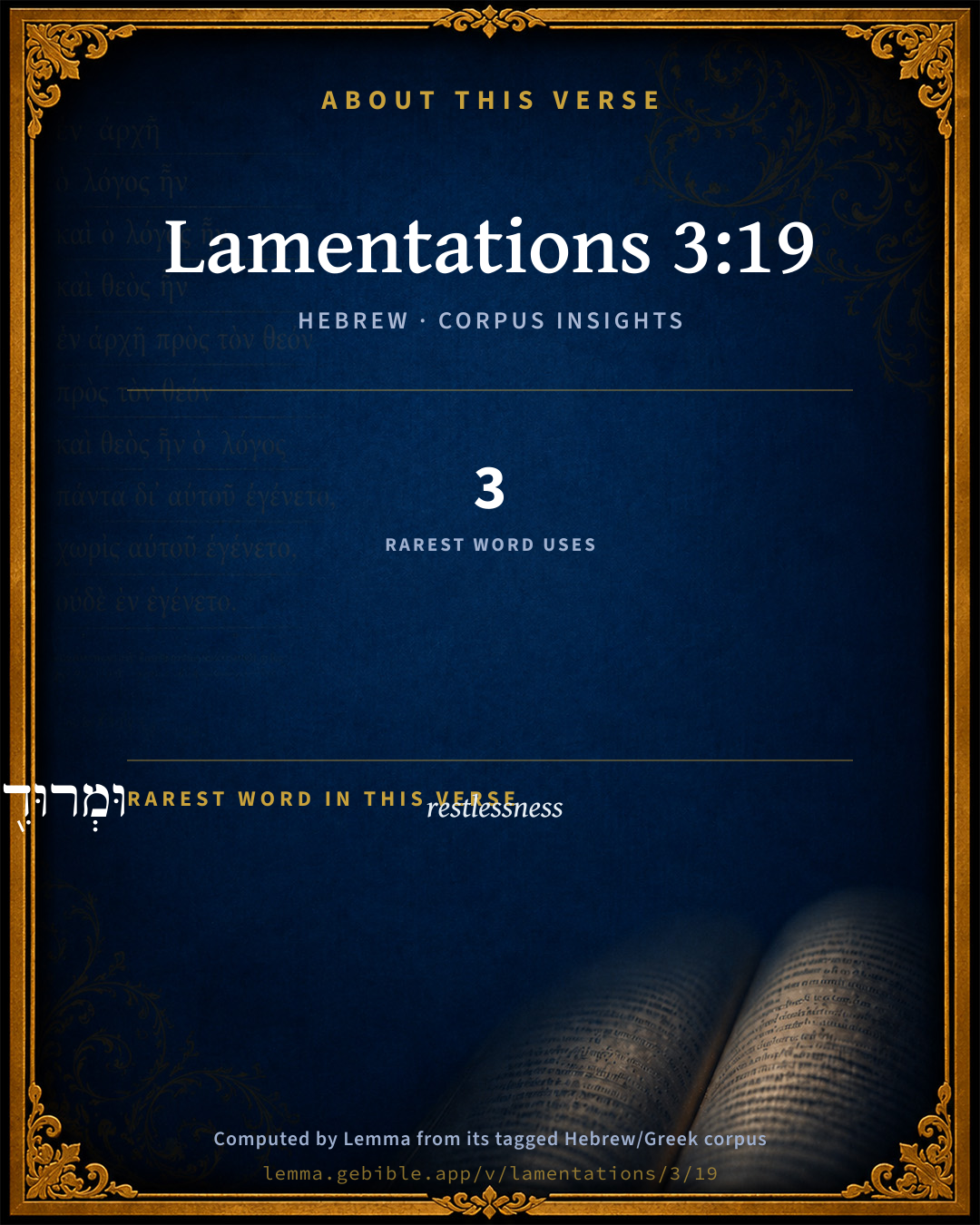
The rarest word here is וּמְרוּדִ֖י restlessness H4788 — appearing just 3 times in the whole Hebrew Bible.

Shared distinctive vocabulary

וּמְרוּדִ֖י restlessness H4788 occurs in 3 verses of the Hebrew Bible. Also found in:

Grammatical profile

  • 1 verb
  • 4 nouns

Verb forms

  • זְכָר Qal · Imperative

Hebrew & Septuagint length

In English translation the verse runs 11 words from the Hebrew and 19 from the Septuagint (LXX English) — the Septuagint runs noticeably longer here. See the side-by-side →

A rough comparison of the two English renderings, which tokenize alike — not a word-level alignment.

Word counts can differ between the Hebrew and the Greek without any difference in meaning — e.g. the Hebrew direct-object marker אֵת has no separate Greek word, and Greek often adds the article ὁ.

Cross-references

8

Topical passages linked to Lamentations 3:19 in the Treasury of Scripture Knowledge — connected by theme and wording, ordered by reader-vote popularity; previews shown in the World English Bible.

  • Lamentations 3:15 He has filled me with bitterness, he has sated me with wormwood.
  • Lamentations 3:5 He has built against me, and compassed me with gall and travail.
  • Nehemiah 9:32 Now therefore, our God, the great, the mighty, and the awesome God, who keep covenant and loving kindness, don't let all the travail seem little before you, that has come on us, on our kings, on our princes, and on our priests, and on our prophets, and on our fathers, and on all your people, since the time of the kings of Assyria to this day.
  • Job 7:7 Oh remember that my life is a breath. My eye shall no more see good.
  • Psalms 89:47 Remember how short my time is! For what vanity have you created all the children of men!
  • Psalms 89:50 Remember, Lord, the reproach of your servants, How I bear in my heart the taunts of all the mighty peoples,
  • Psalms 132:1 Yahweh, remember David and all his affliction,
  • Jeremiah 9:15 therefore thus says Yahweh of Hosts, the God of Israel, Behold, I will feed them, even this people, with wormwood, and give them water of gall to drink.

Cross-references courtesy of OpenBible.info (CC BY 4.0).

Hebrew and Greek witnesses Masoretic Hebrew ↔ Greek Septuagint

The same verse in the two great witnesses to the Old Testament, shown verse-for-verse.

Here the Septuagint runs noticeably longer than the Hebrew — LXX2012 (modern English Septuagint) 19 words vs World English Bible 11. A rough length comparison of the two English translations, not a word-level alignment — read both below.

These are two independent witnesses, not word-aligned to each other, and the Septuagint is shown in lemma (dictionary) form.

Hebrew Lamentations 3:19 Masoretic · Westminster Leningrad Codex

זְכָר עָנְיִ֥י וּמְרוּדִ֖י לַעֲנָ֥ה וָרֹֽאשׁ

Remember my affliction and my misery, the wormwood and the gall.

World English Bible · Public Domain

Greek LXX Lamentations 3:19 Septuagint · lemma form

μιμνήσκω ἀπό πτωχεία ἐγώ καί ἐκ διωγμός ἐγώ πικρία καί χολή ἐγώ

ZAIN. I remembered by reason of my poverty, and because of persecution my bitterness and gall shall be remembered;

LXX2012 (modern English Septuagint) · Public Domain

On this verse, Keil & Delitzsch discusses the Septuagint’s reading. Read the note in Commentary ↓

Hebrew: Westminster Leningrad Codex (CC BY 4.0). Greek: Septuagint (public domain); English from LXX2012 (modern English Septuagint) (Public Domain). How the Septuagint differs from the Hebrew →

Commentary

Notes on Lamentations 3:19 from classic Christian and Jewish commentators (each source and its license shown beneath its notes). The classic Christian expositions comment on the surrounding passage and are grouped to its opening verse, so a note may address several verses; the Jewish commentaries on the Tanakh (Rashi and others) are per-verse, so they appear only where the commentator wrote on this verse.

Lemma curates 59 commentaries, every one of them public domain or Creative Commons licensed, each selected and text-cleaned for this edition rather than reprinted as found. About our sources →

Trapp's Complete Commentary

John Trapp

Lam 3:19 Remembering mine affliction and my misery, the wormwood and the gall.

Ver. 19. Remembering mine affliction and my misery, the wormwood and the gall,] i.e., The bitterness that was in it, but of mine own commingling. Impatiens quisque bis affligitur, Impatience redoubleth an affliction.

John Trapp, A Commentary or Exposition upon All the Books of the Old and New Testament (1647–1656) — public domain. Text from a community e-Sword module.

Whedon's Commentary on the Bible

Daniel D. Whedon

PIOUS ACKNOWLEDGMENT OF GOD’S SOVEREIGNTY AND MERCY, Lam_3:19-39.

19. Remembering — Better, remember, as in the margin. The verb is an infinitive, as in the fourth commandment. Affliction, misery, wormwood, and gall are reminiscences of chapter 1.

Daniel D. Whedon (gen. ed.), Commentary on the Old and New Testaments (1874–1909) — public domain. Text from a community e-Sword module.

Keil & Delitzsch

C. F. Keil & F. Delitzsch

Consideration of God's compassion and His omnipotence as displayed at critical junctures in the affairs of men. C. B. Michaelis has correctly perceived, and thus set forth, the transition from the complaint, bordering on despair, to hope, as given in Lam 3:19 : luctatur hic contra desperationis adfectum, quo tentatus fuerat, Lam 3:18, mix inde per fidem emersurus. In like manner it is said in the Berleburger Bibel, "In Lam 3:19 he struggles with despair, to which he had been tempted, and in the following verse soars up once more into the region of faith." By the resumption of עני from Lam 3:1, and of לענה and ראשׁ from Lam 3:15 and Lam 3:5, the contents of the whole preceding lamentation are given in a summary, and by זכר are presented to God in prayer. "Mine affliction" is intensified by the addition of "my persecution" (see on Lam 1:7), and the contents of the lamentation thereby more plainly pointed out. This connection of the verse has been misunderstood in many ways. An old interpretation of the words, still maintained by Bttcher and Thenius, makes זכר an infinitive; according to this view, Lam 3:19 would require to be conjoined with the preceding, and the inf. without ל would stand for the ground, recordando, "while I think of," - which is grammatically impossible.

(Note: Seb. Mnster long since said: Secundum quosdam est זכר infinit., ut sit sensus: periit spes mea, recordante me afflictionis meae. Calvin also gives the preference to this view, with the remark: Videtur enim hic propheta exprimere, quomodo fere a spe exciderit, ut nihil reperiret amplius fortitudinis in Deo, quia scilicet oppressus erat malis; in support of which he affirms that it is valde absurdum, eos qui experti sunt aliquando Dei misericordiam, sic omnem spem abjicere, ut non statuant amplius sibi esse refugium ad Deum.)

The same remark applies to the assumption that זכר is an infinitive which is resumed in Lam 3:20 : "it thinks of my misery...yes, my soul thinks thereon" (Bttcher, Thenius). Gerlach very properly remarks concerning this view that such a construction is unexampled, and, as regards the change in the form of the infinitive (constr. and abs.), would be unintelligible. The objection of Thenius, however, that the imperative meaning usually attached to זכר is against the whole context, and quite inappropriate here, is connected with the erroneous assumption that Lam 3:19 and Lam 3:20 form a continuation of what precedes, and that the idea of the speaker's being completely overwhelmed by the thought of all that he had suffered and still suffers, forms the proper conclusion of the first part, after which, from Lam 3:21 onwards, there follows relief. Gerlach has rightly opposed to these arguments the following considerations: (1) That, after the outburst of despair in Lam 3:18, "my strength is gone, and my hope from Jahveh," the words "my soul is bowed down in me" form far too feeble a conclusion; (2) That it is undoubtedly more correct to make the relief begin with a prayer breathed out through sighs (Lam 3:19), than with such a reflection as is expressed in Lam 3:21. Ewald also is right in taking זכר as an imperative, but is mistaken in the notion that the speaker addresses any one who is ready to hear him; this view is shown to be erroneous by the simple fact that, in what precedes and succeeds, the thoughts of the speaker are directed to God only.

Lam 3:20-23

The view taken of this verse will depend on the answer to the question whether תּזכר is second or third pers. fem. Following in the wake of Luther ("Thou wilt assuredly think thereon"), C. B. Michaelis, Pareau, Rosenmller, and Kalkschmidt take it as second pers.: "Think, yea, think wilt Thou, that my soul is bowed down in me," or "that my soul is at rest within me" (Ngelsbach). But it is impossible to maintain either of these views in the face of the language employed. To take the ו before תּשׁיח in the meaning of quod is characterized by Ngelsbach as an arbitrary procedure, unwarranted either by Gen 30:27 or Eze 13:11; but neither can the meaning of resting, being at east, which is attributed to שׁוּח or שׁיח by that writer, be established. The verb means to sink down, Pro 2:18, and metaphorically, to be bowed down, Psa 44:26. The latter meaning is required in the present passage, from the simple fact that the sentence undeniably refers to Psa 42:6.

(Note: Luther's translation, "for my soul tells me," is founded on the circumstance that the lxx have mistaken שׁיח for שׂיח: καταδολεσχήσει ἐπ ̓ ἐμὲ ἡ ψυχή μου.)

ותּשׁיח expresses the consequence of זכר תּזכר, which therefore can only be the third pers., and "my soul" the subject of both clauses; for there is no logical consecution of the meaning given by such a rendering as, "If Thou wilt remember, my soul shall be bowed within me." The expression, "If my soul duly meditates thereon (on the deep suffering), it becomes depressed within me," forms the foundation of the request that God would think of his distress, his misery; and Lam 3:21, "I will lay this to heart," connects itself with the leading thought set forth in Lam 3:19, the reason for which is given in Lam 3:20, viz., that my soul is only bowed down within me over the thought of my distress, and must complain of it to God, that He may think of it and alleviate it: This will I lay to heart and set my hope upon. על־כּן is a strong inferential expression: "therefore," because God alone can help, will I hope. This self-encouragement begins with Lam 3:22, inasmuch as the prophet strengthens his hope by a consideration of the infinite compassion of the Lord. (It is) חסדי, "the mercies of God," i.e., proofs of His mercy (cf. Psa 89:2; Psa 107:43; Isa 63:7), "that we are not utterly consumed," as Luther and similarly our English translators have excellently rendered תּמנוּ. This form stands for תּמּונוּ, as in Jer 44:18; Num 17:1-13 :28, not for תּמּוּ, third pers., as Pareau, Thenius, Vaihinger, and Ewald, referring to his Grammar, 84, b, would take it. The proofs of the grace of God have their foundation in His compassion, from which they flow. In Lam 3:23 we take חסדי as the subject of חדשׁים; it is the proofs of the grace of God that are new every morning, not "His compassions," although the idea remains the same. לבּקרים, every morning, as in Isa 33:2; Psa 73:14. Ubi sol et dies oritur, simul et radii hujus inexhaustae bonitatis erumpunt (Tarnovius in Rosenmller). The consciousness of this constant renewal of the divine favour impels to the prayerful exclamation, "great is Thy faithfulness;" cf. Psa 36:6.

Lam 3:24-28

"My portion is Jahveh:" this is a reminiscence from Psa 16:5; Psa 73:26; Psa 142:6; cf. Psa 119:57, where the expression found here is repeated almost verbatim. The expression is based on Num 18:20, where the Lord says to Aaron, "I am thy portion and thine inheritance;" i.e., Jahveh will be to the tribe of Levi what the other tribes receive in their territorial possessions in Canaan; Levi shall have his possession and enjoyment in Jahveh. The last clause, "therefore will I hope," etc., is a repetition of what is in Lam 3:21, as if by way of refrain.

This hope cannot be frustrated, Lam 3:25. The fundamental idea of the section contained in Lam 3:25-33 is thus stated by Ngelsbach: "The Lord is well disposed towards the children of men under all circumstances; for even when He smites them, He seeks their highest interest: they ought so to conduct themselves in adversity, that it is possible for Him to carry out His designs." On Lam 3:25, cf. Psa 34:9; Psa 86:5; and on the general meaning, also Psa 25:3; Psa 69:7. If the Lord is kind to those who hope in Him, then it is good for man to wait patiently for His help in suffering. Such is the mode in which Lam 3:26 is attached to Lam 3:25. טוב, Lam 3:26 and Lam 3:27, followed by ל dat., means to be good for one, i.e., beneficial. Some expositors (Gesenius, Rosenmller, Maurer, Ngelsbach) take יחיל as a noun-form, substantive or adjective; דּוּמם is then also taken in the same way, and ו - ו as correlative: "it is good both to wait and be silent." But although there are analogous cases to support the view that יחיל is a noun-form, the constant employment of דּוּמם as an adverb quite prevents us from taking it as an adjective. Moreover, "to be silent for the help of the Lord," would be a strange expression, and we would rather expect "to be silent and wait for;" and finally, waiting and silence are so closely allied, that the disjunctive ו - ו et - et appears remarkable. We prefer, then, with Ewald (Gram. ֗235, a) and others, to take יחיל as a verbal form, and that, too, in spite of the i in the jussive form of the Hiphil for יחל, from חוּל, in the meaning of יחל, to wait, tarry. "It is good that he (man) should wait, and in silence too (i.e., without complaining), for the help of the Lord." On the thought presented here, cf. Psa 38:7 and Isa 30:15. Hence it is also good for man to bear a yoke in youth (Lam 3:27), that he may exercise himself in calm waiting on the help of the Lord. In the present context the yoke is that of sufferings, and the time of youth is mentioned as the time of freshness and vigour, which render the bearing of burdens more easy. He who has learned in youth to bear sufferings, will not sink into despair should they come on him in old age. Instead of בּנעוּריו, Theodotion has ἐκ νεότητος αὐτοῦ, which is also the reading of the Aldine edition of the lxx; and some codices have מנּעוּריו. But this reading is evidently a correction, prompted by the thought that Jeremiah, who composed the Lamentations in his old age, had much suffering to endure from the time of his call to the prophetic office, in the earlier portion of his old age; nor is it much better than the inference of J. D. Michaelis, that Jeremiah composed this poem when a youth, on the occasion of King Josiah's death. - In Lam 3:28-30, the effect of experience by suffering is set forth, yet not in such a way that the verses are to be taken as still dependent on כּי in Lam 3:27 (Luther, Pareau, De Wette, Maurer, and Thenius): "that he should sit alone and be silent," etc. Such a combination is opposed to the independent character of each separate alphabetic strophe. Rather, the result of early experience in suffering and patience is developed in a cohortative form. The connection of thought is simply as follows: Since it is good for man that he should learn to endure suffering, let him sit still and bear it patiently, when God puts such a burden on him. Let him sit solitary, as becomes those in sorrow (see on Lam 1:1), and be silent, without murmuring (cf. Lam 3:26), when He lays a burden on him. There is no object to נטל expressly mentioned, but it is easily understood from the notion of the verb (if He lays anything on him), or from על in Lam 3:27 (if He lays a yoke on him). We are forbidden to consider the verbs as indicatives ("he sits alone and is silent;" Gerlach, Ngelsbach) by the apocopated form יתּן in Lam 3:29, Lam 3:30, which shows that ישׁב and ידּם are also cohortatives.

Lam 3:29

"Let him put his mouth in the dust," i.e., humbly bow beneath the mighty hand of God. The expression is derived from the Oriental custom of throwing oneself in the most reverential manner on the ground, and involves the idea of humble silence, because the mouth, placed in the dust, cannot speak. The clause, "perhaps there is hope," indicates the frame of mind to be observed in the submission. While the man is to show such resignation, he is not to give up the hope that God will deliver him from trouble; cf. Job 11:18; Jer 31:17.

Lam 3:30-36

Let him also learn patiently to bear abuse and reviling from men. Let him present his cheek to him who smites him, as was done by Job (Job 16:10) and the servant of Jahveh (Isa 50:6); cf. Mat 5:39. On Lam 3:30, cf. Psa 88:4; Psa 123:3, etc. There is a certain gradation in the three verses that it quite unmistakeable. The sitting alone and in silence is comparatively the easiest; it is harder to place the mouth in the dust, and yet cling to hope; it is most difficult of all to give the cheek to the smiter, and to satiate oneself with dishonour (Ngelsbach). In Lam 3:31-33 follow the grounds of comfort. The first is in Lam 3:31 : the sorrow will come to an end; the Lord does not cast off for ever; cf. Jer 3:5, Jer 3:12. The second is in Lam 3:32 : when He has caused sorrow, He shows pity once more, according to the fulness of His grace. Compassion outweighs sorrow. On this subject, cf. Psa 30:6; Job 5:18; Isa 54:8. The third ground of comfort is in Lam 3:33 : God does not send affliction willingly, as if it brought Him joy (cf. Jer 32:41), but merely because chastisement is necessary to sinful man for the increase of his spiritual prosperity; cf. Act 14:22; Co2 4:17. ויּגּה is for וייגּה: cf. Ewald, 232, f; Gesenius, 69, 3, Rem. 6.

That he may bring home to the hearts of God's people the exhortation to bear suffering with patience and resignation, and that he may lead them to see that the weight of sorrow under which they are sighing has been sent from the Lord as a chastisement for their sins, the prophet carries out the thought, in Lam 3:34-39, that every wrong committed upon earth is under the divine control (Lam 3:34-36), and generally that nothing happens without God's permission; hence man ought not to mourn over the suffering that befalls him, but rather over his sins (Lam 3:37-39).

Lam 3:34-36

These verses form one connected sentence: while the subject and predicate for the three infinitival clauses do not follow till the words אדני לא ראה, the infinitives with their objects depend on ראה. If there were any foundation for the assertion of Bttcher in his Aehrenlese, that ראה never occurs in construction with ל, we could take the infinitives with ל as the objects of ראה, in the sense, "As to the crushing of all the prisoners," etc. But the assertion is devoid of truth, and disproved by Sa1 16:7, האדם יראה לעינים ויהוה יראה. In the three infinitival clauses three modes of unjust dealing are set forth. The treading down to the earth of all prisoners under his (the treader's) feet, refers to cruel treatment of the Jews by the Chaldeans at the taking of Jerusalem and Judah, and generally to deeds of violence perpetrated by victors in war. This explains כּל, which Kalkschmidt and Thenius incorrectly render "all captives of the land (country)." Those intended are prisoners generally, who in time of war are trodden down to the earth, i.e., cruelly treated. The other two crimes mentioned, vv. 35 and 36, are among the sins of which Judah and Israel have been guilty, - the former being an offence against the proper administration of justice, and the latter falling under the category of unjust practices in the intercourse of ordinary life. "To pervert the right of a man before the face of the Most High" does not mean, in general, proterve, et sine ull numinis inspectantis reverenti (C. B. Michaelis, Rosenmller); but just as הטות משׁפּט is taken from the law (Exo 23:6; Num 16:19, etc.), so also is נגד פּני עליון to be explained in accordance with the directions given in the law (Exo 22:7, Exo 22:9), that certain clauses were to be brought before האלהים, where this word means the judge or judges pronouncing sentence in the name of God; cf. Psa 82:6, where the judges, as God's representatives, are called אלהים and בּני אלהים. "Before the face of the Most High" thus means, before the tribunal which is held in the name of the Most High. "To turn aside a man in his cause" means to pervert his right in a dispute (cf. Job 8:3; Job 34:12, etc.), which may also be done in contested matters that do not come before the public tribunal. The meaning of the three verses depends on the explanation given of אדני לא ראה, which is a disputed point. ראה with ל, "to look on something," may mean to care for it, be concerned about it, but not to select, choose, or to resolve upon, approve (Michaelis, Ewald, Thenius). Nor can the prophet mean to say, "The Lord does not look upon the treading down of the prisoners, the perversion of justice." If any one be still inclined, with Rosenmller and others, to view the words as the expression of a fact, then he must consider them as an exception taken by those who murmur against God, but repelled in Lam 3:37. Moreover, he must, in some such way as the following, show the connection between Lam 3:33 and Lam 3:34, by carrying out the idea presented in the exhortation to hope for compassion: "But will any one say that the Lord knows nothing of this - does not trouble Himself about such sufferings?" Whereupon, in Lam 3:37, the answer follows: "On the contrary, nothing happens without the will of God" (Gerlach). But there is no point of attachment that can possibly be found in the words of the text for showing such a connection; we must therefore reject this view as being artificial, and forced upon the text. The difficulty is solved in a simple manner, by taking the words אדני לא as a question, just as has been already done in the Chaldee paraphrase: fierine potest ut in conspectu Jovae non reveletur? The absence of the interrogative particle forms no objection to this, inasmuch as a question is pretty often indicated merely by the tone. Lam 3:38 must also be taken interrogatively. Bצttcher and Thenius, indeed, think that the perfect ראה is incompatible with this; but the objection merely tells against the rendering, "Should not the Lord see it?" (De Wette, Maurer, Kalkschmidt), which of course would require יראה. But the idea rather is, "Hath not the Lord looked upon this?" The various acts of injustice mentioned in the three verses are not set forth merely as possible events, but as facts that have actually occurred.

Lam 3:37-39

Lam 3:37 brings the answer to this question in a lively manner, and likewise in an interrogative form: "Who hath spoken, and it came to pass, which the Lord hath not commanded?" The thought here presented reminds us of the word of the Creator in Gen 1:3. The form of the expression is an imitation of Psa 33:9. Rosenmller gives the incorrect rendering, Quis est qui dixit: factum est (i.e., quis audeat dicere fieri quicquam), non praecipiente Deo; although the similar but more free translation of Luther, "Who dares to say that such a thing happens without the command of the Lord?" gives the sense in a general way. The meaning is as follows: Nothing takes place on the earth which the Lord has not appointed; no man can give and execute a command against the will of God. From this it further follows (Lam 3:38), that evil and good will proceed from the mouth of the Lord, i.e., be wrought by Him; on this point, cf. Isa 45:7; Amo 3:6. לא תצא gives no adequate meaning unless it be taken interrogatively, and as indicating what is usual - wont to be. And then there is established from this, in Lam 3:39, the application of the general principle to the particular case in question, viz., the grievous suffering of individuals at the downfall of the kingdom of Judah. "Why does a man sigh as long as he lives? Let every one [sigh] for his sins." Man is not to sigh over suffering and sorrow, but only over his sin. התאונן occurs only here and in Num 11:1, and signifies to sigh, with the accessory notion of murmuring, complaining. חי appended to אדם is more of a predicate than a simple attributive: man, as long as he lives, i.e., while he is in this life. The verse is viewed in a different light by Pareau, Ewald, Neumann, and Gerlach, who combine both members into one sentence, and render it thus: "Why doth a man complain, so long as he lives, - a man over the punishment of his sins?" [Similar is the rendering of our "Authorized" Version.] Neumann translates: "A man in the face of [Ger. bei] his sins." But this latter rendering is lexically inadmissible, because על esua in this connection cannot mean "in view of." The other meaning assigned is improbable, though there is nothing against it, lexically considered. For though חטא, sin, may also signify the punishment of sin, the latter meaning does not suit the present context, because in what precedes it is not said that the people suffer for their sins, but merely that their suffering has been appointed by God. If, then, in what follows, there is an exhortation to return to the Lord (Lam 3:40.), and in Lam 3:42 a confession of sins made; if, moreover, Lam 3:39 forms the transition from Lam 3:33-38 to the exhortation that succeeds (Lam 3:40.); then it is not abstinence from murmuring or sighing over the punishment of sins that forms the true connecting link of the two lines of thought, but merely the refraining from complaint over sufferings, coupled with the exhortation to sigh over their won sins. Tarnov also has viewed the verse in this way, when he deduces from it the advice to every soul labouring under a weight of sorrows: est igitur optimus ex malis emergendi modus Deum excusare et se ipsum accusare.

Keil & Delitzsch — Biblical Commentary on the Old Testament (1861–1891) — public domain (CC PDM 1.0). Text via the HelloAO Bible API. (Old Testament only.)

Tyndale Open Study Notes

Tyndale Open Resources

3:19 is bitter beyond words (or is wormwood and gall): Wormwood is a plant with a bitter taste; here it represents the emotional intensity of inner agony (Prov 5:4; Rev 8:11). Gall is a poisonous plant that causes severe physical pain if eaten; it is a powerful symbol for extremely stressful emotions (Deut 29:18; Ps 69:21). The author seems to be at a dead end from which he cannot escape.

Tyndale Open Study Notes — © Tyndale Open Resources, licensed CC BY-SA 4.0. Text via the HelloAO Bible API.

Jamieson, Fausset & Brown

Robert Jamieson, A. R. Fausset & David Brown

This gives the reason why he gave way to the temptation to despair. The Margin, "Remember" does not suit the sense so well.

wormwood . . . gall-- (Jer 9:15).

Jamieson, Fausset & Brown — Commentary Critical and Explanatory on the Whole Bible (1871) — public domain (CC PDM 1.0). Text via the HelloAO Bible API.

John Calvin's Commentaries

The verb may be considered as an imperative; it is an infinitive mood, but it is often taken in Hebrew as an imperative. Thus, many deem it a prayer, Remember my affliction and my trouble, the gall and the poison This might be admitted; but what others teach I prefer: that this verse depends on the last. For the Prophet seems here to express how he had almost fallen away from hope, so that he no longer found strength from God, even because he was overwhelmed with evils; for it is very unreasonable to think, that those who have once experienced the mercy of God should cast away hope, so as not to believe that they are to flee to God any more. What seems then by no means congruous the Prophet here in a manner excuses, and shews that it was not strange that he succumbed under extreme evils, for he had been so pressed down by afflictions and troubles, that his soul became as it were filled with poison and gall.

But in the meantime, he shews by the word remember, how such a trial as this, when it comes, lays hold on our minds, that is, when we think too much of our evils. For the faithful ought to hold a middle course in their afflictions, lest they contract a torpor; for as hence indifference and stupidity arise, they ought to rouse themselves to a due consideration of their evils; but moderation ought to be observed, lest sorrow should swallow us up, as Paul also warns us (2 Corinthians 2:7.) They then who fix their minds too much on the remembrance of their evils, by degrees open the door to Satan, who may fill their hearts and all their thoughts with despair. The Prophet then describes here the fountain of evils, when he says, that he remembered his affliction and trouble; and suitable to this is what immediately follows, —

John Calvin's Commentaries (1540-1563) — public domain. Text from the Calvin Translation Society English edition (1840s-50s) via the Christian Classics Ethereal Library (ccel.org). Calvin's coverage is partial (roughly two-thirds of the Bible); uncommented books and verses are honest gaps, never fabricated. The 19th-century editor's footnotes and remarks are omitted so the notes are faithfully Calvin's own voice.

Ellicott's Commentary for English Readers

(19) Remembering.—The verb, which is rendered by the Authorised version as a gerundial infinitive, is better taken as an imperative, Remember mine affliction; the prayer being addressed to Jehovah. The two terms of the first clause are taken from Lam_1:7. The mourner begins his prayer, as it were, by a recapitulation of his sufferings. (Comp. Psa_69:21.)

A Bible Commentary for English Readers, edited by Charles John Ellicott (1878–1897) — public domain. Text from a community e-Sword module.

The Cambridge Bible for Schools and Colleges

gen. ed. J. J. S. Perowne

19. God is now directly invoked.

misery] mg. wandering, or, outcast state.

The Cambridge Bible for Schools and Colleges (gen. ed. J. J. S. Perowne; Cambridge University Press, 1878–1918) — public domain. Text from a community e-Sword module.

John Gill's Exposition

Remembering mine affliction and my misery,.... The miserable affliction of him and his people; the remembrance of which, and poring upon it continually, caused the despondency before expressed: though it may be rendered imperatively, "remember my affliction, and my misery" (s); so the Vulgate Latin and Syriac versions; and Aben Ezra observes, that the words may be considered as a request to God, and so they seem to be; the prophet, and the people he represents, were not so far gone into despair, as to cast off prayer before God; but once more looked up to him, beseeching that he would, in his great mercy and pity, remember them in their distressed condition, and deliver out of it; for none could do it but himself:

the wormwood and the gall; figurative expressions of bitter and grievous afflictions, Lam 3:5.

(s) "recordare", Munster, Pagninus, Montanus, Vatablus, Cocceius, Michealis.

John Gill's Exposition of the Whole Bible (1746–1763) — public domain (CC PDM 1.0). Text via the HelloAO Bible API.

Albert Barnes' Notes on the Bible

Remembering - Or, as in the margin. It is a prayer to Yahweh.

My misery - Or, “my” homelessness (Lam 1:7 note).

Albert Barnes' Notes on the Bible (1834–1885) — public domain. Text from a community e-Sword/MySword module.

Matthew Poole's English Annotations

If, according to our translation, we read

Remembering, or While I remember, these two verses contain but one sentence; in tire former part the prophet in the name of this people expresseth their despairing condition; in the latter he gives the reason of it, viz. the people’s poring upon their great and heavy afflictions, which he compares to wormwood and gall, two things excessively bitter, and often made use of to signify great affliction, Psa 69:21; Jer 8:14; 9:15; 23:15; Rev 8:11. But it may as well be read imperatively, Remember mine affliction; so the first of these two verses expresseth the dejection of the people’s minds in their captivity, caused through their proneness to despair of any better condition that their angry God would bring them into. The 19th verse is a prayer directed to God, which showed that though they were mightily perplexed, yet they were not in utter despair; and to this sense the following verses seem to incline.

Matthew Poole's English Annotations on the Holy Bible (1683–1685) — public domain. Text from a community e-Sword/MySword module.

The Pulpit Commentary

Vers. 19-21. These verses prepare the way for a brief interval of calmness and resignation.

Remembering; rather, remember. It is the language of prayer.

Vers. 19-21. God taking notice of man"s affliction.

In his distress the sufferer cries to God, calling upon his great Helper to note his condition and remember it. Then he is calmed by prayer, and rests in the assurance that God does not forget his trouble. Recalling this thought to mind, he recovers hope.

I THE CRY FOR GOD"S NOTICE.

1. It is to God. At first it seems as though God bad forgotten his afflicted child. The vision of the Divine countenance is clouded; no voice speaks out of the darkness. Desolate and despairing, in misery that is bitter as wormwood and gall, the troubled soul seems to be deserted of God in the hour of greatest need. Then the sufferer cries out to God. Here is instinctive wisdom. We may or we may not be observed by our fellow men, and though human sympathy is a consolation, and indifference an additional bitterness, still in the heaviest trouble man can do little. It is not his notice that we should be most anxious to attract. The clamour of the afflicted for pity is an indication of weakness. But we do need God"s sympathy; this is true healing balm. To him let the cry of trouble ascend.

2. It is for God"s notice. It is not for relief, but for remembrance by God. There is good reason to trust that the remembrance will result in the relief. Nevertheless, the first and chief necessity is that God would take notice of us in trouble. If he do so we can leave the rest to him. It would be well if our prayers implied more simple reliance on the goodness of God, without perfect definitions of what we desire him to do for us.

II THE ASSURANCE OF GOD"S NOTICE. No sooner is the cry out of his lips than the sufferer comforts himself with the assurance that God does remember his affliction. Thus speedily is the prayer answered, even in the very act of uttering it. Nevertheless, it is not to be thought that God did not remember the affliction till he had been implored to do so. We should rather understand that it was always under the pitying eye of God, only the Divine compassionate recognition of it was not discovered until prayed for. Thus we often pray to God to do for us what he is already doing, and receive an answer to our prayers in the opening of our eyes to see the Divine action that has been hitherto unobserved. We pray that God will he merciful to us. He answers our prayer, not by becoming merciful, but by showing us that he is and has been merciful all along. This revelation comes to us in two ways.

1. We are able to believe more in the character of God, in his love and mercy. Then we can apply this faith to our present circumstances, and infer with confidence that such a God must be remembering us even when we see no proof of his notice, as a child when lost at first despairs, but, after reflecting on the love of his father and mother, comforts himself with the assurance that they will surely never desert him.

2. We are able to see indications of God"s notice. Sometimes we can-see how God is working for our deliverance when we shift our standpoint and regard our life from the footstool of prayer.

III THE HOPE THAT SPRINGS FROM GOD"S NOTICE. This is enough. God observes us. Still the trouble is great and bitter, But we know that he will not. permit us to perish. As the shipwrecked crew wave garments and make frantic efforts to attract the attention of a passing vessel, and recover hope directly they see indications that they are discovered, so troubled souls should lose all despair as soon as they learn that they are seen by God. It may still be impossible to see how God will save. But we can trust that to.him. Now, that we may enjoy this hope, it is necessary for us to call to mind the fact that God is remembering our affliction. Much depends on the aspect of affairs on which we dwell. If we turn to the wormwood and gall our lot will seem to be hitter without mitigation. We must voluntarily direct our thoughts away to the unseen remembrance of God, that we may receive the comfort of hope.

Vers. 19, 20. Remembering affliction.

As the prophet entreats the Lord to remember the afflictions he and his countrymen have passed through, he records his own vivid recollection of bygone misery and humiliation. Now, the counsel of the world would be Forget your troubles; they are past; why allow them to disturb and to distress the mind? There are, however, good reasons why this advice should be rejected, why the afflictions we have passed through should sometimes be recalled to mind.

I THIS EXERCISE SERVES TO REMIND US OF THE UNCERTAINTY AND VICISSITUDES OF THIS LIFE. It is well that in days of prosperity men should not forget how soon the sky may be clouded, that in times of health liability to sickness and disease should be borne in mind, that the living and the active should hear a voice gently counselling them Memento mori!

II THIS EXERCISE SERVES TO PRESERVE US FROM A DISPOSITION TOWARDS WORLDLINESS. In prosperity it is very common for men to cling to this world, to overestimate its wealth, its pleasures, its honours. Let them remember days of adversity; let them consider how possible it is that such days may recur; and thus preserve themselves from the threatened sin of worldly mindedness.

III THIS EXERCISE MAY LEAD US TO GLORIFY THE DIVINE DELIVERER. Affliction is to many a thing of the past; they have left the tempestuous seas and are in the quiet haven. Let such Consider by whose great mercy such deliverance has been effected, to whom their gratitude is due. Who interposed upon their behalf and brought them into safety? Do they forget to sing, "This poor man cried, and the Lord heard him, and delivered him out of all his troubles"?

IV THIS EXERCISE MAY SUGGEST THE EXPECTATION OF HEAVEN, AND MAY LEND ATTRACTIVENESS TO THE PROSPECT. The past naturally suggests the future. In remembering the afflictions of earth we are reminded of that state where "the wicked cease from troubling, and the weary are at rest. T.

The Pulpit Commentary (1880–1919), ed. H.D.M. Spence-Jones & Joseph S. Exell — public domain. Text from a community e-Sword module.

John Wesley's Explanatory Notes

Wormwood - Wormwood and gall, are often made use of to signify great affliction.

John Wesley, Explanatory Notes Upon the Whole Bible (1754–1765) — public domain. Text via the GEBible commentary corpus.

Kretzmann's Popular Commentary

Paul E. Kretzmann

God’s Mercy and Power Revealed

v. 19. Remembering, or, "Remember," mine affliction and my misery, the wormwood and the gall, the sufferings about which he has just complained so bitterly.

v. 20. My soul hath them still in remembrance and is humbled in me, still bowed down, as under a heavy weight.

v. 21. This, namely, the fact that his soul is deeply afflicted by the mere remembrance of his sufferings, I recall to my mind, taking it to heart, therefore have I hope. Throwing off the feeling of despair which threatened him, he thinks of the fact that God alone can help him, and upon this fact he places his hope. A consideration of the boundless mercy of the Lord strengthens his hope.

v. 22. It is of the Lord’s mercies, on account of the fact that He delights in making known His fatherly kindness and grace toward us, that we are not consumed, because His compassions fail not, they have no end.

v. 23. They are new every morning, namely, the evidences of His love and mercy; great is Thy faithfulness, the outflow of His compassionate love in fulfilling His promises. These wonderful facts the sacred writer now applies to himself.

v. 24. The Lord is my Portion, saith my soul, Cf Psa 16:5; Psa 73:26; Psa 142:6; therefore will I hope in Him, resting his trust in Him in the certainty of faith.

v. 25. The Lord is good unto them that wait for Him, in this steadfast trust, to the soul that seeketh Him, looking to Him alone for help and deliverance. The thoughts of Jehovah are always good and kind, even when He causes pain. Though man be in trouble, he should yet perceive the goodness of the Lord, so that he cannot defiantly murmur or faint-heartedly despair.

v. 26. It is good that a man should both hope and quietly wait for the salvation of the Lord, in the calm certainty that He will send His deliverance in due time. It is a wonderful achievement to be humbly patient and quiet under all circumstances, no matter what tribulations may come, ever resting in the will of God.

v. 27. It is good for a man that he bear the yoke in his youth, so that the disciplinary value of various sufferings may have an opportunity to work patience in his heart and enable him to bear the burdens of age with greater fortitude and trust in the Lord. He who has learned to take up his cross in patient resignation while he was still young will have no trouble in exercising the proper submissiveness when he is old.

v. 28. He sitteth alone and keepeth silence, practicing patience in a solitude which enables him to value the divine chastisements, because He hath borne it upon him, because and when Jehovah has laid the burden upon him.

v. 29. He putteth his mouth in the dust, in the position of most humble submission, restraining himself from murmuring, if so be there may be hope, or, "perhaps there is still hope," namely, that God will have compassion and withdraw His chastening Land.

v. 30. He giveth his cheek to him that smiteth him, submitting even to injustice if it serves the cause of the Lord, Cf Mat 5:39; he is filled full with reproach, enduring also the scorn which men heap upon him for his trust in God. Note the climax beginning with the easiest matter and ending with the most difficult, the patient bearing of insults, if it serves the glory of the Lord.

v. 31. For the Lord will not cast off forever, Cf Psa 77:8;

v. 32. ; but though He cause grief, yet will He have compassion according to the multitude of His mercies, so that His grace and love outweigh the burden of even the severest affliction.

v. 33. For He doth not afflict willingly, literally, "from His heart," nor grieve the children of men. It is not because the Lord takes a vindictive delight in punishing men that He lays afflictions upon them, but because His chastisement is necessary for sinful men, for the furtherance of their soul’s salvation. Cf Heb 12:5.

v. 34. To crush under his feet all the prisoners of the earth, as in the cruel treatment accorded the Jews by the Chaldeans,

v. 35. to turn aside the right of a man before the face of the Most High, as when a judge perverts justice before the very eyes of God, who sees and hears it all,

v. 36. to subvert in his cause, so that justice cannot be done, the Lord approveth not, He very decidedly does not favor such injustice. The thoughts naturally arise at this point whether the Lord, then, has nothing to do with all such happenings.

v. 37. Who is he that saith, and it cometh to pass, when the Lord commandeth it not? There is nothing happening on the earth which is not in accordance with the Lord’s intention or not happening with His permission. While no one may injure his neighbor with the approbation of the Lord, yet the injury he does serves the purposes of God’s providential chastisement of transgressors.

v. 38. Out of the mouth of the Most High proceedeth not evil and good? so that the one as well as the other is done by His command or permission.

v. 39. Wherefore doth a living man complain? with sighs and groans over his afflictions, a man for the punishment of his sins? That is, to rectify the evil in the world, let each one lament over his sins. It is only by daily contrition and repentance that we make any headway in combating the evils of this present world. If we grow weary of this lifelong battle, acts of wickedness are bound to multiply.

Paul E. Kretzmann, Popular Commentary of the Bible (1921–1924) — public domain. Text from a community e-Sword module.

unfoldingWord translationNotes

Door43 World Missions Community

General Information:

In verses 19 to 42, the writer thinks about the lessons that he and his fellow citizens should learn about God and his anger and mercy.

wormwood and bitterness

Wormwood is a plant that gives a liquid which is very bitter to drink. Together "wormwood" and "bitterness" represent severe suffering. (See: Doublet and Metaphor)

I am bowed down within me

The author speaks of his deep sadness and despair as if he were bowed down. AT: "I am depressed" or "I am discouraged" (See: Idiom)

But I call this to mind

This means to intentionally think about something. The word "this" refers to something that the author will start to speak about in the next verse. AT: "But I choose to think about this" or "But I remember this"

I have hope

"I hope"

translationWords

afflicted

bow

unfoldingWord translationNotes — © Distant Shores Media and the Door43 World Missions Community, licensed CC BY-SA 4.0. Source: git.door43.org/Door43/en_tn.

Rashi

Rabbi Shlomo Yitzchaki (Rashi)

and my misery Heb. וּמְרוּדִי, compleynt, wailing.

Rashi on the Tanakh — English translations: “The Judaica Press complete Tanach with Rashi, translated by A. J. Rosenberg” (CC BY 4.0); “Pentateuch with Rashi's commentary by M. Rosenbaum and A.M. Silbermann, 1929-1934” (public domain); “The Metsudah Tanach series, Lakewood, N.J” (CC BY 4.0); and “The Book of Joshua, Metsudah Publications, 1997” (CC BY 4.0). Text via Sefaria.

Lesson kit

Teaching starters — assembled from the data on this page, not authored interpretation. Every prompt links to the verse data it draws on. Edit before teaching.

Lamentations, in the Prophets, opens this verse with 5 words (5 distinct Hebrew lemmas). Its most distinctive word is mârûwd (“restlessness”). The Greek Septuagint runs longer here. A historical commentator’s framing appears above. Read the whole chapter for the surrounding context.

Discussion questions

  1. What does “restlessness” (mârûwd) contribute to the verse as a whole?
  2. Isaiah 58:7 shares the word «restlessness» with this verse. How do the two illuminate each other?
  3. Compared with the Hebrew, the Septuagint runs longer here. What questions does that raise?
  4. These translations render this verse differently; the difference is in the English rendering, not the original. What questions does that raise?
  5. The verb «זְכָר» is Qal Imperative. How does its form color the action?
  6. Reading how Trapp's Complete Commentary and Whedon's Commentary on the Bible read this verse, where do the two commentators agree and where do they part?

Things to notice

Reading settings

Reading text

Shown beneath each verse's original-language words.

Old Testament
Old Testament edition

Read the OT as the Masoretic Hebrew (MT) or the Greek Septuagint (LXX).

English shown for the Greek Septuagint (in the Hebrew ↔ Greek comparison).

Comparing translations? Open the Compare panel on any verse page to stack up to four side by side.