
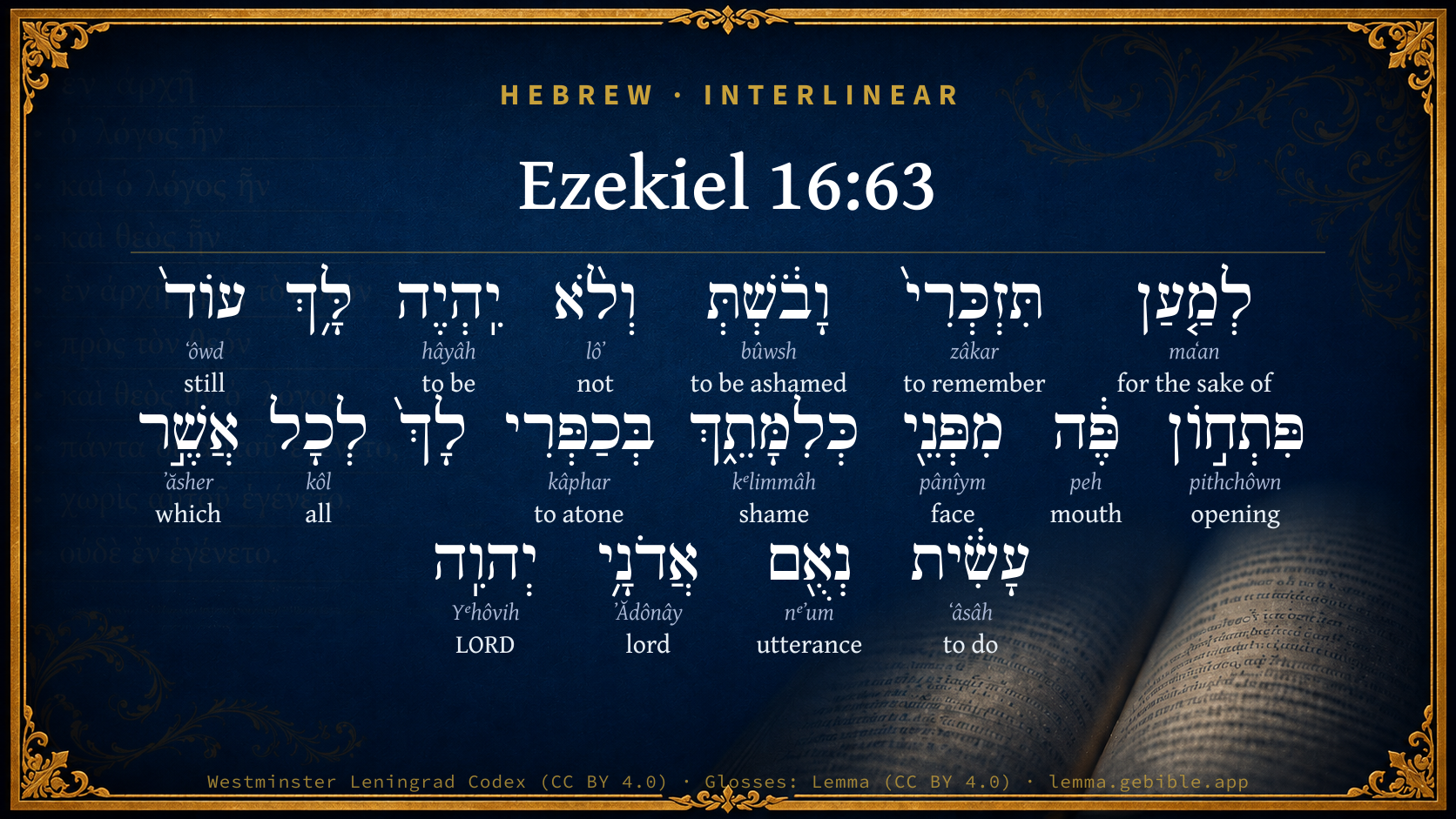
Ezekiel 16:63

Hebrew (Westminster Leningrad Codex) Ezekiel 16:63 appears in the Hebrew Old Testament. The text above is from the Westminster Leningrad Codex. Each word links to its Strong’s number, a concise gloss, and parsing drawn from the Open Scriptures Hebrew Bible morphology. Click any word for its full Brown-Driver-Briggs (BDB) entry.
Download image
Cite this verse

Ezekiel 16:63 (World English Bible). Public Domain. Lemma interlinear Bible study tool, https://lemma.gebible.app/v/ezekiel/16/63.

Show BibTeX & RIS
BibTeX
RIS
English Translation
that you may remember, and be confounded, and never open your mouth any more, because of your shame, when I have forgiven you all that you have done, says the Lord Yahweh.
World English Bible · Public Domain
Highlights
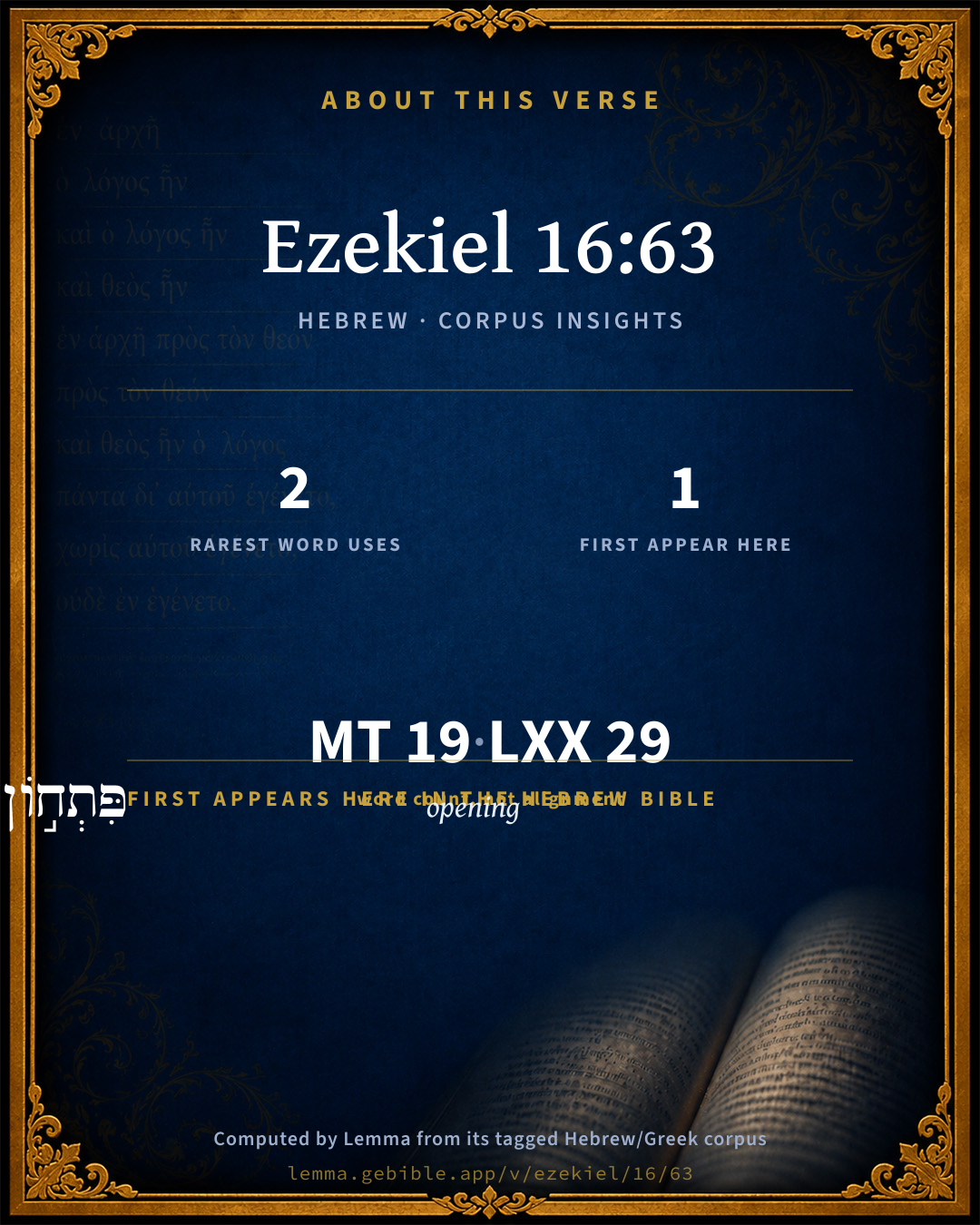
  • 1 first appearance in the Hebrew Bible
Full analysis ↓
Download a study sheet

One document with this verse’s original text, its word-by-word gloss line, the meaning frame, cross-references with their text, attributed commentary, and full source and license credits — printable, and it pastes into notes with its structure intact.

This verse Autodidact and up

Study sheet (.html) Plain text (.txt)

A passage Seminary Student

Up to 50 verses in one chapter. A passage sheet keeps up to 6 commentary sources and 12 cross-references per verse, in the order this page ranks them, and says so on the sheet whenever that leaves anything out. Ask for a single verse and you get the Autodidact verse sheet above.

Everything on this page stays free to read, with no account — the sheet is a download of what is already on screen, not access to it.

Want to remove ads? Support Godless Engineer
Compare translations 3

The same verse in 3 English versions, stacked beneath the original-language interlinear above. Click any original word for its lexicon entry.

Each is an independent rendering of the whole verse — the interlinear is not word-aligned to these translations.

Highlighted words mark where these versions differ — a whole-verse word diff, not a word-by-word alignment.

  • World English Bible Public Domain
    that you may remember, and be confounded, and never open your mouth any more, because of your shame, when I have forgiven you all that you have done, says the Lord Yahweh.
  • King James Version Public Domain
    That thou mayest remember, and be confounded, and never open thy mouth any more because of thy shame, when I am pacified toward thee for all that thou hast done, saith the Lord GOD.
  • unfoldingWord Literal Text CC BY-SA 4.0
    Because of these things, you will call everything to mind and be ashamed, so you will no longer open your mouth to speak because of your shame, when I have forgiven you for all that you have done—this is the Lord Yahweh’s declaration.’”

unfoldingWord Literal Text — © unfoldingWord, licensed CC BY-SA 4.0. Word-aligned USFM3 via Door43 (git.door43.org/unfoldingWord/en_ult).

Versions to compare (up to 4)

3 of 4 selected

Show all 18 translations

Every available English version of this verse, each an independent rendering of the whole verse.

  • World English Bible Public Domain
    that you may remember, and be confounded, and never open your mouth any more, because of your shame, when I have forgiven you all that you have done, says the Lord Yahweh.
  • Berean Standard Bible Public Domain
    so that when I make atonement for all you have done, you will remember and be ashamed and never again open your mouth because of your disgrace, declares the Lord GOD.”
  • Majority Standard Bible Public Domain
    so that when I make atonement for all you have done, you will remember and be ashamed and never again open your mouth because of your disgrace, declares the Lord GOD.”
  • King James Version Public Domain
    That thou mayest remember, and be confounded, and never open thy mouth any more because of thy shame, when I am pacified toward thee for all that thou hast done, saith the Lord GOD.
  • American Standard Version (1901) Public Domain
    that thou mayest remember, and be confounded, and never open thy mouth any more, because of thy shame, when I have forgiven thee all that thou hast done, saith the Lord Jehovah.
  • Revised Version (1885) Public Domain
    that thou mayest remember, and be confounded, and never open thy mouth any more, because of thy shame; when I have forgiven thee all that thou hast done, saith the Lord GOD.
  • Geneva Bible (1599) Public Domain
    That thou mayest remember, and be ashamed, and neuer open thy mouth any more: because of thy shame when I am pacified toward thee, for all that thou hast done, saith the Lord God.
  • Douay-Rheims (1899) Public Domain
    That thou mayest remember, and be confounded, and mayest no more open thy mouth because of thy confusion, when I shall be pacified toward thee for all that thou hast done, saith the Lord God.
  • Young's Literal Translation Public Domain
    So that thou dost remember, And thou hast been ashamed, And there is not to thee any more an opening of the mouth because of thy shame, In My receiving atonement for thee, For all that thou hast done, An affirmation of the Lord Jehovah!'
  • Literal Standard Version CC BY-SA 4.0
    So that you remember, || And you have been ashamed, || And there is not an opening of the mouth to you anymore because of your shame, || In My receiving atonement for you, || For all that you have done, || A declaration of Lord YHWH!”
  • Unlocked Literal Bible CC BY-SA 4.0
    Because of these things, you will call everything to mind and be ashamed, so you will no longer open your mouth to speak because of your shame, when I have forgiven you for all that you have done—this is the Lord Yahweh's declaration.'”
  • unfoldingWord Literal Text CC BY-SA 4.0
    Because of these things, you will call everything to mind and be ashamed, so you will no longer open your mouth to speak because of your shame, when I have forgiven you for all that you have done—this is the Lord Yahweh’s declaration.’”
  • Darby Bible Public Domain
    that thou mayest remember, and be ashamed, and no more open thy mouth because of thy confusion, when I forgive thee all that thou hast done, saith the Lord Jehovah.
  • World Messianic Bible Public Domain
    that you may remember, and be confounded, and never open your mouth any more because of your shame, when I have forgiven you all that you have done,” says the Lord GOD.’”
  • Webster's Bible Public Domain
    That thou mayest remember, and be confounded, and never open thy mouth any more because of thy shame, when I am pacified towards thee for all that thou hast done, saith the Lord GOD.
  • Free Bible Version CC BY-SA 4.0
    so that you will remember and be ashamed, and won't ever defend your disgraceful behavior when I forgive you for everything you've done, declares the Lord God.”
  • Bible in Basic English Public Domain
    So that, at the memory of these things, you may be at a loss, never opening your mouth because of your shame; when you have my forgiveness for all you have done, says the Lord.
  • JPS Tanakh (1917) Public Domain
    that thou mayest remember, and be confounded, and never open thy mouth any more, because of thy shame; when I have forgiven thee all that thou hast done, saith the Lord GOD.'

Literal Standard Version (2020), Covenant Press — licensed CC BY-SA 4.0. Text via the HelloAO Bible API (eBible.org). Unlocked Literal Bible (unfoldingWord) — licensed CC BY-SA 4.0. Text via the HelloAO Bible API (eBible.org). unfoldingWord Literal Text — © unfoldingWord, licensed CC BY-SA 4.0. Word-aligned USFM3 via Door43 (git.door43.org/unfoldingWord/en_ult). Free Bible Version, Dr. Jonathan Gallagher — licensed CC BY-SA 4.0. Text via the HelloAO Bible API (eBible.org).

Word by word

More ways to search: Search by grammar → Find every occurrence → Compare this word →

Practice this passage: Drill this verse → Learn its vocabulary →

פִּתְח֣וֹן
pithchôwn
H6610
“opening of”
Noun, Common, Masculine, Singular, Construct
Part of Speech
Noun
Type
Common
Gender
Masculine
Number
Singular
State
Construct
Full BDB Definition

Origin: from H6605

TWOT: 1854c

opening
  1. לְמַ֤עַן maʻan H4616 “for the sake of” Preposition
  2. תִּזְכְּרִי֙ zâkar H2142 “to remember” Verb, Qal, Imperfect, 2nd Person, Feminine, Singular
  3. וָבֹ֔שְׁתְּ bûwsh H954 “and · to be ashamed” Conjunction + Verb, Qal, Sequential Perfect, 2nd Person, Feminine, Singular
  4. וְלֹ֨א lôʼ H3808 “and · not” Conjunction + Particle, Negative
  5. יִֽהְיֶה hâyâh H1961 “to be” Verb, Qal, Imperfect, 3rd Person, Masculine, Singular
  6. עוֹד֙ ʻôwd H5750 “still” Adverb
  7. פֶּ֔ה peh H6310 “mouth” Noun, Common, Masculine, Singular, Absolute
  8. מִפְּנֵ֖י pânîym H6440 “from · face(s) of” Preposition + Noun, Common, Both, Plural, Construct
  9. כְּלִמָּתֵ֑ךְ kᵉlimmâh H3639 “shame · your” Noun, Common, Feminine, Singular, Construct + Suffix, Personal, 2nd Person, Feminine, Singular
  10. בְּכַפְּרִי kâphar H3722 “in/at · to atone · me” Preposition + Verb, Piel, Infinitive Construct + Suffix, Personal, 1st Person, Common, Singular
  11. לְכָל kôl H3605 “to/for · all of” Preposition + Noun, Common, Masculine, Singular, Construct
  12. אֲשֶׁ֣ר ʼăsher H834 “which” Particle, Relative
  13. עָשִׂ֔ית ʻâsâh H6213 “to do” Verb, Qal, Perfect, 2nd Person, Feminine, Singular
  14. נְאֻ֖ם nᵉʼum H5002 “utterance of” Noun, Common, Masculine, Singular, Construct
  15. אֲדֹנָ֥י ʼĂdônây H136 “Lord · my” Noun, Common, Masculine, Plural, Construct + Suffix, Personal, 1st Person, Common, Singular
  16. יְהוִֽה Yᵉhôvih H3069 “LORD” Noun, Proper

About this verse

These counts appear in no published source. They are computed here, from the morphology-tagged text and Lemma’s own curated glosses. What Lemma adds →

19
words
17
distinct lemmas
Prophets
section

Notable vocabulary

The rarest word here is פִּתְח֣וֹן opening H6610 — appearing just 2 times in the whole Hebrew Bible.

First appearance in Scripture

This word makes its first canonical appearance in the Hebrew Bible here:

  • פִּתְח֣וֹן opening H6610

Shared distinctive vocabulary

פִּתְח֣וֹן opening H6610 occurs in 2 verses of the Hebrew Bible. Also found in:

Grammatical profile

  • 5 verbs
  • 8 nouns
  • 3 prepositions
  • 1 adverb
  • 2 particles

Verb forms

  • תִּזְכְּרִי֙ Qal · Imperfect
  • וָבֹ֔שְׁתְּ Qal · Sequential Perfect
  • יִֽהְיֶה Qal · Imperfect
  • בְּכַפְּרִי Piel · Infinitive Construct
  • עָשִׂ֔ית Qal · Perfect

Hebrew & Septuagint length

In English translation the verse runs 32 words from the Hebrew and 35 from the Septuagint (LXX English) — closely comparable.

A rough comparison of the two English renderings, which tokenize alike — not a word-level alignment.

Word counts can differ between the Hebrew and the Greek without any difference in meaning — e.g. the Hebrew direct-object marker אֵת has no separate Greek word, and Greek often adds the article ὁ.

In the original languages it is 19 Hebrew tokens and 29 Greek tokens — but the two are counted differently (Hebrew bundles its prefixes and suffixes into one token; the Greek is in lemma form), so that isn’t a like-for-like length.

Cross-references

17

Topical passages linked to Ezekiel 16:63 in the Treasury of Scripture Knowledge — connected by theme and wording, ordered by reader-vote popularity; previews shown in the World English Bible.

  • Psalms 39:9 I was mute. I didn't open my mouth, Because you did it.
  • Romans 3:19 Now we know that whatever things the law says, it speaks to those who are under the law, that every mouth may be closed, and all the world may be brought under the judgment of God.
  • Job 40:4–5 "Behold, I am of small account. What shall I answer you? I lay my hand on my mouth.
  • Ezekiel 36:31–32 Then shall you remember your evil ways, and your doings that were not good; and you shall loathe yourselves in your own sight for your iniquities and for your abominations.
  • Daniel 9:7–8 Lord, righteousness belongs to you, but to us confusion of face, as at this day; to the men of Judah, and to the inhabitants of Jerusalem, and to all Israel, who are near, and who are far off, through all the countries where you have driven them, because of their trespass that they have trespassed against you.
  • Titus 3:3–7 For we were also once foolish, disobedient, deceived, serving various lusts and pleasures, living in malice and envy, hateful, and hating one another.
  • Ezra 9:6 and I said, my God, I am ashamed and blush to lift up my face to you, my God; for our iniquities are increased over our head, and our guiltiness is grown up to the heavens.
  • Ezekiel 16:61 Then shall you remember your ways, and be ashamed, when you shall receive your sisters, your elder [sisters] and your younger; and I will give them to you for daughters, but not by your covenant.
  • Romans 2:1 Therefore you are without excuse, O man, whoever you are who judge. For in that which you judge another, you condemn yourself. For you who judge practice the same things.
  • Romans 3:27 Where then is the boasting? It is excluded. By what manner of law? Of works? No, but by a law of faith.
  • Romans 5:1–2 Being therefore justified by faith, we have peace with God through our Lord Jesus Christ;
  • Romans 9:19–20 You will say then to me, "Why does he still find fault? For who withstands his will?"
  • Psalms 65:3 Sins overwhelmed me, But you atoned for our transgressions.
  • Psalms 79:9 Help us, God of our salvation, for the glory of your name. Deliver us, and forgive our sins, for your name's sake.
  • Lamentations 3:39 Why does a living man complain, a man for the punishment of his sins?
  • 1 Corinthians 4:7 For who makes you different? And what do you have that you didn't receive? But if you did receive it, why do you boast as if you had not received it?
  • Ephesians 2:3–5 among whom we also all once lived in the lust of our flesh, doing the desires of the flesh and of the mind, and were by nature children of wrath, even as the rest.

Cross-references courtesy of OpenBible.info (CC BY 4.0).

Hebrew and Greek witnesses Masoretic Hebrew ↔ Greek Septuagint

The same verse in the two great witnesses to the Old Testament, shown verse-for-verse.

These are two independent witnesses, not word-aligned to each other, and the Septuagint is shown in lemma (dictionary) form.

Hebrew Ezekiel 16:63 Masoretic · Westminster Leningrad Codex

לְמַ֤עַן תִּזְכְּרִי֙ וָבֹ֔שְׁתְּ וְלֹ֨א יִֽהְיֶה לָּ֥ךְ עוֹד֙ פִּתְח֣וֹן פֶּ֔ה מִפְּנֵ֖י כְּלִמָּתֵ֑ךְ בְּכַפְּרִי לָךְ֙ לְכָל אֲשֶׁ֣ר עָשִׂ֔ית נְאֻ֖ם אֲדֹנָ֥י יְהוִֽה

that you may remember, and be confounded, and never open your mouth any more, because of your shame, when I have forgiven you all that you have done, says the Lord Yahweh.

World English Bible · Public Domain

Greek LXX Ezekiel 16:63 Septuagint · lemma form

ὅπως μιμνήσκω καί αἰσχύνω καί μή εἰμί σύ ἔτι ἀναοἴγω ὁ στόμα σύ ἀπό πρόσωπον ὁ ἀτιμία σύ ἐν ὁ ἐκἱλάσκομαι ἐγώ σύ κατά πᾶς ὅσος ποιέω λέγω κύριος

that you may remember, and be ashamed, and may no more be able to open your mouth for your shame, when I am reconciled to you for all that you have done, says the Lord.

LXX2012 (modern English Septuagint) · Public Domain

Hebrew: Westminster Leningrad Codex (CC BY 4.0). Greek: Septuagint (public domain); English from LXX2012 (modern English Septuagint) (Public Domain). How the Septuagint differs from the Hebrew →

Targum (Aramaic paraphrase)

1

The Targum is the ancient Jewish Aramaic paraphrase of the Hebrew Scriptures — an interpretive translation, not the Hebrew text itself. Onkelos (literal) and Pseudo-Jonathan (expansive) render the Torah, and Jonathan the Prophets. Coverage is partial: where no permissively-licensed English translation exists for a verse, only the Aramaic is shown. This is verse-level text, not a word-by-word alignment to the Hebrew.

  1. Targum Jonathan Prophets (Joshua–Malachi)
    בְּדִיל דְתִדְכְּרִין וְתִבְהֲתִין וְלָא יְהֵי לִיךְ עוֹד לְאִתְרַבְרְבָא בְּמִלֵי פּוּמִיךְ מִן קֳדָם אִתְכְּנָעוּתִיךְ כַּד אֶשְׁבּוֹק לִיךְ לְכָל דַעֲבַדְתְּ אֲמַר יְיָ אֱלֹהִים:

    And they claimed themselves superior, and did an abomination before Me, so I exiled them, just as has been revealed from before Me.

    Targum Jonathan — Aramaic: “Mikraot Gedolot” (public domain). English: “Sefaria Community Translation” (CC0 1.0 (public-domain dedication)); “London "Chaldee Paraphrase," 1871” (public domain). Text via Sefaria.

Commentary

Notes on Ezekiel 16:63 from classic Christian and Jewish commentators (each source and its license shown beneath its notes). The classic Christian expositions comment on the surrounding passage and are grouped to its opening verse, so a note may address several verses; the Jewish commentaries on the Tanakh (Rashi and others) are per-verse, so they appear only where the commentator wrote on this verse.

Lemma curates 59 commentaries, every one of them public domain or Creative Commons licensed, each selected and text-cleaned for this edition rather than reprinted as found. About our sources →

Trapp's Complete Commentary

John Trapp

Eze 16:63 That thou mayest remember, and be confounded, and never open thy mouth any more because of thy shame, when I am pacified toward thee for all that thou hast done, saith the Lord GOD.

Ver. 63. That thou mayest remember.] Thy many strayings.

And never open thy mouth.] To extenuate thy sins, or to murmur at thy sufferings; but be silent and submissive.

John Trapp, A Commentary or Exposition upon All the Books of the Old and New Testament (1647–1656) — public domain. Text from a community e-Sword module.

Geneva Bible (1599)

Geneva Bible translators

This declareth what fruits God’s mercies work in his, to wit, sorrow and repentance for their former life.

Geneva Bible (1599) marginal notes — public domain. Text via Bolls.life.

Jamieson, Fausset & Brown

Robert Jamieson, A. R. Fausset & David Brown

never open thy mouth--in vindication, or even palliation, of thyself, or expostulation with God for His dealings (Rom 3:19), when thou seest thine own exceeding unworthiness, and My superabounding grace which has so wonderfully overcome with love thy sin (Rom 5:20). "If we would judge ourselves, we should not be judged" (Co1 11:31).

all that thou hast done--enhancing the grace of God which has pardoned so many and so great sins. Nothing so melts into love and humility as the sense of the riches of God's pardoning grace (Luk 7:47).

The date of the prophecy is between the sixth month of Zedekiah's sixth year of reign and the fifth month of the seventh year after the carrying away of Jehoiachin, that is, five years before the destruction of Jerusalem [HENDERSON].

Next: Ezekiel Chapter 17

Jamieson, Fausset & Brown — Commentary Critical and Explanatory on the Whole Bible (1871) — public domain (CC PDM 1.0). Text via the HelloAO Bible API.

Adam Clarke's Commentary

Verse 63. When I am pacified toward thee] This intimates that the Jews shall certainly share in the blessings of the Gospel covenant, and that they shall be restored to the favour and image of God. And when shall this be? Whenever they please. They might have enjoyed them eighteen hundred years ago; but they would not come, though all things were then ready. They may enjoy them now; but they still choose to shut their eyes against the light, and contradict and blaspheme. As they do not turn to the Lord, the veil still continues on their hearts. Let their elder brethren pray for them.

For a key to the principal metaphors in this chapter, the reader is referred to the note on the thirteenth verse, which, if he regard not, he will neither do justice to himself nor to the prophet. The whole chapter is a tissue of invective; sharp, cutting, and confounding; every where well sustained, in every respect richly merited; and in no case leaving any room to the delinquent for justification or response.

Adam Clarke's Commentary on the Bible (1810–1826) — public domain. Text from a community e-Sword/MySword module.

John Calvin's Commentaries

Ezekiel again exhorts the faithful to repentance and constant meditation. We have said that these members cannot be divided, namely, the testimony of grace with the doctrine of repentance: we have said, also, that this is the substance of the gospel, that God wishes those to repent whom he reconciles by gratuitous pardon. For he is appeased by us only when he makes us new creatures in Christ, and regenerates us by his Spirit; as it is said in Isaiah, God will be propitious to the people who shall have returned from their iniquity. (Isaiah 59:20.) That promise is restricted to those who do not indulge and revel in sin, but humble themselves before God, and decide their own salvation to be impossible without their being severe judges to their own condemnation. Therefore Ezekiel follows up this point when he says that you may remember and be ashamed. I have said that penitence is not only to be commended here, but the continual desire for it. And this must be remarked, because it is troublesome to us to be often shaking off our sins; and hence we escape as far as we can from the perception of them: for we desire our own enjoyment, and every one willingly puts his sins out of sight. Surely if we do look upon them, they first compel us to be ashamed, and then we are wounded with serious grief; conscience summons us to God’s tribunal: we then acknowledge the formidable vengeance which slays even the boldest, unless they are upheld by the assurance of pardon. Since, then, the acknowledgment of sins brings us both shame and sorrow, we endeavor to put it far away from us by all means. But no other way of access to embracing God’s favor is open to us, except that of repentance of sins. This, then, is the reason why God insists so much on this point: we do not follow him directly; hence it is not sufficient to show us what ought to be done, unless God pricks us sharply, and violently draws us to himself. This passage, then, must be remarked where the Prophet commands the faithful, after they have obtained pardon, to remember their sins, for hypocrites are here distinguished from the true sons of God. Hypocrites boast with swelling words, that they rely on the mercy of God, and speak mightily of the grace of Christ, but meanwhile they wish the memory of their sins to remain buried. On the other hand, we cannot be otherwise truly humble before God, unless we judge ourselves, as I have said. If we desire, therefore, our sins to be blotted out before God, and to be buried in the depths of the sea, as another Prophet says, (Micah 7:19,) we must recall them often and constantly to our remembrance: for when they are kept before our eyes we then flee seriously to God for mercy, and are properly prepared by humility and fear.

The Prophet adds also, that you may be ashamed: for it is not sufficient simply to remember, unless we add the shame of which the Prophet speaks. For we see that many remember their faults and confess their sins, but they do it lightly, and as a matter of duty; nay, they acknowledge them so as to remain in their integrity, and, as they say, to preserve their credit. But the recognition here required is accompanied by shame, as Paul, when addressing the faithful, puts before them their past life thus:

“What fruit could you gather from that course of life.” (Romans 6:19-21.)

You blush now in truth when so many crimes are heaped upon you: you were then blind, and wandered in darkness: but when God shone upon you by the gospel, you acknowledge your baseness and foulness, from which shame is produced. He now adds, neither may thou open thy mouth any more. It is not surprising if the Prophet uses many words in explaining one thing which is not obscure in itself. But I have already shown why he does so, because we are with the greatest difficulty led on to that shame which the Prophet mentions. We condemn ourselves indeed verbally at once; but scarcely one in a hundred can be found so to cast himself down as to sustain willingly the reproach which he deserves. Since then voluntary submission is not found in man, it is necessary that we should be impelled more hardly and sharply, as the Prophet does here. When he says, there shall be no opening of the mouth, he means, that no partial confession of sins shall be exacted by which men bear witness, and acknowledge themselves liable to God’s judgment; but a full and entire confession, so that they may be held convicted on all sides. And this must be diligently noticed. For we see that the world is always endeavoring to escape God’s sentence by turning away from it; and since it cannot do this completely, it invents subterfuges, so as to retain some portion of its innocence.

Hence the fiction among the papists of partial justification: hence also their satisfactions; for they are compelled, whether they wish it or not, to confess themselves worthy of death: but afterwards they use the exception, that they have merited something before from God through their good works, and are not altogether worthy of condemnation: then they descend to compensations, and wish to treat with God, as if they could appease him by what they call works of supererogation. Whatever be the sense, men can scarcely be found who sincerely and honestly acknowledge that there exists in themselves nothing but material for condemnation. We confess, as I have said, that we are guilty before God, but only for one or two faults. What then does the Holy Spirit here prescribe? that there should be no opening of the mouth; as also Paul says, adopting his form of speech from this and similar passages. It is often said in the Prophets, Let all flesh be silent before God, (Zechariah 2:13;) but here the Prophet speaks specially of the shame by which God’s children lie so confused, that they are altogether silent. Paul also says, that every mouth may be shut, and all flesh humbled before God. (Romans 3:19.) He afterwards shows that Jews as well as Gentiles were involved in the same condemnation, and that there was no hope of safety left except through God’s mercy: he then adds, that God’s justice truly shines forth when our mouth is stopped, that is, when we do not turn aside and offer any excuses, as hypocrites divide the merit between God and themselves. I indeed confess that I have sinned; but why may not my good works come into the account? why should I be condemned for one fault only? as if those who violate law do not depart from righteousness. We see, then, that we are properly humbled when we are silent and do not reproach God, when we do not quibble or allege first one thing and then another to extenuate or excuse our fault. God indeed wishes our mouth to be open; as Peter says, that we are called out of darkness into marvelous light, to show forth his praises who delivered us. (1 Peter 2:9.) For this purpose, then, God was merciful to us, that we might be heralds of his grace. And in this sense, also, David says, Lord, open you my lips, and my mouth shall declare thy praise; that is, by giving me material for a song, as he elsewhere says, He has put a new song into my mouth. (Psalm 51:15; Psalm 40:3.) God, therefore, opens the mouths or lips of the faithful whenever he is liberal or beneficent towards them. But he is here treating of the exceptions of those who would willingly transact business with God, as if they were not wholly worthy of condemnation. In fine, Ezekiel signifies that this is the true fruit of penitence when we do not defend ourselves, but silently confess ourselves convicted. A passage of Paul’s may possibly be objected as apparently contrary to this of our Prophet, in which he reckons defense among the effects or fruits of penitence, (2 Corinthians 7:11;) but defense is not here used in our customary sense: for any one who asserts that he has acted rightly, and so without fault is said to defend himself. But a defense in Paul’s sense is nothing else but a prayer against punishment when a sinner comes forward, and after confessing his fault, begs of God to pardon it, and, as it were, covers himself with mercy, so that his condemnation is nowhere apparent. We see, then, that the language of Paul is not in opposition to that of the Prophet.

He now adds, from thy disgrace, verbally from the face of thy disgrace, when I shall be propitious to thee. We again see that these things agree well together, that God buries our sins and we recall them to memory. For we turn aside his judgment when we willingly accuse and condemn ourselves. For when conscience is asleep, it nourishes a hidden fire, which at length emerges into a flame and lights up God’s wrath. If, therefore, we desire the fire of God’s wrath to be extinguished, there is no other remedy than to shake off our sins and to set before our eyes the disgrace which we deserve, and God’s mercy induces us to this. For we must remark the connection, when I shall be propitious to thee, you shall be silent in thy disgrace. And surely the more any one has tasted of the grace of God, the more ready he is to condemn himself, and as unbelief is proud, so the more any one proceeds in the faith of God’s grace, he is thus humbled more and more before him. And that is best expressed in the words of the Prophet, since he teaches that silence is the effect of grace or of gratuitous reconciliation. When therefore he says, I shall have been propitious to thee, then you shall blush that thou may be mute, namely, on account of thy disgrace. And we see that the people were so taught by legal ceremonies to apprehend the mercy of God, and to be touched at the same time with the serious affection of penitence; for without a victim, God was never appeased under the law. And now although animals are not sacrificed, yet when we consider that no other price was sufficient to satisfy God, except his only-begotten Son poured forth his blood in expiation, there matter is set before us for embracing the grace of God, and at the same time we are touched, as the saying is, with the true affection of penitence. Besides, God amplifies the magnitude of his grace when he says לכל אשר עשית, lekel asher gnesith, on account of all things which, you have done. For the people thought not only to feel God merciful, but to examine their faults, and then to feel how manifold and remarkable was God’s mercy towards them. For if the people had only been guilty of one kind of sin, they would have valued God’s grace the less: but when they had been convicted of so many crimes, as we have seen, hence the magnitude of his grace became more apparent. Let us now go on.

John Calvin's Commentaries (1540-1563) — public domain. Text from the Calvin Translation Society English edition (1840s-50s) via the Christian Classics Ethereal Library (ccel.org). Calvin's coverage is partial (roughly two-thirds of the Bible); uncommented books and verses are honest gaps, never fabricated. The 19th-century editor's footnotes and remarks are omitted so the notes are faithfully Calvin's own voice.

Ellicott's Commentary for English Readers

(63) Pacified toward theo.—Better, when I pardon thee. The original word is the one used technically in the law for the atonement or “covering up” of sins; and the thought is, when God shall forgive the sins of His people, and receive them to communion with Himself.

A Bible Commentary for English Readers, edited by Charles John Ellicott (1878–1897) — public domain. Text from a community e-Sword module.

The Cambridge Bible for Schools and Colleges

gen. ed. J. J. S. Perowne

63. when I am pacified] Better active: when I forgive thee. The word is the technical sacrificial word to “atone” or make atonement for. It probably means to “cover,” though it is no more used in the physical sense but only in reference to sins or guilt. Hence when God is the agent this covering of sin is pardon, Jer_18:23; Deu_21:8 (be merciful to); 2Ch_30:18. The important point is to retain the active sense of the word. An act of God is described, not an effect produced upon his mind.

The great grace of Jehovah in restoring Jerusalem will humble and ashame her, when she remembers her past evil. What all chastisements could accomplish but indifferently, goodness will accomplish fully. Jerusalem will no more “open her mouth,” but sit in abashed though glad silence before God. His goodness and her own sin will so fill her mind that the thoughts will be too deep for words. Formerly she accused God’s providence, thinking she suffered for the iniquities of generations before her; formerly she boasted of her place before Jehovah, and her sister Sodom was not in her mouth. Now her mind will muse on other things.

Though the language and conceptions of Ezekiel are less familiar and natural to western minds than those of some of the other writers of Scripture, his thoughts are very elevated.

(1) The figure of the adulterous wife expresses the conviction, felt by him very strongly, that all through her history Israel had sinned against Jehovah, especially in the matter of his service. While former prophets like Amos and Hosea condemn the ritual and the manner of the worship because this implies a false conception of Jehovah, a conception so false as to correspond in no sense to Jehovah as he really is, Ezekiel condemns the worship at the high places as in itself false. He regards the high places as Canaanite shrines, and the service there is no service of Jehovah. And when he says that Jerusalem was unfaithful with Egypt, Assyria and Babylon, besides expressing his belief that the kingdom of Jehovah is not as one among the other kingdoms, he assails the strange infatuation which the people displayed in adopting the gods and rites of the nations with which in successive ages they entered into relation. What took place in regard to the worship of the Canaanites when Israel entered upon possession of that land, took place all down the history as they successively came under the influence of the great states around.

(2) When the prophet charges Jerusalem with outbidding Samaria and Sodom in wickedness, his judgment agrees with that of Jeremiah, and is founded partly on the fact that Jerusalem had fuller knowledge of Jehovah from her more extended history, and consequently her sin was greater than that of Samaria. The judgment, however, may also be partly based on objective grounds. So far as appears from the prophets Amos and Hosea idolatry in the strict sense was not greatly prevalent in the North. What prevailed was mainly a sensuous worship of Jehovah, due to false conceptions of his nature, which probably had arisen from a long syncretism with the idea and service of the Baals. But in the later history of Judah idolatry in the sense of the worship of gods different from Jehovah greatly prevailed. Neither does the cruel rite of child-sacrifice appear to have invaded the Northern Kingdom.

(3) It is, however, when the prophet brings the sin of Jerusalem into connexion with that of Samaria and Sodom, which it exceeded, and lifts that strange fact up into the region of divine thoughts and providential operations, that his ideas become most profound. The sin of Jerusalem, so great amidst all God’s love and favour, reveals to himself the nature of sin and its power over men, and he remembers with compassion those heathen peoples, like Sodom, on whom his former judgments had so unsparingly fallen. His own people’s fall causes him to take to his heart the Gentile world. The Apostle Paul touches the same or a kindred idea when he says: By their fall salvation is come unto the Gentiles; the casting away of them is the reconciling of the world (Rom_11:11-12).

Again when the prophet says that Jerusalem “shall be ashamed in that she has justified her sisters,” the thought is similar to that expressed by St Paul, “Salvation is come unto the Gentiles for to provoke them (Israel) to jealousy.’ Cf. Deu_32:21. The sight of other peoples received by her God awakens Israel to the meaning of her own past, and to recollections of her former relations to God. Finally the receiving again of Israel and the incoming of the Gentile peoples like Sodom illustrate the manner of salvation, shewing it to be of grace, a grace that is stronger to overcome sin and awaken sorrow for it than all judgments—he hath shut up all into disobedience that he might have mercy upon all. Neither the prophet nor the apostle moves in the region of second causes; they lift up the whole movement of salvation into the region of the divine thoughts and compassions.

(4) The prophet predicts the restoration of Jerusalem, Samaria and Sodom, and that Jerusalem, though like a sister to them in wickedness, shall receive all these greater and smaller sisters as daughters. There shall then in the new kingdom of Jehovah be only one mother city, all other cities or peoples shall be her children. To the prophet’s mind the identity of Samaria and Sodom remains even when they are destroyed, and they shall remember and turn to the Lord. There is in such passages, what is not unusual in Ezekiel, a struggle between the spiritual conception or fact and the external form in which he still feels it must be embodied. It is the spiritual conception of the conversion to Jehovah even of peoples like Sodom that fills his mind; but he is unable to give this expression in any other way than by saying that Sodom shall return to her former estate.

CHAPTER 17

Ch. 17 The treacherous vineplant—King Zedekiah’s disloyalty to the King of Babylon

The chapter is without date. Nebuchadnezzar appeared in Palestine in the ninth year of Zedekiah to punish his disloyalty and intrigues with Egypt. The present passage assumes this disloyalty and may be dated a year or two earlier (c. 590).

The chapter contains these divisions:

First, Eze_16:1-10. The riddle of the great eagle.

Secondly, Eze_16:11-21. Explanation of the riddle.

Thirdly, Eze_16:22-24. Promise that Jehovah will set up in Israel a kingdom that shall be universal.

The Cambridge Bible for Schools and Colleges (gen. ed. J. J. S. Perowne; Cambridge University Press, 1878–1918) — public domain. Text from a community e-Sword module.

Matthew Poole's English Annotations

Mayest remember: see Eze 16:61.

Confounded: see Eze 16:61.

Never open thy mouth, neither to justify thyself, or to condemn others, or to quarrel with thy God, but, as a true penitent, be silent under the judgments sins have deserved, and God hath inflicted, to draw away from sin, and to bring a people to submit to God, and to give him glory.

Because of thy shame; such a confusion for thy sin will cover thee, that thou wilt readily justify God, and blush in remembrance of all thine own wickednesses.

When I am pacified; when I have pardoned, when I have covered all thy sins, and am reconciled to thee, thou wilt ingenuously acknowledge, remember, and hate what thy God hath graciously pardoned, will no more remember against thee, or punish any more upon thee.

Matthew Poole's English Annotations on the Holy Bible (1683–1685) — public domain. Text from a community e-Sword/MySword module.

Whedon's Commentary on the Bible

Daniel D. Whedon

63. That thou mayest… never open thy mouth any more — Jehovah will shame his faithless bride, but it will be so plainly an act of love and be so quickly followed by loving-kindness that she will sit silent, her old impudence all gone, confounded at her divine husband’s goodness. She will no longer blame her misfortunes upon God or heredity, as she had been accustomed to do (see especially 18), but will with shamed face blame herself alone and will repent, when I am pacified (rather, when I forgive thee).

Daniel D. Whedon (gen. ed.), Commentary on the Old and New Testaments (1874–1909) — public domain. Text from a community e-Sword module.

The Pulpit Commentary

That thou mayest remember. The words paint vividly the attitude of the penitent adulteress, humble, contrite, silent, ashamed, (Hos_3:3-5) and yet with a sense that she is pardoned, and that the husband against whom she has sinned is at last pacified. Revised Version, when I have forgiven thee. The Hebrew verb so rendered is that which expresses the fullest idea of forgiveness, and which marked both the "day" and the "sacrifice" of atonement. (Num_8:12; Lev_23:27, et al. ) This, according to the received etymology, was represented in the mercy seat, the iJlasthrion, of the ark of the covenant (cophereth, as from caphar ). So the prophet closes with the wet, Is of an eternal hope what had at first seemed to heal up to nothing but eternal condemnation. How far the prophet expected a literal fulfilment in the restoration of Sodom and Samaria, we cannot define with certainty; but the ideal picture of the purification of the waters of the Dead Sea in ch. 47:8 suggests that it entered into his vision of the future. For us, at least, it is enough to pass from the temporal to the eternal, from the historical to the spiritual, and to see in his words the noblest utterance of mercy prevailing over judgment a theodikea, a "vindication of the ways of God to man," like that of Rom_11:33-36.

Confounded by memory.

I IT IS POSSIBLE TO BE CONFOUNDED BY MEMORY.

1. Memory of sin. We desire to forget our sin; but even if no recording angel wrote it down in the books of Divine judgment, the tooth of conscience would bite the memory of it into the very fibre of our hearts. We may succeed in drowning the hideous recollection for a time, but it seems to be proved that the forgotten past may be revived, and that all our life may be brought to mind in an awful flash of recollection, as in the experience of drowning men, or as we all find in the unexpected reminders of old associations suddenly encountered. When our hideous old sins thus glare upon our startled gaze, surely we must be confounded!

2. Memory of mercy. We may not note the favours of providence with which we are daily visited, and we may be accepting them with ingratitude and even abusing them with disobedience. But some day the goodness of God in our past will rise up in memory and accuse our ill reception of it.

3. Memory of opportunity. When the day of service is past and the night wherein no man can work has fallen upon us, it will be useless to plead our lack of opportunity for following God. Many a warning voice, many an appealing invitation, many an open door, many a day of grace, will confront our guilty souls.

4. Memory of the lost. If we have not been true or kind to those near to us, we shall remember the wrong, when, alas! it is too late to make amends, and the recollection will be confounding.

II TO BE CONFOUNDED BY MEMORY WILL BE A JUST PUNISHMENT,

1. It will be a punishment. Many consequences of sin may be met with a brazen face, but not this. We may even cherish the memory of our evil past with a bad affectionateness, but when it meets us to confound us, all our bravado will be killed, and nothing will remain but shame and anguish and remorse. To be confounded means to have our career arrested, to be put to confusion, to be east down in dismay, to make shipwreck of life. When we fully face the memory of our evil past, impenitent and unpardoned, no less a result can follow. This sin is its own chastisement. The serpent of evil inflicts a deadly wound with its own fangs. There is no necessity for heavenly thunderbolts to dash the sinner to destruction. No demon tormentors need be summoned from Tartarus to torture his guilty soul. His own memory will strike him, his own thoughts will burn and tear and rack his miserable conscience. "Unnatural seeds do breed unnatural troubles.

2. This punishment will be just. It will be the direct consequence of sin. There can be no pretence that the accusation is false. No man can set up the plea of an alibi against the charges of his own memory. Here is a witness who cannot be upset by the most rigorous cross-examination, nor discredited by the bitterest opprobrium. Accused by his own memory, the sinner cannot but be speechless. There is no conceivable escape when the court of justice is a man"s own breast and when witnesses, judge, jury, and executioner are all found in his own thoughts.

To be left alone And face to face with my own crime, had been Just retribution. (Longfellow. )

These terrible thoughts are not written to drive us mad, but to urge us to amendment. When there is no door of escape from the awful chamber of self-judgment the great necessity is to seek a new heart and a Divine pardon that we may never be "confounded by memory."

The Pulpit Commentary (1880–1919), ed. H.D.M. Spence-Jones & Joseph S. Exell — public domain. Text from a community e-Sword module.

John Wesley's Explanatory Notes

Open thy mouth - Neither to justify thyself, or to condemn others, or to quarrel with thy God. Because of thy shame - Such a confusion for thy sin will cover thee. Indeed the more we feel of God's love, the more ashamed we are that ever we offended him. And the more our shame for sin is increased, the more will our comfort in God be increased also.

John Wesley, Explanatory Notes Upon the Whole Bible (1754–1765) — public domain. Text via the GEBible commentary corpus.

Rashi

Rabbi Shlomo Yitzchaki (Rashi)

In order that you remember your way when I do good for you.

and be ashamed to raise your face to Me.

when I forgive you Heb. בְּכַּפְרִי לָךְ [lit. in my atoning to you]. When I forgive you for what you have done, you will be ashamed, and you will know that I did not benefit you because of the good that you bestowed upon Me.

Rashi on the Tanakh — English translations: “The Judaica Press complete Tanach with Rashi, translated by A. J. Rosenberg” (CC BY 4.0); “Pentateuch with Rashi's commentary by M. Rosenbaum and A.M. Silbermann, 1929-1934” (public domain); “The Metsudah Tanach series, Lakewood, N.J” (CC BY 4.0); and “The Book of Joshua, Metsudah Publications, 1997” (CC BY 4.0). Text via Sefaria.

Lesson kit

Teaching starters — assembled from the data on this page, not authored interpretation. Every prompt links to the verse data it draws on. Edit before teaching.

Ezekiel, in the Prophets, opens this verse with 19 words (17 distinct Hebrew lemmas). Its most distinctive word is pithchôwn (“opening”). A historical commentator’s framing appears above. Read the whole chapter for the surrounding context.

Discussion questions

  1. How does “opening” (pithchôwn) shape what this verse is saying?
  2. This is the first place “opening” appears in Scripture (first appears here). What does its debut here establish?
  3. How does Ezekiel 29:21, which shares the word «opening», read alongside this verse?
  4. The translations on this page render this verse differently — a whole-verse word diff, not a word-by-word alignment. What might account for the different wordings?
  5. «תִּזְכְּרִי֙» is a Qal Imperfect verb. How does that grammatical form shape the action described?
  6. Compare how Trapp's Complete Commentary and Geneva Bible (1599) read this verse. Where do they agree or differ?

Things to notice

Reading settings

Reading text

Shown beneath each verse's original-language words.

Old Testament
Old Testament edition

Read the OT as the Masoretic Hebrew (MT) or the Greek Septuagint (LXX).

English shown for the Greek Septuagint (in the Hebrew ↔ Greek comparison).

Comparing translations? Open the Compare panel on any verse page to stack up to four side by side.