Isaiah 12:4

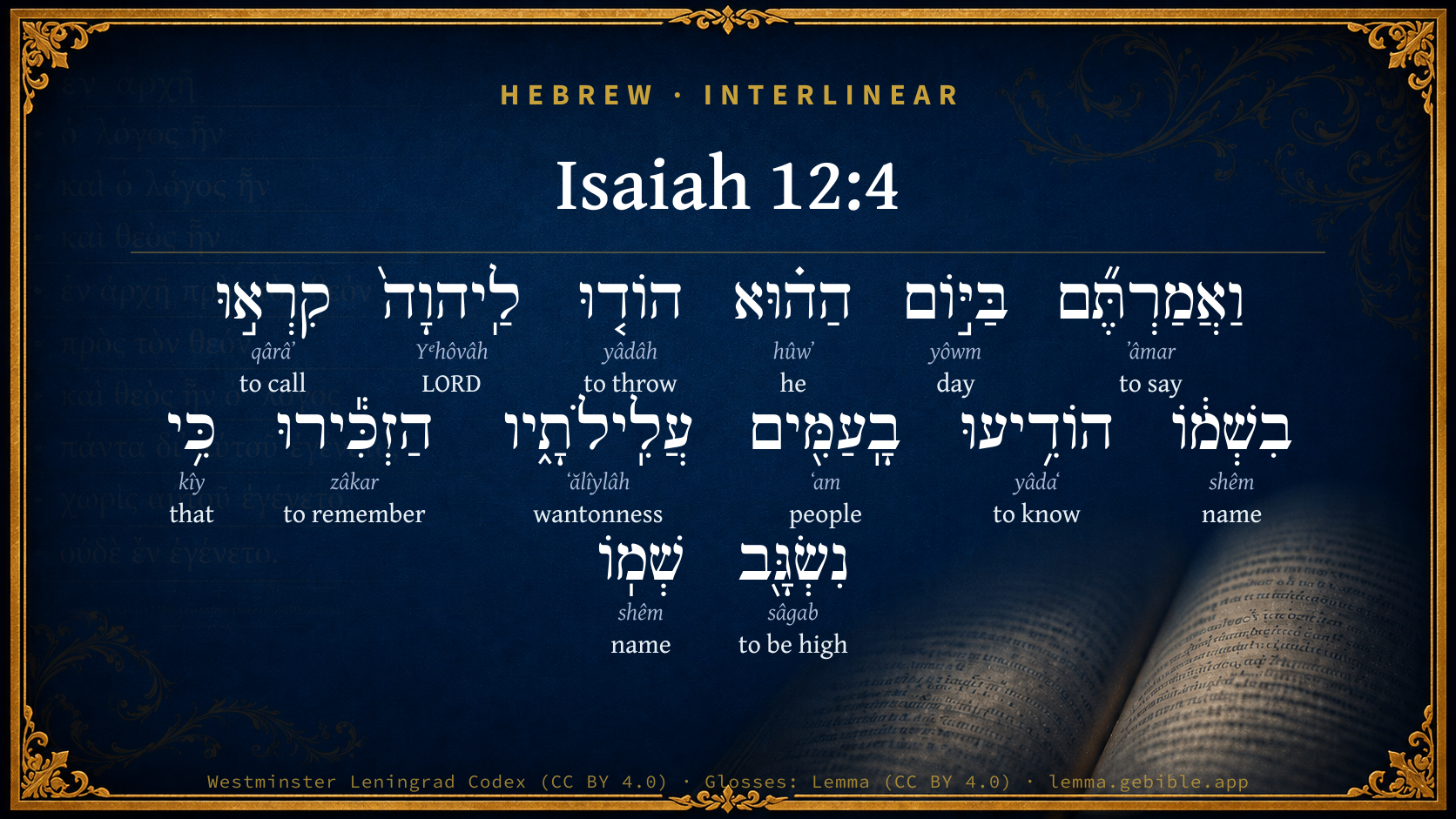
Hebrew (Westminster Leningrad Codex) Isaiah 12:4 appears in the Hebrew Old Testament. The text above is from the Westminster Leningrad Codex. Each word links to its Strong’s number, a concise gloss, and parsing drawn from the Open Scriptures Hebrew Bible morphology. Click any word for its full Brown-Driver-Briggs (BDB) entry.
Download image
Cite this verse

Isaiah 12:4 (World English Bible). Public Domain. Lemma interlinear Bible study tool, https://lemma.gebible.app/v/isaiah/12/4.

Show BibTeX & RIS
BibTeX
RIS
English Translation
In that day you will say, "Give thanks to Yahweh! Call on his name. Declare his doings among the peoples. Proclaim that his name is exalted!
World English Bible · Public Domain
Download a study sheet

One document with this verse’s original text, its word-by-word gloss line, the meaning frame, cross-references with their text, attributed commentary, and full source and license credits — printable, and it pastes into notes with its structure intact.

This verse Autodidact and up

Study sheet (.html) Plain text (.txt)

A passage Seminary Student

Up to 50 verses in one chapter. A passage sheet keeps up to 6 commentary sources and 12 cross-references per verse, in the order this page ranks them, and says so on the sheet whenever that leaves anything out. Ask for a single verse and you get the Autodidact verse sheet above.

Everything on this page stays free to read, with no account — the sheet is a download of what is already on screen, not access to it.

Want to remove ads? Support Godless Engineer
Compare translations 3

The same verse in 3 English versions, stacked beneath the original-language interlinear above. Click any original word for its lexicon entry.

Each is an independent rendering of the whole verse — the interlinear is not word-aligned to these translations.

Highlighted words mark where these versions differ — a whole-verse word diff, not a word-by-word alignment.

  • World English Bible Public Domain
    In that day you will say, "Give thanks to Yahweh! Call on his name. Declare his doings among the peoples. Proclaim that his name is exalted!
  • King James Version Public Domain
    And in that day shall ye say, Praise the LORD, call upon his name, declare his doings among the people, make mention that his name is exalted.
  • unfoldingWord Literal Text CC BY-SA 4.0
    And you will say on that day, “Give thanks to Yahweh, call on his name, make his deeds known among the peoples; make remember that his name is exalted.

unfoldingWord Literal Text — © unfoldingWord, licensed CC BY-SA 4.0. Word-aligned USFM3 via Door43 (git.door43.org/unfoldingWord/en_ult).

Versions to compare (up to 4)

3 of 4 selected

Show all 18 translations

Every available English version of this verse, each an independent rendering of the whole verse.

  • World English Bible Public Domain
    In that day you will say, "Give thanks to Yahweh! Call on his name. Declare his doings among the peoples. Proclaim that his name is exalted!
  • Berean Standard Bible Public Domain
    and on that day you will say: “Give praise to the LORD; proclaim His name! Make His works known among the peoples; declare that His name is exalted.
  • Majority Standard Bible Public Domain
    and on that day you will say: “Give praise to the LORD; proclaim His name! Make His works known among the peoples; declare that His name is exalted.
  • King James Version Public Domain
    And in that day shall ye say, Praise the LORD, call upon his name, declare his doings among the people, make mention that his name is exalted.
  • American Standard Version (1901) Public Domain
    And in that day shall ye say, Give thanks unto Jehovah, call upon his name, declare his doings among the peoples, make mention that his name is exalted.
  • Revised Version (1885) Public Domain
    And in that day shall ye say, Give thanks unto the LORD, call upon his name, declare his doings among the peoples, make mention that his name is exalted.
  • Geneva Bible (1599) Public Domain
    And ye shall say in that day, Prayse the Lord: call vpon his Name: declare his workes among the people: make mention of them, for his Name is exalted.
  • Douay-Rheims (1899) Public Domain
    And you shall say in that day: Praise ye the Lord, and call upon his name: make his works known among the people: remember that his name is high.
  • Young's Literal Translation Public Domain
    And ye have said in that day, Give ye praise to Jehovah, call in His name. Make known among the peoples His acts. Make mention that set on high is His name.
  • Literal Standard Version CC BY-SA 4.0
    And you have said in that day, || Give praise to YHWH, call on His Name. Make His acts known among the peoples. Make mention that His Name is set on high.
  • Unlocked Literal Bible CC BY-SA 4.0
    On that day you will say, “Give thanks to Yahweh and call upon his name; declare his deeds among the peoples, proclaim that his name is exalted.
  • unfoldingWord Literal Text CC BY-SA 4.0
    And you will say on that day, “Give thanks to Yahweh, call on his name, make his deeds known among the peoples; make remember that his name is exalted.
  • Darby Bible Public Domain
    And in that day shall ye say, Give ye thanks to Jehovah, call upon his name, declare his deeds among the peoples, make mention that his name is exalted.
  • World Messianic Bible Public Domain
    In that day you will say, “Give thanks to the LORD! Call on his name! Declare his doings among the peoples! Proclaim that his name is exalted!
  • Webster's Bible Public Domain
    And in that day shall ye say, Praise the LORD, call upon his name, declare his doings among the people, make mention that his name is exalted.
  • Free Bible Version CC BY-SA 4.0
    At that time you will say: “Praise the Lord, shout out his name! Tell the nations what he has done—let them know of his wonderful character!
  • Bible in Basic English Public Domain
    And in that day you will say, Give praise to the Lord, let his name be honoured, give word of his doings among the peoples, say that his name is lifted up.
  • JPS Tanakh (1917) Public Domain
    And in that day shall ye say: 'Give thanks unto the LORD, proclaim His name, declare His doings among the peoples, make mention that His name is exalted.

Literal Standard Version (2020), Covenant Press — licensed CC BY-SA 4.0. Text via the HelloAO Bible API (eBible.org). Unlocked Literal Bible (unfoldingWord) — licensed CC BY-SA 4.0. Text via the HelloAO Bible API (eBible.org). unfoldingWord Literal Text — © unfoldingWord, licensed CC BY-SA 4.0. Word-aligned USFM3 via Door43 (git.door43.org/unfoldingWord/en_ult). Free Bible Version, Dr. Jonathan Gallagher — licensed CC BY-SA 4.0. Text via the HelloAO Bible API (eBible.org).

Word by word

More ways to search: Search by grammar → Find every occurrence → Compare this word →

Practice this passage: Drill this verse → Learn its vocabulary →

נִשְׂגָּ֖ב
sâgab
H7682
“being high”
Verb, Niphal, Participle Active, Masculine, Singular, Absolute
Part of Speech
Verb
Stem
Niphal
Form
Participle Active
Gender
Masculine
Number
Singular
State
Absolute
Full BDB Definition

Origin: a primitive root

TWOT: 2234

to be high, be inaccessibly high - (Qal) - to be (too) high (for capture) - to be high (of prosperity) - (Niphal) - to be high - to be set on high, be (safely) set on high - to be exalted (of God) - (Piel) - to set on high, set (securely) on high - to exalt, exalt (in effective hostility) - (Pual) to be set (securely) on high - (Hiphil) to act exaltedly
  1. וַאֲמַרְתֶּ֞ם ʼâmar H559 “and · to say” Conjunction + Verb, Qal, Sequential Perfect, 2nd Person, Masculine, Plural
  2. בַּיּ֣וֹם yôwm H3117 “in/at the · day” Preposition, Determined + Noun, Common, Masculine, Singular, Absolute
  3. הַה֗וּא hûwʼ H1931 “the · he” Particle, Definite Article + Pronoun, Personal, 3rd Person, Masculine, Singular
  4. הוֹד֤וּ yâdâh H3034 “throw” Verb, Hiphil, Imperative, 2nd Person, Masculine, Plural
  5. לַֽיהוָה֙ Yᵉhôvâh H3068 “to/for · LORD” Preposition + Noun, Proper
  6. קִרְא֣וּ qârâʼ H7121 “call” Verb, Qal, Imperative, 2nd Person, Masculine, Plural
  7. בִשְׁמ֔וֹ shêm H8034 “in/at · name · his” Preposition + Noun, Common, Masculine, Singular, Construct + Suffix, Personal, 3rd Person, Masculine, Singular
  8. הוֹדִ֥יעוּ yâdaʻ H3045 “know” Verb, Hiphil, Imperative, 2nd Person, Masculine, Plural
  9. בָֽעַמִּ֖ים ʻam H5971 “in/at the · peoples” Preposition, Determined + Noun, Common, Masculine, Plural, Absolute
  10. עֲלִֽילֹתָ֑יו ʻălîylâh H5949 “deeds · his” Noun, Common, Feminine, Plural, Construct + Suffix, Personal, 3rd Person, Masculine, Singular
  11. הַזְכִּ֕ירוּ zâkar H2142 “remember” Verb, Hiphil, Imperative, 2nd Person, Masculine, Plural
  12. כִּ֥י kîy H3588 “that” Conjunction
  13. שְׁמֽוֹ shêm H8034 “name · his” Noun, Common, Masculine, Singular, Construct + Suffix, Personal, 3rd Person, Masculine, Singular

About this verse

These counts appear in no published source. They are computed here, from the morphology-tagged text and Lemma’s own curated glosses. What Lemma adds →

14
words
13
distinct lemmas
Prophets
section

Notable vocabulary

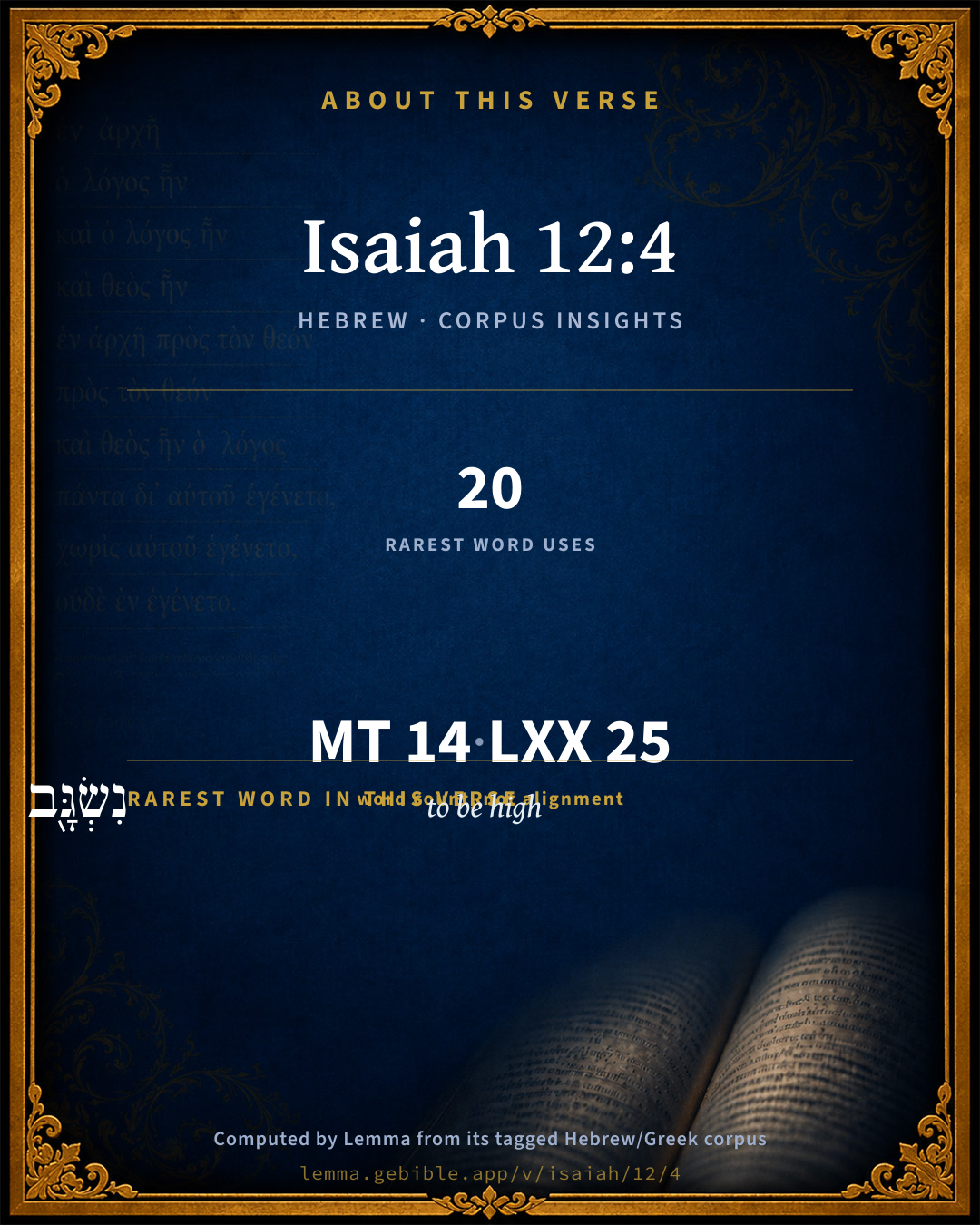
The rarest word here is נִשְׂגָּ֖ב to be high H7682 — appearing just 20 times in the whole Hebrew Bible.

Shared distinctive vocabulary

נִשְׂגָּ֖ב to be high H7682 occurs in 20 verses of the Hebrew Bible. Also found in:

Grammatical profile

  • 6 verbs
  • 6 nouns
  • 1 pronoun
  • 1 conjunction

Verb forms

  • וַאֲמַרְתֶּ֞ם Qal · Sequential Perfect
  • הוֹד֤וּ Hiphil · Imperative
  • קִרְא֣וּ Qal · Imperative
  • הוֹדִ֥יעוּ Hiphil · Imperative
  • הַזְכִּ֕ירוּ Hiphil · Imperative
  • נִשְׂגָּ֖ב Niphal · Participle Active

Repetition

A word recurs within this verse — often emphatic in Hebrew:

  • בִשְׁמ֔וֹ name H8034 ×2

Hebrew & Septuagint length

In English translation the verse runs 26 words from the Hebrew and 30 from the Septuagint (LXX English) — closely comparable.

A rough comparison of the two English renderings, which tokenize alike — not a word-level alignment.

Word counts can differ between the Hebrew and the Greek without any difference in meaning — e.g. the Hebrew direct-object marker אֵת has no separate Greek word, and Greek often adds the article ὁ.

In the original languages it is 14 Hebrew tokens and 25 Greek tokens — but the two are counted differently (Hebrew bundles its prefixes and suffixes into one token; the Greek is in lemma form), so that isn’t a like-for-like length.

Cross-references

36

Topical passages linked to Isaiah 12:4 in the Treasury of Scripture Knowledge — connected by theme and wording, ordered by reader-vote popularity; previews shown in the World English Bible.

  • Psalms 105:1 Give thanks to Yahweh! Call on his name! Make his doings known among the peoples.
  • 1 Chronicles 29:11 Yours, Yahweh, is the greatness, the power, the glory, the victory, and the majesty: for all that is in the heavens and in the earth is yours. Yours is the kingdom, Yahweh, and you are exalted as head above all.
  • Psalms 145:4–6 One generation will commend your works to another, And will declare your mighty acts.
  • Psalms 117:1–2 Praise Yahweh, all you nations! Extol him, all you peoples!
  • John 17:26 I made known to them your name, and will make it known; that the love with which you loved me may be in them, and I in them."
  • Philippians 2:9–11 Therefore God also highly exalted him, and gave to him the name which is above every name;
  • Exodus 15:2 Yah is my strength and song, He has become my salvation: This is my God, and I will praise him; My father's God, and I will exalt him.
  • Exodus 33:19 He said, "I will make all my goodness pass before you, and will proclaim the name of Yahweh before you. I will be gracious to whom I will be gracious, and will show mercy on whom I will show mercy."
  • Nehemiah 9:5 Then the Levites, Jeshua, and Kadmiel, Bani, Hashabneiah, Sherebiah, Hodiah, Shebaniah, [and] Pethahiah, said, Stand up and bless Yahweh your God from everlasting to everlasting; and blessed be your glorious name, which is exalted above all blessing and praise.
  • Psalms 18:46 Yahweh lives; and blessed be my rock. Exalted be the God of my salvation,
  • Psalms 57:5 Be exalted, God, above the heavens! Let your glory be above all the earth!
  • Psalms 71:16–18 I will come with the mighty acts of the Lord Yahweh. I will make mention of your righteousness, even of yours alone.
  • Psalms 113:1–3 Praise Yah! Praise, you servants of Yahweh, Praise the name of Yahweh.
  • Jeremiah 50:2 Declare you among the nations and publish, and set up a standard; publish, and don't conceal: say, Babylon is taken, Bel is disappointed, Merodach is dismayed; her images are disappointed, her idols are dismayed.
  • Jeremiah 51:9–10 We would have healed Babylon, but she is not healed: forsake her, and let us go everyone into his own country; for her judgment reaches to heaven, and is lifted up even to the skies.
  • Exodus 34:5–7 Yahweh descended in the cloud, and stood with him there, and proclaimed the name of Yahweh.
  • Psalms 9:11 Sing praises to Yahweh, who dwells in Zion, And declare among the people what he has done.
  • Psalms 21:13 Be exalted, Yahweh, in your strength, So we will sing and praise your power.
  • Psalms 22:31 They shall come and shall declare his righteousness to a people that shall be born, For he has done it.
  • Psalms 40:5 Many, Yahweh, my God, are the wonderful works which you have done, And your thoughts which are toward us. They can't be set in order to you; If I would declare and speak of them, they are more than can be numbered.
  • Psalms 46:10 "Be still, and know that I am God. I will be exalted among the nations. I will be exalted in the earth."
  • Psalms 73:28 But it is good for me to come close to God. I have made the Lord Yahweh my refuge, That I may tell of all your works.
  • Psalms 96:3 Declare his glory among the nations, His marvelous works among all the peoples.
  • Psalms 97:9 For you, Yahweh, are most high above all the earth. You are exalted far above all gods.
  • Psalms 106:47–48 Save us, Yahweh, our God, Gather us from among the nations, To give thanks to your holy name, To triumph in your praise!
  • Psalms 107:22 Let them offer the sacrifices of thanksgiving, And declare his works with singing.
  • Psalms 113:5 Who is like Yahweh, our God, Who has his seat on high,
  • Isaiah 2:11 The lofty looks of man will be brought low, The haughtiness of men will be bowed down, And Yahweh alone will be exalted in that day.
  • Isaiah 25:1 Yahweh, you are my God; I will exalt you, I will praise your name; for you have done wonderful things, [even] counsels of old, in faithfulness [and] truth.
  • Isaiah 33:5 Yahweh is exalted; for he dwells on high: he has filled Zion with justice and righteousness.
  • 1 Chronicles 16:8 Oh give thanks to Yahweh, call on his name; Make known his doings among the peoples.
  • Psalms 34:3 Oh magnify Yahweh with me. Let us exalt his name together.
  • Isaiah 2:17 The loftiness of man shall be bowed down, And the haughtiness of men shall be brought low; And Yahweh alone shall be exalted in that day.
  • Isaiah 12:1 In that day you will say, "I will give thanks to you, Yahweh; for though you were angry with me, your anger has turned away and you comfort me.
  • Isaiah 24:15 Therefore glorify Yahweh in the east, even the name of Yahweh, the God of Israel, in the isles of the sea!
  • Isaiah 66:19 I will set a sign among them, and I will send such as escape of them to the nations, to Tarshish, Pul, and Lud, who draw the bow, to Tubal and Javan, to the isles afar off, who have not heard my fame, neither have seen my glory; and they shall declare my glory among the nations.

Cross-references courtesy of OpenBible.info (CC BY 4.0).

Hebrew and Greek witnesses Masoretic Hebrew ↔ Greek Septuagint

The same verse in the two great witnesses to the Old Testament, shown verse-for-verse.

These are two independent witnesses, not word-aligned to each other, and the Septuagint is shown in lemma (dictionary) form.

Hebrew Isaiah 12:4 Masoretic · Westminster Leningrad Codex

וַאֲמַרְתֶּ֞ם בַּיּ֣וֹם הַה֗וּא הוֹד֤וּ לַֽיהוָה֙ קִרְא֣וּ בִשְׁמ֔וֹ הוֹדִ֥יעוּ בָֽעַמִּ֖ים עֲלִֽילֹתָ֑יו הַזְכִּ֕ירוּ כִּ֥י נִשְׂגָּ֖ב שְׁמֽוֹ

In that day you will say, "Give thanks to Yahweh! Call on his name. Declare his doings among the peoples. Proclaim that his name is exalted!

World English Bible · Public Domain

Greek LXX Isaiah 12:4 Septuagint · lemma form

καί εἶπον ἐν ὁ ἡμέρα ἐκεῖνος ὑμνέω κύριος βοάω ὁ ὄνομα αὐτός ἀναἀγγέλλω ἐν ὁ ἔθνος ὁ ἔνδοξος αὐτός μιμνήσκω ὅτι ὑψόω ὁ ὄνομα αὐτός

And in that day you shall say, sing to the Lord, call aloud upon his name, proclaim his glorious deeds among the Gentiles; make mention that his name is exalted.

LXX2012 (modern English Septuagint) · Public Domain

Hebrew: Westminster Leningrad Codex (CC BY 4.0). Greek: Septuagint (public domain); English from LXX2012 (modern English Septuagint) (Public Domain). How the Septuagint differs from the Hebrew →

Targum (Aramaic paraphrase)

1

The Targum is the ancient Jewish Aramaic paraphrase of the Hebrew Scriptures — an interpretive translation, not the Hebrew text itself. Onkelos (literal) and Pseudo-Jonathan (expansive) render the Torah, and Jonathan the Prophets. Coverage is partial: where no permissively-licensed English translation exists for a verse, only the Aramaic is shown. This is verse-level text, not a word-by-word alignment to the Hebrew.

  1. Targum Jonathan Prophets (Joshua–Malachi)
    וְתֵימְרוּן בְּעִדָנָא הַהִיא אוֹדוּ קֳדָם יְיָ צַלוּ בִּשְׁמֵיהּ חֲווּ בְּעַמְמַיָא עוֹבָדוֹהִי אִדְכַּרוּ אֲרֵי תַקִיף שְׁמֵיהּ:

    And at that time shall ye say, Praise before the Lord, pray in His name, declare His doings among the people, remember ye that powerful is His name.

    Targum Jonathan — Aramaic: “Mikraot Gedolot” (public domain). English: “Sefaria Community Translation” (CC0 1.0 (public-domain dedication)); “London "Chaldee Paraphrase," 1871” (public domain). Text via Sefaria.

Commentary

Notes on Isaiah 12:4 from classic Christian and Jewish commentators (each source and its license shown beneath its notes). The classic Christian expositions comment on the surrounding passage and are grouped to its opening verse, so a note may address several verses; the Jewish commentaries on the Tanakh (Rashi and others) are per-verse, so they appear only where the commentator wrote on this verse.

Lemma curates 59 commentaries, every one of them public domain or Creative Commons licensed, each selected and text-cleaned for this edition rather than reprinted as found. About our sources →

Trapp's Complete Commentary

John Trapp

Isa 12:4 And in that day shall ye say, Praise the LORD, call upon his name, declare his doings among the people, make mention that his name is exalted.

Ver. 4. And in that day shall ye say, Praise the Lord,] viz., With us and for us. Every true Confitebor tibi hath its confitemini Domino annexed unto it. The saints are unsatiable in praising God for the great work of their redemption, and do therefore call in help, all that may be.

Call upon his name.] Which is a special way of praising him, while we make him the object of our prayers, professing our distance from him, our whole dependence upon him, &c. See 1Ch 16:8 Psa 105:1.

Declare his doings.] Sept., His glorious things; those many miracles of mercy wrought in our redemption, which is a work much more excellent than that of making all things at first of nothing, keeping heaven still upon its hinges, and upholding the whole universe without a foundation. Magna sunt opera Dei creatoris, recreatoris autem longe maxima, saith Gregory.

Make mention that his name is exalted.] Or, Celebrate his name, which is high, far above all praise.

John Trapp, A Commentary or Exposition upon All the Books of the Old and New Testament (1647–1656) — public domain. Text from a community e-Sword module.

The Biblical Illustrator

Joseph S. Exell

Isa_12:4-6

And in that day shall ye say, Praise the Lord

Congregational praise

I.

WHO ARE HERE CALLED UPON TO PRAISE GOD. The inhabitants of Zion and Jerusalem, whom God had in a peculiar manner protected from Sennacheribs violence (Isa_12:6). Those that have received distinguishing favours from God ought to be most forward and zealous in praising Him. The Gospel Church is Zion; Christ is Zions King; those that have a place and name in that should lay out themselves to diffuse the knowledge of Christ, and to bring many to Him.

II. HOW THEY MUST PRAISE THE LORD.

1. By prayer. Call upon His name. As giving thanks for former mercy is a decent way of begging further mercy, so begging further mercy is graciously accepted as a thankful acknowledgment of the mercies we have received.

2. By preaching and writing we must speak to others concerning Him--not only call upon His name, but (as the margin reads it) proclaim His name; let others know something more from us than they did before concerning God, and those things whereby He has made Himself known. Declare His doings--His counsels, so some read it. The work of redemption is according to the counsel of His will and in that and other wonderful works that He hath done, we must take notice of His thoughts which are to usward. Declare these among the people--among the heathen, that they may be brought into communion with Israel, and the God of Israel. When the apostles preached the Gospel to all nations, beginning at Jerusalem, then this Scripture was fulfilled, that His doings should be declared among the people, and that what He hath done should be known in all the earth.

3. By a holy exultation and transport of joy. Cry out and shout.

III. FOR WHAT THEY MUST PRAISE THE LORD.

1. Because He hath glorified Himself. His name is exalted, is become more illustrious and conspicuous, and every good man rejoiceth in that.

2. Because He hath magnified His people. He hath done excellent things for them, which makes them look great and considerable.

3. Because He is, and will be, great among them. (M. Henry.)

The Biblical Illustrator, edited by Joseph S. Exell (c. 1880s–1900s) — public domain. Text from a community e-Sword module.

Joseph Benson's Commentary

Isa 12:4-6. In that day ye shall say, &c. — Here we have the second part of the evangelical song, the subject of which, as of the former, is the praise of God. In the former part, believers stir up themselves to praise God; here they invite and encourage one another to do it, and are represented as contriving to spread his praise, and to draw in others to join with them in it. Praise the Lord, call upon his name — As giving thanks for former mercies is a modest way of begging for further mercies, so requesting further and fresh mercies is graciously accepted as a thankful acknowledgment of the mercies we have received. Declare, &c. — By speaking and writing. We must not only speak to God, but speak to others concerning him; not only call upon his name, but (as the margin reads it) proclaim his name. Let others know something more from us than they did before concerning God, and those things whereby he hath made himself known. His doings — Or, mighty deeds; as Bishop Lowth renders עלילתיו. The works of redemption and salvation are especially intended; these and his other wonderful works we should declare; among the people — Among the heathen, that they may be brought into communion with Israel, and the God of Israel. When the apostles preached the gospel to all nations, beginning at Jerusalem, then this scripture was fulfilled. Make mention — Hebrew, הזכירו, Record, or cause it to be remembered, that his name is exalted — Is become more illustrious and conspicuous than ever, in and by the incarnation and life, doctrine and miracles, death, and resurrection, and ascension of his Son, and the effusion of his Spirit, in gifts and graces, on the Messiah’s disciples and servants. Sing unto the Lord; for he hath done excellent things — For his people, to whom he hath given a wonderful proof of his love, and whom he hath magnified and made honourable. Bishop Lowth renders the original expression, שׁאית עשׁה, he hath wrought a stupendous work. In making his Son a sacrifice for our sins. This is known — Or, shall be made known; in all the earth — The knowledge of this glorious work shall no longer be confined to the land of Israel and Judah, as hitherto it hath been, but shall be published to all nations. Cry out and shout — In a holy exultation and transport of joy; thou inhabitant of Zion — Hebrew, שׁבת, inhabitress, thou daughter of Jerusalem, thou church of the living God, represented under the emblem of a woman. Welcome the gospel to thyself, and publish it to others with loud acclamations; for great is the Holy One of Israel in the midst of thee — Manifesting himself to thee, appearing and doing wonders for thee, and enriching thee with his gifts and graces in great abundance.

Joseph Benson's Commentary on the Old and New Testaments (1811–1818) — public domain. Text from a community e-Sword module.

Tyndale Open Study Notes

Tyndale Open Resources

12:4-5 Tell the nations what he has done: The story of salvation must be told, even beyond the community of Israel (Pss 67:2; 70:4; 98:2).

Tyndale Open Study Notes — © Tyndale Open Resources, licensed CC BY-SA 4.0. Text via the HelloAO Bible API.

Matthew Henry's Commentary

This is the second part of this evangelical song, and to the same purport with the former; there believers stir up themselves to praise God, here they invite and encourage one another to do it, and are contriving to spread his praise and draw in others to join with them in it. Observe,

I. Who are here called upon to praise God - the inhabitants of Zion and Jerusalem, whom God had in a particular manner protected from Sennacherib's violence, Isa 12:6. Those that have received distinguishing favours from God ought to be most forward and zealous in praising him. The gospel church is Zion. Christ is Zion's King. Those that have a place and a name in the church should lay out themselves to diffuse the knowledge of Christ and to bring many to him. Thou inhabitress of Zion; the word is feminine. Let the weaker sex be strong in the Lord, and out of their mouth praise shall be perfected.

II. How they must praise the Lord. 1. By prayer: Call upon his name. As giving thanks for former mercy is a decent way of begging further mercy, so begging further mercy is graciously accepted as a thankful acknowledgment of the mercies we have received. In calling upon God's name we give unto him some of the glory that is due to his name as our powerful and bountiful benefactor. 2. By preaching and writing. We must not only speak to God, but speak to others concerning him, not only call upon his name, but (as the margin reads it) proclaim his name; let others know something more from us than they did before concerning God, and those things whereby he has made himself known. Declare his doings, his counsels (so some read it); the work of redemption is according to the counsel of his will, and in that and other wonderful works that he has done we must take notice of his thoughts which are to us-ward, Psa 40:5. Declare these among the people, among the heathen, that they may be brought into communion with Israel and the God of Israel. When the apostles preached the gospel to all nations, beginning at Jerusalem, then this scripture was fulfilled, that his doings should be declared among the people and that what he has done should be known in all the earth. 3. By a holy exultation and transport of joy: "Cry out and shout; welcome the gospel to yourselves and publish it to others with huzzas and loud acclamations, as those that shout for victory (Exo 32:18) or for the coronation of a king," Num 23:21.

III. For what they must praise the Lord. 1. Because he has glorified himself. Remember it yourselves, and make mention of it to others, that his name is exalted, has become more illustrious and more conspicuous; in this every good man rejoices. 2. Because he has magnified his people: He has done excellent things for them, which make them look great and considerable. 3. Because he is, and will be, great among them: Great is the Holy One, for he is glorious in holiness; therefore great, because holy. True goodness is true greatness. He is great as the Holy One of Israel, and in the midst of them, praised by them (Psa 76:1), manifesting himself among them, and appearing gloriously in their behalf. It is the honour and happiness of Israel that the God who is in covenant with them, and in the midst of them, is infinitely great.

Matthew Henry's Commentary on the Whole Bible (1708–1710) — public domain (CC PDM 1.0). Text via the HelloAO Bible API.

Jamieson, Fausset & Brown

Robert Jamieson, A. R. Fausset & David Brown

make mention--Hebrew, "cause it to be remembered."

Jamieson, Fausset & Brown — Commentary Critical and Explanatory on the Whole Bible (1871) — public domain (CC PDM 1.0). Text via the HelloAO Bible API.

Adam Clarke's Commentary

Verse 4. Call upon his name] קראו בשמו kiru bishmo, invoke his name. Make him your Mediator, or call the people in his name. Preach him who is the Root of Jesse, and who stands as an ensign for the nations. Call on the people to believe in him; as in him alone salvation is to be found.

Adam Clarke's Commentary on the Bible (1810–1826) — public domain. Text from a community e-Sword/MySword module.

Ellicott's Commentary for English Readers

(4) Declare his doings among the people.—Literally, among the peoples. The prophet quotes from the hymn which had been sung when the Ark was placed in Zion (1Ch_16:8), and in part from Psa_105:1.

A Bible Commentary for English Readers, edited by Charles John Ellicott (1878–1897) — public domain. Text from a community e-Sword module.

The Cambridge Bible for Schools and Colleges

gen. ed. J. J. S. Perowne

4. The first part exactly as Psa_105:1; the last clause resembles Psa_148:13, &c.

call upon his name] lit. “call by (means of) His name,” i.e. use His name (Jehovah) in solemn invocation. See 1Ki_18:24. That the expression means merely “utter” or “make known” the name, is hardly probable. The word for “exalted” occurs in ch. Isa_2:11; Isa_2:17.

4–6. The members of the redeemed community exhort each other to publish the praises of Jehovah to the world.

The Cambridge Bible for Schools and Colleges (gen. ed. J. J. S. Perowne; Cambridge University Press, 1878–1918) — public domain. Text from a community e-Sword module.

John Gill's Exposition

In that day shall ye say, praise the Lord,.... On account of his being and perfections, for blessings received from him, especially spiritual ones; and particularly such as are before mentioned, fulness of grace in him, strength and salvation by him, a view of interest in him as a Saviour, and divine comforts communicated from him; which is done by giving him the glory of them, and thanks for them. This is a work very proper for Gospel times; it always was a duty, and there was ever reason for it under the former dispensation, and much more under the present one; and there will be still more reason for it in the latter day here referred to, when antichrist will be destroyed, the kingdom of Christ will be enlarged, and his church will be in a very glorious state and condition, her walls will be salvation, and her gates praise; when the saints will be stirring up one another to this service, and engaging in it with all readiness and cheerfulness; see Rev 11:15,

call upon his name: which takes in the whole of religions worship, of which Christ is the object, being the true Jehovah; and particularly prayer, in which his name is invoked together with faith in him, and expressions of affection to his name; which is precious to believers, and is as ointment poured out:

declare his doings among the people; not merely his works of creation, in which he was equally concerned with his divine Father; nor so much his miracles which he wrought when on earth, in proof of his deity and Messiahship, and in confirmation of his doctrine; but his acts of obedience and righteousness, which were perfect; and his bearing the sins of his people, and the punishment due to them; and so fulfilled the whole law, and hereby accomplished the great work of redemption and salvation; which, according to his orders, have been published among the Gentiles, for their good, and his glory:

make mention that his name is exalted; that is, he himself, who has a name given him above every name; for having obeyed, suffered, and died in the room of his people, he is by his Father, according to promise, exalted, by raising him from the dead, receiving him into heaven, placing him at his right hand, giving him all power in heaven and in earth, and causing angels, authorities, principalities, and powers, to be subject to him; all which is to be made mention of, to the honour of his name: or else the sense is, to speak of him, to make mention of his name, of his person, of his offices, of his grace and salvation, that he may be exalted in each of them by his people; for he is, and ought to be, exalted in their hearts, and with their lips, since he is above all in the excellency of his person, and is their only Saviour and Redeemer, Head and Husband; and so he will be exalted more abundantly in the latter day. See Gill on Isa 2:11.

John Gill's Exposition of the Whole Bible (1746–1763) — public domain (CC PDM 1.0). Text via the HelloAO Bible API.

Albert Barnes' Notes on the Bible

And in that day - (see Isa 12:1).

Call upon his name - Margin, ‘Proclaim.’ It denotes to call upon him in the way of celebrating his praise. The whole hymn is one of praise, and not of prayer.

Declare among the people - Among all people, that they may be brought to see his glory, and join in the celebration of his praise.

His doings - Particularly in regard to the great events which are the subject of the previous predictions - his interposition in saving people by the Messiah from eternal death.

Make mention - Hebrew, ‘Cause it to be remembered’ (see the note at Isa 62:6).

That his name is exalted - That it is worthy of adoration and praise. It is worthy to be exalted, or lifted up in view of the nations of the earth 2Sa 22:47; Psa 21:13; Psa 46:10.

Albert Barnes' Notes on the Bible (1834–1885) — public domain. Text from a community e-Sword/MySword module.

Matthew Poole's English Annotations

Among the people; in all the earth, as it follows, Isa 12:5; unto the Gentile world, who shall partake in the blessing, and will join with you in the praising of God for it. The knowledge of this glorious work of our redemption

Matthew Poole's English Annotations on the Holy Bible (1683–1685) — public domain. Text from a community e-Sword/MySword module.

Whedon's Commentary on the Bible

Daniel D. Whedon

4. In that day — The wonderful day is the day of the glorious Gospel and its wholesome truths; its peace and the heaven it brings.

Daniel D. Whedon (gen. ed.), Commentary on the Old and New Testaments (1874–1909) — public domain. Text from a community e-Sword module.

The Pulpit Commentary

Declare his doings among the people; literally, among the peoples. (comp. Psa_9:11 Psa_77:12 Psa_107:22 Psa_118:17) It is always regarded as one of man"s chief duties to testify of God"s goodness to others. Here Israel is called upon to publish God"s mercies and great deeds to the Gentiles. His name is exalted. God is in his Name, and his Name expresses his nature. As there is nothing so exalted in all the universe as God, so there is no name so exalted as his Name. Hence his Name is protected by an express commandment.

Vers. 4-6. Exultation and activity.

There is a jubilant strain throughout these verses; not, however, without a sense of some sacred duty to be performed. We learn

I THAT THE CHURCH OF CHRIST MAY WELL SPEAK IN THE ACCENTS OF EXULTATION. The terms of the prophecy do not seem to be satisfied with anything less than Messianic blessings; they fit perfectly the estate to which Christ has called us; they belong to that "kingdom of heaven" of which the Son of man had so much to say. (see Mt 13) The Church may exult in that:

1. God has done such great things for her, in

(1) the large and long preparation, through many ages, for her redemption;

(2) the supreme act of Divine revelation in the person of his Son;

(3) the wonderful sacrifice of himself he made on its behalf; (2Co_8:9)

(4) the lofty privileges to which he has summoned it holy service, affectionate sonship, eager-hearted heirship.

2. God himself, the mighty and victorious One, is dwelling in the midst of it. "Great is the Holy One." If the family is proud of its honored father, the army of its invincible captain, the nation of its illustrious sovereign, how much more shall the Church exult in its almighty and victorious Lord! He is great in all the elements of greatness in external majesty, in intrinsic excellency, in overcoming energy, in transcendent beauty, in the everlasting character of his kingdom.

II THAT EXULTATION DOES WELL TO PASS SOON INTO HOLY AND BENEFICENT ACTIVITY. Blending with these accents of triumph, and harmonizing with them, is the voice of exhortation," the summons to useful activity "Praise the Lord;" "Call upon his Name;" "Declare his doings;" "Be this known let this be known in all the earth." Jehovah s greatness could only be known among the nations by the united and continuous testimony of the people of God. The glories of his grace, as they shine in the face of Jesus Christ, are to be beheld by all peoples; but they must be reflected from the lives and published by the lips of his faithful servants. It is the privilege and the duty of the Church to carry the knowledge of his Name and truth to the utmost ends of the earth. It is well to rejoice, "to sing for joy," to indulge in pious exultation; it is better to act in such a way that neighboring nations (cities, districts, streets, homes) shall draw from the wells of this great salvation the waters of eternal life; better, both because

(1) we communicate blessing thereby, and because

(2) we gain increase of spiritual worth by so doing. C.

God"s new name the old one glorified.

"Call upon his Name," which is, in Messiah, "Jehovah Jesus," "Immanuel Jesus," or God with us saving us from our sins." To call upon God"s Name is to publicly give him the glory that is his duo.

I THE OLD NAME IS GOD THE PROVIDER. The God who meets and supplies all ordinary human wants. "God of Abraham, Isaac, and Jacob." The God or whom Jacob could say, "He fed me all my life long." The God "in whose hand our breath is, and whose are all our ways." Who giveth to each his meat in due season." Who crowneth us with loving-kindnesses and tender mercies: who satisfieth our mouth with good things.

II THE NEW NAME IS GOD THE SAVIOR. Who "redeemeth our life from destruction." Who "delivers from going down to the pit." Who "gave himself a Ransom for us." Who brought "deliverance for the captives, and opening of the prison to them that are bound." Who is "able to save unto the uttermost." Who is "exalted a Prince and a Savior, to give repentance unto Israel, and remission of sins.

III THE NEW NAME ONLY TELLS OF GOD PROVIDING FOR MAN"S SOREST NEED AND SADDEST CONDITION. He is not just in trouble; he is in sin. Stained with it, bruised with it, degraded by it, in peril through it, made helpless by it. The man in sin cannot save himself; no fellow-mart can save him. The Hero from Bozrah, who speaks in righteousness, alone is "mighty to save". R.T. (Isa_63:1)

The Pulpit Commentary (1880–1919), ed. H.D.M. Spence-Jones & Joseph S. Exell — public domain. Text from a community e-Sword module.

J. A. Alexander on Isaiah

Joseph Addison Alexander

“And ye shall say (to one another) in that day, praise (or give thanks to) Jehovah, call upon His name (proclaim it), make known among the nations His exploits (or achievements), remind (them) that His name is exalted.” Name is here used in the pregnant sense of that whereby God makes Himself known, including explicit revelation and the exhibition of His attributes in all.

Joseph Addison Alexander, The Prophecies of Isaiah (1846–1847; New York: Scribner, 1870–1878) — public domain. Text from a community e-Sword module.

Rashi

Rabbi Shlomo Yitzchaki (Rashi)

His deeds Heb. עֲלִילוֹתָיו, similar to מַעֲלָלָיו.

keep it in remembrance to praise [His Name,] for it is exalted.

Rashi on the Tanakh — English translations: “The Judaica Press complete Tanach with Rashi, translated by A. J. Rosenberg” (CC BY 4.0); “Pentateuch with Rashi's commentary by M. Rosenbaum and A.M. Silbermann, 1929-1934” (public domain); “The Metsudah Tanach series, Lakewood, N.J” (CC BY 4.0); and “The Book of Joshua, Metsudah Publications, 1997” (CC BY 4.0). Text via Sefaria.

Ibn Ezra

Rabbi Abraham ibn Ezra

And you shall say one to the other.

קראו Call aloud.

עלילותיו His deeds.

Ibn Ezra on the Tanakh — English translations: “Sefaria Community Translation” (CC0 1.0 (public-domain dedication)); “Yalkut, Sifsei Chachomim Chumash, Metsudah Publications, 2009” (CC BY 4.0); and “Commentary of Ibn Ezra on Isaiah - trans. by M. Friedlander, 1873” (public domain). Text via Sefaria.

Lesson kit

Teaching starters — assembled from the data on this page, not authored interpretation. Every prompt links to the verse data it draws on. Edit before teaching.

Isaiah, in the Prophets, opens this verse with 14 words (13 distinct Hebrew lemmas). Its most distinctive word is sâgab (“to be high”). A historical commentator’s framing appears above. Read the whole chapter for the surrounding context.

Discussion questions

  1. What does “to be high” (sâgab) contribute to the verse as a whole?
  2. Deuteronomy 2:36 shares the word «to be high» with this verse. How do the two illuminate each other?
  3. “name” occurs 2× in this one verse. What is the effect of the repetition?
  4. These translations render this verse differently; the difference is in the English rendering, not the original. What questions does that raise?
  5. The verb «וַאֲמַרְתֶּ֞ם» is Qal Sequential Perfect. How does its form color the action?
  6. Reading how Trapp's Complete Commentary and The Biblical Illustrator read this verse, where do the two commentators agree and where do they part?

Things to notice

Reading settings

Reading text

Shown beneath each verse's original-language words.

Old Testament
Old Testament edition

Read the OT as the Masoretic Hebrew (MT) or the Greek Septuagint (LXX).

English shown for the Greek Septuagint (in the Hebrew ↔ Greek comparison).

Comparing translations? Open the Compare panel on any verse page to stack up to four side by side.