
Ezekiel 20:43

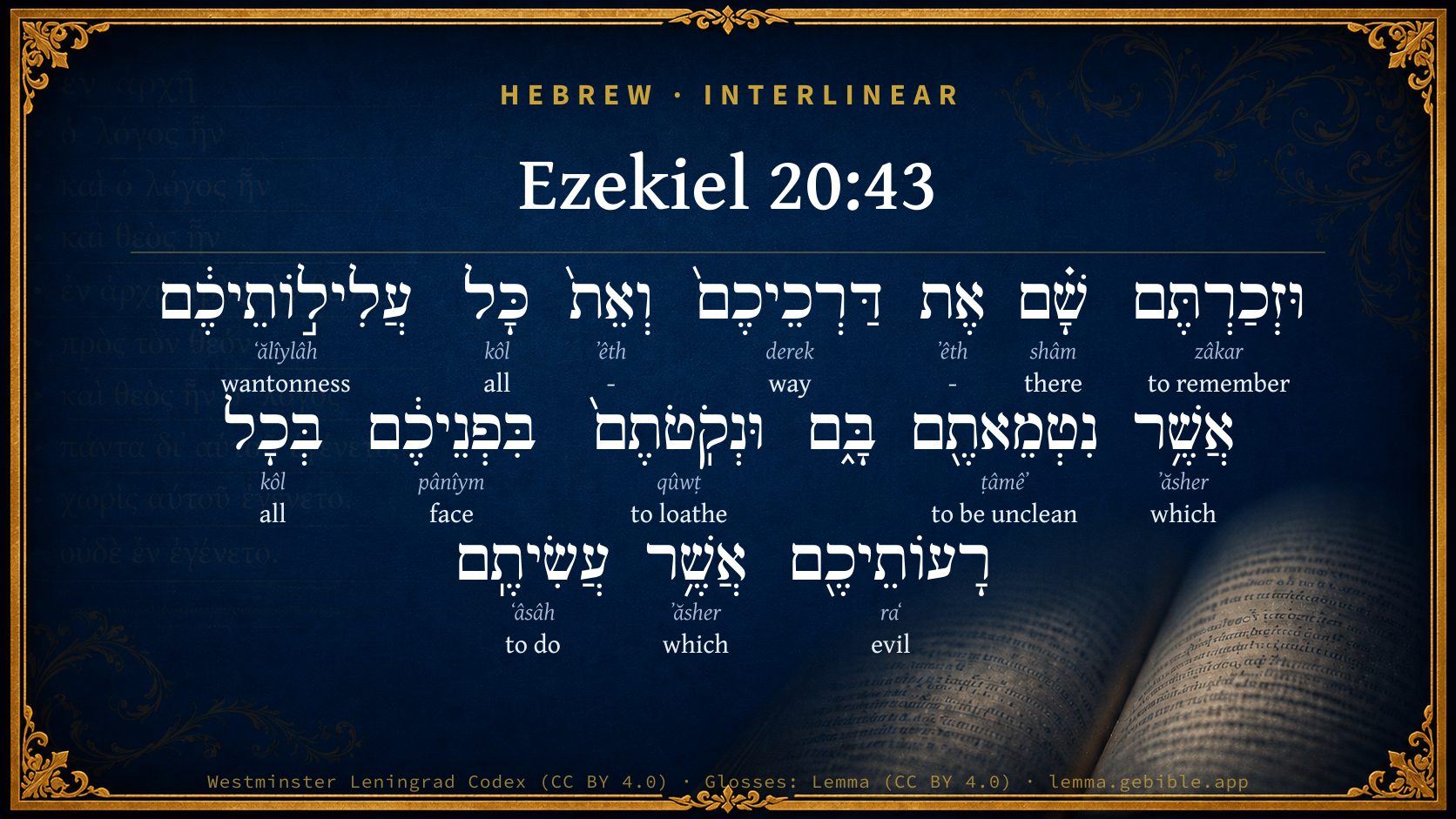
Hebrew (Westminster Leningrad Codex) Ezekiel 20:43 appears in the Hebrew Old Testament. The text above is from the Westminster Leningrad Codex. Each word links to its Strong’s number, a concise gloss, and parsing drawn from the Open Scriptures Hebrew Bible morphology. Click any word for its full Brown-Driver-Briggs (BDB) entry.
Download image
Cite this verse

Ezekiel 20:43 (World English Bible). Public Domain. Lemma interlinear Bible study tool, https://lemma.gebible.app/v/ezekiel/20/43.

Show BibTeX & RIS
BibTeX
RIS
English Translation
There shall you remember your ways, and all your doings, in which you have polluted yourselves; and you shall loathe yourselves in your own sight for all your evils that you have committed.
World English Bible · Public Domain
Download a study sheet

One document with this verse’s original text, its word-by-word gloss line, the meaning frame, cross-references with their text, attributed commentary, and full source and license credits — printable, and it pastes into notes with its structure intact.

This verse Autodidact and up

Study sheet (.html) Plain text (.txt)

A passage Seminary Student

Up to 50 verses in one chapter. A passage sheet keeps up to 6 commentary sources and 12 cross-references per verse, in the order this page ranks them, and says so on the sheet whenever that leaves anything out. Ask for a single verse and you get the Autodidact verse sheet above.

Everything on this page stays free to read, with no account — the sheet is a download of what is already on screen, not access to it.

Want to remove ads? Support Godless Engineer
Compare translations 3

The same verse in 3 English versions, stacked beneath the original-language interlinear above. Click any original word for its lexicon entry.

Each is an independent rendering of the whole verse — the interlinear is not word-aligned to these translations.

Highlighted words mark where these versions differ — a whole-verse word diff, not a word-by-word alignment.

  • World English Bible Public Domain
    There shall you remember your ways, and all your doings, in which you have polluted yourselves; and you shall loathe yourselves in your own sight for all your evils that you have committed.
  • King James Version Public Domain
    And there shall ye remember your ways, and all your doings, wherein ye have been defiled; and ye shall lothe yourselves in your own sight for all your evils that ye have committed.
  • unfoldingWord Literal Text CC BY-SA 4.0
    There you will call to mind your conduct and all of your deeds by which you defiled yourselves, and you will despise yourselves in your own eyes for all your evil deeds that you have done.

unfoldingWord Literal Text — © unfoldingWord, licensed CC BY-SA 4.0. Word-aligned USFM3 via Door43 (git.door43.org/unfoldingWord/en_ult).

Versions to compare (up to 4)

3 of 4 selected

Show all 18 translations

Every available English version of this verse, each an independent rendering of the whole verse.

  • World English Bible Public Domain
    There shall you remember your ways, and all your doings, in which you have polluted yourselves; and you shall loathe yourselves in your own sight for all your evils that you have committed.
  • Berean Standard Bible Public Domain
    There you will remember your ways and all the deeds with which you have defiled yourselves, and you will loathe yourselves for all the evils you have done.
  • Majority Standard Bible Public Domain
    There you will remember your ways and all the deeds with which you have defiled yourselves, and you will loathe yourselves for all the evils you have done.
  • King James Version Public Domain
    And there shall ye remember your ways, and all your doings, wherein ye have been defiled; and ye shall lothe yourselves in your own sight for all your evils that ye have committed.
  • American Standard Version (1901) Public Domain
    And there shall ye remember your ways, and all your doings, wherein ye have polluted yourselves; and ye shall loathe yourselves in your own sight for all your evils that ye have committed.
  • Revised Version (1885) Public Domain
    And there shall ye remember your ways, and all your doings, wherein ye have polluted yourselves; and ye shall loathe yourselves in your own sight for all your evils that ye have committed.
  • Geneva Bible (1599) Public Domain
    And there shall ye remember your wayes, and all your workes, wherein ye haue bene defiled, and ye shall iudge your selues worthy to be cut off, for all your euils, that ye haue committed.
  • Douay-Rheims (1899) Public Domain
    And there you shall remember your ways, and all your wicked doings with which you have been defiled; and you shall be displeased with yourselves in your own sight, for all your wicked deeds which you committed.
  • Young's Literal Translation Public Domain
    And ye have remembered there your ways, And all your doings, In which ye have been defiled, And ye have been loathsome in your own faces, For all your evils that ye have done.
  • Literal Standard Version CC BY-SA 4.0
    And you have remembered your ways there, || And all your doings, || In which you have been defiled, || And you have been loathsome in your own faces, || For all your evils that you have done.
  • Unlocked Literal Bible CC BY-SA 4.0
    There you will call to mind your conduct and all of your deeds by which you defiled yourselves, and you will despise yourselves in your own eyes for all your evil deeds that you have done.
  • unfoldingWord Literal Text CC BY-SA 4.0
    There you will call to mind your conduct and all of your deeds by which you defiled yourselves, and you will despise yourselves in your own eyes for all your evil deeds that you have done.
  • Darby Bible Public Domain
    And there shall ye remember your ways, and all your doings, wherein ye have been defiled; and ye shall loathe yourselves in your own sight for all your evils which ye have committed.
  • World Messianic Bible Public Domain
    There you will remember your ways, and all your deeds in which you have polluted yourselves. Then you will loathe yourselves in your own sight for all your evils that you have committed.
  • Webster's Bible Public Domain
    And there shall ye remember your ways, and all your doings in which ye have been defiled; and ye shall lothe yourselves in your own sight for all your evils that ye have committed.
  • Free Bible Version CC BY-SA 4.0
    That's where you will remember your bad ways and everything you've done to make yourselves unclean, and you will hate yourselves for the evil things you did.
  • Bible in Basic English Public Domain
    And there, at the memory of your ways and of all the things you did to make yourselves unclean, you will have bitter hate for yourselves because of all the evil things you have done.
  • JPS Tanakh (1917) Public Domain
    And there shall ye remember your ways, and all your doings, wherein ye have polluted yourselves; and ye shall loathe yourselves in your own sight for all your evils that ye have committed.

Literal Standard Version (2020), Covenant Press — licensed CC BY-SA 4.0. Text via the HelloAO Bible API (eBible.org). Unlocked Literal Bible (unfoldingWord) — licensed CC BY-SA 4.0. Text via the HelloAO Bible API (eBible.org). unfoldingWord Literal Text — © unfoldingWord, licensed CC BY-SA 4.0. Word-aligned USFM3 via Door43 (git.door43.org/unfoldingWord/en_ult). Free Bible Version, Dr. Jonathan Gallagher — licensed CC BY-SA 4.0. Text via the HelloAO Bible API (eBible.org).

Word by word

More ways to search: Search by grammar → Find every occurrence → Compare this word →

Practice this passage: Drill this verse → Learn its vocabulary →

וּנְקֹֽטֹתֶם֙
qûwṭ
H6962
“and · to loathe”
Conjunction + Verb, Niphal, Sequential Perfect, 2nd Person, Masculine, Plural
Part of Speech
Conjunction + Verb
Stem
Niphal
Form
Sequential Perfect
Person
2nd Person
Gender
Masculine
Number
Plural
Full BDB Definition

Origin: a primitive root

TWOT: 1996

to loathe, be grieved, feel a loathing - (Qal) to feel a loathing - (Niphal) - to feel loathing against self - to detest - (Hithpolel) to loathe oneself
  1. וּזְכַרְתֶּם zâkar H2142 “and · to remember” Conjunction + Verb, Qal, Sequential Perfect, 2nd Person, Masculine, Plural
  2. שָׁ֗ם shâm H8033 “there” Adverb
  3. אֶת ʼêth H853 “-” Particle, Direct Object
  4. דַּרְכֵיכֶם֙ derek H1870 “ways · your” Noun, Common, Both, Plural, Construct + Suffix, Personal, 2nd Person, Masculine, Plural
  5. וְאֵת֙ ʼêth H853 “and · -” Conjunction + Particle, Direct Object
  6. כָּל kôl H3605 “all of” Noun, Common, Masculine, Singular, Construct
  7. עֲלִיל֣וֹתֵיכֶ֔ם ʻălîylâh H5949 “deeds · your” Noun, Common, Feminine, Plural, Construct + Suffix, Personal, 2nd Person, Masculine, Plural
  8. אֲשֶׁ֥ר ʼăsher H834 “which” Particle, Relative
  9. נִטְמֵאתֶ֖ם ṭâmêʼ H2930 “to be unclean” Verb, Niphal, Perfect, 2nd Person, Masculine, Plural
  10. בִּפְנֵיכֶ֔ם pânîym H6440 “in/at · face(s) · your” Preposition + Noun, Common, Both, Plural, Construct + Suffix, Personal, 2nd Person, Masculine, Plural
  11. בְּכָל kôl H3605 “in/at · all of” Preposition + Noun, Common, Masculine, Singular, Construct
  12. רָעוֹתֵיכֶ֖ם raʻ H7451 “evils · your” Noun, Common, Feminine, Plural, Construct + Suffix, Personal, 2nd Person, Masculine, Plural
  13. אֲשֶׁ֥ר ʼăsher H834 “which” Particle, Relative
  14. עֲשִׂיתֶֽם ʻâsâh H6213 “to do” Verb, Qal, Perfect, 2nd Person, Masculine, Plural

About this verse

These counts appear in no published source. They are computed here, from the morphology-tagged text and Lemma’s own curated glosses. What Lemma adds →

16
words
12
distinct lemmas
Prophets
section

Notable vocabulary

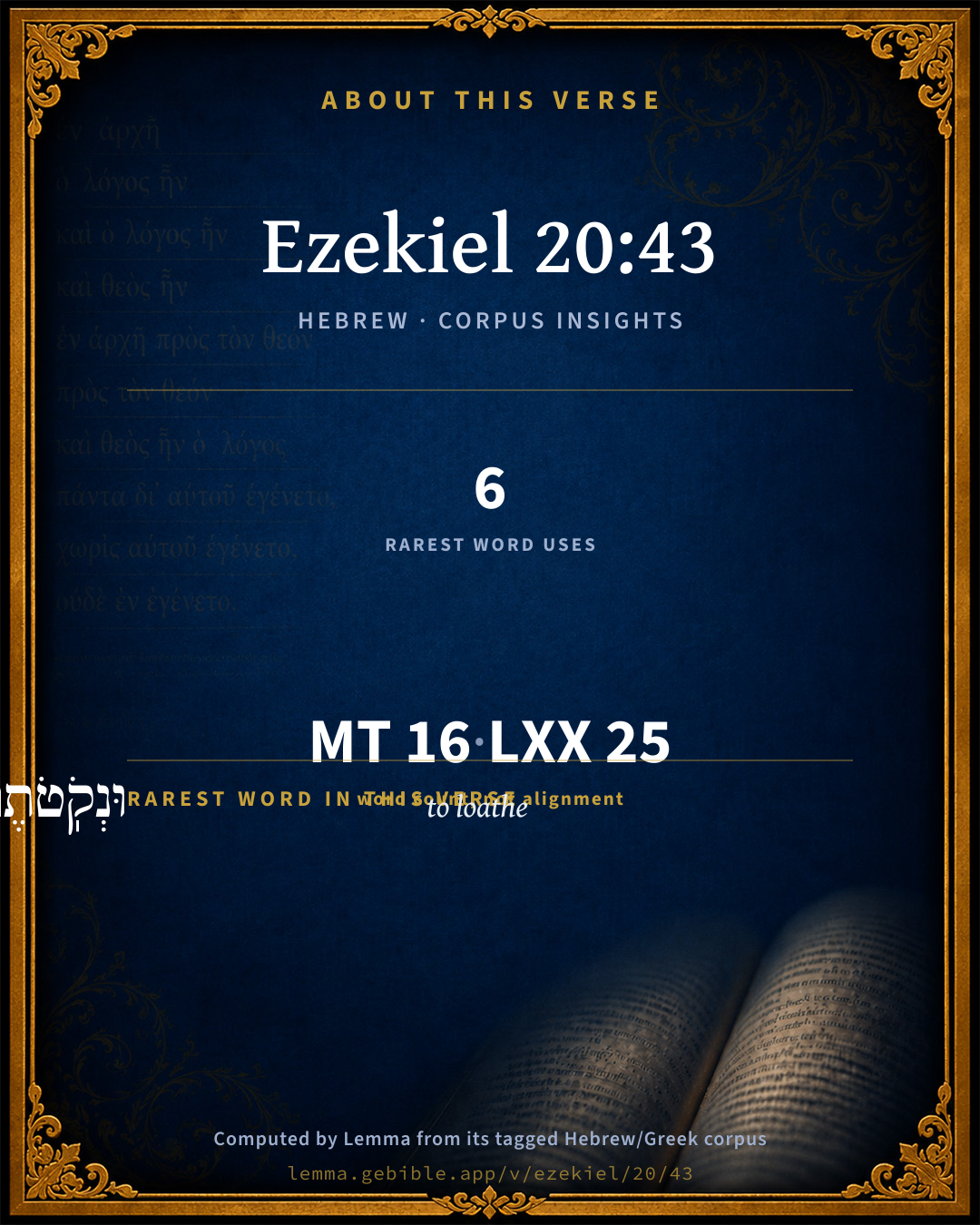
The rarest word here is וּנְקֹֽטֹתֶם֙ to loathe H6962 — appearing just 6 times in the whole Hebrew Bible.

Shared distinctive vocabulary

וּנְקֹֽטֹתֶם֙ to loathe H6962 occurs in 6 verses of the Hebrew Bible. Also found in:

Grammatical profile

  • 4 verbs
  • 6 nouns
  • 1 preposition
  • 1 adverb
  • 4 particles

Verb forms

  • וּזְכַרְתֶּם Qal · Sequential Perfect
  • נִטְמֵאתֶ֖ם Niphal · Perfect
  • וּנְקֹֽטֹתֶם֙ Niphal · Sequential Perfect
  • עֲשִׂיתֶֽם Qal · Perfect

Repetition

Words recur within this verse — often emphatic in Hebrew:

  • כָּל all H3605 ×2
  • אֲשֶׁ֥ר which H834 ×2

Hebrew & Septuagint length

In English translation the verse runs 33 words from the Hebrew and 23 from the Septuagint (LXX English) — the Septuagint runs noticeably shorter here. See the side-by-side →

A rough comparison of the two English renderings, which tokenize alike — not a word-level alignment.

Word counts can differ between the Hebrew and the Greek without any difference in meaning — e.g. the Hebrew direct-object marker אֵת has no separate Greek word, and Greek often adds the article ὁ.

In the original languages it is 16 Hebrew tokens and 25 Greek tokens — but the two are counted differently (Hebrew bundles its prefixes and suffixes into one token; the Greek is in lemma form), so that isn’t a like-for-like length.

Cross-references

11

Topical passages linked to Ezekiel 20:43 in the Treasury of Scripture Knowledge — connected by theme and wording, ordered by reader-vote popularity; previews shown in the World English Bible.

  • Ezekiel 6:9 Those of you that escape shall remember me among the nations where they shall be carried captive, how that I have been broken with their lewd heart, which has departed from me, and with they eyes, which play the prostitute after their idols: and they shall loathe themselves in their own sight for the evils which they have committed in all their abominations.
  • Hosea 5:15 I will go and return to my place, until they acknowledge their offense, And seek my face. In their affliction they will seek me earnestly."
  • Jeremiah 31:18 I have surely heard Ephraim bemoaning himself [thus], You have chastised me, and I was chastised, as a calf unaccustomed [to the yoke]: turn you me, and I shall be turned; for you are Yahweh my God.
  • Ezekiel 36:31 Then shall you remember your evil ways, and your doings that were not good; and you shall loathe yourselves in your own sight for your iniquities and for your abominations.
  • Leviticus 26:39–41 Those of you who are left will pine away in their iniquity in your enemies' lands; and also in the iniquities of their fathers shall they pine away with them.
  • Nehemiah 1:8–10 Remember, I beg you, the word that you commanded your servant Moses, saying, If you trespass, I will scatter you abroad among the peoples:
  • Job 42:6 Therefore I abhor myself, And repent in dust and ashes."
  • Ezekiel 16:61–63 Then shall you remember your ways, and be ashamed, when you shall receive your sisters, your elder [sisters] and your younger; and I will give them to you for daughters, but not by your covenant.
  • Zechariah 12:10–14 I will pour on the house of David, and on the inhabitants of Jerusalem, the spirit of grace and of supplication; and they will look to me whom they have pierced; and they shall mourn for him, as one mourns for his only son, and will grieve bitterly for him, as one grieves for his firstborn.
  • Luke 18:13 But the tax collector, standing far away, wouldn't even lift up his eyes to heaven, but beat his breast, saying, 'God, be merciful to me, a sinner!'
  • 2 Corinthians 7:11 For behold, this same thing, that you were made sorry in a godly way, what earnest care it worked in you. Yes, what defense, indignation, fear, longing, zeal, and vengeance! In everything you demonstrated yourselves to be pure in the matter.

Cross-references courtesy of OpenBible.info (CC BY 4.0).

Hebrew and Greek witnesses Masoretic Hebrew ↔ Greek Septuagint

The same verse in the two great witnesses to the Old Testament, shown verse-for-verse.

Here the Septuagint runs noticeably shorter than the Hebrew — LXX2012 (modern English Septuagint) 23 words vs World English Bible 33. A rough length comparison of the two English translations, not a word-level alignment — read both below.

These are two independent witnesses, not word-aligned to each other, and the Septuagint is shown in lemma (dictionary) form.

Hebrew Ezekiel 20:43 Masoretic · Westminster Leningrad Codex

וּזְכַרְתֶּם שָׁ֗ם אֶת דַּרְכֵיכֶם֙ וְאֵת֙ כָּל עֲלִיל֣וֹתֵיכֶ֔ם אֲשֶׁ֥ר נִטְמֵאתֶ֖ם בָּ֑ם וּנְקֹֽטֹתֶם֙ בִּפְנֵיכֶ֔ם בְּכָל רָעוֹתֵיכֶ֖ם אֲשֶׁ֥ר עֲשִׂיתֶֽם

There shall you remember your ways, and all your doings, in which you have polluted yourselves; and you shall loathe yourselves in your own sight for all your evils that you have committed.

World English Bible · Public Domain

Greek LXX Ezekiel 20:43 Septuagint · lemma form

καί μιμνήσκω ἐκεῖ ὁ ὁδός σύ καί ὁ ἐπιτήδευμα σύ ἐν ὅς μιαίνω ἐν αὐτός καί κόπτω ὁ πρόσωπον σύ ἐν πᾶς ὁ κακία σύ

And you⌃ shall there remember your ways, and your devices wherewith you⌃ defiled yourselves; and you⌃ shall bewail yourselves for all your wickedness.

LXX2012 (modern English Septuagint) · Public Domain

Hebrew: Westminster Leningrad Codex (CC BY 4.0). Greek: Septuagint (public domain); English from LXX2012 (modern English Septuagint) (Public Domain). How the Septuagint differs from the Hebrew →

Targum (Aramaic paraphrase)

1

The Targum is the ancient Jewish Aramaic paraphrase of the Hebrew Scriptures — an interpretive translation, not the Hebrew text itself. Onkelos (literal) and Pseudo-Jonathan (expansive) render the Torah, and Jonathan the Prophets. Coverage is partial: where no permissively-licensed English translation exists for a verse, only the Aramaic is shown. This is verse-level text, not a word-by-word alignment to the Hebrew.

  1. Targum Jonathan Prophets (Joshua–Malachi)
    וְתִדְכְּרוּן תַּמָן יַת אוֹרְחָתְכוֹן וְיַת כָּל עוֹבָדֵיכוֹן דְאִסְתַּאַבְתּוּן בְּהוֹן וְתִידַנְקוּן וּתְהוֹן חָזָן בְּכָל בִּישַׁתְכוֹן דַעֲבַדְתּוּן:

    (no public-domain English translation for this verse)

    Targum Jonathan — Aramaic: “Mikraot Gedolot” (public domain). English: “Sefaria Community Translation” (CC0 1.0 (public-domain dedication)); “London "Chaldee Paraphrase," 1871” (public domain). Text via Sefaria.

Commentary

Notes on Ezekiel 20:43 from classic Christian and Jewish commentators (each source and its license shown beneath its notes). The classic Christian expositions comment on the surrounding passage and are grouped to its opening verse, so a note may address several verses; the Jewish commentaries on the Tanakh (Rashi and others) are per-verse, so they appear only where the commentator wrote on this verse.

Lemma curates 59 commentaries, every one of them public domain or Creative Commons licensed, each selected and text-cleaned for this edition rather than reprinted as found. About our sources →

Trapp's Complete Commentary

John Trapp

Eze 20:43 And there shall ye remember your ways, and all your doings, wherein ye have been defiled; and ye shall lothe yourselves in your own sight for all your evils that ye have committed.

Ver. 43. Ye shall remember your ways.] Recognition is the first thing in reformation. See Eze 16:61.

And ye shall loathe yourselves.] Dissecabimini in faciebus vestris. {a} Ye shall be, as it were, slashed with a sword over your faces, like as those {Act 2:37} were pricked at heart: they felt their sins as so many daggers at their hearts.

{a} Percutietis facies vestras. - Sept.

John Trapp, A Commentary or Exposition upon All the Books of the Old and New Testament (1647–1656) — public domain. Text from a community e-Sword module.

The Biblical Illustrator

Joseph S. Exell

Eze_20:43-44

And there shall ye remember your ways, and all your doings, wherein ye have been defiled; and ye shall loathe yourselves in your own sight.

Gods method of mercy used or abused by man

I. The method of mercy was very remarkable in the case of Israel. The loving kindness of God is infinite. Christ commanded that repentance and remission of sins should be preached in His name among all nations, beginning at Jerusalem. Surely this single circumstance, viewed in connection with Gods ancient dealings with Israel, as brought before us in this chapter, is a proof that Christianity is the religion of the same God, and that His mercy endureth forever. And have not His dealings with the Christian Church been so similar as to show that He is still pursuing a method of mercy and of grace? He has not cut us off in our sins; He still follows us with invitations, He quite presses us with entreaties, to be reconciled to God. Is not Christ able and willing to save to the uttermost, any or all of us, who come unto God by Him? Have not some of us found already--and may not the rest find soon--that with the Lord there is mercy, and with Him there is plenteous redemption?

II. But suppose it so found; then what will be the gracious effect on us? Is it carelessness, or indifference, or licentiousness of living? Not so; surely the goodness of God leadeth to repentance. Then, when thus restored to the Divine favour--then, when this method of mercy shall have been successful--then shall ye remember your ways, etc. Here is work for the mind and memory. Do ye not remember some of your ways in former years--ways which certainly were wrong, perverse, and corrupt? Have ye forgotten all those doings, which certainly were not right? Do ye not remember the circumstances of your sins--how many things concurred to aggravate them in your cases? Therefore exercise your mind and memory, with prayer for the Holy Spirit, in recalling our was and doings. But if truly penitent, ye will also exercise the heart and soul on this subject; and ye shall loathe yourselves, etc. And if you loathe yourselves for having sinned, you will not return to sin. Men do not return willingly to look on a loathsome object. What they abhor they shun. (John Hambleton, M. A.)

Conversion: in its commencement and progress

I. In its commencement God accomplishes it in a variety of ways.

1. By the dispensations of His providence.

2. By the conversion of some pious friend.

3. By the public ministry of the Word.

4. By the secret operation of His Spirit upon the soul.

II. In its progress.

1. He reveals that covenant to us.

2. He enables us to lay hold on it.

3. He confers upon us all the blessings.

Remarks--

1. How sovereign God is in the dispensations of His mercy.

2. How mysterious are His dealings with the children of men.

3. How you may best answer all the purposes of His grace. (C. Simeon, M. A.)

Awakened memory of past sins

Manton says: Old bruises may trouble us long after, upon every change of weather, and new afflictions revive the sense of old sins. We know one who broke his arm in his youth, and though it was well set, and soundly healed, yet before a rough season the bones cry out bitterly; and even so, though early vice may be forsaken, and heartily repented of, and the mind may be savingly renewed, yet the old habits will be a lifelong trouble and injury. The sins of our youth will give us many a twist fifty years after they have been forgiven. How happy, then, are those who are preserved from the ways of ungodliness, and brought to Jesus in the days of their youth, for they thus escape a thousand regrets. It is well to have a broken bone skilfully set, but far better never to have had it broken. The fall of Adam has battered and bruised us all most sadly; it is a superfluity of naughtiness that we should incur further damage by our own personal falls. The aches and pains of age are more than sufficient when every limb is sound, and recklessly to add the anguish of fractures and dislocations would be folly indeed. Young man, do not run up bills which your riper years will find it hard to pay; do not eat today forbidden morsels, which may breed you sorrow long after their sweetness has been forgotten. (C. H. Spurgeon.)

And ye shall know that I am the Lord, when I have wrought with you for My names sake.

Moral Tower: its Divine source

There is a force which fashions suns and impels the movements producing their huge stores of heat; a force which sustains the march of constellations through terms of time that mock our little earthly history, a force which drives the tides and sweeps through the tempests, a force which vivifies and upholds the restless and ever-extending mystery of life, a force which rules the rise and fall of empires and civilisation--and that force is infinite. But from the same spring there issues a less obtrusive force belonging to another order of operations--the force which detaches man from idols; the force which frees him from the legion evils that have trampled his greatness in the dust, which makes sympathies and antipathies strangely change places in his nature, so that he comes to hate what he loved, and to love what he once hated; the force which works out the new creation of the Gospel--and that force is no less infinite though it is dealing with persons rather than things. In the realms of thought, morals, human conduct, Gods power is just as far-reaching as in the realm of physics. (T. G. Selby.)

The Biblical Illustrator, edited by Joseph S. Exell (c. 1880s–1900s) — public domain. Text from a community e-Sword module.

Joseph Benson's Commentary

Eze 20:43-44. And there shall ye remember your ways — There, in my holy mountain, in Zion, when you are restored to your own land; and more especially in the Christian Church, when, in consequence of your conversion, you enter into it, and enjoy the privileges of it, ye shall remember and be humbled on account of your doings, whereby you have been defiled. When you find how gracious I am to you, notwithstanding your long-continued disobedience and repeated rebellions, you will be overcome with my kindness, and blush to think of your refractory conduct toward so good a God. And ye shall loathe yourselves in your own sight — See notes on Eze 6:9; Eze 16:63. Thus the prophet fore-tels that the restoration of the Jews to their own land would be accompanied with a general repentance, and a deep remorse for their former mis-doings. And we find, from the books of Ezra and Nehemiah, that this was in fact the case with multitudes of them: they fasted and made public confessions of their sins upon their returning to Judea, and entered into a general and solemn engagement to be obedient to God, and observe his laws for the future. And, undoubtedly, this humiliation, godly sorrow, and true repentance, will more especially take place, and be more abundantly manifested in and among that people, when they shall be converted to Christianity in the latter days.

Joseph Benson's Commentary on the Old and New Testaments (1811–1818) — public domain. Text from a community e-Sword module.

Geneva Bible (1599)

Geneva Bible translators

Your own consciences shall convict you after, that you have felt my mercies.

Geneva Bible (1599) marginal notes — public domain. Text via Bolls.life.

Jamieson, Fausset & Brown

Robert Jamieson, A. R. Fausset & David Brown

there--not merely in exile when suffering punishment which makes even reprobates sorry for sin, but when received into favor in your own land.

remember-- (Eze 16:61, Eze 16:63). The humiliation of Judah (Neh. 9:1-38) is a type of the future penitence of the whole nation (Hos 5:15; Hos 6:1; Zac 12:10-14). God's goodness realized by the sinner is the only thing that leads to true repentance (Hos 3:5; Luk 7:37-38).

Jamieson, Fausset & Brown — Commentary Critical and Explanatory on the Whole Bible (1871) — public domain (CC PDM 1.0). Text via the HelloAO Bible API.

Adam Clarke's Commentary

Verse 43. And there shall ye remember your ways] Ye shall be ashamed of your past conduct, and of your long opposition to the Gospel of your salvation.

These promises may, in a certain limited sense, be applied to the restoration from the Babylonish captivity; but they must have their proper fulfilment when the Jews shall accept Jesus as their Saviour, and in consequence be brought back from all their dispersions to their own land.

Adam Clarke's Commentary on the Bible (1810–1826) — public domain. Text from a community e-Sword/MySword module.

John Calvin's Commentaries

Here God shows that he would at length be propitious to his elect when they repented. Thus he signifies that there was no other means of reconciliation than by the intervention of repentance. And we must carefully remark this, as I have previously mentioned. For we know with what security all men usually indulge themselves, nor are the pious themselves affected with grief sufficiently serious, when God invites them to the hope of safety and at the same time offers pardon. They embrace indeed greedily what they hear, but meanwhile they bury their sins. But God wishes us to taste his goodness, that the remembrance of our crimes should be bitter, and also that every one should judge himself that he may obtain pardon from him. Now, therefore, we understand the Prophet’s intention. We saw a similar passage in Jeremiah: this teaching occurs throughout the Prophets, there, says he, you shall remember me. The circumstance of place is to be noticed, because the Prophet means that after the elect shall have returned to God’s favor, and he shall account them as true Members of his Church, then they thought to be mindful of their former life and to repent of their sins. As if he had said, as long as God afflicts you and you remain under the tyranny of the Gentiles in exile, the sense of your evils will compel you to groan, so the remembrance of your sins should return, since, whether you will or not, their punishment will ever be before your eyes, since they would be easily persuaded that their sentence was usual and common. But he shows them that the sons of God were not only mindful of their sins, when they feel themselves chastised by him, and experience shows his hostility, but when received into favor and in the enjoyment of their inheritance, they live under God’s wings, and he cherishes them as a tender offspring: when, therefore, the faithful are treated so humanely by God, yet the Prophet shows that in their condition they ought to be mindful of their sins, and all your works in which you have been polluted, says he. He now shows to what purpose they were to be mindful. For the wicked are compelled to call their sins to remembrance when God, by forcibly turning their attention to them, draws them to consider what they desire to bury in oblivion. But it is here said, you shall be confounded in your own sight. Since the Hebrew word קוט, kot, signifies to cut off, many interpreters take it for “ye shall be cut off;” that is, you shall judge yourselves worthy of destruction among those whom God will cut off and blot out of the earth. But this seems forced. Since the same word sometimes signifies to litigate, and to become abominable, I willingly take this meaning, that they shall be abominable, or contemptible, in their own sight: that is, they shall be so ashamed, as willingly and fully to acknowledge themselves utterly disgraced. Hence Ezekiel means that the faithful should suffer voluntary disgrace, that they may glorify God by the pure and genuine confession of their shame. If any one prefers to expound it, you shall be condemned or convinced, that sense will suit well enough; but I have already brought forward what seemed more simple. For I said that this was the fruit of penitence, when we he confounded before God and are vile and despicable in our own eyes, and when we not only suffer ourselves to be condemned by others, but inwardly reflect upon our own disgrace, and so of our own accord prostrate ourselves before God. This then is the fruit of penitence, this is true humility, flowing from genuine shame. At length it follows —

John Calvin's Commentaries (1540-1563) — public domain. Text from the Calvin Translation Society English edition (1840s-50s) via the Christian Classics Ethereal Library (ccel.org). Calvin's coverage is partial (roughly two-thirds of the Bible); uncommented books and verses are honest gaps, never fabricated. The 19th-century editor's footnotes and remarks are omitted so the notes are faithfully Calvin's own voice.

Ellicott's Commentary for English Readers

(43) Ye shall lothe yourselves.—The especial sin above all others for which Israel had been reproved in past ages, and which still formed the burden of Ezekiel’s denunciations, was idolatry; from this they were weaned, once for all, at the restoration, and whatever other sins may have been committed by them, into this, as a nation, they have never since relapsed.

With Eze_20:44 this prophecy ends, and here the chapter closes in the Hebrew and in the ancient versions.

A Bible Commentary for English Readers, edited by Charles John Ellicott (1878–1897) — public domain. Text from a community e-Sword module.

The Cambridge Bible for Schools and Colleges

gen. ed. J. J. S. Perowne

43. The goodness of Jehovah in restoring them shall fill their hearts with abhorrence of their own past doings, cf. Eze_16:61.

lothe … in your own sight] Omit in your own sight, ch. Eze_6:9.

The Cambridge Bible for Schools and Colleges (gen. ed. J. J. S. Perowne; Cambridge University Press, 1878–1918) — public domain. Text from a community e-Sword module.

John Gill's Exposition

And ye shall know that I am the Lord,.... Jehovah their righteousness, their Redeemer and Saviour, Lord and King; they shall know Christ, and him crucified, and God in Christ as their covenant God; See Gill on Eze 20:42; when I have wrought with you for my name's sake; in the thorough conversion of them; not that there is any cooperation with God in that work; ministers indeed are coworkers, not as efficients, but instruments; persons converted are wholly passive in the first work of conversion or regeneration; and in all later actings move as they are acted, turn being turned, walk and run being drawn, not being able to do anything as of themselves: but the phrase signifies a working in favour of them; doing great things for them, and good things in them, well pleasing in his sight, and good unto them; plucking them as brands out of the burning; taking them out of the hands of Satan; calling them out of darkness into light, and bringing them out of bondage into liberty; and all this

for his own name's sake, of his own will and pleasure, according to his abundant mercy, and for the glory of his rich grace:

not according to your wicked ways, not according to your corrupt doings, O ye house of Israel, saith the Lord God; had he, they must have perished in their sins, and been miserable for ever; but he neither proceeds according to the bad works nor the good works of men, in calling and converting them, but according to his own purpose and grace, Ti2 1:9, their evil works do not hinder his grace when he is resolved to work, and their good works do not merit it; he acts freely, and in a sovereign way.

John Gill's Exposition of the Whole Bible (1746–1763) — public domain (CC PDM 1.0). Text via the HelloAO Bible API.

Haydock's Catholic Bible Commentary

Committed. This is a picture of the converts to Christianity. (Calmet)

George Leo Haydock (1774–1849), Haydock's Catholic Family Bible and Commentary, 1859 edition — public domain. Excludes Psalms (Douay-Rheims chapter numbering differs from Protestant) and Deuterocanonical books (Catholic canon only).

Matthew Poole's English Annotations

In your restored state, and in your prosperity, in the land whither you are returned, ye shall review your former ways with sorrow; remember, and grieve.

Your ways of your folly, explained by their doings, which defiled them, i.e. all their more notorious sins.

Loathe: see Eze 6:9.

In your own sight; your own heart and conscience shall see what you have done, and they shall take shame, and be humbled, though none else see it.

Matthew Poole's English Annotations on the Holy Bible (1683–1685) — public domain. Text from a community e-Sword/MySword module.

The Pulpit Commentary

And there shall ye remember, etc. The words stretch far and wide, and throw light on many of the problems that connect themselves with the conversion of the sinner and the eschatology of the Divine government. The whole evil past is still remembered after repentance and forgiveness. There is no water of Lethe, such as the Greeks fabled, such as Dante dreamt of as the condition of entering Paradise ("Purg.," 31:94-105). The self-loathing and humility which grow out of that memory, the acceptance of all the punishment of the past as less than had been deserved, these are the conditions and safeguards of the new blessedness. Ezekielteaches us, i.e., that it is possible to conceive of an eternal punishment, the punishment of memory, shame, self-loathing, as compatible with eternal life. So (in ver. 44) the prophet ends what is perhaps, the profoundest and the noblest of his discourses, his "vindication of the ways of God to man."

The Pulpit Commentary (1880–1919), ed. H.D.M. Spence-Jones & Joseph S. Exell — public domain. Text from a community e-Sword module.

John Wesley's Explanatory Notes

Remember - Review your former ways with sorrow: remember, and grieve.

John Wesley, Explanatory Notes Upon the Whole Bible (1754–1765) — public domain. Text via the GEBible commentary corpus.

Rashi

Rabbi Shlomo Yitzchaki (Rashi)

and you will quarrel Heb. וּנְקֹטֹתֶם, an expression of quarreling (קְטָטָה). Another explanation, following the Targum: וְתִּידַנְקוּן, and so does Jonathan render (9:4) הַנֶאֱנָחִים: “and those who groan,” demonir in Old French, to melt away.

Rashi on the Tanakh — English translations: “The Judaica Press complete Tanach with Rashi, translated by A. J. Rosenberg” (CC BY 4.0); “Pentateuch with Rashi's commentary by M. Rosenbaum and A.M. Silbermann, 1929-1934” (public domain); “The Metsudah Tanach series, Lakewood, N.J” (CC BY 4.0); and “The Book of Joshua, Metsudah Publications, 1997” (CC BY 4.0). Text via Sefaria.

Lesson kit

Teaching starters — assembled from the data on this page, not authored interpretation. Every prompt links to the verse data it draws on. Edit before teaching.

Ezekiel, in the Prophets, opens this verse with 16 words (12 distinct Hebrew lemmas). Its most distinctive word is qûwṭ (“to loathe”). The Greek Septuagint runs shorter here. A historical commentator’s framing appears above. Read the whole chapter for the surrounding context.

Discussion questions

  1. What does “to loathe” (qûwṭ) contribute to the verse as a whole?
  2. Psalms 95:10 shares the word «to loathe» with this verse. How do the two illuminate each other?
  3. “all” occurs 2× in this one verse. What is the effect of the repetition?
  4. Compared with the Hebrew, the Septuagint runs shorter here. What questions does that raise?
  5. These translations render this verse differently; the difference is in the English rendering, not the original. What questions does that raise?
  6. The verb «וּזְכַרְתֶּם» is Qal Sequential Perfect. How does its form color the action?
  7. Reading how Trapp's Complete Commentary and The Biblical Illustrator read this verse, where do the two commentators agree and where do they part?

Things to notice

Reading settings

Reading text

Shown beneath each verse's original-language words.

Old Testament
Old Testament edition

Read the OT as the Masoretic Hebrew (MT) or the Greek Septuagint (LXX).

English shown for the Greek Septuagint (in the Hebrew ↔ Greek comparison).

Comparing translations? Open the Compare panel on any verse page to stack up to four side by side.