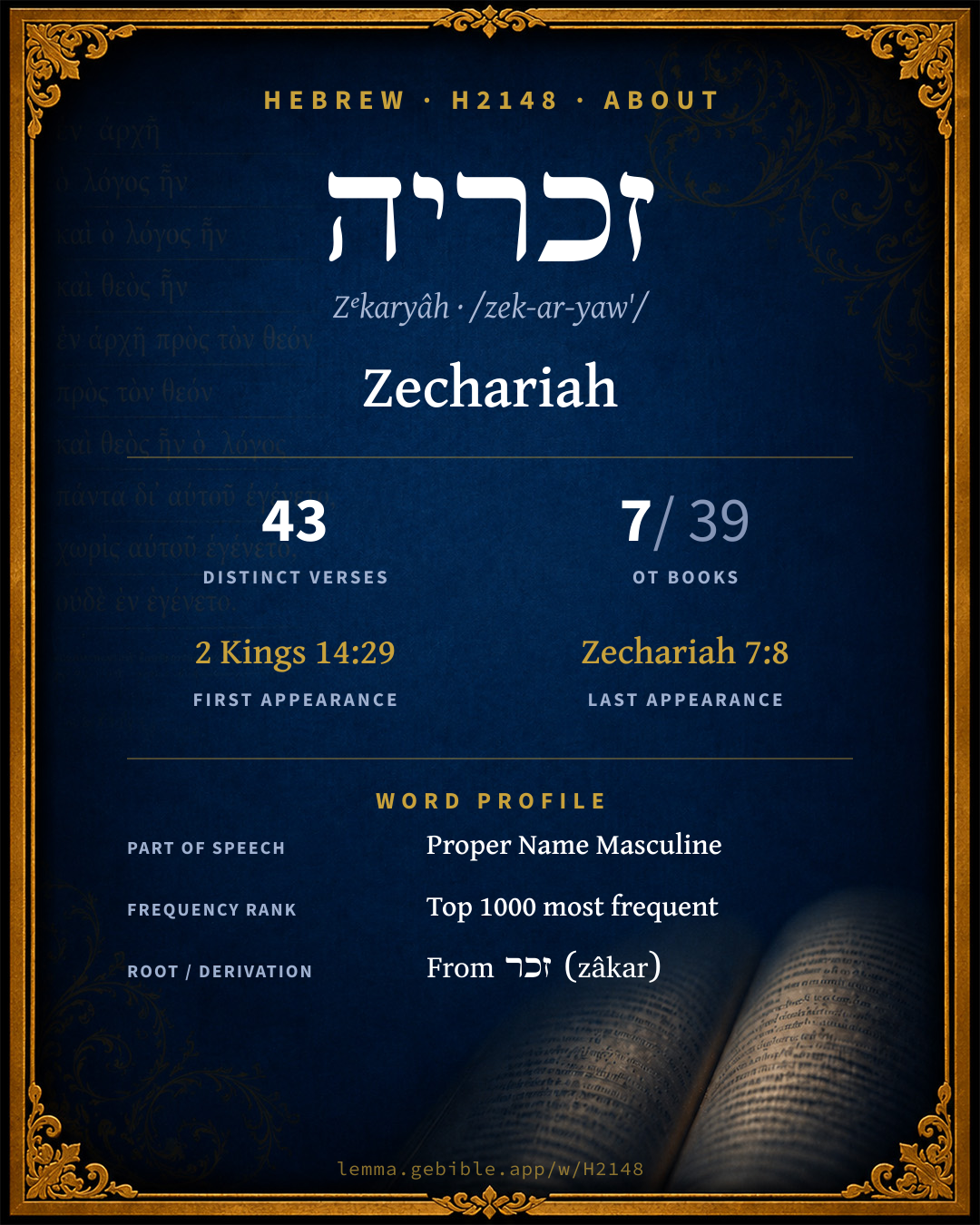
זְכַרְיָה
Zechariah
BDB lists 10 entries for ‘Zechariah’ fuller range ↓
Full lexicon entry — Brown-Driver-Briggs (BDB)
From Brown-Driver-Briggs (BDB)
Where this word appears
Grammar key — what these labels mean
Part of speech
- Noun
- A naming word — a person, place, thing, or idea.
Noun type
- Proper
- A name of a specific person, place, or people (e.g. Abraham, Zion, Israel).
Every verse where H2148 appears — 43 distinct verses across 7 books. Click any verse to open its interlinear word-by-word view. Verse text shown in the World English Bible for context — . Each verse’s Hebrew form is shown with its reference; the English is not keyword-highlighted, since the data carries no word-level English alignment. Use “Compare translations” on any verse to read it across multiple English versions. This concordance covers the Hebrew Bible; Septuagint (Greek Old Testament) occurrences are not indexed here.
2 Kings 4 verses
- 2 Kings 14:29 זְכַרְיָ֥ה n Proper Jeroboam slept with his fathers, even with the kings of Israel; and Zechariah his son reigned in his place.
- 2 Kings 15:8 זְכַרְיָ֨הוּ n Proper In the thirty-eighth year of Azariah king of Judah did Zechariah the son of Jeroboam reign over Israel in Samaria six months.
- 2 Kings 15:11 זְכַרְיָ֑ה n Proper Now the rest of the acts of Zechariah, behold, they are written in the book of the chronicles of the kings of Israel.
- 2 Kings 18:2 זְכַרְיָֽה n Proper He was twenty-five years old when he began to reign; and he reigned twenty-nine years in Jerusalem: and his mother's name was Abi the daughter of Zechariah.
1 Chronicles 12 verses
- 1 Chronicles 5:7 וּ/זְכַרְיָֽהוּ conj + n Proper His brothers by their families, when the genealogy of their generations was reckoned: the chief, Jeiel, and Zechariah,
- 1 Chronicles 9:21 זְכַרְיָה֙ n Proper Zechariah the son of Meshelemiah was porter of the door of the tent of meeting.
- 1 Chronicles 9:37 וּ/זְכַרְיָ֖ה conj + n Proper and Gedor, and Ahio, and Zechariah, and Mikloth.
- 1 Chronicles 15:18 זְכַרְיָ֡הוּ n Proper and with them their brothers of the second degree, Zechariah, Ben, and Jaaziel, and Shemiramoth, and Jehiel, and Unni, Eliab, and Benaiah, and Maaseiah, and Mattithiah, and Eliphelehu, and Mikneiah, and Obed-edom, and Jeiel, the doorkeepers.
- 1 Chronicles 15:20 וּ/זְכַרְיָ֨ה conj + n Proper and Zechariah, and Aziel, and Shemiramoth, and Jehiel, and Unni, and Eliab, and Maaseiah, and Benaiah, with psalteries set to Alamoth;
- 1 Chronicles 15:24 וּ֠/זְכַרְיָהוּ conj + n Proper Shebaniah, and Joshaphat, and Nethanel, and Amasai, and Zechariah, and Benaiah, and Eliezer, the priests, did blow the trumpets before the ark of God: and Obed-edom and Jehiah were doorkeepers for the ark.
- 1 Chronicles 16:5 זְכַרְיָ֑ה n Proper Asaph the chief, and second to him Zechariah, Jeiel, and Shemiramoth, and Jehiel, and Mattithiah, and Eliab, and Benaiah, and Obed-edom, and Jeiel, with psalteries and with harps; and Asaph with cymbals, sounding aloud;
- 1 Chronicles 24:25 זְכַרְיָֽהוּ n Proper The brother of Micah, Isshiah; of the sons of Isshiah, Zechariah.
- 1 Chronicles 26:2 זְכַרְיָ֤הוּ n Proper Meshelemiah had sons: Zechariah the firstborn, Jediael the second, Zebadiah the third, Jathniel the fourth,
- 1 Chronicles 26:11 זְכַרְיָ֖הוּ n Proper Hilkiah the second, Tebaliah the third, Zechariah the fourth: all the sons and brothers of Hosah were thirteen.
- 1 Chronicles 26:14 וּ/זְכַרְיָ֨הוּ conj + n Proper The lot eastward fell to Shelemiah. Then for Zechariah his son, a wise counselor, they cast lots; and his lot came out northward.
- 1 Chronicles 27:21 זְכַרְיָ֑הוּ n Proper of the half-tribe of Manasseh in Gilead, Iddo the son of Zechariah: of Benjamin, Jaasiel the son of Abner:
2 Chronicles 9 verses
- 2 Chronicles 17:7 וְ/לִ/זְכַרְיָ֔ה conj + prep + n Proper Also in the third year of his reign he sent his princes, even Ben Hail, and Obadiah, and Zechariah, and Nethanel, and Micaiah, to teach in the cities of Judah;
- 2 Chronicles 20:14 זְכַרְיָ֡הוּ n Proper Then on Jahaziel the son of Zechariah, the son of Benaiah, the son of Jeiel, the son of Mattaniah, the Levite, of the sons of Asaph, came the Spirit of Yahweh in the midst of the assembly;
- 2 Chronicles 21:2 וּ/זְכַרְיָ֣הוּ conj + n Proper He had brothers, the sons of Jehoshaphat: Azariah, and Jehiel, and Zechariah, and Azariah, and Michael, and Shephatiah; all these were the sons of Jehoshaphat king of Israel.
- 2 Chronicles 24:20 זְכַרְיָה֙ n Proper The Spirit of God came on Zechariah the son of Jehoiada the priest; and he stood above the people, and said to them, Thus says God, Why disobey you the commandments of Yahweh, so that you can't prosper? because you have forsaken Yahweh, he has also forsaken you.
- 2 Chronicles 26:5 זְכַרְיָ֔הוּ n Proper He set himself to seek God in the days of Zechariah, who had understanding in the vision of God: and as long as he sought Yahweh, God made him to prosper.
- 2 Chronicles 29:1 זְכַרְיָֽהוּ n Proper Hezekiah began to reign when he was twenty-five years old; and he reigned twenty-nine years in Jerusalem: and his mother's name was Abijah, the daughter of Zechariah.
- 2 Chronicles 29:13 זְכַרְיָ֖הוּ n Proper and of the sons of Elizaphan, Shimri and Jeuel; and of the sons of Asaph, Zechariah and Mattaniah;
- 2 Chronicles 34:12 וּ/זְכַרְיָ֧ה conj + n Proper The men did the work faithfully: and the overseers of them were Jahath and Obadiah, the Levites, of the sons of Merari; and Zechariah and Meshullam, of the sons of the Kohathites, to set it forward; and [others of] the Levites, all who were skillful with instruments of music.
- 2 Chronicles 35:8 וּ/זְכַרְיָ֜הוּ conj + n Proper His princes gave for a freewill-offering to the people, to the priests, and to the Levites. Hilkiah and Zechariah and Jehiel, the rulers of the house of God, gave to the priests for the Passover offerings two thousand and six hundred [small cattle], and three hundred oxen.
Ezra 6 verses
- Ezra 5:1 וּ/זְכַרְיָ֤ה conj + n Proper Now the prophets, Haggai the prophet, and Zechariah the son of Iddo, prophesied to the Jews who were in Judah and Jerusalem; in the name of the God of Israel [prophesied they] to them.
- Ezra 6:14 וּ/זְכַרְיָ֖ה conj + n Proper The elders of the Jews built and prospered, through the prophesying of Haggai the prophet and Zechariah the son of Iddo. They built and finished it, according to the commandment of the God of Israel, and according to the decree of Cyrus, and Darius, and Artaxerxes king of Persia.
- Ezra 8:3 זְכַרְיָ֑ה n Proper Of the sons of Shecaniah, of the sons of Parosh, Zechariah; and with him were reckoned by genealogy of the males one hundred fifty.
- Ezra 8:11 זְכַרְיָ֖ה n Proper Of the sons of Bebai, Zechariah the son of Bebai; and with him twenty-eight males.
- Ezra 8:16 וְ/לִ/זְכַרְיָ֥ה conj + prep + n Proper Then sent I for Eliezer, for Ariel, for Shemaiah, and for Elnathan, and for Jarib, and for Elnathan, and for Nathan, and for Zechariah, and for Meshullam, chief men; also for Joiarib, and for Elnathan, who were teachers.
- Ezra 10:26 זְכַרְיָה֙ n Proper Of the sons of Elam: Mattaniah, Zechariah, and Jehiel, and Abdi, and Jeremoth, and Elijah.
Nehemiah 7 verses
- Nehemiah 8:4 זְכַרְיָ֥ה n Proper Ezra the scribe stood on a pulpit of wood, which they had made for the purpose; and beside him stood Mattithiah, and Shema, and Anaiah, and Uriah, and Hilkiah, and Maaseiah, on his right hand; and on his left hand, Pedaiah, and Mishael, and Malchijah, and Hashum, and Hashbaddanah, Zechariah, [and] Meshullam.
- Nehemiah 11:4 זְכַרְיָ֧ה n Proper In Jerusalem lived certain of the children of Judah, and of the children of Benjamin. Of the children of Judah: Athaiah the son of Uzziah, the son of Zechariah, the son of Amariah, the son of Shephatiah, the son of Mahalalel, of the children of Perez;
- Nehemiah 11:5 זְכַרְיָ֖ה n Proper and Maaseiah the son of Baruch, the son of Colhozeh, the son of Hazaiah, the son of Adaiah, the son of Joiarib, the son of Zechariah, the son of the Shilonite.
- Nehemiah 11:12 זְכַרְיָ֔ה n Proper and their brothers who did the work of the house, eight hundred twenty-two; and Adaiah the son of Jeroham, the son of Pelaliah, the son of Amzi, the son of Zechariah, the son of Pashhur, the son of Malchijah,
- Nehemiah 12:16 זְכַרְיָ֖ה n Proper of Iddo, Zechariah; of Ginnethon, Meshullam;
- Nehemiah 12:35 זְכַרְיָ֨ה n Proper and certain of the priests' sons with trumpets: Zechariah the son of Jonathan, the son of Shemaiah, the son of Mattaniah, the son of Micaiah, the son of Zaccur, the son of Asaph;
- Nehemiah 12:41 זְכַרְיָ֥ה n Proper and the priests, Eliakim, Maaseiah, Miniamin, Micaiah, Elioenai, Zechariah, and Hananiah, with trumpets;
Isaiah 1 verse
Zechariah 4 verses
- Zechariah 1:1 זְכַרְיָה֙ n Proper In the eighth month, in the second year of Darius, the word of Yahweh came to Zechariah the son of Berechiah, the son of Iddo, the prophet, saying,
- Zechariah 1:7 זְכַרְיָה֙ n Proper On the twenty-fourth day of the eleventh month, which is the month Shebat, in the second year of Darius, the word of Yahweh came to Zechariah the son of Berechiah, the son of Iddo, the prophet, saying,
- Zechariah 7:1 זְכַרְיָ֗ה n Proper It happened in the fourth year of king Darius that the word of Yahweh came to Zechariah in the fourth day of the ninth month, the month of Chislev.
- Zechariah 7:8 זְכַרְיָ֖ה n Proper The word of Yahweh came to Zechariah, saying,
About this entry
At a glance — auto-summarized from this page’s data, not written by a person. Every figure links to its source below. This summary describes the numbers; it doesn’t interpret them.
זכריה (Zᵉkaryâh) is a Hebrew name most often rendered “Zechariah.” It first appears in 2 Kings 14:29. Spanning 43 verses in 7 books, it ranks among the moderately common words of the Hebrew Bible. 1 Chronicles dominates its distribution — 12 of 43 verses. The sections below give every occurrence and version rendering.
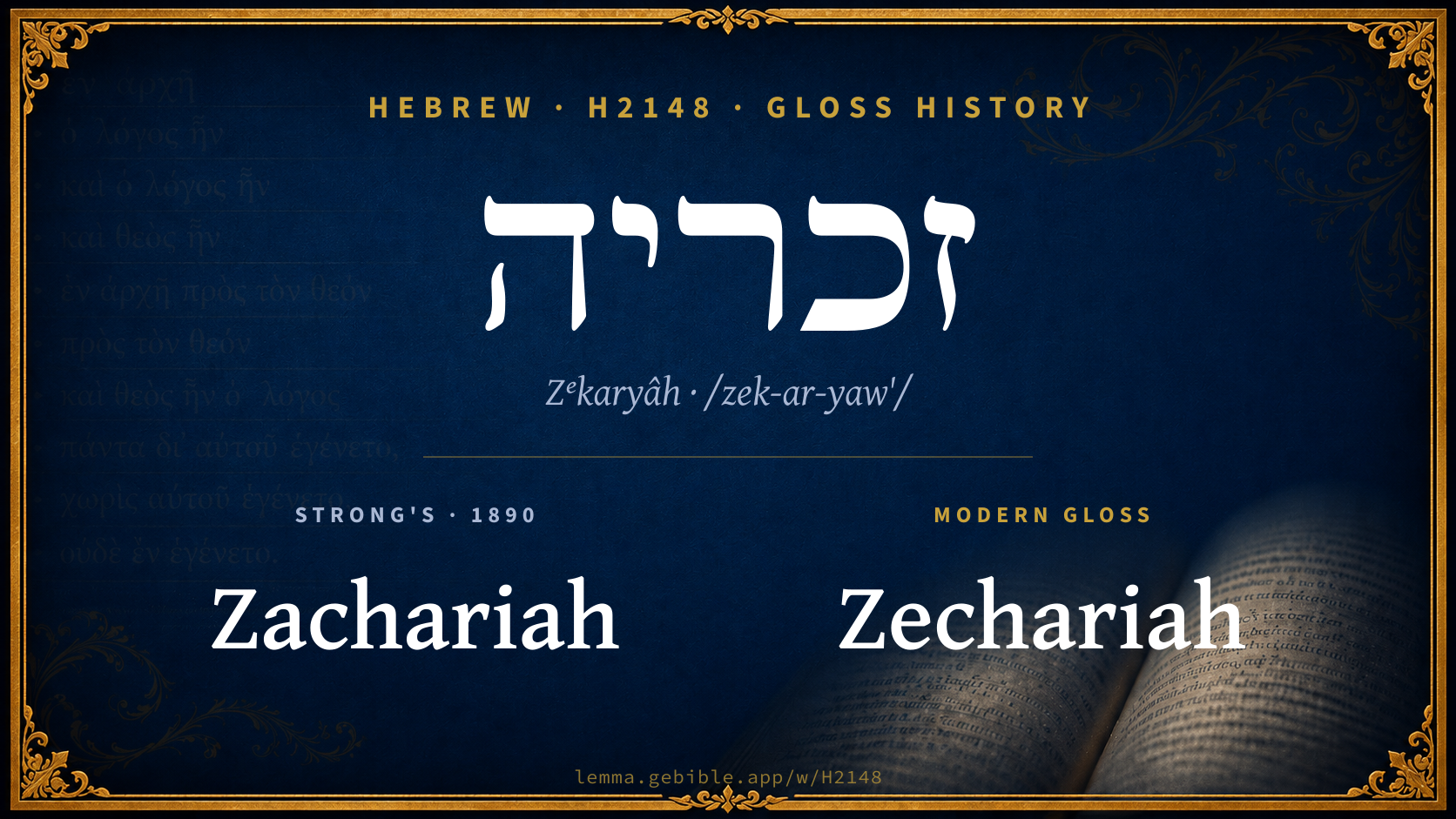
Gloss history
Strong's 1890 vs modern scholarship
About this word
Strong's H2148 catalogs a Hebrew word from the Hebrew Old Testament.
These counts are not copied from any lexicon or concordance. They are computed here, from the morphology-tagged Hebrew Old Testament. What Lemma adds →
- 43
- distinct verses
- The word appears in 43 distinct verses.
- 7 / 39
- OT books
- The word appears in 7 of 39 Old Testament books.
- #837
- by frequency
- Top 1000 most frequent Hebrew words (rank 837 of 8,640 Hebrew words by occurrence).
View all 43 occurrences in the concordance →
Most concentrated in
- 1 Chronicles 12 verses 28%
- 2 Chronicles 9 verses 21%
- Nehemiah 7 verses 16%
By section of the Old Testament
By traditional corpus
Conventional, traditional groupings — biblical authorship is debated, so this is a traditional corpus grouping, not an authorship claim. Each share is this word’s portion of its verses in that division of the Hebrew canon. Each figure is a share of the word’s 43 distinct verses.
- Writings (Ketuvim) 34 verses · 79%
- Prophets (Nevi'im) 9 verses · 21%
How translations render this word
Counts come from each version’s own published word-to-Strong’s tagging or interlinear alignment — an approximate guide to how each version renders this word, not a word-level alignment the data otherwise carries. Because each total is that version’s own tagged count, the per-version totals vary from one another and need not match the appearance or distinct-verse counts above. These counts may also differ from a printed concordance because Lemma counts each distinctly tagged rendering and does not collapse phrase taggings into a single head-word total. This is a fixed set of word-tagged versions (KJV, ASV, BSB, ULT) and does not change with the reading translation you choose elsewhere. Each version’s license is shown beside its name below (and on Sources).
- King James Version: Zechariah 34×, Zachariah 3×, Came unto zechariah 2×
- American Standard Version: Zechariah 38×, Came unto zechariah 2×
- Berean Standard Bible: Zechariah 43×
- unfoldingWord Literal Text: Zechariah 43×
King James Version Public Domain
Renders H2148 across 43 tagged occurrences — most commonly:
Plus 4 renderings that appear only once — usually multi-word phrases or single function words the recovered tagging swept in, not distinct renderings.
American Standard Version Public Domain
Renders H2148 across 42 tagged occurrences — most commonly:
Plus 2 renderings that appear only once — usually multi-word phrases or single function words the recovered tagging swept in, not distinct renderings. Not rendered by a distinct English word in 1 further occurrence.
Berean Standard Bible Public Domain
Renders H2148 across 43 tagged occurrences — most commonly:
unfoldingWord Literal Text CC BY-SA 4.0
Renders H2148 across 43 tagged occurrences — most commonly:
32 senses and sub-senses in the full BDB
What do BDB’s symbols mean?
BDB uses these scholarly abbreviations:
| Symbol | Meaning |
|---|---|
| 𝔊 | the Septuagint (the ancient Greek translation, LXX) |
| 𝔙 | the Vulgate (the Latin translation) |
| 𝔖 | the Syriac version (the Peshitta) |
| 𝔗 | the Targum (the Aramaic translation) |
| ψ | the Psalms |
| √ | root (the underlying root or stem) |
| ‖ | parallel passage (a synonymous or contrasted parallel) |
| † | the dagger: every passage where the word occurs is cited |
The 32 senses and sub-senses the full Brown-Driver-Briggs lexicon distinguishes for this word, in lexicon order (not ranked by frequency), with BDB’s own verbatim wording and sub-sense lettering. Shown in Hebrew script with BDB’s own scholarly abbreviations. The condensed entry is in the Lexicon Entry tab. See also the Forms in the corpus table below.
- 1. זכריהו, king of Isr., son of Jerob. II, 2 K 15:8 = זכריה 14:29; 15:11. e.g. 2 Kings 15:8
- 2. זכריהו, father of Hezekiah’s mother 2 Ch 29:1 = זכריה 2 K 18:2. e.g. 2 Chronicles 29:1
- 3. זכריהו, contemporary of Isaiah Is 8:2. e.g. Isaiah 8:2
- 4. זכריהו, a Reubenite 1 Ch 5:7. e.g. 1 Chronicles 5:7
- 5. זכריה, a Benjamite 1 Ch 9:37 (𝔊 Ζαχαρια, A Ζαχχουρ 𝔊L Ζεχρει) = זָ֑כֶר 1 Ch 8:31 (v. i. [זֶכֶר]). e.g. 1 Chronicles 9:37
- 6. זכריהו, a Manassite 1 Ch 27:21 (𝔊 Ζαβδειου, 𝔊L Ζαχαριου). e.g. 1 Chronicles 27:21
- 7. זכריהו, a son of Jehoshaphat 2 Ch 21:2. e.g. 2 Chronicles 21:2
- 8. זכריה, a captain of Jehosh. 2 Ch 17:7. e.g. 2 Chronicles 17:7
- 9. זכריהו, teacher of Uzziah 2 Ch 26:5. e.g. 2 Chronicles 26:5
- 10. Levites, זכריהו:
- a. 1 Ch 15:18 = זכריה v 20; 16:5. e.g. 1 Chronicles 15:18
- b. 1 Ch 24:25. e.g. 1 Chronicles 24:25
- c. 1 Ch 26:2, 14. e.g. 1 Chronicles 26:2
- d. 1 Ch 26:11. e.g. 1 Chronicles 26:11
- e. 2 Ch 20:14. e.g. 2 Chronicles 20:14
- f. 2 Ch 29:13 (𝔊 Ἀζαριας, A Ζαχαριας, so 𝔊L). זכריה: e.g. 2 Chronicles 29:13
- g. 1 Ch 9:21. e.g. 1 Chronicles 9:21
- h. 2 Ch 34:12. e.g. 2 Chronicles 34:12
- i. an Asaphite Ne 12:35. e.g. Nehemiah 12:35
- 11. priests, זכריהו:
- a. 1 Ch 15:24. e.g. 1 Chronicles 15:24
- b. 2 Ch 35:8. זכריה: e.g. 2 Chronicles 35:8
- c. 2 Ch 24:20 (𝔊 Ἀζαριαν; 𝔊L Ζαχαριαν; prob. referred to Matt 23:35, where appar. confusion with f). e.g. 2 Chronicles 24:20
- d. Ne 11:12. e.g. Nehemiah 11:12
- e. Ne 12:41. e.g. Nehemiah 12:41
- f. the well-known prophet Zc 1:1, 7; 7:1, 8 Ne 12:16 [cf. Aramaic Ezr 5:1; 6:14]. e.g. Zechariah 1:1
- 12. returned exiles, זכריה:
- a. Ezr 8:3 and perhaps v 16, cf. Ne 8:4. e.g. Ezra 8:3
- b. Ezr 8:11 (𝔊 Ἀζαριας, A Ζαχαριας, so 𝔊L). e.g. Ezra 8:11
- c. Ezr 10:26. e.g. Ezra 10:26
- d. a man of Judah Ne 11:4. e.g. Nehemiah 11:4
- e. id. Ne 11:5 (𝔊 Θηζεια, א Θηδεια, A Ζαχαριου, so 𝔊L). e.g. Nehemiah 11:5
Senses from the full Brown-Driver-Briggs lexicon (Brown, Driver, Briggs; Oxford 1906 — public domain), digitized via Sefaria, supplemented by the OpenScriptures HebrewLexicon (CC BY 4.0). Full attribution on Sources.
Word origin
oftener זְכַרְיָה n.pr.m. (Sab. ידֿכראל DHMEpigr. Denkm. 43) 𝔊 Ζαχαρια(ς), etc.:—
— Brown-Driver-Briggs (Oxford 1906, public domain), digitized via Sefaria, supplemented by the OpenScriptures HebrewLexicon (CC BY 4.0). See Sources.
Derived from זכר (zâkar) (H2142) — to remember.
Jastrow Dictionary
A second Hebrew/Aramaic lexicon for comparison, covering Aramaic and post-biblical (Talmudic, Targumic, Midrashic) usage that the biblical-Hebrew BDB does not. Matched by lemma rather than by Strong’s number, so a lemma may carry more than one Jastrow headword (shown separately below), and the entries cover usage well beyond the Bible.
זְכַרְיָה
- (b. h.) pr. n. m. Zechariah,
- 1. the prophet-priest slain in the Temple court (II Chr. XXIV, 20, sq.). Targ. Lam. II, 20.—Gitt. 57ᵇ; Y. Taan. IV, 69ᵃ bot.; Lam. R. to II, 2; a. e. e.g. 2 Chronicles 24:20
- 2. Zechariah, the prophet. Erub. 21ᵃ. Macc. 24ᵇ. Snh. 99ᵃ; a. e.
- 3. Z. ben K’butal, a survivor of the Second Temple. Yoma I, 6; ib. 19ᵇ (v. Rabb. D. S. a. l. notes 3, 4).—4) R. Z. son of Eucolus, a Tannai. Tosef. Sabb. XVI (XVII), 6, v. אֶבְקוֹלָס; Gitt. 56ᵃ; a. e.—5) R. Z., the butcher’s son, a Tannai. Eduy. VIII, 2. B. Bath. 111ᵃ; a. e.—6) name of several Amoraim. Y. Snh. I, 18ᵇ top. Y. Pes. I, 27ᵇ top; Y. Sot. I, 16ᵈ זבדיה; Num. R. s. 9 זכר׳.—Snh. 67ᵇ; a. e.
A Dictionary of the Targumim, the Talmud Babli and Yerushalmi, and the Midrashic Literature (Marcus Jastrow; London, Luzac, 1903) — Public Domain. Digitized via Sefaria. Digitized via Sefaria. Full attribution on Sources.
Forms in the corpus
The 27 distinct written forms H2148 takes in the Hebrew Bible, most frequent first — each parse links to that state’s occurrences in the concordance. Hebrew forms include their vowel points and cantillation, so a single lemma takes many written forms.
| Form | Parsing | Example | Uses |
|---|---|---|---|
| זְכַרְיָה֙ | Noun, Proper | Ezra 10:26 | 5 |
| זְכַרְיָ֖ה | Noun, Proper | Ezra 8:11 | 4 |
| זְכַרְיָ֑ה | Noun, Proper | Ezra 8:3 | 3 |
| זְכַרְיָ֖הוּ | Noun, Proper | 1 Chronicles 26:11 | 3 |
| זְכַרְיָ֥ה | Noun, Proper | 2 Kings 14:29 | 3 |
| וּ/זְכַרְיָ֖ה | Noun, Proper | Ezra 6:14 | 2 |
| זְכַרְיָ֡הוּ | Noun, Proper | 1 Chronicles 15:18 | 2 |
| זְכַרְיָֽהוּ | Noun, Proper | 1 Chronicles 24:25 | 2 |
| וְ/לִ/זְכַרְיָ֔ה | Noun, Proper | 2 Chronicles 17:7 | 1 |
| וְ/לִ/זְכַרְיָ֥ה | Noun, Proper | Ezra 8:16 | 1 |
| וּ/זְכַרְיָ֜הוּ | Noun, Proper | 2 Chronicles 35:8 | 1 |
| וּ/זְכַרְיָ֣הוּ | Noun, Proper | 2 Chronicles 21:2 | 1 |
| וּ/זְכַרְיָ֤ה | Noun, Proper | Ezra 5:1 | 1 |
| וּ/זְכַרְיָ֧ה | Noun, Proper | 2 Chronicles 34:12 | 1 |
| וּ/זְכַרְיָ֨ה | Noun, Proper | 1 Chronicles 15:20 | 1 |
| וּ/זְכַרְיָ֨הוּ | Noun, Proper | 1 Chronicles 26:14 | 1 |
| וּ/זְכַרְיָֽהוּ | Noun, Proper | 1 Chronicles 5:7 | 1 |
| וּ֠/זְכַרְיָהוּ | Noun, Proper | 1 Chronicles 15:24 | 1 |
| זְכַרְיָ֑הוּ | Noun, Proper | 1 Chronicles 27:21 | 1 |
| זְכַרְיָ֔ה | Noun, Proper | Nehemiah 11:12 | 1 |
| זְכַרְיָ֔הוּ | Noun, Proper | 2 Chronicles 26:5 | 1 |
| זְכַרְיָ֗ה | Noun, Proper | Zechariah 7:1 | 1 |
| זְכַרְיָ֤הוּ | Noun, Proper | 1 Chronicles 26:2 | 1 |
| זְכַרְיָ֧ה | Noun, Proper | Nehemiah 11:4 | 1 |
| זְכַרְיָ֨ה | Noun, Proper | Nehemiah 12:35 | 1 |
| זְכַרְיָ֨הוּ | Noun, Proper | 2 Kings 15:8 | 1 |
| זְכַרְיָֽה | Noun, Proper | 2 Kings 18:2 | 1 |
Same root — word family
Other BDB entries built from the same root as H2148, grouped by Strong’s listed origin. These share a root / origin per the lexicon — not necessarily a shared meaning. Each links to that word’s own entry.
Derives from
Shares the same root
- אזכרה ʼazkârâh H234 memorial offering
- זכור zâkûwr H2138 male
- זכר zêker H2143 memorial
- זכר zâkâr H2145 male
- זכרון zikrôwn H2146 memorial
Proper names from this root
People and places named from this root — a name, not an additional meaning of the word.
Compare all same-root words → Showing 4 of 10 — not the complete family. 3 of the same-root words are proper names (people or places). They share a root, not necessarily a meaning.
Bible dictionary
Public-domain dictionary articles matched to this entry by name (Zechariah). A biblical name can be shared by more than one person or place, so an article may treat several.
Easton's Bible Dictionary · M. G. Easton, 1897
Jehovah is renowned or remembered. (1.) A prophet of Judah, the eleventh of the twelve minor prophets. Like Ezekiel, he was of priestly extraction. He describes himself (1:1) as "the son of Berechiah." In Ezra 5:1 and 6:14 he is called "the son of Iddo," who was properly his grandfather. His prophetical career began in the second year of Darius (B.C. 520), about sixteen years after the return of the first company from exile. He was contemporary with Haggai (Ezra 5:1).
His book consists of two distinct parts, (1) chapters 1 to 8, inclusive, and (2) 9 to the end. It begins with a preface (1:1-6), which recalls the nation's past history, for the purpose of presenting a solemn warning to the present generation. Then follows a series of eight visions (1:7-6:8), succeeding one another in one night, which may be regarded as a symbolical history of Israel, intended to furnish consolation to the returned exiles and stir up hope in their minds. The symbolical action, the crowning of Joshua (6:9-15), describes how the kingdoms of the world become the kingdom of God's Christ.
Chapters 7 and 8, delivered two years later, are an answer to the question whether the days of mourning for the destruction of the city should be any longer kept, and an encouraging address to the people, assuring them of God's presence and blessing.
The second part of the book (ch. 9-14) bears no date. It is probable that a considerable interval separates it from the first part. It consists of two burdens.
The first burden (ch. 9-11) gives an outline of the course of God's providential dealings with his people down to the time of the Advent.
The second burden (ch. 12-14) points out the glories that await Israel in "the latter day", the final conflict and triumph of God's kingdom.
(2.) The son or grandson of Jehoiada, the high priest in the times of Ahaziah and Joash. After the death of Jehoiada he boldly condemned both the king and the people for their rebellion against God (2 Chr. 24:20), which so stirred up their resentment against him that at the king's commandment they stoned him with stones, and he died "in the court of the house of the Lord" (24:21). Christ alludes to this deed of murder in Matt. 23:35, Luke 11:51. (See ZACHARIAS .)
(3.) A prophet, who had "understanding in the seeing of God," in the time of Uzziah, who was much indebted to him for his wise counsel (2 Chr. 26:5).
Besides these, there is a large number of persons mentioned in Scripture bearing this name of whom nothing is known.
(4.) One of the chiefs of the tribe of Reuben (1 Chr. 5:7).
(5.) One of the porters of the tabernacle (1 Chr. 9:21).
(6.) 1 Chr. 9:37.
(7.) A Levite who assisted at the bringing up of the ark from the house of Obededom (1 Chr. 15:20-24).
(8.) A Kohathite Levite (1 Chr. 24:25).
(9.) A Merarite Levite (1 Chr. 27:21).
(10.) The father of Iddo (1 Chr. 27:21).
(11.) One who assisted in teaching the law to the people in the time of Jehoshaphat (2 Chr. 17:7).
(12.) A Levite of the sons of Asaph (2 Chr. 20:14).
(13.) One of Jehoshaphat's sons (2 Chr. 21:2).
(14.) The father of Abijah, who was the mother of Hezekiah (2 Chr. 29:1).
(15.) One of the sons of Asaph (2 Chr. 29:13).
(16.) One of the "rulers of the house of God" (2 Chr. 35:8).
(17.) A chief of the people in the time of Ezra, who consulted him about the return from captivity (Ezra 8:16); probably the same as mentioned in Neh. 8:4,
(18.) Neh. 11:12.
(19.) Neh. 12:16.
(20.) Neh. 12:35, 41.
(21.) Isa. 8:2.
Smith's Bible Dictionary · William Smith, 1863
+ The eleventh in order of the twelve minor prophets. He is called in his prophecy the son of Berechiah and the grandson of Iddo, whereas in the book of Ezra, (Ezra 5:1; 6:14) he is said to have been the son of Iddo. It is natural to suppose as the prophet himself mentions his father's name, whereas the book of Ezra mentions only Iddo, that Berechiah had died early, and that there was now no intervening link between the grandfather and the grandson. Zechariah, like Jeremiah and Ezekiel before him, was priest as well as prophet. He seems to have entered upon his office while yet young, (Zechariah 2:4) and must have been born in Babylon whence he returned with the first caravan of exiles under Zerubbabel and Jeshua. It was in the eighth month, in the second year of Darius, that he first publicly discharged his office. In this he acted in concert with Haggai. Both prophets had the same great object before them; both directed all their energies to the building of the second temple. To their influence we find the rebuilding of the temple in a great measure ascribed. If the later Jewish accounts may be trusted, Zechariah, as well as Haggai, was a member of the Great Synagogue. The genuine writings of Zechariah help us but little in our estimate of his character. Some faint traces, however, we may observe in them, of his education in Babylon. He leans avowedly on the authority of the older prophets, and copies their expressions. Jeremiah especially seems to have been his favorite; and hence the Jewish saying that "the spirit of Jeremiah dwelt in Zechariah." But in what may be called the peculiarities of his prophecy, he approaches more nearly to Ezekiel and Daniel. Like them he delights in visions; like them he uses symbols and allegories rather than the bold figures and metaphors which lend so much force and beauty to the writings of the earlier prophets. Generally speaking, Zechariah's style is pure, and remarkably free from Chaldaisms. + Son of Meshelemiah or Shelemiah a Korhite, and keeper of the north gate of the tabernacle of the congregation, (1 Chronicles 9:21) (B.C. 1043.) + One of the sons of Jehiel. (1 Chronicles 9:37) + A Levite of the second order in the temple band as arranged by David, appointed to play "with psalteries on Alamoth." (1 Chronicles 15:18,20) (B.C. 1043.) + One of the princes of Judah in the reign of Jehoshaphat. (2 Chronicles 17:7) (B.C. 910.) + Son of the high priest Jehoiada, in the reign of Joash king of Judah (2 Chronicles 24:20) and therefore the king's cousin. After the death of Jehoiada, Zechariah probably succeeded to his office, and in attempting to check the reaction in favor of idolatry which immediately followed he fell a victim to a conspiracy formed against him by the king, and was stoned in the court of the temple. He is probably the same as the "Zacharias son of Barachias" who was slain between the temple and the altar. (Matthew 23:35) [Zacharias, No. 2] (B.C. 838.) + A Kohathite Levite in the reign of Josiah. (2 Chronicles 34:12) (B.C. 628.) + The leader of the sons of Pharosh who returned with Ezra. (Ezra 8:3) (B.C. 450.) + Son of Behai. (Ezra 8:11) + One of the chiefs of the people whom Ezra summoned in council at the river Ahava. (Ezra 8:16) He stood at Ezra's left hand when he expounded the law to the people. (Nehemiah 8:4) (B.C. 459.) + One of the family of Elam who had married a foreign wife after the captivity. (Ezra 10:26) (B.C.458.) + Ancestor of Athaiah or Uthai. (Nehemiah 11:4) + A Shilonite, descendant of Perez. (Nehemiah 11:5) + A priest, son of Pashur. (Nehemiah 11:12) + The representative of the priestly family of Iddo in the days of Joiakim the son of Jeshua. (Nehemiah 12:16) (B.C. 536.) possibly the same as Zechariah the prophet, the son of Iddo. + One of the priests, son of Jonathan, who blew with the trumpets at the dedication of the city wall by Ezra and Nehemiah. (Nehemiah 12:36,41) (B.C. 446.) + A chief of the Reubenites at the time of the captivity by Tiglath-pileser. (1 Chronicles 5:7) (B.C. 740.) + One of the priests who accompanied the ark from the house of Obed-edom. (1 Chronicles 15:24) (B.C. 1043.) + Son of Isshiah or Jesiah, a Kohathite Levite descended from Uzziel. (1 Chronicles 24:25) (B.C. 1043.) + Fourth son of Hosah of the children of Merari. (1 Chronicles 26:11) + A Manassite. (1 Chronicles 27:21,22) + The father of Jahaziel. (2 Chronicles 20:14) + One of the sons of Jehoshaphat. (2 Chronicles 21:2) + A prophet in the reign of Uzziah who appears to have acted as the king's counsellor, but of whom nothing is known. (2 Chronicles 26:5) (B.C. 807.) + The father of Abijah or Abi, Hezekiah's mother. (2 Chronicles 29:1) + One of the family of Asaph in the reign of Hezekiah. (2 Chronicles 29:13) (B.C. 727.) + One of the rulers of the temple in the reign of Josiah. (2 Chronicles 35:8) (B.C. 628.) + The son of Jeberechiah, who was taken by the prophet Isaiah as one of the "faithful witnesses to record," when he wrote concerning Maher-shalal-hash-baz. (Isaiah 8:2) (B.C. 723.) He may have been the Levite of the same name who in the reign of Hezekiah assisted in the purification of the temple. (2 Chronicles 29:13) Another conjecture is that he is the same as Zechariah the father of Abijah, the queen of Ahaz.
Hitchcock's Bible Names Dictionary · Roswell D. Hitchcock, 1869
same as Zachariah
Classic public-domain reference works; full attribution on Sources.
Septuagint verse parallels
This word appears in 36 verses that also exist in the Greek Old Testament (Septuagint), out of the 43 Hebrew verses it occurs in. You can read those verses in Greek by switching the Old Testament edition to the Septuagint.
Read these verses in the Septuagint
This is a verse-level parallel only — the same verses exist in both the Hebrew and Greek Old Testaments. No word-level Hebrew↔Greek correspondence is claimed: the data carries no such alignment, so no Greek word is shown as this Hebrew word’s translation. Coverage is not total — the Septuagint omits the deuterocanon and renumbers the Psalms, so some Hebrew verses have no direct Greek parallel.