
Exodus 20:8

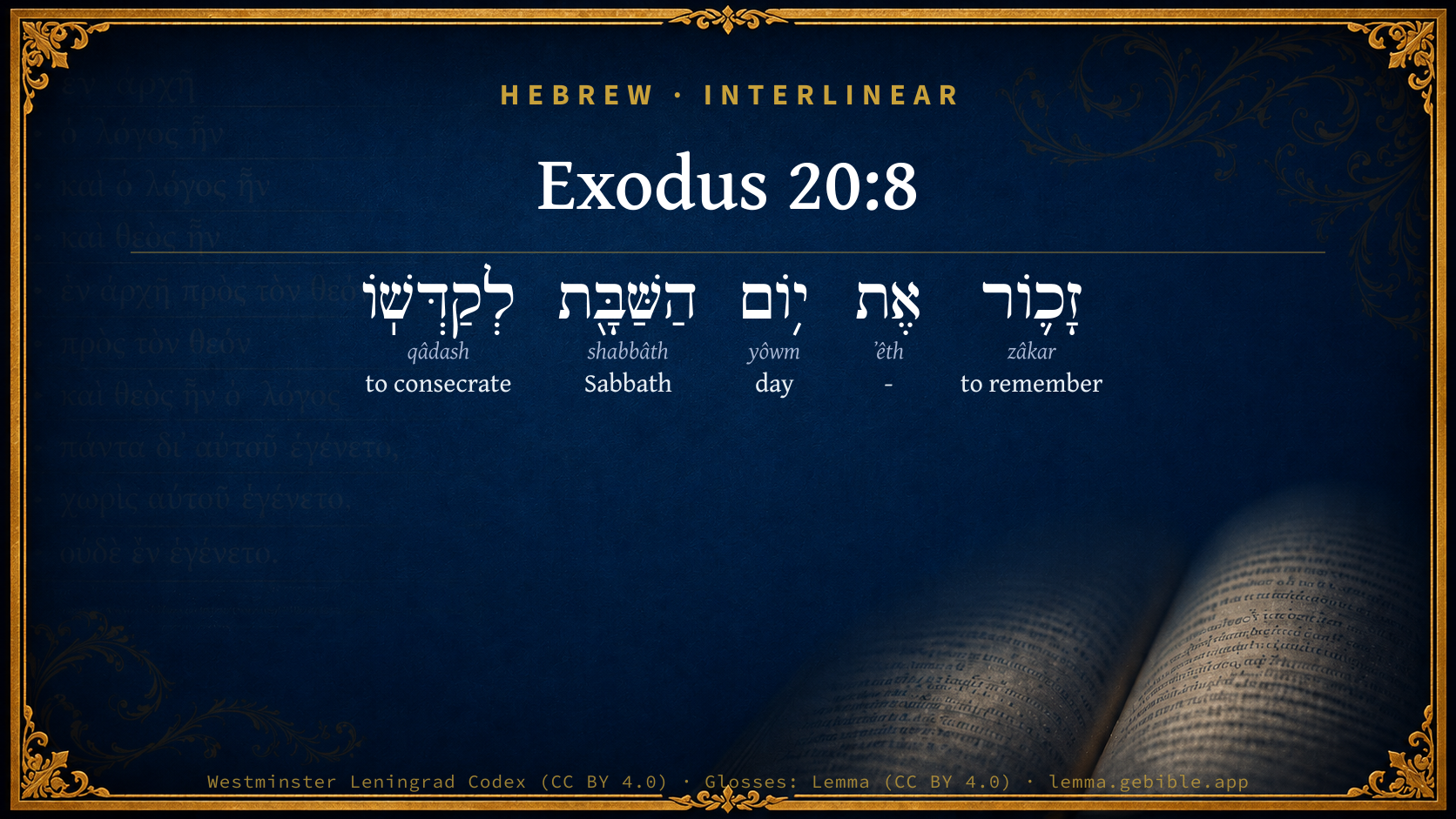
Hebrew (Westminster Leningrad Codex) Exodus 20:8 appears in the Hebrew Old Testament. The text above is from the Westminster Leningrad Codex. Each word links to its Strong’s number, a concise gloss, and parsing drawn from the Open Scriptures Hebrew Bible morphology. Click any word for its full Brown-Driver-Briggs (BDB) entry.
Download image
Cite this verse

Exodus 20:8 (World English Bible). Public Domain. Lemma interlinear Bible study tool, https://lemma.gebible.app/v/exodus/20/8.

Show BibTeX & RIS
BibTeX
RIS
English Translation
"Remember the Sabbath day, to keep it holy.
World English Bible · Public Domain
Download a study sheet

One document with this verse’s original text, its word-by-word gloss line, the meaning frame, cross-references with their text, attributed commentary, and full source and license credits — printable, and it pastes into notes with its structure intact.

This verse Autodidact and up

Study sheet (.html) Plain text (.txt)

A passage Seminary Student

Up to 50 verses in one chapter. A passage sheet keeps up to 6 commentary sources and 12 cross-references per verse, in the order this page ranks them, and says so on the sheet whenever that leaves anything out. Ask for a single verse and you get the Autodidact verse sheet above.

Everything on this page stays free to read, with no account — the sheet is a download of what is already on screen, not access to it.

Want to remove ads? Support Godless Engineer
Compare translations 3

The same verse in 3 English versions, stacked beneath the original-language interlinear above. Click any original word for its lexicon entry.

Each is an independent rendering of the whole verse — the interlinear is not word-aligned to these translations.

Highlighted words mark where these versions differ — a whole-verse word diff, not a word-by-word alignment.

  • World English Bible Public Domain
    "Remember the Sabbath day, to keep it holy.
  • King James Version Public Domain
    Remember the sabbath day, to keep it holy.
  • unfoldingWord Literal Text CC BY-SA 4.0
    Remember the Sabbath day, to set it apart to me.

unfoldingWord Literal Text — © unfoldingWord, licensed CC BY-SA 4.0. Word-aligned USFM3 via Door43 (git.door43.org/unfoldingWord/en_ult).

Versions to compare (up to 4)

3 of 4 selected

Show all 18 translations

Every available English version of this verse, each an independent rendering of the whole verse.

  • World English Bible Public Domain
    "Remember the Sabbath day, to keep it holy.
  • Berean Standard Bible Public Domain
    Remember the Sabbath day by keeping it holy.
  • Majority Standard Bible Public Domain
    Remember the Sabbath day by keeping it holy.
  • King James Version Public Domain
    Remember the sabbath day, to keep it holy.
  • American Standard Version (1901) Public Domain
    Remember the sabbath day, to keep it holy.
  • Revised Version (1885) Public Domain
    Remember the sabbath day, to keep it holy.
  • Geneva Bible (1599) Public Domain
    Remember the Sabbath day, to keepe it holy.
  • Douay-Rheims (1899) Public Domain
    Remember that thou keep holy the sabbath day.
  • Young's Literal Translation Public Domain
    `Remember the Sabbath-day to sanctify it;
  • Literal Standard Version CC BY-SA 4.0
    Remember the Sabbath day to sanctify it;
  • Unlocked Literal Bible CC BY-SA 4.0
    Remember the Sabbath day, to set it apart to me.
  • unfoldingWord Literal Text CC BY-SA 4.0
    Remember the Sabbath day, to set it apart to me.
  • Darby Bible Public Domain
    Remember the sabbath day to hallow it.
  • World Messianic Bible Public Domain
    “Remember the Sabbath day, to keep it holy.
  • Webster's Bible Public Domain
    Remember the sabbath-day to keep it holy.
  • Free Bible Version CC BY-SA 4.0
    Remember the Sabbath day to keep it holy.
  • Bible in Basic English Public Domain
    Keep in memory the Sabbath and let it be a holy day.
  • JPS Tanakh (1917) Public Domain
    Remember the sabbath day, to keep it holy.

Literal Standard Version (2020), Covenant Press — licensed CC BY-SA 4.0. Text via the HelloAO Bible API (eBible.org). Unlocked Literal Bible (unfoldingWord) — licensed CC BY-SA 4.0. Text via the HelloAO Bible API (eBible.org). unfoldingWord Literal Text — © unfoldingWord, licensed CC BY-SA 4.0. Word-aligned USFM3 via Door43 (git.door43.org/unfoldingWord/en_ult). Free Bible Version, Dr. Jonathan Gallagher — licensed CC BY-SA 4.0. Text via the HelloAO Bible API (eBible.org).

Word by word

More ways to search: Search by grammar → Find every occurrence → Compare this word →

Practice this passage: Drill this verse → Learn its vocabulary →

About this verse

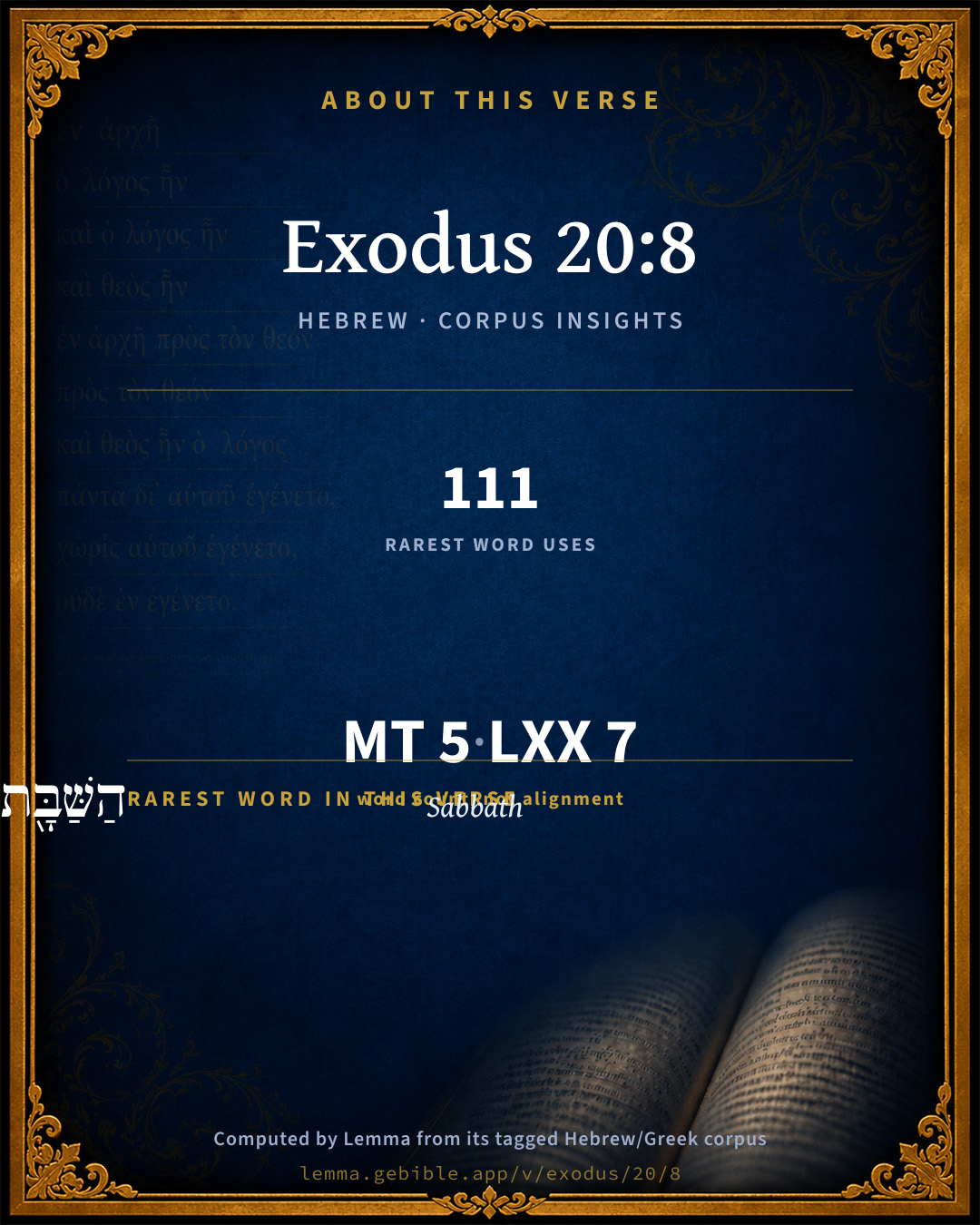
These counts appear in no published source. They are computed here, from the morphology-tagged text and Lemma’s own curated glosses. What Lemma adds →

5
words
5
distinct lemmas
Pentateuch
section

Grammatical profile

  • 2 verbs
  • 2 nouns
  • 1 particle

Verb forms

  • זָכ֛וֹר Qal · Infinitive Absolute
  • לְקַדְּשֽׁוֹ Piel · Infinitive Construct

Hebrew & Septuagint length

In English translation the verse runs 8 words from the Hebrew and 8 from the Septuagint (LXX English) — the same length.

A rough comparison of the two English renderings, which tokenize alike — not a word-level alignment.

Word counts can differ between the Hebrew and the Greek without any difference in meaning — e.g. the Hebrew direct-object marker אֵת has no separate Greek word, and Greek often adds the article ὁ.

In the original languages it is 5 Hebrew tokens and 7 Greek tokens — but the two are counted differently (Hebrew bundles its prefixes and suffixes into one token; the Greek is in lemma form), so that isn’t a like-for-like length.

Cross-references

9

Topical passages linked to Exodus 20:8 in the Treasury of Scripture Knowledge — connected by theme and wording, ordered by reader-vote popularity; previews shown in the World English Bible.

  • Leviticus 26:2 "'You shall keep my Sabbaths, and have reverence for my sanctuary. I am Yahweh.
  • Leviticus 19:3 "'Each one of you shall respect his mother and his father. You shall keep my Sabbaths. I am Yahweh your God.
  • Genesis 2:3 God blessed the seventh day, and made it holy, because he rested in it from all his work which he had created and made.
  • Exodus 31:13–16 "Speak also to the children of Israel, saying, 'Most assuredly you shall keep my Sabbaths: for it is a sign between me and you throughout your generations; that you may know that I am Yahweh who sanctifies you.
  • Leviticus 23:3 "'Six days shall work be done: but on the seventh day is a Sabbath of solemn rest, a holy convocation; you shall do no manner of work. It is a Sabbath to Yahweh in all your dwellings.
  • Leviticus 19:30 "'You shall keep my Sabbaths, and reverence my sanctuary; I am Yahweh.
  • Exodus 16:23–30 He said to them, "This is that which Yahweh has spoken, 'Tomorrow is a solemn rest, a holy Sabbath to Yahweh. Bake that which you want to bake, and boil that which you want to boil; and all that remains over lay up for yourselves to be kept until the morning."
  • Exodus 23:12 "Six days you shall do your work, and on the seventh day you shall rest, that your ox and your donkey may have rest, and the son of your handmaid, and the alien may be refreshed.
  • Isaiah 56:4–6 For thus says Yahweh of the eunuchs who keep my Sabbaths, and choose the things that please me, and hold fast my covenant:

Cross-references courtesy of OpenBible.info (CC BY 4.0).

Hebrew and Greek witnesses Masoretic Hebrew ↔ Greek Septuagint

The same verse in the two great witnesses to the Old Testament, shown verse-for-verse.

These are two independent witnesses, not word-aligned to each other, and the Septuagint is shown in lemma (dictionary) form.

Hebrew Exodus 20:8 Masoretic · Westminster Leningrad Codex

זָכ֛וֹר אֶת י֥וֹם הַשַּׁבָּ֖ת לְקַדְּשֽׁוֹ

"Remember the Sabbath day, to keep it holy.

World English Bible · Public Domain

Greek LXX Exodus 20:8 Septuagint · lemma form

μιμνήσκω ὁ ἡμέρα ὁ σάββατον ἁγιάζω αὐτός

Remember the sabbath day to keep it holy.

LXX2012 (modern English Septuagint) · Public Domain

Hebrew: Westminster Leningrad Codex (CC BY 4.0). Greek: Septuagint (public domain); English from LXX2012 (modern English Septuagint) (Public Domain). How the Septuagint differs from the Hebrew →

Targum (Aramaic paraphrase)

2

The Targum is the ancient Jewish Aramaic paraphrase of the Hebrew Scriptures — an interpretive translation, not the Hebrew text itself. Onkelos (literal) and Pseudo-Jonathan (expansive) render the Torah, and Jonathan the Prophets. Coverage is partial: where no permissively-licensed English translation exists for a verse, only the Aramaic is shown. This is verse-level text, not a word-by-word alignment to the Hebrew.

  1. Targum Onkelos Torah (Genesis–Deuteronomy)
    הֲוֵי דְכִיר יָת יוֹמָא דְשַׁבְּתָא לְקַדָשׁוּתֵהּ:

    (no public-domain English translation for this verse)

    Targum Onkelos — Aramaic: “Onkelos Genesis” (public domain); “Onkelos Exodus” (public domain); “Onkelos Leviticus” (public domain); “Onkelos Numbers” (public domain); “Onkelos Deuteronomy” (public domain). English: “Sefaria Community Translation” (CC0 1.0 (public-domain dedication)); “J.W. Etheridge. The Targums of Onkelos and Jonathan Ben Uzziel on the Pentateuch. London: Longmans, Green, 1862” (public domain). Text via Sefaria.

  2. Targum Pseudo-Jonathan Torah (Genesis–Deuteronomy)
    עַמִּי בֵּית יִשְרָאֵל הֲווֹן דְּכִירִין יוֹמָא דְשַׁבַּתָּא לְמַקְדְּשָׁא יָתֵיהּ

    My people of the house of Israel, Remember the day of Shabbatha, to sanctify it.

    Targum Pseudo-Jonathan — Aramaic: “Targum Jonathan on Genesis” (public domain); “Targum Jonathan on Exodus” (public domain); “Targum Jonathan on Leviticus” (public domain); “Targum Jonathan on Numbers” (public domain); “Targum Jonathan on Deuteronomy” (public domain). English: “The Targum of Jonathan ben Uzziel, trans. J. W. Etheridge, London, 1862” (public domain). Text via Sefaria.

Commentary

Notes on Exodus 20:8 from classic Christian and Jewish commentators (each source and its license shown beneath its notes). The classic Christian expositions comment on the surrounding passage and are grouped to its opening verse, so a note may address several verses; the Jewish commentaries on the Tanakh (Rashi and others) are per-verse, so they appear only where the commentator wrote on this verse.

Lemma curates 59 commentaries, every one of them public domain or Creative Commons licensed, each selected and text-cleaned for this edition rather than reprinted as found. About our sources →

Trapp's Complete Commentary

John Trapp

Exo 20:8 Remember the sabbath day, to keep it holy.

Ver. 8. Remember the Sabbath day.] He saith not, The seventh day from the creation, but the day of religious rest; such is now our Christian Sabbath, called a "Sabbath day" by our Saviour, {Mat 24:20} who is "Lord of this Sabbath," called therefore the Lord’s day, {Rev 1:10} as one of our sacraments is called "the Lord’s supper," {1Co 11:20} and "the table of the Lord," {1Co 10:21} because instituted by him. Pope Sylvester presumed to alter the Christian Sabbath, decreeing that Thursday should be kept through the whole year; because on that day Christ ascended, and on that instituted the blessed sacrament of his body and blood. {a} And generally Papists press the sanctification of the Sabbath as a mere human institution in religious worship; an ordinance of the Church; and do in their celebration more solemnly observe the festivals of the saints, than the Lord’s Sabbaths, making it as Bacchus’s orgies, &c., that, according to what their practice is, it may more fitly be styled, Dies daemoniacus quam Dominicus, the devil’s day than God’s.

To keep it holy.] Let every one of us keep the Sabbath spiritually, saith Ignatius, - μελετη {β} νομου χαιρων ου σωματος ανεσει, - rejoicing in the meditation of Christ’s law, more than in the rest of our bodies. The ox and ass must rest; we must consecrate a rest: as God on the seventh day rested not from his works of preservation. {Joh 5:17} {See Trapp (for summary of Law) on "Exo 20:17"}

{a} Hospin, De Fest. Christ.

{b} Epist. 3, ad Magnesian.

John Trapp, A Commentary or Exposition upon All the Books of the Old and New Testament (1647–1656) — public domain. Text from a community e-Sword module.

The Biblical Illustrator

Joseph S. Exell

Exo_20:8-11

Remember the Sabbath Day.

The Fourth Commandment

I. The first word of the Fourth Commandment reminds us that the Sabbath Day was already established among the Israelites when the law was delivered on Sinai. That law created nothing. It preserved and enforced what God had already taught His people to observe by another method than that of formal decrees.

II. In this Commandment work is enjoined, just as much as rest is enjoined. Mans sin has turned work into a curse. God has redeemed and restored work into a blessing by uniting it again to the rest with which, in His Divine original order, it was associated.

III. God rests; therefore he would have man rest. God works; therefore He would have man work. Man cannot rest truly unless he remembers his relation to God, who rests.

IV. It is not wonderful that the Jews after the Captivity, as they had been schooled by a long discipline into an understanding of the meaning of the Second Commandment, so had learnt also to appreciate in some degree the worth of the Fourth. Nehemiah speaks frequently and with great emphasis of the Sabbath as a gift of God which their fathers had lightly esteemed, and which the new generation was bound most fondly to cherish. His words and acts were abused by the Jews who lived between his age and that of our Lords nativity, and when Christ came, the Sabbath itself, all its human graciousness, all its Divine reasonableness, were becoming each day more obscured.

V. Jesus, as the Mediator, declared Himself to be the Lord of the Sabbath, and proved Himself to be so by turning what the Jews made a curse into a blessing. He asserted the true glory of the Sabbath Day in asserting the mystery of His own relation to God and to His creatures. (F. D. Maurice, M. A.)

The Jewish Sabbath

1. The Jewish Sabbath was founded on a definite Divine command.

2. The particular day which was to be kept as a Sabbath was authoritatively determined.

3. The purpose of the day was expressly defined.

4. The manner in which the Sabbath was to be kept was very distinctly stated.

5. The sanction which defended the law of the Sabbath was most severe. The only similarity between the Lords Day and the Jewish Sabbath is that both recur once a week, and that both are religious festivals. To the idea of the Jewish Sabbath rest was essential, worship was an accident; to the idea of the Christian Sunday worship is essential, rest an accident. The observance of Sunday as a religious institution is a question of privilege, not of duty. (R. W. Dale, D. D.)

The Sabbath Day

I. The design of the Sabbath.

1. A day of rest from physical toil.

2. A day of holy employment. Keep it holy. (See also Deu_5:12, Isa_58:13-14). It is to be a day of rest, but not a day of idleness.

II. What is the practical religious value of the Sabbath?

1. It is a perpetual reminder of spiritual things.

2. It is a great conservative of good, and a powerful barrier against evil.

III. The duty and privilege of keeping this day.

1. It is a duty we owe to God. He made the Sabbath. He commands us to keep it.

2. It is a duty we owe to ourselves. As a day of rest it is essential to the highest condition of physical health. As a day of holy meditation and worship, it is essential to our spiritual education and growth.

3. It is a duty we owe to our fellow-men. You cannot violate the Sabbath without influencing your brother to do the same. (George Brooks.)

The Fourth Commandment

This Commandment holds a remarkable position in the Decalogue. It lies between those which touch our duty to God and those which touch our duty to man. It belongs to both branches of the Decalogue. Its position tells us that a breach of the Sabbath is a direct insult to God, and is also a direct injury to man, weakening the power of a day which is eminently a blessing to the human race. This remarkable position of the Sabbath Commandment is proof incontrovertible of its binding character for all men in all time. There are two expressions in the command itself which testify to this universality of application.

1. Remember the Sabbath Day. It is no new institution which you are now to learn about for the first, but it is an old observance, not Israelitish, but human, Noachic, and Adamic, which you, Gods Israel, are to remember, that you may sustain it in its purity, just as you are to sustain a true and spiritual worship as against idolatry.

2. The other expression which proves the universality of its application (in addition to its very position in the Decalogue) is the reason given for the Divine order--because in six days Jehovah made heaven and earth, the sea and all that in them is, and rested the seventh day; wherefore Jehovah blessed the Sabbath Day and hallowed it. The reason began at the creation, and therefore the observance began at the creation.

I. What is the idea of the Sabbath? It had its origin in Gods resting on that day.

II. What is its proper observance? God has given it His own holy name--The Sabbath of the Lord thy God, and the Holy Spirit calls it the Lords Day, in the New Testament. This fact shows us that its rightful observance must have regard to our right relation to God. The soul must be turned Godward. (H. Crosby, D.D.)

The Sabbath cheerful and holy

Let us always make the Sabbath a cheerful day, as Phariseeism does not, and let us always make it a holy day, as worldliness does not. (H. Crosby, D. D.)

Sunday and suicide

There is no one thing that kills, exhausts, or sends to the lunatic asylum more of the active and strong men of this country (United States) than the breach of the Fourth Commandment.

1. He kept no Sunday. You may safely write that epitaph over hundreds of graves that will be dug this year for ambitious, prosperous, influential men, cut off in the midst of the race of life. There are suicides in scores where no apparent cause exists for what the newspapers call the rash act. The man was doing well; his business was prospering; his family relations were pleasant and affectionate.

2. No law of God is arbitrary. It is for mans good that God has established all His statutes. Clear as that truth is about them all, it is especially clear about the day of rest.

3. As a matter of fact, there is no rest, no relaxation, so utter as that offered by a well-kept Sunday. There is perfect rest and quiet for the body, and, to the worker with his hands, that may be the main point. But there is far more than this. The mind is called away from all its cares and all its common vulgar interests. The man is called to rise out of the changing into the unchanging, out of the temporary into the eternal, out of the low into the infinitely lofty, out of the strife into the deep calm of the eternal peace.

4. It is the neglect of this provision of God that is the root-cause of the deaths and suicides from overwork, which shock us almost daily in the current items of news.

5. We are not placing this thing on the highest motive, because the highest motive is powerless to touch the transgressors. We only say the transgression does not pay. And by working on Sunday we do not mean only the formal going to the office or counting-room. We mean the carrying a mans business about with him on that day; the taking it home and poisoning the fireside with it; the taking it to church and poisoning the church with it. (Bp. H. M. Thompson.)

The manner of keeping the Sabbath

I. Let us first take the negative view.

1. We are forbidden to do any work upon the Sabbath.

2. We are forbidden to make the Sabbath a day of pleasure (Isa_58:13-14).

3. The Sabbath is not to be a day of sloth.

II. Notice the positive duties implied in keeping the Sabbath holy.

1. Portions of the Sabbath should be devoted to public religious worship.

2. Portions of the Sabbath are due to special private devotion.

3. Portions of the Sabbath should be devoted to religious reading.

4. A portion of the Sabbath is very properly adjudged to Sunday-school work.

5. What remains of the Sabbath, deducting the time for necessary temporal cares, should be devoted to family religion. (H. Winslow.)

The Fourth Commandment

I. Duties enjoined.

1. The duty of work. This is mans normal condition.

(1) For the soils sake. Natures capacities are latent as well as vast, and need the quickening, unfolding, marshalling power of a tireless, and skilful labour.

(2) For mans own sake. He who does not use his faculties is as though he had none. Indolence and barbarism go hand in hand.

(3) For Gods sake. Stewardship.

2. The duty of rest. The seventh day is to be a day of rest for the body, jaded with the toils of the week: a day of rest for the mind, jaded with the cares of the week: a day of rest for the heart, jaded with the griefs of the week.

3. The duty of worship. Keep it holy. The Sabbath, if I may so say, is Gods weekly toll on mankind, the periodical tribute which He demands in token of human fealty.

II. Reason assigned.

1. Cessation of creative process.

2. The Creators resting. Holy, blessed, festal contemplation.

3. The Creators sanctification of the seventh day.

III. Christs doctrine of the sabbath (see Mar_2:23-28.)

1. Man himself is the basis of the Sabbath.

(1) He needs it--for his secular nature, alike bodily and mental;

(2) for his religious nature.

(3) What man needs, God has appointed.

2. Man is greater than the Sabbath. It is to be used as a means, not as an end. Man is more sacred than ordinances.

IV. True method of keeping the Sabbath. It is to be kept in such a way as will unfold man heavenward the most thoroughly, totally, symmetrically. The Sabbath being made for man, he must use it religiously; for the faculty of worship is mans chief definition. But full unfolding of mans spiritual nature is possible only in the sphere of edification--that is, society building. The Sabbath summons man to conjugate life in a new mood and tense; but still in the active voice. And here the Son of Man is our teacher and blessed model. No one truly keeps the Sabbath unless he keeps it as the Divine Man kept it: and He went about doing good, and healing all that were oppressed of the devil. Indeed, I cannot conceive how a young man can unfold himself more thoroughly or symmetrically than by devoting himself vigorously to study during the week, and then setting apart Sunday as a day of restful worship, first praising God in His sanctuary, and then praising Him in works of mercy, visiting the sick, comforting the sorrowful, teaching the ignorant, reclaiming the outcast.

V. Change of day. Saturday was the Sabbath of nature, Sunday is the Sabbath of grace; Saturday the Sabbath of a rejected, executed, entombed Jesus, Sunday the Sabbath of a risen, exalted, triumphant Christ; Saturday Creators day, Sunday Redeemers day.

VI. Lastly: Jesus Christ Himself is our Sabbath, alike its origin, its meaning, and its end. In fact, the final cause of the Sabbath is to sabbatize each day and make all life sacramental. And Jesus Christ being our true Sabbath, Jesus Christ is also our true rest, even the spirits everlasting Eden. (G. D. Boardman.)

The Sabbath

I. Its perpetual obligation.

1. Its early Divine institution.

2. The uninterrupted observance of this day.

3. Though the day be changed under the Christian dispensation, the obligation of it remains unaltered.

4. God has eminently honoured and signally blessed this day in every age of time. Therefore the Lord blessed the Sabbath day, and hallowed it.

II. The manner of its observance.

1. This requires, first, that we should diligently prepare for its approach.

2. We must carefully watch against the profanation of it.

3. There is required by this command an entire cessation from secular and worldly occupations.

4. The observation of the Sabbath requires the religious appropriation and occupation of all its hours.

5. We should guard against the two extremes, of excessive rigour on the one hand, and of excessive relaxation on the other hand, in our regard to this sacred institution. (G. Clayton.)

The Sabbath under the law of Moses

I. The endeavour to displace the Fourth Commandment is an open invasion of the first principles both of faith and obedience. For everything conspires to cast an importance around the Ten Commandments peculiar to themselves. As the First command fixes the object of worship, and the Second the means, and the Third the reverential manner, so the Fourth determines the time.

II. But we proceed to show, that even when the ceremonial usages were in their greatest vigour, the Sabbath appeared high and distinct above them. For first, after the record of the promulgation of the Decalogue, three chapters of judicial statutes follow; but in the midst of these, the people are reminded of the essential importance of the Sabbath, in a manner quite distinct and peculiar. Again, after six chapters more concerning the tabernacle and its various services and sacrifices, the whole communication of the forty days abode on the mount is concluded with a re-inculcation of the Sabbathrest, in a manner the most solemn and affecting.

III. But proceed we to show that, in the latter ages of the Jewish Church, the weekly Sabbath was insisted upon by the prophets as of essential moral obligation, and as destined to form a part of the gospel dispensation.

IV. Let us then turn from these discussions to some practical points which may affect our hearts.

1. Let us learn to give to the holy day of rest that prominency in our esteem which Moses was instructed to give it in his dispensation.

2. And to this end, let us imbibe the spirit of love and delight in the worship of God, which the Psalms and Prophets display.

3. But add to these motives the awful indignation of Almighty God against the contempt of His name and His day. (D. Wilson, M. A.)

The pearl of days

The Sabbath was spoken of as the Prince and Sovereign of Days by a good man, long ago. It might be called the King of days. I wish I could get you to love it, so that, instead of it being a dull, wearisome day, and as coming after Saturday, just like passing out of bright sunshine into a dark night--or out of a palace into a prison, it should be wearied for, all the week round, and received with songs of welcome when it comes. The Sabbath comes to us as a holy visitant--as a messenger of love. It bears its message in its very name--Rest.

I. Reasons for observing the Sabbath.

1. We have Gods command. This of itself should be enough for us.

2. We have Gods example. He does Himself what He bids us do.

3. God claims it as His own day. Here is His own direction--Not doing thine own ways, nor finding thine own pleasure, nor speaking thine own words, on My holy day.

4. God is pleased and honoured by the keeping of it.

5. It is a memorial of a completed creation work and of Christs resurrection. In an ironmongers shop in a country town in Scotland, the shopkeeper sat at his desk at the window. A young apprentice in the cellar below had stuck the candle which he carried in a barrel of gunpowder; the gunpowder exploded, the shop window was blown out, and the good man who sat in it was carried in the current of air to the top of the street, and there landed safely on his feet, while the apprentice was blown to pieces. It was such a wonderful deliverance that the ironmonger observed the day as a day of prayer and thanksgiving to the end of his life. Is it difficult to understand how he should have done so? And shall we not gladly commemorate our deliverance--our emancipation--the announcement that the sinners salvation was complete, by the rising of Jesus from the dead? Shall we ever suffer ourselves to be deprived of a day that has such happy and hallowed associations?

Sabbath-breaking is a sin

This Commandment is more than the setting forth of a need of our nature, more than advice for our own good. It is a command of God. Breaking the Sabbath is therefore more than an error, more than a mistake. It is a sin.

1. It is a sin because it contemns the authority of God, and that is the essence of all sin.

2. It is a sin further against the love of God. As a father invites his children home to a family gathering because he loves to have them in his presence, so God would have us, His children, come to Him on the Sabbath day because He loves us.

3. It is a sin further against our higher nature. God calls us to remember our spiritual nature and to guard against degrading ourselves to mere sensual beings. (F. S. Schenck.)

Some blessings of the rest day

Here, as everywhere, in keeping Gods commandments there is great reward. There is great blessedness that comes from keeping the rest day holy--to the one keeping it so, and to his fellow-men.

I. Consider the blessings to our fellow-men.

1. The holy or religious observance of the day bestows the rest day upon mankind. The unbelieving world may rail against God and His Church, but while it does so it is receiving from Him through the Church the rich gift of the only rest day it has from grinding labour.

2. The religious observance of the day also preaches a powerful though silent sermon to the non-church-goer, telling him he is a man, not a beast of burden; that there is a God whom he should worship; that there is an eternal life beyond this fleeting one for which he should prepare.

3. The religious observance of the day does much also to educate the conscience of a community.

4. The religious observance of the day further secures the continuance and progress of Christianity in the world. The procession of secular days bears rich material gifts to man. The Holy day spreads heavens glories over the earth.

II. The religious observance of the day brings also rich blessing to the one so observing it.

1. Communion with God, to refresh and strengthen the soul.

2. A clear view of our heavenly home, the eternal holy rest from all this worlds toil and care. (F. S. Schenck.)

Reasons for observing the Sabbath

I. The first consideration which I shall suggest is, that if the Sabbath is abolished, the Christian religion will be abolished with it. The question whether this day is to be observed or desecrated, is just a question of life and death in regard to Christianity. In former generations, attempts were made to destroy the gospel by the sword and the fagot; but all such attempts were foiled. Imperial power attempted to crush it; but imperial power found its arm too weak to contend with God. Argument and sophistry were then employed; ridicule lent its aid, and contempt pointed the finger of scorn; but all was in vain. Christianity survived all these, and rose with augmented power and more resplendent beauty--and would do so to the end of time. But there is one weapon which the enemy has employed to destroy Christianity, and to drive it from the world, which has never been employed but with signal success. It is the attempt to corrupt the Christian Sabbath; to make it a day of festivity; to cause Christians to feel that its sacred and rigid obligation has ceased; to induce them on that day to mingle in the scenes of pleasure, or the exciting plans of ambition. The Book of Sports, did more to destroy Christianity than all the ten persecutions of the Roman Emperors; and the views of the second Charles and his court about the Lords-day, tended more to drive religion from the British nation than all the fires that were enkindled by Mary.

II. The second reason why this subject demands now the special attention of Christians is, that if the Sabbath is not regarded as holy time, it will be regarded as pastime; if not a day sacred to devotion, it will be a day of recreation, of pleasure, of licentiousness. The Sabbath is not essentially an arbitrary appointment, for it is required in the very nature of the animal economy that there should be periodical seasons of relaxation. We must have periodical rest in all the functions of our nature. Buonaparte once passed three entire days and nights without sleep, but he could no longer contend against a great law of nature, and sank to sleep on his horse. There is not a muscle in the animal economy that does not demand rest after effort, that will not have it. If it is not granted voluntarily, it will be taken. In demanding, therefore, that the animal and mental economy should be allowed a day of periodical repose, God has acted in accordance with a great law of nature.

III. A third reason why this subject demands the attention of Christians in a special manner now is, that there is a state of things in this land that is tending to obliterate the Sabbath altogether. The Sabbath has more enemies in this land than the Lords Supper, than baptism, than the Bible, than all the other institutions of religion put together. At the same time it is more difficult to meet the enemy here than anywhere else--for we come in conflict not with argument, but with interest, and pleasure, and the love of indulgence, and of gain. (A. Barnes, D. D.)

The holy day

The old principles of Mosaism, I contend, are doing duty still under higher forces in the new life in Christ. They are not abolished, only transformed. The idea of circumcision has been elevated and spiritualized into membership of the body of Christ with baptism as the sign and seal; and the whole sacrificial system has been transfigured into the sacrifice of praise and thanksgiving in the Holy Communion, etc. It seems, therefore, natural to expect that so prominent and important a part of the law as the principle of devoting time to God would reappear also in a higher but yet definite form as these parts have done, that is, in fact, in the form of the Lords Day. There are two considerations which strongly support this expectation.

1. There is in the Commandment more than a Jewish ordinance. It expresses a physical law--a law of nature--and it does so most precisely. How all this suggests the beneficence of Jehovah!

2. The second suggestive consideration is the real purpose of the Sabbath as given to the slave-nation. That purpose was beneficent, from every point of view. Do you not see that in a time when men as men had no rights, this law brought a right of rest to the most helpless and defenceless? Do you not see that it imposed a check upon the greed and rapacious selfishness which is natural to those who have their fellow-creatures under their power? Without this law where would the poor slaves have been? (W. Senior, B. A.)

Reason for change of day

Now there is a grand reason for changing of the Jewish Sabbath to the Lords Day, because this puts us in mind of the mystery of our redemption by Christ. Great was the work of creation, but greater was the work of redemption. As it was said, the glory of the second temple was greater than the glory of the first temple; so the glory of the redemption was greater than the glory of the creation. Great wisdom was seen in curiously making us, but more miraculous wisdom in saving us. Great power was seen in bringing us out of nothing, but greater power in helping us when we were worse than nothing. It cost more to redeem us than to create us. In the creation there was but speaking a word; in the redeeming us, there was shedding of blood. In the creation God gave us ourselves; in the redemption He gave us Himself. By creation, we have a life in Adam; by redemption, we have a life in Christ. By creation, we had a right to an earthly paradise; by redemption, we have a title to an heavenly kingdom. So that well Christ might change the seventh day of the week into the first, because this day puts us in mind of our redemption, which is a more glorious work than the creation. (T. Watson.)

Honouring the Sabbath

Dr. Edward W. Hitchcock says: While he was minister of the American Chapel in Paris, General Grant was invited by the President of the Republic of France to occupy the grand stand at Le Grand Prix, the great day of the races, which comes on Sunday. Such an invitation from the chief magistrate of a great nation is an honour which is almost a command. But General Grant, replying in a note to the President, said in substance, It is not in accordance with the custom of my countrymen, or with the spirit of my religion, to spend Sunday in this way. I beg that you will permit me to decline the honour. Instead of accepting the invitation, he attended public worship at the American Chapel.

Sabbath breakers reproved

The late Dr. Lockhart of the College Church, Glasgow, when travelling in England, was sojourning at an inn when the Sabbath came round. On entering the public-room, and about to set out for church, he found two gentlemen preparing for a game of chess. He addressed them in words to this affect, Gentlemen, have you locked up your portmanteaus carefully? No! What! are there thieves in this house? I do not say that, replied the doctor, only I was thinking that if the waiter comes in and finds you making free with the Fourth Commandment, he may think of making free with the Eighth. The gentlemen said there was something in that, and so laid aside their game.

Benefit of keeping the Sabbath

In the Life of Frank Buckland, the eminent naturalist, who devoted himself so thoroughly to the scientific and practical study of the river and sea fisheries of Great Britain, there is the following testimony to the value of Sunday rest:--March, 1866. I am now working from 8 a.m. to 6 p.m., and then a bit in the evening--fourteen hours a day; but, thank God, it does not hurt me. I should, however, collapse if it were not for Sunday. The machinery has time to get cool, the mill-wheel ceases to patter the water, the mill-head is ponded up, and the superfluous water let off by an easy, quiet current, which leads to things above.

Result of a weekly rest

Tell me, said a gentleman, addressing a clean, tidy cabman, how is it that some of the men on the stand look so smart on a Monday morning--they have clean shirts, and are much happier-looking than the other men; and their horses are sprightlier, too. What is the cause of the contrast? Oh, they are six-day men, sir. They have green plates; their cabs dont run on Sundays; both men and horses have now a weekly rest. Thats the reason why they are not jaded like the others, sir.

Sabbath kept under difficulties

The Mayflower, a name now immortal, had crossed the ocean. It had borne its hundred passengers over the vast deep, and after a perilous voyage had reached the bleak shores of New England, in the beginning of winter. The spot which was to furnish a home and a burial-place was now to be selected. The shallop was unshipped, but needed repairs, and sixteen weary days elapsed before it was ready for service. Amidst ice and snow it was then sent out, with some half-a-dozen pilgrims, to find a suitable place where to land. The spray of the sea, says the historian, froze on them, and made their clothes like coats of iron. Five days they wandered about, searching in vain for a suitable landing-place. A storm came on, the snow and the rain fell, the sea swelled, the rudder broke, the mast and the sail fell overboard. In this storm and cold, without a tent, a house, or the shelter of a rock, the Christian Sabbath approached, the day which they regarded as holy unto God, a day on which they were not to do any work. What should be done? As the evening before the Sabbath drew on, they pushed over the surf, entered a fair sound, sheltered themselves under the lee of a rise of land, kindled a fire, and on that little island they spent the day in the solemn worship of their Maker. On the next day their feet touched the rock, now sacred as the place of the landing of the pilgrims. Nothing more strikingly marks the character of this people than this act, and I do not know that I could refer to a better illustration, even in their history, showing that theirs was the religion of principle, and that this religion made them what they were. (A. Barnes.)

Grief at profanation of the Sabbath

Truly it should be a matter of grief to us to see so much Sabbath profanation. When one of Darius eunuchs saw Alexander setting his feet on a rich table of Darius, he fell a-weeping; Alexander asked him why he wept? He said it was to see the table which his master so highly esteemed to be now made a footstool. So we may weep to see the Sabbath, which God so highly esteems, and has so honoured and blessed, made a footstool, and trampled upon by the feet of sinners. (T. Watson.)

Heaven seen on the Sabbath

A gentleman was once directing the attention of his friend to the objects of interest visible from his observatory. Just beyond the river, he said, is a city which on the Sabbath Day can be distinctly seen. Why, asked the friend, can it be better seen on the Sabbath than on other days? Because, was the reply, on other days the smoke from its chimneys settles about the city and hides it from sight; but on the Sabbath, when the factories are still and the smoke is gone, the city, with its glittering spires, is clearly seen. So on the Sabbath, when the smoke and dust of earth and its cares have settled away, through the clear transparent air can be distinctly seen the City of God and the pathway leading thither. (P. B. Davis.)

Bible law recognized

A motion was once made in the House of Commons for raising and embodying the militia, and, for the purpose of saving time, to exercise them on the Sabbath. When the resolution was about to pass, an old gentleman stood up, and said, Mr. Speaker, I have one objection to make to this; I believe in an old book called the Bible. The members looked at one another, and the motion was dropped.

The Sabbath appointed by God

The Governor Turnusrupis once asked Rabbi Akiba, What is this day you call the Sabbath, more than any other day? The Rabbi responded, What art thou, more than any other person? I am superior to others, he replied, because the Emperor has appointed me governor over them. Then said Akiba, The Lord our God, who is greater than your Emperor, has appointed the Sabbath day to be holier than the other days. (Talmud.)

Honouring the Sabbath

When King George III. was repairing his palace at Kew, one of the workmen, a pious man, was particularly noticed by His Majesty, and he often held conversations with him upon serious subjects. One Monday morning the king went as usual to watch the progress of the work, and not seeing this man in his customary place, inquired the reason of his absence. He was answered evasively, and for some time the other workmen avoided telling His Majesty the truth; at last, however, upon being more strictly interrogated, they acknowledged that, not having been able to complete a particular job on the Saturday night, they had returned to finish it on the following morning. This man alone had refused to comply, because he considered it a violation of the Christian Sabbath; anal in consequence of what they called his obstinacy, he had been dismissed entirely from his employment. Call him back immediately, exclaimed the good King; the man who refused doing his ordinary work on the Lords Day is the man for me. Let him be sent for. The man was accordingly replaced, and the King ever after showed him particular favour.

The Biblical Illustrator, edited by Joseph S. Exell (c. 1880s–1900s) — public domain. Text from a community e-Sword module.

Joseph Benson's Commentary

Exo 20:8-11. The fourth commandment concerns the time of worship; God is to be served and honoured daily; but one day in seven is to be particularly dedicated to his honour, and spent in his service. Remember the sabbath day, to keep it holy; in it thou shalt do no manner of work — It is taken for granted, that the sabbath was instituted before. We read of God’s blessing and sanctifying a seventh day from the beginning, (Gen 2:3,) so that this was not the enacting of a new law, but the reviving of an old law. 1st, They are told what is the day they must observe, a seventh after six days’ labour; whether this was the seventh by computation from the first seventh, or from the day of their coming out of Egypt, or both, is not certain. 2d, How it must be observed; 1st, As a day of rest; they were to do no manner of work on this day, in their worldly business. 2d, As a holy day, set apart to the honour of the holy God, and to be spent in holy exercises. God, by his blessing it, had made it holy; they, by solemnly blessing him, must keep it holy, and not alienate it to any other purpose than that for which the difference between it and other days was instituted. 3d, Who must observe it? Thou, and thy son, and thy daughter — The wife is not mentioned, because she is supposed to be one with the husband, and present with him; and if he sanctify the sabbath, it is taken for granted she will join with him; but the rest of the family is instanced in it; children and servants must keep it according to their age and capacity. In this, as in other instances of religion, it is expected that masters of families should take care, not only to serve the Lord themselves, but that their houses also should serve him. By the sanctification of the sabbath, the Jews declared they worshipped the God that made the world, and so distinguished themselves from all other nations, who worshipped gods which they themselves made. God has given us an example of rest after six days’ work; he rested on the seventh day — Took a complacency in himself, and rejoiced in the work of his hand, to teach us on that day to take a complacency in him, and to give him the glory of his works.

Joseph Benson's Commentary on the Old and New Testaments (1811–1818) — public domain. Text from a community e-Sword module.

Whedon's Commentary on the Bible

Daniel D. Whedon

THE FOURTH COMMANDMENT, Exo_20:8-11.

8. Remember the sabbath day — The word remember here cannot properly be pressed to mean the recalling it to mind, as if something old, and, for that reason, liable to be forgotten. It cannot be fairly adduced as a proof that the Sabbath was observed by the patriarchs. It means rather: Be ever mindful to observe the day. In the parallel in Deuteronomy (Exo_20:12) we find the word keep employed instead of remember. So in Exo_13:3, Moses says to the people: “Remember this day, in which ye came out from Egypt.” Nevertheless, the word may well have suggested that the Sabbath was an ancient institution and worthy to be remembered, and this is specifically brought forward in Exo_20:11. See also note on Exo_16:23. As the word sabbath means rest, so the main idea associated with it in the Scriptures is that of cessation from ordinary labour. See further on Exo_20:10.

Keep it holy — That is, treat it as sacred, hallow it. This is the positive side of the commandment, whereas the negative comes out more clearly in Exo_20:10. The Israelites were wont to sanctify the Sabbath day by offering double offerings, (Num_28:9-10,) and by renewal of the twelve cakes of show-bread in the tabernacle. Lev_24:5-9. It would appear from 2Ki_4:23, that at a later time the people were accustomed to resort to the prophets on the Sabbath to obtain instruction.

The adaptation of such a day of rest and devotion to cultivate the spiritual nature is evident.

Daniel D. Whedon (gen. ed.), Commentary on the Old and New Testaments (1874–1909) — public domain. Text from a community e-Sword module.

The Preacher's Complete Homiletical Commentary

Joseph S. Exell (gen. ed.)

CRITICAL NOTES.—

Exo_20:8. Before Me.] That is, “in presence of Me:” suggesting that the Divine presence in Israel would greatly aggravate the sin of idolatry—under the circumstances, the worship of idols would be an affront committed to Jehovah’s face. The expression may admonish us that a due sense of the Divine presence is the great safeguard against idolatry.

MAIN HOMILETICS OF THE PARAGRAPH.—Exo_20:8-11

THE FOURTH COMMANDMENT

It is not the original institution of the Sabbath which is here referred to. The Jews are simply reminded of an institution which is actually in existence. This is clearly implied in the word “Remember.” To remember a thing, it is necessary that we should have some previous knowledge of it. We are, therefore, carried back to the original institution of the Sabbath (Gen_2:2-3).

Some say Moses was speaking anticipatively in this passage. They contend that the Sabbath was not instituted until the law-was given on Sinai. It was peculiarly a Jewish institution; consequently it came to an end with the Jewish dispensation, and is, therefore, no longer binding. That this view is utterly false is evident from the following considerations:—

1. The language of the text—“Remember.” This implies some familiarity with the Sabbath on the part of the persons addressed.

2. It is recorded in sacred history that the Sabbath was regarded as a Divine institution, and observed as a day of peculiar sacredness before the law was given (Exo_16:22-28).

3. This is a precept of the MORAL LAW. Moral duties can never be temporary. Nor can the application of a moral law be restricted to any particular nation. Dispensations may change or pass away, but man remains a moral being in all ages and countries; and those laws which relate to his moral nature must ever abide in full force. If the Fourth Commandment is not binding upon us, neither are the rest.

I. The design of the Sabbath. Two ideas are invariably associated with this day—rest and sanctity. It is intended to serve two great purposes:

1. A day of rest from physical toil. On this day God “rested” (Gen_2:2; Exo_31:17). So man is to “rest.” On this day there should be a general cessation from labour. Ordinary work must be laid aside, and only that which is necessary performed. This provision applies to the animals which serve man (Exo_23:12; Deu_5:14). Is not this day of rest a wise and benevolent appointment? We greatly undervalue it. What would be our condition without a Sabbath? Every workshop, business mart, and commercial exchange open. Hand at it. Brain at it. Pen at it. One monotonous round of work, with no break in the weary march. Can we conceive of anything more dreary? How would this no Sabbath tell upon the physical constitution? Let facts give the answer. How is the Sabbath observed as a day of rest? In some departments of activity it is difficult to distinguish it from other days—specially true of places of refreshment, public conveyances, &c. The following statistics throw a flood of light on the question:—100,000 men are employed on Sundays on our railways; another 100,000 on rivers, steamboats, and canals; 250,000 in public-houses and beer-shops; 24,000 in connection with cabs, omnibuses, and tramways in London alone, and 20,000 in the Post-office.

2. A day of holy employment. Mark the injunction: “Keep it holy.” (See also Deu_5:12; Isa_58:13-14). It is to be a day of rest, but not a day of idleness. The time taken from secular employments must be devoted to holy pursuits.

II. What is the practical religious value of the Sabbath?

1. It is a perpetual reminder of spiritual things. It makes men think of God, keeps eternity before then. &c.

2. It is a great conservative of good, and a powerful barrier against evil. As things are now, the moral condition of the country is dreadful. What would it be if we had no Sabbath? Some advocate the opening of museums, picture-galleries, &c. To this I offer most resolute and unqualified opposition. I do so for three reasons:—

(1.) The opening of such places is quite unnecessary. As an age of books. Books are plentiful and cheap. Working men get good wages, and can afford to buy them. They work short hours, and so have time to read them. They have frequent holidays, and may visit museums, &c., without encroaching on the Lord’s day.

(2.) It would entail labour upon others. It is unjust to compel one portion of the community to work on Sunday merely to gratify the whims and tastes of another portion.

(3.) The purpose served by these institutions is not a spiritual one, and is, therefore, unsuited to the character of this holy day. They instruct and elevate the mind, but do not purify the moral nature.

III. The duty and privilege of keeping this day. As a duty, it is binding upon us in a threefold sense.

1. It is a duty we owe to God. He made the Sabbath. He commands us to keep it.

2. It is a duty we owe to ourselves. As a day of rest it is essential to the highest condition of physical health. As a day of holy meditation and worship, it is essential to our spiritual education and growth.

3. It is a duty we owe to our fellow-men. You cannot violate the Sabbath without influencing your brother to do the same. Perhaps you directly compel him to labour for your pleasure. A privilege. It is a great privilege to be permitted to rest from exhausting toil. It is a still greater privilege to be able to devote an entire day to the interests of the soul. A Sabbath rightly spent is a foretaste of heaven; it exalts us into intimate communion with God, and elevates the whole tone of our life.—George Brooks.

SUGGESTIVE COMMENTS ON THE VERSES

Exo_20:8-11. As a social institution, the Sunday imposes upon us an obligation to keep it as free as possible from ordinary work; but as a religious institution it does not so much impose obligation as offer privilege. The great question we have to ask, in relation to any possible infraction of its religious sanctions is not, Shall I by doing this break a law? but, Shall I by this miss a blessing? Every thing will fall into its right place, and every question will receive its true answer, if we once seize the true idea of the day. It is a day to rejoice in; a day not of bondage, but of freedom; not of gloom, but of gladness; a day in which we declare that we are not merely merchants, mechanics, shopkeepers, and lawyers, but men—children of God and heirs of immortality; a day in which we assert our position as the rulers and lords of the material universe, and refuse to be in thraldom to it, and in which we claim to be the citizens of an invisible and Divine commonwealth. It perpetuates the memory not of our rescue from slavery in Egypt, but of a still nobler redemption. It bears witness to the resurrection of Christ; and to our resurrection with Him—it is “an Easter Day in every week.” It reminds us, not of the completion of the Old Creation, but of the commencement of the New; in which at last the sins and sorrows which have marred and desolated the fair beauty of this world shall be known no more; but in which the glory of God shall be man’s inheritance, because in the life of man the life of God shall be perfectly manifested; and in this weekly rest, which has not been imposed upon us by any external law, but demanded and won by an inward spiritual instinct, we anticipate the blessedness of the new heavens and the new earth in which righteousness shall dwell—the everlasting Sabbath of the regenerated and glorified sons of God.—R. W. Dale.

ILLUSTRATIONS

BY

THE REV. WILLIAM ADAMSON

Sabbath-Symbolism! Exo_20:8. The Sabbath is coeval with Paradise. Both date their existence from the first week of time, and both bear the impress of an unfallen world. There is meet harmony between the two. Hence they stand together on the same page of the Bible, and are linked inseparably together in our recollections of man’s primeval condition. As we cast our eyes backwards, they are seen shining like twin stars in the morning sky of the world, giving promise of a refulgent day. Venerable, beneficent, and holy, the Sabbath is the link between the Paradise which has passed away and the Paradise which is yet to come.

“Where that innumerable throng

Of saints and angels mingle song;—

Where, wrought with hands, no temples rise,

For God Himself their place supplies;

Nor priests are needed in the abode

Where the whole hosts are priests to God;—

Think what a Sabbath there shall be,—

The Sabbath of eternity!”—Grinfield.

Sabbath-Slaughter! Exo_20:8. One morning, a happy cheerful Christian was on his way to the house of God. He was a singular man, prone to do things which others called “eccentric;” but his readiness of thought often proved of great service. As he walked joyfully along the way to the sanctuary, he encountered a man driving a heavily-loaded waggon through the town. No sooner had be encountered the cart than he suddenly stopped, turned around, and, lifting up both hands in horror, he exclaimed, as he grazed under the waggon. “Oh! you have gone right over the child.” The driver was frightened, brought up his horses with a jerk, and then looked down with pallid face under the wheels. He expected to find a little mangled body, but he observed nothing. Perplexed, he looked to the man who had so strangely arrested his attention, and anxiously exclaimed, “What have I gone over?” “The fourth of God’s ten offspring. ‘Remember the Sabbath-day to keep it holy.’ ”

“Day fixed by God for intercourse with dust,

To raise our thoughts and purify our powers,

Periods appointed to renew our trust;

A gleam of glory after six days’ showers!”—Barton.

Sabbath-Steadfastness! Exo_20:8.

(1) Recently, the Queen’s bandmaster required the members to attend rehearsal on Sunday, on account of some special performances before Her Majesty. Two Germans refused to desecrate the Lord’s Day, and were dismissed by the master without the knowledge of the Queen. The Bishop of London heard of the incident and reported it to Her Majesty, who, on the day of performance, inquired for the absentees. The bandmaster acknowledged the dismissal, whereupon the Queen ordered their instant restoration, declaring that none in her service should suffer for “remembering the Lord’s day to keep it holy.”

(2) In New York, an esteemed clerk was required by the manager of the bank to attend next day (Sunday), and help to make up the back work. As a Christian he could not comply. The president threatened him with dismissal, but to no purpose. He steadily refused to “forget the Sabbath day,” and was dismissed. Some time after, when a new branch was opened, the president was asked to recommend a thoroughly trustworthy manager. He at once nominated the clerk whom he had dismissed, and the nomination was sanctioned. He felt the force of sterling Christian principle displayed in so praiseworthy a manner.

“Let us say to the world, should it tempt us to wander,

As Abraham said to his men on the plain,

There’s the mountain of prayer, I am going up yonder,

And tarry yon here till I seek you again.”

—Edmeston.

The Preacher's Complete Homiletical Commentary (gen. ed. Joseph S. Exell; Funk & Wagnalls, c. 1892) — public domain (pre-1929). A full-Bible homiletical/sermon-outline anthology covering 65 of 66 books (2 John is absent from the source module). Text from a community e-Sword module.

Tyndale Open Study Notes

Tyndale Open Resources

20:8-11 The Sabbath day is kept holy when it is dedicated to the Lord (20:10). Whatever belongs exclusively to God shares his character. This is not to say that the other six days are unholy, but simply that they are for ordinary work (20:9). On this day set apart, we are reminded that it is not our work that supplies our needs. Our needs are supplied by God as an act of his grace (20:6).

Tyndale Open Study Notes — © Tyndale Open Resources, licensed CC BY-SA 4.0. Text via the HelloAO Bible API.

Geneva Bible (1599)

Geneva Bible translators

Which is by meditating the spiritual rest, by hearing God’s word, and resting from worldly travails.

Geneva Bible (1599) marginal notes — public domain. Text via Bolls.life.

Jamieson, Fausset & Brown

Robert Jamieson, A. R. Fausset & David Brown

Remember the sabbath day--implying it was already known, and recognized as a season of sacred rest. The first four commandments [Exo 20:3-11] comprise our duties to God--the other six [Exo 20:12-17] our duties to our fellow men; and as interpreted by Christ, they reach to the government of the heart as well as the lip (Mat 5:17). "If a man do them he shall live in them" [Lev 18:5; Neh 9:29]. But, ah! what an if for frail and fallen man. Whoever rests his hope upon the law stands debtor to it all; and in this view every one would be without hope were not "the LORD OUR RIGHTEOUSNESS" [Jer 23:6; Jer 33:16] (Joh 1:17).

Jamieson, Fausset & Brown — Commentary Critical and Explanatory on the Whole Bible (1871) — public domain (CC PDM 1.0). Text via the HelloAO Bible API.

Adam Clarke's Commentary

THE FOURTH COMMANDMENT

Against profanation of the Sabbath, and

idleness on the other days of the week.

Verse 8. Remember the Sabbath day, to keep it holy.] See what has been already said on this precept, Ge 2:2, and elsewhere. See Clarke on Ge 2:2. As this was the most ancient institution, God calls them to remember it; as if he had said, Do not forget that when I had finished my creation I instituted the Sabbath, and remember why I did so, and for what purposes. The word שבת shabbath signifies rest or cessation from labour; and the sanctification of the seventh day is commanded, as having something representative in it; and so indeed it has, for it typifies the rest which remains for the people of God, and in this light it evidently appears to have been understood by the apostle, Heb. iv. Because this commandment has not been particularly mentioned in the New Testament as a moral precept binding on all, therefore some have presumptuously inferred that there is no Sabbath under the Christian dispensation. The truth is, the Sabbath is considered as a type: all types are of full force till the thing signified by them takes place; but the thing signified by the Sabbath is that rest in glory which remains for the people of God, therefore the moral obligation of the Sabbath must continue till time be swallowed up in eternity.

Adam Clarke's Commentary on the Bible (1810–1826) — public domain. Text from a community e-Sword/MySword module.

Ellicott's Commentary for English Readers

(8) Remember the sabbath day.—It is pertinent to remark that this command is introduced differently from any other by the word “remember.” But we cannot, therefore, conclude that the Sabbath was a primitive institution, which the Israelites were bound to have held in perpetual remembrance, since the reference may be merely to the injunction recently given in connection with the gathering of the manna. (Exo_16:23). The Sabbath had certainly been at that time solemnly instituted, if no earlier. (See Note on. Exo_16:25.)

To keep it holy.—It had been already noted that the rest of the Sabbath was to be a “holy rest” (Exo_16:23); but it is not quite clear what was intended by this. For the most part, the Law insists on abstinence from labour as the main element of Sabbath observance (Exo_16:23-30; Exo_20:9-11; Exo_23:12; Exo_34:21; Exo_35:2-3; Deu_5:12-15, &c.); and it can scarcely be said to prescribe anything positive with respect to the religious employment of the day. That the morning and evening sacrifice were to be doubled might indeed suggest to a religiously-minded Israelite that his own religious exercises and devotions should also be augmented; but the Law made no such requirement. His attendance at the morning and evening sacrifice was not required nor expected. No provision was made for his receiving religious teaching on the day; no special offerings were required from him upon it. The day became one of “languid bodily ease, relaxation, and luxury” to the bulk of the later Jews (Augustin. Enarr. in Psalms 91); but probably there were always some whom natural piety taught that, in the absence of their ordinary employments, it was intended they should devote themselves to prayer and communion with God—to meditation on “high and holy themes,” such as His mercies in past time, His character, attributes, revelations of Himself, government of the world, dealings with men and nations. Thus only could the day be really “kept holy,” with a positive, and not a mere negative, holiness.

A Bible Commentary for English Readers, edited by Charles John Ellicott (1878–1897) — public domain. Text from a community e-Sword module.

The Cambridge Bible for Schools and Colleges

gen. ed. J. J. S. Perowne

8. Remember] ‘Think of it always, so as never to forget it, as a day to be distinguished from ordinary days, and held sacred: remember, as Exo_13:3’ (Di.). Deu_5:12 substitutes the more ordinary ‘Observe.’

sabbath] Heb. shabbâth. The derivation is uncertain. As a Hebrew, word, it would naturally be connected with shâbath, to desist, cease,—see Isa_14:4; Isa_24:8; with from, Gen_2:2-3 : where the sabbath is thought of, either with ‘from work’ understood, or as a ‘denominative,’ to ‘keep sabbath,’ Exo_16:30; Exo_23:12 a, Exo_31:17, Exo_34:21, Lev_25:34-35—and suggest the idea of cessation from work. The verb shâbath denotes ‘rest,’ not in the positive sense of relaxation or refreshment (which is nûaḥ, see v. 11, Exo_23:12 b), but in the negative sense of cessation from work or activity: but it is at least possible that the word ‘sabbath’ is of Babylonian origin (p. 198), though of uncertain etymology (see DB. iv. 319a; note also, on the etym., the reserve expressed by Zimmern, ZDMG. 1904, p. 202). Even, however, though this should be its origin, the word might well have been connected by the Hebrews with the Heb. shâbath, and regarded by them as suggesting the idea of cessation. See further, on the Bab. and Heb. ‘sabbath,’ KAT.3[177] 592–4.

[177] Die Keilinschriften und das A T., 1903, by H. Zimmern (pp. 345–653) and H. Winckler (pp. 1–342).

keep … holy] elsewhere rendered hallow, as v. 11 end, Gen_2:3 a, Jer_17:12 al. Comp. Isa_58:13 (‘my holy day’).

8–11. The fourth commandment. The observance of the Sabbath.

The Cambridge Bible for Schools and Colleges (gen. ed. J. J. S. Perowne; Cambridge University Press, 1878–1918) — public domain. Text from a community e-Sword module.

John Gill's Exposition

Remember the sabbath day, to keep it holy. By abstaining from all servile work and business, and from all pleasures and recreations lawful on other days, and by spending it in religious exercises, both internal and external. This the Israelites are bid to "remember", by observing it in such a manner, because this command had been given them before at the first time the manna was rained about their tents, Exo 16:23 and because it was a command of positive institution, and not a part of the law of nature, and therefore more liable to be forgotten and neglected; for, as a Jewish writer (e) observes, all the laws of the decalogue are according to the dictates of nature, the law and light of reason, and knowledge of men, excepting this: wherefore no other has this word "remember" prefixed to it; there being somewhat in the light of every man's reason and conscience to direct and engage him in some measure to the observation of them. In what day of the week this sabbath was to be kept next follows; for all to the end of the eleventh verse belongs to this command, which is the fourth.

(e) Aben Ezra.

John Gill's Exposition of the Whole Bible (1746–1763) — public domain (CC PDM 1.0). Text via the HelloAO Bible API.

Haydock's Catholic Bible Commentary

Sabbath day, on which rest from servile work is prescribed, that we may worship God with greater fervour. Saturday was kept holy by the Jews, in honour of God’s resting. The apostles have authorized us to keep Sunday instead, to commemorate the mysteries of Christ’s resurrection, &c.

George Leo Haydock (1774–1849), Haydock's Catholic Family Bible and Commentary, 1859 edition — public domain. Excludes Psalms (Douay-Rheims chapter numbering differs from Protestant) and Deuterocanonical books (Catholic canon only).

Matthew Poole's English Annotations

This word remember is here very emphatical; and,

1. It reminds us of a former delivery of the substance of this command, to wit, Gen 2:3.

2. It insinuates the great necessity of consideration and preparation for the sabbath before it comes,

3. It shows the singular importance of this command, which is therefore placed in the heart and centre of the rest, to show that the religious observation of this is the best way to secure our obedience to all the rest, and that the neglect of this will bring in the violation of all the other, as common experience shows.

To keep it holy, i.e. to use it holily, by a careful abstinence from servile works or worldly business, and by a diligent employing of the day in holy thoughts, words, and exercises, in the worship of God in public and private, and the celebration of his works, and the furthering of our own and others’ sanctification and salvation. See Isa 58:13.

Matthew Poole's English Annotations on the Holy Bible (1683–1685) — public domain. Text from a community e-Sword/MySword module.

The Pulpit Commentary

Remember the sabbath day. The institution of the sabbath dates, at any rate, from the giving of the manna. (Exo_16:23) Its primeval institution, which has been thought to be implied in Gen_2:3, is uncertain. The word "remember" here may be simply a reference to what passed in the "wilderness of Sin" as related in Exo_16:22-30. On the sabbath itself, both Jewish and Christian, see the comment upon that chapter.

Vers. 8-11. The Fourth Commandment: the sacred Sabbath.

I THE GROUND OF THIS COMMANDMENT. God, who had spoken to Israel as to those whom he had brought out of the house of bondage, and who had bidden Moses speak of him to the captives as the God of Abraham, Isaac, and Jacob, now takes the thoughts of his people as far back as it is possible for them to go. They are directed to think of the great work of him who in six days made heaven and earth, the sea, and all that in them is. "All the earth is mine," he had bidden Moses say in Exo_19:5; and of course the Israelites, whatever their other difficulties in the way of understanding God"s commandments, had no question such as modern science has thrown down for us to ponder with respect to these alleged days of creation. Though indeed, as is now generally agreed, no difficulty is found in this question when we approach it rightly. God"s thoughts are not as our thoughts; his ways are not as our ways; and so we may add his days are not as our days, seeing that with him one day is as a thousand years and a thousand years as one day. The great matter to be borne in mind by ancient Israelites and for every Christian the consideration remains whether he also should not very strictly bear it in mind was that by this seventh day of rest after creation, God gave the great rule for the consecration of his people"s time. It is to a certain extent correct to say that this precept is a positive one; but it is not therefore arbitrary. God may have seen well to give the precept in such emphatic way, just because the need of setting apart one day out of seven is in some way fixed in the nature of things. It is a question worth while asking, why creation is set before us as having occupied six successive periods. Why not some other number? May not the periods of creation have been so arranged with a view to the use of them as a ground for this commandment? God sanctified the seventh day because it was the best day best for human welfare and Divine glory; and it seems to have been atSinai that he first distinctly made this sanctification. Israel knew already that God rested on the seventh day from all his work which he had made; (Gen_2:2) now it is known at least it is known in part why this resting was not till the seventh day, and also not later. May it not be that the expression "God blessed the seventh day, and sanctified it, because that in it he had rested from all his work which God created and made," (Gen_2:3) was inserted by Moses after the transactions at Sinai, as a suitable addition to the statement that God rested from his work? If this verse was not inserted in the Genesis record until after the instructions from Sinai, then we have some sort of explanation why no clear, indubitable sign of the Sabbath is found in patriarchal times.

II THE MODE OF KEEPING THIS COMMANDMENT. Let us distinctly bear in mind the object to be attained. The seventh day was to be sanctified, and in order that it might be properly sanctified, a scrupulous rest from ordinary work was necessary. The rest was but the means to the sanctification; and the sanctification is the thing to be kept prominently in view. The mere resting from work on the seventh day did an Israelite no good, unless he remembered what the rest implied. The commandment began, "Remember the Sabbath day, to keep it holy," not "Remember to do no work therein." Certainly it was only too easy to forget the requirement of rest; but it was easier still to forget the requirement of holiness. A man might rest without hallowing, and so it had to be enjoined on him to shape his rest that hallowing might be secured by it. Certain of the animals required for holy purposes by God, were to be such as had not borne the yoke. The animal could not be given to God and at the same time used for self. And in like manner the Sabbath could not both be given to God and used for self. Therefore the Israelite is charged to do no work and let no work be done, even by the humblest of his slaves. He himself must get no temporal benefit from this day. God has so arranged, in his loving providence and holy requirements, that six days" work shall supply seven days" need. This lesson the manna distinctly teaches if it teaches anything at all. And now that the Jewish Sabbath has gone, the Christian has to ask himself how far the mode of Sabbath-keeping in Israel furnishes any guide for him in his use of the Lord"s day. He is a miserable Christian who begins to plead that there is no distinct and express commandment in the New Testament for the keeping of a sacred day of rest. To say that the Sabbath is gone with the outward ordinances of Judaism is only making an excuse for self-indulgence. True, the sacrifices of the law are done away with, but only that imperfections may give place to perfections. In the very doing away, a solemn claim is made that the Christian should present his body as a living sacrifice; and one cannot be a living sacrifice without feeling that all one"s time is for doing God"s will. When in the inscrutable arrangements of Providence, we find that one day in seven has actually come to be so largely a day of cessation from toil, surely the part of Christian wisdom is to make the very best of the opportunity. There is, and there always will be, room for much improvement as to the mode of keeping the day of rest; but in proportion as we become filled with the spirit of Christ and the desire for perfection, in that proportion we shall be delivered from the inclination to make Sunday a day for self, and led forward in resolution, diligence and love, to make it a day for God. The more we can make our time holy time, the more we shall make ourselves holy persons. If in God"s mercy we find Sunday a day of larger opportunities, let it be according to our individual opportunity, a day of larger achievements. Each one of us should say, "I am bound to discover how God would have me use this day." My neighbour Christian may feel constrained to use it in a way that, if I were to imitate him, might not promote my own spiritual advantage, or the glory of God. Let every man be fully persuaded in his own mind, only let him take care that he has a persuasion and acts conscientiously and lovingly up to it.

III THE PECULIAR EMPHASIS LAID ON THIS COMMANDMENT. "Remember." Not of course that this commandment is more important than the rest. He who breaks one breaks all, for each is a member of the whole as of a living unity. But there must have been a special reason in the mind of God for calling attention to this commandment. We are told to remember what we are likely to forget. Also, certain things we are exhorted to remember, because if we only remember them we shall come in due course to other things which cannot be so constantly in the mind, and which indeed the mind may not yet be able properly to grasp. He who remembers the right way will assuredly come to the right end, even though he may not be constantly thinking of it. We may be sure that keeping the Sabbath day really holy, had a very salutary effect towards keeping all the rest of the commandments. It gave time for reflection on all those affairs of daily life in which there are so many opportunities and temptations to set at nought the righteous claims both of God and of our fellow-men. And so the Christian may ever say to himself, "Soul, remember the day of rest which God has so graciously secured to thee." God, though he has condescendingly done so much to come near to needy men with his supplies of grace, gets soon hidden by the cloud and dust of this world"s business. It is only too easy to forget the spirit of these commandments, and be unfair, unkind, malicious and revengeful toward our fellow-men in the jostlings and rivalries of life. Remember then. Let us but attend to this and the rest of Gods remembers, and we may be sure they will do a great deal to neutralise that forgetting which is inevitably incident to the infirmities of fallen human nature. Y.

The Pulpit Commentary (1880–1919), ed. H.D.M. Spence-Jones & Joseph S. Exell — public domain. Text from a community e-Sword module.

John Wesley's Explanatory Notes

The fourth commandment concerns the time of worship; God is to be served and honoured daily; but one day in seven is to be particularly dedicated to his honour, and spent in his service. Remember the sabbath day, to keep it holy; in it thou shalt do no manner of work - It is taken for granted that the sabbath was instituted before. We read of God's blessing and sanctifying a seventh day from the beginning, Gen. ii, 3, so that this was not the enacting of a new law, but the reviving of an old law. 1st. They are told what is the day, they must observe, a seventh after six days labour, whether this was the seventh by computation from the first seventh, or from the day of their coming out of Egypt, or both, is not certain. A late pious Writer seems to prove, That the sabbath was changed, when Israel came out of Egypt; which change continued till our Lord rose again: But that then the Original Sabbath was restored. And he makes it highly probable, at least, That the sabbath we observe, is the seventh day from the creation. 2ndly, How it must be observed;

1. As a day of rest; they were to do no manner of work on this day, in their worldly business.

2. As a holy day, set apart to the honour of the holy God, and to be spent in holy exercises. God, by his blessing it, had made it holy; they, by solemn blessing him, must keep it holy, and not alienate it to any other purpose than that for which the difference between it and other days was instituted. 3rdly, Who must observe it? Thou and thy son and thy daughter - The wife is not mentioned, because she is supposed to be one with the husband, and present with him, and if he sanctify the sabbath, it is taken for granted she will join with him; but the rest of the family is instanced in it, children and servants must keep it according to their age and capacity. In this, as in other instances of religion, it is expected that masters of families should take care, not only to serve the Lord themselves, but that their houses also should serve him. Even the proselyted strangers must observe a difference between this day and other days, which, if it laid some restraint upon them then, yet proved a happy indication of God's gracious design, to bring the Gentiles into the church. By the sanctification of the sabbath, the Jews declared that they worshipped the God that made the world, and so distinguished themselves from all other nations, who worshipped gods which they themselves made. God has given us an example of rest after six days work; he rested the seventh day - Took a complacency in himself, and rejoiced in the work of his hand, to teach us on that day, to take a complacency in him, and to give him the glory of his works. The sabbath begun in the finishing of the work of creation; so will the everlasting sabbath in the finishing of the work of providence and redemption; and we observe the weekly sabbath in expectation of that, as well as in remembrance of the former, in both conforming ourselves to him we worship. He hath himself blessed the sabbath day and sanctified it. He hath put an honour upon it; it is holy to the Lord, and honourable; and he hath put blessings into it which he hath encouraged us to expect from him in the religious observation of that day. Let us not profane, dishonour, and level that with common time, which God's blessing hath thus dignified and distinguished.

John Wesley, Explanatory Notes Upon the Whole Bible (1754–1765) — public domain. Text via the GEBible commentary corpus.

Keil & Delitzsch

C. F. Keil & F. Delitzsch

The Fourth Word, "Remember the Sabbath-day, to keep it holy," presupposes an acquaintance with the Sabbath, as the expression "remember" is sufficient to show, but not that the Sabbath had been kept before this. From the history of the creation that had been handed down, Israel must have known, that after God had created the world in six days He rested the seventh day, and by His resting sanctified the day (Gen 2:3). But hitherto there had been no commandment given to man to sanctify the day. This was given for the first time to Israel at Sinai, after preparation had been made for it by the fact that the manna did not fall on the seventh day of the week (Exo 16:22). Here therefore the mode of sanctifying it was established for the first time. The seventh day was to be שׁבּי (a festival-keeper, see Exo 16:23), i.e., a day of rest belonging to the Lord, and to be consecrated to Him by the fact that no work was performed upon it. The command not to do any (כּל) work applied to both man and beast without exception. Those who were to rest are divided into two classes by the omission of the cop. ו before עבדּך (Exo 20:10): viz., first, free Israelites ("thou") and their children ("thy son and thy daughter"); and secondly, their slaves (man-servant and maid-servant), and cattle (beasts of draught and burden), and their strangers, i.e., foreign labourers who had settled among the Israelites. "Within thy gates" is equivalent to in the cities, towns, and villages of thy land, not in thy houses (cf. Deu 5:14; Deu 14:21, etc.). שׁער (a gate) is only applied to the entrances to towns, or large enclosed courts and palaces, never to the entrances into ordinary houses, huts, and tents. מלאכה work (cf. Gen 2:2), as distinguished from עבדה labour, is not so much a term denoting a lighter kind of labour, as a general and comprehensive term applied to the performance of any task, whether easy or severe. עבדה is the execution of a definite task, whether in field labour (Psa 104:23) and mechanical employment (Exo 39:32) on the one hand, or priestly service and the duties connected with worship on the other (Exo 12:25-26; Num 4:47). On the Sabbath (and also on the day of atonement, Lev 23:28, Lev 23:31) every occupation was to rest; on the other feast-days only laborious occupations (עבדה מלאכת, Lev 23:7.), i.e., such occupations as came under the denomination of labour, business, or industrial employment. Consequently, not only were ploughing and reaping (Exo 34:21), pressing wine and carrying goods (Neh 13:15), bearing burdens (Jer 17:21), carrying on trade (Amo 8:5), and holding markets (Neh 13:15.) prohibited, but collecting manna (Exo 16:26.), gathering wood (Num 15:32.), and kindling fire for the purpose of boiling or baking (Exo 35:3). The intention of this resting from every occupation on the Sabbath is evident from the foundation upon which the commandment is based in Exo 20:11, viz., that at the creation of the heaven and the earth Jehovah rested on the seventh day, and therefore blessed the Sabbath-day and hallowed it. This does not imply, however, that "Israel was to follow the Lord by keeping the Sabbath, and, in imitation of His example, to be active where the Lord was active, and rest where the Lord rested; to copy the Lord in accordance with the lofty aim of man, who was created in His likeness, and make the pulsation of the divine life in a certain sense his own" (Schultz). For although a parallel is drawn, between the creation of the world by God in six days and His resting upon the seventh day on the one hand, and the labour of man for six days and his resting upon the seventh on the other; the reason for the keeping of the Sabbath is not to be found in this parallel, but in the fact that God blessed the seventh day and hallowed it, because He rested upon it. The significance of the Sabbath, therefore, is to be found in God's blessing and sanctifying the seventh day of the week at the creation, i.e., in the fact, that after the work of creation was finished on the seventh day, God blessed and hallowed the created world, filling it with the powers of peace and good belonging to His own blessed rest, and raising it to a participation in the pure light of His holy nature (see Gen 2:3). For this reason His people Israel were to keep the Sabbath now, not for the purpose of imitating what God had done, and enjoying the blessing of God by thus following God Himself, but that on this day they also might rest from their work; and that all the more, because their work was no longer the work appointed to man at the first, when he was created in the likeness of God, work which did not interrupt his blessedness in God (Gen 2:15), but that hard labour in the sweat of his brow to which he had been condemned in consequence of the fall. In order therefore that His people might rest from toil so oppressive to both body and soul, and be refreshed, God prescribed the keeping of the Sabbath, that they might thus possess a day for the repose and elevation of their spirits, and a foretaste of the blessedness into which the people of God are at last to enter, the blessedness of the eternal κατάπαυσις ἀπὸ τῶν ἔργων αὐτοῦ (Heb 4:10), the ἀνάπαυσις ἐκ τῶν κόπων (Rev 14:13). See my Archaeologie, 77).

But instead of this objective ground for the sabbatical festival, which furnished the true idea of the Sabbath, when Moses recapitulated the decalogue, he adduced only the subjective aspect of rest or refreshing (Deu 5:14-15), reminding the people, just as in Exo 23:12, of their bondage in Egypt and their deliverance from it by the strong arm of Jehovah, and then adding, "therefore (that thou mightest remember this deliverance from bondage) Jehovah commanded thee to keep the Sabbath-day." This is not at variance with the reason given in the present verse, but simply gives prominence to a subjective aspect, which was peculiarly adapted to warm the hearts of the people towards the observance of the Sabbath, and to render the Sabbath rest dear to the people, since it served to keep the Israelites constantly in mind of the rest which Jehovah had procured for them from the slave labour of Egypt. For resting from every work is the basis of the observance of the Sabbath; but this observance is an institution peculiar to the Old Testament, and not to be met with in any other nation, though there are many among whom the division of weeks occurs. The observance of the Sabbath, by being adopted into the decalogue, was made the foundation of all the festal times and observances of the Israelites, as they all culminated in the Sabbath rest. At the same time, as an ἐντολὴ τοῦ νόμον, an ingredient in the Sinaitic law, it belonged to the "shadow of (good) things to come" (Col 2:17, cf. Heb 10:1), which was to be done away when the "body" in Christ had come. Christ is Lord of the Sabbath (Mat 12:8), and after the completion of His work, He also rested on the Sabbath. But He rose again on the Sunday; and through His resurrection, which is the pledge to the world of the fruits of His redeeming work, He has made this day the κυριακὴ ἡμέρα (Lord's day) for His Church, to be observed by it till the Captain of its salvation shall return, and having finished the judgment upon all His foes to the very last shall lead it to the rest of that eternal Sabbath, which God prepared for the whole creation through His own resting after the completion of the heaven and the earth.

Keil & Delitzsch — Biblical Commentary on the Old Testament (1861–1891) — public domain (CC PDM 1.0). Text via the HelloAO Bible API. (Old Testament only.)

unfoldingWord translationNotes

Door43 World Missions Community

do all your work

"do all your usual duties"

within your gates

Cities often had walls around them to keep out enemies, and gates for people to go in and out. AT: "within your community" or "inside your city" (See: Metonymy)

on the seventh day

"on day seven." Here "seventh" is the ordinal number for "7." (See: Ordinal Numbers)

blessed the Sabbath day

Possible meanings are that 1) God caused the Sabbath day to produce good results, or 2) God said that the Sabbath day was good.

set it apart

"set it apart for a special purpose"

translationWords

Sabbath

set apart

labor

servant

alien

gate

rest

bless

unfoldingWord translationNotes — © Distant Shores Media and the Door43 World Missions Community, licensed CC BY-SA 4.0. Source: git.door43.org/Door43/en_tn.

Rashi

Rabbi Shlomo Yitzchaki (Rashi)

זכור — This word REMEMBER which opens this commandment here and שמור “observe” which opens it in Deuteronomy (5:12) were spoken in one utterance. Similar is, (Exodus 31:14) “Everyone that profaneth it (the Sabbath) shall surely be put to death”, which apparently is in contradiction with (Numbers 28:9) “And on the Sabbath day [ye shall offer] two lambs”, a command necessitating actions which, if done for any other purposes on the Sabbath, would involve a profanation of that day. Similar is, (Deuteronomy 22:11) “Thou shalt not wear a garment of two kinds, [as of woollen and linen together]” and (Deuteronomy 22:12) “Thou shalt make thee tassels”, for the performance of which command wool and linen may be employed in combination. Similar is, (Leviticus 18:16) “The nakedness of thy brother’s wife” (the prohibition of marriage with her), and (Deuteronomy 25:5) “her husband’s brother shall come unto her” (he shall marry her). — This is the meaning of what is said (Psalms 62:12) “One thing did God speak, these two things did we hear” (Mekhilta). זכור — This word expresses the verbal action without any reference to a particular time (the infinitive), similar to, (Isaiah 22:13) אכול ושתו “to eat and to drink”; (II Samuel 3:16) הלוך ובכה “to go and to weep”; and the following is its meaning: take care to remember always the Sabbath day — that if, for example, you come across a nice article of food during the week, put it by for the Sabbath (Beitzah 16a).

Rashi on the Tanakh — English translations: “The Judaica Press complete Tanach with Rashi, translated by A. J. Rosenberg” (CC BY 4.0); “Pentateuch with Rashi's commentary by M. Rosenbaum and A.M. Silbermann, 1929-1934” (public domain); “The Metsudah Tanach series, Lakewood, N.J” (CC BY 4.0); and “The Book of Joshua, Metsudah Publications, 1997” (CC BY 4.0). Text via Sefaria.

Ramban (Nachmanides)

Rabbi Moshe ben Nachman (Ramban / Nachmanides)

REMEMBER THE SABBATH DAY, TO KEEP IT HOLY. After He commanded that we believe in the Proper Name of G-d, blessed be He — i.e., that He exists, that He is the Creator, that He understands [and watches over all that happens to man], and that He is the All-powerful — and [after commanding] that we should direct both our faith in all these matters and all honor towards Him alone, and He further commanded that the remembrance of His Name be done in a manner of respect, He now commanded that we make in this matter a sign and perpetual remembrance to let it be known that He created everything. This is in the commandment of the Sabbath, which is a remembrance of the creation.Now He said here, ‘Remember’ the Sabbath-day, to keep it holy; and in the Book of Deuteronomy it is written, ‘Observe’ the Sabbath-day, to keep it holy. Our Rabbis have said with respect to these verses: “Remember and Observe were both spoken with one utterance.” Now the Rabbis were not so particular as to comment on the other changes of language [between the Ten Commandments written here and those in the Book of Deuteronomy. They commented only on the above-mentioned change] because their intent is to point out that zachor (remember) constitutes a positive commandment, i.e., that He commanded that we remember the Sabbath-day to keep it holy and that we do not forget it, [as will be explained further on]. [They considered] shamor (observe), on the other hand, as a negative commandment, just as they have said, “Wherever Scripture says take heed (‘hishamer’), or lest (‘pen’), or do not (‘al’), there is a negative commandment.” It warns us that we should watch it [i.e., the Sabbath] to keep it holy and that we should not profane it, [thus clearly implying both a positive commandment and a negative one with respect to the Sabbath]. It would not have been proper for Moses to change G-d’s words from a positive commandment to a negative commandment. [Therefore the Rabbis were careful to point out that both remember and observe were spoken by G-d in one utterance.] However, the change in the second commandment from ‘and’ any manner of likeness to any manner of likeness, omitting the vav (and), and then adding it [to the expression al shileishim (unto the third generation), which is found here in Verse 5, rendering it there in Deuteronomy], v’al shileishim (‘and’ unto the third generation), Verse 9. and all such similar changes in the rest of the Ten Commandments, do not matter, for it is all one. This explanation [of why the Rabbis were particular to comment only on the change from remember to observe] will not be entertained by one who is not used to the ways of the Talmud. And the Rabbis have expressly said: “Women are obligated by law of the Torah to proclaim the sanctity of the Sabbath, because it is said, remember and observe, thus equating them so that all those who are obligated to observe the Sabbath are obligated also to remember it. commandments that depend on time is incumbent on men but not on women, but the observance of all the negative commandments, whether they depend on time or not, is incumbent both on men and women” (Kiddushin 29 a). Now proclaiming the sanctity of the Sabbath is naturally dependent on time — i.e., the arrival of the Sabbath — and one would therefore say that women are not obligated to observe that commandment. But ‘shamor’ (observe) the Sabbath-day to keep it holy, as was explained in the text, constitutes a negative commandment, and therefore applies to women as well. Now since the Torah equated zachor (remember) with shamor (observe), it follows that women are also obligated in the positive commandment of proclaiming the sanctity of the Sabbath. And since women are obligated in the observance [of the Sabbath] — for women are obligated in the observance thereof, since the observance of all negative commandments is incumbent on women, [and shamor (observe) the Sabbath, as was mentioned above, constitutes a negative commandment] — they are obligated also to remember the Sabbath. Now women would not have been bound to remember the Sabbath — for it is a positive commandment that is dependent on time and is [therefore] not incumbent on women — were it not for this analogy [of remember and observe, i.e., that all who are obligated to observe are bound to remember], which does make it incumbent on them. to observe and not about the other changes in the Decalogues, is that here, the change represents a reclassification from a positive to a negative commandment. Hence it became necessary for them to point out that both words were spoken with one Divine utterance.But I wonder! If remember and observe were both said by the Almighty, why were they not [both] written in the first Tablets? It is possible that in both the first and second Tablets, [only] remember was written, and Moses explained to Israel that observe was [also] said with it. This is indeed the true intent [of the saying of the Rabbis that “remember and observe were both spoken with one utterance]”. And in the Midrash of Rabbi Nechunya ben Hakanah, the Sages have mentioned also a great secret in this matter of remember and observe. Generally, [in the mystic lore], remembrance is at daytime and observance is at night, and this is the intent of what the Sages used to say on the Sabbath-eve at twilight [when welcoming the Sabbath]: “Come, O Bride; Come, O Bride; Come, let us go forth to meet the Sabbath, the Queen, the Bride.” And the Sages call the blessing that is recited [over the Kiddush-cup] on the Sabbath-day “the great Kiddush,” for it is the sanctification of the Great One. Understand this.It is also true that the attribute of “remembering” is alluded to in a positive commandment and issues forth from the attribute of love to that of mercy, for he who does his master’s command is beloved of him and his master shows him mercy. But the attribute of “observing” is alluded to in a negative commandment, which goes to the attribute of justice and issues forth from that of fear, for he who guards himself from doing anything which does not please his master does so out of fear for him. It is for this reason that a positive commandment is greater than a negative commandment, just as love is greater than fear, for he who fulfills and observes the will of his master with his body and his possessions is greater than he who guards himself from doing that which is not pleasing to him. This is why the Rabbis have said that a positive commandment overrides a negative commandment. And it is for this reason that punishment for violation of the negative commandments is great, — the court punishing the transgressor with whipping or death — whereas no punishment at all is meted out in the case of failure to fulfill the positive commandments, excepting when one is in brazen rebelliousness, such as when he says, “I shall not take the lulav, I shall not make fringes [on my four-cournered garment], I shall not make a tabernacle.” In these cases, the Sanhedrin would whip him until he accepts upon himself to do them, or until he dies. In explanation of the word zachor (remember) — [remember the Sabbath-day] — Rashi wrote: “Take care always to remember the Sabbath-day, so that if a food of good quality happens to come your way, you should put it away for the Sabbath.” This is a Beraitha. taught in the Mechilta in the following way: “Rabbi Eleazar the son of Chananyah the son of Chizkiyah the son of Garon says: ‘Remember the Sabbath-day, to keep it holy, and remember it from the first day of the week, so that if a good portion happens to come your way, prepare it for the Sabbath.’” But this [Beraitha in the Mechilta] is taught in the name of a single Sage and is not the final decision of the law. In the Gemara,. we find that the Rabbis have said: “We have been taught [in the Beraitha]: They have told about Shammai the Elder that all his life, he ate in honor of the Sabbath. How so? If he found a beautiful animal to buy, he would say, ‘This one will be in honor of the Sabbath.’ On the following day, if he would find a more beautiful one, he left the second one for the Sabbath, and ate the first. But Hillel the Elder was guided by another principle. All his deeds were for the sake of Heaven, as it is said, Blessed be the Eternal, day by day He beareth our burden. We have also been so taught [in another Beraitha]: The School of Shammai say that on the first day of the week, you should begin preparing for your Sabbath. And the School of Hillel say: Blessed be the Eternal, day by day He beareth our burden.” And in another Mechilta Mechilta,” see Vol. I, p. 603, Note 245. we find: “Shammai the Elder says: ‘Remembering’ — [Remember the Sabbath-day] — means remember it before it comes; ‘observing’ — [Observe the Sabbath-day] — means observe it when it comes. It was told of Shammai the Elder that the memory of the Shabbath never left his lips. If he bought a good article he would say, ‘This is for the Sabbath;’ a new garment, he would say ‘This is for the Sabbath.’ But Hillel the Elder was guided by another principle, for he would say, ‘Let all thy deeds be done for the sake of Heaven.’” And the accepted decision is like that of the School of Hillel. [Thus it is clear that Rashi’s explanation is like that of Shammai the Elder, or of the School of Shammai, while the accepted decision of law is like that of Hillel or that of the School of Hillel.] In line with the plain meaning of Scripture, the Rabbis have said that this verse commands us that we should always remember the Sabbath on every day, so that we should neither forget it nor confuse it with the other days. By always remembering the Sabbath, it will at all times remind us of the creation, and we will forever acknowledge that the universe has a Creator, and that He commanded us regarding this sign, [i.e., the Sabbath], as He has said, for it is a sign between Me and you, this being a fundamental principle in the belief of G-d. The meaning of l’kadsho (to keep it holy) is that our remembrance of it should be to the end that it be holy to us, just as He said, and call the Sabbath a delight, the sacred of the Eternal honorable. The purport of this is that the resting thereon should be ours because it is a holy day, [which enables us] to turn away from our mental preoccupations and the vanities of the times and instead to give delight to our souls in the ways of G-d, and go to the Sages and to the prophets to hear the words of G-d. This is just as it is said, Wherefore wilt thou go to him [the prophet] today? it is neither New Moon nor Sabbath, for such was their custom. And so did our Rabbis of blessed memory say: “From this you learn that on the New Moon and on the Sabbath one must go [to the prophet].” This is the reason [that the Torah commanded us concerning the resting of cattle on the Sabbath], i.e., in order that we should harbor no thought of it in our hearts. And it is for this reason that the Rabbis, of blessed memory, have said that the Sabbath is equal in importance to all the commandments in the Torah, just as they have said with reference to idolatry, because on the Sabbath we testify to all the fundamentals of the faith — creation, providence, and prophecy. And in the Mechilta we find: “Rabbi Yitzchak says: ‘You should not count [the days of the week] as others count them. Rather you should count them with reference to the Sabbath.’” The meaning of this is that other nations count the days of the week in such a manner that each is independent of the other. Thus they call each day by a separate name or by a name of the ministers [in heaven, such as Sunday, which means “sun’s day,” Monday which means “moon’s day,” etc.], or by any other names which they call them. But Israel counts all days with reference to the Sabbath: “one day after the Sabbath,” “two days after the Sabbath.” This is of the essence of the commandment which we have been obligated always to remember the Sabbath every day [of the week]. This is the literal meaning of the verse, and so did Rabbi Abraham ibn Ezra interpret it.And I say further that this is the intent of Shammai the Elder’s interpretation [mentioned above], Mechilta,” see Vol. I, p. 603, Note 245. who explained the command remember as meaning “[remember the Sabbath] before it comes.” That is to say, we should by no means forget it. [By counting the days of the week with reference to the Sabbath, forgetting it will thus be impossible.] But in the Beraitha [quoted above], they also mentioned a degree of his piety, i.e., that he would remember the Sabbath even in his eating, for all his life he ate in honor of the Sabbath. Now Hillel himself agreed to the interpretation of Shammai [that we are to count the days of the week with reference to the Sabbath], but in food-matters he followed another principle, for all of his deeds were for the sake of Heaven, and he trusted in G-d that He would provide him with a better portion for the Sabbath than that of all the other days of the week.However, our Rabbis have yet another Midrash on the word l’kadsho (to keep it holy), namely, that we are to sanctify it by utterance of words. This is similar in usage to the verse, And ye shall hallow the fiftieth year, which requires the sanctification of the court, i.e., that they say of the Jubilee year, “It is hallowed! It is hallowed!” Here too He commanded that we remember the Sabbath-day by proclaiming its sanctity. And so the Rabbis have said in the Mechilta: “To keep it holy. Sanctify it by reciting a blessing. Based on this verse, the Rabbis have said: ‘On its entrance, proclaim the sanctity of the Sabbath over wine. But from this verse, I know only the sanctification for the day. Whence do we know that this applies also for the night? [We know it] from the words of Scripture, And ye shall keep the Sabbath.”, it indicates that the proclamation of the Sabbath is to be observed at its entrance at night. See also further in the text here for a more correct version of this Mechilta as Ramban explains it. This is “the sanctification of the [Sabbath-] day” [to which the Rabbis refer]. It is incumbent upon us by law of the Torah, and is not a mere asmachta.. Thus the Rabbis have said: “Women are obligated by law of the Torah to proclaim the sanctity of the day.” Now this really refers to the sanctification recited at night, for all things requiring sanctification need to be done only once at the time of their entrance, such as the sanctification of the New Moon and the sanctification of the Jubilee year. However, the duty to recite it on the day itself is but an asmachta,. and [the kiddush at daytime] contains no reference to the holiness of the day — [since only a benediction over the wine is recited] — because it is sufficient that we proclaimed the sanctity of the Sabbath once at its entrance. So also is the recital [of the sanctity of the Sabbath] over wine only an asmachta. and is not at all a fixed part of the commandment itself.And in the Gemara Pesachim, the Rabbis have said: “Remember the Sabbath-day, to keep it holy. That is, remember it over wine at its entrance. From this, I know only that it be done at daytime. Whence do we know that it must be done at night? It is from the Scriptural words, the Sabbath-'day.’ [On the version of the Beraitha, the Sages of the Gemara asked]: ‘This Tanna is seeking to find a basis for the sanctification at night, and he mentions a verse which speaks of the day! Besides, the main sanctification is at nighttime!’ Rather, you must learn [the above Beraitha] in this way: ‘Remember the Sabbath-day, to keep it holy. That is, remember it over wine at its entrance. From this, I know only that the Sabbath is to be sanctified at night.’ Whence do we know that it must be done at daytime? It is from the Scriptural words, the Sabbath day.” In a similar way we will explain the Mechilta [mentioned above to make it read as follows]: “From this, I know only that the sanctification of the Sabbath is to be done at night, which is the main kiddush. Whence do we know that it must be done at daytime, etc.,” this being but a mere asmachta.. And from there you will learn that this commandment [of proclaiming the sanctity of the Sabbath] is derived from the word l’kadsho (to sanctify it), while the expression, Remember the Sabbath-day, constitutes the commandment to remember it continually every day, as we have explained. However, in the number of two hundred and forty-eight positive commandments that we have been commanded to observe, both aspects are included in the one commandment of remembering the Sabbath. Know this.

Ramban (Nachmanides) on the Tanakh — English translation: “Commentary on the Torah by Ramban (Nachmanides). Translated and annotated by Charles B. Chavel. New York, Shilo Pub. House, 1971-1976” (CC BY 4.0). Text via Sefaria.

Sforno

Rabbi Ovadia Sforno

Remember the Shabbos day. Zachor is an infinitive form indicating that the action is to be performed continually. Thus one must remember the Shabbos at all times, even while engaged in mundane activities during the week.

To sanctify it. The purpose of recalling Shabbos during the week is to be able to sanctify it when it arrives; i.e. one must arrange his affairs in such a way that they can be put out of mind completely once the Shabbos begins.

Sforno on the Tanakh — English translation: “Yalkut, Sifsei Chachomim Chumash, Metsudah Publications, 2009” (CC BY 4.0). Text via Sefaria.

Lesson kit

Teaching starters — assembled from the data on this page, not authored interpretation. Every prompt links to the verse data it draws on. Edit before teaching.

Exodus, in the Pentateuch, opens this verse with 5 words (5 distinct Hebrew lemmas). Its most distinctive word is shabbâth (“Sabbath”). A historical commentator’s framing appears above. Read the whole chapter for the surrounding context.

Discussion questions

  1. The word shabbâth carries the sense “Sabbath.” How does it shape the verse?
  2. Leviticus 26:2 shares this passage’s theme. How do the two illuminate each other?
  3. These translations render this verse differently. What is at stake in choosing one wording over another?
  4. The verb «זָכ֛וֹר» is Qal Infinitive Absolute. How does its form color the action?
  5. Reading how Trapp's Complete Commentary and The Biblical Illustrator read this verse, where do the two commentators agree and where do they part?

Things to notice

Reading settings

Reading text

Shown beneath each verse's original-language words.

Old Testament
Old Testament edition

Read the OT as the Masoretic Hebrew (MT) or the Greek Septuagint (LXX).

English shown for the Greek Septuagint (in the Hebrew ↔ Greek comparison).

Comparing translations? Open the Compare panel on any verse page to stack up to four side by side.