
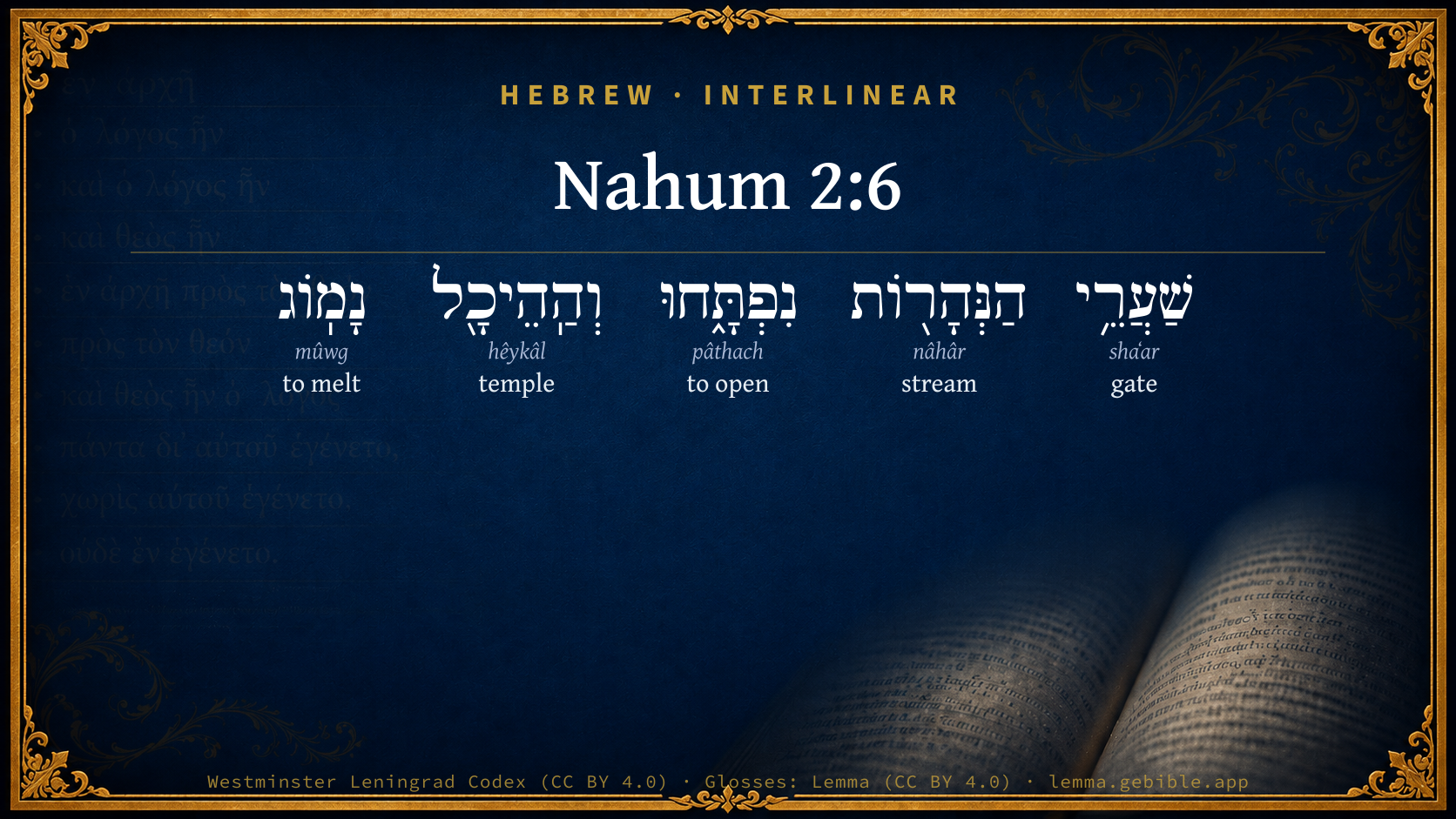
Nahum 2:6

Hebrew (Westminster Leningrad Codex) Nahum 2:6 appears in the Hebrew Old Testament. The text above is from the Westminster Leningrad Codex. Each word links to its Strong’s number, a concise gloss, and parsing drawn from the Open Scriptures Hebrew Bible morphology. Click any word for its full Brown-Driver-Briggs (BDB) entry.
Download image
Cite this verse

Nahum 2:6 (World English Bible). Public Domain. Lemma interlinear Bible study tool, https://lemma.gebible.app/v/nahum/2/6.

Show BibTeX & RIS
BibTeX
RIS
English Translation
The gates of the rivers are opened, and the palace is dissolved.
World English Bible · Public Domain
Download a study sheet

One document with this verse’s original text, its word-by-word gloss line, the meaning frame, cross-references with their text, attributed commentary, and full source and license credits — printable, and it pastes into notes with its structure intact.

This verse Autodidact and up

Study sheet (.html) Plain text (.txt)

A passage Seminary Student

Up to 50 verses in one chapter. A passage sheet keeps up to 6 commentary sources and 12 cross-references per verse, in the order this page ranks them, and says so on the sheet whenever that leaves anything out. Ask for a single verse and you get the Autodidact verse sheet above.

Everything on this page stays free to read, with no account — the sheet is a download of what is already on screen, not access to it.

Want to remove ads? Support Godless Engineer
Compare translations 3

The same verse in 3 English versions, stacked beneath the original-language interlinear above. Click any original word for its lexicon entry.

Each is an independent rendering of the whole verse — the interlinear is not word-aligned to these translations.

Highlighted words mark where these versions differ — a whole-verse word diff, not a word-by-word alignment.

  • World English Bible Public Domain
    The gates of the rivers are opened, and the palace is dissolved.
  • King James Version Public Domain
    The gates of the rivers shall be opened, and the palace shall be dissolved.
  • unfoldingWord Literal Text CC BY-SA 4.0
    The gates of the rivers have been opened, and the palace has melted away.

unfoldingWord Literal Text — © unfoldingWord, licensed CC BY-SA 4.0. Word-aligned USFM3 via Door43 (git.door43.org/unfoldingWord/en_ult).

Versions to compare (up to 4)

3 of 4 selected

Show all 18 translations

Every available English version of this verse, each an independent rendering of the whole verse.

  • World English Bible Public Domain
    The gates of the rivers are opened, and the palace is dissolved.
  • Berean Standard Bible Public Domain
    The river gates are thrown open and the palace collapses.
  • Majority Standard Bible Public Domain
    The river gates are thrown open and the palace collapses.
  • King James Version Public Domain
    The gates of the rivers shall be opened, and the palace shall be dissolved.
  • American Standard Version (1901) Public Domain
    The gates of the rivers are opened, and the palace is dissolved.
  • Revised Version (1885) Public Domain
    The gates of the rivers are opened, and the palace is dissolved.
  • Geneva Bible (1599) Public Domain
    The gates of the riuers shalbe opened, and the palace shall melt.
  • Douay-Rheims (1899) Public Domain
    The gates of the rivers are opened, and the temple is thrown down to the ground.
  • Young's Literal Translation Public Domain
    Gates of the rivers have been opened, And the palace is dissolved.
  • Literal Standard Version CC BY-SA 4.0
    Gates of the rivers have been opened, || And the palace is dissolved.
  • Unlocked Literal Bible CC BY-SA 4.0
    The gates at the rivers are forced open, and the palace falls to ruins.
  • unfoldingWord Literal Text CC BY-SA 4.0
    The gates of the rivers have been opened, and the palace has melted away.
  • Darby Bible Public Domain
    The gates of the rivers are opened, and the palace melteth away.
  • World Messianic Bible Public Domain
    The gates of the rivers are opened, and the palace is dissolved.
  • Webster's Bible Public Domain
    \\2:5\\He shall recount his worthies: they shall stumble in their walk; they shall make haste to the wall thereof, and the defense shall be prepared.
  • Free Bible Version CC BY-SA 4.0
    The river gates are opened; the palace washes away.
  • Bible in Basic English Public Domain
    He takes the record of his great men: they go falling on their way; they go quickly to the wall, the cover is made ready.
  • JPS Tanakh (1917) Public Domain
    (2-7) The gates of the rivers are opened, and the palace is dissolved.

Literal Standard Version (2020), Covenant Press — licensed CC BY-SA 4.0. Text via the HelloAO Bible API (eBible.org). Unlocked Literal Bible (unfoldingWord) — licensed CC BY-SA 4.0. Text via the HelloAO Bible API (eBible.org). unfoldingWord Literal Text — © unfoldingWord, licensed CC BY-SA 4.0. Word-aligned USFM3 via Door43 (git.door43.org/unfoldingWord/en_ult). Free Bible Version, Dr. Jonathan Gallagher — licensed CC BY-SA 4.0. Text via the HelloAO Bible API (eBible.org).

Word by word

More ways to search: Search by grammar → Find every occurrence → Compare this word →

Practice this passage: Drill this verse → Learn its vocabulary →

About this verse

These counts appear in no published source. They are computed here, from the morphology-tagged text and Lemma’s own curated glosses. What Lemma adds →

5
words
5
distinct lemmas
Prophets
section

Notable vocabulary

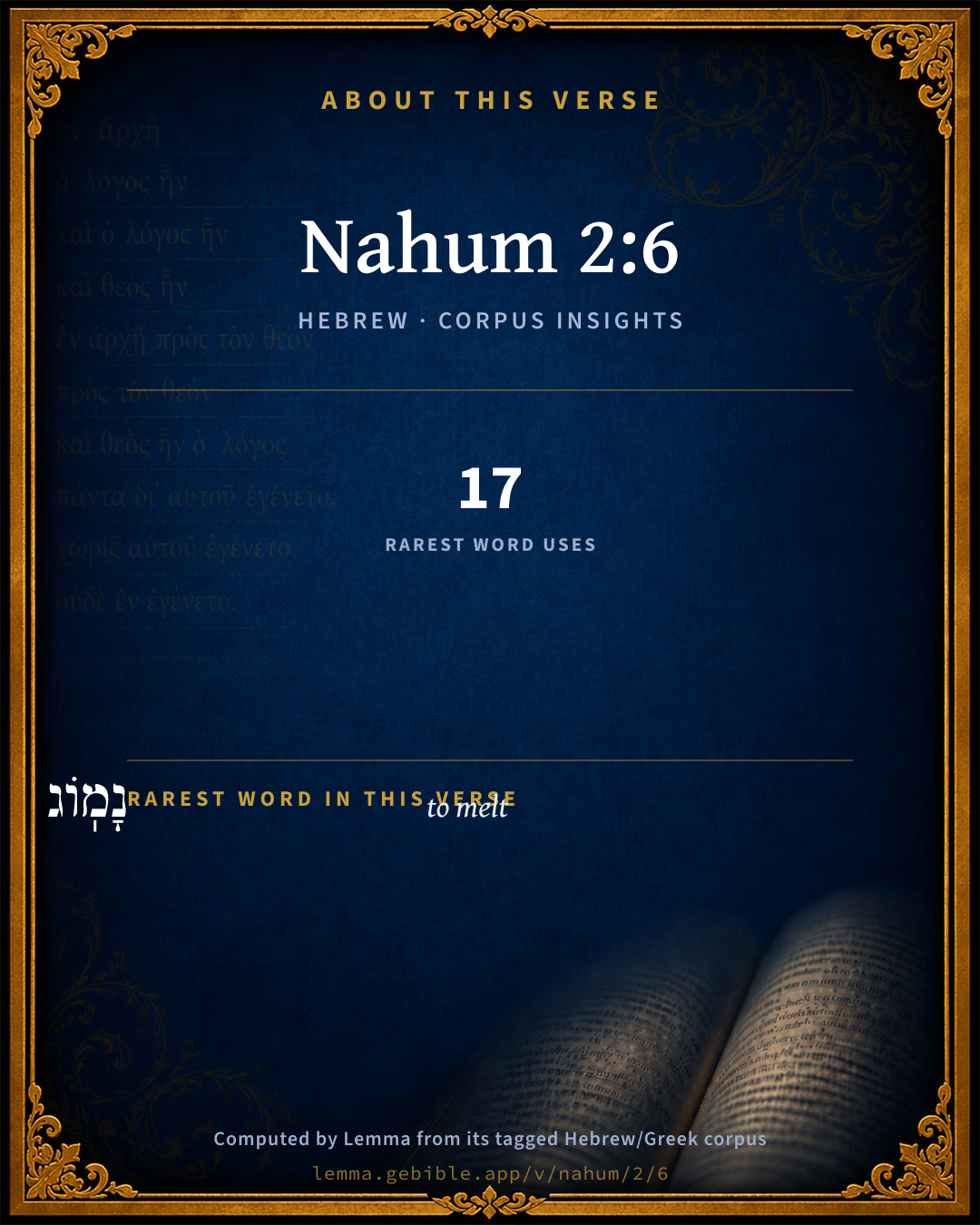
The rarest word here is נָמֽוֹג to melt H4127 — appearing just 17 times in the whole Hebrew Bible.

Shared distinctive vocabulary

נָמֽוֹג to melt H4127 occurs in 17 verses of the Hebrew Bible. Also found in:

Grammatical profile

  • 2 verbs
  • 3 nouns

Verb forms

  • נִפְתָּ֑חוּ Niphal · Perfect
  • נָמֽוֹג Niphal · Perfect

Hebrew & Septuagint length

In English translation the verse runs 12 words from the Hebrew and 15 from the Septuagint (LXX English) — closely comparable.

A rough comparison of the two English renderings, which tokenize alike — not a word-level alignment.

Word counts can differ between the Hebrew and the Greek without any difference in meaning — e.g. the Hebrew direct-object marker אֵת has no separate Greek word, and Greek often adds the article ὁ.

Cross-references

2

Topical passages linked to Nahum 2:6 in the Treasury of Scripture Knowledge — connected by theme and wording, ordered by reader-vote popularity; previews shown in the World English Bible.

  • Isaiah 45:1–2 Thus says Yahweh to his anointed, to Cyrus, whose right hand I have held, to subdue nations before him, and I will loose the loins of kings; to open the doors before him, and the gates shall not be shut:
  • 2 Peter 3:10–11 But the day of the Lord will come as a thief in the night; in which the heavens will pass away with a great noise, and the elements will be dissolved with fervent heat, and the earth and the works that are in it will be burned up.

Cross-references courtesy of OpenBible.info (CC BY 4.0).

Hebrew and Greek witnesses Masoretic Hebrew ↔ Greek Septuagint

The same verse in the two great witnesses to the Old Testament, shown verse-for-verse.

These are two independent witnesses, not word-aligned to each other, and the Septuagint is shown in lemma (dictionary) form.

Hebrew Nahum 2:6 Masoretic · Westminster Leningrad Codex

שַׁעֲרֵ֥י הַנְּהָר֖וֹת נִפְתָּ֑חוּ וְהַֽהֵיכָ֖ל נָמֽוֹג

The gates of the rivers are opened, and the palace is dissolved.

World English Bible · Public Domain

Greek LXX Nahum 2:6 Septuagint · lemma form

καί μιμνήσκω ὁ μεγιστάν αὐτός καί φεύγω ἡμέρα καί ἀσθενέω ἐν ὁ πορεία αὐτός καί σπεύδω ἐπί ὁ τεῖχος καί ἑτοιμάζω ὁ προφυλακή αὐτός

The gates of the cities have been opened, and the palaces have fallen into ruin,

LXX2012 (modern English Septuagint) · Public Domain

On this verse, Haydock's Catholic Bible Commentary discusses the Septuagint’s reading. Read the note in Commentary ↓

Hebrew: Westminster Leningrad Codex (CC BY 4.0). Greek: Septuagint (public domain); English from LXX2012 (modern English Septuagint) (Public Domain). How the Septuagint differs from the Hebrew →

Targum (Aramaic paraphrase)

1

The Targum is the ancient Jewish Aramaic paraphrase of the Hebrew Scriptures — an interpretive translation, not the Hebrew text itself. Onkelos (literal) and Pseudo-Jonathan (expansive) render the Torah, and Jonathan the Prophets. Coverage is partial: where no permissively-licensed English translation exists for a verse, only the Aramaic is shown. This is verse-level text, not a word-by-word alignment to the Hebrew.

  1. Targum Jonathan Prophets (Joshua–Malachi)
    יְמַנוּן רַבָּנֵי מַשִׁרְיָתְהוֹן יִתְקְלוּן בְּמַהֲכֵיהוֹן יוֹחוּן יִכְבְּשׁוּן שׁוּרָא יִבְנוּן מִגְדָלַיָא:

    (no public-domain English translation for this verse)

    Targum Jonathan — Aramaic: “Mikraot Gedolot” (public domain). English: “Sefaria Community Translation” (CC0 1.0 (public-domain dedication)); “London "Chaldee Paraphrase," 1871” (public domain). Text via Sefaria.

Commentary

Notes on Nahum 2:6 from classic Christian and Jewish commentators (each source and its license shown beneath its notes). The classic Christian expositions comment on the surrounding passage and are grouped to its opening verse, so a note may address several verses; the Jewish commentaries on the Tanakh (Rashi and others) are per-verse, so they appear only where the commentator wrote on this verse.

Lemma curates 59 commentaries, every one of them public domain or Creative Commons licensed, each selected and text-cleaned for this edition rather than reprinted as found. About our sources →

Trapp's Complete Commentary

John Trapp

Nah 2:6 The gates of the rivers shall be opened, and the palace shall be dissolved.

Ver. 6. The gates of the rivers shall be opened] Notwithstanding all afore mentioned endeavours to save the city, the water gates of those that stood near the river Tigris flew open either, by means of that inundation above mentioned, or by the enemies’ irruption, or the treachery of some that were within.

And the palace shall be dissolved] Or melted, haply by that inundation; howsoever by hostile impression: whether we understand it to be the palace royal or the idol temple, or both (the word will bear either), for it was not unusual for princes to have their houses near to the temples, as the kings of Judah had, Jer 22:14. The Trojans had their palladium in the tower; the Romans their temple of Jupiter Capitolinus in the capitol; Constantine the Great built the Lateran church in his Lateran palace; William Rufus, his Westminster hall near the minster.

John Trapp, A Commentary or Exposition upon All the Books of the Old and New Testament (1647–1656) — public domain. Text from a community e-Sword module.

Whedon's Commentary on the Bible

Daniel D. Whedon

Nah_2:6 continues the description of the attack; hence we would expect Nah_2:5 also to refer to actions of the attacking army; so Nowack and others. But, as the text reads now, unexpected as the transition may be, it is more natural to understand Nah_2:5 as describing the defensive measures taken by the king of Nineveh. As in Nah_2:4 the tense should be reproduced by the present.

Recount his worthies — Better, R.V., “remembereth his nobles.” “The Assyrian monarch, surprised in his careless carousing, arouses himself and calls on his nobles (Nah_3:18) to rush to the walls, to drive back the enemy already thundering at the gates.”

Stumble in their walk — As a result of debauchery or of the prolonged siege, which has exhausted their strength. Though the siege of Nineveh lasted about two years, the prophet condenses the long struggle in a few vivid pictures of the final attack. Weary and worn, as they are, they make all possible haste.

Defense shall be prepared — R.V., “the mantelet is prepared.” The meaning of the word translated “defense” or “mantelet” is uncertain. Hebrews sokhekh; literally, coverer. It is probably a technical military term; as such it may be applied to a body of soldiers ordered to cover or protect the city, or to a roof or some other arrangement that covers, and thus protects, soldiers. In this case the latter is more probable. “City walls were usually provided with turrets or battlements projecting forward over the walls, from which the besieged could observe the movements of the enemies at the foot, and hurl destructive missiles upon them.” Such coverings are prepared hastily by the defenders.

Those who interpret Nah_2:5, or at least 5b, as describing the offensive measures must give a different meaning to the term; they take it to denote a cover erected for the purpose of protecting the soldiers who attack the walls from the outside. “They (the defenders),” says Von Orelli, “reel to the wall, where the storming cover of the besiegers is already erected; and so the best chance of resistance is already lost.” Jeremias, on the other hand, has suggested that it may denote the “covering” attached to battering rams, which protects the soldiers directing the attack, and even the battering ram itself (compare Beitraege zur Assyriologie, iii, 1:101, 178ff.) If this suggestion is correct, the thought is that when the nobles reach the walls they discover that the enemy is already approaching with his battering machines. The interpretations of Von Orelli and of Jeremias Billerbeck give good sense, but, as the text stands now, the interpretation which takes the entire verse as a description of the defensive measures is to be preferred.

6. The defensive measures prove ineffective; the city is taken.

The gates of the rivers shall be [“are”] opened — The rivers are the Tigris, the Choser, and the canals supplied with water chiefly from these. Nineveh was located on the east side of the Tigris. It was surrounded by walls, and these were protected by moats. The city was cut into two parts by the river Choser, which emptied into the Tigris. The water supply for the moats as well as for general use came from these rivers, and from streams and canals that came from the hills in the northeast. The “gates of the rivers” are the points in the city walls where the streams or canals enter the city. With these gates would be connected sluices by which the flow of water might be regulated. The indiscriminate or malicious opening of the sluices would set the water free and cause the undermining of the walls and the inundation of the city. Some think, with less probability, that the reference is to the opening of the sluices of the moats, permitting the water to run out, and thus enabling the attacking army to cross the moats dry shod. If the latter were the thought the reference would be expected to precede the description of the attack upon the city wall itself, since the moats were some distance from the walls. The succeeding expression also favors the former interpretation.

The palace shall be [“is”] dissolved — Might be understood literally, since the buildings in whose erection sun-dried bricks were used would easily be dissolved by the overflowing water; but a more general interpretation is equally permissible: the inhabitants of the palace are overwhelmed by despair. The expression is suggested by the one preceding, “the gates of the rivers are opened.”

Nah_2:7 seems to picture a scene in the palace subsequent to the fall of the city, but certainty is impossible, since the text is in several places very obscure, as a comparison of A.V. with R.V. will readily show. R.V. reads, “And it is decreed: she is uncovered, she is carried away; and her handmaids moan as with the voice of doves, beating upon their breasts.” The first difficulty is in the Hebrew huzzabh, which A.V. takes as a proper noun, while R.V. translates it as a verb form, “it is decreed,” that is, by Jehovah. According to the Revisers, the rest of Nah_2:7 contains the substance of the decree. “She” they seem to interpret of Nineveh (8), personified as a queen; the “handmaids” are the inhabitants mourning over the fate of their city. It is very doubtful, however, that huzzabh can be translated “it is decreed”; and even if it could be thus translated, the statement of the decree in the midst of the description of the fall of the city sounds peculiar. The tone of the entire verse suggests that it is descriptive of the fate of the queen and of the mourning of her attendants. Therefore, from the earliest times, huzzabh has been interpreted as in some way denoting the queen, either as a proper name, or as an epithet descriptive of her. As a proper name it is not known otherwise; it might, perhaps, be a foreign name; as an epithet it is difficult of explanation in its present form. Kimchi connected it with the verb used in Psa_45:9, “at thy right hand doth stand the queen”; hence the queen might be called “the one standing”; but, aside from the peculiarity of such expression, the form of the verb used here would remain unexplained. Hitzig changes the vowel points and reads “the lizard,” and he suggests that this name is applied to the queen because she, like this “creature which takes refuge in holes,” has taken refuge in out-of-the-way places in the palace. Some, following the usage of the Arabic, suggest the meaning “litter” (Isa_66:20), and then “the lady carried in the litter,” that is, the queen. All these suggestions are ingenious but improbable. Others think that the noun “queen” has dropped out or that huzzabh is a corruption of that noun. The difficulty is still unsolved, but the probability is that the subject of the verbs in 7a is the queen.

Led away captive — Better, R.V., “uncovered,” or discovered, in the secret place where she sought to hide.

Brought up — R.V., “carried away,” into exile. A.V. is to be preferred; she is dragged up from her hiding place.

Lead her — Better, R.V., “moan.”

As with the voice of doves — The sighs and wails of mourners are often compared to the mourning of doves (Isa_59:11; Eze_7:16). The comparison is found also in Arabic and Assyrian; in the latter language the dove is called summatu, “she who mourns.”

Tabering — R.V., “beating.”

Upon their breasts — A common gesture of grief or despair among the Jews (Josephus, Antiquities, 16:7, 5; Luk_18:13; Luk_23:27).

Daniel D. Whedon (gen. ed.), Commentary on the Old and New Testaments (1874–1909) — public domain. Text from a community e-Sword module.

Tyndale Open Study Notes

Tyndale Open Resources

2:6 The rush to defend (2:5) comes too late; the defenses are already breached. • Nineveh was served by a reservoir formed by a double dam on the Khosr River, a tributary of the Tigris that flowed through the city. The reservoir was augmented by a series of flood gates. The Greek historian Diodorus reported that during this time torrential rains had already swelled the city’s river system. By first closing, then opening the flood gates, Nineveh’s attackers released the pent-up water as a battering ram against the city walls.

Tyndale Open Study Notes — © Tyndale Open Resources, licensed CC BY-SA 4.0. Text via the HelloAO Bible API.

Jamieson, Fausset & Brown

Robert Jamieson, A. R. Fausset & David Brown

The gates of the rivers . . . opened--The river wall on the Tigris (the west defense of Nineveh) was 4,530 yards long. On the north, south, and east sides, there were large moats, capable of being easily filled with water from the Khosru. Traces of dams ("gates," or sluices) for regulating the supply are still visible, so that the whole city could be surrounded with a water barrier (Nah 2:8). Besides, on the east, the weakest side, it was further protected by a lofty double rampart with a moat two hundred feet wide between its two parts, cut in the rocky ground. The moats or canals, flooded by the Ninevites before the siege to repel the foe, were made a dry bed to march into the city, by the foe turning the waters into a different channel: as Cyrus did in the siege of Babylon [MAURER]. In the earlier capture of Nineveh by Arbaces the Mede, and Belesis the Babylonian, DIODORUS SICULUS, [1.2.80], states that there was an old prophecy that it should not be taken till the river became its enemy; so in the third year of the siege, the river by a flood broke down the walls twenty furlongs, and the king thereupon burnt himself and his palace and all his concubines and wealth together, and the enemy entered by the breach in the wall. Fire and water were doubtless the means of the second destruction here foretold, as of the first.

dissolved--by the inundation [HENDERSON]. Or, those in the palace shall melt with fear, namely, the king and his nobles [GROTIUS].

Jamieson, Fausset & Brown — Commentary Critical and Explanatory on the Whole Bible (1871) — public domain (CC PDM 1.0). Text via the HelloAO Bible API.

Adam Clarke's Commentary

Verse 6. The gates of the rivers shall be opened] I have already referred to this, See Clarke on Na 1:8; but it will be necessary to be more particular. The account given by Diodorus Siculus, lib. ii., is very surprising. He begins thus: Ην δ' αυτῳ λογιον παραδεδομενον εκ προγονων, κ.τ.λ. - "There was a prophecy received from their forefathers, that Nineveh should not be taken till the river first became an enemy to the city. It happened in the third year of the siege, that the Euphrates [query, Tigris] being swollen with continued rains, overflowed part of the city, and threw down twenty stadia of the wall. The king then imagining that the oracle was accomplished, and that the river was now manifestly become an enemy to the city, casting aside all hope of safety, and lest he should fall into the hands of the enemy, built a large funeral pyre in the palace, (εντοιςβασιλειοις,) and having collected all his gold and silver and royal vestments, together with his concubines and eunuchs, placed himself with them in a little apartment built in the pyre; burnt them, himself, and the palace together. When the death of the king (Sardanapalus) was announced by certain deserters, the enemy entered in by the breach which the waters had made, and took the city."

Thus the prophecy of Nahum was literally fulfilled: "the gates of the river were opened, and the palace dissolved," i.e., burnt.

Adam Clarke's Commentary on the Bible (1810–1826) — public domain. Text from a community e-Sword/MySword module.

John Calvin's Commentaries

By the gates of the rivers the Prophet means that part of the city which was most fortified by the river Tigris; for the Tigris flowed close by the city. As then the Tigris was like the strongest defense, (for we know it to have been a most rapid river,) the Prophet ridicules the confidence of the Ninevites, who thought that the access of enemies could be wholly prevented in that part where the Tigris flowed. The gates then of the rivers are opened; that is, your river shall not prevent your enemies from breaking through and penetrating into your city.

We hence see, that the Prophet removes all the hindrances which might have seemed available to keep off enemies; and he did so, not so much for the sake of Nineveh as for the sake of his chosen people, that the Israelites and Jews might know, that that city was no less in the power of God than any other; for God can no less easily pass through rivers than go along the plain, where there is no obstacle. We now see why the Prophet says, that the gates of the rivers were opened: and then he adds, The palace is dissolved; that is, there will be no impediment to prevent the approach of enemies; for all the fortresses will melt away, and that of themselves, as though they were walls of paper, and the stones, as though they were water. He afterwards adds —

John Calvin's Commentaries (1540-1563) — public domain. Text from the Calvin Translation Society English edition (1840s-50s) via the Christian Classics Ethereal Library (ccel.org). Calvin's coverage is partial (roughly two-thirds of the Bible); uncommented books and verses are honest gaps, never fabricated. The 19th-century editor's footnotes and remarks are omitted so the notes are faithfully Calvin's own voice.

Ellicott's Commentary for English Readers

(6) The gates of the rivers.—This verse is one of great importance. The account of Ctesias, preserved by Diodorus Siculus, tells us that for over two years the immense thickness of the walls of Nineveh baffled the engineering skill of the besiegers; but that “in the third year it happened that by reason of a continual discharge of great storms, the Euphrates (sic) being swollen, both inundated a part of the city and overthrew the wall to the extent of twenty stadia.” The king saw in this the fulfilment of an oracle, which had declared that the city should fall when “the river became an enemy to the city.” Determined not to fall into the hands of his foes, he shut himself up with all his treasures in the royal citadel, which he then set on fire. We believe that this account, though inaccurate in detail, may be regarded as based on a substratum of historical fact. So gigantic were the fortifications of Nineveh, that of those on the east, where the city was most open to attack, Mr. Layard writes: “The remains still existing . . . almost confirm the statements of Diodorus Siculus that the walls were a hundred feet high, and that three chariots could drive upon them abreast” (Nineveh and Babylon, p. 660). Against ramparts such as these the most elaborate testudo of ancient times may well have been comparatively powerless. On the other hand, the force of a swollen river has often proved suddenly fatal to the strongest modern masonry. It would be specially destructive where, as in the case of Nineveh, the walls inundated were of sun-dried brick or “clay-bat.” Thus the fate of the city may well have been precipitated in accordance with the terse prediction of this verse. The “gates of the rivers” (i.e., the dams which fenced the Khausser, which ran through Nineveh, and the Tigris, which was outside it) are forced open by the swelling torrents, and lo, the fate of the city is sealed! ramparts against which the battering-ram might have plied in vain are sapped at the very foundation; palace walls are undermined, and literally “dissolve;” the besieger hastens to avail himself of the disaster, and (in the single word of Nah_2:7) it-is-decided. It is unnecessary to identify the “palace” which thus succumbs. Neither is it a reasonable objection that the palaces of Khorsabad and Kouyunjik, lying near the Khausser, bear the marks of fire, not water. If Nahum must have in mind some particular palace, it may be fairly argued that water is not such a demonstrative agency as the sister element; and that nothing would so effectively conceal the damage done by the inundation as the subsequent conflagrations effected by the victorious besieger. The verb nâmôg, “dissolved,” we thus take in its literal signification of the dissolution of a solid substance by the action of water; not as Dr. Pusey, figuratively, of the “dissolution of the empire itself.

A Bible Commentary for English Readers, edited by Charles John Ellicott (1878–1897) — public domain. Text from a community e-Sword module.

The Cambridge Bible for Schools and Colleges

gen. ed. J. J. S. Perowne

6. The gates … shall be opened] are opened. The city of Nineveh lay on the left or E. side of the Tigris. The city proper was of the form of an irregular parallelogram, stretching from N.W. to S.E., the broader end being on the N. This city proper was enclosed by walls protected by moats. It was only at the N.W. point that the city touched the Tigris, from which it gradually retreated to the S.E., leaving between it and the river a considerable space of territory, though an arm of the river again approached the city at the S.W. corner of the parallelogram. Billerbeck computes the length of the north wall at 2000 mètres (6561 feet), that of the south wall at 800 m., and the length of the east wall N. to S. at 5000 m., and conjectures that there was room in the city for 300,000 inhabitants. Through the city ran a mountain stream, the Choser, cutting the city into two parts and falling into the Tigris, and from this stream and other streams and canals from the hills on the N.E. was drawn the water that filled the moats as well as the water supply of the city, the Tigris being unsuited for drinking. Besides the walls of the city proper with their moats there were extensive outer defences. A wall ran along the east bank of the Tigris, and an immense rampart protected the city on the east side, between which and the city walls rose various kinds of fortifications. These outer walls were also protected by moats. The moats did not wash the walls, but were trenches at some distance from them, and the walls could only be approached by drying the moats or throwing dams across them. The “gates of the rivers” are not city gates situated on the rivers, but rather the points in the wall where the rivers or canals enter the city. Reference to a bab nari (river gate) occurs in an inscription of Sennacherib (Billerb. p. 126, note), which it is conjectured might be the point where a canal entered the city on the north-east, the course of which is now the road to Khorsabad. Such “gates” would be structures provided with sluices regulating the supply of water, and if these were opened the walls would be undermined or the city inundated. Others suggest that the “river-gates” may be the sluices of the moats. If these were opened, however, for the purpose of running the moats dry, this step should have come earlier in the prophet’s description. Whatever the opening of the river-gates means, it threw the palace into a panic and shewed that all was over. The precise conception of the prophet must remain somewhat uncertain. The attack on the city would not be made from the west nor from the Tigris, but from the north or north-east, the side of the hills.

palace shall be dissolved] is dissolved, i.e. the inmates are overwhelmed with terror and despair. Possibly the word “dissolved,” though not used literally was suggested by the previous words, “the river gates are opened.”

The Cambridge Bible for Schools and Colleges (gen. ed. J. J. S. Perowne; Cambridge University Press, 1878–1918) — public domain. Text from a community e-Sword module.

John Gill's Exposition

The gates of the rivers shall be opened,.... Of Diava and Adiava, or Lycus and Caprus, between which, according to some writers (i), Nineveh was situated; or the gates of the city, which lay nearest to the river Tigris, are meant; or that river itself, the plural for the singular, which overflowing, broke down the walls of the city for two and a half miles, and opened a way for the Medes and Chaldeans to enter in; of which see Nah 1:8,

and the palace shall be dissolved; by the inundation, or destroyed by the enemy; meaning the palace of the king, which might be situated near the river; or the temple of Nisroch the Assyrian deity, or Jupiter Belus; for the same word (k) signifies a temple as well as palace.

(i) Vid. Fuller. Miscel. Sacr. l. 3. c. 6. (k) "templum", V. L. Junius & Tremellius, Piscator, Drusius, Cocceius.

John Gill's Exposition of the Whole Bible (1746–1763) — public domain (CC PDM 1.0). Text via the HelloAO Bible API.

Albert Barnes' Notes on the Bible

The gates of the rivers shall be opened, and the palace shall be disolved - All gives way in an instant at the will of God; the strife is hushed; no more is said of war and death; there is no more resistance or bloodshed; no sound except the wailing of the captives, the flight of those who can escape, while the conquerors empty it of the spoil, and then she is left a waste. The swelling of the river and the opening made by it may have given rise to the traditional account of Ctesias, although obviously exaggerated as to the destruction of the wall. The exaggerated character of that tradition is not inconsistent with, it rather implies, a basis of truth. It is inconceivable that it should have been thought, that walls, of the thickness which Ctesias had described, were overthrown by the swelling of any river, unless some such event as Ctesias relates, that the siege was ended by an entrance afforded to the enemy through some bursting in of the river, had been true.

Nahum speaks nothing of the wall, but simply of the opening of “the gates of the river,” obviously the gates, by which the inhabitants could have access to the rivers , which otherwise would be useless to them except as a wall. These “rivers” correspond to the “rivers,” the artificial divisions of the Nile, by which No or Thebes was defended, or “the rivers of Babylon” Psa 137:1 which yet was washed by the one stream, the Euphrates. But Nineveh was surrounded and guarded by actual rivers, the Tigris and the Khausser, and, (assuming those larger dimensions of Nineveh, which are supported by evidences so various ) the greater Zab, which was “called the frantic Zab on account of the violence of its current.” “The Zab contained (says Ainsworth ), when we saw it, a larger body of water than the Tigris, whose tributaries are not supplied by so many snow-mountains as those of the Zab.” Of these, if the Tigris be now on a level lower than the rains of Nineveh, it may not have been so formerly.

The Khausser, in its natural direction, ran through Nineveh where, now as of old, it turns a mill, and must, of necessity, have been fenced by gates; else any invader might enter at will: as, in modern times, Mosul has its “gate of the bridge.” A break in these would obviously let in an enemy, and might the more paralyze the inhabitants, if they had any tradition, that the river alone could or would be their enemy, as Nahum himself prophesied. Subsequently inaccuracy or exaggeration might easily represent this to be an overthrow of the walls themselves. It was all one, in which way the breach was made.

The palace shall be dissolved - The prophet unites the beginning and the end. The river-gates were opened; what had been the fence against the enemy became an entrance for them: with the river, there poured in also the tide of the people of the enemy. The palace, then, the imperial abode, the center of the empire, embellished with the history of its triumphs, sank, was disolved , and ceased to be. It is not a physical loosening of the sun-dried bricks by the stream which would usually flow harmless by; but the dissolution of the empire itself. : “The temple, that is, his kingdom was destroyed.” The palaces both of Khorsabad and Kouyunjik lay near the Khausser and both bear the marks of fire .

Albert Barnes' Notes on the Bible (1834–1885) — public domain. Text from a community e-Sword/MySword module.

Haydock's Catholic Bible Commentary

Gates; floodgates or channel of the Tigris overflowing, chap. i. 8. --- Temple. Septuagint," palace."

George Leo Haydock (1774–1849), Haydock's Catholic Family Bible and Commentary, 1859 edition — public domain. Excludes Psalms (Douay-Rheims chapter numbering differs from Protestant) and Deuterocanonical books (Catholic canon only).

Matthew Poole's English Annotations

The gates of the rivers; of the city toward the river. Rivers, for river, or because of the greatness of Tigris, upon which Nineveh stood.

Shall be opened: it is reported by Diodorus Siculus, Biblioth. 1. 3. c. 7, that when the Chaldeans besieged Nineveh, a mighty deluge of waters overthrew the walls of Nineveh, by the space of twenty furlongs, or two miles and half, through which breach the besiegers made their entrance, so Nah 1:8. Usher Annal. ad A.M. 3257. The overrunning flood may be literally understood: here the prophet expressly declares how Nineveh shall be ruined.

The palace; either the royal stately palace of the Assyrian monarch; or the more stately temple of Nisroch, or Jupiter Belus, or some mighty bulwark raised there for defence.

Shall be dissolved, as if melted; it shall drop to pieces, and they that were in, whether servants of the court, or votaries to the idol, or soldiers for defence of the fort, shall in haste, with fear of the danger, flee away.

Matthew Poole's English Annotations on the Holy Bible (1683–1685) — public domain. Text from a community e-Sword/MySword module.

The Pulpit Commentary

All defence is vain. The prophet describes the last scene. The gates of the rivers shall be (are) opened. The simplest explanation of this much disputed clause is, according to Strauss and others, the following: The gates intended are those adjacent to the streams which encircled the city, and which were therefore the best defended and the hardest to capture. When these were carried, there was no way of escape for the besieged. But, as Rosenmuller remarks, it would have been an act of folly in the enemy to attack just that part of the city which was most strongly defended by nature and art. We are, therefore, induced to take "the gates of the rivers," not literally, but as a metaphorical expression (like "the windows of heaven," Gen_7:1 Ge 50 Isa_24:18) for an overwhelming flood, and to see in this a reference to the fact mentioned by Diod. Sic. (2:27), that the capture of Nineveh was owing to a great and unprecedented inundation, which destroyed a large portion of the fortifications, and laid the city open to the enemy. "At the northwest angle of Nineveh," says Professor Rawlinson, "there was a sluice or flood gate, intended mainly to keep the water of the Khosr-su, which ordinarily filled the city moat, from flowing off too rapidly into the Tigris, but probably intended also to keep back the water of the Tigris, when that stream rose above its common level. A sudden and great rise in the Tigris would necessarily endanger this gate, and if it gave way beneath the pressure, a vast torrent of water would rush up the moat along and against the northern wall, which may have been undermined by its force, and have fallen in" (Rawlinson, "Ancient Monarchies," 2. p. 397, edit. 1871). The suggestion that the course of its rivers was diverted, and that the enemy entered the town through the dried channels, has no historical basis. Dr. Pusey explains the term to mean the gates by which the inhabitants had access to the rivers. But these would be well guarded, and the open. ing of them would not involve the capture of the city, which the expression in the text seems to imply. The LXX gives, polewn dihnoicyhsan , "The gates of the cities were opened." The palace shall be (is) dissolved; or, melteth away. Some take this to signify that the hearts of the in. habitants melt with fear, or the royal power vanishes in terror. That the clause is to be taken literally, to denote the destruction of the royal palace by the action of the waters, seems to be negatived by the fact that the Assyrian palaces were built on artificial mounds of some thirty or forty feet in elevation, composed of sun-dried bricks united into a solid mass, and were thus secured from the effects of an inundation (see Bosoms, "Nineveh and its Discoveries," p. 129, etc.). There is evidence, too, that fire played a great part in the destruction of the temples and palaces. (see note on Nah_3:13)

The Pulpit Commentary (1880–1919), ed. H.D.M. Spence-Jones & Joseph S. Exell — public domain. Text from a community e-Sword module.

John Wesley's Explanatory Notes

The gates - Of the city toward the river. The rivers - Of the Tigris, upon which Nineveh stood. Dissolved - While the Chaldeans besieged Nineveh, a mighty deluge overthrew the walls of Nineveh, by the space of twenty furlongs, through which breach the besiegers made their entrance. Dissolved - As if melted, it shall drop to pieces.

John Wesley, Explanatory Notes Upon the Whole Bible (1754–1765) — public domain. Text via the GEBible commentary corpus.

unfoldingWord translationNotes

Door43 World Missions Community

The gates at the rivers are forced open

This can be stated in active form. AT: "The enemy forces open the gates at the rivers" (See: Active or Passive)

The gates at the rivers

This refers to the gates that controlled the flow and direction of the river.

Huzzab is stripped of her clothes and is taken away

This can be stated in active form. AT: "The enemy strips Huzzab of her clothes and takes her away" (See: Active or Passive)

Huzzab is stripped of her clothes and is taken away

The exact meaning of the word "Huzzab" is uncertain. Two possible meanings are 1) it is the name of a queen in Nineveh and the sentence means that the attacking soldiers have stripped her of her clothes in order to humiliate her and then have carried her off into captivity or 2) it is the name of an idol and the sentence means that the attackers have stripped the gold and silver off the idol and have carried it away. (See: Translate Unknowns and Assumed Knowledge and Implicit Information)

her female servants moan like doves

The moaning sounds that the female servants make sound like the sounds that doves make.

her female servants

If the word "Huzzab" refers to a queen, then this phrase refers to the young women who attended her. If the word "Huzzab" refers to an idol, then this phrase refers to the young women who worked as temple prostitutes.

beating on their breasts

Beating one's breast was a gesture used to express great mourning. (See: Symbolic Action)

translationWords

gate

ruin

queen

servant

dove

unfoldingWord translationNotes — © Distant Shores Media and the Door43 World Missions Community, licensed CC BY-SA 4.0. Source: git.door43.org/Door43/en_tn.

Rashi

Rabbi Shlomo Yitzchaki (Rashi)

He shall remember—The king of Assyria shall remember his mighty men and his heroes, and he shall contemplate going forth and waging war, but [he and his men] shall stumble in their walk.

they shall hasten to its wall—to flee to run to the wall of the city. Any word requiring a “lammed” in its beginning has a “hey” at its end.

and the protector is armed Heb. הַסֹּכֵךְ. Jonathan renders: They shall build towers. We can also explain וְהֻכַן הַסֹּכֵךְ: and the king shall be armed with his weapons, as in (Ezek.28:14) “who shelters over a great distance (מִמְשַׁח הַסֹּכֵךְ),” an expression of ruling.

Rashi on the Tanakh — English translations: “The Judaica Press complete Tanach with Rashi, translated by A. J. Rosenberg” (CC BY 4.0); “Pentateuch with Rashi's commentary by M. Rosenbaum and A.M. Silbermann, 1929-1934” (public domain); “The Metsudah Tanach series, Lakewood, N.J” (CC BY 4.0); and “The Book of Joshua, Metsudah Publications, 1997” (CC BY 4.0). Text via Sefaria.

Lesson kit

Teaching starters — assembled from the data on this page, not authored interpretation. Every prompt links to the verse data it draws on. Edit before teaching.

Nahum, in the Prophets, opens this verse with 5 words (5 distinct Hebrew lemmas). Its most distinctive word is mûwg (“to melt”). A historical commentator’s framing appears above. Read the whole chapter for the surrounding context.

Discussion questions

  1. What does “to melt” (mûwg) contribute to the verse as a whole?
  2. How does Exodus 15:15, which shares the word «to melt», read alongside this verse?
  3. These translations render this verse differently; the difference is in the English rendering, not the original. What questions does that raise?
  4. «נִפְתָּ֑חוּ» is a Niphal Perfect verb. How does that grammatical form shape the action described?
  5. Compare how Trapp's Complete Commentary and Whedon's Commentary on the Bible read this verse. Where do they agree or differ?

Things to notice

Reading settings

Reading text

Shown beneath each verse's original-language words.

Old Testament
Old Testament edition

Read the OT as the Masoretic Hebrew (MT) or the Greek Septuagint (LXX).

English shown for the Greek Septuagint (in the Hebrew ↔ Greek comparison).

Comparing translations? Open the Compare panel on any verse page to stack up to four side by side.