
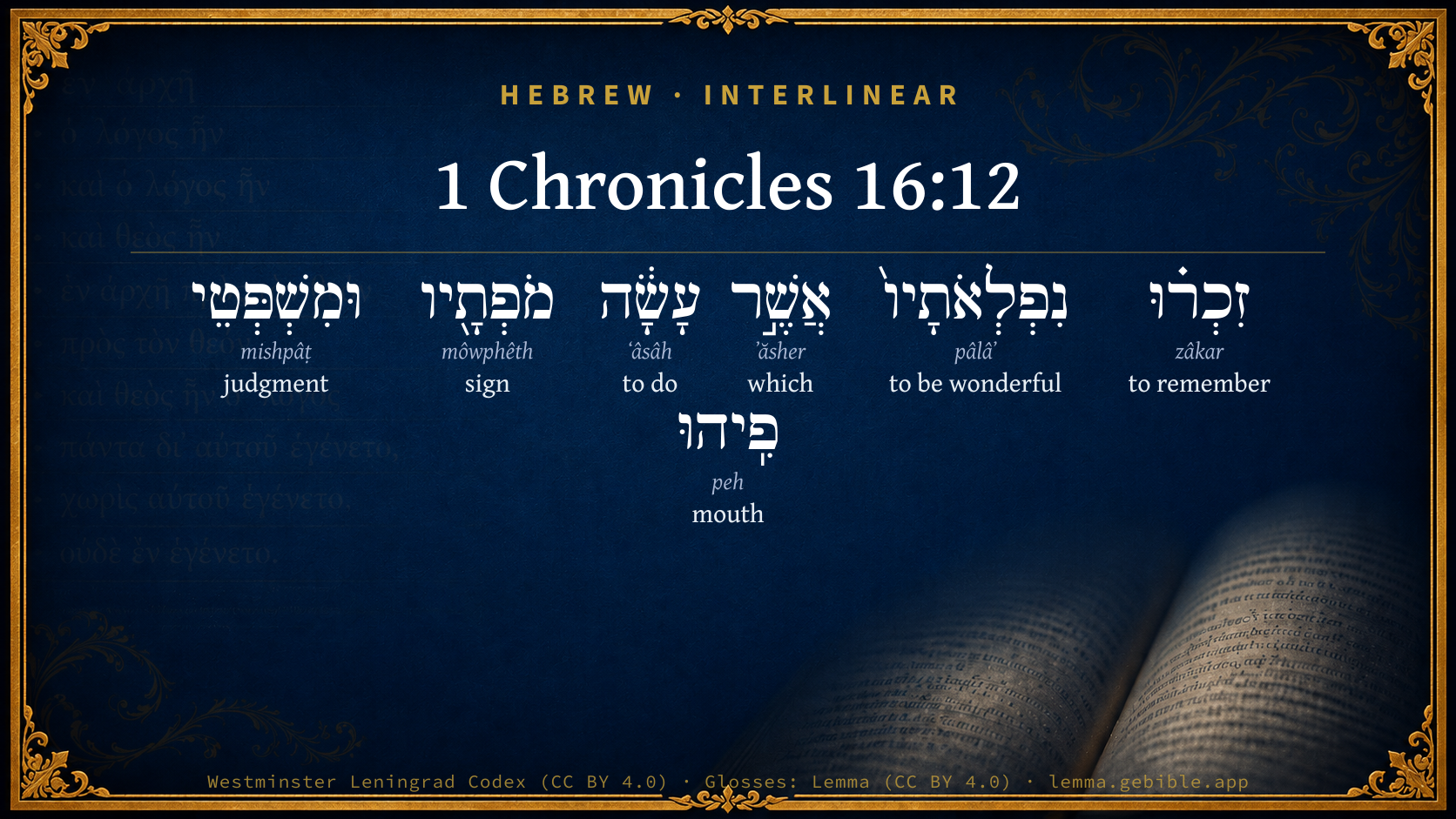
1 Chronicles 16:12

Hebrew (Westminster Leningrad Codex) 1 Chronicles 16:12 appears in the Hebrew Old Testament. The text above is from the Westminster Leningrad Codex. Each word links to its Strong’s number, a concise gloss, and parsing drawn from the Open Scriptures Hebrew Bible morphology. Click any word for its full Brown-Driver-Briggs (BDB) entry.
Download image
Cite this verse

1 Chronicles 16:12 (World English Bible). Public Domain. Lemma interlinear Bible study tool, https://lemma.gebible.app/v/1-chronicles/16/12.

Show BibTeX & RIS
BibTeX
RIS
English Translation
Remember his marvelous works that he has done, His wonders, and the judgments of his mouth,
World English Bible · Public Domain
Download a study sheet

One document with this verse’s original text, its word-by-word gloss line, the meaning frame, cross-references with their text, attributed commentary, and full source and license credits — printable, and it pastes into notes with its structure intact.

This verse Autodidact and up

Study sheet (.html) Plain text (.txt)

A passage Seminary Student

Up to 50 verses in one chapter. A passage sheet keeps up to 6 commentary sources and 12 cross-references per verse, in the order this page ranks them, and says so on the sheet whenever that leaves anything out. Ask for a single verse and you get the Autodidact verse sheet above.

Everything on this page stays free to read, with no account — the sheet is a download of what is already on screen, not access to it.

Want to remove ads? Support Godless Engineer
Compare translations 3

The same verse in 3 English versions, stacked beneath the original-language interlinear above. Click any original word for its lexicon entry.

Each is an independent rendering of the whole verse — the interlinear is not word-aligned to these translations.

Highlighted words mark where these versions differ — a whole-verse word diff, not a word-by-word alignment.

  • World English Bible Public Domain
    Remember his marvelous works that he has done, His wonders, and the judgments of his mouth,
  • King James Version Public Domain
    Remember his marvelous works that he hath done, his wonders, and the judgments of his mouth;
  • unfoldingWord Literal Text CC BY-SA 4.0
    Remember his wonderful doings that he has done, his miracles and the judgments of his mouth,

unfoldingWord Literal Text — © unfoldingWord, licensed CC BY-SA 4.0. Word-aligned USFM3 via Door43 (git.door43.org/unfoldingWord/en_ult).

Versions to compare (up to 4)

3 of 4 selected

Show all 18 translations

Every available English version of this verse, each an independent rendering of the whole verse.

  • World English Bible Public Domain
    Remember his marvelous works that he has done, His wonders, and the judgments of his mouth,
  • Berean Standard Bible Public Domain
    Remember the wonders He has done, His marvels, and the judgments He has pronounced,
  • Majority Standard Bible Public Domain
    Remember the wonders He has done, His marvels, and the judgments He has pronounced,
  • King James Version Public Domain
    Remember his marvelous works that he hath done, his wonders, and the judgments of his mouth;
  • American Standard Version (1901) Public Domain
    Remember his marvellous works that he hath done, His wonders, and the judgments of his mouth,
  • Revised Version (1885) Public Domain
    Remember his marvelous works that he hath done; his wonders, and the judgments of his mouth;
  • Geneva Bible (1599) Public Domain
    Remember his marueilous workes that he hath done, his wonders, and the iudgements of his mouth,
  • Douay-Rheims (1899) Public Domain
    Remember his wonderful works, which he hath done: his signs, and the judgments of his mouth.
  • Young's Literal Translation Public Domain
    Remember His wonders that He did, His signs, and the judgments of His mouth,
  • Literal Standard Version CC BY-SA 4.0
    Remember His wonders that He did, || His signs, and the judgments of His mouth,
  • Unlocked Literal Bible CC BY-SA 4.0
    Recall the marvelous things he has done, his miracles and the decrees from his mouth,
  • unfoldingWord Literal Text CC BY-SA 4.0
    Remember his wonderful doings that he has done, his miracles and the judgments of his mouth,
  • Darby Bible Public Domain
    Remember his wondrous works which he hath done; His miracles, and the judgments of his mouth:
  • World Messianic Bible Public Domain
    Remember his marvelous works that he has done, his wonders, and the judgments of his mouth,
  • Webster's Bible Public Domain
    Remember his wonderful works that he hath done, his wonders, and the judgments of his mouth;
  • Free Bible Version CC BY-SA 4.0
    Remember all the wonderful things he's done, the miracles he's performed, and the judgments he's carried out,
  • Bible in Basic English Public Domain
    Keep in mind the great works which he has done; his wonders, and the decisions of his mouth;
  • JPS Tanakh (1917) Public Domain
    Remember His marvellous works that He hath done, His wonders, and the judgments of His mouth;

Literal Standard Version (2020), Covenant Press — licensed CC BY-SA 4.0. Text via the HelloAO Bible API (eBible.org). Unlocked Literal Bible (unfoldingWord) — licensed CC BY-SA 4.0. Text via the HelloAO Bible API (eBible.org). unfoldingWord Literal Text — © unfoldingWord, licensed CC BY-SA 4.0. Word-aligned USFM3 via Door43 (git.door43.org/unfoldingWord/en_ult). Free Bible Version, Dr. Jonathan Gallagher — licensed CC BY-SA 4.0. Text via the HelloAO Bible API (eBible.org).

Word by word

More ways to search: Search by grammar → Find every occurrence → Compare this word →

Practice this passage: Drill this verse → Learn its vocabulary →

About this verse

These counts appear in no published source. They are computed here, from the morphology-tagged text and Lemma’s own curated glosses. What Lemma adds →

7
words
7
distinct lemmas
Historical
section

Shared distinctive vocabulary

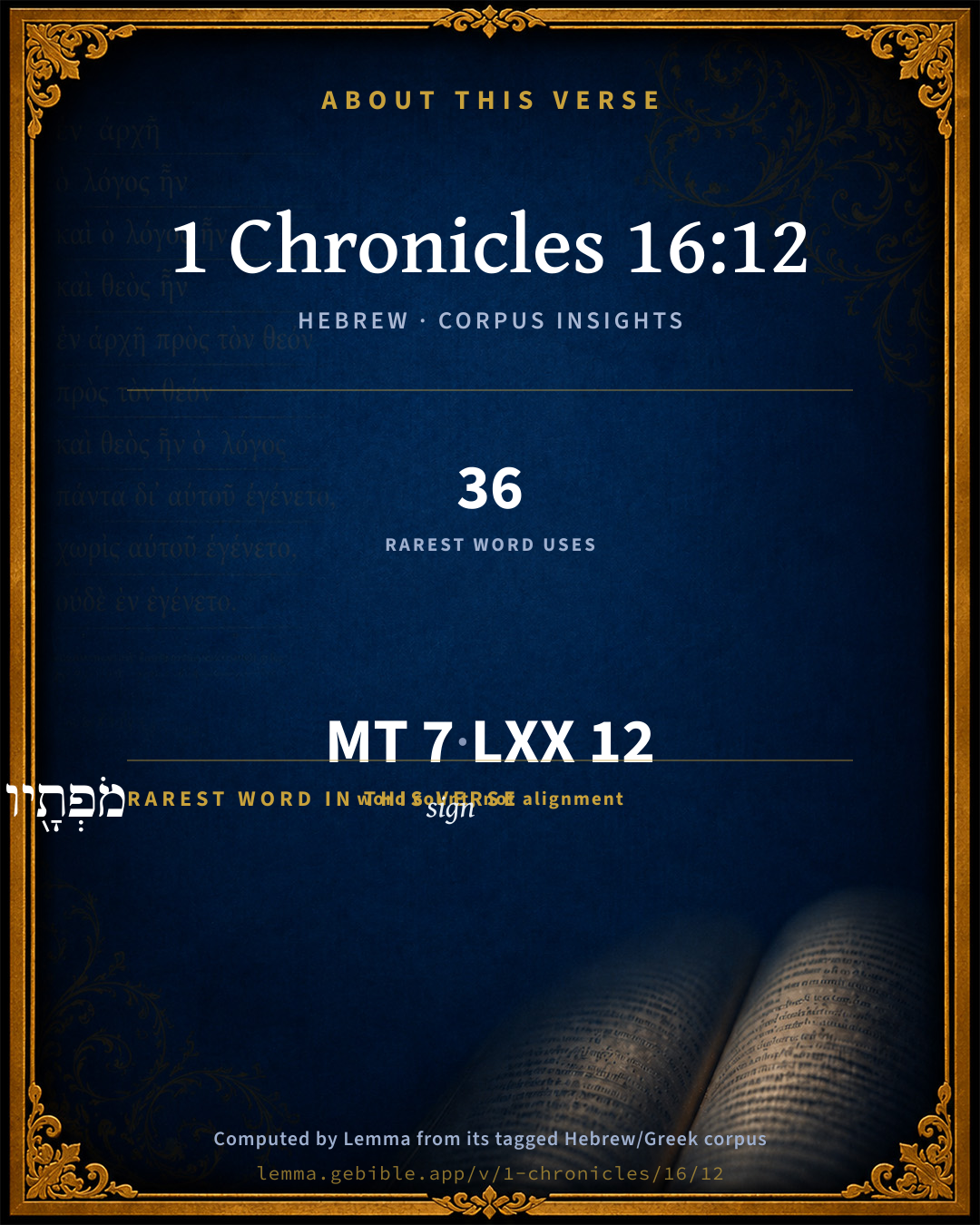
מֹפְתָ֖יו sign H4159 occurs in 35 verses of the Hebrew Bible. Also found in:

Grammatical profile

  • 3 verbs
  • 3 nouns
  • 1 particle

Verb forms

  • זִכְר֗וּ Qal · Imperative
  • נִפְלְאֹתָיו֙ Niphal · Participle Active
  • עָשָׂ֔ה Qal · Perfect

Hebrew & Septuagint length

In English translation the verse runs 16 words from the Hebrew and 16 from the Septuagint (LXX English) — the same length.

A rough comparison of the two English renderings, which tokenize alike — not a word-level alignment.

Word counts can differ between the Hebrew and the Greek without any difference in meaning — e.g. the Hebrew direct-object marker אֵת has no separate Greek word, and Greek often adds the article ὁ.

In the original languages it is 7 Hebrew tokens and 12 Greek tokens — but the two are counted differently (Hebrew bundles its prefixes and suffixes into one token; the Greek is in lemma form), so that isn’t a like-for-like length.

Cross-references

13

Topical passages linked to 1 Chronicles 16:12 in the Treasury of Scripture Knowledge — connected by theme and wording, ordered by reader-vote popularity; previews shown in the World English Bible.

  • Psalms 111:4 He has caused his wonderful works to be remembered. Yahweh is gracious and merciful.
  • Psalms 103:2 Praise Yahweh, my soul, And don't forget all his benefits;
  • Psalms 119:20 My soul is consumed with longing for your ordinances at all times.
  • Psalms 119:75 Yahweh, I know that your judgments are righteous, That in faithfulness you have afflicted me.
  • Psalms 119:137 You are righteous, Yahweh. Your judgments are upright.
  • Romans 11:33 Oh the depth of the riches both of the wisdom and the knowledge of God! How unsearchable are his judgments, and his ways past tracing out!
  • 1 Chronicles 16:8–9 Oh give thanks to Yahweh, call on his name; Make known his doings among the peoples.
  • Psalms 19:9 The fear of Yahweh is clean, enduring forever. Yahweh's ordinances are true, and righteous altogether.
  • Psalms 77:11 I will remember Yah's deeds; For I will remember your wonders of old.
  • Psalms 78:43 How he set his signs in Egypt, His wonders in the field of Zoan,
  • Psalms 119:13 With my lips, I have declared all the ordinances of your mouth.
  • Revelation 16:7 I heard the altar saying, "Yes, Lord God, the Almighty, true and righteous are your judgments."
  • Revelation 19:2 for true and righteous are his judgments. For he has judged the great prostitute, who corrupted the earth with her sexual immorality, and he has avenged the blood of his servants at her hand."

Cross-references courtesy of OpenBible.info (CC BY 4.0).

Hebrew and Greek witnesses Masoretic Hebrew ↔ Greek Septuagint

The same verse in the two great witnesses to the Old Testament, shown verse-for-verse.

These are two independent witnesses, not word-aligned to each other, and the Septuagint is shown in lemma (dictionary) form.

Hebrew 1 Chronicles 16:12 Masoretic · Westminster Leningrad Codex

זִכְר֗וּ נִפְלְאֹתָיו֙ אֲשֶׁ֣ר עָשָׂ֔ה מֹפְתָ֖יו וּמִשְׁפְּטֵי פִֽיהוּ

Remember his marvelous works that he has done, His wonders, and the judgments of his mouth,

World English Bible · Public Domain

Greek LXX 1 Chronicles 16:12 Septuagint · lemma form

μνημονεύω ὁ θαυμάσιος αὐτός ὅς ποιέω τέρας καί κρίμα ὁ στόμα αὐτός

Remember his wonderful works which he has wrought, his wonders, and the judgments of his mouth;

LXX2012 (modern English Septuagint) · Public Domain

Hebrew: Westminster Leningrad Codex (CC BY 4.0). Greek: Septuagint (public domain); English from LXX2012 (modern English Septuagint) (Public Domain). How the Septuagint differs from the Hebrew →

Commentary

Notes on 1 Chronicles 16:12 from classic Christian and Jewish commentators (each source and its license shown beneath its notes). The classic Christian expositions comment on the surrounding passage and are grouped to its opening verse, so a note may address several verses; the Jewish commentaries on the Tanakh (Rashi and others) are per-verse, so they appear only where the commentator wrote on this verse.

Lemma curates 59 commentaries, every one of them public domain or Creative Commons licensed, each selected and text-cleaned for this edition rather than reprinted as found. About our sources →

Geneva Bible (1599)

Geneva Bible translators

In overcoming Pharaoh, which judgments were declared by God’s mouth to Moses.

Geneva Bible (1599) marginal notes — public domain. Text via Bolls.life.

Adam Clarke's Commentary

Verse 12. Remember his marvellous works] The whole of the psalm refers to God's wondrous actions among the nations in behalf of Israel.

Adam Clarke's Commentary on the Bible (1810–1826) — public domain. Text from a community e-Sword/MySword module.

Ellicott's Commentary for English Readers

(12) The second strophe of Psalms 105

Marvellous works.—Wonders, as in 1Ch_16:9.

His wonders.—His portents; τέρατα of the New Testament.

The judgments of his mouth.—His judicial utterances, which execute themselves. (Comp. Gen_1:3; Exo_12:12.)

Of his mouth.—Psa_105:5 has a different form of the pronoun.

A Bible Commentary for English Readers, edited by Charles John Ellicott (1878–1897) — public domain. Text from a community e-Sword module.

The Cambridge Bible for Schools and Colleges

gen. ed. J. J. S. Perowne

12. his wonders] i.e. the plagues of Egypt; Psa_105:27-36.

of his mouth] Deu_4:33; Deu_4:36.

The Cambridge Bible for Schools and Colleges (gen. ed. J. J. S. Perowne; Cambridge University Press, 1878–1918) — public domain. Text from a community e-Sword module.

The Pulpit Commentary

Vers. 12-14.

The contents of a godly memory.

Remember, recall the records of Divine dealings; set afresh before your minds your own personal experiences of the Divine goodness and mercy." The conception of the "solidarity of the race" is matched by that of the essential unity of the race, in its mental and spiritual experiences, throughout all the ages. Really to know God"s dealings with any one people is to know his dealings with all peoples. And therefore the story of his relations with the Jews is so minutely recorded, and so graciously preserved for us on whom the "ends of the world are come." And yet, further, it may be shown that an individual experience really affords the race-type. God is essentially to each what he is to all. We too often fix our attention on the changeable accidents of a man"s career, and then think that his experience is unique. If it were so it were of little use to keep any record of the Divine dealings with men, for one man"s experience could not help another. What then, are the usual contents of the godly memory? We can only deal with such as are suggested by the terms of the verses before us.

I IT HOLDS ITS OWN PERSONAL MEMORIES OF GOD"S GOODNESS. Not merely has the godly man a general belief in God and God"s merciful ways, but he has the assurance that God has been merciful to him. He can see in page after page of his life"s story how guidance, restraint, comfort, teaching, and strength have come in precise adaptations to his own conditions and needs. He can speak of the "good hand of his God which has ever been upon him for good." The importance of fixing the memory of God"s dealings by pious attention to them at the time, and by frequent review of them afterwards, should be pointed out. A richly stored memory becomes an unfailing well-spring of comfort in later life. To our view all our past should be dotted over with pillars we have raised, on which we have inscribed our "Ebenezer the Lord hath helped us;" and at any time we should be able to look back and bid these pillars remind us of the "wonderful works that he hath done.

II IT HOLDS THE RACE-MEMORIALS OF GOD"S GOODNESS. Scripture tells us of God"s dealings with men, both before he separated the Jewish people and while he had them under his special leadings. The God of the whole earth shall he be called." It is characteristic of David"s psalms that they are full of large broad thoughts of God"s relations to the whole world. And both Scripture and secular history should provide us with stores for the memory, as they reveal God"s workings towards his gracious ends of substantial and eternal good. If Israel may say, "He is the Lord our God," it must go on to say, "His judgments are in all the earth.

III IT HOLDS THE COVENANT PEOPLE"S MEMORIALS OF GOD"S GOODNESS. This is the. peculiar treasure of the godly. We have the Bible records of the covenant race God"s peculiar people, whom he had chosen for himself. Show what a large portion of the good man"s memory is taken up with the Scripture story of Israel. God"s ways with his covenant people are to us the model and example of all his dealings, and upon these we argue what he is and will be in his ways with us. But they are wonderful ways, marvellous works; often mysterious, often severe; ways of judgment as well as mercy.

Impress that the use of due occasions for considering the contents of the memory, for refreshing the memory, and for making new grounds of praise and trust, is a most important, but often neglected, part of Christian duty, bearing direct relation to Christian strength and joy. R.T.

The Pulpit Commentary (1880–1919), ed. H.D.M. Spence-Jones & Joseph S. Exell — public domain. Text from a community e-Sword module.

unfoldingWord translationNotes

Door43 World Missions Community

Recall the marvelous things

"Remember the marvelous things"

his miracles and

The understood verb may be supplied. AT: "remember his miracles and" (See: Ellipsis)

decrees from his mouth

Here "mouth" refers to the things that Yahweh spoke. AT: "decrees that he has spoken" (See: Metonymy)

you descendants of Israel his servant, you people of Jacob, his chosen ones

These phrases share similar meanings and are used for emphasis. (See: Parallelism)

His decrees are on all the earth

Here "all the earth" refers to all the people of the earth. AT: "His laws are for all the people of the earth" (See: Metonymy)

translationWords

miracle

decree

descend

Israel

servant

people group

Jacob

chosen one

Yahweh

God

earth

unfoldingWord translationNotes — © Distant Shores Media and the Door43 World Missions Community, licensed CC BY-SA 4.0. Source: git.door43.org/Door43/en_tn.

Rashi

Rabbi Shlomo Yitzchaki (Rashi)

Remember His wonders the plague of the mice, and they took milch cows and shut up their young in the house, and the cows went straight (I Sam. 6:10-12), and they did not turn back, and the breach of Uzza. The entire song was composed concerning the Ark, and they would say it for the daily sacrifice in the morning, and “Sing to the Lord,” for the daily sacrifice in the afternoon (Seder Olam ch. 14). And to whom do I say that they should remember the wonders of the One Who is perfect in knowledge?

Rashi on the Tanakh — English translations: “The Judaica Press complete Tanach with Rashi, translated by A. J. Rosenberg” (CC BY 4.0); “Pentateuch with Rashi's commentary by M. Rosenbaum and A.M. Silbermann, 1929-1934” (public domain); “The Metsudah Tanach series, Lakewood, N.J” (CC BY 4.0); and “The Book of Joshua, Metsudah Publications, 1997” (CC BY 4.0). Text via Sefaria.

Lesson kit

Teaching starters — assembled from the data on this page, not authored interpretation. Every prompt links to the verse data it draws on. Edit before teaching.

1 Chronicles, in the Historical, opens this verse with 7 words (7 distinct Hebrew lemmas). Its most distinctive word is môwphêth (“sign”). A historical commentator’s framing appears above. Read the whole chapter for the surrounding context.

Discussion questions

  1. The word môwphêth carries the sense “sign.” How does it shape the verse?
  2. How does Exodus 4:21, which shares the word «sign», read alongside this verse?
  3. The translations on this page render this verse differently — a whole-verse word diff, not a word-by-word alignment. What might account for the different wordings?
  4. «זִכְר֗וּ» is a Qal Imperative verb. How does that grammatical form shape the action described?
  5. Compare how Geneva Bible (1599) and Adam Clarke's Commentary read this verse. Where do they agree or differ?

Things to notice

Reading settings

Reading text

Shown beneath each verse's original-language words.

Old Testament
Old Testament edition

Read the OT as the Masoretic Hebrew (MT) or the Greek Septuagint (LXX).

English shown for the Greek Septuagint (in the Hebrew ↔ Greek comparison).

Comparing translations? Open the Compare panel on any verse page to stack up to four side by side.