Psalms 87:4

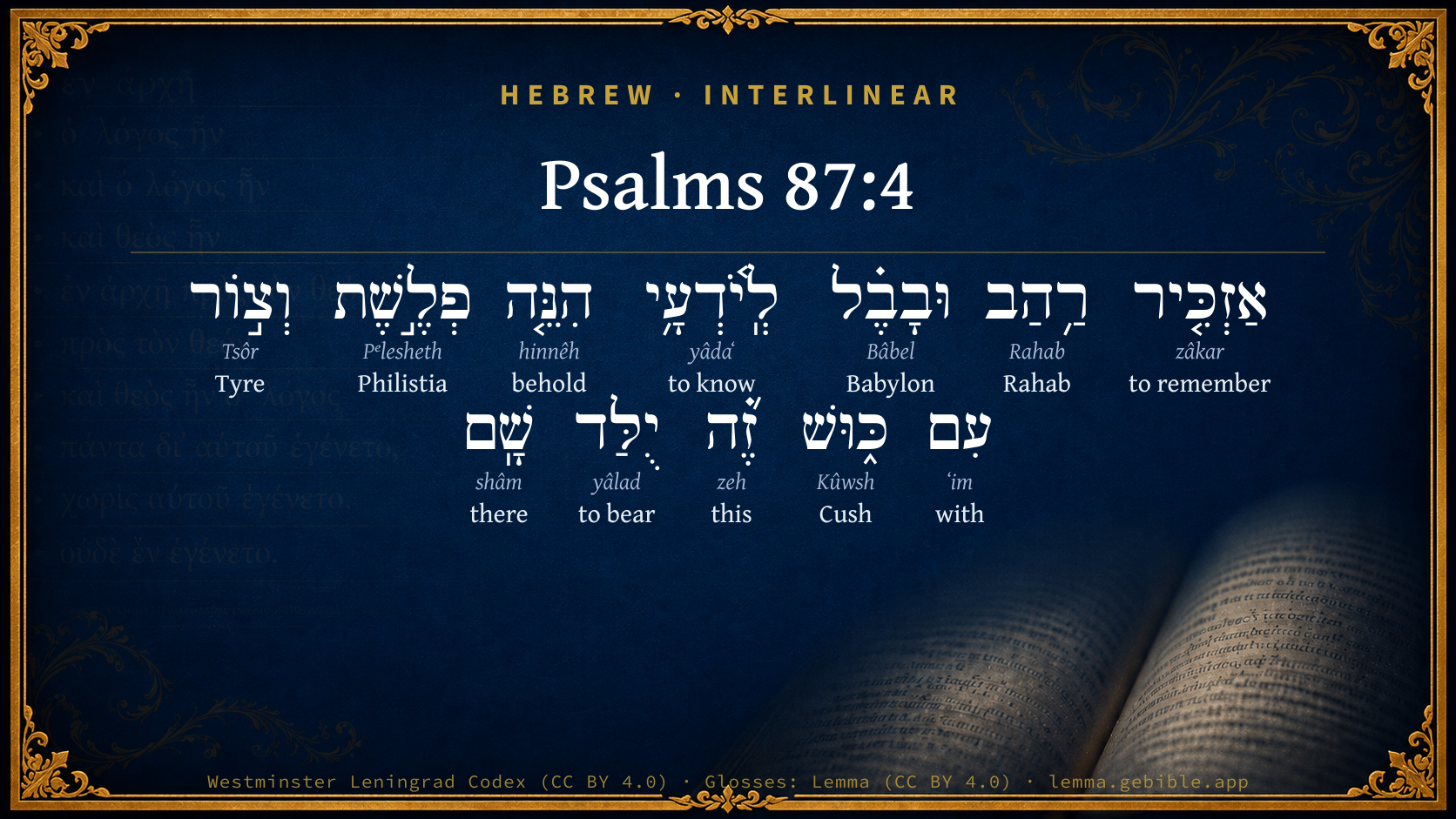
Hebrew (Westminster Leningrad Codex) Psalms 87:4 appears in the Hebrew Old Testament. The text above is from the Westminster Leningrad Codex. Each word links to its Strong’s number, a concise gloss, and parsing drawn from the Open Scriptures Hebrew Bible morphology. Click any word for its full Brown-Driver-Briggs (BDB) entry.
Download image
Cite this verse

Psalms 87:4 (World English Bible). Public Domain. Lemma interlinear Bible study tool, https://lemma.gebible.app/v/psalms/87/4.

Show BibTeX & RIS
BibTeX
RIS
English Translation
I will record Rahab and Babylon among those who acknowledge me. Behold, Philistia, Tyre, and also Ethiopia: "This one was born there."
World English Bible · Public Domain
Highlights
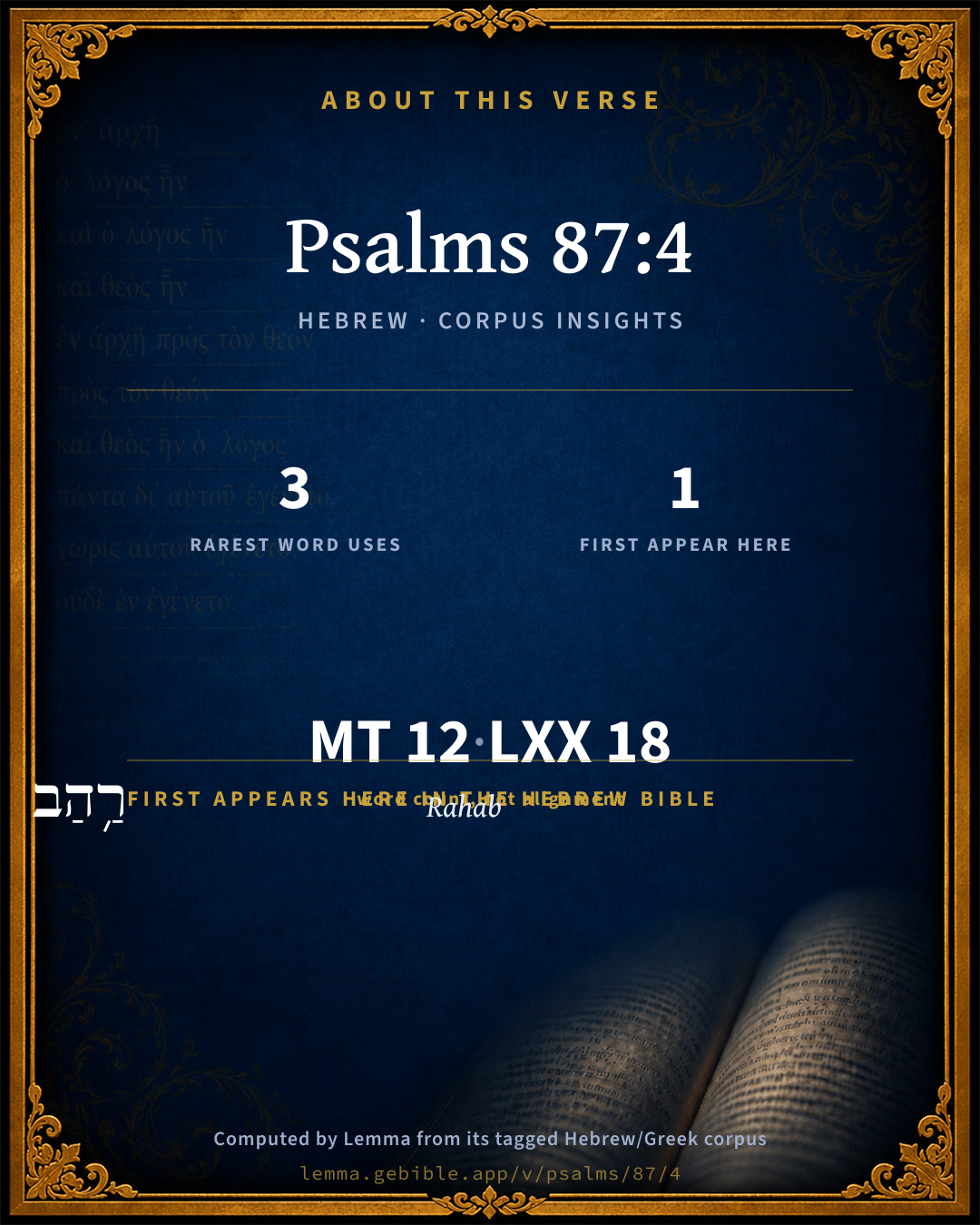
  • 1 first appearance in the Hebrew Bible
Full analysis ↓
Download a study sheet

One document with this verse’s original text, its word-by-word gloss line, the meaning frame, cross-references with their text, attributed commentary, and full source and license credits — printable, and it pastes into notes with its structure intact.

This verse Autodidact and up

Study sheet (.html) Plain text (.txt)

A passage Seminary Student

Up to 50 verses in one chapter. A passage sheet keeps up to 6 commentary sources and 12 cross-references per verse, in the order this page ranks them, and says so on the sheet whenever that leaves anything out. Ask for a single verse and you get the Autodidact verse sheet above.

Everything on this page stays free to read, with no account — the sheet is a download of what is already on screen, not access to it.

Want to remove ads? Support Godless Engineer
Compare translations 3

The same verse in 3 English versions, stacked beneath the original-language interlinear above. Click any original word for its lexicon entry.

Each is an independent rendering of the whole verse — the interlinear is not word-aligned to these translations.

Highlighted words mark where these versions differ — a whole-verse word diff, not a word-by-word alignment.

  • World English Bible Public Domain
    I will record Rahab and Babylon among those who acknowledge me. Behold, Philistia, Tyre, and also Ethiopia: "This one was born there."
  • King James Version Public Domain
    I will make mention of Rahab and Babylon to them that know me: behold Philistia, and Tyre, with Ethiopia; this man was born there.
  • unfoldingWord Literal Text CC BY-SA 4.0
    I will mention Rahab and Babylon to the ones knowing me; behold, Philistia and Tyre with Cush— “This one was born there.”

unfoldingWord Literal Text — © unfoldingWord, licensed CC BY-SA 4.0. Word-aligned USFM3 via Door43 (git.door43.org/unfoldingWord/en_ult).

Versions to compare (up to 4)

3 of 4 selected

Show all 18 translations

Every available English version of this verse, each an independent rendering of the whole verse.

  • World English Bible Public Domain
    I will record Rahab and Babylon among those who acknowledge me. Behold, Philistia, Tyre, and also Ethiopia: "This one was born there."
  • Berean Standard Bible Public Domain
    “I will mention Rahab and Babylon among those who know Me—along with Philistia, Tyre, and Cush—when I say, ‘This one was born in Zion.’”
  • Majority Standard Bible Public Domain
    “I will mention Rahab and Babylon among those who know Me—along with Philistia, Tyre, and Cush—when I say, ‘This one was born in Zion.’”
  • King James Version Public Domain
    I will make mention of Rahab and Babylon to them that know me: behold Philistia, and Tyre, with Ethiopia; this man was born there.
  • American Standard Version (1901) Public Domain
    I will make mention of Rahab and Babylon as among them that know me: Behold, Philistia, and Tyre, with Ethiopia: This one was born there.
  • Revised Version (1885) Public Domain
    I will make mention of Rahab and Babylon as among them that know me: behold Philistia, and Tyre, with Ethiopia; this one was born there.
  • Geneva Bible (1599) Public Domain
    I will make mention of Rahab and Babel among them that knowe me: beholde Palestina and Tyrus with Ethiopia, There is he borne.
  • Douay-Rheims (1899) Public Domain
    I will be mindful of Rahab and of Babylon knowing me. Behold the foreigners, and Tyre, and the people of the Ethiopians, these were there.
  • Young's Literal Translation Public Domain
    I mention Rahab and Babel to those knowing Me, Lo, Philistia, and Tyre, with Cush! This `one' was born there.
  • Literal Standard Version CC BY-SA 4.0
    I mention Rahab and Babel to those knowing Me, || Behold, Philistia, and Tyre, with Cush! This [one] was born there.
  • Unlocked Literal Bible CC BY-SA 4.0
    “I mention Rahab and Babylon to my followers. See, there are Philistia, and Tyre, along with Cush— and will say, 'This one was born there.'”
  • unfoldingWord Literal Text CC BY-SA 4.0
    I will mention Rahab and Babylon to the ones knowing me; behold, Philistia and Tyre with Cush— “This one was born there.”
  • Darby Bible Public Domain
    I will make mention of Rahab and Babylon among them thatknow me; behold Philistia, and Tyre, with Ethiopia: this [man] was born there.
  • World Messianic Bible Public Domain
    I will record Rahab and Babylon among those who acknowledge me. Behold, Philistia, Tyre, and also Ethiopia: “This one was born there.”
  • Webster's Bible Public Domain
    I will make mention of Rahab and Babylon to them that know me: behold Philistia, and Tyre, with Cush; this man was born there.
  • Free Bible Version CC BY-SA 4.0
    I mention Egypt and Babylon as those who know me, and in addition Philistia, Tyre, and Ethiopia—“this man was born there.”
  • Bible in Basic English Public Domain
    Rahab and Babylon will be named among those who have knowledge of me; see, Philistia and Tyre, with Ethiopia; this man had his birth there.
  • JPS Tanakh (1917) Public Domain
    'I will make mention of Rahab and Babylon as among them that know Me; behold Philistia, and Tyre, with Ethiopia; this one was born there.'

Literal Standard Version (2020), Covenant Press — licensed CC BY-SA 4.0. Text via the HelloAO Bible API (eBible.org). Unlocked Literal Bible (unfoldingWord) — licensed CC BY-SA 4.0. Text via the HelloAO Bible API (eBible.org). unfoldingWord Literal Text — © unfoldingWord, licensed CC BY-SA 4.0. Word-aligned USFM3 via Door43 (git.door43.org/unfoldingWord/en_ult). Free Bible Version, Dr. Jonathan Gallagher — licensed CC BY-SA 4.0. Text via the HelloAO Bible API (eBible.org).

Word by word

More ways to search: Search by grammar → Find every occurrence → Compare this word →

Practice this passage: Drill this verse → Learn its vocabulary →

About this verse

These counts appear in no published source. They are computed here, from the morphology-tagged text and Lemma’s own curated glosses. What Lemma adds →

12
words
12
distinct lemmas
Wisdom
section

Notable vocabulary

The rarest word here is רַ֥הַב Rahab H7294 — appearing just 3 times in the whole Hebrew Bible.

First appearance in Scripture

This word makes its first canonical appearance in the Hebrew Bible here:

  • רַ֥הַב Rahab H7294

Shared distinctive vocabulary

רַ֥הַב Rahab H7294 occurs in 3 verses of the Hebrew Bible. Also found in:

Grammatical profile

  • 3 verbs
  • 5 nouns
  • 1 pronoun
  • 1 preposition
  • 1 adverb
  • 1 particle

Verb forms

  • אַזְכִּ֤יר Hiphil · Imperfect
  • לְֽיֹ֫דְעָ֥י Qal · Participle Active
  • יֻלַּד Pual · Perfect

Hebrew & Septuagint length

In English translation the verse runs 22 words from the Hebrew and 29 from the Septuagint (LXX English) — closely comparable.

A rough comparison of the two English renderings, which tokenize alike — not a word-level alignment.

Word counts can differ between the Hebrew and the Greek without any difference in meaning — e.g. the Hebrew direct-object marker אֵת has no separate Greek word, and Greek often adds the article ὁ.

In the original languages it is 12 Hebrew tokens and 18 Greek tokens — but the two are counted differently (Hebrew bundles its prefixes and suffixes into one token; the Greek is in lemma form), so that isn’t a like-for-like length.

Cross-references

25

Topical passages linked to Psalms 87:4 in the Treasury of Scripture Knowledge — connected by theme and wording, ordered by reader-vote popularity; previews shown in the World English Bible.

  • Psalms 45:12 The daughter of Tyre comes with a gift. The rich among the people entreat your favor.
  • Psalms 68:31 Princes shall come out of Egypt. Ethiopia shall hurry to stretch out her hands to God.
  • Isaiah 19:23–25 In that day shall there be a highway out of Egypt to Assyria, and the Assyrian shall come into Egypt, and the Egyptian into Assyria; and the Egyptians shall worship with the Assyrians.
  • Job 9:13 "God will not withdraw his anger; The helpers of Rahab stoop under him.
  • Psalms 89:10 You have broken Rahab in pieces, like one of the slain. You have scattered your enemies with your mighty arm.
  • 2 Samuel 21:16–22 and Ishbibenob, who was of the sons of the giant, the weight of whose spear was three hundred [shekels] of brass in weight, he being girded with a new [sword], thought to have slain David.
  • 1 Kings 10:1–29 When the queen of Sheba heard of the fame of Solomon concerning the name of Yahweh, she came to prove him with hard questions.
  • 2 Kings 20:17–18 Behold, the days come, that all that is in your house, and that which your fathers have laid up in store to this day, shall be carried to Babylon: nothing shall be left, says Yahweh.
  • Psalms 137:1 By the rivers of Babylon, there we sat down. Yes, we wept, when we remembered Zion.
  • Psalms 137:8–9 Daughter of Babylon, doomed to destruction, He will be happy who rewards you, As you have served us.
  • Isaiah 13:1–22 The burden of Babylon, which Isaiah the son of Amoz did see.
  • Isaiah 14:4–6 that you shall take up this parable against the king of Babylon, and say, How has the oppressor ceased! the golden city ceased!
  • Isaiah 19:11 The princes of Zoan are utterly foolish; the counsel of the wisest counselors of Pharaoh is become brutish: how do you say to Pharaoh, I am the son of the wise, the son of ancient kings?
  • Isaiah 23:1–18 The burden of Tyre. Howl, you ships of Tarshish; for it is laid waste, so that there is no house, no entering in: from the land of Kittim it is revealed to them.
  • Isaiah 51:9 Awake, awake, put on strength, arm of Yahweh; awake, as in the days of old, the generations of ancient times. Isn't it you who did cut Rahab in pieces, who pierced the monster?
  • Jeremiah 25:9 behold, I will send and take all the families of the north, says Yahweh, and [I will send] to Nebuchadrezzar the king of Babylon, my servant, and will bring them against this land, and against the inhabitants of it, and against all these nations round about; and I will utterly destroy them, and make them an astonishment, and a hissing, and perpetual desolations.
  • Jeremiah 50:1–46 The word that Yahweh spoke concerning Babylon, concerning the land of the Chaldeans, by Jeremiah the prophet.
  • Ezekiel 27:1–28 The word of Yahweh came again to me, saying,
  • Ezekiel 28:2 Son of man, tell the prince of Tyre, Thus says the Lord Yahweh: Because your heart is lifted up, and you have said, I am a god, I sit in the seat of God, in the midst of the seas; yet you are man, and not God, though you did set your heart as the heart of God;-
  • Daniel 2:47–48 The king answered to Daniel, and said, Of a truth your God is the God of gods, and the Lord of kings, and a revealer of secrets, seeing you have been able to reveal this secret.
  • Daniel 4:30 The king spoke and said, Is not this great Babylon, which I have built for the royal dwelling-place, by the might of my power and for the glory of my majesty?
  • Acts 8:27 He arose and went; and behold, there was a man of Ethiopia, a eunuch of great authority under Candace, queen of the Ethiopians, who was over all her treasure, who had come to Jerusalem to worship.
  • Revelation 17:5 And on her forehead a name was written, "MYSTERY, BABYLON THE GREAT, THE MOTHER OF THE PROSTITUTES AND OF THE ABOMINATIONS OF THE EARTH."
  • Revelation 18:2 He cried with a mighty voice, saying, "Fallen, fallen is Babylon the great, and she has become a habitation of demons, a prison of every unclean spirit, and a prison of every unclean and hateful bird!
  • 1 Samuel 17:8 He stood and cried to the armies of Israel, and said to them, Why are you come out to set your battle in array? am I not a Philistine, and you servants to Saul? choose you a man for you, and let him come down to me.

Cross-references courtesy of OpenBible.info (CC BY 4.0).

Hebrew and Greek witnesses Masoretic Hebrew ↔ Greek Septuagint

The same verse in the two great witnesses to the Old Testament, shown verse-for-verse.

You’re reading Greek Psalm 86 (Hebrew Psalm 87). The Septuagint counts the superscription, so verse numbers can differ from the Hebrew — chapter-level alignment, not verse-by-verse. Numbering follows Rahlfs.

These are two independent witnesses, not word-aligned to each other, and the Septuagint is shown in lemma (dictionary) form.

Hebrew Psalms 87:4 Masoretic · Westminster Leningrad Codex

אַזְכִּ֤יר רַ֥הַב וּבָבֶ֗ל לְֽיֹ֫דְעָ֥י הִנֵּ֤ה פְלֶ֣שֶׁת וְצ֣וֹר עִם כּ֑וּשׁ זֶ֝֗ה יֻלַּד שָֽׁם

I will record Rahab and Babylon among those who acknowledge me. Behold, Philistia, Tyre, and also Ethiopia: "This one was born there."

World English Bible · Public Domain

Greek LXX Greek Psalm 86:4 Septuagint · lemma form

μιμνήσκω ρααβ καί βαβυλών ὁ γιγνώσκω ἐγώ καί ἰδού ἀλλόφυλος καί τύρος καί λαός αἰθίοψ οὗτος γίγνομαι ἐκεῖ

I will make mention of Raab and Babylon to them that know me: behold also the Philistines, and Tyre, and the people of the Ethiopians: these were born there.

LXX2012 (modern English Septuagint) · Public Domain

Hebrew: Westminster Leningrad Codex (CC BY 4.0). Greek: Septuagint (public domain); English from LXX2012 (modern English Septuagint) (Public Domain). How the Septuagint differs from the Hebrew →

Commentary

Notes on Psalms 87:4 from classic Christian and Jewish commentators (each source and its license shown beneath its notes). The classic Christian expositions comment on the surrounding passage and are grouped to its opening verse, so a note may address several verses; the Jewish commentaries on the Tanakh (Rashi and others) are per-verse, so they appear only where the commentator wrote on this verse.

Lemma curates 59 commentaries, every one of them public domain or Creative Commons licensed, each selected and text-cleaned for this edition rather than reprinted as found. About our sources →

Matthew Henry's Commentary

Zion is here compared with other places, and preferred before them; the church of Christ is more glorious and excellent than the nations of the earth. 1. It is owned that other places have their glories (Psa 87:4): "I will make mention of Rahab" (that is, Egypt) "and Babylon, to those that know me and are about me, and with whom I discourse about public affairs; behold Philistia and Tyre, with Ethiopia" (or rather Arabia), "we will observe that this man was born there; here and there one famous man, eminent for knowledge and virtue, may be produced, that was a native of these countries; here and there one that becomes a proselyte and worshipper of the true God." But some give another sense of it, supposing that it is a prophecy or promise of bringing the Gentiles into the church and of uniting them in one body with the Jews. God says, "I will reckon Egypt and Babylon with those that know me. I will reckon them my people as much as Israel when they shall receive the gospel of Christ, and own them as born in Zion, born again there, and admitted to the privileges of Zion as freely as a true-born Israelite." Those that were strangers and foreigners became fellow-citizens with the saints, Eph 2:19. A Gentile convert shall stand upon a level with a native Jew; compare Isa 19:23-25. The Lord shall say, Blessed be Egypt my people, and Assyria the work of my hands, and Israel my inheritance. 2. It is proved that the glory of Zion outshines them all, upon many accounts; for, (1.) Zion shall produce many great and good men that shall be famous in their generation, Psa 87:5. Of Zion it shall be said by all her neighbours that this and that man were born in her, many men of renown for wisdom and piety, and especially for acquaintance with the words of God and the visions of the Almighty - many prophets and kings, who should be greater favourites of heaven, and greater blessings to the earth, than ever were bred in Egypt or Babylon. The worthies of the church far exceed those of heathen nations, and their names will shine brighter than in perpetual records. A man, a man was born in her, by which some understand Christ, that man, that son of man, who is fairer than the children of men; he was born at Bethlehem near Zion, and was the glory of his people Israel. The greatest honour that ever was put upon the Jewish nation was, that of them, as concerning the flesh, Christ came, Rom 9:5. Or this also may be applied to the conversion of the Gentiles. Of Zion it shall be said that the law which went forth out of Zion, the gospel of Christ, shall be an instrument to beget many souls to God, and the Jerusalem that is from above shall be acknowledged the mother of them all. (2.) Zion's interest shall be strengthened and settled by an almighty power. The Highest himself shall undertake to establish her, who can do it effectually; the accession of proselytes out of various nations shall be so far from occasioning discord and division that it shall contribute greatly to Zion's strength; for, God himself having founded her upon an everlasting foundation, whatever convulsions and revolutions there are of states and kingdoms, and however heaven and earth may be shaken, these are things which cannot be shaken, but must remain. (3.) Zion's sons shall be registered with honour (Psa 87:6): "The Lord shall count, when he writes up the people, and takes a catalogue of his subjects, that this man was born there, and so is a subject by birth, by the first birth, being born in his house - by the second birth, being born again of his Spirit." When God comes to reckon with the children of men, that he may render to every man according to his works, he will observe who was born in Zion, and consequently enjoyed the privileges of God's sanctuary, to whom pertained the adoption, and the glory, and the covenants, and the service of God, Rom 9:4; Rom 3:1, Rom 3:2. For to them much was given, and therefore of them much will be required, and the account will be accordingly; five talents must be improved by those that were entrusted with five. I know thy works, and where thou dwellest, and where thou was born. Selah. Let those that dwell in Zion mark this, and live up to their profession. (4.) Zion's songs shall be sung with joy and triumph: As well the singers as the players on instruments shall be there to praise God, Psa 87:7. It was much to the honour of Zion, and is to the honour of the gospel-church, that there God is served and worshipped with rejoicing: his work is done, and done cheerfully; see Psa 68:25. All my springs are in thee, O Zion! So God says; he has deposited treasures of grace in his holy ordinances; there are the springs from which those streams take rise which make glad the city of our God, Psa 46:4. So the psalmist says, reckoning the springs from which his dry soul must be watered to lie in the sanctuary, in the word and ordinances, and in the communion of saints. The springs of the joy of a carnal worldling lie in wealth and pleasure; but the springs of the joy of a gracious soul lie in the word of God and prayer. Christ is the true temple; all our springs are in him, and from him all our streams flow. It pleased the Father, and all believers are well pleased with it too, that in him should all fulness dwell.

Matthew Henry's Commentary on the Whole Bible (1708–1710) — public domain (CC PDM 1.0). Text via the HelloAO Bible API.

Trapp's Complete Commentary

John Trapp

Psa 87:4 I will make mention of Rahab and Babylon to them that know me: behold Philistia, and Tyre, with Ethiopia; this [man] was born there.

Ver. 4. I will make mention of Rahab and Babylon] Rahab is Egypt, and so called for its strength and pride. Babel, the chief city of the Babylonians. These were deadly enemies to Jerusalem, which was ground between them as between a pair of millstones, but they shall be reckoned hereafter, saith God, among his domestics, among those that know me, or rather are known of me. See Isa 19:19; Isa 19:21; Isa 19:25 1Pe 5:13.

Behold Philistia] The Philistines were ever bitter enemies to the Israelites, but shall be converted and become children of the Church. See Isa 56:1; Isa 44:5.

And Tyre] Which shall leave heaping and hoarding, and employ her merchandise to feed and clothe God’s saints, Isa 23:18 Act 21:8; Act 21:4.

With Ethiopia] Heb. Cush, of Cush, the son of Ham, their father and founder, Gen 10:6. Ethiopians they were called from their burnt faces. The eunuch received the gospel, and published it, Acts viii.; the Christian faith was professed among them, as it is thought, from the apostle’s time; though now, for over a hundred years, they have again forsaken it.

This man was born there] Natus, id est, renatus in illa. The men of these several and other countries were born, that is, born anew, and so made free denizens of the new Jerusalem, fellowcitizens with the saints, and of the household of God, Eph 2:19.

John Trapp, A Commentary or Exposition upon All the Books of the Old and New Testament (1647–1656) — public domain. Text from a community e-Sword module.

The Treasury of David

Charles H. Spurgeon

Ver. 4. I will make mention of Rahab and Babylon to them that know me. This shall be a glorious subject to speak of concerning Zion, that her old foes are new born and have become her friends, worshipping in the temple of her God. Rahab or Egypt which oppressed Israel shall become a sister nation, and Babylon in which the tribes endured their second great captivity, shall become a fellow worshipper; then shall there be mention made in familiar talk of the old enmities forgotten and the new friendships formed. Some consider that these are the words of God himself, and should be rendered "I will mention Rahab and Babylon as knowing me": but we feel content with our common version, and attribute the words to the Psalmist himself, who anticipates the conversion of the two great rival nations and speaks of it with exultation.

Behold Philistia, and Tyre, with Ethiopia. These also are to bow before the Lord. Philistia shall renounce her ancient hate, Tyre shall not be swallowed up by thoughts of her commerce, and distant Ethiopia shall not be too far off to receive the salvation of the Lord.

This man was born there. The word man is inserted by the translators to the marring of the sense, which is clear enough when the superfluous word is dropped, "Philistia, and Tyre, with Ethiopia; this was born there" i.e., this nation has been born into Zion, regenerated into the church of God. Of the new births of nations we will make mention, for it is at once a great blessing and a great wonder. It is a glorious thing indeed when whole nations are born unto God.

"Mark ye well Philistia's legions,

Lo, to seek the Lord they came;

And within the sacred regions

Tyre and Cush have found a home."

Many understand the sense of these verses to be that all men are proud of their native country, and so also is the citizen of Zion, so that while of one it is said, "he was born in Egypt" and of another, "he came from Ethiopia", it would be equally to the honour of others that they were home born sons of the city of God. The passage is not so clear that any one should become dogmatical as to its meaning, but we prefer the interpretation given above.

Ver. 4. I will make mention, etc. As if he had said, I do not deny the due praises which belong to other places and countries, but rather am wont to make honourable mention of them among my acquaintance; and to allow that this man, that is, some notable person, though comparatively of no great value, was born in them. Thomas Fenton.

Ver. 4. Rahab, a poetical name of Egypt. The same word signifies "fierceness, insolence, pride"; if Hebrew when applied to Egypt, it would indicate the national character of the inhabitants. Smith's Dictionary of the Bible.

Ver. 4. It should comfort the church that God is able to make her chiefest enemies to become converts, and that he hath done it sundry times, and will yet do it more; and that he can take order with those enemies which shall not be converted, as he did with Rahab and Babylon; for, I will make mention of Rahab and Babylon to them that know me, signifieth a mention making of them; viz., to the edification of the church's children, both concerning what God had done in those nations in justice; and what he would do to them in mercy, or unto other enemies like unto them. David Dickson.

Ver. 4. Rahab, Babylon, Philistia, Tyre, Ethiopia. This is the glory of the Church, that into her the fulness of the nations shall enter, the proud from Egypt, who for her haughtiness is called Rahab, the worldly from Babylon, the city of confusion, the wrathful from Philistia, so long the enemies of Israel, the covetous from Tyre, the rich city of the traders, and the slaves of ignorance from Cush, and from the land of Ham, all these shall learn the love of Christ and confess his truth, and shall enter into that all glorious city, and be admitted and acknowledged as citizens of the celestial Sion. "Plain Commentary".

Ver. 4.By this testimony of the nations here mentioned, we may understand the testimony of the Gentile Christians in general, though, perhaps, a special reference is had to that extraordinary scene which took place at Jerusalem on the day of Pentecost: "And there were dwelling at Jerusalem Jews, devout men, out of every nation under heaven. Now when this was noised abroad, the multitude came together, and were confounded, because that every man heard them speak in his own language. And they were all amazed and marvelled, saying one to another, Behold, are not all these which speak Galilaeans? And how hear we every man in his own tongue, wherein we were born?" Ac 2:5-8.

The reader will find that there is a remarkable agreement between the nations specified in the book of the Acts, and the nations pointed out in the Psalm before us. Rahab, that is, Egypt, is first mentioned; and in the Acts we find enumerated, "Egypt and the parts of Libya about Cyrene"; next Babylon is in the record; and the Parthians, Medes, and Elamites, and the dwellers in Mesopotamia, were inhabitants of what once was the Babylonian empire: Philistia is also mentioned; and "dwellers in Judea" are spoken of in the Acts "dwellers in Judea" speaking a different language from what was common at Jerusalem. Who could these be, so probably, as the inhabitants of the ancient Philistia, which was in the precincts of the allotment of Judah? Here, too, perhaps, on account of its port of Joppa, was a grand resort of "Cretes and Arabians", and "strangers of Rome".

The Grecian settlements of Asia Minor are the only ones specified in the Acts of the Apostles, which we have not noticed in the Psalm "Cappadocia, Pontus, Asia, Phrygia, and Pamphylia": but what could so probably indicate these countries, and all who spoke the dialects of the Grecian tongue, as the great mart of Tyre, in frequenting which, the Jews would have the most frequent opportunity of intercourse with these nations? John Fry.

Ver. 4. Born in her. The Missionary Society set forth in the Prophets, by our Lord and by his apostles, is, the Church; and so, whereas our natural state, after Adam's fall, was alienation from God, and disunion among ourselves, would He restore "glory to God in the highest and on earth peace, good will towards men", by binding us up in one holy fellowship, and making the continuance of his blessings dependent upon that unity, which he imparted and preserves. To adduce the whole proof for this, would be to go through the whole Old Testament; for the Old Testament is direct prophecy and type, is one large prophecy of the Redeemer and his Kingdom or Church. No sooner had disunion multiplied with the multiplying of men, but in the second generation from Adam, he formed union through a Church, and "Men began to call upon the name of the Lord" (Ge 4:26), i.e., they began to unite in worshipping the Lord, and amid the growing corruption, religion was no longer entrusted to the insulated care of single families, but concentrated in a church. And when, after the flood, one righteous man was called out of the fast corrupting world, unity was preserved, in that one only was called, but in that one a church was founded; for this was the reason assigned by God himself: "All the nations of the earth shall be blessed in him. For I know him, that he will command his children and his household after him, and they shall keep the way of the Lord", (Ge 18:18-19). "God called Abraham alone, and blessed him, and increased him" (Isa 51:2), and formed the Jewish Church out of him, that however largely it might spread, it might be bound in one by its origin of one; and he gave it also outward marks and signs between him and it, which by severing it from others, might keep it one in itself. The temporal people had their union through a temporal birth of one, and outward signs; the Christian Church has its unity by a spiritual birth, and inward graces, through the power deposited in her to give spiritual birth, so that through one mother, we are all born of one Father, God, and amongst ourselves are brethren, by being members of One, our ever blessed Lord.

The unity of the Christian Church and her office of gathering all nations unto the Lord, are set forth, in many ways, in prophecy. Thus, in our Psalm, Zion is set forth as the special object of God's love, as having (in language which anticipates the Gospel) been "founded" by him "on the holy mountains", as the "city of God", whereof "glorious things are spoken." And what are these? That she should be the spiritual birthplace of all nations. It is not merely said, as in other places, that they should "come to her", should "flow into her", but that they should be "born in her." "Of Zion it shall be said, This and that man (i.e. all, one by one) was born in her; "and whence? all the nations of the earth, Rahab or Egypt, Babylon, Tyre, Ethiopia, Philistia, the most learned, the most powerful, the wealthiest, the furthest, and her nearest, oldest and bitterest enemy Philistia, all, being already born after the flesh, as Egyptians, Babylonians, Ethiopians, Tyrians, Philistines, should be "born in her", and by being "born there", should become children of God, citizens of the heavenly Jerusalem, written by God in the roll of his book. "The Lord shall count, when he writeth up the people, that this man was born there"; he shall account them as his, being reborn in his Church.

In like manner, with regard to every prophecy, whereat men's hearts beat, as an encouragement to Missionary labours. Throughout, it is the Lord and Saviour of the Church, or the Church itself, filled with his Spirit, and restored and enlarged, and widening herself by his favour, and gathering his people into herself, his fold. E.B. Pusey, in a Sermon entitled, "The Church the Converter of the Heathen." 1838.

Ver. 4-6. It is made the honour and dignity of Sion, that is, of the true Church of God, to have such and such born in it: "this and that man was born in her." There are two things signified in this expression, as branches of their honour; the one is the quality of the persons; and the other is the number of them. For the quality of them, this; for the number of them, this and that. To have both of these born in Sion, persons of note and eminency, and a multitude and plurality of such persons; this is a part of that dignity and renown which belongs unto it...

And so for the noun, man; the Hebrew word vya which is here used for a man, except qualified by some other word as joined with it, signifies a man of worth, not a common or ordinary person. The Church brings forth such as these, Mvh yvna, men of renown, famous and eminent men, and that in all kinds of perfections, whether natural, or civil, or spiritual; men of parts, or men of power, or men of piety. There are those in all these excellencies which have been and still are born in her.

First, take it for natural or acquired abilities; men of parts, and knowledge, and wisdom, and improved understandings; the church is not without these: this man, i.e., this learned man, or this wise man was born in Sion. All are not idiots who are Christians; no, but there are some of very rare and admirable accomplishments in all kinds and pieces of learning and secular knowledge, which are graciously qualified. There's Paul with his parchments, and Peter with his fisher's net. So also secondly, take it for civil or secular qualifications; men of dignity, and power, and estate: "this man", i.e., this honourable man, Mynp awvn, eminent in countenance, as he is called, Isa 3:2, he is likewise born in Sion; the mighty man, and the man of war. The Syriac interpreter was so far sensible of this, as that he expresses it in the very text; and therefore instead of saying, "This man was born there", he says, "A potent man was born there, `and he has established it; '"whereby (as I conceive), he takes in the word highest, which follows afterwards in the verse, and refers it here to this place...And again, the Chaldee paraphrast in the text, "This King was born there", understanding thereby Solomon, as most conceive and apprehend it.

Thirdly, take it for spirituals, and for these accomplishments especially; This man, i.e., this godly man; this is that which is most proper and essential to Sion, and to the being born in it; yea, it is that which makes Sion itself, in the sense we now take it. It is the highest perfection of it, and the greatest commendation to it of any thing else. This is the great honour of the church, that it forms men to such qualities and dispositions as those are, which no other place does beside...As for other places, they may perhaps now and then reach to some other principles, and those likewise very glorious in the eyes of the world morality, and civility, and ingenuity, and smoothness of behaviour. The school of nature and common reason may sometimes come up to these, and that in a very great measure; yea, but now go a little higher, to brokenness of heart, to self denial, to love of enemies, to closing with Christ, the frame and spirit of the gospel; this is to be found nowhere but only in Sion. And here it is: "This man was born there."

Behold Philistia, and Tyre, with Ethiopia; this man was born there. Here's the excellency of the ordinances, and that power and energy which is stirring in the Church of Christ; that it is able to work such a miraculous alteration as this; to bring men from darkness to light, from Satan to God, from a state of sin and corruption and unregeneracy, to a state of grace and holiness and regeneration; yea, from the lowest degree of the one to the highest degree of the other. That Philistia should turn into Palestina, Tyre into, Jerusalem, Ethiopia into Judea;here's the wonder of all; the reconciling of these two opposite terms thus both together. That "princes should come out of Egypt", and that Ethiopia should stretch out her hands to God, as it is in Ps 68:31; that the blackamoor should change his skin, and that the leopard should change his spots; and that this Ethiopian should become this Christian; "that he which was born there, should be born here." Thomas Horton, in "Zion's Birth Register unfolded in a Sermon to the native citizens of London." 1656.

Ver. 4-6. Foreign nations are here described not as captives or tributaries, not even as doing voluntary homage to the greatness and glory of Zion, but as actually incorporated and enrolled, by a new birth, among her sons. Even the worst enemies of their race, the tyrants and oppressors of the Jews, Egypt and Babylon, are threatened with no curse, no shout of joy is raised at the prospect of their overthrow, but the privileges of citizenship are extended to them, and they are welcomed as brothers. Nay more, God himself receives each one as a child newly born into his family, acknowledges each as his son, and enrols him with his own hand on the sacred register of his children. It is the mode of anticipating a future union and brotherhood of all the nations of the earth, not by conquest, but by incorporation into one state, and by a birthright so acquired, which is so remarkable. In some of the prophets, more especially in Isaiah, we observe the same liberal, conciliatory, comprehensive language towards foreign states, as Tyre and Ethiopia, and still more strikingly toward Egypt and Assyria (Isa 19:22-25). But the Psalm stands alone amongst the writings of the Old Testament, in representing this union of nations as a new birth unto the city of God ...It is the first announcement of that great amity of nations, or rather of that universal common citizenship of which heathen philosophers dreamt, which was "in the mind of Socrates when he called himself a citizen of the world", which had become a common place of Stoic philosophy, which Judaism tried finally to realize by the admission of proselytes, through baptism, into the Jewish community; which Rome accomplished, so far as the external semblance went, first by subduing the nations, and then by admitting them to the rights of Roman citizenship. But the true fulfilment of this hope is to be found only in that kingdom which Christ has set up. He has gathered into his commonwealth all the kingdoms of the earth. He has made men one, members of the same family, by teaching them to feel that they are all children of the same Father. He has made it evident that the hope of the Jewish singer is no false hope; that there is a Father in heaven who cares for all, whatever name they bear. Thus the Psalm has received a better and higher fulfilment than that which lies on the surface of its words. It was fulfilled in Christ. J. J. Stewart Perowne.

Ver. 4-7. The main thought is that contained in Ps 87:4-7, the glorifying of Sion by the reception of the heathen into the number of its citizens; and a well defined form and arrangement of this thought forms the proper kernel of the Ps 87:1-7, "Sion, the birth place of the nations", which occurs in every one of the three verses (Ps 87:4-6), which are bounded by a Selah behind and before. E. W. Hengstenberg.

Ver. 4. (last clause).

1. Behold what the "man" was: a native of "Philistia", a heathen, and an enemy to God.

2. Behold what happened to him: he

"was born there", i.e. new born in Zion.

3. Behold what he becamehe became by his new birth a freeman and burgess of Zion, & c.

Ver. 4-5.

1. What is not the most honourable birth placenot Rahab nor Egypt, nor Babylon, nor any earthly palace or kingdom.

2. What is? "Of Zion", & c.

(a) Because it is a nobler birth; a being born again of the

Spirit of God.

(b) Because it is a nobler place; the residence of the

Highest, and established for ever.

(c) Because it brings nobler rank and privileges. G.R.

Ver. 4-7.

1. Zion shall produce many good and great men.

2. Zion's interest shall be established by divine power.

3. Zion's sons shall be registered with honour.

4. Zion's songs shall be sung with joy and triumph. Matthew Henry.

Ver. 4-7.

1. The excellence of the church is here stated.

2. Her enlargement is here promised. J. Scholefield, 1825.

Psalms 87:5*

Charles H. Spurgeon's The Treasury of David (1869–1885) — public domain. Psalms only. Text from a community e-Sword/MySword module.

Joseph Benson's Commentary

Psa 87:4. I will make mention — Hebrew, אזכיר, azchir, I will record, or, cause to be remembered, Rahab — That is, Egypt, so called, Psa 89:10; Isa 51:9, but whether from its pride, or natural strength, both which the word signifies, is not material; and Babylon — I will reckon upon the inhabitants of Egypt and Babylon, though most alienated from the profession of the truth, yea, even on all the church’s enemies, as those that shall become members of it. For under these two, and Philistia, he seems to comprehend all the enemies of God’s people, of whom he prophesies that they should be not only reconciled, but united to them. To them that know me — Or with, or among them, that is, with or among those that truly, affectionately, and practically know me; so as to love, serve, and obey me. I will reckon these nations among the number of those that shall be converted; or, among my worshippers, subjects, and children; they seem to be God’s words, foretelling that he would account, and cause these Gentiles to be recorded as his people, when they should receive the gospel of Christ, as truly as Israel was his people, and would own them as born in Zion, that is, born again there, and entitled to all its privileges as freely as true-born Israelites. That though they had been strangers and foreigners, they should become fellow-citizens with the saints, Eph 2:17. Thus Isa 19:23-25, The Lord shall say, Blessed be Egypt, my people, and Assyria, the work of my hands, and Israel mine inheritance. Behold — Take notice of it, as a thing new, and strange, and delightful. Philistia and Tyre, with Ethiopia — That is, the nations on every side of them, for Philistia was on the west, Tyre on the north, and Ethiopia, or Arabia, (which rather seems to be intended by the word Cush, here,) on the south. So that those nearest to them, and those more remote from them, are here mentioned, as converts to the gospel church: this man was born there — Or, in her, as it is Psa 87:5, namely, born by adoption and regeneration, Joh 1:12; Joh 3:7; Gal 3:26; 1Pe 1:23; that is, the Gentiles, from all countries, shall be brought into the church of God, and be accounted genuine members thereof.

Joseph Benson's Commentary on the Old and New Testaments (1811–1818) — public domain. Text from a community e-Sword module.

J. A. Alexander on Psalms

Joseph Addison Alexander

4. (Psa 87:4) I will mention Rahab aad Babylon as knowing me. Lo, Philistia and Tyre with Ethiopia ! This (one) was born there. Interpreters are commonly agreed, that these are the words of God himself, though not expressly so announced. The first verb in Hebrew is a causative, I will make to be remembered, celebrate, commemorate. See above, Psa 20:7), 45:17, 71:15, 77:11. It here means to announce or proclaim. To know God is to love him and to be his servant. See above, on Psa 36:10, and compare Isa 19:21. Those knowing him in this sense are his people. As knowing me, literally to those knowing me, i.e. belonging to their number. Or the sense may be, for knowers of me, I will recognise and reckon them for such. Compare the Hebrew of Exo 21:2, he shall go out free, literally for free, i.e. as free. The nations thus announced as belonging to God's people are mere samples of the whole gentile world, those being chosen for the purpose, who were or had been most connected with the history of Israel, and were at the same time ruling powers of antiquity. Rahab is an enigmatical name given to Egypt by the Prophet Isaiah. See below, on Psa 89:10, and compare my notes on Isa 30:7; Isa 51:9. Babylon is named instead of Assyria, perhaps because in Hezekiah's reign the former began to supersede the latter as the dominant power of Western Asia. See my note on Isa 39:1. Compare the prophecy respecting Egypt and Assyria in Isa 19:23-24. Philistia and Tyre are put together, as in Psa 83:7. As to the latter, see above, on Psa 45:12, and compare Isa 23:18. The conversion of Cush or Ethiopia had already been foretold by David, Psa 68:31, and by Solomon, Psa 72:10. The last words are obscure but may be rendered clearer by supplying before them, as to each of these it shall be said. The pronoun (this) is then to be referred not to individual men, but to the nations as ideal persons. The idea of regeneration or spiritual birth, applied in the New Testament to individuals, is here applied to nations, who are represented as born again, when received into communion with the church or chosen people.

Joseph Addison Alexander, The Psalms Translated and Explained (1850) — public domain. Text from a community e-Sword module.

Tyndale Open Study Notes

Tyndale Open Resources

87:4 As great as Zion is, it will be even greater when it becomes an international city where believers from all the nations have citizenship. • God keeps a record of all who confess him as their Lord (Dan 7:10; Rev 13:8).

Tyndale Open Study Notes — © Tyndale Open Resources, licensed CC BY-SA 4.0. Text via the HelloAO Bible API.

Geneva Bible (1599)

Geneva Bible translators

That is, Egypt and these other countries shall come to the knowledge of God.

It shall be said of him that is regenerate and come to the Church, that he is as one that was born in the Church.

Geneva Bible (1599) marginal notes — public domain. Text via Bolls.life.

Adam Clarke's Commentary

Verse 4. I will make mention of Rahab] The meaning seems to be, Rahab, i.e., Egypt, Babylon, Tyre, Philistia, and Ethiopia are not so honourable as Jerusalem. To be born in any of them is no privilege when compared with being a native of Jerusalem: their cities are but heads of villages; Jerusalem alone is a CITY. I have met with a very similar sentiment in a Persian work, of which I know not the author:

[---Persic---]

[---Persic---]

Tche Mesr, o tche Sham, o tche Birr o Buhr.

Heme rustaee and, we Sheerazee Shuhr.

What celebrity can Egypt or Syria, or any thing on earth or

on the sea, pretend to?

"When compared to Sheeraz, those are but villages, but this

alone is a CITY."

The meaning seems to be the same in both the Hebrew and Persian poet.

Adam Clarke's Commentary on the Bible (1810–1826) — public domain. Text from a community e-Sword/MySword module.

John Calvin's Commentaries

4 I will make mention of Rahab and Babel. The name of Rahab is put for Egypt in many other parts of Scripture; and this signification is very suitable to the present passage, the object of which is to portray the magnificent amplitude of the Church, which as yet was only matter of hope. It is therefore said that those who formerly were deadly enemies, or entire strangers, shall not only become familiar friends, but shall also be ingrafted into one body, that they may be accounted citizens of Jerusalem. In the first clause it is said, I will make mention of Egypt and Babylon among my household. In the second, it is added, that the Philistines, Tyrians, and Ethiopians, who hitherto had been so much at variance with the people of God, shall now be brought into as cordial harmony with them as if they were Jews by birth. What a glorious distinction of the Church, that even those who held her in contempt shall come flocking to her from every quarter, and that those who desired to see her completely cut up and destroyed, shall consider it the highest honor to have a place among the number of her citizens, and to be accounted such! All of them shall voluntarily renounce their own countries in which they had before proudly boasted. Wherever they may have been born, whether in Palestine, or Ethiopia, or Tyre, they shall profess themselves citizens of the holy city.

The Hebrew doctors explain this passage as meaning, that there shall spring from other nations very few who shall excel either in mental endowment or in virtuous attainment, but that in Israel such persons will be very numerous. Scarcely, say they, will there be found among the Tyrians, the Egyptians, the Ethiopians, and other nations, a man to each of them worthy of praise; so that if such an one be found among them, he may be pointed at with the finger, on account of his rarity; but in Zion man and man shall be born; that is to say, the number of such men among the Jews shall be great. Christian doctors are almost unanimous in referring these words to Christ, and think that the cause is here assigned why those who hitherto were strangers, and even mortal enemies to each other, are now to be numbered among the citizens of Jerusalem, namely, because Christ shall be born there, whose office it is to gather together into the unity of faith and hope of eternal life, men who were scattered like members torn from the body. The first of these interpretations being altogether forced, needs no refutation. Moreover, it is very evident that the Jews, actuated by a foolish ambition, wrest this passage as it were purposely. The exposition of the Christian doctors is, at first sight, plausible from its ingenuity; but it is destitute of solidity. The words clearly imply, that whatever nation men may belong to, they shall willingly renounce their own country, to be enrolled in the Register of the chosen people. When it is said, that they are born there, this does not mean that they are natives of the country, and have been brought up in it from their birth, but that they are its citizens. What is added afterwards, The Most High himself will establish her, may, with equal propriety, be translated, will order her; it being the work of God specially to govern his Church by his word.

John Calvin's Commentaries (1540-1563) — public domain. Text from the Calvin Translation Society English edition (1840s-50s) via the Christian Classics Ethereal Library (ccel.org). Calvin's coverage is partial (roughly two-thirds of the Bible); uncommented books and verses are honest gaps, never fabricated. The 19th-century editor's footnotes and remarks are omitted so the notes are faithfully Calvin's own voice.

Ellicott's Commentary for English Readers

(4) This verse may be paraphrased—

I will mention to my intimates Rahab and Babylon; (I will say) look at Philistia and Tyre—yes, and even Ethiopia. So-and-so was born there.

The last clause is literally this was born there, and on its reference the whole meaning of the verse and the whole intention of the psalm turn. Now immediately after the mention of a place, there must surely refer to that place, and not to a place mentioned in the previous verse and there too addressed as in the second person. The demonstrative this, is evidently used in a general way. (Comp. the fuller form, Jdg_18:4, &c.) The poet begins his special addition to the praises of Zion, by enumerating various renowned nations much in the same way as Horace’s

“Laudabunt alii claram Rhodon, aut Mitylenen.”

only instead of leaving them as a theme to others he tells us what he himself in ordinary conversation might say of these places, and of the estimation in which their natives were held. It is hardly possible to escape from the conclusion that the Palestinian Jew is here implying his superiority to those of his race who were born abroad, a spirit shown so strongly in the relations of the Hebrews to the Hellenistic Jews in the New Testament.

Rahab undoubtedly stands for Egypt, but the exact origin of the term and of its connection with Egypt is much disputed. Most probably it is a term (possibly Coptic) for some large sea or river monster symbolic of Egypt. (Comp. the word “dragons,” Psa_74:13, and see Job_9:13; Job_26:12.)

Ethiopia—Heb., Khûsh (in Authorised Version Cush). (See Gen_10:6 : 2Ki_19:9.)

There is no need with our explanation to look for emblematic reasons for the choice of names in this verse—as Egypt for antiquity; Babylon, strength; Tyre, wealth, &c. There is no one of the districts where Jews of the Dispersion might not have been found, but no doubt in his enumeration the poet takes care to mention countries near and far, as Philistia and Ethiopia. There appears, however, to have been a district in Babylonia known to the Hebrews as Khûsh (Lenormant, Origines de l’Histoire; and see a paper on the site of Eden, in the Nineteenth Century for October, 1882). The parallelism would be improved by this reference here.

A Bible Commentary for English Readers, edited by Charles John Ellicott (1878–1897) — public domain. Text from a community e-Sword module.

The Cambridge Bible for Schools and Colleges

gen. ed. J. J. S. Perowne

4. God Himself is the speaker (cp. Psa_60:6 ff.). I will make mention of, solemnly and publicly acknowledge, Rahab and Babylon, as among them that know me, that own Me as their God and worship Me. Cp. Psa_36:10; Psa_9:10; Psa_5:11; Isa_19:21. Rahab[48] is a nickname for Egypt (Isa_30:7; Isa_51:9; Psa_89:10). It may have been the name of some mythological sea-monster (Job_26:12; Job_9:13, R.V.) chosen as an emblem of Egypt (cp. Isa_51:9), or it may simply mean ‘Arrogance.’ Its use here is significant: the ferocious monster is tamed; the blustering antagonist is reconciled.

[48] It may be noted that this name is differently spelt in Hebrew from Rahab in Jos_22:1 ff., and is derived from a different root. This is Rãhãb, that Râchâb.

Behold &c.] God points as it were to each of these nations in succession and says, This one was born there, namely in Zion. By this divine edict each of them is invested with the full rights and privileges of citizenship as though they had been born in Zion.

It is God’s purpose to reconcile all nations to Himself. Egypt, the world-power of the South, the ancient and hereditary enemy of God’s people; Babylon, the world-power of the North, the cruel oppressor of later times; warlike Philistia, by which Israel had so often been harassed; proud Tyre, the haughty representative of commerce and wealth; distant Ethiopia, famous for its stalwart warriors (Isa_18:7);—all will be brought to recognise Jehovah as their God; all shall be incorporated into the commonwealth of Israel (Eph_2:12). The thought is the same as that of Isa_19:24-25, though it is expressed in different language.

4–6. The nations of the world shall be enrolled as Zion’s children; and Zion shall be glorified by this accession of unnumbered fresh citizens.

The Cambridge Bible for Schools and Colleges (gen. ed. J. J. S. Perowne; Cambridge University Press, 1878–1918) — public domain. Text from a community e-Sword module.

John Gill's Exposition

I will make mention of Rahab,.... Not of Rahab the harlot, as Jerom and others of the ancients (y) interpret it; for the letters of both words are not the same in Hebrew; though mention is made of her in the Gospel, and Gospel times, in the genealogy of Christ, and by two of the apostles, Mat 1:5, but of Egypt; and so the Targum interprets it, which is so called, as it is in Psa 89:10 either from the pride of its inhabitants, the word having in it the sense of pride and haughtiness, and these being naturally proud and haughty, as Philo (z) the Jew observes; or from some city of this name in it; or rather this respects that part of Egypt called Delta, which was in the form of a pear; which "raab", or "rib", in the Egyptian language, signifies; in the midst of which was the city of Athribis of Ptolemy (a), which has its name from hence, and signifies the heart of a pear; and still this part of the country is called Errifia, as Leo Africanus (b) relates, and is here put for the whole country: the passage respects the conversion of it, and are the words of God foretelling it, and of which mention is made in Isa 19:18 and had its accomplishment, at least in part, on the day of Pentecost, Act 2:10 and will be further accomplished in the latter day, when the people that now inhabit that country shall be converted, which will be when the kingdoms of this world become Christ's: and Babylon; the country of the Assyrians and Chaldeans, of which Babylon was the metropolis: mention is made of the conversion of these in Isa 19:24 and which also was fulfilled, in part, on the day of Pentecost, Act 2:9 and in Babylon there was a church, in the times of the Apostle Peter, Pe1 5:13 these the Lord promises that he would make mention of:

to them that know me; says he, that so they might expect their conversion, and take notice of them, and receive them, when converted;

or among them that know me (c); that is, I will make mention of them, as such that know me, and belong to that number; even such that love the Lord, believe in him, own and confess him, and yield obedience to him, and whom he takes into communion and fellowship with himself, and makes his friends, familiars, and acquaintance:

behold Philistia, and Tyre, with Ethiopia; where also will be many converts, regenerate persons, and such as know the Lord; of which there has been a partial accomplishment already; of Philistia, see Act 8:40, for Azotus, or Ashdod, was a city of the Philistines; and of Tyre, see Psa 45:12 and of Ethiopia, and its conversion, mention is made in Psa 68:31, and the Ethiopian eunuch is one instance of it, Act 8:27 of all which there will be abundance of instances in the latter day; and thus, as the church is commended from her foundation, from the superlative love the Lord bears to her, and the glorious things spoken of her; so from the number of her converts in different nations, in which her glory in Gospel times would greatly lie; see Isa 49:18,

this man was born there; not any particular man; any single individual, famous for piety, wisdom, wealth, or power; as if it suggested that now and then such a person might be born in the above countries; whereas in Zion there were frequently many such persons born: nor is it to be understood of the Messiah, that should come out of Zion, as if that was the reason why multitudes from the above places should flock thither, because of the birth of this illustrious Person: the Targum understands it of a great personage, a king; and paraphrases it,

"a king is educated there;''

but it designs many persons in each of those countries that should be born again, of water, and of the Spirit, of the incorruptible seed of grace, by the ministry of the word; who, because they should be regenerated by means of the Gospel preached in Zion, therefore are said to be born there; and besides, being born again, they are admitted members of Zion, and to all the privileges of Zion, as true born Israelites; and are brought up there, are nourished with the sincere milk of the word, and nursed with the breasts of Gospel ordinances there administered; and so Zion, or Jerusalem, the Gospel church, is truly the mother of them all, Gal 4:26.

(y) Aug. Euthymius, Theodoret, & alii, in Amama, Antibarbar. Bibl. I. 3. p. 820. (z) De Agricultura, p. 196. (a) Geograph. l. 4. c. 5. (b) Descriptio Africae, l. 8. c. 2. (c) "inter scientes me", Vatablus, Gejerus, Schmidt; "apud noscentes me", Junius & Tremellius; "apud familiares meos", Piscator; "apud notos meos", Amama.

John Gill's Exposition of the Whole Bible (1746–1763) — public domain (CC PDM 1.0). Text via the HelloAO Bible API.

Albert Barnes' Notes on the Bible

I will make mention of Rahab and Babylon ... - The word Rahab here refers to Egypt. See Isa 51:9. It is also applied to Egypt in Psa 89:10. The reason why the name was given to Egypt is not certainly known. The Hebrew word properly means fierceness, insolence, pride; and it may have been given to Egypt by the Hebrews on account of its haughtiness, pride, and insolence. It has been supposed by some (Jablonski, Opusc. i. 228) that the name is of Egyptian origin, but this has not been clearly made out. (Gesenius, Lexicon) Egypt, Babylon, Philistia, Tyre, and Ethiopia, are mentioned here as among the best known nations and cities of the world; as places where it would commonly be regarded as an honor to have been born. The meaning is, “I will refer to these as places well-known and distinguished; I will refer to the honor of having been born there; but great as is such an honor, the honor of having been born in Zion is far above that; it conveys the idea of a much higher distinction; it should be more sacredly cherished as among those things on which men value themselves.” The word “I” here seems to have reference to the psalmist, and not to God. The psalmist is mentioning what to him would seem to have a claim to the highest honor.

Philistia - The western portion of Palestine, from which the whole country was afterward named. See the notes at Psa 60:8; compare Psa 108:9; Isa 14:29, Isa 14:31. “And Tyre.” See Psa 45:12, note; Isa 23:1, note.

With Ethiopia - Hebrew, Cush. The reference here is probably to the southern portion of Arabia. See Psa 68:31, note; Isa 18:1, note.

This man was born there - That is, It would be said of individuals that they were born in one of those places, and it would be regarded as an honor thus to have been born. People would pride themselves on the fact that they were born there, and the world would hold them in esteem on that account. This refers to a very natural, and a very common feeling among people. We can, of course, claim no credit, and deserve no real honor, on account of the place where we happen to have been born; but the fact that one has been born in a place distinguished for its advantages and its fame, - in a place where liberty, religion, and the arts have flourishcd - in a place renowned for its public spirit, and for producing illustrious people, - may be properly accounted as an occasion for gratitude, and as a stimulus to high and honorable efforts, and may thus be made an important auxiliary to virtue, patriotism, and piety.

Albert Barnes' Notes on the Bible (1834–1885) — public domain. Text from a community e-Sword/MySword module.

Matthew Poole's English Annotations

I will make mention, i.e. I will reckon or account them in the number of my children and subjects.

Rahab, i.e. Egypt, so called, Psa 89:10; Isa 51:9, but whether from its pride, or natural strength, or figure, or shape, is not material.

And Babylon: under these two and Philistia, the old and constant enemies of Israel, he seems to understand all the keenest enemies of the Israel or church of God, who shall now be not only reconciled, but united to them; which also was foretold under the similitude of the wolf’s dwelling with the lamb, &c., Isa 11:6. To them; or, with or among them, as the prefix lamed is frequently used.

That know me, to wit, truly, clearly, affectionately, and practically, so as to love, serve, and obey me, as this phrase is very frequently used in Scripture. And upon this account, not only heathens, but wicked Israelites, are said not to know God, as 1Sa 2:12, and oft elsewhere.

Behold; take notice of it as a thing new, and strange, and comfortable.

Philistia, and Tyre, with Ethiopia; the nations on every side of them; for Tyrus was on the north, Ethiopia or Arabia (for that seems rather to be meant by Cush, as hath been before observed) on the south, those nearest to them, and those more remote from them, that lived in the uttermost parts of the earth, as this very land is called, Mat 12:42. This man was born there; or, saying, This man, &c., for this cohereth with the first words thus, I will make mention of Rahab, &c., saying, This man (i.e. these men or people now mentioned, the singular number put collectively for the plural; and the Scripture oft speaks of a nation as of one man, as Psa 25:22; 130:8) was born there, or in her, as it is expressed, Psa 87:5, to wit, in Zion; born by adoption and regeneration. See Joh 1:12; 3:3,7; Ga 3:26; 4:26; 1Pe 1:23. The Gentiles shall be ingrafted into the Jewish church, and into all their privileges.

Matthew Poole's English Annotations on the Holy Bible (1683–1685) — public domain. Text from a community e-Sword/MySword module.

Whedon's Commentary on the Bible

Daniel D. Whedon

4. I will make mention—As examples.

Rahab—Or, the sea monster, the people of tumultuous violence; a title poetically given to Egypt in the later books, (Psa_89:10; Isa_51:9; Isa_30:7,) where “strength” in the common version is Rahab in the Hebrew, and seems to be an allusion to the inactivity of the crocodile combined with his proverbial strength and violence. Lowth translates: “Rahab the inactive;” and Gesenius, “Violence, or, the violent, they sit still.” See Eze_29:3; Eze_32:2.

Babylon—Hebrew, Babel, the first of the kingdoms, (Gen_10:10,) and now the ruling power of western Asia.

To them that know me— Rather, Of them that know me. He speaks of them as of nations to whom had been given great opportunity to know the true God, one the ruling power in the south and the other in the north and east. Both in turn had held Jehovah’s people in bondage, and from both had they been delivered by most signal manifestations of God. See Isa_19:21 : “And the Egyptians shall know the Lord in that day.”

Philistia—A strong military people on the southwest coast of Palestine, the constant enemy of Israel.

Tyre—The chief city of Phoenicia on the northwest coast, and the great commercial city of the world; once the friendly ally, now the jealous enemy, of the Hebrew power.

Ethiopia—Hebrew, Cush, from the father of the numerous Cushite race, (Gen_10:7,) the name applied to the country east of the Euphrates, (Gen_2:13,) afterward to Arabia, (Num_12:1; 1Ch_21:16; Heb_3:7,) and also to “Ethiopia” proper, or the African country south of Egypt. Psa_68:31; Isa_43:3; Isa_45:14. In the widest sense it denotes southern country, on account of the dark colour of the inhabitants. In the text it means either Arabia Felix or Ethiopia proper.

This man was born there—The point of the allusion is, to the honour which a man derives from being a native citizen of any renowned country, or that a government feels in claiming that such or such a man was one of her native born sons. Thus seven illustrious cities claimed the honour of having given birth to Homer. See Act_16:37; Act_22:25-28. The argument is, that if citizenship in any given country confers honour, much more, by the same rule, shall Jerusalem be honoured, for of Zion it shall be said, This and that man was born in her, literally, A man and a man were born in her. The repetition gives intensity, and denotes that multitudes, or vast numbers, shall be born in her, so that both the quality and greater numbers of her “born” citizens shall give her the pre-eminence. The spiritual sense must predominate here, the “Jerusalem” and the “Zion” representing the Church, (Gal_4:26; Heb_12:22,) and the native born citizen he that is born of God. Joh_3:5.

Shall establish her—Comp, Psa_87:1. God has founded his city, or Church, and this is the guaranty of her stability and renown.

Daniel D. Whedon (gen. ed.), Commentary on the Old and New Testaments (1874–1909) — public domain. Text from a community e-Sword module.

The Pulpit Commentary

Vers. 4-6. The Almighty is introduced as making a revelation to the psalmist. He will cause the Gentiles to flock into his Church, even those who have been hitherto the most bitter enemies of Israel (ver. 4), and will place these strangers on a par with such as have belonged to his Church from their birth (vers. 4, 5, 6), admitting them to every blessing and every privilege. The Church, thus augmented, shall be taken under his own protection, and "established," or placed on a sure footing, forever. Compare our Lord"s promise to St. Peter," On this rock will I build my Church, and the gates of hell shall not prevail against it". (Mat_16:18)

I will make mention of Rahab; i.e. of Egypt. The context requires this meaning, which is found also in Psa_89:10 and in Isa_51:9. Literally "Rahab" means "pride, arrogance." And Babylon. The fitting counterpart of Egypt, equally antagonistic to Israel, and equally lifted up with pride and presumption. To them that know me; rather, among them that know me; i.e. as belonging to them, included in their number. (comp. Isa_19:21, "And the Lord shall be known to the Egyptians, and the Egyptians shall know the Lord in that day;" and see also Psa_72:11, 17 82:8 Isa_66:23) Behold Philistia, and Tyre, with Ethiopia. Other hostile nations. (comp. Psa_83:7 2Ch_12:3 2Ch_14:9-13) This man was horn there. There is no "man" in the original, and it is better to understand "nation;" this, that, and the other nation all those mentioned, and others are grafted into Zion, and have a second birth there.

The Pulpit Commentary (1880–1919), ed. H.D.M. Spence-Jones & Joseph S. Exell — public domain. Text from a community e-Sword module.

John Wesley's Explanatory Notes

Rahab - Egypt, so called, either from its pride or natural strength. Babylon - Under these two and Philistia, the constant enemies of Israel, he seems to understand all the enemies of the church of God, who shall now be not only reconciled but united to them. Arabia - The nations on every side of them, for Tyre was on the north, Arabia on the South; those nearest to them, and those more remote from them.

John Wesley, Explanatory Notes Upon the Whole Bible (1754–1765) — public domain. Text via the GEBible commentary corpus.

unfoldingWord translationNotes

Door43 World Missions Community

I mention

"I tell about." Here "I" refers to Yahweh.

Rahab and Babylon

Here "Rahab" is a poetic way of referring to Egypt. Both "Rahab" and "Babylon" represent the people. AT: "the people of Egypt and Babylon" (See: Metonymy and How to Translate Names)

to my followers

"to those who worship me"

Philistia, and Tyre, along with Cush

The names of these nations represent the people. AT: people from Philistia and Tyre, along with people from Cush"

This one was born there

"This one" refers to the people from the nations that the writer mentions. Although they were not physically born in Zion, those who follow God are natives of Jerusalem spiritually. (See: Metaphor)

translationWords

Babylon

Philistines

Tyre

Ethiopia

unfoldingWord translationNotes — © Distant Shores Media and the Door43 World Missions Community, licensed CC BY-SA 4.0. Source: git.door43.org/Door43/en_tn.

Rashi

Rabbi Shlomo Yitzchaki (Rashi)

I will remind Rahab and Babylon of My beloved ones This too He spoke of You: I shall remind Egypt and Babylon of My beloved ones, to bring them as a gift, as the matter that is stated (Isa. 66: 20): “And they will bring all your brethren, etc., a tribute to the Lord.”

Behold Philistia and Tyre with Cush They too, like Egypt and Babylon, will direct their attention to seek out and to remember each one.

“This one was born there” This one was of a family of those born in Zion, as the matter that is stated (Isa. 27:12): “and you will be gathered one by one.”

Rashi on the Tanakh — English translations: “The Judaica Press complete Tanach with Rashi, translated by A. J. Rosenberg” (CC BY 4.0); “Pentateuch with Rashi's commentary by M. Rosenbaum and A.M. Silbermann, 1929-1934” (public domain); “The Metsudah Tanach series, Lakewood, N.J” (CC BY 4.0); and “The Book of Joshua, Metsudah Publications, 1997” (CC BY 4.0). Text via Sefaria.

Lesson kit

Teaching starters — assembled from the data on this page, not authored interpretation. Every prompt links to the verse data it draws on. Edit before teaching.

Psalms, in the Wisdom, opens this verse with 12 words (12 distinct Hebrew lemmas). Its most distinctive word is Rahab (“Rahab”). A historical commentator’s framing appears above. Read the whole chapter for the surrounding context.

Discussion questions

  1. What does “Rahab” (Rahab) contribute to the verse as a whole?
  2. This is the first place “Rahab” appears in Scripture (first appears here). What does its debut here establish?
  3. How does Psalms 89:10, which shares the word «Rahab», read alongside this verse?
  4. These translations render this verse differently; the difference is in the English rendering, not the original. What questions does that raise?
  5. «אַזְכִּ֤יר» is a Hiphil Imperfect verb. How does that grammatical form shape the action described?
  6. Compare how Matthew Henry's Commentary and Trapp's Complete Commentary read this verse. Where do they agree or differ?

Things to notice

Reading settings

Reading text

Shown beneath each verse's original-language words.

Old Testament
Old Testament edition

Read the OT as the Masoretic Hebrew (MT) or the Greek Septuagint (LXX).

English shown for the Greek Septuagint (in the Hebrew ↔ Greek comparison).

Comparing translations? Open the Compare panel on any verse page to stack up to four side by side.