
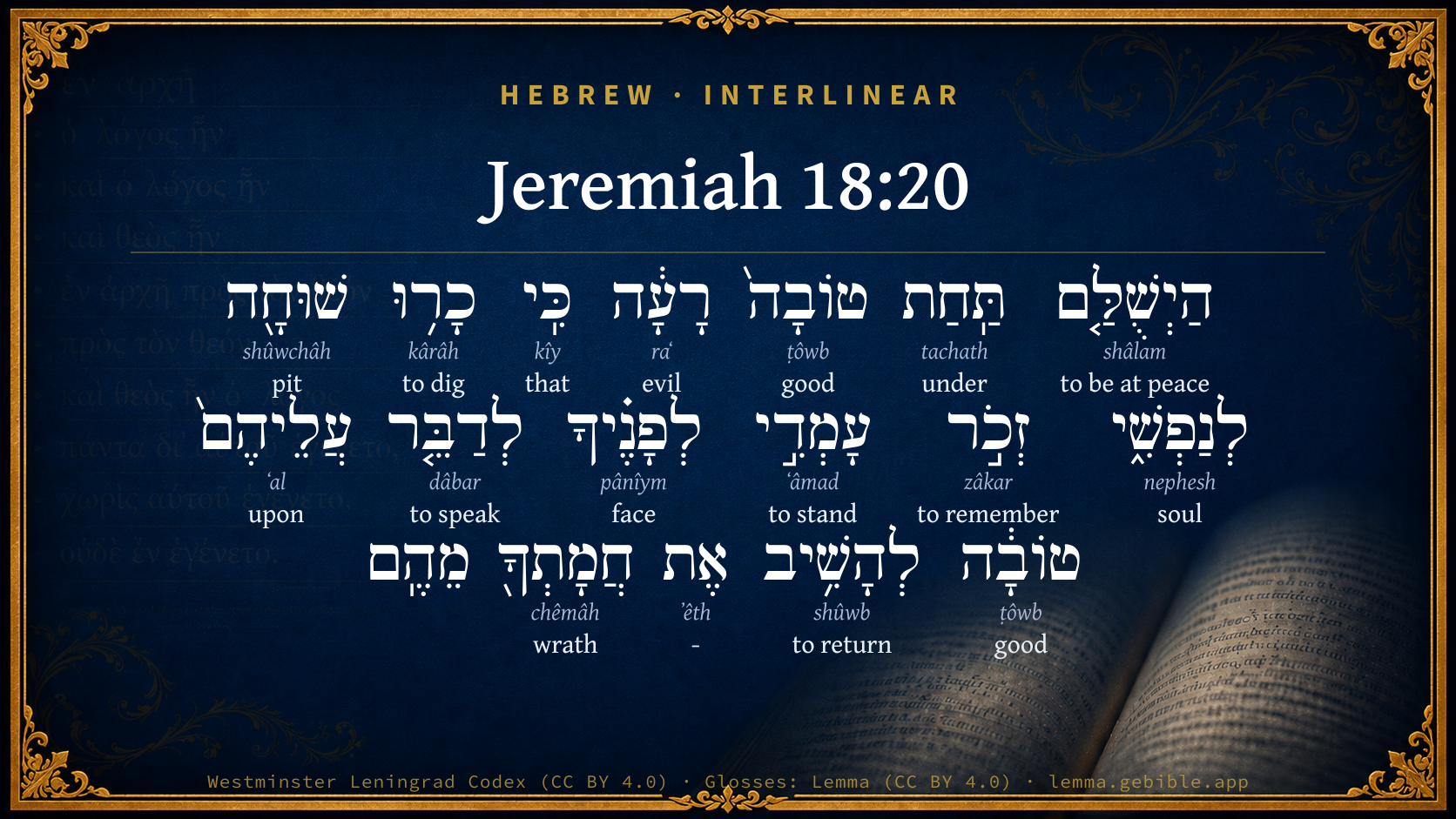
Jeremiah 18:20

Hebrew (Westminster Leningrad Codex) Jeremiah 18:20 appears in the Hebrew Old Testament. The text above is from the Westminster Leningrad Codex. Each word links to its Strong’s number, a concise gloss, and parsing drawn from the Open Scriptures Hebrew Bible morphology. Click any word for its full Brown-Driver-Briggs (BDB) entry.
Download image
Cite this verse

Jeremiah 18:20 (World English Bible). Public Domain. Lemma interlinear Bible study tool, https://lemma.gebible.app/v/jeremiah/18/20.

Show BibTeX & RIS
BibTeX
RIS
English Translation
Shall evil be recompensed for good? for they have dug a pit for my soul. Remember how I stood before you to speak good for them, to turn away your wrath from them.
World English Bible · Public Domain
Download a study sheet

One document with this verse’s original text, its word-by-word gloss line, the meaning frame, cross-references with their text, attributed commentary, and full source and license credits — printable, and it pastes into notes with its structure intact.

This verse Autodidact and up

Study sheet (.html) Plain text (.txt)

A passage Seminary Student

Up to 50 verses in one chapter. A passage sheet keeps up to 6 commentary sources and 12 cross-references per verse, in the order this page ranks them, and says so on the sheet whenever that leaves anything out. Ask for a single verse and you get the Autodidact verse sheet above.

Everything on this page stays free to read, with no account — the sheet is a download of what is already on screen, not access to it.

Want to remove ads? Support Godless Engineer
Compare translations 3

The same verse in 3 English versions, stacked beneath the original-language interlinear above. Click any original word for its lexicon entry.

Each is an independent rendering of the whole verse — the interlinear is not word-aligned to these translations.

Highlighted words mark where these versions differ — a whole-verse word diff, not a word-by-word alignment.

  • World English Bible Public Domain
    Shall evil be recompensed for good? for they have dug a pit for my soul. Remember how I stood before you to speak good for them, to turn away your wrath from them.
  • King James Version Public Domain
    Shall evil be recompensed for good? for they have digged a pit for my soul. Remember that I stood before thee to speak good for them, and to turn away thy wrath from them.
  • unfoldingWord Literal Text CC BY-SA 4.0
    Should evil be repaid in place of good? For they have dug a pit for my life. Remember my standing to your face to speak good concerning them, to turn back your wrath from them.

unfoldingWord Literal Text — © unfoldingWord, licensed CC BY-SA 4.0. Word-aligned USFM3 via Door43 (git.door43.org/unfoldingWord/en_ult).

Versions to compare (up to 4)

3 of 4 selected

Show all 18 translations

Every available English version of this verse, each an independent rendering of the whole verse.

  • World English Bible Public Domain
    Shall evil be recompensed for good? for they have dug a pit for my soul. Remember how I stood before you to speak good for them, to turn away your wrath from them.
  • Berean Standard Bible Public Domain
    Should good be repaid with evil? Yet they have dug a pit for me. Remember how I stood before You to speak good on their behalf, to turn Your wrath from them.
  • Majority Standard Bible Public Domain
    Should good be repaid with evil? Yet they have dug a pit for me. Remember how I stood before You to speak good on their behalf, to turn Your wrath from them.
  • King James Version Public Domain
    Shall evil be recompensed for good? for they have digged a pit for my soul. Remember that I stood before thee to speak good for them, and to turn away thy wrath from them.
  • American Standard Version (1901) Public Domain
    Shall evil be recompensed for good? for they have digged a pit for my soul. Remember how I stood before thee to speak good for them, to turn away thy wrath from them.
  • Revised Version (1885) Public Domain
    Shall evil be recompensed for good? for they have digged a pit for my soul. Remember how I stood before thee to speak good for them, to turn away thy fury from them.
  • Geneva Bible (1599) Public Domain
    Shall euill be recompensed for good? for they haue digged a pit for my soule: remember that I stood before thee, to speake good for the, and to turne away thy wrath from them.
  • Douay-Rheims (1899) Public Domain
    Shall evil be rendered for good, because they have digged a pit for my soul? Remember that I have stood in thy sight, so speak good for them, and turn away thy indignation from them.
  • Young's Literal Translation Public Domain
    Is evil recompensed instead of good, That they have dug a pit for my soul? Remember my standing before Thee to speak good of them, To turn back Thy wrath from them.
  • Literal Standard Version CC BY-SA 4.0
    Is evil repaid instead of good, || That they have dug a pit for my soul? Remember my standing before You to speak good of them, || To turn back Your wrath from them.
  • Unlocked Literal Bible CC BY-SA 4.0
    Will disaster from them really be my reward for being good to them? For they have dug a pit for me. Remember how I stood before you to speak for their welfare, to cause your fury to turn away from them.
  • unfoldingWord Literal Text CC BY-SA 4.0
    Should evil be repaid in place of good? For they have dug a pit for my life. Remember my standing to your face to speak good concerning them, to turn back your wrath from them.
  • Darby Bible Public Domain
    Shall evil be recompensed for good? For they have digged a pit for my soul. Remember how I stood before thee to speak good for them, to turn away thy wrath from them.
  • World Messianic Bible Public Domain
    Should evil be recompensed for good? For they have dug a pit for my soul. Remember how I stood before you to speak good for them, to turn away your wrath from them.
  • Webster's Bible Public Domain
    Shall evil be recompensed for good? for they have digged a pit for my soul. Remember that I stood before thee to speak good for them, and to turn away thy wrath from them.
  • Free Bible Version CC BY-SA 4.0
    Should good be paid back with evil? Yet they have dug a pit to trap me! Remember how I stood before you to plead on their behalf, to stop you being angry with them?
  • Bible in Basic English Public Domain
    Is evil to be the reward of good? for they have made a deep hole for my soul. Keep in mind how I took my place before you, to say a good word for them so that your wrath might be turned away from them.
  • JPS Tanakh (1917) Public Domain
    Shall evil be recompensed for good? For they have digged a pit for my soul. Remember how I stood before Thee to speak good for them, to turn away Thy wrath from them.

Literal Standard Version (2020), Covenant Press — licensed CC BY-SA 4.0. Text via the HelloAO Bible API (eBible.org). Unlocked Literal Bible (unfoldingWord) — licensed CC BY-SA 4.0. Text via the HelloAO Bible API (eBible.org). unfoldingWord Literal Text — © unfoldingWord, licensed CC BY-SA 4.0. Word-aligned USFM3 via Door43 (git.door43.org/unfoldingWord/en_ult). Free Bible Version, Dr. Jonathan Gallagher — licensed CC BY-SA 4.0. Text via the HelloAO Bible API (eBible.org).

Word by word

More ways to search: Search by grammar → Find every occurrence → Compare this word →

Practice this passage: Drill this verse → Learn its vocabulary →

שׁוּחָ֖ה
shûwchâh
H7745
“pit”
Noun, Common, Feminine, Singular, Absolute
Part of Speech
Noun
Type
Common
Gender
Feminine
Number
Singular
State
Absolute
Full BDB Definition

Origin: from H7743

TWOT: 2343 . 1a

pit
  1. הַיְשֻׁלַּ֤ם shâlam H7999 “to be at peace” Particle, Interrogative + Verb, Pual, Imperfect, 3rd Person, Masculine, Singular
  2. תַּֽחַת tachath H8478 “under” Preposition
  3. טוֹבָה֙ ṭôwb H2896 “good” Adjective, Adjective, Feminine, Singular, Absolute
  4. רָעָ֔ה raʻ H7451 “evil” Noun, Common, Feminine, Singular, Absolute
  5. כִּֽי kîy H3588 “that” Conjunction
  6. כָר֥וּ kârâh H3738 “to dig” Verb, Qal, Perfect, 3rd Person, Common, Plural
  7. לְנַפְשִׁ֑י nephesh H5315 “to/for · soul · my” Preposition + Noun, Common, Both, Singular, Construct + Suffix, Personal, 1st Person, Common, Singular
  8. זְכֹ֣ר zâkar H2142 “remember” Verb, Qal, Imperative, 2nd Person, Masculine, Singular
  9. עָמְדִ֣י ʻâmad H5975 “to stand · me” Verb, Qal, Infinitive Construct + Suffix, Personal, 1st Person, Common, Singular
  10. לְפָנֶ֗יךָ pânîym H6440 “to/for · face(s) · your” Preposition + Noun, Common, Both, Plural, Construct + Suffix, Personal, 2nd Person, Masculine, Singular
  11. לְדַבֵּ֤ר dâbar H1696 “to speak” Preposition + Verb, Piel, Infinitive Construct
  12. עֲלֵיהֶם֙ ʻal H5921 “upon · them” Preposition + Suffix, Personal, 3rd Person, Masculine, Plural
  13. טוֹבָ֔ה ṭôwb H2896 “good” Adjective, Adjective, Feminine, Singular, Absolute
  14. לְהָשִׁ֥יב shûwb H7725 “to return” Preposition + Verb, Hiphil, Infinitive Construct
  15. אֶת ʼêth H853 “-” Particle, Direct Object
  16. חֲמָתְךָ֖ chêmâh H2534 “wrath · your” Noun, Common, Feminine, Singular, Construct + Suffix, Personal, 2nd Person, Masculine, Singular

About this verse

These counts appear in no published source. They are computed here, from the morphology-tagged text and Lemma’s own curated glosses. What Lemma adds →

18
words
16
distinct lemmas
Prophets
section

Notable vocabulary

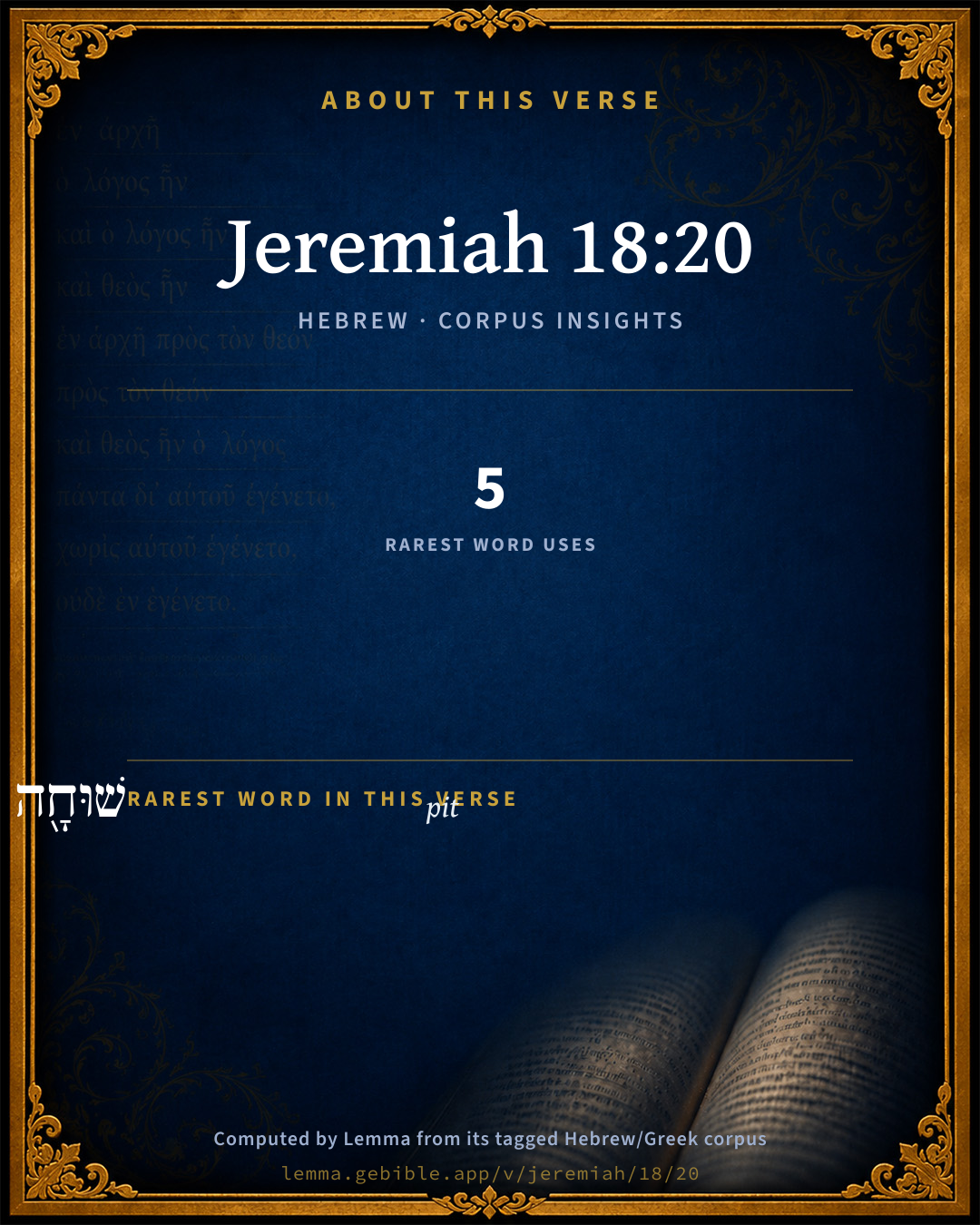
The rarest word here is שׁוּחָ֖ה pit H7745 — appearing just 5 times in the whole Hebrew Bible.

Shared distinctive vocabulary

שׁוּחָ֖ה pit H7745 occurs in 5 verses of the Hebrew Bible. Also found in:

Grammatical profile

  • 6 verbs
  • 5 nouns
  • 2 adjectives
  • 3 prepositions
  • 1 conjunction
  • 1 particle

Verb forms

  • הַיְשֻׁלַּ֤ם Pual · Imperfect
  • כָר֥וּ Qal · Perfect
  • זְכֹ֣ר Qal · Imperative
  • עָמְדִ֣י Qal · Infinitive Construct
  • לְדַבֵּ֤ר Piel · Infinitive Construct
  • לְהָשִׁ֥יב Hiphil · Infinitive Construct

Repetition

A word recurs within this verse — often emphatic in Hebrew:

  • טוֹבָה֙ good H2896 ×2

Cross-references

23

Topical passages linked to Jeremiah 18:20 in the Treasury of Scripture Knowledge — connected by theme and wording, ordered by reader-vote popularity; previews shown in the World English Bible.

  • Psalms 35:7 For without cause they have hidden their net in a pit for me. Without cause they have dug a pit for my soul.
  • Psalms 57:6 They have prepared a net for my steps. My soul is bowed down. They dig a pit before me. They fall into the midst of it themselves. Selah.
  • Psalms 106:23 Therefore he said that he would destroy them, Had Moses, his chosen, not stood before him in the breach, To turn away his wrath, so that he wouldn't destroy them.
  • 1 Samuel 24:17–19 He said to David, You are more righteous than I; for you have rendered to me good, whereas I have rendered to you evil.
  • Psalms 35:12 They reward me evil for good, To the bereaving of my soul.
  • Psalms 109:4–5 In return for my love, they are my adversaries; But I am in prayer.
  • Psalms 119:95 The wicked have waited for me, to destroy me. I will consider your statutes.
  • Proverbs 26:27 Whoever digs a pit shall fall into it. Whoever rolls a stone, it will come back on him.
  • Ecclesiastes 10:8 He who digs a pit may fall into it; and whoever breaks through a wall may be bitten by a snake.
  • Jeremiah 18:22 Let a cry be heard from their houses, when you shall bring a troop suddenly on them; for they have dug a pit to take me, and hid snares for my feet.
  • Genesis 18:22–32 The men turned from there, and went toward Sodom, but Abraham stood yet before Yahweh.
  • Job 6:27 Yes, you would even cast lots for the fatherless, And make merchandise of your friend.
  • Psalms 7:15 He has dug a hole, And has fallen into the pit which he made.
  • Psalms 38:20 They who also render evil for good are adversaries to me, Because I follow what is good.
  • Proverbs 17:13 Whoever rewards evil for good, Evil shall not depart from his house.
  • Jeremiah 7:16 Therefore don't you pray for this people, neither lift up a cry nor prayer for them, neither make intercession to me; for I will not hear you.
  • Jeremiah 11:14 Therefore don't you pray for this people, neither lift up cry nor prayer for them; for I will not hear them in the time that they cry to me because of their trouble.
  • Jeremiah 14:7–11 Though our iniquities testify against us, work you for your name's sake, Yahweh; for our backslidings are many; we have sinned against you.
  • Jeremiah 14:20–15:1 We acknowledge, Yahweh, our wickedness, and the iniquity of our fathers; for we have sinned against you.
  • Ezekiel 22:30–31 I sought for a man among them, who should build up the wall, and stand in the gap before me for the land, that I should not destroy it; but I found none.
  • Zechariah 3:1–2 He showed me Joshua the high priest standing before the angel of Yahweh, and Satan standing at his right hand to be his adversary.
  • John 10:32 Jesus answered them, "I have shown you many good works from my Father. For which of those works do you stone me?"
  • John 15:25 But this happened so that the word may be fulfilled which was written in their law, 'They hated me without a cause.'

Cross-references courtesy of OpenBible.info (CC BY 4.0).

Hebrew and Greek witnesses Masoretic Hebrew ↔ Greek Septuagint

The same verse in the two great witnesses to the Old Testament, shown verse-for-verse.

These are two independent witnesses, not word-aligned to each other, and the Septuagint is shown in lemma (dictionary) form.

Hebrew Jeremiah 18:20 Masoretic · Westminster Leningrad Codex

הַיְשֻׁלַּ֤ם תַּֽחַת טוֹבָה֙ רָעָ֔ה כִּֽי כָר֥וּ שׁוּחָ֖ה לְנַפְשִׁ֑י זְכֹ֣ר עָמְדִ֣י לְפָנֶ֗יךָ לְדַבֵּ֤ר עֲלֵיהֶם֙ טוֹבָ֔ה לְהָשִׁ֥יב אֶת חֲמָתְךָ֖ מֵהֶֽם

Shall evil be recompensed for good? for they have dug a pit for my soul. Remember how I stood before you to speak good for them, to turn away your wrath from them.

World English Bible · Public Domain

Greek LXX Structure differs

In the Septuagint, Jeremiah is about an eighth shorter than the Hebrew and arranges its material differently — the Oracles Against the Nations (Hebrew chapters 46–51) appear in the middle of the Greek book, after 25:13. Because the chapter and verse boundaries do not line up, a verse-for-verse comparison with the Hebrew is not shown.

A verse-for-verse comparison isn’t shown here because the chapters and verses don’t line up. Switch to the LXX edition with the MT / LXX toggle above to read the Greek directly.

Hebrew: Westminster Leningrad Codex (CC BY 4.0). Greek: Septuagint (public domain); English from a public-domain English Septuagint. How the Septuagint differs from the Hebrew →

Targum (Aramaic paraphrase)

1

The Targum is the ancient Jewish Aramaic paraphrase of the Hebrew Scriptures — an interpretive translation, not the Hebrew text itself. Onkelos (literal) and Pseudo-Jonathan (expansive) render the Torah, and Jonathan the Prophets. Coverage is partial: where no permissively-licensed English translation exists for a verse, only the Aramaic is shown. This is verse-level text, not a word-by-word alignment to the Hebrew.

  1. Targum Jonathan Prophets (Joshua–Malachi)
    הֲאֶפְשַׁר לְשַׁלָמָא חֲלַף טַבְתָא בִּישְׁתָּא אֲרֵי כְרוּ פַחַת לְמִקְטְלֵי יֵעוּל דוּכְרַן מֵקָמִי קֳדָמָךְ לְמַלָלָא עֲלֵיהוֹן פִּתְגָמִין תַּקְנִין לַאֲתָבָא יַת חַמְתָךְ מִנְהוֹן:

    (no public-domain English translation for this verse)

    Targum Jonathan — Aramaic: “Mikraot Gedolot” (public domain). English: “Sefaria Community Translation” (CC0 1.0 (public-domain dedication)); “London "Chaldee Paraphrase," 1871” (public domain). Text via Sefaria.

Commentary

Notes on Jeremiah 18:20 from classic Christian and Jewish commentators (each source and its license shown beneath its notes). The classic Christian expositions comment on the surrounding passage and are grouped to its opening verse, so a note may address several verses; the Jewish commentaries on the Tanakh (Rashi and others) are per-verse, so they appear only where the commentator wrote on this verse.

Lemma curates 59 commentaries, every one of them public domain or Creative Commons licensed, each selected and text-cleaned for this edition rather than reprinted as found. About our sources →

Trapp's Complete Commentary

John Trapp

Jer 18:20 Shall evil be recompensed for good? for they have digged a pit for my soul. Remember that I stood before thee to speak good for them, [and] to turn away thy wrath from them.

Ver. 20. Shall evil be recompensed for good?] q.d., That is greatest disingenuity and unthankfulness. To render good for evil is divine; good for good is human; evil for evil is brutish; but evil for good devilish. Lo, with such breathing devils had Jeremiah here to do; and, indeed, what good man hath not? See 1Sa 24:17 Psa 35:12; Psa 109:5.

John Trapp, A Commentary or Exposition upon All the Books of the Old and New Testament (1647–1656) — public domain. Text from a community e-Sword module.

Jamieson, Fausset & Brown

Robert Jamieson, A. R. Fausset & David Brown

In the particulars here specified, Jeremiah was a type of Jesus Christ (Psa 109:4-5; Joh 15:25).

my soul--my life; me (Psa 35:7).

I stood before thee . . . to turn away thy wrath--so Moses (Psa 106:23; compare Eze 22:30). So Jesus Christ, the antitype of previous partial intercessors (Isa 59:16).

Jamieson, Fausset & Brown — Commentary Critical and Explanatory on the Whole Bible (1871) — public domain (CC PDM 1.0). Text via the HelloAO Bible API.

Adam Clarke's Commentary

Verse 20. They have digged a pit for my soul.] For my life; this they wish to take away.

Stood before thee to speak good for them] I was their continual intercessor.

Adam Clarke's Commentary on the Bible (1810–1826) — public domain. Text from a community e-Sword/MySword module.

John Calvin's Commentaries

The Prophet in this verse exaggerates the sin of his enemies, for they not only were ferocious against God, but also forgot everything humane, and wickedly assailed the Prophet himself. Impiety is indeed more detestable than inhumanity, inasmuch as God is far above all mortals; but inhumanity has in it more basenes, for it is, so to speak, more gross and more evident. The ungodly often hide their perfidy; but when they come to act towards men, then it appears immediately what they are. Hence the Prophet, having made known the impiety of his enemies, now adds, that they, when tried by the judgment of men, were found to be wholly intolerable, for they rendered a shameful reward to an innocent man who was sedulous in securing their salvation. We now understand the meaning of the Prophet.

Though it often happens that evil is rendered for good, and ingratitude is a common vice, yet nature itself detests ingratitude: hence it has been said that there is no law against the ungrateful, because ingratitude seems a monstrous thing. As then nature dictates that merit deserves a reward, and this ought to be a fixed principle in the hearts of all, the Prophet reasons according to the common sense and judgment of all mankind.

Shall evil, he says, be rendered for good? for they have digged a pit for my soul? and yet I prayed for them, and endeavored to turn away the wrath of God. Since I have set myself humbly to pray for their salvation, how great is their savageness and inhumanity in persecuting me? But as he saw that it was vain to speak to the deaf, he again appeals to God as a witness to his integrity; Remember, he says, that I stood before thy face to speak for them; as though he had said, “Even if malignity prevent men to own what I am, and how I have conducted myself towards them, God will be to me a sufficient witness, and I shall be satisfied with his judgment.” It then follows —

John Calvin's Commentaries (1540-1563) — public domain. Text from the Calvin Translation Society English edition (1840s-50s) via the Christian Classics Ethereal Library (ccel.org). Calvin's coverage is partial (roughly two-thirds of the Bible); uncommented books and verses are honest gaps, never fabricated. The 19th-century editor's footnotes and remarks are omitted so the notes are faithfully Calvin's own voice.

Ellicott's Commentary for English Readers

(20) They have digged a pit for my soul.—The image has become so familiar that we have all but lost its vividness. What it meant here (as in Psa_57:6) was that the man was treated as a beast, the prophet who sought their good as the wolf or the jackal whom they entrapped and slew.

Remember that I stood before thee.—The phrase is used frequently, though not uniformly, of the act of worship, of the communion of the soul with God (comp. Jer_7:10; Deu_10:8; Deu_19:17; Deu_29:10; 1Ki_19:11), and is clearly used in this sense here. The prophet refers to his repeated though fruitless entreaties for the people in Jeremiah 14, 15. It is interesting to note the description of Jeremiah, in 2Ma_15:14, as “a lover of the brethren who prayeth much for the people and the holy city.” Men had come to recognise that the spirit of intercession had been the prophet’s dominant characteristic.

A Bible Commentary for English Readers, edited by Charles John Ellicott (1878–1897) — public domain. Text from a community e-Sword module.

The Cambridge Bible for Schools and Colleges

gen. ed. J. J. S. Perowne

20. Shall evil be recompensed for good?] Jeremiah had interceded for the people in times past, e.g. ch. Jer_14:7; Jer_14:21.

The Cambridge Bible for Schools and Colleges (gen. ed. J. J. S. Perowne; Cambridge University Press, 1878–1918) — public domain. Text from a community e-Sword module.

John Gill's Exposition

Let a cry be heard from their houses,.... A shrieking of women and children, not only for the loss of husbands and parents, but because of the entrance of the enemy into the city, and into their houses, to take away their lives and their substance; as follows:

when thou shalt bring a troop suddenly upon them; or an army, as the Targum; either the Chaldean army, or rather the Roman army:

for they have digged a pit to take me, and hid snares for my feet: and therefore it was a just retaliation, that a troop or army should suddenly come upon them, and seize their persons and substance; though Kimchi understands it, as before, of poison, which they would have given him; but Jarchi, of a suspicion and vile calumny they raised of him, that he was guilty of adultery with another man's wife; a "whore" being called a "deep ditch" by the wise man, Pro 23:27; and so it is in the Talmud (h).

(h) T. Bab. Kama, fol. 16. 2.

John Gill's Exposition of the Whole Bible (1746–1763) — public domain (CC PDM 1.0). Text via the HelloAO Bible API.

Albert Barnes' Notes on the Bible

Jeremiah had been laboring earnestly to avert the ruin of his country, but the Jews treated him as farmers do some noxious animal which wastes their fields, and for which they dig pitfalls.

Albert Barnes' Notes on the Bible (1834–1885) — public domain. Text from a community e-Sword/MySword module.

Haydock's Catholic Bible Commentary

Remember, &c. This is spoken in the person of Christ, persecuted by the Jews, and prophetically denouncing the evils that should fall upon them in punishment for their crimes. (Challoner) --- Jeremias had prayed earnestly for the people, chap. xiv. 17. (Haydock)

George Leo Haydock (1774–1849), Haydock's Catholic Family Bible and Commentary, 1859 edition — public domain. Excludes Psalms (Douay-Rheims chapter numbering differs from Protestant) and Deuterocanonical books (Catholic canon only).

Matthew Poole's English Annotations

Shall evil be recompensed for good? to requite good for evil is divine, God maketh his sun to shine, and his rain to fall, upon the just and unjust; to requite evil for evil, or good for good, is but human, what the nature of reasonable men prompt them to; but to requite evil for good is diabolical, and the character of those that are the children of the evil one.

For they have digged a pit for my soul; Lord, saith the prophet, these men have done thus, they have laid snares for my life; though thou knowest that as a prophet I stood before thee, both preaching and praying for their good. Their wrath is kindled to a great height against me, and thou knowest my business was, both in my preachings to them, and prayers for them,

to turn away thy wrath from them. Lord, remember this, both for good to me, and for vengeance upon them.

Matthew Poole's English Annotations on the Holy Bible (1683–1685) — public domain. Text from a community e-Sword/MySword module.

Lesson kit

Teaching starters — assembled from the data on this page, not authored interpretation. Every prompt links to the verse data it draws on. Edit before teaching.

Jeremiah, in the Prophets, opens this verse with 18 words (16 distinct Hebrew lemmas). Its most distinctive word is shûwchâh (“pit”). A historical commentator’s framing appears above. Read the whole chapter for the surrounding context.

Discussion questions

  1. What does “pit” (shûwchâh) contribute to the verse as a whole?
  2. Proverbs 22:14 shares the word «pit» with this verse. How do the two illuminate each other?
  3. “good” occurs 2× in this one verse. What is the effect of the repetition?
  4. The translations on this page render this verse differently — a whole-verse word diff, not a word-by-word alignment. What might account for the different wordings?
  5. The verb «הַיְשֻׁלַּ֤ם» is Pual Imperfect. How does its form color the action?
  6. Reading how Trapp's Complete Commentary and Jamieson, Fausset & Brown read this verse, where do the two commentators agree and where do they part?

Things to notice

Reading settings

Reading text

Shown beneath each verse's original-language words.

Old Testament
Old Testament edition

Read the OT as the Masoretic Hebrew (MT) or the Greek Septuagint (LXX).

English shown for the Greek Septuagint (in the Hebrew ↔ Greek comparison).

Comparing translations? Open the Compare panel on any verse page to stack up to four side by side.