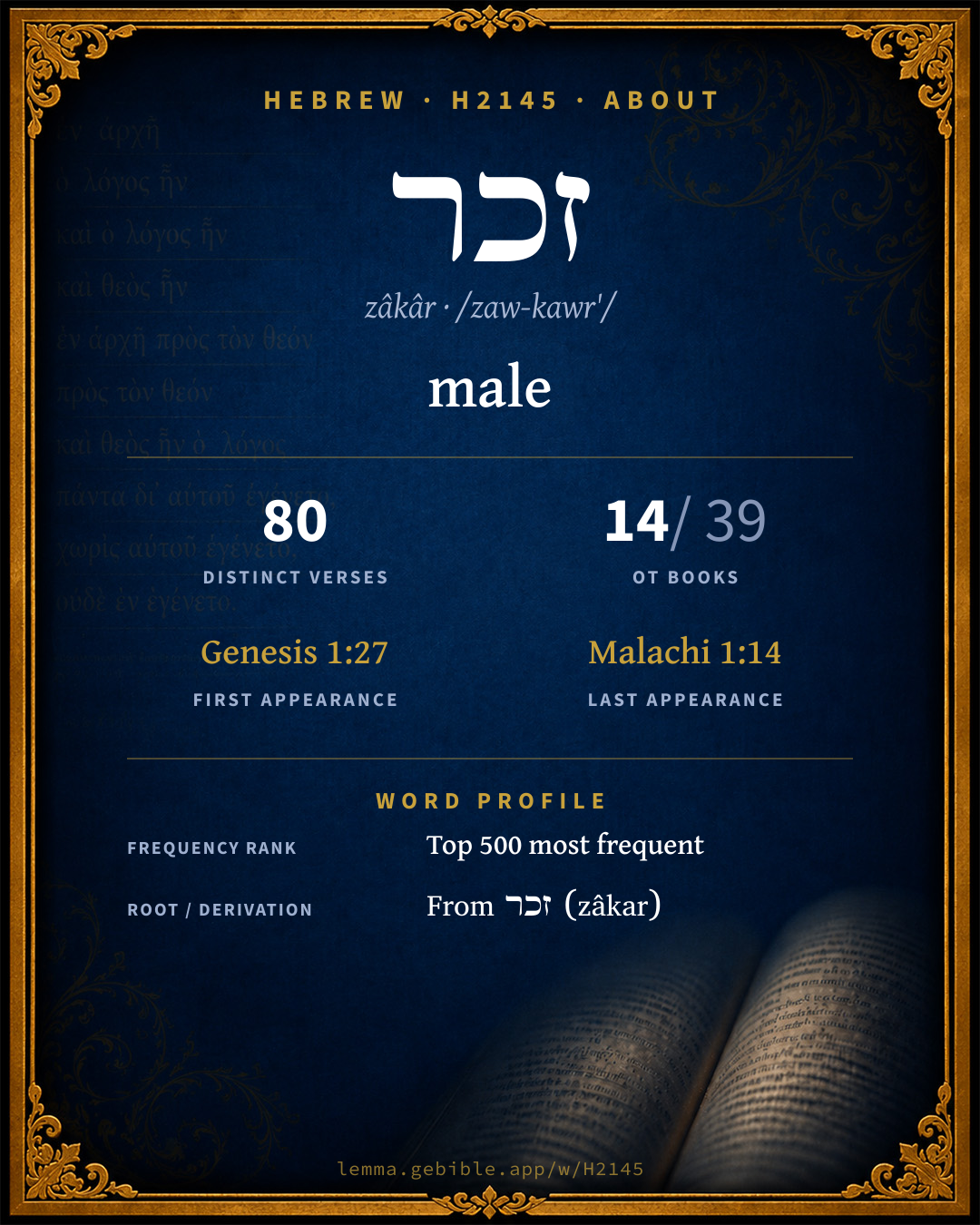
זָכָר
male
‘male’ is one of 2 main senses fuller range ↓
Full lexicon entry — Brown-Driver-Briggs (BDB)
From Brown-Driver-Briggs (BDB)
Where this word appears
Grammar key — what these labels mean
Part of speech
- Adjective
- A word that describes or qualifies a noun.
Noun type
- Common
- A common noun — a general class of person, place, or thing (“king,” “city,” “water”), not a specific name.
State
- Absolute
- The independent form of a noun, not bound to a following word.
Gender
- Masculine
- Grammatically masculine.
Number
- Singular
- One.
- Plural
- More than one (in Hebrew, generally three or more).
Grammatical forms
- Adjective, Adjective, Masculine, Singular, Absolute 58 times (71%)
- Noun, Common, Masculine, Plural, Absolute 17 times (21%)
- Noun, Common, Masculine, Singular, Absolute 7 times (9%)
Parsed forms decoded from the imported morphology (morphhb / Westminster Leningrad Codex — WLC text public domain, morphhb tagging CC BY 4.0), counted across 82 parsed occurrences — not distinct verses.
Every verse where H2145 appears — 80 distinct verses across 14 books. Click any verse to open its interlinear word-by-word view. Verse text shown in the World English Bible for context — . Each verse’s Hebrew form is shown with its reference; the English is not keyword-highlighted, since the data carries no word-level English alignment. Use “Compare translations” on any verse to read it across multiple English versions. This concordance covers the Hebrew Bible; Septuagint (Greek Old Testament) occurrences are not indexed here.
Genesis 14 verses
- Genesis 1:27 זָכָ֥ר adj Adjective ms God created man in his own image. In God's image he created him; male and female he created them.
- Genesis 5:2 זָכָ֥ר adj Adjective ms He created them male and female, and blessed them, and called their name Adam, in the day when they were created.
- Genesis 6:19 זָכָ֥ר adj Adjective ms Of every living thing of all flesh, you shall bring two of every sort into the ark, to keep them alive with you. They shall be male and female.
- Genesis 7:3 זָכָ֣ר adj Adjective ms Also of the birds of the sky, seven and seven, male and female, to keep seed alive on the surface of all the earth.
- Genesis 7:9 זָכָ֣ר adj Adjective ms went by pairs to Noah into the ark, male and female, as God commanded Noah.
- Genesis 7:16 זָכָ֨ר adj Adjective ms Those who went in, went in male and female of all flesh, as God commanded him; and Yahweh shut him in.
- Genesis 17:10 זָכָֽר adj Adjective ms This is my covenant, which you shall keep, between me and you and your seed after you. Every male among you shall be circumcised.
- Genesis 17:12 זָכָ֖ר adj Adjective ms He who is eight days old will be circumcised among you, every male throughout your generations, he who is born in the house, or bought with money of any foreigner who is not of your seed.
- Genesis 17:14 זָכָ֗ר adj Adjective ms The uncircumcised male who is not circumcised in the flesh of his foreskin, that soul shall be cut off from his people. He has broken my covenant."
- Genesis 17:23 זָכָ֕ר adj Adjective ms Abraham took Ishmael his son, all who were born in his house, and all who were bought with his money; every male among the men of Abraham's house, and circumcised the flesh of their foreskin in the same day, as God had said to him.
- Genesis 34:15 זָכָֽר adj Adjective ms Only on this condition will we consent to you. If you will be as we are, that every male of you be circumcised;
- Genesis 34:22 זָכָ֔ר adj Adjective ms Only on this condition will the men consent to us to dwell with us, to become one people, if every male among us be circumcised, as they are circumcised.
- Genesis 34:24 זָכָ֔ר adj Adjective ms All who went out of the gate of his city listened to Hamor, and to Shechem his son; and every male was circumcised, all who went out of the gate of his city.
- Genesis 34:25 זָכָֽר adj Adjective ms It happened on the third day, when they were sore, that two of Jacob's sons, Simeon and Levi, Dinah's brothers, each took his sword, came upon the unsuspecting city, and killed all the males.
Exodus 4 verses
- Exodus 12:5 זָכָ֥ר adj Adjective ms Your lamb shall be without blemish, a male a year old. You shall take it from the sheep, or from the goats:
- Exodus 12:48 זָכָ֗ר adj Adjective ms When a stranger shall live as a foreigner with you, and will keep the Passover to Yahweh, let all his males be circumcised, and then let him come near and keep it; and he shall be as one who is born in the land: but no uncircumcised person shall eat of it.
- Exodus 13:12 הַ/זְּכָרִ֖ים ptcl def.art + n c mp that you shall set apart to Yahweh all that opens the womb, and every firstborn which you have that comes from an animal. The males shall be Yahweh's.
- Exodus 13:15 הַ/זְּכָרִ֔ים ptcl def.art + n c mp and it happened, when Pharaoh would hardly let us go, that Yahweh killed all the firstborn in the land of Egypt, both the firstborn of man, and the firstborn of animal. Therefore I sacrifice to Yahweh all that opens the womb, being males; but all the firstborn of my sons I redeem.'
Leviticus 18 verses
- Leviticus 1:3 זָכָ֥ר adj Adjective ms "'If his offering is a burnt offering from the herd, he shall offer a male without blemish. He shall offer it at the door of the Tent of Meeting, that he may be accepted before Yahweh.
- Leviticus 1:10 זָכָ֥ר adj Adjective ms "'If his offering is from the flock, from the sheep, or from the goats, for a burnt offering, he shall offer a male without blemish.
- Leviticus 3:1 זָכָר֙ adj Adjective ms "'If his offering is a sacrifice of peace offerings; if he offers it from the herd, whether male or female, he shall offer it without blemish before Yahweh.
- Leviticus 3:6 זָכָר֙ adj Adjective ms "'If his offering for a sacrifice of peace offerings to Yahweh is from the flock; male or female, he shall offer it without blemish.
- Leviticus 4:23 זָכָ֥ר adj Adjective ms if his sin, in which he has sinned, is made known to him, he shall bring as his offering a goat, a male without blemish.
- Leviticus 6:18 זָכָ֞ר adj Adjective ms Every male among the children of Aaron shall eat of it, as their portion forever throughout your generations, from the offerings of Yahweh made by fire. Whoever touches them shall be holy.'"
- Leviticus 6:29 זָכָ֥ר adj Adjective ms Every male among the priests shall eat of it: it is most holy.
- Leviticus 7:6 זָכָ֥ר adj Adjective ms Every male among the priests may eat of it. It shall be eaten in a holy place. It is most holy.
- Leviticus 12:2 זָכָ֑ר adj Adjective ms "Speak to the children of Israel, saying, 'If a woman conceives, and bears a male child, then she shall be unclean seven days; as in the days of her monthly period she shall be unclean.
- Leviticus 12:7 לַ/זָּכָ֖ר prep det + n c ms and he shall offer it before Yahweh, and make atonement for her; and she shall be cleansed from the fountain of her blood. "'This is the law for her who bears, whether a male or a female.
- Leviticus 15:33 לַ/זָּכָ֖ר prep det + n c ms and of her who has her period, and of a man or woman who has a discharge, and of him who lies with her who is unclean.
- Leviticus 18:22 זָכָ֔ר adj Adjective ms "'You shall not lie with a man, as with a woman. That is detestible.
- Leviticus 20:13 זָכָר֙ adj Adjective ms If a man lies with a male, as with a woman, both of them have committed an abomination: they shall surely be put to death; their blood shall be upon them.
- Leviticus 22:19 זָכָ֔ר adj Adjective ms that you may be accepted, you shall offer a male without blemish, of the bulls, of the sheep, or of the goats.
- Leviticus 27:3 הַ/זָּכָ֔ר ptcl def.art + n c ms Your valuation shall be of a male from twenty years old even to sixty years old, even your valuation shall be fifty shekels of silver, after the shekel of the sanctuary.
- Leviticus 27:5 הַ/זָּכָ֖ר ptcl def.art + n c ms If the person is from five years old even to twenty years old, then your valuation shall be for a male twenty shekels, and for a female ten shekels.
- Leviticus 27:6 הַ/זָּכָ֔ר ptcl def.art + n c ms If the person is from a month old even to five years old, then your valuation shall be for a male five shekels of silver, and for a female your valuation shall be three shekels of silver.
- Leviticus 27:7 זָכָ֔ר adj Adjective ms If the person is from sixty years old and upward; if it is a male, then your valuation shall be fifteen shekels, and for a female ten shekels.
Numbers 17 verses
- Numbers 1:2 זָכָ֖ר adj Adjective ms "Take a census of all the congregation of the children of Israel, by their families, by their fathers' houses, according to the number of the names, every male, one by one;
- Numbers 1:20 זָכָ֗ר adj Adjective ms The children of Reuben, Israel's firstborn, their generations, by their families, by their fathers' houses, according to the number of the names, one by one, every male from twenty years old and upward, all who were able to go out to war;
- Numbers 1:22 זָכָ֗ר adj Adjective ms Of the children of Simeon, their generations, by their families, by their fathers' houses, those who were numbered of it, according to the number of the names, one by one, every male from twenty years old and upward, all who were able to go out to war;
- Numbers 3:15 זָכָ֛ר adj Adjective ms "Number the children of Levi by their fathers' houses, by their families: every male from a month old and upward shall you number."
- Numbers 3:22 זָכָ֔ר adj Adjective ms Those who were numbered of them, according to the number of all the males, from a month old and upward, even those who were numbered of them were seven thousand five hundred.
- Numbers 3:28 זָכָ֔ר adj Adjective ms According to the number of all the males, from a month old and upward, there were eight thousand six hundred, keeping the charge of the sanctuary.
- Numbers 3:34 זָכָ֔ר adj Adjective ms Those who were numbered of them, according to the number of all the males, from a month old and upward, were six thousand two hundred.
- Numbers 3:39 זָכָר֙ adj Adjective ms All who were numbered of the Levites, whom Moses and Aaron numbered at the commandment of Yahweh, by their families, all the males from a month old and upward, were twenty-two thousand.
- Numbers 3:40 זָכָר֙ adj Adjective ms Yahweh said to Moses, "Number all the firstborn males of the children of Israel from a month old and upward, and take the number of their names.
- Numbers 3:43 זָכָ֜ר adj Adjective ms All the firstborn males according to the number of names, from a month old and upward, of those who were numbered of them, were twenty-two thousand two hundred seventy-three.
- Numbers 5:3 מִ/זָּכָ֤ר prep + n c ms Both male and female shall you put out, outside of the camp shall you put them; that they not defile their camp, in the midst of which I dwell."
- Numbers 18:10 זָכָר֙ adj Adjective ms As the most holy things shall you eat of it; every male shall eat of it: it shall be holy to you.
- Numbers 26:62 זָכָ֖ר adj Adjective ms Those who were numbered of them were twenty-three thousand, every male from a month old and upward: for they were not numbered among the children of Israel, because there was no inheritance given them among the children of Israel.
- Numbers 31:7 זָכָֽר adj Adjective ms They warred against Midian, as Yahweh commanded Moses; and they killed every male.
- Numbers 31:17 זָכָ֖ר זָכָ֖ר adj Adjective ms adj Adjective ms Now therefore kill every male among the little ones, and kill every woman who has known man by lying with him.
- Numbers 31:18 זָכָ֑ר adj Adjective ms But all the girls, who have not known man by lying with him, keep alive for yourselves.
- Numbers 31:35 זָכָ֑ר adj Adjective ms and thirty-two thousand persons in all, of the women who had not known man by lying with him.
Deuteronomy 2 verses
- Deuteronomy 4:16 זָכָ֖ר adj Adjective ms Lest you corrupt yourselves, and make yourself an engraved image in the form of any figure, the likeness of male or female,
- Deuteronomy 15:19 הַ/זָּכָ֔ר ptcl def.art + n c ms All the firstborn males that are born of your herd and of your flock you shall sanctify to Yahweh your God: you shall do no work with the firstborn of your herd, nor shear the firstborn of your flock.
Joshua 2 verses
- Joshua 5:4 הַ/זְּכָרִ֜ים ptcl def.art + n c mp This is the cause why Joshua did circumcise: all the people who came forth out of Egypt, who were males, even all the men of war, died in the wilderness by the way, after they came forth out of Egypt.
- Joshua 17:2 הַ/זְּכָרִ֖ים ptcl def.art + n c mp So [the lot] was for the rest of the children of Manasseh according to their families: for the children of Abiezer, and for the children of Helek, and for the children of Asriel, and for the children of Shechem, and for the children of Hepher, and for the children of Shemida: these were the male children of Manasseh the son of Joseph according to their families.
Judges 2 verses
- Judges 21:11 זָכָ֗ר זָכָ֖ר adj Adjective ms adj Adjective ms This is the thing that you shall do: you shall utterly destroy every male, and every woman who has lain by man.
- Judges 21:12 זָכָ֑ר adj Adjective ms They found among the inhabitants of Jabesh Gilead four hundred young virgins, who had not known man by lying with him; and they brought them to the camp to Shiloh, which is in the land of Canaan.
1 Kings 2 verses
- 1 Kings 11:15 זָכָ֖ר adj Adjective ms For it happened, when David was in Edom, and Joab the captain of the host was gone up to bury the slain, and had struck every male in Edom
- 1 Kings 11:16 זָכָ֖ר adj Adjective ms (for Joab and all Israel remained there six months, until he had cut off every male in Edom);
2 Chronicles 2 verses
- 2 Chronicles 31:16 לִ/זְכָרִ֗ים prep + n c mp besides those who were reckoned by genealogy of males, from three years old and upward, even everyone who entered into the house of Yahweh, as the duty of every day required, for their service in their offices according to their divisions;
- 2 Chronicles 31:19 זָכָר֙ adj Adjective ms Also for the sons of Aaron the priests, who were in the fields of the suburbs of their cities, in every city, there were men who were mentioned by name, to give portions to all the males among the priests, and to all who were reckoned by genealogy among the Levites.
Ezra 12 verses
- Ezra 8:3 לִ/זְכָרִ֖ים prep + n c mp Of the sons of Shecaniah, of the sons of Parosh, Zechariah; and with him were reckoned by genealogy of the males one hundred fifty.
- Ezra 8:4 הַ/זְּכָרִֽים ptcl def.art + n c mp Of the sons of Pahath-moab, Eliehoenai the son of Zerahiah; and with him two hundred males.
- Ezra 8:5 הַ/זְּכָרִֽים ptcl def.art + n c mp Of the sons of Shecaniah, the son of Jahaziel; and with him three hundred males.
- Ezra 8:6 הַ/זְּכָרִֽים ptcl def.art + n c mp Of the sons of Adin, Ebed the son of Jonathan; and with him fifty males.
- Ezra 8:7 הַ/זְּכָרִֽים ptcl def.art + n c mp Of the sons of Elam, Jeshaiah the son of Athaliah; and with him seventy males.
- Ezra 8:8 הַ/זְּכָרִֽים ptcl def.art + n c mp Of the sons of Shephatiah, Zebadiah the son of Michael; and with him eighty males.
- Ezra 8:9 הַ/זְּכָרִֽים ptcl def.art + n c mp Of the sons of Joab, Obadiah the son of Jehiel; and with him two hundred and eighteen males.
- Ezra 8:10 הַ/זְּכָרִֽים ptcl def.art + n c mp Of the sons of Shelomith, the son of Josiphiah; and with him one hundred sixty males.
- Ezra 8:11 הַ/זְּכָרִֽים ptcl def.art + n c mp Of the sons of Bebai, Zechariah the son of Bebai; and with him twenty-eight males.
- Ezra 8:12 הַ/זְּכָרִֽים ptcl def.art + n c mp Of the sons of Azgad, Johanan the son of Hakkatan; and with him one hundred ten males.
- Ezra 8:13 הַ/זְּכָרִֽים ptcl def.art + n c mp Of the sons of Adonikam, [who were] the last; and these are their names: Eliphelet, Jeuel, and Shemaiah; and with them sixty males.
- Ezra 8:14 הַ/זְּכָרִֽים ptcl def.art + n c mp Of the sons of Bigvai, Uthai and Zabbud; and with them seventy males.
Isaiah 1 verse
Jeremiah 2 verses
- Jeremiah 20:15 זָכָ֑ר adj Adjective ms Cursed be the man who brought news to my father, saying, A man-child is born to you; making him very glad.
- Jeremiah 30:6 זָכָ֑ר adj Adjective ms Ask now, and see whether a man does travail with child: why do I see every man with his hands on his loins, as a woman in travail, and all faces are turned into paleness?
Ezekiel 1 verse
Malachi 1 verse
About this entry
At a glance — auto-summarized from this page’s data, not written by a person. Every figure links to its source below. This summary describes the numbers; it doesn’t interpret them.
זכר (zâkâr) is a Hebrew word most often rendered “male.” Where the King James Version says “males,” newer translations reach for “male” (Berean Standard Bible); the renderings breakdown has the detail. The Hebrew Bible uses it across 80 verses — moderately common. Debuting at Genesis 1:27, it then recurs through the corpus. It is not a single-sense word — see its full sense range. The sections below give every sense, occurrence, and version rendering.
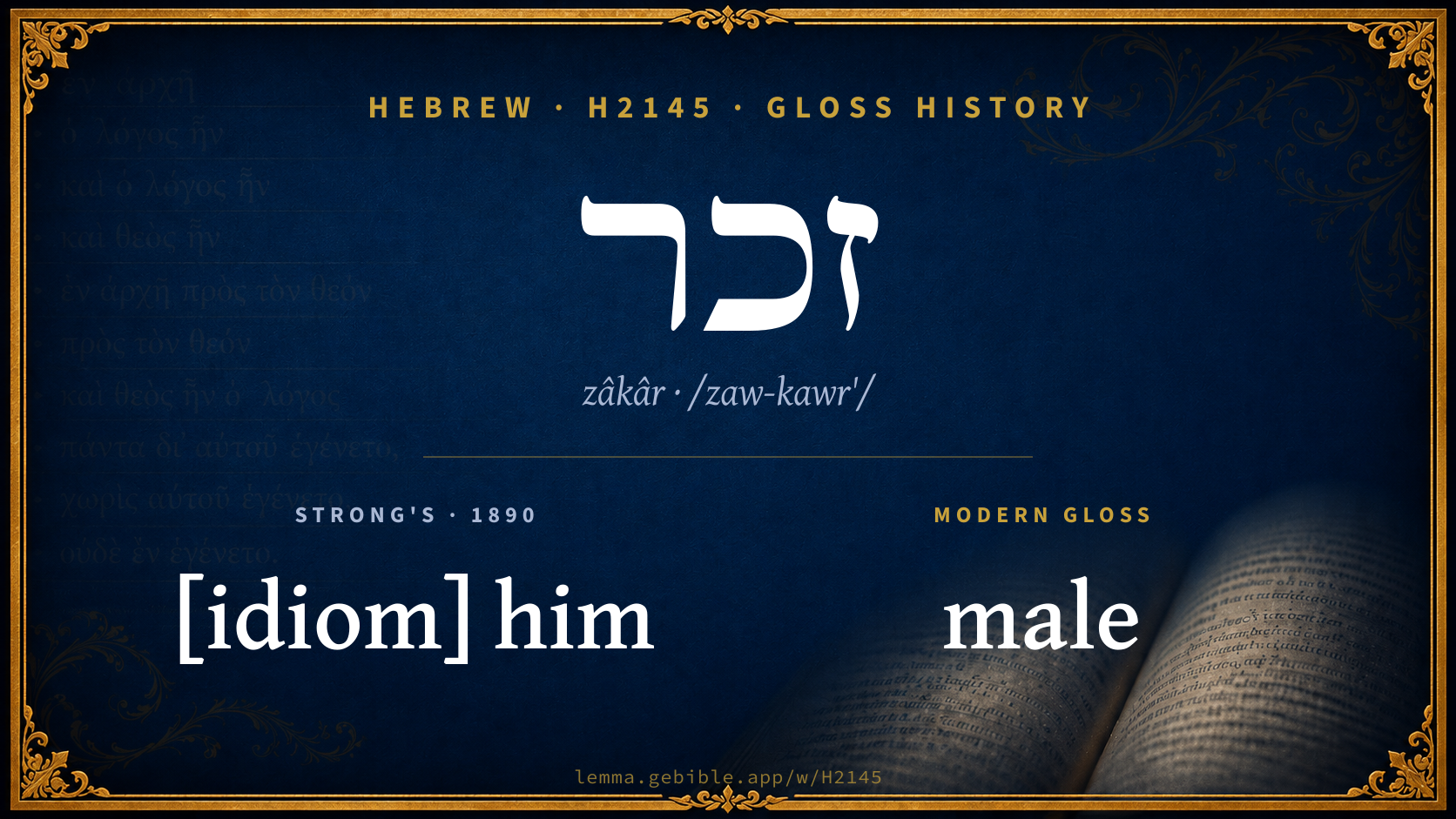
Gloss history
Strong's 1890 vs modern scholarship
About this word
Strong's H2145 catalogs a Hebrew word from the Hebrew Old Testament.
These counts are not copied from any lexicon or concordance. They are computed here, from the morphology-tagged Hebrew Old Testament. What Lemma adds →
- 80
- distinct verses
- The word appears in 80 distinct verses.
- 14 / 39
- OT books
- The word appears in 14 of 39 Old Testament books.
- #487
- by frequency
- Top 500 most frequent Hebrew words (rank 487 of 8,640 Hebrew words by occurrence).
View all 80 occurrences in the concordance →
By section of the Old Testament
By traditional corpus
Conventional, traditional groupings — biblical authorship is debated, so this is a traditional corpus grouping, not an authorship claim. Each share is this word’s portion of its verses in that division of the Hebrew canon. Each figure is a share of the word’s 80 distinct verses.
- Torah (Pentateuch) 55 verses · 69%
- Writings (Ketuvim) 14 verses · 18%
- Prophets (Nevi'im) 11 verses · 14%
How translations render this word
Counts come from each version’s own published word-to-Strong’s tagging or interlinear alignment — an approximate guide to how each version renders this word, not a word-level alignment the data otherwise carries. Because each total is that version’s own tagged count, the per-version totals vary from one another and need not match the appearance or distinct-verse counts above. These counts may also differ from a printed concordance because Lemma counts each distinctly tagged rendering and does not collapse phrase taggings into a single head-word total. This is a fixed set of word-tagged versions (KJV, ASV, BSB, ULT) and does not change with the reading translation you choose elsewhere. Each version’s license is shown beside its name below (and on Sources).
- King James Version: Males 16×, Every male 13×, Male 13×
- American Standard Version: Every male 17×, Males 17×, Male 12×
- Berean Standard Bible: Male 40×, Men 13×, Males 9×
- unfoldingWord Literal Text: Male 60×, Males 19×, A 4×
King James Version Public Domain
Renders H2145 across 81 tagged occurrences — most commonly:
Plus 18 renderings that appear only once — usually multi-word phrases or single function words the recovered tagging swept in, not distinct renderings.
American Standard Version Public Domain
Renders H2145 across 80 tagged occurrences — most commonly:
Plus 17 renderings that appear only once — usually multi-word phrases or single function words the recovered tagging swept in, not distinct renderings.
Berean Standard Bible Public Domain
Renders H2145 across 80 tagged occurrences — most commonly:
Plus 6 renderings that appear only once — usually multi-word phrases or single function words the recovered tagging swept in, not distinct renderings. Not rendered by a distinct English word in 2 further occurrences.
unfoldingWord Literal Text CC BY-SA 4.0
Renders H2145 across 89 tagged occurrences — most commonly:
Plus 2 renderings that appear only once — usually multi-word phrases or single function words the recovered tagging swept in, not distinct renderings.
Senses in the full BDB
What do BDB’s symbols mean?
BDB uses these scholarly abbreviations:
| Symbol | Meaning |
|---|---|
| 𝔊 | the Septuagint (the ancient Greek translation, LXX) |
| 𝔙 | the Vulgate (the Latin translation) |
| 𝔖 | the Syriac version (the Peshitta) |
| 𝔗 | the Targum (the Aramaic translation) |
| ψ | the Psalms |
| √ | root (the underlying root or stem) |
| ‖ | parallel passage (a synonymous or contrasted parallel) |
| † | the dagger: every passage where the word occurs is cited |
The 6 senses and sub-senses the full Brown-Driver-Briggs lexicon distinguishes for this word, in lexicon order (not ranked by frequency), with BDB’s own verbatim wording and sub-sense lettering. Shown in Hebrew script with BDB’s own scholarly abbreviations. The condensed entry is in the Lexicon Entry tab. See also the Forms in the corpus table below.
- I. subst. male, offspring of men and animals Ex 13:12, 15 (pl., both JE); opp. נְקֵבָה Dt 4:16; specif. e.g. Exodus 13:12
- 1. of men:
- a. in phr. אשׁר לא יָֽדְעָה אישׁ לְמִשְׁכַב זָכָר Ju 21:12 (BuRS 153 DrIntr. 151), cf. v 11, Nu 31:17, 18, 35 (all 3 P); צַלְמֵי זָכָר Ez 16:17. e.g. Judges 21:12
- b. alone = man Je 30:6 (רְאוּ אִם־יֹלֵד זָכָ֑ר, ‖ גֶּבֶר); usually coll., men, male persons (of all ages) Ju 21:11 1 K 11:15, 16, Gn 34:25 Lv 6:11, 22; 7:6 Nu 1:2, 20, 22; 3:28, 34, 39; 18:10; 26:62; 31:7, 17 (all P); pl. (ה)זכרים 2 Ch 31:16 Ezr 8:3, 4, 5, 6, 7, 8, 9, 10, 11, 12, 13, 14, so also Jos 5:4 (‖ כל־העם, and כל־אנשׁי המלחמה), 17:2 (gloss? cf. DrIntr. 104); especially of individ., in connex. with circumcision Gn 17:10, 12, 14, 23; 34:15, 22, 24 Ex 12:48 (all P); of male child Lv 12:2 (P) Is 66:7; opp. נְקֵבָה Gn 1:27; 5:2 Lv 12:7 (child) 15:33; 27:3, 5, 6, 7 Nu 5:3 (all P; cf. Sab. אנתֿים פאו דֿ(כ)רם DHMl.c.); opp. אִשָּׁה in command ag. sodomy Lv 18:22; 20:13 (both H). e.g. Jeremiah 30:6
- 2. of animals, especially for sacrifice Ex 34:19 (JE; read הַזָּכָר for MT תִּזָּכָר); Ex 12:5 Lv 1:3, 10; 4:23 (all P) 22:19 (H), Mal 1:14; opp. נְקֵבָה Gn 6:19; 7:3, 9, 16 Lv 3:1, 6 (all P) e.g. Exodus 34:19
- 1. of men:
- II. adj. sg. male (only human beings) יֻלַּד־לְךָ בֵּן ז׳ Je 20:15; כָּל־בְּכֹר ז׳ Nu 3:40, 43 (both P). e.g. Jeremiah 20:15
Senses from the full Brown-Driver-Briggs lexicon (Brown, Driver, Briggs; Oxford 1906 — public domain), digitized via Sefaria, supplemented by the OpenScriptures HebrewLexicon (CC BY 4.0). Full attribution on Sources.
Word origin
n.m. & adj. male (Assyrian zikaru, zikru, COTGloss Lyon Manual, Gloss; Arabic ذَكَرٌ; Aramaic דִּכְרָא, ܕܶܟܪܳܐ; Sab. דֿ[כ]רם DHMZMG 1876, 675; relation to above √ obscure; male as mentioned, talked of, Lane969 f.; from assumed orig. sense be sharp (traces of this in Arabic: v. Lane), BöProb 207 Fl in ChWB i, 422, cf. Arabic ذَكَرٌ male organ; SchwallyZAW 1891, 176 ff. from זָכַר = call upon in worship; hence male as competent to worship. (Against Schwally’s view see JPeritzWoman in the Ancient Hebrew Cult, JBL xvii (1898), 111 ff.).) —always abs. ז׳ Gn 1:27 +; pl. (ה)זְכָרִים Ex 13:12 +; vid. also [זָכוּר]:—
— Brown-Driver-Briggs (Oxford 1906, public domain), digitized via Sefaria, supplemented by the OpenScriptures HebrewLexicon (CC BY 4.0). See Sources.
Derived from זכר (zâkar) (H2142) — to remember.
Jastrow Dictionary
A second Hebrew/Aramaic lexicon for comparison, covering Aramaic and post-biblical (Talmudic, Targumic, Midrashic) usage that the biblical-Hebrew BDB does not. Matched by lemma rather than by Strong’s number, so a lemma may carry more than one Jastrow headword (shown separately below), and the entries cover usage well beyond the Bible.
זָכַר
- [to mark,] to remember, mention; to celebrate (by a ceremony &c.). Pes. 106ᵃ (ref. to Ex. XX, 8 זכור) זָכְרֵהוּ על היין Ms. M. (ed. זוֹכְרֵהוּ) remember the Sabbath (distinguish it) by a benediction over wine; Bets. 15ᵇ זכרהו מֵאַחֵר שבא וכ׳ mark the Sabbath (by a ceremony) from another (Holy Day) which (preceding the Sabbath) may cause the neglect of it (Ms. M. לאחר, Rashi מֵאַחַר, v. אַחַר; v. R. Nissim a. l.). Men. 43ᵇ ראה … וזְכוֹר וכ׳ see this ceremony and be reminded of another &c.; a. fr.—Part. pass. זָכוּר, f. זְכוּרָה a) reminded, remembering, mindful.—ז׳ אני, contr. זְכוּרַנִי I recollect. Sabb. 115ᵃ ז׳ אני ב־ I recollect about &c.—Bets. 18ᵃ ז׳ היא she will remember. Snh. 52ᵇ; a. fr.—b) thought of, remembered. B. Mets. 11ᵃ ז׳ ולבסוף שכוח if the sheaf had been thought of and was afterwards forgotten.—ז׳ לטוב (abbr. ז"ל) remembered for blessing. Gen. R. s. 16 end אליהו ז"ל El. of blessed memory, v. זִכָּרוֹן.—Sabb. 13ᵇ, a. e., v. בְּרַם; a. fr.—Pl. זְכוּרִים. Pesik. R. s. 13, end; a. e. e.g. Exodus 20:8
- to be reminded, to remember (with accus.). Pes. 66ᵃ; Snh. 82ᵃ ראה מעשה ונ׳ הלכה he saw the practice and recalled the tradition. Yoma 38ᵃ כביד אבותי נִזְכַּרְתִּי I was thinking of the vanished glory of my ancestors. Ex. R. s. 45 הִזָּכֵר remember; a. fr.
- 1. to cause to be remembered, to recall. Ber. 55ᵃ, a. e. ג׳ דברים מַזְכִּירִים וכ׳ three occasions cause the sins of man to be remembered; a. fr.
- 2. to cite (as an argument), to take into account. Ib. 60ᵃ; a. e. אין מזכירין מ"נ miracles must not be cited as evidence. Kidd. 40ᵇ אין מזכירין לו שוב רשעו his wickedness is not counted; a. fr.
- 3. to recite (in prayer), quote. Hor. 14ᵃ ושמותם אין אנו מז׳ whose names we do not quote (as authorities). Ber. I, 5 מזכירין י"מ וכ׳ we must recite the going out from Egypt (Num. XV, 37 to 41) in night prayers; a. fr. e.g. Numbers 15:37
- to be mentioned. Kel. XVII, 5. Toh. VI, 6; a. e.—Part. מוּזְכָּר, f. מוּזְכֶּרֶת clearly defined. Kidd. 77ᵃ
זָכָר
- preced.) [v. זָכוּר,]
- 1. male (of man and animals), male child; opp. נקבה. Nidd. III, 7 תשב לז׳ וכ׳ she shall observe the laws as after the birth of a male child &c. (Lev. XII, 4). Ib. בריית הז׳ the formation of the male embryo. Y. B. Bath. IX, 16ᵈ bot. שמחת ז׳ the rejoicing over the birth of a boy; a. v. fr.—Pl. זְכָרִים. Nidd. 31ᵇ. Zeb. V, 3, a. fr. זִכְרֵי כהונה the male members of the priestly tribe.—Gen. R. s. 13, a. e. המים העליונים ז׳ וכ׳ the waters from above are the males (fructifiers), &c. e.g. Leviticus 12:4
- 2. (v. דְּכַר II) (של רחלים) ז׳ the male of the flock, ram. Bekh. V, 3; Yeb. 121ᵇ.—Shek. V, 3 ז׳ משמש עם וכ׳ that with the inscription ‘male’ was used only for libations connected with rams.—Pl. as above. R. Hash. III, 4, sq. בשל ז׳ with horns of rams; a. fr.
- 3. membrum (of animals). Tosef. Bekh. IV, 6, v. זוּבָּן.
- 4. (of inanimate objects) the thinner, pointed side of a double tool, v. זַכְרוּת. Kel. XIII, 2 הז׳ the pointed side of the cosmetic tube, contrad. to כף the broad part.
- 5. the marrow of horns, reeds &c. Tosef. Kel. B. Mets. VII, 12. [Ib. Par. II (I), 2, v. זַכְרוּת.]
- 6. (gramm.) לשון ז׳ masculine gender. Kidd. 2ᵇ אשכחן דרך דאיקרי ל׳ ז׳ we find (in the Bible) derekh in the masculine gender. Mekh. B’shall., Shirah 1 בל׳ ז׳ in the masculine form (שִׁיר); Cant. R. to I, 5; a. e.
זֵכֶר
- memorial, remembrance, symbol, mnemonical allusion. Succ. III, 12 ז׳ למקדש as a reminiscence of the Temple usages; Pes. 115ᵃ. Ib. 116ᵃ ז׳ לתפוח typical of the apple tree (Cant. VIII, 5; v. Sot. 11ᵇ); ז׳ לטיט typical of the clay (which the Israelites had to tread). Ber. 2ᵇ; Tosef. Sabb. VII (VIII), 4, a. e. אע"פ שאין … ז׳ לדבר although there is no proof for it (in the Bible), there is a mnemonical allusion to it; a. fr. e.g. Song of Solomon 8:5
A Dictionary of the Targumim, the Talmud Babli and Yerushalmi, and the Midrashic Literature (Marcus Jastrow; London, Luzac, 1903) — Public Domain. Digitized via Sefaria. Digitized via Sefaria. Full attribution on Sources.
Forms in the corpus
The 23 distinct written forms H2145 takes in the Hebrew Bible, most frequent first — each parse links to that state’s occurrences in the concordance. Hebrew forms include their vowel points and cantillation, so a single lemma takes many written forms.
| Form | Parsing | Example | Uses |
|---|---|---|---|
| הַ/זְּכָרִֽים | Noun, Common, Masculine, Plural, Absolute | Ezra 8:4 | 11 |
| זָכָ֔ר | Adjective, Adjective, Masculine, Singular, Absolute | Genesis 34:22 | 9 |
| זָכָ֖ר | Adjective, Adjective, Masculine, Singular, Absolute | Deuteronomy 4:16 | 9 |
| זָכָ֥ר | Adjective, Adjective, Masculine, Singular, Absolute | Exodus 12:5 | 9 |
| זָכָ֑ר | Adjective, Adjective, Masculine, Singular, Absolute | Ezekiel 16:17 | 7 |
| זָכָר֙ | Adjective, Adjective, Masculine, Singular, Absolute | 2 Chronicles 31:19 | 7 |
| זָכָ֗ר | Adjective, Adjective, Masculine, Singular, Absolute | Exodus 12:48 | 5 |
| זָכָֽר | Adjective, Adjective, Masculine, Singular, Absolute | Genesis 17:10 | 5 |
| הַ/זָּכָ֔ר | Noun, Common, Masculine, Singular, Absolute | Deuteronomy 15:19 | 3 |
| הַ/זְּכָרִ֖ים | Noun, Common, Masculine, Plural, Absolute | Exodus 13:12 | 2 |
| זָכָ֣ר | Adjective, Adjective, Masculine, Singular, Absolute | Genesis 7:3 | 2 |
| לַ/זָּכָ֖ר | Noun, Common, Masculine, Singular, Absolute | Leviticus 12:7 | 2 |
| הַ/זְּכָרִ֔ים | Noun, Common, Masculine, Plural, Absolute | Exodus 13:15 | 1 |
| הַ/זְּכָרִ֜ים | Noun, Common, Masculine, Plural, Absolute | Joshua 5:4 | 1 |
| הַ/זָּכָ֖ר | Noun, Common, Masculine, Singular, Absolute | Leviticus 27:5 | 1 |
| זָכָ֕ר | Adjective, Adjective, Masculine, Singular, Absolute | Genesis 17:23 | 1 |
| זָכָ֛ר | Adjective, Adjective, Masculine, Singular, Absolute | Numbers 3:15 | 1 |
| זָכָ֜ר | Adjective, Adjective, Masculine, Singular, Absolute | Numbers 3:43 | 1 |
| זָכָ֞ר | Adjective, Adjective, Masculine, Singular, Absolute | Leviticus 6:18 | 1 |
| זָכָ֨ר | Adjective, Adjective, Masculine, Singular, Absolute | Genesis 7:16 | 1 |
| לִ/זְכָרִ֖ים | Noun, Common, Masculine, Plural, Absolute | Ezra 8:3 | 1 |
| לִ/זְכָרִ֗ים | Noun, Common, Masculine, Plural, Absolute | 2 Chronicles 31:16 | 1 |
| מִ/זָּכָ֤ר | Noun, Common, Masculine, Singular, Absolute | Numbers 5:3 | 1 |
Same root — word family
Other BDB entries built from the same root as H2145, grouped by Strong’s listed origin. These share a root / origin per the lexicon — not necessarily a shared meaning. Each links to that word’s own entry.
Derives from
Shares the same root
- אזכרה ʼazkârâh H234 memorial offering
- זכור zâkûwr H2138 male
- זכר zêker H2143 memorial
- זכרון zikrôwn H2146 memorial
Derived from this word
Proper names from this root
People and places named from this root — a name, not an additional meaning of the word.
Compare all same-root words → Showing 4 of 10 — not the complete family. 3 of the same-root words are proper names (people or places). They share a root, not necessarily a meaning.
Septuagint verse parallels
This word appears in 79 verses that also exist in the Greek Old Testament (Septuagint), out of the 80 Hebrew verses it occurs in. You can read those verses in Greek by switching the Old Testament edition to the Septuagint.
Read these verses in the Septuagint
- Genesis 1:27
- Exodus 12:5
- Leviticus 1:3
- Numbers 1:2
- Deuteronomy 4:16
- Joshua 5:4
- Judges 21:11
- 1 Kings 11:15
- 2 Chronicles 31:16
- Ezra 8:3
- Isaiah 66:7
- Jeremiah 20:15
This is a verse-level parallel only — the same verses exist in both the Hebrew and Greek Old Testaments. No word-level Hebrew↔Greek correspondence is claimed: the data carries no such alignment, so no Greek word is shown as this Hebrew word’s translation. Coverage is not total — the Septuagint omits the deuterocanon and renumbers the Psalms, so some Hebrew verses have no direct Greek parallel.