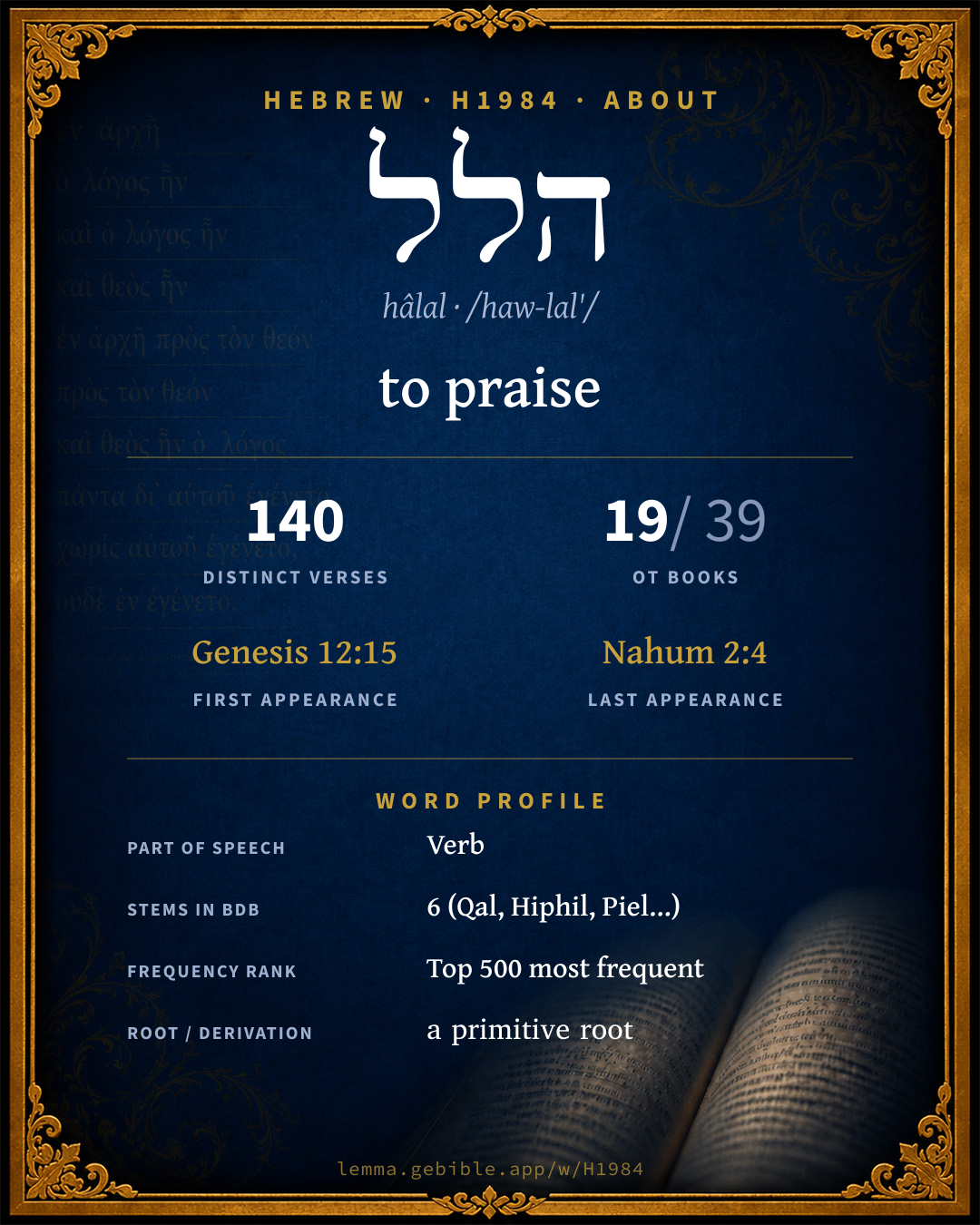
הָלַל
to praise
‘to praise’ is one of 2 main senses fuller range ↓
Full lexicon entry — Brown-Driver-Briggs (BDB)
From Brown-Driver-Briggs (BDB)
Where this word appears
See every Piel verb in the Hebrew Bible →
Grammar key — what these labels mean
Part of speech
- Verb
- An action or state-of-being word.
Stem
- Piel
- An intensive or resultative active stem. Here: ‘praise man or woman’
- Pual
- The passive counterpart of the Piel. Here: ‘human subj.’
- Hithpael
- The reflexive or reciprocal stem (the subject acts on itself).
- Qal
- The basic, simple active stem — the plain form of the verb (“he wrote”). Here: ‘only Inf. sf.’
- Hithpolel
- The reflexive counterpart of the Polel.
- Hiphil
- The causative active stem (“he caused / brought about”).
Form
- Imperative
- A direct command (“write!”).
- Infinitive Construct
- A bound verbal noun, frequently with prepositions (“to write / in writing”).
- Participle Passive
- A verbal adjective expressing action received (“written”).
- Sequential Imperfect
- An imperfect with prefixed waw — the standard past-narrative form (waw-consecutive imperfect).
- Imperfect
- An incomplete, ongoing, or future action (“he will / would write”).
- Jussive
- A third- or second-person volitional form expressing wish or command (“let him write”).
- Participle Active
- A verbal adjective expressing ongoing or characteristic action (“writing / one who writes”).
- Infinitive Absolute
- An unbound verbal noun, often intensifying or standing in for a finite verb.
- Cohortative
- A first-person volitional form expressing wish or resolve (“let me / let us write”).
- Sequential Perfect
- A perfect with prefixed waw continuing a preceding imperfect or command (waw-consecutive perfect).
- Perfect
- A completed action or state — Hebrew marks aspect (completeness) more than strict tense (“he wrote”).
State
- Absolute
- The independent form of a noun, not bound to a following word.
- Construct
- A noun bound to a following noun in a possessive / “of” relationship (the construct chain).
Person
- 2nd Person
- The one addressed (“you”).
- 3rd Person
- The one spoken about (“he / she / it / they”).
- 1st Person
- The speaker (“I / we”).
Gender
- Masculine
- Grammatically masculine.
- Common
- Either gender — not distinguished for this form.
- Feminine
- Grammatically feminine.
Number
- Plural
- More than one (in Hebrew, generally three or more).
- Singular
- One.
58 verses where H1984 appears in the Piel stem in the Book of Psalms. Filtered view — show all forms. Click any verse to open its interlinear word-by-word view. Verse text shown in the World English Bible for context — . Each verse’s Hebrew form is shown with its reference; the English is not keyword-highlighted, since the data carries no word-level English alignment. Use “Compare translations” on any verse to read it across multiple English versions. This concordance covers the Hebrew Bible; Septuagint (Greek Old Testament) occurrences are not indexed here.
Psalms
- Psalms 10:3 הִלֵּ֣ל Piel pf 3ms For the wicked boasts of his heart's cravings, He blesses the greedy, and condemns Yahweh.
- Psalms 22:22 אֲהַלְלֶֽ/ךָּ Piel coh 1cs + sfx pers 2ms I will declare your name to my brothers. In the midst of the assembly, I will praise you.
- Psalms 22:23 הַֽלְל֗וּ/הוּ Piel impv 2mp + sfx pers 3ms You who fear Yahweh, praise him! All you descendants of Jacob, glorify him! Stand in awe of him, all you descendants of Israel!
- Psalms 22:26 יְהַֽלְל֣וּ Piel impf 3mp The humble shall eat and be satisfied. They shall praise Yahweh who seek after him. Let your hearts live forever.
- Psalms 35:18 אֲהַֽלְלֶֽ/ךָּ Piel impf 1cs + sfx pers 2ms I will give you thanks in the great assembly. I will praise you among many people.
- Psalms 44:8 הִלַּלְ֣נוּ Piel pf 1cp In God we have made our boast all day long, We will give thanks to your name forever. Selah.
- Psalms 56:4 אֲהַלֵּ֪ל Piel impf 1cs In God, I praise his word. In God, I put my trust. I will not be afraid. What can flesh do to me?
- Psalms 56:10 אֲהַלֵּ֣ל אֲהַלֵּ֥ל Piel impf 1cs Piel impf 1cs In God, I will praise his word. In Yahweh, I will praise his word.
- Psalms 63:5 יְהַלֶּל Piel impf 3ms My soul shall be satisfied as with the richest food. My mouth shall praise you with joyful lips,
- Psalms 69:30 אֲהַֽלְלָ֣ה Piel coh 1cs I will praise the name of God with a song, And will magnify him with thanksgiving.
- Psalms 69:34 יְֽ֭הַלְלוּ/הוּ Piel impf 3mp + sfx pers 3ms Let heaven and earth praise him; The seas, and everything that moves therein!
- Psalms 74:21 יְֽהַלְל֥וּ Piel impf 3mp Don't let the oppressed return ashamed. Let the poor and needy praise your name.
- Psalms 84:4 יְֽהַלְל֥וּ/ךָ Piel impf 3mp + sfx pers 2ms Blessed are those who dwell in your house. They are always praising you. Selah.
- Psalms 102:18 יְהַלֶּל Piel impf 3ms This will be written for the generation to come. A people which will be created will praise Yah.
- Psalms 104:35 הַֽלְלוּ Piel impv 2mp Let sinners be consumed out of the earth. Let the wicked be no more. Bless Yahweh, my soul. Praise Yah!
- Psalms 105:45 הַֽלְלוּ Piel impv 2mp That they might keep his statutes, And observe his laws. Praise Yah!
- Psalms 106:1 הַֽלְלוּ Piel impv 2mp Praise Yahweh! Give thanks to Yahweh, for he is good, For his loving kindness endures forever.
- Psalms 106:48 הַֽלְלוּ Piel impv 2mp Blessed be Yahweh, the God of Israel, From everlasting even to everlasting! Let all the people say, "Amen." Praise Yah!
- Psalms 107:32 יְהַלְלֽוּ/הוּ Piel impf 3mp + sfx pers 3ms Let them exalt him also in the assembly of the people, And praise him in the seat of the elders.
- Psalms 109:30 אֲהַֽלְלֶֽ/נּוּ Piel impf 1cs + sfx pers 3ms I will give great thanks to Yahweh with my mouth. Yes, I will praise him among the multitude.
- Psalms 111:1 הַ֥לְלוּ Piel impv 2mp Praise Yah! I will give thanks to Yahweh with my whole heart, In the council of the upright, and in the congregation.
- Psalms 112:1 הַ֥לְלוּ Piel impv 2mp Praise Yah! Blessed is the man who fears Yahweh, Who delights greatly in his commandments.
- Psalms 113:1 הַ֥לְלוּ הַ֭לְלוּ הַֽ֝לְלוּ Piel impv 2mp Piel impv 2mp Piel impv 2mp Praise Yah! Praise, you servants of Yahweh, Praise the name of Yahweh.
- Psalms 113:9 הַֽלְלוּ Piel impv 2mp He settles the barren woman in her home, As a joyful mother of children. Praise Yah!
- Psalms 115:17 יְהַֽלְלוּ Piel impf 3mp The dead don't praise Yah, Neither any who go down into silence;
- Psalms 115:18 הַֽלְלוּ Piel impv 2mp But we will bless Yah, From this time forth and forevermore. Praise Yah!
- Psalms 116:19 הַֽלְלוּ Piel impv 2mp In the courts of Yahweh's house, In the midst of you, Jerusalem. Praise Yah!
- Psalms 117:1 הַֽלְל֣וּ Piel impv 2mp Praise Yahweh, all you nations! Extol him, all you peoples!
- Psalms 117:2 הַֽלְלוּ Piel impv 2mp For his loving kindness is great toward us. Yahweh's faithfulness endures forever. Praise Yah!
- Psalms 119:164 הִלַּלְתִּ֑י/ךָ Piel pf 1cs + sfx pers 2ms Seven times a day, I praise you, Because of your righteous ordinances.
- Psalms 119:175 וּֽ/תְהַֽלְלֶ֑/ךָּ conj + Piel juss 3fs + sfx pers 2ms Let my soul live, that I may praise you. Let your ordinances help me.
- Psalms 135:1 הַ֥לְלוּ הַֽ֭לְלוּ הַֽ֝לְלוּ Piel impv 2mp Piel impv 2mp Piel impv 2mp Praise Yah! Praise the name of Yahweh! Praise him, you servants of Yahweh,
- Psalms 135:3 הַֽ֭לְלוּ Piel impv 2mp Praise Yah, for Yahweh is good. Sing praises to his name, for that is pleasant.
- Psalms 135:21 הַֽלְלוּ Piel impv 2mp Blessed be Yahweh from Zion, Who dwells at Jerusalem. Praise Yah!
- Psalms 145:2 וַ/אֲהַלְלָ֥ה conj + Piel coh 1cs Every day I will praise you. I will extol your name forever and ever.
- Psalms 146:1 הַֽלְלוּ הַלְלִ֥י Piel impv 2mp Piel impv 2fs Praise Yah! Praise Yahweh, my soul.
- Psalms 146:2 אֲהַלְלָ֣ה Piel coh 1cs While I live, I will praise Yahweh. I will sing praises to my God as long as I exist.
- Psalms 146:10 הַֽלְלוּ Piel impv 2mp Yahweh will reign forever; Your God, O Zion, to all generations. Praise Yah!
- Psalms 147:1 הַ֥לְלוּ Piel impv 2mp Praise Yah, For it is good to sing praises to our God; For it is pleasant and fitting to praise him.
- Psalms 147:12 הַֽלְלִ֖י Piel impv 2fs Praise Yahweh, Jerusalem! Praise your God, Zion!
- Psalms 147:20 הַֽלְלוּ Piel impv 2mp He has not done this for just any nation. They don't know his ordinances. Praise Yah!
- Psalms 148:1 הַ֥לְלוּ הַֽלְל֣וּ הַֽ֝לְל֗וּ/הוּ Piel impv 2mp Piel impv 2mp Piel impv 2mp + sfx pers 3ms Praise Yah! Praise Yahweh from the heavens! Praise him in the heights!
- Psalms 148:2 הַֽלְל֥וּ/הוּ הַֽ֝לְל֗וּ/הוּ Piel impv 2mp + sfx pers 3ms Piel impv 2mp + sfx pers 3ms Praise him, all his angels! Praise him, all his host!
- Psalms 148:3 הַֽ֭לְלוּ/הוּ הַ֝לְל֗וּ/הוּ Piel impv 2mp + sfx pers 3ms Piel impv 2mp + sfx pers 3ms Praise him, sun and moon! Praise him, all you shining stars!
- Psalms 148:4 הַֽ֭לְלוּ/הוּ Piel impv 2mp + sfx pers 3ms Praise him, you heavens of heavens, You waters that are above the heavens.
- Psalms 148:5 יְֽ֭הַֽלְלוּ Piel juss 3mp Let them praise the name of Yahweh, For he commanded, and they were created.
- Psalms 148:7 הַֽלְל֣וּ Piel impv 2mp Praise Yahweh from the earth, You great sea creatures, and all depths!
- Psalms 148:13 יְהַלְל֤וּ Piel juss 3mp Let them praise the name of Yahweh, For his name alone is exalted. His glory is above the earth and the heavens.
- Psalms 148:14 הַֽלְלוּ Piel impv 2mp He has lifted up the horn of his people, The praise of all his saints; Even of the children of Israel, a people near to him. Praise Yah!
- Psalms 149:1 הַ֥לְלוּ Piel impv 2mp Praise Yahweh! Sing to Yahweh a new song, His praise in the assembly of the saints.
- Psalms 149:3 יְהַֽלְל֣וּ Piel juss 3mp Let them praise his name in the dance! Let them sing praises to him with tambourine and harp!
- Psalms 149:9 הַֽלְלוּ Piel impv 2mp To execute on them the written judgment. All his saints have this honor. Praise Yah!
- Psalms 150:1 הַ֥לְלוּ הַֽלְלוּ הַֽ֝לְל֗וּ/הוּ Piel impv 2mp Piel impv 2mp Piel impv 2mp + sfx pers 3ms Praise Yah! Praise God in his sanctuary! Praise him in his heavens for his acts of power!
- Psalms 150:2 הַֽלְל֥וּ/הוּ הַֽ֝לְל֗וּ/הוּ Piel impv 2mp + sfx pers 3ms Piel impv 2mp + sfx pers 3ms Praise him for his mighty acts! Praise him according to his excellent greatness!
- Psalms 150:3 הַֽ֭לְלוּ/הוּ הַֽ֝לְל֗וּ/הוּ Piel impv 2mp + sfx pers 3ms Piel impv 2mp + sfx pers 3ms Praise him with the sounding of the trumpet! Praise him with harp and lyre!
- Psalms 150:4 הַֽ֭לְלוּ/הוּ הַֽ֝לְל֗וּ/הוּ Piel impv 2mp + sfx pers 3ms Piel impv 2mp + sfx pers 3ms Praise him with tambourine and dancing! Praise him with stringed instruments and flute!
- Psalms 150:5 הַֽלְל֥וּ/הוּ הַֽ֝לְל֗וּ/הוּ Piel impv 2mp + sfx pers 3ms Piel impv 2mp + sfx pers 3ms Praise him with loud cymbals! Praise him with resounding cymbals!
- Psalms 150:6 תְּהַלֵּ֥ל הַֽלְלוּ Piel impf 3fs Piel impv 2mp Let everything that has breath praise Yah! Praise Yah!
About this entry
At a glance — auto-summarized from this page’s data, not written by a person. Every figure links to its source below. This summary describes the numbers; it doesn’t interpret them.
“to praise” is the headline sense of the Hebrew verb הלל (hâlal). It clusters heavily in Psalms, which alone accounts for 54% of its uses. With 140 verses in 19 books, it is a common word in the Hebrew Bible. Scripture first uses it in Genesis 12:15. Different stems carry different senses — BDB groups them under 6 stems, among them Qal and Hiphil. See the sense tree, 140-verse concordance, and the renderings breakdown below.
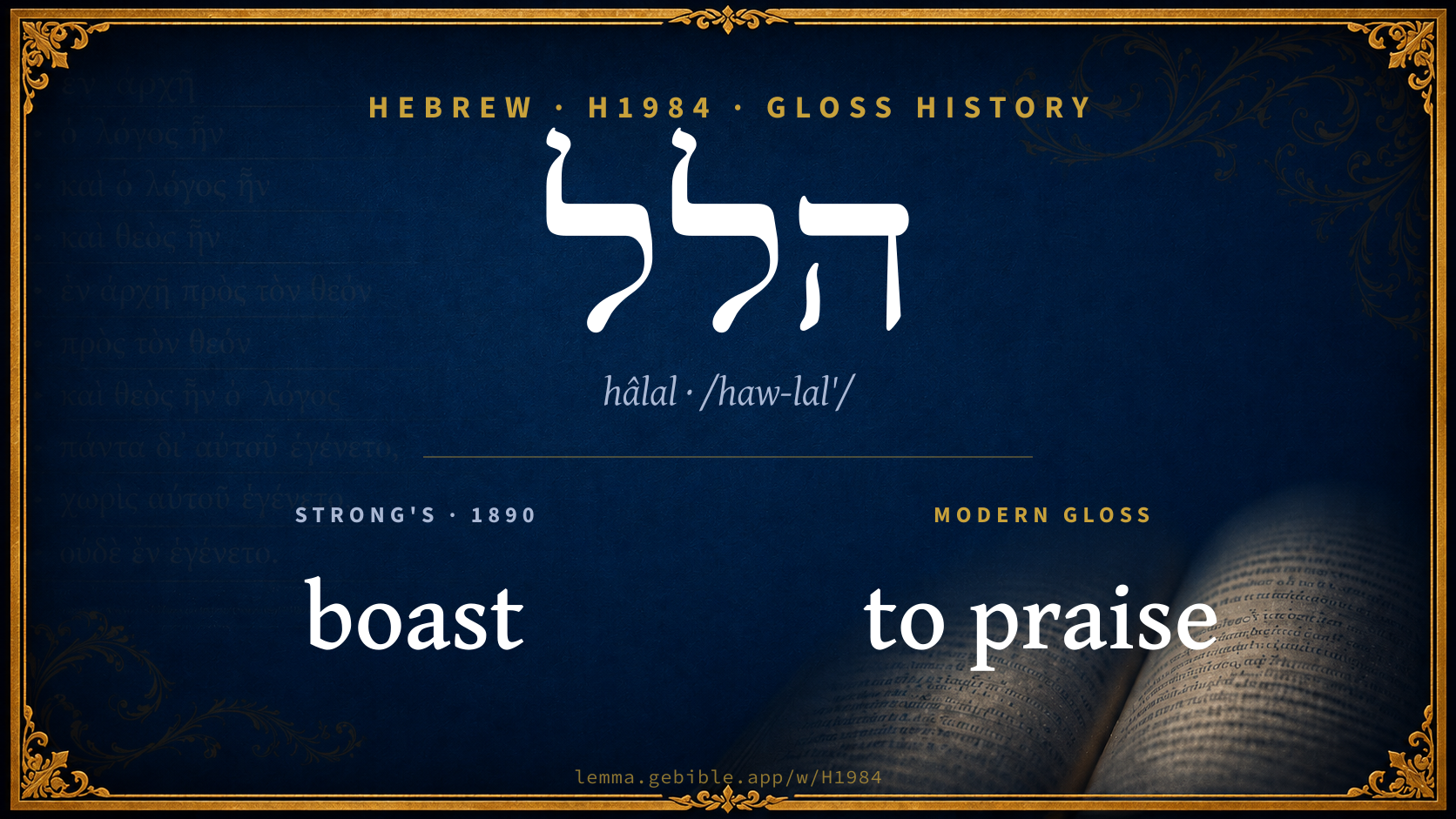
Gloss history
Strong's 1890 vs modern scholarship
About this word
Strong's H1984 catalogs a Hebrew word from the Hebrew Old Testament.
These counts are not copied from any lexicon or concordance. They are computed here, from the morphology-tagged Hebrew Old Testament. What Lemma adds →
- 140
- distinct verses
- The word appears in 140 distinct verses.
- 19 / 39
- OT books
- The word appears in 19 of 39 Old Testament books.
- #277
- by frequency
- Top 500 most frequent Hebrew words (rank 277 of 8,640 Hebrew words by occurrence).
View all 140 occurrences in the concordance →
Most concentrated in
- Psalms 76 verses 54%
- 2 Chronicles 10 verses 7%
- Jeremiah 10 verses 7%
By section of the Old Testament
By traditional corpus
Conventional, traditional groupings — biblical authorship is debated, so this is a traditional corpus grouping, not an authorship claim. Each share is this word’s portion of its verses in that division of the Hebrew canon. Each figure is a share of the word’s 140 distinct verses.
- Writings (Ketuvim) 114 verses · 81%
- Prophets (Nevi'im) 25 verses · 18%
- Torah (Pentateuch) 1 verse · 1%
How translations render this word
Counts come from each version’s own published word-to-Strong’s tagging or interlinear alignment — an approximate guide to how each version renders this word, not a word-level alignment the data otherwise carries. Because each total is that version’s own tagged count, the per-version totals vary from one another and need not match the appearance or distinct-verse counts above. These counts may also differ from a printed concordance because Lemma counts each distinctly tagged rendering and does not collapse phrase taggings into a single head-word total. This is a fixed set of word-tagged versions (KJV, ASV, BSB, ULT) and does not change with the reading translation you choose elsewhere. Each version’s license is shown beside its name below (and on Sources).
BDB lists this Strong’s number as 2 distinct words (homographs). Each count above pools all of them and is not split by sense — see the Senses section below. A low-frequency rendering may belong to a different one of those words, not the primary meaning.
- King James Version†: Praise 68×, Praised 8×, Be praised 4×
- American Standard Version†: Praise 60×, Praised 8×, I will praise 5×
- Berean Standard Bible†: Praise 25×, Hallelujah 24×, Praise him 18×
- unfoldingWord Literal Text†: Praise 27×, Hallelu 24×, Praise him 19×
King James Version Public Domain
Renders H1984 across 165† tagged occurrences — most commonly:
Plus other, less common renderings. Plus 40 renderings that appear only once — usually multi-word phrases or single function words the recovered tagging swept in, not distinct renderings.
American Standard Version Public Domain
Renders H1984 across 164† tagged occurrences — most commonly:
Plus other, less common renderings. Plus 47 renderings that appear only once — usually multi-word phrases or single function words the recovered tagging swept in, not distinct renderings.
Berean Standard Bible Public Domain
Renders H1984 across 163† tagged occurrences — most commonly:
Plus other, less common renderings. Plus 53 renderings that appear only once — usually multi-word phrases or single function words the recovered tagging swept in, not distinct renderings. Not rendered by a distinct English word in 2 further occurrences.
unfoldingWord Literal Text CC BY-SA 4.0
Renders H1984 across 186† tagged occurrences — most commonly:
Plus other, less common renderings. Plus 47 renderings that appear only once — usually multi-word phrases or single function words the recovered tagging swept in, not distinct renderings.
22 senses and sub-senses in the full BDB
Hebrew verbs can shift meaning by stem (binyan): Qal is the basic action, Niphal is often passive or reflexive, Piel often intensifies or makes it factitive, and Hiphil is typically causative. The senses below are grouped under the stem BDB assigns to each. This entry also uses Pual (the passive of Piel), Hithpaal (the reflexive or passive Aramaic stem), and one or more reduplicated stems (the Pōlēl/Pilpēl type), which for hollow or geminate roots behave much like Piel — often intensive or iterative.
What do BDB’s symbols mean?
BDB uses these scholarly abbreviations:
| Symbol | Meaning |
|---|---|
| 𝔊 | the Septuagint (the ancient Greek translation, LXX) |
| 𝔙 | the Vulgate (the Latin translation) |
| 𝔖 | the Syriac version (the Peshitta) |
| 𝔗 | the Targum (the Aramaic translation) |
| ψ | the Psalms |
| √ | root (the underlying root or stem) |
| ‖ | parallel passage (a synonymous or contrasted parallel) |
| † | the dagger: every passage where the word occurs is cited |
The 22 senses and sub-senses the full Brown-Driver-Briggs lexicon distinguishes for this word, in lexicon order (not ranked by frequency), with BDB’s own verbatim wording and sub-sense lettering. Shown in Hebrew script with BDB’s own scholarly abbreviations. The condensed entry is in the Lexicon Entry tab. See also the Forms in the corpus table below.
הלל I shine (according to Thes al. = II. הלל (splenduit, from sonuit acute, clare, so Thes
Qal
- only Inf. sf. בְּהִלּוֹ נֵרוֹ עֲלֵי רֹאשִׁי Jb 29:3 when it, viz. his lamp, shone upon my head (cf. Ew§ 309 c), fig. of God’s favour. e.g. Job 29:3
Hiphil
- Impf. יָהֵל Jb 31:26, 3 fs. תָּהֶל Jb 41:10; 3 mpl. יָהֵלּוּ Is 13:10;—flash forth light, of heavenly bodies, אוֹר = sun Jb 31:26 (‖ יָרֵחַ יָקָר הֹלֵךְ); sq. acc. cogn. כּוֹכְבֵי הַשָּׁמַיִם וּכְסִילֵיהֶם לֹא יָהֵלּוּ אוֹרָם Is 13:10 (‖ חָשַׁךְ הַשֶּׁמֶשׁ, & יָרֵחַ לֹא־יַגִּיהַּ אוֹרוֹ); also of crocodile עֲטִישֹׁתָיו תָּ֫הֶל אוֹר Jb 41:10 his sneezings flash forth light (shining water-drops). e.g. Job 31:26
הלל II be boastful, Pi. praise (Arabic هَلَّ shout, both in joy & (if conject. of Nö RS be right, v. cit. infr.) in terror
Qal
- Impf. 2 mpl. תָּהֹ֑לּוּ ψ 75:5; Pt. הוֹלֲלִים ψ 5:6 + 2 times;—be boastful אַל־תָּהֹ֑לּוּ ψ 75:5 (‖ אַל־תָּרִימוּקָ֑רֶן); pt. boastful ones, boasters ψ 5:6 (‖ פֹּעֲלֵי אָוֶן); 73:3; 75:5 (both ‖ רְשָׁעִים). e.g. Psalms 75:5
Piel
- Pf. הִלֵּל ψ 10:3, 1 s. sf. הִלַּלְתִּיךָ ψ 119:164; 3 mpl. וְהִלֲלוּ consec. Is 62:9, sf. הִלֲלוּךָ Is 64:10, etc.; Impf. יְהַלֶּל־ ψ 63:6; 102:19; sf. יְהַלֶּלְךָ Pr 27:2, יְהַלֲלֶ֑ךָּ Is 38:18, וַיְהַלֲלָהּ Pr 31:28; 31 s. אֲהַלֵּל ψ 56:5 + 2 times, cohort. אֲהַלֲלָה ψ 69:31 + 2 times, etc.; Imv. fs. הַלֲלִי ψ 146:1; 147:12; mpl. הַלְלוּ ψ 104:35 + 30 times ψ + Je 20:13; 31:7; sf. הַלֲלוּ֫הוּ ψ 22:24 + 15 times ψ; Inf. abs. הַלֵּל 1 Ch 16:36; cstr. הַלֵּל 2 S 14:25 + 16 times Chr; Pt. pl. מְהַלֲלִים 1 Ch 23:5 + 4 times Ch;— e.g. Psalms 10:3
- 1. praise man or woman, acc. וַיְהַלֲלוּ אֹתָהּ אֶל־פַּרְעֹה Gn 12:15 (J) and they praised her to Pharaoh, cf. Pr 27:2; 31:28, 31 Ct 6:9; וְהַמְהַלֲלִים אֶת־הַמֶּלֶךְ 2 Ch 23:12 and those praising (shouting acclamations to) the king; v. also לְהַלֵּל מְאֹד 2 S 14:25 (of Absalom’s beauty); in bad sense עֹזְבֵי תוֹרָה יְהַלֲלוּ רָשָׁע Pr 28:4 deserters of law praise a wicked man. e.g. Genesis 12:15
- 2. usually praise אֱלֹהִים, י׳, etc.:
- a. sq. acc. of heathen god Ju 16:24. e.g. Judges 16:24
- b. obj. י׳ (אֱלֹהִים); ψ 119:164 (עַל on account of), subj. heaven, earth, seas, etc., ψ 69:35; תְּחִי נַפְשִׁי וּתְהַלֲלֶךָּ ψ 119·164;175; in summons to all creatures to praise 148:5, 13; Is 38:18 לֹא שְׁאוֹל תּוֹדֶךָּ מָוֶת יְהַלֲלֶ֑ךָּ (cf. ψ 115:17); often of public worship in sanctuary, Is 62:9 (thanksgiving in sanctuary after harvest), cf. 64:10 ψ 22:23 (‖ אֲסַפְּרָה שִׁמְךָ), v 27; 35:18; 109:30 (both ‖ אוֹדְךָ) 107:32 (‖ יְרוֹמֲמוּהוּ) 84:5, v. also 146:2 (‖ אֲזַמְּרָה לֵא׳) 149:3 (c. בְּ instr.; ‖ יְזַמְּרוּ לוֹ) also obj. שֵׁם י׳ (in some cases of public worship) ψ 74:21; 148:5, Jo 2:26 (thanksgiving after harvest); שֵׁם־אֱלֹהִים בְּשִׁיר ψ 69:31 (‖ וַאֲגַדְּלֶנּוּ בְתוֹדָה), 145:2 (‖ אֲכָֽרֲכֶ֑ךָּ); further, ψ 56:5 בֵּאלֹהִים אֲהַלֵּל דְּבָרוֹ, also v 11 + v 11b ביהוה וגו׳, but cf. Hup Che on 11b as editorial addition; obj. not expressed הַשְׁמִיעוּ הַלֲלוּ וְאִמְרוּ הוֹשַׁע י׳ אֶת־עַמְּךָ Je 31:7, וְשִׂפְתֵי רְנָנוֹת יְהַלֶּל־פִּי ψ 63:6. e.g. Psalms 119:164
- c. use of Imv. deserves special notice: הַלֲלוּהוּ ψ 22:24 (‖ כַּבְּדוּהוּ; of temple-worship cf. v 23, 25); also in summons to angels, sun, moon, etc. (all created things) to praise י׳ 148:2(×2), 3(×2), 4; 150:1; of temple-worship 150:2 (בְּ on account of) v 2 (כְּ), v 3(×2), 4(×2), 5(×2) (all c. בְּ instr.); further Je 20:13 (‖ שִׁירוּ לי׳), הַלֲלוּ אֶת־י׳ ψ 117:1 (addressed to nations, ‖ שַׁבְּחוּהוּ), 148:7 (created things), הַלֲלִי אֱלֹהַיִךְ צִיּוֹן 147:12 (‖ שַׁבְּחִי יְרוּשָׁלִַם אֶת־י׳). e.g. Psalms 22:24
- d. note especially: praise ye Yah! הַלֲלוּ־יָהּ ψ 135:3, liturgical (‖ זַמְּרוּ לִשְׁמוֹ); elsewhere always one word v. Baerψ p. 115, & always at beginning or end of ψ (chiefly late), appar. liturgical; הַלֲלוּיָ֑הֿ ψ 104:35 (‖ בָּֽרְכִי נַפְשִׁי אֶת־י׳), elsewhere הַלֲלוּיָהּ: (1) at beginning ψ 106:1; 111:1 (both ‖ הודה) 112:1; 113:1 (‖ הַלֲלוּ & ה׳ אֶת־שֵׁם י׳), 135:1 (‖ id.), 146:1 (‖ הַלֲלִי נַפְשִׁי אֶת־י׳), 147:1 (sq. זַמְּרָה in cl. with כִּי), 148:1 (‖ הַלֲלוּ אֶת־י׳, הַלֲלוּהוּ), 149:1 (‖ שִׁירוּ לי׳), 150:1 (‖ הַלֲלוּ־אֵל, הַלֲלוּהוּ); (2) at end ψ 104:35 (supr.), 105:45; 106:48; 113:9; 115:18 (‖ נְבָרֵךְ יָהּ), 116:19; 117:2; 135:21 (‖ בָּרוּךְ י׳) 146:10; 147:20; 148:14; 149:9; 150:6 (‖ כֹּל הַנְּשָׁמָה תְּהַלֵּל יָהּ); add to these (not liturgical) יְהַלֶּל־יָהּ ψ 102:19, כֹּל נְשָׁמָה תְּהַלֵּל יָהּ 150:6, לֹא הַמֵּתִים יְהַלֲלוּ־יָהּ 115:17. e.g. Psalms 135:3
- e. also sq. ליהוה, in Chr, of technical Levitical function (cf. LagOr. ii. 16 ff., who limits this technical הלל to priests, using חֲצֹצְרוֹת, for a signal to the people; v. e.g. Ne 12:24 cf. v 27), 1 Ch 16:4 (with instrumental music, cf. בִּכְלֵי נְבָלִים וּבְכִנֹּרוֹת & בַּמְצִלְתַּיִם, all v 5, and Ne 12:27) 23:30; 25:3 (all ‖ הוֹדוֹת); exercised (apparently) by both priests and Levites Ezr 3:11 (‖ הֹדוֹת) cf. v 11; by Levites 2 Ch 20:19 (בְּקֹל גָּדוֹל), 29:30 (בְּדִבְרֵי דָוִיד) in which the people also joined 1 Ch 16:36; also 2 Ch 5:13 (בַּחֲצֹצְרוֹת וּבִמְצִלְתַּיִם וּבִכְלֵי הַשִּׁיר cf. also v 12; ‖ הֹדוֹת), v 13 (appar. of Levites & priests), מְהַלֲלִים לי׳ בַּכֵּלִים 1 Ch 23:5 (Levites) cf. 2 Ch 30:21 (Levites & priests בִּכְלֵי עֹז לי׳); sq. לְשֵׁם תִּפְאַרְתֶּ֑ךָ 1 Ch 29:13 (‖ מוֹדִים; David speaks in name of people); sq. לְהַדְרַת־קֹ֑דֶשׁ 2 Ch 20:21 (before the army; ‖ מְשֹׁרֲרִים לי׳; prob. of Levites, cf. v 19). e.g. Nehemiah 12:24
- f. sq. acc. י׳ Ezr 3:10 (priests & Levites: עַל־יְדֵי דָּוִיד), Ne 5:13 (people). e.g. Ezra 3:10
- g. other forms, with like technical sense, but abs.: לְהַלֵּל לְהוֹדוֹת בְּמִצְוַת דָּוִיד Ne 12:24 (Levites) cf. 1 Ch 23:5 2 Ch 8:14; 29:30 (עַד־לְשִׂמְחָה) 2 Ch 31:2 (appar. priests & Levites; בְּשַׁעֲרֵי מַחֲנוֹת י׳; ‖ לְשָׁרֵת וּלְהֹדוֹת); v. also מוֹדִיעִים לְהַלֵּל 2 Ch 23:13 (‖ מְשׁוֹרֲרִים בִּכְלַי הַשִּׁיר); בְּהַלֵּל דָּוִיד בְּיָדָם 2 Ch 7:6 (‖ הֹדוֹת ליהוה). e.g. Nehemiah 12:24
- 3. appar. make one’s boast cf. Hithpa. 2 (sq. בְּ in, of), בֵּאלֹהִים ψ 44:9 (‖ שִׁמְךָ לְעוֹלָם נוֹדֶה); so, according to most, in bad sense, ה׳ רָשָׁע עַל־תַּאֲוַת נַפְשׁוֹ ψ 10:3 a wicked man boasteth of the desire of his soul, but Che praiseth (י׳) for (i.e. in a mercenary spirit). e.g. Psalms 44:9
Pual
- Pf. 3 pl. הוּלָּ֑לוּ ψ 78:63; Impf. יְהֻלַּל־ Pr 12:8; Pt. מְהֻלָּל 2 S 22:4 + 6 times; f. הַהֻלָּ֑לָה Ez 26:17 (cf. Ol§ 250 c Sta§ 220, 617 b; MT, however, accents as Pf., regarding הַ as = relative, v. Sta§ 176 c Ges§ 52. 2, R. 6);—be praised, e.g. Psalms 78:63
- 1. human subj., be praised, commended Pr 12:8 (opp. יִהְיֶה לָבוּז); of maidens, praised, celebrated (in song) ψ 78:63; pt. (v. supr.) of city, renowned Ez 26:17. e.g. Proverbs 12:8
- 2. of י׳, only pt. = gerundive, to be praised, worthy of praise 2 S 22:4 = ψ 18:4; גָּדוֹל י׳ וּמְה׳ מְאֹד ψ 48:2; 96:4 = 1 Ch 16:25, ψ 145:3; so מְה׳ שֵׁם י׳ 113:3. e.g. 2 Samuel 22:4
Hithpaal
- Impf. יִתְהַלֵּל 1 K 20:11 + 5 times; יִתְהַלָּ֑ל Pr 20:14; 3 fs. תִּתְהַלֵּל ψ 34:3, תִּתְהַלָּ֑ל Pr 31:30; 2 ms. תִּתְהַלֵּל ψ 52:3 Pr 27:1; תִּתְהַלָּ֑ל Is 41:16; 2 fs. תִּתְהַלֲלִי Je 49:4; 3 mpl. יִתְהַלֲלוּ ψ 64:11 Is 45:25; יִתְהַלָּ֑לוּ ψ 49:7 Je 4:2; Imv. mpl. הִתְהַלֲלוּ 1 Ch 16:10 ψ 105:3; Inf. לְהִתְהַלֵּל ψ 106:5; Pt. מִתְהַלֵּל Pr 25:14 Je 9:23; pl. מִתְהַלֲלִים ψ 97:7;—glory, boast, make one’s boast:— e.g. 1 Kings 20:11
- 1. of self-confident boasting, abs. 1 K 20:11 cf. Pr 20:14; sq. בְּ of ground of boast Je 9:22(×3); 49:4 ψ 49:7; 52:3 Pr 25:14, אַל־תִּתְהַלֵּל בְּיוֹם מָחָר Pr 27:1; of glorying in idols הַמִּתְהַלֲלִים בָּאֱלִילִים ψ 97:7. e.g. 1 Kings 20:11
- 2. of glorying, making one’s boast in (בְּ, on the ground of) י׳: בי׳ תִּתְהַלֵּל נַפְשִׁי ψ 34:3, cf. Is 45:25 Je 4:2 (‖ וְהִתְבָּֽרְכוּ בוֹ); sq. בִּקְדוֹשׁ יִשְׂרָאֵל Is 41:16; v. also ψ 105:3 = 1 Ch 16:10 sq. בְּשֵׁם קָדְשׁוֹ (‖ יִשְׂמַח לֵב מְבַקְשֵׁי י׳), cf. further Je 9:23; less often abs. Je 9:23 ψ 63:12; 64:11 & 106:5 sq. עִם־נַחֲלָתֶ֑ךָ together with thine heritage (‖ לִשְׂמֹחַ בְּשִׂמְחַת גּוֹיֶ֑ךָ). e.g. Psalms 34:3
- 3. once, late = pass. be praised, commended, of God-fearing woman Pr 31:30. Poʿel Impf. יְהוֹלֵל Is 44:25 + 2 times;—make into a fool, make fool of, obj. שֹׁפְטִים Jb 12:17 (subj. י׳; ‖ מוֹלִיךְ יוֹעֲצִים שׁוֹלָ֑ל); obj. קֹסְמִים Is 44:25 (subj. י׳ ‖ מֵפֵר אֹתוֹת בַּדִּים); obj. חָכָם Ec 7:7 (subj. הָעשֶׁק; ‖ וִיאַבֵּד אֶת־לֵב מַתָּנָה). Poʿal Pt. לִשְׂחוֹק אָמַרְתִּי מְהוֹלָ֑ל Ec 2:2 of laughter I said, It is mad (folly); מְהוֹלָלַי ψ 102:9 those mad against me (‖ אוֹיְבָ֑י). e.g. Proverbs 31:30
Hithpo
- Impf. וַיִּתְהֹלֵל 1 S 21:14; 3 mpl. יִתְהֹלֲלוּ Je 51:7, יִתְהוֹלֲלוּ Na 2:5, יִתְהֹלָ֑לוּ Je 50:38; Imv. mpl. הִתְהֹלֲלוּ Je 46:9, הִתְהֹלָ֑לוּ Je 25:16;—act madly, or like a madman, וַיִּתְהֹלֵל בְּיָדָם 1 S 21:14 (of David) and he acted like a madman in their hands; of idolatrous worship by Chaldeans וּבָאֵימִים יִתְה׳ Je 50:38; of nations, as drunken men, fig. of terror at Yahweh’s judgments, Je 25:16 (‖ הִתְגֹּעֲשׁוּ) 51:7; also of madly driving & jolting chariots Na 2:5 Je 46:9. e.g. 1 Samuel 21:14
Senses from the full Brown-Driver-Briggs lexicon (Brown, Driver, Briggs; Oxford 1906 — public domain), digitized via Sefaria, supplemented by the OpenScriptures HebrewLexicon (CC BY 4.0). Full attribution on Sources.
Word origin
I. vb. shine (according to Thes al. = II. הלל (splenduit, from sonuit acute, clare, so Thes; these meanings, however, merely assumed); but v. LagOr. ii. 19; cf. Arabic هَلَّ begin to shine, هِلَالٌ new moon; Assyrian elêlu, be bright, ellu, bright COTGloss.)—
II. vb. be boastful, Pi. praise (Arabic هَلَّ shout, both in joy & (if conject. of Nö RS be right, v. cit. infr.) in terror; especially ii. in formula of worship; Syriac Pa. ܗܰܥܶܠ cecinit, laudavit; cf. NH הִלּוּל praise, הַלֵּל id., Hallel (ψ 113–118); Aramaic הִילּוּלָא marriage-song, &c.; on Assyrian alâlu, shout for joy, rejoice v. Lyon Sargontexte 66 (Cylinder, l. 36) also WincklerSargontexte 134, l. 194; 156, l. 149 KB44, l. 36; 80, l. 194; all variations of cry aloud, cf. NöZMG 1887, 723 RSSem 411; perhaps orig. break through, or out (in a cry), cf. WeSkizzen iii. 107 ff., especially 109; comp. also (according to PrätBAS i. 369 f.) Ethiopic ተማህለለ; implore (cf. Amhar. Tigr.), & መሀለ; swear)—
— Brown-Driver-Briggs (Oxford 1906, public domain), digitized via Sefaria, supplemented by the OpenScriptures HebrewLexicon (CC BY 4.0). See Sources.
Origin: a primitive root
Jastrow Dictionary
A second Hebrew/Aramaic lexicon for comparison, covering Aramaic and post-biblical (Talmudic, Targumic, Midrashic) usage that the biblical-Hebrew BDB does not. Matched by lemma rather than by Strong’s number, so a lemma may carry more than one Jastrow headword (shown separately below), and the entries cover usage well beyond the Bible.
הִלֵּל
- Hillel,
- 1. H. the Babylonian (הבבלי) or Senior (הזקן). Pes. 66ᵃ. Tosef. Snh. VII, 11. Yoma 35ᵇ ה׳ מחייב וכ׳ the example of Hillel condemns the poor (who plead poverty as an excuse for not studying the Law); a. v. fr.—בֵּית ה׳ Beth-Hillel, the School of H., the Hillelites. Bets. I, 1; a. v. fr.
- 2. H., son of Rabban Gamliel. Pes. 51ᵃ; Tosef. M. Kat. II, 16; a. fr.
- 3. R. H., son of אָלָס or וָולָס, an Amora. Y. Kil. IX, 32ᵃ top. Gitt. 59ᵃ; a. fr.—[Y. Bets. V, 63ᵃ bot. ר׳ ליל, prob. a corrupt. or abbrev. of H.]
- 4. name of several Amoraim. Y. Ber. II, 5ᵃ bot.; a. fr. V. Frank. M’bo p. 76ᵃ
- 5. one Rabbi H. Snh. 98ᵇ, sq.
הָלַל
- (b. h.) to be bright, shine. —Pi. הִלֵּל to praise. Pes. X, 5 לְהַלֵּל. Midr. Till. to Ps. CXIII צריכים אתם להַ׳ לו you must give praise to Him. Ib. מנין הַלְלוּ the numerical value of hal’lu (71).
- to praise one’s self, boast. Yalk. Jer. 284.
הַלֵּל
- (preced.) Hallel (Praise), recitations for Holy Days, consisting of Ps. CXIII to CXVIII, called ה׳ המצרי Egyptian H. (with ref. to Ps. CXIV), contrad. to ה׳ הגדול the Large H. (v. differ. opinions Pes. 118ᵃ). Pes. X, 7, v. גָּמַר. Taan. 28ᵇ; a. fr.
A Dictionary of the Targumim, the Talmud Babli and Yerushalmi, and the Midrashic Literature (Marcus Jastrow; London, Luzac, 1903) — Public Domain. Digitized via Sefaria. Digitized via Sefaria. Full attribution on Sources.
Forms in the corpus
The 114 distinct written forms H1984 takes in the Hebrew Bible, most frequent first — each parse links to that stem’s occurrences in the concordance. Hebrew forms include their vowel points and cantillation, so a single lemma takes many written forms.
The 60 most common forms are shown; 54 rarer forms follow in the full concordance.
Same root — word family
Other BDB entries built from the same root as H1984, grouped by Strong’s listed origin. These share a root / origin per the lexicon — not necessarily a shared meaning. Each links to that word’s own entry.
Derived from this word
- הוללה hôwlêlâh H1947 madness
- הוללות hôwlêlûwth H1948 madness
- הלול hillûwl H1974 rejoicing
- מהלל mahălâl H4110 praise
- תהלה tᵉhillâh H8416 praise
- תהלה tohŏlâh H8417 error
Proper names from this root
People and places named from this root — a name, not an additional meaning of the word.
Compare all same-root words → Showing 4 of 10 — not the complete family. 3 of the same-root words are proper names (people or places). They share a root, not necessarily a meaning.
Septuagint verse parallels
This word appears in 118 verses that also exist in the Greek Old Testament (Septuagint), out of the 140 Hebrew verses it occurs in. You can read those verses in Greek by switching the Old Testament edition to the Septuagint.
Read these verses in the Septuagint
- Genesis 12:15
- Judges 16:24
- 1 Samuel 21:13
- 2 Samuel 14:25
- 1 Kings 20:11
- 1 Chronicles 16:4
- 2 Chronicles 5:13
- Ezra 3:10
- Job 12:17
- Psalms 5:5
- Proverbs 12:8
- Ecclesiastes 2:2
This is a verse-level parallel only — the same verses exist in both the Hebrew and Greek Old Testaments. No word-level Hebrew↔Greek correspondence is claimed: the data carries no such alignment, so no Greek word is shown as this Hebrew word’s translation. Coverage is not total — the Septuagint omits the deuterocanon and renumbers the Psalms, so some Hebrew verses have no direct Greek parallel.