1 Samuel 21:14

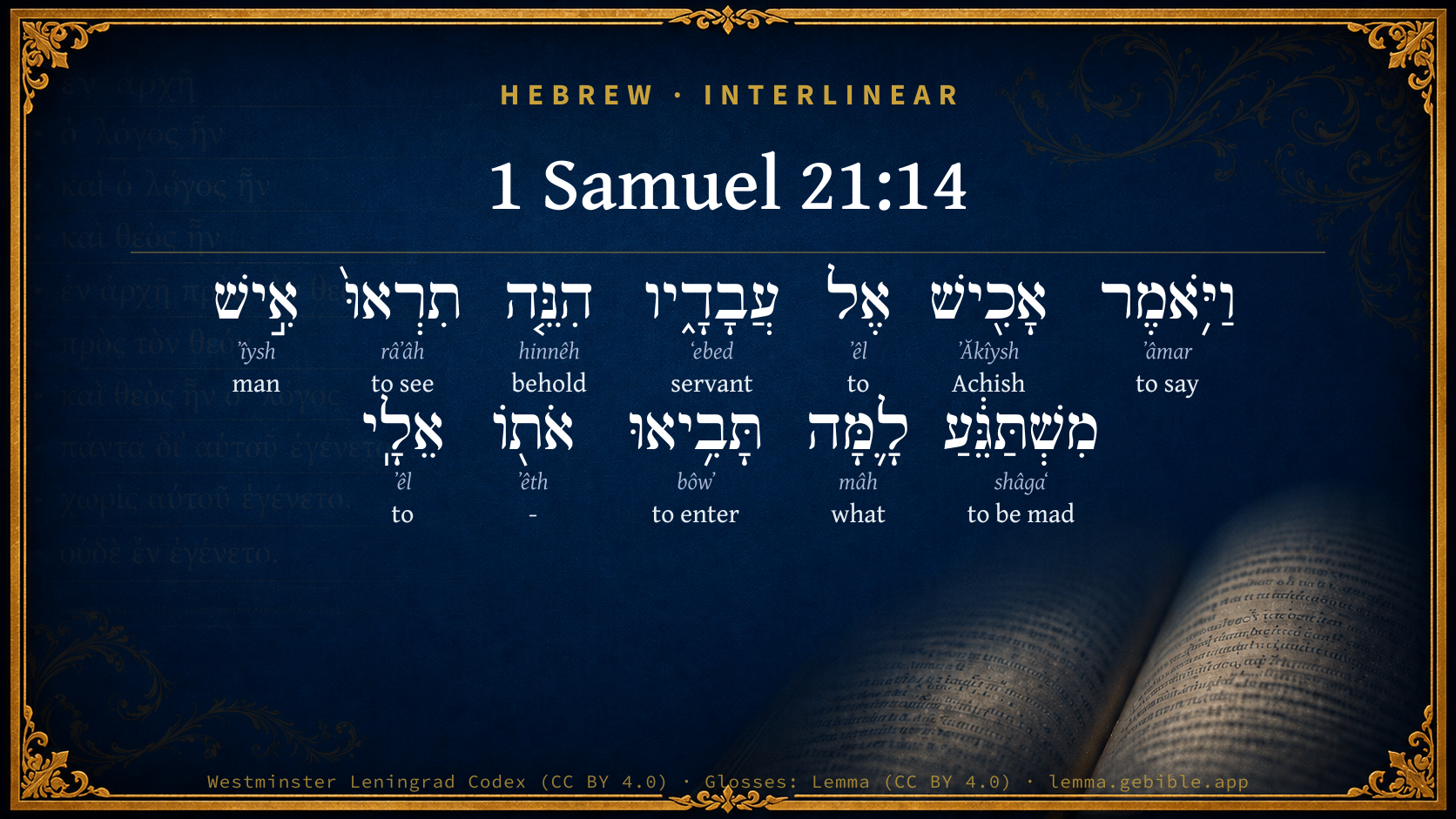
Hebrew (Westminster Leningrad Codex) 1 Samuel 21:14 appears in the Hebrew Old Testament. The text above is from the Westminster Leningrad Codex. Each word links to its Strong’s number, a concise gloss, and parsing drawn from the Open Scriptures Hebrew Bible morphology. Click any word for its full Brown-Driver-Briggs (BDB) entry.
Download image
Cite this verse

1 Samuel 21:14 (World English Bible). Public Domain. Lemma interlinear Bible study tool, https://lemma.gebible.app/v/1-samuel/21/14.

Show BibTeX & RIS
BibTeX
RIS
English Translation
Then said Achish to his servants, Look, you see the man is mad; why then have you brought him to me?
World English Bible · Public Domain
Download a study sheet

One document with this verse’s original text, its word-by-word gloss line, the meaning frame, cross-references with their text, attributed commentary, and full source and license credits — printable, and it pastes into notes with its structure intact.

This verse Autodidact and up

Study sheet (.html) Plain text (.txt)

A passage Seminary Student

Up to 50 verses in one chapter. A passage sheet keeps up to 6 commentary sources and 12 cross-references per verse, in the order this page ranks them, and says so on the sheet whenever that leaves anything out. Ask for a single verse and you get the Autodidact verse sheet above.

Everything on this page stays free to read, with no account — the sheet is a download of what is already on screen, not access to it.

Want to remove ads? Support Godless Engineer
Compare translations 3

The same verse in 3 English versions, stacked beneath the original-language interlinear above. Click any original word for its lexicon entry.

Each is an independent rendering of the whole verse — the interlinear is not word-aligned to these translations.

Highlighted words mark where these versions differ — a whole-verse word diff, not a word-by-word alignment.

  • World English Bible Public Domain
    Then said Achish to his servants, Look, you see the man is mad; why then have you brought him to me?
  • King James Version Public Domain
    Then said Achish unto his servants, Lo, ye see the man is mad: wherefore then have ye brought him to me?
  • unfoldingWord Literal Text CC BY-SA 4.0
    And Achish said to his servants, “Behold, you see a man raving. Why did you bring him to me?

unfoldingWord Literal Text — © unfoldingWord, licensed CC BY-SA 4.0. Word-aligned USFM3 via Door43 (git.door43.org/unfoldingWord/en_ult).

Versions to compare (up to 4)

3 of 4 selected

Show all 18 translations

Every available English version of this verse, each an independent rendering of the whole verse.

  • World English Bible Public Domain
    Then said Achish to his servants, Look, you see the man is mad; why then have you brought him to me?
  • Berean Standard Bible Public Domain
    Then Achish said to his servants, “Look, you can see that the man is insane! Why have you brought him to me?
  • Majority Standard Bible Public Domain
    Then Achish said to his servants, “Look, you can see that the man is insane! Why have you brought him to me?
  • King James Version Public Domain
    Then said Achish unto his servants, Lo, ye see the man is mad: wherefore then have ye brought him to me?
  • American Standard Version (1901) Public Domain
    Then said Achish unto his servants, Lo, ye see the man is mad; wherefore then have ye brought him to me?
  • Revised Version (1885) Public Domain
    Then said Achish unto his servants, Lo, ye see the man is mad: wherefore then have ye brought him to me?
  • Geneva Bible (1599) Public Domain
    Then said Achish vnto his seruants, Lo, ye see the man is beside him selfe, wherefore haue ye brought him to me?
  • Douay-Rheims (1899) Public Domain
    And Achis said to his servants: You saw the man was mad: why have you brought him to me?
  • Young's Literal Translation Public Domain
    And Achish saith unto his servants, `Lo, ye see a man acting as a madman; why do ye bring him in unto me?
  • Literal Standard Version CC BY-SA 4.0
    And Achish says to his servants, “Behold, you see a man acting as a madman; why do you bring him to me?
  • Unlocked Literal Bible CC BY-SA 4.0
    Then Achish said to his servants, “Look, you see the man is mad. Why have you brought him to me?
  • unfoldingWord Literal Text CC BY-SA 4.0
    And Achish said to his servants, “Behold, you see a man raving. Why did you bring him to me?
  • Darby Bible Public Domain
    And Achish said to his servants, Behold, ye see the man is mad: why did ye bring him to me?
  • World Messianic Bible Public Domain
    Then Achish said to his servants, “Look, you see the man is insane. Why then have you brought him to me?
  • Webster's Bible Public Domain
    Then said Achish to his servants, Lo, ye see the man is mad: why then have ye brought him to me?
  • Free Bible Version CC BY-SA 4.0
    Achish told his officials, “Look, you can see the man is completely mad! Why did you bring him to me?
  • Bible in Basic English Public Domain
    Then Achish said to his servants, Look! the man is clearly off his head; why have you let him come before me?
  • JPS Tanakh (1917) Public Domain
    (21-15) Then said Achish unto his servants: 'Lo, when ye see a man that is mad, wherefore do ye bring him to me?

Literal Standard Version (2020), Covenant Press — licensed CC BY-SA 4.0. Text via the HelloAO Bible API (eBible.org). Unlocked Literal Bible (unfoldingWord) — licensed CC BY-SA 4.0. Text via the HelloAO Bible API (eBible.org). unfoldingWord Literal Text — © unfoldingWord, licensed CC BY-SA 4.0. Word-aligned USFM3 via Door43 (git.door43.org/unfoldingWord/en_ult). Free Bible Version, Dr. Jonathan Gallagher — licensed CC BY-SA 4.0. Text via the HelloAO Bible API (eBible.org).

Word by word

More ways to search: Search by grammar → Find every occurrence → Compare this word →

Practice this passage: Drill this verse → Learn its vocabulary →

מִשְׁתַּגֵּ֔עַ
shâgaʻ
H7696
“being mad”
Verb, Hithpael, Participle Active, Masculine, Singular, Absolute
Part of Speech
Verb
Stem
Hithpael
Form
Participle Active
Gender
Masculine
Number
Singular
State
Absolute
Full BDB Definition

Origin: a primitive root

TWOT: 2328

to be mad - (Pual) - to be mad - to be maddened (participle) - (Hithpael) to show madness
  1. וַיֹּ֥אמֶר ʼâmar H559 “and · to say” Conjunction + Verb, Qal, Sequential Imperfect, 3rd Person, Masculine, Singular
  2. אָכִ֖ישׁ ʼĂkîysh H397 “Achish” Noun, Proper
  3. אֶל ʼêl H413 “to” Preposition
  4. עֲבָדָ֑יו ʻebed H5650 “servants · his” Noun, Common, Masculine, Plural, Construct + Suffix, Personal, 3rd Person, Masculine, Singular
  5. הִנֵּ֤ה hinnêh H2009 “behold” Particle, Demonstrative
  6. תִרְאוּ֙ râʼâh H7200 “to see” Verb, Qal, Imperfect, 2nd Person, Masculine, Plural
  7. אִ֣ישׁ ʼîysh H376 “man” Noun, Common, Masculine, Singular, Absolute
  8. לָ֛מָּה mâh H4100 “to/for · what” Preposition + Particle, Interrogative
  9. תָּבִ֥יאוּ bôwʼ H935 “to enter” Verb, Hiphil, Imperfect, 2nd Person, Masculine, Plural
  10. אֹת֖וֹ ʼêth H853 “- · him” Particle, Direct Object + Suffix, Personal, 3rd Person, Masculine, Singular
  11. אֵלָֽי ʼêl H413 “to · me” Preposition + Suffix, Personal, 1st Person, Common, Singular

About this verse

These counts appear in no published source. They are computed here, from the morphology-tagged text and Lemma’s own curated glosses. What Lemma adds →

12
words
11
distinct lemmas
Historical
section

Notable vocabulary

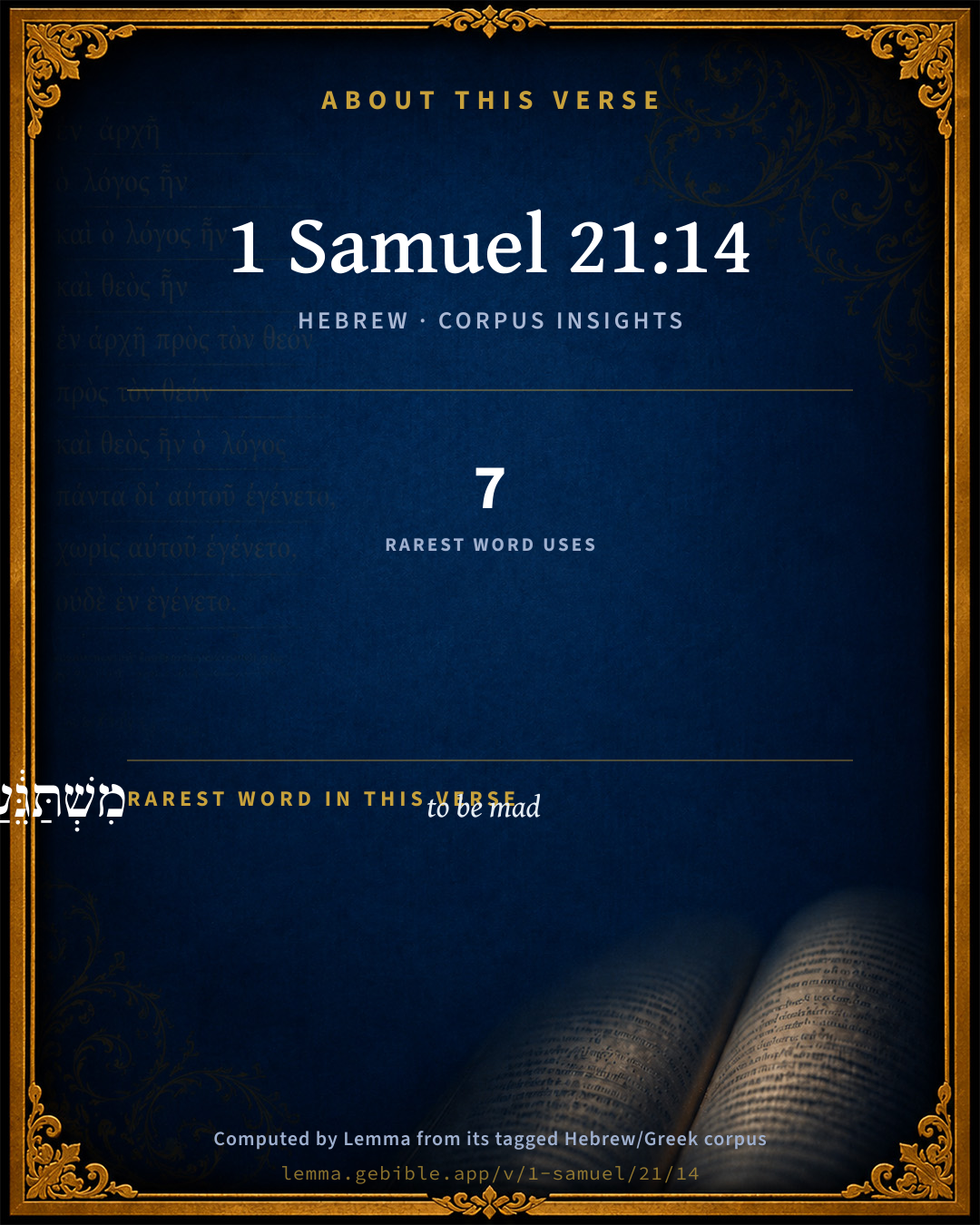
The rarest word here is מִשְׁתַּגֵּ֔עַ to be mad H7696 — appearing just 7 times in the whole Hebrew Bible.

Shared distinctive vocabulary

מִשְׁתַּגֵּ֔עַ to be mad H7696 occurs in 6 verses of the Hebrew Bible. Also found in:

Grammatical profile

  • 4 verbs
  • 3 nouns
  • 2 prepositions
  • 3 particles

Verb forms

  • וַיֹּ֥אמֶר Qal · Sequential Imperfect
  • תִרְאוּ֙ Qal · Imperfect
  • מִשְׁתַּגֵּ֔עַ Hithpael · Participle Active
  • תָּבִ֥יאוּ Hiphil · Imperfect

Repetition

A word recurs within this verse — often emphatic in Hebrew:

  • אֶל to H413 ×2

Hebrew & Septuagint length

In English translation the verse runs 21 words from the Hebrew and 21 from the Septuagint (LXX English) — the same length.

A rough comparison of the two English renderings, which tokenize alike — not a word-level alignment.

Word counts can differ between the Hebrew and the Greek without any difference in meaning — e.g. the Hebrew direct-object marker אֵת has no separate Greek word, and Greek often adds the article ὁ.

Cross-references

1

Topical passages linked to 1 Samuel 21:14 in the Treasury of Scripture Knowledge — connected by theme and wording, ordered by reader-vote popularity; previews shown in the World English Bible.

  • Ecclesiastes 7:7 Surely extortion makes the wise man foolish; and a bribe destroys the understanding.

Cross-references courtesy of OpenBible.info (CC BY 4.0).

Hebrew and Greek witnesses Masoretic Hebrew ↔ Greek Septuagint

The same verse in the two great witnesses to the Old Testament, shown verse-for-verse.

These are two independent witnesses, not word-aligned to each other, and the Septuagint is shown in lemma (dictionary) form.

Hebrew 1 Samuel 21:14 Masoretic · Westminster Leningrad Codex

וַיֹּ֥אמֶר אָכִ֖ישׁ אֶל עֲבָדָ֑יו הִנֵּ֤ה תִרְאוּ֙ אִ֣ישׁ מִשְׁתַּגֵּ֔עַ לָ֛מָּה תָּבִ֥יאוּ אֹת֖וֹ אֵלָֽי

Then said Achish to his servants, Look, you see the man is mad; why then have you brought him to me?

World English Bible · Public Domain

Greek LXX 1 Samuel 21:14 Septuagint · lemma form

καί ἀλλοιόω ὁ πρόσωπον αὐτός ἐνώπιον αὐτός καί προςποιέω ἐν ὁ ἡμέρα ἐκεῖνος καί τυμπανίζω ἐπί ὁ θύρα ὁ πόλις καί παραφέρω ἐν ὁ χείρ αὐτός καί πίπτω ἐπί ὁ θύρα ὁ πύλη καί ὁ σίελον αὐτός καταἔρρω ἐπί ὁ πώγων αὐτός

And Anchus said to his servants, Behold! you⌃ see the man is mad: why have you⌃ brought him in to me?

LXX2012 (modern English Septuagint) · Public Domain

Hebrew: Westminster Leningrad Codex (CC BY 4.0). Greek: Septuagint (public domain); English from LXX2012 (modern English Septuagint) (Public Domain). How the Septuagint differs from the Hebrew →

Targum (Aramaic paraphrase)

1

The Targum is the ancient Jewish Aramaic paraphrase of the Hebrew Scriptures — an interpretive translation, not the Hebrew text itself. Onkelos (literal) and Pseudo-Jonathan (expansive) render the Torah, and Jonathan the Prophets. Coverage is partial: where no permissively-licensed English translation exists for a verse, only the Aramaic is shown. This is verse-level text, not a word-by-word alignment to the Hebrew.

  1. Targum Jonathan Prophets (Joshua–Malachi)
    וְאַשְׁנֵי יַת טַעְמֵיהּ בְּעֵינֵיהוֹן וְאִשְׁתְּמַם בִּידֵיהוֹן וּמְסָרֵט עַל דָשֵׁי תַרְעָא וּמָחַת רִירֵיהּ עַל דִקְנֵיהּ:

    (no public-domain English translation for this verse)

    Targum Jonathan — Aramaic: “Mikraot Gedolot” (public domain). English: “Sefaria Community Translation” (CC0 1.0 (public-domain dedication)); “London "Chaldee Paraphrase," 1871” (public domain). Text via Sefaria.

Commentary

Notes on 1 Samuel 21:14 from classic Christian and Jewish commentators (each source and its license shown beneath its notes). The classic Christian expositions comment on the surrounding passage and are grouped to its opening verse, so a note may address several verses; the Jewish commentaries on the Tanakh (Rashi and others) are per-verse, so they appear only where the commentator wrote on this verse.

Lemma curates 59 commentaries, every one of them public domain or Creative Commons licensed, each selected and text-cleaned for this edition rather than reprinted as found. About our sources →

Trapp's Complete Commentary

John Trapp

1Sa 21:14 Then said Achish unto his servants, Lo, ye see the man is mad: wherefore [then] have ye brought him to me?

Ver. 14. Lo, ye see the man is mad.] Ay, or else you are infatuated to dismiss him for mad, to your further ruth {grief} and utter ruin.

John Trapp, A Commentary or Exposition upon All the Books of the Old and New Testament (1647–1656) — public domain. Text from a community e-Sword module.

Ellicott's Commentary for English Readers

(14) Then said Achish . . . the man is mad.—The Philistine king would look with peculiar sorrow and repulsion on a madman if, as according to Jewish tradition (see Philippson), his own wife and daughter were insane.

The device, however, succeeded, as David hoped it would, and he was suffered to depart in safety—nay, was even hurried out of the Philistine country. In old times, as now, in many parts of the East, the insane are looked upon as persons in some peculiar way possessed by, and therefore under the more immediate protection of, Deity. The life then of the hunted fugitive was perfectly safe from the moment the Philistines considered him mad.

There is a curious legend in the Talmud in which several events recorded in the Biblical account are confused. Part of it apparently refers to this strange choice of his of Phillstia as a place of refuge. “One day Satan appeared to him (David) in the shape of a gazelle, which, eluding his pursuit, decoyed him into the land of the Philistines. ‘Ah!’ said Ishbi-benob, when he caught sight of him, ‘art thou the man that slew my brother, Goliath?’ So saying, he seized and bound him.”—Treatise Sanhedrin, fol. 95, cols 1, 2. The wild legend goes on to explain how, partly by miracle, partly with the aid of Abishai, David slew Ishbi-benob and escaped.

A Bible Commentary for English Readers, edited by Charles John Ellicott (1878–1897) — public domain. Text from a community e-Sword module.

John Gill's Exposition

Then said Achish to his servants, lo, you see the man is mad,.... Which he said, as willing his servants should think so, and therefore rather the object of their pity than of their rage and malice; or as really believing he was so, which he and they might conclude not merely from these his actions, before described, which they might judge real and not feigned; but they might suppose this was truly his case, brought upon him by the ill usage of Saul, who pursuing him from place to place, and sending after him to take away his life, had really brought him to distraction; and this they might rather conclude from his coming to Gath, an enemy's country, and whose champion he had slain, and many others of them; which it might be thought no man in his senses would have done:

wherefore then have ye brought him to me? for if he was brought to be employed in his service, he seemed very unfit for it, whether in the camp, or in the court; and if to be tried and condemned as an enemy, since he was a madman, he was rather to be pitied.

John Gill's Exposition of the Whole Bible (1746–1763) — public domain (CC PDM 1.0). Text via the HelloAO Bible API.

Matthew Poole's English Annotations

Ye see the man is mad; and so were Achish and his men too, to be so soon cheated. But this must be ascribed to the wise and powerful providence of God, who, in answer to David’s prayer now made, which is recorded Psa 34; Psa 61, did infatuate them, as he hath done many others in like cases.

Wherefore then have ye brought him to me? what service can I expect from him? or what cause have I to fear him?

Matthew Poole's English Annotations on the Holy Bible (1683–1685) — public domain. Text from a community e-Sword/MySword module.

Whedon's Commentary on the Bible

Daniel D. Whedon

14. The man is mad — “A sort of respect for persons thus afflicted, as if they were under some kind of supernatural influence, has always existed, and does now exist, in the East; so that David knew his personal safety, and even his freedom, were guaranteed by the belief in his madness.” — Kitto.

Daniel D. Whedon (gen. ed.), Commentary on the Old and New Testaments (1874–1909) — public domain. Text from a community e-Sword module.

The Pulpit Commentary

Vers. 14, 15. The man is mad. Achish supposes that David"s madness was real, and "drove him away" (Psalm 34., title). Here we have only his contemptuous words, declaring that he had madmen enough of his own, and needed no more. As madmen were looked upon in old time as possessed by the Deity, and therefore as persons who must not be interfered with, they probably presumed upon the liberty granted them, and gave much annoyance. In my presence. Rather, "against me." Achish feared personal injury. Shall this fellow come into my house? A strong negative taking the form of a question. It means, David shall not enter into my service (comp. Psalm 34., title). The whole psalm bears witness to the deep perturbation of David"s spirit, and helps to explain his strange conduct.

The Pulpit Commentary (1880–1919), ed. H.D.M. Spence-Jones & Joseph S. Exell — public domain. Text from a community e-Sword module.

Keil & Delitzsch

C. F. Keil & F. Delitzsch

By this dissimulation David escaped the danger which threatened him; for Achish thought him mad, and would have nothing to do with him. "Wherefore do ye bring him to me? Have I need of madmen, that ye have brought this man hither to rave against me? Shall this man come into my house?" Thus Achish refused to receive him into his house. But whether he had David taken over the border, or at any rate out of the town; or whether David went away of his own accord; or whether he was taken away by his servants, and then hurried as quickly as possible out of the land of the Philistines, is not expressly mentioned, as being of no importance in relation to the principal object of the narrative. All that is stated is, that he departed thence, and escaped to the cave Adullam.

Keil & Delitzsch — Biblical Commentary on the Old Testament (1861–1891) — public domain (CC PDM 1.0). Text via the HelloAO Bible API. (Old Testament only.)

unfoldingWord translationNotes

Door43 World Missions Community

Why have you brought him to me?

Possible meanings are 1) Achish demands that his servants explain why they have brought David to him or 2) Achish is scolding them with a rhetorical question. AT: "You should have known not to bring him to me." (See: Rhetorical Question)

Do I lack madmen, so that you have brought this fellow to behave like one in my presence?

This rhetorical question is a rebuke. AT: "There are enough madmen here who waste my time. You should not have brought this fellow to behave like one in my presence." (See: Rhetorical Question and Assumed Knowledge and Implicit Information)

Will this fellow really come into my house?

This rhetorical question can be translated as a statement. AT: "Do not allow this fellow to enter my house." (See: Rhetorical Question)

translationWords

servant

house

unfoldingWord translationNotes — © Distant Shores Media and the Door43 World Missions Community, licensed CC BY-SA 4.0. Source: git.door43.org/Door43/en_tn.

Rashi

Rabbi Shlomo Yitzchaki (Rashi)

His behavior. His words.

And feigned madness. He acted insane.

He scribbled. He wrote.

His saliva. His saliva; anything which drips is called 'ריר' as in, 'in saliva [בְּרִיר] of health', and as in, '[whether] his flesh run [דָר]'.

Rashi on the Tanakh — English translations: “The Judaica Press complete Tanach with Rashi, translated by A. J. Rosenberg” (CC BY 4.0); “Pentateuch with Rashi's commentary by M. Rosenbaum and A.M. Silbermann, 1929-1934” (public domain); “The Metsudah Tanach series, Lakewood, N.J” (CC BY 4.0); and “The Book of Joshua, Metsudah Publications, 1997” (CC BY 4.0). Text via Sefaria.

Lesson kit

Teaching starters — assembled from the data on this page, not authored interpretation. Every prompt links to the verse data it draws on. Edit before teaching.

1 Samuel, in the Historical, opens this verse with 12 words (11 distinct Hebrew lemmas). Its most distinctive word is shâgaʻ (“to be mad”). A historical commentator’s framing appears above. Read the whole chapter for the surrounding context.

Discussion questions

  1. How does “to be mad” (shâgaʻ) shape what this verse is saying?
  2. Deuteronomy 28:34 shares the word «to be mad» with this verse. How do the two illuminate each other?
  3. “to” occurs 2× in this one verse. What is the effect of the repetition?
  4. The translations on this page render this verse differently — a whole-verse word diff, not a word-by-word alignment. What might account for the different wordings?
  5. The verb «וַיֹּ֥אמֶר» is Qal Sequential Imperfect. How does its form color the action?
  6. Reading how Trapp's Complete Commentary and Ellicott's Commentary for English Readers read this verse, where do the two commentators agree and where do they part?

Things to notice

Reading settings

Reading text

Shown beneath each verse's original-language words.

Old Testament
Old Testament edition

Read the OT as the Masoretic Hebrew (MT) or the Greek Septuagint (LXX).

English shown for the Greek Septuagint (in the Hebrew ↔ Greek comparison).

Comparing translations? Open the Compare panel on any verse page to stack up to four side by side.