
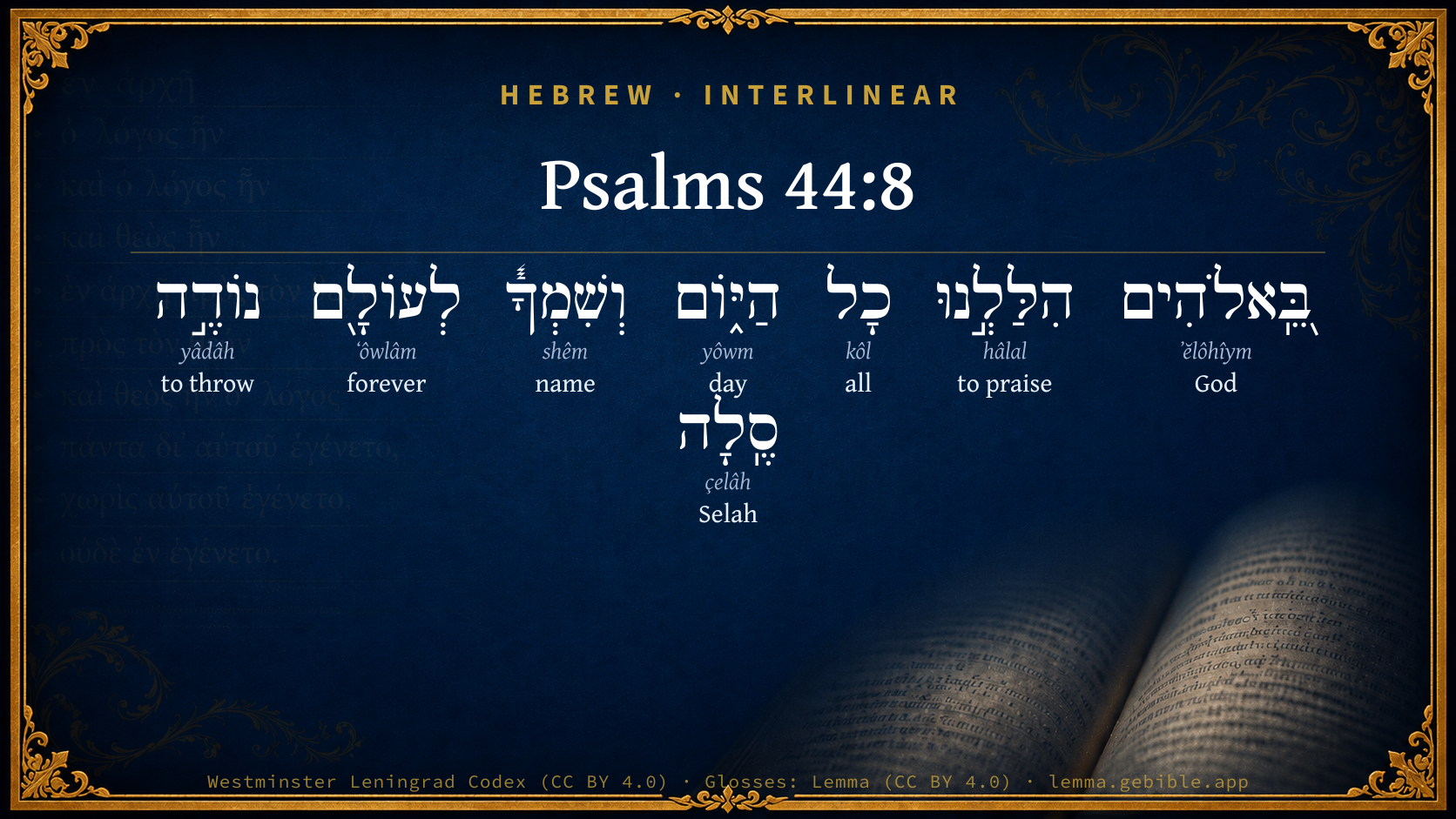
Psalms 44:8

Hebrew (Westminster Leningrad Codex) Psalms 44:8 appears in the Hebrew Old Testament. The text above is from the Westminster Leningrad Codex. Each word links to its Strong’s number, a concise gloss, and parsing drawn from the Open Scriptures Hebrew Bible morphology. Click any word for its full Brown-Driver-Briggs (BDB) entry.
Download image
Cite this verse

Psalms 44:8 (World English Bible). Public Domain. Lemma interlinear Bible study tool, https://lemma.gebible.app/v/psalms/44/8.

Show BibTeX & RIS
BibTeX
RIS
English Translation
In God we have made our boast all day long, We will give thanks to your name forever. Selah.
World English Bible · Public Domain
Download a study sheet

One document with this verse’s original text, its word-by-word gloss line, the meaning frame, cross-references with their text, attributed commentary, and full source and license credits — printable, and it pastes into notes with its structure intact.

This verse Autodidact and up

Study sheet (.html) Plain text (.txt)

A passage Seminary Student

Up to 50 verses in one chapter. A passage sheet keeps up to 6 commentary sources and 12 cross-references per verse, in the order this page ranks them, and says so on the sheet whenever that leaves anything out. Ask for a single verse and you get the Autodidact verse sheet above.

Everything on this page stays free to read, with no account — the sheet is a download of what is already on screen, not access to it.

Want to remove ads? Support Godless Engineer
Compare translations 3

The same verse in 3 English versions, stacked beneath the original-language interlinear above. Click any original word for its lexicon entry.

Each is an independent rendering of the whole verse — the interlinear is not word-aligned to these translations.

Highlighted words mark where these versions differ — a whole-verse word diff, not a word-by-word alignment.

  • World English Bible Public Domain
    In God we have made our boast all day long, We will give thanks to your name forever. Selah.
  • King James Version Public Domain
    In God we boast all the day long, and praise thy name for ever. Selah.
  • unfoldingWord Literal Text CC BY-SA 4.0
    In God we boast all of the day, and we will praise your name forever. Selah

unfoldingWord Literal Text — © unfoldingWord, licensed CC BY-SA 4.0. Word-aligned USFM3 via Door43 (git.door43.org/unfoldingWord/en_ult).

Versions to compare (up to 4)

3 of 4 selected

Show all 18 translations

Every available English version of this verse, each an independent rendering of the whole verse.

  • World English Bible Public Domain
    In God we have made our boast all day long, We will give thanks to your name forever. Selah.
  • Berean Standard Bible Public Domain
    In God we have boasted all day long, and Your name we will praise forever. Selah
  • Majority Standard Bible Public Domain
    In God we have boasted all day long, and Your name we will praise forever. Selah
  • King James Version Public Domain
    In God we boast all the day long, and praise thy name for ever. Selah.
  • American Standard Version (1901) Public Domain
    In God have we made our boast all the day long, And we will give thanks unto thy name for ever. Selah
  • Revised Version (1885) Public Domain
    In God have we made our boast all the day long, and we will give thanks unto thy name for ever. Selah
  • Geneva Bible (1599) Public Domain
    Therefore will wee praise God continually, and will confesse thy Name for euer. Selah.
  • Douay-Rheims (1899) Public Domain
    But thou hast saved us from them that afflict us: and hast put them to shame that hate us.
  • Young's Literal Translation Public Domain
    In God we have boasted all the day, And Thy name to the age we thank. Selah.
  • Literal Standard Version CC BY-SA 4.0
    In God we have boasted all the day, || And we thank Your Name for all time. Selah.
  • Unlocked Literal Bible CC BY-SA 4.0
    In God we have made our boast all the day long, and we will give thanks to your name forever. Selah
  • unfoldingWord Literal Text CC BY-SA 4.0
    In God we boast all of the day, and we will praise your name forever. Selah
  • Darby Bible Public Domain
    In God will we boast all the day, and we will praise thy name for ever. Selah.
  • World Messianic Bible Public Domain
    In God we have made our boast all day long. We will give thanks to your name forever. Selah.
  • Webster's Bible Public Domain
    \\44:7\\But thou hast saved us from our enemies, and hast put them to shame that hated us.
  • Free Bible Version CC BY-SA 4.0
    God, we proudly thank you all day long, and praise your name forever. Selah.
  • Bible in Basic English Public Domain
    Our pride is in God at all times, to his name we give praise for ever. (Selah.)
  • JPS Tanakh (1917) Public Domain
    (44-9) In God have we gloried all the day, and we will give thanks unto Thy name for ever. Selah

Literal Standard Version (2020), Covenant Press — licensed CC BY-SA 4.0. Text via the HelloAO Bible API (eBible.org). Unlocked Literal Bible (unfoldingWord) — licensed CC BY-SA 4.0. Text via the HelloAO Bible API (eBible.org). unfoldingWord Literal Text — © unfoldingWord, licensed CC BY-SA 4.0. Word-aligned USFM3 via Door43 (git.door43.org/unfoldingWord/en_ult). Free Bible Version, Dr. Jonathan Gallagher — licensed CC BY-SA 4.0. Text via the HelloAO Bible API (eBible.org).

Word by word

More ways to search: Search by grammar → Find every occurrence → Compare this word →

Practice this passage: Drill this verse → Learn its vocabulary →

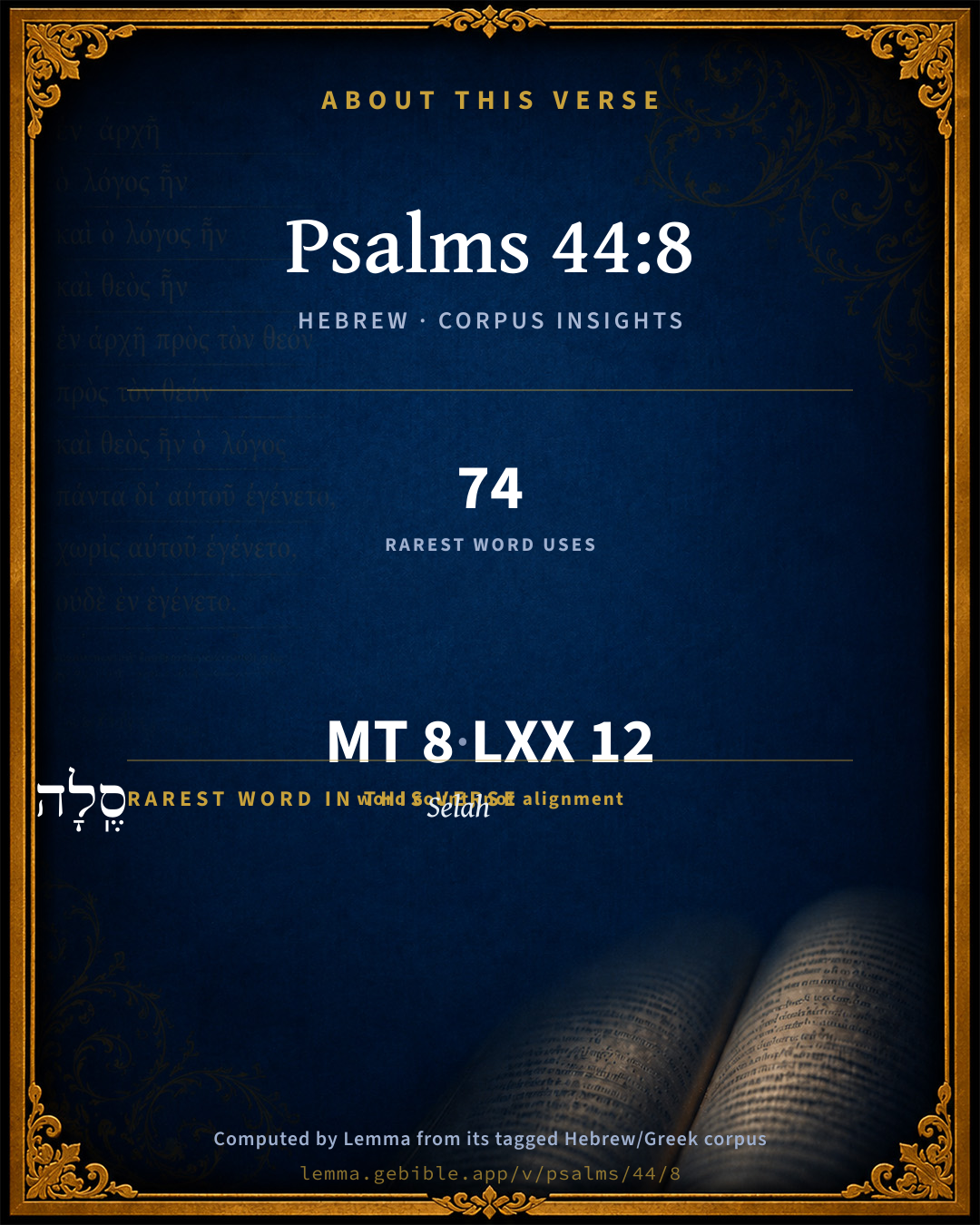
About this verse

These counts appear in no published source. They are computed here, from the morphology-tagged text and Lemma’s own curated glosses. What Lemma adds →

8
words
8
distinct lemmas
Wisdom
section

Grammatical profile

  • 2 verbs
  • 5 nouns
  • 1 particle

Verb forms

  • הִלַּלְ֣נוּ Piel · Perfect
  • נוֹדֶ֣ה Hiphil · Cohortative

Hebrew & Septuagint length

In English translation the verse runs 19 words from the Hebrew and 21 from the Septuagint (LXX English) — closely comparable.

A rough comparison of the two English renderings, which tokenize alike — not a word-level alignment.

Word counts can differ between the Hebrew and the Greek without any difference in meaning — e.g. the Hebrew direct-object marker אֵת has no separate Greek word, and Greek often adds the article ὁ.

In the original languages it is 8 Hebrew tokens and 12 Greek tokens — but the two are counted differently (Hebrew bundles its prefixes and suffixes into one token; the Greek is in lemma form), so that isn’t a like-for-like length.

Cross-references

7

Topical passages linked to Psalms 44:8 in the Treasury of Scripture Knowledge — connected by theme and wording, ordered by reader-vote popularity; previews shown in the World English Bible.

  • Psalms 34:2 My soul shall boast in Yahweh. The humble shall hear of it, and be glad.
  • Jeremiah 9:24 but let him who glories glory in this, that he has understanding, and knows me, that I am Yahweh who exercises loving kindness, justice, and righteousness, in the earth: for in these things I delight, says Yahweh.
  • 1 Corinthians 1:29–31 that no flesh should boast before God.
  • Romans 2:17 Indeed you bear the name of a Jew, and rest on the law, and glory in God,
  • Psalms 30:12 To the end that my heart may sing praise to you, and not be silent. Yahweh my God, I will give thanks to you forever!
  • Isaiah 45:25 In Yahweh shall all the seed of Israel be justified, and shall glory.
  • Psalms 115:1–18 Not to us, Yahweh, not to us, But to your name give glory, For your loving kindness, and for your truth's sake.

Cross-references courtesy of OpenBible.info (CC BY 4.0).

Hebrew and Greek witnesses Masoretic Hebrew ↔ Greek Septuagint

The same verse in the two great witnesses to the Old Testament, shown verse-for-verse.

You’re reading Greek Psalm 43 (Hebrew Psalm 44). The Septuagint counts the superscription, so verse numbers can differ from the Hebrew — chapter-level alignment, not verse-by-verse. Numbering follows Rahlfs.

These are two independent witnesses, not word-aligned to each other, and the Septuagint is shown in lemma (dictionary) form.

Hebrew Psalms 44:8 Masoretic · Westminster Leningrad Codex

בֵּֽ֭אלֹהִים הִלַּלְ֣נוּ כָל הַיּ֑וֹם וְשִׁמְךָ֓ לְעוֹלָ֖ם נוֹדֶ֣ה סֶֽלָה

In God we have made our boast all day long, We will give thanks to your name forever. Selah.

World English Bible · Public Domain

Greek LXX Greek Psalm 43:8 Septuagint · lemma form

σώζω γάρ ἐγώ ἐκ ὁ θλίβω ἐγώ καί ὁ μισέω ἐγώ κατααἰσχύνω

In God will we make our boast all the day, and to your name will we give thanks for ever. Pause.

LXX2012 (modern English Septuagint) · Public Domain

Hebrew: Westminster Leningrad Codex (CC BY 4.0). Greek: Septuagint (public domain); English from LXX2012 (modern English Septuagint) (Public Domain). How the Septuagint differs from the Hebrew →

Commentary

Notes on Psalms 44:8 from classic Christian and Jewish commentators (each source and its license shown beneath its notes). The classic Christian expositions comment on the surrounding passage and are grouped to its opening verse, so a note may address several verses; the Jewish commentaries on the Tanakh (Rashi and others) are per-verse, so they appear only where the commentator wrote on this verse.

Lemma curates 59 commentaries, every one of them public domain or Creative Commons licensed, each selected and text-cleaned for this edition rather than reprinted as found. About our sources →

Trapp's Complete Commentary

John Trapp

Psa 44:8 In God we boast all the day long, and praise thy name for ever. Selah.

Ver. 8. In God we boast all the day long] The Spaniards are said to be great boasters in the very lowest ebb of fortune. A godly man may be, and must be so by a holy gloriation; he must make his boasts of such a King, immortal, invisible, &c. The three children did so: Our God can deliver us, &c.

And praise thy name] Thou alone shall have the praise of all our prosperity.

John Trapp, A Commentary or Exposition upon All the Books of the Old and New Testament (1647–1656) — public domain. Text from a community e-Sword module.

J. A. Alexander on Psalms

Joseph Addison Alexander

9. (Psa 44:8). For thou hast saved us from our adversaries, and our haters (or those hating us) hast shamed. The preterites in this verse are explanatory of the futures in the one before it. "We will not rely upon ourselves hereafter, because it is thou who hast helped us heretofore." This logical relation of the verses is destroyed by confounding the preterites and futures with each other, or explaining both as presents. Shamed, i.e. defeated, disappointed. See above, on Psa 6:10 (9), Psa 14:6.

Joseph Addison Alexander, The Psalms Translated and Explained (1850) — public domain. Text from a community e-Sword module.

Jamieson, Fausset & Brown

Robert Jamieson, A. R. Fausset & David Brown

thy name--as in Psa 5:11.

Jamieson, Fausset & Brown — Commentary Critical and Explanatory on the Whole Bible (1871) — public domain (CC PDM 1.0). Text via the HelloAO Bible API.

Adam Clarke's Commentary

Verse 8. In God we boast] We have told the heathen how great and powerful our God is. If thou do not deliver us by thy mighty power, they will not believe our report, but consider that we are held in bondage by the superior strength of their gods.

Adam Clarke's Commentary on the Bible (1810–1826) — public domain. Text from a community e-Sword/MySword module.

John Calvin's Commentaries

8. In God we will boast all the day This is the conclusion of the first part of the psalm. To express the meaning in a few words, they acknowledge, that in all ages the goodness of God had been so great towards the children of Abraham, that it furnished them with continual matter of thanksgiving. As if the thing were still present to their view, they acknowledge that, without ceasing, they ought to give praise to God, because they had flourished and triumphed, not merely for one age, or a short period of time, but because they had continued to do so successively from age to age, for whatever prosperity had befallen them, they ascribe it to the grace of God. And, certainly, it is then that men experience from the prosperity which befalls them, a holy and a well-regulated joy, when it bursts forth in the praises of God. Let us then, in the first place, bear in mind that this verse relates to the time of joy and prosperity in which God manifested his favor towards his people; secondly, that the faithful here manifest that they are not ungrateful, inasmuch as, having laid aside all vain boasting, they confess that all the victories by which they had become great and renowned proceeded from God, and that it was by his power alone that they had hitherto continued to exist, and had been preserved in safety; and, thirdly, that it was not only once or twice that matter of joy had been afforded them, but that this existed for a long time, inasmuch as God had manifested towards them, during a long and uninterrupted period, divers proofs and tokens of his paternal favor, so that the continuance, and, so to speak, the long experience they had had of it, ought to have been the means of confirming their hope.

John Calvin's Commentaries (1540-1563) — public domain. Text from the Calvin Translation Society English edition (1840s-50s) via the Christian Classics Ethereal Library (ccel.org). Calvin's coverage is partial (roughly two-thirds of the Bible); uncommented books and verses are honest gaps, never fabricated. The 19th-century editor's footnotes and remarks are omitted so the notes are faithfully Calvin's own voice.

The Cambridge Bible for Schools and Colleges

gen. ed. J. J. S. Perowne

8. Of God have we made our boast all day long,

And unto thy name will we give thanks for ever.

God has been the object of their praises in the past, and to Him they are resolved to give thanks (Psa_42:5) continually.

A musical interlude marks the conclusion of the first main division of the Psalm.

The Cambridge Bible for Schools and Colleges (gen. ed. J. J. S. Perowne; Cambridge University Press, 1878–1918) — public domain. Text from a community e-Sword module.

John Gill's Exposition

In God we boast all the day long,.... Or, as the Targum, "in the word of the Lord", in Christ, who is God over all, and who of God is made to his church and people wisdom, righteousness, sanctification, and redemption; so that there is always matter of glorying and boasting in him;

and praise thy name for ever and ever; in this world, as long as life continues; and in the other world to all eternity; both for the works of providence and of grace; for deliverances commanded, and for salvation from all enemies wrought out.

Selah; of this word See Gill on Psa 3:2.

John Gill's Exposition of the Whole Bible (1746–1763) — public domain (CC PDM 1.0). Text via the HelloAO Bible API.

Albert Barnes' Notes on the Bible

In God we boast all the day long - That is, continually or constantly. It is not a momentary or temporary expression of our feelings, but it is our habitual and constant employment. We have no other ground of reliance, and we express that reliance constantly. The word rendered “boast” here rather more literally means praise: “In God we praise all the day long.” The idea is, that he was their only ground of confidence. They ascribed all their former successes to him; they had no other reliance now.

And praise thy name for ever - We do it now; we shall never cease to do it.

Selah - On the meaning of this word, see the notes at Psa 3:2.

Albert Barnes' Notes on the Bible (1834–1885) — public domain. Text from a community e-Sword/MySword module.

Matthew Poole's English Annotations

In God we boast, as in a most sure rock, and our only refuge.

Matthew Poole's English Annotations on the Holy Bible (1683–1685) — public domain. Text from a community e-Sword/MySword module.

The Treasury of David

Charles H. Spurgeon

Ver. 8. In God we boast all the day long. We have abundant reason for doing so while we recount his mighty acts. What blessed boasting is this! it is the only sort of boasting that is bearable. All other manna bred worms and stank except that which was laid up before the Lord, and all other boasting is loathsome save this glorying in the Lord, which is laudable and pleasing. And praise thy name for ever. Praise should be perpetual. If there were no new acts of love, yet ought the Lord to be praised for what he has done for his people. High let the song be lifted up as we bring to remembrance the eternal love which chose us, predestinated us to be sons, redeemed us with a price, and then enriched us with all the fulness of God. Selah. A pause comes in fitly here, when we are about to descend from the highest to the lowest key. No longer are we to hear Miriam's timbrel, but rather Rachel's weeping.

Ver. 1-2,4,8. See Psalms on "Ps 44:1" for further information.

Ver. 8. Praise, its continuancehow to make it continual, how to manifest it perpetually, influence of its continuance, and reasons to compel us to abide in it.

Psalms 44:9*

Charles H. Spurgeon's The Treasury of David (1869–1885) — public domain. Psalms only. Text from a community e-Sword/MySword module.

Whedon's Commentary on the Bible

Daniel D. Whedon

8. In God we boast—Or, rather, dropping the preposition as a pleonasm, God we have praised all the day.

Praise… for ever—Give thanks forever. The past and future are here embraced. The praise already given for former mercies shall be the pledge of future and endless thanksgiving.

Daniel D. Whedon (gen. ed.), Commentary on the Old and New Testaments (1874–1909) — public domain. Text from a community e-Sword module.

The Pulpit Commentary

In God we boast all the day long, and praise thy Name for ever. We boast of God as our God, who saves us, and puts to shame our enemies (see ver. 7).

The Pulpit Commentary (1880–1919), ed. H.D.M. Spence-Jones & Joseph S. Exell — public domain. Text from a community e-Sword module.

Lesson kit

Teaching starters — assembled from the data on this page, not authored interpretation. Every prompt links to the verse data it draws on. Edit before teaching.

Psalms, in the Wisdom, opens this verse with 8 words (8 distinct Hebrew lemmas). Its most distinctive word is çelâh (“Selah”). A historical commentator’s framing appears above. Read the whole chapter for the surrounding context.

Discussion questions

  1. How does “Selah” (çelâh) shape what this verse is saying?
  2. Psalms 34:2 shares this passage’s theme. How do the two illuminate each other?
  3. These translations render this verse differently. What is at stake in choosing one wording over another?
  4. The verb «הִלַּלְ֣נוּ» is Piel Perfect. How does its form color the action?
  5. Reading how Trapp's Complete Commentary and J. A. Alexander on Psalms read this verse, where do the two commentators agree and where do they part?

Things to notice

Reading settings

Reading text

Shown beneath each verse's original-language words.

Old Testament
Old Testament edition

Read the OT as the Masoretic Hebrew (MT) or the Greek Septuagint (LXX).

English shown for the Greek Septuagint (in the Hebrew ↔ Greek comparison).

Comparing translations? Open the Compare panel on any verse page to stack up to four side by side.