
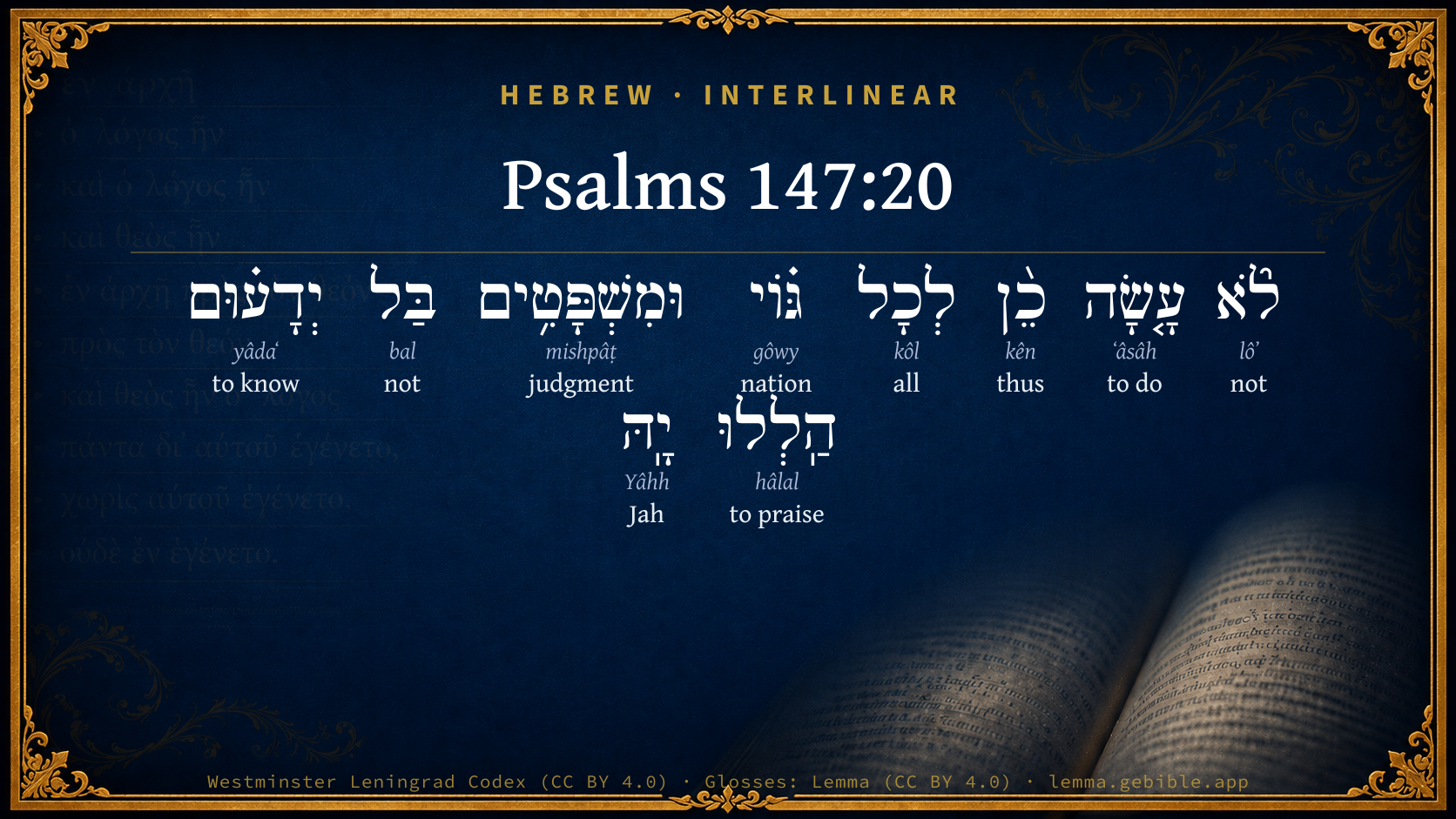
Psalms 147:20

Hebrew (Westminster Leningrad Codex) Psalms 147:20 appears in the Hebrew Old Testament. The text above is from the Westminster Leningrad Codex. Each word links to its Strong’s number, a concise gloss, and parsing drawn from the Open Scriptures Hebrew Bible morphology. Click any word for its full Brown-Driver-Briggs (BDB) entry.
Download image
Cite this verse

Psalms 147:20 (World English Bible). Public Domain. Lemma interlinear Bible study tool, https://lemma.gebible.app/v/psalms/147/20.

Show BibTeX & RIS
BibTeX
RIS
English Translation
He has not done this for just any nation. They don't know his ordinances. Praise Yah!
World English Bible · Public Domain
Download a study sheet

One document with this verse’s original text, its word-by-word gloss line, the meaning frame, cross-references with their text, attributed commentary, and full source and license credits — printable, and it pastes into notes with its structure intact.

This verse Autodidact and up

Study sheet (.html) Plain text (.txt)

A passage Seminary Student

Up to 50 verses in one chapter. A passage sheet keeps up to 6 commentary sources and 12 cross-references per verse, in the order this page ranks them, and says so on the sheet whenever that leaves anything out. Ask for a single verse and you get the Autodidact verse sheet above.

Everything on this page stays free to read, with no account — the sheet is a download of what is already on screen, not access to it.

Want to remove ads? Support Godless Engineer
Compare translations 3

The same verse in 3 English versions, stacked beneath the original-language interlinear above. Click any original word for its lexicon entry.

Each is an independent rendering of the whole verse — the interlinear is not word-aligned to these translations.

Highlighted words mark where these versions differ — a whole-verse word diff, not a word-by-word alignment.

  • World English Bible Public Domain
    He has not done this for just any nation. They don't know his ordinances. Praise Yah!
  • King James Version Public Domain
    He hath not dealt so with any nation: and as for his judgments, they have not known them. Praise ye the LORD.
  • unfoldingWord Literal Text CC BY-SA 4.0
    He has not done this for any nation, and his judgments, they do not know them. Hallelu Yah!

unfoldingWord Literal Text — © unfoldingWord, licensed CC BY-SA 4.0. Word-aligned USFM3 via Door43 (git.door43.org/unfoldingWord/en_ult).

Versions to compare (up to 4)

3 of 4 selected

Show all 17 translations

Every available English version of this verse, each an independent rendering of the whole verse.

  • World English Bible Public Domain
    He has not done this for just any nation. They don't know his ordinances. Praise Yah!
  • Berean Standard Bible Public Domain
    He has done this for no other nation; they do not know His judgments. Hallelujah!
  • Majority Standard Bible Public Domain
    He has done this for no other nation; they do not know His judgments. Hallelujah!
  • King James Version Public Domain
    He hath not dealt so with any nation: and as for his judgments, they have not known them. Praise ye the LORD.
  • American Standard Version (1901) Public Domain
    He hath not dealt so with any nation; And as for his ordinances, they have not known them. Praise ye Jehovah.
  • Revised Version (1885) Public Domain
    He hath not dealt so with any nation: and as for his judgments, they have not known them. Praise ye the LORD.
  • Geneva Bible (1599) Public Domain
    He hath not dealt so with euery nation, neither haue they knowen his iudgements. Prayse ye the Lord.
  • Young's Literal Translation Public Domain
    He hath not done so to any nation, As to judgments, they have not known them. Praise ye Jah!
  • Literal Standard Version CC BY-SA 4.0
    He has not done so to any nation, || As for judgments, they have not known them. Praise YAH!
  • Unlocked Literal Bible CC BY-SA 4.0
    He has not done so with any other nation, and as for his decrees, they do not know them. Praise Yahweh.
  • unfoldingWord Literal Text CC BY-SA 4.0
    He has not done this for any nation, and his judgments, they do not know them. Hallelu Yah!
  • Darby Bible Public Domain
    He hath not dealt thus with any nation; and as for [his] judgments, they have not known them. Hallelujah!
  • World Messianic Bible Public Domain
    He has not done this for just any nation. They don’t know his ordinances. Praise the LORD!
  • Webster's Bible Public Domain
    He hath not dealt so with any nation: and as for his judgments, they have not known them. Praise ye the LORD.
  • Free Bible Version CC BY-SA 4.0
    He has not done this for any other nation—they don't know his laws. Praise the Lord!
  • Bible in Basic English Public Domain
    He has not done these things for any other nation: and as for his laws, they have no knowledge of them. Let the Lord be praised.
  • JPS Tanakh (1917) Public Domain
    He hath not dealt so with any nation; and as for His ordinances, they have not known them. Hallelujah.

Literal Standard Version (2020), Covenant Press — licensed CC BY-SA 4.0. Text via the HelloAO Bible API (eBible.org). Unlocked Literal Bible (unfoldingWord) — licensed CC BY-SA 4.0. Text via the HelloAO Bible API (eBible.org). unfoldingWord Literal Text — © unfoldingWord, licensed CC BY-SA 4.0. Word-aligned USFM3 via Door43 (git.door43.org/unfoldingWord/en_ult). Free Bible Version, Dr. Jonathan Gallagher — licensed CC BY-SA 4.0. Text via the HelloAO Bible API (eBible.org).

Word by word

More ways to search: Search by grammar → Find every occurrence → Compare this word →

Practice this passage: Drill this verse → Learn its vocabulary →

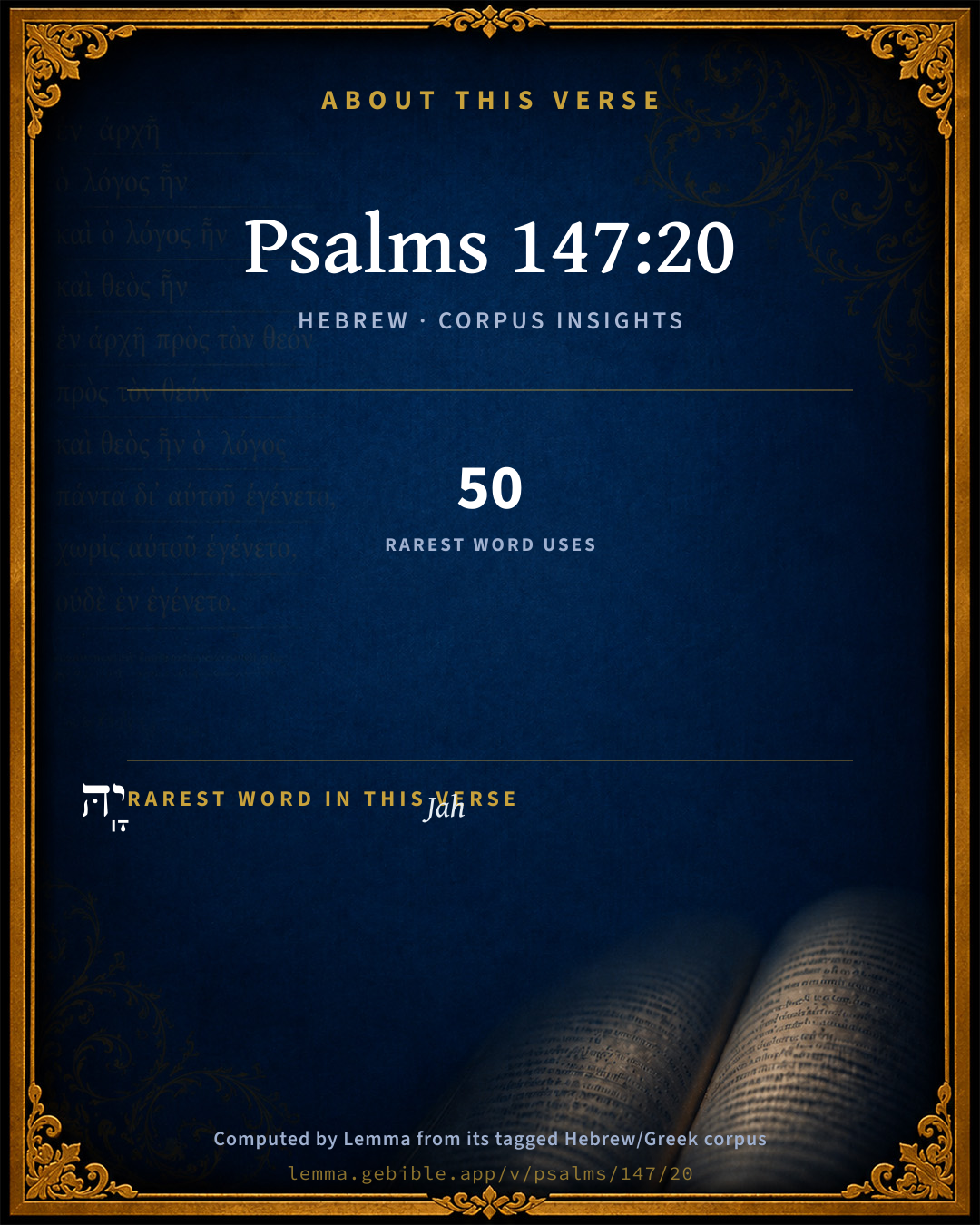
About this verse

These counts appear in no published source. They are computed here, from the morphology-tagged text and Lemma’s own curated glosses. What Lemma adds →

10
words
10
distinct lemmas
Wisdom
section

Shared distinctive vocabulary

יָֽהּ Jah H3050 occurs in 46 verses of the Hebrew Bible. Also found in:

Grammatical profile

  • 3 verbs
  • 4 nouns
  • 1 adverb
  • 2 particles

Verb forms

  • עָ֤שָׂה Qal · Perfect
  • יְדָע֗וּם Qal · Perfect
  • הַֽלְלוּ Piel · Imperative

Cross-references

12

Topical passages linked to Psalms 147:20 in the Treasury of Scripture Knowledge — connected by theme and wording, ordered by reader-vote popularity; previews shown in the World English Bible.

  • Deuteronomy 4:32–34 For ask now of the days that are past, which were before you, since the day that God created man on the earth, and from the one end of the sky to the other, whether there has been [any such thing] as this great thing is, or has been heard like it?
  • Deuteronomy 4:7–8 For what great nation is there, that has a god so near to them, as Yahweh our God is whenever we call on him?
  • Romans 3:1–2 Then what advantage does the Jew have? Or what is the profit of circumcision?
  • Ephesians 2:12 that you were at that time separate from Christ, alienated from the commonwealth of Israel, and strangers from the covenants of the promise, having no hope and without God in the world.
  • 1 Peter 2:9–10 But you are a chosen race, a royal priesthood, a holy nation, a people for God's own possession, that you may show forth the excellencies of him who called you out of darkness into his marvelous light:
  • Ephesians 5:8 For you were once darkness, but are now light in the Lord. Walk as children of light,
  • Isaiah 5:1–7 Let me sing for my well beloved a song of my beloved about his vineyard. My beloved had a vineyard on a very fruitful hill.
  • Acts 14:16 who in the generations gone by allowed all the nations to walk in their own ways.
  • Acts 26:27 King Agrippa, do you believe the prophets? I know that you believe."
  • Proverbs 29:18 Where there is no revelation, the people cast off restraint; But one who keeps the law is blessed.
  • Matthew 21:33–41 "Hear another parable. There was a man who was a master of a household, who planted a vineyard, set a hedge about it, dug a winepress in it, built a tower, leased it out to farmers, and went into another country.
  • Acts 26:18 to open their eyes, that they may turn from darkness to light and from the power of Satan to God, that they may receive remission of sins and an inheritance among those who are sanctified by faith in me.'

Cross-references courtesy of OpenBible.info (CC BY 4.0).

Hebrew and Greek witnesses Masoretic Hebrew ↔ Greek Septuagint

The same verse in the two great witnesses to the Old Testament, shown verse-for-verse.

You’re reading Greek Psalm 146 (Hebrew Psalm 147). The Septuagint counts the superscription, so verse numbers can differ from the Hebrew — chapter-level alignment, not verse-by-verse. Numbering follows Rahlfs.

These are two independent witnesses, not word-aligned to each other, and the Septuagint is shown in lemma (dictionary) form.

Hebrew Psalms 147:20 Masoretic · Westminster Leningrad Codex

לֹ֘א עָ֤שָׂה כֵ֨ן לְכָל גּ֗וֹי וּמִשְׁפָּטִ֥ים בַּל יְדָע֗וּם הַֽלְלוּ יָֽהּ

He has not done this for just any nation. They don't know his ordinances. Praise Yah!

World English Bible · Public Domain

Hebrew: Westminster Leningrad Codex (CC BY 4.0). Greek: Septuagint (public domain); English from a public-domain English Septuagint. How the Septuagint differs from the Hebrew →

Commentary

Notes on Psalms 147:20 from classic Christian and Jewish commentators (each source and its license shown beneath its notes). The classic Christian expositions comment on the surrounding passage and are grouped to its opening verse, so a note may address several verses; the Jewish commentaries on the Tanakh (Rashi and others) are per-verse, so they appear only where the commentator wrote on this verse.

Lemma curates 59 commentaries, every one of them public domain or Creative Commons licensed, each selected and text-cleaned for this edition rather than reprinted as found. About our sources →

Trapp's Complete Commentary

John Trapp

Psa 147:20 He hath not dealt so with any nation: and [as for his] judgments, they have not known them. Praise ye the LORD.

Ver. 20. He hath not dealt so with any nation] He had not then; but now, blessed be God, he hath dealt so with many nations, in these last happy days of reformation especially; wherein the knowledge of God’s holy Word covereth the earth, as the waters cover the sea; and of England it may be said, as once of the Rhodes, semper in Sole, sita est Rhodos, that it hath the sun ever shining upon it. This we should prize as a precious treasure, and praise the Lord for it, corde, ore, opere. by heart, mouth and work.

And as for his judgments, they have not known them] And therefore lie in deadly darkness; wherein, though they wander woefully, yet not so wide as to miss of hell.

John Trapp, A Commentary or Exposition upon All the Books of the Old and New Testament (1647–1656) — public domain. Text from a community e-Sword module.

J. A. Alexander on Psalms

Joseph Addison Alexander

20. (Psa 147:20) He has not done so to every nation—and (as for) judgments, they know nothing of them. This revelation to Israel is peculiar and exclusive. Every nation, and by implication, any one. This is, indeed, the only form in which that idea could be expressed in Hebrew. The last clause declares the other nations ignorant not only of his laws or judgments, but of any that deserve the name.

Joseph Addison Alexander, The Psalms Translated and Explained (1850) — public domain. Text from a community e-Sword module.

Geneva Bible (1599)

Geneva Bible translators

The cause of this difference is God’s free mercy, which hath elected his in his Son Christ Jesus to salvation: and his just judgment, whereby he hath appointed the reprobate to eternal damnation.

Geneva Bible (1599) marginal notes — public domain. Text via Bolls.life.

Adam Clarke's Commentary

Verse 20. And as for his judgments] The wondrous ordinances of his law, no nation had known them; and consequently, did not know the glorious things in futurity to which they referred.

ANALYSIS OF THE HUNDRED AND FORTY-SEVENTH PSALM

The parts of this Psalm are two: -

I. An exhortation to praise God, Ps 147:1, which is repeated, Ps 147:7; Ps 147:12.

II. The arguments to persuade to it: God's bounty, wisdom, power, providence, justice, and mercy, dwelt on through the whole Psalm.

I. The exhortation is briefly proposed, "Praise the Lord." Which the prophet, as the chanter of the choir, begins; and then more fully repeats, "Sing unto the Lord," c. And again "Praise the Lord, O Jerusalem," &c., Ps 147:12, where the Arabic, Greek, and Latin translators begin a new Psalm: but in the Hebrew they are conjoined, and form but one hymn.

The prophet, having ended his exhortation, adds his reasons for it.

1. It is pleasant and becoming.

2. His bounty in building Jerusalem, and bringing back the dispersed, Ps 147:2. In comforting the distressed, Ps 147:3. For his wisdom, Ps 147:4. For his power, Ps 147:5. For his mercy and justice, Ps 147:6.

His first arguments are drawn from the thing itself.

I. Good: "For it is good," &c.

For many reasons this may be called good.

1. For it is God's command, and must not be neglected.

2. It elevates the heart from earth to heaven.

3. Good again, because we are bound to it by obligations.

II. "To praise God is pleasant."

1. Because it proceeds from love.

2. Because it is pleasant to perform our duty, and the end of our creation.

3. Because God is pleased with it: "He that offereth me praise, glorifieth me," &c.

4. Because God is pleased with the virtues of faith, hope, charity, humility, devotion, &c., of which praise is the effect.

III. "It is comely." There is no sin greater than that of ingratitude.

These are the first arguments the prophet uses, and they are drawn from the nature of the thing itself: they may apply to all ages of the Church.

He dwells upon the deliverance of Israel from captivity.

1. "The Lord doth build up" his Church, the seat of his sanctuary. He hath restored our policy and religion.

2. "He gathereth together," &c. The banished and scattered ones the Gentiles.

3. "He healeth the broken in heart," c. Oppressed by captivity or sin.

4. "And bindeth up," &c. Like a good surgeon.

The second argument is drawn from his wisdom.

1. "He telleth the number of the stars," &c. A thing to man impossible,

2. "He calleth them," &c. They are his army, and he knows them.

By the stars in this place some understand God's saints.

1. The stars are infinite in number. So are the saints.

2. Among them are planets. Saints have their circuits and always revolve round him, the Sun of righteousness.

3. The stars shine clearest in the night. The saints in persecution.

4. One star differeth from another in glory. Some saints excel others in piety.

5. The stars are above. The saints' conversation is in heaven.

6. The stars are obscured by clouds. The Church is sometimes obscured by affliction and persecution.

His third argument is drawn from God's power: "Great is the Lord," c.

His fourth argument is drawn from God's justice and mercy.

1. His mercy: "The Lord lifteth up the meek," &c. Sustains and exalts them.

2. His justice: "He casteth the wicked down," &c. They shall not always triumph.

But, before the prophet proceeds farther, he repeats: -

1. "Sing unto the Lord with thanksgiving." Do it in words.

2. "Sing praises upon the harp," &c. Do it in works.

Then he proceeds to argue from God's providence.

1. "Who covereth the heaven," &c. Not to obscure, but fructify the earth.

2. "Who maketh grass to grow," &c. By his blessing on the most barren places.

3. "He giveth to the beast," &c. They gather it from his supplies.

4. "And to the young ravens," &c. No bird suffers its young so soon to provide for themselves, but God hears and sends them food. Christ himself uses this argument to encourage us to rely on God's providence, Mt 6:26.

Should the distrustful Jew argue, Alas, we have no strength, ammunition, horse, or armour, the prophet replies: -

1. "He delighteth not," &c. When used as a warlike creature.

2. "He taketh not pleasure," &c. In the nimbleness of man, when used for warlike preparations.

But he delights in his servants.

1. "The Lord taketh pleasure," &c. In those who obey and love him.

2. "In those that hope," &c. Have faith and confidence in him.

3. He again repeats his proposition, and calls upon the Church to perform it: "Praise the Lord, O Jerusalem," &c. "Thy God, O Zion." Should others be negligent, be not ye.

He then adds four reasons why Zion should praise him: 1. Security and defence. 2. Benediction. 3. Peace. 4. Substance.

1. Security: "For he hath strengthened," &c.

2. Benediction: "He hath blessed," &c. His officers with wisdom, &c.

3. Peace: "He maketh peace." The vision of peace is the literal interpretation of the word Jerusalem.

4. Provision: "Filleth thee with the finest of the wheat," &c.

That God has done this for Jerusalem, is evident from his general providence over the world. And this argument the prophet uses: "He sendeth forth his commandment upon earth," &c. For,

1. "He giveth snow like wool." Beautiful in appearance, and in order to preserve vegetables from the nipping but necessary frost, when long continued.

2. "He scattereth the hoar frost," &c. Thickening the air with it like ashes freezing all the vapours that float in it.

3. "He casteth forth his ice," c. Fragments of ice.

4. "Who can stand before his cold?" Endure it unprovided.

But having described all these powerful agents, the prophet next shows how easily they are governed by his word.

1. "He sendeth out his word, and melteth them."

2. "He causeth his wind to blow," &c. And the ice and snow return to water. All these are his, and on him we must depend for safety and comfort.

By these God teaches alike nations to acknowledge him.

But there are particular acts which refer to his people for,

1. "He showeth his word," c. By Moses and the prophets.

2. "He hath not dealt so," &c. None at that time, but since to his Church.

3. "As for his judgments," &c. His evangelical precepts. He is sending forth his word the nations could not find out his precepts otherwise: therefore for this praise ye the Lord.

Adam Clarke's Commentary on the Bible (1810–1826) — public domain. Text from a community e-Sword/MySword module.

Ellicott's Commentary for English Readers

(20) Any nation.—This boast in Israel’s peculiar and exclusive privilege may be compared with Deu_4:7; Deu_32:32-41.

Judgments.—Here plainly not manifestations of wrath; but, as so frequently in Psalms 119, the display of righteousness towards Israel.

A Bible Commentary for English Readers, edited by Charles John Ellicott (1878–1897) — public domain. Text from a community e-Sword module.

John Gill's Exposition

He hath not dealt so with any nation,.... Or "every nation" (b); or all the nations under the heavens; only with the Jewish nation: these only for many hundreds of years were favoured with the divine revelation, with the word and ordinances of God; with the law, and with the Gospel, and with the service and worship of God; as well as with promises and prophecies of Christ, and good things to come by him. These were not communicated to anyone nation or body of people besides them; only now and then, to one here and there among the Gentiles: the Gospel was first preached to them at the coming of Christ, and after them to the Gentiles, when rejected by them;

and as for his judgments, they have not known them; by which are meant, not the providential dispensations of God, which are unsearchable, and past finding out, till made manifest; nor punishments inflicted on wicked men, unobserved by them; but the word of God, and the ordinances of it, which the Gentile world for many ages were unacquainted with; see Psa 19:9;

praise ye the Lord: as literal Israel had reason to do, for those distinguishing instances of his favour and goodness; and as the spiritual Israel of God everywhere have; and particularly our British ones, who are highly favoured with the privileges of having the word of God purely and powerfully preached, and his ordinances truly and duly administered; at least in some parts of it, and that more than in any other nation under the heavens.

(b) "omni genti", Pagninus, Montanus, Gejerus; "omni nationi", V. L.

Next: Psalms Chapter 148

John Gill's Exposition of the Whole Bible (1746–1763) — public domain (CC PDM 1.0). Text via the HelloAO Bible API.

Albert Barnes' Notes on the Bible

He hath not dealt so with any nation - He has favored Israel more than any other people by giving them his revealed truth. This was so. There was no nation in the ancient world so favored as the Hebrew people in this respect. There is no nation now so favored as the nation that has the revealed will of God - the Bible. The possession of that book gives a nation a vast superiority in all respects over all others. In laws, customs, morals, intelligence, social life, purity, charity, prosperity, that book elevates a nation at once, and scatters blessings which can be derived from nothing else. The highest benevolence that could be shown to any nation would be to put it in possession of the word of God in the language of the people.

And as for his judgments, they have not known them - Other nations are ignorant of his laws, his statutes, his revealed will. They are consequently subjected to all the evils which arise from ignorance of those laws. The fact that the ancient people of God possessed them was a sufficient reason for the Hallelujah with which the psalm closes. The fact that we possess them is a sufficient reason why we should re-echo the shout of praise, and cry Hallelujah.

Albert Barnes' Notes on the Bible (1834–1885) — public domain. Text from a community e-Sword/MySword module.

Matthew Poole's English Annotations

He left all others to their own native darkness and blindness, and to those dim discoveries of God and of themselves which they had from the light of nature.

Matthew Poole's English Annotations on the Holy Bible (1683–1685) — public domain. Text from a community e-Sword/MySword module.

The Treasury of David

Charles H. Spurgeon

Ver. 20. He hath not dealt so with any nation. Israel had clear and exclusive knowledge of God, while others were left in ignorance. Election is the loudest call for grateful adoration. And as for his judgments, they have not known them; or, and judgments they had not known them, as if not knowing the laws of God, they might be looked upon as having no laws at all worth mentioning. The nations were covered with darkness, and only Israel sat in the light. This was sovereign grace in its fullest noontide of power. Praise ye the Lord. When we have mentioned electing, distinguishing love, our praise can rise no higher, and therefore we close with one more hallelujah.

Ver. 20. He hath not dealt so with any nation... Praise ye the Lord. The sweet Psalmist of Israel, a man skilful in praises, doth begin and end this Psalm with Hallelujah. In the body of the Psalm he doth set forth the mercy of God, both towards all creatures in general in his common providence, and towards his church in particular. So in this close of the Psalm: "He sheweth his word unto Jacob, and his statutes to Israel. He hath not dealt so with any nation." In the original 'tis, "He hath not dealt so with every nation": that is, with any nation. In the text you may observe a position and a conclusion. A position; and that is, that God deals in a singular way of mercy with his people above all other people. And then the conclusion: "Praise ye the Lord." Doctrine. That God deals in a singular way of mercy with his people, and therefore expects singular praises from his people. Joseph Alleine (1633-1668), in "A Thanksgiving Sermon."

Ver. 20. See the wonderful goodness of God, who besides the light of nature, has committed to us the sacred Scriptures. The heathen are enveloped in ignorance. As for his judgments, they have not known them. They have the oracles of the Sybils, but not the writings of Moses and the apostles. How many live in the region of death, where the bright star of Scripture has never appeared! We have the blessed Book of God to resolve all our doubts, and to point out a way of life to us. "Lord, how is it thou wilt manifest thyself unto us, and not unto the world?" Joh 14:22. Thomas Watson.

Ver. 20. Electing Grace inspires the Heart with Praise.

1. God's love has chosen us. Hallelujah.

2. God has intrusted us with his truth. Hallelujah.

3. God has made us almoners of his bounty. Hallelujah.

4. God through us is to save the world. Hallelujah. W.B.H.

Charles H. Spurgeon's The Treasury of David (1869–1885) — public domain. Psalms only. Text from a community e-Sword/MySword module.

The Pulpit Commentary

He hath not dealt so with any nation. Though the Word of God, to a certain extent, "lighteth every man that cometh into the world", (Joh_1:9) yet this light of nature is not to be compared to the revelation vouchsafed to Israel. Israel was God"s "peculiar people," and had peculiar privileges, which involved special responsibilities. And as for his judgments, they (i.e. the nations) have not known them. (comp. Amo_3:2, "You only have I known out of all the families of the earth: therefore will I visit upon you all your iniquities Praise ye the Lord (comp. ver. 1).

The Pulpit Commentary (1880–1919), ed. H.D.M. Spence-Jones & Joseph S. Exell — public domain. Text from a community e-Sword module.

Lesson kit

Teaching starters — assembled from the data on this page, not authored interpretation. Every prompt links to the verse data it draws on. Edit before teaching.

Psalms, in the Wisdom, opens this verse with 10 words (10 distinct Hebrew lemmas). Its most distinctive word is Yâhh (“Jah”). A historical commentator’s framing appears above. Read the whole chapter for the surrounding context.

Discussion questions

  1. What does “Jah” (Yâhh) contribute to the verse as a whole?
  2. Exodus 15:2 shares the word «Jah» with this verse. How do the two illuminate each other?
  3. These translations render this verse differently. What is at stake in choosing one wording over another?
  4. The verb «עָ֤שָׂה» is Qal Perfect. How does its form color the action?
  5. Reading how Trapp's Complete Commentary and J. A. Alexander on Psalms read this verse, where do the two commentators agree and where do they part?

Things to notice

Reading settings

Reading text

Shown beneath each verse's original-language words.

Old Testament
Old Testament edition

Read the OT as the Masoretic Hebrew (MT) or the Greek Septuagint (LXX).

English shown for the Greek Septuagint (in the Hebrew ↔ Greek comparison).

Comparing translations? Open the Compare panel on any verse page to stack up to four side by side.