
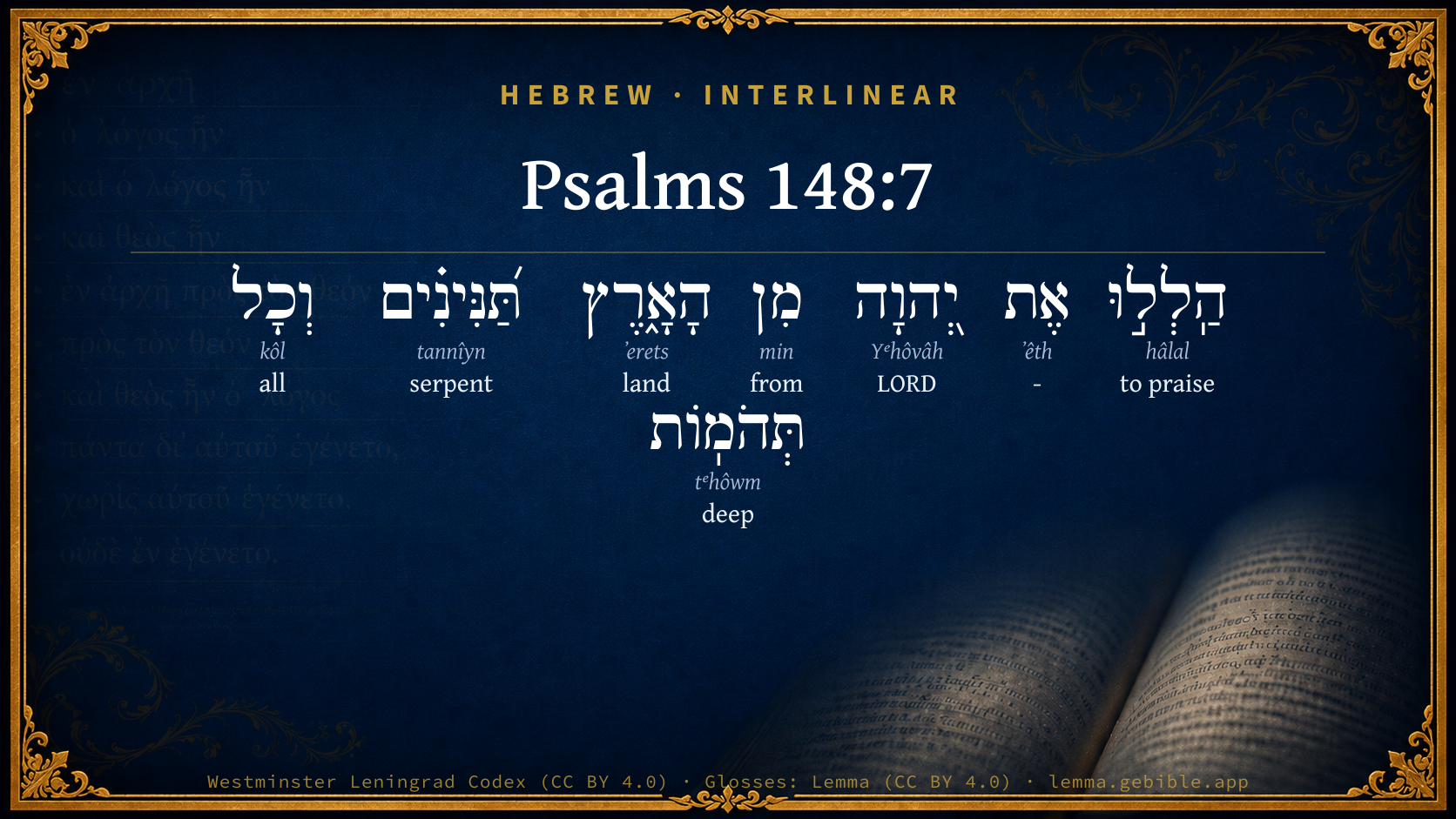
Psalms 148:7

Hebrew (Westminster Leningrad Codex) Psalms 148:7 appears in the Hebrew Old Testament. The text above is from the Westminster Leningrad Codex. Each word links to its Strong’s number, a concise gloss, and parsing drawn from the Open Scriptures Hebrew Bible morphology. Click any word for its full Brown-Driver-Briggs (BDB) entry.
Download image
Cite this verse

Psalms 148:7 (World English Bible). Public Domain. Lemma interlinear Bible study tool, https://lemma.gebible.app/v/psalms/148/7.

Show BibTeX & RIS
BibTeX
RIS
English Translation
Praise Yahweh from the earth, You great sea creatures, and all depths!
World English Bible · Public Domain
Download a study sheet

One document with this verse’s original text, its word-by-word gloss line, the meaning frame, cross-references with their text, attributed commentary, and full source and license credits — printable, and it pastes into notes with its structure intact.

This verse Autodidact and up

Study sheet (.html) Plain text (.txt)

A passage Seminary Student

Up to 50 verses in one chapter. A passage sheet keeps up to 6 commentary sources and 12 cross-references per verse, in the order this page ranks them, and says so on the sheet whenever that leaves anything out. Ask for a single verse and you get the Autodidact verse sheet above.

Everything on this page stays free to read, with no account — the sheet is a download of what is already on screen, not access to it.

Want to remove ads? Support Godless Engineer
Compare translations 3

The same verse in 3 English versions, stacked beneath the original-language interlinear above. Click any original word for its lexicon entry.

Each is an independent rendering of the whole verse — the interlinear is not word-aligned to these translations.

Highlighted words mark where these versions differ — a whole-verse word diff, not a word-by-word alignment.

  • World English Bible Public Domain
    Praise Yahweh from the earth, You great sea creatures, and all depths!
  • King James Version Public Domain
    Praise the LORD from the earth, ye dragons, and all deeps:
  • unfoldingWord Literal Text CC BY-SA 4.0
    Praise Yahweh from the earth, sea creatures and all depths,

unfoldingWord Literal Text — © unfoldingWord, licensed CC BY-SA 4.0. Word-aligned USFM3 via Door43 (git.door43.org/unfoldingWord/en_ult).

Versions to compare (up to 4)

3 of 4 selected

Show all 18 translations

Every available English version of this verse, each an independent rendering of the whole verse.

  • World English Bible Public Domain
    Praise Yahweh from the earth, You great sea creatures, and all depths!
  • Berean Standard Bible Public Domain
    Praise the LORD from the earth, all great sea creatures and ocean depths,
  • Majority Standard Bible Public Domain
    Praise the LORD from the earth, all great sea creatures and ocean depths,
  • King James Version Public Domain
    Praise the LORD from the earth, ye dragons, and all deeps:
  • American Standard Version (1901) Public Domain
    Praise Jehovah from the earth, Ye sea-monsters, and all deeps.
  • Revised Version (1885) Public Domain
    Praise the LORD from the earth, ye dragons, and all deeps:
  • Geneva Bible (1599) Public Domain
    Prayse ye the Lord from the earth, ye dragons and all depths:
  • Douay-Rheims (1899) Public Domain
    Sing ye to the Lord with praise: sing to our God upon the harp.
  • Young's Literal Translation Public Domain
    Praise ye Jehovah from the earth, Dragons and all deeps,
  • Literal Standard Version CC BY-SA 4.0
    Praise YHWH from the earth, || Dragons and all deeps,
  • Unlocked Literal Bible CC BY-SA 4.0
    Praise him from the earth, you sea monsters and all ocean depths,
  • unfoldingWord Literal Text CC BY-SA 4.0
    Praise Yahweh from the earth, sea creatures and all depths,
  • Darby Bible Public Domain
    Praise Jehovah from the earth, ye sea-monsters, and all deeps;
  • World Messianic Bible Public Domain
    Praise the LORD from the earth, you great sea creatures, and all depths,
  • Webster's Bible Public Domain
    Praise the LORD from the earth, ye dragons, and all deeps:
  • Free Bible Version CC BY-SA 4.0
    Praise the Lord from the earth, and creatures from all the depths of the seas,
  • Bible in Basic English Public Domain
    Give praise to the Lord from the earth, you great sea-beasts, and deep places:
  • JPS Tanakh (1917) Public Domain
    Praise the LORD from the earth, ye sea-monsters, and all deeps;

Literal Standard Version (2020), Covenant Press — licensed CC BY-SA 4.0. Text via the HelloAO Bible API (eBible.org). Unlocked Literal Bible (unfoldingWord) — licensed CC BY-SA 4.0. Text via the HelloAO Bible API (eBible.org). unfoldingWord Literal Text — © unfoldingWord, licensed CC BY-SA 4.0. Word-aligned USFM3 via Door43 (git.door43.org/unfoldingWord/en_ult). Free Bible Version, Dr. Jonathan Gallagher — licensed CC BY-SA 4.0. Text via the HelloAO Bible API (eBible.org).

Word by word

More ways to search: Search by grammar → Find every occurrence → Compare this word →

Practice this passage: Drill this verse → Learn its vocabulary →

About this verse

These counts appear in no published source. They are computed here, from the morphology-tagged text and Lemma’s own curated glosses. What Lemma adds →

8
words
8
distinct lemmas
Wisdom
section

Shared distinctive vocabulary

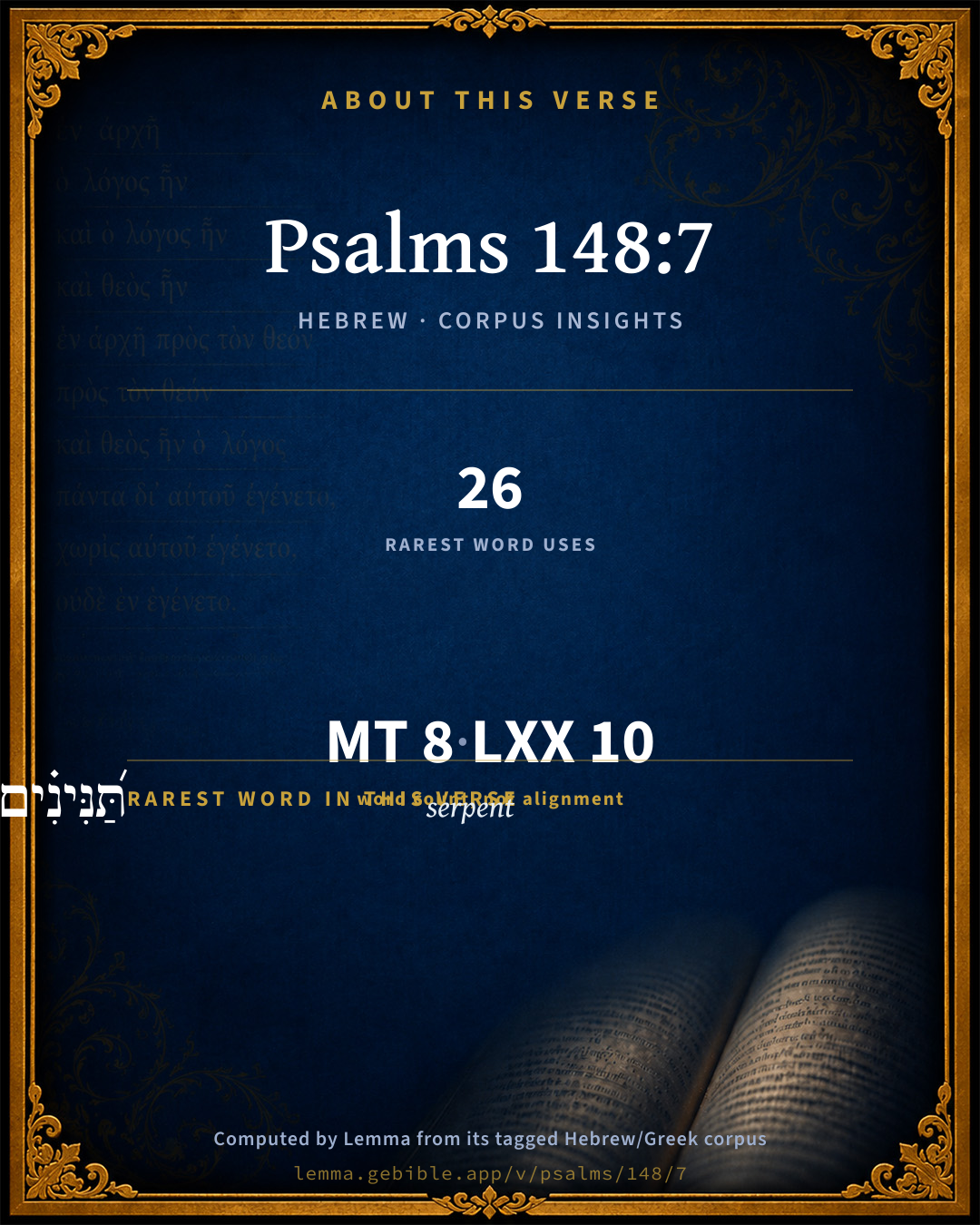
תַּ֝נִּינִ֗ים serpent H8577 occurs in 26 verses of the Hebrew Bible. Also found in:

Grammatical profile

  • 1 verb
  • 5 nouns
  • 1 preposition
  • 1 particle

Verb forms

  • הַֽלְל֣וּ Piel · Imperative

Hebrew & Septuagint length

In English translation the verse runs 12 words from the Hebrew and 11 from the Septuagint (LXX English) — closely comparable.

A rough comparison of the two English renderings, which tokenize alike — not a word-level alignment.

Word counts can differ between the Hebrew and the Greek without any difference in meaning — e.g. the Hebrew direct-object marker אֵת has no separate Greek word, and Greek often adds the article ὁ.

In the original languages it is 8 Hebrew tokens and 10 Greek tokens — but the two are counted differently (Hebrew bundles its prefixes and suffixes into one token; the Greek is in lemma form), so that isn’t a like-for-like length.

Cross-references

7

Topical passages linked to Psalms 148:7 in the Treasury of Scripture Knowledge — connected by theme and wording, ordered by reader-vote popularity; previews shown in the World English Bible.

  • Genesis 1:21 God created the large sea creatures, and every living creature that moves, with which the waters swarmed, after their kind, and every winged bird after its kind. God saw that it was good.
  • Psalms 74:13–14 You divided the sea by your strength. You broke the heads of the sea monsters in the waters.
  • Job 41:1–34 "Can you draw out Leviathan with a fishhook? Or press down his tongue with a cord?
  • Psalms 104:25–26 There is the sea, great and wide, In which are innumerable living things, Both small and large animals.
  • Isaiah 43:20 The animals of the field shall honor me, the jackals and the ostriches; because I give waters in the wilderness, and rivers in the desert, to give drink to my people, my chosen,
  • Isaiah 27:1 In that day Yahweh with his hard and great and strong sword will punish leviathan the swift serpent, and leviathan the crooked serpent; and he will kill the monster that is in the sea.
  • Isaiah 51:9–10 Awake, awake, put on strength, arm of Yahweh; awake, as in the days of old, the generations of ancient times. Isn't it you who did cut Rahab in pieces, who pierced the monster?

Cross-references courtesy of OpenBible.info (CC BY 4.0).

Hebrew and Greek witnesses Masoretic Hebrew ↔ Greek Septuagint

The same verse in the two great witnesses to the Old Testament, shown verse-for-verse.

You’re reading Greek Psalm 148 (Hebrew Psalm 148). The Septuagint counts the superscription, so verse numbers can differ from the Hebrew — chapter-level alignment, not verse-by-verse. Numbering follows Rahlfs.

These are two independent witnesses, not word-aligned to each other, and the Septuagint is shown in lemma (dictionary) form.

Hebrew Psalms 148:7 Masoretic · Westminster Leningrad Codex

הַֽלְל֣וּ אֶת יְ֭הוָה מִן הָאָ֑רֶץ תַּ֝נִּינִ֗ים וְכָל תְּהֹמֽוֹת

Praise Yahweh from the earth, You great sea creatures, and all depths!

World English Bible · Public Domain

Greek LXX Greek Psalm 148:7 Septuagint · lemma form

αἰνέω ὁ κύριος ἐκ ὁ γῆ δράκων καί πᾶς ἄβυσσος

Praise the Lord from the earth, you⌃ serpents, and all deeps.

LXX2012 (modern English Septuagint) · Public Domain

Hebrew: Westminster Leningrad Codex (CC BY 4.0). Greek: Septuagint (public domain); English from LXX2012 (modern English Septuagint) (Public Domain). How the Septuagint differs from the Hebrew →

Commentary

Notes on Psalms 148:7 from classic Christian and Jewish commentators (each source and its license shown beneath its notes). The classic Christian expositions comment on the surrounding passage and are grouped to its opening verse, so a note may address several verses; the Jewish commentaries on the Tanakh (Rashi and others) are per-verse, so they appear only where the commentator wrote on this verse.

Lemma curates 59 commentaries, every one of them public domain or Creative Commons licensed, each selected and text-cleaned for this edition rather than reprinted as found. About our sources →

Matthew Henry's Commentary

Considering that this earth, and the atmosphere that surrounds it, are the very sediment of the universe, it concerns us to enquire after those considerations that may be of use to reconcile us to our place in it; and I know none more likely than this (next to the visit which the Son of God once made to it), that even in this world, dark and as bad as it is, God is praised: Praise you the Lord from the earth, Psa 148:7. As the rays of the sun, which are darted directly from heaven, reflect back (though more weakly) from the earth, so should the praises of God, with which this cold and infected world should be warmed and perfumed.

I. Even those creatures that are not dignified with the powers of reason are summoned into this concert, because God may be glorified in them, Psa 148:7-10. Let the dragons or whales, that sport themselves in the mighty waters (Psa 104:26), dance before the Lord, to his glory, who largely proves his own omnipotence by his dominion over the leviathan or whale, Job 41:1, etc. All deeps, and their inhabitants, praise God - the sea, and the animals there - the bowels of the earth, and the animals there. Out of the depths God may be praised as well as prayed unto. If we look up into the atmosphere we meet with a great variety of meteors, which, being a king of new productions (and some of them unaccountable), do in a special manner magnify the power of the great Creator. There are fiery meteors; lightning is fire, and there are other blazes sometimes kindled which may be so called. There are watery meteors, hail, and snow, and the vapours of which they are gendered. There are airy meteors, stormy winds; we know not whence they come nor whither they go, whence their mighty force comes nor how it is spent; but this we know, that, be they ever so strong, so stormy, they fulfil God's word, and do that, and no more than that, which he appoints them; and by this Christ showed himself to have a divine power, that he commanded even the winds and the seas, and they obeyed him. Those that will not fulfil God's word, but rise up in rebellion against it, show themselves to be more violent and headstrong than even the stormy winds, for they fulfil it. Take a view of the surface of the earth (Psa 148:9), and there are presented to our view the exalted grounds, mountains and all hills, from the barren tops of some of which, and the fruitful tops of others, we may fetch matter for praise; there are the exalted plants, some that are exalted by their usefulness, as the fruitful trees of various kinds, for the fruits of which God is to be praised, others by their stateliness, as all cedars, those trees of the Lord, Psa 104:16. Cedars, the high trees, are not the fruitful trees, yet they had their use even in God's temple. Pass we next to the animal kingdom, and there we find God glorified, even by the beasts that run wild, and all cattle that are tame and in the service of man, Psa 148:10. Nay, even the creeping things have not sunk so low, nor do the flying fowl soar so high, as not to be called upon to praise the Lord. Much of the wisdom, power, and goodness of the Creator appears in the several capacities and instincts of the creatures, in the provision made for them and the use made of them. When we see all so very strange, and all so very good, surely we cannot but acknowledge God with wonder and thankfulness.

II. Much more those creatures that are dignified with the powers of reason ought to employ them in praising God: Kings of the earth and all people, Psa 148:11, Psa 148:12. 1. God is to be glorified in and for these, as in and for the inferior creatures, for their hearts are in the hand of the Lord and he makes what use he pleases of them. God is to be praised in the order and constitution of kingdoms, the pars imperans - the part that commands, and the pars subdita - the part that is subject: Kings of the earth and all people. It is by him that kings reign, and people are subject to them; the princes and judges of the earth have their wisdom and their commission from him, and we, to whom they are blessings, ought to bless God for them. God is to be praised also in the constitution of families, for he is the founder of them; and for all the comfort of relations, the comfort that parents and children, brothers and sisters, have in each other, God is to be praised. 2. God is to be glorified by these. Let all manner of persons praise God. (1.) Those of each rank, high and low. The praises of kings, and princes, and judges, are demanded; those on whom God has put honour must honour him with it, and the power they are entrusted with, and the figure they make in the world, put them in a capacity of bringing more glory to God and doing him more service than others. Yet the praises of the people are expected also, and God will graciously accept of them; Christ despised not the hosannas of the multitude. (2.) Those of each sex, young men and maidens, who are accustomed to make merry together; let them turn their mirth into this channel; let it be sacred, that it may be pure. (3.) Those of each age. Old men must still bring forth this fruit in old age, and not think that either the gravity or the infirmity of their age will excuse them from it; and children too must begin betimes to praise God; even out of the mouth of babes and sucklings this good work is perfected. A good reason is given (Psa 148:13) why all these should praise the name of the Lord, because his name alone is excellent and worthy to be praised; it is a name above every name, no name, no nature, but his, has in it all excellency. His glory is above both the earth and the heaven, and let all inhabitants both of earth and heaven praise him and yet acknowledge his name to be exalted far above all blessing and praise.

III. Most of all his own people, who are dignified with peculiar privileges, must in a peculiar manner give glory to him, Psa 148:14. Observe, 1. The dignity God has put upon his people, even the children of Israel, typical of the honour reserved for all true believers, who are God's spiritual Israel. He exalts their horn, their brightness, their plenty, their power. The people of Israel were, in many respects, honoured above any other nation, for to them pertained the adoption, the glory, and the covenants, Rom 9:4. It was their own honour that they were a people near unto God, his Segulla, his peculiar treasure; they were admitted into his courts, when a stranger that came nigh must be put to death. They had him nigh to them in all that which they called upon him for. This blessing has not come upon the Gentiles, through Christ, for those that were afar off are by his blood made nigh, Eph 2:13. It is the greatest honour that can be put upon a man to be brought near to god, the nearer the better; and it will be best of all when nearest of all in the kingdom of glory. 2. The duty God expects from them in consideration of this. Let those whom God honours honour him: Praise you the Lord. Let him be the praise of all his saints, the object of their praise; for he is a praise to them. He is thy praise, and he is thy God, Deu 10:21. Some by the horn of his people understand David, as a type of Christ, whom God has exalted to be a prince and a Saviour, who is indeed the praise of all his saints and will be so for ever; for it is through him that they are a people near to God.

Matthew Henry's Commentary on the Whole Bible (1708–1710) — public domain (CC PDM 1.0). Text via the HelloAO Bible API.

Trapp's Complete Commentary

John Trapp

Psa 148:7 Praise the LORD from the earth, ye dragons, and all deeps:

Ver. 7. Praise the Lord from the earth] The psalmist proceedeth to factor for God among the inferior creatures; beginning with the lowest in the waters beneath, as the dragons or great whales; and then coming to rain and snow, &c., which are made out of the waters above.

Ye dragons, and all deeps] Of sea dragons, see Aelian. lib. 4, Animal. cap. 12: they live partly in the sea and partly on the land, as do crocodiles. These also yield matter of God’s praise.

John Trapp, A Commentary or Exposition upon All the Books of the Old and New Testament (1647–1656) — public domain. Text from a community e-Sword module.

Joseph Benson's Commentary

Psa 148:7. Praise the Lord from the earth, ye dragons, and all deeps — “From heaven above the psalmist descends to the deep beneath, which, while it proclaims the power, observes the laws and decrees of him who made it, and poured it abroad. And the same may be said of its enormous inhabitants, which are under the command of Jehovah, and of none but him.” By dragons here, we may either understand serpents, which abide in the deep caverns or holes of the earth; or, rather, whales, crocodiles, and other sea monsters, which dwell in the depths of the sea, or of rivers, and are often intended by the word תנינים, here rendered dragons.

Joseph Benson's Commentary on the Old and New Testaments (1811–1818) — public domain. Text from a community e-Sword module.

J. A. Alexander on Psalms

Joseph Addison Alexander

7. (Psa 148:7) Praise Jehovah from the earth, ye dragons and all depths. Here begins the second part, in which the address is to the earth and its inhabitants. From the earth is in ,antithesis to from the heavens in Psa 148:1. Earth here includes land and water; hence the last clause makes exclusive mention of the latter, as the word translated dragons is applied to huge aquatic animals (Psa 74:13, and the one translated depths to large bodies of water (Psa 33:7). As the first, however, sometimes means serpents (Psa 91:13), it may here be the connecting link between land and water.

Joseph Addison Alexander, The Psalms Translated and Explained (1850) — public domain. Text from a community e-Sword module.

Geneva Bible (1599)

Geneva Bible translators

Meaning, the great and monstrous fishes, as whales and such like.

Geneva Bible (1599) marginal notes — public domain. Text via Bolls.life.

Jamieson, Fausset & Brown

Robert Jamieson, A. R. Fausset & David Brown

The call on the earth, as opposed to heaven, includes seas or depths, whose inhabitants the dragon, as one of the largest (on leviathan, see on Psa 104:26), is selected to represent. The most destructive and ungovernable agents of inanimate nature are introduced.

Jamieson, Fausset & Brown — Commentary Critical and Explanatory on the Whole Bible (1871) — public domain (CC PDM 1.0). Text via the HelloAO Bible API.

Adam Clarke's Commentary

Verse 7. Praise the Lord from the earth] As in the first address, he calls upon the heavens and all that belong to them; so here, in this second part, he calls upon the earth, and all that belong to it.

Ye dragons] תנינים tanninim, whales, porpoises, sharks, and sea-monsters of all kinds.

And all deeps] Whatsoever is contained in the sea, whirlpools, eddies, ground tides, with the astonishing flux and reflux of the ocean.

Every thing, in its place and nature, shows forth the perfections of its Creator.

Adam Clarke's Commentary on the Bible (1810–1826) — public domain. Text from a community e-Sword/MySword module.

John Calvin's Commentaries

7. Praise Jehovah, etc. He now comes to the lower parts of the world; although deviating at the same time from the exact order, he mixes up such things as are produced in the air — lightning’s, snow, ice, and storms. These should rather have been placed among the former class, but he has respect to the common apprehension of men. The scope of the whole is, that wherever we turn our eyes we meet with evidences of the power of God. He speaks first of the whales; for, as he mentions the abysses or deeps immediately afterwards, I have no doubt that by תנינים, tanninim, he means fishes of the sea, such as whales. It is only reasonable to think that matter for praising God should be taken from the sea, which is fraught with so many wonders. He then ascends to hail, snows, and storms, which he says fulfill the word of God; for it is not by an effect of chance that the heavens are clouded, or that a single drop of rain falls from the clouds, or that the thunders rage, but one and all of these changes depend upon the secret will of God, whether he will show his goodness to the children of men in irrigating the earth, or punish their sins by tempest, hail, or other calamities. The passage contains instruction of various kinds, as, for example, that when dearth impends, however parched the earth may be by long continued heat, God can promptly send rain which will remove the drought at his pleasure. If from incessant rains, on the other hand, the seed rot in the ground, or the crops do not come to maturity, we should pray for fair weather. If we are alarmed by thunder, we are taught to pray to God, for as it is he who sends it in his anger, so he can still all the troubled elements. And we are not to take up the narrow view of this truth which irreligious men advocate, that things in nature merely move according to the laws impressed upon them from the beginning, while God stands by idle, but are to hold firmly that God watches over his creatures, and that nothing can take place without his present disposal, as we have seen, Psalm 104:4 that

“he maketh the winds his messengers, and his ministers a flaming fire.”

John Calvin's Commentaries (1540-1563) — public domain. Text from the Calvin Translation Society English edition (1840s-50s) via the Christian Classics Ethereal Library (ccel.org). Calvin's coverage is partial (roughly two-thirds of the Bible); uncommented books and verses are honest gaps, never fabricated. The 19th-century editor's footnotes and remarks are omitted so the notes are faithfully Calvin's own voice.

Ellicott's Commentary for English Readers

(7) Earth —The invocation now passes downwards, and the first sound of terrestrial praise is to come, according to the order of Creation in Genesis 1, from the sea-monsters (for which see Note, Psa_74:13; Psa_91:13), the “deeps” being added to include all great waters in which such creatures are found.

A Bible Commentary for English Readers, edited by Charles John Ellicott (1878–1897) — public domain. Text from a community e-Sword module.

The Cambridge Bible for Schools and Colleges

gen. ed. J. J. S. Perowne

7. dragons, and all deeps] The sea-monsters of Gen_1:21, and the depths of ocean which they were supposed to inhabit[90].

[90] Robertson Smith (Rel. of the Semites, p. 161) suggests that the tannîn is a personification of the waterspout.

7–13. Let earth and all that is therein praise Jehovah for the revelation of His majesty.

The Cambridge Bible for Schools and Colleges (gen. ed. J. J. S. Perowne; Cambridge University Press, 1878–1918) — public domain. Text from a community e-Sword module.

John Gill's Exposition

Praise the Lord from the earth,.... Let his praise resound from all creatures on earth, and reach him in the highest heavens; this phrase comprehends all terrestrial beings afterwards particularly mentioned; all in the terraqueous globe, all that arise from it, are upon it, or within it;

ye dragons, and all deeps; either land dragons, or rather sea dragons, the water or sea being the proper place of them, Psa 44:19; these, as cruel, as poisonous, and pernicious as they are, are made to honour and praise the Lord, Isa 43:20; and such as are mystically signified by, them, as Satan, tyrannical and persecuting princes, and antichristian ones, as Pharaoh king of Egypt, Rome Pagan and Papal; out of whom the Lord has or will get himself praise in the deliverance of his people from them, and in the destruction of them, and in the confessions they have been obliged to make of him, Rev 12:3; these seem to be set in contrast with the angels. The word is used for the great whales the Lord made, which are thought to be the same with the "leviathan" of Job; of whom so many things are said, which declare the power and wisdom of God in the formation of it, Gen 1:21, &c. and these may be put for the innumerable creatures in the sea, which in their way show forth the praise and glory of God, Psa 102:24; as "all deeps" do, deep waters, especially the depths of the sea, and the inhabitants of them; where the wonders of God are to be seen, and give occasion to those that go down to the sea in ships to praise his name, Psa 107:23.

John Gill's Exposition of the Whole Bible (1746–1763) — public domain (CC PDM 1.0). Text via the HelloAO Bible API.

Albert Barnes' Notes on the Bible

Praise the Lord from the earth - From among those who dwell on the earth. In respect to terrestrial objects, let these also unite in the praise of God.

Ye dragons - On the meaning of this word, see Psa 91:13, note; Isa 13:22, note. The word may mean a great fish, a whale, a sea monster, or a serpent. It would seem to refer here to whales and sea monsters. See the notes at Rev 12:3.

And all deeps - All that are in the depths of the sea. Not merely the “dragons” or sea monsters, but all that inhabit the oceans.

Albert Barnes' Notes on the Bible (1834–1885) — public domain. Text from a community e-Sword/MySword module.

Matthew Poole's English Annotations

Either,

1. Dragons and serpents, which abide in the deep caverns and holes of the earth; or,

2. Whales or other sea-monsters, which dwell in the depths of the sea, which are oft called by this name, as Job 7:12; Eze 29:3, and elsewhere, as the word here rendered

deeps is most commonly used concerning the sea.

Matthew Poole's English Annotations on the Holy Bible (1683–1685) — public domain. Text from a community e-Sword/MySword module.

The Treasury of David

Charles H. Spurgeon

Ver. 7. Praise the LORD from the earth. The song descends to our abode, and so comes nearer home to us. We who are "bodies terrestrial", are to pour out our portion of praise from the golden globe of this favoured planet. Jehovah is to be praised not only in the earth but from the earth, as if the adoration ran over from this planet into the general accumulation of worship. In Ps 148:1 the song was "from the heavens"; here it is "from the earth": songs coming down from heaven are to blend with those going up from earth. The "earth" here meant is our entire globe of land and water: it is to be made vocal everywhere with praise.

Ye dragons, and all deeps. It would be idle to inquire what special sea monsters are here meant; but we believe all of them are intended, and the places where they abide are indicated by "all deeps." Terrible beasts or fishes, whether they roam the earth or swim the seas, are bidden to the feast of praise. Whether they float amid the teeming waves of the tropics, or wend their way among the floes and bergs of polar waters, they are commanded by our sacred poet to yield their tribute to the creating Jehovah. They pay no service to man; let them the more heartily confess their allegiance to the Lord. About "dragons" and "deeps" there is somewhat of dread, but this may the more fitly become the bass of the music of the Psalm. If there be aught grim in mythology, or fantastic in heraldry, let it praise the incomprehensible Lord.

Ver. 7. Dragons. The word tanninim, rendered "dragons", is a word which may denote whales, sharks, serpents, or sea monsters of any kind (Job 7:1 Eze 29:3). John Morison.

Ver. 7. Sea monsters, in Revised Version. Fishes constrain our admiration, as a created wonder, by the perfection of their form, their magnitude, their adaptation to the element they inhabit, and their multitude. Thus their very nature praises the Creator. Thomas Le Blanc.

Ver. 7-8. He calls to the deeps, dire, hail, snow, mountains, and hills, to bear a part in this work of praise. Not that they are able to do it actively, but to show that man is to call in the whole creation to assist him passively, and should have so much charity to all creatures as to receive what they offer, and so much affection to God as to present to him what he receives from him. Snow and hail cannot bless and praise God, but man ought to bless God for those things, wherein there is a mixture of trouble and inconvenience, something to molest our sense, as well as something that improves the earth for fruit. Stephen Charnock.

Ver. 7-10. Here be many things easy to be understood, they are clear to every eye; as when David doth exhort "kings" and "princes", "old men" and "babes" to praise God; that is easy to be done, and we know the meaning as soon as we look on it; but here are some things again that are hard to be understood, dark and obscure, and they are two:

First, in that David doth exhort dumb, unreasonable, and senseless creatures to praise God, such as cannot hear, at least cannot understand. Doth the Holy Ghost in the gospel bid us avoid impertinent speeches, and vain repetitions, and shall we think he will use them himself? No, no. But,

Secondly, not only doth he call upon these creatures, but also he calls upon the deeps and the seas to praise God; these two things are hard to be conceived. But to give you some reasons.

The first reason may be this, why David calls upon the unreasonable creatures to perform this duty, He doth his duty like a faithful preacher, whether they will hear or no that he preaches to, yet he will discharge his soul: a true preacher, he speaks forth the truth, and calls upon them to hear, though his auditors sleep, are careless, and regard it not. So likewise doth David, in this sense, with these creatures; he doth his duty, and calls upon them to do it, though they understand not, though they comprehend it not. And likewise he doth it to show his vehement desire for all creatures to praise God.

The second reason may be this: he doth it craftily, by way of policy, to incite others to perform this duty, that if such creatures as they ought to do this, then those that are above them in degree have more cause, and may be ashamed to neglect it; as an ill governed master, though he stay himself at home, yet he will send his servants to church: so David, being conscious of his own neglect, yet he calls upon others not to be slack and negligent: though he came infinitely short of that he should do, yet he shows his own desire for all creatures to perform this duty.

But if these reasons will not satisfy you, though they have done many others, a third reason may be this: to set forth the sweet harmony that is among all God's creatures; to show how that all the creatures being God's family, do with one consent speak and preach aloud God's praise; and therefore he calls upon some above him, some below him, on both sides, everywhere, to speak God's praise; for every one in their place, degree, and calling, show forth, though it be in a dumb sense and way, their Creator's praise.

Or, fourthly and lastly, which I think to be a good reason: zeal makes men speak and utter things impossible; the fire of zeal will so transport him that it will make him speak things unreasonable, impossible, as Moses in his zeal desired God, for the safety of Israel, "to blot his name out of his book"; and Paul wished himself "anathema", accursed or separate from Christ, for his brethren's salvation, which was a thing impossible, it could not be. John Everard, in "Some Gospel Treasures", 1653.

Ver. 7-10. The ox and the ass acknowledge their master. The winds and the sea obey him. It should seem that as there is a religion above man, the religion of angels, so there may be a religion beneath man, the religion of dumb creatures. For wheresoever there is a service of God, in effect it is a religion. Thus according to the several degrees and difference of statesthe state of nature, grace, and gloryreligion may likewise admit of degrees. G.G., in a sermon entitled "The Creatures Praysing God", 1662.

Ver. 7. God's praise from dark, deep, and mysterious things.

Psalms 148:8*

Charles H. Spurgeon's The Treasury of David (1869–1885) — public domain. Psalms only. Text from a community e-Sword/MySword module.

Whedon's Commentary on the Bible

Daniel D. Whedon

7. Praise the Lord from the earth—Here begins the second division of the psalm. Having summoned the celestial beings and worlds to the grand chorus of the universe, the author now calls upon the earth. But he reverses the order. In the former he began with the highest heavens; in the latter, with the lowest depths.

Dragons, and all deeps—Sea monsters and all unfathomed abysses of the ocean.

Daniel D. Whedon (gen. ed.), Commentary on the Old and New Testaments (1874–1909) — public domain. Text from a community e-Sword module.

The Pulpit Commentary

Praise the Lord from the earth. The counterpart of the clause in ver. 1, "Praise ye the Lord from the heavens." Earth must join with heaven in the praise of God. Ye dragons; or, "ye sea-monsters". (comp. Psa_74:13, where the same word is used) Hengstenberg translates by "whales;" but all the greater sea-animals are probably included. And all deeps. The extreme "ocean depths" are meant deeps," in certain parts of what was commonly known as "the great deep". (Psa_36:6)

Vers. 7, 8. The praise-voices of nature-forces.

How poet-souls recognize the voices of nature may be illustrated by Milton"s lines"His praise, ye winds, that from four quarters blow, Breathe soft or loud; and wave your tops, ye pines, With every plant, in sign of worship wave!

What is peculiar to the psalmist is his recognizing signs of will in nature. He conceives of "stormy wind fulfilling his Word," voluntarily fulfilling it, and so an image of himself. It is a blending of poetic and pious feeling that thus leads man to make of nature a mirror in which he sees himself.

I MAN PUTTING HIMSELF INTO THINGS. When we are impressed with anything in nature, we, in a sort of unconscious way, say to it, "If I were you, how should I feel, and what should I do?" And then we represent it to ourselves as actually feeling what we should feel, and doing what we should do. In this way the psalmist calls on the winds to praise God, because that is what he would do if he were the wind; and he calls on the wind to fulfill God"s Word, because that is what he would do if he were the wind. This is man"s interpreting of nature, which is never any more than interpreting himself in the terms of nature. But manifestly this putting of ourselves into things belongs exclusively to the poetic and the pious souls. To most men nature is but a satisfaction of artistic sensibilities: all that can be observed is the beautiful in form and color. It is but the sublime side of this truth to say that God puts himself into nature to show himself to us, as we put ourselves into nature to show ourselves to him.

II MAN INFLUENCING HIMSELF BY SEEING HIMSELF IN THINGS. Introspection is neither healthy nor effective. A man must put himself outside himself; must find a mirror of himself, and see himself in the mirror. And what he thus sees is always himself as he should be. So the projection of himself is an inspiration to himself. The psalmist seas this in the one matter of obedience. Projecting himself into the stormy wind, he is inspired to the "fulfilling of God"s Word. R.T.

HOMILIES BY C. SHORT Vers. 7-14. The Creator and his creatures.

"The psalmist calls upon the whole creation, in its two great divisions of heaven and earth, to praise God. Things with and things without life, things rational and irrational, are summoned to join the mighty chorus. The psalm is an expression of the loftiest devotion, and embraces the most comprehensive view of the relation of the creature to the Creator.

I IRRATIONAL CREATURES OF THE SEA, LAND, AND AIR ARE BIDDEN INTO THE CHORUS OF PRAISE. (Vers. 7, 10) From the monsters of the sea to the creeping things of the earth. All life, in its various forms, owes itself to the creative life of God. All creatures, after their own manner, are an echo and reflection of the glory of God; and by sympathy we link them with us in the praise of God.

II MATERIAL THINGS PRAISE GOD BY THEIR OBEDIENCE TO THE DIVINE LAW. (Vers. 8, 9) Stormy wind," that seems far from the control of law, is really obedient to it; like all the other elements and hail, snow and vapor". (Psa_107:25) All fruitful life, "and all cedars examples of majesty and beauty testify to the power and goodness of God. All things are alive to the man of religious sympathies.

III ALL RANKS OF HUMAN BEINGS ARE SUMMONED TO PRAISE GOD. "Kings and all their subjects. Princes and judges of the earth; Young men and maidens, Old men and children.

Each rank, each class, has its own theme and reason for praise and worship.

IV THE GROUNDS OF PRAISE.

1. General. His Name is greater, more exalted, than the heavens and the earth.

2. Special. God has raised his people from deep degradation, and filled them with powers and exultation. "A people near unto him. S.

The Pulpit Commentary (1880–1919), ed. H.D.M. Spence-Jones & Joseph S. Exell — public domain. Text from a community e-Sword module.

John Wesley's Explanatory Notes

Dragons - Either serpents, which hide in the deep caverns of the earth; or whales, and other sea-monsters, which dwell in the depths of the sea.

John Wesley, Explanatory Notes Upon the Whole Bible (1754–1765) — public domain. Text via the GEBible commentary corpus.

unfoldingWord translationNotes

Door43 World Missions Community

all ocean depths

This phrase represents every creature that lives in the depths of the oceans. AT: "all creatures in the ocean depths" (See: Metonymy)

fire and hail, snow and clouds, stormy wind

The writer speaks to these natural phenomena as if they are people and commands them to praise Yahweh. (See: Personification)

stormy wind fulfilling his word

"stormy wind that does what Yahweh commands"

translationWords

earth

creature

fire

hail

snow

word of God

unfoldingWord translationNotes — © Distant Shores Media and the Door43 World Missions Community, licensed CC BY-SA 4.0. Source: git.door43.org/Door43/en_tn.

Rashi

Rabbi Shlomo Yitzchaki (Rashi)

sea monsters Heb. תנינים, huge fish.

Rashi on the Tanakh — English translations: “The Judaica Press complete Tanach with Rashi, translated by A. J. Rosenberg” (CC BY 4.0); “Pentateuch with Rashi's commentary by M. Rosenbaum and A.M. Silbermann, 1929-1934” (public domain); “The Metsudah Tanach series, Lakewood, N.J” (CC BY 4.0); and “The Book of Joshua, Metsudah Publications, 1997” (CC BY 4.0). Text via Sefaria.

Lesson kit

Teaching starters — assembled from the data on this page, not authored interpretation. Every prompt links to the verse data it draws on. Edit before teaching.

Psalms, in the Wisdom, opens this verse with 8 words (8 distinct Hebrew lemmas). Its most distinctive word is tannîyn (“serpent”). A historical commentator’s framing appears above. Read the whole chapter for the surrounding context.

Discussion questions

  1. What does “serpent” (tannîyn) contribute to the verse as a whole?
  2. Genesis 1:21 shares the word «serpent» with this verse. How do the two illuminate each other?
  3. The translations on this page render this verse differently — a whole-verse word diff, not a word-by-word alignment. What might account for the different wordings?
  4. The verb «הַֽלְל֣וּ» is Piel Imperative. How does its form color the action?
  5. Reading how Matthew Henry's Commentary and Trapp's Complete Commentary read this verse, where do the two commentators agree and where do they part?

Things to notice

Reading settings

Reading text

Shown beneath each verse's original-language words.

Old Testament
Old Testament edition

Read the OT as the Masoretic Hebrew (MT) or the Greek Septuagint (LXX).

English shown for the Greek Septuagint (in the Hebrew ↔ Greek comparison).

Comparing translations? Open the Compare panel on any verse page to stack up to four side by side.