
Psalms 149:3

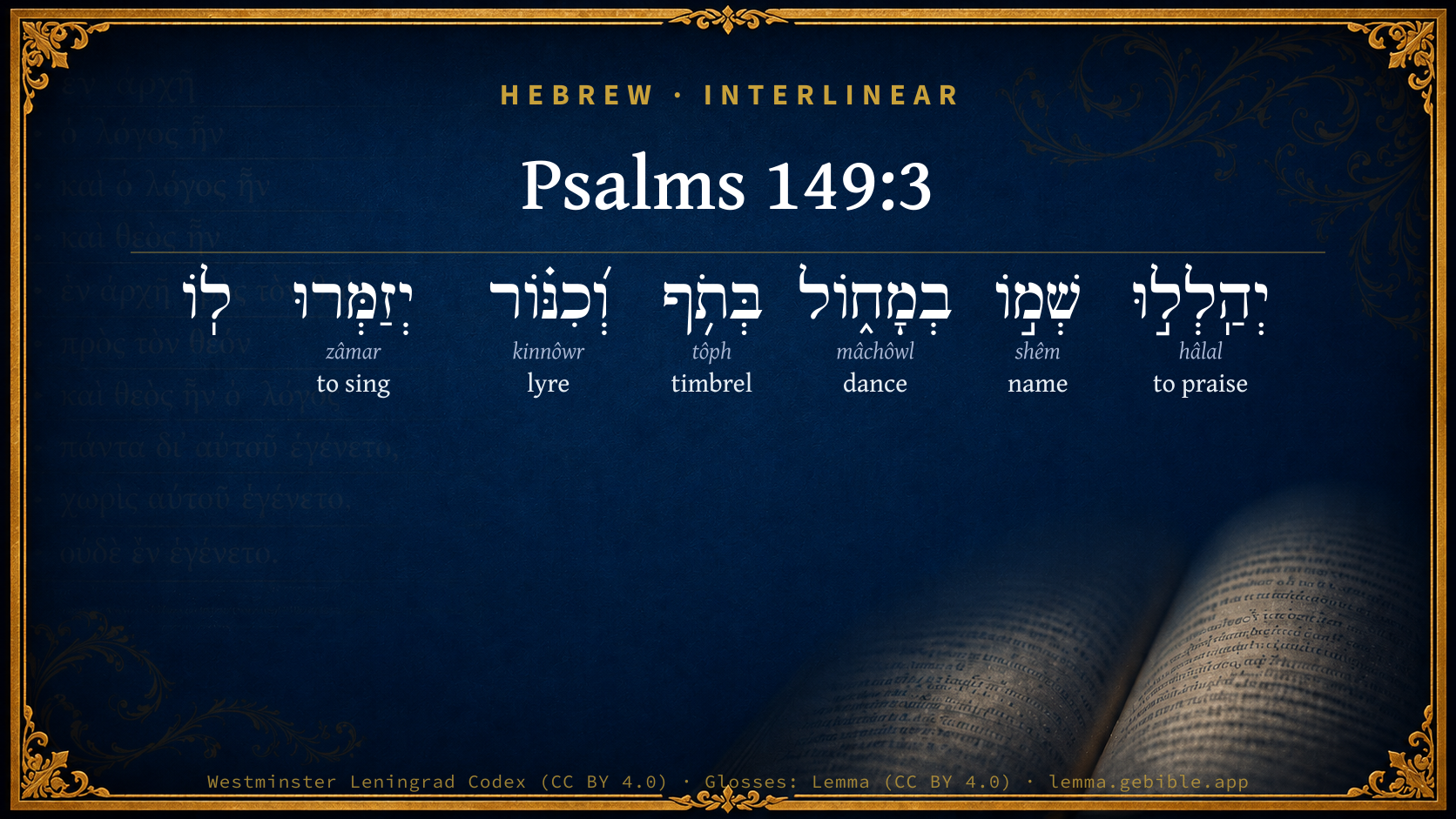
Hebrew (Westminster Leningrad Codex) Psalms 149:3 appears in the Hebrew Old Testament. The text above is from the Westminster Leningrad Codex. Each word links to its Strong’s number, a concise gloss, and parsing drawn from the Open Scriptures Hebrew Bible morphology. Click any word for its full Brown-Driver-Briggs (BDB) entry.
Download image
Cite this verse

Psalms 149:3 (World English Bible). Public Domain. Lemma interlinear Bible study tool, https://lemma.gebible.app/v/psalms/149/3.

Show BibTeX & RIS
BibTeX
RIS
English Translation
Let them praise his name in the dance! Let them sing praises to him with tambourine and harp!
World English Bible · Public Domain
Download a study sheet

One document with this verse’s original text, its word-by-word gloss line, the meaning frame, cross-references with their text, attributed commentary, and full source and license credits — printable, and it pastes into notes with its structure intact.

This verse Autodidact and up

Study sheet (.html) Plain text (.txt)

A passage Seminary Student

Up to 50 verses in one chapter. A passage sheet keeps up to 6 commentary sources and 12 cross-references per verse, in the order this page ranks them, and says so on the sheet whenever that leaves anything out. Ask for a single verse and you get the Autodidact verse sheet above.

Everything on this page stays free to read, with no account — the sheet is a download of what is already on screen, not access to it.

Want to remove ads? Support Godless Engineer
Compare translations 3

The same verse in 3 English versions, stacked beneath the original-language interlinear above. Click any original word for its lexicon entry.

Each is an independent rendering of the whole verse — the interlinear is not word-aligned to these translations.

Highlighted words mark where these versions differ — a whole-verse word diff, not a word-by-word alignment.

  • World English Bible Public Domain
    Let them praise his name in the dance! Let them sing praises to him with tambourine and harp!
  • King James Version Public Domain
    Let them praise his name in the dance: let them sing praises unto him with the timbrel and harp.
  • unfoldingWord Literal Text CC BY-SA 4.0
    Let them praise his name in the dance; let them make music to him with the tambourine and the harp.

unfoldingWord Literal Text — © unfoldingWord, licensed CC BY-SA 4.0. Word-aligned USFM3 via Door43 (git.door43.org/unfoldingWord/en_ult).

Versions to compare (up to 4)

3 of 4 selected

Show all 17 translations

Every available English version of this verse, each an independent rendering of the whole verse.

  • World English Bible Public Domain
    Let them praise his name in the dance! Let them sing praises to him with tambourine and harp!
  • Berean Standard Bible Public Domain
    Let them praise His name with dancing, and make music to Him with tambourine and harp.
  • Majority Standard Bible Public Domain
    Let them praise His name with dancing, and make music to Him with tambourine and harp.
  • King James Version Public Domain
    Let them praise his name in the dance: let them sing praises unto him with the timbrel and harp.
  • American Standard Version (1901) Public Domain
    Let them praise his name in the dance: Let them sing praises unto him with timbrel and harp.
  • Revised Version (1885) Public Domain
    Let them praise his name in the dance: let them sing praises unto him with the timbrel and harp.
  • Geneva Bible (1599) Public Domain
    Let them prayse his Name with the flute: let them sing prayses vnto him with the timbrell and harpe.
  • Young's Literal Translation Public Domain
    They praise His name in a dance, With timbrel and harp sing praise to Him.
  • Literal Standard Version CC BY-SA 4.0
    They praise His Name in a dance, || Sing praise to Him with timbrel and harp.
  • Unlocked Literal Bible CC BY-SA 4.0
    Let them praise his name with dancing; let them sing praises to him with tambourine and harp.
  • unfoldingWord Literal Text CC BY-SA 4.0
    Let them praise his name in the dance; let them make music to him with the tambourine and the harp.
  • Darby Bible Public Domain
    Let them praise his name in the dance; let them sing psalms unto him with the tambour and harp.
  • World Messianic Bible Public Domain
    Let them praise his name in the dance! Let them sing praises to him with tambourine and harp!
  • Webster's Bible Public Domain
    Let them praise his name in the dance: let them sing praises to him with the timbrel and harp:
  • Free Bible Version CC BY-SA 4.0
    Praise his nature with dancing; sing praises to him, accompanied by tambourine and harp.
  • Bible in Basic English Public Domain
    Let them give praise to his name in the dance: let them make melody to him with instruments of brass and corded instruments of music.
  • JPS Tanakh (1917) Public Domain
    Let them praise His name in the dance; let them sing praises unto Him with the timbrel and harp.

Literal Standard Version (2020), Covenant Press — licensed CC BY-SA 4.0. Text via the HelloAO Bible API (eBible.org). Unlocked Literal Bible (unfoldingWord) — licensed CC BY-SA 4.0. Text via the HelloAO Bible API (eBible.org). unfoldingWord Literal Text — © unfoldingWord, licensed CC BY-SA 4.0. Word-aligned USFM3 via Door43 (git.door43.org/unfoldingWord/en_ult). Free Bible Version, Dr. Jonathan Gallagher — licensed CC BY-SA 4.0. Text via the HelloAO Bible API (eBible.org).

Word by word

More ways to search: Search by grammar → Find every occurrence → Compare this word →

Practice this passage: Drill this verse → Learn its vocabulary →

About this verse

These counts appear in no published source. They are computed here, from the morphology-tagged text and Lemma’s own curated glosses. What Lemma adds →

7
words
6
distinct lemmas
Wisdom
section

Notable vocabulary

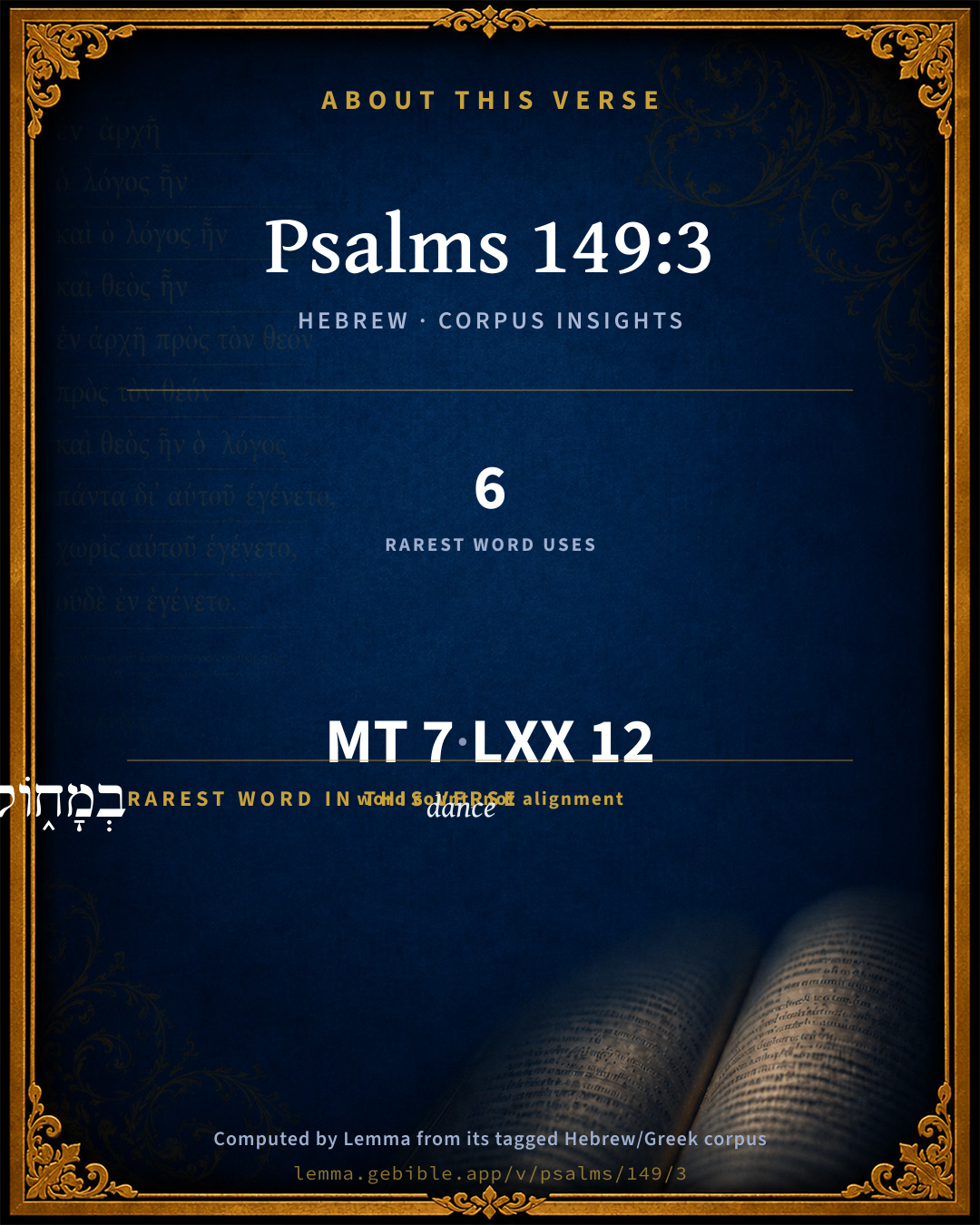
The rarest word here is בְמָח֑וֹל dance H4234 — appearing just 6 times in the whole Hebrew Bible.

Shared distinctive vocabulary

בְמָח֑וֹל dance H4234 occurs in 6 verses of the Hebrew Bible. Also found in:

Grammatical profile

  • 2 verbs
  • 4 nouns
  • 1 preposition

Verb forms

  • יְהַֽלְל֣וּ Piel · Jussive
  • יְזַמְּרוּ Piel · Imperfect

Hebrew & Septuagint length

In English translation the verse runs 18 words from the Hebrew and 18 from the Septuagint (LXX English) — the same length.

A rough comparison of the two English renderings, which tokenize alike — not a word-level alignment.

Word counts can differ between the Hebrew and the Greek without any difference in meaning — e.g. the Hebrew direct-object marker אֵת has no separate Greek word, and Greek often adds the article ὁ.

In the original languages it is 7 Hebrew tokens and 12 Greek tokens — but the two are counted differently (Hebrew bundles its prefixes and suffixes into one token; the Greek is in lemma form), so that isn’t a like-for-like length.

Cross-references

15

Topical passages linked to Psalms 149:3 in the Treasury of Scripture Knowledge — connected by theme and wording, ordered by reader-vote popularity; previews shown in the World English Bible.

  • Jeremiah 31:13 Then shall the virgin rejoice in the dance, and the young men and the old together; for I will turn their mourning into joy, and will comfort them, and make them rejoice from their sorrow.
  • Exodus 15:20 Miriam the prophetess, the sister of Aaron, took a tambourine in her hand; and all the women went out after her with tambourines and with dances.
  • 2 Samuel 6:14 David danced before Yahweh with all his might; and David was girded with a linen ephod.
  • 2 Samuel 6:16 It was so, as the ark of Yahweh came into the city of David, that Michal the daughter of Saul looked out at the window, and saw king David leaping and dancing before Yahweh; and she despised him in her heart.
  • 1 Chronicles 15:28–29 Thus all Israel brought up the ark of the covenant of Yahweh with shouting, and with sound of the cornet, and with trumpets, and with cymbals, sounding aloud with psalteries and harps.
  • Psalms 81:2 Raise a song, and bring here the tambourine, The pleasant lyre with the harp.
  • Judges 11:34 Jephthah came to Mizpah to his house; and, behold, his daughter came out to meet him with tambourines and with dances: and she was his only child; besides her he had neither son nor daughter.
  • Psalms 30:11 You have turned my mourning into dancing for me. You have removed my sackcloth, and clothed me with gladness,
  • Psalms 150:3–5 Praise him with the sounding of the trumpet! Praise him with harp and lyre!
  • 1 Chronicles 16:42 and with them Heman and Jeduthun [with] trumpets and cymbals for those that should sound aloud, and [with] instruments for the songs of God; and the sons of Jeduthun to be at the gate.
  • Ezra 3:10 When the builders laid the foundation of the temple of Yahweh, they set the priests in their clothing with trumpets, and the Levites the sons of Asaph with cymbals, to praise Yahweh, after the order of David king of Israel.
  • Psalms 33:2 Give thanks to Yahweh with the lyre. Sing praises to him with the harp of ten strings.
  • Psalms 137:2–4 On the willows in the midst of it, We hung up our harps.
  • 2 Chronicles 29:25 He set the Levites in the house of Yahweh with cymbals, with psalteries, and with harps, according to the commandment of David, and of Gad the king's seer, and Nathan the prophet; for the commandment was of Yahweh by his prophets.
  • 1 Chronicles 25:6 All these were under the hands of their father for song in the house of Yahweh, with cymbals, psalteries, and harps, for the service of the house of God; Asaph, Jeduthun, and Heman being under the order of the king.

Cross-references courtesy of OpenBible.info (CC BY 4.0).

Hebrew and Greek witnesses Masoretic Hebrew ↔ Greek Septuagint

The same verse in the two great witnesses to the Old Testament, shown verse-for-verse.

You’re reading Greek Psalm 149 (Hebrew Psalm 149). The Septuagint counts the superscription, so verse numbers can differ from the Hebrew — chapter-level alignment, not verse-by-verse. Numbering follows Rahlfs.

These are two independent witnesses, not word-aligned to each other, and the Septuagint is shown in lemma (dictionary) form.

Hebrew Psalms 149:3 Masoretic · Westminster Leningrad Codex

יְהַֽלְל֣וּ שְׁמ֣וֹ בְמָח֑וֹל בְּתֹ֥ף וְ֝כִנּ֗וֹר יְזַמְּרוּ לֽוֹ

Let them praise his name in the dance! Let them sing praises to him with tambourine and harp!

World English Bible · Public Domain

Greek LXX Greek Psalm 149:3 Septuagint · lemma form

αἰνέω ὁ ὄνομα αὐτός ἐν χορός ἐν τύμπανον καί ψαλτήριον ψάλλω αὐτός

Let them praise his name in the dance: let them sings praises to him with timbrel and lute.

LXX2012 (modern English Septuagint) · Public Domain

Hebrew: Westminster Leningrad Codex (CC BY 4.0). Greek: Septuagint (public domain); English from LXX2012 (modern English Septuagint) (Public Domain). How the Septuagint differs from the Hebrew →

Commentary

Notes on Psalms 149:3 from classic Christian and Jewish commentators (each source and its license shown beneath its notes). The classic Christian expositions comment on the surrounding passage and are grouped to its opening verse, so a note may address several verses; the Jewish commentaries on the Tanakh (Rashi and others) are per-verse, so they appear only where the commentator wrote on this verse.

Lemma curates 59 commentaries, every one of them public domain or Creative Commons licensed, each selected and text-cleaned for this edition rather than reprinted as found. About our sources →

Trapp's Complete Commentary

John Trapp

Psa 149:3 Let them praise his name in the dance: let them sing praises unto him with the timbrel and harp.

Ver. 3. Let them praise his name in the dance] Or, with the pipe, tibiis et tympanis et omni musices organicae genere, by all lawful means possible.

John Trapp, A Commentary or Exposition upon All the Books of the Old and New Testament (1647–1656) — public domain. Text from a community e-Sword module.

J. A. Alexander on Psalms

Joseph Addison Alexander

3. (Psa 149:3) Let them praise his name in the dance; with timbrel and harp let them play (or make music) to him. The usual modes of expressing joy are here combined. As to the dance, see above, on Psa 30:11.

Joseph Addison Alexander, The Psalms Translated and Explained (1850) — public domain. Text from a community e-Sword module.

Jamieson, Fausset & Brown

Robert Jamieson, A. R. Fausset & David Brown

in the dance-- (Psa 30:11). The dance is connected with other terms, expressive of the great joy of the occasion. The word may be rendered "lute," to which the other instruments are joined.

sing praises--or, sing and play.

Jamieson, Fausset & Brown — Commentary Critical and Explanatory on the Whole Bible (1871) — public domain (CC PDM 1.0). Text via the HelloAO Bible API.

Adam Clarke's Commentary

Verse 3. Let them praise his name in the dance] במחול bemachol, with the pipe, or some kind of wind music, classed here with תף toph, the tabor or drum, and כנור kinnor, the harp. " מחול machol," says Parkhurst, "some fistular wind-instrument of music, with holes, as a flute, pipe, or fife, from חל chal, to make a hole or opening." I know no place in the Bible where מחול machol and מחלת machalath mean dance of any kind; they constantly signify some kind of pipe.

Adam Clarke's Commentary on the Bible (1810–1826) — public domain. Text from a community e-Sword/MySword module.

Ellicott's Commentary for English Readers

(3) In the dance.—Rather, as margin, with the pipe. The use of the word machôl in what was evidently a list of all the orchestral instruments used in the Temple in the next psalm, would alone be almost decisive of the meaning. But one possible derivation is certainly in favour of this rendering, as also the translation in the Syriac version by the name of a flute still found in Syria. Its connection, too, with the timbrel or drum (comp. our pipe and tabor), just as a cognate, chalîl, is connected in 1Sa_10:5; Isa_5:12, points the same way. (See Bible Educator, i. p. 70, and Note to Son_6:13.)

Timbrel.—See Exo_15:20; Bible Educator, i. 314.

Harp.—See Psa_33:2.

A Bible Commentary for English Readers, edited by Charles John Ellicott (1878–1897) — public domain. Text from a community e-Sword module.

The Cambridge Bible for Schools and Colleges

gen. ed. J. J. S. Perowne

3. in the dance] This, and not pipe (A.V. marg.), is the right rendering here and in Psa_150:4. Dancing was a natural expression of joy among the Jews as among other nations of antiquity, in all periods of their history, on occasions of religious as well as secular festivity. Cp. Exo_15:20; Jdg_11:34; 2Sa_6:14; Jer_31:4; and for a description of the torch-dance, which formed part of the festivities of the Feast of Tabernacles in the later post-exilic period, see Delitzsch in the Expositor, 1886 (2), pp. 81 ff.; Hastings’ Dict. of Bible, 1. 550. Even the leading men of the city and famous teachers joined in it, and it was a current proverb that he who had not seen this joy had not seen any joy in his life.

timbrel] The tambourine, or hand drum, frequently mentioned in connexion with dances and processions (Psa_68:25).

The Cambridge Bible for Schools and Colleges (gen. ed. J. J. S. Perowne; Cambridge University Press, 1878–1918) — public domain. Text from a community e-Sword module.

John Gill's Exposition

Let them praise his name in the dance,.... In a chorus of saints, joining together in their expressions of joy, by words and gestures; an ancient practice that went along with singing praises, Exo 15:20; or rather, "with the pipe" (k), as some render it; a musical instrument used in former times in the worship of God, in this part of it, praising his name, with those that follow;

let them sing praises unto him with the timbrel and harp; the former of these was a vessel of brass, a drum or tabret, on which they beat, perhaps like one of our kettle drums; the other was a stringed instrument of music much used, and in playing on which David was very skilful: the music of these was typical of the spiritual melody made in the heart to the Lord in singing his praises, to which there are allusions in Gospel times; though the instruments themselves are now laid aside, being only suited to the church in her infant state, when under tutors and governors; see Psa 68:25.

(k) "cum tibia", Tigurine version, Junius & Tremellius, Piscator, Amama.

John Gill's Exposition of the Whole Bible (1746–1763) — public domain (CC PDM 1.0). Text via the HelloAO Bible API.

Albert Barnes' Notes on the Bible

Let them praise his name in the dance - Margin, with the pipe. The Hebrew word here - מחול mâchôl - is rendered dancing in Psa 30:11; dance, as here, Psa 150:4 (where also the margin has pipe); Jer 31:13; Lam 5:15; dances, Jer 31:4. It does not elsewhere occur. On the verb חול chûl, see Psa 10:5, note; Psa 51:5, note. Here it cannot be improper to regard it as referring to that measured tread, or solemn movement which sometimes constituted a part of worship: 2Sa 6:14. Such a movement cannot be proved to be wrong in worship; whether it is wise or expedient is a different matter. Customs in worship change as the customs of a people change; and that might be very proper in one stage of society, or in one period of the world, which, though not in itself wrong, might be very unadvisable in another. There was much in the Hebrew mode of worship which cannot be transferred to the forms of Christian worship without an obvious incongruity and disadvantage; and because a thing has been done, and is not in itself wrong, we should not infer that it should always be done, or that it would be always best. If people like the Shakers dance in worship, they have an undoubted right to do so, and it may be the most edifying mode of worship for them with their low notions of religion; let not others ridicule them; nor let others go to see them as they would any other “outr’e” performance from idle curiosity. Such absurdities might soon die away if they were not kept alive by the notice which they attract, and by the foolish curiosity of wiser people. There are some things which are more certain to come to an end by neglect than they could by sober argument; some things which live merely because they are ridiculed, and because they who practice them are exalted into conspicuity by their own folly, and by the idea that they are martyrs.

Let them sing praises unto him with the timbrel and harp - On these instruments, see the notes at Isa 5:12; notes at Job 21:12; notes at Psa 68:25; notes at Psa 81:2.

Albert Barnes' Notes on the Bible (1834–1885) — public domain. Text from a community e-Sword/MySword module.

Matthew Poole's English Annotations

According to the usage of that time and dispensation.

Matthew Poole's English Annotations on the Holy Bible (1683–1685) — public domain. Text from a community e-Sword/MySword module.

The Treasury of David

Charles H. Spurgeon

Ver. 3. Let them praise his name in the dance: let them sing praises unto him with the timbrel and harp. Thus let them repeat the triumph of the Red Sea, which was ever the typical glory of Israel. Miriam led the daughters of Israel in the dance when the Lord had triumphed gloriously; was it not most fit that she should? The sacred dance of devout joy is no example, nor even excuse, for frivolous dances, much less for lewd ones. Who could help dancing when Egypt was vanquished, and the tribes were free? Every mode of expressing delight was bound to be employed on so memorable an occasion. Dancing, singing, and playing on instruments were all called into requisition, and most fitly so. There are unusual seasons which call for unusual expressions of joy. When the Lord saves a soul its holy joy overflows, and it cannot find channels enough for its exceeding gratitude: if the man does not leap, or play, or sing, at any rate he praises God, and wishes for a thousand tongues with which to magnify his Saviour. Who would wish it to be otherwise? Young converts are not to be restrained in their joy. Let them sing and dance while they can. How can they mourn now that their Bridegroom is with them? Let us give the utmost liberty to joy. Let us never attempt its suppression, but issue in the terms of this verse a double license for exultation. If any ought to be glad it is the children of Zion; rejoicing is more fit for Israel than for any other people: it is their own folly and fault that they are not oftener brimming with joy in God, for the very thought of him is delight.

Ver. 3. The dance was in early times one of the modes of expressing religious joy (Ex 15:20 2Sa 6:16). When from any cause men's ideas shall undergo such a revolution as to lead them to do the same thing for the same purpose, it will be time enough to discuss that matter. In our time, dancing has no such use, and cannot, therefore, in any wise be justified by pleading the practice of pious Jews of old. William Swan Plumer.

Ver. 3. Let them sing praises unto him with the timbrel and harp. They who from hence urge the use of music in religious worship, must, by the same rule, introduce dancing, for they went together, as in David's dancing before the ark (Jud 21:21). But whereas many Scriptures in the New Testament keep up singing as a gospel ordinance, none provide for the keeping up of music and dancing; the gospel canon for Psalmody is to "sing with the spirit and with the understanding." Matthew Henry.

Ver. 3. Timbrel. The toph was employed by David in all the festivities of religion (2Sa 6:5). The occasions on which it was used were mostly joyful, and those who played upon it were generally females (Ps 68:25), as was the case among most ancient nations, and is so at the present day in the East. The usages of the modern East might adequately illustrate all the scriptural allusions to this instrument, but happily we have more ancient and very valuable illustration from the monuments of Egypt. In these we find that the tambourine was a favourite instrument, both on sacred and festive occasions. There were three kinds, differing, no doubt, in sound as well as in form; one was circular, another square or oblong, and the third consisted of two squares separated by a bar. They were all beaten by the land, and often used as an accompaniment to the harp and other instruments. The tambourine was usually played by females, who are represented as dancing to its sound without the accompaniment of any other instrument. John Kitto.

Ver. 3. Harp. Of the kinnor the Scripture affords little further information than that it was composed of the sounding parts of good wood, and furnished with strings. Josephus asserts that it was furnished with ten strings, and played with a plectrum; which, however, is not understood to imply that it never had any other number of strings, or was always played with the plectrum. David certainly played it with the hand (1Sa 16:23 18:10 19:9); and it was probably used in both ways, according to its size. That this instrument was really a harp is now very generally denied (Kitto). The reader will, by this time, have balanced the probabilities as to the nature and construction of the kinnor; and most likely he will be led to think that it was either a guitar or lyre, a belief which seems to be gaining ground, on account of the aptitude of such instruments for the uses to which the kinnor was devoted. J. Stainer.

Psalms 149:4*

Charles H. Spurgeon's The Treasury of David (1869–1885) — public domain. Psalms only. Text from a community e-Sword/MySword module.

Whedon's Commentary on the Bible

Daniel D. Whedon

3. In the dance—Hebrew, With the mahhol. מחול, (mahhol) from חול, (hhool,) to twist, turn, writhe, is supposed to indicate the “dance,” from the twisted and contorted motions of the actor, or the round “dance,” dancing in a circle. It occurs, with its derivative mehhoolah, fourteen times, and is always translated “dance” in our English Version, except once, (Son_6:13,) though in the text, and in Psa_150:4, the marginal reading is pipe, which is probably the true idea. The mention in the text, of the mahhol with the timbrel, (toph,) or tambourine and harp, would seem to be sufficient to class it with their musical instruments. This is corroborated by Jdg_21:21, where the English translation, “If the daughters of Shiloh come out to dance in dances,” should be: “If they come out to dance with meholoth, or musical instruments,” of whatever kind. Professor Marks, (Smith’s Dic. of the Bible, article Dance,) quotes Joel Brill, an author of the first authority on this subject, who says: “It is evident from the passage (Psalm cl, 4) ‘Let him praise his name with the toph, [timbrel] and mahhol,’ that the latter must here mean some musical instrument, and this, he adds, is the opinion of the majority of scholars.”

Dr. A. Clarke says: “I know of no place in the Bible where the word means dance, but constantly some kind of pipe,” and quotes Parkhurst as sustaining the same opinion. So also Rosenmuller.

As the English version now stands, it would authorize the opinion that dancing was a familiar accompaniment of the higher forms of praise among the Hebrews. We have already had occasion to say, (see note on Psa_30:10,) that this is unsustained by history. The marginal reading is better: “Let them praise his name with the pipe.” A form of solemn dance, did accompany some of their triumphal celebrations, such as are recorded Exodus 15; 2Sa_6:14; 2Sa_6:16; but the evangelical spirit predominated. A notable instance is given Psalms 68. Dancing is not there specified, but from Psa_68:11; Psa_68:25, it seems probable. Let the reader examine the psalms composed and sung on the occasion of the second removal of the ark, at which David danced, and judge whether his example countenances modern social dancing, or justifies any custom of religious dancing. In the religious rites of the heathen it was common, but always, with them, irreverent, gay, and lewd. With the Hebrews it never received the sanction of Moses, nor attained a permanency. The reference of Jdg_21:21, indicates the custom at a time proverbial for irregularities. See notes on Psa_30:11; Psa_42:4

Daniel D. Whedon (gen. ed.), Commentary on the Old and New Testaments (1874–1909) — public domain. Text from a community e-Sword module.

The Pulpit Commentary

Let them praise his Name in the dance. (comp. Psa_150:4) (On the employment of dancing by the Hebrews as a religious exercise, and in their most solemn acts of worship, see Exo_15:20 2Sa_6:14-16. Let them sing praises unto him with the timbrel and harp. (On the toph, or "timbrel," see the comment upon Psa_68:25) It was used to accompany a hymn of rejoicing by Miriam, (Exo_15:20) by Jephthah"s daughter, (Jud_1:11:34) and by David. (2Sa_6:5)

The Pulpit Commentary (1880–1919), ed. H.D.M. Spence-Jones & Joseph S. Exell — public domain. Text from a community e-Sword module.

Lesson kit

Teaching starters — assembled from the data on this page, not authored interpretation. Every prompt links to the verse data it draws on. Edit before teaching.

Psalms, in the Wisdom, opens this verse with 7 words (6 distinct Hebrew lemmas). Its most distinctive word is mâchôwl (“dance”). A historical commentator’s framing appears above. Read the whole chapter for the surrounding context.

Discussion questions

  1. How does “dance” (mâchôwl) shape what this verse is saying?
  2. How does Psalms 30:11, which shares the word «dance», read alongside this verse?
  3. The translations on this page render this verse differently — a whole-verse word diff, not a word-by-word alignment. What might account for the different wordings?
  4. «יְהַֽלְל֣וּ» is a Piel Jussive verb. How does that grammatical form shape the action described?
  5. Compare how Trapp's Complete Commentary and J. A. Alexander on Psalms read this verse. Where do they agree or differ?

Things to notice

Reading settings

Reading text

Shown beneath each verse's original-language words.

Old Testament
Old Testament edition

Read the OT as the Masoretic Hebrew (MT) or the Greek Septuagint (LXX).

English shown for the Greek Septuagint (in the Hebrew ↔ Greek comparison).

Comparing translations? Open the Compare panel on any verse page to stack up to four side by side.