
Psalms 150:5

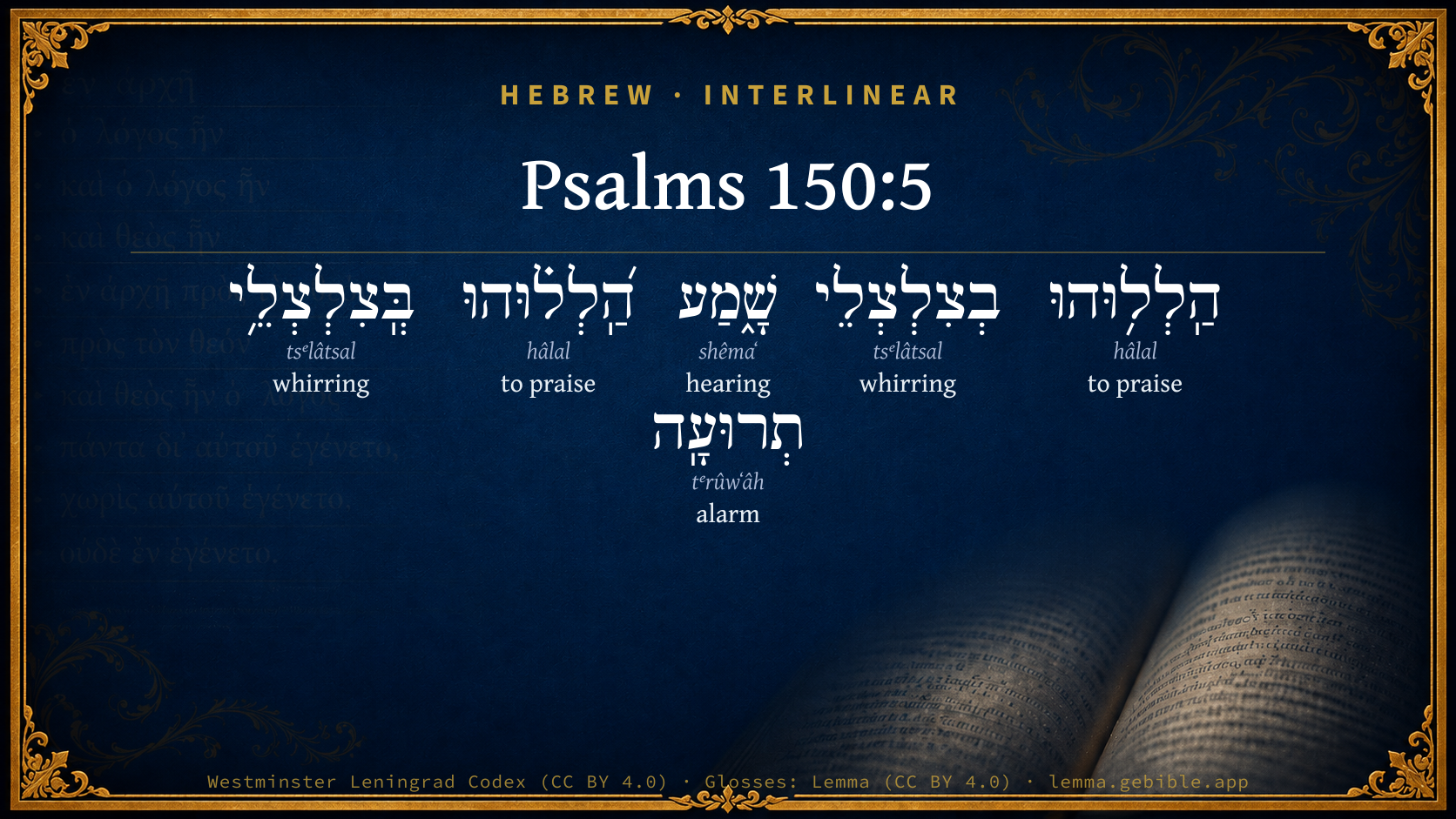
Hebrew (Westminster Leningrad Codex) Psalms 150:5 appears in the Hebrew Old Testament. The text above is from the Westminster Leningrad Codex. Each word links to its Strong’s number, a concise gloss, and parsing drawn from the Open Scriptures Hebrew Bible morphology. Click any word for its full Brown-Driver-Briggs (BDB) entry.
Download image
Cite this verse

Psalms 150:5 (World English Bible). Public Domain. Lemma interlinear Bible study tool, https://lemma.gebible.app/v/psalms/150/5.

Show BibTeX & RIS
BibTeX
RIS
English Translation
Praise him with loud cymbals! Praise him with resounding cymbals!
World English Bible · Public Domain
Download a study sheet

One document with this verse’s original text, its word-by-word gloss line, the meaning frame, cross-references with their text, attributed commentary, and full source and license credits — printable, and it pastes into notes with its structure intact.

This verse Autodidact and up

Study sheet (.html) Plain text (.txt)

A passage Seminary Student

Up to 50 verses in one chapter. A passage sheet keeps up to 6 commentary sources and 12 cross-references per verse, in the order this page ranks them, and says so on the sheet whenever that leaves anything out. Ask for a single verse and you get the Autodidact verse sheet above.

Everything on this page stays free to read, with no account — the sheet is a download of what is already on screen, not access to it.

Want to remove ads? Support Godless Engineer
Compare translations 3

The same verse in 3 English versions, stacked beneath the original-language interlinear above. Click any original word for its lexicon entry.

Each is an independent rendering of the whole verse — the interlinear is not word-aligned to these translations.

Highlighted words mark where these versions differ — a whole-verse word diff, not a word-by-word alignment.

  • World English Bible Public Domain
    Praise him with loud cymbals! Praise him with resounding cymbals!
  • King James Version Public Domain
    Praise him upon the loud cymbals: praise him upon the high sounding cymbals.
  • unfoldingWord Literal Text CC BY-SA 4.0
    Praise him with cymbals of hearing; praise him with cymbals of a shout.

unfoldingWord Literal Text — © unfoldingWord, licensed CC BY-SA 4.0. Word-aligned USFM3 via Door43 (git.door43.org/unfoldingWord/en_ult).

Versions to compare (up to 4)

3 of 4 selected

Show all 18 translations

Every available English version of this verse, each an independent rendering of the whole verse.

  • World English Bible Public Domain
    Praise him with loud cymbals! Praise him with resounding cymbals!
  • Berean Standard Bible Public Domain
    Praise Him with clashing cymbals; praise Him with resounding cymbals.
  • Majority Standard Bible Public Domain
    Praise Him with clashing cymbals; praise Him with resounding cymbals.
  • King James Version Public Domain
    Praise him upon the loud cymbals: praise him upon the high sounding cymbals.
  • American Standard Version (1901) Public Domain
    Praise him with loud cymbals: Praise him with high sounding cymbals.
  • Revised Version (1885) Public Domain
    Praise him upon the loud cymbals: praise him upon the high sounding cymbals.
  • Geneva Bible (1599) Public Domain
    Prayse ye him with sounding cymbales: prayse ye him with high sounding cymbales.
  • Douay-Rheims (1899) Public Domain
    praise the name of the Lord. For he spoke, and they were made: he commanded, and they were created.
  • Young's Literal Translation Public Domain
    Praise Him with cymbals of sounding, Praise Him with cymbals of shouting.
  • Literal Standard Version CC BY-SA 4.0
    Praise Him with cymbals of sounding, || Praise Him with cymbals of shouting.
  • Unlocked Literal Bible CC BY-SA 4.0
    Praise him with loud cymbals; praise him with high sounding cymbals.
  • unfoldingWord Literal Text CC BY-SA 4.0
    Praise him with cymbals of hearing; praise him with cymbals of a shout.
  • Darby Bible Public Domain
    Praise him with loud cymbals; praise him with high sounding cymbals.
  • World Messianic Bible Public Domain
    Praise him with loud cymbals! Praise him with resounding cymbals!
  • Webster's Bible Public Domain
    Praise him upon the loud cymbals: praise him upon the high sounding cymbals.
  • Free Bible Version CC BY-SA 4.0
    Praise him with the clash of cymbals, praise him with really loud cymbals!
  • Bible in Basic English Public Domain
    Give him praise with the loud brass: give him praise with the high-sounding brass.
  • JPS Tanakh (1917) Public Domain
    Praise Him with the loud-sounding cymbals; praise Him with the clanging cymbals.

Literal Standard Version (2020), Covenant Press — licensed CC BY-SA 4.0. Text via the HelloAO Bible API (eBible.org). Unlocked Literal Bible (unfoldingWord) — licensed CC BY-SA 4.0. Text via the HelloAO Bible API (eBible.org). unfoldingWord Literal Text — © unfoldingWord, licensed CC BY-SA 4.0. Word-aligned USFM3 via Door43 (git.door43.org/unfoldingWord/en_ult). Free Bible Version, Dr. Jonathan Gallagher — licensed CC BY-SA 4.0. Text via the HelloAO Bible API (eBible.org).

Word by word

More ways to search: Search by grammar → Find every occurrence → Compare this word →

Practice this passage: Drill this verse → Learn its vocabulary →

About this verse

These counts appear in no published source. They are computed here, from the morphology-tagged text and Lemma’s own curated glosses. What Lemma adds →

6
words
4
distinct lemmas
Wisdom
section

Notable vocabulary

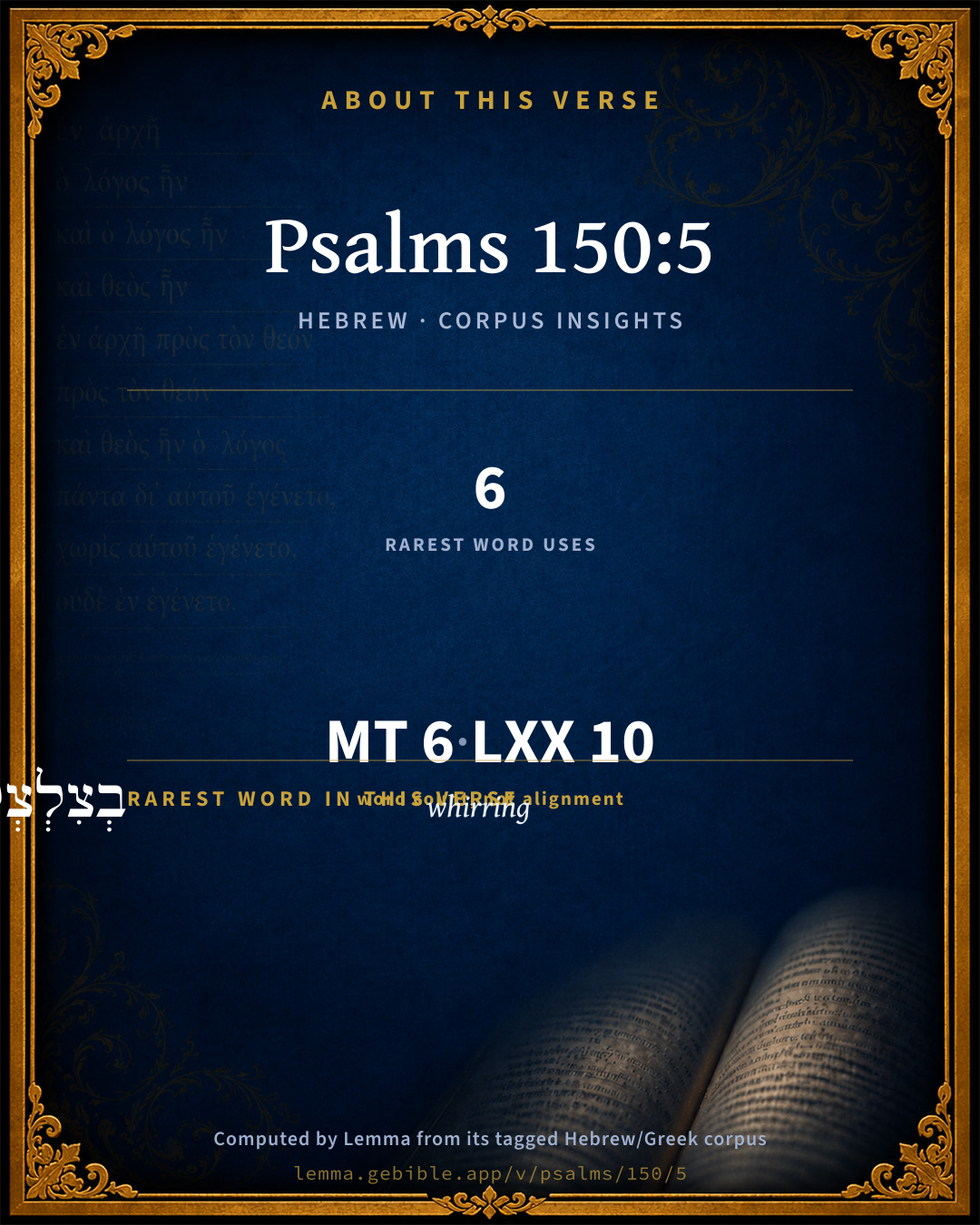
The rarest word here is בְצִלְצְלֵי whirring H6767 — appearing just 6 times in the whole Hebrew Bible.

Shared distinctive vocabulary

בְצִלְצְלֵי whirring H6767 occurs in 5 verses of the Hebrew Bible. Also found in:

Grammatical profile

  • 2 verbs
  • 4 nouns

Verb forms

  • הַֽלְל֥וּהוּ Piel · Imperative
  • הַֽ֝לְל֗וּהוּ Piel · Imperative

Repetition

Words recur within this verse — often emphatic in Hebrew:

  • הַֽלְל֥וּהוּ to praise H1984 ×2
  • בְצִלְצְלֵי whirring H6767 ×2

Hebrew & Septuagint length

In English translation the verse runs 10 words from the Hebrew and 10 from the Septuagint (LXX English) — the same length.

A rough comparison of the two English renderings, which tokenize alike — not a word-level alignment.

Word counts can differ between the Hebrew and the Greek without any difference in meaning — e.g. the Hebrew direct-object marker אֵת has no separate Greek word, and Greek often adds the article ὁ.

In the original languages it is 6 Hebrew tokens and 10 Greek tokens — but the two are counted differently (Hebrew bundles its prefixes and suffixes into one token; the Greek is in lemma form), so that isn’t a like-for-like length.

Cross-references

8

Topical passages linked to Psalms 150:5 in the Treasury of Scripture Knowledge — connected by theme and wording, ordered by reader-vote popularity; previews shown in the World English Bible.

  • 1 Chronicles 15:16 David spoke to the chief of the Levites to appoint their brothers the singers, with instruments of music, psalteries and harps and cymbals, sounding aloud and lifting up the voice with joy.
  • 1 Chronicles 25:1 Moreover, David and the captains of the host set apart for the service certain of the sons of Asaph, and of Heman, and of Jeduthun, who should prophesy with harps, with psalteries, and with cymbals: and the number of those who did the work according to their service was:
  • 1 Chronicles 15:19 So the singers, Heman, Asaph, and Ethan, [were appointed] with cymbals of brass to sound aloud;
  • 1 Chronicles 15:28 Thus all Israel brought up the ark of the covenant of Yahweh with shouting, and with sound of the cornet, and with trumpets, and with cymbals, sounding aloud with psalteries and harps.
  • 1 Chronicles 25:6 All these were under the hands of their father for song in the house of Yahweh, with cymbals, psalteries, and harps, for the service of the house of God; Asaph, Jeduthun, and Heman being under the order of the king.
  • 2 Samuel 6:5 David and all the house of Israel played before Yahweh with all manner of [instruments made of] fir-wood, and with harps, and with psalteries, and with tambourines, and with castanets, and with cymbals.
  • 1 Chronicles 16:5 Asaph the chief, and second to him Zechariah, Jeiel, and Shemiramoth, and Jehiel, and Mattithiah, and Eliab, and Benaiah, and Obed-edom, and Jeiel, with psalteries and with harps; and Asaph with cymbals, sounding aloud;
  • 1 Chronicles 13:8 David and all Israel played before God with all their might, even with songs, and with harps, and with psalteries, and with tambourines, and with cymbals, and with trumpets.

Cross-references courtesy of OpenBible.info (CC BY 4.0).

Hebrew and Greek witnesses Masoretic Hebrew ↔ Greek Septuagint

The same verse in the two great witnesses to the Old Testament, shown verse-for-verse.

You’re reading Greek Psalm 150 (Hebrew Psalm 150). The Septuagint counts the superscription, so verse numbers can differ from the Hebrew — chapter-level alignment, not verse-by-verse. Numbering follows Rahlfs.

These are two independent witnesses, not word-aligned to each other, and the Septuagint is shown in lemma (dictionary) form.

Hebrew Psalms 150:5 Masoretic · Westminster Leningrad Codex

הַֽלְל֥וּהוּ בְצִלְצְלֵי שָׁ֑מַע הַֽ֝לְל֗וּהוּ בְּֽצִלְצְלֵ֥י תְרוּעָֽה

Praise him with loud cymbals! Praise him with resounding cymbals!

World English Bible · Public Domain

Greek LXX Greek Psalm 150:5 Septuagint · lemma form

αἰνέω αὐτός ἐν κύμβαλον εὐήχος αἰνέω αὐτός ἐν κύμβαλον ἀλαλαγμός

Praise him with melodious cymbals: praise him with loud cymbals.

LXX2012 (modern English Septuagint) · Public Domain

On this verse, John Gill's Exposition discusses the Septuagint’s reading. Read the note in Commentary ↓

Hebrew: Westminster Leningrad Codex (CC BY 4.0). Greek: Septuagint (public domain); English from LXX2012 (modern English Septuagint) (Public Domain). How the Septuagint differs from the Hebrew →

Commentary

Notes on Psalms 150:5 from classic Christian and Jewish commentators (each source and its license shown beneath its notes). The classic Christian expositions comment on the surrounding passage and are grouped to its opening verse, so a note may address several verses; the Jewish commentaries on the Tanakh (Rashi and others) are per-verse, so they appear only where the commentator wrote on this verse.

Lemma curates 59 commentaries, every one of them public domain or Creative Commons licensed, each selected and text-cleaned for this edition rather than reprinted as found. About our sources →

Trapp's Complete Commentary

John Trapp

Psa 150:5 Praise him upon the loud cymbals: praise him upon the high sounding cymbals.

Ver. 5. Praise him upon the loud cymbals] These were, saith Cicero (in Pison.), instrumenta aerea, concava, tinnula, in matris Deorum sacris usurpata; bells, some render it. The apostle speaketh of a tinkling cymbal; and a grave divine complaineth, that God cannot please some hearers unless he speak tinkling and tickling words (Dr Stough on 2Ti 1:13).

John Trapp, A Commentary or Exposition upon All the Books of the Old and New Testament (1647–1656) — public domain. Text from a community e-Sword module.

J. A. Alexander on Psalms

Joseph Addison Alexander

5. (Psa 150:5) Praise him with cymbals of loud sound! Praise him with cymbals of joyful noise! The dominant idea, that of audibly expressed joy, is sustained to the last, where the cymbals are mentioned in both clauses, as an instrument peculiarly appropriated to occasions of unusual rejoicing. See 2Sa 6:5, Ezr 3:10, Neh 12:27. .The effect is still further heightened by the qualifying epithets, the first of which strictly denotes hearing or the thing heard, i.e. sound, and here by implication, loud sound. To this idea the parallel term adds that of joyful sound, to which it is constantly applied in usage. See above, on Psa 27:6; Psa 89:15, and compare Num 23:21. The distinction, here assumed by some interpreters, between cymbals of a larger and a smaller size, is wholly unnecessary.

Joseph Addison Alexander, The Psalms Translated and Explained (1850) — public domain. Text from a community e-Sword module.

Adam Clarke's Commentary

Verse 5. Loud cymbals] צלצלים tseltselim. Two hollow plates of brass, which, being struck together, produced a sharp clanging sound. This instrument is still in use. What the high-sounding cymbals meant I know not; unless those of a larger make, struck above the head, and consequently emitting a louder sound.

Adam Clarke's Commentary on the Bible (1810–1826) — public domain. Text from a community e-Sword/MySword module.

Ellicott's Commentary for English Readers

(5) Cymbals.—Heb., tseltselîm (2Sa_6:5), a word evidently formed to express the sound of the instrument. Two kinds are evidently indicated in this verse, the “loud” cymbals (literally, cymbals of hearing), and “high-sounding” (literally, of tumult). As the Arabs use at present a larger and smaller instrument (see Bible Educator, 2, 211, 311), it is possible that the same distinction is made here, but which would be the larger instrument it is impossible from the Hebrew to determine.

A Bible Commentary for English Readers, edited by Charles John Ellicott (1878–1897) — public domain. Text from a community e-Sword module.

The Cambridge Bible for Schools and Colleges

gen. ed. J. J. S. Perowne

5. the loud cytubals … the high sounding cymbals] The clear sounding cymbals … the clanging cymbals. Two kinds of cymbals are obviously meant: the first, lit. cymbals of hearing, may have been a smaller kind, producing a sharp, clear sound, possibly castanets: the second may have been a larger kind, producing a clanging, booming sound. “The Arabs have two distinct varieties, large and small.… They use their large cymbals in religious ceremonies, but the smaller kind seem to be almost limited to the accompaniment of dancers.” Stainer, p. 137. For cymbals of hearing cp. 1Ch_15:19, “with cymbals of bronze, to sound aloud,” lit. to cause to hear; Psa_16:5, “Asaph with cymbals, sounding aloud,” lit. causing to hear. With the Sept. of the second phrase, ἐν κυμβάλοις ἀλαλαγμοῦ, cp. κύμβαλον ἀλαλάζον ‘a clanging cymbal’ (1Co_13:1).

The Cambridge Bible for Schools and Colleges (gen. ed. J. J. S. Perowne; Cambridge University Press, 1878–1918) — public domain. Text from a community e-Sword module.

John Gill's Exposition

Praise him upon the loud cymbals,.... Or "cymbals of hearing" (x); that were heard with pleasure and delight, and afar off: the Septuagint and Vulgate Latin versions render it, "well sounding cymbals", which give a grateful sound to the ear; these were made of brass, Ch1 15:19; to which the apostle alludes, Co1 13:1;

praise him upon the high sounding, cymbals; or "cymbals of shouting" (y), ovation or triumph; which were used on joyful occasions, as victories, deliverances, and the like; and were used also in the temple service, see Ch1 16:5; according to the Targum and Septuagint version, these were three stringed instruments; for so they render the word them in Sa1 18:6. Now these several instruments of music are named, not as to be used in Gospel times; but, being expressive of the highest praise and joy shown in former times, are mentioned to set forth the highest strains and notes of praise in New Testament saints; as well as to denote their heartiness, agreement, and unanimity in this service, Rom 15:6.

(x) "in cymbalis auditus", Montanus, Vatablus. (y) "in cymbalis jubilationis", V. L. Musculus, Cocceius; "in cymbalis ovationis", Montanus.

John Gill's Exposition of the Whole Bible (1746–1763) — public domain (CC PDM 1.0). Text via the HelloAO Bible API.

Albert Barnes' Notes on the Bible

Praise him upon the loud cymbals - literally, “the cymbals of sound” or hearing. That is, Let there be audibly expressed joy. The allusion here is to an instrument of music that was most distinctly heard in union with other instruments. The sound of the cymbal would be most clearly audible in its accompaniment of the other instruments referred to, as the sound of cymbals, or as the “triangle” would be now. The Hebrew word rendered cymbal means a tinkling, clanging, ringing, as of metal, or of arms; then, a whirring, as of wings (compare the notes at Isa 18:1); then, any tinkling or clanging instrument, as a fish-spear or harpoon; then, cymbals, instruments of music. The cymbal, as now used, is an instrument of brass, in a circular form, like a dish, producing, when two are struck gether, a sharp, ringing sound - Webster. An instrument of this kind is evidently referred to here. The word occurs in the Bible in the following places only: Deu 28:42, rendered locust; 2Sa 6:5, rendered, as here, cymbal; Job 41:7, rendered fish-spears; and Isa 18:1, rendered shadowing with.

Praise him upon the high-sounding cymbals - The cymbals of joyful voice. On the word teruah, rendered high, see the notes at Psa 89:16. A loud, lofty sound or shout, as on the reception of a conqueror, is the idea here; and the sense is, that the praise of God was to be celebrated with that which would in the highest sense express joy and triumph.

Albert Barnes' Notes on the Bible (1834–1885) — public domain. Text from a community e-Sword/MySword module.

The Treasury of David

Charles H. Spurgeon

Ver. 5. Praise high upon the loud cymbals: praise him upon the high sounding cymbals. Let the clash of the loudest music be the Lord's: let the joyful clang of the loftiest notes be all for him. Praise has beaten the timbrel, swept the harp, and sounded the trumpet, and now for a last effort, awakening the most heavy of slumberers, and startling the most indifferent of onlookers, she dashes together the disks of brass, and with sounds both loud and high proclaims the glories of the Lord.

Ver. 5. Loud cymbals...high sounding cymbals. This important passage clearly points to two instruments under the same name, and leaves us to conclude that the Hebrews had both hand cymbals and finger cymbals (or castanets), although it may not in all cases be easy to say which of the two is intended in particular texts. John Kitto.

Ver. 5. (Prayer Book Version). Praise him upon the well tuned cymbals: praise him upon the loud cymbals. As I have heard these words read monthly in our churches, it has often come into my thoughts that when we intend to glorify God with our cymbals, it should not be our only care to have them loud enough, but our first care should be to have them well tuned, else the louder the worse. Zeal does very wellthere is great, yea, necessary use for it in every part of God's service. The cymbal will be flat, it will have no life or spirit in it, it will not be loud enough without it. But if meekness, peaceableness, and moderation do not first put the cymbal into good tune, the loudness will but make it the more ungrateful in the player, the more ungrateful to the hearer. Robert Sanderson, 1587-1662

Psalms 150:6*

Charles H. Spurgeon's The Treasury of David (1869–1885) — public domain. Psalms only. Text from a community e-Sword/MySword module.

Whedon's Commentary on the Bible

Daniel D. Whedon

5. Loud cymbals—The idea is, cymbals giving a clear, distinct sound, causing a distinct hearing—literally, cymbals of hearing.

High sounding cymbals—Literally, cymbals of shouting, clanging cymbals. The difference between the two is simply in the volume of sound they are adapted to give forth. The Hebrew music was noisy and strong, but this occasion exceeded all others.

Daniel D. Whedon (gen. ed.), Commentary on the Old and New Testaments (1874–1909) — public domain. Text from a community e-Sword module.

The Pulpit Commentary

Praise him upon the loud cymbals; praise him upon the high-sounding cymbals. "We can hardly," says Professor Cheyne, "venture to distinguish two kinds of cymbals on the ground of these two epithet" The mention of "cymbals" is reserved to the last, as being the instrument of music most expressive of joy and jubilation. It completes the musical climax, as ver. 6 completes the ideal one.

The Pulpit Commentary (1880–1919), ed. H.D.M. Spence-Jones & Joseph S. Exell — public domain. Text from a community e-Sword module.

Rashi

Rabbi Shlomo Yitzchaki (Rashi)

with resounding cymbals Heb. בצלצלי שמע, cymbals that let a sound be heard.

שָׁמַע is a noun, like שֶׁמַע, with a “segol,” but because of the “ethnactha” [which denotes a pause], it is vowelized with a long “kamatz,” and therefore, its accent is above, under the “shin.”

Rashi on the Tanakh — English translations: “The Judaica Press complete Tanach with Rashi, translated by A. J. Rosenberg” (CC BY 4.0); “Pentateuch with Rashi's commentary by M. Rosenbaum and A.M. Silbermann, 1929-1934” (public domain); “The Metsudah Tanach series, Lakewood, N.J” (CC BY 4.0); and “The Book of Joshua, Metsudah Publications, 1997” (CC BY 4.0). Text via Sefaria.

Lesson kit

Teaching starters — assembled from the data on this page, not authored interpretation. Every prompt links to the verse data it draws on. Edit before teaching.

Psalms, in the Wisdom, opens this verse with 6 words (4 distinct Hebrew lemmas). Its most distinctive word is tsᵉlâtsal (“whirring”). A historical commentator’s framing appears above. Read the whole chapter for the surrounding context.

Discussion questions

  1. How does “whirring” (tsᵉlâtsal) shape what this verse is saying?
  2. How does Deuteronomy 28:42, which shares the word «whirring», read alongside this verse?
  3. What does the repetition of “to praise” (2× in this one verse) do in this verse?
  4. These translations render this verse differently. What is at stake in choosing one wording over another?
  5. «הַֽלְל֥וּהוּ» is a Piel Imperative verb. How does that grammatical form shape the action described?
  6. Compare how Trapp's Complete Commentary and J. A. Alexander on Psalms read this verse. Where do they agree or differ?

Things to notice

Reading settings

Reading text

Shown beneath each verse's original-language words.

Old Testament
Old Testament edition

Read the OT as the Masoretic Hebrew (MT) or the Greek Septuagint (LXX).

English shown for the Greek Septuagint (in the Hebrew ↔ Greek comparison).

Comparing translations? Open the Compare panel on any verse page to stack up to four side by side.