
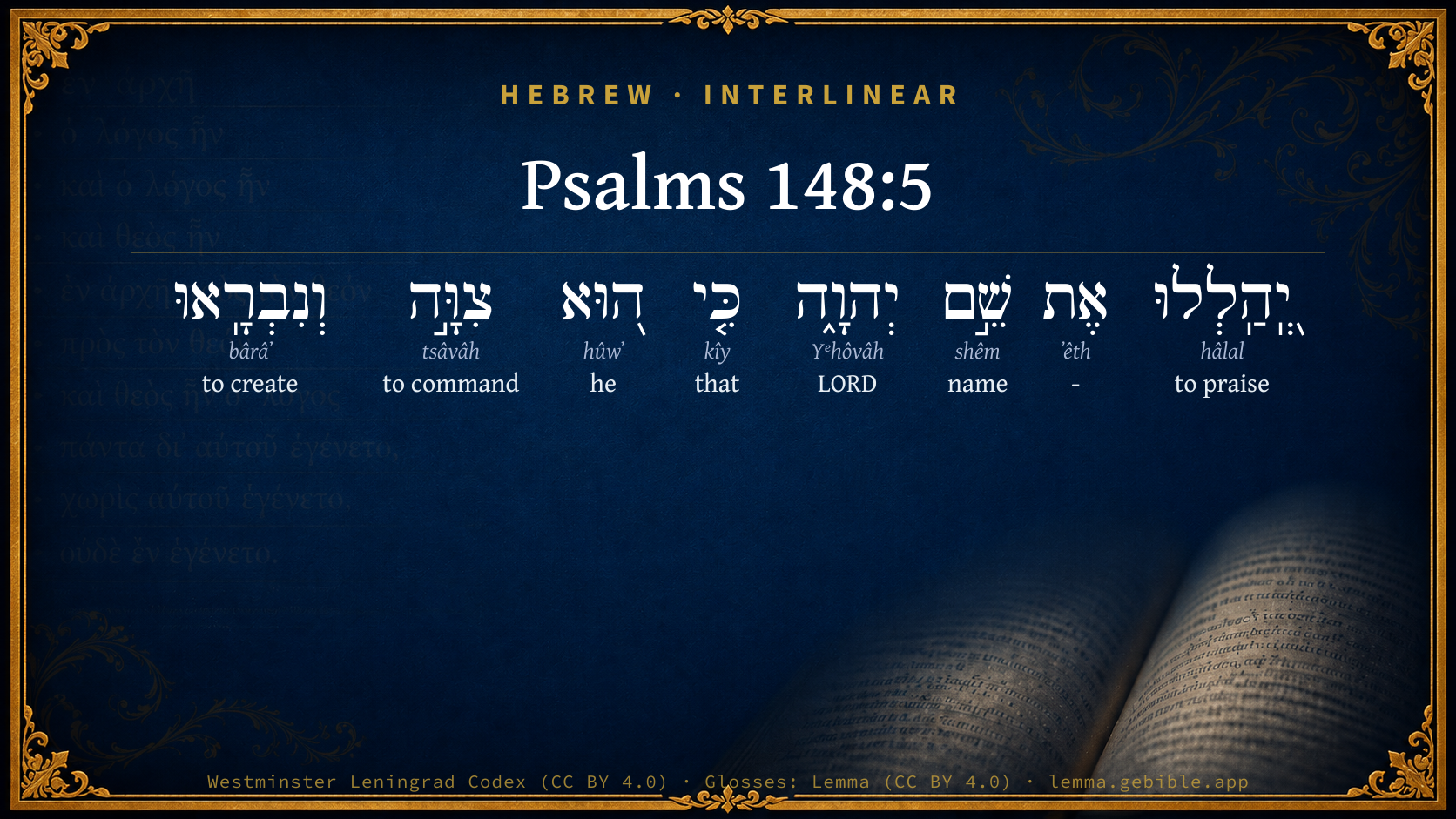
Psalms 148:5

Hebrew (Westminster Leningrad Codex) Psalms 148:5 appears in the Hebrew Old Testament. The text above is from the Westminster Leningrad Codex. Each word links to its Strong’s number, a concise gloss, and parsing drawn from the Open Scriptures Hebrew Bible morphology. Click any word for its full Brown-Driver-Briggs (BDB) entry.
Download image
Cite this verse

Psalms 148:5 (World English Bible). Public Domain. Lemma interlinear Bible study tool, https://lemma.gebible.app/v/psalms/148/5.

Show BibTeX & RIS
BibTeX
RIS
English Translation
Let them praise the name of Yahweh, For he commanded, and they were created.
World English Bible · Public Domain
Download a study sheet

One document with this verse’s original text, its word-by-word gloss line, the meaning frame, cross-references with their text, attributed commentary, and full source and license credits — printable, and it pastes into notes with its structure intact.

This verse Autodidact and up

Study sheet (.html) Plain text (.txt)

A passage Seminary Student

Up to 50 verses in one chapter. A passage sheet keeps up to 6 commentary sources and 12 cross-references per verse, in the order this page ranks them, and says so on the sheet whenever that leaves anything out. Ask for a single verse and you get the Autodidact verse sheet above.

Everything on this page stays free to read, with no account — the sheet is a download of what is already on screen, not access to it.

Want to remove ads? Support Godless Engineer
Compare translations 3

The same verse in 3 English versions, stacked beneath the original-language interlinear above. Click any original word for its lexicon entry.

Each is an independent rendering of the whole verse — the interlinear is not word-aligned to these translations.

Highlighted words mark where these versions differ — a whole-verse word diff, not a word-by-word alignment.

  • World English Bible Public Domain
    Let them praise the name of Yahweh, For he commanded, and they were created.
  • King James Version Public Domain
    Let them praise the name of the LORD: for he commanded, and they were created.
  • unfoldingWord Literal Text CC BY-SA 4.0
    Let them praise the name of Yahweh, for he, he commanded, and they were created.

unfoldingWord Literal Text — © unfoldingWord, licensed CC BY-SA 4.0. Word-aligned USFM3 via Door43 (git.door43.org/unfoldingWord/en_ult).

Versions to compare (up to 4)

3 of 4 selected

Show all 18 translations

Every available English version of this verse, each an independent rendering of the whole verse.

  • World English Bible Public Domain
    Let them praise the name of Yahweh, For he commanded, and they were created.
  • Berean Standard Bible Public Domain
    Let them praise the name of the LORD, for He gave the command and they were created.
  • Majority Standard Bible Public Domain
    Let them praise the name of the LORD, for He gave the command and they were created.
  • King James Version Public Domain
    Let them praise the name of the LORD: for he commanded, and they were created.
  • American Standard Version (1901) Public Domain
    Let them praise the name of Jehovah; For he commanded, and they were created.
  • Revised Version (1885) Public Domain
    Let them praise the name of the LORD: for he commanded, and they were created.
  • Geneva Bible (1599) Public Domain
    Let them prayse the Name of the Lord: for he commanded, and they were created.
  • Douay-Rheims (1899) Public Domain
    Great is our Lord, and great is his power: and of his wisdom there is no number.
  • Young's Literal Translation Public Domain
    They do praise the name of Jehovah, For He commanded, and they were created.
  • Literal Standard Version CC BY-SA 4.0
    They praise the Name of YHWH, || For He commanded, and they were created.
  • Unlocked Literal Bible CC BY-SA 4.0
    Let them praise the name of Yahweh, for he gave the command, and they were created.
  • unfoldingWord Literal Text CC BY-SA 4.0
    Let them praise the name of Yahweh, for he, he commanded, and they were created.
  • Darby Bible Public Domain
    Let them praise the name of Jehovah, for he it is that commanded, and they were created:
  • World Messianic Bible Public Domain
    Let them praise the LORD’s name, for he commanded, and they were created.
  • Webster's Bible Public Domain
    Let them praise the name of the LORD: for he commanded, and they were created.
  • Free Bible Version CC BY-SA 4.0
    Let them all praise the Lord and his nature, for he gave the order and they were created.
  • Bible in Basic English Public Domain
    Let them give praise to the name of the Lord: for he gave the order, and they were made.
  • JPS Tanakh (1917) Public Domain
    Let them praise the name of the LORD; for He commanded, and they were created.

Literal Standard Version (2020), Covenant Press — licensed CC BY-SA 4.0. Text via the HelloAO Bible API (eBible.org). Unlocked Literal Bible (unfoldingWord) — licensed CC BY-SA 4.0. Text via the HelloAO Bible API (eBible.org). unfoldingWord Literal Text — © unfoldingWord, licensed CC BY-SA 4.0. Word-aligned USFM3 via Door43 (git.door43.org/unfoldingWord/en_ult). Free Bible Version, Dr. Jonathan Gallagher — licensed CC BY-SA 4.0. Text via the HelloAO Bible API (eBible.org).

Word by word

More ways to search: Search by grammar → Find every occurrence → Compare this word →

Practice this passage: Drill this verse → Learn its vocabulary →

וְנִבְרָֽאוּ
bârâʼ
H1254
“and · to create”
Conjunction + Verb, Niphal, Perfect, 3rd Person, Common, Plural
Part of Speech
Conjunction + Verb
Stem
Niphal
Form
Perfect
Person
3rd Person
Gender
Common
Number
Plural
Full BDB Definition

Origin: a primitive root

TWOT: 278

to create, shape, form - (Qal) to shape, fashion, create (always with God as subject) - of heaven and earth - of individual man - of new conditions and circumstances - of transformations - (Niphal) to be created - of heaven and earth - of birth - of something new - of miracles - (Piel) - to cut down - to cut out - to be fat - (Hiphil) to make yourselves fat
  1. יְֽ֭הַֽלְלוּ hâlal H1984 “to praise” Verb, Piel, Jussive, 3rd Person, Masculine, Plural
  2. אֶת ʼêth H853 “-” Particle, Direct Object
  3. שֵׁ֣ם shêm H8034 “name of” Noun, Common, Masculine, Singular, Construct
  4. יְהוָ֑ה Yᵉhôvâh H3068 “LORD” Noun, Proper
  5. כִּ֤י kîy H3588 “that” Conjunction
  6. ה֭וּא hûwʼ H1931 “he” Pronoun, Personal, 3rd Person, Masculine, Singular
  7. צִוָּ֣ה tsâvâh H6680 “to command” Verb, Piel, Perfect, 3rd Person, Masculine, Singular

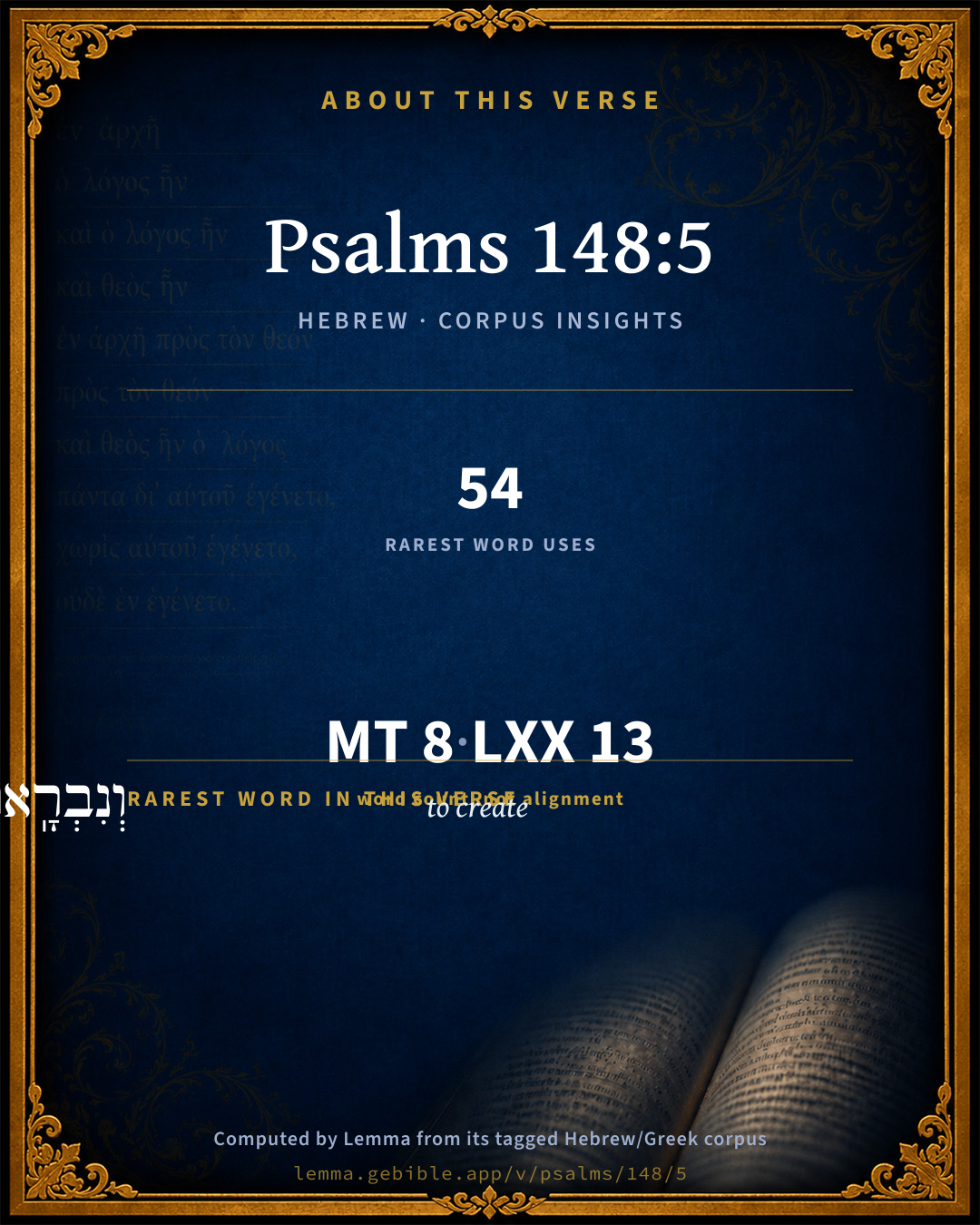
About this verse

These counts appear in no published source. They are computed here, from the morphology-tagged text and Lemma’s own curated glosses. What Lemma adds →

8
words
8
distinct lemmas
Wisdom
section

Shared distinctive vocabulary

וְנִבְרָֽאוּ to create H1254 occurs in 46 verses of the Hebrew Bible. Also found in:

Grammatical profile

  • 3 verbs
  • 2 nouns
  • 1 pronoun
  • 1 conjunction
  • 1 particle

Verb forms

  • יְֽ֭הַֽלְלוּ Piel · Jussive
  • צִוָּ֣ה Piel · Perfect
  • וְנִבְרָֽאוּ Niphal · Perfect

Hebrew & Septuagint length

In English translation the verse runs 14 words from the Hebrew and 21 from the Septuagint (LXX English) — closely comparable.

A rough comparison of the two English renderings, which tokenize alike — not a word-level alignment.

Word counts can differ between the Hebrew and the Greek without any difference in meaning — e.g. the Hebrew direct-object marker אֵת has no separate Greek word, and Greek often adds the article ὁ.

In the original languages it is 8 Hebrew tokens and 13 Greek tokens — but the two are counted differently (Hebrew bundles its prefixes and suffixes into one token; the Greek is in lemma form), so that isn’t a like-for-like length.

Cross-references

7

Topical passages linked to Psalms 148:5 in the Treasury of Scripture Knowledge — connected by theme and wording, ordered by reader-vote popularity; previews shown in the World English Bible.

  • Revelation 4:11 "Worthy are you, our Lord and God, the Holy One, to receive the glory, the honor, and the power, for you created all things, and because of your desire they existed, and were created!"
  • Genesis 1:6 God said, "Let there be an expanse in the midst of the waters, and let it divide the waters from the waters."
  • Psalms 33:6–9 By Yahweh's word the heavens were made; All their host by the breath of his mouth.
  • Genesis 1:1–2 In the beginning God created the heavens and the earth.
  • Jeremiah 10:11–13 Thus shall you say to them, The gods that have not made the heavens and the earth, these shall perish from the earth, and from under the heavens.
  • Psalms 95:5 The sea is his, and he made it. His hands formed the dry land.
  • Amos 9:6 It is he who builds his chambers in the heavens, and has founded his vault on the earth; he who calls for the waters of the sea, and pours them out on the surface of the earth; Yahweh is his name.

Cross-references courtesy of OpenBible.info (CC BY 4.0).

Hebrew and Greek witnesses Masoretic Hebrew ↔ Greek Septuagint

The same verse in the two great witnesses to the Old Testament, shown verse-for-verse.

You’re reading Greek Psalm 148 (Hebrew Psalm 148). The Septuagint counts the superscription, so verse numbers can differ from the Hebrew — chapter-level alignment, not verse-by-verse. Numbering follows Rahlfs.

These are two independent witnesses, not word-aligned to each other, and the Septuagint is shown in lemma (dictionary) form.

Hebrew Psalms 148:5 Masoretic · Westminster Leningrad Codex

יְֽ֭הַֽלְלוּ אֶת שֵׁ֣ם יְהוָ֑ה כִּ֤י ה֭וּא צִוָּ֣ה וְנִבְרָֽאוּ

Let them praise the name of Yahweh, For he commanded, and they were created.

World English Bible · Public Domain

Greek LXX Greek Psalm 148:5 Septuagint · lemma form

αἰνέω ὁ ὄνομα κύριος ὅτι αὐτός εἶπον καί γίγνομαι αὐτός ἐντέλλομαι καί κτίζω

Let them praise the name of the Lord: for he spoke, and they were made; he commanded, and they were created.

LXX2012 (modern English Septuagint) · Public Domain

On this verse, The Cambridge Bible for Schools and Colleges discusses the Septuagint’s reading. Read the note in Commentary ↓

Hebrew: Westminster Leningrad Codex (CC BY 4.0). Greek: Septuagint (public domain); English from LXX2012 (modern English Septuagint) (Public Domain). How the Septuagint differs from the Hebrew →

Commentary

Notes on Psalms 148:5 from classic Christian and Jewish commentators (each source and its license shown beneath its notes). The classic Christian expositions comment on the surrounding passage and are grouped to its opening verse, so a note may address several verses; the Jewish commentaries on the Tanakh (Rashi and others) are per-verse, so they appear only where the commentator wrote on this verse.

Lemma curates 59 commentaries, every one of them public domain or Creative Commons licensed, each selected and text-cleaned for this edition rather than reprinted as found. About our sources →

Trapp's Complete Commentary

John Trapp

Psa 148:5 Let them praise the name of the LORD: for he commanded, and they were created.

Ver. 5. For he commanded, and they were created] His fiat only made all; this is celebrated by that heavenly choir, Rev 4:11.

John Trapp, A Commentary or Exposition upon All the Books of the Old and New Testament (1647–1656) — public domain. Text from a community e-Sword module.

Joseph Benson's Commentary

Psa 148:5-6. Let them praise the name of the Lord — “Who hath set forth his most transcendent wisdom, power, and magnificence in such a variety of stupendous works, that there is not the smallest of them, but ministers such matter of praise and admiration to those who attentively consider them, that they cannot but wish, with the psalmist here, that every one of them were able to tell us how much skill he hath shown in its contrivance; or that we were able to find it out and comprehend it.” He commanded, and they were created — They owe their existence wholly to his will and pleasure. He hath also established them for ever and ever — To the end of the world. They are, by his superintending and watchful providence, constantly preserved and continued. He made a decree, &c. — “That is, prescribed rules to the heavens, the stars, and other creatures, as to their situation, motion, and influence; which, though inanimate, they never transgress.” — Dodd.

Joseph Benson's Commentary on the Old and New Testaments (1811–1818) — public domain. Text from a community e-Sword module.

J. A. Alexander on Psalms

Joseph Addison Alexander

5. (Psa 148:5) Let them praise the name of Jehovah, for he commanded and they were created. The direct invitation to the heavens is followed by a statement of the reason why they should comply with it, expressed in the third person, as if addressed to others. The pronoun he is emphatic. (It was) he (that) commanded (and no other). See above, on Psa 33:9, and compare Gen 1:3.

Joseph Addison Alexander, The Psalms Translated and Explained (1850) — public domain. Text from a community e-Sword module.

Jamieson, Fausset & Brown

Robert Jamieson, A. R. Fausset & David Brown

praise the name--as representing His perfections.

he commanded--"He" is emphatic, ascribing creation to God alone.

Jamieson, Fausset & Brown — Commentary Critical and Explanatory on the Whole Bible (1871) — public domain (CC PDM 1.0). Text via the HelloAO Bible API.

Adam Clarke's Commentary

Verse 5. He commanded, and they were created.] He spake the word expressive of the idea in his infinite mind; and they sprang into being according to that idea.

Adam Clarke's Commentary on the Bible (1810–1826) — public domain. Text from a community e-Sword/MySword module.

John Calvin's Commentaries

5. Let them praise the name, etc. As he speaks of things wanting intelligence, he passes to the third person, from which we infer that his reason for having spoken in the second person hitherto, was to make a deeper impression upon men. And he asks no other praise than that which may teach us that the stars did not make themselves, nor the rains spring from chance; for notwithstanding the signal proofs we constantly have before our eyes of the divine power, we with shameful carelessness overlook the great author. He says emphatically — for He Himself created, intimating that the world is not eternal, as wicked men conjecture, nor made by a concourse of atoms, but that this fair order of things which we see, suddenly sprang forth upon the commandment of God. And, speaking of the creation, he adds what is even more worthy of observation, that he gave that law to them which remains inviolable. For many, while they grant that the world was made by God, lapse from this into the senseless notion that now the order of nature stands of itself, and that God sits idle in the heavens. The Psalmist very properly insists, therefore, that the works of God above us in the heavens were not only made by him, but even now move forward at his disposal; and that not only was a secret power communicated to them at first, but while they go through their assigned parts, their operation and ministry to their various ends is dependent upon God.

John Calvin's Commentaries (1540-1563) — public domain. Text from the Calvin Translation Society English edition (1840s-50s) via the Christian Classics Ethereal Library (ccel.org). Calvin's coverage is partial (roughly two-thirds of the Bible); uncommented books and verses are honest gaps, never fabricated. The 19th-century editor's footnotes and remarks are omitted so the notes are faithfully Calvin's own voice.

The Cambridge Bible for Schools and Colleges

gen. ed. J. J. S. Perowne

5. for HE commanded] HE is emphatically expressed. Cp. Psa_33:9, whence also comes the addition of the LXX, which is retained in P.B.V., HE spake the word, and they were made.

The Cambridge Bible for Schools and Colleges (gen. ed. J. J. S. Perowne; Cambridge University Press, 1878–1918) — public domain. Text from a community e-Sword module.

John Gill's Exposition

Let them praise the name of the Lord,.... Set forth the glory of the nature and perfections of God, and celebrate the praise of them; even all celestial creatures, the angels, the hosts of heaven, the sun, moon, and stars; the heavens, and the haven of heavens, and the waters above them; and that for the following reasons;

for he commanded, and they were created; they are all his creatures, and therefore should praise him: he is the "Father of spirits", of angelic spirits, as well as the spirits of men; and the "Father of lights", of all the luminaries of the heavens; and he has made the heavens themselves, and all their hosts, and the firmament dividing the waters above and below; and all this by an almighty "fiat", at a word of command; he spoke, and they came into being at once, Heb 12:9, Jam 1:17.

John Gill's Exposition of the Whole Bible (1746–1763) — public domain (CC PDM 1.0). Text via the HelloAO Bible API.

Albert Barnes' Notes on the Bible

Let them praise the name of the Lord - That is, Let them praise Yahweh himself - the name being often put for the person or thing referred to.

For he commanded, and they were created - He showed his great power by merely speaking, and they came at once into being. Compare Psa 33:6, note; Psa 33:9, note.

Albert Barnes' Notes on the Bible (1834–1885) — public domain. Text from a community e-Sword/MySword module.

Matthew Poole's English Annotations

They owe their being wholly to God’s good will.

Matthew Poole's English Annotations on the Holy Bible (1683–1685) — public domain. Text from a community e-Sword/MySword module.

The Treasury of David

Charles H. Spurgeon

Ver. 5. Let them praise the name of the LORD; for he commanded, and they were created. Here is good argument: The Maker should have honour from his works, they should tell forth his praise: and thus they should praise his name by which his character is intended. The name of JEHOVAH is written legibly upon his works, so that his power, wisdom, goodness, and other attributes are therein made manifest to thoughtful men, and thus his name is praised. The highest praise of God is to declare what he is. We can invent nothing which would magnify the Lord: we can never extol him better than by repeating his name, or describing his character. The Lord is to be extolled as creating all things that exist, and as doing so by the simple agency of his word. He created by a command; what a power is this! Well may he expect those to praise him who owe their being to him. Evolution may be atheistic; but the doctrine of creation logically demands worship; and hence, as the tree is known by its fruit, it proves itself to be true. Those who were created by command are under command to adore their Creator. The voice which said "Let them be", now saith "Let them praise."

Ver. 5-6. This is the account of creation in a wordHe spake; it was done. When Jesus came, he went everywhere showing his Divinity by this evidence, that his word was omnipotent. These verses declare two miracles of God's Will and Word, viz., the creation and consolidation of the earth. Jehovah first produced matter, then he ordered and established it. John Lorinus.

Ver. 5-6. Creation and conservation, two chief reasons for praise.

Psalms 148:6*

Charles H. Spurgeon's The Treasury of David (1869–1885) — public domain. Psalms only. Text from a community e-Sword/MySword module.

The Pulpit Commentary

Let them praise the Name of the Lord. Frequent changes of person, when no doubt can arise as to the meaning, are a sort of Hebrew idiom. They give liveliness and variety. For he commanded, and they were created. (Gen_1:3, Gen_1:6, Gen_1:9, Gen_1:11, Gen_1:14, Gen_1:15, etc.) All creation sprang into being at the word of God. (Psa_33:8)

The Pulpit Commentary (1880–1919), ed. H.D.M. Spence-Jones & Joseph S. Exell — public domain. Text from a community e-Sword module.

unfoldingWord translationNotes

Door43 World Missions Community

Let them praise the name of Yahweh

Here the word "name" represents Yahweh himself. AT: "Let them praise Yahweh" (See: Metonymy)

they were created

This can be stated in active form. AT: "he created them" (See: Active or Passive)

he issued a decree that will never change

Possible meanings are 1) "he gave a command that is permanent" or 2) "he gave a command that they will not disobey."

he issued

"he gave"

translationWords

name

command

create

eternity

decree

unfoldingWord translationNotes — © Distant Shores Media and the Door43 World Missions Community, licensed CC BY-SA 4.0. Source: git.door43.org/Door43/en_tn.

Lesson kit

Teaching starters — assembled from the data on this page, not authored interpretation. Every prompt links to the verse data it draws on. Edit before teaching.

Psalms, in the Wisdom, opens this verse with 8 words (8 distinct Hebrew lemmas). Its most distinctive word is bârâʼ (“to create”). A historical commentator’s framing appears above. Read the whole chapter for the surrounding context.

Discussion questions

  1. The word bârâʼ carries the sense “to create.” How does it shape the verse?
  2. Genesis 1:1 shares the word «to create» with this verse. How do the two illuminate each other?
  3. These translations render this verse differently. What is at stake in choosing one wording over another?
  4. The verb «יְֽ֭הַֽלְלוּ» is Piel Jussive. How does its form color the action?
  5. Reading how Trapp's Complete Commentary and Joseph Benson's Commentary read this verse, where do the two commentators agree and where do they part?

Things to notice

Reading settings

Reading text

Shown beneath each verse's original-language words.

Old Testament
Old Testament edition

Read the OT as the Masoretic Hebrew (MT) or the Greek Septuagint (LXX).

English shown for the Greek Septuagint (in the Hebrew ↔ Greek comparison).

Comparing translations? Open the Compare panel on any verse page to stack up to four side by side.