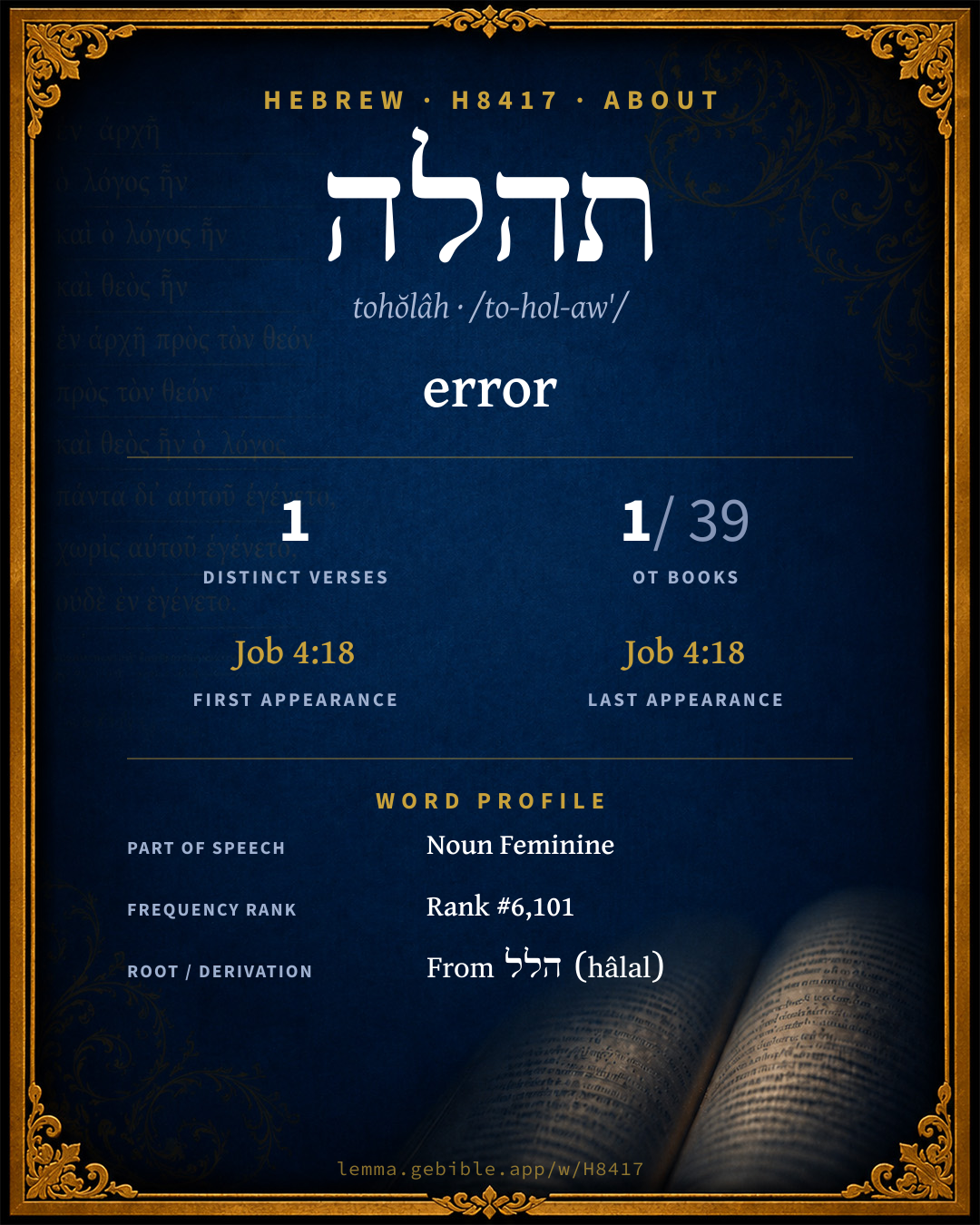
תׇּהֳלָה
error
Full lexicon entry — Brown-Driver-Briggs (BDB)
From Brown-Driver-Briggs (BDB)
Where this word appears
Grammar key — what these labels mean
Part of speech
- Noun
- A naming word — a person, place, thing, or idea.
Noun type
- Common
- A common noun — a general class of person, place, or thing (“king,” “city,” “water”), not a specific name.
State
- Absolute
- The independent form of a noun, not bound to a following word.
Gender
- Feminine
- Grammatically feminine.
Number
- Singular
- One.
Every verse where H8417 appears — 1 distinct verse across 1 book. Click any verse to open its interlinear word-by-word view. Verse text shown in the World English Bible for context — . Each verse’s Hebrew form is shown with its reference; the English is not keyword-highlighted, since the data carries no word-level English alignment. Use “Compare translations” on any verse to read it across multiple English versions. This concordance covers the Hebrew Bible; Septuagint (Greek Old Testament) occurrences are not indexed here.
Job 1 verse
About this entry
At a glance — auto-summarized from this page’s data, not written by a person. Every figure links to its source below. This summary describes the numbers; it doesn’t interpret them.
“error” is the headline sense of the Hebrew noun תהלה (tohŏlâh). It is rare — just 1 verse in the entire Hebrew Bible. More than three-quarters of its appearances fall in Job. It occurs only once, in Job 4:18. Related forms include הלל, הוללה and הוללות. See the sense tree, 1-verse concordance, and the renderings breakdown below.
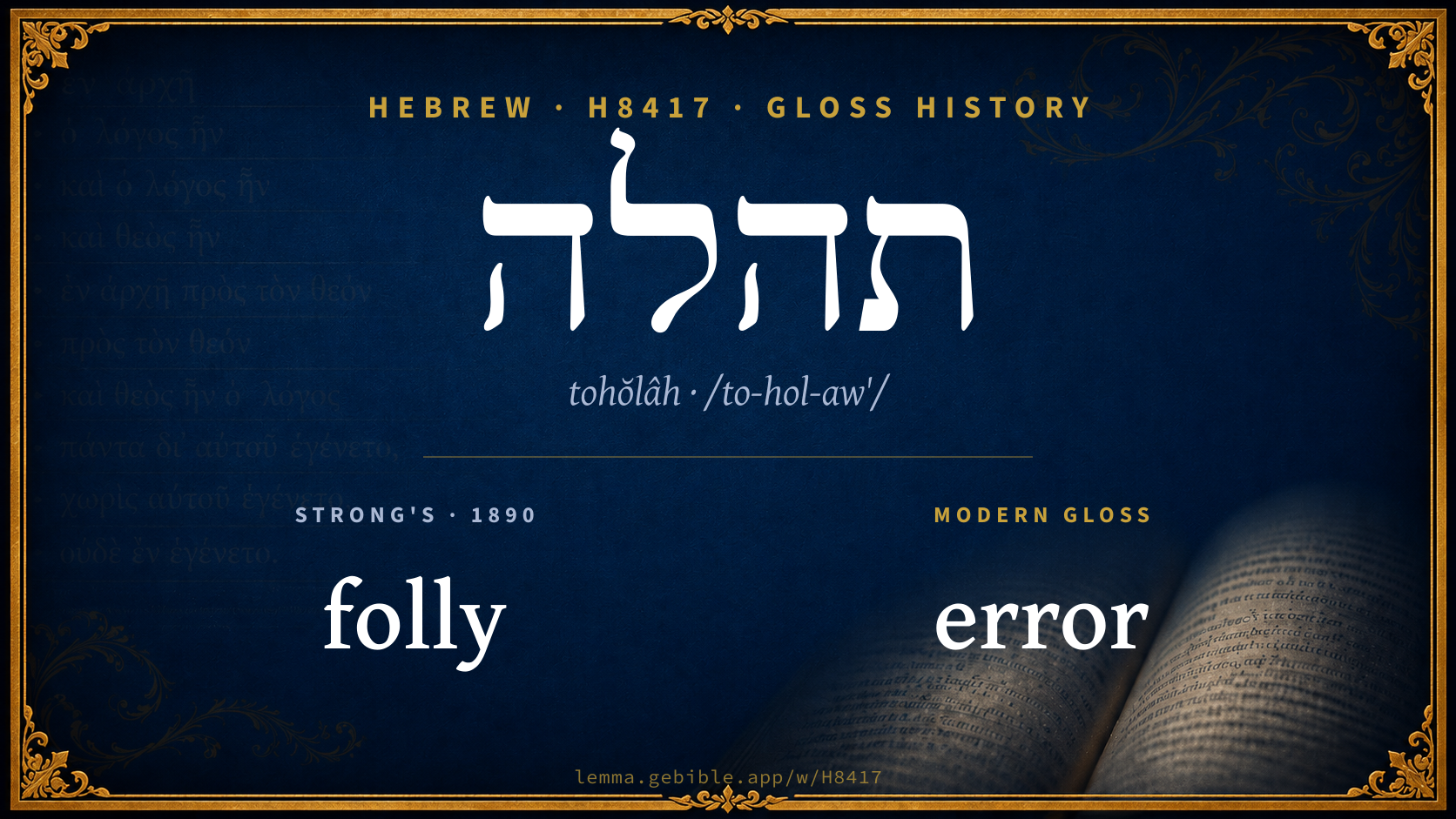
Gloss history
Strong's 1890 vs modern scholarship
About this word
Strong's H8417 catalogs a Hebrew word from the Hebrew Old Testament.
These counts are not copied from any lexicon or concordance. They are computed here, from the morphology-tagged Hebrew Old Testament. What Lemma adds →
- 1
- distinct verses
- The word appears in 1 distinct verse.
- 1 / 39
- OT books
- The word appears in 1 of 39 Old Testament books.
- #6,101
- by frequency
- Rank #6,101 (rank 6,101 of 8,640 Hebrew words by occurrence).
View all 1 occurrence in the concordance →
Most concentrated in
- Job 1 verse 100%
By section of the Old Testament
By traditional corpus
Conventional, traditional groupings — biblical authorship is debated, so this is a traditional corpus grouping, not an authorship claim. Each share is this word’s portion of its verses in that division of the Hebrew canon. Each figure is a share of the word’s 1 distinct verse.
- Writings (Ketuvim) 1 verse · 100%
How translations render this word
Counts come from each version’s own published word-to-Strong’s tagging or interlinear alignment — an approximate guide to how each version renders this word, not a word-level alignment the data otherwise carries. Because each total is that version’s own tagged count, the per-version totals vary from one another and need not match the appearance or distinct-verse counts above. These counts may also differ from a printed concordance because Lemma counts each distinctly tagged rendering and does not collapse phrase taggings into a single head-word total. This is a fixed set of word-tagged versions (KJV, ASV, BSB, ULT) and does not change with the reading translation you choose elsewhere. Each version’s license is shown beside its name below (and on Sources).
- King James Version: Folly 1×
- American Standard Version: Folly 1×
- Berean Standard Bible: Error 1×
- unfoldingWord Literal Text: Folly 1×
King James Version Public Domain
Renders H8417 across 1 tagged occurrence — most commonly:
American Standard Version Public Domain
Renders H8417 across 1 tagged occurrence — most commonly:
Berean Standard Bible Public Domain
Renders H8417 across 1 tagged occurrence — most commonly:
unfoldingWord Literal Text CC BY-SA 4.0
Renders H8417 across 1 tagged occurrence — most commonly:
Senses in BDB
The 1 sense BDB distinguishes for this word, in lexicon order (not ranked by frequency or importance). The full entry — with sub-senses — is in the Lexicon Entry tab.
- error
Word origin
n.f. error (? si. vera l.; √ תהל according to DiLex. Æth. 522, who cp. Ethiopic ተሐለ: iii. rove, wander; Arabic وَهَلَ is commit error, cf. BaNB § 179, Anm. 3);—וּבְמַלְאָכָיו יָשִׂים ת׳ Jb 4:18, תִּפְלָה q.v.
— Brown-Driver-Briggs (Oxford 1906, public domain), digitized via Sefaria, supplemented by the OpenScriptures HebrewLexicon (CC BY 4.0). See Sources.
Derived from הלל (hâlal) (H1984) — to praise.
Jastrow Dictionary
A second Hebrew/Aramaic lexicon for comparison, covering Aramaic and post-biblical (Talmudic, Targumic, Midrashic) usage that the biblical-Hebrew BDB does not. Matched by lemma rather than by Strong’s number, so a lemma may carry more than one Jastrow headword (shown separately below), and the entries cover usage well beyond the Bible.
תְּהִלָּה
- praise, song. Pes. 117ᵃ בעשרה … בת׳ וכ׳ the Book of Psalms contains ten expressions for praise: nitstsuaḥ … t’hillah &c. Ber. 4ᵇ כל האומר ת׳ לדוד וכ׳ he who recites the Praise of David (Ps. CXLV) three times a day &c. Taan. 16ᵇ (ref. to Nehem. IX, 5) על כל ברכה וברכה תן לו ת׳ after every benediction give him praise (close with ברוך שם כבוד וכ׳); a. e.—Pl. תְּהִלּוֹת; תְּהִלִּים, תְּהִילּ׳. Mekh. B’shall, Shir., s. 8 (ref. to Ex. XV, 12) נורא ת׳ לא מעכשיו אלא מעולם נורא ת׳ not from now is he fearful in praises (i.e. נורא is not meant as participle present), but from eternity was he &c.—Esp. תְּהִלִּים (סֵפֶר), תְּהִילִּ׳; contr. תִּלִּים, תִּילִּ׳ the Book of Psalms. Pes. l. c. B. Bath. 14ᵇ sq. דוד כתב ס׳ ת׳ על ידי וכ׳ David composed the Book of Psalms through the agency of ten elders …, and of the three sons of Korah. Gen. R. s. 68 חמשה … שבס׳ ת׳ the fifteen ‘songs of the ascents’ in the Psalms; ib. s. 74. Y. Sabb. XVI, 15ᶜ bot. מאה … בת׳ וכ׳ the one hundred and forty-five psalms in the Psalms correspond to the years of Jacob; Treat. Sof’rim ch. XVI, 17 בספר ת׳. Y. B. Bath. I, end, 13ᵃ; a. fr.—Gen. R. s. 33 מסתכל הייתי באגדת ת׳ I was meditating over the Agadah on the Psalms; Y. Kil. IX, 32ᵇ bot.; Y. Keth. XIII, 35ᵃ bot. אשגרית עיניי בכל ספר ת׳ אגדה (not עינוי) I let my glance pass through the whole ‘Book of Psalms, an Agadah.’—Chald. תִּילִּין, תִּילֵּי. Pes. l. c. חזינא להו לת׳ דבי רב וכ׳ I saw a copy of the Psalms of the house of R. … in which Halleluiah was written in the middle of a chapter (psalm).—[תִּלִּים, תִּלִּין, תִּילִּ׳, pl. of תֵּל, q. v.] e.g. Psalms 145:21
A Dictionary of the Targumim, the Talmud Babli and Yerushalmi, and the Midrashic Literature (Marcus Jastrow; London, Luzac, 1903) — Public Domain. Digitized via Sefaria. Digitized via Sefaria. Full attribution on Sources.
Same root — word family
Other BDB entries built from the same root as H8417, grouped by Strong’s listed origin. These share a root / origin per the lexicon — not necessarily a shared meaning. Each links to that word’s own entry.
Derives from
Shares the same root
- הוללה hôwlêlâh H1947 madness
- הוללות hôwlêlûwth H1948 madness
- הלול hillûwl H1974 rejoicing
- מהלל mahălâl H4110 praise
- תהלה tᵉhillâh H8416 praise
Proper names from this root
People and places named from this root — a name, not an additional meaning of the word.
Compare all same-root words → Showing 4 of 10 — not the complete family. 3 of the same-root words are proper names (people or places). They share a root, not necessarily a meaning.
Septuagint verse parallels
This word appears in 1 verse that also exists in the Greek Old Testament (Septuagint), out of the 1 Hebrew verse it occurs in. You can read those verses in Greek by switching the Old Testament edition to the Septuagint.
Read these verses in the Septuagint
This is a verse-level parallel only — the same verses exist in both the Hebrew and Greek Old Testaments. No word-level Hebrew↔Greek correspondence is claimed: the data carries no such alignment, so no Greek word is shown as this Hebrew word’s translation. Coverage is not total — the Septuagint omits the deuterocanon and renumbers the Psalms, so some Hebrew verses have no direct Greek parallel.