
Psalms 56:10

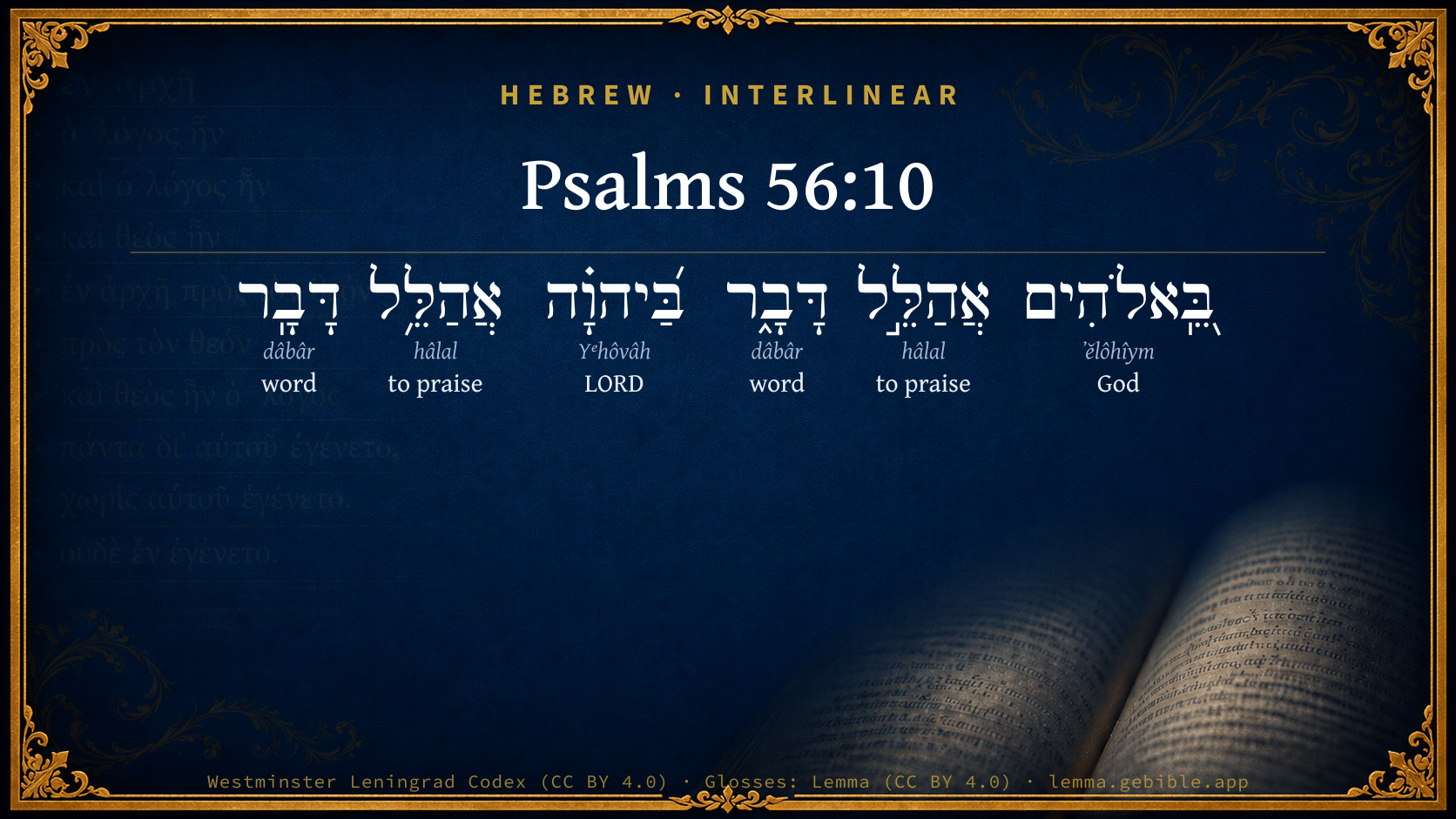
Hebrew (Westminster Leningrad Codex) Psalms 56:10 appears in the Hebrew Old Testament. The text above is from the Westminster Leningrad Codex. Each word links to its Strong’s number, a concise gloss, and parsing drawn from the Open Scriptures Hebrew Bible morphology. Click any word for its full Brown-Driver-Briggs (BDB) entry.
Download image
Cite this verse

Psalms 56:10 (World English Bible). Public Domain. Lemma interlinear Bible study tool, https://lemma.gebible.app/v/psalms/56/10.

Show BibTeX & RIS
BibTeX
RIS
English Translation
In God, I will praise his word. In Yahweh, I will praise his word.
World English Bible · Public Domain
Download a study sheet

One document with this verse’s original text, its word-by-word gloss line, the meaning frame, cross-references with their text, attributed commentary, and full source and license credits — printable, and it pastes into notes with its structure intact.

This verse Autodidact and up

Study sheet (.html) Plain text (.txt)

A passage Seminary Student

Up to 50 verses in one chapter. A passage sheet keeps up to 6 commentary sources and 12 cross-references per verse, in the order this page ranks them, and says so on the sheet whenever that leaves anything out. Ask for a single verse and you get the Autodidact verse sheet above.

Everything on this page stays free to read, with no account — the sheet is a download of what is already on screen, not access to it.

Want to remove ads? Support Godless Engineer
Compare translations 3

The same verse in 3 English versions, stacked beneath the original-language interlinear above. Click any original word for its lexicon entry.

Each is an independent rendering of the whole verse — the interlinear is not word-aligned to these translations.

Highlighted words mark where these versions differ — a whole-verse word diff, not a word-by-word alignment.

  • World English Bible Public Domain
    In God, I will praise his word. In Yahweh, I will praise his word.
  • King James Version Public Domain
    In God will I praise his word: in the LORD will I praise his word.
  • unfoldingWord Literal Text CC BY-SA 4.0
    In God—I praise his word— in Yahweh—I praise his word—

unfoldingWord Literal Text — © unfoldingWord, licensed CC BY-SA 4.0. Word-aligned USFM3 via Door43 (git.door43.org/unfoldingWord/en_ult).

Versions to compare (up to 4)

3 of 4 selected

Show all 18 translations

Every available English version of this verse, each an independent rendering of the whole verse.

  • World English Bible Public Domain
    In God, I will praise his word. In Yahweh, I will praise his word.
  • Berean Standard Bible Public Domain
    In God, whose word I praise, in the LORD, whose word I praise,
  • Majority Standard Bible Public Domain
    In God, whose word I praise, in the LORD, whose word I praise,
  • King James Version Public Domain
    In God will I praise his word: in the LORD will I praise his word.
  • American Standard Version (1901) Public Domain
    In God (I will praise `his' word), In Jehovah (I will praise `his' word),
  • Revised Version (1885) Public Domain
    In God will I praise his word: in the LORD will I praise his word.
  • Geneva Bible (1599) Public Domain
    I will reioyce in God because of his worde: in the Lord wil I reioyce because of his worde.
  • Douay-Rheims (1899) Public Domain
    Then shall my enemies be turned back. In what day soever I shall call upon thee, behold I know thou art my God.
  • Young's Literal Translation Public Domain
    In God I praise the word, In Jehovah I praise the word.
  • Literal Standard Version CC BY-SA 4.0
    In God I praise the word, || In YHWH I praise the word.
  • Unlocked Literal Bible CC BY-SA 4.0
    In God—whose word I praise, in Yahweh—whose word I praise,
  • unfoldingWord Literal Text CC BY-SA 4.0
    In God—I praise his word— in Yahweh—I praise his word—
  • Darby Bible Public Domain
    In God will I praise [his] word; in Jehovah will I praise [his] word.
  • World Messianic Bible Public Domain
    In God, I will praise his word. In the LORD, I will praise his word.
  • Webster's Bible Public Domain
    \\56:9\\When I cry to thee, then shall my enemies turn back: this I know; for God is for me.
  • Free Bible Version CC BY-SA 4.0
    I thank God for his promises. I thank the Lord for his promises.
  • Bible in Basic English Public Domain
    In God will I give praise to his word; in the Lord will I give praise to his word.
  • JPS Tanakh (1917) Public Domain
    (56-11) In God — I will praise His word — in the LORD — I will praise His word —

Literal Standard Version (2020), Covenant Press — licensed CC BY-SA 4.0. Text via the HelloAO Bible API (eBible.org). Unlocked Literal Bible (unfoldingWord) — licensed CC BY-SA 4.0. Text via the HelloAO Bible API (eBible.org). unfoldingWord Literal Text — © unfoldingWord, licensed CC BY-SA 4.0. Word-aligned USFM3 via Door43 (git.door43.org/unfoldingWord/en_ult). Free Bible Version, Dr. Jonathan Gallagher — licensed CC BY-SA 4.0. Text via the HelloAO Bible API (eBible.org).

Word by word

More ways to search: Search by grammar → Find every occurrence → Compare this word →

Practice this passage: Drill this verse → Learn its vocabulary →

אֲהַלֵּ֣ל
hâlal
H1984
“to praise”
Verb, Piel, Imperfect, 1st Person, Common, Singular
Part of Speech
Verb
Stem
Piel
Form
Imperfect
Person
1st Person
Gender
Common
Number
Singular
Full BDB Definition

Origin: a primitive root

TWOT: 499 , 500

to shine - (Qal) to shine (figuratively of God's favour) - (Hiphil) to flash forth light - to praise, boast, be boastful - (Qal) - to be boastful - boastful ones, boasters (participle) - (Piel) - to praise - to boast, make a boast - (Pual) - to be praised, be made praiseworthy, be commended, be worthy of praise - (Hithpael) to boast, glory, make one's boast - (Poel) to make a fool of, make into a fool - (Hithpoel) to act madly, act like a madman
  1. בֵּֽ֭אלֹהִים ʼĕlôhîym H430 “in/at · God(s)” Preposition + Noun, Common, Masculine, Plural, Absolute
  2. דָּבָ֑ר dâbâr H1697 “word” Noun, Common, Masculine, Singular, Absolute
  3. בַּ֝יהוָ֗ה Yᵉhôvâh H3068 “in/at · LORD” Preposition + Noun, Proper
  4. אֲהַלֵּ֥ל hâlal H1984 “to praise” Verb, Piel, Imperfect, 1st Person, Common, Singular
  5. דָּבָֽר dâbâr H1697 “word” Noun, Common, Masculine, Singular, Absolute

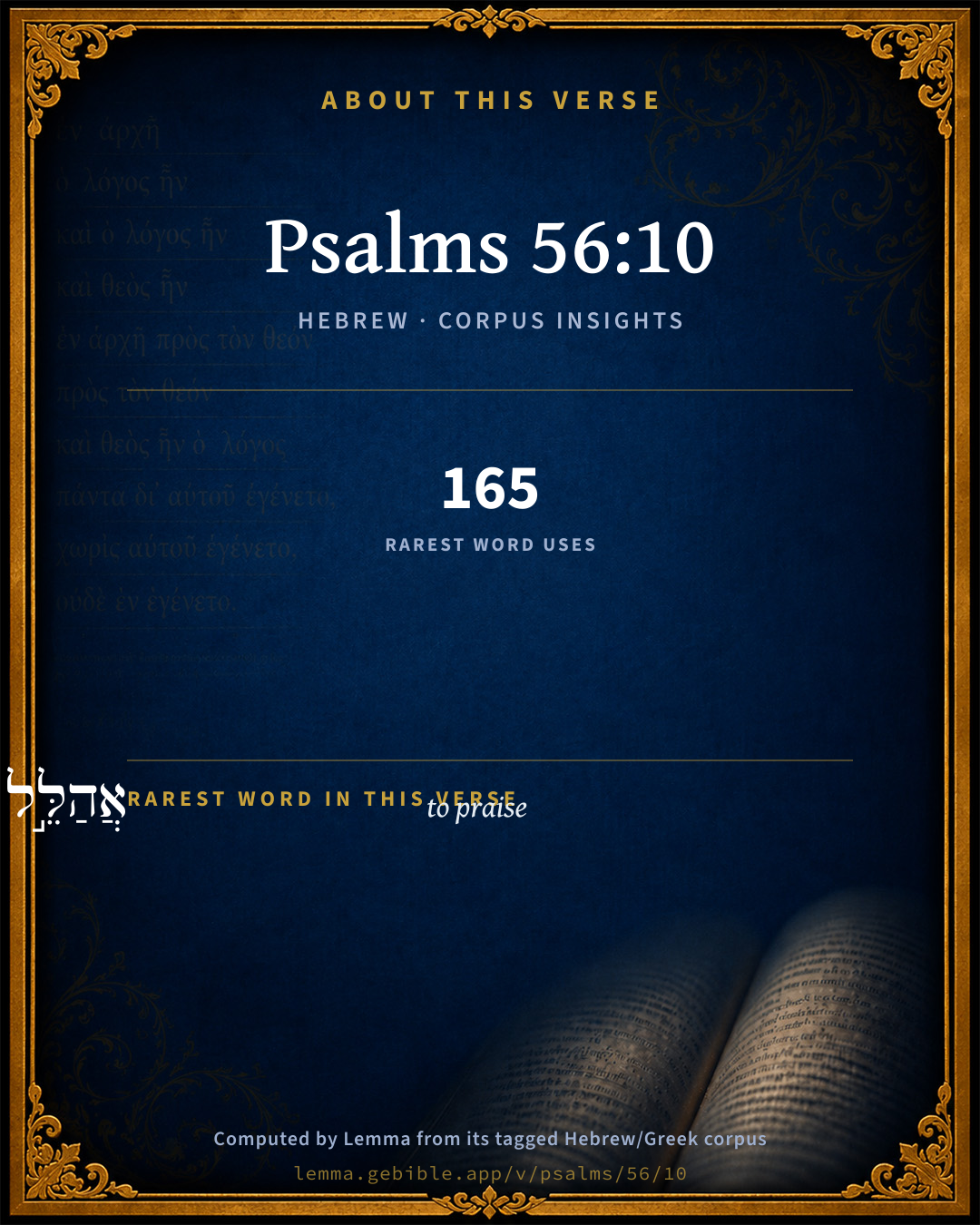
About this verse

These counts appear in no published source. They are computed here, from the morphology-tagged text and Lemma’s own curated glosses. What Lemma adds →

6
words
4
distinct lemmas
Wisdom
section

Grammatical profile

  • 2 verbs
  • 4 nouns

Verb forms

  • אֲהַלֵּ֣ל Piel · Imperfect
  • אֲהַלֵּ֥ל Piel · Imperfect

Repetition

Words recur within this verse — often emphatic in Hebrew:

  • אֲהַלֵּ֣ל to praise H1984 ×2
  • דָּבָ֑ר word H1697 ×2

Hebrew & Septuagint length

In English translation the verse runs 14 words from the Hebrew and 15 from the Septuagint (LXX English) — closely comparable.

A rough comparison of the two English renderings, which tokenize alike — not a word-level alignment.

Word counts can differ between the Hebrew and the Greek without any difference in meaning — e.g. the Hebrew direct-object marker אֵת has no separate Greek word, and Greek often adds the article ὁ.

Cross-references

6

Topical passages linked to Psalms 56:10 in the Treasury of Scripture Knowledge — connected by theme and wording, ordered by reader-vote popularity; previews shown in the World English Bible.

  • Matthew 24:35 Heaven and earth will pass away, but my words will not pass away.
  • Genesis 32:11 Please deliver me from the hand of my brother, from the hand of Esau: for I fear him, lest he come and strike me, and the mothers with the children.
  • Psalms 56:4 In God, I praise his word. In God, I put my trust. I will not be afraid. What can flesh do to me?
  • Psalms 60:6 God has spoken from his sanctuary: "I will triumph. I will divide Shechem, And measure out the valley of Succoth.
  • Hebrews 6:18 that by two immutable things, in which it is impossible for God to lie, we may have a strong encouragement, who have fled for refuge to take hold of the hope set before us.
  • 2 Peter 1:4 by which he has granted to us his precious and exceedingly great promises; that through these you may become partakers of the divine nature, having escaped from the corruption that is in the world by lust.

Cross-references courtesy of OpenBible.info (CC BY 4.0).

Hebrew and Greek witnesses Masoretic Hebrew ↔ Greek Septuagint

The same verse in the two great witnesses to the Old Testament, shown verse-for-verse.

You’re reading Greek Psalm 55 (Hebrew Psalm 56). The Septuagint counts the superscription, so verse numbers can differ from the Hebrew — chapter-level alignment, not verse-by-verse. Numbering follows Rahlfs.

These are two independent witnesses, not word-aligned to each other, and the Septuagint is shown in lemma (dictionary) form.

Hebrew Psalms 56:10 Masoretic · Westminster Leningrad Codex

בֵּֽ֭אלֹהִים אֲהַלֵּ֣ל דָּבָ֑ר בַּ֝יהוָ֗ה אֲהַלֵּ֥ל דָּבָֽר

In God, I will praise his word. In Yahweh, I will praise his word.

World English Bible · Public Domain

Greek LXX Greek Psalm 55:10 Septuagint · lemma form

ἐπιστρέφω ὁ ἐχθρός ἐγώ εἰς ὁ ὀπίσω ἐν ὅς ἄν ἡμέρα ἐπικαλέω σύ ἰδού γιγνώσκω ὅτι θεός ἐγώ εἰμί σύ

In God, will I praise his word; in the Lord will I praise his saying.

LXX2012 (modern English Septuagint) · Public Domain

Hebrew: Westminster Leningrad Codex (CC BY 4.0). Greek: Septuagint (public domain); English from LXX2012 (modern English Septuagint) (Public Domain). How the Septuagint differs from the Hebrew →

Commentary

Notes on Psalms 56:10 from classic Christian and Jewish commentators (each source and its license shown beneath its notes). The classic Christian expositions comment on the surrounding passage and are grouped to its opening verse, so a note may address several verses; the Jewish commentaries on the Tanakh (Rashi and others) are per-verse, so they appear only where the commentator wrote on this verse.

Lemma curates 59 commentaries, every one of them public domain or Creative Commons licensed, each selected and text-cleaned for this edition rather than reprinted as found. About our sources →

Trapp's Complete Commentary

John Trapp

Psa 56:10 In God will I praise [his] word: in the LORD will I praise [his] word.

Ver. 10. In God will I praise his word] The Jewish doctors observe that Elohim, God, is a name importing justice; and that Jehovah, Lord, holdeth out mercy, according to that, Exo 34:6, Jehovah, Jehovah merciful, gracious, &c. But if God should seem neither to show his mercy upon us nor his justice upon our enemies, we must nevertheless adhere to his word or promise, and patiently wait his performance; which will be as sure as he is God and Lord. {See Trapp on "Psa 56:4"}

John Trapp, A Commentary or Exposition upon All the Books of the Old and New Testament (1647–1656) — public domain. Text from a community e-Sword module.

J. A. Alexander on Psalms

Joseph Addison Alexander

11. (Psa 56:10). In God I will praise (this) word; in Jehovah I will praise (this) word. This unusual form of speech must have the same sense as in Psa 56:4 above. Some understand it to mean by God's help, others, in union with God, I will praise (his) word. But on the whole, the most natural explanation still seems to be, "what I shall particularly praise in God, both as God, and as the tutelary God of Israel and my own, is the word of promise, which he has uttered and fulfilled in this case."

Joseph Addison Alexander, The Psalms Translated and Explained (1850) — public domain. Text from a community e-Sword module.

Adam Clarke's Commentary

Verse 10. - 11. See on Ps 56:4, where the same words occur.

Adam Clarke's Commentary on the Bible (1810–1826) — public domain. Text from a community e-Sword/MySword module.

John Calvin's Commentaries

10 In God will I praise his word In the original the pronoun is not expressed, but we are left to infer, from the parallel verse which went before, that it is understood. The repetition adds an emphasis to the sentiment, intimating, that though God delayed the sensible manifestation of his favor, and might seem to deal hardly in abandoning him to the word — giving him nothing more, he was resolved to glory in it with undiminished confidence. When in a spirit such as this we honor the word of God, though deprived of any present experience of his goodness or his power, we “set to our seal that God is true,” (John 3:33.) The repetition amounts to an expression of his determination that, notwithstanding all circumstances which might appear to contravene the promise, he would trust in it, and persist in praising it both now, henceforth, and for ever. How desirable is it that the Lord’s people generally would accustom themselves to think in the same manner, and find, in the word of God, matter of never-failing praise amidst their worst trials! They may meet with many mercies calling for the exercise of thanksgiving, but can scarcely have proceeded one step in life before they will feel the necessity of reliance upon the naked promise. A similar reason may be given for his repetition of the sentiment in the 11th verse — In God have I hoped, etc. We shall find men universally agreed in the opinion that God is an all-sufficient protector; but observation proves how ready we are to distrust him under the slightest temptation. When exposed to the opposition of assailants formidable for strength, or policy, or any worldly advantages, let us learn with David to set God in opposition to them, and we shall speedily be able to view the mightiest of them without dismay.

John Calvin's Commentaries (1540-1563) — public domain. Text from the Calvin Translation Society English edition (1840s-50s) via the Christian Classics Ethereal Library (ccel.org). Calvin's coverage is partial (roughly two-thirds of the Bible); uncommented books and verses are honest gaps, never fabricated. The 19th-century editor's footnotes and remarks are omitted so the notes are faithfully Calvin's own voice.

The Cambridge Bible for Schools and Colleges

gen. ed. J. J. S. Perowne

10. his word] The omission of the pronoun, which is found in Psa_56:4, is difficult. If the text is sound, word must be used absolutely for the divine word of promise. Cp. Pro_13:13; Pro_16:20.

In the Lord will I praise his word] The line is repeated for emphasis with the substitution of the covenant name Jehovah for God. The two names sometimes occur together in the Elohistic Psalms (e. g. Psa_55:16; Psa_58:6); and a refrain is not always repeated in precisely the same form. But the repetition may simply be a ‘conflate reading,’ the second line being either the survival or the restoration of the original text, while the first line is due to the ‘Elohistic’ editor.

The Cambridge Bible for Schools and Colleges (gen. ed. J. J. S. Perowne; Cambridge University Press, 1878–1918) — public domain. Text from a community e-Sword module.

John Gill's Exposition

In God will I praise his word,.... These words are repeated from Psa 56:4; and for the greater certainty of the thing, and to show his fixed resolution to do it, and his strong affection for the Lord and his word, they are doubled;

in the Lord will I praise his word: in the former clause the word "Elohim" is made use of, which, the Jews say, denotes the property of justice, and in the latter Jehovah, which with them is the property of mercy; and accordingly the Targum paraphrases the words,

"in the attribute of the justice of God will I praise his word; in the attribute of the mercies of Jehovah will I praise his word;''

and to the same sense Jarchi: that is, whether I am in adversity or prosperity, receive evil or good things from the hand of the Lord; yet will I praise him: I will sing of mercy and of judgment, Psa 101:1; or rather the one may denote the grace and goodness of a covenant God in making promises, and the other his truth and faithfulness in keeping them; on account of both which he is worthy of praise. The word "his" is not in either clause in the original text, and they may be rendered, "in God will I praise the word; in the Lord will I praise the word": in and by the help, assistance, and grace of Jehovah the Father, will I praise the eternal and essential Word, his Son. The Targum renders it his "Memra"; a word often used in it for a divine Person, the eternal Logos; the loveliness of his person, the love of his heart to his people, the fulness of grace that is in him, the offices he sustains on their account, and the virtue of his blood, righteousness, and sacrifice, render him praiseworthy in their esteem.

John Gill's Exposition of the Whole Bible (1746–1763) — public domain (CC PDM 1.0). Text via the HelloAO Bible API.

Albert Barnes' Notes on the Bible

In God will I praise his word - Luther renders this, “I will praise the word of God.” The phrase “in God” means probably “in respect to God;” or, “in what pertains to God.” That which he would “particularly” praise or celebrate in respect to God - that which called for the most decided expressions of praise and gratitude, was his “word,” his promise, his revealed truth. So in Psa 138:2, “Thou hast magnified thy word above all thy name;” that is, above all the other manifestations of thyself. The allusion in the passage here is to what God had “spoken” to David, or the “promise” which he had made - the declaration of his gracious purposes in regard to him. Amidst all the perfections of Deity, and all which God had done for him, this now seemed to him to have special pre-eminence in his praises. The “word” of God was to him that which impressed his mind most deeply - that which most tenderly affected his heart. There are times when we feel this, and properly feel it; times when, in the contemplation of the divine perfections and dealings, our minds so rest on his word, on his truth, on what he has revealed, on his gracious promises, on the disclosures of a plan of redemption, on the assurance of a heaven hereafter, on the instructions which he has given us about himself and his plans - about ourselves, our duty, and our prospects, that this absorbs all our thoughts, and we feel that this is “the” great blessing for which we are to be thankful; this, “the” great mercy for which we are to praise him. What would the life of man be without the Bible! What a dark, gloomy, sad course would ours be on earth if we had nothing to guide us to a better world!

In the Lord will I praise his word - In “Yahweh.” That is, whether I contemplate God in the usual name by which he is known - אלהים 'Elohiym - or by that more sacred name which he has assumed - יהוה Yahweh - that which seems now to me to lay the foundation of loftiest praise and most hearty thanksgiving, is that he has spoken to people, and made known his will in his revealed truth.

Albert Barnes' Notes on the Bible (1834–1885) — public domain. Text from a community e-Sword/MySword module.

Matthew Poole's English Annotations

What I have already engaged to do, Psa 56:4, that I do again and again promise to do, and I cannot sufficiently praise thy goodness in making promises, and thy faithfulness in keeping them.

Matthew Poole's English Annotations on the Holy Bible (1683–1685) — public domain. Text from a community e-Sword/MySword module.

The Treasury of David

Charles H. Spurgeon

Ver. 10. In God will I praise his word. Now comes the thanksgiving. He is a wretch who, having obtained help, forgets to return a grateful acknowledgment. The least we can do is to praise him from whom we receive such distinguished favours. Does David here mean "by God's grace I will praise him"? If so, he shows us that all our emotions towards God must be in God, produced by him and presented as such. Or does he mean, "that which in God is most the object of my praise is his word, and the faithfulness with which he keeps it"? If so, we see how attached our hearts should be to the sure word of promise, and especially to him who is the WORD incarnate. The Lord is to be praised under every aspect, and in all his attributes and acts, but certain mercies peculiarly draw out our admiration towards special portions of the great whole. That praise which is never special in its direction cannot be very thoughtful, and it is to be feared cannot be very acceptable.

In the Lord will I praise his word. He delights to dwell on his praise, he therefore repeats his song. The change by which he brings in the glorious name of Jehovah is doubtless meant to indicate that under every aspect he delights in his God and in his word.

Ver. 10. In God will I praise his word: in the Lord will I praise his word. The first word, Elohim, is a name belonging to God as a judge, the second word, Jehovah, is a name of mercy. I will praise God whether he deal with me in a way of justice or in a way of mercy, when he hath thunder in his voice, as well as when he hath honey under his tongue. Oh, how should we praise God, and pleasure ourselves by such a frame! Stephen Charnock.

Ver. 10. (first clause). By the assistance of God I shall be enabled to praise him for the performance of his promises. Symon Patrick, 1626-1707.

Ver. 10.

I. "I will praise God for his word."

II. In his word, as he is there revealed.

III. By his word. "Thou hast put a song, "etc.

Psalms 56:11*

Charles H. Spurgeon's The Treasury of David (1869–1885) — public domain. Psalms only. Text from a community e-Sword/MySword module.

Whedon's Commentary on the Bible

Daniel D. Whedon

10, 11. The refrain of Psa_56:4, with enlargement.

Daniel D. Whedon (gen. ed.), Commentary on the Old and New Testaments (1874–1909) — public domain. Text from a community e-Sword module.

The Pulpit Commentary

In God will I praise his word; rather, through God (see the comment on ver. 4). In the Lord (rather, through the Lord) will I praise his word. Professor Cheyne looks upon this as "a feeble Jehovistic interpolation, which interrupts the refrain." But other commentators see in it a certain force.

The Pulpit Commentary (1880–1919), ed. H.D.M. Spence-Jones & Joseph S. Exell — public domain. Text from a community e-Sword module.

Lesson kit

Teaching starters — assembled from the data on this page, not authored interpretation. Every prompt links to the verse data it draws on. Edit before teaching.

Psalms, in the Wisdom, opens this verse with 6 words (4 distinct Hebrew lemmas). Its most distinctive word is hâlal (“to praise”). A historical commentator’s framing appears above. Read the whole chapter for the surrounding context.

Discussion questions

  1. What does “to praise” (hâlal) contribute to the verse as a whole?
  2. Matthew 24:35 shares this passage’s theme. How do the two illuminate each other?
  3. “to praise” occurs 2× in this one verse. What is the effect of the repetition?
  4. These translations render this verse differently. What is at stake in choosing one wording over another?
  5. The verb «אֲהַלֵּ֣ל» is Piel Imperfect. How does its form color the action?
  6. Reading how Trapp's Complete Commentary and J. A. Alexander on Psalms read this verse, where do the two commentators agree and where do they part?

Things to notice

  • These translations choose different wording for 7 words in this verse.
  • “to praise” occurs 2× in this single verse.
  • 4 distinct Hebrew lemmas span 6 words in this verse.

Reading settings

Reading text

Shown beneath each verse's original-language words.

Old Testament
Old Testament edition

Read the OT as the Masoretic Hebrew (MT) or the Greek Septuagint (LXX).

English shown for the Greek Septuagint (in the Hebrew ↔ Greek comparison).

Comparing translations? Open the Compare panel on any verse page to stack up to four side by side.