

Psalms 135:3

Hebrew (Westminster Leningrad Codex) Psalms 135:3 appears in the Hebrew Old Testament. The text above is from the Westminster Leningrad Codex. Each word links to its Strong’s number, a concise gloss, and parsing drawn from the Open Scriptures Hebrew Bible morphology. Click any word for its full Brown-Driver-Briggs (BDB) entry.
Download image
Cite this verse

Psalms 135:3 (World English Bible). Public Domain. Lemma interlinear Bible study tool, https://lemma.gebible.app/v/psalms/135/3.

Show BibTeX & RIS
BibTeX
RIS
English Translation
Praise Yah, for Yahweh is good. Sing praises to his name, for that is pleasant.
World English Bible · Public Domain
Download a study sheet

One document with this verse’s original text, its word-by-word gloss line, the meaning frame, cross-references with their text, attributed commentary, and full source and license credits — printable, and it pastes into notes with its structure intact.

This verse Autodidact and up

Study sheet (.html) Plain text (.txt)

A passage Seminary Student

Up to 50 verses in one chapter. A passage sheet keeps up to 6 commentary sources and 12 cross-references per verse, in the order this page ranks them, and says so on the sheet whenever that leaves anything out. Ask for a single verse and you get the Autodidact verse sheet above.

Everything on this page stays free to read, with no account — the sheet is a download of what is already on screen, not access to it.

Want to remove ads? Support Godless Engineer
Compare translations 3

The same verse in 3 English versions, stacked beneath the original-language interlinear above. Click any original word for its lexicon entry.

Each is an independent rendering of the whole verse — the interlinear is not word-aligned to these translations.

Highlighted words mark where these versions differ — a whole-verse word diff, not a word-by-word alignment.

  • World English Bible Public Domain
    Praise Yah, for Yahweh is good. Sing praises to his name, for that is pleasant.
  • King James Version Public Domain
    Praise the LORD; for the LORD is good: sing praises unto his name; for it is pleasant.
  • unfoldingWord Literal Text CC BY-SA 4.0
    Hallelu Yah, for Yahweh good; make music to his name, for pleasant.

unfoldingWord Literal Text — © unfoldingWord, licensed CC BY-SA 4.0. Word-aligned USFM3 via Door43 (git.door43.org/unfoldingWord/en_ult).

Versions to compare (up to 4)

3 of 4 selected

Show all 18 translations

Every available English version of this verse, each an independent rendering of the whole verse.

  • World English Bible Public Domain
    Praise Yah, for Yahweh is good. Sing praises to his name, for that is pleasant.
  • Berean Standard Bible Public Domain
    Hallelujah, for the LORD is good; sing praises to His name, for it is lovely.
  • Majority Standard Bible Public Domain
    Hallelujah, for the LORD is good; sing praises to His name, for it is lovely.
  • King James Version Public Domain
    Praise the LORD; for the LORD is good: sing praises unto his name; for it is pleasant.
  • American Standard Version (1901) Public Domain
    Praise ye Jehovah; for Jehovah is good: Sing praises unto his name; for it is pleasant.
  • Revised Version (1885) Public Domain
    Praise ye the LORD; for the LORD is good: sing praises unto his name; for it is pleasant.
  • Geneva Bible (1599) Public Domain
    Praise ye the Lord: for the Lord is good: sing praises vnto his Name: for it is a comely thing.
  • Douay-Rheims (1899) Public Domain
    May the Lord out of Sion bless thee, he that made heaven and earth.
  • Young's Literal Translation Public Domain
    Praise ye Jah! for Jehovah `is' good, Sing praise to His name, for `it is' pleasant.
  • Literal Standard Version CC BY-SA 4.0
    Praise YAH! For YHWH [is] good, || Sing praise to His Name, for [it is] pleasant.
  • Unlocked Literal Bible CC BY-SA 4.0
    Praise Yahweh, for he is good; sing praises to his name, for it is pleasant to do so.
  • unfoldingWord Literal Text CC BY-SA 4.0
    Hallelu Yah, for Yahweh good; make music to his name, for pleasant.
  • Darby Bible Public Domain
    Praise ye Jah; for Jehovah is good: sing psalms unto his name; for it is pleasant.
  • World Messianic Bible Public Domain
    Praise the LORD, for the LORD is good. Sing praises to his name, for that is pleasant.
  • Webster's Bible Public Domain
    Praise the LORD; for the LORD is good; sing praises to his name; for it is pleasant.
  • Free Bible Version CC BY-SA 4.0
    Praise the Lord, for the Lord is good; sing praises to his character because it is wonderful!
  • Bible in Basic English Public Domain
    Give praise to Jah, for he is good: make melody to his name, for it is pleasing.
  • JPS Tanakh (1917) Public Domain
    Praise ye the LORD, for the LORD is good; sing praises unto His name, for it is pleasant.

Literal Standard Version (2020), Covenant Press — licensed CC BY-SA 4.0. Text via the HelloAO Bible API (eBible.org). Unlocked Literal Bible (unfoldingWord) — licensed CC BY-SA 4.0. Text via the HelloAO Bible API (eBible.org). unfoldingWord Literal Text — © unfoldingWord, licensed CC BY-SA 4.0. Word-aligned USFM3 via Door43 (git.door43.org/unfoldingWord/en_ult). Free Bible Version, Dr. Jonathan Gallagher — licensed CC BY-SA 4.0. Text via the HelloAO Bible API (eBible.org).

Word by word

More ways to search: Search by grammar → Find every occurrence → Compare this word →

Practice this passage: Drill this verse → Learn its vocabulary →

About this verse

These counts appear in no published source. They are computed here, from the morphology-tagged text and Lemma’s own curated glosses. What Lemma adds →

9
words
8
distinct lemmas
Wisdom
section

Notable vocabulary

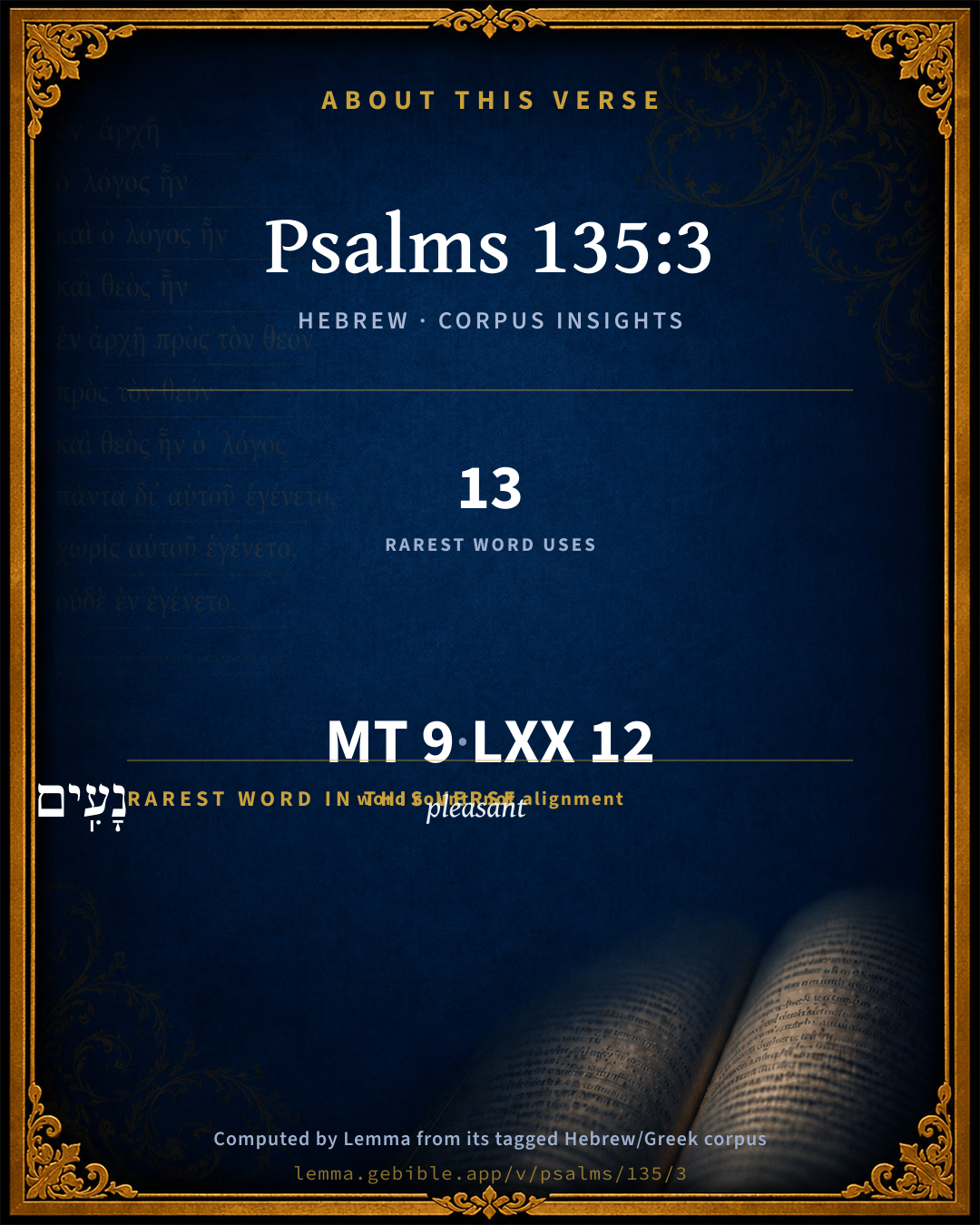
The rarest word here is נָעִֽים pleasant H5273 — appearing just 13 times in the whole Hebrew Bible.

Shared distinctive vocabulary

נָעִֽים pleasant H5273 occurs in 13 verses of the Hebrew Bible. Also found in:

Grammatical profile

  • 2 verbs
  • 3 nouns
  • 2 adjectives
  • 2 conjunctions

Verb forms

  • הַֽ֭לְלוּ Piel · Imperative
  • זַמְּר֥וּ Piel · Imperative

Repetition

A word recurs within this verse — often emphatic in Hebrew:

  • כִּי that H3588 ×2

Hebrew & Septuagint length

In English translation the verse runs 15 words from the Hebrew and 18 from the Septuagint (LXX English) — closely comparable.

A rough comparison of the two English renderings, which tokenize alike — not a word-level alignment.

Word counts can differ between the Hebrew and the Greek without any difference in meaning — e.g. the Hebrew direct-object marker אֵת has no separate Greek word, and Greek often adds the article ὁ.

In the original languages it is 9 Hebrew tokens and 12 Greek tokens — but the two are counted differently (Hebrew bundles its prefixes and suffixes into one token; the Greek is in lemma form), so that isn’t a like-for-like length.

Cross-references

12

Topical passages linked to Psalms 135:3 in the Treasury of Scripture Knowledge — connected by theme and wording, ordered by reader-vote popularity; previews shown in the World English Bible.

  • Psalms 147:1 Praise Yah, For it is good to sing praises to our God; For it is pleasant and fitting to praise him.
  • Psalms 119:68 You are good, and do good. Teach me your statutes.
  • Psalms 33:1 Rejoice in Yahweh, you righteous! Praise is fitting for the upright.
  • Psalms 106:1 Praise Yahweh! Give thanks to Yahweh, for he is good, For his loving kindness endures forever.
  • Psalms 118:1 Give thanks to Yahweh, for he is good, For his loving kindness endures forever.
  • Psalms 145:7–8 They will utter the memory of your great goodness, And will sing of your righteousness.
  • Matthew 19:17 He said to him, "Why do you call me good? No one is good but one, that is, God. But if you want to enter into life, keep the commandments."
  • Psalms 63:5 My soul shall be satisfied as with the richest food. My mouth shall praise you with joyful lips,
  • Psalms 100:5 For Yahweh is good. His loving kindness endures forever, His faithfulness to all generations.
  • Psalms 92:1–2 It is a good thing to give thanks to Yahweh, To sing praises to your name, Most High;
  • Psalms 107:1 Give thanks to Yahweh, For he is good, For his loving kindness endures forever.
  • Psalms 136:1 Give thanks to Yahweh, for he is good; For his loving kindness endures forever.

Cross-references courtesy of OpenBible.info (CC BY 4.0).

Hebrew and Greek witnesses Masoretic Hebrew ↔ Greek Septuagint

The same verse in the two great witnesses to the Old Testament, shown verse-for-verse.

You’re reading Greek Psalm 134 (Hebrew Psalm 135). The Septuagint counts the superscription, so verse numbers can differ from the Hebrew — chapter-level alignment, not verse-by-verse. Numbering follows Rahlfs.

These are two independent witnesses, not word-aligned to each other, and the Septuagint is shown in lemma (dictionary) form.

Hebrew Psalms 135:3 Masoretic · Westminster Leningrad Codex

הַֽ֭לְלוּ יָהּ כִּי ט֣וֹב יְהוָ֑ה זַמְּר֥וּ לִ֝שְׁמ֗וֹ כִּ֣י נָעִֽים

Praise Yah, for Yahweh is good. Sing praises to his name, for that is pleasant.

World English Bible · Public Domain

Greek LXX Greek Psalm 134:3 Septuagint · lemma form

αἰνέω ὁ κύριος ὅτι ἀγαθός κύριος ψάλλω ὁ ὄνομα αὐτός ὅτι καλός

Praise you⌃ the Lord; for the Lord is good: sing praises to his name; for it is good.

LXX2012 (modern English Septuagint) · Public Domain

Hebrew: Westminster Leningrad Codex (CC BY 4.0). Greek: Septuagint (public domain); English from LXX2012 (modern English Septuagint) (Public Domain). How the Septuagint differs from the Hebrew →

Commentary

Notes on Psalms 135:3 from classic Christian and Jewish commentators (each source and its license shown beneath its notes). The classic Christian expositions comment on the surrounding passage and are grouped to its opening verse, so a note may address several verses; the Jewish commentaries on the Tanakh (Rashi and others) are per-verse, so they appear only where the commentator wrote on this verse.

Lemma curates 59 commentaries, every one of them public domain or Creative Commons licensed, each selected and text-cleaned for this edition rather than reprinted as found. About our sources →

Trapp's Complete Commentary

John Trapp

Psa 135:3 Praise the LORD; for the LORD [is] good: sing praises unto his name; for [it is] pleasant.

Ver. 3. Praise the Lord; for the Lord is good] sc. Originally, transcendently, effectively; he is good and doeth good, Psa 119:68, and is therefore to be praised with mind, mouth, and practice.

For it is pleasant] An angelical exercise, and, to the spiritually minded man, very delicious. To others, indeed, who have no true notion of God but as of an enemy, it is but as music at funerals, or as the trumpet before a judge, no comfort to the mourning wife, or guilty prisoner.

John Trapp, A Commentary or Exposition upon All the Books of the Old and New Testament (1647–1656) — public domain. Text from a community e-Sword module.

J. A. Alexander on Psalms

Joseph Addison Alexander

3. (Psa 135:3) Hallelujah (praise ye Jah!) for good (is) Jehovah. Make music to his name, for it is lovely. The last words may also be translated, he is lovely, i.e. an object worthy of supreme attachment.

Joseph Addison Alexander, The Psalms Translated and Explained (1850) — public domain. Text from a community e-Sword module.

Adam Clarke's Commentary

Verse 3. The Lord is good] Here is the first reason why he should be praised; and a second is subjoined: -

For it is pleasant.] It is becoming to acknowledge this infinite Being, and our dependence on him; and it is truly comfortable to an upright mind to be thus employed.

Adam Clarke's Commentary on the Bible (1810–1826) — public domain. Text from a community e-Sword/MySword module.

Ellicott's Commentary for English Readers

(3) Sing praises.—Rather, play.

For it is pleasant—i.e., thus to sing hallelujah. (See Psa_147:1; Pro_22:18. Others take name as the subject, and the Prayer-Book version suggested to Crashaw the beautiful hymn beginning “Come lovely name,” &c.

A Bible Commentary for English Readers, edited by Charles John Ellicott (1878–1897) — public domain. Text from a community e-Sword module.

The Cambridge Bible for Schools and Colleges

gen. ed. J. J. S. Perowne

3. for it is pleasant] Either ‘His name is lovely,’ or ‘it is pleasant to sing praise.’ Cp. Psa_147:1.

The Cambridge Bible for Schools and Colleges (gen. ed. J. J. S. Perowne; Cambridge University Press, 1878–1918) — public domain. Text from a community e-Sword module.

John Gill's Exposition

Praise ye the Lord, for the Lord is good,.... Essentially and communicatively; he is good, and he does good, in a providential way, to all men; and in a way of special grace to his own people; for whom he has laid up and to whom he has promised good things, and on whom he bestows them; as pardon, righteousness, and eternal life; both grace and glory; and therefore they should praise him;

sing praises unto his name, for it is pleasant; either the work of singing praise is pleasant, being the employment of angels and glorified saints; the subject matter of it delightful, the blessings of grace flowing from the everlasting love of God it leads unto, which is excellent and better than life; and it must be pleasant work to a saint, because it is pleasing to God; and especially when the presence of God is enjoyed in it, and melody is made in the heart as well as with the mouth. Or the sense is, "his name is pleasant"; so Aben Ezra and Kimchi interpret it: for though it is holy and reverend in itself, and fearful and terrible to sinners; yet as it is proclaimed in Christ, it is exceeding delightful, and in whom all the perfections of God are glorified; particularly the name of God, as a covenant God and Father in Christ, blessing, with all spiritual blessings in him, is exceeding pleasant; as are all the names of Christ, and therefore to be praised.

John Gill's Exposition of the Whole Bible (1746–1763) — public domain (CC PDM 1.0). Text via the HelloAO Bible API.

Albert Barnes' Notes on the Bible

Praise the Lord, for the Lord is good - See Psa 107:1.

Sing praises unto his name, for it is pleasant - See Psa 33:1; Psa 92:1. The idea here is, that it is a source of happiness, and that it is proper in itself.

Albert Barnes' Notes on the Bible (1834–1885) — public domain. Text from a community e-Sword/MySword module.

Matthew Poole's English Annotations

Is good; bountiful and gracious, especially to you, and therefore he justly expects and deserves your praises.

Is pleasant; the work itself of singing praises to God is pleasant, as it is more fully expressed, Psa 147:1.

Matthew Poole's English Annotations on the Holy Bible (1683–1685) — public domain. Text from a community e-Sword/MySword module.

The Treasury of David

Charles H. Spurgeon

Ver. 3. Praise the LORD. Do it again; continue to do it; do it better and more heartily; do it in growing numbers; do it at once. There are good reasons for praising the Lord, and among the first is thisfor the LORD is good. He is so good that there is none good in the same sense or degree. He is so good that all good is found in him, flows from him, and is rewarded by him. The word God is brief for good; and truly God is the essence of goodness. Should not his goodness be well spoken of? Yea, with our best thoughts, and words, and hymns let us glorify his name. Sing praises unto his name, for it is pleasant. The adjective may apply to the singing and to the namethey are both pleasant. The vocal expression of praise by sacred song is one of our greatest delights. We were created for this purpose, and hence it is a joy to us. It is a charming duty to praise the lovely name of our God. All pleasure is to be found in the joyful worship of Jehovah; all joys are in his sacred name as perfumes lie slumbering in a garden of flowers. The mind expands, the soul is lifted up, the heart warms, the whole being is filled with delight when we are engaged in singing the high praises of our Father, Redeemer, Comforter. When in any occupation goodness and pleasure unite, we do well to follow it up without stint: yet it is to be feared that few of us sing to the Lord at all in proportion as we talk to men.

Ver. 3. Praise the LORD. Hallelujah (praise to Jah!) for good (is) Jehovah. Make music to his name, for it is lovely. The last words may also he translated, he is lovely, i.e. an object worthy of supreme attachment. Joseph Addison Alexander.

Ver. 3. Praise the LORD; for the LORD is good. That is, originally, transcendently, effectively; he is good, and doeth good (Ps 119:68), and is therefore to be praised with mind, mouth, and practice. John Trapp.

Ver. 3. Sing praises unto his name; for it is pleasant. The work of praising God hath a sort of reward joined with it. When we praise God most we get much benefit by so doing: it is so comely in itself, so pleasant unto God, and profitable to the person that offereth praises, so fit to cheer up his spirit, and strengthen his faith in God, whose praises are the pillars of the believer's confidence and comfort, that a man should be allured thereunto: "Sing praises unto his name; for it is pleasant; "and this is the second motive or reason to praise God the first being that "the Lord is good". David Dickson.

Ver. 3. Praise the Lord,

1. For the excellence of his nature.

2. For the revelation of his name.

3. For the pleasantness of his worship.

Psalms 135:4*

Charles H. Spurgeon's The Treasury of David (1869–1885) — public domain. Psalms only. Text from a community e-Sword/MySword module.

Whedon's Commentary on the Bible

Daniel D. Whedon

3. Pleasant—That is, the employment is pleasant. Jehovah is not the subject of the adjective, which would not be reverent.

Daniel D. Whedon (gen. ed.), Commentary on the Old and New Testaments (1874–1909) — public domain. Text from a community e-Sword module.

The Pulpit Commentary

Praise the Lord; for the Lord is good. (comp. Psa_86:5 Psa_119:68) Sing praises unto his Name; for it is pleasant; or, "lovely". (comp. Psa_52:9 Psa_54:6)

HOMILIES BY R. TUCK Ver. 3. The pleasantness of the Divine Name.

"God is love," and this absolute fact concerning him is embodied in the Divine Name. This is especially true for us to whom the Divine Name of names is "our Father." The word used here is elsewhere used in the sense of propitious or gracious; and it is the graciousness, pitifulness, long-suffering of God which, man thinks of as making his Name so lovely., In Psa_54:6 we find the expression, I will praise thy Name, O Lord; for it is good. Some think the meaning of the psalmist is, that the work of offering praise is pleasant; but it is fresher, and an indication of deeper feeling in the psalmist, that he should associate pleasantness even with the sound of the Divine Name.

I THE PLEASANTNESS OF THE DIVINE TAME, BECAUSE OF WHAT IT RECALLS. There is a whole history of Divine dealings embodied in the Name. Illustrate from the way in which some special intervention of God was put into a special form of the Divine Name, such as Jehovah-jireh, Jehovah-nissi, Jehovah-tsidkenu, etc. The whole story of the Divine patience, intervention, and redemption is gathered up into the general name Jehovah, and is recalled by it. So the spiritual redemption is recalled by the name given to God manifest in the flesh Jehovah-Jesus, Jehovah-Emmanuel. How pleasant the names which recall such gracious things!

II THE PLEASANTNESS OF THE DIVINE NAME BECAUSE OF WHAT IT CONTAINS. It is familiar to point out that a name embodies and expresses the attributes or characteristics of a person. The early Bible names have distinct meanings; they describe persons. The Divine Name is lovely because it describes our ideal of everything true, pure, kind, gracious, wise. It describes him who is the "chief among ten thousand, and altogether lovely." The satisfaction and rest of the human heart cannot come only out of what God says, or out of what God does; it comes out of what God is; and what God is embodied in his Name.

III THE PLEASANTNESS OF THE DIVINE NAME BECAUSE OF WHAT IT SUGGESTS OR ASSURES. When we have absolute confidence in a person, and seal that confidence by fixing our own name for him, all our future relations with that person are guaranteed. So the name Jehovah (Yehweh), "I am that I am," seals our absolute confidence in God, and suggests entire trust in him, and the certainty of Divine help and blessing in all that may unfold before us. He is the "same yesterday, and today, and for ever. R.T.

The Pulpit Commentary (1880–1919), ed. H.D.M. Spence-Jones & Joseph S. Exell — public domain. Text from a community e-Sword module.

unfoldingWord translationNotes

Door43 World Missions Community

for it is pleasant to do so

"because we get pleasure from praising his name"

Yahweh has chosen Jacob

"Jacob" here refers to his descendants, the people of Israel. AT: "Yahweh has chosen Jacob's descendants" (See: Metonymy)

Israel as his possession

The beginning of the sentence can be stated clearly. AT: "he has chosen Israel to be his possession" (See: Ellipsis)

translationWords

good

chosen one

Jacob

Israel

possess

unfoldingWord translationNotes — © Distant Shores Media and the Door43 World Missions Community, licensed CC BY-SA 4.0. Source: git.door43.org/Door43/en_tn.

Lesson kit

Teaching starters — assembled from the data on this page, not authored interpretation. Every prompt links to the verse data it draws on. Edit before teaching.

Psalms, in the Wisdom, opens this verse with 9 words (8 distinct Hebrew lemmas). Its most distinctive word is nâʻîym (“pleasant”). A historical commentator’s framing appears above. Read the whole chapter for the surrounding context.

Discussion questions

  1. The word nâʻîym carries the sense “pleasant.” How does it shape the verse?
  2. 2 Samuel 1:23 shares the word «pleasant» with this verse. How do the two illuminate each other?
  3. “that” occurs 2× in this one verse. What is the effect of the repetition?
  4. The translations on this page render this verse differently — a whole-verse word diff, not a word-by-word alignment. What might account for the different wordings?
  5. The verb «הַֽ֭לְלוּ» is Piel Imperative. How does its form color the action?
  6. Reading how Trapp's Complete Commentary and J. A. Alexander on Psalms read this verse, where do the two commentators agree and where do they part?

Things to notice

Reading settings

Reading text

Shown beneath each verse's original-language words.

Old Testament
Old Testament edition

Read the OT as the Masoretic Hebrew (MT) or the Greek Septuagint (LXX).

English shown for the Greek Septuagint (in the Hebrew ↔ Greek comparison).

Comparing translations? Open the Compare panel on any verse page to stack up to four side by side.