
Psalms 148:4

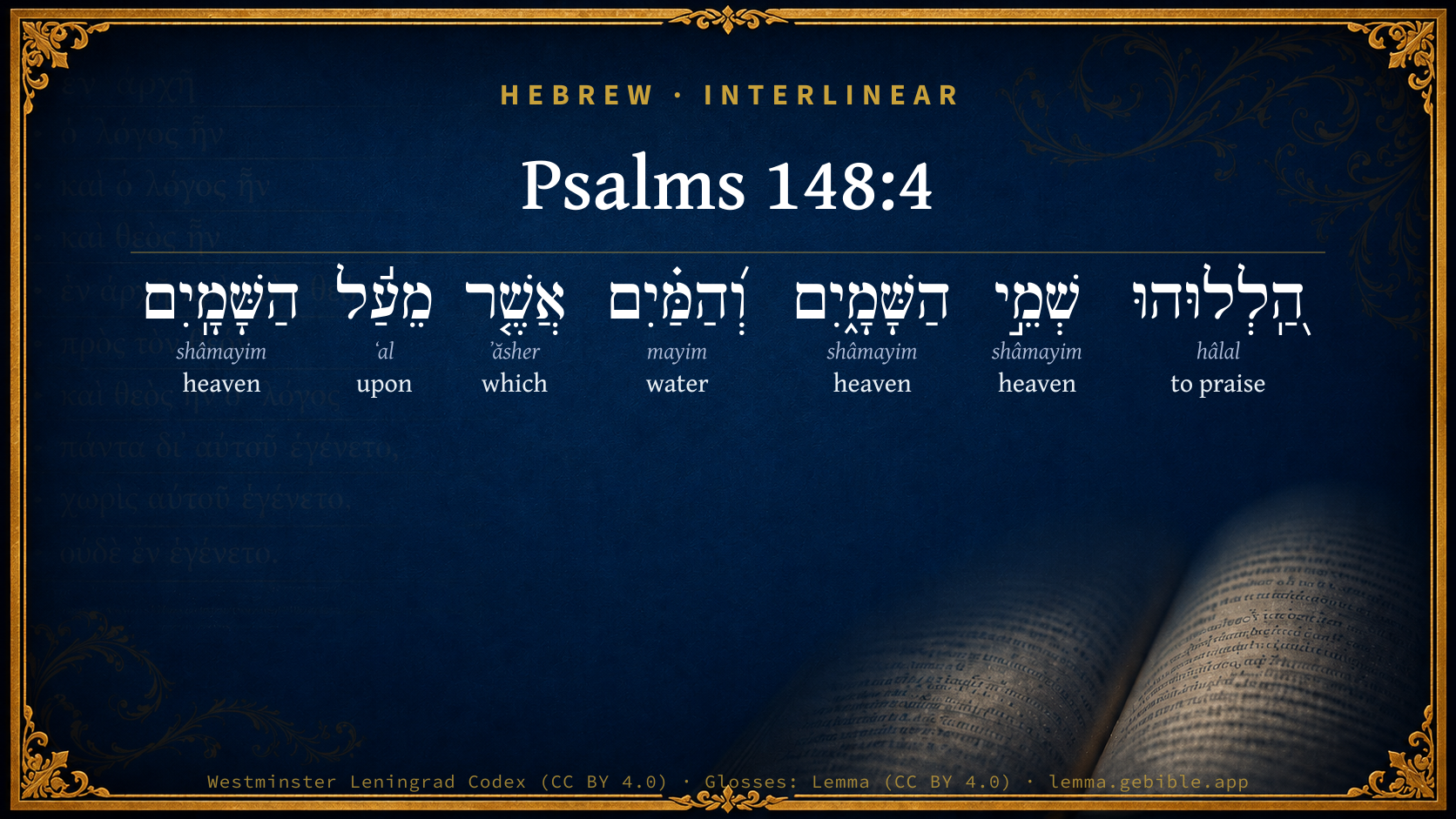
Hebrew (Westminster Leningrad Codex) Psalms 148:4 appears in the Hebrew Old Testament. The text above is from the Westminster Leningrad Codex. Each word links to its Strong’s number, a concise gloss, and parsing drawn from the Open Scriptures Hebrew Bible morphology. Click any word for its full Brown-Driver-Briggs (BDB) entry.
Download image
Cite this verse

Psalms 148:4 (World English Bible). Public Domain. Lemma interlinear Bible study tool, https://lemma.gebible.app/v/psalms/148/4.

Show BibTeX & RIS
BibTeX
RIS
English Translation
Praise him, you heavens of heavens, You waters that are above the heavens.
World English Bible · Public Domain
Download a study sheet

One document with this verse’s original text, its word-by-word gloss line, the meaning frame, cross-references with their text, attributed commentary, and full source and license credits — printable, and it pastes into notes with its structure intact.

This verse Autodidact and up

Study sheet (.html) Plain text (.txt)

A passage Seminary Student

Up to 50 verses in one chapter. A passage sheet keeps up to 6 commentary sources and 12 cross-references per verse, in the order this page ranks them, and says so on the sheet whenever that leaves anything out. Ask for a single verse and you get the Autodidact verse sheet above.

Everything on this page stays free to read, with no account — the sheet is a download of what is already on screen, not access to it.

Want to remove ads? Support Godless Engineer
Compare translations 3

The same verse in 3 English versions, stacked beneath the original-language interlinear above. Click any original word for its lexicon entry.

Each is an independent rendering of the whole verse — the interlinear is not word-aligned to these translations.

Highlighted words mark where these versions differ — a whole-verse word diff, not a word-by-word alignment.

  • World English Bible Public Domain
    Praise him, you heavens of heavens, You waters that are above the heavens.
  • King James Version Public Domain
    Praise him, ye heavens of heavens, and ye waters that be above the heavens.
  • unfoldingWord Literal Text CC BY-SA 4.0
    Praise him, heavens of the heavens, and the waters that above the heavens.

unfoldingWord Literal Text — © unfoldingWord, licensed CC BY-SA 4.0. Word-aligned USFM3 via Door43 (git.door43.org/unfoldingWord/en_ult).

Versions to compare (up to 4)

3 of 4 selected

Show all 18 translations

Every available English version of this verse, each an independent rendering of the whole verse.

  • World English Bible Public Domain
    Praise him, you heavens of heavens, You waters that are above the heavens.
  • Berean Standard Bible Public Domain
    Praise Him, O highest heavens, and you waters above the skies.
  • Majority Standard Bible Public Domain
    Praise Him, O highest heavens, and you waters above the skies.
  • King James Version Public Domain
    Praise him, ye heavens of heavens, and ye waters that be above the heavens.
  • American Standard Version (1901) Public Domain
    Praise him, ye heavens of heavens, And ye waters that are above the heavens.
  • Revised Version (1885) Public Domain
    Praise him, ye heavens of heavens, and ye waters that be above the heavens.
  • Geneva Bible (1599) Public Domain
    Prayse ye him, heauens of heauens, and waters, that be aboue the heauens.
  • Douay-Rheims (1899) Public Domain
    Who telleth the number of the stars: and calleth them all by their names.
  • Young's Literal Translation Public Domain
    Praise ye Him, heavens of heavens, And ye waters that are above the heavens.
  • Literal Standard Version CC BY-SA 4.0
    Praise Him, heavens of heavens, || And you waters that are above the heavens.
  • Unlocked Literal Bible CC BY-SA 4.0
    Praise him, highest heaven and you waters that are above the sky.
  • unfoldingWord Literal Text CC BY-SA 4.0
    Praise him, heavens of the heavens, and the waters that above the heavens.
  • Darby Bible Public Domain
    Praise him, ye heavens of heavens, and ye waters that are above the heavens.
  • World Messianic Bible Public Domain
    Praise him, you heavens of heavens, you waters that are above the heavens.
  • Webster's Bible Public Domain
    Praise him, ye heavens of heavens, and ye waters that are above the heavens.
  • Free Bible Version CC BY-SA 4.0
    Praise him, highest heavens, and the waters above the heavens!
  • Bible in Basic English Public Domain
    Give praise to him, you highest heavens, and you waters which are over the heavens.
  • JPS Tanakh (1917) Public Domain
    Praise Him, ye heavens of heavens, and ye waters that are above the heavens.

Literal Standard Version (2020), Covenant Press — licensed CC BY-SA 4.0. Text via the HelloAO Bible API (eBible.org). Unlocked Literal Bible (unfoldingWord) — licensed CC BY-SA 4.0. Text via the HelloAO Bible API (eBible.org). unfoldingWord Literal Text — © unfoldingWord, licensed CC BY-SA 4.0. Word-aligned USFM3 via Door43 (git.door43.org/unfoldingWord/en_ult). Free Bible Version, Dr. Jonathan Gallagher — licensed CC BY-SA 4.0. Text via the HelloAO Bible API (eBible.org).

Word by word

More ways to search: Search by grammar → Find every occurrence → Compare this word →

Practice this passage: Drill this verse → Learn its vocabulary →

הַֽ֭לְלוּהוּ
hâlal
H1984
“praise · him”
Verb, Piel, Imperative, 2nd Person, Masculine, Plural + Suffix, Personal, 3rd Person, Masculine, Singular
Part of Speech
Verb
Stem
Piel
Form
Imperative
Person
2nd Person
Gender
Masculine
Number
Plural
Full BDB Definition

Origin: a primitive root

TWOT: 499 , 500

to shine - (Qal) to shine (figuratively of God's favour) - (Hiphil) to flash forth light - to praise, boast, be boastful - (Qal) - to be boastful - boastful ones, boasters (participle) - (Piel) - to praise - to boast, make a boast - (Pual) - to be praised, be made praiseworthy, be commended, be worthy of praise - (Hithpael) to boast, glory, make one's boast - (Poel) to make a fool of, make into a fool - (Hithpoel) to act madly, act like a madman
  1. שְׁמֵ֣י shâmayim H8064 “heaven(s) of” Noun, Common, Masculine, Plural, Construct
  2. הַשָּׁמָ֑יִם shâmayim H8064 “the · heaven(s)” Particle, Definite Article + Noun, Common, Masculine, Plural, Absolute
  3. וְ֝הַמַּ֗יִם mayim H4325 “and · the · water(s)” Conjunction + Particle, Definite Article + Noun, Common, Masculine, Plural, Absolute
  4. אֲשֶׁ֤ר ʼăsher H834 “which” Particle, Relative
  5. מֵעַ֬ל ʻal H5921 “from · upon” Preposition + Preposition
  6. הַשָּׁמָֽיִם shâmayim H8064 “the · heaven(s)” Particle, Definite Article + Noun, Common, Masculine, Plural, Absolute

About this verse

These counts appear in no published source. They are computed here, from the morphology-tagged text and Lemma’s own curated glosses. What Lemma adds →

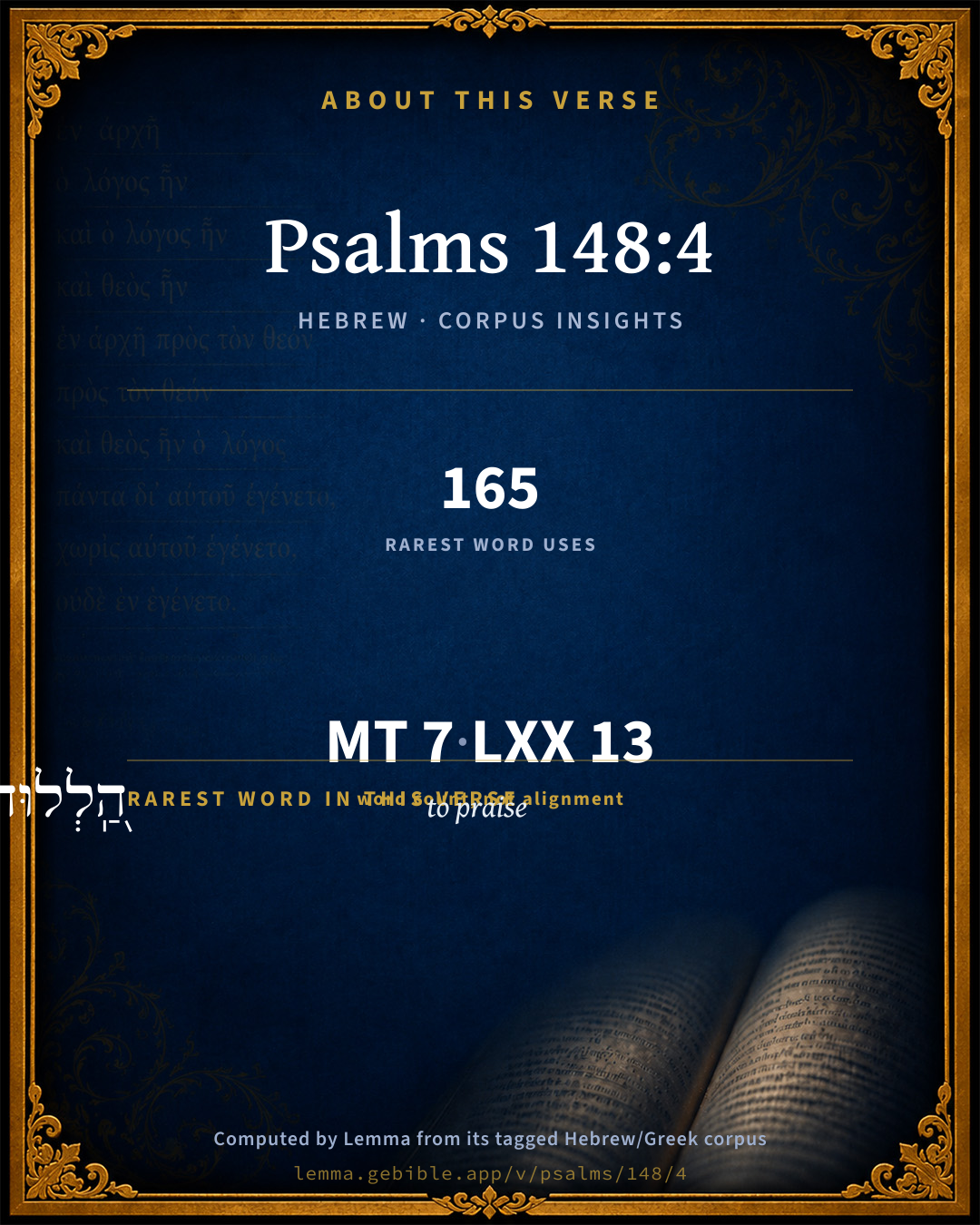
7
words
5
distinct lemmas
Wisdom
section

Grammatical profile

  • 1 verb
  • 4 nouns
  • 1 preposition
  • 1 particle

Verb forms

  • הַֽ֭לְלוּהוּ Piel · Imperative

Repetition

A word recurs within this verse — often emphatic in Hebrew:

  • שְׁמֵ֣י heaven H8064 ×3

Hebrew & Septuagint length

In English translation the verse runs 13 words from the Hebrew and 14 from the Septuagint (LXX English) — closely comparable.

A rough comparison of the two English renderings, which tokenize alike — not a word-level alignment.

Word counts can differ between the Hebrew and the Greek without any difference in meaning — e.g. the Hebrew direct-object marker אֵת has no separate Greek word, and Greek often adds the article ὁ.

In the original languages it is 7 Hebrew tokens and 13 Greek tokens — but the two are counted differently (Hebrew bundles its prefixes and suffixes into one token; the Greek is in lemma form), so that isn’t a like-for-like length.

Cross-references

9

Topical passages linked to Psalms 148:4 in the Treasury of Scripture Knowledge — connected by theme and wording, ordered by reader-vote popularity; previews shown in the World English Bible.

  • 1 Kings 8:27 But will God in very deed dwell on the earth? behold, heaven and the heaven of heavens can't contain you; how much less this house that I have built!
  • Genesis 1:7 God made the expanse, and divided the waters which were under the expanse from the waters which were above the expanse, and it was so.
  • Deuteronomy 10:14 Behold, to Yahweh your God belongs heaven and the heaven of heavens, the earth, with all that is therein.
  • Nehemiah 9:6 You are Yahweh, even you alone; you have made heaven, the heaven of heavens, with all their host, the earth and all things that are thereon, the seas and all that is in them, and you preserve them all; and the host of heaven worships you.
  • Genesis 7:11 In the six hundredth year of Noah's life, in the second month, on the seventeenth day of the month, on the same day all the fountains of the great deep were burst open, and the sky's windows were opened.
  • Psalms 68:33 To him who rides on the heaven of heavens, which are of old; Behold, he utters his voice, a mighty voice.
  • Psalms 104:3 He lays the beams of his chambers in the waters. He makes the clouds his chariot. He walks on the wings of the wind.
  • Psalms 113:6 Who stoops down to see in heaven and in the earth?
  • 2 Corinthians 12:2 I know a man in Christ, fourteen years ago (whether in the body, I don't know, or whether out of the body, I don't know; God knows), such a one caught up into the third heaven.

Cross-references courtesy of OpenBible.info (CC BY 4.0).

Hebrew and Greek witnesses Masoretic Hebrew ↔ Greek Septuagint

The same verse in the two great witnesses to the Old Testament, shown verse-for-verse.

You’re reading Greek Psalm 148 (Hebrew Psalm 148). The Septuagint counts the superscription, so verse numbers can differ from the Hebrew — chapter-level alignment, not verse-by-verse. Numbering follows Rahlfs.

These are two independent witnesses, not word-aligned to each other, and the Septuagint is shown in lemma (dictionary) form.

Hebrew Psalms 148:4 Masoretic · Westminster Leningrad Codex

הַֽ֭לְלוּהוּ שְׁמֵ֣י הַשָּׁמָ֑יִם וְ֝הַמַּ֗יִם אֲשֶׁ֤ר מֵעַ֬ל הַשָּׁמָֽיִם

Praise him, you heavens of heavens, You waters that are above the heavens.

World English Bible · Public Domain

Greek LXX Greek Psalm 148:4 Septuagint · lemma form

αἰνέω αὐτός ὁ οὐρανός ὁ οὐρανός καί ὁ ὕδωρ ὁ ὑπεράνω ὁ οὐρανός

Praise him, you⌃ heavens of heavens, and the water that is above the heavens.

LXX2012 (modern English Septuagint) · Public Domain

Hebrew: Westminster Leningrad Codex (CC BY 4.0). Greek: Septuagint (public domain); English from LXX2012 (modern English Septuagint) (Public Domain). How the Septuagint differs from the Hebrew →

Commentary

Notes on Psalms 148:4 from classic Christian and Jewish commentators (each source and its license shown beneath its notes). The classic Christian expositions comment on the surrounding passage and are grouped to its opening verse, so a note may address several verses; the Jewish commentaries on the Tanakh (Rashi and others) are per-verse, so they appear only where the commentator wrote on this verse.

Lemma curates 59 commentaries, every one of them public domain or Creative Commons licensed, each selected and text-cleaned for this edition rather than reprinted as found. About our sources →

Trapp's Complete Commentary

John Trapp

Psa 148:4 Praise him, ye heavens of heavens, and ye waters that [be] above the heavens.

Ver. 4. Praise him, ye heavens of heavens] Whereby he meaneth not the lowest heavens, the air whereon we breathe, and wherein birds fly, clouds swim, &c., as some would have it; but the highest heaven, called by St Paul the third heaven, the habitation of the crowned saints and glorious angels; called by philosophers coelum Empyreum, and here by the psalmist the heavens of heavens, as King of kings, Song of songs, &c., by an excellence. See Deu 10:14.

And ye waters that be above the heavens] i.e. Above the air, and that do distinguish between the air and the sky, as the Primmn Mobile doth between the sky and the highest heavens, Superius suspensae aquarum fornices.

John Trapp, A Commentary or Exposition upon All the Books of the Old and New Testament (1647–1656) — public domain. Text from a community e-Sword module.

J. A. Alexander on Psalms

Joseph Addison Alexander

4. (Psa 148:4) Praise him, ye heavens of heavens, and ye waters which are above the heavens! The object of address in the first clause is the highest heaven, the heaven of that which is heaven to us. See above, on Psa 68:33) and compare Deu 10:14, 1Ki 8:27, 2Co 12:2. The waters meant are the watery clouds above the lower heavens, as in Gen 1:7. See above, on Psa 104:3.

Joseph Addison Alexander, The Psalms Translated and Explained (1850) — public domain. Text from a community e-Sword module.

Geneva Bible (1599)

Geneva Bible translators

That is, the rain which is in the middle region of the air, which he here comprehendeth under the name of the heavens.

Not that there are divers heavens, but because of the spheres and of the situation of the fixed stars and planets, he comprehendeth by this word the whole heaven.

Geneva Bible (1599) marginal notes — public domain. Text via Bolls.life.

Jamieson, Fausset & Brown

Robert Jamieson, A. R. Fausset & David Brown

heavens of heavens--the very highest.

waters--clouds, resting above the visible heavens (compare Gen 1:7).

Jamieson, Fausset & Brown — Commentary Critical and Explanatory on the Whole Bible (1871) — public domain (CC PDM 1.0). Text via the HelloAO Bible API.

Adam Clarke's Commentary

Verse 4. Heavens of heavens] Heavens exceeding heavens. Systems of systems extending as far beyond the solar system, as it does beyond the lowest deeps. The endless systematic concatenation of worlds.

Ye waters that be above the heavens.] This refers to Ge 1:7, where see the notes. Clouds, vapours, air, exhalations, rain, snow, and meteors of every kind.

Adam Clarke's Commentary on the Bible (1810–1826) — public domain. Text from a community e-Sword/MySword module.

Ellicott's Commentary for English Readers

(4) Heavens of heavens.—See Psa_68:33, and references. Before passing downwards to the earth the invocation pauses to combine all the heights, which have been before addressed in the expression which denotes their position relatively to the earth; the highest heaven of all, and then the world of water which, in the Hebrew conception of the Cosmos, was supposed to be the foundation, while itself rests on the firmament or heavenly vault. (See Psa_104:3.)

A Bible Commentary for English Readers, edited by Charles John Ellicott (1878–1897) — public domain. Text from a community e-Sword module.

The Cambridge Bible for Schools and Colleges

gen. ed. J. J. S. Perowne

4. heavens of heavens] i.e. the highest heavens. Cp. Psa_68:33; Deu_10:14; 1Ki_8:27 (= 2Ch_6:18); 1Ch_2:6; Neh_9:6; Sir_16:18. It is doubtful whether the idea of a plurality of heavens, three (2Co_12:2) or seven, which is prominent in later Jewish literature, was already current. See however Salmond in Hastings’ Dict. of the Bible, 11. 321, who thinks that it is implied by this phrase.

ye waters that be above the heavens] The great reservoir of waters supposed to exist above the ‘firmament,’ the source of rain. See Gen_1:6-7; Psa_104:3.

The Cambridge Bible for Schools and Colleges (gen. ed. J. J. S. Perowne; Cambridge University Press, 1878–1918) — public domain. Text from a community e-Sword module.

John Gill's Exposition

Praise him, ye heaven of heavens,.... All the heavens, the airy and starry heavens; and the third heaven, the residence of God, angels and saints: these are made by the Lord, and declare the glory of his power, wisdom, and goodness, and show forth his handiwork, Psa 19:1. A voice was heard from heaven, praising Jehovah the Son, when on earth in our nature; a cloud of the lower heavens received him when he went from hence, and in the clouds thereof he will come again: the highest heavens opened to receive him, and will retain him until the restitution of all things; and from hence he will descend to judge the world in righteousness, Mat 3:16;

and ye waters that be above the heavens; divided by the firmament from the waters below; and are no other than the thick clouds, in which the waters are bound up, and not rent, but at the pleasure of God, Gen 1:7; so Seneca (d) calls the clouds the celestial waters. And these give men occasion to praise the Lord, that those vast bodies of water that are over their heads are not let down in such large quantities upon them as would destroy them; and that are carried about from place to place, and let down and gentle showers, to water and refresh the earth, and make it fruitful, so that it brings forth food for man and beast. The Targum is,

"ye waters, that by the Word (of the Lord) hang above the heavens;''

in which is displayed the glory of amazing power, wisdom, and goodness. The most ancient Syrians and Arabians were thoroughly persuaded, that beyond the bounds of the visible heavens there was a great sea, without any limits; which some (e) suppose to be the waters here meant.

(d) Nat. Quaest. l. 3. c. 23. (e) Vid. Steeb. Coelum Sephirot. Heb. c. 7. s. 3. p. 126, 127. and Gregory's Works, p. 110.

John Gill's Exposition of the Whole Bible (1746–1763) — public domain (CC PDM 1.0). Text via the HelloAO Bible API.

Albert Barnes' Notes on the Bible

Praise him, ye heavens of heavens - Referring to the idea that there is one heaven rising above another. See the notes at Psa 68:33. See 1Ki 8:27 : “Behold, the heaven and heaven of heavens cannot contain thee.” Compare 2Ch 2:6.

And ye waters that be above the heavens - Gen 1:7 : “And God made the firmament, and divided the waters which were under the firmament from the waters which were above the firmament.” The allusion here is to the waters which seem to be above the lower heaven, that is, the air, and which seem to come from some higher region - some higher heaven. See the notes at Psa 104:3 : “Who layeth the beams of his chambers in the waters.”

Albert Barnes' Notes on the Bible (1834–1885) — public domain. Text from a community e-Sword/MySword module.

Matthew Poole's English Annotations

Ye heavens of heavens; ye highest and most glorious heavens, the place of God’s throne and glorious presence, as this phrase is used, Deu 10:14; 1Ki 8:27; Neh 9:6; Psa 115:16. Or, ye starry heavens, which also may well be so called, because they are above the air, which is oft. called heaven in Scripture.

Ye waters that be above the heavens; ye clouds, which are above a part of the heavens; of which See Poole "Gen 1:7".

Matthew Poole's English Annotations on the Holy Bible (1683–1685) — public domain. Text from a community e-Sword/MySword module.

The Treasury of David

Charles H. Spurgeon

Ver. 4. Praise him, ye heavens of heavens. By these are meant those regions which are heavens to those who dwell in our heavens; or those most heavenly of abodes where the most choice of spirits dwell. As the highest of the highest, so the best of the best are to praise the Lord. If we could climb as much above the heavens as the heavens are above the earth, we could still cry out to all around us, "Praise ye the Lord." There can be none so great and high as to be above praising Jehovah.

And ye waters that be above the heavens. Let the clouds roll up volumes of adoration. Let the sea above roar, and the fulness thereof, at the presence of Jehovah, the God of Israel. There is something of mystery about these supposed reservoirs of water; but let them be what they may, and as they may, they shall give glory to the Lord our God. Let the most unknown and perplexing phenomena take up their parts in the universal praise.

Ver. 4. Paise him, ye heavens of heavens, etc. From the heavenly inhabitants the poetic strain passes in transition to the heavens themselves. There are orders of heavens, ranks and heights supreme, and stages and degrees of lower altitude. This verse sublimely traverses the immensities which are the home of the most exalted dignities who wait on Deity, and then it descends to the firmament where the meteors flash forth, and where the heavens stoop to lift the clouds that aspire from earth. And the idea sustained is that all these vast realms, higher and lower, are one temple of unceasing praise. Herman Venema.

Ver. 4. The ancients thought there was an ethereal and lofty ocean in which the worlds floated like ships in a sea. Thomas Le Blanc.

Psalms 148:5*

Charles H. Spurgeon's The Treasury of David (1869–1885) — public domain. Psalms only. Text from a community e-Sword/MySword module.

The Pulpit Commentary

Praise him, ye heavens of heavens; i.e. "ye highest heavens". (comp. Deu_10:14 1Ki_8:27 Psa_68:33) And ye waters that be above the heavens. (comp. Gen_1:7) The clouds are probably intended.

The Pulpit Commentary (1880–1919), ed. H.D.M. Spence-Jones & Joseph S. Exell — public domain. Text from a community e-Sword module.

John Wesley's Explanatory Notes

Heavens of heavens - Ye highest heavens, the place of God's throne. Waters - Ye clouds which are above a part of the heavens.

John Wesley, Explanatory Notes Upon the Whole Bible (1754–1765) — public domain. Text via the GEBible commentary corpus.

Lesson kit

Teaching starters — assembled from the data on this page, not authored interpretation. Every prompt links to the verse data it draws on. Edit before teaching.

Psalms, in the Wisdom, opens this verse with 7 words (5 distinct Hebrew lemmas). Its most distinctive word is hâlal (“to praise”). A historical commentator’s framing appears above. Read the whole chapter for the surrounding context.

Discussion questions

  1. How does “to praise” (hâlal) shape what this verse is saying?
  2. How does 1 Kings 8:27, which shares this passage’s theme, read alongside this verse?
  3. What does the repetition of “heaven” (3× in this one verse) do in this verse?
  4. These translations render this verse differently. What is at stake in choosing one wording over another?
  5. «הַֽ֭לְלוּהוּ» is a Piel Imperative verb. How does that grammatical form shape the action described?
  6. Compare how Trapp's Complete Commentary and J. A. Alexander on Psalms read this verse. Where do they agree or differ?

Things to notice

Reading settings

Reading text

Shown beneath each verse's original-language words.

Old Testament
Old Testament edition

Read the OT as the Masoretic Hebrew (MT) or the Greek Septuagint (LXX).

English shown for the Greek Septuagint (in the Hebrew ↔ Greek comparison).

Comparing translations? Open the Compare panel on any verse page to stack up to four side by side.