
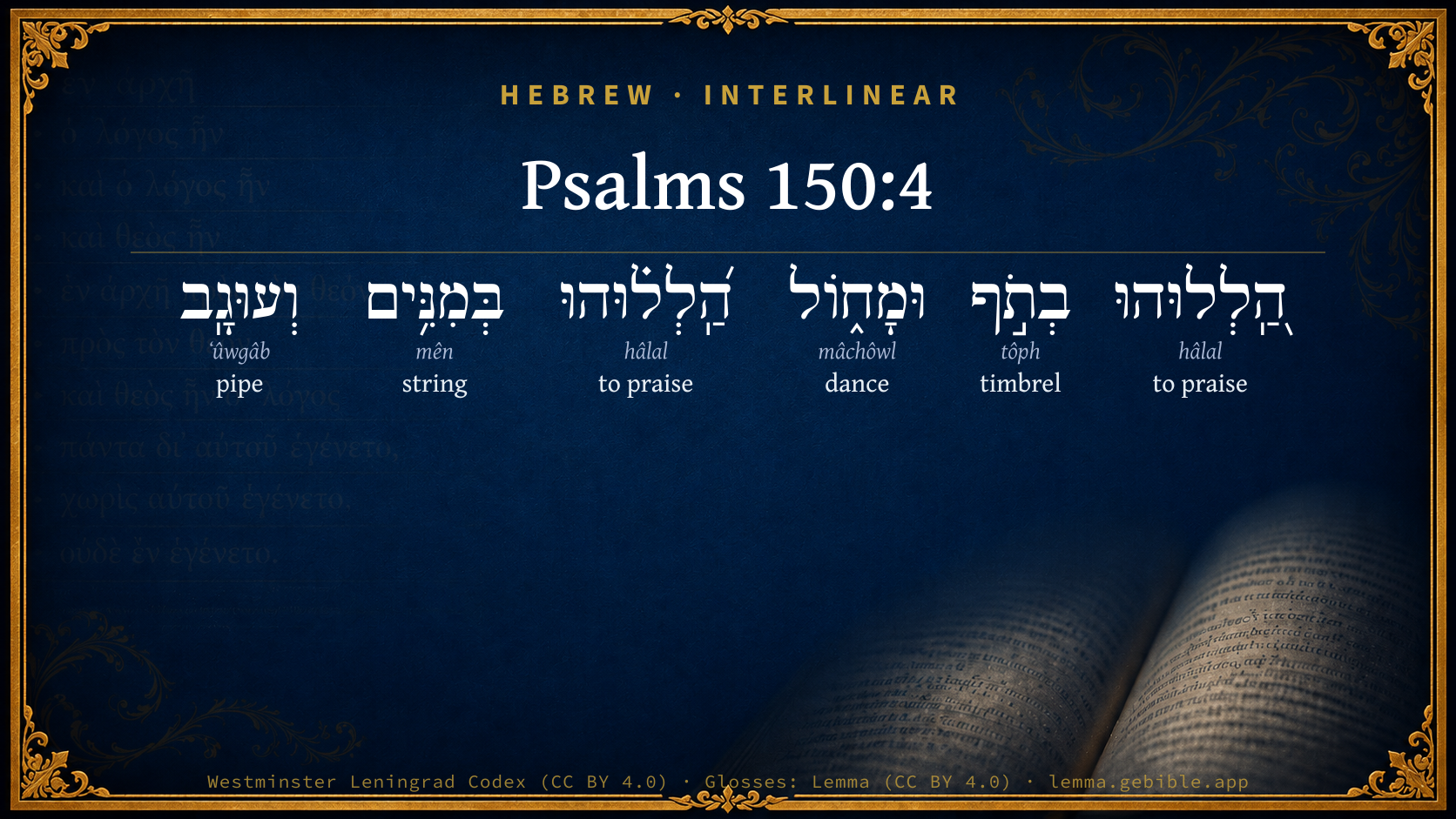
Psalms 150:4

Hebrew (Westminster Leningrad Codex) Psalms 150:4 appears in the Hebrew Old Testament. The text above is from the Westminster Leningrad Codex. Each word links to its Strong’s number, a concise gloss, and parsing drawn from the Open Scriptures Hebrew Bible morphology. Click any word for its full Brown-Driver-Briggs (BDB) entry.
Download image
Cite this verse

Psalms 150:4 (World English Bible). Public Domain. Lemma interlinear Bible study tool, https://lemma.gebible.app/v/psalms/150/4.

Show BibTeX & RIS
BibTeX
RIS
English Translation
Praise him with tambourine and dancing! Praise him with stringed instruments and flute!
World English Bible · Public Domain
Download a study sheet

One document with this verse’s original text, its word-by-word gloss line, the meaning frame, cross-references with their text, attributed commentary, and full source and license credits — printable, and it pastes into notes with its structure intact.

This verse Autodidact and up

Study sheet (.html) Plain text (.txt)

A passage Seminary Student

Up to 50 verses in one chapter. A passage sheet keeps up to 6 commentary sources and 12 cross-references per verse, in the order this page ranks them, and says so on the sheet whenever that leaves anything out. Ask for a single verse and you get the Autodidact verse sheet above.

Everything on this page stays free to read, with no account — the sheet is a download of what is already on screen, not access to it.

Want to remove ads? Support Godless Engineer
Compare translations 3

The same verse in 3 English versions, stacked beneath the original-language interlinear above. Click any original word for its lexicon entry.

Each is an independent rendering of the whole verse — the interlinear is not word-aligned to these translations.

Highlighted words mark where these versions differ — a whole-verse word diff, not a word-by-word alignment.

  • World English Bible Public Domain
    Praise him with tambourine and dancing! Praise him with stringed instruments and flute!
  • King James Version Public Domain
    Praise him with the timbrel and dance: praise him with stringed instruments and organs.
  • unfoldingWord Literal Text CC BY-SA 4.0
    Praise him with the tambourine and the dance; praise him with stringed instruments and the flute.

unfoldingWord Literal Text — © unfoldingWord, licensed CC BY-SA 4.0. Word-aligned USFM3 via Door43 (git.door43.org/unfoldingWord/en_ult).

Versions to compare (up to 4)

3 of 4 selected

Show all 18 translations

Every available English version of this verse, each an independent rendering of the whole verse.

  • World English Bible Public Domain
    Praise him with tambourine and dancing! Praise him with stringed instruments and flute!
  • Berean Standard Bible Public Domain
    Praise Him with tambourine and dancing; praise Him with strings and flute.
  • Majority Standard Bible Public Domain
    Praise Him with tambourine and dancing; praise Him with strings and flute.
  • King James Version Public Domain
    Praise him with the timbrel and dance: praise him with stringed instruments and organs.
  • American Standard Version (1901) Public Domain
    Praise him with timbrel and dance: Praise him with stringed instruments and pipe.
  • Revised Version (1885) Public Domain
    Praise him with the timbrel and dance: praise him with stringed instruments and the pipe.
  • Geneva Bible (1599) Public Domain
    Prayse ye him with timbrell and flute: praise ye him with virginales and organs.
  • Douay-Rheims (1899) Public Domain
    Praise him, ye heavens of heavens: and let all the waters that are above the heavens
  • Young's Literal Translation Public Domain
    Praise Him with timbrel and dance, Praise Him with stringed instruments and organ.
  • Literal Standard Version CC BY-SA 4.0
    Praise Him with timbrel and dance, || Praise Him with stringed instruments and pipe.
  • Unlocked Literal Bible CC BY-SA 4.0
    Praise him with tambourines and dancing; praise him with stringed instruments and wind instruments.
  • unfoldingWord Literal Text CC BY-SA 4.0
    Praise him with the tambourine and the dance; praise him with stringed instruments and the flute.
  • Darby Bible Public Domain
    Praise him with the tambour and dance; praise him with stringed instruments and the pipe;
  • World Messianic Bible Public Domain
    Praise him with tambourine and dancing! Praise him with stringed instruments and flute!
  • Webster's Bible Public Domain
    Praise him with the timbrel and dance: praise him with stringed instruments and organs.
  • Free Bible Version CC BY-SA 4.0
    Praise him with tambourine and dancing, praise him with strings and flutes!
  • Bible in Basic English Public Domain
    Give him praise with instruments of brass and in the dance: give him praise with horns and corded instruments.
  • JPS Tanakh (1917) Public Domain
    Praise Him with the timbrel and dance; praise Him with stringed instruments and the pipe.

Literal Standard Version (2020), Covenant Press — licensed CC BY-SA 4.0. Text via the HelloAO Bible API (eBible.org). Unlocked Literal Bible (unfoldingWord) — licensed CC BY-SA 4.0. Text via the HelloAO Bible API (eBible.org). unfoldingWord Literal Text — © unfoldingWord, licensed CC BY-SA 4.0. Word-aligned USFM3 via Door43 (git.door43.org/unfoldingWord/en_ult). Free Bible Version, Dr. Jonathan Gallagher — licensed CC BY-SA 4.0. Text via the HelloAO Bible API (eBible.org).

Word by word

More ways to search: Search by grammar → Find every occurrence → Compare this word →

Practice this passage: Drill this verse → Learn its vocabulary →

About this verse

These counts appear in no published source. They are computed here, from the morphology-tagged text and Lemma’s own curated glosses. What Lemma adds →

6
words
5
distinct lemmas
Wisdom
section

Notable vocabulary

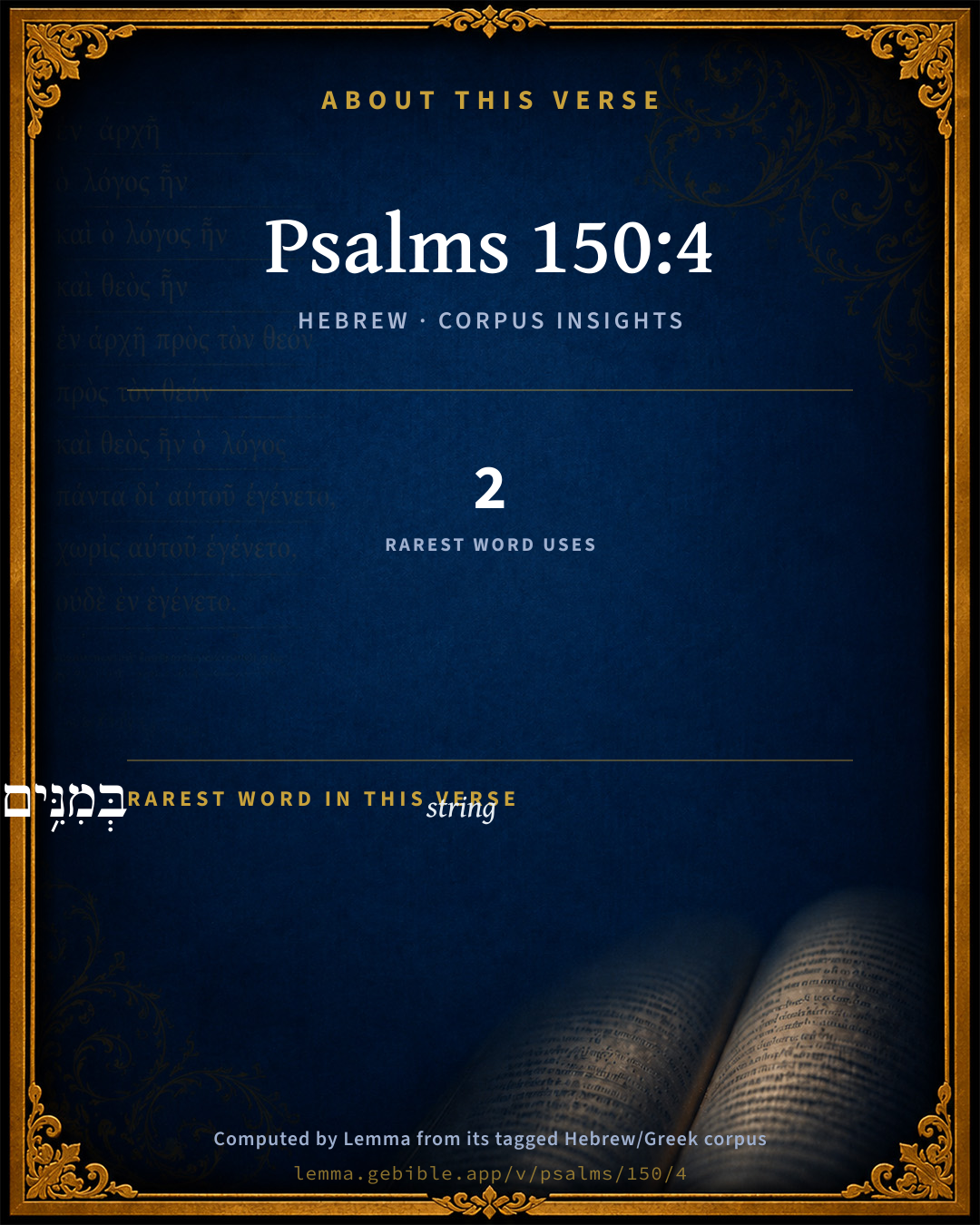
The rarest word here is בְּמִנִּ֥ים string H4482 — appearing just 2 times in the whole Hebrew Bible.

Shared distinctive vocabulary

בְּמִנִּ֥ים string H4482 occurs in 2 verses of the Hebrew Bible. Also found in:

Grammatical profile

  • 2 verbs
  • 4 nouns

Verb forms

  • הַֽ֭לְלוּהוּ Piel · Imperative
  • הַֽ֝לְל֗וּהוּ Piel · Imperative

Repetition

A word recurs within this verse — often emphatic in Hebrew:

  • הַֽ֭לְלוּהוּ to praise H1984 ×2

Hebrew & Septuagint length

In English translation the verse runs 13 words from the Hebrew and 14 from the Septuagint (LXX English) — closely comparable.

A rough comparison of the two English renderings, which tokenize alike — not a word-level alignment.

Word counts can differ between the Hebrew and the Greek without any difference in meaning — e.g. the Hebrew direct-object marker אֵת has no separate Greek word, and Greek often adds the article ὁ.

Cross-references

10

Topical passages linked to Psalms 150:4 in the Treasury of Scripture Knowledge — connected by theme and wording, ordered by reader-vote popularity; previews shown in the World English Bible.

  • Psalms 149:3 Let them praise his name in the dance! Let them sing praises to him with tambourine and harp!
  • Isaiah 38:20 Yahweh is [ready] to save me: Therefore we will sing my songs with stringed instruments All the days of our life in the house of Yahweh.
  • Exodus 15:20 Miriam the prophetess, the sister of Aaron, took a tambourine in her hand; and all the women went out after her with tambourines and with dances.
  • Psalms 144:9 I will sing a new song to you, God. On a ten-stringed lyre, I will sing praises to you.
  • Job 30:31 Therefore is my harp turned to mourning, And my pipe into the voice of those who weep.
  • Psalms 92:3 With the ten-stringed lute, with the harp, And with the melody of the lyre.
  • Job 21:12 They sing to the tambourine and harp, And rejoice at the sound of the pipe.
  • Psalms 33:2 Give thanks to Yahweh with the lyre. Sing praises to him with the harp of ten strings.
  • Psalms 45:8 All your garments smell like myrrh, aloes, and cassia. Out of ivory palaces stringed instruments have made you glad.
  • Habakkuk 3:19 Yahweh, the Lord, is my strength. He makes my feet like deer's feet, And enables me to go in high places. For the music director, on my stringed instruments.

Cross-references courtesy of OpenBible.info (CC BY 4.0).

Hebrew and Greek witnesses Masoretic Hebrew ↔ Greek Septuagint

The same verse in the two great witnesses to the Old Testament, shown verse-for-verse.

You’re reading Greek Psalm 150 (Hebrew Psalm 150). The Septuagint counts the superscription, so verse numbers can differ from the Hebrew — chapter-level alignment, not verse-by-verse. Numbering follows Rahlfs.

These are two independent witnesses, not word-aligned to each other, and the Septuagint is shown in lemma (dictionary) form.

Hebrew Psalms 150:4 Masoretic · Westminster Leningrad Codex

הַֽ֭לְלוּהוּ בְתֹ֣ף וּמָח֑וֹל הַֽ֝לְל֗וּהוּ בְּמִנִּ֥ים וְעוּגָֽב

Praise him with tambourine and dancing! Praise him with stringed instruments and flute!

World English Bible · Public Domain

Greek LXX Greek Psalm 150:4 Septuagint · lemma form

αἰνέω αὐτός ἐν τύμπανον καί χορός αἰνέω αὐτός ἐν χορδή καί ὄργανον

Praise him with timbrel and dance: praise him with stringed instruments and the organ.

LXX2012 (modern English Septuagint) · Public Domain

On this verse, The Treasury of David discusses the Septuagint’s reading. Read the note in Commentary ↓

Hebrew: Westminster Leningrad Codex (CC BY 4.0). Greek: Septuagint (public domain); English from LXX2012 (modern English Septuagint) (Public Domain). How the Septuagint differs from the Hebrew →

Commentary

Notes on Psalms 150:4 from classic Christian and Jewish commentators (each source and its license shown beneath its notes). The classic Christian expositions comment on the surrounding passage and are grouped to its opening verse, so a note may address several verses; the Jewish commentaries on the Tanakh (Rashi and others) are per-verse, so they appear only where the commentator wrote on this verse.

Lemma curates 59 commentaries, every one of them public domain or Creative Commons licensed, each selected and text-cleaned for this edition rather than reprinted as found. About our sources →

Trapp's Complete Commentary

John Trapp

Psa 150:4 Praise him with the timbrel and dance: praise him with stringed instruments and organs.

Ver. 4. Praise him with the timbrel and dance] Or, pipe. But these are ancient things (as it is said in another case, 1Ch 4:22), and now out of date. When the use of these musical instruments crept into the Christian Churches (which was not till lately) great abuses crept in with it; the preaching of the word was changed into songs and anthems, little understood by those that sang them, and that grave and simple psalmody or singing of psalms (so much used of old and by this blessed Reformation restored to the Church) was jostled out, or rather turned in turpissimum lenocinium (as one justly complaineth), such as Nebuchadnezzar made before his golden image, Dan 3:1 Justin Martyr musices usum reprehendit qu. 107, ad Orthodox. Sic Theodoret Lib. de Sacrific. When Aristotle was asked what he thought of music, he answered, Iovem nec canere, nec citharam pulsars; thinking it an unprofitable art to men, that was no more delightful to God. Plato told the musicians who pressed into his company, that philosophers could do well enough without them. There is (no doubt) a lawful use of music, and great power it hath to move men’s minds one way or another, 2Ki 3:15 1Sa 16:23. But in God’s public worship it is dangerous to do anything without his special warrant, though we intend never so well in so doing; as we see in Uzzah. Temple music was part of the Jewish pedagogy, of the Levitical worship; and therefore cannot be retained without injury to Christ.

John Trapp, A Commentary or Exposition upon All the Books of the Old and New Testament (1647–1656) — public domain. Text from a community e-Sword module.

The Treasury of David

Charles H. Spurgeon

Ver. 4. Praise him with the timbrel and dance. Associated with the deliverance at the Red Sea, this form of worship set forth the most jubilant and exultant of worship. The hands and the feet were both employed, and the entire body moved in sympathy with the members. Are there not periods of life when we feel so glad that we would fain dance for joy? Let not such exhilaration be spent upon common themes, but let the name of God stir us to ecstasy. Let us exult as we cry,

"In the heavenly Lamb thrice happy I am,

And my heart it doth dance at the sound of his name."

There is enough in our holy faith to create and to justify the utmost degree of rapturous delight. If men are dull in the worship of the Lord our God they are not acting consistently with the character of their religion.

Praise him with stringed instruments and organs. We have here the three kinds of musical instruments: timbrels, which are struck, and strings, and pipes; let all be educated to praise the Lord. Nothing is common and unclean: all may be sanctified to highest uses. Many men, many minds, and these as different as strings and pipes; but there is only one God, and that one God all should worship. The word translated "organs" signifies pipea simpler form of wind instrument than the more modern and more elaborate organ. Doubtless many a pious shepherd has poured out gracious pastorals from a reed or oaten pipe, and so has magnified his God.

Ver. 4. Stringed instruments. Minnim (which is derived from a root signifying "division", or" distribution", hence strings) occurs in Ps 45:8, and Ps 150:4, and is supposed by some to denote a stringed instrument, but it seems merely a poetical allusion to the strings of any instrument. Thus, in Ps 45:8, we would read, "Out of the ivory palaces the strings (i.e. concerts of music) have made thee glad"; and so in Ps 150:4, "Praise him with strings (stringed instruments), and ugabs." John Kitto.

Ver. 4. Organs. bgwe, 'ugab is the word rendered "organ" in our version. The Targum renders the word simply by abwba, a pipe; the Septuagint varies, it has kiyara in Genesis, qalmov in Job, and organon, in the Psalms. The last is the sense which the Arabic, Syriac, Latin, English, and most other versions have adopted. The organon simply denotes a double or manifold pipe; and hence, in particular, the Pandaean or shepherd's pipe, which is at this day called a "mouth organ", among ourselves. (Kitto.) A collection of tubes of different sizes, stopped at one end and blown at the other, forms the musical instrument known as Pan's pipes, in the Greek syrinx, surunx ...Was the'ugab a syrinx or an organ? As the former seems to have been the more ancient of the two, and as'ugab is included in the very first allusion to musical instruments in the Bible, it would seem reasonable to say at once that it was a syrinx, especially as this instrument was, and is to this day, commonly met with in various parts of Asia. Yet it would, indeed, be strange if such an instrument were selected for use in divine worship; and that the ugab was so used is proved beyond a doubt by its mention in Ps 150:1-6: "Praise him with the minnim and ugab." Its mention here in antithesis to a collective name for stringed instruments, surely points to the fact of its being a more important instrument than a few river reeds fixed together with wax. Let us not forget that we have but one and the same name for the single row of about fifty pipes, placed, perhaps, in a little room, and the mighty instrument of five thousand pipes, occupying as much space as an ordinary dwelling house. Each is an organ. May it not have been the case that the'ugab, which in Ge 4:21 is mentioned as the simply constructed wind instrument, in contrast to the simple stringed instrument, the kinnor, was a greatly inferior instrument to that which in Ps 150:1-6 is thought worthy of mention by the side of a term for the whole string power? J. Stainer.

Psalms 150:5*

Charles H. Spurgeon's The Treasury of David (1869–1885) — public domain. Psalms only. Text from a community e-Sword/MySword module.

J. A. Alexander on Psalms

Joseph Addison Alexander

4. (Psa 150:4) Praise him with timbrel and dance! Praise him with strings and pipe! The three great classes of instruments are here distinctly mentioned, namely, wind, stringed, and pulsatile. The last, represented by the drum or timbrel, still called by a kindred name in Arabic, is here accompanied by its inseparable adjunct dancing, which might seem misplaced in a list of instruments, and those employed in sacred music, but for the peculiar usages and notions of the ancient Hebrews, with respect to this external sign of joy. See above, on Psa 30:11; Psa 149:3. The common version of the last word (organ) is derived through the Vulgate from the Septuagint, where it denotes a system or combination of pipes. The Hebrew word, according to the Jewish tradition, means a simple pipe, and is so rendered in the Prayer Book version. It here represents the whole class of wind-instruments. See above, on Psa 68:25, and compare 2Sa 6:5.

Joseph Addison Alexander, The Psalms Translated and Explained (1850) — public domain. Text from a community e-Sword module.

Adam Clarke's Commentary

Verse 4. Praise him with the timbrel] תף toph, drum, tabret, or tomtom, or tympanum of the ancients; a skin stretched over a broad hoop; perhaps something like the tambarine. Anglo-Saxon; [A.S.] the glad pipe. Taburne; Old Psalter.

And dance] מחול machol, the pipe. The croude or crowthe: Old Psalter; a species of violin. It never means dance; See Clarke on Ps 149:3. Crwth signifies a fiddle in Welsh.

Stringed instruments] מנים minnim. This literally signifies strings put in order; perhaps a triangular kind of hollow instrument on which the strings were regularly placed, growing shorter and shorter till they came to a point. This would give a variety of sounds, from a deep bass to a high treble. In an ancient MS. Psalter before me, David is represented in two places, playing on such an instrument. It may be the sambuck, or psaltery, or some such instrument.

Organs.] עוגב ugab. Very likely the syrinx or mouth organ; Pan's pipe; both of the ancients and moderns. The fistula, septem, disparibus nodis conjuncta, made of seven pieces of cane or thick straw, of unequal lengths, applied to the lips, each blown into, according to the note intended to be expressed. This instrument is often met with in the ancient bucolic or pastoral writers.

Adam Clarke's Commentary on the Bible (1810–1826) — public domain. Text from a community e-Sword/MySword module.

Ellicott's Commentary for English Readers

(4) Timbrel and dance.—See Psa_149:3.

Stringed instruments.—Minnîm. Literally, parts, so threads, so here, as in LXX. and Vulg., “with” or “on strings.” (See Note, Psa_45:9.)

Organs.—Heb., ‘ugab, which has been variously identified with the syrinx, or Pan’s pipes, of the Greeks, with the “bagpipe,” and even with a rude instrument embodying the principle of the modern organ. (See Bible Educator, 2:70, 183, 229.)

A Bible Commentary for English Readers, edited by Charles John Ellicott (1878–1897) — public domain. Text from a community e-Sword module.

The Cambridge Bible for Schools and Colleges

gen. ed. J. J. S. Perowne

4. with the timbrel and dance] See on Psa_149:3. The P.B.V. cymbals seems to be a slip of Coverdale’s, which was not corrected in the Great Bible, as he renders tôph correctly by tabret, i.e. a small drum, in Psa_149:3.

with stringed instruments and pipes] The word minnîm, ‘stringed instruments,’ occurs in Psa_45:8 (R.V.): the ugâbh, mentioned in Gen_4:21; Job_21:12; Job_30:31, was probably the syrinx or Pan’s-pipes, a wind instrument consisting of a collection of reeds or pipes. See Stainer, Music of the Bible, Ch. vi. The two terms may include string and wind instruments generally, as “harp and pipe” in Gen_4:21; and as the words are not elsewhere used in connexion with religious ceremonies, they may be meant to suggest that all instruments, secular as well as sacred, should be enlisted in this service of praise. The A.V. organs follows the LXX and Vulg.

The Cambridge Bible for Schools and Colleges (gen. ed. J. J. S. Perowne; Cambridge University Press, 1878–1918) — public domain. Text from a community e-Sword module.

John Gill's Exposition

Praise him with the timbrel and dance,.... Or "pipe" (u); See Gill on Psa 149:3;

praise him with stringed instruments; or divers "kinds" (w) of instruments not named, as R. Saadiah Gaon; and which, as Aben Ezra says, had all one sound or note; what they were is not known, as also many of them that are particularly mentioned;

and organs; which have their name from the loveliness of their sound; these are of ancient original and use, Gen 4:21; but were not of the same kind with those now in use, which are of much later invention.

(u) "et tibia", Tigurine version, Junius & Tremellius, Piscator, Gejerus. (w) "varia symphonia", Cocceius.

John Gill's Exposition of the Whole Bible (1746–1763) — public domain (CC PDM 1.0). Text via the HelloAO Bible API.

Albert Barnes' Notes on the Bible

Praise him with the timbrel - Hebrew, תף tôph. See this described in the notes at Isa 5:12. It is rendered tabret and tabrets in Gen 31:27; 1Sa 10:5; 1Sa 18:6; Isa 5:12; Isa 24:8; Isa 30:32; Jer 31:4; Eze 28:13; timbrel and timbrels in Exo 15:20; Jdg 11:34; 2Sa 6:5; 1Ch 13:8; Job 21:12; Psa 81:2; Psa 149:3; and in the margin in Jer 31:4. The word does not occur elsewhere. It was an instrument that was struck with the hands.

And dance - See this word explained in the notes at Psa 149:3. Dancing among the Hebrews seems to have accompanied the timbrel or tabret. See Exo 15:20,

Praise him with stringed instruments - מנים minniym. This word means strings, from a verb which means to divide; and the proper reference would be to slender threads, as if they were divided, or made small. It is nowhere else applied to instruments of music, but might be properly applied to a harp, a violin, a bass-viol, etc. The word strings is indeed applied elsewhere to instruments of music Psa 33:2; Psa 144:9; 1Sa 18:16; Isa 38:20; Hab 3:19, but the Hebrew word is different. Such instruments were commonly used in the praise of God. See the notes at Psa 33:2.

And organs - Hebrew, עוגב ‛ûgâb. See this word explained in the notes at Job 21:12. It occurs elsewhere only in Gen 4:21; Job 21:12; Job 30:31; in all of which places it is rendered organ. The word is derived from a verb meaning to breathe, to blow; and would be applicable to any wind-instrument. It here represents the whole class of wind-instruments. The word organ is a Greek word, and is found in the Septuagint in this place; and hence, our word organ has been introduced into the translation. The Greek word properly denotes

(a) something by which work is accomplished, as a machine;

(b) a musical instrument;

(c) the material from which anything is made;

(d) the work itself. (Passow, Lexicon).

Our word organ, as used in music, suggests the idea of a combination of instruments or sounds. That idea is not found in the Hebrew word. It denotes merely a wind-instrument. Neither the Hebrews nor any of the ancient nations had an instrument that corresponded with the organ as we now use the term.

Albert Barnes' Notes on the Bible (1834–1885) — public domain. Text from a community e-Sword/MySword module.

Whedon's Commentary on the Bible

Daniel D. Whedon

4. Dance—A translation of doubtful propriety. The word in the text and in Psa_149:3, stands classified as a musical instrument, and is translated “pipe” in the margin of our English Bible. In Psa_30:11, it seems evidently used in a figurative sense for joy, and the same in Lam_5:15. Jer_31:4; Jer_31:13, might also be taken in the same sense. The same noun in the feminine (מחולה) is more commonly taken in the literal sense of dancing, or, as the etymology suggests, “dancing in a circle,” probably because, in the literal sense, females only or chiefly practised it. These “dances,” though embracing a religious sentiment, were not connected with the regular worship, but belonged to occasions of rare national joy and triumph. In the text, and in Psa_149:3, the word stands connected with earnest, spiritual, and universal praise and worship; and though it is more in harmony with the connexion and scope to take it as an instrument of music, still, if understood of dancing, it can give no countenance to that movement as a common mode of worship, much less to modern social dancing, which is not only practiced without a religious object, but in antagonism to all true religious sensibility. See note on Psa_30:11

Daniel D. Whedon (gen. ed.), Commentary on the Old and New Testaments (1874–1909) — public domain. Text from a community e-Sword module.

The Pulpit Commentary

Praise him with the timbrel and dance. (comp. Psa_149:3) Praise him with stringed instruments and organs; literally, with strings and pipe. "Organs" are, of course, out of the question. The "pipe" intended is probably the double pipe so often represented on the monuments of Egypt, Assyria, and Phoenicia.

The Pulpit Commentary (1880–1919), ed. H.D.M. Spence-Jones & Joseph S. Exell — public domain. Text from a community e-Sword module.

Rashi

Rabbi Shlomo Yitzchaki (Rashi)

with stringed instrument and flute Heb. במנים ועגב. They are kinds of musical instruments.

Rashi on the Tanakh — English translations: “The Judaica Press complete Tanach with Rashi, translated by A. J. Rosenberg” (CC BY 4.0); “Pentateuch with Rashi's commentary by M. Rosenbaum and A.M. Silbermann, 1929-1934” (public domain); “The Metsudah Tanach series, Lakewood, N.J” (CC BY 4.0); and “The Book of Joshua, Metsudah Publications, 1997” (CC BY 4.0). Text via Sefaria.

Lesson kit

Teaching starters — assembled from the data on this page, not authored interpretation. Every prompt links to the verse data it draws on. Edit before teaching.

Psalms, in the Wisdom, opens this verse with 6 words (5 distinct Hebrew lemmas). Its most distinctive word is mên (“string”). A historical commentator’s framing appears above. Read the whole chapter for the surrounding context.

Discussion questions

  1. How does “string” (mên) shape what this verse is saying?
  2. Psalms 45:8 shares the word «string» with this verse. How do the two illuminate each other?
  3. “to praise” occurs 2× in this one verse. What is the effect of the repetition?
  4. The translations on this page render this verse differently — a whole-verse word diff, not a word-by-word alignment. What might account for the different wordings?
  5. The verb «הַֽ֭לְלוּהוּ» is Piel Imperative. How does its form color the action?
  6. Reading how Trapp's Complete Commentary and The Treasury of David read this verse, where do the two commentators agree and where do they part?

Things to notice

  • These translations choose different wording for 6 words in this verse.
  • “to praise” occurs 2× in this single verse.
  • 5 distinct Hebrew lemmas span 6 words in this verse.

Reading settings

Reading text

Shown beneath each verse's original-language words.

Old Testament
Old Testament edition

Read the OT as the Masoretic Hebrew (MT) or the Greek Septuagint (LXX).

English shown for the Greek Septuagint (in the Hebrew ↔ Greek comparison).

Comparing translations? Open the Compare panel on any verse page to stack up to four side by side.