Isaiah 64:11

Hebrew (Westminster Leningrad Codex) Isaiah 64:11 appears in the Hebrew Old Testament. The text above is from the Westminster Leningrad Codex. Each word links to its Strong’s number, a concise gloss, and parsing drawn from the Open Scriptures Hebrew Bible morphology. Click any word for its full Brown-Driver-Briggs (BDB) entry.
Download image
Cite this verse

Isaiah 64:11 (World English Bible). Public Domain. Lemma interlinear Bible study tool, https://lemma.gebible.app/v/isaiah/64/11.

Show BibTeX & RIS
BibTeX
RIS
English Translation
Our holy and our beautiful house, where our fathers praised you, is burned with fire; and all our pleasant places are laid waste.
World English Bible · Public Domain
Download a study sheet

One document with this verse’s original text, its word-by-word gloss line, the meaning frame, cross-references with their text, attributed commentary, and full source and license credits — printable, and it pastes into notes with its structure intact.

This verse Autodidact and up

Study sheet (.html) Plain text (.txt)

A passage Seminary Student

Up to 50 verses in one chapter. A passage sheet keeps up to 6 commentary sources and 12 cross-references per verse, in the order this page ranks them, and says so on the sheet whenever that leaves anything out. Ask for a single verse and you get the Autodidact verse sheet above.

Everything on this page stays free to read, with no account — the sheet is a download of what is already on screen, not access to it.

Want to remove ads? Support Godless Engineer
Compare translations 3

The same verse in 3 English versions, stacked beneath the original-language interlinear above. Click any original word for its lexicon entry.

Each is an independent rendering of the whole verse — the interlinear is not word-aligned to these translations.

Highlighted words mark where these versions differ — a whole-verse word diff, not a word-by-word alignment.

  • World English Bible Public Domain
    Our holy and our beautiful house, where our fathers praised you, is burned with fire; and all our pleasant places are laid waste.
  • King James Version Public Domain
    Our holy and our beautiful house, where our fathers praised thee, is burned up with fire: and all our pleasant things are laid waste.
  • unfoldingWord Literal Text CC BY-SA 4.0
    The house of our holiness and our splendor, where our fathers praised you, has become a burning of fire, and all of our precious things have become a desolation.

unfoldingWord Literal Text — © unfoldingWord, licensed CC BY-SA 4.0. Word-aligned USFM3 via Door43 (git.door43.org/unfoldingWord/en_ult).

Versions to compare (up to 4)

3 of 4 selected

Show all 18 translations

Every available English version of this verse, each an independent rendering of the whole verse.

  • World English Bible Public Domain
    Our holy and our beautiful house, where our fathers praised you, is burned with fire; and all our pleasant places are laid waste.
  • Berean Standard Bible Public Domain
    Our holy and beautiful temple, where our fathers praised You, has been burned with fire, and all that was dear to us lies in ruins.
  • Majority Standard Bible Public Domain
    Our holy and beautiful temple, where our fathers praised You, has been burned with fire, and all that was dear to us lies in ruins.
  • King James Version Public Domain
    Our holy and our beautiful house, where our fathers praised thee, is burned up with fire: and all our pleasant things are laid waste.
  • American Standard Version (1901) Public Domain
    Our holy and our beautiful house, where our fathers praised thee, is burned with fire; and all our pleasant places are laid waste.
  • Revised Version (1885) Public Domain
    Our holy and our beautiful house, where our fathers praised thee, is burned with fire; and all our pleasant things are laid waste.
  • Geneva Bible (1599) Public Domain
    The House of our Sanctuarie and of our glorie, where our fathers praysed thee, is burnt vp with fire and all our pleasant things are wasted.
  • Douay-Rheims (1899) Public Domain
    The house of our holiness, and of our glory, where our fathers praised thee, is burnt with fire, and all our lovely things are turned into ruins.
  • Young's Literal Translation Public Domain
    Our holy and our beautiful house, Where praise Thee did our fathers, Hath become burnt with fire, And all our desirable things have become a waste.
  • Literal Standard Version CC BY-SA 4.0
    Our holy and our beautiful house, || Where our fathers praised You, || Has become burned with fire, || And all our desirable things have become a ruin.
  • Unlocked Literal Bible CC BY-SA 4.0
    Our holy and beautiful temple, where our fathers praised you, has been destroyed by fire, and all that was so dear is in ruins.
  • unfoldingWord Literal Text CC BY-SA 4.0
    The house of our holiness and our splendor, where our fathers praised you, has become a burning of fire, and all of our precious things have become a desolation.
  • Darby Bible Public Domain
    Our holy and our beautiful house, where our fathers praised thee, is burnt up with fire, and all our precious things are laid waste.
  • World Messianic Bible Public Domain
    Our holy and our beautiful house where our fathers praised you is burned with fire. All our pleasant places are laid waste.
  • Webster's Bible Public Domain
    \\64:12\\Wilt thou refrain thyself for these things, O LORD? wilt thou hold thy peace, and grievously afflict us?
  • Free Bible Version CC BY-SA 4.0
    Our beautiful, holy Temple where our forefathers praised you has been burned down, and all that we treasured has been destroyed.
  • Bible in Basic English Public Domain
    In view of all this, will you still do nothing, O Lord? will you keep quiet, and go on increasing our punishment?
  • JPS Tanakh (1917) Public Domain
    (64-10) Our holy and our beautiful house, where our fathers praised Thee, is burned with fire; and all our pleasant things are laid waste.

Literal Standard Version (2020), Covenant Press — licensed CC BY-SA 4.0. Text via the HelloAO Bible API (eBible.org). Unlocked Literal Bible (unfoldingWord) — licensed CC BY-SA 4.0. Text via the HelloAO Bible API (eBible.org). unfoldingWord Literal Text — © unfoldingWord, licensed CC BY-SA 4.0. Word-aligned USFM3 via Door43 (git.door43.org/unfoldingWord/en_ult). Free Bible Version, Dr. Jonathan Gallagher — licensed CC BY-SA 4.0. Text via the HelloAO Bible API (eBible.org).

Word by word

More ways to search: Search by grammar → Find every occurrence → Compare this word →

Practice this passage: Drill this verse → Learn its vocabulary →

לִשְׂרֵ֣פַת
sᵉrêphâh
H8316
“to/for · burning of”
Preposition + Noun, Common, Feminine, Singular, Construct
Part of Speech
Preposition + Noun
Type
Common
Gender
Feminine
Number
Singular
State
Construct
Full BDB Definition

Origin: from H8313

TWOT: 2292c

burning
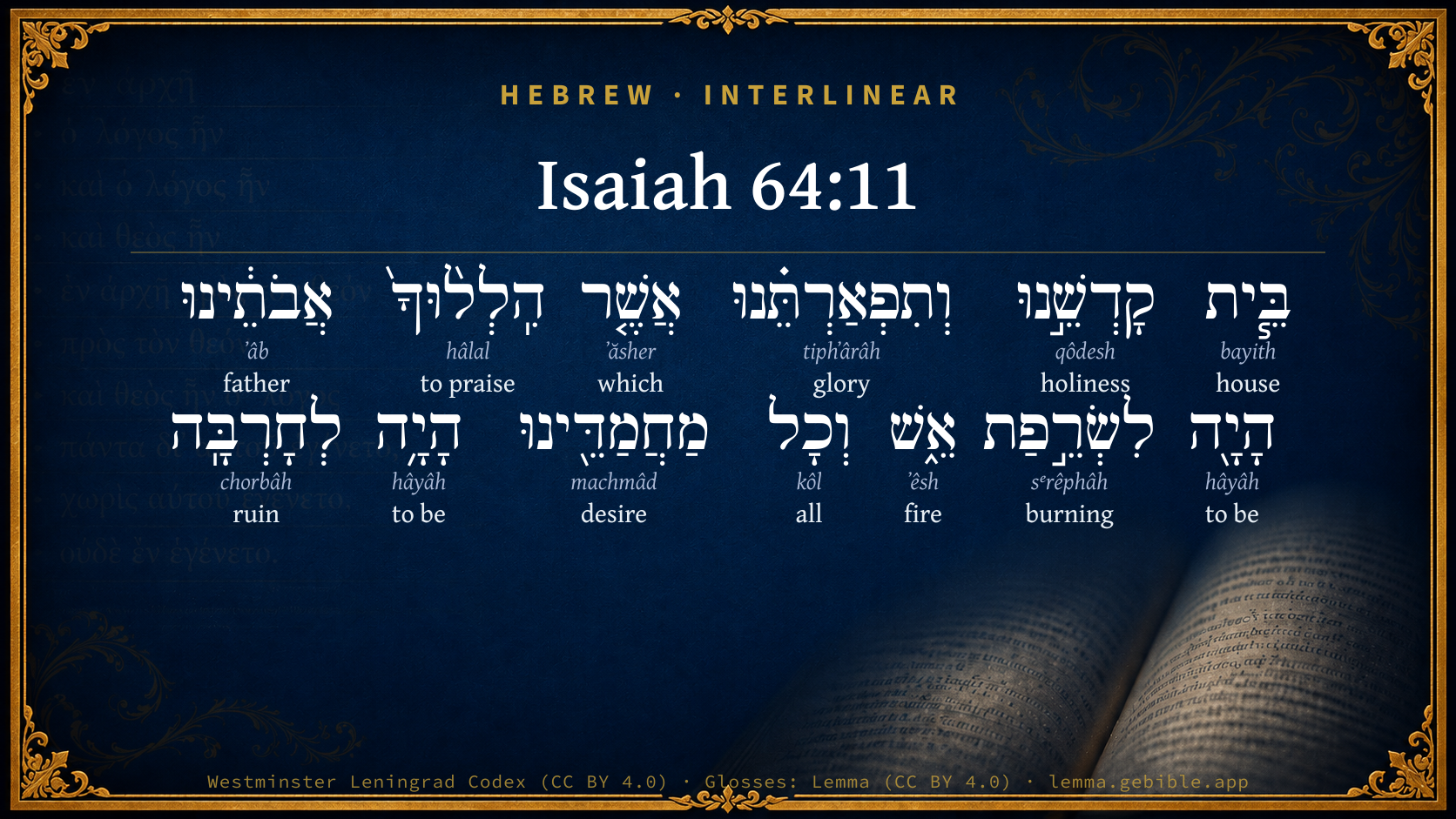
  1. בֵּ֧ית bayith H1004 “house of” Noun, Common, Masculine, Singular, Construct
  2. קָדְשֵׁ֣נוּ qôdesh H6944 “holiness · our” Noun, Common, Masculine, Singular, Construct + Suffix, Personal, 1st Person, Common, Plural
  3. וְתִפְאַרְתֵּ֗נוּ tiphʼârâh H8597 “and · glory · our” Conjunction + Noun, Common, Feminine, Singular, Construct + Suffix, Personal, 1st Person, Common, Plural
  4. אֲשֶׁ֤ר ʼăsher H834 “which” Particle, Relative
  5. הִֽלְל֨וּךָ֙ hâlal H1984 “to praise · you” Verb, Piel, Perfect, 3rd Person, Common, Plural + Suffix, Personal, 2nd Person, Masculine, Singular
  6. אֲבֹתֵ֔ינוּ ʼâb H1 “fathers · our” Noun, Common, Masculine, Plural, Construct + Suffix, Personal, 1st Person, Common, Plural
  7. הָיָ֖ה hâyâh H1961 “to be” Verb, Qal, Perfect, 3rd Person, Masculine, Singular
  8. אֵ֑שׁ ʼêsh H784 “fire” Noun, Common, Both, Singular, Absolute
  9. וְכָל kôl H3605 “and · all of” Conjunction + Noun, Common, Masculine, Singular, Construct
  10. מַחֲמַדֵּ֖ינוּ machmâd H4261 “desires · our” Noun, Common, Masculine, Plural, Construct + Suffix, Personal, 1st Person, Common, Plural
  11. הָיָ֥ה hâyâh H1961 “to be” Verb, Qal, Perfect, 3rd Person, Masculine, Singular
  12. לְחָרְבָּֽה chorbâh H2723 “to/for · ruin” Preposition + Noun, Common, Feminine, Singular, Absolute

About this verse

These counts appear in no published source. They are computed here, from the morphology-tagged text and Lemma’s own curated glosses. What Lemma adds →

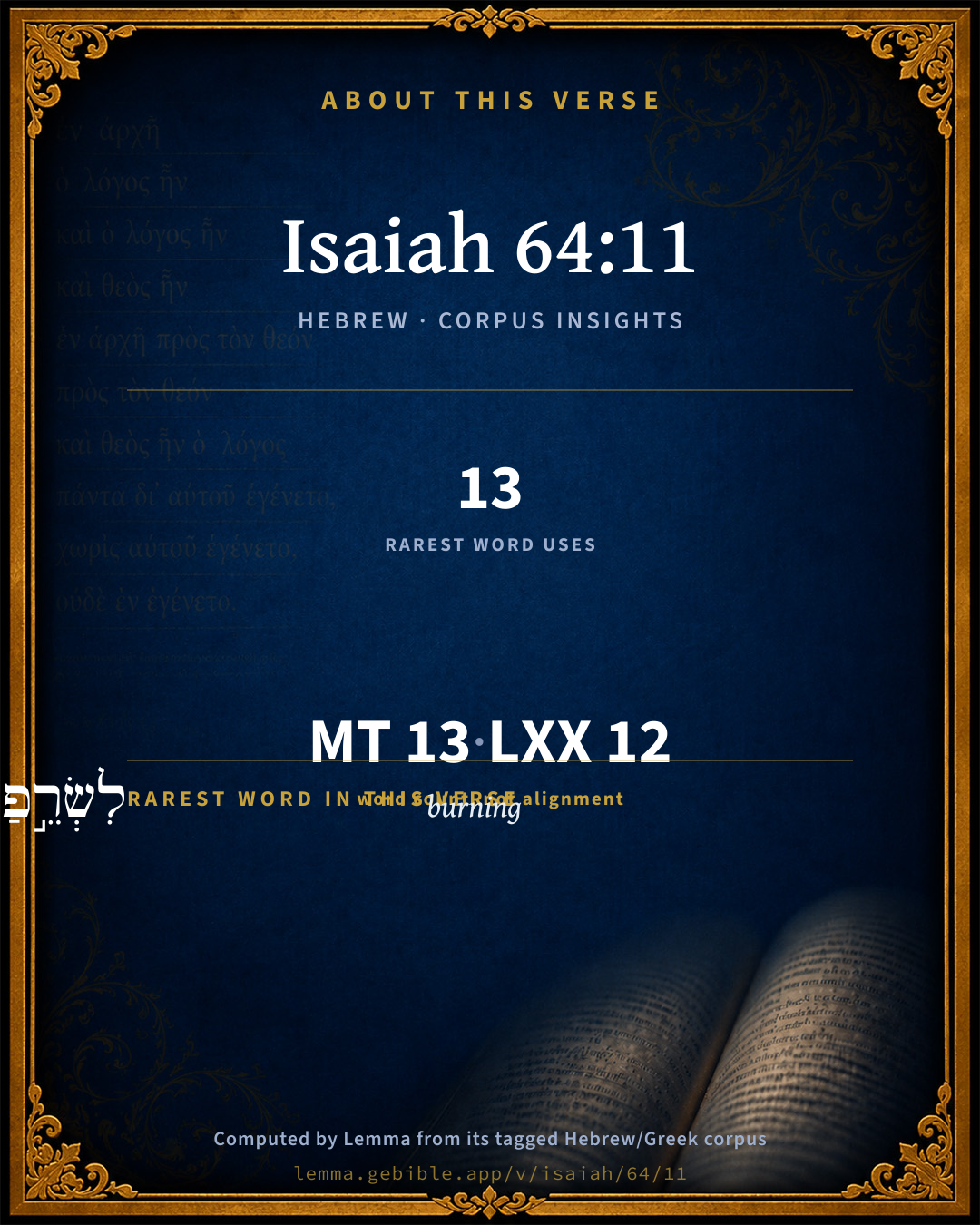
13
words
12
distinct lemmas
Prophets
section

Notable vocabulary

The rarest word here is לִשְׂרֵ֣פַת burning H8316 — appearing just 13 times in the whole Hebrew Bible.

Shared distinctive vocabulary

לִשְׂרֵ֣פַת burning H8316 occurs in 12 verses of the Hebrew Bible. Also found in:

Grammatical profile

  • 3 verbs
  • 9 nouns
  • 1 particle

Verb forms

  • הִֽלְל֨וּךָ֙ Piel · Perfect
  • הָיָ֖ה Qal · Perfect
  • הָיָ֥ה Qal · Perfect

Repetition

A word recurs within this verse — often emphatic in Hebrew:

  • הָיָ֖ה to be H1961 ×2

Hebrew & Septuagint length

In English translation the verse runs 23 words from the Hebrew and 25 from the Septuagint (LXX English) — closely comparable.

A rough comparison of the two English renderings, which tokenize alike — not a word-level alignment.

Word counts can differ between the Hebrew and the Greek without any difference in meaning — e.g. the Hebrew direct-object marker אֵת has no separate Greek word, and Greek often adds the article ὁ.

In the original languages it is 13 Hebrew tokens and 12 Greek tokens — but the two are counted differently (Hebrew bundles its prefixes and suffixes into one token; the Greek is in lemma form), so that isn’t a like-for-like length.

Cross-references

17

Topical passages linked to Isaiah 64:11 in the Treasury of Scripture Knowledge — connected by theme and wording, ordered by reader-vote popularity; previews shown in the World English Bible.

  • 2 Kings 25:9 He burnt the house of Yahweh, and the king's house; and all the houses of Jerusalem, even every great house, burnt he with fire.
  • Psalms 74:5–7 They behaved like men wielding axes, Cutting through a thicket of trees.
  • 2 Chronicles 36:19 They burnt the house of God, and broke down the wall of Jerusalem, and burnt all the palaces of it with fire, and destroyed all the goodly vessels of it.
  • Lamentations 1:7 Jerusalem remembers in the days of her affliction and of her miseries all her pleasant things that were from the days of old: When her people fell into the hand of the adversary, and none did help her, The adversaries saw her, they did mock at her desolations.
  • Lamentations 1:10–11 The adversary has spread out his hand on all her pleasant things: For she has seen that the nations are entered into her sanctuary, Concerning whom you did command that they should not enter into your assembly.
  • Jeremiah 52:13 and he burned the house of Yahweh, and the king's house; and all the houses of Jerusalem, even every great house, burned he with fire.
  • Lamentations 2:7 The Lord has cast off his altar, he has abhorred his sanctuary; He has given up into the hand of the enemy the walls of her palaces: They have made a noise in the house of Yahweh, as in the day of a solemn assembly.
  • Ezekiel 24:21 Speak to the house of Israel, Thus says the Lord Yahweh: Behold, I will profane my sanctuary, the pride of your power, the desire of your eyes, and that which your soul pities; and your sons and your daughters whom you have left behind shall fall by the sword.
  • 1 Kings 8:14 The king turned his face about, and blessed all the assembly of Israel: and all the assembly of Israel stood.
  • 1 Kings 8:56 Blessed be Yahweh, who has given rest to his people Israel, according to all that he promised: there has not failed one word of all his good promise, which he promised by Moses his servant.
  • 2 Chronicles 6:4 He said, Blessed be Yahweh, the God of Israel, who spoke with his mouth to David my father, and has with his hands fulfilled it, saying,
  • 2 Chronicles 7:3 All the children of Israel looked on, when the fire came down, and the glory of Yahweh was on the house; and they bowed themselves with their faces to the ground on the pavement, and worshiped, and gave thanks to Yahweh, [saying], For he is good; for his loving kindness endures for ever.
  • 2 Chronicles 7:6 The priests stood, according to their offices; the Levites also with instruments of music of Yahweh, which David the king had made to give thanks to Yahweh, (for his loving kindness endures for ever), when David praised by their ministry: and the priests sounded trumpets before them; and all Israel stood.
  • 2 Chronicles 29:25–30 He set the Levites in the house of Yahweh with cymbals, with psalteries, and with harps, according to the commandment of David, and of Gad the king's seer, and Nathan the prophet; for the commandment was of Yahweh by his prophets.
  • Ezekiel 7:20–21 As for the beauty of his ornament, he set it in majesty; but they made the images of their abominations [and] their detestable things therein: therefore have I made it to them as an unclean thing.
  • Ezekiel 24:25 You, son of man, shall it not be in the day when I take from them their strength, the joy of their glory, the desire of their eyes, and that whereupon they set their heart, their sons and their daughters,
  • Matthew 24:2 But he answered them, "Don't you see all of these things? Most assuredly I tell you, there will not be left here one stone on another, that will not be thrown down."

Cross-references courtesy of OpenBible.info (CC BY 4.0).

Hebrew and Greek witnesses Masoretic Hebrew ↔ Greek Septuagint

The same verse in the two great witnesses to the Old Testament, shown verse-for-verse.

These are two independent witnesses, not word-aligned to each other, and the Septuagint is shown in lemma (dictionary) form.

Hebrew Isaiah 64:11 Masoretic · Westminster Leningrad Codex

בֵּ֧ית קָדְשֵׁ֣נוּ וְתִפְאַרְתֵּ֗נוּ אֲשֶׁ֤ר הִֽלְל֨וּךָ֙ אֲבֹתֵ֔ינוּ הָיָ֖ה לִשְׂרֵ֣פַת אֵ֑שׁ וְכָל מַחֲמַדֵּ֖ינוּ הָיָ֥ה לְחָרְבָּֽה

Our holy and our beautiful house, where our fathers praised you, is burned with fire; and all our pleasant places are laid waste.

World English Bible · Public Domain

Greek LXX Isaiah 64:11 Septuagint · lemma form

καί ἐπί πᾶς οὗτος ἀναἔχω κύριος καί σιωπάω καί ταπεινόω ἐγώ σφόδρα

The house, our sanctuary, and the glory which our fathers blessed, has been burnt with fire: and all our glorious things have gone to ruin.

LXX2012 (modern English Septuagint) · Public Domain

Hebrew: Westminster Leningrad Codex (CC BY 4.0). Greek: Septuagint (public domain); English from LXX2012 (modern English Septuagint) (Public Domain). How the Septuagint differs from the Hebrew →

Targum (Aramaic paraphrase)

1

The Targum is the ancient Jewish Aramaic paraphrase of the Hebrew Scriptures — an interpretive translation, not the Hebrew text itself. Onkelos (literal) and Pseudo-Jonathan (expansive) render the Torah, and Jonathan the Prophets. Coverage is partial: where no permissively-licensed English translation exists for a verse, only the Aramaic is shown. This is verse-level text, not a word-by-word alignment to the Hebrew.

  1. Targum Jonathan Prophets (Joshua–Malachi)
    הַעַל אִלֵין תִּתְחַסָן יְיָ וְאַתְּ יָהֵיב אַרְכָּא לְרַשִׁיעַיָא דִמְשַׁעְבְּדִין בָּנָא עַד עַלְמָא:

    Wilt Thou refrain Thyself for these things, O Lord? and wilt Thou give prosperity for ever to the wicked, who make us servile?

    Targum Jonathan — Aramaic: “Mikraot Gedolot” (public domain). English: “Sefaria Community Translation” (CC0 1.0 (public-domain dedication)); “London "Chaldee Paraphrase," 1871” (public domain). Text via Sefaria.

Commentary

Notes on Isaiah 64:11 from classic Christian and Jewish commentators (each source and its license shown beneath its notes). The classic Christian expositions comment on the surrounding passage and are grouped to its opening verse, so a note may address several verses; the Jewish commentaries on the Tanakh (Rashi and others) are per-verse, so they appear only where the commentator wrote on this verse.

Lemma curates 59 commentaries, every one of them public domain or Creative Commons licensed, each selected and text-cleaned for this edition rather than reprinted as found. About our sources →

Trapp's Complete Commentary

John Trapp

Isa 64:11 Our holy and our beautiful house, where our fathers praised thee, is burned up with fire: and all our pleasant things are laid waste.

Ver. 11. Our holy and our beautiful house.] The Church riseth higher and higher in her complaints to God; we must do likewise.

Where our fathers praised thee.] Their own praises there they mention not, as not holding them worth mentioning.

John Trapp, A Commentary or Exposition upon All the Books of the Old and New Testament (1647–1656) — public domain. Text from a community e-Sword module.

The Biblical Illustrator

Joseph S. Exell

Isa_64:11

Our holy and our beautiful house, where our fathers praised Thee, is burned up with fire

The burnt temple

I.

HERE IS PATHETIC LAMENTATION.

1. The children of Israel regarded the temple as their own house. They spoke of it as Gods house. But because it was Gods it was their own, for they were Gods; and all that particularly belonged to Him had a special interest for them, and they had a special claim in it.

2. This temple was sacred in the peoples eyes. The prophet calls it, our holy house. It was really so.

3. The Jews, exiled abroad, thought of yonder ruined house where their fathers praised the Lord. There is no attachment stronger than that which exists between men and women, sons and daughters of Christian fathers and mothers, who are worshipping in the place where their predecessors worshipped.

4. All their pleasant things were laid waste.

II. HERE IS AFFECTIONATE EXPOSTULATION. Wilt Thou refrain Thyself? etc. The plain English of it is, Canst Thou bear to see this, Lord? Does it not affect Thee as it does us? Hast Thou no sighs, no groans, no tears? And if Thou hast, wilt Thou not pluck Thy hand from out Thy bosom and help us? Wilt Thou not open Thy lips and speak a word of peace? We cannot bear Thy silence, Lord. Wilt Thou hold Thy peace, and afflict us very sore? (T. Spurgeon.)

All our pleasant things are laid waste

Religious thing, pleasant things

The ordinances of religion are, to the Israel of God, pleasant things.

I. WHAT ARE THEY?

1. In the number of their pleasant things, they include the sanctuary. To them the temple is not a ]prison, a place of confinement and correct!on; but the house of their heavenly Father, their holy and beautiful house; beautiful because holy.

2. In the number of their pleasant things they include Sabbaths. To many, indeed, Gods holy day is uninviting, and even irksome. But the Christian calls the Sabbath a delight, and considers the holy of the Lord honourable. To him it is a time of refreshing from the presence of the Lord; a weekly jubilee: and, wearied with the toils, and follies, and vexations of the world, he hails a day of seclusion from it.

3. Are not the Scriptures some of their pleasant things?

4. This too will apply to the preaching of the Word.

5. They find it a pleasant thing to approach God in prayer, and to come before His presence with singing--a pleasant thing to surround His table, and to refresh their minds with the memorials of a Saviours dying love--to be in the circle of pious friends, and hear from their lips what God has done for their souls.

II. HOW THEY BECOME SO POWERFULLY ATTRACTIVE. For it is certain they are not so universally: by numbers they are not only neglected, but despised. Whence, then, do real Christians find them so pleasing?

1. There is in them a suitableness to their dispositions. Thus we know music charms those who have an ear for it. Money is a pleasant thing to the covetous; honour to the ambitious; scandal to the slanderous. In all these instances there is something that meets the taste; and that which gratifies always delights. So it is here. The pleasure of the Christian does not depend upon persuasion--but inclination.

2. experience is another source of this pleasure.

3. Continual need also renders them pleasant things.

III. REVIEW WHAT WE HAVE SAID--and learn--

1. To justify religion from the reproaches of the world. The world pretends that the services which religion demands of us are all slavery and gloom. But if you are willing to enter in, let no mans heart fail him.

2. Let us try ourselves by this rule. A man may want assurance and still be in a state of safety: but if he be habitually a stranger to pleasure in Divine things, and can pass through all the services of religion as a mere formalist, it is an awful proof that he has no part nor lot in the matter; his heart is not right in the sight of God. A number of speculative opinions, cold ceremonies, cheap moralities, in which the affections have no share, can never be a substitute for real devotion.

3. What an affliction do Christians sustain when they are deprived of their pleasant things! This may be done in two ways.

(1) By the removal of these privileges from them. Thus persecution has sometimes forbidden them to assemble together, and has silenced their preachers, destroyed their sanctuaries, and banished all religious ordinances from a neighbourhood. God sometimes inflicts His judgments upon a place for neglect and abuse of Gospel privileges.

(2) By removing Christians from these privileges. Thus business may call them away from a favoured situation, accidents or sickness may detain them prisoners from the courts of the Lord.

4. Let us be very thankful that these pleasant things are within our reach--that we have been so long favoured with them--that we have them in so rich an abundance--that we have liberty to partake of them--and strength to go forth and enjoy them.

5. Let us raise our thoughts and desires after the pleasant things of heaven. Philip. Henry often, said, when he had finished the delightful exercises of the Sabbath, Well, if this be not the way to heaven, I know not what is. These are introductory to the glory that shall be revealed: they are foretastes to endear it, and earnests to insure it. (W. Jay.)

The Biblical Illustrator, edited by Joseph S. Exell (c. 1880s–1900s) — public domain. Text from a community e-Sword module.

Geneva Bible (1599)

Geneva Bible translators

Wherein we rejoiced and worshipped thee.

Geneva Bible (1599) marginal notes — public domain. Text via Bolls.life.

Jamieson, Fausset & Brown

Robert Jamieson, A. R. Fausset & David Brown

house--the temple.

beautiful--includes the idea of glorious (Mar 13:1; Act 3:2).

burned-- (Psa 74:7; Lam 2:7; Ch2 36:19). Its destruction under Nebuchadnezzar prefigured that under Titus.

pleasant things--Hebrew, "objects of desire"; our homes, our city, and all its dear associations.

Jamieson, Fausset & Brown — Commentary Critical and Explanatory on the Whole Bible (1871) — public domain (CC PDM 1.0). Text via the HelloAO Bible API.

Ellicott's Commentary for English Readers

(11) Our holy and our beautiful house . . .—The destruction of the Temple, which, on the assumption of Isaiah’s authorship, the prophet sees in vision, with all its historic memories, comes as the climax of suffering, and, therefore, of the appeal to the compassion of Jehovah.

All our pleasant things . . .—Probably, as in 2Ch_36:19, the precincts, porticoes, and other “goodly buildings” of the Temple.

A Bible Commentary for English Readers, edited by Charles John Ellicott (1878–1897) — public domain. Text from a community e-Sword module.

The Cambridge Bible for Schools and Colleges

gen. ed. J. J. S. Perowne

11. The reference must apparently be to the first Temple and its destruction by the Chaldæans. The expression, and indeed the whole tone of the passage, suggest an event not quite recent; it is not the present generation, but their fathers who praised God in the “holy and beautiful house.” The question then comes to be whether this could have been said after the erection of Zerubbabel’s Temple. In spite of the tendency to hyperbolical language which marks the prayer, and the painful contrast between the magnificence of the first Temple and the poverty of the second, it is difficult to think that the author should absolutely ignore the existence of the sanctuary if it had been restored. See Introductory note.

is burned with fire] Lit. “has become a burning of fire”; cf. ch. Isa_9:5.

our pleasant things] Rather, our desirable places; cf. 2Ch_36:19; Lam_1:10; Eze_24:21; Eze_24:25.

The Cambridge Bible for Schools and Colleges (gen. ed. J. J. S. Perowne; Cambridge University Press, 1878–1918) — public domain. Text from a community e-Sword module.

John Gill's Exposition

Our holy and our beautiful house,.... Meaning the temple, the house of God, as Aben Ezra: called "holy", because dedicated to holy uses; where the holy sacrifices were offered up, the holy service of God performed; and where the holy God granted his presence, and where were the symbols of it: and "beautiful", in its building, as the first temple was that was built by Solomon; but here the second temple is meant, built by Zerubbabel, which being repaired and beautified by Herod, was a very beautiful building; and the Jews say (d), that

"he who has not seen the building of Herod has never seen a beautiful building;''

or it may be rendered, "the house of our holiness, and of our glory" (e); where their holy services were performed, and which was the glory of their nation, and on which they gloried and boasted:

where our fathers praised thee: with psalms and songs; the singers in the temple, as Aben Ezra; and the priests and all the people also, who, by their various services, as well as songs, gave praise and glory to God in this place; they do not mention their own services and praises, which they had been very negligent of, or not sincerely performed; but their fathers, which had been acceptable to the Lord, and therefore would bear mentioning when theirs would not: now this place, in which the glory of God and the interest of his people were concerned,

is burnt up with fire; this is true, as Kimchi observes, both of the first and second temple; the first was burnt with fire by Nebuchadnezzar king of Babylon, Jer 52:13, and the second by the Romans under Titus the man emperor, as Josephus (f) relates:

and all our pleasant things are laid waste; their pleasant land, and pleasant cities, and especially Jerusalem, the palaces of their princes and nobles, and all the riches and grandeur of them, the temple, and all the rich vessels and utensils in it.

(d) T. Bab. Bava Bathra, fol. 4. 1. & Succa, fol. 51. 2. (e) "domus sanctitatis nostae, et gloriae nostrae", Calvin, Junius & Tremellius, Forerius. (f) De Bello Judaeorum, l. 6. c. 4. sect. 2.

John Gill's Exposition of the Whole Bible (1746–1763) — public domain (CC PDM 1.0). Text via the HelloAO Bible API.

Albert Barnes' Notes on the Bible

Our holy and our beautiful house - The temple. It was called ‘holy,’ because it was dedicated to the service of God; and ‘beautiful,’ on account of its extraordinary magnificence. The original word more properly means glorious.

Where our fathers praised thee - Few attachments become stronger than that which is formed for a place of worship where our ancestors have long been engaged in the service of God. It was now a great aggravation of their sufferings, that that beautiful place, consecrated by the fact that their forefathers had long there offered praise to God, was lying in ruins.

Is burned up with fire - (See 2Ch 36:19).

And all our pleasant things - All that is precious to us (Hebrew); all the objects of our desire. The reference is to their temples, their homes, their city - to all that was dear to them in their native land. It would be difficult to find a passage anywhere in the Bible - or out of it - that equals this for tenderness and true pathos. They were an exiled people; long suffering in a distant land with the reflection that their homes were in ruins; their splendid temple long since fired and lying in desolation; the rank grass growing in their streets, and their whole country overrun with wild beasts, and with a rank and unsubdued vegetation. To that land they longed to return, and here with the deepest emotion they plead with God in behalf of their desolate country. The sentiment here is, that we should go to God with deep emotion when his church is prostrate, and that then is the time when we should use the most tender pleadings, and when our hearts should be melted within us.

Albert Barnes' Notes on the Bible (1834–1885) — public domain. Text from a community e-Sword/MySword module.

Matthew Poole's English Annotations

Our holy and our beautiful house; the temple, Isa 60:7; q.d. Not only our cities, and our principal cities, but even our temple, which we thought sacred and inviolable, in which we have gloried, because it was thine, and our fathers, and ours, the place where thy holy service was performed, and thy glory and presence was manifested.

Our fathers; not presuming to mention themselves, they had been so every way abominable, but their fathers.

All our pleasant things; the king’s palace, and the houses of the nobles, and other places of state and magnificence, 2Ki 25:9; Lam 1:7,10; or, their synagogues; or, those stately pieces about the temple.

Matthew Poole's English Annotations on the Holy Bible (1683–1685) — public domain. Text from a community e-Sword/MySword module.

The Pulpit Commentary

Our holy and our beautiful house. This is the true meaning. The exiles have the tenderest and most vivid remembrance of the holiness and the beauty (or glory) of that edifice, which had formed the centre of the national life for above four centuries, and had been a marvel of richness and magnificence. Many of them had seen it with their own eyes, (Ezr_3:12) and could never forget its splendours. Where our fathers praised thee. Though in the later times of the Captivity there were still some of the exiles who had seen the temple, and probably worshipped in it, yet with the great majority it was otherwise. They thought of the temple as the place where their "fathers" had worshipped. Burned up with fire. (see 2Ki_25:9 2Ch_36:19 Jer_52:13) Our pleasant things; or, our delectable things as in Isa_44:9; the courts, gardens, outbuildings of the temple, are probably meant.

The Pulpit Commentary (1880–1919), ed. H.D.M. Spence-Jones & Joseph S. Exell — public domain. Text from a community e-Sword module.

John Wesley's Explanatory Notes

Pleasant things - The king's palace, and the houses of the nobles, and other pieces of state and magnificence.

John Wesley, Explanatory Notes Upon the Whole Bible (1754–1765) — public domain. Text via the GEBible commentary corpus.

J. A. Alexander on Isaiah

Joseph Addison Alexander

“Our house of holiness and beauty, (in) which our fathers praised Thee, has been burned up with fire, and all our delights (or desirable places) have become a desolation.” The elliptical use of the relative in reference to place is the same as in Gen 39:20. ‘Burned up,’ literally, become a burning of fire, as in Isa 9:6. The reference in this verse is of course to the destruction of the temple, but to which destruction is disputed. Some refer it to the Babylonian conquest, when the temple, as we are expressly told, was burnt (Jer 52:13), some to its profanation by Antiochus Epiphanes, at which time, however, it was not consumed by fire; many later writers, with the Jews themselves, to its destruction by the Romans, since which the city and the land have lain desolate. To the first and last of these events the words are equally appropriate. Either hypothesis being once assumed, the particular expressions admit of being easily adapted to it. With our own hypothesis the passage may be reconciled in several different ways. There is nothing, however, in the terms themselves, or in the analogy of prophetic language, to forbid our understanding this as a description of the desolations of the church itself, expressed by figures borrowed from the old economy and from the ancient history of Israel. If literally understood, the destruction of the temple and the holy city may be here lamented as a loss not merely to the Jewish nation, but to the church of God to which they rightfully belong and by which they ought yet to be recovered, a sense of which obligation blended with some superstitious errors gave occasion to the fanatical attempt of the crusades. (See above; on Isa 63:18).

Joseph Addison Alexander, The Prophecies of Isaiah (1846–1847; New York: Scribner, 1870–1878) — public domain. Text from a community e-Sword module.

Rashi

Rabbi Shlomo Yitzchaki (Rashi)

will You remain silent and afflict us Will You remain silent concerning what is done to us? Until here is the prophet’s prayer. Its beginning is (supra 63:7) “The kind acts of the Lord I will mention.”

Rashi on the Tanakh — English translations: “The Judaica Press complete Tanach with Rashi, translated by A. J. Rosenberg” (CC BY 4.0); “Pentateuch with Rashi's commentary by M. Rosenbaum and A.M. Silbermann, 1929-1934” (public domain); “The Metsudah Tanach series, Lakewood, N.J” (CC BY 4.0); and “The Book of Joshua, Metsudah Publications, 1997” (CC BY 4.0). Text via Sefaria.

Ibn Ezra

Rabbi Abraham ibn Ezra

תחשה Wilt Thou hold Thy peace? Wilt Thou not hasten to save us.

Ibn Ezra on the Tanakh — English translations: “Sefaria Community Translation” (CC0 1.0 (public-domain dedication)); “Yalkut, Sifsei Chachomim Chumash, Metsudah Publications, 2009” (CC BY 4.0); and “Commentary of Ibn Ezra on Isaiah - trans. by M. Friedlander, 1873” (public domain). Text via Sefaria.

Lesson kit

Teaching starters — assembled from the data on this page, not authored interpretation. Every prompt links to the verse data it draws on. Edit before teaching.

Isaiah, in the Prophets, opens this verse with 13 words (12 distinct Hebrew lemmas). Its most distinctive word is sᵉrêphâh (“burning”). A historical commentator’s framing appears above. Read the whole chapter for the surrounding context.

Discussion questions

  1. The word sᵉrêphâh carries the sense “burning.” How does it shape the verse?
  2. How does Genesis 11:3, which shares the word «burning», read alongside this verse?
  3. What does the repetition of “to be” (2× in this one verse) do in this verse?
  4. These translations render this verse differently; the difference is in the English rendering, not the original. What questions does that raise?
  5. «הִֽלְל֨וּךָ֙» is a Piel Perfect verb. How does that grammatical form shape the action described?
  6. Compare how Trapp's Complete Commentary and The Biblical Illustrator read this verse. Where do they agree or differ?

Things to notice

Reading settings

Reading text

Shown beneath each verse's original-language words.

Old Testament
Old Testament edition

Read the OT as the Masoretic Hebrew (MT) or the Greek Septuagint (LXX).

English shown for the Greek Septuagint (in the Hebrew ↔ Greek comparison).

Comparing translations? Open the Compare panel on any verse page to stack up to four side by side.