
Jeremiah 46:9

Hebrew (Westminster Leningrad Codex) Jeremiah 46:9 appears in the Hebrew Old Testament. The text above is from the Westminster Leningrad Codex. Each word links to its Strong’s number, a concise gloss, and parsing drawn from the Open Scriptures Hebrew Bible morphology. Click any word for its full Brown-Driver-Briggs (BDB) entry.
Download image
Cite this verse

Jeremiah 46:9 (World English Bible). Public Domain. Lemma interlinear Bible study tool, https://lemma.gebible.app/v/jeremiah/46/9.

Show BibTeX & RIS
BibTeX
RIS
English Translation
Go up, you horses; and rage, you chariots; and let the mighty men go forth: Cush and Put, who handle the shield; and the Ludim, who handle and bend the bow.
World English Bible · Public Domain
Download a study sheet

One document with this verse’s original text, its word-by-word gloss line, the meaning frame, cross-references with their text, attributed commentary, and full source and license credits — printable, and it pastes into notes with its structure intact.

This verse Autodidact and up

Study sheet (.html) Plain text (.txt)

A passage Seminary Student

Up to 50 verses in one chapter. A passage sheet keeps up to 6 commentary sources and 12 cross-references per verse, in the order this page ranks them, and says so on the sheet whenever that leaves anything out. Ask for a single verse and you get the Autodidact verse sheet above.

Everything on this page stays free to read, with no account — the sheet is a download of what is already on screen, not access to it.

Want to remove ads? Support Godless Engineer
Compare translations 3

The same verse in 3 English versions, stacked beneath the original-language interlinear above. Click any original word for its lexicon entry.

Each is an independent rendering of the whole verse — the interlinear is not word-aligned to these translations.

Highlighted words mark where these versions differ — a whole-verse word diff, not a word-by-word alignment.

  • World English Bible Public Domain
    Go up, you horses; and rage, you chariots; and let the mighty men go forth: Cush and Put, who handle the shield; and the Ludim, who handle and bend the bow.
  • King James Version Public Domain
    Come up, ye horses; and rage, ye chariots; and let the mighty men come forth; the Ethiopians and the Libyans, that handle the shield; and the Lydians, that handle and bend the bow.
  • unfoldingWord Literal Text CC BY-SA 4.0
    Go up, horses. Be angry, you chariots. Let the soldiers go out, Cush and Put, men skillful with a shield, and Ludim, men skillful at bending their bows.’

unfoldingWord Literal Text — © unfoldingWord, licensed CC BY-SA 4.0. Word-aligned USFM3 via Door43 (git.door43.org/unfoldingWord/en_ult).

Versions to compare (up to 4)

3 of 4 selected

Show all 18 translations

Every available English version of this verse, each an independent rendering of the whole verse.

  • World English Bible Public Domain
    Go up, you horses; and rage, you chariots; and let the mighty men go forth: Cush and Put, who handle the shield; and the Ludim, who handle and bend the bow.
  • Berean Standard Bible Public Domain
    Advance, O horses! Race furiously, O chariots! Let the warriors come forth—Cush and Put carrying their shields, men of Lydia drawing the bow.
  • Majority Standard Bible Public Domain
    Advance, O horses! Race furiously, O chariots! Let the warriors come forth—Cush and Put carrying their shields, men of Lydia drawing the bow.
  • King James Version Public Domain
    Come up, ye horses; and rage, ye chariots; and let the mighty men come forth; the Ethiopians and the Libyans, that handle the shield; and the Lydians, that handle and bend the bow.
  • American Standard Version (1901) Public Domain
    Go up, ye horses; and rage, ye chariots; and let the mighty men go forth: Cush and Put, that handle the shield; and the Ludim, that handle and bend the bow.
  • Revised Version (1885) Public Domain
    Go up, ye horses; and rage, ye chariots; and let the mighty men go forth: Cush and Put, that handle the shield; and the Ludim, that handle and bend the bow.
  • Geneva Bible (1599) Public Domain
    Come vp, ye horses, and rage ye charets, and let the valiant men come foorth, the blacke Mores, and the Lybians that beare the shield, and the Lydians that handle and bend the bowe.
  • Douay-Rheims (1899) Public Domain
    Get ye up on horses, and glory in chariots, and let the valiant men come forth, the Ethiopians, and the Libyans that hold the shield, and the Lydians that take, and shoot arrows.
  • Young's Literal Translation Public Domain
    Go up, ye horses; and boast yourselves, ye chariots, And go forth, ye mighty, Cush and Phut handling the shield, And Lud handling -- treading the bow.
  • Literal Standard Version CC BY-SA 4.0
    Go up, you horses; and boast yourselves, you chariots, || And go forth, you mighty, || Cush and Phut handling the shield, || And Lud handling—treading the bow.
  • Unlocked Literal Bible CC BY-SA 4.0
    Go up, horses. Be angry, you chariots. Let the soldiers go out, Cush and Put, men skillful with a shield, and Ludim, men skillful at bending their bows.'
  • unfoldingWord Literal Text CC BY-SA 4.0
    Go up, horses. Be angry, you chariots. Let the soldiers go out, Cush and Put, men skillful with a shield, and Ludim, men skillful at bending their bows.’
  • Darby Bible Public Domain
    Go up, ye horses, and drive furiously, ye chariots; and let the mighty men go forth: Cush and Phut that handle the shield, and the Ludim that handle the bow [and] bend it.
  • World Messianic Bible Public Domain
    Go up, you horses! Rage, you chariots! Let the mighty men go out: Cush and Put, who handle the shield; and the Ludim, who handle and bend the bow.
  • Webster's Bible Public Domain
    Come up, ye horses; and rage, ye chariots; and let the mighty men come forth: the Cushites and the Libyans, that handle the shield; and the Lydians that handle and bend the bow.
  • Free Bible Version CC BY-SA 4.0
    Horses, charge in! Chariots, drive like crazy! Have the infantry advance: soldiers from Ethiopia and Put carrying their shields, archers from Lydia with their bows.
  • Bible in Basic English Public Domain
    Go up, you horses; go rushing on, you carriages of war; go out, you men of war: Cush and Put, gripping the body-cover, and the Ludim, with bent bows.
  • JPS Tanakh (1917) Public Domain
    Prance, ye horses, and rush madly, ye chariots; and let the mighty men go forth: Cush and Put, that handle the shield, and the Ludim, that handle and bend the bow.

Literal Standard Version (2020), Covenant Press — licensed CC BY-SA 4.0. Text via the HelloAO Bible API (eBible.org). Unlocked Literal Bible (unfoldingWord) — licensed CC BY-SA 4.0. Text via the HelloAO Bible API (eBible.org). unfoldingWord Literal Text — © unfoldingWord, licensed CC BY-SA 4.0. Word-aligned USFM3 via Door43 (git.door43.org/unfoldingWord/en_ult). Free Bible Version, Dr. Jonathan Gallagher — licensed CC BY-SA 4.0. Text via the HelloAO Bible API (eBible.org).

Word by word

More ways to search: Search by grammar → Find every occurrence → Compare this word →

Practice this passage: Drill this verse → Learn its vocabulary →

וְלוּדִ֕ים
Lûwdîy
H3866
“and · Ludim”
Conjunction + Noun, Proper
Part of Speech
Conjunction + Noun
Type
Proper
Full BDB Definition

Origin: patrial from H3865

TWOT: None

Ludim or Lydians = "to the firebrands: travailings" - the descendants of Lud the son of Shem
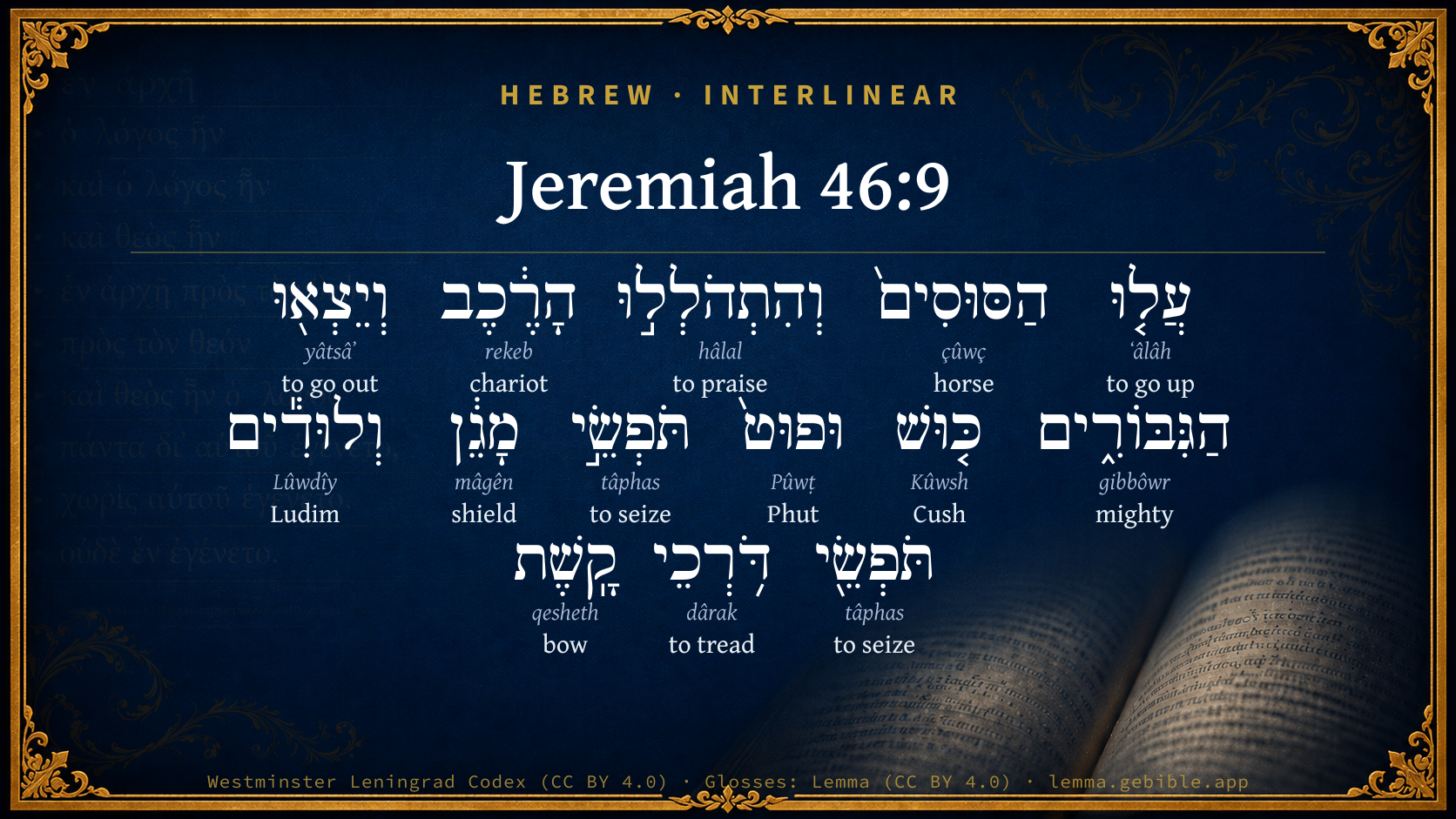
  1. עֲל֤וּ ʻâlâh H5927 “go up” Verb, Qal, Imperative, 2nd Person, Masculine, Plural
  2. הַסּוּסִים֙ çûwç H5483 “the · horses” Particle, Definite Article + Noun, Common, Masculine, Plural, Absolute
  3. וְהִתְהֹלְל֣וּ hâlal H1984 “and · praise” Conjunction + Verb, Hithpolel, Imperative, 2nd Person, Masculine, Plural
  4. הָרֶ֔כֶב rekeb H7393 “the · chariot” Particle, Definite Article + Noun, Common, Masculine, Singular, Absolute
  5. וְיֵצְא֖וּ yâtsâʼ H3318 “and · to go out” Conjunction + Verb, Qal, Imperfect, 3rd Person, Masculine, Plural
  6. הַגִּבּוֹרִ֑ים gibbôwr H1368 “the · mighty” Particle, Definite Article + Adjective, Adjective, Masculine, Plural, Absolute
  7. כּ֤וּשׁ Kûwsh H3568 “Cush” Noun, Proper
  8. וּפוּט֙ Pûwṭ H6316 “and · Phut” Conjunction + Noun, Proper
  9. תֹּפְשֵׂ֣י tâphas H8610 “seizing” Verb, Qal, Participle Active, Masculine, Plural, Construct
  10. מָגֵ֔ן mâgên H4043 “shield” Noun, Common, Both, Singular, Absolute
  11. תֹּפְשֵׂ֖י tâphas H8610 “seizing” Verb, Qal, Participle Active, Masculine, Plural, Construct
  12. דֹּ֥רְכֵי dârak H1869 “treading” Verb, Qal, Participle Active, Masculine, Plural, Construct
  13. קָֽשֶׁת qesheth H7198 “bow” Noun, Common, Feminine, Singular, Absolute

About this verse

These counts appear in no published source. They are computed here, from the morphology-tagged text and Lemma’s own curated glosses. What Lemma adds →

14
words
13
distinct lemmas
Prophets
section

Notable vocabulary

The rarest word here is וְלוּדִ֕ים Ludim H3866 — appearing just 4 times in the whole Hebrew Bible.

Shared distinctive vocabulary

וְלוּדִ֕ים Ludim H3866 occurs in 3 verses of the Hebrew Bible. Also found in:

Grammatical profile

  • 6 verbs
  • 7 nouns
  • 1 adjective

Verb forms

  • עֲל֤וּ Qal · Imperative
  • וְהִתְהֹלְל֣וּ Hithpolel · Imperative
  • וְיֵצְא֖וּ Qal · Imperfect
  • תֹּפְשֵׂ֣י Qal · Participle Active
  • תֹּפְשֵׂ֖י Qal · Participle Active
  • דֹּ֥רְכֵי Qal · Participle Active

Repetition

A word recurs within this verse — often emphatic in Hebrew:

  • תֹּפְשֵׂ֣י to seize H8610 ×2

Cross-references

11

Topical passages linked to Jeremiah 46:9 in the Treasury of Scripture Knowledge — connected by theme and wording, ordered by reader-vote popularity; previews shown in the World English Bible.

  • Isaiah 66:19 I will set a sign among them, and I will send such as escape of them to the nations, to Tarshish, Pul, and Lud, who draw the bow, to Tubal and Javan, to the isles afar off, who have not heard my fame, neither have seen my glory; and they shall declare my glory among the nations.
  • Ezekiel 27:10 Persia and Lud and Put were in your army, your men of war: they hanged the shield and helmet in you; they set forth your comeliness.
  • Nahum 3:9 Cush and Egypt were her boundless strength. Put and Libya were her helpers.
  • Genesis 10:6 The sons of Ham: Cush, Mizraim, Put, and Canaan.
  • Genesis 10:13 Mizraim became the father of Ludim, Anamim, Lehabim, Naphtuhim,
  • 1 Chronicles 1:11 Mizraim became the father of Ludim, and Anamim, and Lehabim, and Naphtuhim,
  • Jeremiah 30:5 For thus says Yahweh: We have heard a voice of trembling, of fear, and not of peace.
  • Jeremiah 47:3 At the noise of the stamping of the hoofs of his strong ones, at the rushing of his chariots, at the rumbling of his wheels, the fathers don't look back to their children for feebleness of hands;
  • Nahum 2:3–4 The shield of his mighty men is made red. The valiant men are in scarlet. The chariots flash with steel in the day of his preparation, and the pine spears are brandished.
  • Acts 2:10 Phrygia, Pamphylia, Egypt, the parts of Libya around Cyrene, visitors from Rome, both Jews and proselytes,
  • 1 Corinthians 1:8 who will also confirm you until the end, blameless in the day of our Lord Jesus Christ.

Cross-references courtesy of OpenBible.info (CC BY 4.0).

Hebrew and Greek witnesses Masoretic Hebrew ↔ Greek Septuagint

The same verse in the two great witnesses to the Old Testament, shown verse-for-verse.

These are two independent witnesses, not word-aligned to each other, and the Septuagint is shown in lemma (dictionary) form.

Hebrew Jeremiah 46:9 Masoretic · Westminster Leningrad Codex

עֲל֤וּ הַסּוּסִים֙ וְהִתְהֹלְל֣וּ הָרֶ֔כֶב וְיֵצְא֖וּ הַגִּבּוֹרִ֑ים כּ֤וּשׁ וּפוּט֙ תֹּפְשֵׂ֣י מָגֵ֔ן וְלוּדִ֕ים תֹּפְשֵׂ֖י דֹּ֥רְכֵי קָֽשֶׁת

Go up, you horses; and rage, you chariots; and let the mighty men go forth: Cush and Put, who handle the shield; and the Ludim, who handle and bend the bow.

World English Bible · Public Domain

Greek LXX Structure differs

In the Septuagint, Jeremiah is about an eighth shorter than the Hebrew and arranges its material differently — the Oracles Against the Nations (Hebrew chapters 46–51) appear in the middle of the Greek book, after 25:13. Because the chapter and verse boundaries do not line up, a verse-for-verse comparison with the Hebrew is not shown.

A verse-for-verse comparison isn’t shown here because the chapters and verses don’t line up. Switch to the LXX edition with the MT / LXX toggle above to read the Greek directly.

On this verse, Ellicott's Commentary for English Readers discusses the Septuagint’s reading. Read the note in Commentary ↓

Hebrew: Westminster Leningrad Codex (CC BY 4.0). Greek: Septuagint (public domain); English from a public-domain English Septuagint. How the Septuagint differs from the Hebrew →

Targum (Aramaic paraphrase)

1

The Targum is the ancient Jewish Aramaic paraphrase of the Hebrew Scriptures — an interpretive translation, not the Hebrew text itself. Onkelos (literal) and Pseudo-Jonathan (expansive) render the Torah, and Jonathan the Prophets. Coverage is partial: where no permissively-licensed English translation exists for a verse, only the Aramaic is shown. This is verse-level text, not a word-by-word alignment to the Hebrew.

  1. Targum Jonathan Prophets (Joshua–Malachi)
    יִסְקוּן סוּסְוָתָא וְיִשְׁתַּגְשׁוּן רְתִיכַיָא וְיִפְקוּן גִבָּרַיָא כּוּשָׁאֵי וּפוּטָאֵי אֱחֲדֵי תְרֵסִין וְלוּדָאֵי דְנַגְדִין וּמָחָן בְּקַשְׁתָּא:

    (no public-domain English translation for this verse)

    Targum Jonathan — Aramaic: “Mikraot Gedolot” (public domain). English: “Sefaria Community Translation” (CC0 1.0 (public-domain dedication)); “London "Chaldee Paraphrase," 1871” (public domain). Text via Sefaria.

Commentary

Notes on Jeremiah 46:9 from classic Christian and Jewish commentators (each source and its license shown beneath its notes). The classic Christian expositions comment on the surrounding passage and are grouped to its opening verse, so a note may address several verses; the Jewish commentaries on the Tanakh (Rashi and others) are per-verse, so they appear only where the commentator wrote on this verse.

Lemma curates 59 commentaries, every one of them public domain or Creative Commons licensed, each selected and text-cleaned for this edition rather than reprinted as found. About our sources →

Trapp's Complete Commentary

John Trapp

Jer 46:9 Come up, ye horses; and rage, ye chariots; and let the mighty men come forth; the Ethiopians and the Libyans, that handle the shield; and the Lydians, that handle [and] bend the bow.

Ver. 9. Come up, ye horses,] i.e., Ye horsemen, all the cavalry of Egypt. {as Exo 14:7}

And rage.] Or, Bestir yourselves as if ye were wild or mad: instar furiarum discurrite per campos.

The Ethiopians and the Lybians.] The Africans that were confederates and auxiliaries to the Egyptians.

John Trapp, A Commentary or Exposition upon All the Books of the Old and New Testament (1647–1656) — public domain. Text from a community e-Sword module.

Tyndale Open Study Notes

Tyndale Open Resources

46:9-10 The Lord had decreed that Egypt would lose the battle, so allies would be of little help. The battle of Carchemish was pivotal to the rise of Babylon as the great empire of the area.

Tyndale Open Study Notes — © Tyndale Open Resources, licensed CC BY-SA 4.0. Text via the HelloAO Bible API.

Geneva Bible (1599)

Geneva Bible translators

For these nations took part with the Egyptians.

Geneva Bible (1599) marginal notes — public domain. Text via Bolls.life.

Jamieson, Fausset & Brown

Robert Jamieson, A. R. Fausset & David Brown

Ironical exhortation, as in Jer 46:3. The Egyptians, owing to the heat of their climate and abstinence from animal food, were physically weak, and therefore employed mercenary soldiers.

Ethiopians--Hebrew, Cush: Abyssinia and Nubia.

Libyans--Phut, Mauritania, west of Egypt (compare Gen 10:6).

shield--The Libyans borrowed from Egypt the use of the long shield extending to the feet [XENOPHON, Cyropædia, 6 and 7].

Lydians--not the Lydians west of Asia Minor (Gen 10:22; Eze 30:5), but the Ludim, an African nation descended from Egypt (Mizraim) (Gen 10:13; Eze 30:5; Nah 3:9).

handle and bend the bow--The employment of two verbs expresses the manner of bending the bow, namely, the foot being pressed on the center, and the hands holding the ends of it.

Jamieson, Fausset & Brown — Commentary Critical and Explanatory on the Whole Bible (1871) — public domain (CC PDM 1.0). Text via the HelloAO Bible API.

Adam Clarke's Commentary

Verse 9. The Ethiopians] Heb. Cush, Phut, and the Ludim. This army was composed of many nations. Cush, which we translate Ethiopians, almost invariably means the Arabians; and here, those Arabs that bordered on Egypt near the Red Sea. Phut probably means the Libyans; for Phut settled in Libya, according to Josephus. Phut and Cush were two of the sons of Ham, and brothers to Mitsraim, the father of the Egyptians, Ge 10:6; and the Ludim were descended from Mitsraim; see Ge 10:13. Bochart contends that the Ludim were Ethiopians, and that they were famous for the use of the bow. Phaleg, lib. iv. 26.

Adam Clarke's Commentary on the Bible (1810–1826) — public domain. Text from a community e-Sword/MySword module.

John Calvin's Commentaries

He goes on with the same subject, and enumerates whatever might discredit his prophecy. For when the faithful saw that the Egyptians went on that expedition not only with immense forces, but had also, as foreign aids, the Ethiopians and the Libyans, and even transmarine soldiers from Lydia, — when they saw hired soldiers from all parts joined to the Egyptians, it was hardly credible that such an army could be put to flight. Then the Prophet says here, that though Pharaoh hired the Ethiopians, the Libyans, and the Lydians, yet with all these forces he would perish.

He again speaks in the name of Pharaoh, Ascend, ye horses; toss, ye chariots, and let the valiant come forth This coming forth may refer to the lands whence they came. He mentions first the Ethiopians, who were near the Egyptians, though separated from them. Then he adds the people of Libya, who were Africans, or who were in the middle between Egypt and Africa. Then he says, that they laid hold on the shield. He points out their principal armor, not that they were without a helmet and sword and other arms, but they mainly trusted in their shields. As we know that the Macedonians wore the pelta, and were remarkable for that piece of armor, so the Prophet says that the Ethiopians and Libyans were furnished with bucklers or shields. He mentions also the Lydians, who were from another part, even from the opposite shore of the sea; for we know that the Lydians were in Asia Minor, while the Egyptians were in the middle between Africa and Judea. The Mediterranean Sea was therefore between them. It hence appears, that auxiliaries from a distance, and with great expense, were procured by Pharaoh when he undertook this war. And it is also probable that other nations were hired; but the Prophet mentions only the Ethiopians, Libyans, and Lydians: and he says, that those named last laid hold on the bow, because they were the best archers. It now follows, —

John Calvin's Commentaries (1540-1563) — public domain. Text from the Calvin Translation Society English edition (1840s-50s) via the Christian Classics Ethereal Library (ccel.org). Calvin's coverage is partial (roughly two-thirds of the Bible); uncommented books and verses are honest gaps, never fabricated. The 19th-century editor's footnotes and remarks are omitted so the notes are faithfully Calvin's own voice.

Ellicott's Commentary for English Readers

(9) The Ethiopians and the Libyans.—In the Hebrew, Cush and Put. The verse describes the prominent elements in the composition of the Egyptian army. The “chariots and horses” had long been proverbial (1Ki_10:28-29; 2Ch_1:16; Exo_15:19). The Cushites were the Ethiopians of the Upper Valley of the Nile, sometimes, as under Zerah (2Ch_14:9) and Tirhakah (2Ki_19:9), asserting their independence, but at this time subject to Necho. The name Phut meets us, with Cush and Mizraim, in the list of the sons of Ham in Gen_10:6; and presumably, therefore, belongs to an African people. Wherever it is mentioned by the prophets it is as an ally or tributary of Egypt (Nah_3:9; Eze_27:10; Eze_30:5; Eze_38:5). The LXX. version renders it by Libyan, and is followed by the Vulgate and the English. In Nah_3:9, however, Phut is distinguished from the Libyans (= Lubim); and the LXX. has but one word for both. The word PET is found on Egyptian inscriptions, both as meaning a “bow”and as the name of a people, and this may correspond to the Put of the Hebrew text. The Lydians, or Ludim, are named in the list of Hamite nations as descended from Mizraim (Gen_10:13); the name is joined with Phut in Eze_27:10, with Cush and Phut in Eze_30:4-5. This would seem to point to an African rather than an Asiatic people like the Lydians. On the other hand, we learn from Herodotus (ii. 153) that, some thirty or forty years before the time of Jeremiah and Ezekiel, Psammetichus I. had settled a large colony of Ionian and Carian emigrants on both banks of the Nile, between Bubastis and the Pelusiac mouth of that river, and that Amasis afterwards formed them into a bodyguard at Memphis. It is obvious that the fame of the monarchy which had its capital at Sardis might easily lead to these Greeks being classed as Lydians, and that thus the name (without entering into its earlier ethnological significance) would acquire a new prominence at the time when the prophets wrote in connexion with Egypt.

A Bible Commentary for English Readers, edited by Charles John Ellicott (1878–1897) — public domain. Text from a community e-Sword module.

The Cambridge Bible for Schools and Colleges

gen. ed. J. J. S. Perowne

9. Probably a continuation of Pharaoh’s appeal to his warriors, as put into his mouth by Jeremiah.

Go up] The summons is to cavalry, chariots, and infantry that they should set forth from Egypt.

Cush and Put … and the Ludim] the mercenary troops, who formed from the days of Psammetichus the chief part of the Egyptian armies. The Ethiopians (Cush) were children of Ham (Gen_10:6). The situation of Put is doubtful. It is generally placed on the N. coast of Africa, W. of Egypt, but may have been Punt, a country on the Red Sea. The Ludim (see Gen_10:13) were also Africans. Possibly, however, we should read Lubim here, as in Nah_3:9, i.e. the people of Libya (W. of Egypt). We have the three peoples here mentioned spoken of again as Egyptian mercenaries in Eze_30:5.

bend] literally, tread, string.

The Cambridge Bible for Schools and Colleges (gen. ed. J. J. S. Perowne; Cambridge University Press, 1878–1918) — public domain. Text from a community e-Sword module.

John Gill's Exposition

Come up, ye horses; and rage, ye chariots,.... These are either the words of Pharaoh, giving orders to his cavalry and charioteers to make haste and come up to battle, not doubting of victory: or rather of the Lord by the prophet, ironically calling upon the horsemen in the Egyptian army to come on and engage with the enemy, and behave gallantly; and those in the chariots to drive, Jehu like, Kg2 9:20, with great swiftness, force, and fury, to make their chariots rattle again, and run about here and there like madmen, as the word (u) signifies, to throw the enemy into confusion and disorder if they could:

and let the mighty men come forth: out of the land of Egypt, as Abarbinel; or let them come forth, and appear in the field of battle with courage and greatness of mind, and do all their might and skill can furnish them with, or enable them to do:

the Ethiopians and the Lybians, that handle the shield; or Cush and Phut, both sons of Ham, and brethren of Mizraim, from whence Egypt had its name, Gen 10:6; the posterity of these are meant. The Cushites or Ethiopians were near neighbours of the Egyptians, and their allies and confederates. The Lybians or Phuteans, as the Targum, were the posterity of Phut, who dwelt to the westward of Egypt, and were the auxiliaries of that nation, and with the Ethiopians and Lydians are mentioned as such in Eze 30:4; as here. The shield was a weapon they much used in war, and were famous for their skill in it, and are described by it. The Egyptians were remarkable for their shields: Xenophon (w) describes them as having shields reaching down to their feet; and which covered their bodies more than the breast plates and targets of the Persians did; which helped them to push forward, having them on their shoulders, so that the enemy could not withstand them:

and the Lydians, that handle and bend the bow; these were the posterity of Ludim the son of Mizraim, Gen 10:13; and were the Lydians in Africa, and not in Asia, who sprung from Lud the son of Shem, Gen 10:22; they were famous for their skilfulness in the use of bows and arrows; see Isa 66:19; now these are called together to use their military skill, and show all the courage they were masters of; and yet all would be in vain. Bochart (x) endeavours to prove, by various arguments, that these Lydians were Ethiopians; and, among the rest, because they are here, and in Isa 66:19; described as expert in handling, bending, and drawing the bow; which he proves, by the testimonies of several writers, the Ethiopians were famous for; that bows were their armour; and that theirs were larger than others, even than the Persians, being four cubits long; that they were very dexterous in shooting their arrows; took sure aim, and seldom missed.

(u) "insanite", Pagninus, Montanus, Cocceius, Schmidt; "insano impetu agitamini", Junius & Tremellius, Piscator. (w) Cyropaedia, l. 6. c. 14. & l. 7. c. 9. (x) Phaleg. l. 4. c. 26. col. 266.

John Gill's Exposition of the Whole Bible (1746–1763) — public domain (CC PDM 1.0). Text via the HelloAO Bible API.

Albert Barnes' Notes on the Bible

Rather, Go up, advance, ye horses; and drive furiously, ye chariots; and let the mighty men go forth. They march out of Egypt, arranged in three divisions, cavalry, chariots, and infantry, to begin the campaign. The armies of Egypt were composed chiefly of mercenaries. Cush (see the margin), the Nubian negro, and Phut, the Libyans of Mauritania, supplied the heavy-armed soldiers Jer 46:3; and Ludim, the Hamite Lydians of North Africa (see Gen 10:13 note), a weaker race, served as light-armed troops.

Albert Barnes' Notes on the Bible (1834–1885) — public domain. Text from a community e-Sword/MySword module.

Haydock's Catholic Bible Commentary

Men. Soldiers formed one of the principal classes among the Egyptians. (Herodotus ii. 164.) --- Ethiopians. Hebrew, "Cush," in Lower Egypt, on the Red Sea. --- Lybians. Hebrew, "Phut, another son of Cham, inhabiting the Nome Phtenethu," Ezechiel xxx. 5., and Nahum iii. 2. --- Lydians. Their situation is not known.

George Leo Haydock (1774–1849), Haydock's Catholic Family Bible and Commentary, 1859 edition — public domain. Excludes Psalms (Douay-Rheims chapter numbering differs from Protestant) and Deuterocanonical books (Catholic canon only).

Matthew Poole's English Annotations

Their ancient way of fighting was with chariots and bows; the prophet calls, in the name of the commanders of the Egyptian armies, to the horses and chariots to come on, and engage in the fight. The

Ethiopians were the Cushites, who were neighbours to the Egyptians, so were the Libyans; both of them it should seem were famous for handling the shield: the

Libyans were descended from Phut; both the Cushites and the Phutites or Libyans were descended from Ham, Gen 10:6. The

Lydians were as famous for the use of the bow in war; they were descended from Mizraim or Shem, Gen 10:13,22; the Lydians here meant are thought to be those descended from Mizraim, and some think these were Ethiopians. They were all auxiliaries to the Egyptians in this expedition.

Matthew Poole's English Annotations on the Holy Bible (1683–1685) — public domain. Text from a community e-Sword/MySword module.

Whedon's Commentary on the Bible

Daniel D. Whedon

9. Ethiopians… Libyans… Lydians — Auxiliaries or mercenaries, because the Egyptians were not themselves of such physical vigour as to make a nation of soldiers. There is a similar description of the Egyptian army in Eze_30:5.

Daniel D. Whedon (gen. ed.), Commentary on the Old and New Testaments (1874–1909) — public domain. Text from a community e-Sword module.

The Pulpit Commentary

A call to the army, particularizing its two grand divisions, viz. the warriors in chariots, and the light and heavy armed infantry. M. Piorret, of the Egyptian Museum at the Louvre, writes thus: "The army was composed

(1) of infantry equipped with a cuirass, a buckler, a pike or an axe, and a sword; they manoeuvred to the sound of the drum and the trumpet;

(2) of light troops (archers, slingers, and other soldiers carrying the axe or the tomahawk);

(3) warriors in chariots. Cavalry, properly so called, was not employed ... The Egyptians also enlisted auxiliaries, such as Mashawash, a tribe of Libyans, who, after the defeat of a confederation of northern peoples hostile to Menephtah, into which they had entered, refused to leave Egypt, and entered the Egyptian army; the Kahakas, another Libyan tribe; the Shardanas (Sardinians); the Madjaiu, who, after having been in war with the Egyptians under the twelfth dynasty, enrolled themselves under the standard of their conquerors, and constituted a sort of gendarmerie," etc. ("Dictionnaire d"Archdologie Egyptienne," pp. 64, 65). Among the mercenaries mentioned by Jeremiah, the Ludim deserve special mention. They are generally supposed to be a North African people. (and so Eze_30:5) Professor Sayce, however, thinks they may be the Lydian soldiers by whose help Psammetichus made Egypt independent of Assyria, and his successors maintained their power (Cheyne"s "Prophecies of Isaiah," 2:287). Come up, ye horses; rather, bound (or, prance), ye horses. The verb is literally go up, and seems to be used in the same sense, only in the Hiphil or causative conjugation, in Nah_3:3 (which should begin, "Horsemen making (their horses) to rear"). Ewald and others render, "Mount the horses," the phrase being substantially the same as in ver. 4 (see above). But the parallelism here is opposed to this; and the prophet has evidently been a reader of the prophecy of Nahum, as the very next clause shows. Rage, ye chariots; rather, rush madly, ye chariots. (alluding to Nah_2:5) The Ethiopians; Hebrew, Cush; often mentioned in connection with Egypt. The whole Nile valley, as far as Abyssinia, had been reduced to an Egyptian province. At last Cush had its turn of revenge, and an Ethiopian dynasty reigned in the palaces of Thebes (s.c. 725-665). The Libyans; Hebrew, Put. (which occurs in combination with Lud, as here with Ludim, in Eze_27:10 Eze_30:5) This appears to be the Egyptian Put (nasalized into Punt), i.e. the Somali country on the east coast of Africa, opposite to Arabia (Brugsch).

The Pulpit Commentary (1880–1919), ed. H.D.M. Spence-Jones & Joseph S. Exell — public domain. Text from a community e-Sword module.

John Wesley's Explanatory Notes

And the Lydians - They were all auxiliaries to the Egyptians in this expedition.

John Wesley, Explanatory Notes Upon the Whole Bible (1754–1765) — public domain. Text via the GEBible commentary corpus.

Rashi

Rabbi Shlomo Yitzchaki (Rashi)

and rush madly Heb. והתהללו, an expression of folly.

Rashi on the Tanakh — English translations: “The Judaica Press complete Tanach with Rashi, translated by A. J. Rosenberg” (CC BY 4.0); “Pentateuch with Rashi's commentary by M. Rosenbaum and A.M. Silbermann, 1929-1934” (public domain); “The Metsudah Tanach series, Lakewood, N.J” (CC BY 4.0); and “The Book of Joshua, Metsudah Publications, 1997” (CC BY 4.0). Text via Sefaria.

Lesson kit

Teaching starters — assembled from the data on this page, not authored interpretation. Every prompt links to the verse data it draws on. Edit before teaching.

Jeremiah, in the Prophets, opens this verse with 14 words (13 distinct Hebrew lemmas). Its most distinctive word is Lûwdîy (“Ludim”). A historical commentator’s framing appears above. Read the whole chapter for the surrounding context.

Discussion questions

  1. How does “Ludim” (Lûwdîy) shape what this verse is saying?
  2. Genesis 10:13 shares the word «Ludim» with this verse. How do the two illuminate each other?
  3. “to seize” occurs 2× in this one verse. What is the effect of the repetition?
  4. These translations render this verse differently; the difference is in the English rendering, not the original. What questions does that raise?
  5. The verb «עֲל֤וּ» is Qal Imperative. How does its form color the action?
  6. Reading how Trapp's Complete Commentary and Tyndale Open Study Notes read this verse, where do the two commentators agree and where do they part?

Things to notice

Reading settings

Reading text

Shown beneath each verse's original-language words.

Old Testament
Old Testament edition

Read the OT as the Masoretic Hebrew (MT) or the Greek Septuagint (LXX).

English shown for the Greek Septuagint (in the Hebrew ↔ Greek comparison).

Comparing translations? Open the Compare panel on any verse page to stack up to four side by side.