
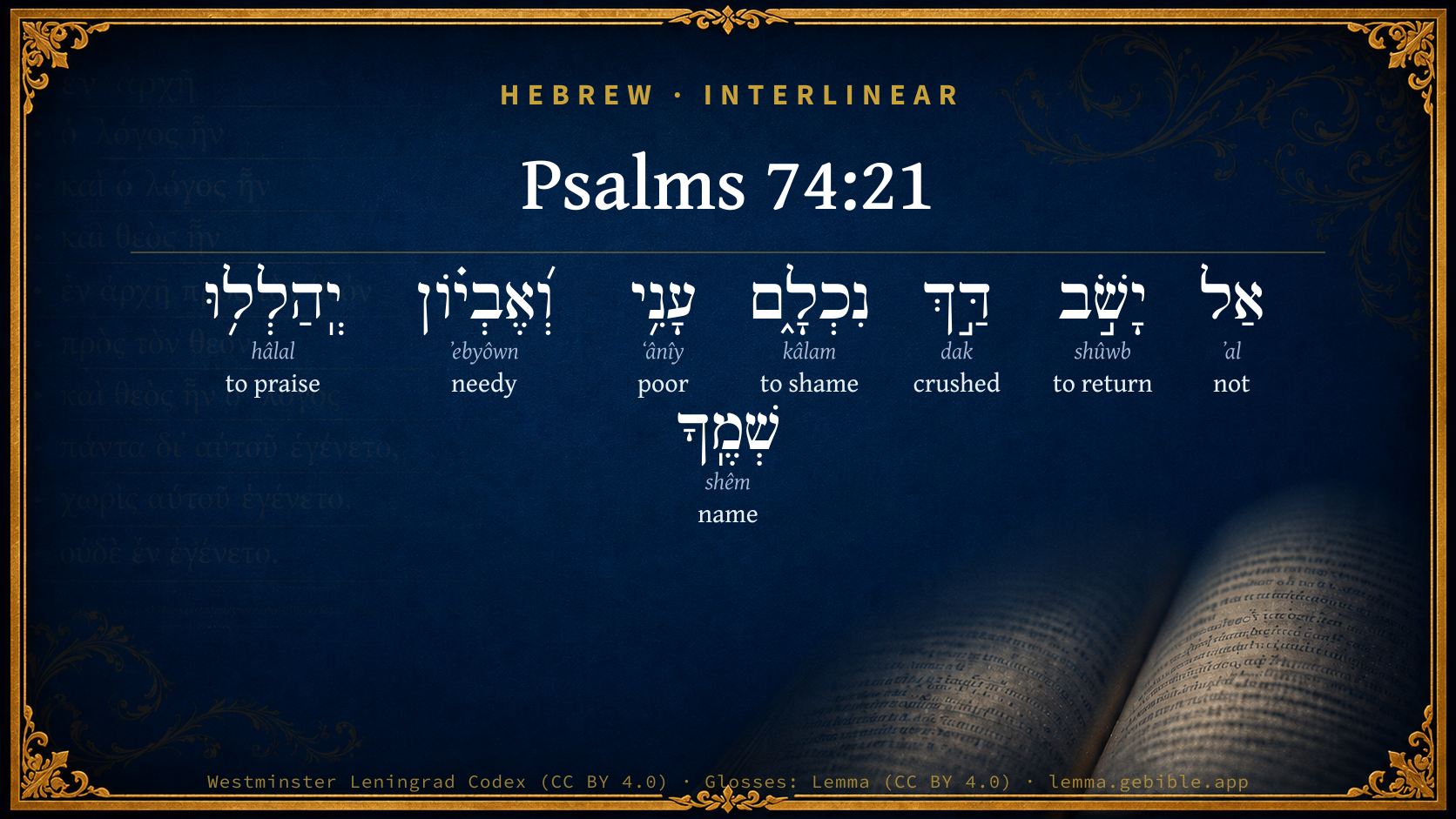
Psalms 74:21

Hebrew (Westminster Leningrad Codex) Psalms 74:21 appears in the Hebrew Old Testament. The text above is from the Westminster Leningrad Codex. Each word links to its Strong’s number, a concise gloss, and parsing drawn from the Open Scriptures Hebrew Bible morphology. Click any word for its full Brown-Driver-Briggs (BDB) entry.
Download image
Cite this verse

Psalms 74:21 (World English Bible). Public Domain. Lemma interlinear Bible study tool, https://lemma.gebible.app/v/psalms/74/21.

Show BibTeX & RIS
BibTeX
RIS
English Translation
Don't let the oppressed return ashamed. Let the poor and needy praise your name.
World English Bible · Public Domain
Download a study sheet

One document with this verse’s original text, its word-by-word gloss line, the meaning frame, cross-references with their text, attributed commentary, and full source and license credits — printable, and it pastes into notes with its structure intact.

This verse Autodidact and up

Study sheet (.html) Plain text (.txt)

A passage Seminary Student

Up to 50 verses in one chapter. A passage sheet keeps up to 6 commentary sources and 12 cross-references per verse, in the order this page ranks them, and says so on the sheet whenever that leaves anything out. Ask for a single verse and you get the Autodidact verse sheet above.

Everything on this page stays free to read, with no account — the sheet is a download of what is already on screen, not access to it.

Want to remove ads? Support Godless Engineer
Compare translations 3

The same verse in 3 English versions, stacked beneath the original-language interlinear above. Click any original word for its lexicon entry.

Each is an independent rendering of the whole verse — the interlinear is not word-aligned to these translations.

Highlighted words mark where these versions differ — a whole-verse word diff, not a word-by-word alignment.

  • World English Bible Public Domain
    Don't let the oppressed return ashamed. Let the poor and needy praise your name.
  • King James Version Public Domain
    O let not the oppressed return ashamed: let the poor and needy praise thy name.
  • unfoldingWord Literal Text CC BY-SA 4.0
    May the weak not return ashamed; may the poor and the needy praise your name.

unfoldingWord Literal Text — © unfoldingWord, licensed CC BY-SA 4.0. Word-aligned USFM3 via Door43 (git.door43.org/unfoldingWord/en_ult).

Versions to compare (up to 4)

3 of 4 selected

Show all 18 translations

Every available English version of this verse, each an independent rendering of the whole verse.

  • World English Bible Public Domain
    Don't let the oppressed return ashamed. Let the poor and needy praise your name.
  • Berean Standard Bible Public Domain
    Do not let the oppressed retreat in shame; may the poor and needy praise Your name.
  • Majority Standard Bible Public Domain
    Do not let the oppressed retreat in shame; may the poor and needy praise Your name.
  • King James Version Public Domain
    O let not the oppressed return ashamed: let the poor and needy praise thy name.
  • American Standard Version (1901) Public Domain
    Oh let not the oppressed return ashamed: Let the poor and needy praise thy name.
  • Revised Version (1885) Public Domain
    O let not the oppressed return ashamed: let the poor and needy praise thy name.
  • Geneva Bible (1599) Public Domain
    Oh let not the oppressed returne ashamed, but let the poore and needie prayse thy Name.
  • Douay-Rheims (1899) Public Domain
    Let not the humble be turned away with confusion: the poor and needy shall praise thy name.
  • Young's Literal Translation Public Domain
    Let not the oppressed turn back ashamed, Let the poor and needy praise Thy name,
  • Literal Standard Version CC BY-SA 4.0
    Do not let the oppressed turn back ashamed, || Let the poor and needy praise Your Name,
  • Unlocked Literal Bible CC BY-SA 4.0
    Do not let the oppressed be turned back in shame; let the poor and oppressed praise your name.
  • unfoldingWord Literal Text CC BY-SA 4.0
    May the weak not return ashamed; may the poor and the needy praise your name.
  • Darby Bible Public Domain
    Oh let not the oppressed one return ashamed; let the afflicted and needy praise thy name.
  • World Messianic Bible Public Domain
    Don’t let the oppressed return ashamed. Let the poor and needy praise your name.
  • Webster's Bible Public Domain
    O let not the oppressed return ashamed: let the poor and needy praise thy name.
  • Free Bible Version CC BY-SA 4.0
    Don't let those who suffer be mistreated again. Let the poor and needy praise you for you who are.
  • Bible in Basic English Public Domain
    O let not the crushed be turned back in shame; let the low man and the poor give praise to your name.
  • JPS Tanakh (1917) Public Domain
    O let not the oppressed turn back in confusion; let the poor and needy praise Thy name.

Literal Standard Version (2020), Covenant Press — licensed CC BY-SA 4.0. Text via the HelloAO Bible API (eBible.org). Unlocked Literal Bible (unfoldingWord) — licensed CC BY-SA 4.0. Text via the HelloAO Bible API (eBible.org). unfoldingWord Literal Text — © unfoldingWord, licensed CC BY-SA 4.0. Word-aligned USFM3 via Door43 (git.door43.org/unfoldingWord/en_ult). Free Bible Version, Dr. Jonathan Gallagher — licensed CC BY-SA 4.0. Text via the HelloAO Bible API (eBible.org).

Word by word

More ways to search: Search by grammar → Find every occurrence → Compare this word →

Practice this passage: Drill this verse → Learn its vocabulary →

About this verse

These counts appear in no published source. They are computed here, from the morphology-tagged text and Lemma’s own curated glosses. What Lemma adds →

8
words
8
distinct lemmas
Wisdom
section

Notable vocabulary

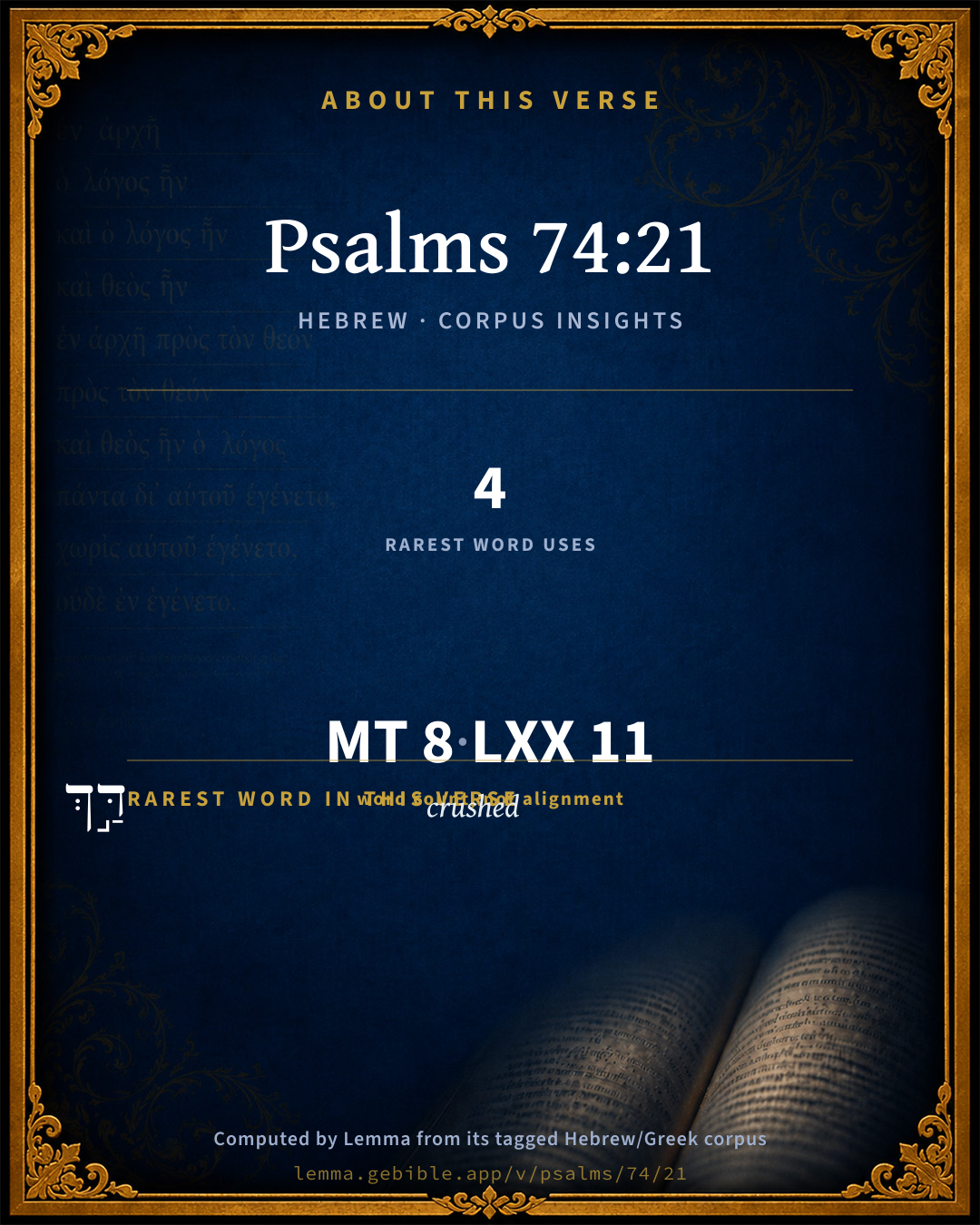
The rarest word here is דַּ֣ךְ crushed H1790 — appearing just 4 times in the whole Hebrew Bible.

Shared distinctive vocabulary

דַּ֣ךְ crushed H1790 occurs in 4 verses of the Hebrew Bible. Also found in:

Grammatical profile

  • 3 verbs
  • 1 noun
  • 3 adjectives
  • 1 particle

Verb forms

  • יָשֹׁ֣ב Qal · Jussive
  • נִכְלָ֑ם Niphal · Participle Active
  • יְֽהַלְל֥וּ Piel · Imperfect

Hebrew & Septuagint length

In English translation the verse runs 14 words from the Hebrew and 17 from the Septuagint (LXX English) — closely comparable.

A rough comparison of the two English renderings, which tokenize alike — not a word-level alignment.

Word counts can differ between the Hebrew and the Greek without any difference in meaning — e.g. the Hebrew direct-object marker אֵת has no separate Greek word, and Greek often adds the article ὁ.

In the original languages it is 8 Hebrew tokens and 11 Greek tokens — but the two are counted differently (Hebrew bundles its prefixes and suffixes into one token; the Greek is in lemma form), so that isn’t a like-for-like length.

Cross-references

9

Topical passages linked to Psalms 74:21 in the Treasury of Scripture Knowledge — connected by theme and wording, ordered by reader-vote popularity; previews shown in the World English Bible.

  • Psalms 12:5 "Because of the oppression of the weak and because of the groaning of the needy, I will now arise," says Yahweh; "I will set him in safety from those who malign him."
  • Ezra 3:11 They sang one to another in praising and giving thanks to Yahweh, [saying], For he is good, for his loving kindness endures forever toward Israel. All the people shouted with a great shout, when they praised Yahweh, because the foundation of the house of Yahweh was laid.
  • Psalms 9:18 For the needy shall not always be forgotten, Nor the hope of the poor perish forever.
  • Psalms 35:10 All my bones shall say, "Yahweh, who is like you, Who delivers the poor from him who is too strong for him, Yes, the poor and the needy from him who robs him?"
  • Psalms 103:6 Yahweh executes righteous acts, And justice for all who are oppressed.
  • Psalms 102:19–21 For he has looked down from the height of his sanctuary. From heaven, Yahweh saw the earth;
  • Psalms 109:22 For I am poor and needy. My heart is wounded within me.
  • Isaiah 45:17 [But] Israel shall be saved by Yahweh with an everlasting salvation: you shall not be disappointed nor confounded world without end.
  • Jeremiah 33:11 the voice of joy and the voice of gladness, the voice of the bridegroom and the voice of the bride, the voice of those who say, Give thanks to Yahweh of Hosts, for Yahweh is good, for his loving kindness endures forever; [and of them] who bring [sacrifices of] thanksgiving into the house of Yahweh. For I will cause the captivity of the land to return as at the first, says Yahweh.

Cross-references courtesy of OpenBible.info (CC BY 4.0).

Hebrew and Greek witnesses Masoretic Hebrew ↔ Greek Septuagint

The same verse in the two great witnesses to the Old Testament, shown verse-for-verse.

You’re reading Greek Psalm 73 (Hebrew Psalm 74). The Septuagint counts the superscription, so verse numbers can differ from the Hebrew — chapter-level alignment, not verse-by-verse. Numbering follows Rahlfs.

These are two independent witnesses, not word-aligned to each other, and the Septuagint is shown in lemma (dictionary) form.

Hebrew Psalms 74:21 Masoretic · Westminster Leningrad Codex

אַל יָשֹׁ֣ב דַּ֣ךְ נִכְלָ֑ם עָנִ֥י וְ֝אֶבְי֗וֹן יְֽהַלְל֥וּ שְׁמֶֽךָ

Don't let the oppressed return ashamed. Let the poor and needy praise your name.

World English Bible · Public Domain

Greek LXX Greek Psalm 73:21 Septuagint · lemma form

μή ἀποστρέφω ταπεινόω κατααἰσχύνω πτωχός καί πένης αἰνέω ὁ ὄνομα σύ

let not the afflicted and shamed one be rejected: the poor and needy shall praise your name.

LXX2012 (modern English Septuagint) · Public Domain

Hebrew: Westminster Leningrad Codex (CC BY 4.0). Greek: Septuagint (public domain); English from LXX2012 (modern English Septuagint) (Public Domain). How the Septuagint differs from the Hebrew →

Commentary

Notes on Psalms 74:21 from classic Christian and Jewish commentators (each source and its license shown beneath its notes). The classic Christian expositions comment on the surrounding passage and are grouped to its opening verse, so a note may address several verses; the Jewish commentaries on the Tanakh (Rashi and others) are per-verse, so they appear only where the commentator wrote on this verse.

Lemma curates 59 commentaries, every one of them public domain or Creative Commons licensed, each selected and text-cleaned for this edition rather than reprinted as found. About our sources →

Trapp's Complete Commentary

John Trapp

Psa 74:21 O let not the oppressed return ashamed: let the poor and needy praise thy name.

Ver. 21. O let not the oppressed, &c.] Contusus non revertatur confusus, let him not take the repulse, be disappointed of his expected help from heaven.

John Trapp, A Commentary or Exposition upon All the Books of the Old and New Testament (1647–1656) — public domain. Text from a community e-Sword module.

The Biblical Illustrator

Joseph S. Exell

Psa_74:21

Let the poor and needy praise Thy name.

The poor and needy have cause to praise Gods Name

Rev. Mark Guy Pearse relates that he was walking once beside some cliffs, when he saw a father draw near with his children; the two boys were running on in front, and every now and then the father called to them to be careful, and gave them various directions for their safety. But he was leading the little girl slowly and gently, for she was blind. Presently he sat down beside her and told her of all the beauties of the vision, cheering her by many a tender thought. He never let his healthy boys go beyond his sight and care, but the blind child he held continually by the hand. So let the weak ones be cheered and encouraged by the thought that for them there are special promises, special assurances of care: thank God, none of us can drift beyond the reach of His love, but His feeble children He is holding by the hand.

Psa_75:1-10

The Biblical Illustrator, edited by Joseph S. Exell (c. 1880s–1900s) — public domain. Text from a community e-Sword module.

Joseph Benson's Commentary

Psa 74:21-23. O let not the oppressed return ashamed — From thee, and from the throne of thy grace, to which they have recourse in this their distressed condition. “It is for the honour of God that they who apply to him for help should not, by returning without it, suffer shame and confusion in the presence of their insulting adversaries.” Let the poor and needy praise thy name — Which they will have a fresh motive to do, if thou deliver us. O God, plead thine own cause — Maintain thy honour, worship, and service, against those that reproach thee, as it here follows, and was observed before, Psa 74:10; Psa 74:18. As we are reviled and persecuted for thy sake, so thou art injured in all our wrongs. Forget not the voice of thine enemies — Their insulting and reproachful expressions against thee, as well as against us. The tumult — The tumultuous noise and loud clamours; of those that rise up against thee increaseth — They grow worse and worse, encouraging and hardening themselves in their wicked courses by their continual success and prosperity, and by thy patience extended to them.

Joseph Benson's Commentary on the Old and New Testaments (1811–1818) — public domain. Text from a community e-Sword module.

J. A. Alexander on Psalms

Joseph Addison Alexander

Psa 74:21. Let not the oppressed turn back confounded; let the sufferer and the poor (man) praise thy name. The word translated oppressed means strictly broken, bruised, or crushed. See above, on Psa 9:9; Psa 10:18. Turn back, abandon his pursuit, retire in despair. Confounded, disappointed, put to shame, by the frustration of his hopes and wishes. See above, on Psa 35:4; Psa 40:14; Psa 69:6; Psa 70:2.

Joseph Addison Alexander, The Psalms Translated and Explained (1850) — public domain. Text from a community e-Sword module.

Adam Clarke's Commentary

Verse 21. Let not the oppressed return ashamed] Do not permit thy people to be so diminished, that when, according to thy promise, they are restored to their own land, they may appear to be but a handful of men.

Adam Clarke's Commentary on the Bible (1810–1826) — public domain. Text from a community e-Sword/MySword module.

John Calvin's Commentaries

21. Let not him who is oppressed return with shame. The word return, as it has a reference to God, is equivalent to the expression, to go away empty. The faithful, then, beseech Him that they may not be put to shame by suffering a repulse at his hands. They call themselves afflicted, poor, and needy, as an argument to obtain the Divine favor and mercy. It is, however, to be observed, that they do not speak insincerely, nor give an exaggerated representation of their distresses, but intimate, that by so many calamities they were brought to such a low condition, that there no longer remained for them any quarter in the world from which they could expect any help. By this example, we are taught that when we are reduced to the greatest extremity, there is a remedy always ready for our misery, in calling upon God.

John Calvin's Commentaries (1540-1563) — public domain. Text from the Calvin Translation Society English edition (1840s-50s) via the Christian Classics Ethereal Library (ccel.org). Calvin's coverage is partial (roughly two-thirds of the Bible); uncommented books and verses are honest gaps, never fabricated. The 19th-century editor's footnotes and remarks are omitted so the notes are faithfully Calvin's own voice.

Ellicott's Commentary for English Readers

(21) Oppressed.—Literally, crushed. (See Psa_9:9; Psa_10:18.)

A Bible Commentary for English Readers, edited by Charles John Ellicott (1878–1897) — public domain. Text from a community e-Sword module.

The Cambridge Bible for Schools and Colleges

gen. ed. J. J. S. Perowne

21. O let not the oppressed &c.] Let not the crushed or down-trodden (Psa_9:9; Psa_10:18) turn back from Thee unanswered and disappointed.

let the poor &c.] Let the afflicted have cause to praise Thee for answered prayer.

The Cambridge Bible for Schools and Colleges (gen. ed. J. J. S. Perowne; Cambridge University Press, 1878–1918) — public domain. Text from a community e-Sword module.

John Gill's Exposition

Arise, O God, plead thine own cause,.... The church's cause being the cause of God; and therefore she desires that he would arise and exert himself, and take vengeance on his and her enemies: this is an interesting argument, and a forcible one:

remember how the foolish man reproacheth thee daily; this being so frequently repeated, as in Psa 74:10, shows how much the name and glory of God lay near her heart; the Targum is,

"remember the reproach of thy people by a foolish king all the day;''

perhaps the man of sin is meant, the king of the locusts, and angel of the bottomless pit.

John Gill's Exposition of the Whole Bible (1746–1763) — public domain (CC PDM 1.0). Text via the HelloAO Bible API.

Albert Barnes' Notes on the Bible

O let not the oppressed return ashamed - Ashamed by being disappointed, as if they had trusted in that which had no claims to confidence. Compare the notes at Job 6:20. The word rendered “oppressed,” means “trodden down, crushed, broken, afflicted.” It refers to the people as attacked by foreign armies, or as crushed by those who had gained power over them. The word “return” refers to their coining back from God - from the throne of mercy. Let them not come back from thee with no assurance of thy favor; with no evidence that their prayers have been heard; let them not come back, subject to the reproach that they had made their appeal to thee in vain.

Let the poor and needy praise thy name - The people who are oppressed and helpless. Let them have occasion to praise thee because their prayer has been heard, and because thou dost save them.

Albert Barnes' Notes on the Bible (1834–1885) — public domain. Text from a community e-Sword/MySword module.

Matthew Poole's English Annotations

Return ashamed from thee, and from the throne of thy grace, to which they make their resort in this their distressed condition.

Matthew Poole's English Annotations on the Holy Bible (1683–1685) — public domain. Text from a community e-Sword/MySword module.

The Treasury of David

Charles H. Spurgeon

Ver. 21. O let not the oppressed return ashamed. Though broken and crushed they come to thee with confidence; suffer them not to be disappointed, for then they will be ashamed of their hope.

Let the poor and needy praise thy name. By thy speedy answer to their cries make their hearts glad, and they will render to thee their gladdest songs. It is not the way of the Lord to allow any of those who trust in him to be put to shame; for his word is, "He shall call upon me, and I will deliver him, and he shall glorify me."

None.

None.

Psalms 74:22*

Charles H. Spurgeon's The Treasury of David (1869–1885) — public domain. Psalms only. Text from a community e-Sword/MySword module.

The Pulpit Commentary

O let not the oppressed return ashamed; i.e. let not this oppressed nation turn their back on thee in shame and confusion at thy forsaking them. Rather, let the poor and needy praise thy Name; i.e. show them some mercy, some deliverance, which may turn their shame into joy, and call forth from them songs of praise.

The Pulpit Commentary (1880–1919), ed. H.D.M. Spence-Jones & Joseph S. Exell — public domain. Text from a community e-Sword module.

John Wesley's Explanatory Notes

Return - From the throne of thy grace, to which they make their resort.

John Wesley, Explanatory Notes Upon the Whole Bible (1754–1765) — public domain. Text via the GEBible commentary corpus.

Rashi

Rabbi Shlomo Yitzchaki (Rashi)

Let not the poor turn back in disgrace Let the poor not turn back from before You disgraced in his prayer.

Rashi on the Tanakh — English translations: “The Judaica Press complete Tanach with Rashi, translated by A. J. Rosenberg” (CC BY 4.0); “Pentateuch with Rashi's commentary by M. Rosenbaum and A.M. Silbermann, 1929-1934” (public domain); “The Metsudah Tanach series, Lakewood, N.J” (CC BY 4.0); and “The Book of Joshua, Metsudah Publications, 1997” (CC BY 4.0). Text via Sefaria.

Lesson kit

Teaching starters — assembled from the data on this page, not authored interpretation. Every prompt links to the verse data it draws on. Edit before teaching.

Psalms, in the Wisdom, opens this verse with 8 words (8 distinct Hebrew lemmas). Its most distinctive word is dak (“crushed”). A historical commentator’s framing appears above. Read the whole chapter for the surrounding context.

Discussion questions

  1. What does “crushed” (dak) contribute to the verse as a whole?
  2. Psalms 9:9 shares the word «crushed» with this verse. How do the two illuminate each other?
  3. The translations on this page render this verse differently — a whole-verse word diff, not a word-by-word alignment. What might account for the different wordings?
  4. The verb «יָשֹׁ֣ב» is Qal Jussive. How does its form color the action?
  5. Reading how Trapp's Complete Commentary and The Biblical Illustrator read this verse, where do the two commentators agree and where do they part?

Things to notice

Reading settings

Reading text

Shown beneath each verse's original-language words.

Old Testament
Old Testament edition

Read the OT as the Masoretic Hebrew (MT) or the Greek Septuagint (LXX).

English shown for the Greek Septuagint (in the Hebrew ↔ Greek comparison).

Comparing translations? Open the Compare panel on any verse page to stack up to four side by side.