Jeremiah 4:2

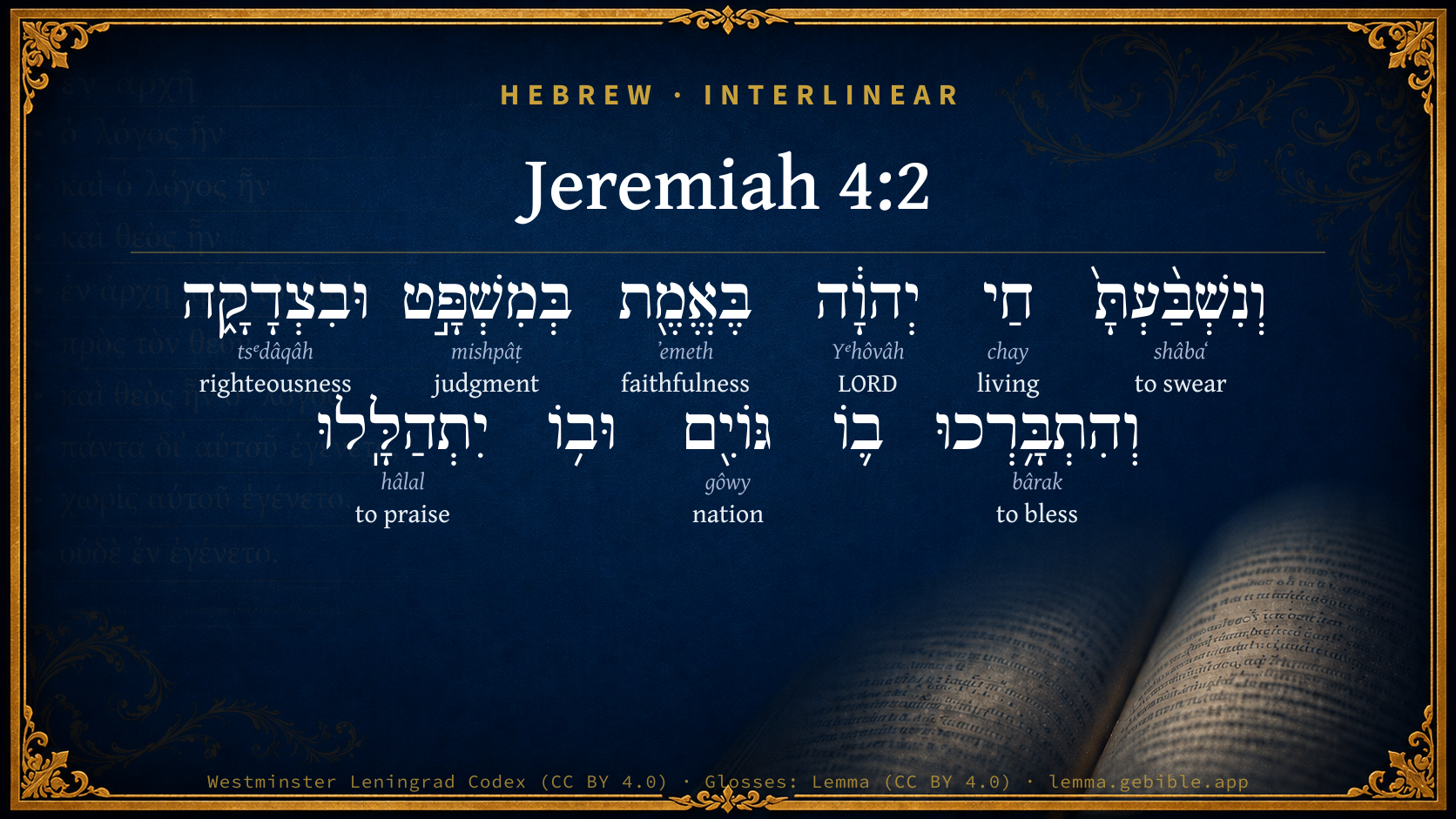
Hebrew (Westminster Leningrad Codex) Jeremiah 4:2 appears in the Hebrew Old Testament. The text above is from the Westminster Leningrad Codex. Each word links to its Strong’s number, a concise gloss, and parsing drawn from the Open Scriptures Hebrew Bible morphology. Click any word for its full Brown-Driver-Briggs (BDB) entry.
Download image
Cite this verse

Jeremiah 4:2 (World English Bible). Public Domain. Lemma interlinear Bible study tool, https://lemma.gebible.app/v/jeremiah/4/2.

Show BibTeX & RIS
BibTeX
RIS
English Translation
and you shall swear, As Yahweh lives, in truth, in justice, and in righteousness; and the nations shall bless themselves in him, and in him shall they glory.
World English Bible · Public Domain
Download a study sheet

One document with this verse’s original text, its word-by-word gloss line, the meaning frame, cross-references with their text, attributed commentary, and full source and license credits — printable, and it pastes into notes with its structure intact.

This verse Autodidact and up

Study sheet (.html) Plain text (.txt)

A passage Seminary Student

Up to 50 verses in one chapter. A passage sheet keeps up to 6 commentary sources and 12 cross-references per verse, in the order this page ranks them, and says so on the sheet whenever that leaves anything out. Ask for a single verse and you get the Autodidact verse sheet above.

Everything on this page stays free to read, with no account — the sheet is a download of what is already on screen, not access to it.

Want to remove ads? Support Godless Engineer
Compare translations 3

The same verse in 3 English versions, stacked beneath the original-language interlinear above. Click any original word for its lexicon entry.

Each is an independent rendering of the whole verse — the interlinear is not word-aligned to these translations.

Highlighted words mark where these versions differ — a whole-verse word diff, not a word-by-word alignment.

  • World English Bible Public Domain
    and you shall swear, As Yahweh lives, in truth, in justice, and in righteousness; and the nations shall bless themselves in him, and in him shall they glory.
  • King James Version Public Domain
    And thou shalt swear, The LORD liveth, in truth, in judgment, and in righteousness; and the nations shall bless themselves in him, and in him shall they glory.
  • unfoldingWord Literal Text CC BY-SA 4.0
    and you swear, ‘ Yahweh alive’ in truth, in justice, and in righteousness, then the nations will bless themselves in him, and in him they will boast.”

unfoldingWord Literal Text — © unfoldingWord, licensed CC BY-SA 4.0. Word-aligned USFM3 via Door43 (git.door43.org/unfoldingWord/en_ult).

Versions to compare (up to 4)

3 of 4 selected

Show all 18 translations

Every available English version of this verse, each an independent rendering of the whole verse.

  • World English Bible Public Domain
    and you shall swear, As Yahweh lives, in truth, in justice, and in righteousness; and the nations shall bless themselves in him, and in him shall they glory.
  • Berean Standard Bible Public Domain
    and if you can swear, ‘As surely as the LORD lives,’ in truth, in justice, and in righteousness, then the nations will be blessed by Him, and in Him they will glory.”
  • Majority Standard Bible Public Domain
    and if you can swear, ‘As surely as the LORD lives,’ in truth, in justice, and in righteousness, then the nations will be blessed by Him, and in Him they will glory.”
  • King James Version Public Domain
    And thou shalt swear, The LORD liveth, in truth, in judgment, and in righteousness; and the nations shall bless themselves in him, and in him shall they glory.
  • American Standard Version (1901) Public Domain
    and thou shalt swear, As Jehovah liveth, in truth, in justice, and in righteousness; and the nations shall bless themselves in him, and in him shall they glory.
  • Revised Version (1885) Public Domain
    and thou shalt swear, As the LORD liveth, in truth, in judgment, and in righteousness; and the nations shall bless themselves in him, and in him shall they glory.
  • Geneva Bible (1599) Public Domain
    And thou shalt sweare, The Lord liueth in trueth, in iudgement, and in righteousnesse, and the nations shall be blessed in him, and shall glorie in him.
  • Douay-Rheims (1899) Public Domain
    And thou shalt swear: As the Lord liveth, in truth, and in judgement, and in justice: and the Gentiles shall bless him, and shall praise him.
  • Young's Literal Translation Public Domain
    And thou hast sworn -- Jehovah liveth, In truth, in judgment, and in righteousness, And blessed themselves in Him have nations, And in Him they boast themselves.
  • Literal Standard Version CC BY-SA 4.0
    And you have sworn—YHWH lives, || In truth, in judgment, and in righteousness, || And nations have blessed themselves in Him, || And they boast themselves in Him.”
  • Unlocked Literal Bible CC BY-SA 4.0
    You must be truthful, just, and righteous when you swear, 'As Yahweh lives.' Then the nations will bless themselves in him, and in him they will glory.”
  • unfoldingWord Literal Text CC BY-SA 4.0
    and you swear, ‘ Yahweh alive’ in truth, in justice, and in righteousness, then the nations will bless themselves in him, and in him they will boast.”
  • Darby Bible Public Domain
    -- and thou shalt in truth, in justice, and in righteousness swear, [As] Jehovah liveth! and the nations shall bless themselves in him, and in him shall they glory.
  • World Messianic Bible Public Domain
    and you will swear, ‘As the LORD lives,’ in truth, in justice, and in righteousness. The nations will bless themselves in him, and they will glory in him.”
  • Webster's Bible Public Domain
    And thou shalt swear, The LORD liveth, in truth, in judgment, and in righteousness; and the nations shall bless themselves in him, and in him shall they glory.
  • Free Bible Version CC BY-SA 4.0
    and if when you make your vows, you do so only to me, sincerely, truly, and honestly, then the nations will be blessed by me, and they will praise me.
  • Bible in Basic English Public Domain
    And you will take your oath, By the living Lord, in good faith and wisdom and righteousness; and the nations will make use of you as a blessing, and in you will they take a pride.
  • JPS Tanakh (1917) Public Domain
    And wilt swear: 'As the LORD liveth' in truth, in justice, and in righteousness; then shall the nations bless themselves by Him, and in Him shall they glory.

Literal Standard Version (2020), Covenant Press — licensed CC BY-SA 4.0. Text via the HelloAO Bible API (eBible.org). Unlocked Literal Bible (unfoldingWord) — licensed CC BY-SA 4.0. Text via the HelloAO Bible API (eBible.org). unfoldingWord Literal Text — © unfoldingWord, licensed CC BY-SA 4.0. Word-aligned USFM3 via Door43 (git.door43.org/unfoldingWord/en_ult). Free Bible Version, Dr. Jonathan Gallagher — licensed CC BY-SA 4.0. Text via the HelloAO Bible API (eBible.org).

Word by word

More ways to search: Search by grammar → Find every occurrence → Compare this word →

Practice this passage: Drill this verse → Learn its vocabulary →

בֶּאֱמֶ֖ת
ʼemeth
H571
“in/at · faithfulness”
Preposition + Noun, Common, Feminine, Singular, Absolute
Part of Speech
Preposition + Noun
Type
Common
Gender
Feminine
Number
Singular
State
Absolute
Full BDB Definition

Origin: contracted from H539

TWOT: 116k

firmness, faithfulness, truth (noun feminine) - sureness, reliability - stability, continuance - faithfulness, reliableness - truth - as spoken - of testimony and judgment - of divine instruction - truth as a body of ethical or religious knowledge - true doctrine - in truth, truly (adverb)
  1. וְנִשְׁבַּ֨עְתָּ֙ shâbaʻ H7650 “and · to swear” Conjunction + Verb, Niphal, Sequential Perfect, 2nd Person, Masculine, Singular
  2. חַי chay H2416 “living” Adjective, Adjective, Masculine, Singular, Absolute
  3. יְהוָ֔ה Yᵉhôvâh H3068 “LORD” Noun, Proper
  4. בְּמִשְׁפָּ֣ט mishpâṭ H4941 “in/at · judgment” Preposition + Noun, Common, Masculine, Singular, Absolute
  5. וּבִצְדָקָ֑ה tsᵉdâqâh H6666 “and · in/at · righteousness” Conjunction + Preposition + Noun, Common, Feminine, Singular, Absolute
  6. וְהִתְבָּ֥רְכוּ bârak H1288 “and · to bless” Conjunction + Verb, Hithpael, Sequential Perfect, 3rd Person, Common, Plural
  7. גּוֹיִ֖ם gôwy H1471 “nations” Noun, Common, Masculine, Plural, Absolute
  8. יִתְהַלָּֽלוּ hâlal H1984 “to praise” Verb, Hithpael, Imperfect, 3rd Person, Masculine, Plural

About this verse

These counts appear in no published source. They are computed here, from the morphology-tagged text and Lemma’s own curated glosses. What Lemma adds →

11
words
9
distinct lemmas
Prophets
section

Grammatical profile

  • 3 verbs
  • 5 nouns
  • 1 adjective
  • 2 prepositions

Verb forms

  • וְנִשְׁבַּ֨עְתָּ֙ Niphal · Sequential Perfect
  • וְהִתְבָּ֥רְכוּ Hithpael · Sequential Perfect
  • יִתְהַלָּֽלוּ Hithpael · Imperfect

Cross-references

18

Topical passages linked to Jeremiah 4:2 in the Treasury of Scripture Knowledge — connected by theme and wording, ordered by reader-vote popularity; previews shown in the World English Bible.

  • Isaiah 65:16 so that he who blesses himself in the earth shall bless himself in the God of truth; and he who swears in the earth shall swear by the God of truth; because the former troubles are forgotten, and because they are hid from my eyes.
  • Genesis 22:18 In your seed will all the nations of the earth be blessed, because you have obeyed my voice."
  • Jeremiah 9:24 but let him who glories glory in this, that he has understanding, and knows me, that I am Yahweh who exercises loving kindness, justice, and righteousness, in the earth: for in these things I delight, says Yahweh.
  • Deuteronomy 10:20 You shall fear Yahweh your God; him shall you serve; and to him shall you cleave, and by his name shall you swear.
  • 1 Corinthians 1:31 that, according as it is written, "He who boasts, let him boast in the Lord."
  • 2 Corinthians 10:17 But "he who boasts, let him boast in the Lord."
  • Psalms 72:17 His name endures forever. His name continues as long as the sun. Men shall be blessed by him. All nations will call him blessed.
  • Isaiah 45:25 In Yahweh shall all the seed of Israel be justified, and shall glory.
  • Jeremiah 12:16 It shall happen, if they will diligently learn the ways of my people, to swear by my name, As Yahweh lives; even as they taught my people to swear by Baal; then shall they be built up in the midst of my people.
  • Galatians 3:8 The Scripture, foreseeing that God would justify the Gentiles by faith, preached the Gospel beforehand to Abraham, saying, "In you all the nations will be blessed."
  • 1 Kings 3:6 Solomon said, You have shown to your servant David my father great loving kindness, according as he walked before you in truth, and in righteousness, and in uprightness of heart with you; and you have kept for him this great loving kindness, that you have given him a son to sit on his throne, as it is this day.
  • Isaiah 45:23 By myself have I sworn, the word is gone forth from my mouth [in] righteousness, and shall not return, that to me every knee shall bow, every tongue shall swear.
  • Zechariah 8:8 and I will bring them, and they will dwell in the midst of Jerusalem; and they will be my people, and I will be their God, in truth and in righteousness."
  • Psalms 99:4 The King's strength also loves justice. You do establish equity. You execute justice and righteousness in Jacob.
  • Isaiah 48:1–2 Hear you this, house of Jacob, who are called by the name of Israel, and are come forth out of the waters of Judah; who swear by the name of Yahweh, and make mention of the God of Israel, but not in truth, nor in righteousness
  • Jeremiah 5:2 Though they say, As Yahweh lives; surely they swear falsely.
  • Hosea 2:19 I will betroth you to me forever. Yes, I will betroth you to me in righteousness, in justice, in loving kindness, and in compassion.
  • Philippians 3:3 For we are the circumcision, who worship God in the Spirit, and rejoice in Christ Jesus, and have no confidence in the flesh;

Cross-references courtesy of OpenBible.info (CC BY 4.0).

Hebrew and Greek witnesses Masoretic Hebrew ↔ Greek Septuagint

The same verse in the two great witnesses to the Old Testament, shown verse-for-verse.

These are two independent witnesses, not word-aligned to each other, and the Septuagint is shown in lemma (dictionary) form.

Hebrew Jeremiah 4:2 Masoretic · Westminster Leningrad Codex

וְנִשְׁבַּ֨עְתָּ֙ חַי יְהוָ֔ה בֶּאֱמֶ֖ת בְּמִשְׁפָּ֣ט וּבִצְדָקָ֑ה וְהִתְבָּ֥רְכוּ ב֛וֹ גּוֹיִ֖ם וּב֥וֹ יִתְהַלָּֽלוּ

and you shall swear, As Yahweh lives, in truth, in justice, and in righteousness; and the nations shall bless themselves in him, and in him shall they glory.

World English Bible · Public Domain

Greek LXX Structure differs

In the Septuagint, Jeremiah is about an eighth shorter than the Hebrew and arranges its material differently — the Oracles Against the Nations (Hebrew chapters 46–51) appear in the middle of the Greek book, after 25:13. Because the chapter and verse boundaries do not line up, a verse-for-verse comparison with the Hebrew is not shown.

A verse-for-verse comparison isn’t shown here because the chapters and verses don’t line up. Switch to the LXX edition with the MT / LXX toggle above to read the Greek directly.

Hebrew: Westminster Leningrad Codex (CC BY 4.0). Greek: Septuagint (public domain); English from a public-domain English Septuagint. How the Septuagint differs from the Hebrew →

Targum (Aramaic paraphrase)

1

The Targum is the ancient Jewish Aramaic paraphrase of the Hebrew Scriptures — an interpretive translation, not the Hebrew text itself. Onkelos (literal) and Pseudo-Jonathan (expansive) render the Torah, and Jonathan the Prophets. Coverage is partial: where no permissively-licensed English translation exists for a verse, only the Aramaic is shown. This is verse-level text, not a word-by-word alignment to the Hebrew.

  1. Targum Jonathan Prophets (Joshua–Malachi)
    אִם תְּקַיֵם בִּשְׁמִי קַיָם הוּא יְיָ בְּקוּשְׁטָא בְּדִינָא וּבִזְכוּתָא וְיִתְבָּרְכוּן עַמְמַיָא בְּיִשְׂרָאֵל וּבֵיהּ יִשְׁתַּבְּחוּן:

    (no public-domain English translation for this verse)

    Targum Jonathan — Aramaic: “Mikraot Gedolot” (public domain). English: “Sefaria Community Translation” (CC0 1.0 (public-domain dedication)); “London "Chaldee Paraphrase," 1871” (public domain). Text via Sefaria.

Commentary

Notes on Jeremiah 4:2 from classic Christian and Jewish commentators (each source and its license shown beneath its notes). The classic Christian expositions comment on the surrounding passage and are grouped to its opening verse, so a note may address several verses; the Jewish commentaries on the Tanakh (Rashi and others) are per-verse, so they appear only where the commentator wrote on this verse.

Lemma curates 59 commentaries, every one of them public domain or Creative Commons licensed, each selected and text-cleaned for this edition rather than reprinted as found. About our sources →

Trapp's Complete Commentary

John Trapp

Jer 4:2 And thou shalt swear, The LORD liveth, in truth, in judgment, and in righteousness; and the nations shall bless themselves in him, and in him shall they glory.

Ver. 2. And thou shalt swear, The Lord liveth.] Not by Baal shalt thou swear, or other idols, but by the living God, or by the life of God. The Egyptians once sware by the life of Pharaoh, as the proud Spaniards now do by the life of their king. But, to speak properly, none liveth but the Lord, and none should be sworn by but he alone, an oath being a proof of the divine power, which one worshippeth. The Pythagoreans used to swear by πεπρακτην, Quaternity, which they called παγαν αενναου φυσεως, the fountain of eternal being; and this doubtless was the same with τετραγραμματον, Jehovah.

In truth, in judgment, and in righteousness.] Vere, rite, et iuste: {a} (1.) In truth, {Rom 9:1} that is, to that which is true, lest we fall into perjury. {Lev 19:12} And (2.) Truly, agreeable both to the intentions of our mind, not deceitfully, {Psa 24:2} and agreeable also to the intentions of him that ministereth the oath, and not with mental reservations, as Romish priests oft swear.

In judgment.] Or, Considerately, duly weighing the conditions and circumstances, not rashly and unadvisedly, {Lev 5:4 1Sa 14:39} as those that swear in heat and choler, swear when they should fear. {Deu 10:20; Deu 28:58} The Romans used that most considerate word arbitror, when the jurors said those things which they knew most certainly. {b} The Grecians, when they would swear by their Jupiter, out of the mere dread and reverence of his name, forbore to mention him. And the Egyptians bore such respect to Mercurius Trismegistus, that they held it not lawful to pronounce his name lightly and rashly. This is check to many swearing pseudo-Christians. Such also as swear in jest, will, without repentance, go to hell in earnest. The ancient form of taking and imposing an oath was, Give glory to God. {Jos 7:19 Joh 9:24}

And in righteousness.] (1.) Promising by oath lawful and possible things only, not making an oath a bond of iniquity. {1Sa 25:21-22; 1Sa 28:10} (2.) Careful to perform what we have sworn, though to our own hindrance. {Psa 15:4}

And the nations shall bless themselves in him.] Or, Shall be blessed in him - that is, in that God to whom thou returnest, and by whom thou thus swearest. They shall turn to God by thine example, and hold themselves happy in such a good turn.

{a} Tremel.

{b} Suidas.

John Trapp, A Commentary or Exposition upon All the Books of the Old and New Testament (1647–1656) — public domain. Text from a community e-Sword module.

Joseph Benson's Commentary

Jer 4:2. And thou shalt swear, &c. — In taking a solemn oath, thou shalt appeal, not to dead and vain idols, but to Jehovah, the living and true God. This is put here for the whole worship of God, acknowledging and owning God as the only God, which is strongly expressed by this act: see Isa 48:1; Isa 65:16. In truth — In sincerity, knowing that the matter of the oath is strictly true; in judgment — Deliberately, advisedly, and reverently, the occasion being great and important; in righteousness — That none be injured by it, that the things we engage to do, or to see done, be both lawful and possible, and that we look to the performance of our oaths. And the nations shall bless themselves in him — This shall be a means of inducing the heathen nations to turn to the true God, and embrace the same way of worship. They shall think themselves happy to be incorporated with thee, that it may be with them according to the promise, Gen 12:3. And in him, shall they glory — Whereas before they gloried in their idols, they shall now glory in Jehovah alone. This is evidently “a prediction of gospel times, when the heathen should join with the Israelites in paying all solemn acts of worship and devotion to the true God only, and in ascribing all honour and glory to him, and to his only Son, the Messiah, in whom all the nations were to be blessed.”

Joseph Benson's Commentary on the Old and New Testaments (1811–1818) — public domain. Text from a community e-Sword module.

Tyndale Open Study Notes

Tyndale Open Resources

4:2 As surely as the Lord lives: The correct attitude when offering a prayer of confession and making oaths reflects truth, justice, and righteousness. Truth means that the inner attitudes and thoughts of those praying match the words they utter. Justice means living by the laws of the Lord, who will judge the earth. Righteousness means that people relate to others in accordance with the Lord’s Spirit and the moral standards he has established. This kind of prayer requires a radical transformation of people’s inner lives and outer lifestyle (Gen 22:18; Deut 10:20; Ps 72:18; Isa 48:1; 1 Cor 1:31). If the Israelites returned to the Lord in this way, the people would be blessed, and their influence would flow out as a blessing to all the nations of the world. Their changed lives would cause people of the world to come and join in a chorus of praise to God’s name.

Tyndale Open Study Notes — © Tyndale Open Resources, licensed CC BY-SA 4.0. Text via the HelloAO Bible API.

Geneva Bible (1599)

Geneva Bible translators

Thou shalt detest the name of idols, Ps. 16:4, and shalt with reverence swear by the living God, when thine oath may advance God’s glory, and profit others: and here, by swearing he meaneth the true religion of God.

Geneva Bible (1599) marginal notes — public domain. Text via Bolls.life.

Jamieson, Fausset & Brown

Robert Jamieson, A. R. Fausset & David Brown

And thou--rather, "And if (carried on from Jer 4:1) thou shalt swear, 'Jehovah liveth,' in truth, &c.", that is, if thou shalt worship Him (for we swear by the God whom we worship; compare Deu 6:13; Deu 10:20; Isa 19:18; Amo 8:14) in sincerity, &c.

and the nations--Rather, this is apodosis to the "if"; then shall the nations bless themselves in (by) Him" (Isa 65:16). The conversion of the nations will be the consequence of Israel's conversion (Psa 102:13, Psa 102:15; Rom 11:12, Rom 11:15).

Jamieson, Fausset & Brown — Commentary Critical and Explanatory on the Whole Bible (1871) — public domain (CC PDM 1.0). Text via the HelloAO Bible API.

Adam Clarke's Commentary

Verse 2. Thou shalt swear, The Lord liveth] Thou shalt not bind thyself by any false god; thou shalt acknowledge ME as the Supreme. Bind thyself BY me, and TO me; and do this in truth, in judgment, and in righteousness.

The nations shall bless themselves in him] They shall be so fully convinced of the power and goodness of Jehovah in seeing the change wrought on thee, and the mercies heaped upon thee, that their usual mode of benediction shall be, May the God of Israel bless thee!

Adam Clarke's Commentary on the Bible (1810–1826) — public domain. Text from a community e-Sword/MySword module.

John Calvin's Commentaries

Here the Prophet goes on with the same subject; for he denudes these flatteries, by which they thought that God could be pacified: for when they had his name in their mouth, they thought it sufficient for their defense, — “What! do we not call upon God? do we not ascribe to him his due honor, when we swear by his name?” There is in the Prophet’s words a part given for the whole; for swearing is to be taken for the whole of God’s worship. When therefore the Israelites made a profession of God’s name, they thought themselves absolved from all guilt.

Hence the Prophet says, Thou shalt swear truly in the name of God; that is, “Ye are indeed self — confident, because an external profession of religion seems to you to be a sort of expiation, whenever ye seek to contend with God: ye boast that you are Abraham’s seed, and swear by the name of God; but ye are sacrilegious, when ye thus falsely profess God’s name.” Swear then, he says, in truth

We hence see how the words of the Prophet harmonize together: he had said, that Israel had hitherto dealt falsely with God, because they had not performed what in words they had promised, for they went astray; and now he adds, that it availed the Israelites nothing, that they openly called on God and shewed themselves to be his people by an external worship: this, he says, is nothing, except ye worship God in truth and in judgment and in righteousness

Truth is no doubt to be taken here for integrity, as we shall see in the fifth chapter: it is the same as though he had said, that God is not rightly worshipped, except when the heart is free from all guile and deceit; in short, he means that there is no worship of God without sincerity of heart. But the truth, of which the Prophet speaks, is especially known by judgment and righteousness; that is, when men deal faithfully with one another, and render to all their right, and seek not their own gain at the expense of others. When therefore equity and uprightness are thus observed by men, then is fulfilled what is required here by the Prophet: for then they worship not God fallaciously, nor with vain words, but really shew that they do, without disguise, fear and reverence God.

What follows is variously explained by interpreters; but the Prophet, I have no doubt, does here indirectly reprove the Israelites, because God’s name had been exposed to many reproaches and mockeries, when the heathens said, that there was no power in God to help the Israelites, and when the people themselves expostulated with God, as though they had a just cause for contending with him, — “What! God has promised that we should be models of his blessing; but we are exposed to the reproaches of the heathens: how can this be?” Since then the Israelites thus deplored their lot, and cast the blame on God, the Prophet gives this answer, Bless themselves shall the nations and glory in him Some refer this to the Israelites, but not correctly. It had indeed been said to Abraham, “In thy seed shall all nations be blessed,” or, shall bless themselves. But this blessing had its beginning, as it is here noticed by the Prophet. For we must look for the cause or the fountain of this blessing: how could the nations bless themselves through the seed or the children of Abraham, except God, the author of the blessing, manifested his favor towards the children of Abraham? Very aptly then does the Prophet say here, Then bless themselves in God shall all the nations, and in him shall they glory; that is, “Ye are to be blamed, that God’s curse is upon you and renders you objects of reproach to all people, and also, that heathens disdain and despise the name of God: for your impiety has constrained God to deal more severely with you than he wished; for he is ever ready to shew his paternal clemency. What then is the hindrance, that the nations bless not themselves in God and glory in him? that is, that pure religion does not flourish through the whole world, and that all nations do not come to you and unite in the worship of the only true God? The hindrance is your impiety and wickedness; this is the reason why God is not glorified, and why your felicity is not everywhere celebrated among the nations.” We now perceive the meaning of the Prophet, — that the Jews groundlessly imputed blame to God, because they were oppressed by so many evils; for they had procured for themselves all their calamities, and at the same time gave occasion to heathens to profane God’s name by their reproaches. It follows —

John Calvin's Commentaries (1540-1563) — public domain. Text from the Calvin Translation Society English edition (1840s-50s) via the Christian Classics Ethereal Library (ccel.org). Calvin's coverage is partial (roughly two-thirds of the Bible); uncommented books and verses are honest gaps, never fabricated. The 19th-century editor's footnotes and remarks are omitted so the notes are faithfully Calvin's own voice.

Ellicott's Commentary for English Readers

(2) And thou shalt swear.—The conditions are continued: If thou wilt swear by the living Jehovah [“the Lord liveth” being the received formula of adjuration], in truth, in judgment, and in righteousness.

And the nations shall bless themselves in him.—This forms the completion of the sentence. If the conditions of a true repentance are fulfilled by Israel, then the outlying heathen nations shall bless themselves in Jehovah—i.e., shall own Him and adore Him, be blessed by Him.

A Bible Commentary for English Readers, edited by Charles John Ellicott (1878–1897) — public domain. Text from a community e-Sword module.

The Cambridge Bible for Schools and Colleges

gen. ed. J. J. S. Perowne

2. shall bless themselves in him] not in Israel, but in God, i.e. they will use Jehovah’s name in invoking blessings on themselves.

The Cambridge Bible for Schools and Colleges (gen. ed. J. J. S. Perowne; Cambridge University Press, 1878–1918) — public domain. Text from a community e-Sword module.

John Gill's Exposition

And thou shalt swear, the Lord liveth,.... Or by the living Lord, by him and him only; not by the creatures, but by the God of truth. This is sometimes put for the whole worship and service of God, Deu 6:13 and for a confession of Christ, and profession of faith in him, Isa 45:23, compared with Rom 14:11 and which ought to be done,

in truth, in righteousness, and in judgment; in sincerity, integrity, and uprightness of soul; in spirit and in, truth; in righteousness and true holiness:

and the nations shall bless themselves in him, not in Israel, as the Targum, Jarchi, and Kimchi, interpret it; but in the Lord, even in the Messiah, the Lord Jesus Christ, in whom all the nations of the earth were to be blessed with all spiritual blessings; with which being blessed, they call and count themselves happy, being pardoned through the blood of Christ, justified by his righteousness, and having peace, life, and salvation by him, Gen 22:18,

and in him shall they glory; not in themselves, nor in any creature, or creature enjoyment; but in the Lord, and in what he is to them, wisdom, righteousness, sanctification, and redemption; in whom all the seed of Israel, being justified, glory; see Co1 1:30. The sense of the words seems to be, that upon the Gospel being preached by Christ and his apostles to the Israelites, and some of them being converted, and their abominations put away, and they cleaving to the Lord, and to his worship; the Gentiles should have the Gospel sent to them, and receive it, and place all their blessedness in Christ, and glory in him.

John Gill's Exposition of the Whole Bible (1746–1763) — public domain (CC PDM 1.0). Text via the HelloAO Bible API.

Haydock's Catholic Bible Commentary

Swear, when requisite. (Calmet) --- Thus thou wilt learn to confess one God. (Theodoret) --- If all were upright, oaths would be unnecessary, Matthew v. 34. But as they are not so, (Calmet) this may be a religious act. (Worthington) --- Justice. These three conditions are essential. (Haydock) --- Him; the people, (Calmet) or God. (St. Jerome) --- An oath must attest God, and be used when a thing is true and of moment. (Worthington)

George Leo Haydock (1774–1849), Haydock's Catholic Family Bible and Commentary, 1859 edition — public domain. Excludes Psalms (Douay-Rheims chapter numbering differs from Protestant) and Deuterocanonical books (Catholic canon only).

Matthew Poole's English Annotations

And thou shalt swear: this is to be understood, partly by way of command, as Deu 10:20; and partly by way of direction, if thou swear, or when thou swearest: it is put here synecdochically for the whole worship of God, hereby acknowledging and owning God as the only God.

The Lord liveth, in truth, in judgment, and in righteousness: here he prescribes,

1. The form of the oath. viz.

The Lord liveth, or, By the life of God, which was that form which they did use in swearing, 1Sa 14:39,45, and many other places; so Joseph sware by the life of Pharaoh, Gen 42:15,16; and Elisha very frequently useth this form, 2Ki 2:2,4,6; 3:14; 5:16; which is also to be understood exclusively; q.d. not by any idol, as Baal, &c., or any creature, Jer 5:7; Mat 5:34-36; Jam 5:12, but by God alone, Isa 65:16; see Hos 2:17; for by this indeed we declare the Godhead of him whom we worship, Isa 19:18.

2. The qualification of it, in which indeed are comprised all the requisites to a religious oath and worship of God, both in our general and particular calling, with respect to God, ourselves, our neighbours,

1.

In truth, that the matter and substance of it be really true in itself, Rom 9:1, that which agrees with the intent of the mind, Psa 24:4, and with the intent of him that administers it; not doubtful, feigned, or deceitful, as they did, Isa 48:1; Jer 5:2, but as true as the Lord lives.

2.

In judgment, i.e. either in matter or places of judicature, for the decision of controversies, deliberately, advisedly, and reverently, well considering both of the form and matter of the oath, Lev 5:4, that God’s name be neither taken in vain customarily, or in matters trivial, Deu 5:11, nor abused by oaths the are rash and precipitant, such as Saul’s was, 1Sa 14:39, and as Herod’s, Mat 14:7, and without necessity.

3.

In righteousness, that none be injured by it, that the things we engage be,

1. Both lawful and possible; see 1Sa 25:21,22; 28:10; 1Ki 19:2; and,

2. That we look to the performance, Psa 15:4; Mat 5:33; the want of either of which circumstances makes it a bond of iniquity, Ecc 5:4,5.

The nations shall bless themselves in him; this shall be a means to work upon the heathen nations, and prevail with them to come into the same way of worship, that now scorn both you and me, because I am forced to make them the rod of my anger against you, in regard of your provocations, Psa 47:8,9; Jer 3:17. They shall think themselves happy to be incorporated with thee, that it may be with them according to that promise, Gen 12:3; 22:17,18. They shall, as it were, bless themselves in such like form; The Lord make me and mine as Israel; blessed be Israel, and the God of Israel. Or rather,

in him shall they glory; whereas before they gloried in their idols, now, being taken into the true church, among God’s Israel, they shall glory in God alone, Psa 106:5, who indeed alone is the glory of his people, Psa 89:17; 148:14.

Matthew Poole's English Annotations on the Holy Bible (1683–1685) — public domain. Text from a community e-Sword/MySword module.

The Pulpit Commentary

Jehovah"s requirement with respect to the oath.

Jehovah has just told his people that, with unwavering resolve, they must put their abominations out of his Sight. This exhortation, general as it is, is very emphatic; but it chiefly serves to lead on to something more explicit. Jehovah singles out one peculiar abomination, and fixes the attention of his people on that. The truth is, if they sweep this abomination away, all is done that needs to be done. These abominations, so odious to the pure eyes of Jehovah, were bound together in a kind of organic unity. The infliction of a fatal blow on any one of them inevitably brought death and withering on the others. Just as he who stops the action of one of the vital organs of the body stops the action of them all. Look, then

I AT WHAT JEHOVAH REQUIRES WITH REGARD TO THE OATH. There were many solemn appeals that had in them the nature of an oath. God at once directs attention to the most solemn of all, the appeal to himself by his own peculiar Name and his own enduring existence. The passages are too numerous to mention in which there is record of people saying, "As Jehovah liveth." Now and then, no doubt, the words were spoken with solemnity and sincerity, and also with a steady remembrance afterwards of the holy Name, which had thus come to the lips. But in the great bulk of instances it was only an idle word. A man gets excited, and then the most solemn words rush from his mouth, with no thought of the meaning they express. Or, worse still, there may be the deliberate attempt to consecrate a falsity, and get it received for undoubted truth, so that others may act from it and rest upon it with the utmost confidence. Now, to the removal of all this false swearing, God would have his people earnestly to apply themselves. Note that God does not say here what Jesus afterwards said, "Swear not at all." The time was not ripe for such an exhortation. The words of Jesus aim directly at that ideal state when every man shall speak truth as naturally as he breathes pure air; when it shall be as impossible for him to speak or even think the false as to live amid carbonic acid gas. One may say that even here, in this word through Jeremiah, there is nothing to bind the hearer to an oath. The injunction has a permissive element. A man needs not to say, "Jehovah liveth;" but if he does say so, let him bear in mind all that the expression involves. It is the most solemn way of securing that all speaking and acting shall be true and sincere; that all judgments shall be according to proven facts and Jehovah"s declared principles of justice; and that all life, in short, should be pervaded and filled with energy by a spirit of righteousness. To begin with, what an abomination it was to say, "As Jehovah liveth," when the practice showed that whatever true recognition of Deity obtained among these people was on the high places and towards the heathen idols! Then from this it was only too easy to bring forward Jehovah"s Name in connection with all sorts of falsehood, cruelty, and oppression. The change is to come by bringing truth into the oath. There must ever live in the mind of the oath-taker a distinct apprehension and conviction as to Jehovah"s real, enduring existence. It must be remembered how he said to Moses, "I am that I am." And, following the history of Israel onward, there must be an ever-clearer perception of his character, of his power, of his constant observation of individual life, and his fiery, consuming anger against all iniquity. Then, if all this truth, justice, and righteousness appear where before there was such a loathsome sink of deception and corruption, what will be the result?

II THE NATIONS WILL ENTER INTO AN INEXPRESSIBLY SATISFACTORY RELATION TOWARDS JEHOVAH. His aspect, in their eyes, altogether alters. A step is taken a great step, and one that makes all others easy towards that gathering of the nations to Jehovah"s throne which is mentioned in Jer_3:17. There is now something to awe and to attract the hitherto worshippers of idols. They say that a man is known by his friends. If the man be one not yet seen, living at a distance, he can only be judged of by those professing to be his friends, with whom we come into actual intercourse. If those whom we see be upright, generous, magnanimous, loving, we shall have no difficulty in crediting that the unseen one is the same. Israel having been what it had been, it was little wonder if the heathen came to have a very poor opinion of Jehovah. But Israel is now called to a very different life, and, in particular, to make such a use of the oath as that the nations shall not merely have their opinion of Jehovah altered, but shall find in him a source of blessing to themselves and one in whom, without risk of shame and confusion, they can continually glory. Jehovah, God of Israel, whom Israel at last has truly honored, obtains then more than a bare acknowledgment. He is exulted in as Lord and Benefactor to all the nations of the earth. "And I heard as it were the voice of a great multitude, and as the voice of many waters, and as the voice of mighty thunderings, saying, Alleluia: for the Lord God omnipotent reigneth". (Rev_19:6) This is the consummation of creation"s choral song, and it comes from practicing truth, justice, and righteousness in such a way as will fully please Jehovah. Y.

The Pulpit Commentary (1880–1919), ed. H.D.M. Spence-Jones & Joseph S. Exell — public domain. Text from a community e-Sword module.

John Wesley's Explanatory Notes

Swear - This is put here for the whole worship of God, acknowledging an& owning God as the only God; which is strongly exprest by this act. In truth - That the matter and substance of it be true. In judgment - Deliberately, advisedly, and reverently. In righteousness - That none be injured by it, that the things we engage be both lawful and possible, and that we look to the performance. The nations - This shall be a means to work upon the Heathen nations, to come into the same way of worship. They shall think themselves happy to be incorporated with thee, that it may be with them according to that promise, Gen. xii, 3. Glory - Whereas before they gloried in their idols, they shall glory in God alone.

John Wesley, Explanatory Notes Upon the Whole Bible (1754–1765) — public domain. Text via the GEBible commentary corpus.

Rashi

Rabbi Shlomo Yitzchaki (Rashi)

And you will swear, “As the Lord lives,” in truth When you swear by My name, you will swear in truth, not as now, that it is written concerning you, “And if they say, ‘As the Lord lives,’ surely they swear falsely” (5:2).

nations will bless themselves with him If you do so, then nations will bless themselves with Israel. Every non-Jew will say to his son, “You shall be like So-and-so the Jew.”

boast Heb. יתהללו, they will recite your praise. Another explanation of is יתהללו: Whoever is able to cleave to Israel will boast about the matter (porvanter in French).

Rashi on the Tanakh — English translations: “The Judaica Press complete Tanach with Rashi, translated by A. J. Rosenberg” (CC BY 4.0); “Pentateuch with Rashi's commentary by M. Rosenbaum and A.M. Silbermann, 1929-1934” (public domain); “The Metsudah Tanach series, Lakewood, N.J” (CC BY 4.0); and “The Book of Joshua, Metsudah Publications, 1997” (CC BY 4.0). Text via Sefaria.

Lesson kit

Teaching starters — assembled from the data on this page, not authored interpretation. Every prompt links to the verse data it draws on. Edit before teaching.

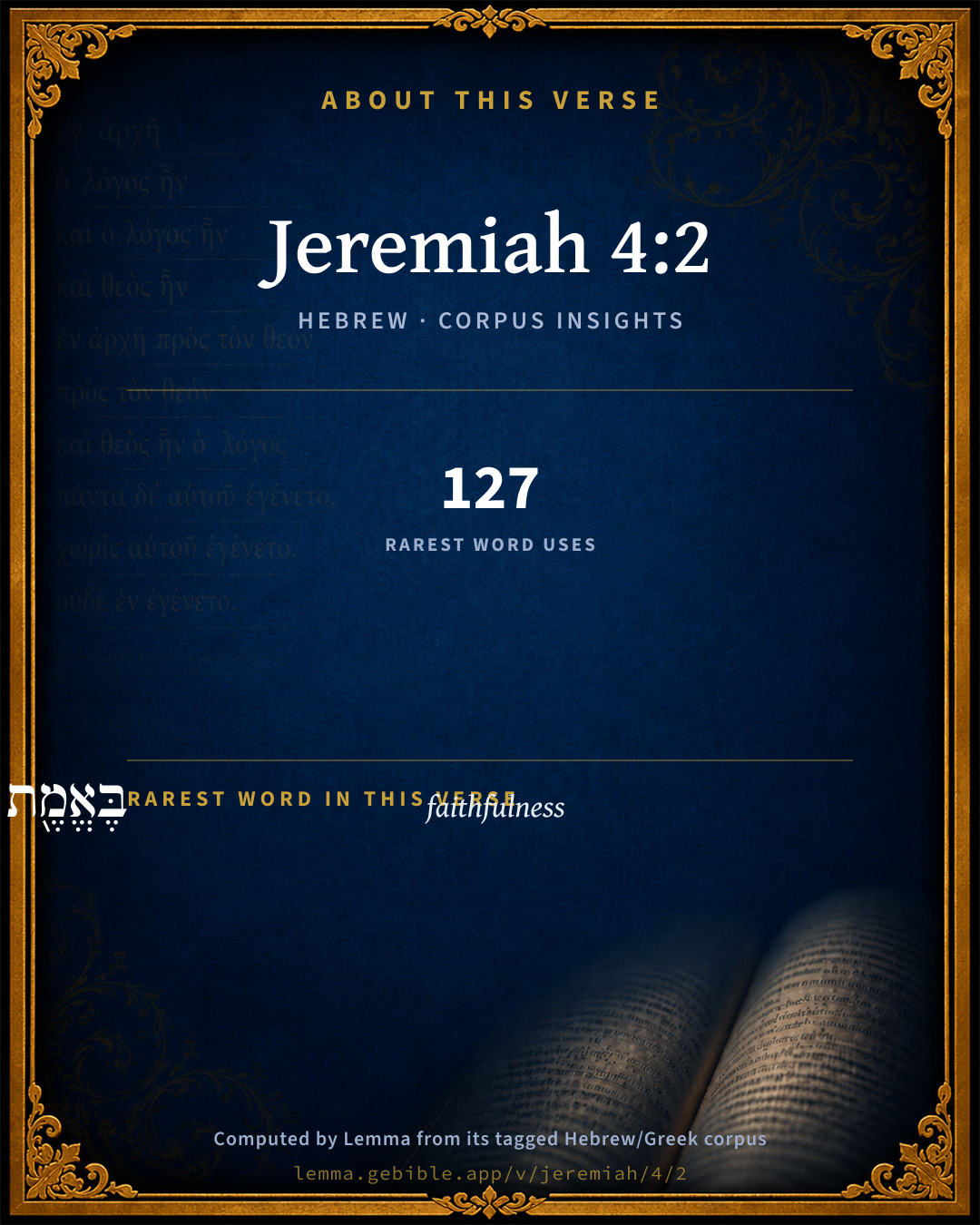
Jeremiah, in the Prophets, opens this verse with 11 words (9 distinct Hebrew lemmas). Its most distinctive word is ʼemeth (“faithfulness”). A historical commentator’s framing appears above. Read the whole chapter for the surrounding context.

Discussion questions

  1. The word ʼemeth carries the sense “faithfulness.” How does it shape the verse?
  2. How does Isaiah 65:16, which shares this passage’s theme, read alongside this verse?
  3. These translations render this verse differently. What is at stake in choosing one wording over another?
  4. «וְנִשְׁבַּ֨עְתָּ֙» is a Niphal Sequential Perfect verb. How does that grammatical form shape the action described?
  5. Compare how Trapp's Complete Commentary and Joseph Benson's Commentary read this verse. Where do they agree or differ?

Things to notice

Reading settings

Reading text

Shown beneath each verse's original-language words.

Old Testament
Old Testament edition

Read the OT as the Masoretic Hebrew (MT) or the Greek Septuagint (LXX).

English shown for the Greek Septuagint (in the Hebrew ↔ Greek comparison).

Comparing translations? Open the Compare panel on any verse page to stack up to four side by side.