
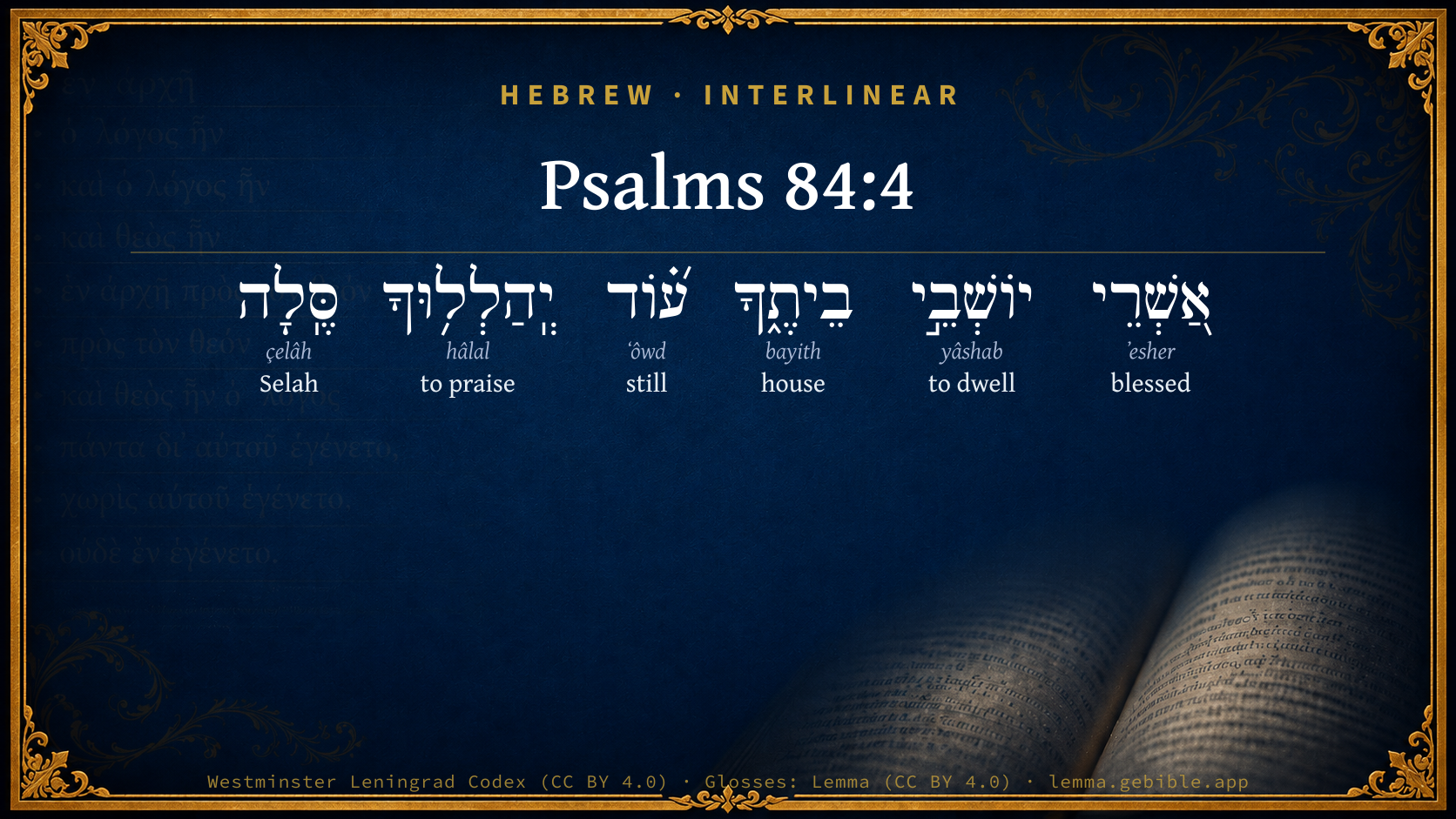
Psalms 84:4

Hebrew (Westminster Leningrad Codex) Psalms 84:4 appears in the Hebrew Old Testament. The text above is from the Westminster Leningrad Codex. Each word links to its Strong’s number, a concise gloss, and parsing drawn from the Open Scriptures Hebrew Bible morphology. Click any word for its full Brown-Driver-Briggs (BDB) entry.
Download image
Cite this verse

Psalms 84:4 (World English Bible). Public Domain. Lemma interlinear Bible study tool, https://lemma.gebible.app/v/psalms/84/4.

Show BibTeX & RIS
BibTeX
RIS
English Translation
Blessed are those who dwell in your house. They are always praising you. Selah.
World English Bible · Public Domain
Download a study sheet

One document with this verse’s original text, its word-by-word gloss line, the meaning frame, cross-references with their text, attributed commentary, and full source and license credits — printable, and it pastes into notes with its structure intact.

This verse Autodidact and up

Study sheet (.html) Plain text (.txt)

A passage Seminary Student

Up to 50 verses in one chapter. A passage sheet keeps up to 6 commentary sources and 12 cross-references per verse, in the order this page ranks them, and says so on the sheet whenever that leaves anything out. Ask for a single verse and you get the Autodidact verse sheet above.

Everything on this page stays free to read, with no account — the sheet is a download of what is already on screen, not access to it.

Want to remove ads? Support Godless Engineer
Compare translations 3

The same verse in 3 English versions, stacked beneath the original-language interlinear above. Click any original word for its lexicon entry.

Each is an independent rendering of the whole verse — the interlinear is not word-aligned to these translations.

Highlighted words mark where these versions differ — a whole-verse word diff, not a word-by-word alignment.

  • World English Bible Public Domain
    Blessed are those who dwell in your house. They are always praising you. Selah.
  • King James Version Public Domain
    Blessed are they that dwell in thy house: they will be still praising thee. Selah.
  • unfoldingWord Literal Text CC BY-SA 4.0
    The happinesses of the dwellers of your house! They praise you continually. Selah

unfoldingWord Literal Text — © unfoldingWord, licensed CC BY-SA 4.0. Word-aligned USFM3 via Door43 (git.door43.org/unfoldingWord/en_ult).

Versions to compare (up to 4)

3 of 4 selected

Show all 18 translations

Every available English version of this verse, each an independent rendering of the whole verse.

  • World English Bible Public Domain
    Blessed are those who dwell in your house. They are always praising you. Selah.
  • Berean Standard Bible Public Domain
    How blessed are those who dwell in Your house! They are ever praising You. Selah
  • Majority Standard Bible Public Domain
    How blessed are those who dwell in Your house! They are ever praising You. Selah
  • King James Version Public Domain
    Blessed are they that dwell in thy house: they will be still praising thee. Selah.
  • American Standard Version (1901) Public Domain
    Blessed are they that dwell in thy house: They will be still praising thee. Selah
  • Revised Version (1885) Public Domain
    Blessed are they that dwell in thy house: they will be still praising thee. Selah
  • Geneva Bible (1599) Public Domain
    Blessed are they that dwell in thine house: they will euer praise thee. Selah.
  • Douay-Rheims (1899) Public Domain
    For the sparrow hath found herself a house, and the turtle a nest for herself where she may lay her young ones: Thy altars, O Lord of hosts, my king and my God.
  • Young's Literal Translation Public Domain
    O the happiness of those inhabiting Thy house, Yet do they praise Thee. Selah.
  • Literal Standard Version CC BY-SA 4.0
    O the blessedness of those inhabiting Your house, || Yet they praise You. Selah.
  • Unlocked Literal Bible CC BY-SA 4.0
    Blessed are they who live in your house; they praise you continually. Selah
  • unfoldingWord Literal Text CC BY-SA 4.0
    The happinesses of the dwellers of your house! They praise you continually. Selah
  • Darby Bible Public Domain
    Blessed are they that dwell in thy house: they will be constantly praising thee. Selah.
  • World Messianic Bible Public Domain
    Blessed are those who dwell in your house. They are always praising you. Selah.
  • Webster's Bible Public Domain
    \\84:3\\Yes, the sparrow hath found a house, and the swallow a nest for herself, where she may lay her young, even thy altars, O LORD of hosts, my King, and my God.
  • Free Bible Version CC BY-SA 4.0
    How happy are those who live in your house—they are always praising you! Selah.
  • Bible in Basic English Public Domain
    Happy are they whose resting-place is in your house: they will still be praising you. (Selah.)
  • JPS Tanakh (1917) Public Domain
    (84-5) Happy are they that dwell in Thy house, they are ever praising Thee. Selah

Literal Standard Version (2020), Covenant Press — licensed CC BY-SA 4.0. Text via the HelloAO Bible API (eBible.org). Unlocked Literal Bible (unfoldingWord) — licensed CC BY-SA 4.0. Text via the HelloAO Bible API (eBible.org). unfoldingWord Literal Text — © unfoldingWord, licensed CC BY-SA 4.0. Word-aligned USFM3 via Door43 (git.door43.org/unfoldingWord/en_ult). Free Bible Version, Dr. Jonathan Gallagher — licensed CC BY-SA 4.0. Text via the HelloAO Bible API (eBible.org).

Word by word

More ways to search: Search by grammar → Find every occurrence → Compare this word →

Practice this passage: Drill this verse → Learn its vocabulary →

About this verse

These counts appear in no published source. They are computed here, from the morphology-tagged text and Lemma’s own curated glosses. What Lemma adds →

6
words
6
distinct lemmas
Wisdom
section

Shared distinctive vocabulary

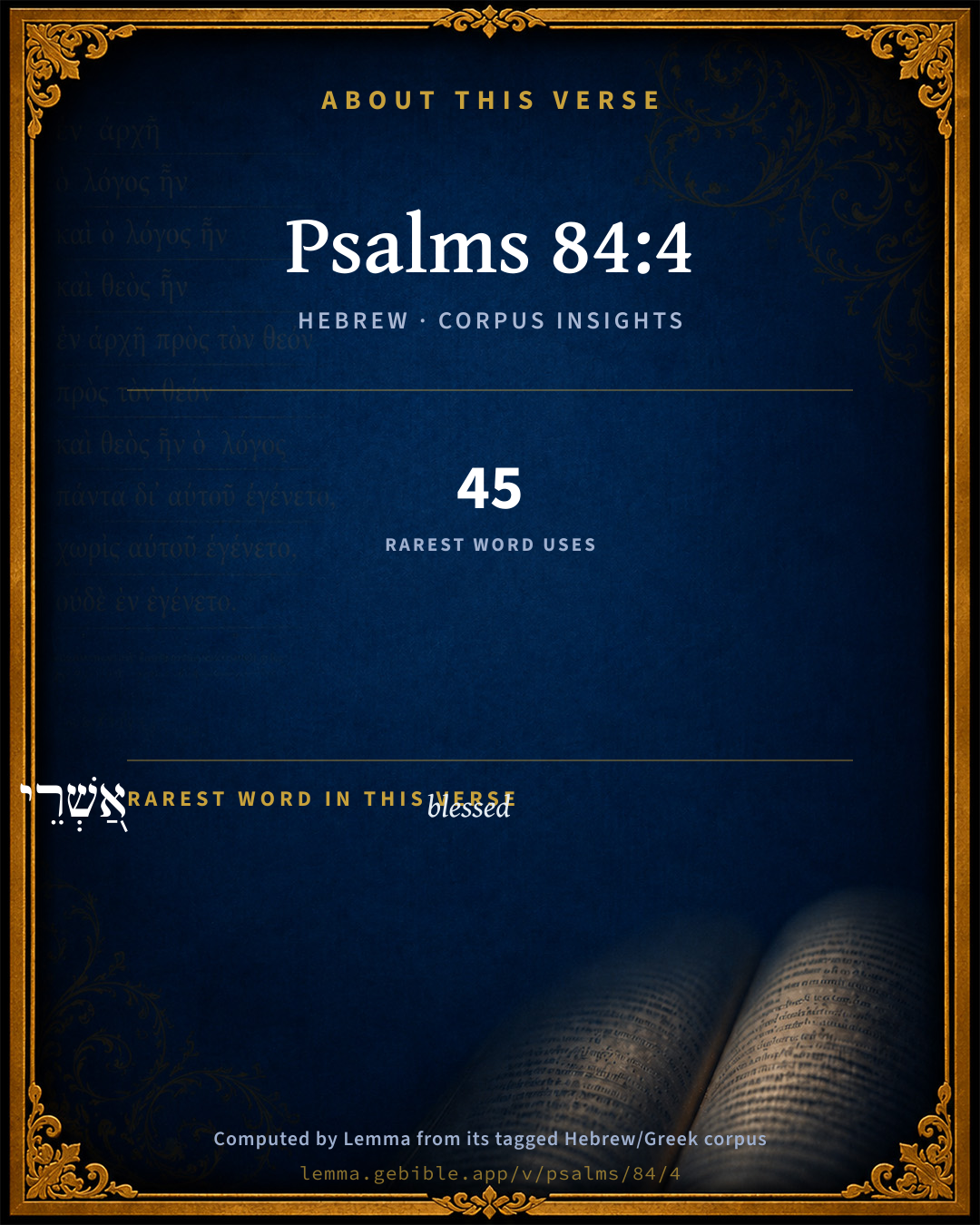
אַ֭שְׁרֵי blessed H835 occurs in 42 verses of the Hebrew Bible. Also found in:

Grammatical profile

  • 2 verbs
  • 2 nouns
  • 1 adverb
  • 1 particle

Verb forms

  • יוֹשְׁבֵ֣י Qal · Participle Active
  • יְֽהַלְל֥וּךָ Piel · Imperfect

Hebrew & Septuagint length

In English translation the verse runs 14 words from the Hebrew and 14 from the Septuagint (LXX English) — the same length.

A rough comparison of the two English renderings, which tokenize alike — not a word-level alignment.

Word counts can differ between the Hebrew and the Greek without any difference in meaning — e.g. the Hebrew direct-object marker אֵת has no separate Greek word, and Greek often adds the article ὁ.

Cross-references

12

Topical passages linked to Psalms 84:4 in the Treasury of Scripture Knowledge — connected by theme and wording, ordered by reader-vote popularity; previews shown in the World English Bible.

  • Psalms 23:6 Surely goodness and loving kindness shall follow me all the days of my life, And I shall dwell in Yahweh's house forever.
  • Psalms 65:4 Blessed is one whom you choose, and cause to come near, That he may live in your courts. We will be filled with the goodness of your house, Your holy temple.
  • Psalms 27:4 One thing I have asked of Yahweh, that I will seek after, That I may dwell in the house of Yahweh all the days of my life, To see Yahweh's beauty, And to inquire in his temple.
  • Isaiah 12:4–5 In that day you will say, "Give thanks to Yahweh! Call on his name. Declare his doings among the peoples. Proclaim that his name is exalted!
  • Psalms 71:8 My mouth shall be filled with your praise, With your honor all the day.
  • Psalms 42:11 Why are you in despair, my soul? Why are you disturbed within me? Hope in God! For I shall still praise him, The saving help of my countenance, and my God.
  • Psalms 71:15 My mouth will tell about your righteousness, And of your salvation all day, Though I don't know its full measure.
  • Psalms 134:1–3 Look! Praise Yahweh, all you servants of Yahweh, Who stand by night in Yahweh's house!
  • Psalms 145:21 My mouth will speak the praise of Yahweh. Let all flesh bless his holy name forever and ever.
  • Revelation 7:15 Therefore they are before the throne of God, they serve him day and night in his temple. He who sits on the throne will spread his tent over them.
  • Psalms 42:5 Why are you in despair, my soul? Why are you disturbed within me? Hope in God! For I shall still praise him for the saving help of his presence.
  • Psalms 145:1–2 I will exalt you, my God, the King. I will praise your name forever and ever.

Cross-references courtesy of OpenBible.info (CC BY 4.0).

Hebrew and Greek witnesses Masoretic Hebrew ↔ Greek Septuagint

The same verse in the two great witnesses to the Old Testament, shown verse-for-verse.

You’re reading Greek Psalm 83 (Hebrew Psalm 84). The Septuagint counts the superscription, so verse numbers can differ from the Hebrew — chapter-level alignment, not verse-by-verse. Numbering follows Rahlfs.

These are two independent witnesses, not word-aligned to each other, and the Septuagint is shown in lemma (dictionary) form.

Hebrew Psalms 84:4 Masoretic · Westminster Leningrad Codex

אַ֭שְׁרֵי יוֹשְׁבֵ֣י בֵיתֶ֑ךָ ע֝֗וֹד יְֽהַלְל֥וּךָ סֶּֽלָה

Blessed are those who dwell in your house. They are always praising you. Selah.

World English Bible · Public Domain

Greek LXX Greek Psalm 83:4 Septuagint · lemma form

καί γάρ στρουθίον εὑρίσκω ἑαυτοῦ οἰκία καί τρυγών νοσσιά ἑαυτοῦ ὅς τίθημι ὁ νοσσίον αὐτός ὁ θυσιαστήριον σύ κύριος ὁ δύναμις ὁ βασιλεύς ἐγώ καί ὁ θεός ἐγώ

Blessed are they that dwell in your house: they will praise you evermore. Pause.

LXX2012 (modern English Septuagint) · Public Domain

On this verse, Albert Barnes' Notes on the Bible discusses the Septuagint’s reading. Read the note in Commentary ↓

Hebrew: Westminster Leningrad Codex (CC BY 4.0). Greek: Septuagint (public domain); English from LXX2012 (modern English Septuagint) (Public Domain). How the Septuagint differs from the Hebrew →

Commentary

Notes on Psalms 84:4 from classic Christian and Jewish commentators (each source and its license shown beneath its notes). The classic Christian expositions comment on the surrounding passage and are grouped to its opening verse, so a note may address several verses; the Jewish commentaries on the Tanakh (Rashi and others) are per-verse, so they appear only where the commentator wrote on this verse.

Lemma curates 59 commentaries, every one of them public domain or Creative Commons licensed, each selected and text-cleaned for this edition rather than reprinted as found. About our sources →

Trapp's Complete Commentary

John Trapp

Psa 84:4 Blessed [are] they that dwell in thy house: they will be still praising thee. Selah.

Ver. 4. Blessed are they that dwell in thy house] viz. Those menial servants of thine, the priests and Levites, who have their lodgings near thee, and their employment about thee, Exclamatio pathetica ex abrupto (Trem.). This is still the happiness of God’s ministers, whose holy function and calling (both in the preparation to it and execution of it) Ieadeth them to God, and holdeth them with him.

They will be still praising thee] As having hearts full of heaven and consciences full of comfort. There cannot but be music in the temple of the Holy Ghost.

John Trapp, A Commentary or Exposition upon All the Books of the Old and New Testament (1647–1656) — public domain. Text from a community e-Sword module.

The Biblical Illustrator

Joseph S. Exell

Psa_84:4

Blessed are they that dwell in Thy house: they will be still praising Thee.

The priest and the pilgrim

1. The means of grace are prized in proportion to the difficulty or danger in the way of their enjoyment. The Scottish Covenanters would not be absent from public worship, although to be present at a conventicle was to brave not only oftentimes winter cold and storm under the open sky, but as well the cruel death that threatened them as law-breakers. Shall we not appear to our less favoured brethren to be the spoilt children of too many mercies?

2. The psalmists utterance also illustrates the universal disposition among men to think they see in the lot assigned to others benefits and advantages greater than anything they themselves enjoy. Much of this discontent and murmuring has no better justification than an erroneous estimate of the prosperity and happiness of others. A little reflection would show it to be unworthy and mean-spirited. Instead of saying, Happy are those others, and allowing discontent to embitter our spirit, let us look around, and, seeing what others lack and suffer, say gratefully, Happy are we. Not envy, but loving, self-forgetting sympathy will be the passion stirred in our hearts. The pilgrim is not justified in supposing that those who remain in Gods house are so much better off religiously than himself. After all, it is not constant and close association with sacred things that makes a man blessed. The following three verses (5-7) effectively enforce this lesson. They are best understood as the reply of the Temple ministers to the pilgrims exclamation, Happy are they that dwell in Thy house! These do not seek to make out that they are not happy, but with quiet dignity they perform the useful and needful service of drawing the mans attention to his own happiness. Nay, say they, not only those who dwell in Gods house are happy. Happy is every man whose strength the Lord is, and very specially such as are pilgrims on the highways with gladness in their heart. The pilgrim limits the conditions of happiness unduly. All who put their trust in God, pilgrims like himself, are as fortunate as they. Happy is the priest and happy is the pilgrim! (A. S. Laidlaw, B. D.)

The blessedness of dwelling in Gods house

I. There is a place peculiarly distinguished as the House of God. Jehovah planned, built, furnished and inhabits it.

II. There are persons who find an abiding residence in it. This implies--

1. The most ardent attachment to it.

2. Constant attendance upon it.

3. The greatest enjoyment in it.

III. Such characters are truly blessed.

1. From the nature of their employment. Praise.

2. From its perpetuity. (T. Spencer.)

Blessings received in the sanctuary an incentive to special praise

I. A sacred scene. What though wealth may have poured no tribute to enrich it? what though art may have conferred no labour to adorn it? what though nobility may have allowed no patronage to sanction it? what though royalty may have pronounced no decree to exalt it? what though there be no ceremonial of gorgeous pomp to decorate its ritual, and no thrilling notes of scientific harmony to reverberate through long-drawn aisles and lofty domes, melting the passions by its charm, and swaying the senses on the side of salvation?--yet let there be the open voice of inspiration, let there be the prayer of the penitent and the hymn of the grateful, let there be the voice of the living ministry declaring the whole counsel of God, and expounding the Gospel of His grace--and there angel bands descend and hover, the ministering spirits of the place, and there God pronounces, as of old, in solemn approval, This is my rest for ever, here will I dwell, for I have desired it.

II. A delightful fact. The house of God is the scene of--

1. Instruction.

2. Comfort.

3. Fellowship with God.

4. Preparation for heaven.

Here it is, you plume your souls for the glory, which is yet to be revealed in you; and it is but a trifling distance that separates you from the consummation, when you shall stand in the presence of God. Blessed, then, are they that dwell in His house.

III. As appropriate enjoyment. Still praising God--

1. When you tell verbally of His goodness.

2. As you render personal consecration to His service.

3. By advocating with others the claims of His house and cause. (J. Parsons.)

Contrasted lots

It is early morning. A party of pilgrims are drawing nigh to the Holy City. They have come from afar to pay their vows in the house of the Lord. They catch sight of the golden sheen from the eastern front of the Temple as it flashes in the morning light, and break out into song. O how lovely are Thy dwellings, O Lord of hosts. But as the pilgrim still toils on his way and climbs the long ascent, hot, wearied, travel-stained, his throat choked with the sands of the desert, his tongue parched with thirst, he cannot help contrasting his position with that of the fortunate servants of the Temple. There they are constantly and without effort where he can be but once or twice in his life, and then only at great sacrifice of time, energy, comfort. It takes him days of wearisome and exhausting travel to come and pay his vows, while the priest, and even the doorkeeper have nothing to do but to tumble out of bed at the last minute and they are on the spoil He can only stay amid these delightful scenes a few days at the most, and must then return to the tents of wickedness, where it is so hard to keep a conscience void of offence. The Temple servants, on the other hand, can hardly fail to be good. They dwell always in the gracious and heavenly atmosphere of the Temple courts, and continually engage in sanctifying and delightful duties. How enviable their lot! Blessed are they that dwell in Thy house, they are constantly praising Thee. The priest, the Levite, and the doorkeeper are at their customary duty. The pilgrim song strikes on their car. They cannot help pausing a moment. How fresh and sincere it sounds! What genuine and holy passion! My soul longeth, yea, even fainteth for the courts of the Lord. And now again that note of exaltation and rapture, My King and my God! The old doorkeeper looks at the aged priest. They are both in their fortieth year of service. They have never departed from the Temple, each engaged in his same round of duties all the time. They read and share each others thoughts. Ah! sighs the priest, for the pilgrims experience! He is visiting the holy spot, not because he has to be here, but because he has a strong desire to come. What adventures he has had on the way! What perils confronted and difficulties surmounted! And now he is here, and sees everything for the first time. All is fresh, full of novelty and interest, reality and zest. I, poor wight, have been doing these same duties for forty years! And I am bound to fulfil them, whether in the mood or not. It is long enough since I had a new idea, or felt the breath of a fresh inspiration. Behold what a weariness in the monotonous reiteration of even holy duty! Would I could change places with these pilgrims! Blessed is the man who finds such strength in Thee, who has it in his heart to make a pilgrimage to Zion. So it is all the world over, in religious and in daily life! We see the desirable things of the lot of another and the hardships of our own. To this side of the river, says the Hindu proverb, that side looks green. But cross the river and see! Have you not in walking along a street after a heavy shower of rain often noticed that the other side was far drier than the puddly pavement you were treading? So to avoid walking in the water you have crossed the road, but your feet got wet nevertheless! Many a young Christian, harassed and tempted at his daily work, thinks how fine it must be to be a minister. Well, so it is. But the position must not be judged by the parade day. It might be a good thing for him to be a minister just for one week. Lots are more equally divided than we think, and it is well that we should be initiated into the secret of St. Paul, who had learnt in whatsoever state he was therein to be content. For we may be well assured that if we are not content in our own lot we never should be in that of any one else. From the opinion of others we may learn some of the advantages our own calling possesses. The pilgrim tells the Temple servant for what he envies him, the Temple servant can show the pilgrim the compensation of his position. And the wise-hearted will heed the criticism. The sage bids us not to leave the ills we have to fly to those we know not of. The pilgrim must see the grand compensation of his lot. He cannot always be engaged offering the sacrifices of the sanctuary. But let him remember that lifes redeeming and renewing ministry is not confined to the hours or places of worship. Look, says the priest, surveying the wilderness which the pilgrim has sorrowfully trodden; passing through the valley of weeping they make it a place of springs. In the wilderness of the world, through which Gods people pass as strangers and pilgrims, their struggles are sacrificial, their tears life-giving. They wander in the wilderness in a desert way, hungry and thirsty, their souls faint in them, but as they go through it they turn the wilderness into a pool of water and the dry land into a spring of water. All that come after them bless God for the sighs and tears, the struggles and pains of those that went before, for they find that the desert has rejoiced and blossoms as the rose. You bewail the wickedness of your generation or the neighbourhood in which you live, or the business place you work in. You sigh and say, Woe is me that I dwell in the tents of wickedness; I had rather be a doorkeeper in the house of the Lord. Already you are a doorkeeper of the house of the Lord. If ever the people among whom your lot is east are to hear of Christ and see the Kingdom of Heaven opened, it is by your witness and Christly ministry among them. Christ is the Door, and, if I may so say, you are the Door-keeper. That is your privilege, your great opportunity. You may be the only one on the pilgrimage in your neighbourhood, or family, or place of business. But you will not long be. For as you pass oh your way your cheery courage, your prayers, your sorrows and struggles shall, by Gods grace, avail to change the face of the dark spot in the midst of which He has placed you and to make the wilderness into a fruitful field. (F. L. Wiseman.)

The Biblical Illustrator, edited by Joseph S. Exell (c. 1880s–1900s) — public domain. Text from a community e-Sword module.

Joseph Benson's Commentary

Psa 84:4. Blessed, &c. — “Here the metaphor is dropped, and the former sentiment expressed in plain language;” are they that dwell in thy house — That constantly abide in, or frequently resort to, thy house; intending either the priests and Levites, who kept constant watch there; or such devout Jews as Anna, Luk 2:37, who were there continually. They will be still praising thee — They are constantly employed in that blessed and glorious work, of praising and serving thee, in the place which thou hast appointed for that end. Observe, reader, “Blessed are, not the mighty and opulent of the earth, but they that dwell in God’s house, the ministers of the eternal temple in heaven, the angels and the spirits of just men made perfect; their every passion is resolved into love, every duty into praise; hallelujah succeeds hallelujah; they are still, for ever, praising thee. And blessed, next to them, are those ministers and members of the church here below, who, in disposition, as well as employment, do most resemble them.” — Horne.

Joseph Benson's Commentary on the Old and New Testaments (1811–1818) — public domain. Text from a community e-Sword module.

J. A. Alexander on Psalms

Joseph Addison Alexander

5. (Psa 84:4) Happy the dwellers in thy house, (for) still they praise thee (or will praise thee). The first phrase is the idiomatic one with which the book begins, for the peculiar form and sense of which, see above on Psa 1:1; Psa 2:12; Psa 32:1-2; Psa 33:12; Psa 41:1. Dwellers in, inhabitants of, thy house, i.e. members of thy family, as the same words literally mean in Jer 20:5. For the spiritual or figurative meaning, see above, on Psa 65:1; Psa 23:6; Psa 24:3; Psa 27:4; Psa 61:4; Psa 65:4. The privilege thus described might be enjoyed in any local situation; but the outward sign of it, under the old economy, was the frequenting of the sanctuary. As inmates, not mere visitors, they will still have occasion and opportunity of doing what they do when first admitted into God's household. They will still praise, because they will have renewed cause so to do. See above, on Psa 5:7; Psa 50:15; Psa 50:23; Psa 79:13.

Joseph Addison Alexander, The Psalms Translated and Explained (1850) — public domain. Text from a community e-Sword module.

Tyndale Open Study Notes

Tyndale Open Resources

84:4 The priests and Temple personnel lived in the Temple.

Tyndale Open Study Notes — © Tyndale Open Resources, licensed CC BY-SA 4.0. Text via the HelloAO Bible API.

Adam Clarke's Commentary

Verse 4. Blessed are they that dwell in thy house] They who have such a constant habitation in thy temple as the sparrow or the swallow has in the house wherein it has built its nest.

They will be still praising thee.] They will find it good to draw nigh unto God, as he always pours out his Spirit on his sincere worshippers.

Adam Clarke's Commentary on the Bible (1810–1826) — public domain. Text from a community e-Sword/MySword module.

John Calvin's Commentaries

4 Blessed are they who dwell in thy house. Here the Psalmist expresses more distinctly the proper and legitimate use of the sanctuary; and thus he distinguishes himself from hypocrites, who are sedulously attentive to the observance of outward ceremonies, but destitute of genuine heart godliness. David, on the contrary, testifies, that the true worshippers of God offer to him the sacrifice of praise, which can never be dissociated from faith. Never will a man praise God from the heart, unless, relying upon his grace, he is a partaker of spiritual peace and joy.

John Calvin's Commentaries (1540-1563) — public domain. Text from the Calvin Translation Society English edition (1840s-50s) via the Christian Classics Ethereal Library (ccel.org). Calvin's coverage is partial (roughly two-thirds of the Bible); uncommented books and verses are honest gaps, never fabricated. The 19th-century editor's footnotes and remarks are omitted so the notes are faithfully Calvin's own voice.

The Cambridge Bible for Schools and Colleges

gen. ed. J. J. S. Perowne

4. Blessed] Or, happy, as in Psa_1:1; and so in Psa_84:5; Psa_84:12. Not those who are “of the household of God” in the wider sense (Psa_23:6; Psa_27:4; cp. Eph_2:19), but the actual ministers of the Temple appear to be meant. They can be still, i.e. again and again, raising their Hallelujahs.

The Cambridge Bible for Schools and Colleges (gen. ed. J. J. S. Perowne; Cambridge University Press, 1878–1918) — public domain. Text from a community e-Sword module.

John Gill's Exposition

Blessed is the man whose strength is in thee, Or, "for thee", as some choose to render the words; who have bodily strength from the Lord, for his worship and service, to go up to his house, and serve him: this, with what follows in the two next verses, seem to refer to the males in Israel going up from different parts of the land to Jerusalem to worship, who had strength so to do; when the women and children, for want thereof, stayed at home, which was their infelicity, as it was the happiness of the males that they had ability for such a journey and service: the Targum is,

"whose strength is in thy Word;''

the essential Word, the Messiah, who have spiritual strength in and from him; see Isa 45:24, without this there is no heart to go up to the house of God; and this will carry through a great deal of bodily weakness; and by it saints overcome the temptations of Satan to the contrary, and perform the several duties of religion:

in whose heart are the ways of them; or "thy ways" (x); the ways of God, the ways of Zion, the ways to the house of God; who have these ways at heart, who ask the way to Zion with their faces thitherwards; who have not only ability, but inclination and readiness of mind, to walk in them; whose hearts are bent upon them, regarding no objection, difficulty, and discouragement; who stir up themselves and others to go up to the house of God, and are heartily desirous of being taught his ways, and walking in them, and take great pleasure and delight therein; they are ways of pleasantness and paths of peace to them; the word properly signifies "highways" (y), ways cast up. Some render it "ascensions in his heart" (z); the affections of whose heart go up to God, like pillars of smoke perfumed with frankincense, are after God, his ways and worship, and are set on things above.

(x) "Semitae tuae", Tigurine version; so Kimchi. (y) "viae stratae", Montanus, Cocceius. (z) "Ascensiones in corde suo", V. L. so Sept.

John Gill's Exposition of the Whole Bible (1746–1763) — public domain (CC PDM 1.0). Text via the HelloAO Bible API.

Albert Barnes' Notes on the Bible

Blessed are they that dwell in thy house - Who are constantly there; whose permanent abode is there. The reference is to the priests and Levites - the ministers of religion - who had their permanent abode near the tabernacle and the temple, and who were wholly devoted to the sacred duties of religion. Their lot is here spoken of as a blessed, or as a happy lot, in contradistinction from those who had only the opportunity of occasionally going up to worship. Compare the notes at Psa 65:4.

They will be still praising thee - They will do it constantly, as their daily employment. It will not be worship begun and ended, but worship continued - the regular business from day to day. Such will heaven be; and this will constitute its glory. There will be

(a) a permanent residence there: “Him that overcometh will I make a pillar in the temple of my God, and he shall go no more out,” Rev 3:12; and

(b) there will be the constant service of God; such a service that it may be described as perpetual praise.

The Septuagint and the Latin Vulgate render this, “They will praise thee for ages of ages;” that is, forever.

Albert Barnes' Notes on the Bible (1834–1885) — public domain. Text from a community e-Sword/MySword module.

Matthew Poole's English Annotations

They that constantly or frequently resort to and abide in thy house; either the priests and Levites, who kept continual watch there; or other devout Jews who were there perpetually, as Anna, Luk 2:37. For they are continually employed in that blessed and glorious work of praising and serving thee in the place which thou hast appointed for that end.

Matthew Poole's English Annotations on the Holy Bible (1683–1685) — public domain. Text from a community e-Sword/MySword module.

The Treasury of David

Charles H. Spurgeon

Ver. 4. Blessed are they that dwell in thy house. Those he esteems to be highly favoured who are constantly engaged in divine worshipthe canons residentiary, yea, the pew openers, the menials who sweep and dust. To come and go is refreshing, but to abide in the place of prayer must be heaven below. To be the guests of God, enjoying the hospitalities of heaven, set apart for holy work, screened from a noisy world, and familiar with sacred thingswhy this is surely the choicest heritage a son of man can possess.

They will be still praising thee. So near to God, their very life must be adoration. Surely their hearts and tongues never cease from magnifying the Lord. We fear David here drew rather a picture of what should be than of what is; for those occupied daily with the offices needful for public worship are not always among the most devout; on the contrary, "the nearer the church the further from God." Yet in a spiritual sense this is most true, for those children of God who in spirit abide even in his house, are also ever full of the praises of God. Communion is the mother of adoration. They fail to praise the Lord who wander far from him, but those who dwell in him are always magnifying him.

Selah. In such an occupation as this we might be content to remain for ever. It is worth while to pause and meditate upon the prospect of dwelling with God and praising him throughout eternity.

Ver. 4. Blessed are they that dwell in thy house; etc. Alas, how happens this? There were tabernacles before, as belonging to a Lord; and courts as belonging to a king, and altars as belonging to a God; and now to be but a house as belonging to a private man; and so all this great rising to end in a fall? No, my soul, it is no fall, it is an aggregation rather of all the other; for where his tabernacles did but serve to shew his power, his courts but to shew his majesty; his altars but to shew his deity, his house serves to shew them all; for in his house there will still be praising him, and his praise and glory is the sum of all. Or is it that to dwell in God's house is a kind of appropriating him to ourselves, seeing his tabernacles and his courts lie open to strangers, his house open to none but his servants; and seeing in the nearness to God, and conversing with him, consists all true blessedness; therefore Blessed are they that dwell in his house, but how dwell in it? Not to look in sometimes as we pass by, or to stay in it a time, as we do at an inn, but to be constant abiders in it day and night, as to which we have devoted ourselves and bowed our service. Sir Richard Baker.

Ver. 4. Blessed are they that dwell in thy house. What was this house more to David than another house, save that here he reckoned upon enjoying the Divine Presence? So that here was a heart so naturalized to this presence as to affect an abode in it, and that he might lead his life with God, and dwell with him all his days; he could not be content with giving a visit now and then. And why should this temper of spirit in the clearer light of the gospel be looked upon as an unattainable thing! A lazy despondency, and the mean conceit that it is modest not to aim so high, starve religion, and stifles all truly noble and generous desires. Let this then be the thing designed with you, and constantly pursue and drive the design, that you may get into the disposition of spirit toward God. John Howe.

Ver. 4. Blessed are they that dwell in thy house, etc. Blessed indeed, we too may exclaim, and blessed shall they be for ever. They are dwellers, not visitors, in God's house. I will dwell in the house of the Lord for ever. This is true, blessedly true, of all who trust in Jesus now. But though God's children are all priests by birth, as were the sons of Aaron, they are not all, alas! priests by consecration. (See Exodus 29.) Comparatively few know their priestly place at the golden altar. Many of them are doubting as to whether their sins, root and branch, were all consumed outside the camp; and, consequently, such are afraid to come within the court, and as for being assured of their full justification and sanctification in the risen One, they gravely doubt and fear that such blessedness can ever be their happy lot. Hence that state of soul which answers to priestly consecration at the laver, and happy worship at the golden altar, is unknown and unenjoyed. They are not priests by consecration.

Our text is plain. They will still be praising thee. Doubts, fears, unsettled questions, all are gone. Such cannot exist in the holy place. All, of course, who are in Christ, must be in God's account where he is; but all who believe in Christ, do not know and believe that they are in him, as being one with him now. When the state of our souls answers to what is symbolized by the holy place, we can only praise: They that dwell in thy house will be still praising thee. Then we are happily near to God, and have communion with him, in the glorified Christ, through the power of the Holy Ghost. Things New and Old.

Ver. 4. They will be still praising thee. How appears it to be true, that they who dwell in God's house will always be praising him, seeing it is but seldom seen that servants be so forward to praise their masters? O my soul! it is not so much the good dispositions of the servants, as the infinite worthiness of the Master that makes them to praise him, for when they see the admirable economy of his government, when they see how sweetly he disposeth all things in weight and measure, when they find him to use them more like children than servants, what heart can be so ungrateful as not to praise him? And seeing by dwelling in God's house, they see these things continually, therefore they that dwell in his house will always be praising him. Sir Richard Baker.

Ver. 4. They will be still praising thee. As having hearts full of heaven, and consciences full of comfort. There cannot but be music in the temple of the Holy Ghost. John Trapp.

Ver. 4. Still praising. It is not enough to praise him, it must be a praising him still, before it will make a blessedness; and though to praise God be an easy matter, yet to praise him still, will be found a busy work, indeed to flesh and blood a miserable work, for if I be still praising him, what time shall I have for any pleasures? O my soul, if thou make it not thy pleasure, thy chief, thy only pleasure to be praising him, thou art not like in haste to come to blessedness. And marvel not that David speaks thus under the law, when St. Paul under the Gospel saith as much: Whether ye eat or drink, or whatsoever ye do, let all be done to the glory and praise of God. Sir Richard Baker.

Ver. 4.

I. The Privilege suggesteddwelling in the house of

God. Some birds fly over the house of Godsome

occasionally alight upon itothers build their nests

and train up their young there. This was the privilege

which the Psalmist desired. II. The Fact asserted. Blessed are they that dwell, etc.,

who make it the spiritual home of themselves and their

children. III. The Reason given. They will be still, etc.

(1) They will have much for which to praise God;

(2) They will see much to praise in God. G. R.

Psalms 84:5*

Charles H. Spurgeon's The Treasury of David (1869–1885) — public domain. Psalms only. Text from a community e-Sword/MySword module.

Whedon's Commentary on the Bible

Daniel D. Whedon

4. Dwell in thy house—The dwellers in the house of God are not simply the Levites, who always serve there, but those who in heart abide there, the spiritual dwellers.

They will be still praising thee—Notwithstanding any present affliction or temporary banishment from Zion.

Daniel D. Whedon (gen. ed.), Commentary on the Old and New Testaments (1874–1909) — public domain. Text from a community e-Sword module.

The Pulpit Commentary

Blessed are they that dwell in thy house. As the Korahite Levites did, being "keepers of the gates" of the Lord"s house. (1Ch_9:19 1Ch_26:1) They will be still praising thee. It is their privilege to be always praising thee. "The speaker regards the temple as predominantly the house of praise" (Cheyne).

The Pulpit Commentary (1880–1919), ed. H.D.M. Spence-Jones & Joseph S. Exell — public domain. Text from a community e-Sword module.

John Wesley's Explanatory Notes

They-That constantly abide in thy house; the priests and Levites, or other devout Jews who were there perpetually, as Anna, Luke ii, 36-37. They will - They are continually employed in that blessed work.

John Wesley, Explanatory Notes Upon the Whole Bible (1754–1765) — public domain. Text via the GEBible commentary corpus.

Rashi

Rabbi Shlomo Yitzchaki (Rashi)

Even a bird found a house In its ruins, the birds have nested. According to Midrash Aggadah (Mid. Ps. 84:2), it speaks of [the Temple] when it is built, and the bird is the nation of Israel.

Rashi on the Tanakh — English translations: “The Judaica Press complete Tanach with Rashi, translated by A. J. Rosenberg” (CC BY 4.0); “Pentateuch with Rashi's commentary by M. Rosenbaum and A.M. Silbermann, 1929-1934” (public domain); “The Metsudah Tanach series, Lakewood, N.J” (CC BY 4.0); and “The Book of Joshua, Metsudah Publications, 1997” (CC BY 4.0). Text via Sefaria.

Lesson kit

Teaching starters — assembled from the data on this page, not authored interpretation. Every prompt links to the verse data it draws on. Edit before teaching.

Psalms, in the Wisdom, opens this verse with 6 words (6 distinct Hebrew lemmas). Its most distinctive word is ʼesher (“blessed”). A historical commentator’s framing appears above. Read the whole chapter for the surrounding context.

Discussion questions

  1. How does “blessed” (ʼesher) shape what this verse is saying?
  2. Deuteronomy 33:29 shares the word «blessed» with this verse. How do the two illuminate each other?
  3. The translations on this page render this verse differently — a whole-verse word diff, not a word-by-word alignment. What might account for the different wordings?
  4. The verb «יוֹשְׁבֵ֣י» is Qal Participle Active. How does its form color the action?
  5. Reading how Trapp's Complete Commentary and The Biblical Illustrator read this verse, where do the two commentators agree and where do they part?

Things to notice

Reading settings

Reading text

Shown beneath each verse's original-language words.

Old Testament
Old Testament edition

Read the OT as the Masoretic Hebrew (MT) or the Greek Septuagint (LXX).

English shown for the Greek Septuagint (in the Hebrew ↔ Greek comparison).

Comparing translations? Open the Compare panel on any verse page to stack up to four side by side.