

Proverbs 12:8

Hebrew (Westminster Leningrad Codex) Proverbs 12:8 appears in the Hebrew Old Testament. The text above is from the Westminster Leningrad Codex. Each word links to its Strong’s number, a concise gloss, and parsing drawn from the Open Scriptures Hebrew Bible morphology. Click any word for its full Brown-Driver-Briggs (BDB) entry.
Download image
Cite this verse

Proverbs 12:8 (World English Bible). Public Domain. Lemma interlinear Bible study tool, https://lemma.gebible.app/v/proverbs/12/8.

Show BibTeX & RIS
BibTeX
RIS
English Translation
A man shall be commended according to his wisdom, But he who has a warped mind shall be despised.
World English Bible · Public Domain
Download a study sheet

One document with this verse’s original text, its word-by-word gloss line, the meaning frame, cross-references with their text, attributed commentary, and full source and license credits — printable, and it pastes into notes with its structure intact.

This verse Autodidact and up

Study sheet (.html) Plain text (.txt)

A passage Seminary Student

Up to 50 verses in one chapter. A passage sheet keeps up to 6 commentary sources and 12 cross-references per verse, in the order this page ranks them, and says so on the sheet whenever that leaves anything out. Ask for a single verse and you get the Autodidact verse sheet above.

Everything on this page stays free to read, with no account — the sheet is a download of what is already on screen, not access to it.

Want to remove ads? Support Godless Engineer
Compare translations 3

The same verse in 3 English versions, stacked beneath the original-language interlinear above. Click any original word for its lexicon entry.

Each is an independent rendering of the whole verse — the interlinear is not word-aligned to these translations.

Highlighted words mark where these versions differ — a whole-verse word diff, not a word-by-word alignment.

  • World English Bible Public Domain
    A man shall be commended according to his wisdom, But he who has a warped mind shall be despised.
  • King James Version Public Domain
    A man shall be commended according to his wisdom: but he that is of a perverse heart shall be despised.
  • unfoldingWord Literal Text CC BY-SA 4.0
    For the mouth of his insight a man will be praised, but twisted of heart will be for contempt.

unfoldingWord Literal Text — © unfoldingWord, licensed CC BY-SA 4.0. Word-aligned USFM3 via Door43 (git.door43.org/unfoldingWord/en_ult).

Versions to compare (up to 4)

3 of 4 selected

Show all 18 translations

Every available English version of this verse, each an independent rendering of the whole verse.

  • World English Bible Public Domain
    A man shall be commended according to his wisdom, But he who has a warped mind shall be despised.
  • Berean Standard Bible Public Domain
    A man is praised according to his wisdom, but a twisted mind is despised.
  • Majority Standard Bible Public Domain
    A man is praised according to his wisdom, but a twisted mind is despised.
  • King James Version Public Domain
    A man shall be commended according to his wisdom: but he that is of a perverse heart shall be despised.
  • American Standard Version (1901) Public Domain
    A man shall be commended according to his wisdom; But he that is of a perverse heart shall be despised.
  • Revised Version (1885) Public Domain
    A man shall be commended according to his wisdom: but he that is of a perverse heart shall be despised.
  • Geneva Bible (1599) Public Domain
    A man shall be commended for his wisedome: but the froward of heart shalbe despised.
  • Douay-Rheims (1899) Public Domain
    A man shall be known by his learning: but he that is vain and foolish, shall be exposed to contempt.
  • Young's Literal Translation Public Domain
    According to his wisdom is a man praised, And the perverted of heart becometh despised.
  • Literal Standard Version CC BY-SA 4.0
    A man is praised according to his wisdom, || And the perverted of heart becomes despised.
  • Unlocked Literal Bible CC BY-SA 4.0
    A person is praised by how much wisdom he has, but the one who makes perverse choices is despised.
  • unfoldingWord Literal Text CC BY-SA 4.0
    For the mouth of his insight a man will be praised, but twisted of heart will be for contempt.
  • Darby Bible Public Domain
    A man is commended according to his wisdom; but he that is of a perverted heart shall be despised.
  • World Messianic Bible Public Domain
    A man shall be commended according to his wisdom, but he who has a warped mind shall be despised.
  • Webster's Bible Public Domain
    A man shall be commended according to his wisdom: but he that is of a perverse heart shall be despised.
  • Free Bible Version CC BY-SA 4.0
    People are appreciated for talking sense, but those with perverted minds are despised.
  • Bible in Basic English Public Domain
    A man will be praised in the measure of his wisdom, but a wrong-minded man will be looked down on.
  • JPS Tanakh (1917) Public Domain
    A man shall be commended according to his intelligence; but he that is of a distorted understanding shall be despised.

Literal Standard Version (2020), Covenant Press — licensed CC BY-SA 4.0. Text via the HelloAO Bible API (eBible.org). Unlocked Literal Bible (unfoldingWord) — licensed CC BY-SA 4.0. Text via the HelloAO Bible API (eBible.org). unfoldingWord Literal Text — © unfoldingWord, licensed CC BY-SA 4.0. Word-aligned USFM3 via Door43 (git.door43.org/unfoldingWord/en_ult). Free Bible Version, Dr. Jonathan Gallagher — licensed CC BY-SA 4.0. Text via the HelloAO Bible API (eBible.org).

Word by word

More ways to search: Search by grammar → Find every occurrence → Compare this word →

Practice this passage: Drill this verse → Learn its vocabulary →

About this verse

These counts appear in no published source. They are computed here, from the morphology-tagged text and Lemma’s own curated glosses. What Lemma adds →

8
words
8
distinct lemmas
Wisdom
section

Notable vocabulary

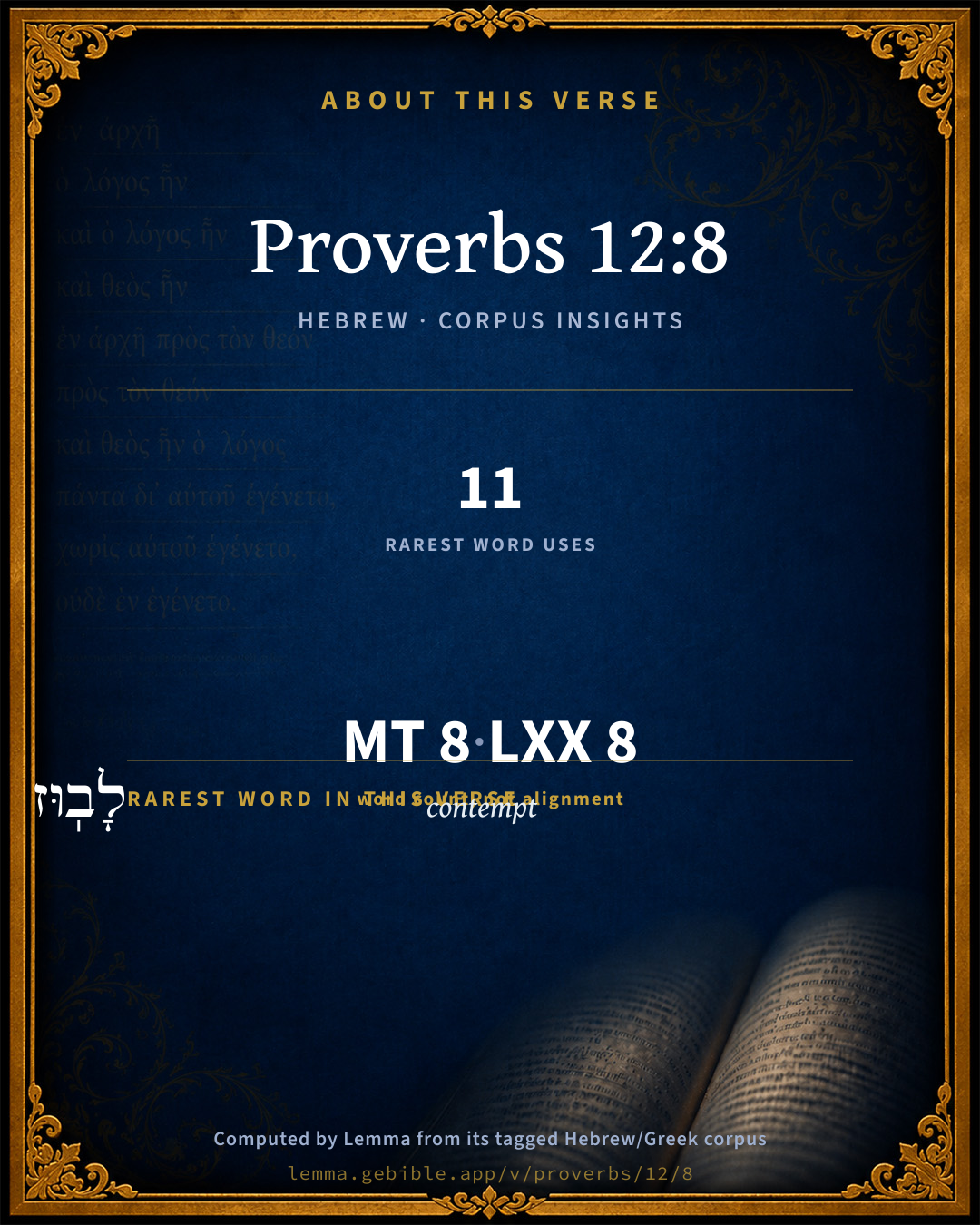
The rarest word here is לָבֽוּז contempt H937 — appearing just 11 times in the whole Hebrew Bible.

Shared distinctive vocabulary

לָבֽוּז contempt H937 occurs in 11 verses of the Hebrew Bible. Also found in:

Grammatical profile

  • 3 verbs
  • 5 nouns

Verb forms

  • יְהֻלַּל Pual · Imperfect
  • וְנַעֲוֵה Niphal · Participle Active
  • יִהְיֶ֥ה Qal · Imperfect

Hebrew & Septuagint length

In English translation the verse runs 19 words from the Hebrew and 22 from the Septuagint (LXX English) — closely comparable.

A rough comparison of the two English renderings, which tokenize alike — not a word-level alignment.

Word counts can differ between the Hebrew and the Greek without any difference in meaning — e.g. the Hebrew direct-object marker אֵת has no separate Greek word, and Greek often adds the article ὁ.

In the original languages it is 8 Hebrew tokens and 8 Greek tokens — but the two are counted differently (Hebrew bundles its prefixes and suffixes into one token; the Greek is in lemma form), so that isn’t a like-for-like length.

Cross-references

19

Topical passages linked to Proverbs 12:8 in the Treasury of Scripture Knowledge — connected by theme and wording, ordered by reader-vote popularity; previews shown in the World English Bible.

  • 2 Corinthians 10:18 For it isn't he who commends himself who is approved, but whom the Lord commends.
  • Proverbs 3:35 The wise will inherit glory, But shame will be the promotion of fools.
  • Malachi 2:8–9 But you have turned aside out of the way. You have caused many to stumble in the law. You have corrupted the covenant of Levi," says Yahweh of Hosts.
  • Matthew 27:4–5 saying, "I have sinned in that I betrayed innocent blood." But they said, "What is that to us? You see to it."
  • 1 Corinthians 3:10–15 According to the grace of God which was given to me, as a wise master builder I laid a foundation, and another builds on it. But let each man be careful how he builds on it.
  • 1 Corinthians 4:5 Therefore judge nothing before the time, until the Lord comes, who will both bring to light the hidden things of darkness, and reveal the counsels of the hearts. Then each man will get his praise from God.
  • Genesis 41:39 Pharaoh said to Joseph, "Because God has shown you all of this, there is none so discreet and wise as you.
  • Psalms 132:18 I will clothe his enemies with shame, But on himself, his crown will be resplendant."
  • Daniel 12:2 Many of those who sleep in the dust of the earth shall awake, some to everlasting life, and some to shame and everlasting contempt.
  • Luke 12:42–44 The Lord said, "Who then is the faithful and wise steward, whom his lord will set over his household, to give them their portion of food at the right times?
  • Luke 16:8 "His lord commended the dishonest manager because he had done wisely, for the children of this world are, in their own generation, wiser than the children of the light.
  • Acts 12:23 Immediately an angel of the Lord struck him, because he didn't give God the glory, and he was eaten by worms and died.
  • 1 Samuel 13:13 Samuel said to Saul, You have done foolishly; you have not kept the commandment of Yahweh your God, which he commanded you: for now would Yahweh have established your kingdom on Israel forever.
  • 1 Samuel 16:18 Then answered one of the young men, and said, Behold, I have seen a son of Jesse the Bethlehemite, who is skillful in playing, and a mighty man of valor, and a man of war, and prudent in speech, and a comely person; and Yahweh is with him.
  • 1 Samuel 18:30 Then the princes of the Philistines went forth: and it happened, as often as they went forth, that David behaved himself more wisely than all the servants of Saul; so that his name was much set by.
  • 1 Samuel 25:17 Now therefore know and consider what you will do; for evil is determined against our master, and against all his house: for he is such a worthless fellow that one can't speak to him.
  • Proverbs 1:26 I also will laugh at your disaster. I will mock when calamity overtakes you;
  • Proverbs 5:23 He will die for lack of instruction. In the greatness of his folly, he will go astray.
  • Ecclesiastes 8:1 Who is like the wise man? And who knows the interpretation of a thing? A man's wisdom makes his face shine, and the hardness of his face is changed.

Cross-references courtesy of OpenBible.info (CC BY 4.0).

Hebrew and Greek witnesses Masoretic Hebrew ↔ Greek Septuagint

The same verse in the two great witnesses to the Old Testament, shown verse-for-verse.

These are two independent witnesses, not word-aligned to each other, and the Septuagint is shown in lemma (dictionary) form.

Hebrew Proverbs 12:8 Masoretic · Westminster Leningrad Codex

לְֽפִי שִׂ֭כְלוֹ יְהֻלַּל אִ֑ישׁ וְנַעֲוֵה לֵ֝֗ב יִהְיֶ֥ה לָבֽוּז

A man shall be commended according to his wisdom, But he who has a warped mind shall be despised.

World English Bible · Public Domain

Greek LXX Proverbs 12:8 Septuagint · lemma form

στόμα συνετός ἐνκωμιάζω ὑπό ἀνήρ νωθροκάρδιος δέ μυκτηρίζω

The mouth of an understanding man is praised by a man; but he that is dull of heart is had in derision.

LXX2012 (modern English Septuagint) · Public Domain

On this verse, The Pulpit Commentary discusses the Septuagint’s reading. Read the note in Commentary ↓

Hebrew: Westminster Leningrad Codex (CC BY 4.0). Greek: Septuagint (public domain); English from LXX2012 (modern English Septuagint) (Public Domain). How the Septuagint differs from the Hebrew →

Commentary

Notes on Proverbs 12:8 from classic Christian and Jewish commentators (each source and its license shown beneath its notes). The classic Christian expositions comment on the surrounding passage and are grouped to its opening verse, so a note may address several verses; the Jewish commentaries on the Tanakh (Rashi and others) are per-verse, so they appear only where the commentator wrote on this verse.

Lemma curates 59 commentaries, every one of them public domain or Creative Commons licensed, each selected and text-cleaned for this edition rather than reprinted as found. About our sources →

Trapp's Complete Commentary

John Trapp

Pro 12:8 A man shall be commended according to his wisdom: but he that is of a perverse heart shall be despised.

Ver. 8. A man shall be commended according to his wisdom.] And all wisdom consists in this, Ut Deum quis cognoscat et colat, saith Lactantius; - That a man rightly know and worship God. This did not Apollonius, whom yet Philostratus commendeth, that he was non doctus, sed natus sapiens, not instructed, but born wise. See the contrary, Job 11:12. Nor Archimedes, who yet had the name and note, saith Plutarch, of a divine, and not human wisdom; {a} nor Aristotle, whom yet Averroes admires, as the very rule and copy that nature invented, wherein to set forth the utmost of human perfection; and further saith, that his doctrine was the chiefest truth, and his understanding the utmost extent of human wisdom. These were wise, I confess, in their generations, and so accounted; but by whom? Not by St Paul; he had another opinion of them. See Rom 1:22-23 1Co 2:6. Not by our Saviour. See Mat 11:25. Not by any that are rightly instructed to the kingdom of heaven, and have their senses exercised to discern good and evil. The Italians arrogate to themselves the monopoly of wisdom in that proverb of theirs, Italus sapit ante factum, Hispanus in facto, Germanus post factum. Italians, say they, both seem and are wise; whereas Spaniards seem wise, and are fools; Frenchmen seem fools, and are wise; Portuguese neither are wise, nor so much as seem so. Thus the Jesuits - those great clerks, politicians, and wizards of the world - do vaunt that the Church is the soul of the world, the clergy of the Church, and they of the clergy. But what saith that great apostle that knew more than twenty of them? "He that glorieth, let him glory in the Lord"; {1Co 1:31} for "not he that commendeth himself is approved," - no, nor he whom the world cries up for a wise man - "but he whom the Lord commendeth." {2Co 10:18}

But he that is of a perverse heart.] As all are that are not heavenly wise, and that show not "out of a good conversation their works with meekness of wisdom." {Jas 3:13; Jas 3:17} But so did none of those heathen sages, whom God, for their unthankfulness, "gave up unto vile affections" {Rom 1:20} and vicious conversation; and so set a noverint universi, as it were, upon them. Know all men that these men know nothing aright, and as they ought to know; "professing themselves to be wise, they proclaim themselves fools." {Rom 1:22}

{a} εκ ανθρωπινες αλλα δαιμονιου τινος συνεσεως. - Plut.

John Trapp, A Commentary or Exposition upon All the Books of the Old and New Testament (1647–1656) — public domain. Text from a community e-Sword module.

The Biblical Illustrator

Joseph S. Exell

Pro_12:8

A man shall be commended according to his wisdom.

Appreciation better than praise

There are persons in this world--and the pity is that there are not more of them--who care less for praise than for appreciation. They have an ideal after which they are striving, but of which they consciously fall short, as every one who has a lofty ideal is sure to do. When that ideal is recognised by another, and they are praised or commended for something--let that something be important or not--in its direction, they are grateful, not for the praise, but for appreciation. An element of sympathy enters into that recognition, and they feel that they have something in common with the observer who admires what they admire, and praises what they think is most worthy of praise. (Alliance News.)

The Biblical Illustrator, edited by Joseph S. Exell (c. 1880s–1900s) — public domain. Text from a community e-Sword module.

Joseph Benson's Commentary

Pro 12:8. A man shall be commended — Namely, by wise and good men; according to his wisdom — More or less, according to the degree of wisdom, which his discourses and actions discover to be in him; but he that is of a perverse heart — Which he shows by his wicked words and actions; shall be despised — By God, and all wise men.

Joseph Benson's Commentary on the Old and New Testaments (1811–1818) — public domain. Text from a community e-Sword module.

Tyndale Open Study Notes

Tyndale Open Resources

12:8 To be sensible means to act only after reflecting on the consequences. A warped mind acts on impulse.

Tyndale Open Study Notes — © Tyndale Open Resources, licensed CC BY-SA 4.0. Text via the HelloAO Bible API.

Matthew Henry's Commentary

We are here told whence to expect a good name. Reputation is what most have a high regard to and stand much upon. Now it is certain, 1. The best reputation is that which attends virtue and serious piety, and the prudent conduct of life: A man shall be commended by all that are wise and good, in conformity to the judgment of God himself, which we are sure is according to truth, not according to his riches or preferments, his craft and subtlety, but according to his wisdom, the honesty of his designs and the prudent choice of means to compass them. 2. The worst reproach is that which follows wickedness and an opposition to that which is good: He that is of a perverse heart, that turns aside to crooked ways, and goes on frowardly in them, shall be despised. Providence will bring him to poverty and contempt, and all that have a true sense of honour will despise him as unworthy to be dealt with and unfit to be trusted, as a blemish and scandal to mankind.

Matthew Henry's Commentary on the Whole Bible (1708–1710) — public domain (CC PDM 1.0). Text via the HelloAO Bible API.

Jamieson, Fausset & Brown

Robert Jamieson, A. R. Fausset & David Brown

despised--as opposed to commended (Pro 11:12).

perverse heart--or, "wicked principles," as opposed to one of wisdom.

Jamieson, Fausset & Brown — Commentary Critical and Explanatory on the Whole Bible (1871) — public domain (CC PDM 1.0). Text via the HelloAO Bible API.

Ellicott's Commentary for English Readers

(8) According to his wisdom—i.e., intelligent observance of the ends to be pursued in life, and the best means of attaining to them; in other words, finding out the will of God and how to fulfil it.

Shall be despised.—Comp. 1Sa_2:30.

A Bible Commentary for English Readers, edited by Charles John Ellicott (1878–1897) — public domain. Text from a community e-Sword module.

John Gill's Exposition

A man shall be commended according to his wisdom,.... Not according to his birth and pedigree; not according to his riches and wealth; not according to the places of honour and trust he may be in; but according to his wisdom, which he discovers in his words and actions, in his life and conversation: not according to the wisdom that is earthly, sensual, and devilish; not according to the wisdom of the world, which comes to nought, either natural or civil; especially that which lies in sophistry and subtlety, in wicked craft and cunning, whereby men trick, overreach, and defraud one another; but according to that which is spiritual and evangelical; which lies in the knowledge of Christ, and of God in Christ, and of those things which belong to salvation; the beginning of which is the fear of the Lord, and which comes from above, and is pure and peaceable. A man possessed of this is commended by all wise and good men, and by the Lord himself; as the wise man is by Christ, Mat 7:24; who builds his house on a rock; for which reason it stands, as in the preceding verse;

but he that is of a perverse heart shall be despised; and which appears by the perverse words he speaks against God and Christ; against his people, ways, and worship, as antichrist and his followers do; and by his perverse actions, which are contrary to the light of nature, to the law of God, and Gospel of Christ: and such vile persons are contemned in the eyes of all good men, and are had in abhorrence by the Lord himself; for such who despise him are lightly esteemed; see Pro 18:3.

John Gill's Exposition of the Whole Bible (1746–1763) — public domain (CC PDM 1.0). Text via the HelloAO Bible API.

Haydock's Catholic Bible Commentary

Learning. We apply to those things which we love, and those who study sacred (Calmet) or useful sciences, shall receive praise.

George Leo Haydock (1774–1849), Haydock's Catholic Family Bible and Commentary, 1859 edition — public domain. Excludes Psalms (Douay-Rheims chapter numbering differs from Protestant) and Deuterocanonical books (Catholic canon only).

Matthew Poole's English Annotations

A man shall be commended, to wit, by wise and good men, according to his wisdom; more or less according to the degree of wisdom which his discourses and actions discover to be in him.

He that is of a perverse heart, which he showeth by his wicked words and conversation, shall be despised by God and all wise men.

Matthew Poole's English Annotations on the Holy Bible (1683–1685) — public domain. Text from a community e-Sword/MySword module.

Whedon's Commentary on the Bible

Daniel D. Whedon

8. According to his wisdom — Shrewdness or prudence. In proportion to it shall he be applauded.

Perverse — Crooked of heart.

Shall be despised — Literally, it shall be for contempt.

Daniel D. Whedon (gen. ed.), Commentary on the Old and New Testaments (1874–1909) — public domain. Text from a community e-Sword module.

The Pulpit Commentary

According to his wisdom. A man who gives practical proof of wisdom by life and character, whose words and actions show that he is actuated by high views, is praised and acknowledged by all (see on Pro_27:21). Thus we read of David, that he behaved himself wisely, "and he was acceptable in the sight of all the people". (1Sa_18:5) The Septuagint, taking lephi differently, renders, "The mouth of the prudent is commended by men." He that is of a perverse heart; Vulgate, "a vain and senseless man;" Septuagint, "one slow of heart (nwyrokardiov )." One who takes distorted views of things, judges unfairly, has no sympathy for others, shall be despised.

The Pulpit Commentary (1880–1919), ed. H.D.M. Spence-Jones & Joseph S. Exell — public domain. Text from a community e-Sword module.

Keil & Delitzsch

C. F. Keil & F. Delitzsch

8 According to the measure of his intelligence is a man praised,

And whoever is of a perverse mind is despised.

Everywhere in the Mishle שׂכל has no other meaning than intellectus. The praise which is given to a man measures itself לפי שׂכלו (punctuate לפי־שׂכלו, according to Torath Emeth, p. 41, Accentssystem, xx. 1), i.e., according to the measure (so לפי is used in the oldest form of the language) of his intelligence, or as we may also say, of his culture; for in these proverbs, which make the fear of God the highest principle, שׂכל means also understanding of moral excellence, not merely the intellectual superiority of natural gifts. הלּל is here a relative conception of manifold gradations, but it does not mean renown in general, but good renown. Parallel with שׂכלו, לב refers to the understanding (νοῦς); the rendering of Lwenstein, "who is of false heart," is defective. נעוה (synon. of נפתּל and עקּשׁ, but nowhere else interchanging with it) means here a vero et recto detortus et aversus (Fl.). Such a man who has not a good understanding, nor any certain rule of judgment, falls under contempt (Graec. Venet. τῷ ὀντωτῇ εἰς μυσαγμόν, after the false reading of יהוה instead of יהיה), i.e., he defames himself by his crooked judgment of men, of things and their relations, and is on this account in no position rightly to make use of them.

Keil & Delitzsch — Biblical Commentary on the Old Testament (1861–1891) — public domain (CC PDM 1.0). Text via the HelloAO Bible API. (Old Testament only.)

Bridges on Proverbs

Charles Bridges

The ordinary judgment of this world is to "put darkness for light" (Isa 5:20 ), and therefore to commend according to folly, rather than according to wisdom. And yet even hated wisdom often caries its voice of conviction both to conscience and judgment; and a man is commended according to it. Hence the elevation of Joseph and Daniel; the honour paid to David in private life; and the universal respect shewn to his wise son.†1 Our Lord’s wisdom was also commended, not only by the popular voice (Mat 7:28-29 ), but even by the testimony of his enemies. (Joh 7:46 ). The wisdom of Stephen, "making his face to shine," overpowered his beholders with solemn awe. (Act 6:10, Act 6:15 .) How thrilling will be the commendation of wisdom before the assembled universe! (Luk 12:42-44 .) Who will not then acknowledge the wise choice of an earthly cross with an heavenly crown? (Mat 5:11-12 .) Wisdom (2Sa 20:18-22 ) then — not dignity, riches, or talent — brings honour. This is the Lord’s commendation. It must be right. (2Co 10:18 .) It will stand for eternity.

What then makes a man despised? Not his poverty, obscure circumstances, or misfortune; but perverseness of spirit (1Ki 12:16 . Mal 2:8-9 ), too proud to be taught: following a mad course to ruin. Perverse Nabal was despised by his own family (1Sa 25:17, 1Sa 25:25 ); the prodigal by his former companions. (Luk 15:15-16 .) And of all such, shame will be their present promotion (Pro 3:35 ; Pro 11:2 ; Pro 18:3 ), their eternal doom. (Dan 12:2 .)

Footnotes:

†1 Gen 41:39. Dan 1:19-20 ; Dan 2:46 . 1Sa 16:18 ; 1Sa 18:30 . 1Ki 3:28 ; 1Ki 4:29-34 .

Charles Bridges, An Exposition of the Book of Proverbs (1846) — public domain. Text from a community e-Sword module.

Kretzmann's Popular Commentary

Paul E. Kretzmann

v. 8. A man shall be commended according to (literally, "in the presence of") his wisdom, in proportion to the insight he shows in all matters of life; but he that is of a perverse heart shall be despised, his crooked and malicious dealings meeting with the contempt and condemnation which they deserve.

Paul E. Kretzmann, Popular Commentary of the Bible (1921–1924) — public domain. Text from a community e-Sword module.

Rashi

Rabbi Shlomo Yitzchaki (Rashi)

According to his intelligence a man is praised Whether he possesses little or much intelligence, he will receive his reward according to his intelligence.

but he whose heart has turned away He who moved his heart completely away from the Torah will be despised.

Heb. נעוה, as in (Isa. 21:3): “I have become confused (נעויתי) from hearing,” and similarly (I Sam. 20:30): “the son of a straying (נעות) woman deserving of punishment.” And it is possible to say that נעוה means one whose heart has strayed, from the expression נע ונד, moving and wandering, and as one says זעוה, horror, from the root זע, stirred.

Rashi on the Tanakh — English translations: “The Judaica Press complete Tanach with Rashi, translated by A. J. Rosenberg” (CC BY 4.0); “Pentateuch with Rashi's commentary by M. Rosenbaum and A.M. Silbermann, 1929-1934” (public domain); “The Metsudah Tanach series, Lakewood, N.J” (CC BY 4.0); and “The Book of Joshua, Metsudah Publications, 1997” (CC BY 4.0). Text via Sefaria.

Lesson kit

Teaching starters — assembled from the data on this page, not authored interpretation. Every prompt links to the verse data it draws on. Edit before teaching.

Proverbs, in the Wisdom, opens this verse with 8 words (8 distinct Hebrew lemmas). Its most distinctive word is bûwz (“contempt”). A historical commentator’s framing appears above. Read the whole chapter for the surrounding context.

Discussion questions

  1. How does “contempt” (bûwz) shape what this verse is saying?
  2. Genesis 38:23 shares the word «contempt» with this verse. How do the two illuminate each other?
  3. The translations on this page render this verse differently — a whole-verse word diff, not a word-by-word alignment. What might account for the different wordings?
  4. The verb «יְהֻלַּל» is Pual Imperfect. How does its form color the action?
  5. Reading how Trapp's Complete Commentary and The Biblical Illustrator read this verse, where do the two commentators agree and where do they part?

Things to notice

Reading settings

Reading text

Shown beneath each verse's original-language words.

Old Testament
Old Testament edition

Read the OT as the Masoretic Hebrew (MT) or the Greek Septuagint (LXX).

English shown for the Greek Septuagint (in the Hebrew ↔ Greek comparison).

Comparing translations? Open the Compare panel on any verse page to stack up to four side by side.