
Psalms 109:30

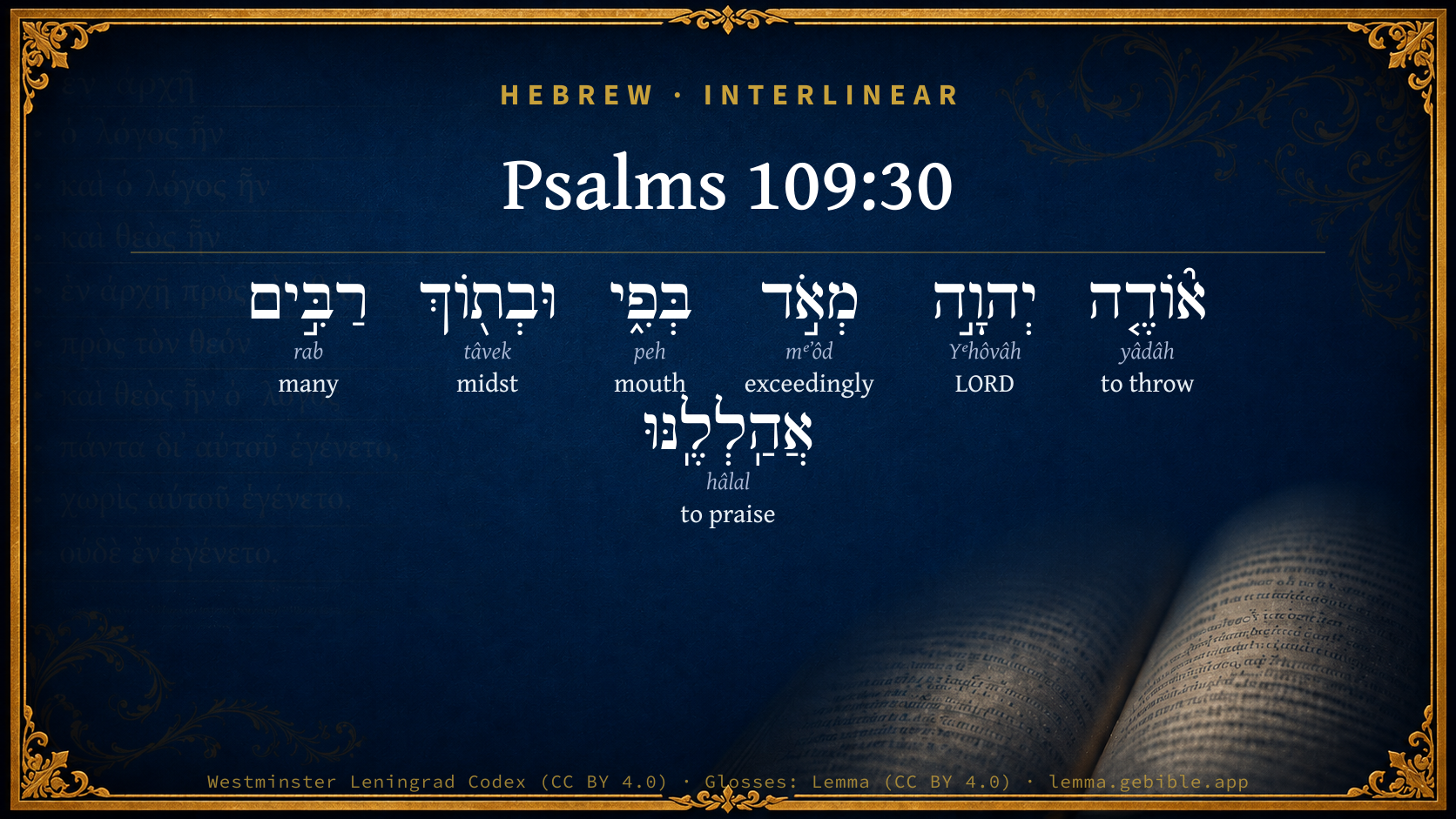
Hebrew (Westminster Leningrad Codex) Psalms 109:30 appears in the Hebrew Old Testament. The text above is from the Westminster Leningrad Codex. Each word links to its Strong’s number, a concise gloss, and parsing drawn from the Open Scriptures Hebrew Bible morphology. Click any word for its full Brown-Driver-Briggs (BDB) entry.
Download image
Cite this verse

Psalms 109:30 (World English Bible). Public Domain. Lemma interlinear Bible study tool, https://lemma.gebible.app/v/psalms/109/30.

Show BibTeX & RIS
BibTeX
RIS
English Translation
I will give great thanks to Yahweh with my mouth. Yes, I will praise him among the multitude.
World English Bible · Public Domain
Download a study sheet

One document with this verse’s original text, its word-by-word gloss line, the meaning frame, cross-references with their text, attributed commentary, and full source and license credits — printable, and it pastes into notes with its structure intact.

This verse Autodidact and up

Study sheet (.html) Plain text (.txt)

A passage Seminary Student

Up to 50 verses in one chapter. A passage sheet keeps up to 6 commentary sources and 12 cross-references per verse, in the order this page ranks them, and says so on the sheet whenever that leaves anything out. Ask for a single verse and you get the Autodidact verse sheet above.

Everything on this page stays free to read, with no account — the sheet is a download of what is already on screen, not access to it.

Want to remove ads? Support Godless Engineer
Compare translations 3

The same verse in 3 English versions, stacked beneath the original-language interlinear above. Click any original word for its lexicon entry.

Each is an independent rendering of the whole verse — the interlinear is not word-aligned to these translations.

Highlighted words mark where these versions differ — a whole-verse word diff, not a word-by-word alignment.

  • World English Bible Public Domain
    I will give great thanks to Yahweh with my mouth. Yes, I will praise him among the multitude.
  • King James Version Public Domain
    I will greatly praise the LORD with my mouth; yea, I will praise him among the multitude.
  • unfoldingWord Literal Text CC BY-SA 4.0
    With my mouth I greatly thank Yahweh; and in the midst of many I will praise him.

unfoldingWord Literal Text — © unfoldingWord, licensed CC BY-SA 4.0. Word-aligned USFM3 via Door43 (git.door43.org/unfoldingWord/en_ult).

Versions to compare (up to 4)

3 of 4 selected

Show all 18 translations

Every available English version of this verse, each an independent rendering of the whole verse.

  • World English Bible Public Domain
    I will give great thanks to Yahweh with my mouth. Yes, I will praise him among the multitude.
  • Berean Standard Bible Public Domain
    With my mouth I will thank the LORD profusely; I will praise Him in the presence of many.
  • Majority Standard Bible Public Domain
    With my mouth I will thank the LORD profusely; I will praise Him in the presence of many.
  • King James Version Public Domain
    I will greatly praise the LORD with my mouth; yea, I will praise him among the multitude.
  • American Standard Version (1901) Public Domain
    I will give great thanks unto Jehovah with my mouth; Yea, I will praise him among the multitude.
  • Revised Version (1885) Public Domain
    I will give great thanks unto the LORD with my mouth; yea, I will praise him among the multitude.
  • Geneva Bible (1599) Public Domain
    I will giue thankes vnto the Lord greatly with my mouth and praise him among ye multitude.
  • Douay-Rheims (1899) Public Domain
    I will give great thanks to the Lord with my mouth: and in the midst of many I will praise him.
  • Young's Literal Translation Public Domain
    I thank Jehovah greatly with my mouth, And in the midst of many I praise Him,
  • Literal Standard Version CC BY-SA 4.0
    I thank YHWH greatly with my mouth, || And I praise Him in the midst of many,
  • Unlocked Literal Bible CC BY-SA 4.0
    With my mouth I give great thanks to Yahweh; I will praise him in the midst of a crowd.
  • unfoldingWord Literal Text CC BY-SA 4.0
    With my mouth I greatly thank Yahweh; and in the midst of many I will praise him.
  • Darby Bible Public Domain
    I will greatly celebrate Jehovah with my mouth; yea, I will praise him among the multitude.
  • World Messianic Bible Public Domain
    I will give great thanks to the LORD with my mouth. Yes, I will praise him among the multitude.
  • Webster's Bible Public Domain
    I will greatly praise the LORD with my mouth; yes, I will praise him among the multitude.
  • Free Bible Version CC BY-SA 4.0
    But I will keep on thanking the Lord, praising him to everyone around me.
  • Bible in Basic English Public Domain
    I will give the Lord great praise with my mouth; yes, I will give praise to him among all the people.
  • JPS Tanakh (1917) Public Domain
    I will give great thanks unto the LORD with my mouth; yea, I will praise Him among the multitude;

Literal Standard Version (2020), Covenant Press — licensed CC BY-SA 4.0. Text via the HelloAO Bible API (eBible.org). Unlocked Literal Bible (unfoldingWord) — licensed CC BY-SA 4.0. Text via the HelloAO Bible API (eBible.org). unfoldingWord Literal Text — © unfoldingWord, licensed CC BY-SA 4.0. Word-aligned USFM3 via Door43 (git.door43.org/unfoldingWord/en_ult). Free Bible Version, Dr. Jonathan Gallagher — licensed CC BY-SA 4.0. Text via the HelloAO Bible API (eBible.org).

Word by word

More ways to search: Search by grammar → Find every occurrence → Compare this word →

Practice this passage: Drill this verse → Learn its vocabulary →

About this verse

These counts appear in no published source. They are computed here, from the morphology-tagged text and Lemma’s own curated glosses. What Lemma adds →

7
words
7
distinct lemmas
Wisdom
section

Grammatical profile

  • 2 verbs
  • 3 nouns
  • 1 adjective
  • 1 adverb

Verb forms

  • א֘וֹדֶ֤ה Hiphil · Imperfect
  • אֲהַֽלְלֶֽנּוּ Piel · Imperfect

Hebrew & Septuagint length

In English translation the verse runs 18 words from the Hebrew and 21 from the Septuagint (LXX English) — closely comparable.

A rough comparison of the two English renderings, which tokenize alike — not a word-level alignment.

Word counts can differ between the Hebrew and the Greek without any difference in meaning — e.g. the Hebrew direct-object marker אֵת has no separate Greek word, and Greek often adds the article ὁ.

Cross-references

12

Topical passages linked to Psalms 109:30 in the Treasury of Scripture Knowledge — connected by theme and wording, ordered by reader-vote popularity; previews shown in the World English Bible.

  • Psalms 111:1 Praise Yah! I will give thanks to Yahweh with my whole heart, In the council of the upright, and in the congregation.
  • Psalms 35:18 I will give you thanks in the great assembly. I will praise you among many people.
  • Psalms 22:22–25 I will declare your name to my brothers. In the midst of the assembly, I will praise you.
  • Psalms 138:1 I will give you thanks with my whole heart. Before the gods, I will sing praises to you.
  • Psalms 107:32 Let them exalt him also in the assembly of the people, And praise him in the seat of the elders.
  • Psalms 108:1–3 My heart is steadfast, God. I will sing and I will make music with my soul.
  • Psalms 116:12–18 What will I give to Yahweh for all his benefits toward me?
  • Psalms 138:4 All the kings of the earth will give you thanks, Yahweh, For they have heard the words of your mouth.
  • Hebrews 2:12 saying, "I will declare your name to my brothers. In the midst of the congregation I will sing your praise."
  • Psalms 7:17 I will give thanks to Yahweh according to his righteousness, And will sing praise to the name of Yahweh Most High.
  • Psalms 9:1 I will give thanks to Yahweh with my whole heart. I will tell of all your marvelous works.
  • Psalms 71:22–23 I will also praise you with the harp for your faithfulness, my God. I sing praises to you with the lyre, Holy One of Israel.

Cross-references courtesy of OpenBible.info (CC BY 4.0).

Hebrew and Greek witnesses Masoretic Hebrew ↔ Greek Septuagint

The same verse in the two great witnesses to the Old Testament, shown verse-for-verse.

You’re reading Greek Psalm 108 (Hebrew Psalm 109). The Septuagint counts the superscription, so verse numbers can differ from the Hebrew — chapter-level alignment, not verse-by-verse. Numbering follows Rahlfs.

These are two independent witnesses, not word-aligned to each other, and the Septuagint is shown in lemma (dictionary) form.

Hebrew Psalms 109:30 Masoretic · Westminster Leningrad Codex

א֘וֹדֶ֤ה יְהוָ֣ה מְאֹ֣ד בְּפִ֑י וּבְת֖וֹךְ רַבִּ֣ים אֲהַֽלְלֶֽנּוּ

I will give great thanks to Yahweh with my mouth. Yes, I will praise him among the multitude.

World English Bible · Public Domain

Greek LXX Greek Psalm 108:30 Septuagint · lemma form

ἐκὁμολογέω ὁ κύριος σφόδρα ἐν ὁ στόμα ἐγώ καί ἐν μέσος πολύς αἰνέω αὐτός

I will give thanks to the Lord abundantly with my mouth; and in the midst of many I will praise him.

LXX2012 (modern English Septuagint) · Public Domain

Hebrew: Westminster Leningrad Codex (CC BY 4.0). Greek: Septuagint (public domain); English from LXX2012 (modern English Septuagint) (Public Domain). How the Septuagint differs from the Hebrew →

Commentary

Notes on Psalms 109:30 from classic Christian and Jewish commentators (each source and its license shown beneath its notes). The classic Christian expositions comment on the surrounding passage and are grouped to its opening verse, so a note may address several verses; the Jewish commentaries on the Tanakh (Rashi and others) are per-verse, so they appear only where the commentator wrote on this verse.

Lemma curates 59 commentaries, every one of them public domain or Creative Commons licensed, each selected and text-cleaned for this edition rather than reprinted as found. About our sources →

Trapp's Complete Commentary

John Trapp

Psa 109:30 I will greatly praise the LORD with my mouth; yea, I will praise him among the multitude.

Ver. 30. I will greatly praise the Lord] Diligenter et impense. God’s blessings are binders; and great deliverances call for suitable praises, the neglect hereof is crimen stellionatus, cousenage.

John Trapp, A Commentary or Exposition upon All the Books of the Old and New Testament (1647–1656) — public domain. Text from a community e-Sword module.

The Treasury of David

Charles H. Spurgeon

Ver. 30. I will greatly praise the LORD with my mouth. Enthusiastically, abundantly, and loudly will he extol the righteous Lord, who redeemed him from all evil; and that not only in his own chamber or among his own family, but in the most public manner.

Yea, I will praise him among the multitude. Remarkable and public providence demand public recognition, for otherwise men of the world will judge us to be ungrateful. We do not praise God to be heard of men, but as a natural sense of justice leads every one to expect to hear a befriended person speak well of his benefactor, we therefore have regard to such natural and just expectations, and endeavour to make our praises as public as the benefit we have received. The singer in the present case is the man whose heart was wounded within him because he was the laughing stock of remorseless enemies; yet now he praises, praises greatly, praises aloud, praises in the teeth of all gainsayers, and praises with a right joyous spirit. Never let us despair, yea, never let us cease to praise.

Ver. 30. I will greatly praise the Lord with my mouth. In the celebration of God's praises, there can be no question that these must issue from the heart ere they can be uttered by the lips; at the same time, it would be an indication of great coldness, and of want of fervour, did not the tongue unite with the heart in this exercise. The reason why David makes mention of the tongue only is, that he takes it for granted that, unless there be a pouring out of the heart before God, those praises which reach no farther than the ear are vain and frivolous; and, therefore, from the very bottom of his soul, he pours forth his heart felt gratitude in fervent strains of praise; and this he does from the same motives which ought to influence all the faithfulthe desire of mutual edification; for to act otherwise would be to rob God of the honour which belongs to him. John Calvin.

Ver. 30. Vocal praise. Should be personal, resolute, intelligent, abundant, hearty. It should attract others, join with others, stimulate others, but never lose its personality.

Ver. 30-31.

1. David's will with respect to himself: "I will... yea, I will" etc. (Ps 109:30).

2. His shall with respect to God: "he shall", etc. (Ps 109:31). G.R.

Ver. 30-31. He promises God that he will praise him, Ps 109:30. He promises himself that he shall have cause to praise God, Ps 109:31. Matthew Henry.

Psalms 109:31*

Charles H. Spurgeon's The Treasury of David (1869–1885) — public domain. Psalms only. Text from a community e-Sword/MySword module.

Joseph Benson's Commentary

Psa 109:30-31. I will greatly praise the Lord — For that deliverance which I confidently expect; with my mouth — Not only with my heart, in secret, but with my mouth, openly; and among the multitude — Or, among the mighty, or the great men, as בתוךְ רבים, betoch rabbim, may be properly translated; for he shall stand at the right hand of the poor — Nigh to him, as a present help; as his patron and advocate, to plead his cause against, and defend him from, his adversary, who stood in that place to accuse him, and procure his condemnation and destruction; to save him from those that condemn his soul — That pass a sentence of death upon him. God was David’s protector in his sufferings, and was present also with the Lord Jesus in his; stood at his right hand, so that he was not moved, Psa 16:8; saved his soul from those that pretended to be the judges of it, and received it into his own hands. Let all those that suffer according to the will of God, commit the keeping of their souls to him, in well-doing, as unto a faithful Creator, 1Pe 4:19.

Joseph Benson's Commentary on the Old and New Testaments (1811–1818) — public domain. Text from a community e-Sword module.

J. A. Alexander on Psalms

Joseph Addison Alexander

30. (Psa 109:30) I will thank Jehovah greatly with my mouth, and in the midst of many will I praise him. He vows that his thanksgiving shall not be merely mental or domestic, but audible and public. With the last clause compare Psa 22:22.

Joseph Addison Alexander, The Psalms Translated and Explained (1850) — public domain. Text from a community e-Sword module.

Geneva Bible (1599)

Geneva Bible translators

Not only in confessing it secretly in myself, but also in declaring it before all the congregation.

Geneva Bible (1599) marginal notes — public domain. Text via Bolls.life.

Adam Clarke's Commentary

Verse 30. I will greatly praise the Lord] I have the fullest prospect of deliverance, and a plenary vindication of my innocence.

Adam Clarke's Commentary on the Bible (1810–1826) — public domain. Text from a community e-Sword/MySword module.

John Calvin's Commentaries

30. I will praise Jehovah greatly with my mouth These words clearly establish the truth of the observation I formerly made, that David does not pray God to curse his enemies, but, by the holy boldness of his faith, sets them at defiance; for he prepares to offer up a tribute of gratitude to God, as if he had already realised the object of his desire. The phrase, with my mouth, is not, as some erroneously suppose, superfluous, but is to be considered as a public acknowledgement, on his part, of his thanksgiving to God for the deliverance vouchsafed to him; as if he should say, I will, not only when alone and when no human eye beholds me, and in the inward recesses of my heart, meditate upon the great goodness which I have received from God, but also in the appointed sacrifice of praise will I declare publicly, before men, how much I am indebted to his grace. Agreeably to this meaning, he adds, in the assembly of great, or of many men; for the term רבים, rabbim, is susceptible of being rendered both ways. I prefer rendering it, great men, because it appears to me, that David refers to an assembly of men of notable and noble rank. He declares that he will acknowledge the goodness of God, not only in some obscure corner, but also in the great assembly of the people, and among governors and those of noble rank. In the celebration of God’s praises, there can be no question that these must issue from the heart ere they be uttered by the lips; at the same time, it would be an indication of great coldness, and of want of fervor, did not the tongue unite with the heart in this exercise. The reason why David makes mention of the tongue only is, that he takes it for granted that, unless there be a pouring out of the heart before God, those praises which reach no farther than the ear are vain and frivolous; and, therefore, from the very bottom of his soul, he pours forth his heart-felt gratitude in fervent strains of praise; and this he does, from the same motives which ought to influence all the faithful — the desire of mutual edification; for to act otherwise would be to rob God of the honor which belongs to him.

John Calvin's Commentaries (1540-1563) — public domain. Text from the Calvin Translation Society English edition (1840s-50s) via the Christian Classics Ethereal Library (ccel.org). Calvin's coverage is partial (roughly two-thirds of the Bible); uncommented books and verses are honest gaps, never fabricated. The 19th-century editor's footnotes and remarks are omitted so the notes are faithfully Calvin's own voice.

The Cambridge Bible for Schools and Colleges

gen. ed. J. J. S. Perowne

30. I will give great thanks unto Jehovah with my mouth] Confidently he anticipates the resumption of his former thanksgivings and praises (Psa_109:1) in the congregation.

The Cambridge Bible for Schools and Colleges (gen. ed. J. J. S. Perowne; Cambridge University Press, 1878–1918) — public domain. Text from a community e-Sword module.

John Gill's Exposition

For he shall stand at the right hand of the poor,.... Of the Messiah, as in Psa 109:22 at whose right hand the Lord was, to guide and direct, help and assist, protect and defend, Psa 16:8, or of his people, who are poor in every sense; but the Lord is on their side, and is a present help in time of trouble, Psa 46:1.

To save him from those that condemn his soul: the Messiah: from his judges, the high priest and Jewish sanhedrim, and Pilate the Roman governor, who condemned him to death; but he committed his spirit, or soul, to God, who received it, and raised his body from the dead; and would not suffer it to see corruption, as a testimony of his innocence: or the soul of the poor saints, which the Lord saves from the condemnation of sin, Satan, the law, and their own consciences, Rom 8:1.

Next: Psalms Chapter 110

John Gill's Exposition of the Whole Bible (1746–1763) — public domain (CC PDM 1.0). Text via the HelloAO Bible API.

Albert Barnes' Notes on the Bible

I will greatly praise the Lord with my mouth - I will sing abundant praises to him. Compare the notes at Isa 38:20.

Yea, I will praise him among the multitude - In the great congregation. I will publicly acknowledge his goodness and mercy. See the notes at Psa 22:25.

Albert Barnes' Notes on the Bible (1834–1885) — public domain. Text from a community e-Sword/MySword module.

Matthew Poole's English Annotations

For that deliverance which I confidently expect.

Among the multitude; or, among the mighty, or great men, as this word sometimes signifies. Compare Psa 119:46.

Matthew Poole's English Annotations on the Holy Bible (1683–1685) — public domain. Text from a community e-Sword/MySword module.

Whedon's Commentary on the Bible

Daniel D. Whedon

30. I will greatly praise—As the answer of the psalmist’s prayers and the fulfilment of his forewarning predictions would be to him a signal deliverance as well as a vindication of righteous principles, so his praise for the same would be rendered greatly, exceedingly, with all his might. This shows that the spirit and example of this psalm are in harmony with the mind of God, and hence with the essential ethics both of the law and of the gospel.

Daniel D. Whedon (gen. ed.), Commentary on the Old and New Testaments (1874–1909) — public domain. Text from a community e-Sword module.

The Pulpit Commentary

Vers. 30, 31. The psalm terminates with a short burst of praise, the writer feeling assured that his prayer is granted, and that he will shortly triumph over his enemies.

I will greatly praise the Lord with my mouth. The expression "greatly praise" does not occur elsewhere in the Psalms. It is indicative of an unusually strong feeling of thankfulness. Yea, I will praise him among the multitude; i.e. in the congregation.

Vers. 30, 31. The power of prayer to change our moods.

There is clearly a different tone in the closing portion of this psalm. It may not be so evident as we should like it to have been, but it is there. The storm of angry feeling dies down, and we only hear mutterings after the loud thunder-peals. There is gradually more earnest prayer for himself, less concern about his enemy, and a fuller confidence that God will answer his prayer, and, in his own wise way, bless the good and shame the evil. It is his praying on that has wrought this change of mood. He has prayed himself into a better mind, by the very saying out so freely all the bitter things he had thought and felt.

I PRAYER CHANGES OUR MOODS BY EXHAUSTING THE BAD MOODS. Here is a most singular thing. Saying out all our bad feelings to a fellow-man would only intensify the badness. We should excite ourselves even to plan revengeful things. But if we say out all our bad feelings to God, we find they get exhausted. Somehow, in his presence, we cannot keep them up. We soon come to the end, and the very Divine silence seems to be waiting until we have said it all; and presently we feel as if there was nothing more we could say. Another mood must come, as tears come when passion has expended itself. So prayer helps by finding us the opportunity for safely saying out all that is in our hearts.

II PRAYER HELPS US BY ENCOURAGING NEW AND BETTER MOODS. Gradually, as we pray on, the sense of God"s presence makes us feel kinder. We cease to want our enemy punished, we want ourselves vindicated; and then presently we feel as if we could just leave our enemy in the hands of God. The Judge of all the earth will surely do the right. At last we find ourselves filled with pity for them; it comes to us, as we pray, that it is far sadder to be a wrong-doer than to be a wronged one; the injurer is much more to be pitied than the injured. So mood after mood changing for the better, we come at last to the Christian mood, and do as the Lord Jesus did, and as St. Stephen did pray for our enemies. In all the strain-times of life we may prove the soothing, correcting, and comforting power of prayer. R.T.

The Pulpit Commentary (1880–1919), ed. H.D.M. Spence-Jones & Joseph S. Exell — public domain. Text from a community e-Sword module.

unfoldingWord translationNotes

Door43 World Missions Community

With my mouth I give

This means that he will speak. AT: "I will speak and give" (See: Idiom)

will stand at the right hand of the one who is needy

This means that he will help and defend the poor person. AT: "will defend the one who is needy" (See: Idiom)

translationWords

Yahweh

praise

right hand

save

unfoldingWord translationNotes — © Distant Shores Media and the Door43 World Missions Community, licensed CC BY-SA 4.0. Source: git.door43.org/Door43/en_tn.

Lesson kit

Teaching starters — assembled from the data on this page, not authored interpretation. Every prompt links to the verse data it draws on. Edit before teaching.

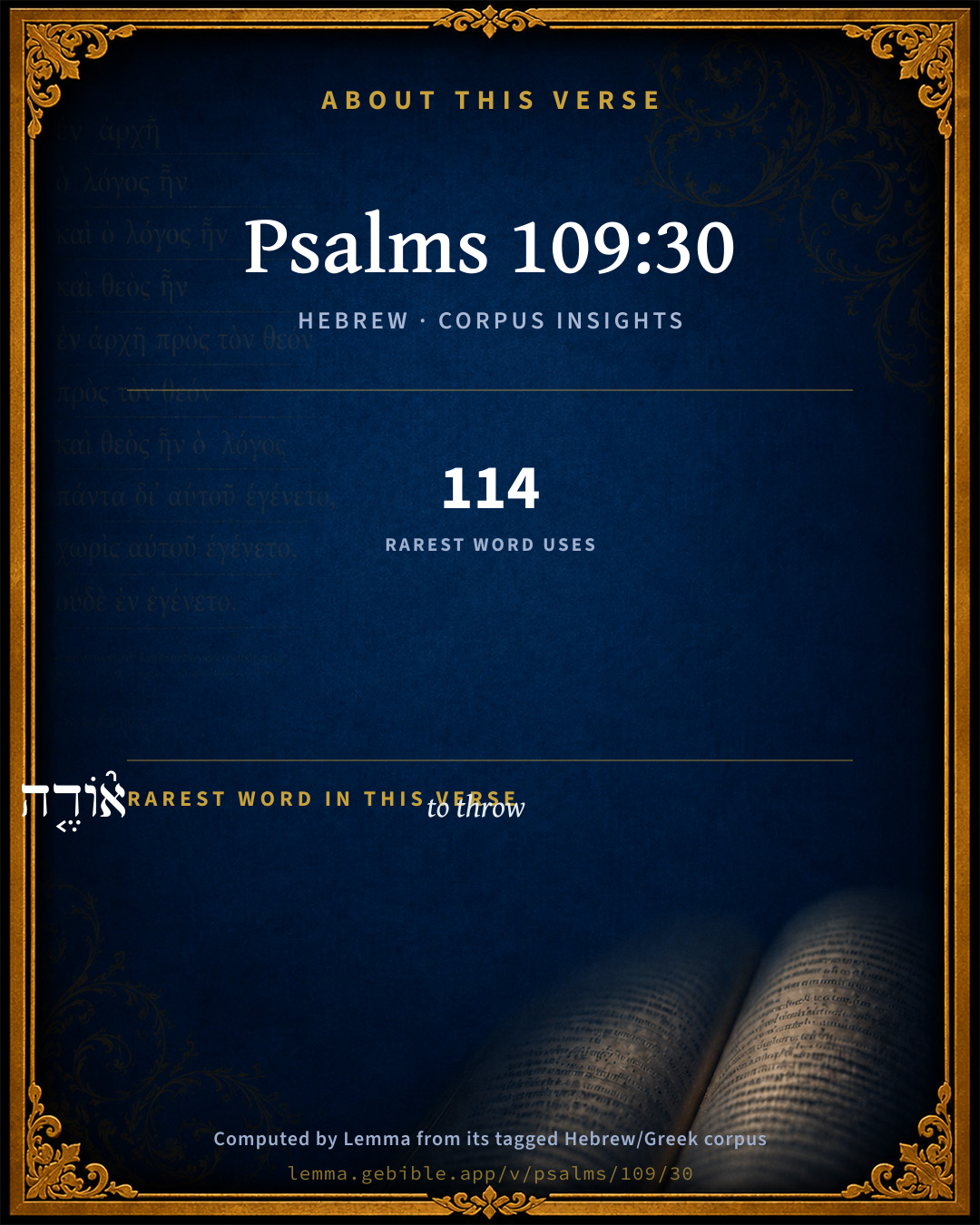
Psalms, in the Wisdom, opens this verse with 7 words (7 distinct Hebrew lemmas). Its most distinctive word is yâdâh (“to throw”). A historical commentator’s framing appears above. Read the whole chapter for the surrounding context.

Discussion questions

  1. How does “to throw” (yâdâh) shape what this verse is saying?
  2. How does Psalms 111:1, which shares this passage’s theme, read alongside this verse?
  3. These translations render this verse differently; the difference is in the English rendering, not the original. What questions does that raise?
  4. «א֘וֹדֶ֤ה» is a Hiphil Imperfect verb. How does that grammatical form shape the action described?
  5. Compare how Trapp's Complete Commentary and The Treasury of David read this verse. Where do they agree or differ?

Things to notice

Reading settings

Reading text

Shown beneath each verse's original-language words.

Old Testament
Old Testament edition

Read the OT as the Masoretic Hebrew (MT) or the Greek Septuagint (LXX).

English shown for the Greek Septuagint (in the Hebrew ↔ Greek comparison).

Comparing translations? Open the Compare panel on any verse page to stack up to four side by side.