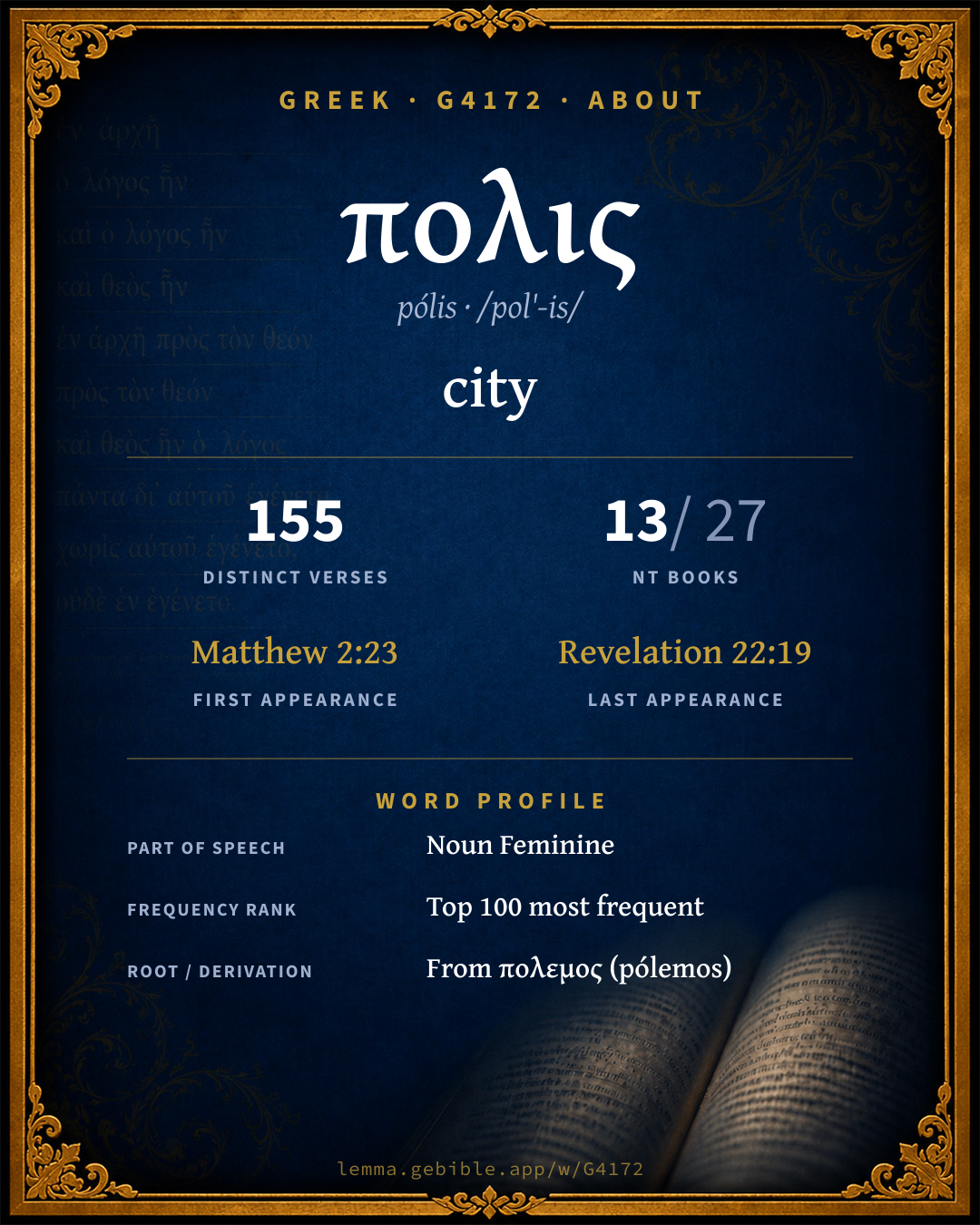
πόλις
city
‘city’ is one of 3 main senses fuller range ↓
Full lexicon entry — Thayer's Greek Lexicon
From Thayer's Greek Lexicon
Where this word appears
See every Accusative-case word in the Greek New Testament →
Grammar key — what these labels mean
Part of speech
- Noun
- A naming word — a person, place, thing, or idea.
Case
- Accusative
- The case of the direct object and of extent.
- Genitive
- The case of source, possession, or “of” — answers “whose / from what.”
- Nominative
- The case of the subject (and the predicate nominative).
- Dative
- The case of the indirect object, means, or location — “to / for / with / in.”
Gender
- Feminine
- Grammatically feminine.
Number
- Singular
- One.
- Plural
- More than one.
Every verse where G4172 appears in the Book of Acts — 42 distinct verses. Click any verse to open its interlinear word-by-word view. Verse text shown in the World English Bible for context — . Each verse’s Greek form is shown with its reference; the English is not keyword-highlighted, since the data carries no word-level English alignment. Use “Compare translations” on any verse to read it across multiple English versions. This concordance covers the Greek New Testament; Septuagint (Greek Old Testament) occurrences of this word are not indexed here.
Acts
- Acts 4:27 πόλει n dat sg fem For truly, in this city against your holy servant, Jesus, whom you anointed, both Herod and Pontius Pilate, with the Gentiles and the people of Israel, were gathered together
- Acts 5:16 πόλεων n gen pl fem Multitudes also came together from the cities around Jerusalem, bringing sick people, and those who were tormented by unclean spirits: and they were all healed.
- Acts 7:58 πόλεως n gen sg fem They threw him out of the city, and stoned him. The witnesses placed their garments at the feet of a young man named Saul.
- Acts 8:5 πόλιν n acc sg fem Philip went down to the city of Samaria, and proclaimed to them the Christ.
- Acts 8:8 πόλει n dat sg fem There was great joy in that city.
- Acts 8:9 πόλει n dat sg fem But there was a certain man, Simon by name, who used to practice sorcery in the city, and amazed the people of Samaria, making himself out to be some great one,
- Acts 8:40 πόλεις n acc pl fem But Philip was found at Azotus. Passing through, he preached the Gospel to all the cities, until he came to Caesarea.
- Acts 9:6 πόλιν n acc sg fem But rise up, and enter into the city, and you will be told what you must do."
- Acts 10:9 πόλει n dat sg fem Now on the next day as they were on their journey, and got close to the city, Peter went up on the housetop to pray at about noon.
- Acts 11:5 πόλει n dat sg fem "I was in the city of Joppa praying, and in a trance I saw a vision: a certain container descending, like it was a great sheet let down from heaven by four corners. It came as far as me.
- Acts 12:10 πόλιν n acc sg fem When they were past the first and the second guard, they came to the iron gate that leads into the city, which opened to them by itself. They went out, and went down one street, and immediately the angel departed from him.
- Acts 13:44 πόλις n nom sg fem The next Sabbath almost the whole city was gathered together to hear the word of God.
- Acts 13:50 πόλεως n gen sg fem But the Jews stirred up the devout and prominent women and the chief men of the city, and stirred up a persecution against Paul and Barnabas, and threw them out of their borders.
- Acts 14:4 πόλεως n gen sg fem But the multitude of the city was divided. Part sided with the Jews, and part with the apostles.
- Acts 14:6 πόλεις n acc pl fem they became aware of it, and fled to the cities of Lycaonia, Lystra, Derbe, and the surrounding region.
- Acts 14:13 πόλεως n gen sg fem The priest of Jupiter, whose temple was in front of their city, brought oxen and garlands to the gates, and would have made a sacrifice along with the multitudes.
- Acts 14:19 πόλεως n gen sg fem But some Jews from Antioch and Iconium came there, and having persuaded the multitudes, they stoned Paul, and dragged him out of the city, supposing that he was dead.
- Acts 14:20 πόλιν n acc sg fem But as the disciples stood around him, he rose up, and entered into the city. On the next day he went out with Barnabas to Derbe.
- Acts 14:21 πόλιν n acc sg fem When they had preached the Gospel to that city, and had made many disciples, they returned to Lystra, Iconium, and Antioch,
- Acts 15:21 πόλιν n acc sg fem For Moses from generations of old has in every city those who preach him, being read in the synagogues every Sabbath."
- Acts 15:36 πόλιν n acc sg fem After some days Paul said to Barnabas, "Let's return now and visit our brothers in every city in which we proclaimed the word of the Lord, to see how they are doing."
- Acts 16:4 πόλεις n acc pl fem As they went on their way through the cities, they delivered the decrees to them to keep which had been ordained by the apostles and elders who were at Jerusalem.
- Acts 16:11 πόλιν n acc sg fem Setting sail therefore from Troas, we made a straight course to Samothrace, and the day following to Neapolis;
- Acts 16:12 πόλις πόλει n nom sg fem n dat sg fem and from there to Philippi, which is a city of Macedonia, the foremost of the district, a Roman colony. We were staying some days in this city.
- Acts 16:14 πόλεως n gen sg fem A certain woman named Lydia, a seller of purple, of the city of Thyatira, one who worshiped God, heard us; whose heart the Lord opened to listen to the things which were spoken by Paul.
- Acts 16:20 πόλιν n acc sg fem When they had brought them to the magistrates, they said, "These men, being Jews, are agitating our city,
- Acts 16:39 πόλεως n gen sg fem and they came and begged them. When they had brought them out, they asked them to depart from the city.
- Acts 17:5 πόλιν n acc sg fem But the unpersuaded Jews took along some wicked men from the marketplace, and gathering a crowd, set the city in an uproar. Assaulting the house of Jason, they sought to bring them out to the people.
- Acts 17:16 πόλιν n acc sg fem Now while Paul waited for them at Athens, his spirit was provoked within him as he saw the city full of idols.
- Acts 18:10 πόλει n dat sg fem for I am with you, and no one will attack you to harm you, for I have many people in this city."
- Acts 19:29 πόλις n nom sg fem The whole city was filled with confusion, and they rushed with one accord into the theater, having seized Gaius and Aristarchus, men of Macedonia, Paul's companions in travel.
- Acts 19:35 πόλιν n acc sg fem When the town clerk had quieted the multitude, he said, "You men of Ephesus, what man is there who doesn't know that the city of the Ephesians is temple-keeper of the great goddess Artemis, and of the image which fell down from Zeus?
- Acts 20:23 πόλιν n acc sg fem except that the Holy Spirit testifies in every city, saying that bonds and afflictions wait for me.
- Acts 21:5 πόλεως n gen sg fem When it happened that we had accomplished the days, we departed and went on our journey. They all, with wives and children, brought us on our way until we were out of the city. Kneeling down on the beach, we prayed.
- Acts 21:29 πόλει n dat sg fem For they had seen Trophimus, the Ephesian, with him in the city, and they supposed that Paul had brought him into the temple.
- Acts 21:30 πόλις n nom sg fem All the city was moved, and the people ran together. They seized Paul and dragged him out of the temple. Immediately the doors were shut.
- Acts 21:39 πόλεως n gen sg fem But Paul said, "I am a Jew, from Tarsus in Cilicia, a citizen of no insignificant city. I beg you, allow me to speak to the people."
- Acts 22:3 πόλει n dat sg fem "I am indeed a Jew, born in Tarsus of Cilicia, but brought up in this city at the feet of Gamaliel, instructed according to the strict manner of the law of our fathers, being zealous for God, even as you all are this day.
- Acts 24:12 πόλιν n acc sg fem In the temple they didn't find me disputing with anyone or stirring up a crowd, either in the synagogues, or in the city.
- Acts 25:23 πόλεως n gen sg fem So on the next day, when Agrippa and Bernice had come with great pomp, and they had entered into the place of hearing with the commanding officers and principal men of the city, at the command of Festus, Paul was brought in.
- Acts 26:11 πόλεις n acc pl fem Punishing them often in all the synagogues, I tried to make them blaspheme. Being exceedingly enraged against them, I persecuted them even to foreign cities.
- Acts 27:8 πόλις n nom sg fem With difficulty sailing along it we came to a certain place called Fair Havens, near the city of Lasea.
About this entry
At a glance — auto-summarized from this page’s data, not written by a person. Every figure links to its source below. This summary describes the numbers; it doesn’t interpret them.
πολις — transliterated pólis — is a Greek noun carrying the sense “city.” It first appears in Matthew 2:23. With 155 verses in 13 books, it is a common word in the Greek New Testament. Its uses concentrate in Acts (27% of all occurrences). Its lexical range runs to 3 senses. Each statement above links to its evidence; the full detail follows below.
Gloss history
Strong's 1890 vs modern scholarship
About this word
Strong's G4172 catalogs a Greek word from the Greek New Testament.
These counts are not copied from any lexicon or concordance. They are computed here, from the morphology-tagged Greek New Testament. What Lemma adds →
- 155
- distinct verses
- The word appears in 155 distinct verses.
- 13 / 27
- NT books
- The word appears in 13 of 27 New Testament books.
- #97
- by frequency
- Top 100 most frequent Greek words (rank 97 of 5,347 Greek words by occurrence).
View all 155 occurrences in the concordance →
By section of the New Testament
By traditional corpus
Conventional, traditional groupings — biblical authorship is debated, so this is a traditional corpus grouping, not an authorship claim. Some books belong to more than one corpus (Luke is in both the Gospels and the Lukan corpus, and so on), so these shares overlap and need not total 100%. Each figure is a share of the word’s 155 distinct verses.
- Lukan (Luke–Acts) 79 verses · 51%
- Gospels 78 verses · 50%
- Johannine 32 verses · 21%
- Revelation 24 verses · 15%
- Pauline corpus 4 verses · 3%
- Hebrews 4 verses · 3%
- General (Catholic) Epistles 3 verses · 2%
How translations render this word
Counts come from each version’s own published word-to-Strong’s tagging or interlinear alignment — an approximate guide to how each version renders this word, not a word-level alignment the data otherwise carries. Because each total is that version’s own tagged count, the per-version totals vary from one another and need not match the appearance or distinct-verse counts above. These counts may also differ from a printed concordance because Lemma counts each distinctly tagged rendering and does not collapse phrase taggings into a single head-word total. This is a fixed set of word-tagged versions (KJV, ASV, BSB, ULT) and does not change with the reading translation you choose elsewhere. Each version’s license is shown beside its name below (and on Sources).
- King James Version: City 141×, Cities 19×
- American Standard Version: City 133×, Cities 19×, For 2×
- Berean Standard Bible: City 87×, Town 47×, Towns 10×
- unfoldingWord Literal Text: City 134×, Cities 19×, Town 8×
King James Version Public Domain
Renders G4172 across 164 tagged occurrences — most commonly:
Plus 4 renderings that appear only once — usually multi-word phrases or single function words the recovered tagging swept in, not distinct renderings.
American Standard Version Public Domain
Renders G4172 across 161 tagged occurrences — most commonly:
Plus 5 renderings that appear only once — usually multi-word phrases or single function words the recovered tagging swept in, not distinct renderings.
Berean Standard Bible Public Domain
Renders G4172 across 158 tagged occurrences — most commonly:
Plus 5 renderings that appear only once — usually multi-word phrases or single function words the recovered tagging swept in, not distinct renderings. Not rendered by a distinct English word in 6 further occurrences.
unfoldingWord Literal Text CC BY-SA 4.0
Renders G4172 across 176 tagged occurrences — most commonly:
Plus 3 renderings that appear only once — usually multi-word phrases or single function words the recovered tagging swept in, not distinct renderings.
Senses in Thayer's
The 3 senses Thayer's distinguishes for this word, in lexicon order (not ranked by frequency or importance). The full entry — with sub-senses — is in the Lexicon Entry tab.
- one's native city, the city in which one lives
- the heavenly Jerusalem
- the inhabitants of a city
Word origin
Derived from πολεμος (pólemos) (G4171) — war.
Forms in the corpus
The 7 distinct written forms G4172 takes in the Greek New Testament, most frequent first — each parse links to that case’s occurrences in the concordance.
| Form | Parsing | Example | Uses |
|---|---|---|---|
| πόλιν pólin | Noun, Accusative, Singular, Feminine | Matthew 2:23 | 65 |
| πόλεως póleōs | Noun, Genitive, Singular, Feminine | Matthew 10:14 | 36 |
| πόλις pólis | Noun, Nominative, Singular, Feminine | Matthew 5:14 | 22 |
| πόλει pólei | Noun, Dative, Singular, Feminine | Matthew 10:15 | 21 |
| πόλεις póleis | Noun, Accusative, Plural, Feminine | Matthew 9:35 | 12 |
| πόλεων póleōn | Noun, Genitive, Plural, Feminine | Matthew 14:13 | 6 |
| πόλεσιν pólesin | Noun, Dative, Plural, Feminine | Matthew 11:1 | 2 |
Same root — word family
Other Thayer's entries built from the same root as G4172, grouped by Strong’s listed origin. These share a root / origin per the lexicon — not necessarily a shared meaning. Each links to that word’s own entry.
Derives from
Shares the same root
Derived from this word
Compare all same-root words → Showing 4 of 5 — not the complete family. They share a root, not necessarily a meaning.
Septuagint usage
The same Greek word πολις appears 1,226 times in the Greek Old Testament (Septuagint), across 1,053 verses in 36 books.
- 1,226
- LXX occurrences
- Tagged occurrences of this Greek word in the Septuagint.
- 1,053
- verses
- Distinct Septuagint verses containing this word.
- 36 / 39
- OT books
- The word appears in 36 of the 39 Old Testament books.
Sample Septuagint occurrences
- Genesis 4:17 πόλις
- Exodus 1:11 πόλις
- Leviticus 14:40 πόλις
- Numbers 13:19 πόλις
- Deuteronomy 1:22 πόλις
- Joshua 2:14 πόλις
- Judges 1:8 πόλις
- Ruth 1:19 πόλις
- 1 Samuel 1:3 πόλις
- 2 Samuel 2:1 πόλις
- 1 Kings 1:41 πόλις
- 2 Kings 2:19 πόλις
Septuagint occurrences (same lexeme)
Every verse where the same Strong’s number (G4172) appears in the Greek Septuagint — showing the first 50 of 1,053. Verse text shown in the World English Bible for context; the Greek form is the matched word — the English is not keyword-highlighted.
- Genesis 4:17 πόλις Cain knew his wife. She conceived, and gave birth to Enoch. He built a city, and called the name of the city, after the name of his son, Enoch.
- Genesis 10:11 πόλις Out of that land he went forth into Assyria, and built Nineveh, Rehoboth Ir, Calah,
- Genesis 10:12 πόλις and Resen between Nineveh and Calah (the same is the great city).
- Genesis 11:4 πόλις They said, "Come, let's build us a city, and a tower, whose top reaches to the sky, and let's make us a name; lest we be scattered abroad on the surface of the whole earth."
- Genesis 11:5 πόλις Yahweh came down to see the city and the tower, which the children of men built.
- Genesis 11:8 πόλις So Yahweh scattered them abroad from there on the surface of all the earth. They stopped building the city.
- Genesis 13:12 πόλις Abram lived in the land of Canaan, and Lot lived in the cities of the plain, and moved his tent as far as Sodom.
- Genesis 14:5 πόλις In the fourteenth year Chedorlaomer came, and the kings who were with him, and struck the Rephaim in Ashteroth Karnaim, and the Zuzim in Ham, and the Emim in Shaveh-kiriathaim,
- Genesis 18:24 πόλις What if there are fifty righteous within the city? Will you consume and not spare the place for the fifty righteous who are therein?
- Genesis 18:26 πόλις Yahweh said, "If I find in Sodom fifty righteous within the city, then I will spare all the place for their sake."
- Genesis 18:28 πόλις What if there will lack five of the fifty righteous? Will you destroy all the city for lack of five?" He said, "I will not destroy it, if I find forty-five there."
- Genesis 19:4 πόλις But before they lay down, the men of the city, the men of Sodom, surrounded the house, both young and old, all the people from every quarter.
- Genesis 19:12 πόλις The men said to Lot, "Do you have anybody else here? Sons-in-law, your sons, your daughters, and whoever you have in the city, bring them out of the place:
- Genesis 19:14 πόλις Lot went out, and spoke to his sons-in-law, who were pledged to marry his daughters, and said, "Get up! Get out of this place, for Yahweh will destroy the city." But he seemed to his sons-in-law to be joking.
- Genesis 19:15 πόλις When the morning arose, then the angels hurried Lot, saying, "Arise, take your wife, and your two daughters who are here, lest you be consumed in the iniquity of the city."
- Genesis 19:20 πόλις See now, this city is near to flee to, and it is a little one. Oh let me escape there (isn't it a little one?), and my soul will live."
- Genesis 19:21 πόλις He said to him, "Behold, I have granted your request concerning this thing also, that I will not overthrow the city of which you have spoken.
- Genesis 19:22 πόλις Hurry, escape there, for I can't do anything until you get there." Therefore the name of the city was called Zoar.
- Genesis 19:25 πόλις He overthrew those cities, all the plain, all the inhabitants of the cities, and that which grew on the ground.
- Genesis 19:29 πόλις It happened, when God destroyed the cities of the plain, that God remembered Abraham, and sent Lot out of the midst of the overthrow, when he overthrew the cities in which Lot lived.
- Genesis 20:2 πόλις Abraham said about Sarah his wife, "She is my sister." Abimelech king of Gerar sent, and took Sarah.
- Genesis 22:17 πόλις that in blessing I will bless you, and in multiplying I will multiply your seed as the stars of the heavens, and as the sand which is on the seashore. Your seed will possess the gate of his enemies.
- Genesis 23:2 πόλις Sarah died in Kiriath Arba (the same is Hebron), in the land of Canaan. Abraham came to mourn for Sarah, and to weep for her.
- Genesis 23:10 πόλις Now Ephron was sitting in the midst of the children of Heth. Ephron the Hittite answered Abraham in the hearing of the children of Heth, even of all who went in at the gate of his city, saying,
- Genesis 23:18 πόλις to Abraham for a possession in the presence of the children of Heth, before all who went in at the gate of his city.
- Genesis 24:10 πόλις The servant took ten camels, of his master's camels, and departed, having all goodly things of his master's in his hand. He arose, and went to Mesopotamia, to the city of Nahor.
- Genesis 24:11 πόλις He made the camels kneel down outside the city by the well of water at the time of evening, the time that women go out to draw water.
- Genesis 24:13 πόλις Behold, I am standing by the spring of water. The daughters of the men of the city are coming out to draw water.
- Genesis 24:43 πόλις Behold, I am standing by the spring of water. Let it happen, that the maiden who comes forth to draw, to whom I will say, Give me, I pray you, a little water from your pitcher to drink.
- Genesis 24:60 πόλις They blessed Rebekah, and said to her, "Our sister, may you be the mother of thousands of ten thousands, and let your seed possess the gate of those who hate them."
- Genesis 26:33 πόλις He called it Shibah. Therefore the name of the city is Beersheba to this day.
- Genesis 28:19 πόλις He called the name of that place Bethel, but the name of the city was Luz at the first.
- Genesis 33:18 πόλις Jacob came in peace to the city of Shechem, which is in the land of Canaan, when he came from Paddan Aram; and encamped before the city.
- Genesis 34:20 πόλις Hamor and Shechem, his son, came to the gate of their city, and talked with the men of their city, saying,
- Genesis 34:24 πόλις All who went out of the gate of his city listened to Hamor, and to Shechem his son; and every male was circumcised, all who went out of the gate of his city.
- Genesis 34:25 πόλις It happened on the third day, when they were sore, that two of Jacob's sons, Simeon and Levi, Dinah's brothers, each took his sword, came upon the unsuspecting city, and killed all the males.
- Genesis 34:27 πόλις Jacob's sons came on the dead, and plundered the city, because they had defiled their sister.
- Genesis 34:28 πόλις They took their flocks, their herds, their donkeys, that which was in the city, that which was in the field;
- Genesis 34:29 πόλις and all their wealth. They took captive all their little ones and their wives, and took as plunder everything that was in the house.
- Genesis 35:5 πόλις They traveled: and a terror of God was on the cities that were round about them, and they didn't pursue the sons of Jacob.
- Genesis 35:27 πόλις Jacob came to Isaac his father, to Mamre, to Kiriath Arba (the same is Hebron), where Abraham and Isaac lived as foreigners.
- Genesis 36:32 πόλις Bela, the son of Beor, reigned in Edom. The name of his city was Dinhabah.
- Genesis 36:35 πόλις Husham died, and Hadad, the son of Bedad, who struck Midian in the field of Moab, reigned in his place. The name of his city was Avith.
- Genesis 36:39 πόλις Baal Hanan the son of Achbor died, and Hadar reigned in his place. The name of his city was Pau. His wife's name was Mehetabel, the daughter of Matred, the daughter of Me-zahab.
- Genesis 41:35 πόλις Let them gather all the food of these good years that come, and lay up grain under the hand of Pharaoh for food in the cities, and let them keep it.
- Genesis 41:45 πόλις Pharaoh called Joseph's name Zaphenath-paneah; and he gave him Asenath, the daughter of Potiphera priest of On as a wife. Joseph went out over the land of Egypt.
- Genesis 41:48 πόλις He gathered up all the food of the seven years which were in the land of Egypt, and laid up the food in the cities: the food of the field, which was round about every city, he laid up in the same.
- Genesis 41:50 πόλις To Joseph were born two sons before the year of famine came, whom Asenath, the daughter of Potiphera priest of On, bore to him.
- Genesis 44:4 πόλις When they had gone out of the city, and were not yet far off, Joseph said to his steward, "Up, follow after the men. When you overtake them, ask them, 'Why have you rewarded evil for good?
- Genesis 44:13 πόλις Then they tore their clothes, and loaded every man his donkey, and returned to the city.
These are occurrences of the same Greek lexeme (G4172) in the Septuagint — not a translation of any one Hebrew word. The store carries no word-level Hebrew↔Greek alignment, so no Hebrew original is asserted here. Counts come from the recovered LXX Strong's tagging — high-frequency vocabulary is well covered, while rare or late forms may be untagged — so they reflect tagged occurrences and may slightly undercount.