
Acts 14:6

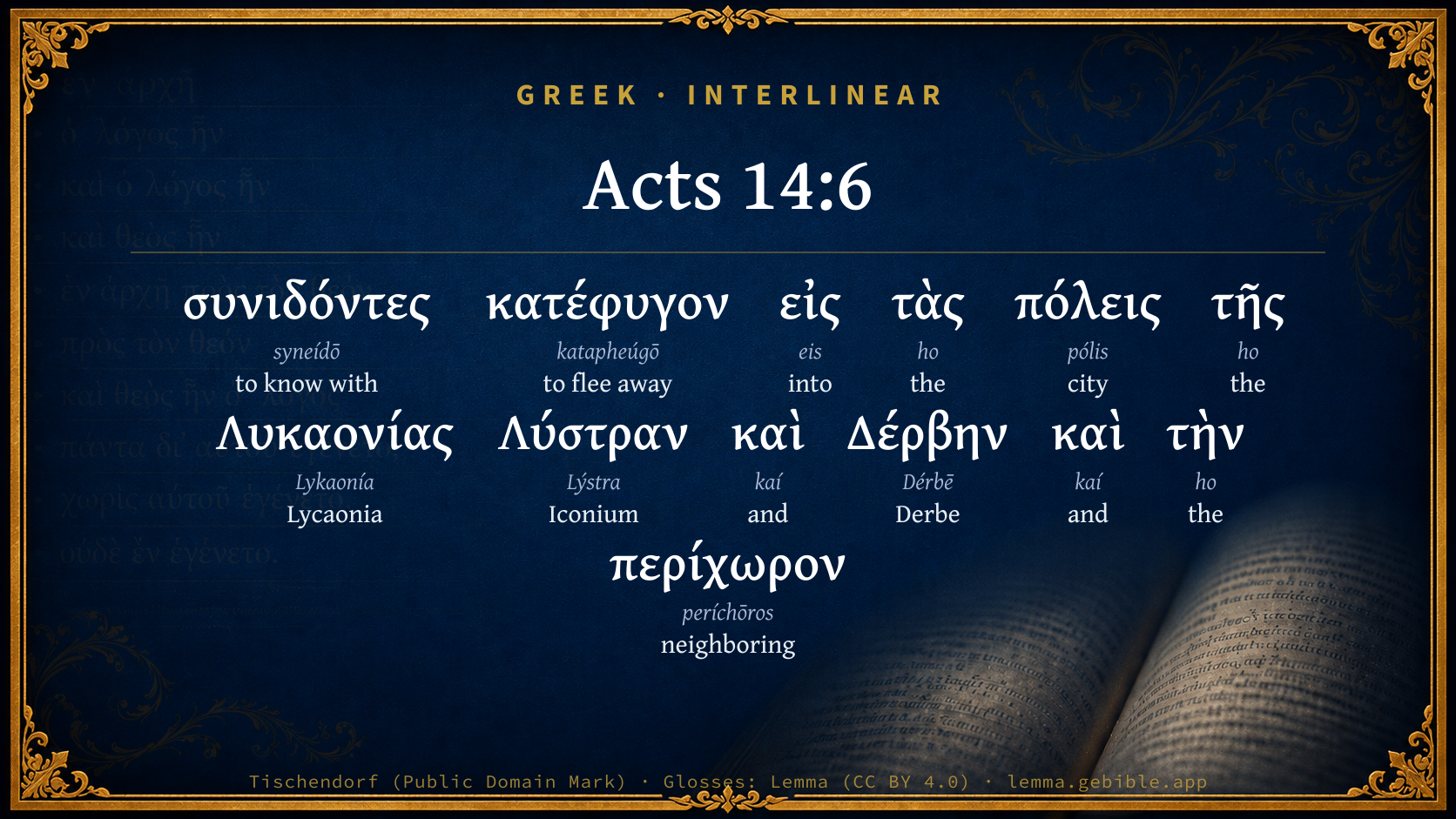
Greek (Tischendorf 8th ed.) Acts 14:6 appears in the Greek New Testament. The text above is from the Tischendorf 8th edition. Each word links to its Strong’s number and a concise gloss. Click any word for its full Thayer’s Greek Lexicon entry.
Download image
Cite this verse

Acts 14:6 (World English Bible). Public Domain. Lemma interlinear Bible study tool, https://lemma.gebible.app/v/acts/14/6.

Show BibTeX & RIS
BibTeX
RIS
English Translation
they became aware of it, and fled to the cities of Lycaonia, Lystra, Derbe, and the surrounding region.
World English Bible · Public Domain
Highlights
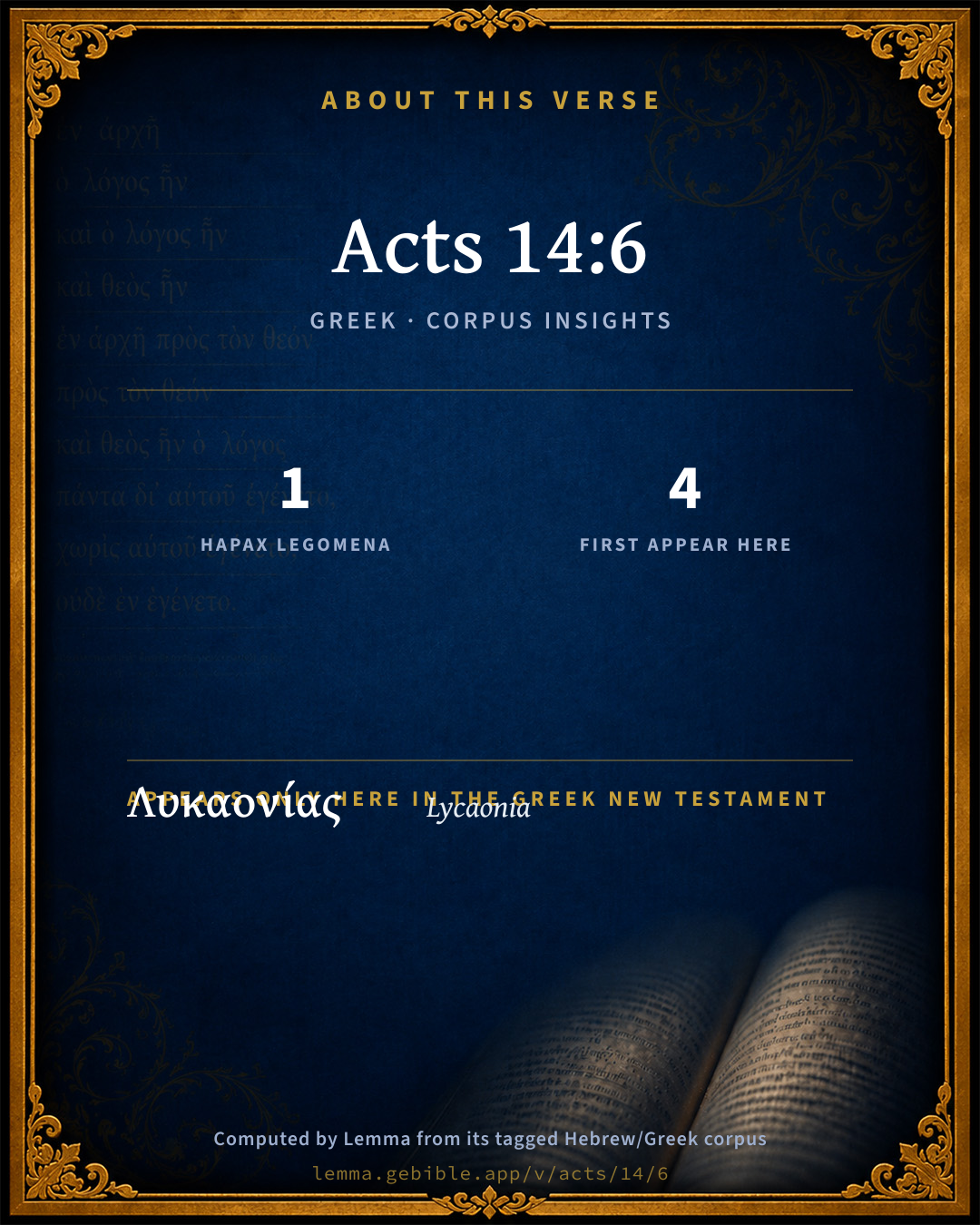
  • 1 hapax legomenon — only here in the Greek New Testament
  • 4 first appearances in the Greek New Testament
Full analysis ↓
Download a study sheet

One document with this verse’s original text, its word-by-word gloss line, the meaning frame, cross-references with their text, attributed commentary, and full source and license credits — printable, and it pastes into notes with its structure intact.

This verse Autodidact and up

Study sheet (.html) Plain text (.txt)

A passage Seminary Student

Up to 50 verses in one chapter. A passage sheet keeps up to 6 commentary sources and 12 cross-references per verse, in the order this page ranks them, and says so on the sheet whenever that leaves anything out. Ask for a single verse and you get the Autodidact verse sheet above.

Everything on this page stays free to read, with no account — the sheet is a download of what is already on screen, not access to it.

Want to remove ads? Support Godless Engineer
Compare translations 3

The same verse in 3 English versions, stacked beneath the original-language interlinear above. Click any original word for its lexicon entry.

Each is an independent rendering of the whole verse — the interlinear is not word-aligned to these translations.

Highlighted words mark where these versions differ — a whole-verse word diff, not a word-by-word alignment.

  • World English Bible Public Domain
    they became aware of it, and fled to the cities of Lycaonia, Lystra, Derbe, and the surrounding region.
  • King James Version Public Domain
    They were ware of it, and fled unto Lystra and Derbe, cities of Lycaonia, and unto the region that lieth round about:
  • unfoldingWord Literal Text CC BY-SA 4.0
    having become aware of it, they fled to the cities of Lycaonia, Lystra and Derbe, and the surrounding region,

unfoldingWord Literal Text — © unfoldingWord, licensed CC BY-SA 4.0. Word-aligned USFM3 via Door43 (git.door43.org/unfoldingWord/en_ult).

Versions to compare (up to 4)

3 of 4 selected

Show all 19 translations

Every available English version of this verse, each an independent rendering of the whole verse.

  • World English Bible Public Domain
    they became aware of it, and fled to the cities of Lycaonia, Lystra, Derbe, and the surrounding region.
  • Berean Standard Bible Public Domain
    they found out about it and fled to the Lycaonian cities of Lystra and Derbe and to the surrounding region,
  • Majority Standard Bible Public Domain
    they found out about it and fled to the Lycaonian cities of Lystra and Derbe and to the surrounding region,
  • King James Version Public Domain
    They were ware of it, and fled unto Lystra and Derbe, cities of Lycaonia, and unto the region that lieth round about:
  • American Standard Version (1901) Public Domain
    they became aware of it, and fled unto the cities of Lycaonia, Lystra and Derbe, and the region round about:
  • Revised Version (1885) Public Domain
    they became aware of it, and fled unto the cities of Lycaonia, Lystra and Derbe, and the region round about:
  • Geneva Bible (1599) Public Domain
    They were ware of it, and fled vnto Lystra, and Derbe, cities of Lycaonia, and vnto the region round about,
  • Douay-Rheims (1899) Public Domain
    They understanding it, fled to Lystra, and Derbe, cities of Lycaonia, and to the whole country round about, and were there preaching the gospel.
  • Young's Literal Translation Public Domain
    they having become aware, did flee to the cities of Lycaonia, Lystra, and Derbe, and to the region round about,
  • Literal Standard Version CC BY-SA 4.0
    they having become aware, fled to the cities of Lycaonia, Lystra, and Derbe, and the surrounding region,
  • Unlocked Literal Bible CC BY-SA 4.0
    they became aware of it and fled to the cities of Lycaonia, Lystra and Derbe, and the surrounding region,
  • unfoldingWord Literal Text CC BY-SA 4.0
    having become aware of it, they fled to the cities of Lycaonia, Lystra and Derbe, and the surrounding region,
  • Darby Bible Public Domain
    they, being aware of it, fled to the cities of Lycaonia, Lystra and Derbe, and the surrounding country,
  • World Messianic Bible Public Domain
    they became aware of it and fled to the cities of Lycaonia, Lystra, Derbe, and the surrounding region.
  • Webster's Bible Public Domain
    Being apprised of it, they fled to Lystra and Derbe, cities of Lycaonia, and to the region in that vicinity.
  • Free Bible Version CC BY-SA 4.0
    However, they found out about it and fled to the region of Lycaonia, to the towns of Lystra and Derbe,
  • Bible in Basic English Public Domain
    Having got news of it, they went in flight to the towns of Lycaonia, Lystra, and Derbe, and the country round about:
  • Text-Critical English NT CC BY 4.0
    Paul and Barnabas became aware of it and fled for refuge to the Lycaonian cities of Lystra and Derbe and to the surrounding region.
  • Tyndale New Testament (1534) Public Domain
    they were ware of it and fled vnto Listra and Derba cities of Licaonia and vnto the region that lyeth round aboute

Literal Standard Version (2020), Covenant Press — licensed CC BY-SA 4.0. Text via the HelloAO Bible API (eBible.org). Unlocked Literal Bible (unfoldingWord) — licensed CC BY-SA 4.0. Text via the HelloAO Bible API (eBible.org). unfoldingWord Literal Text — © unfoldingWord, licensed CC BY-SA 4.0. Word-aligned USFM3 via Door43 (git.door43.org/unfoldingWord/en_ult). Free Bible Version, Dr. Jonathan Gallagher — licensed CC BY-SA 4.0. Text via the HelloAO Bible API (eBible.org).

Word by word

More ways to search: Search by grammar → Find every occurrence → Compare this word →

Practice this passage: Drill this verse → Learn its vocabulary →

Λυκαονίας
Lykaonía
G3071
“Lycaonia”
Noun, Genitive, Singular, Feminine
Part of Speech
Noun
Case
Genitive
Number
Singular
Gender
Feminine
Full Thayer's Definition

Origin: perhaps remotely from G3074

TDNT: None

Lycaonia = "wolf land" 1. a region in Asia Minor, situated between Pisidia, Cilicia, Cappadocia, Galatia and Phrygia, whose chief towns were Derbe, Lystra and Iconium
  1. συνιδόντες syneídō G4894 “to know with” Verb, Aorist, Active, Participle, Nominative, Plural, Masculine
  2. κατέφυγον katapheúgō G2703 “to flee away” Verb, Aorist, Active, Indicative, 3rd person, Plural
  3. εἰς eis G1519 “into” Preposition
  4. τὰς ho G3588 “the” Article, Accusative, Plural, Feminine
  5. πόλεις pólis G4172 “city” Noun, Accusative, Plural, Feminine
  6. τῆς ho G3588 “the” Article, Genitive, Singular, Feminine
  7. Λύστραν Lýstra G3082 “Iconium” Noun, Accusative, Singular, Feminine
  8. καὶ kaí G2532 “and” Conjunction
  9. Δέρβην Dérbē G1191 “Derbe” Noun, Accusative, Singular, Feminine
  10. καὶ kaí G2532 “and” Conjunction
  11. τὴν ho G3588 “the” Article, Accusative, Singular, Feminine
  12. περίχωρον períchōros G4066 “neighboring” Adjective, Accusative, Singular, Feminine

About this verse

These counts appear in no published source. They are computed here, from the morphology-tagged text and Lemma’s own curated glosses. What Lemma adds →

13
words
10
distinct lemmas
Acts
section

Notable vocabulary

1 hapax legomenon — a word that appears only here in the entire Greek New Testament:

  • Λυκαονίας Lycaonia G3071

First appearance in Scripture

These words make their first canonical appearance in the Greek New Testament here:

  • κατέφυγον to flee away G2703
  • Λυκαονίας Lycaonia G3071
  • Λύστραν Iconium G3082
  • Δέρβην Derbe G1191

Shared distinctive vocabulary

κατέφυγον to flee away G2703 occurs in 2 verses of the Greek New Testament. Also found in:
Repetition

Words recur within this verse:

Cross-references

8

Topical passages linked to Acts 14:6 in the Treasury of Scripture Knowledge — connected by theme and wording, ordered by reader-vote popularity; previews shown in the World English Bible.

  • Matthew 10:23 But when they persecute you in this city, flee into the next, for most assuredly I tell you, you will not have gone through the cities of Israel, until the Son of Man has come.
  • Acts 14:20–21 But as the disciples stood around him, he rose up, and entered into the city. On the next day he went out with Barnabas to Derbe.
  • 2 Timothy 3:11 persecutions, and sufferings: those things that happened to me at Antioch, Iconium, and Lystra. I endured those persecutions. Out of them all the Lord delivered me.
  • Acts 16:1–2 He came to Derbe and Lystra: and behold, a certain disciple was there, named Timothy, the son of a Jewess who believed; but his father was a Greek.
  • Acts 17:13–14 But when the Jews of Thessalonica had knowledge that the word of God was proclaimed by Paul at Beroea also, they came there likewise, agitating the multitudes.
  • 2 Kings 6:8–12 Now the king of Syria was warring against Israel; and he took counsel with his servants, saying, In such and such a place shall be my camp.
  • Acts 9:24 but their plot became known to Saul. They watched the gates both day and night that they might kill him,
  • Acts 23:12–22 When it was day, some of the Jews banded together, and bound themselves under a curse, saying that they would neither eat nor drink until they had killed Paul.

Cross-references courtesy of OpenBible.info (CC BY 4.0).

Commentary

Notes on Acts 14:6 from classic Christian and Jewish commentators (each source and its license shown beneath its notes). The classic Christian expositions comment on the surrounding passage and are grouped to its opening verse, so a note may address several verses; the Jewish commentaries on the Tanakh (Rashi and others) are per-verse, so they appear only where the commentator wrote on this verse.

Lemma curates 59 commentaries, every one of them public domain or Creative Commons licensed, each selected and text-cleaned for this edition rather than reprinted as found. About our sources →

Whedon's Commentary on the Bible

Daniel D. Whedon

At Lystra—Healing of Lame Man—Attempted Sacrifices, Act_14:6-18.

6. Cities of Lycaonia—Driven from the great metropolitan cities of Pisidian Antioch and Lycaonian Iconium, our apostles now take refuge in the more rural towns of Lystra and Derbe. They find here an almost exclusively primitive population, with little of the Greek, Jew, or Roman upper stratum, and an inferior civilization. There is no synagogue for them to enter. There are few resident Jews to gainsay. Primitive paganism still prevails. And it is a curious fact that the very word pagan signifies villager, which arises from the fact that when the Roman empire became Christian, the rural regions and villages were the latest to be pervaded by its power, and so the latest in retaining their old idolatries.

Daniel D. Whedon (gen. ed.), Commentary on the Old and New Testaments (1874–1909) — public domain. Text from a community e-Sword module.

Tyndale Open Study Notes

Tyndale Open Resources

14:6 Lycaonia was a southern region of the Roman province of Galatia. Its major cities were Lystra, Derbe, Laranda, and Iconium. Acts reports two more visits by Paul to Lycaonia (16:1-5; 18:23). Paul’s letter to the Galatians was probably addressed to scattered believers in the churches of Lycaonia (see Galatians Book Introduction, “Recipients”). • Lystra was located roughly twenty-five miles (40 km) south-southwest of Iconium. • Derbe, situated about thirty miles (50 km) southeast of Lystra, was on the busy major road that stretched from Iconium and Lystra eastward to Tarsus, the capital of Cilicia.

Tyndale Open Study Notes — © Tyndale Open Resources, licensed CC BY-SA 4.0. Text via the HelloAO Bible API.

Bengel's Gnomon

Johann Albrecht Bengel

Act 14:6. Κατέφυγον, they fled for refuge) There is most abundant refuge for the godly, viz. either earth or heaven.

Bengel's Gnomon of the New Testament — English translation (T&T Clark, Edinburgh, 1860) — public domain. Text from a community e-Sword module.

Expositor's Greek Testament

ed. W. Robertson Nicoll

Act 14:6 . συνιδόντες , cf. Act 12:12 , Act 5:2 , only in Luke and Paul, 1Co 4:4 ; 1Ma 4:21 ; 2Ma 4:41 ; 2Ma 14:26 ; 2Ma 14:30 ; 3Ma 5:50 . κατέφυγον , cf. Mat 10:23 : “We ought not to run into danger, but to flee from it if needful, like these leaders of the Church wishing to extend their preaching, and to multiply by persecution” Oecumenius; only elsewhere in N.T., Heb 6:18 ; see Westcott, l.c. , cf. Deu 4:42 , Num 35:26 ; 1Ma 5:11 , etc. So in classical Greek with εἰς , ἐπί , πρός . εἰς τὰς πόλεις τῆς Λ . Λύστραν καὶ Δέρβην , καὶ τὴν περίχωρον : in these words Ramsay sees a notable indication of St. Luke’s habit of defining each new sphere of work according to the existing political divisions of the Roman Empire: “Lystra and Derbe and the surrounding Region ”; in going from Antioch to Iconium the travellers entered no new Region ( χώρα ), but in Act 14:6 another Region is referred to, comprising part of Lycaonia, consisting of two cities and a stretch of cityless territory; and if this is so, we see also in the words an indication of St. Paul’s constant aim in his missionary efforts, viz. , the Roman world and its centres of life and commerce; when he reached the limit of Roman territory (Derbe) he retraced his steps. The position of Lystra, about six hours south-south-west from Iconium, near the village Khatyn Serai , is now considered as established by Professor Sterrett’s evidence based on an inscription; and from similar evidence of inscriptions it appears that Lystra had been a Roman colonia since Augustus, Ramsay, Church in the Roman Empire , p. 47 ff., and Wendt (1899), p. 248; O. Holtzmann, Neutestamentliche Zeitgeschichte , p. 102. The site of Derbe cannot be quite so satisfactorily determined, but probably near the village Losta or Zosta; about three miles north-west of this place, a large mound, by name Gudelissin, is marked by evident traces of the remains of a city, “Derbe,” Hastings’ B.D.; Ramsay, Church in the Roman Empire , p. 54 ff., and Wendt (1899), p. 249. From 41 72 A.D. Derbe was the frontier city of the Roman province on the south-east. But if St. Paul thus found in Lystra and Derbe centres of Roman commercial life, we must modify our view of the wild and uncivilised nature of the region into which the Apostles penetrated after leaving Antioch and Iconium, cf. C. and H., p. 147, with Ramsay, Church in the Roman Empire , pp. 56, 57. If Paul had gone to the ruder parts of Lycaonia, it is very doubtful whether the inhabitants could have understood him, or any one addressing them in Greek (see also Rendall, Acts , p. 263).

The Expositor's Greek Testament, edited by W. Robertson Nicoll (1897–1910) — public domain. Text from a community e-Sword module.

Geneva Bible (1599)

Geneva Bible translators

It is lawful sometimes to flee dangers, in time convenient.

Geneva Bible (1599) marginal notes — public domain. Text via Bolls.life.

Jamieson, Fausset & Brown

Robert Jamieson, A. R. Fausset & David Brown

unto Lystra and Derbe--the one some twenty miles to the south, the other some sixty miles to the east of Iconium, somewhere near the bases of what are called the Black Mountains and the roots of Mount Taurus; but their exact position has not yet been discovered.

Jamieson, Fausset & Brown — Commentary Critical and Explanatory on the Whole Bible (1871) — public domain (CC PDM 1.0). Text via the HelloAO Bible API.

Adam Clarke's Commentary

Verse 6. They were ware of it] They were informed of the scheme, and of the attempt that was about to be made, and fled unto Lystra and Derbe; they did not leave the province of Lycaonia, but went to other towns and cities. Lystra lay to the south and Derbe to the north of Iconium, according to the general opinion. Strabo, Geogr. lib. xii., tells us expressly, that Iconium was within Lycaonia, Thence are the Lycaonian hills plain, cold, naked, and pastures for wild asses. About these places stands Iconium, a town built in a better soil. Ptolemy also, Tab. Asiae, i. cap. 6, places Iconium in Lycaonia. How comes it, then, that St. Luke does not call Iconium a city of Lycaonia, as well as Derbe and Lystra? Pliny, Hist. Nat. lib. v. cap. 27, solves this difficulty, by stating, that there was granted a tetrarchy out of Lycaonia, on that side which borders upon Galatia, consisting of fourteen cities; the most famous of which is Iconium. See Lightfoot.

Adam Clarke's Commentary on the Bible (1810–1826) — public domain. Text from a community e-Sword/MySword module.

Ellicott's Commentary for English Readers

(6) And fled unto Lystra and Derbe, cities of Lycaonia.—Here again, as in Act_13:51, we can scarcely fail to trace a literal obedience to our Lord’s commands. (See Note on Mat_10:23.) The direction of the Apostles journey now took them into a wilder and less civilised region. The range of the Taurus cut it off from the more cultivated country of Cilicia and Pisidia. It is described as a dreary plain, bare of trees, destitute of fresh water, and with several salt lakes. So Ovid (Metaph. 8:621) speaks of it, as the result of personal observation:

“Where men once dwelt a marshy lake is seen,

And coots and bitterns haunt the waters green.”

The very name Lycaonia, interpreted traditionally as Wolf-land (the local legend derived it from Lycaon, who had been transformed into a wolf), represented but too faithfully the character of the inhabitants. The travellers were also losing the protection which a Roman citizen might claim in a Roman province, Lycaonia, which had been annexed in A.D. 17 to the Roman province of Galatia, having been assigned by Caligula to Antiochus, King of Commagene. So wild a country was hardly likely to attract Jewish settlers; and there is no trace in St. Luke’s narrative of the existence of a synagogue in either of the two cities. For the first time, so far as we know, St. Paul had to begin his work by preaching to the heathen. Even the child of a devout Jewish mother had grown up to manhood uncircumcised (see Note on Act_16:3). Of the two towns named, Lystra was about forty miles to the south-east of Iconium, Derbe about twenty miles further to the east. The former, which lies to the north of a lofty conical mountain, the Kara-dagh (=Black Mountain) is now known as Bin-bir-Kilisseh, i.e., “the thousand and one churches,” from the ruins that abound there. The addition of “the region that lieth round about” suggests the thought that the cities were not large enough to supply a sufficient field of action. The work in the country villages must obviously—even more than in the cities—have been entirely among the Gentiles. Among the converts of this region, and probably of this time, we may note the names of Timotheus of Lystra (see Note on Act_16:1), and Gaius, or Caius, of Derbe (Act_20:4).

A Bible Commentary for English Readers, edited by Charles John Ellicott (1878–1897) — public domain. Text from a community e-Sword module.

The Cambridge Bible for Schools and Colleges

gen. ed. J. J. S. Perowne

6. they were ware of it] Among the party which sided with the Apostles there would be some who would get information about any attack which was being planned against them. It is to be noticed that throughout the history there is no attempt to exaggerate the sufferings of the Christian teachers. Here was a narrow escape from stoning, and as such it is recorded with no more expansion than is absolutely unavoidable.

and fled unto Lystra and Derbe, cities of Lycaonia, and unto the region that lieth round about] What the Apostles actually did is more truly represented if we preserve the Greek order, “fled unto the cities of Lycaonia, Lystra and Derbe, and the region round about.” From the violence of a mob excited by the Jews they fled into a wilder region where were few or no Jews, and the cities are enumerated in the order in which they were visited, while some to which they went are unnamed but included in the general term “the region round about.” The flight of the Apostles is exactly in accord with Christ’s injunction (Mat_10:23).

The Cambridge Bible for Schools and Colleges (gen. ed. J. J. S. Perowne; Cambridge University Press, 1878–1918) — public domain. Text from a community e-Sword module.

John Gill's Exposition

They were ware of it,.... They understood it, were apprised of it, and well weighed it, and considered it in their minds, and what was best to be done at this juncture:

and fled unto Lystra and Derbe, cities of Lycaonia; according to the orders and command of Christ, Mat 10:23 not so much to save their lives, as to spread the Gospel in other parts. Lycaonia was a province in the lesser Asia, near Phrygia, separated from it by the mountains; on the east it bordered on Galatia, and had on the west Pamphylia and Pisidia, and on the south Cilicia, unto Mount Taurus. Some say it had its name from Lycaon, the son of Pelasgus; others, seeing it was not a Greek colony, chose to fetch the name of the country from the Syrians, who used to call their neighbour's country Leikonia, or in the Greek pronunciation Lycaonia; that is, the country of Iconium, which city was the metropolis of Lycaonia (i): Lystra is by Ptolomy (k) placed in Isauria, and so Derbe is said by Strabo (l) to be upon the coast of Isauria; wherefore the words may be read thus, as they are in the Syriac and Ethiopic versions, "and they fled to the cities of Lycaonia, and to Lystra, and to Derbe"; by which reading, they are not necessarily made the cities of Lycaoma: according to Jerom (m), they were both cities of Lycaonia. Lystra is the same with "Lehesthera"; which, in the Hebrew and Syriac languages, signifies "a flock of sheep", or "a city of flocks"; it being a place that abounded with sheep, as the country of Lycaonia in general did (n). Derbe was sometimes called "Delbia", which, in the language of the Lycaonians, signifies a "juniper tree"; and Delub, and Dulbe, with the Targumist (o) and Talmudists (p), signify a chesnut tree; and with the Arabians, "Dulb" is a plane tree, or poplar; it seems as if it had its name from one or other of those trees, which might grow in large quantities near it:

and unto the region that lieth round about; the said cities.

(i) Vid. Hiller. Onomasticum Sacrum, p. 870. (k) Geograph. l. 5. c. 4. (l) Ib. l. 12. (m) De locis Hebraicis, fol. 96. A. D. (n) Vid. Hiller. ib. p. 870, 871. (o) Targum Onkelos in Gen. xxx. 37. (p) T. Hieros. Cetubot, fol. 31. 4. T. Bab. Roshhashana, fol. 23. 1. & Succa, fol. 32. 2.

John Gill's Exposition of the Whole Bible (1746–1763) — public domain (CC PDM 1.0). Text via the HelloAO Bible API.

Trapp's Complete Commentary

John Trapp

6 They were ware of it, and fled unto Lystra and Derbe, cities of Lycaonia, and unto the region that lieth round about:

Ver. 6. Fled unto Lystra] They had their Lord’s good leave to do so, Mat 10:23. He had made them, not as butts, to be perpetually shot at; but as the marks of rovers, movable, as the wind and sun may best serve.

John Trapp, A Commentary or Exposition upon All the Books of the Old and New Testament (1647–1656) — public domain. Text from a community e-Sword module.

Albert Barnes' Notes on the Bible

They were ware of it - They were in some way informed of the excitement and of their danger.

And fled unto Lystra and Derbe, cities of Lycaonia - Lycaonia was one of the provinces of Asia Minor. It had Galatia north, Pisidia south, Cappadocia east, and Phrygia west. It was formerly within the limits of Phrygia, but was erected into a separate province by Augustus. “The district of Lycaonia extends from the ridges of Mount Taurus and the borders of Cilicia on the south, to the Cappadocian hills on the north. It is a bare and dreary region, unwatered by streams, though in parts liable to occasional inundations. Strabo mentions one place where water was even sold for money. Across some portion of this plain Paul and Barnabas traveled both before and after their residence in Iconium. After leaving the high land to the northwest, during a journey of several hours before arriving at the city, the eye ranges freely over a vast expanse of level ground to the south and the east, The two most eminent objects in the view are the snowy summits of Mount Argaeus, rising high above all the intervening hills in the direction of Armenia, and the singular mountain mass called the ‘Kara-Dagh,’ or ‘Black Mount,’ southeastward in the direction of Cilicia. And still these features continue to be conspicuous after Iconium is left behind, and the traveler moves on over the plain toward Lystra and Derbe. Mount Argaeus still rises far to the northeast, at the distance of 150 miles.

The Black Mountain is gradually approached, and discovered to be an isolated mass, with reaches of the plain extending round it like channels of the sea. The cities of Lystra and Derbe were somewhere about the bases of the Black Mountain.” The exact position of Lystra and Derbe is still subject to some uncertainty. In 1824, Col. Leake wrote thus: “Nothing can more strongly show the little progress that has hitherto been made in a knowledge of the ancient geography of Asia Minor, than that, of the cities which the journey of Paul has made so interesting to us, the site of one only (Iconium) is yet certainly known. Perga, Antioch of Pisidia, Lystra, and Derbe, remain to be discovered.” The situation of the first two of these towns has been since that fully identified, and some ruins have been found which have been supposed to mark the place of Lystra and Derbe, though not with entire certainty.

And unto the region ... - The adjacent country. Though persecuted, they still preached; and though driven from one city, they fled into another. This was the direction of the Saviour, Mat 10:23.

Albert Barnes' Notes on the Bible (1834–1885) — public domain. Text from a community e-Sword/MySword module.

Matthew Poole's English Annotations

And fled; the apostles did not flee so much to save their lives, as to husband their time best for the glory of God in other places; and this they were commanded to do, Mat 10:23,

When they persecute you in this city, flee ye into another. Lystra and Derbe; these were cities further in the country of Lycaonia than Iconium was.

Lycaonia; a part of the Lesser Asia, nigh unto the mountain Taurus.

Matthew Poole's English Annotations on the Holy Bible (1683–1685) — public domain. Text from a community e-Sword/MySword module.

The Pulpit Commentary

Vers. 6, 7. Became aware for were ware, A.V. (sunidontev), see Act_12:12; the cities of Lycaonia, Lystra, and Derbe, for Lystra and Derbe, cities of Lycaonia, A.V.; the region for unto the region, A.V.; round about for that lieth round about, A.V. They preached; were preaching not once or twice, but continuously. Lystra and Derbe were cities of southern Lycaonia, obscure and remote from civilization, situated north of Mount Taurus, in a cold arid country somewhere between Ak Ghieul on the north, and the volcanic region of Karadagh on the south. They seem to have been included at this time in the dominions of Antiochus, king of Commagene (Lewin) Lystra is thought to be now represented by Bin-bir Kilissete (the thousand and one churches) (Lewin and Renan), though this is doubtful; and Derbe distant about twenty miles from Lystra, and the capital of that part of Lycaonia called Isaurica, is thought to be the modern Dioli (Hamilton, Renan, etc.); others, however, place it nearer the White Lake, Ak Ghieul, where the ruins of an ancient town are found.

The Pulpit Commentary (1880–1919), ed. H.D.M. Spence-Jones & Joseph S. Exell — public domain. Text from a community e-Sword module.

Godbey's Commentary on the New Testament

William B. Godbey

6, 7. “Recognizing, they fled down into the cities of Lycaonia, i. e., Lystra and Derbe, and the surrounding country; and there they were preaching the gospel.”

William B. Godbey, Commentary on the New Testament (1896–1900) — public domain. Text from a community e-Sword module.

McGarvey & Pendleton's Commentaries

J. W. McGarvey

See notes one verse 3

J. W. McGarvey (with Philip Y. Pendleton), Commentaries on the New Testament (The Fourfold Gospel, 1914; Acts; and the epistles) — public domain. Text from a community e-Sword/MySword module.

Cambridge Greek Testament for Schools and Colleges

6. συνιδόντες, they being ware of it. The Apostles were not without friends among the people, and of the party which sided with them there would be some who could get information about any attack which was being planned against them. It is to be noticed that throughout the history there is no attempt to exaggerate the sufferings of the Christian teachers. Here was a narrow escape from stoning, and as such it is recorded with no more expansion than is absolutely unavoidable.

κατέφυγον … καὶ τὴν περίχωρον, fled unto the cities of Lycaonia, Lystra and Derbe, and unto the region round about. From the violence of a mob excited by the Jews they fled into a wilder region where were few or no Jews, and the cities are enumerated in the order in which they were visited, while some to which they went are unnamed but included in the general term ‘the region round about.’ The flight of the Apostles is exactly in accord with Christ’s injunction (Mat 10:23).

Cambridge Greek Testament for Schools and Colleges (Cambridge University Press, 1896; 21 vols, various authors incl. Carr, Maclear, Plummer, Farrar, Lumby, Moule, M. R. James, Simcox) — public domain. Text from a community e-Sword module.

Alford’s Greek Testament

Henry Alford

6. Λύστραν] τὰ Λ. also, ver. 8. This, as well as Derbe (of both which very little further is known), was probably a small town at the foot of the singular mountain-mass known as the Kara-dagh, or black mountain, Lystra being S., and Derbe S.E. from Iconium. The sites are very uncertain. There are the ruins of about forty Christian churches on the north side of the Kara-dagh, at a place called by the Turks Bin-bir-Kilisseh (the 1001 churches), which the most recent travellers believe may be Lystra (C. and H. i. pp. 225 ff.). In one of these places (probably at Lystra, see note, ch. 16:1) Paul found and took up Timothy on his second journey; and from τέκνον, 1Co 4:17, compared with πατήρ, as defined ib. ver. 15, we are justified in concluding that he had been converted by the Apostle; and, if so, during this visit.

There appear to have been few Jews in the district: we hear of no synagogue.

Λυκαονίας] Strabo describes Lycaonia (xii. 6) as a hilly plain among the mountain-spurs of Taurus, very ill watered, cold and bare, but exceedingly adapted for sheep-pasture and the growth of wool.

Henry Alford, The Greek Testament (1849–1861) — public domain. Text from a community e-Sword module.

Vincent's Word Studies in the New Testament

Marvin R. Vincent

Were ware [συνιδοντες] . Rev., became aware. See on considered, ch. 12 12.

Marvin R. Vincent, Word Studies in the New Testament (1887–1900) — public domain. Text from a community e-Sword/MySword module.

Lesson kit

Teaching starters — assembled from the data on this page, not authored interpretation. Every prompt links to the verse data it draws on. Edit before teaching.

Acts, in the Acts, opens this verse with 13 words (10 distinct Greek lemmas). Its most distinctive word is Lykaonía (“Lycaonia”). A historical commentator’s framing appears above. Read the whole chapter for the surrounding context.

Discussion questions

  1. How does “Lycaonia” (Lykaonía) shape what this verse is saying?
  2. This verse holds 1 word here found nowhere else in the Greek New Testament. What might the rare word draw attention to?
  3. 4 words here appear for the first time in Scripture. What is being introduced at this debut?
  4. Hebrews 6:18 shares the word «to flee away» with this verse. How do the two illuminate each other?
  5. “the” occurs 3× in this one verse. What is the effect of the repetition?
  6. These translations render this verse differently; the difference is in the English rendering, not the original. What questions does that raise?
  7. Reading how Whedon's Commentary on the Bible and Tyndale Open Study Notes read this verse, where do the two commentators agree and where do they part?

Things to notice

  • 1 word in this verse appears nowhere else in the Greek New Testament.
  • 4 words make their first canonical appearance in Scripture here.
  • These translations choose different wording for 9 words in this verse.
  • “the” occurs 3× in this single verse.
  • 10 distinct Greek lemmas span 13 words in this verse.

Reading settings

Reading text

Shown beneath each verse's original-language words.

Old Testament
Old Testament edition

Read the OT as the Masoretic Hebrew (MT) or the Greek Septuagint (LXX).

English shown for the Greek Septuagint (in the Hebrew ↔ Greek comparison).

Comparing translations? Open the Compare panel on any verse page to stack up to four side by side.