
Acts 16:11

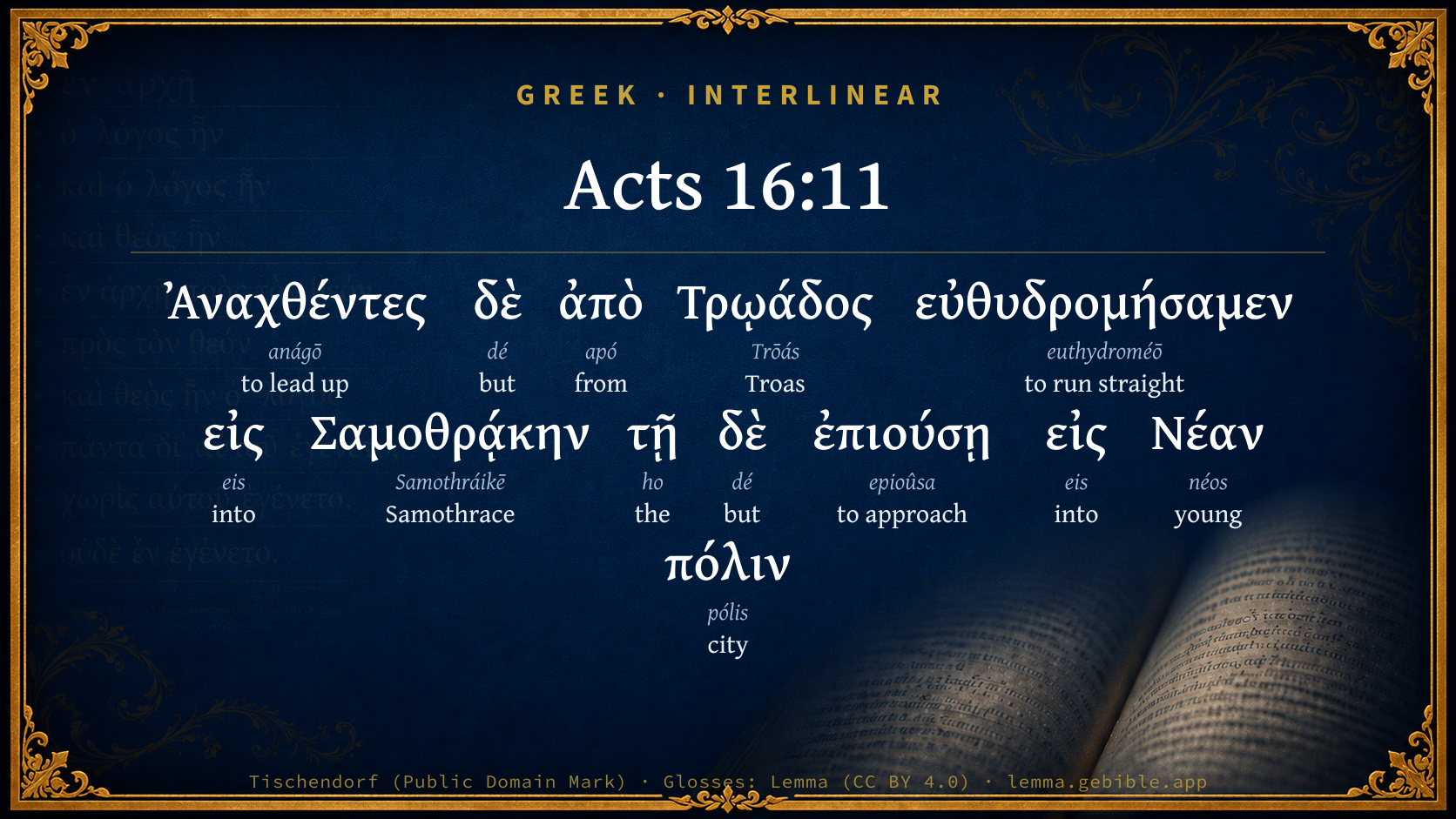
Greek (Tischendorf 8th ed.) Acts 16:11 appears in the Greek New Testament. The text above is from the Tischendorf 8th edition. Each word links to its Strong’s number and a concise gloss. Click any word for its full Thayer’s Greek Lexicon entry.
Download image
Cite this verse

Acts 16:11 (World English Bible). Public Domain. Lemma interlinear Bible study tool, https://lemma.gebible.app/v/acts/16/11.

Show BibTeX & RIS
BibTeX
RIS
English Translation
Setting sail therefore from Troas, we made a straight course to Samothrace, and the day following to Neapolis;
World English Bible · Public Domain
Highlights
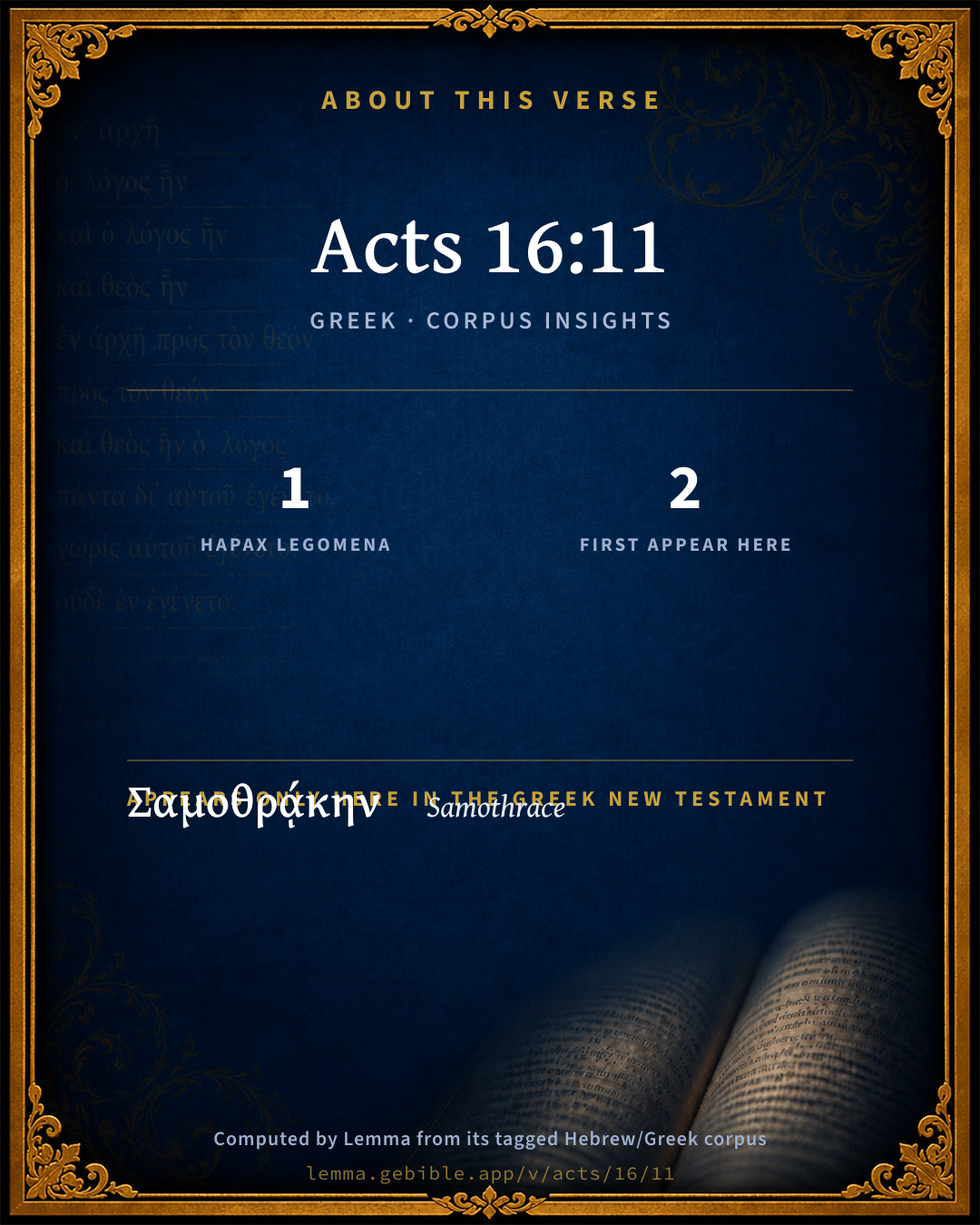
  • 1 hapax legomenon — only here in the Greek New Testament
  • 2 first appearances in the Greek New Testament
Full analysis ↓
Download a study sheet

One document with this verse’s original text, its word-by-word gloss line, the meaning frame, cross-references with their text, attributed commentary, and full source and license credits — printable, and it pastes into notes with its structure intact.

This verse Autodidact and up

Study sheet (.html) Plain text (.txt)

A passage Seminary Student

Up to 50 verses in one chapter. A passage sheet keeps up to 6 commentary sources and 12 cross-references per verse, in the order this page ranks them, and says so on the sheet whenever that leaves anything out. Ask for a single verse and you get the Autodidact verse sheet above.

Everything on this page stays free to read, with no account — the sheet is a download of what is already on screen, not access to it.

Want to remove ads? Support Godless Engineer
Compare translations 3

The same verse in 3 English versions, stacked beneath the original-language interlinear above. Click any original word for its lexicon entry.

Each is an independent rendering of the whole verse — the interlinear is not word-aligned to these translations.

Highlighted words mark where these versions differ — a whole-verse word diff, not a word-by-word alignment.

  • World English Bible Public Domain
    Setting sail therefore from Troas, we made a straight course to Samothrace, and the day following to Neapolis;
  • King James Version Public Domain
    Therefore loosing from Troas, we came with a straight course to Samothracia, and the next day to Neapolis;
  • unfoldingWord Literal Text CC BY-SA 4.0
    So setting sail from Troas, we made a straight course to Samothrace, and the next day to Neapolis,

unfoldingWord Literal Text — © unfoldingWord, licensed CC BY-SA 4.0. Word-aligned USFM3 via Door43 (git.door43.org/unfoldingWord/en_ult).

Versions to compare (up to 4)

3 of 4 selected

Show all 19 translations

Every available English version of this verse, each an independent rendering of the whole verse.

  • World English Bible Public Domain
    Setting sail therefore from Troas, we made a straight course to Samothrace, and the day following to Neapolis;
  • Berean Standard Bible Public Domain
    We sailed from Troas straight to Samothrace, and the following day on to Neapolis.
  • Majority Standard Bible Public Domain
    Therefore we sailed from Troas straight to Samothrace, and the following day on to Neapolis.
  • King James Version Public Domain
    Therefore loosing from Troas, we came with a straight course to Samothracia, and the next day to Neapolis;
  • American Standard Version (1901) Public Domain
    Setting sail therefore from Troas, we made a straight course to Samothrace, and the day following to Neapolis;
  • Revised Version (1885) Public Domain
    Setting sail therefore from Troas, we made a straight course to Samothrace, and the day following to Neapolis;
  • Geneva Bible (1599) Public Domain
    Then went we forth from Troas, and with a straight course came to Samothracia, and the next day to Neapolis,
  • Douay-Rheims (1899) Public Domain
    And sailing from Troas, we came with a straight course to Samothracia, and the day following to Neapolis;
  • Young's Literal Translation Public Domain
    having set sail, therefore, from Troas, we came with a straight course to Samothracia, on the morrow also to Neapolis,
  • Literal Standard Version CC BY-SA 4.0
    having set sail, therefore, from Troas, we came with a straight course to Samothracia, on the next day also to Neapolis,
  • Unlocked Literal Bible CC BY-SA 4.0
    Setting sail therefore from Troas, we made a straight course to Samothrace, and the next day we came to Neapolis.
  • unfoldingWord Literal Text CC BY-SA 4.0
    So setting sail from Troas, we made a straight course to Samothrace, and the next day to Neapolis,
  • Darby Bible Public Domain
    Having sailed therefore away from Troas, we went in a straight course to Samothracia, and on the morrow to Neapolis,
  • World Messianic Bible Public Domain
    Setting sail therefore from Troas, we made a straight course to Samothrace, and the day following to Neapolis;
  • Webster's Bible Public Domain
    Therefore loosing from Troas, we came with a straight course to Samothracia, and the next day to Neapolis;
  • Free Bible Version CC BY-SA 4.0
    We set sail from Troas and made straight for Samothrace. The next day we went on to Neapolis,
  • Bible in Basic English Public Domain
    So, from Troas we went straight by ship to Samothrace and the day after to Neapolis;
  • Text-Critical English NT CC BY 4.0
    So we set sail from Troas and followed a straight course to Samothrace, and on the next day we went to Neapolis.
  • Tyndale New Testament (1534) Public Domain
    Then lowsed we forth from Troada and with a strayght course came to Samothracia and the nexte daye to Neapolim

Literal Standard Version (2020), Covenant Press — licensed CC BY-SA 4.0. Text via the HelloAO Bible API (eBible.org). Unlocked Literal Bible (unfoldingWord) — licensed CC BY-SA 4.0. Text via the HelloAO Bible API (eBible.org). unfoldingWord Literal Text — © unfoldingWord, licensed CC BY-SA 4.0. Word-aligned USFM3 via Door43 (git.door43.org/unfoldingWord/en_ult). Free Bible Version, Dr. Jonathan Gallagher — licensed CC BY-SA 4.0. Text via the HelloAO Bible API (eBible.org).

Word by word

More ways to search: Search by grammar → Find every occurrence → Compare this word →

Practice this passage: Drill this verse → Learn its vocabulary →

Σαμοθρᾴκην
Samothráikē
G4543
“Samothrace”
Noun, Accusative, Singular, Feminine
Part of Speech
Noun
Case
Accusative
Number
Singular
Gender
Feminine
Full Thayer's Definition

Origin: from G4544 and Thraike (Thrace)

TDNT: None

Samothracia = "a sign of rags" 1. an island on the Aegean Sea, about 38 Miles (60 km) from the coast of Thrace at the mouth of the river Hebrus
  1. Ἀναχθέντες anágō G321 “to lead up” Verb, Aorist, Passive, Participle, Nominative, Plural, Masculine
  2. δὲ dé G1161 “but” Conjunction
  3. ἀπὸ apó G575 “from” Preposition
  4. Τρῳάδος Trōás G5174 “Troas” Noun, Genitive, Singular, Feminine
  5. εὐθυδρομήσαμεν euthydroméō G2113 “to run straight” Verb, Aorist, Active, Indicative, 1st person, Plural
  6. εἰς eis G1519 “into” Preposition
  7. τῇ ho G3588 “the” Article, Dative, Singular, Feminine
  8. δὲ dé G1161 “but” Conjunction
  9. ἐπιούσῃ epioûsa G1966 “to approach” Verb, Present, Active, Participle, Dative, Singular, Feminine
  10. εἰς eis G1519 “into” Preposition
  11. Νέαν néos G3501 “young” Adjective, Accusative, Singular, Feminine
  12. πόλιν pólis G4172 “city” Noun, Accusative, Singular, Feminine

About this verse

These counts appear in no published source. They are computed here, from the morphology-tagged text and Lemma’s own curated glosses. What Lemma adds →

13
words
11
distinct lemmas
Acts
section

Notable vocabulary

1 hapax legomenon — a word that appears only here in the entire Greek New Testament:

  • Σαμοθρᾴκην Samothrace G4543

First appearance in Scripture

These words make their first canonical appearance in the Greek New Testament here:

  • εὐθυδρομήσαμεν to run straight G2113
  • Σαμοθρᾴκην Samothrace G4543

Shared distinctive vocabulary

εὐθυδρομήσαμεν to run straight G2113 occurs in 2 verses of the Greek New Testament. Also found in:
Repetition

Words recur within this verse:

Cross-references

2

Topical passages linked to Acts 16:11 in the Treasury of Scripture Knowledge — connected by theme and wording, ordered by reader-vote popularity; previews shown in the World English Bible.

  • Acts 21:1 When it happened that we had parted from them and had set sail, we came with a straight course to Cos, and the next day to Rhodes, and from there to Patara.
  • Acts 16:8 Passing by Mysia, they came down to Troas.

Cross-references courtesy of OpenBible.info (CC BY 4.0).

Where the printed editions differ

1 variant

Places in this verse where the major printed Greek editions disagree on the wording in a way that affects the translation — a comparison of editions, not a manuscript-by-manuscript collation. The editions are the modern critical texts (Nestlé-Aland 28/27, SBL, Westcott-Hort, Tregelles, Tyndale House) and the traditional texts behind the KJV (the Textus Receptus and the Byzantine/Majority text). It is not a claim about which reading is original.

  1. Different wording
    δὲ

    “then”

    In NA27 Not in NA28TynSBLWHTregTRByz

    οὖν (oun) 'therefore' occurs in traditional manuscripts (NA28+Tyn+SBL+WH+Treg+TR+Byz) instead of δὲ (de) 'then' in older manuscripts (NA27)

Textual data: Translators Amalgamated Greek New Testament (STEPBible TAGNT) · CC BY 4.0.

Commentary

Notes on Acts 16:11 from classic Christian and Jewish commentators (each source and its license shown beneath its notes). The classic Christian expositions comment on the surrounding passage and are grouped to its opening verse, so a note may address several verses; the Jewish commentaries on the Tanakh (Rashi and others) are per-verse, so they appear only where the commentator wrote on this verse.

Lemma curates 59 commentaries, every one of them public domain or Creative Commons licensed, each selected and text-cleaned for this edition rather than reprinted as found. About our sources →

Joseph Benson's Commentary

Act 16:11-12. Therefore, loosing from Troas, we came to Samothracia — An island in these seas, famous for being the seat of certain religious mysteries, in equal estimation with those called Eleusinian. But it does not appear that they went ashore there, for they landed the next day at Neapolis — A seaport town of Macedonia. Nor did they make any stay even there, but went straight to Philippi; because it was the chief city of that part of Macedonia — And a Roman colony. Thus Paul, having preached first at Damascus, next at Jerusalem, after that throughout all the coasts of Judea, and then to the Gentiles in Syria, Cilicia, and most of the countries of the Lesser Asia, went at length, by the particular commandment of Christ, among the Greek nations, to whom it was proper that the glad tidings of salvation should now be given. For, seeing the gospel was a revelation from the true God, and was supported by great and undeniable miracles, it was fit that it should, in due course, be proposed to those nations who were best qualified to judge of its nature and evidences; because if, upon an accurate examination, great numbers of men embraced the gospel, whose minds were improved by science, and every kind of culture, their conversion would render it indubitable, in after times, that the gospel was supported by those great and undeniable miracles, which the Christian records affirm were performed in every country, by the preachers of the gospel. Besides, God, in his infinite wisdom, was determined that the reigning idolatry should be utterly overthrown in those countries of Europe where it had the greatest support, from the ability and learning of its abetters; that no person might suspect, or affirm, in after times, that idolatry was destroyed, and Christianity established, merely through the ignorance and simplicity of the people among whom it was first preached.

Joseph Benson's Commentary on the Old and New Testaments (1811–1818) — public domain. Text from a community e-Sword module.

The Preacher's Complete Homiletical Commentary

Joseph S. Exell (gen. ed.)

CRITICAL REMARKS

Act_16:12. The chief city of that part of Macedonia, and a colony.—Better, a city of Macedonia, the first of the district, a colony—i.e., of Rome. Macedonia was divided into four parts; but whether “the first” meant “the first arrived at” (Winer, Zöckler, Lightfoot Alford), not a very valuable observation; or the first in political importance (Farrar, Ramsay), which Philippi was, though Thessalonica was the capital of Macedonia, and Amphipolis of the province; or “the first to be made a colony” (Grotius, Meyer, Wendt, Overbeck), the distinction pointed out in the text; or “the first city on the frontier” (Wordsworth), is debated, and is not clear. Wordsworth’s idea derives support from the occurrence of a similar phrase in Xenophon (Anab., I. iv. 1): εἰς Ἰσσούς, τῆς Κιλικίας ἐσχάτην πόλιν. Dr. Hort thinks some early corruption has crept into the text, and that instead of μερίδος should be read Πιερίδος (M for II), for Philippi belonged to the Pieria of Mount Paragon, and might well be called “a chief city of Pierian Macedonia” (Westcott and Hort’s The New Testament in Greek, 2:97, Appendix.) Ramsay says: “The term ‘first’ was commonly assumed by towns which were or claimed to be chief of a district or province.”

Act_16:13. By a river side.—Neither the Strymon nor the Nestos, which are both distant from Philippi, but the smaller stream Gangas close by the town. Where prayer was wont to be made; or, where we supposed there has as a place of prayer (R.V.). The received reading corrected thus, where a place of prayer was wont to be, has the support of good authorities. Josephus (Ant., XIV. x. 23) mentions the custom of making “prayer houses” at the seaside.

HOMILETICAL ANALYSIS.—Act_16:11-13

Paul and Silas in Philippi; or, the Gospel carried to Europe

I. The journey to Philippi.—

1. From Troas to Samothraoia. No sooner had Paul and his companions, Silas, Timothy, and Luke, the beloved physician, who had now joined the apostle (see “Critical Remarks,” Act_16:10, and “Hints” on Act_16:11), understood the significance of the midnight vision than they proceeded to comply with the call of the Macedonian man. With the early dawn, having turned their steps towards the harbour, and found a ship about to sail for Europe, they engaged berths. As the vessel weighed anchor and shot into the deep “the sun rose and spread the day over the sea and the islands as far as Athos and Samothrace” (Conybeare and Howson). Running in a straight course, or, in modern nautical phrase, sailing before the (south) wind (see Act_21:1, and compare Act_27:16), the vessel would reach the island of Samothrace that day, anchoring for the night to the leeward of it. Samothrace, the present-day Samothraki, about half-way between Troas and Neapolis, contains the highest land in this part of the Ægean except Mount Athos.

2. From Samothrace to Neapolis. “A run of seven or eight hours would bring the vessel under the lee of the island of Thasos, and within a few miles of the coast of Macedonia” (Conybeare and Howson), which accordingly was reached next day. The harbour in which the four passengers disembarked belonged to the town of Neapolis, the modern Kavala, in Thrace, on the Gulf of Strymon, and about ten miles distant from Philippi, to which it served as a port. Hence the missionaries did not linger in Neapolis, but pushed on towards the capital of the district.

3. From Neapolis to Philippi. A short journey of not more than three hours would conduct them to “the chief city of that part of Macedonia,” or to “a city of Macedonia, the first of the district [see “Critical Remarks”], a Roman colony.” This city was Philippi, once an obscure place, called Krenides from its streams and springs, but erected into a frontier city against the Thracian mountaineers, and named after himself by the father of Alexander, and constituted a colonia by Augustus. It was “a fact of deep significance that the first city at which Paul arrived on his entrance into Europe was that colony which was more fit than any other in the empire to be considered the representative of Imperial Rome” (Conybeare and Howson, i. 267).

II. The stay in Philippi.—

1. How long it continued. Impossible to tell. Clearly two Sabbaths (Act_16:13; Act_16:16), and most likely some weeks were spent in the city (Act_16:20).

2. What incidents occurred.

(1) The conversion of Lydia on the first Sabbath in a prayer-house by the river-side, through Paul’s preaching (Act_16:13-15). See below.

(2) The cure of a Pythoness, or damsel possessing a spirit of divination, by the word of Paul who, in the name of Jesus, commanded the spirit to come out of her (Act_16:16-18).

(3) The imprisonment of Paul and Silas by the town magistrates, who first commanded them to be beaten and then handed them over to the care of the town jailor (Act_16:19-24).

(4) The conversion of the jailor, who was spiritually awakened by an earthquake which shook the foundations of the prison at midnight, and by Paul was directed how to find salvation (Act_16:25-34).

III. The departure from Philippi.—

1. After liberation from jail. This took place:

(1) on the morning after the earthquake—“when it was day”;

(2) at the request of the magistrates, who had become alarmed at the situation, either in consequence of the earthquake which seemed like an interposition of the gods on behalf of the prisoners, or because on reflection they had grown convinced of the injustice of what they had done (Act_16:35-36);

(3) after the remonstrance of Paul, who declined to be surreptitiously thrust out of bonds after having been publicly scourged, and that, too, while they were Romans, and who demanded that they should be honourably and openly liberated by the magistrates themselves (Act_16:37); and

(4) by the hands of the magistrates, who, on learning that their prisoners were Roman citizens, feared what might happen to themselves for having so thoughtlessly violated the sanctity of Roman law, and, like evildoers generally who tremble when confronted with the consequences of their crimes, were exceeding glad to get them peacefully despatched beyond the city precincts (Act_16:39).

2. After visiting the house of Lydia. Having resided there before arrest and imprisonment (Act_16:15), they naturally returned thither on release from confinement. Not, however, to stay, but to exchange Christian greetings with, and address words of comfort to, the brethren there assembled, who, having been converted by their ministry, formed the nucleus of the Church to which afterwards the epistle to the Philippians was directed. This done, they departed, but not for ever (see Act_20:6).

Learn.—

1. That the track of the gospel over land and sea has always been guided by God.

2. That Europeans have reasons to bless God for having so early sent the gospel to their shores.

3. That nothing befalls God’s people without His express permission.

4. That events which seem to hinder may eventually further the gospel.

5. That the gospel spreads by means of preaching.

HINTS AND SUGGESTIONS

Act_16:11. The Writer of the “We” Passages; or, Luke the Beloved Physician (see Introduction).—“Of Luke himself, beyond what we learn of his movements and of his character from his own writings, we know but little. There is no reason to reject the unanimous tradition that he was by birth an Antiochene, and it is clear (?) from St. Paul’s allusions that he was a Gentile convert, and that he had not been circumcised (Col_4:10-11; Col_4:14). That he was a close observer, a careful narrator, a man of cultivated intellect, and possessed of a good Greek style we see from his two books; and they also reveal to us a character gentle and manly, sympathetic and self-denying. The incidental allusion of St. Paul shows us that he was a physician, and this allusion is singularly confirmed by his own turns of phrase. The rank of a physician in those days was not in any respect so high as now it is, and does not at all exclude the possibility that St. Luke may have been a freedman; but on this, and all else which concerns him, Scripture and tradition leave us entirely uninformed. That he was familiar with naval matters is strikingly shown in his account of the shipwreck, and it has even been conjectured that he exercised his art in the huge and crowded merchant vessels which were incessantly coasting from point to point of the Mediterranean.—Farrar, “The Life and Work of St. Paul,” chap. xxiv.

St. Luke and St. Paul.—“It may be well to note the phenomena in the writings ascribed to the physician which, though they do not directly indicate his calling, at least fall in with it and are best explained by it.… Thus we find him noting specifically the special combination of fevers (πυρετοί, as in Hippoc., Aph., vii. 63, 64—the plural is obviously technical for feverish symptoms) and a bloody flux (δυσεντερία) from which the father of Publius suffered at Melita (Act_28:8), and using in relation to the generous gifts which it called forth the special word “honour” (τιμή), which, like our “honorarium,” was applied to the payments made to those who practised a profession and not a trade (?). So, again, in the healing of the cripple in the temple (Act_3:7), he records with a technical precision which our English Version but partially represents that “his feet” (not the common πόδες, but βάσεις—a word used by Hippocrates, p. 637) “and ankle-bones” (σφυρά) “were strengthened,” the previous crippled state being due to the congenital imperfect development of the bones and tendons of the feet.… So he stated that the paralysis of Æneas lasted eight years, and that for the whole of that period he had been bedridden (Act_9:33); that from Saul’s eyes “there fell as it had been the scales” (ὡσεὶ λεπίδες) of the incrustation incidental to ophthalmia (Act_9:18); and that the damsel at Philippi had “a spirit of Python,” or Apollo, “presenting phenomena identical with the convulsive movements and wild cries of the Pythian priestess at Delphi” (Act_16:16); while as one whose previous studies had made him acquainted with the recorded cases of phthiriasis, such as those of Antiochus Epiphancs (2Ma_9:9), Pheretima (Herod., iv. 205), and Sylla, and perhaps Herod the Great (Josephus, Ant., Act_17:15), he would note with a special interest the addition of another instance in the death of Herod Agrippa as “eaten by worms,” σκωληκόβρωτος (Act_12:23).—Dean Plumptre, in “The Expositor” (1876), iv., pp. 137–139.

Act_16:13. An Ancient Prayer Meeting.

I. The place of worship.—

1. Outside the city. Rendered necessary because of the character of the city which, being large and heathen, was not much suited for devotion. Those who wish to pray should withdraw from both the world’s bustle and the world’s superstition and sin (Mat_6:6).

2. By a river side. Jewish prayer-houses were usually erected on river-banks, or at places where water could be easily obtained for ceremonial lustrations. Suggestive of that inward cleansing which is required by all who would approach God in prayer (Isa_1:15-16; Jas_4:8).

3. In a prayer-house. Not an ordinary synagogue (Schürer), there being few Jews in the town; most likely an open space consecrated to Divine worship. Prayer may be offered anywhere. If Christians, for any reason, cannot obtain comfortable edifices in which to worship, rather than not worship at all they should betake themselves to river-banks, hillsides, district moors, dens, and caves of the earth.

II. The time of worship.—The Sabbath. Whether on other days is not clear (see Act_16:16); but in any case the seventh-day worship was not neglected. Neither should the Lord’s-day worship be omitted by Christians (Act_20:7; Heb_10:25).

III. The congregation of worshippers.—A few women; amongst them some converts to Judaism, like Lydia (see below). If no men were present before Paul and his companions arrived upon the scene, the intrusion of four male worshippers must have caused a sensation. Women have always been more devout than men (Act_1:14, Act_13:50).

IV. The acts of worship.—

1. Prayer. This the primary object of such gatherings.

2. Reading of the Scriptures. Though not stated, this may be assumed.

3. Exposition of the word. As in the synagogue by any capable person who might happen to be present (Act_13:15).

Act_16:13. The Opening of the Mission.

I. When was it that they had an opportunity of preaching? It was on the Sabbath day. The Sabbath was the great day on which he knew that his work was to be done.

II. Observe, then, the place at which he preached. It was by the river-side, “where prayer was wont to be made.” There appears to have been no synagogue at Philippi.

III. One other thing to be observed is, the persons to whom they preached. They “sat down and spake unto the women which resorted thither.”

Now, what are the lessons which we are to learn for ourselves from this account of the first preaching of the gospel at Philippi?

1. It is fitted to remind us of the great practical value of the Sabbath.

2. Another lesson which we learn from the history, closely connected with this, is the importance of meeting together for united prayer whenever we have the opportunity.

3. One other thing we are taught by this passage of history which we have been considering to-day, and that is, not to despise any means of doing good, however small it may be, which is put within our reach. We do not know what great results may follow it.—M. F. Day.

The Preacher's Complete Homiletical Commentary (gen. ed. Joseph S. Exell; Funk & Wagnalls, c. 1892) — public domain (pre-1929). A full-Bible homiletical/sermon-outline anthology covering 65 of 66 books (2 John is absent from the source module). Text from a community e-Sword module.

Tyndale Open Study Notes

Tyndale Open Resources

16:11 Samothrace is a small mountainous island lying west-northwest of the Hellespont about twenty miles (32 km) from the coast of Thrace. • Neapolis (modern Kavala) was the seaport for Philippi and the eastern terminus of the famous Via Egnatia (the Egnatian Way), which ran from Rome to Asia.

Tyndale Open Study Notes — © Tyndale Open Resources, licensed CC BY-SA 4.0. Text via the HelloAO Bible API.

Bengel's Gnomon

Johann Albrecht Bengel

Act 16:11. Εὐθυδρομήσαμεν, we came with a straight course) The favourable voyage increased their confidence. But even to this day Europe saith, All hail to you (the first preachers of the Gospel in Europe).

Bengel's Gnomon of the New Testament — English translation (T&T Clark, Edinburgh, 1860) — public domain. Text from a community e-Sword module.

Meyer's Critical & Exegetical Commentary

Heinrich August Wilhelm Meyer

Act_16:11. Εὐθυδρομ.] having sailed from Troas, we ran by a straight course (Act_21:1). The word is not preserved in Greek writers, who have, however, εὐθυδρόμος, and as a verb, εὐθυπλοέω.

Samothrace, a well-known island off the coast of Thrace, in the Aegean Sea.

τῇ ἐπιούσῃ] die postero, used by Greek writers both with (Act_7:26) and without ἡμέρᾳ. See Lobeck, ad Phryn. p. 464 In the N.T. it occurs only in Acts.

Neapolis, at an earlier period Datos (Strabo, vii. p. 330), a seaport on the Strymonian Gulf, opposite the island of Thasos, at that time belonging to Thrace, but after Vespasian to Macedonia (Sueton. Vesp. 8; Dio Cass. xlvii. 35; Ptol. iii. 13. 9).

On Philippi, formerly Krenides, named from the Macedonian Philip, who enlarged and fortified it, see the Introd. to Philipp. § 1.

πρώτη τῆς μερίδος Μακεδ. κολωνία πόλις] As in that district of Macedonia, divided by Aemilius Paulus into four parts (Liv. xlv. 29), Amphipolis was the capital, and πρώτη πόλις cannot therefore in a strict sense mean capital;[50] all difficulty is removed simply by connecting, and not, as is usually done,[51] separating, πόλις κολωνία: which is the first (in rank) colony-town of the part (concerned) of Macedonia. Comp. also Baumgarten.[52] Thus it is unnecessary, with Kuinoel, Hug, and others (see also Credner, Einl. II. p. 418 f.; Mynster, kl. theol. Schr. p. 170), who separate πόλις from κολωνία, to take πρώτη πόλις in the sense of a city endowed with privileges (Bertholdt compares the French use of bonne ville), inscriptions on coins being appealed to, in which the formal epithet πρώτη is given to Greek cities which were not capitals. See Eckhel, doctr. vet. num. I. 4. 282; Boeckh, Corpus inscript. I. 2, No. 335. In the case of Philippi itself no special privileges are known, except the general colonial rights of the jus Italicum; nor is the title πρώτη found on the coins of Philippi, it is met with only in the case of cities in Asia Minor (see Rettig, Quaest. Philipp. p. 5 f.). Others take πρώτη of local situation, so that they too separate πόλις from κολωνία: Philippi was the first city of Macedonia at which Paul touched in his line of travel. So Olshausen and Wieseler, following Erasmus (who, however, appears to join πόλις κολ.), Cornelius a Lapide, Calovius, Raphel, Wolf, Bengel, Eckermann, Heinrichs. In this case we have not to consider Neapolis as the mere port of Philippi (Olshausen), but with Rettig, van Hengel, ad Phil. p. 4 ff., and De Wette, to lay stress on the fact that Neapolis at that time belonged to Thrace, and to take ἐστί (Luke did not write ἦν) as an expression of the admitted state of things, that Philippi from that side is the first city (consequently the most easterly, see Wieseler, p. 37 f.). But what reason could Luke have to make such an exact geographical specification, especially with regard to such a well-known city as Philippi? It is quite at variance with his manner elsewhere. And that too with the argumentatively (quippe quae) emphatic ἥτις? This applies also in opposition to Grotius, who takes πόλις κολωνία together (the first colonial-city), but understands πρώτη also of the geographical situation. According to our view, there is conveyed in ἥτις an explanation of the motive for their going to Philippi in particular, seeing that it is, namely, the most noteworthy colonial-city of the district, so that the gospel might at once acquire a very considerable and extensive sphere of action in Macedonia. If in itself ἀξίωμά ἐστι πόλεως ἡ κολώνεια (Chrysostom), this is yet more heightened by πρώτη.

On the combination of two substantives like πόλις κολωνία, comp. Lobeck, Paralip. p. 344. Instead of κολωνία, the Greek uses ἀποικία or ἐποικία; instead of πόλις κολωνία, πόλις ἀποικίς.

Philippi was colonized by Octavianus through the removal thither of the partisans of Antonius, and had also the jus Italicum conferred on it. See Dio Cass. li. 4; Plin. H. N. iv. 11; Digest. Leg. xv. 6.

[50] Without any reason, Wetstein imagined that after the battle at Philippi this city was raised to be the capital. From the erroneous interpretation capital arose the reading ἥτις ἐστὶν κεφαλὴ τῆς Μακ., πόλις κολωνία, which Bornemann regards as original.

[51] Thus also Ewald, p. 485, according to whom Philippi, on account of its flourishing condition at that time, is assumed to he named the first city of the province of Macedonia. But μερίς does not mean province (ἐπαρχία, Act_23:34, Act_25:1).

[52] Who elaborately explains μερίδος, as if τῆς οἰκουμένης stood alongside of it, so that τῆς Μακεδ. would be in apposition to τ. μερίδος.

Meyer — Critical and Exegetical Commentary on the New Testament — English translation by Peter Christie, edited by Frederick Crombie (T&T Clark, 1880) — public domain. Text from a community e-Sword module.

Expositor's Greek Testament

ed. W. Robertson Nicoll

Act 16:11 . ἀναχθέντες , see on Act 13:13 . εὐθυδρομήσαμεν : only in Acts here and in Act 21:1 , nowhere else in N.T., not in LXX or Apocrypha but used by Philo, cf. St. Luke’s true Greek feeling for the sea, Ramsay, p. 205. Strabo used εὐθύδρομος , p. 45, and elsewhere St. Luke’s language may point to the influence of the great geographer; see Plumptre’s Introduction to St. Luke’s Gospel. Σαμοθρᾴκην : an island of the Ægean sea on the Thracian coast about half-way between Troas and Neapolis, but with adverse winds or calms the voyage from Philippi to Troas takes five days, Act 20:6 . Samothracia, with the exception of Mount Athos, was the highest point in this part of the Ægean, and would have been a familiar landmark for every Greek sailor, see C. and H., pp. 220, 221. Νεάπολιν : modern Cavallo , the harbour of Philippi, lying some miles further north: Thracian, but after Vespasian reckoned as Macedonian; opposite Thasos, C. and H., p. 221; Renan, Saint Paul , p. 139. τῇ τε ἐπιούσῃ , sc. , ἡμέρᾳ , cf. Act 20:15 , Act 21:18 , with ἡμέρᾳ added, Act 7:26 , Act 23:11 , so too in classical Greek, Polyb., Jos.; in N.T., phrase only found in Acts: mark the exact note of time.

The Expositor's Greek Testament, edited by W. Robertson Nicoll (1897–1910) — public domain. Text from a community e-Sword module.

Jamieson, Fausset & Brown

Robert Jamieson, A. R. Fausset & David Brown

Therefore loosing from Troas, we came--literally, "ran."

with a straight course--that is, "ran before the wind."

to Samothracia--a lofty island on the Thracian coast, north from Troas, with an inclination westward. The wind must have set in strong from the south or south-southeast to bring them there so soon, as the current is strong in the opposite direction, and they afterwards took five days to what they now did in two (Act 20:6) [HOWSON].

next day to Neapolis--on the Macedonian, or rather Thracian, coast, about sixty-five miles from Samothracia, and ten from Philippi, of which it is the harbor.

Jamieson, Fausset & Brown — Commentary Critical and Explanatory on the Whole Bible (1871) — public domain (CC PDM 1.0). Text via the HelloAO Bible API.

Adam Clarke's Commentary

Verse 11. Loosing from Troas] Setting sail from this place.

With a straight course to Samothracia] This was an island of the AEgean Sea, contiguous to Thrace, and hence called Samothracia, or the Thracian Samos. It is about twenty miles in circumference, and is now called Samandrachi by the Turks, who are its present masters.

And the next day to Neapolis.] There were many cities of this name; but this was a sea-port town of Macedonia, a few miles eastward of Philippi. Neapolis signifies the new city.

Adam Clarke's Commentary on the Bible (1810–1826) — public domain. Text from a community e-Sword/MySword module.

John Calvin's Commentaries

11. This history doth, as it were in a glass, show how sharply the Lord did exercise the faith and patience of his, by bringing them in great straits which they could not have overcome unless they had been endued with singular constancy; for the entrance of Paul into Macedonia is reported to be such, as that it might have cause him to give but small credence to the vision. These holy men, leaving the work which they had in hand, did cross the seas with great haste, as if the whole nation of the Macedonians would have come to meet them with earnest desire to be helped. Now, the success is so far from being answerable to their hope, that their mouths are almost quite stopped. When they enter the chief city, they find non there with whom they may take any pains; therefore they are enforced to go into the field, that they may speak in an obscure corner and wilderness. Yea, even there they cannot have one man which will hearken to their doctrine; they can only have one woman to be a disciple of Christ, and that one which was an alien. Who would not have said that this journey was taken in hand foolishly which fell out so unhappily? But the Lord doth thus bring to pass his works under a base and weak kind, that his power may shine more clearly at length; and it was most meet that the beginnings of the kingdom of Christ should be so ordered, that they might taste [savor] of the humility of the cross. But we must mark the constancy of Paul and his companions, who being not dismayed with such unprosperous beginnings, try whether any occasion will offer itself contrary to their expectation. And assuredly the servants of Christ must wrestle with all lets, neither must they be discouraged, but go forward to-morrow, if this day there appear no fruit of their labor, for there is no cause why they should desire to be more happy than Paul. When Luke saith that they abode in that city, some had rather have it, that they conferred or disputed, but the other translation is more plain. And the text persuadeth us to make choice thereof, because Luke will shortly after declare that Lydia was the first-fruits of that Church; and we may easily guess that the apostles went out of the city, because there was no gate opened to them in it.

John Calvin's Commentaries (1540-1563) — public domain. Text from the Calvin Translation Society English edition (1840s-50s) via the Christian Classics Ethereal Library (ccel.org). Calvin's coverage is partial (roughly two-thirds of the Bible); uncommented books and verses are honest gaps, never fabricated. The 19th-century editor's footnotes and remarks are omitted so the notes are faithfully Calvin's own voice.

Ellicott's Commentary for English Readers

(11) We came with a straight course to Samothracia.—Their course lay to the north-west, and, probably, after the manner of the navigation of the time, they put into harbour each night; and the historian, with his characteristic love of geographical detail (see Introduction to St. Luke’s Gospel), notes the main facts of the voyage. The “straight course” implies that they had the wind in their favour. The current, which sets to the south after leaving the Hellespont, and to the east between Samothrace and the mainland, would, of course, be against them. In Act_20:6, the voyage from Philippi to Troas takes five, days. The name of Samothrace points, probably, to its having been a colony from Samos. In early Greek history it had been one of the chief seats of the worship of the Pelasgic race, and, besides the mysteries of Demeter and Persephone, which it had in common with the rest of Greece, was celebrated for the local cultus of the Cabiri, a name of uncertain origin, and applied to the twelve great gods.

The next day to Neapolis.—The name (=new town) was naturally common wherever Greek was spoken. It survives in two conspicuous instances—in Naples, and in Nablous as the modern name of Sychem. The town now before us was in Thrace, about twelve miles from Philippi, which was the frontier town of Macedonia. It has been identified, on adequate grounds, with the modern Kavalla, where a Roman aqueduct, columns, and Greek and Latin inscriptions remain to attest the former importance of the city. Ten or twelve miles to the west are the traces of another harbour at Eski Kavalla, which was probably the Palæopolis (= old town) that had been superseded by the new port.

A Bible Commentary for English Readers, edited by Charles John Ellicott (1878–1897) — public domain. Text from a community e-Sword module.

The Cambridge Bible for Schools and Colleges

gen. ed. J. J. S. Perowne

11. Samothracia] This island lies in the north of the Aegean Sea, opposite to that part of the Thracian coast at which the river Hebrus empties itself.

Neapolis] The port of Philippi. This place is generally identified with the modern Kavalla. On the discussion about its identity, see Dictionary of the Bible (s. v.)

The Cambridge Bible for Schools and Colleges (gen. ed. J. J. S. Perowne; Cambridge University Press, 1878–1918) — public domain. Text from a community e-Sword module.

John Gill's Exposition

Therefore loosing from Troas,.... Or setting sail from thence, which, as before observed, was the Hellespont; which was a narrow sea that divided Asia from Europe, now called Stretto di Gallipoii, or Bracci di St. Georgio: and so Pliny (q) speaking of Troas says, it lies near the Hellespont; and Jerom (r) calls it a maritime city of Asia; and it further appears to be on the sea coast, by what is said in Act 20:6, for from Philippi hither, the apostle and his company sailed in five days, and from hence they sailed to Assos, Act 20:6

we came with a straight course to Samothracia; which was an island in the Aegean sea, or Archipelago: it was formerly called Dardania (s), from Dardanus the, son of Jupiter by Electra, who fled hither from Italy, upon killing his brother Jasius; it had its name of Samothracia, from Thracia, near to which it was, and from the Samians who inhabited it; and it was called Samothracia to distinguish it from the island Samos in the Ionian sea; it is now called Samandrachi: Jerom (t) calls it an island in the gulf of Pagasa; of this island of Samothracia, Pliny says (u), that it was free before Hebrus, was thirty two miles from Imbrus, twenty two and a half from Lemnus, thirty eight, from the shore of Thracia, and in circumference thirty two--and that it is fullest of good havens of any in those parts; and adds, that Callimachus calls it by its ancient name Dardania; it seems it was also called Leucosia, or Leucadia, because to spectators at a distance it looked white: according to (w) Herodotus the Pelasgi first inhabited Samothracia, who with the Athenians dwelt there, and from them the Samothracians received their sacred rites and mysteries; for this island was famous for the worship of the Cabiri, or chief deities of the Gentiles, particularly Ceres, Proserpina, Pluto, Mercury, and the two brothers Castor and Pollux, Neptune, and all the sea gods; insomuch that it was called "the holy island" (x), and persons of other nations, and even of the greatest figure, were initiated into the mysteries of the Samothracians, which Pliny (y) calls the most holy; for speaking of Venus, Potho, and Phaeton, adds, who are worshipped with the most holy ceremonies of Samothracia. The apostle did not stay to preach the Gospel in this place, nor do we read of its being preached here by him at any other time, or by any other, nor of any church in this place in after ages in ecclesiastical history. The apostle and his companions are said to come hither, "with a straight course"; not only because they might have a fair gale, which brought them at once hither; but because when they were over the Hellespont, this island lay directly in their way, in a straight line to Macedonia:

and the next day to Neapolis; the Alexandrian copy reads, "the new city", as the word signifies; hence the Ethiopic version by way of interpretation renders it, "the next day we came to the new city, the name of which is Neapolis": according to Ptolomy, it was a sea port of Edonis, a part of Macedonia, and was upon the borders of Thrace; it is now called Christopoli; and was not Neapolis in Campania, nor Sychem in Samaria, which is so called, but was at a great distance from either of these. Pliny places it in Thracia, as he also does Edonis, and even Philippi (z). Jerom calls (a) it a city of Caria, but wrongly: and though we have no account of the apostles preaching in this place, and of making converts, neither now nor at any other time; yet it appears even in after ages that here was a church in this place: in the "sixth" century the bishop of it was sent to the fifth Roman synod; and in the "seventh" century one Andreas was bishop of this place, who was in the sixth synod at Constantinople (b).

(q) Nat. Hist. l. 5. c. 30. (r) De locis Hebraicis, fol. 96. K. (s) Pausanias Achaica, sive, l. 7. p. 403. Ptolom. Geograph. l. 3. c. 11. (t) Ib. fol. 96. I. (u) Nat. Hist. l. 4. c. 12. (w) Euterpe, c. 51. (x) L. Attilius in Liv. Hist. l. 45. c. 5. (y) Nat. Hist. l. 36. c. 5. (z) Ib. l. 4. c. 11, (a) De locis Hebraicis, fol. 96. F. (b) Magdeburg. Hist. Eccl cent. 6. c. 2. p. 7. cent. 7. c. 10. p. 258.

John Gill's Exposition of the Whole Bible (1746–1763) — public domain (CC PDM 1.0). Text via the HelloAO Bible API.

Trapp's Complete Commentary

John Trapp

11 Therefore loosing from Troas, we came with a straight course to Samothracia, and the next day to Neapolis;

Ver. 11. We came with a straight course] Or with a speedy course. The straight way is the next way: {a} "How long wilt thou go about, O backsliding daughter?" Jer 31:22. Impii ambulant in circuitu, saith the Psalmist, the wicked walk the round; so doth the devil, that great peripatetic, {b} seeking to circumvent, Job 1:7. But the righteous look straight before them, Pro 4:25, and make straight paths for their feet, Heb 12:13; so that they soon finish their course with joy, and live long in a little time.

To Samothracia] An island opposite Thracia; whereof see Pliny, iv. 11.

Neapolis] A city near Philippi, in the borders between Thracia and Macedonia.

{a} ευθυδρομης’ Utrumquo significat, et recte et cito currentes. Lorin.

{b} Walking about or from place to place in connection with some occupation or calling; itinerant. ŒD

John Trapp, A Commentary or Exposition upon All the Books of the Old and New Testament (1647–1656) — public domain. Text from a community e-Sword module.

Albert Barnes' Notes on the Bible

Loosing from Troas - Setting sail from this place.

To Samothracia - This was an island in the Aegean Sea not far from Thrace. It was populated by inhabitants from Samos and from Thrace, and hence called Samothracia. It was about 20 miles in circumference, and was an asylum for fugitives and criminals.

And the next day to Nepalese - This was a maritime city of Macedonia, near the borders of Thrace. It was about 10 miles from Philippi.

Albert Barnes' Notes on the Bible (1834–1885) — public domain. Text from a community e-Sword/MySword module.

Matthew Poole's English Annotations

Samothracia; an island so called, because the inhabitants came partly out of Thrace, and partly from Samos. This

Neapolis was a city in the confines of Thrace and Macedonia.

Matthew Poole's English Annotations on the Holy Bible (1683–1685) — public domain. Text from a community e-Sword/MySword module.

Whedon's Commentary on the Bible

Daniel D. Whedon

11. Loosing from Troas—Directly before them lie the isles of the AEgean, celebrated by the genius of Homer, Tenedos, Lemnos, Imbros, and, farther to the northwest, the tall cliffs of Samothrace overlooking the others, and gazing upon the shore of Troas. By a brisk wind from the south, it must have been, that they were able to take a straight course to Samothrace, and to accomplish in two days their trip to Neapolis, which often takes five. Neapolis was a small marine town, (now called Cavallo,) too unimportant to detain the apostle, who had the large metropolis, Philippi, in view. And when Paul debarks at Neapolis, he sets his foot for the first time on the soil of Europe. From Neapolis, moving to the northwest, he ascends a mountain ridge, from which, in the rear, a beautiful view of the sea which they have crossed is spread before their eyes; while in front they behold the vast plain of PHILIPPI, where was fought one of the great decisive battles of the world.

Daniel D. Whedon (gen. ed.), Commentary on the Old and New Testaments (1874–1909) — public domain. Text from a community e-Sword module.

The Pulpit Commentary

Setting sail therefore for therefore loosing, A.V.; made for came with, A.V.; (eujqudromew, elsewhere only in Act_21:1) Samothrace for Samothracia, A.V.; day following for next day, A.V.. In the New Testament this latter phrase only occurs in the Acts.

Vers. 11-15. The opened heart; or, the power of Divine gentleness.

Promptly obedient to the heavenly vision, Paul and Silas went "with a straight course to Samothracia," and by Neapolis to Philippi. There, eagerly awaiting a sacred opportunity, they "abode certain days." They availed themselves of the weekly gathering "at the river-side," where women, who everywhere are the most devout, were wont to meet for prayer. The whole narrative suggests the by-truths:

1. That we should instantly carry out the will of Christ when we are distinctly assured of it.

2. That we should chemise the largest and likeliest sphere chief city" (ver. 12) for our activity.

3. That those who are least honored of man are they who find most solace in the service of God.

4. That those who go reverently to worship are in the way to secure a greater blessing than they seek. God reveals himself in unexpected ways to us, as now to Lydia: going to render the homage of a pure heart, she returned with a new faith in her mind, a new hope and love in her soul, a new song in her mouth.

5. That holy gratitude to God will show itself in a generous, constraining kindness toward man a kindness that will not be refused (ver. 15). But the lesson of our text is the truth which we learn concerning the gentle power of God in opening the closed heart of man: "Whose heart the Lord opened, that she attended unto the things which were spoken of Paul" (ver. 14). We may regard

I THE FACT THAT HE DOES WORK THUS UPON US. If we appeal to our own consciousness we find that it is the case. Often God"s Spirit so touches and moves the human soul, that it is only just aware, at the time, that it is being wrought upon; or he so operates that we can only tell, by comparing past things with present, that we have changed our spiritual position. It is found by us to be the fact that the Lord is not in the storm, nor in the earthquake, nor in the fire, but rather in the "still small voice.

Silently, like morning light, Putting mists and chills to flight;

he lays his hand upon us and touches the deepest springs of our nature. Any faith which does not include the action of God"s gentle power in awakening, enlightening, renewing, reviving, the souls of men is utterly inadequate and completely fails to cover the facts of human experience.

II THE WAY IN WHICH HE WORKS. God opens our hearts in different ways.

1. Sometimes it is by making us gradually sensible of our own unworthiness, and therefore of our need of a Divine Savior.

2. Sometimes by drawing our thought and love upward, higher and higher, from the true and pure and gracious that are found in the human, to him who is the true and pure and gracious Friend Divine.

3. Sometimes by constraining us to feel dissatisfied with the seen and temporal, and to seek our joy and our treasure in the unseen and eternal.

III THE MEANS BY WHICH HE WORKS. These are manifold: the sacred Scriptures; the services of the sanctuary; the friendship of the holy; the opening, enlarging experiences of life; the trial which, though not startling and terrible, is yet arresting and revealing.

IV THE EXCELLENCY OF HIS WORK. Some may suppose that they have more to be thankful for when they can point to one quickening and arousing circumstance in their life, sent of God to awaken and change them. But there is as much of the Divine in the opening of the flower by the light of the morning as in the upheaval of the lava by the fires beneath the crust of the earth; and there is as much of Divine power in its gentler action on the soul as there is in its more palpable and more terrible manifestations. It is open to us to think that there is even greater kindness shown in the former than in the latter. It behooves us

(1) to recognize the reality of his gentle power;

(2) to bless him most gratefully for his exercise of it upon ourselves;

(3) to seek that he would put it forth on those with whom we have to do children, etc.;

(4) to watch for its operation in them, and to co-operate with God therein. C.

Vers. 11-15 (or ver. 14). The opened heart.

a certain woman named Lydia," etc. Study of personal history specially helpful. A few broad strokes make up the picture. Fill in the outline from human nature and experience. Describe the circumstances. Philippi a local metropolis. In the midst of perishing heathenism a germ of spiritual life. Country market-place outside the gate. Devout women, Jewesses and proselytes. The Old Testament read there. Prayer offered. Without Christ they could not be made perfect. Influence of praying women. The contrast. The great heathen city, the small gathering of pious souls waiting for consolation. An image of the world with the true Church beside it waiting to take possession. "Stone cut out of the mountain." Apostles sent to lift up the little one into a thousand. Lydia the first convert from Europe. The message came as an answer to prayer.

I THE GOSPEL WAITING TO FIND A PLACE IN THE HUMAN HEART.

1. Devoutness, religiousness, not all that is required. Apostles preached Christ to religious people. Christianity a positive system of truth, which must be known and received. The moral side of it not separable from the spiritual. This specially seen in the mission of the Church to the world. If Lydia was herself to preach to her neighbors, she must be taught.

2. Attention to truth a work in the heart. Curiosity, habit, sentiment, all may fall short of bringing the mind to lay hold of truth. Personal application. The spring of affection opened. Love of Jesus shed abroad. Faith fixed on its objects.

II THE GRACE OF GOD WORKING THROUGH HUMAN AGENCY. Paul preached; the Lord opened the heart.

1. The distinction must be recognized in all ministrations.

2. The record of the apostolic ministry an example. The greatest preachers may fail. If they succeed, to the Lord"s Name be the praise.

3. We are cast by such a mystery on prayer.

4. The opened heart is the pre-requisite to the changed and consecrated life. R.

The Pulpit Commentary (1880–1919), ed. H.D.M. Spence-Jones & Joseph S. Exell — public domain. Text from a community e-Sword module.

John Wesley's Explanatory Notes

We ran with a straight course - Which increased their confidence that God had called them.

John Wesley, Explanatory Notes Upon the Whole Bible (1754–1765) — public domain. Text via the GEBible commentary corpus.

Kretzmann's Popular Commentary

Paul E. Kretzmann

Paul and His Companions at Philippi

The voyage to Philippi:

v. 11. Therefore loosing from Troas, we came with a straight course to Samothracia and the next day to Neapolis,

v. 12. and from thence to Philippi, which is the chief city of that part of Macedonia and a colony, and we were in that city abiding certain days.

v. 13. And on the Sabbath we went out of the city by a riverside, where prayer was wont to be made; and we sat down and spake unto the women which resorted thither.

In those days of active commercial intercourse between the various Aegean ports, it did not take long for them to find a ship upon which they could take passage. Paul and his companions therefore drew away, they set sail from Troas, being favored by a good stiff breeze from the south and east, which enabled them to make a straight run past the island of Imbros to that called Samothrace, one of the northernmost islands of the Grecian archipelago. Here they turned toward the west and sailed past the island of Thasus to the Macedonian port of Neapolis, the latter part of the journey taking only one day. Thus the voyage had been undertaken under unusually propitious circumstances and completed in an exceptionally short time. The missionaries did not remain in Neapolis, however, but pressed on to the larger city of Philippi, which was a Roman colony, both coins and inscriptions corroborating the words of Luke. Near it was fought the great battle between Augustus and Antony on one side, and Brutus and Cassius, the murderers of Julius Caesar, on the other, the battle which decided that Rome would be an empire, and not a republic. In honor of this event Philippi had been granted the rights of a Roman colony, as the name "praetors," used by Luke to designate the officials of the city, also shows. And Philippi was the first city in that district, or division, of Macedonia. For almost two Centuries before, Macedonia had been divided into four districts, whose general boundaries were still recognized, although they were no longer accepted by the government as political districts. That Philippi was the first, the most important city of that part of Macedonia was due to its location on the great Egnatian Way, the main Roman road between Europe and Asia. It was in those days what Byzantium, or Constantinople, later became, the gateway to the Orient. The Roman province of Macedonia lay between Greece and the Aegean Sea, on the south, and the Balkan Mountains, on the north. In Philippi, then, where the East and the West met, these travelers from the Orient spent some time, anxious to gain some souls for the Lord. Since the Jewish population of the city at that time was not large enough to support a synagogue, and the Jews had therefore the custom of gathering outside of the city gates, on the banks of a river, by the riverside, and of holding their meetings of prayer there, this site had become known as the place of prayer. To that spot, therefore, Paul and his companions also went on the Sabbath, to the river Gangas or Gangites. There was probably no formal worship, as in the synagogues, although there may have been leaders of the devotions. At any rate, Paul accommodated himself to the conditions. He sat down with his party among the worshipers and spent the morning talking to the women that had come together there. It seems, then, that the Jews and proselytes of the city consisted largely of women, many of whom occupied positions of considerable freedom and social influence, a fact which is fully borne out by careful historical research. Note: it may have seemed strange to Paul, after all the elaborate preparations, to find only a handful of women assembled, but God has His own ways of doing things and conducting the affairs of His kingdom, as the subsequent condition of the Philippian congregation shows.

Paul E. Kretzmann, Popular Commentary of the Bible (1921–1924) — public domain. Text from a community e-Sword module.

Burkitt's Expository Notes on the New Testament

William Burkitt

A farther account is here given of St. Paul’s travels to preach the gospel; he departs from Troas to Samothracia, from thence to Neapolis, and thence to Philippi, the chief city of Macedonia. Here on the sabbath-day he went out of the city to the river’s side, where a meeting place for prayer, say some, was built, and made use of, as being remote from the noise and observation of the multitude.

In this oratory, St. Paul preached to the women, they being both most numerous and most zealous; and God gives him the seal of his ministry in the conversion of Lydia.

In which famous conversion observe how particularly the Holy Ghost is in relating the several circumstances belonging to it; she is described by her person and sex, a certain woman; by her name Lydia; by her calling and employment, a seller of purple; by her city, Thyatira; by her pious disposition, she worshipped God.

Her conversion is described,

1. By the efficient cause of it; the Lord opened her heart.

2. By the instrumental cause of it; her attending to the things that were spoken of Paul.

Learn, 1. That the hearts of persons are naturally shut up and fast barred against Jesus Christ.

2. That the opening of the heart to receive Jesus Christ, is the peculiar effect of the sovereign power and omnipotent grace of God.

3. That till God opens the heart of a sinner, the preaching of the gospel little affecteth, though never so plainly and persuasuvely preached. That when once the heart is opened, the ear will not be shut, the person is truly attentive to the preaching of the gospel: The Lord opened Lydia’s heart, and she attended.

Observe, next, The seal of her conversion and salvation received by her: She was baptized, and her whole house. It was the ordinary way of the apostles to baptize households; not that they were sure that they were all believers, or that the family governors could make them so; but it was their duty to devote all their power to God, and to do their utmost to persuade; and God usually succeeded their endeavours.

Note here, That the church of God for near seventeen hundred years, never refused the baptizing of infants of believing parents, as being taken into covenant with themselves. Having then for so many ages been in the possession of this privilege, we may more reasonably require the Anabaptists to prove by express scripture, that the children were not baptized by the apostles, (when they baptized whole families, yea, whole nations, according to their commission, Mat 28:19) than they can require us to prove that they were.

Lydia and her house were baptized, says the text; that is, says the Syriac, Lydia and her children. Lydia, by reason of her faith in Christ, having a right to baptism, all her family, upon her undertaking to bring them up in the knowledge of Christ, were admitted to the ordinance with her.

Observe lastly, A special fruit and evidence of Lydia’s conversion: she constrained the apostles with an amicable violence, by fervent entreaties and passionate importunities, to receive the civilities of her house. Converted persons have so much love to Christ’s ministers, who were the instruments of their conversion, that they greatly desire to express it by all acts of possible kindness. If ye have judged me faithful, come into my house, and abide there; and she constrained us.

William Burkitt's Expository Notes on the New Testament (1700–1703) — public domain. Text from a community e-Sword module.

Godbey's Commentary on the New Testament

William B. Godbey

11. Samothracia is a large island far up near the northern coast of the Aegean Sea, while Neapolis is in Thrace on the European shore, whither the evangelistic quarto disembark.

William B. Godbey, Commentary on the New Testament (1896–1900) — public domain. Text from a community e-Sword module.

McGarvey & Pendleton's Commentaries

J. W. McGarvey

11, 12. An opportunity was offered without delay, for the apostolic company to make the contemplated voyage to Macedonia. (11) " Therefore, setting sail from Troas, we ran by a straight course to Samothrace, and the next day to Neapolis; (12) and thence to Philippi, which is the first city of that part of Macedonia, and a colony. And we abode in that city some days. "

Samothrace is an island in the Archipelago, about midway between Troas and Neapolis. Neapolis was a seaport of Macedonia, and the landing place for Philippi. The remark that they sailed to Samothrace, and the next day to Neapolis, shows that they spent the night at Samothrace, which accords with the custom of ancient navigators, who generally cast anchor at night, during coasting voyages, unless the stars were out. This voyage occupied a part of two days.

Philippi was not the chief city of that part of Macedonia, as rendered in the common version, but the first city; by which is meant, either that it was the first which Paul visited, or the first in point of celebrity. I think the latter is the real idea; for it is obvious from the history that this was the first city Paul visited, and of this the reader need not be informed. But it was the first city of that region in point of celebrity, because it was the scene of the great battle in which Brutus and Cassius were defeated by Marc Antony. Thessalonica was then, and is yet, the chief city of Macedonia.

The observant reader will here notice a change in the style of the narrative, which indicates the presence of the writer among the companions of Paul. Hitherto he had spoken of them only in the third person; but when about to leave Troas, he uses the first person plural, saying, " we sought to go forth into Macedonia," and " we ran to Samothrace," etc. It is only by such a change in the pronoun employed, from the third to the first person, and from the first to the third that we can detect the presence or absence of Luke. From this indication we conclude that he first joined the company in the interior of Asia Minor, just previous to entering the city of Troas. The company with whom we are now traveling is composed of Paul and Silas, Timothy and Luke.

J. W. McGarvey (with Philip Y. Pendleton), Commentaries on the New Testament (The Fourfold Gospel, 1914; Acts; and the epistles) — public domain. Text from a community e-Sword/MySword module.

The People's New Testament

B. W. Johnson

11, 12. We came with a straight course. Before the wind. To Samothracia. An island about halfway between Troas and Neapolis, the European port where they landed.

And from thence to Philippi. Only a few miles distant. They sought it at once, because it was the chief city of that part of Macedonia. The apostles tried to leaven the centers of influence with the Gospel. The city had been rebuilt about 400 years before this by Philip, the father of Alexander the Great, who named it after himself. It was famous as the place of the decisive battle between Brutus and Cassius on the one hand, and Mark Antony and Octavius, afterwards Augustus Cæsar, upon the other. A colony. A Roman colony was a settlement of Romans in a foreign country, with all the privileges of Romans. The colony had its own senate, its own magistrates, observed all the Roman forms, and was a miniature Rome. This colony had been established by Augustus Cæsar, who settled at this place a multitude of the partisans of his rival, Mark Antony, after the death of the latter. Philippi is now a small village named Filiba.

B. W. Johnson's The People's New Testament with Notes (1889–1891) — public domain. Electronic text from the Christian Classics Ethereal Library (CCEL) ThML edition.

unfoldingWord translationNotes

Door43 World Missions Community

Connecting Statement:

Paul and his companions are now in Philippi on their missionary trip. Verse 13 begins the story of Lydia. This short story happens during Paul's travels.

Samothrace ... Neapolis

These are coastal cities near Phillipi in Macedonia. (See: How to Translate Names)

we came to Neapolis

Here "came to" can be translated as "went to" or "arrived at." (See: Go and Come)

a Roman colony

This is a city outside of Italy where many people who came from Rome lived. The people there had the same rights and freedoms as people who lived in cities in Italy. They could govern themselves and they did not have to pay taxes. (See: Assumed Knowledge and Implicit Information)

translationWords

Troas

Philippi

Macedonia

Rome

day

Sabbath

gate

pray

unfoldingWord translationNotes — © Distant Shores Media and the Door43 World Missions Community, licensed CC BY-SA 4.0. Source: git.door43.org/Door43/en_tn.

Cambridge Greek Testament for Schools and Colleges

11. Σαμοθρᾴκην, Samothrace. This island lies in the north of the Aegean Sea, opposite to that part of the Thracian coast at which the river Hebrus empties itself.

Νέαν πόλιν, Neapolis, the port of Philippi. This place is generally identified with the modern Kavalla. On the discussion about its identity see Dictionary of the Bible (s. v.).

Cambridge Greek Testament for Schools and Colleges (Cambridge University Press, 1896; 21 vols, various authors incl. Carr, Maclear, Plummer, Farrar, Lumby, Moule, M. R. James, Simcox) — public domain. Text from a community e-Sword module.

Alford’s Greek Testament

Henry Alford

11.] They had a fair wind on this occasion: in ch. 20:6, the voyage in the opposite direction took five days. This is also implied by εὐθυδρομήσαμεν: see ref., where it has the same sense, viz., ran before the wind. The coincidence of their going to Samothrace also shews it: determining the wind to have been from the S. or S.S.E. It is only a strong southerly breeze which will overcome the current southwards which runs from the Dardanelles by Tenedos (C. and H. i. p. 336): and this, combined with the short passage, is another mark of the veracity of our narrative. They seem to have anchored N. of the lofty island of Samothrace, under its lee.

εἱς Νεάπολιν] In an E. by N. direction, past the island of Thasos. It was not properly in Macedonia, but in Thrace, and twelve (ten, C. and H. i. 339, from the Jerusalem Itinerary) Roman miles from Philippi, which was the frontier town of Macedonia strictly speaking: see below. It was by Vespasian, together with the whole of Thrace, attached to the province of Macedonia (Winer, Realw.). Some Roman ruins and inscriptions serve to point out the Turkish village of Cavallo as its site.

Henry Alford, The Greek Testament (1849–1861) — public domain. Text from a community e-Sword module.

Vincent's Word Studies in the New Testament

Marvin R. Vincent

Came with a straight course [ευθυδρομησαμεν] . Lit., we ran a straight course. A nautical term for sailing before the wind.

Marvin R. Vincent, Word Studies in the New Testament (1887–1900) — public domain. Text from a community e-Sword/MySword module.

Lesson kit

Teaching starters — assembled from the data on this page, not authored interpretation. Every prompt links to the verse data it draws on. Edit before teaching.

Acts, in the Acts, opens this verse with 13 words (11 distinct Greek lemmas). Its most distinctive word is Samothráikē (“Samothrace”). A historical commentator’s framing appears above. Read the whole chapter for the surrounding context.

Discussion questions

  1. The word Samothráikē carries the sense “Samothrace.” How does it shape the verse?
  2. This verse holds 1 word here found nowhere else in the Greek New Testament. What might the rare word draw attention to?
  3. 2 words here appear for the first time in Scripture. What is being introduced at this debut?
  4. Acts 21:1 shares the word «to run straight» with this verse. How do the two illuminate each other?
  5. “into” occurs 2× in this one verse. What is the effect of the repetition?
  6. The translations on this page render this verse differently — a whole-verse word diff, not a word-by-word alignment. What might account for the different wordings?
  7. Reading how Joseph Benson's Commentary and The Preacher's Complete Homiletical Commentary read this verse, where do the two commentators agree and where do they part?

Things to notice

  • 1 word in this verse appears nowhere else in the Greek New Testament.
  • 2 words make their first canonical appearance in Scripture here.
  • These translations choose different wording for 10 words in this verse.
  • “into” occurs 2× in this single verse.
  • 11 distinct Greek lemmas span 13 words in this verse.

Reading settings

Reading text

Shown beneath each verse's original-language words.

Old Testament
Old Testament edition

Read the OT as the Masoretic Hebrew (MT) or the Greek Septuagint (LXX).

English shown for the Greek Septuagint (in the Hebrew ↔ Greek comparison).

Comparing translations? Open the Compare panel on any verse page to stack up to four side by side.