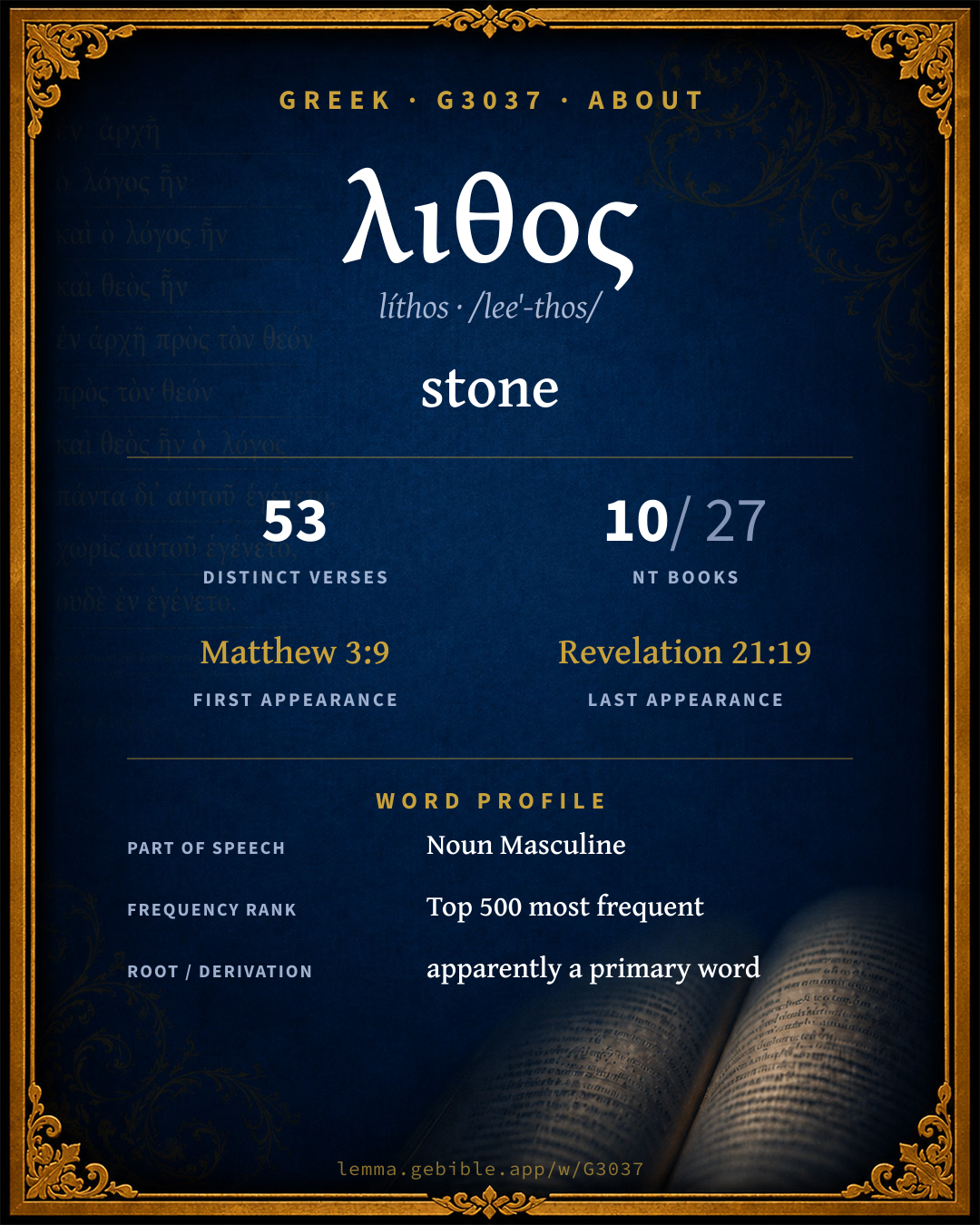
λίθος
stone
‘stone’ is one of 3 main senses fuller range ↓
Full lexicon entry — Thayer's Greek Lexicon
From Thayer's Greek Lexicon
Where this word appears
See every Accusative-case word in the Greek New Testament →
Grammar key — what these labels mean
Part of speech
- Noun
- A naming word — a person, place, thing, or idea.
Case
- Accusative
- The case of the direct object and of extent.
- Dative
- The case of the indirect object, means, or location — “to / for / with / in.”
- Nominative
- The case of the subject (and the predicate nominative).
- Genitive
- The case of source, possession, or “of” — answers “whose / from what.”
Gender
- Masculine
- Grammatically masculine.
Number
- Singular
- One.
- Plural
- More than one.
Grammatical forms
- Noun, Accusative, Singular, Masculine 27 times (46%)
- Noun, Dative, Singular, Masculine 10 times (17%)
- Noun, Nominative, Singular, Masculine 8 times (14%)
- Noun, Nominative, Plural, Masculine 4 times (7%)
- Noun, Accusative, Plural, Masculine 3 times (5%)
- Noun, Dative, Plural, Masculine 3 times (5%)
- Noun, Genitive, Plural, Masculine 2 times (3%)
- Noun, Genitive, Singular, Masculine 2 times (3%)
Parsed forms decoded from the imported morphology (Robinson–Tischendorf, public domain), counted across 59 parsed occurrences — not distinct verses.
Every verse where G3037 appears — 53 distinct verses across 10 books. Click any verse to open its interlinear word-by-word view. Verse text shown in the World English Bible for context — . Each verse’s Greek form is shown with its reference; the English is not keyword-highlighted, since the data carries no word-level English alignment. Use “Compare translations” on any verse to read it across multiple English versions. This concordance covers the Greek New Testament; Septuagint (Greek Old Testament) occurrences of this word are not indexed here.
Matthew 9 verses
- Matthew 3:9 λίθων n gen pl masc Don't think to yourselves, 'We have Abraham for our father,' for I tell you that God is able to raise up children to Abraham from these stones.
- Matthew 4:3 λίθοι n nom pl masc The tempter came and said to him, "If you are the Son of God, command that these stones become bread."
- Matthew 4:6 λίθον n acc sg masc and said to him, "If you are the Son of God, throw yourself down, for it is written, 'He will give his angels charge concerning you.' and, 'On their hands they will bear you up, So that you don't dash your foot against a stone.'"
- Matthew 7:9 λίθον n acc sg masc Or who is there among you, who, if his son asks him for bread, will give him a stone?
- Matthew 21:42 λίθον n acc sg masc Jesus said to them, "Did you never read in the Scriptures, 'The stone which the builders rejected, The same was made the head of the corner. This was from the Lord. It is marvelous in our eyes?'
- Matthew 24:2 λίθος λίθον n nom sg masc n acc sg masc But he answered them, "Don't you see all of these things? Most assuredly I tell you, there will not be left here one stone on another, that will not be thrown down."
- Matthew 27:60 λίθον n acc sg masc and laid it in his own new tomb, which he had hewn out in the rock, and he rolled a great stone to the door of the tomb, and departed.
- Matthew 27:66 λίθον n acc sg masc So they went with the guard and made the tomb secure, sealing the stone.
- Matthew 28:2 λίθον n acc sg masc Behold, there was a great earthquake, for an angel of the Lord descended from the sky, and came and rolled away the stone from the door, and sat on it.
Mark 7 verses
- Mark 5:5 λίθοις n dat pl masc Always, night and day, in the tombs and in the mountains, he was crying out, and cutting himself with stones.
- Mark 12:10 λίθον n acc sg masc Haven't you even read this Scripture: 'The stone which the builders rejected, The same was made the head of the corner.
- Mark 13:1 λίθοι n nom pl masc As he went out of the temple, one of his disciples said to him, "Teacher, see what kind of stones and what kind of buildings!"
- Mark 13:2 λίθος λίθον n nom sg masc n acc sg masc Jesus said to him, "Do you see these great buildings? There will not be left here one stone on another, which will not be thrown down."
- Mark 15:46 λίθον n acc sg masc He bought a linen cloth, and taking him down, wound him in the linen cloth, and laid him in a tomb which had been cut out of a rock. He rolled a stone against the door of the tomb.
- Mark 16:3 λίθον n acc sg masc They were saying among themselves, "Who will roll away the stone from the door of the tomb for us?"
- Mark 16:4 λίθος n nom sg masc for it was very big. Looking up, they saw that the stone was rolled back.
Luke 13 verses
- Luke 3:8 λίθων n gen pl masc Bring forth therefore fruits worthy of repentance, and don't begin to say among yourselves, 'We have Abraham for our father;' for I tell you that God is able to raise up children to Abraham from these stones!
- Luke 4:3 λίθῳ n dat sg masc The devil said to him, "If you are the Son of God, command this stone to become bread."
- Luke 4:11 λίθον n acc sg masc and, 'On their hands they will bear you up, Lest perhaps you dash your foot against a stone.'"
- Luke 11:11 λίθον n acc sg masc "Which of you fathers, if your son asks for bread, will give him a stone? Or if he asks for a fish, he won't give him a snake instead of a fish, will he?
- Luke 17:2 λίθος n nom sg masc It would be better for him if a millstone were hung around his neck, and he were thrown into the sea, rather than that he should cause one of these little ones to stumble.
- Luke 19:40 λίθοι n nom pl masc He answered them, "I tell you that if these were silent, the stones would cry out."
- Luke 19:44 λίθον λίθον n acc sg masc n acc sg masc and will dash you and your children within you to the ground. They will not leave in you one stone on another, because you didn't know the time of your visitation."
- Luke 20:17 λίθον n acc sg masc But he looked at them, and said, "Then what is this that is written, 'The stone which the builders rejected, The same was made the chief cornerstone?'
- Luke 20:18 λίθον n acc sg masc "Everyone who falls on that stone will be broken to pieces, But it will crush whomever it falls on to dust."
- Luke 21:5 λίθοις n dat pl masc As some were talking about the temple and how it was decorated with beautiful stones and gifts, he said,
- Luke 21:6 λίθος λίθῳ n nom sg masc n dat sg masc "As for these things which you see, the days will come, in which there will not be left here one stone on another that will not be thrown down."
- Luke 22:41 λίθου n gen sg masc He was withdrawn from them about a stone's throw, and he knelt down and prayed,
- Luke 24:2 λίθον n acc sg masc They found the stone rolled away from the tomb.
John 7 verses
- John 8:7 λίθον n acc sg masc But when they continued asking him, he looked up and said to them, "He who is without sin among you, let him throw the first stone at her."
- John 8:59 λίθους n acc pl masc Therefore they took up stones to throw at him, but Jesus was hidden, and went out of the temple, having gone through the midst of them, and so passed by.
- John 10:31 λίθους n acc pl masc Therefore Jews took up stones again to stone him.
- John 11:38 λίθος n nom sg masc Jesus therefore, again groaning in himself, came to the tomb. Now it was a cave, and a stone lay against it.
- John 11:39 λίθον n acc sg masc Jesus said, "Take away the stone." Martha, the sister of him who was dead, said to him, "Lord, by this time there is a stench, for he has been dead four days."
- John 11:41 λίθον n acc sg masc So they took away the stone from the place where the dead man was lying. Jesus lifted up his eyes, and said, "Father, I thank you that you listened to me.
- John 20:1 λίθον n acc sg masc Now on the first day of the week, Mary Magdalene went early, while it was still dark, to the tomb, and saw the stone taken away from the tomb.
Acts 2 verses
- Acts 4:11 λίθος n nom sg masc He is 'the stone which was regarded as worthless by you, the builders, which has become the head of the corner.'
- Acts 17:29 λίθῳ n dat sg masc Being then the offspring of God, we ought not to think that the Divine Nature is like gold, or silver, or stone, engraved by art and design of man.
Romans 2 verses
- Romans 9:32 λίθῳ n dat sg masc Why? Because they didn't seek it by faith, but as it were by works of the law. They stumbled over the stumbling stone;
- Romans 9:33 λίθον n acc sg masc even as it is written, "Behold, I lay in Zion a stumbling stone and a rock of offense; And no one who believes in him will be disappointed."
1 Corinthians 1 verse
2 Corinthians 1 verse
1 Peter 4 verses
- 1 Peter 2:4 λίθον n acc sg masc coming to him, a living stone, rejected indeed by men, but chosen by God, precious.
- 1 Peter 2:5 λίθοι n nom pl masc You also, as living stones, are built up as a spiritual house, to be a holy priesthood, to offer up spiritual sacrifices, acceptable to God through Jesus Christ.
- 1 Peter 2:6 λίθον n acc sg masc Because it is contained in Scripture, "Behold, I lay in Zion a chief cornerstone, chosen, and precious: He who believes in him will not be disappointed."
- 1 Peter 2:7 λίθον λίθος n acc sg masc n nom sg masc For you therefore who believe is the honor, but for such as are disobedient, "The stone which the builders rejected, Has become the chief cornerstone,"
Revelation 7 verses
- Revelation 4:3 λίθῳ n dat sg masc that looked like a jasper stone and a sardius. There was a rainbow around the throne, like an emerald to look at.
- Revelation 17:4 λίθῳ n dat sg masc The woman was dressed in purple and scarlet, and decked with gold and precious stones and pearls, having in her hand a golden cup full of abominations and the impurities of the sexual immorality of the earth.
- Revelation 18:12 λίθου n gen sg masc merchandise of gold, silver, precious stones, pearls, fine linen, purple, silk, scarlet, all expensive wood, every vessel of ivory, every vessel made of most precious wood, and of brass, and iron, and marble;
- Revelation 18:16 λίθῳ n dat sg masc saying, 'Woe, woe, the great city, she who was dressed in fine linen, purple, and scarlet, and decked with gold and precious stones and pearls!
- Revelation 18:21 λίθον n acc sg masc A mighty angel took up a stone like a great millstone and cast it into the sea, saying, "Thus with violence will Babylon, the great city, be thrown down, and will be found no more at all.
- Revelation 21:11 λίθῳ λίθῳ n dat sg masc n dat sg masc having the glory of God. Her light was like a most precious stone, as if it was a jasper stone, clear as crystal;
- Revelation 21:19 λίθῳ n dat sg masc The foundations of the city's wall were adorned with all kinds of precious stones. The first foundation was jasper; the second, sapphire; the third, chalcedony; the fourth, emerald;
About this entry
At a glance — auto-summarized from this page’s data, not written by a person. Every figure links to its source below. This summary describes the numbers; it doesn’t interpret them.
λιθος (líthos) is a Greek noun most often rendered “stone.” Debuting at Matthew 3:9, it then recurs through the corpus. With 53 verses in 10 books, it is a moderately common word in the Greek New Testament. It concentrates in Luke, which alone accounts for 25% of its uses. Its lexical range runs to 3 senses. The sections below give every sense, occurrence, and version rendering.
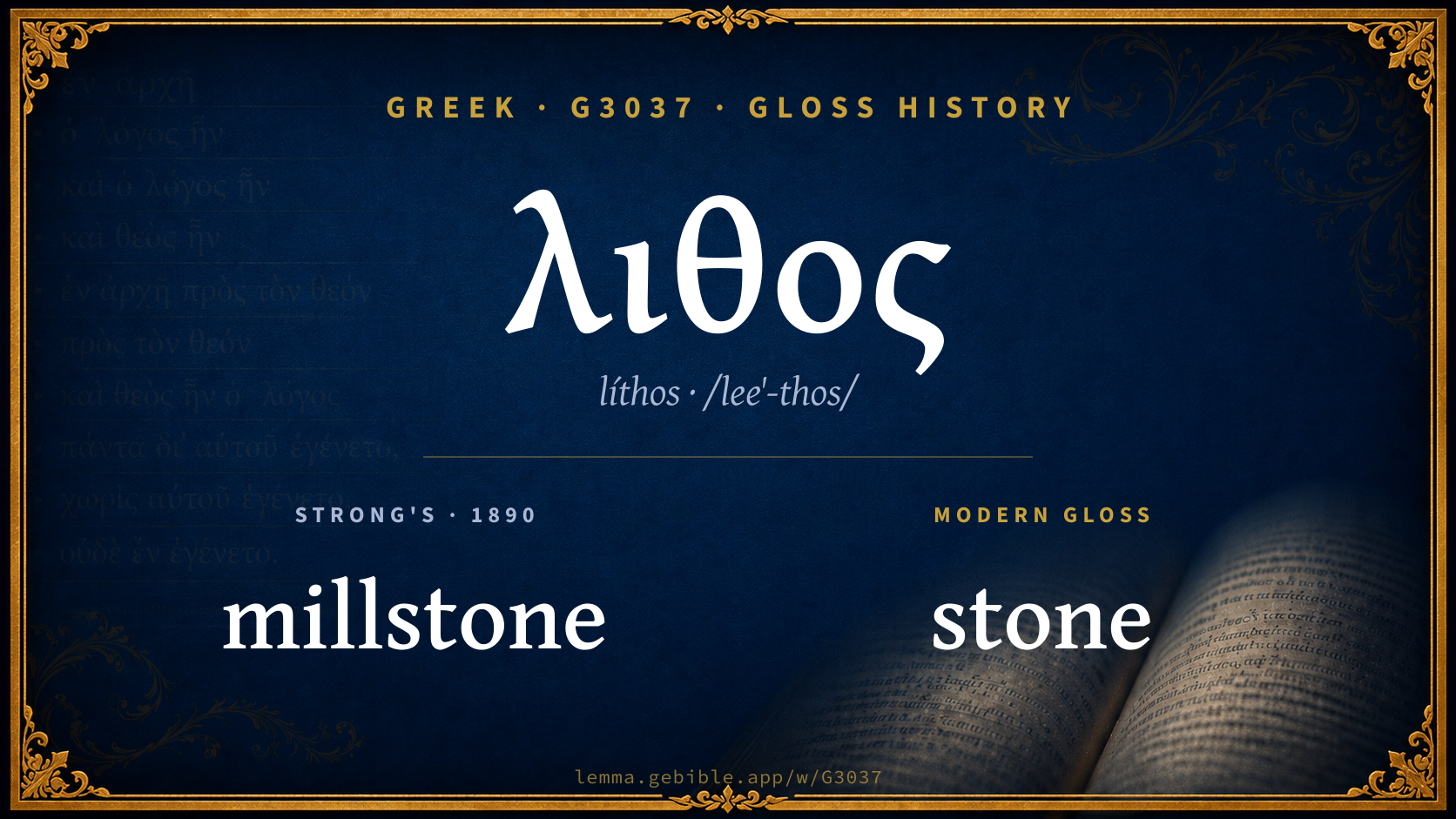
Gloss history
Strong's 1890 vs modern scholarship
About this word
Strong's G3037 catalogs a Greek word from the Greek New Testament.
These counts are not copied from any lexicon or concordance. They are computed here, from the morphology-tagged Greek New Testament. What Lemma adds →
- 53
- distinct verses
- The word appears in 53 distinct verses.
- 10 / 27
- NT books
- The word appears in 10 of 27 New Testament books.
- #275
- by frequency
- Top 500 most frequent Greek words (rank 275 of 5,347 Greek words by occurrence).
View all 53 occurrences in the concordance →
By section of the New Testament
By traditional corpus
Conventional, traditional groupings — biblical authorship is debated, so this is a traditional corpus grouping, not an authorship claim. Some books belong to more than one corpus (Luke is in both the Gospels and the Lukan corpus, and so on), so these shares overlap and need not total 100%. Each figure is a share of the word’s 53 distinct verses.
- Gospels 36 verses · 68%
- Lukan (Luke–Acts) 15 verses · 28%
- Johannine 14 verses · 26%
- Revelation 7 verses · 13%
- Pauline corpus 4 verses · 8%
- General (Catholic) Epistles 4 verses · 8%
How translations render this word
Counts come from each version’s own published word-to-Strong’s tagging or interlinear alignment — an approximate guide to how each version renders this word, not a word-level alignment the data otherwise carries. Because each total is that version’s own tagged count, the per-version totals vary from one another and need not match the appearance or distinct-verse counts above. These counts may also differ from a printed concordance because Lemma counts each distinctly tagged rendering and does not collapse phrase taggings into a single head-word total. This is a fixed set of word-tagged versions (KJV, ASV, BSB, ULT) and does not change with the reading translation you choose elsewhere. Each version’s license is shown beside its name below (and on Sources).
- King James Version: Stone 32×, Stones 16×, Another 4×
- American Standard Version: Stone 36×, Stones 13×, Another 4×
- Berean Standard Bible: Stone 34×, Stones 14×, One stone 2×
- unfoldingWord Literal Text: Stone 45×, Stones 13×, A 4×
King James Version Public Domain
Renders G3037 across 60 tagged occurrences — most commonly:
Plus 2 renderings that appear only once — usually multi-word phrases or single function words the recovered tagging swept in, not distinct renderings.
American Standard Version Public Domain
Renders G3037 across 59 tagged occurrences — most commonly:
Plus 2 renderings that appear only once — usually multi-word phrases or single function words the recovered tagging swept in, not distinct renderings.
Berean Standard Bible Public Domain
Renders G3037 across 53 tagged occurrences — most commonly:
Plus 3 renderings that appear only once — usually multi-word phrases or single function words the recovered tagging swept in, not distinct renderings. Not rendered by a distinct English word in 6 further occurrences.
unfoldingWord Literal Text CC BY-SA 4.0
Renders G3037 across 67 tagged occurrences — most commonly:
Plus 3 renderings that appear only once — usually multi-word phrases or single function words the recovered tagging swept in, not distinct renderings.
Senses in Thayer's
The 3 senses Thayer's distinguishes for this word, in lexicon order (not ranked by frequency or importance). The full entry — with sub-senses — is in the Lexicon Entry tab.
- of small stones
- of building stones
- metaph. of Christ
Word origin
Origin: apparently a primary word
Apparently a primary word; a stone (literally or figuratively): - (mill- stumbling-) stone.
— Strong’s Exhaustive Concordance (1890), public domain.
Forms in the corpus
The 8 distinct written forms G3037 takes in the Greek New Testament, most frequent first — each parse links to that case’s occurrences in the concordance.
| Form | Parsing | Example | Uses |
|---|---|---|---|
| λίθον líthon | Noun, Accusative, Singular, Masculine | Matthew 4:6 | 27 |
| λίθῳ líthō | Noun, Dative, Singular, Masculine | Luke 4:3 | 10 |
| λίθος líthos | Noun, Nominative, Singular, Masculine | Matthew 24:2 | 8 |
| λίθοι líthoi | Noun, Nominative, Plural, Masculine | Matthew 4:3 | 4 |
| λίθοις líthois | Noun, Dative, Plural, Masculine | Mark 5:5 | 3 |
| λίθους líthous | Noun, Accusative, Plural, Masculine | John 8:59 | 3 |
| λίθου líthou | Noun, Genitive, Singular, Masculine | Luke 22:41 | 2 |
| λίθων líthōn | Noun, Genitive, Plural, Masculine | Matthew 3:9 | 2 |
Same root — word family
Other Thayer's entries built from the same root as G3037, grouped by Strong’s listed origin. These share a root / origin per the lexicon — not necessarily a shared meaning. Each links to that word’s own entry.
Derived from this word
- λιθαζω litházō G3034 to stone
- λιθινος líthinos G3035 stone
- λιθοβολεω lithoboléō G3036 to stone
- λιθοστρωτος lithóstrōtos G3038 pavement
Compare all same-root words → Showing 4 of 5 — not the complete family. They share a root, not necessarily a meaning.
Septuagint usage
The same Greek word λιθος appears 255 times in the Greek Old Testament (Septuagint), across 230 verses in 29 books.
- 255
- LXX occurrences
- Tagged occurrences of this Greek word in the Septuagint.
- 230
- verses
- Distinct Septuagint verses containing this word.
- 29 / 39
- OT books
- The word appears in 29 of the 39 Old Testament books.
Sample Septuagint occurrences
- Genesis 2:12 λίθος
- Exodus 7:19 λίθος
- Leviticus 14:40 λίθος
- Numbers 14:10 λίθος
- Deuteronomy 4:28 λίθος
- Joshua 4:3 λίθος
- Judges 9:5 λίθος
- 1 Samuel 6:14 λίθος
- 2 Samuel 5:11 λίθος
- 1 Kings 1:9 λίθος
- 2 Kings 3:19 λίθος
- 1 Chronicles 12:2 λίθος
Septuagint occurrences (same lexeme)
Every verse where the same Strong’s number (G3037) appears in the Greek Septuagint — showing the first 50 of 230. Verse text shown in the World English Bible for context; the Greek form is the matched word — the English is not keyword-highlighted.
- Genesis 2:12 λίθος and the gold of that land is good. There is aromatic resin and the onyx stone.
- Genesis 11:3 λίθος They said one to another, "Come, let's make brick, and burn them thoroughly." They had brick for stone, and they used tar for mortar.
- Genesis 28:11 λίθος He came to a certain place, and stayed there all night, because the sun had set. He took one of the stones of the place, and put it under his head, and lay down in that place to sleep.
- Genesis 28:18 λίθος Jacob rose up early in the morning, and took the stone that he had put under his head, and set it up for a pillar, and poured oil on the top of it.
- Genesis 28:22 λίθος then this stone, which I have set up for a pillar, will be God's house. Of all that you will give me I will surely give the tenth to you."
- Genesis 29:2 λίθος He looked, and behold, a well in the field, and, behold, three flocks of sheep lying there by it. For out of that well they watered the flocks. The stone on the well's mouth was great.
- Genesis 29:3 λίθος There all the flocks were gathered. They rolled the stone from the well's mouth, and watered the sheep, and put the stone again on the well's mouth in its place.
- Genesis 29:8 λίθος They said, "We can't, until all the flocks are gathered together, and they roll the stone from the well's mouth. Then we water the sheep."
- Genesis 29:10 λίθος It happened, when Jacob saw Rachel the daughter of Laban, his mother's brother, and the sheep of Laban, his mother's brother, that Jacob went near, and rolled the stone from the well's mouth, and watered the flock of Laban his mother's brother.
- Genesis 31:45 λίθος Jacob took a stone, and set it up for a pillar.
- Genesis 31:46 λίθος Jacob said to his relatives, "Gather stones." They took stones, and made a heap. They ate there by the heap.
- Exodus 7:19 λίθος Yahweh said to Moses, "Tell Aaron, 'Take your rod, and stretch out your hand over the waters of Egypt, over their rivers, over their streams, and over their pools, and over all their ponds of water, that they may become blood; and there shall be blood throughout all the land of Egypt, both in vessels of wood and in vessels of stone.'"
- Exodus 15:5 λίθος The deeps cover them. They went down into the depths like a stone.
- Exodus 17:12 λίθος But Moses' hands were heavy; and they took a stone, and put it under him, and he sat on it. Aaron and Hur held up his hands, the one on the one side, and the other on the other side. His hands were steady until sunset.
- Exodus 19:13 λίθος No hand shall touch him, but he shall surely be stoned or shot through; whether it is animal or man, he shall not live.' When the trumpet sounds long, they shall come up to the mountain."
- Exodus 20:25 λίθος If you make me an altar of stone, you shall not build it of hewn stones; for if you lift up your tool on it, you have polluted it.
- Exodus 21:18 λίθος "If men quarrel and one strikes the other with a stone, or with his fist, and he doesn't die, but is confined to bed;
- Exodus 21:28 λίθος "If a bull gores a man or a woman to death, the bull shall surely be stoned, and its flesh shall not be eaten; but the owner of the bull shall not be held responsible.
- Exodus 24:4 λίθος Moses wrote all the words of Yahweh, and rose up early in the morning, and built an altar under the mountain, and twelve pillars for the twelve tribes of Israel.
- Exodus 25:7 λίθος onyx stones, and stones to be set for the ephod and for the breastplate.
- Exodus 28:9 λίθος You shall take two onyx stones, and engrave on them the names of the children of Israel:
- Exodus 28:10 λίθος six of their names on the one stone, and the names of the six that remain on the other stone, in the order of their birth.
- Exodus 28:11 λίθος With the work of an engraver in stone, like the engravings of a signet, shall you engrave the two stones, according to the names of the children of Israel: you shall make them to be enclosed in settings of gold.
- Exodus 28:12 λίθος You shall put the two stones on the shoulder-pieces of the ephod, to be stones of memorial for the children of Israel: and Aaron shall bear their names before Yahweh on his two shoulders for a memorial.
- Exodus 28:17 λίθος You shall set in it settings of stones, four rows of stones: a row of ruby, topaz, and beryl shall be the first row;
- Exodus 28:21 λίθος The stones shall be according to the names of the children of Israel, twelve, according to their names; like the engravings of a signet, everyone according to his name, they shall be for the twelve tribes.
- Exodus 35:9 λίθος onyx stones, and stones to be set for the ephod and for the breastplate.
- Exodus 35:12 λίθος the ark, and its poles, the mercy seat, the veil of the screen;
- Exodus 35:27 λίθος The rulers brought the onyx stones, and the stones to be set, for the ephod and for the breastplate;
- Exodus 35:33 λίθος in cutting of stones for setting, and in carving of wood, to work in all kinds of skillful workmanship.
- Exodus 36:13 λίθος He made fifty clasps of gold, and coupled the curtains one to another with the clasps: so the tent was a unit.
- Exodus 36:14 λίθος He made curtains of goats' hair for a covering over the tent. He made them eleven curtains.
- Exodus 36:17 λίθος He made fifty loops on the edge of the curtain that was outmost in the coupling, and he made fifty loops on the edge of the curtain which was outmost in the second coupling.
- Exodus 36:21 λίθος Ten cubits was the length of a board, and a cubit and a half the breadth of each board.
- Leviticus 14:40 λίθος then the priest shall command that they take out the stones in which is the plague, and cast them into an unclean place outside of the city:
- Leviticus 14:42 λίθος They shall take other stones, and put them in the place of those stones; and he shall take other mortar, and shall plaster the house.
- Leviticus 14:43 λίθος "If the plague comes again, and breaks out in the house, after he has taken out the stones, and after he has scraped the house, and after it was plastered;
- Leviticus 14:45 λίθος He shall break down the house, its stones, and its timber, and all the house's mortar. He shall carry them out of the city into an unclean place.
- Leviticus 20:2 λίθος "Moreover, you shall tell the children of Israel, 'Anyone of the children of Israel, or of the strangers who live as foreigners in Israel, who gives any of his seed to Molech; he shall surely be put to death. The people of the land shall stone him with stones.
- Leviticus 20:27 λίθος "'A man or a woman that is a medium, or is a wizard, shall surely be put to death: they shall stone them with stones; their blood shall be upon them.'"
- Leviticus 24:16 λίθος He who blasphemes the name of Yahweh, he shall surely be put to death; all the congregation shall certainly stone him: the foreigner as well as the native-born, when he blasphemes the Name, shall be put to death.
- Leviticus 24:23 λίθος Moses spoke to the children of Israel; and they brought forth him who had cursed out of the camp, and stoned him with stones. The children of Israel did as Yahweh commanded Moses.
- Leviticus 26:1 λίθος "'You shall make for yourselves no idols, neither shall you raise up an engraved image or a pillar, neither shall you place any figured stone in your land, to bow down to it: for I am Yahweh your God.
- Numbers 14:10 λίθος But all the congregation bade stone them with stones. The glory of Yahweh appeared in the tent of meeting to all the children of Israel.
- Numbers 15:35 λίθος Yahweh said to Moses, The man shall surely be put to death: all the congregation shall stone him with stones outside of the camp.
- Numbers 15:36 λίθος All the congregation brought him outside of the camp, and stoned him to death with stones; as Yahweh commanded Moses.
- Numbers 35:17 λίθος If he struck him with a stone in the hand, by which a man may die, and he died, he is a murderer: the murderer shall surely be put to death.
- Numbers 35:23 λίθος or with any stone, by which a man may die, not seeing him, and cast it on him, so that he died, and he was not his enemy, neither sought his harm;
- Deuteronomy 4:28 λίθος There you shall serve gods, the work of men's hands, wood and stone, which neither see, nor hear, nor eat, nor smell.
- Deuteronomy 8:9 λίθος a land in which you shall eat bread without scarceness, you shall not lack anything in it; a land whose stones are iron, and out of whose hills you may dig copper.
These are occurrences of the same Greek lexeme (G3037) in the Septuagint — not a translation of any one Hebrew word. The store carries no word-level Hebrew↔Greek alignment, so no Hebrew original is asserted here. Counts come from the recovered LXX Strong's tagging — high-frequency vocabulary is well covered, while rare or late forms may be untagged — so they reflect tagged occurrences and may slightly undercount.