
Revelation 18:12

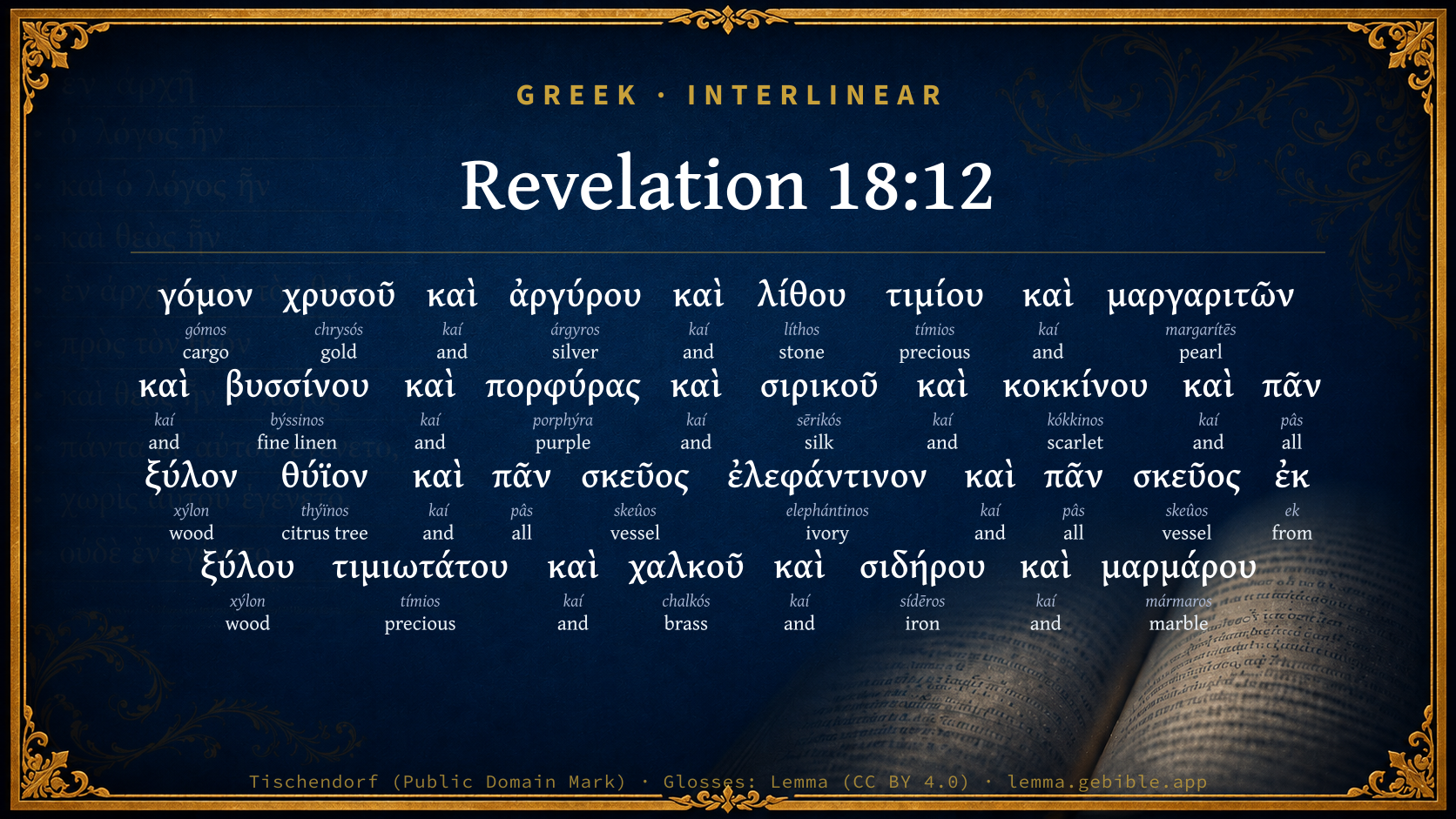
Greek (Tischendorf 8th ed.) Revelation 18:12 appears in the Greek New Testament. The text above is from the Tischendorf 8th edition. Each word links to its Strong’s number and a concise gloss. Click any word for its full Thayer’s Greek Lexicon entry.
Download image
Cite this verse

Revelation 18:12 (World English Bible). Public Domain. Lemma interlinear Bible study tool, https://lemma.gebible.app/v/revelation/18/12.

Show BibTeX & RIS
BibTeX
RIS
English Translation
merchandise of gold, silver, precious stones, pearls, fine linen, purple, silk, scarlet, all expensive wood, every vessel of ivory, every vessel made of most precious wood, and of brass, and iron, and marble;
World English Bible · Public Domain
Highlights
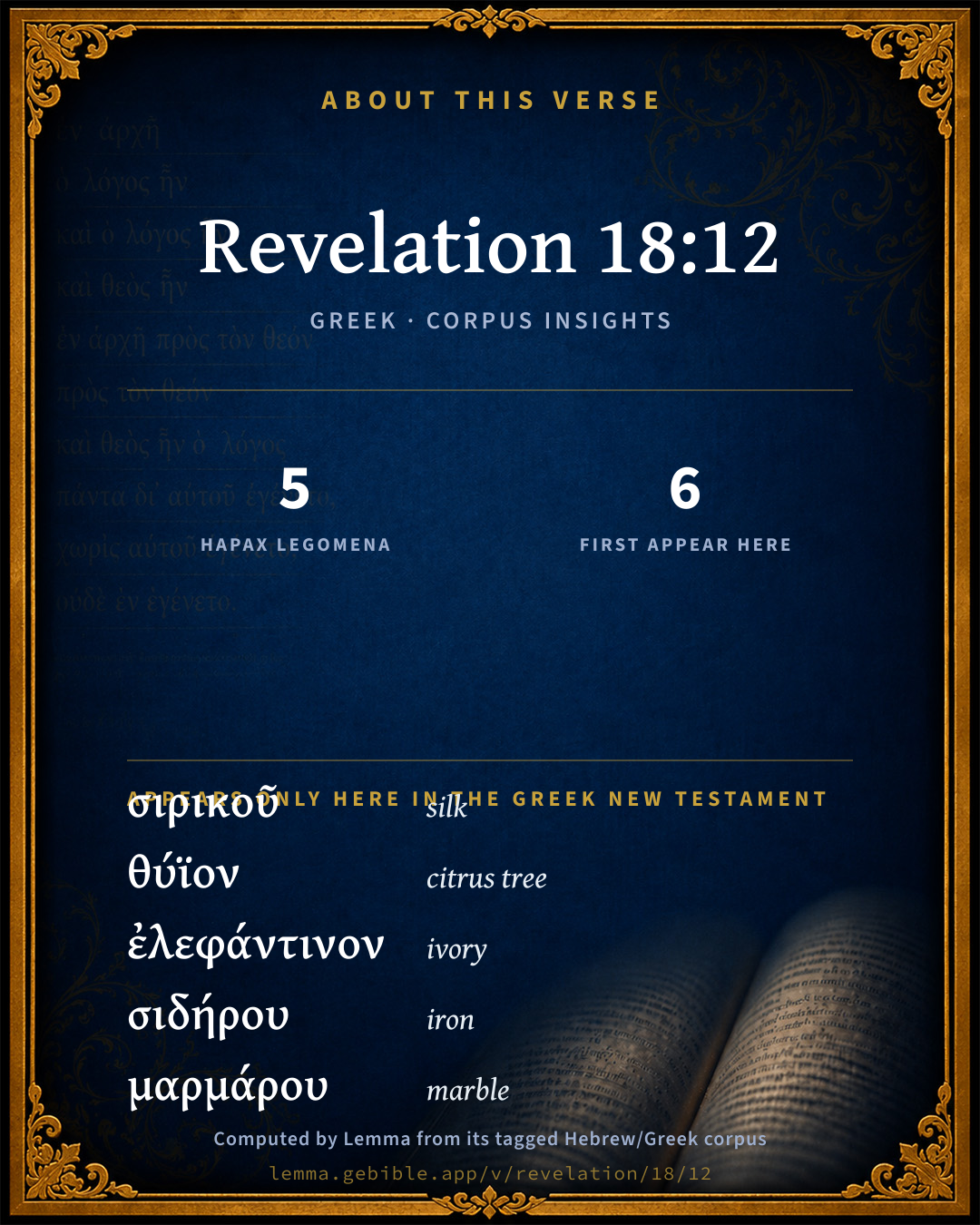
  • 5 hapax legomena — only here in the Greek New Testament
  • 6 first appearances in the Greek New Testament
Full analysis ↓
Download a study sheet

One document with this verse’s original text, its word-by-word gloss line, the meaning frame, cross-references with their text, attributed commentary, and full source and license credits — printable, and it pastes into notes with its structure intact.

This verse Autodidact and up

Study sheet (.html) Plain text (.txt)

A passage Seminary Student

Up to 50 verses in one chapter. A passage sheet keeps up to 6 commentary sources and 12 cross-references per verse, in the order this page ranks them, and says so on the sheet whenever that leaves anything out. Ask for a single verse and you get the Autodidact verse sheet above.

Everything on this page stays free to read, with no account — the sheet is a download of what is already on screen, not access to it.

Want to remove ads? Support Godless Engineer
Compare translations 3

The same verse in 3 English versions, stacked beneath the original-language interlinear above. Click any original word for its lexicon entry.

Each is an independent rendering of the whole verse — the interlinear is not word-aligned to these translations.

Highlighted words mark where these versions differ — a whole-verse word diff, not a word-by-word alignment.

  • World English Bible Public Domain
    merchandise of gold, silver, precious stones, pearls, fine linen, purple, silk, scarlet, all expensive wood, every vessel of ivory, every vessel made of most precious wood, and of brass, and iron, and marble;
  • King James Version Public Domain
    The merchandise of gold, and silver, and precious stones, and of pearls, and fine linen, and purple, and silk, and scarlet, and all thyine wood, and all manner vessels of ivory, and all manner vessels of most precious wood, and of brass, and iron, and marble,
  • unfoldingWord Literal Text CC BY-SA 4.0
    cargo of gold and silver and precious stone and pearls and fine linen and purple cloth and silk and scarlet cloth and every citron wood and every ivory vessel and every vessel from the costliest wood and bronze and iron and marble

unfoldingWord Literal Text — © unfoldingWord, licensed CC BY-SA 4.0. Word-aligned USFM3 via Door43 (git.door43.org/unfoldingWord/en_ult).

Versions to compare (up to 4)

3 of 4 selected

Show all 19 translations

Every available English version of this verse, each an independent rendering of the whole verse.

  • World English Bible Public Domain
    merchandise of gold, silver, precious stones, pearls, fine linen, purple, silk, scarlet, all expensive wood, every vessel of ivory, every vessel made of most precious wood, and of brass, and iron, and marble;
  • Berean Standard Bible Public Domain
    cargo of gold, silver, precious stones, and pearls; of fine linen, purple, silk, and scarlet; of all kinds of citron wood and every article of ivory, precious wood, bronze, iron, and marble;
  • Majority Standard Bible Public Domain
    cargo of gold, silver, precious stones, and pearls; of fine linen, purple, silk, and scarlet; of all kinds of citron wood and every article of ivory, precious wood, bronze, iron, and marble;
  • King James Version Public Domain
    The merchandise of gold, and silver, and precious stones, and of pearls, and fine linen, and purple, and silk, and scarlet, and all thyine wood, and all manner vessels of ivory, and all manner vessels of most precious wood, and of brass, and iron, and marble,
  • American Standard Version (1901) Public Domain
    merchandise of gold, and silver, and precious stone, and pearls, and fine linen, and purple, and silk, and scarlet; and all thyine wood, and every vessel of ivory, and every vessel made of most precious wood, and of brass, and iron, and marble;
  • Revised Version (1885) Public Domain
    merchandise of gold, and silver, and precious stone, and pearls, and fine linen, and purple, and silk, and scarlet; and all thyine wood, and every vessel of ivory, and every vessel made of most precious wood, and of brass, and iron, and marble;
  • Geneva Bible (1599) Public Domain
    The ware of golde, and siluer, and of precious stone, and of pearles, and of fine linnen, and of purple, and of silke, and of skarlet, and of all maner of Thyne wood, and of all vessels of yuorie, and of all vessels of most precious wood, and of brasse, and of yron, and of marble,
  • Douay-Rheims (1899) Public Domain
    Merchandise of gold and silver, and precious stones; and of pearls, and fine linen, and purple, and silk, and scarlet, and all thyine wood, and all manner of vessels of ivory, and all manner of vessels of precious stone, and of brass, and of iron, and of marble,
  • Young's Literal Translation Public Domain
    lading of gold, and silver, and precious stone, and pearl, and fine linen, and purple, and silk, and scarlet, and all thyne wood, and every vessel of ivory, and every vessel of most precious wood, and brass, and iron, and marble,
  • Literal Standard Version CC BY-SA 4.0
    cargo of gold, and silver, and precious stone, and pearls, and fine linen, and purple, and silk, and scarlet, and all fragrant wood, and every vessel of ivory, and every vessel of most precious wood, and brass, and iron, and marble,
  • Unlocked Literal Bible CC BY-SA 4.0
    merchandise of gold, silver, precious stone, pearls, fine linen, purple, silk, scarlet, all kinds of scented wood, every vessel of ivory, every vessel made of most precious wood, bronze, iron, marble,
  • unfoldingWord Literal Text CC BY-SA 4.0
    cargo of gold and silver and precious stone and pearls and fine linen and purple cloth and silk and scarlet cloth and every citron wood and every ivory vessel and every vessel from the costliest wood and bronze and iron and marble
  • Darby Bible Public Domain
    lading of gold, and silver, and precious stones, and pearl, and fine linen, and purple, and silk, and scarlet dye, and all thyine wood, and every article in ivory, and every article in most precious wood, and in brass, and in iron, and in marble,
  • World Messianic Bible Public Domain
    merchandise of gold, silver, precious stones, pearls, fine linen, purple, silk, scarlet, all expensive wood, every vessel of ivory, every vessel made of most precious wood, and of brass, and iron, and marble;
  • Webster's Bible Public Domain
    The merchandise of gold, and silver, and precious stones, and of pearls, and fine linen, and purple, and silk, and scarlet, and all thyine wood, and all vessels of ivory, and all vessels of most precious wood, and of brass, and iron, and marble,
  • Free Bible Version CC BY-SA 4.0
    products made of gold, silver, gems and pearls; fine linen, purple cloth, silk, and scarlet material; all kinds of objects made of scented wood, or from ivory, or expensive woods, or bronze, iron, or marble;
  • Bible in Basic English Public Domain
    Gold, and silver, and stones of great price, and jewels, and delicate linen, and robes of purple and silk and red; and perfumed wood, and every vessel of ivory, and every vessel made of fair wood, and of brass, and iron, and stone;
  • Text-Critical English NT CC BY 4.0
    cargo of gold, silver, precious stones, pearls, fine linen, purple cloth, silk, scarlet cloth, all kinds of citron wood, all kinds of articles made of ivory, all kinds of articles made of costly wood, bronze, iron, and marble;
  • Tyndale New Testament (1534) Public Domain
    the ware of golde and silver and precious stones nether of pearle and raynes and purple and skarlet and all thyne wodde and almanner vessels of yvery and almanner vessels of most precious wodde and of brasse and of yron

Literal Standard Version (2020), Covenant Press — licensed CC BY-SA 4.0. Text via the HelloAO Bible API (eBible.org). Unlocked Literal Bible (unfoldingWord) — licensed CC BY-SA 4.0. Text via the HelloAO Bible API (eBible.org). unfoldingWord Literal Text — © unfoldingWord, licensed CC BY-SA 4.0. Word-aligned USFM3 via Door43 (git.door43.org/unfoldingWord/en_ult). Free Bible Version, Dr. Jonathan Gallagher — licensed CC BY-SA 4.0. Text via the HelloAO Bible API (eBible.org).

Word by word

More ways to search: Search by grammar → Find every occurrence → Compare this word →

Practice this passage: Drill this verse → Learn its vocabulary →

σιρικοῦ
sērikós
G4596
“silk”
Adjective, Genitive, Singular, Neuter
Part of Speech
Adjective
Case
Genitive
Number
Singular
Gender
Neuter
Full Thayer's Definition

Origin: from Ser (an Indian tribe from whom silk was procured, hence the name of the silk-worm)

TDNT: None

1. made of silk 2. silk, i.e. the fabric, silken garments
  1. γόμον gómos G1117 “cargo” Noun, Accusative, Singular, Masculine
  2. χρυσοῦ chrysós G5557 “gold” Noun, Genitive, Singular, Masculine
  3. καὶ kaí G2532 “and” Conjunction
  4. ἀργύρου árgyros G696 “silver” Noun, Genitive, Singular, Masculine
  5. καὶ kaí G2532 “and” Conjunction
  6. λίθου líthos G3037 “stone” Noun, Genitive, Singular, Masculine
  7. τιμίου tímios G5093 “precious” Adjective, Genitive, Singular, Masculine
  8. καὶ kaí G2532 “and” Conjunction
  9. μαργαριτῶν margarítēs G3135 “pearl” Noun, Genitive, Plural, Masculine
  10. καὶ kaí G2532 “and” Conjunction
  11. βυσσίνου býssinos G1039 “fine linen” Adjective, Genitive, Singular, Neuter
  12. καὶ kaí G2532 “and” Conjunction
  13. πορφύρας porphýra G4209 “purple” Noun, Genitive, Singular, Feminine
  14. καὶ kaí G2532 “and” Conjunction
  15. καὶ kaí G2532 “and” Conjunction
  16. κοκκίνου kókkinos G2847 “scarlet” Adjective, Genitive, Singular, Neuter
  17. καὶ kaí G2532 “and” Conjunction
  18. πᾶν pâs G3956 “all” Adjective, Accusative, Singular, Neuter
  19. ξύλον xýlon G3586 “wood” Noun, Accusative, Singular, Neuter
  20. θύϊον thýïnos G2367 “citrus tree” Adjective, Accusative, Singular, Neuter
  21. καὶ kaí G2532 “and” Conjunction
  22. πᾶν pâs G3956 “all” Adjective, Accusative, Singular, Neuter
  23. σκεῦος skeûos G4632 “vessel” Noun, Accusative, Singular, Neuter
  24. ἐλεφάντινον elephántinos G1661 “ivory” Adjective, Accusative, Singular, Neuter
  25. καὶ kaí G2532 “and” Conjunction
  26. πᾶν pâs G3956 “all” Adjective, Accusative, Singular, Neuter
  27. σκεῦος skeûos G4632 “vessel” Noun, Accusative, Singular, Neuter
  28. ἐκ ek G1537 “from” Preposition
  29. ξύλου xýlon G3586 “wood” Noun, Genitive, Singular, Neuter
  30. τιμιωτάτου tímios G5093 “precious” Adjective, Genitive, Singular, Neuter, Superlative
  31. καὶ kaí G2532 “and” Conjunction
  32. χαλκοῦ chalkós G5475 “brass” Noun, Genitive, Singular, Masculine
  33. καὶ kaí G2532 “and” Conjunction
  34. σιδήρου sídēros G4604 “iron” Noun, Genitive, Singular, Masculine
  35. καὶ kaí G2532 “and” Conjunction
  36. μαρμάρου mármaros G3139 “marble” Noun, Genitive, Singular, Masculine

About this verse

These counts appear in no published source. They are computed here, from the morphology-tagged text and Lemma’s own curated glosses. What Lemma adds →

37
words
20
distinct lemmas
Revelation
section

Notable vocabulary

5 hapax legomena — words that appear only here in the entire Greek New Testament:

  • σιρικοῦ silk G4596
  • θύϊον citrus tree G2367
  • ἐλεφάντινον ivory G1661
  • σιδήρου iron G4604
  • μαρμάρου marble G3139

First appearance in Scripture

These words make their first canonical appearance in the Greek New Testament here:

  • βυσσίνου fine linen G1039
  • σιρικοῦ silk G4596
  • θύϊον citrus tree G2367
  • ἐλεφάντινον ivory G1661
  • σιδήρου iron G4604
  • μαρμάρου marble G3139

Shared distinctive vocabulary

γόμον cargo G1117 occurs in 3 verses of the Greek New Testament. Also found in:
Repetition

Words recur within this verse:

  • πᾶν all G3956 ×3
  • τιμίου precious G5093 ×2
  • ξύλον wood G3586 ×2
  • σκεῦος vessel G4632 ×2
  • καὶ and G2532 ×13

Cross-references

5

Topical passages linked to Revelation 18:12 in the Treasury of Scripture Knowledge — connected by theme and wording, ordered by reader-vote popularity; previews shown in the World English Bible.

  • Revelation 17:4 The woman was dressed in purple and scarlet, and decked with gold and precious stones and pearls, having in her hand a golden cup full of abominations and the impurities of the sexual immorality of the earth.
  • 1 Kings 10:11–12 The navy also of Hiram, that brought gold from Ophir, brought in from Ophir great plenty of almug trees and precious stones.
  • Proverbs 8:10–11 Receive my instruction rather than silver; Knowledge rather than choice gold.
  • Ezekiel 27:5–25 They have made all your planks of fir trees from Senir; they have taken a cedar from Lebanon to make a mast for you.
  • 2 Chronicles 2:8 Send me also cedar trees, fir trees, and algum trees, out of Lebanon; for I know that your servants know how to cut timber in Lebanon: and, behold, my servants shall be with your servants,

Cross-references courtesy of OpenBible.info (CC BY 4.0).

Commentary

Notes on Revelation 18:12 from classic Christian and Jewish commentators (each source and its license shown beneath its notes). The classic Christian expositions comment on the surrounding passage and are grouped to its opening verse, so a note may address several verses; the Jewish commentaries on the Tanakh (Rashi and others) are per-verse, so they appear only where the commentator wrote on this verse.

Lemma curates 59 commentaries, every one of them public domain or Creative Commons licensed, each selected and text-cleaned for this edition rather than reprinted as found. About our sources →

Joseph Benson's Commentary

Rev 18:12-14. The merchandise, &c. — There is an end of all traffic or commerce with her, whether spiritual or temporal; of gold and silver, &c. — Almost all the things here named are still in use at Rome, both in their idolatrous service and in common life; fine linen — The sort of which here mentioned, βυσσος, is exceedingly costly; thyine-wood — A sweet- smelling wood, not unlike citron, used in adorning magnificent palaces. Vessels of most precious wood — Ebony in particular, which is often, as here, mentioned with ivory, the one excelling in whiteness, the other in blackness, and both in uncommon smoothness. And cinnamon — Bengelius adds, και αμωμον, and amomum, a shrub whose wood is a fine perfume; and ointments. — Μυρον, liquid and fragrant ointment; and beasts — Cows and oxen; and chariots — Ρεδων, a word purely Latin, but here inserted in the Greek, doubtless, on purpose to show more fully the luxury of Rome; and slaves — Σωματων, bodies; a common term for slaves; and souls of men — For these also have been and are continually bought and sold at Rome. And this, of all others, is the most gainful merchandise to the Roman traffickers. And the fruits that thy soul lusted after — And for which alone thy degenerate nature had any remaining relish. From what was imported, the narrative proceeds to the domestic delicacies of Rome; none of which is in greater request there than the particular sort of fruits here mentioned. The word οπωρα properly signifies such fruit as pears, peaches, nectarines, and all the apple and plum kinds; and all things — Λιπαρα και τα λαμπρα dainty — Or delightful to the taste; and splendid — To the sight; as clothes, buildings, furniture. “It is plain,” says Lowman, “this is designed to be a figurative, and not a literal description; therefore readers seem to be at liberty to apply the figurative expressions to such literal meanings as will agree to the general and certain intention of them. But whether each of these wares is designed to point out some particular gainful corruption of Popery, may very well be questioned. It is sufficient, to answer the general intention of the prophecy, to observe, that Rome shall be deprived of all her wealth, which she procured by her management and intrigues, in the several places where her agents resided, who continually made her returns of great riches, and plentifully supplied her excessive pride and luxury. It is a pretty observation of Daubuz, “Rome receives all the luxurious wares mentioned, but she has so infatuated the world that she pays nothing for them but trumpery; her money is her enchantments and sorceries. Her merchants, her superior clergy, engross the real wealth of the world to bring it to her; and her returns and exportations are paper and bills drawn upon heaven and hell, never to be accepted; however, they pass among the common people for payment, as if they were of real value. The merchant who finds means to get shut of them takes no care about their intrinsic value, finding gulls who take them off his hands for real wealth.” Whether these wares were designed to signify pardons, indulgences, dispensations, and the like trifles, with which Rome purchases gold, silver, and whatever ministers to pride and luxury, this is a plain and manifest meaning, that she shall be deprived of all her wealth and luxury at once, and of all the means by which she used to procure them.

Joseph Benson's Commentary on the Old and New Testaments (1811–1818) — public domain. Text from a community e-Sword module.

Tyndale Open Study Notes

Tyndale Open Resources

18:12-13 This cargo list suggests the extent of the wealth Rome pillaged from the rest of its empire (cp. Ezek 27:12-24). Some of the most expensive products in the ancient world are mentioned in this indictment of ostentatious materialism and pride.

Tyndale Open Study Notes — © Tyndale Open Resources, licensed CC BY-SA 4.0. Text via the HelloAO Bible API.

Bengel's Gnomon

Johann Albrecht Bengel

Rev 18:12. Θύϊνον) θύα is, according to some, citria:[200] but citria is κιτρία, θύα thya. The latter tree is also fragrant; and thus the citria is not unlike some kinds of thya. See Plin. 50:13. ch. 16 throughout. There is no place here for ebony, but shortly afterwards.—ἐκ ξύλου τιμιωτάτου, of most precious wood) For ξύλου, some African copies read ΛΊΘΟΥ, from the alliteration to the preceding words.[201] Vessels are not made out of most precious stone, but out of precious stone, or out of most precious wood. Such especially is ebony, which is often mentioned together with ivory. The one excels in whiteness, the other in blackness; each is of remarkable smoothness. See Fuller’s Misc. l. 6, c. 14.—χαλκοῦ, κ.τ.λ.) of brass, and iron, and marble.

[200] Citria) [rather ‘citrea,’ the citrus-tree of Africa: Plin. xvi. 44, xiii. 15. Citria are gourds. The citrus is the Greek Thuega articulata, Desfont.—E.] a fragrant wood used by the Romans for furniture.—T.

[201] And thus Ed. ii., together with Vers. Germ., gives the palm to the reading ξύλον, the judgment of Ed. maj. being abandoned.—E. B.

A and Vulg. read λίθου: so Lachm. But BCh, ξύλου: so Tisch.—E.

Bengel's Gnomon of the New Testament — English translation (T&T Clark, Edinburgh, 1860) — public domain. Text from a community e-Sword module.

Expositor's Greek Testament

ed. W. Robertson Nicoll

Rev 18:12 . βυσσίνου (sc. ἱματίου ) = “of fine linen”; from βύσσος the delicate and expensive linen (or cotton) made out of Egypt an flax (Luk 16:19 ); σιρικοῦ = “silk,” muslin, or gauze, chiefly used for women’s attire (Paus. iv. 110 f.); πᾶν ξύλον θύϊνον = “all citron (citrus)-wood,” a fragrant, hard, dark brown, expensive material for furniture, exported from N. Africa. Note the extensive range of Roman commerce to supply the needs of luxury (interea gustus elementa per omnia quaerunt, Juv. xi. 14; pearls, e.g. , from Britain as well as Red Sea), also the various demands in order: ornaments, wearing apparel, furniture, perfumes (for personal and religious use), food, and social requirements. Wets, cites a rabbinic saying: decem partes diuitiarum sunt in mundo, nouem Romae et una in mundo uniuerso.

The Expositor's Greek Testament, edited by W. Robertson Nicoll (1897–1910) — public domain. Text from a community e-Sword module.

Jamieson, Fausset & Brown

Robert Jamieson, A. R. Fausset & David Brown

(See on Rev 17:4).

stones . . . pearls--Greek, "stone . . . pearl."

fine linen--A, B, and C read Greek, "bussinou" for "bussou," that is, "fine linen manufacture" [ALFORD]. The manufacture for which Egypt (the type of the apostate Church, Rev 11:8) was famed. Contrast "the fine linen" (Eze 16:10) put on Israel, and on the New Testament Church (Rev 19:8), the Bride, by God (Psa 132:9).

thyine wood--the citrus of the Romans: probably the cypressus thyoyides, or the thuia articulata. "Citron wood" [ALFORD]. A sweet-smelling tree of Cyrene in Lybia, used for incense.

all manner vessels--Greek, "every vessel," or "furniture."

Jamieson, Fausset & Brown — Commentary Critical and Explanatory on the Whole Bible (1871) — public domain (CC PDM 1.0). Text via the HelloAO Bible API.

Adam Clarke's Commentary

Verse 12. The merchandise of gold, and silver, c.] The same author, Bishop Bale, who was once a priest of the Romish Church, goes on to apply all these things to that Church and whether the text have this meaning or not, they will show us something of the religious usages of his time, and the real mockery of this intolerant and superstitious Church. Speaking in reference to the Reformation, and the general light that had been diffused abroad by the word of God, which was then translated into the vulgar tongue, and put into the hands of the people at large, he says:-

"They will pay no more money for the housell sippings, bottom blessings; nor for 'seest me and seest me not,' above the head and under of their chalices, which in many places be of fine gold. Neyther regarde they to kneele anye more downe, and to kisse their pontificall rings which are of the same metal. They will be no more at coste to have the ayre beaten, and the idols perfumed with their sensers at pryncipall feastes; to have their crucifixes layde upon horses, or to have them solemply borne aloft in their gaddings abroade; with the religious occupyings of their paxes, cruettes, and other jewels which be of silver.

"Neyther passe they greatly to beholde precyous stones any more in their two-horned miters, whan they hollow their churches, give theyr whorishe orders, and tryumphantly muster in processions. Nor in costuous pearles in theyr copes perrours, and chysibilles, whan they be in their prelately pompous sacrifices. Men, knowing the worde of God, supposeth that their ornaments of silk, wherewith they garnishe their temples and adorne their idolles, is very blasphemous and divillish. They thinke also, that their fayre white rockets of raynes, or fine linnen cloath; their costly gray amices, of calaber and cattes tayles; theyr fresh purple gownes, whan they walke for their pleasures; and their read scarlet frockes, whan they preach lyes in the pulpit, are very superfluous and vayne.

"In their thynen wood (whom some men call algume trees, some basill, some corall) may be understande all theyr curious buildings of temples, abbeys, chappels, and chambers; all shrines, images, church stooles, and pews that are well payed for; all banner staves, paternoster scores, and peeces of the holy crosse.

"The vessels of ivory comprehendeth all their maundye dyshes, their offring platters, their relique chestes, their god boxes, their drinking horns, their sipping cuppes for the hiccough, their tables whereupon are charmed their chalises and vestiments; their standiches, their combes, their muske balles, their pomaunder pottes, and their dust boxes, with other toyes.

"The vessels of precious stone; which after some interpretours, are of precious stone, or after some are of most precious wood; betokeneth their costuous cuppes, or cruses of jasper, jacinct, amel, and fine beral; and their alabaster boxes, wherwith they annointe kinges, confirme children, and minister their holy whorish orders. Their pardon masers, or drinking dishes, as St. Benit's bole, St. Edmond's bole, St. Giles's bole, St. Blythe's bole, and Westminster bole, with such other holy re-liques.

"Of brasse, which containeth latten, copper, alcumine, and other harde metals, are made all their great candlesticks, holy water kettles, lampes, desks, pyllers, butterasses, bosses, bels, and many other thinges more.

"Of strong yron are the braunches made that holde up the lightes before their false gods; the tacks that sustayne them for fallinge; the lockes that save them from the robberye of thieves; their fyre pans, bars, and poolyes, with many other straunge ginnes besides.

"With marble most commonlye pave they their temples, and build strong pillers and arches in their great cathedrale churches and monastries; they make thereof also their superalities, their tumbs, and their solemne grave-stones; besides their other buildinges, with free-stone, flint, ragge, and brick, comprehended in the same.

Adam Clarke's Commentary on the Bible (1810–1826) — public domain. Text from a community e-Sword/MySword module.

The Cambridge Bible for Schools and Colleges

gen. ed. J. J. S. Perowne

12. This whole passage should be compared with Ezekiel 27, where the wealth and trade of Tyre is described in detail.

and scarlet] Thus far the goods enumerated have been expressed by genitives, “merchandise of gold … and of scarlet.” Here they cease to be so, as far as the word “sheep.”

thyine wood] Wood of the thyia or thyion, a kind of cypress or arbor vitae: apparently the same that was called citrus by the Romans, and used for the costliest furniture.

The Cambridge Bible for Schools and Colleges (gen. ed. J. J. S. Perowne; Cambridge University Press, 1878–1918) — public domain. Text from a community e-Sword module.

John Gill's Exposition

And cinnamon, and odours, and ointments, and frankincense,.... Things for delight and pleasure, for the gratifying of the senses; cinnamon, and odours were used for perfuming, Pro 7:17 anointing with oil was used at feasts, Psa 23:5 and "frankincense", or censings, at banquets, and for the regaling of persons after food (k): these customs obtained among the eastern people. Tyre had its merchants for these things, Eze 27:19 and Mr. Brightman thinks Italy is Rome's merchant in these, which it fetches from Greece, Arabia, and Egypt; it may be these rather respect the ecclesiastical use of them; "cinnamon, odours", and "frankincense", may signify the perfumings and censings used in churches, or the burning incense in imitation of the sweet incense under the law; and "ointments" may denote their chrism, or anointing with oil at baptism, imagining that Christ was anointed with material oil at his baptism, whereas it was with the Holy Ghost: moreover, these things may be mystically understood, "cinnamon" being used by harlots in perfuming their bed, Pro 7:17 may intend the stews and brothel houses erected at Rome, and licensed by authority, each whore paying so much per week; the revenues of which would sometimes yearly amount to twenty thousand ducats: "ointments" may be understood of chrism in baptism, and extreme unction at death: "odours" and "frankincense" may mean their prayers and pater nosters, their prayers for the dead, which were never made without the pence; hence that proverbial expression, no pence, no pater noster.

And wine, and oil, and fine flour, and wheat, and beasts, and sheep: things for civil use; these are things which belong to food, to eating and drinking, and are the most material and necessary things of life, Psa 4:7. Tyre had her merchants for these, Eze 27:17 and Mr. Brightman will have Italy to be Rome's merchant for wine and oil; Sardinia and Sicily her merchants for fine flour and wheat; Germany for beasts, and England for sheep: and with respect to the ecclesiastical use of these things, wine is for the chalice, used in daily Masses, and drank only by the priests; "oil" for chrism at baptism, and for the extreme unction: "fine flour" for the Mass, or to make their breaden god of; and "wheat, beasts, and sheep" for tithes for the clergy:

and horses, and chariots, and slaves; things for splendour, equipage, and attendance; horses and chariots for the popes, cardinals, archbishops, and bishops, to ride in state and grandeur, and slaves to wait upon them. Tyre had her merchants for these Eze 27:14 and Mr. Brightman's opinion is, that the French are Rome's merchants for horses and chariots, and the Swiss for slaves, or "bodies", as the word may be rendered, who live by exercising their bodies, and hiring them out in war; and who are many of them the guards of the person of the pope of Rome: and last of all it is added,

and souls of men; still in allusion to the merchandise of Tyre, some of whose merchants are said to trade in the persons of men, Eze 27:13 which the Targum and Septuagint render, in the souls of men; the popes have some of them sold their own souls to the devil, to get into the chair, and, when in, have been the means of destroying of thousands of others; they assume a power over the souls of men, of binding and loosing the consciences of men, imposing new laws upon them, and freeing them from obligation to the laws of God and men, to the ruin of their souls; and it has been said by their sycophants, that if the pope should send thousands of men to hell, no one should say to him, what dost thou? The Romish priests pretend to redeem souls out of purgatory for such a sum of money, and sell pardons and indulgences, say Mass, and promise heaven itself for money; and this they get at the expense of men's souls, by their false doctrine and superstitious worship, and so make merchandise of them, as is said of the false teachers, Pe2 2:3 moreover, as by "slaves", or bodies, in the preceding clause, are meant such who serve with their bodies, either by way of attendance, or in unnatural lust; so by "souls" of men may be meant men of soul, of great natural wit and understanding, of great parts, abilities, and learning, with which they serve the man of sin, and his interest, such as Bellarmine, and others.

(k) Misn. Beracot, c. 6. sect. 6.

John Gill's Exposition of the Whole Bible (1746–1763) — public domain (CC PDM 1.0). Text via the HelloAO Bible API.

Trapp's Complete Commentary

John Trapp

12 The merchandise of gold, and silver, and precious stones, and of pearls, and fine linen, and purple, and silk, and scarlet, and all thyine wood, and all manner vessels of ivory, and all manner vessels of most precious wood, and of brass, and iron, and marble,

Ver. 12. The merchandise of gold] All this is taken out of Eze 27:22. All countries have catered and purveyed for the pope, who hath had it either in money or other commodity; but money answered all things.

Thyine wood] A wild kind of cedar, very sweet and sound; for it will not easily rot.

John Trapp, A Commentary or Exposition upon All the Books of the Old and New Testament (1647–1656) — public domain. Text from a community e-Sword module.

Albert Barnes' Notes on the Bible

The merchandise of gold, and silver - Of course, these constitute an important article of commerce in a great city.

And precious stones - Diamonds, emeralds, rubies, etc. These have always been important articles of traffic in the world, and, of course, most of the traffic in them would find its way to great commercial cities.

And pearls - See the notes on Mat 7:6; Mat 13:46. These, too, have been always, and were, particularly in early times, valuable articles of commerce. Mr. Gibbon mentions them as among the articles that contributed to the luxury of Rome in the age of the Antonines: “precious stones, among which the pearl claimed the first rank after the diamond,” vol. i. p. 34.

And fine linen - This was also a valuable article of commerce. It was obtained chiefly from Egypt. See the notes on Isa 19:9. Linen, among the ancients, was an article of luxury, for it was worn chiefly by the rich, Exo 28:42; Lev 6:10; Luk 16:19. The original word here is βύσσος bussos, “byssus,” and it is found in the New Testament only in this place, and in Luk 16:19. It was a “species of fine cotton, highly prized by the ancients.” Various kinds are mentioned - as that of Egypt, the cloth which is still found wrapped around mummies; that of Syria, and that of India, which grew on a tree similar to the poplar; and that of Achaia, which grew in the vicinity of Elis. See Robinson, Lexicon.

And purple - See the notes on Luk 16:19. Cloth of this color was a valuable article of commerce, as it was worn by rich men and princes.

And silk - Silk was a very valuable article of commerce, as it was costly, and could be worn only by the rich. It is mentioned by Mr. Gibbon as such an article in Rome in the age of the Antonines: “Silk, a pound of which was esteemed not inferior in value to a pound of gold,” vol. i. p. 34. On the cultivation and manufacture of silk by the ancients, see the work entitled, “The History of Silk, Cotton, Linen, and Wool, etc.,” published by Harper Brothers, New York, 1845, pp. 1-21.

And scarlet - See the notes on Rev 17:3.

And all thyine wood - The word used here - θύΐνον thuinon - occurs nowhere else in the New Testament. It denotes an evergreen African tree, from which statues and costly vessels were made. It is not agreed, however, whether it was a species of cedar, savin, or lignum-vitae, which latter constitutes the modern genus Thuja, or Thyia. See Rees’ Cyclo., art. “Thuja.”

And all manner vessels of ivory - Everything that is made of ivory. Ivory, or the tusk of the elephant, has always been among the precious articles of commerce.

And all manner vessels of most precious wood - Furniture of costly wood - cedar, the citron tree, lignum-vitae, etc.

And of brass, and iron, and marble - Brass or copper would, of course, be a valuable article of commerce. The same would be the case with iron; and so marble, for building, for statuary, etc., would likewise be.

Albert Barnes' Notes on the Bible (1834–1885) — public domain. Text from a community e-Sword/MySword module.

Matthew Poole's English Annotations

Here is a large enumeration of several sorts of wares, such as were most precious,

gold, silver, precious stones; such as were most useful for ornament,

fine linen, purple, silk, scarlet; most gratifying the exterior senses,

thyine wood, odours, ointments, & c.; most necessary,

beasts, sheep, horses, chariots; all which, as is prophesied, shall depart from Rome: that is, whatsoever she had, which allured men into her idolatrous communion; all their idols and images, cardinals’ caps, priests’ copes, all their preferments and dignities, whatsoever served the lust of the eye, the lust of the flesh, or the pride of life; whatsoever their own carnal and ambitious minds, or the carnal and ambitious minds of others that courted this whore, thirsted after, which brought them to seek her communion; they should all perish, and she be despoiled of them. It is very remarkable, that here is one piece of merchandise to be had no where but at Rome, viz. the

souls of men; which lets us know they are no earthly merchants that are here understood. As souls are to be sold a thousand ways, so they are to be bought; by paying for pardons, indulgences, dispensations, so the silly chapmen think they buy their own souls; by purchasing of cardinals’ caps, bishoprics, great livings, all manner of ecclesiastical dignities and preferments, so they really buy the souls of others; but when the papacy shall be wholly destroyed, none of these things shall any more be found.

Matthew Poole's English Annotations on the Holy Bible (1683–1685) — public domain. Text from a community e-Sword/MySword module.

Whedon's Commentary on the Bible

Daniel D. Whedon

12. The enumeration, though irregular, to express the cumulative character of the merchandise, or lading, as the word signifies, runs into spontaneous groups.

Gold… silver… precious stones… pearls—The solid substances possessing an artificial value.

Fine linen… purple… silk… scarlet—The costly array of the wealthy, noble, and royal. Thyine or citron wood. Vessels, or any implements, of ivory… wood… brass… iron… marble—The furnitures of most costly material.

Daniel D. Whedon (gen. ed.), Commentary on the Old and New Testaments (1874–1909) — public domain. Text from a community e-Sword module.

The Pulpit Commentary

The merchandise of gold, and silver, and precious stones, and of pearls, and fine linen, and purple, and silk, and scarlet. (On "precious stone" and" linen," see on Rev_15:6) Such was the attire of the harlot. (Rev_17:4) Writers have endeavoured to classify in various ways the articles mentioned, in order to obtain some signification from the numbers used. Thus Hengstenberg sees four hard and then four soft articles mentioned, and he reminds us that the number four is symbolical of the world: but this does not carry him beyond ver. 12. The articles enumerated seem naturally to fall into six classes. (from which we can gather no information, unless we look upon six as typifying the world, as in Rev_13:18) First, articles of personal adornment; second, articles used for furniture, etc.; third, objects of sensual gratification smell, etc.; fourth, articles of food; fifth, animate possessions; sixth, souls of men. These certainly seem to be arranged in a kind of progressive order of importance. All the articles mentioned in the text above were of the highest value. Purple and scarlet (see Rev_17:3) were the prerogative of kings; silk was so scarce, that its use was forbidden in the reign of Tiberius. And all thyine wood, and all manner vessels of ivory, and all manner vessels of most precious wood, and of brass, and iron, and marble; and every ivory vessel, and every vessel, etc. Thyine wood is "that of the Thuya articulata, Desfont., the Callitris quadrivalvis of present botanists. This tree was much prized by the ancient Greeks and Romans, on account of the beauty of its wood for various ornamental purposes. By the Romans the tree was called citrus, the wood citrum. It is a native of Barbary, and grows to the height of fifteen to twenty-five feet" (Smith"s "Dictionary of the Bible"). In this passage the accusative case is used; the preceding nouns are in the genitive.

The Pulpit Commentary (1880–1919), ed. H.D.M. Spence-Jones & Joseph S. Exell — public domain. Text from a community e-Sword module.

John Wesley's Explanatory Notes

Merchandise of gold, &c. - Almost all these are still in use at Rome, both in their idolatrous service, and in common life. Fine linen - The sort of it mentioned in the original is exceeding costly. Thyine wood - A sweet-smelling wood not unlike citron, used in adorning magnificent palaces. Vessels of most precious wood - Ebony, in particular, which is often mentioned with ivory: the one excelling in whiteness, the other in blackness; and both in uncommon smoothness.

John Wesley, Explanatory Notes Upon the Whole Bible (1754–1765) — public domain. Text via the GEBible commentary corpus.

Cambridge Greek Testament for Schools and Colleges

12, 13. See crit. notes. The various readings are partly due to deliberate attempts to carry either the accusative or the genitive through; partly perhaps to various very early combinations of two lists, one with the names in genitive and one in accusative; compare ἴππων and κτήνη, Lat. jumenta, and σωμάτων and ψυχὰς ἀνθρώπων. The whole passage should be compared with Ezekiel 17 where the wealth and trade of Tyre is described in detail.

>12. πᾶν ξύλον θύϊνον. Wood of the thyia or thyion, a kind of cypress or arbor vitae: apparently the same that was called citrus by the Romans and used for the costliest furniture.

σκεῦος. Both ivory and wood were used rather for furniture than “vessels” in our sense; it is not clear that marble was much used for either.

12. γόμον χρυσοῦ, καὶ ἀργύρου, καὶ λίθου τιμίου. CP read γ. χρυσοῦν καὶ ἀργυροῦν καὶ λίθους τιμίους, Primas[657] mercis auri et argenti et lapidum pretiosorum.

[657] Primasius, edited by Haussleiter.

μαργαριτῶν with א Primas[658]; Text. Rec[659] μαργαρίτου with B2 vg[660]; A has μαργαρίταις, CP μαργαρίτας. Both are possibly as W. H[661] suggest corruptions of μαργαρίδος.

[658] Primasius, edited by Haussleiter.

[659] Rec. Textus Receptus as printed by Scrivener.

[660] Vulgate.

[661] H. Westcott aud Hort.

καὶ βυσσίνου. Primas[662] omits.

[662] Primasius, edited by Haussleiter.

καὶ πορφύρας. A omits, Primas[663] inserts after καὶ σιρικοῦ.

[663] Primasius, edited by Haussleiter.

ξύλον. A has σκεῦος, Primas[664] omnis ligni citrei.

[664] Primasius, edited by Haussleiter.

ἐκ ξύλου. A has ἐκ λίθου, C omits ἐκ.

Cambridge Greek Testament for Schools and Colleges (Cambridge University Press, 1896; 21 vols, various authors incl. Carr, Maclear, Plummer, Farrar, Lumby, Moule, M. R. James, Simcox) — public domain. Text from a community e-Sword module.

Vincent's Word Studies in the New Testament

Marvin R. Vincent

Fine Linen [βυσσου] . See on Luk 16:19.

Purple [πορφυρας] . See on Luk 16:19.

Silk [σηρικου] . Properly an adjective, meaning pertaining to the Seres. From Shrev Seres, a people of India, perhaps of modern China. Before the time of Justinian, when silkworms were first brought to Constantinople, it was thought that the Seres gathered or combed the downy substance woven by the worms from the leaves of certain trees. Hence Virgil speaks of the Seres, how they comb (depectant) the fine fleeces from the leaves (" Georgics, " 2, 121).

Silk was a costly article of luxury among the Romans, so that Tacitus relates that in the reign of Tiberius a law was passed against "men disgracing themselves with silken garments" (" Annals, "2, 33)." Two hundred years after the age of Pliny, "says Gibbon," the use of pure or even of mixed silks was confined to the female sex, till the opulent citizens of Rome and the provinces were insensibly familiarized with the example of Elagabalos, the first who, by this effeminate habit, had sullied the dignity of an emperor and a man. Aorelian complained that a pound of silk was sold at Rome for twelve ounces of gold "(" Decline and Fall," ch. 40). At the time of Justinian the Persians held a monopoly of this trade. Two missionary monks residing in China imparted to Justinian the project of introducing the eggs of the silkworm into Europe, and returning to China concealed the eggs in a hollow cane and so transported them.

Scarlet. See on Mt 27:6.

Thyine wood [ξυλον θυινον] . Ony here in the New Testament. From quia or qua the citrus, a North - African tree, a native of Barbary, used as incense and for inlaying. Pliny speaks of a mania among the Romans for tables made of this wood. The most expensive of these were called orbes, circles, because they were massive plates of wood cut from the stem in its whole diameter. Pliny mentions plates four feet in diameter, and nearly six inches Thick;. The most costly were those taken from near the root, both because the tree was broadest there, and because the wood was dappled and speckled. Hence they were described by different epithets according as the markings resembled those of the tiger, the panther, or the peacock. Vessel [σκευος] . See on 1Pe 3:7, and Act 9:15. Also on goods, Mt 12:29; Mr 3:27; and strake sail, Act 27:17.

Of ivory [ελεφαντινον] . Only here in the New Testament. References to ivory are frequent in the Old Testament. The navy of Tarshish brought ivory to Solomon with apes and peacocks (1Ki 10:22). His great throne was made of it (1Ki 10:18). Ahab 's ivory palace (1Ki 22:39) was probably a house with ivory panels. "Ivory palaces" are mentioned in Psa 45:8, and "houses of ivory" in Amo 3:15. The Assyrians carried on a great trade in this article. On the obelisk in the British Museum the captives or tribute - bearers are represented as carrying tusks. The Egyptians early made use of it in decoration, bringing it mostly from Ethiopia, where, according to Pliny, ivory was so plentiful that the natives made of it door - posts and fences, and stalls for their cattle. In the early ages of Greece ivory was frequently employed for ornamental purposes, for the trappings of horses, the handles of kegs, and the bosses of shields. Homer represents an Asiatic woman staining ivory with purple to form trappings for horses, and describes the reins of chariot - horses as adorned with ivory. The statue of Jupiter by Phidias was of ivory and gold. In the "Odyssey" of Homer, Telemachus thus addresses his companion, the son of Nestor as they contemplate the splendor of Menelaus' palace :

"See, son of Nestor, my beloved friend, In all these echoing rooms the sheen of brass, Of gold, of amber and of ivory; Such is the palace of Olympian Jove." " Odyssey, " 4, 71 - 74.

Marble [μαρμαρου] . From marmairw to sparkle or glisten.

Marvin R. Vincent, Word Studies in the New Testament (1887–1900) — public domain. Text from a community e-Sword/MySword module.

Lesson kit

Teaching starters — assembled from the data on this page, not authored interpretation. Every prompt links to the verse data it draws on. Edit before teaching.

Revelation, in the Revelation, opens this verse with 37 words (20 distinct Greek lemmas). Its most distinctive word is sērikós (“silk”). A historical commentator’s framing appears above. Read the whole chapter for the surrounding context.

Discussion questions

  1. What does “silk” (sērikós) contribute to the verse as a whole?
  2. 5 words here appear nowhere else in the Greek New Testament. Why might the author reach for such rare wording?
  3. 6 words make their first appearance in Scripture here. What does this debut establish?
  4. How does Acts 21:3, which shares the word «cargo», read alongside this verse?
  5. What does the repetition of “all” (3× in this one verse) do in this verse?
  6. These translations render this verse differently; the difference is in the English rendering, not the original. What questions does that raise?
  7. Compare how Joseph Benson's Commentary and Tyndale Open Study Notes read this verse. Where do they agree or differ?

Things to notice

  • 5 words in this verse appear nowhere else in the Greek New Testament.
  • 6 words make their first canonical appearance in Scripture here.
  • These translations choose different wording for 18 words in this verse.
  • “all” occurs 3× in this single verse.
  • 20 distinct Greek lemmas span 37 words in this verse.

Reading settings

Reading text

Shown beneath each verse's original-language words.

Old Testament
Old Testament edition

Read the OT as the Masoretic Hebrew (MT) or the Greek Septuagint (LXX).

English shown for the Greek Septuagint (in the Hebrew ↔ Greek comparison).

Comparing translations? Open the Compare panel on any verse page to stack up to four side by side.