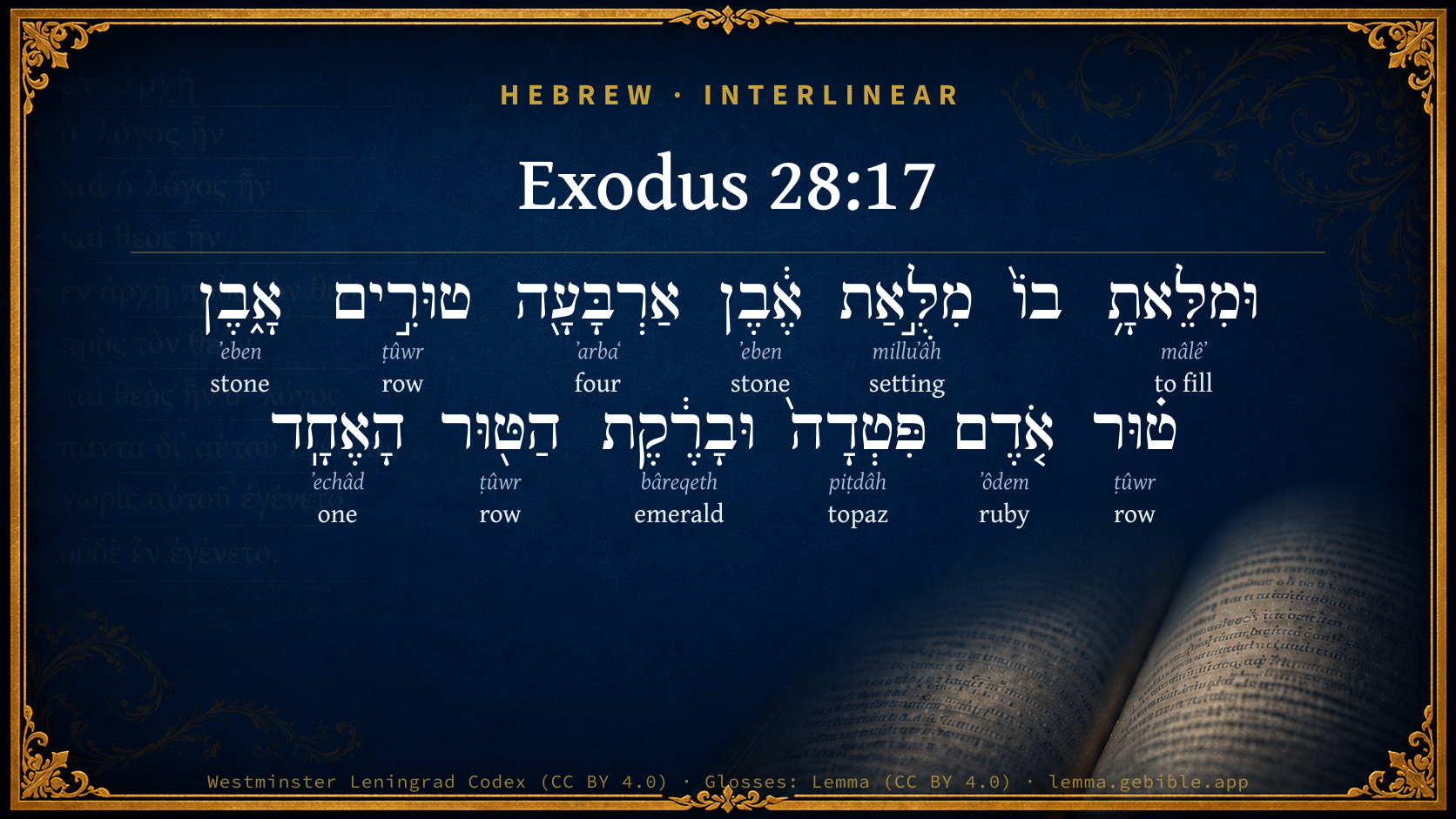
Exodus 28:17

Hebrew (Westminster Leningrad Codex) Exodus 28:17 appears in the Hebrew Old Testament. The text above is from the Westminster Leningrad Codex. Each word links to its Strong’s number, a concise gloss, and parsing drawn from the Open Scriptures Hebrew Bible morphology. Click any word for its full Brown-Driver-Briggs (BDB) entry.
Download image
Cite this verse

Exodus 28:17 (World English Bible). Public Domain. Lemma interlinear Bible study tool, https://lemma.gebible.app/v/exodus/28/17.

Show BibTeX & RIS
BibTeX
RIS
English Translation
You shall set in it settings of stones, four rows of stones: a row of ruby, topaz, and beryl shall be the first row;
World English Bible · Public Domain
Highlights
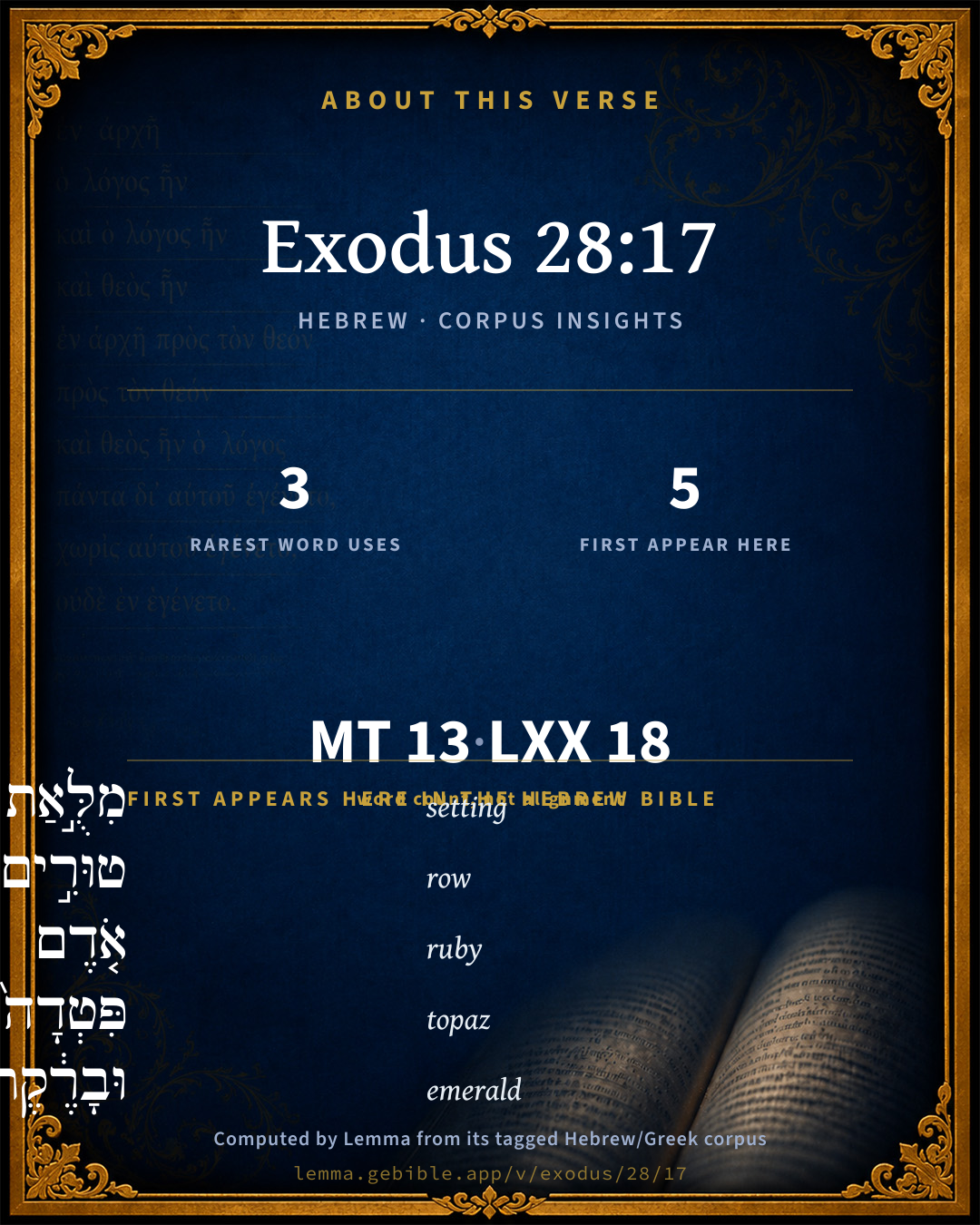
  • 5 first appearances in the Hebrew Bible
Full analysis ↓
Download a study sheet

One document with this verse’s original text, its word-by-word gloss line, the meaning frame, cross-references with their text, attributed commentary, and full source and license credits — printable, and it pastes into notes with its structure intact.

This verse Autodidact and up

Study sheet (.html) Plain text (.txt)

A passage Seminary Student

Up to 50 verses in one chapter. A passage sheet keeps up to 6 commentary sources and 12 cross-references per verse, in the order this page ranks them, and says so on the sheet whenever that leaves anything out. Ask for a single verse and you get the Autodidact verse sheet above.

Everything on this page stays free to read, with no account — the sheet is a download of what is already on screen, not access to it.

Want to remove ads? Support Godless Engineer
Compare translations 3

The same verse in 3 English versions, stacked beneath the original-language interlinear above. Click any original word for its lexicon entry.

Each is an independent rendering of the whole verse — the interlinear is not word-aligned to these translations.

Highlighted words mark where these versions differ — a whole-verse word diff, not a word-by-word alignment.

  • World English Bible Public Domain
    You shall set in it settings of stones, four rows of stones: a row of ruby, topaz, and beryl shall be the first row;
  • King James Version Public Domain
    And thou shalt set in it settings of stones, even four rows of stones: the first row shall be a sardius, a topaz, and a carbuncle: this shall be the first row.
  • unfoldingWord Literal Text CC BY-SA 4.0
    And you shall set in it settings of precious stone—four stone rows. The first row shall be a row with a ruby, a topaz, and a garnet.

unfoldingWord Literal Text — © unfoldingWord, licensed CC BY-SA 4.0. Word-aligned USFM3 via Door43 (git.door43.org/unfoldingWord/en_ult).

Versions to compare (up to 4)

3 of 4 selected

Show all 18 translations

Every available English version of this verse, each an independent rendering of the whole verse.

  • World English Bible Public Domain
    You shall set in it settings of stones, four rows of stones: a row of ruby, topaz, and beryl shall be the first row;
  • Berean Standard Bible Public Domain
    And mount on it a setting of gemstones, four rows of stones: In the first row there shall be a ruby, a topaz, and an emerald;
  • Majority Standard Bible Public Domain
    And mount on it a setting of gemstones, four rows of stones: In the first row there shall be a ruby, a topaz, and an emerald;
  • King James Version Public Domain
    And thou shalt set in it settings of stones, even four rows of stones: the first row shall be a sardius, a topaz, and a carbuncle: this shall be the first row.
  • American Standard Version (1901) Public Domain
    And thou shalt set in it settings of stones, four rows of stones: a row of sardius, topaz, and carbuncle shall be the first row;
  • Revised Version (1885) Public Domain
    And thou shalt set in it settings of stones, four rows of stones: a row of sardius, topaz, and carbuncle shall be the first row;
  • Geneva Bible (1599) Public Domain
    Then thou shalt set it full of places for stones, euen foure rowes of stones: the order shalbe this, a rubie, a topaze, and a carbuncle in the first rowe.
  • Douay-Rheims (1899) Public Domain
    And thou shalt set in it four rows of stones: in the first row shall be a sardius stone, and a topaz, and an emerald:
  • Young's Literal Translation Public Domain
    `And thou hast set in it settings of stone, four rows of stone; a row of sardius, topaz, and carbuncle `is' the first row;
  • Literal Standard Version CC BY-SA 4.0
    And you have set settings of stone in it, four rows of stone: a row of sardius, topaz, and carbuncle [is] the first row;
  • Unlocked Literal Bible CC BY-SA 4.0
    You must place in it four rows of precious stones. The first row must have a ruby, a topaz, and a garnet.
  • unfoldingWord Literal Text CC BY-SA 4.0
    And you shall set in it settings of precious stone—four stone rows. The first row shall be a row with a ruby, a topaz, and a garnet.
  • Darby Bible Public Domain
    And thou shalt set in it settings of stones -- four rows of stones: [one] row, a sardoin, a topaz, and an emerald -- the first row;
  • World Messianic Bible Public Domain
    You shall set in it settings of stones, four rows of stones: a row of ruby, topaz, and beryl shall be the first row;
  • Webster's Bible Public Domain
    And thou shalt set in it settings of stones, even four rows of stones: the first row shall be a sardius, a topaz, and a carbuncle: this shall be the first row.
  • Free Bible Version CC BY-SA 4.0
    Attach an arrangement of precious stones in four rows as follows. In the first row carnelian, peridot, and emerald.
  • Bible in Basic English Public Domain
    And on it you are to put four lines of jewels; the first line is to be a cornelian, a chrysolite, and an emerald;
  • JPS Tanakh (1917) Public Domain
    And thou shalt set in it settings of stones, four rows of stones: a row of carnelian, topaz, and smaragd shall be the first row;

Literal Standard Version (2020), Covenant Press — licensed CC BY-SA 4.0. Text via the HelloAO Bible API (eBible.org). Unlocked Literal Bible (unfoldingWord) — licensed CC BY-SA 4.0. Text via the HelloAO Bible API (eBible.org). unfoldingWord Literal Text — © unfoldingWord, licensed CC BY-SA 4.0. Word-aligned USFM3 via Door43 (git.door43.org/unfoldingWord/en_ult). Free Bible Version, Dr. Jonathan Gallagher — licensed CC BY-SA 4.0. Text via the HelloAO Bible API (eBible.org).

Word by word

More ways to search: Search by grammar → Find every occurrence → Compare this word →

Practice this passage: Drill this verse → Learn its vocabulary →

מִלֻּ֣אַת
milluʼâh
H4396
“setting of”
Noun, Common, Feminine, Singular, Construct
Part of Speech
Noun
Type
Common
Gender
Feminine
Number
Singular
State
Construct
Full BDB Definition

Origin: from H4394

TWOT: 1195d

setting (of jewel)
  1. וּמִלֵּאתָ֥ mâlêʼ H4390 “and · to fill” Conjunction + Verb, Piel, Sequential Perfect, 2nd Person, Masculine, Singular
  2. אֶ֔בֶן ʼeben H68 “stone” Noun, Common, Feminine, Singular, Absolute
  3. אַרְבָּעָ֖ה ʼarbaʻ H702 “four” Adjective, Cardinal number, Masculine, Singular, Absolute
  4. טוּרִ֣ים ṭûwr H2905 “rows” Noun, Common, Masculine, Plural, Absolute
  5. אָ֑בֶן ʼeben H68 “stone” Noun, Common, Feminine, Singular, Absolute
  6. ט֗וּר ṭûwr H2905 “row of” Noun, Common, Masculine, Singular, Construct
  7. אֹ֤דֶם ʼôdem H124 “ruby” Noun, Common, Masculine, Singular, Absolute
  8. פִּטְדָה֙ piṭdâh H6357 “topaz” Noun, Common, Feminine, Singular, Absolute
  9. וּבָרֶ֔קֶת bâreqeth H1304 “and · emerald” Conjunction + Noun, Common, Feminine, Singular, Absolute
  10. הַטּ֖וּר ṭûwr H2905 “the · row” Particle, Definite Article + Noun, Common, Masculine, Singular, Absolute
  11. הָאֶחָֽד ʼechâd H259 “the · one” Particle, Definite Article + Adjective, Cardinal number, Masculine, Singular, Absolute

About this verse

These counts appear in no published source. They are computed here, from the morphology-tagged text and Lemma’s own curated glosses. What Lemma adds →

13
words
9
distinct lemmas
Pentateuch
section

Notable vocabulary

The rarest word here is מִלֻּ֣אַת setting H4396 — appearing just 3 times in the whole Hebrew Bible.

First appearance in Scripture

These words make their first canonical appearance in the Hebrew Bible here:

  • מִלֻּ֣אַת setting H4396
  • טוּרִ֣ים row H2905
  • אֹ֤דֶם ruby H124
  • פִּטְדָה֙ topaz H6357
  • וּבָרֶ֔קֶת emerald H1304

Shared distinctive vocabulary

מִלֻּ֣אַת setting H4396 occurs in 3 verses of the Hebrew Bible. Also found in:

Grammatical profile

  • 1 verb
  • 9 nouns
  • 2 adjectives
  • 1 preposition

Verb forms

  • וּמִלֵּאתָ֥ Piel · Sequential Perfect

Repetition

Words recur within this verse — often emphatic in Hebrew:

  • טוּרִ֣ים row H2905 ×3
  • אֶ֔בֶן stone H68 ×2

Hebrew & Septuagint length

In English translation the verse runs 24 words from the Hebrew and 29 from the Septuagint (LXX English) — closely comparable.

A rough comparison of the two English renderings, which tokenize alike — not a word-level alignment.

Word counts can differ between the Hebrew and the Greek without any difference in meaning — e.g. the Hebrew direct-object marker אֵת has no separate Greek word, and Greek often adds the article ὁ.

In the original languages it is 13 Hebrew tokens and 18 Greek tokens — but the two are counted differently (Hebrew bundles its prefixes and suffixes into one token; the Greek is in lemma form), so that isn’t a like-for-like length.

Cross-references

13

Topical passages linked to Exodus 28:17 in the Treasury of Scripture Knowledge — connected by theme and wording, ordered by reader-vote popularity; previews shown in the World English Bible.

  • Exodus 39:10–21 They set in it four rows of stones. A row of ruby, topaz, and beryl was the first row;
  • Ezekiel 28:13 You were in Eden, the garden of God; every precious stone adorned you: ruby, topaz, emerald, chrysolite, onx, jasper, sapphire, turquoise, and beryl. Gold work of tambourines and of pipes was in you. In the day that you were created they were prepared.
  • Proverbs 8:11 For wisdom is better than rubies. All the things that may be desired can't be compared to it.
  • Revelation 21:19–21 The foundations of the city's wall were adorned with all kinds of precious stones. The first foundation was jasper; the second, sapphire; the third, chalcedony; the fourth, emerald;
  • Exodus 28:9 You shall take two onyx stones, and engrave on them the names of the children of Israel:
  • Exodus 28:11 With the work of an engraver in stone, like the engravings of a signet, shall you engrave the two stones, according to the names of the children of Israel: you shall make them to be enclosed in settings of gold.
  • Job 28:18–19 No mention shall be made of coral or of crystal: Yes, the price of wisdom is above rubies.
  • Proverbs 3:15 She is more precious than rubies. None of the things you can desire are to be compared to her.
  • Proverbs 20:15 There is gold and abundance of rubies; But the lips of knowledge are a rare jewel.
  • Proverbs 31:10 Who can find a worthy woman? For her price is far above rubies.
  • Isaiah 54:11–12 you afflicted, tossed with tempest, and not comforted, behold, I will set your stones in beautiful colors, and lay your foundations with sapphires.
  • Lamentations 4:7 Her nobles were purer than snow, they were whiter than milk; They were more ruddy in body than rubies, their polishing was as of sapphire.
  • Malachi 3:17 They shall be mine," says Yahweh of Hosts, "my own possession in the day that I make, and I will spare them, as a man spares his own son who serves him.

Cross-references courtesy of OpenBible.info (CC BY 4.0).

Hebrew and Greek witnesses Masoretic Hebrew ↔ Greek Septuagint

The same verse in the two great witnesses to the Old Testament, shown verse-for-verse.

These are two independent witnesses, not word-aligned to each other, and the Septuagint is shown in lemma (dictionary) form.

Hebrew Exodus 28:17 Masoretic · Westminster Leningrad Codex

וּמִלֵּאתָ֥ בוֹ֙ מִלֻּ֣אַת אֶ֔בֶן אַרְבָּעָ֖ה טוּרִ֣ים אָ֑בֶן ט֗וּר אֹ֤דֶם פִּטְדָה֙ וּבָרֶ֔קֶת הַטּ֖וּר הָאֶחָֽד

You shall set in it settings of stones, four rows of stones: a row of ruby, topaz, and beryl shall be the first row;

World English Bible · Public Domain

Greek LXX Exodus 28:17 Septuagint · lemma form

καί καταὑφαίνω ἐν αὐτός ὕφασμα κατάλιθος τετράστιχος στίχος λίθος εἰμί σάρδιον τοπάζιον καί σμάραγδος ὁ στίχος ὁ εἷς

And you shall interweave with it a texture of four rows of stone; there shall be a row of stones, a sardius, a topaz, and emerald, the first row.

LXX2012 (modern English Septuagint) · Public Domain

On this verse, Ellicott's Commentary for English Readers discusses the Septuagint’s reading. Read the note in Commentary ↓

Hebrew: Westminster Leningrad Codex (CC BY 4.0). Greek: Septuagint (public domain); English from LXX2012 (modern English Septuagint) (Public Domain). How the Septuagint differs from the Hebrew →

Targum (Aramaic paraphrase)

2

The Targum is the ancient Jewish Aramaic paraphrase of the Hebrew Scriptures — an interpretive translation, not the Hebrew text itself. Onkelos (literal) and Pseudo-Jonathan (expansive) render the Torah, and Jonathan the Prophets. Coverage is partial: where no permissively-licensed English translation exists for a verse, only the Aramaic is shown. This is verse-level text, not a word-by-word alignment to the Hebrew.

  1. Targum Onkelos Torah (Genesis–Deuteronomy)
    וְתַשְׁלֵם בֵּה אַשְׁלָמוּת אַבְנָא אַרְבְּעָא סִדְרִין אֶבֶן טָּבָא סִדְרָא קַדְמָאָה סָמְקָן יַרְקָן וּבַרְקָן סִדְרָא חָד:

    (no public-domain English translation for this verse)

    Targum Onkelos — Aramaic: “Onkelos Genesis” (public domain); “Onkelos Exodus” (public domain); “Onkelos Leviticus” (public domain); “Onkelos Numbers” (public domain); “Onkelos Deuteronomy” (public domain). English: “Sefaria Community Translation” (CC0 1.0 (public-domain dedication)); “J.W. Etheridge. The Targums of Onkelos and Jonathan Ben Uzziel on the Pentateuch. London: Longmans, Green, 1862” (public domain). Text via Sefaria.

  2. Targum Pseudo-Jonathan Torah (Genesis–Deuteronomy)
    וְתַשְׁלֵים בֵּיהּ אַשְׁלָמוּת דְּמַרְגַּלְיָין טַבָאָן אַרְבְּעָא סִדְרִין דִּמַרְגַלְיָין טַבָאָן כָּל קָבֵיל אַרְבַּע טְרִיגוֹנִין דְּעַלְמָא סִדְרָא קַדְמָאָה סִמוּקְתָּא יַרְקְתָא וּבַרְקְתָא סִדְרָא חָד וַעֲלֵיהוֹן חָקִיק וּמְפָרַשׁ שְׁמָהַת שִׁבְטַיָא רְאוּבֵן שִׁמְעוֹן וְלֵוִי

    And thou shalt fill it with a fulness of precious stones: four rows of precious gems, answering to the four regions of the world. The first row, carnelian, topaz, carbuncle; and on them shall be engraven and expressed the names of the tribes Reuben, Shemeon, and Levi.

    Targum Pseudo-Jonathan — Aramaic: “Targum Jonathan on Genesis” (public domain); “Targum Jonathan on Exodus” (public domain); “Targum Jonathan on Leviticus” (public domain); “Targum Jonathan on Numbers” (public domain); “Targum Jonathan on Deuteronomy” (public domain). English: “The Targum of Jonathan ben Uzziel, trans. J. W. Etheridge, London, 1862” (public domain). Text via Sefaria.

Commentary

Notes on Exodus 28:17 from classic Christian and Jewish commentators (each source and its license shown beneath its notes). The classic Christian expositions comment on the surrounding passage and are grouped to its opening verse, so a note may address several verses; the Jewish commentaries on the Tanakh (Rashi and others) are per-verse, so they appear only where the commentator wrote on this verse.

Lemma curates 59 commentaries, every one of them public domain or Creative Commons licensed, each selected and text-cleaned for this edition rather than reprinted as found. About our sources →

Adam Clarke's Commentary

Verse 17. Four rows of stones] With a name on each stone, making in all the twelve names of the twelve tribes. And as these were disposed according to their birth, Ex 28:10, we may suppose they stood in this order, the stones being placed also in the order in which they are produced, Ex 28:17-20: -

FIRST ROW

Upon a

Sardius or Ruby

was engraven

Reuben

ראובן

Sons of Leah

Topaz

Simeon

שמעון

-

Carbuncle

Levi

לוי

-

SECOND ROW

Upon an

Emerald

was engraven

Judah

יהודה

-

Sapphire

Issachar

יששכר

-

Diamond

Zebulun

זבולן

-

THIRD ROW

Upon a

Ligure or Jacinth

was engraven

Dan

דן

Sons of Bilhah,

Agate

Naphtali

נפתלי

Rachael's maid

Amethyst

Gad

גד

Son of Zilpah,

FOURTH ROW

Upon a

Beryl, or Crysolite

was engraven

Asher

אשר

Leah's maid

Onyx, or Sardonyx

Joseph

יוסף

Sons of Rachel

Jasper

Benjamin

בנימין

-

In this order the Jews in general agree to place them. See the Jerusalem Targum on this place, and the Targum upon Canticles, Son 5:14; and see also Ainsworth. The Targum of Jonathan says, "These four rows were placed opposite to the four quarters of the world; but this could only be when laid down horizontally, for when it hung on the breast of the high priest it could have had no such position. As it is difficult to ascertain in every case what these precious stones were, it may be necessary to consider this subject more at large.

1. A SARDIUS, מדם odem, from the root adam, he was ruddy; the ruby, a beautiful gem of a fine deep red colour. The sardius, or sardie stones, is defined to be a precious stone of a blood-red colour, the best of which come from Babylon.

2. A TOPAZ, פטדה pitdah, a precious stone of a pale dead green, with a mixture of yellow, sometimes of a fine yellow; and hence it was called chrysolite by the ancients, from its gold colour. It is now considered by mineralogists as a variety of the sapphire.

3. CARBUNCLE, ברקת bareketh, from ברק barak, to lighten, glitter, or glister; a very elegant gem of a deep red colour, with an admixture of scarlet. From its bright lively colour it had the name carbunculus, which signifies a little coal; and among the Greeks ανθραξ anthrax, a coal, because when held before the sun it appears like a piece of bright burning charcoal. It is found only in the East Indies, and there but rarely.

4. EMERALD, נפך nophech, the same with the ancient smaragdus; it is one of the most beautiful of all the gems, and is of a bright green colour, without any other mixture. The true oriental emerald is very scarce, and is only found at present in the kingdom of Cambay.

5. SAPPHIRE, ספיר sappir. See this described, Ex 24:10.

6. DIAMOND, יהלם yahalom, from הלם halam, to beat or smite upon. The diamond is supposed to have this name from its resistance to a blow, for the ancients have assured us that if it be struck with a hammer, upon an anvil, it will not break, but either break them or sink into the surface of that which is softest. This is a complete fable, as it is well known that the diamond can be easily broken, and is capable of being entirely volatilized or consumed by the action of fire. It is, however, the hardest, as it is the most valuable, of all the precious stones hitherto discovered, and one of the most combustible substances in nature.

7. LIGURE, לשם leshem, the same as the jacinth or hyacinth; a precious stone of a dead red or cinnamon colour, with a considerable mixture of yellow.

8. AGATE, שבו shebo. This is a stone that assumes such a variety of hues and appearances, that Mr. Parkhurst thinks it derives its name from the root שב shab, to turn, to change, "as from the circumstance of the agate changing its appearance without end, it might be called the varier." Agates are met with so variously figured in their substance, that they seem to represent the sky, the stars, clouds, earth, water, rocks, villages, fortifications, birds, trees, flowers, men, and animals of different kinds. Agates have a white, reddish, yellowish, or greenish ground. They are only varieties of the flint, and the lowest in value of all the precious stones.

9. AMETHYST, אחלמה achlamah, a gem generally of a purple colour, composed of a strong blue and deep red. The oriental amethyst is sometimes of a dove colour, though some are purple, and others white like diamonds. The name amethyst is Greek, αμεθυστος, and it was so called because it was supposed that it prevented inebriation.

10. The BERYL, תרשיש tarshish. Mr. Parkhurst derives this name from תר tar, to go round, and שש shash, to be vivid or bright in colour. If the beryl be intended, it is a pellucid gem of a bluish green colour, found in the East Indies, and about the gold mines of Peru. But some of the most learned mineralogists and critics suppose the chrysolite to be meant. This is a gem of a yellowish green colour, and ranks at present among the topazes. Its name in Greek, chrysolite, χρυσολιθος, literally signifies the golden stone.

11. The ONYX, שהם shoham. See Clarke on Ge 2:12; and "Ex 25:7". There are a great number of different sentiments on the meaning of the original; it has been translated beryl, emerald, prasius, sapphire, sardius, ruby, cornelian, onyx, and sardonyx. It is likely that the name may signify both the onyx and sardonyx. This latter stone is a mixture of the chalcedony and cornelian, sometimes in strata, at other times blended together, and is found striped with white and red strata or layers. It is generally allowed that there is no real difference, except in the degree of hardness, between the onyx, cornelian, chalcedony, sardonyx, and agate. It is well known that the onyx is of a darkish horny colour, resembling the hoof or nail, from which circumstance it has its name. It has often a plate of a bluish white or red in it, and when on one or both sides of this white there appears a plate of a reddish colour, the jewellers, says Woodward, call the stone a sardonyx.

12. JASPER, ישפה yashepheh. The similarity of the Hebrew name has determined most critics and mineralogists to adopt the jasper as intended by the original word. The jasper is usually defined a hard stone, of a beautiful bright green colour, sometimes clouded with white, and spotted with red or yellow. Mineralogists reckon not less than fifteen varieties of this stone: 1. green; 2. red; 3. yellow; 4. brown; 5. violet; 6. black; 7. bluish grey; 8. milky white; 9. variegated with green, red, and yellow clouds; 10. green with red specks; 11. veined with various colours, apparently in the form of letters; 12. with variously coloured zones; 13. with various colours mixed without any order; 14. with many colours together; 15. mixed with particles of agate. It can scarcely be called a precious stone; it is rather a dull opaque rock.

In examining what has been said on these different precious stones by the best critics, I have adopted such explanations as appeared to me to be best justified by the meaning and use of the original words; but I cannot say that the stones which I have described are precisely those intended by the terms in the Hebrew text, nor can I take upon me to assert that the tribes are arranged exactly in the manner intended by Moses; for as these things are not laid down in the text in such a way as to preclude all mistake, some things must be left to conjecture. Of several of these stones many fabulous accounts are given by the ancients, and indeed by the moderns also: these I have in general omitted because they are fabulous; as also all spiritual meanings which others have found so plentifully in each stone, because I consider some of them puerile, all futile, and not a few dangerous.

Adam Clarke's Commentary on the Bible (1810–1826) — public domain. Text from a community e-Sword/MySword module.

Trapp's Complete Commentary

John Trapp

Exo 28:17 And thou shalt set in it settings of stones, [even] four rows of stones: [the first] row [shall be] a sardius, a topaz, and a carbuncle: [this shall be] the first row.

Ver. 17. Four rows of stones.] According to the number and order of the twelve tribes encamping about God’s tabernacle. In all which rows, a very reverend writer {a} hath well observed eight things: - (1.) The shining of the stones; pointing to the purity of Christ and his Church: (2.) Their price; of great value and worth; signifying what a price Christ valued his Church at: (3.) Their place or situation; they are set in the heart, and Aaron must carry them on his heart, signifying that Christ hath as much care of his Church, as if it were enclosed in his heart, - lets out his blood to make room in his heart for them: (4.) Their number; twelve; noting, that with Christ is plentiful redemption: (5.) Their order; they stood in a comely quadrangle; Christ hath stablished a comely order in his Church; and we must keep our ranks: (6.) The figure; the four square; signifying the stability and firmness of the Church; Satan and all deceivers shall not pick one stone out of Christ’s heart: (7.) Their use; that Aaron must bear them on his heart; signifying Christ’s ardent affection to his, and constant intercession for them: (8.) The quantity; as all the names of Israel were gathered into a narrow compass, so Christ shall "gather together into one all the dispersed sons of God," and present them before God as the most beautiful and precious parts of the world. {Joh 11:52}

{a} Dr Taylor.

John Trapp, A Commentary or Exposition upon All the Books of the Old and New Testament (1647–1656) — public domain. Text from a community e-Sword module.

Whedon's Commentary on the Bible

Daniel D. Whedon

17. Four rows of stones — These were in-wrought into the costly fabric in settings or fillings, so as to form a splendid piece of work. The names of these stones, which follow, (Exo_28:17-20,) are sufficient to show that this ornamental breast-piece of the high priest must have been prepared with the greatest possible care and skill. It is hardly possible to identify the Hebrew names of all the stones. The student should consult the larger Bible dictionaries on the several words, where all that is known upon the subject is gathered together.

Daniel D. Whedon (gen. ed.), Commentary on the Old and New Testaments (1874–1909) — public domain. Text from a community e-Sword module.

Geneva Bible (1599)

Geneva Bible translators

Or, Sardius.

Or, Emerald.

Geneva Bible (1599) marginal notes — public domain. Text via Bolls.life.

Ellicott's Commentary for English Readers

(17-19) Set in it settings of stones . . . There is always considerable difficulty in identifying ancient with modern gems, the etymologies of the words being frequently uncertain, the names (where they have survived) having sometimes changed their meaning, and the opinions of early commentators, who might seem to speak with some authority, being discrepant. In the present case, scarcely one of the twelve stones can be said to be determined with certainty. 1. The ôdem, identified by the LXX. and the Vulg. With the “sard,” has been regarded as the ruby, the carbuncle, and the carnelian. Etymologically the word means “red,” or “the red stone.” The ruby is certainly wrong, since ancient engravers could not cut it. Either “sard” or “carnelian” is probably intended, both being common in Egypt. 2. The pitdah is certainly not the topaz, which could no more be cut than the ruby. If the word is derived, as supposed, from a root meaning “pale,” the chrysolite, which resembles a pale topaz, but is far softer, may be meant. 3. The bârìketh is rendered smaragdus, “emerald,” by the LXX. and Vulg.; but neither could the emerald be cut by the ancient engravers. The word means “brightly flashing,” which tells us next to nothing. “Beryl” and “a kind of corundum” have been suggested; but neither is particularly sparkling. 4. The nôphek, translated ἃυθραξ by the LXX. and Josehus, may well be the “carbuncle,” as is now generally supposed. It cannot, any more than the ôdem, be the ruby. 5. The sappir one might have supposed by its name to be certainly the “sapphire;” but this, again, is a gem which ancient engravers could not cut. It would seem that here we have one of the cases where the name has been transferred from one stone to another, the modern “lapis lazuli” being the gem which was called “sapphire” by the ancients. 6. The yahãlôm is certainly not the “diamond,” which is the hardest of all gems. The LXX. and Vulg. translate by “jasper” (ἴασπις, jaspis); but this seems really to have been the twelfth stone. Other renderings are mere conjectures, and the yahãlôm must be regarded as unknown. 7. The leshem, rendered “ligure” by the LXX., the Vulgate, Josephus, and our translators, is probably the stone known to the ancients as lapis ligurius, but what that stone was is a matter of great uncertainty. It has been regarded as amber, as jacinth, and as tourmaline; but amber does not admit of engraving, while jacinth and tourmaline are pure conjectures. This stone, then, must also be regarded as unknown. 8. The shevo, rendered achates, “agate,” by the LXX. and the Vulg., is generally allowed to have been that stone, which was well known to the ancients, and widely used for engraving. 9. The akhlâmâh was regarded as the amethyst by the LXX., the Vulgate, and Josephus; but it has been suggested that it may have been “malachite” (Knobel); and there is no disproving the suggestion. Still the amethyst, which is easily engraved, and was well known in Egypt, should find a place in the present list, and may well have been intended by the akhlâmâh. 10. The tarshish, by its name, should be a stone brought from Tarshish, which is either Tarsus or Tartessus. Some suppose it to have been the beryl, some the chrysolite, others the turquoise. There are really no sufficient grounds for identifying it with any known gem. 11. The shôham has been already discussed (see Note on Exo_28:9), and identified with the onyx, or the sardonyx. 12. The yâsh’peh should, by its name, be the “jasper,” which was one of the stones most used in Egypt, and which could scarcely have been absent from the present list. The LXX., however, translate “onyx,” Josephus and the Vulgate “beryl;” so that here again there is uncertainty. The views of the present writer may be best presented to the reader by means of a table:—

1st Row of Gems . . .

2nd Row . . .

3rd Row . . .

4th Row . . .Odern

(the Sard)

Nôphck

(the Carbuncle)

Leshem

(uncertain)

Tarshish

(uncertain)Pitdah

(the Chrysolite)

Sappir

(the Lapis Lazuli)

Shevo

(the Agate)

Shôham

(the Onyx or the

Sardonyx)Bârĕtketh

(uncertain)

Yuhâlôm

(uncertain)

Akhlâmâh

(the Amethyst)

Yush’peh

(the Jasper)

A Bible Commentary for English Readers, edited by Charles John Ellicott (1878–1897) — public domain. Text from a community e-Sword module.

The Cambridge Bible for Schools and Colleges

gen. ed. J. J. S. Perowne

17. a sardius. Heb. ’ôdem, ‘redness,’ LXX. σάρδιον, Vulg. sardius: Eze_28:13, Rev_21:20. The sardius is described by the ancients as ‘blood-red’: it is either what we call the cornelian (Kn. Di., Myres altern.), or the opaque red jasper (Petrie, Myres altern.). The ruby (RVm.) is improbable, because (1) it is found only in countries as distant from the Hebrews as Ceylon and Burmah, and (2) because it is so hard that it was scarcely ever engraved in antiquity.

a topaz. Heb. p̣iṭdâh, τοπάζιον, topazius (Eze_28:13, Rev_21:20); spoken of in Job_28:19 as coming from Ethiopia. The modern ‘topaz’ was hardly known before Greek times. ‘The τοπάζιον of the Greeks was a translucent, golden-coloured (διαφανὴς χρυσοειδὲς ἀποστίλβων φέγγος, Strabo xvi. 770), or yellow-green (e virenti genere, Plin. H. N. xxxvii. 8) stone, probably the modern chrysolite (or peridot); and this was in common use for scarabs and cylinders of all dates’ (Myres). The ancient topaz was obtained chiefly from an island (τοπάζιος νῆσος) in the Red Sea (Strabo, p. 770). The identification with the Ass. ḥipindu [EB. iv. 4803) depends upon an alteration in the Heb. text (ibid. 5140).

a carbuncle. Heb. bâréḳeth, σμάραγδος, smaragdus: Eze_28:13, Rev_4:3; Rev_21:20. Probably, if these renderings are right, a rock-crystal, a colourless stone, used for engraving in Egypt at all periods: or (Petrie) only a colourless stone would shew a rainbow of prismatic colours (Rev_4:3), or could have been used by Nero for an eye-glass (Pliny, H. N. xxxvii. 64). So also Myres, who compares carefully the rival claims of beryl.

17–21. Twelve precious stones, each engraved with the name of one of the tribes of Israel, to be arranged in gold settings in four rows of three each, and fastened in front of the pouch. The identity of several of the stones mentioned is very uncertain; for philology throws little or no light upon the meanings of the names, and the ancient Versions in several cases give inconsistent renderings, or renderings which are themselves of uncertain interpretation. The oldest interpretations of the names are those given by the LXX.; and in identifying these, much help is afforded by Theophrastus, On Stones [c. 300 b.c.), and notices in Pliny, H. N. See more fully Petrie, DB. iv. 619 ff., and esp. J. L. Myres, EB. iv. 4799 ff. The list is repeated in Exo_39:10-13 : comp. also the lists in Eze_28:13 (= the 1st, 2nd, and 4th rows here, the stones being however differently arranged) of stones in the ‘covering,’ or decorated garment, of the king of Tyre, and in Rev_21:19 f. of the stones forming the foundations of the walls of the New Jerusalem (cf. Isa_54:11 f.; Tob_13:16 f.).

The Cambridge Bible for Schools and Colleges (gen. ed. J. J. S. Perowne; Cambridge University Press, 1878–1918) — public domain. Text from a community e-Sword module.

John Gill's Exposition

And the second row shall be an emerald, a sapphire, and a diamond. The first of these stones is by both the Targums of Onkelos and Jonathan rendered an "emerald", as by us; and which is described by Pliny (k) as of a green colour, exceeding delightful and pleasant, and to which he gives the third place among precious stones; though by many the stone here called Nophec is thought to be the carbuncle, and is so rendered by the Septuagint; the carbuncle of the ancients is no other than what we call the, "ruby"; and which Braunius (l) thinks is here meant, and so Abarbinel, which is just making an exchange of the last stone of the first row for this; and De Dieu observes, that if any chooses to render the preceding stone an emerald, as Braunius does, he must render this a carbuncle or ruby; and if he renders that a carbuncle, then he must this for an emerald. The next stone is "the sapphire", of which one would think there could be no doubt, it is the very Hebrew word itself that is here used; which Ruaeus (m) says is of a sky colour, and sparkles with golden spots or specks, with which agrees Job 28:6. The third stone of this row is the "diamond" or adamant; and that this stone is meant seems clear from its name Jahalom, which comes from a word which signifies to break; and from hence a hammer has its name, because this stone pierces, cuts, and breaks other stones, but cannot be broken itself. On these three stones were engraved, according to the Jerusalem Targum, the names of the three tribes of Judah, Issachar and Zebulun; but more truly, according to the Targum of Jonathan, the names of the tribes of Judah, Dan and Naphtali, and so Jarchi; for the names here, as on the onyx stones, were according to the order of their birth.

(k) Ut supra, (Nat. Hist. l. 37.) c. 5. (l) Ut supra, (De Vestitu Sacerd. Heb. l. 2.) c. 11. sect. 2, 7. p. 661, 667. (m) De Gemmis, l. 2. c. 2.

John Gill's Exposition of the Whole Bible (1746–1763) — public domain (CC PDM 1.0). Text via the HelloAO Bible API.

Haydock's Catholic Bible Commentary

Stones. It is difficult to ascertain the true names of these stones, interpreters are so much at variance; as they are also respecting the name of the 12 patriarchs, which were engraven upon each. They probably stood according to the order of their birth, ver. 10, 21. Thus Ruben, Simeon, and Levi, would occupy the first places, upon the sardius, topaz, and emerald. See on these stones Pliny, Natural History xxvii. 5; xxxviii. 8.

George Leo Haydock (1774–1849), Haydock's Catholic Family Bible and Commentary, 1859 edition — public domain. Excludes Psalms (Douay-Rheims chapter numbering differs from Protestant) and Deuterocanonical books (Catholic canon only).

Matthew Poole's English Annotations

It is needless to trouble the reader with the explication of these stones, which the Jewish doctors themselves are not agreed in, seeing this use of them is now abolished. It may suffice to know that they were precious stones severally allotted to the names of the several tribes, according to God’s good pleasure, possibly with respect to some disposition or concernment of each tribe, which at this distance we cannot learn.

Matthew Poole's English Annotations on the Holy Bible (1683–1685) — public domain. Text from a community e-Sword/MySword module.

The Pulpit Commentary

Settings of stones. These were similar to those of the two shoulder stonesi.e. of filagree or cloisonne work as appears from Exo_39:13. The first row of the stones is said to have been composed of a sardius, or sard, a topaz, and a carbuncle. Of these names the first only would seem to be tolerably certain. The second cannot be right, since the topaz was too hard a stone to be engraved by the ancient engravers. We may conjecture that the chrysolite, a pale stone not unlike the topaz, but far less hard, was the Genesis intended. The "carbuncle" is also thought to be wrong; and the "beryl" is suggested by some; by others "a sort of precious corundum." Emerald, to which the "smaragdus" of the LXX and Josephus would seem to point, cannot be right, since that stoneis fully as hard as the topaz.

The Pulpit Commentary (1880–1919), ed. H.D.M. Spence-Jones & Joseph S. Exell — public domain. Text from a community e-Sword module.

Keil & Delitzsch

C. F. Keil & F. Delitzsch

"And fill thereon (put on it) a stone-setting, four rows of stones," i.e., fix four rows of set jewels upon it. The stones, so far as their names can be determined with the help of the ancient versions, the researches of L. de Dieu (animadv. ad Ex 28) and Braun (vestit. ii. c. 8-10), and other sources pointed out in Winer's R. W. (s. v. Edensteine), were the following: - In the first or upper row, odem (σάρδιος), i.e., our cornelian, of a blood-red colour; pitdah, τοπάζιον, the golden topaz; bareketh, lit., the flashing, σμάραγδος, the emerald, of a brilliant green. In the second row, nophek, ἄνθραξ, carcunculus, the ruby or carbuncle, a fire-coloured stone; sappir, the sapphire, of a sky-blue colour; jahalom, ἴασπις according to the lxx, but this is rather to be found in the jaspeh, - according to the Graec., Ven., and Pers., to Aben Ezra, etc., the diamond, and according to others the onyx, a kind of chalcedony, of the same colour as the nail upon the human finger through which the flesh is visible. In the third row, lesehm, λιγύριον, lugurius, i.e., according to Braun and others, a kind of hyacinth, a transparent stone chiefly of an orange colour, but running sometimes into a reddish brown, at other times into a brownish or pale red, and sometimes into an approach to a pistachio green; shevo, ἀχάτης, a composite stone formed of quartz, chalcedony, cornelian, flint, jasper, etc., and therefore glittering with different colours; and achlaham, ἀμέθυστος, amethyst, a stone for the most part of a violet colour. In the fourth row, tarshish, χρυσόλιθος, chrysolite, a brilliant stone of a golden colour, not like what is now called a chrysolite, which is of a pale green with a double refraction; shoham, beryl (see at Gen 2:12); and jaspeh, no doubt the jasper, an opaque stone, for the most part of a dull red, often with cloudy and flame-like shadings, but sometimes yellow, red, brown, or some other colour.

Keil & Delitzsch — Biblical Commentary on the Old Testament (1861–1891) — public domain (CC PDM 1.0). Text via the HelloAO Bible API. (Old Testament only.)

unfoldingWord translationNotes

Door43 World Missions Community

General Information:

Twelve kinds of stone are listed here. Scholars are not sure which kinds of stones the Hebrew words refer to. Some translations list different stones.

precious stones

"valuable gems" or "treasured gems." See how you translated these in Exodus 25:7. (See: Translate Unknowns)

ruby ... jasper

These are precious stones. (See: Translate Unknowns)

sapphire

This is a gemstone that is blue in color. See how you translated this in Exodus 24:10.

onyx

This is a valuable stone that has layers of white and black, red or brown. See how you translated these in Exodus 25:7. (See: Translate Unknowns)

They must be mounted in gold settings

This can be stated in active form. AT: "You must mount them in gold settings" (See: Active or Passive)

translationWords

gold

unfoldingWord translationNotes — © Distant Shores Media and the Door43 World Missions Community, licensed CC BY-SA 4.0. Source: git.door43.org/Door43/en_tn.

Rashi

Rabbi Shlomo Yitzchaki (Rashi)

ומלאת בו AND THOU SHALT FILL IT [WITH FILLINGS OF STONES] — Because the stones fill the hollows of the settings which were specially made for them it calls them by the term מלואים “fillings”.

Rashi on the Tanakh — English translations: “The Judaica Press complete Tanach with Rashi, translated by A. J. Rosenberg” (CC BY 4.0); “Pentateuch with Rashi's commentary by M. Rosenbaum and A.M. Silbermann, 1929-1934” (public domain); “The Metsudah Tanach series, Lakewood, N.J” (CC BY 4.0); and “The Book of Joshua, Metsudah Publications, 1997” (CC BY 4.0). Text via Sefaria.

Lesson kit

Teaching starters — assembled from the data on this page, not authored interpretation. Every prompt links to the verse data it draws on. Edit before teaching.

Exodus, in the Pentateuch, opens this verse with 13 words (9 distinct Hebrew lemmas). Its most distinctive word is milluʼâh (“setting”). A historical commentator’s framing appears above. Read the whole chapter for the surrounding context.

Discussion questions

  1. What does “setting” (milluʼâh) contribute to the verse as a whole?
  2. 5 words here appear for the first time in Scripture. What is being introduced at this debut?
  3. Exodus 28:20 shares the word «setting» with this verse. How do the two illuminate each other?
  4. “row” occurs 3× in this one verse. What is the effect of the repetition?
  5. These translations render this verse differently. What is at stake in choosing one wording over another?
  6. The verb «וּמִלֵּאתָ֥» is Piel Sequential Perfect. How does its form color the action?
  7. Reading how Adam Clarke's Commentary and Trapp's Complete Commentary read this verse, where do the two commentators agree and where do they part?

Things to notice

Reading settings

Reading text

Shown beneath each verse's original-language words.

Old Testament
Old Testament edition

Read the OT as the Masoretic Hebrew (MT) or the Greek Septuagint (LXX).

English shown for the Greek Septuagint (in the Hebrew ↔ Greek comparison).

Comparing translations? Open the Compare panel on any verse page to stack up to four side by side.