1 Peter 2:6

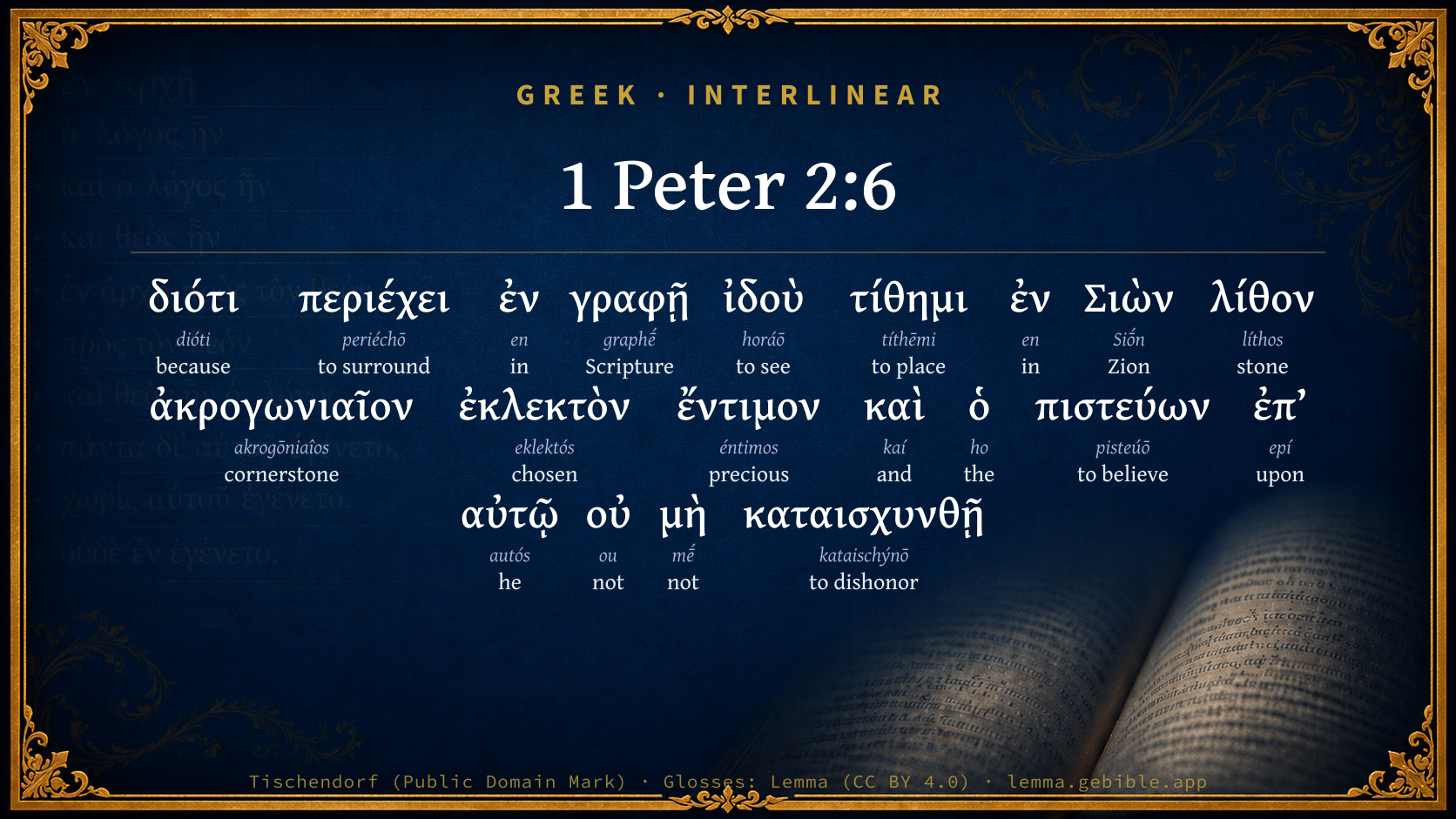
Greek (Tischendorf 8th ed.) 1 Peter 2:6 appears in the Greek New Testament. The text above is from the Tischendorf 8th edition. Each word links to its Strong’s number and a concise gloss. Click any word for its full Thayer’s Greek Lexicon entry.
Download image
Cite this verse

1 Peter 2:6 (World English Bible). Public Domain. Lemma interlinear Bible study tool, https://lemma.gebible.app/v/1-peter/2/6.

Show BibTeX & RIS
BibTeX
RIS
English Translation
Because it is contained in Scripture, "Behold, I lay in Zion a chief cornerstone, chosen, and precious: He who believes in him will not be disappointed."
World English Bible · Public Domain
Download a study sheet

One document with this verse’s original text, its word-by-word gloss line, the meaning frame, cross-references with their text, attributed commentary, and full source and license credits — printable, and it pastes into notes with its structure intact.

This verse Autodidact and up

Study sheet (.html) Plain text (.txt)

A passage Seminary Student

Up to 50 verses in one chapter. A passage sheet keeps up to 6 commentary sources and 12 cross-references per verse, in the order this page ranks them, and says so on the sheet whenever that leaves anything out. Ask for a single verse and you get the Autodidact verse sheet above.

Everything on this page stays free to read, with no account — the sheet is a download of what is already on screen, not access to it.

Want to remove ads? Support Godless Engineer
Compare translations 3

The same verse in 3 English versions, stacked beneath the original-language interlinear above. Click any original word for its lexicon entry.

Each is an independent rendering of the whole verse — the interlinear is not word-aligned to these translations.

Highlighted words mark where these versions differ — a whole-verse word diff, not a word-by-word alignment.

  • World English Bible Public Domain
    Because it is contained in Scripture, "Behold, I lay in Zion a chief cornerstone, chosen, and precious: He who believes in him will not be disappointed."
  • King James Version Public Domain
    Wherefore also it is contained in the scripture, Behold, I lay in Sion a chief corner stone, elect, precious: and he that believeth on him shall not be confounded.
  • unfoldingWord Literal Text CC BY-SA 4.0
    Therefore, it stands in scripture: “Behold, I am laying in Zion a stone, a cornerstone, chosen, precious. And the one believing in him may certainly not be ashamed.”

unfoldingWord Literal Text — © unfoldingWord, licensed CC BY-SA 4.0. Word-aligned USFM3 via Door43 (git.door43.org/unfoldingWord/en_ult).

Versions to compare (up to 4)

3 of 4 selected

Show all 19 translations

Every available English version of this verse, each an independent rendering of the whole verse.

  • World English Bible Public Domain
    Because it is contained in Scripture, "Behold, I lay in Zion a chief cornerstone, chosen, and precious: He who believes in him will not be disappointed."
  • Berean Standard Bible Public Domain
    For it stands in Scripture: “See, I lay in Zion a stone, a chosen and precious cornerstone; and the one who believes in Him will never be put to shame.”
  • Majority Standard Bible Public Domain
    For it stands in Scripture: “See, I lay in Zion a stone, a chosen and precious cornerstone; and the one who believes in Him will never be put to shame.”
  • King James Version Public Domain
    Wherefore also it is contained in the scripture, Behold, I lay in Sion a chief corner stone, elect, precious: and he that believeth on him shall not be confounded.
  • American Standard Version (1901) Public Domain
    Because it is contained in scripture, Behold, I lay in Zion a chief corner stone, elect, precious: And he that believeth on him shall not be put to shame.
  • Revised Version (1885) Public Domain
    Because it is contained in scripture, Behold, I lay in Zion a chief corner stone, elect, precious: And he that believeth on him shall not be put to shame.
  • Geneva Bible (1599) Public Domain
    Wherefore also it is conteyned in the Scripture, Beholde, I put in Sion a chiefe corner stone, elect and precious: and hee that beleeueth therein, shall not be ashamed.
  • Douay-Rheims (1899) Public Domain
    Wherefore it is said in the scripture: Behold, I lay in Sion a chief corner stone, elect, precious. And he that shall believe in him, shall not be confounded.
  • Young's Literal Translation Public Domain
    Wherefore, also, it is contained in the Writing: `Lo, I lay in Zion a chief corner-stone, choice, precious, and he who is believing on him may not be put to shame;'
  • Literal Standard Version CC BY-SA 4.0
    For this reason, also, it is contained in the Writing: “Behold, I lay in Zion a chief cornerstone, choice, precious, and he who is believing on Him may not be put to shame”;
  • Unlocked Literal Bible CC BY-SA 4.0
    Scripture contains this: “See, I am laying in Zion a cornerstone, chosen and valuable. Whoever believes in him will not be ashamed.”
  • unfoldingWord Literal Text CC BY-SA 4.0
    Therefore, it stands in scripture: “Behold, I am laying in Zion a stone, a cornerstone, chosen, precious. And the one believing in him may certainly not be ashamed.”
  • Darby Bible Public Domain
    Because it is contained in the scripture: Behold, I lay in Zion a corner stone, elect, precious: and he that believes on him shall not be put to shame.
  • World Messianic Bible Public Domain
    Because it is contained in Scripture, “Behold, I lay in Zion a chief cornerstone, chosen and precious. He who believes in him will not be disappointed.”
  • Webster's Bible Public Domain
    Wherefore also it is contained in the scripture, Behold, I lay in Sion a chief corner-stone, elect, precious: and he that believeth on him shall not be confounded.
  • Free Bible Version CC BY-SA 4.0
    As Scripture says, “See! I'm setting in Zion its main cornerstone, specially-chosen and valuable. Whoever trusts in him will not be disappointed.”
  • Bible in Basic English Public Domain
    Because it is said in the Writings, See, I am placing a keystone in Zion, of great and special value; and the man who has faith in him will not be put to shame.
  • Text-Critical English NT CC BY 4.0
    For it says in Scripture, “Behold, I lay in Zion a stone, a chosen and precious cornerstone, and no one who believes in him will ever be put to shame.”
  • Tyndale New Testament (1534) Public Domain
    Wherfore it is contayned in the scripture: beholde I put in Sion an heed corner stone electe and precious: and he that beleveth on him shall not be ashamed.

Literal Standard Version (2020), Covenant Press — licensed CC BY-SA 4.0. Text via the HelloAO Bible API (eBible.org). Unlocked Literal Bible (unfoldingWord) — licensed CC BY-SA 4.0. Text via the HelloAO Bible API (eBible.org). unfoldingWord Literal Text — © unfoldingWord, licensed CC BY-SA 4.0. Word-aligned USFM3 via Door43 (git.door43.org/unfoldingWord/en_ult). Free Bible Version, Dr. Jonathan Gallagher — licensed CC BY-SA 4.0. Text via the HelloAO Bible API (eBible.org).

Word by word

More ways to search: Search by grammar → Find every occurrence → Compare this word →

Practice this passage: Drill this verse → Learn its vocabulary →

περιέχει
periéchō
G4023
“to surround”
Verb, Present, Active, Indicative, 3rd person, Singular
Part of Speech
Verb
Tense
Present
Voice
Active
Mood
Indicative
Person
3rd person
Number
Singular
Full Thayer's Definition

Origin: from G4012 and G2192

TDNT: None

1. to surround, encompass a. to contain: of the subject-matter, contents, of a writing b. to take possession of, to seize
  1. διότι dióti G1360 “because” Conjunction
  2. ἐν en G1722 “in” Preposition
  3. γραφῇ graphḗ G1124 “Scripture” Noun, Dative, Singular, Feminine
  4. ἰδοὺ horáō G3708 “to see” Verb, Aorist, Middle, Imperative, 2nd person, Singular
  5. τίθημι títhēmi G5087 “to place” Verb, Present, Active, Indicative, 1st person, Singular
  6. ἐν en G1722 “in” Preposition
  7. Σιὼν Siṓn G4622 “Zion” Noun, Proper, indeclinable
  8. λίθον líthos G3037 “stone” Noun, Accusative, Singular, Masculine
  9. ἀκρογωνιαῖον akrogōniaîos G204 “cornerstone” Adjective, Accusative, Singular, Masculine
  10. ἐκλεκτὸν eklektós G1588 “chosen” Adjective, Accusative, Singular, Masculine
  11. ἔντιμον éntimos G1784 “precious” Adjective, Accusative, Singular, Masculine
  12. καὶ kaí G2532 “and” Conjunction
  13. ὁ ho G3588 “the” Article, Nominative, Singular, Masculine
  14. πιστεύων pisteúō G4100 “to believe” Verb, Present, Active, Participle, Nominative, Singular, Masculine
  15. ἐπ’ epí G1909 “upon” Preposition
  16. αὐτῷ autós G846 “he” Personal pronoun, Dative, Singular, Masculine
  17. οὐ ou G3756 “not” Particle, Negative
  18. μὴ mḗ G3361 “not” Particle, Negative
  19. καταισχυνθῇ kataischýnō G2617 “to dishonor” Verb, Aorist, Passive, Subjunctive, 3rd person, Singular

About this verse

These counts appear in no published source. They are computed here, from the morphology-tagged text and Lemma’s own curated glosses. What Lemma adds →

20
words
19
distinct lemmas
General Epistles
section

Notable vocabulary

The rarest word here is περιέχει to surround G4023 — appearing just 2 times in the whole Greek New Testament.

Shared distinctive vocabulary

περιέχει to surround G4023 occurs in 2 verses of the Greek New Testament. Also found in:

Repetition

A word recurs within this verse:

Cross-references

23

Topical passages linked to 1 Peter 2:6 in the Treasury of Scripture Knowledge — connected by theme and wording, ordered by reader-vote popularity; previews shown in the World English Bible.

  • Isaiah 28:16 therefore thus says the Lord Yahweh, Behold, I lay in Zion for a foundation a stone, a tried stone, a precious corner -[stone] of sure foundation: he who believes shall not be in haste.
  • Romans 9:32–33 Why? Because they didn't seek it by faith, but as it were by works of the law. They stumbled over the stumbling stone;
  • 1 Peter 2:4 coming to him, a living stone, rejected indeed by men, but chosen by God, precious.
  • Ephesians 2:20 being built on the foundation of the apostles and prophets, Christ Jesus himself being the chief cornerstone;
  • Zechariah 10:4 From him will come forth the corner-stone, From him the nail, From him the battle bow, From him every ruler together.
  • Romans 10:11 For the Scripture says, "Whoever believes in him will not be disappointed."
  • Mark 12:10 Haven't you even read this Scripture: 'The stone which the builders rejected, The same was made the head of the corner.
  • Isaiah 50:7 For the Lord Yahweh will help me; therefore I have not been confounded: therefore have I set my face like a flint, and I know that I shall not be disappointed.
  • Isaiah 42:1 Behold, my servant, whom I uphold; my chosen, in whom my soul delights: I have put my Spirit on him; he will bring forth justice to the Gentiles.
  • John 7:38 He who believes in me, as the Scripture has said, from within him will flow rivers of living water."
  • Isaiah 54:4 Don't be afraid; for you shall not be ashamed: neither be confounded; for you shall not be disappointed: for you shall forget the shame of your youth; and the reproach of your widowhood shall you remember no more.
  • 2 Timothy 3:16 Every writing inspired by God is profitable for teaching, for reproof, for correction, and for instruction which is in righteousness,
  • Isaiah 45:16–17 They shall be disappointed, yes, confounded, all of them; they shall go into confusion together who are makers of idols.
  • Luke 23:35 The people stood watching. The rulers with them also scoffed at him, saying, "He saved others. Let him save himself, if this is the Christ of God, his chosen one!"
  • Psalms 40:14 Let them be disappointed and confounded together who seek after my soul to destroy it. Let them be turned backward and brought to dishonor who delight in my hurt.
  • Psalms 89:19 Then you spoke in vision to your saints, And said, "I have bestowed strength on the warrior. I have exalted a young man from the people.
  • Isaiah 41:11 Behold, all those who are incensed against you shall be disappointed and confounded: those who strive with you shall be as nothing, and shall perish.
  • Matthew 12:18 "Behold, my servant whom I have chosen; My beloved in whom my soul is well pleased: I will put my Spirit on him. He will proclaim justice to the Gentiles.
  • 2 Peter 1:20 knowing this first, that no prophecy of Scripture is of private interpretation.
  • 2 Peter 3:16 as also in all of his letters, speaking in them of these things. In those are some things hard to be understood, which the ignorant and unsettled twist, as they also do to the other Scriptures, to their own destruction.
  • Acts 1:16 "Brothers, it was necessary that this Scripture should be fulfilled, which the Holy Spirit spoke before by the mouth of David concerning Judas, who was guide to those who took Jesus.
  • Ephesians 1:4 even as he chose us in him before the foundation of the world, that we would be holy and without blemish before him in love;
  • Daniel 10:21 But I will tell you that which is inscribed in the writing of truth: and there is none who holds with me against these, but Michael your prince."

Cross-references courtesy of OpenBible.info (CC BY 4.0).

Commentary

Notes on 1 Peter 2:6 from classic Christian and Jewish commentators (each source and its license shown beneath its notes). The classic Christian expositions comment on the surrounding passage and are grouped to its opening verse, so a note may address several verses; the Jewish commentaries on the Tanakh (Rashi and others) are per-verse, so they appear only where the commentator wrote on this verse.

Lemma curates 59 commentaries, every one of them public domain or Creative Commons licensed, each selected and text-cleaned for this edition rather than reprinted as found. About our sources →

Ellicott's Commentary for English Readers

(6) Wherefore also.—The mention of Jesus Christ brings the writer back again to his theme, viz., that the whole system to which his readers belong has undergone a radical change, and is based on Jesus and His fulfilment of the sufferings and glories of the Messiah. The right reading here is not “wherefore also,” but because—i.e., the quotations are introduced in the same way as in 1Pe_1:16; 1Pe_1:24, as justifying the foregoing expressions.

It is contained in the scripture.—In the original the phrase is a curious one. “The scripture” never means the Old Testament as a whole, which would be called “the Scriptures,” but is always the particular book or passage of the Old Testament. Literally, then, our present phrase runs, because it encloses or contains in that passage. Thus attention is drawn to the context of the quotation, and in this context we shall again find what made St. Peter quote the text.

Behold, I lay.—The sentence is taken from Isa_28:16, and, like the last, is adapted to the occasion out of both Hebrew and LXX. Gesenius on that passage gives evidence to show that the early Jewish explanation, current in our Lord’s time, referred it to the Messiah; the later Rabbinical expositors, probably by way of opposition to the Christians, explained it to mean Hezekiah. In order to gain a clear conception of St. Peter’s aim in the quotation, it is necessary to glance over the whole section contained in the 28th and 29th chapters of Isaiah. “The prophecy here cited,” says Archbishop Leighton, “if we look upon it in its own place, we shall find inserted in the middle of a very sad denunciation of judgment against the Jews.” Besides our present text, which is quoted also in Rom_9:33, our Lord’s prophecy of the destruction of Jerusalem is an amplification of Isa_29:3-4; His sharp censure of the corrupt traditions which had superseded the law of God (Mat_15:7-9) is taken from Isa_29:13; St. Paul’s image of the potter changing his purpose with the lump of clay (Rom_9:21), comes from Isa_29:16. Like one bright spot in the sad picture appears our verse, but only as serving to heighten the general gloom. St. Peter’s quotation here, therefore, calling attention as it does to the context, is at least as much intended to show his Hebrew readers the sweeping away of the carnal Israel as to encourage them in their Christian allegiance. In the original passage the sure foundation is contrasted with the refuge of lies which the Jewish rulers had constructed for themselves against Assyria, “scorning” this sure foundation as a piece of antiquated and unpractical religionism. Nägelsbach (in his new commentary on Isaiah) seems to be right in interpreting the “refuge of lies” to mean the diplomatic skill with which Ahaz and the Jewish authorities flattered themselves their treaty with Egypt was drawn up, and the “sure foundation” opposed to it is primarily God’s plighted promise to the house of David, in which all who trusted would have no cause for flight. In the Messianic fulfilment, those promises are all summed up in the one person of Jesus Christ (Act_13:33; 2Co_1:20); and the “refuge of lies” in which the Jewish rulers had trusted was the wicked policy by which they had tried to secure their “place and nation” against the Romans (Joh_11:48).

In Sion.—In Isaiah it means that the people have not to look for any distant external aid, such as that of Pharaoh: all that they need is to be found in the city of David itself. Here, it seems to impress upon the Hebrew Christians that they are not abandoning their position as Hebrews by attaching themselves to Jesus Christ. It is they who are really clinging to Sion when the other Jews are abandoning her.

Shall not be confounded (or, ashamed).—Our version of Isaiah translates the Hebrew original by the unintelligible “shall not make haste.” It really means, shall not flee. While all the Jewish rulers, who had turned faithless and trusted in their finesse with Egypt, would have to flee from the face of the Assyrians, those who preserved their faith in God would be able to stand their ground. This, of course, did not come literally true in the first instance, where a common temporal overthrow came upon faithful and faithless alike, from Babylon, though not from Assyria. In the Messianic fulfilment, however, the faith or unbelief of the individual makes all the difference to him: the overthrow of the many does not affect the few. St. Peter adds to “believe” the words “on Him” or “on it.” which are found in neither the Hebrew nor the Greek of Isaiah, such an addition being quite in keeping with the Rabbinic method of quotation, which frequently alters words (comp. Mat_2:6) to bring out the concealed intention more fully. The general quality of “faith” of which the prophet spoke, i.e., reliance on the promises of God, becomes faith in Him in whom the promises are fulfilled. For a like cause St. Peter prefers the LXX. “be ashamed” to the Hebrew “flee away,” there being (except at the Fall of Jerusalem) no opportunity for actual flight. It comes to the same thing in the end: “shall not find his confidence misplaced.”

A Bible Commentary for English Readers, edited by Charles John Ellicott (1878–1897) — public domain. Text from a community e-Sword module.

The Biblical Illustrator

Joseph S. Exell

1Pe_2:6

It is contained in the Scripture.

Wherein the Scriptures exceed all other writings

I. They were inspired all of the Holy Ghost (2Ti_3:17; 2Pe_1:21), so were no other writings.

II. They contain a wisdom far above all that can be had by the princes and men of this world (1Co_6:7).

III. They were penned by more excellent men than any other writings: the greatest, wisest, holiest men-Moses, David, Solomon, prophets, evangelists, apostles, etc.

IV. They have such properties as no other writings have: they are more perfect, pure, deep, and immutable than any mans writings. These contain all things necessary unto faith and a good life (2Ti_3:16-17).

V. If we consider the effects that must be acknowledged to the praise of the scriptures, no writings can describe God so fully to us, do so bring glory to God; no Scripture but this can convert a soul (Heb_4:12-13; Psa_19:11; Psa_119:14-15; Psa_119:27). (N. Byfield.)

I lay in Sion a chief cornerstone.

The Divine foundation

I. Jesus Christ is the foundation stone, or the fundamental truth of Christianity.

1. Jesus Christ is the cardinal truth of the Christian system.

2. Jesus Christ is the central truth of Christianity.

3. Jesus Christ is the all-comprehensive truth of Christianity. Christ is Christianity.

What is meant by it? Two things.

(1) First, that Jesus Christ is essential to His religion. Plato is not essential to Platonism. Suppose that nothing was known of the birth, life, and death of Plato, that his writings came down to us anonymously, it would make but very little difference to his students. And what is true of Plato as a philosopher is also true of Cakyamouni, Confucius, and Mahomet, as founders of religions. Their personalities form no integral portion of their systems. Plato said, Accept my ideas; Christ said, Accept Me. Cakyamouni said, This is the way, by renunciation; Christ said , I am the Way. They, each and all, put the centres of their systems outside themselves; but Christ put the centre of His in His own person.

(2) But, secondly, the phrase, Christ is Christianity, means precisely the same as when we say that the tree is the branches. The tree throws itself out into branches, and it must be patent to all that there can be no more in the branches than there is already in the tree.

II. Jesus Christ is the cornerstone, or the harmonising truth of Christianity.

1. He is the Cornerstone of the religions of the world; that is to say, in Him and the religion He instituted all other religions meet and are unified.

2. Jesus Christ is the Cornerstone of Christian doctrines; in other words, in Him they find the principle of their reconciliation.

3. Jesus Christ is also the Cornerstone of Christian Churches; in Him is their one point of union.

III. Jesus Christ is the sure foundation. Whosoever believeth in Him shall not be confounded.

1. Jesus Christ is the sure foundation, the one truth which maintains its ground notwithstanding the fierce assaults made upon it from time to time.

2. He is a sure foundation for us to build thereupon the hope of everlasting life. (J. C. Jones, D. D.)

The cornerstone

I. Stability. The cornerstone upholds and is the strength of the building. So it is in the Church, whether viewed collectively, or as composed of individual Christians. Strength is in Christ alone.

II. Beauty. Cornerstones give beauty and ornament to a building. They are often graceful and rich, and curiously wrought; and the other and ordinary stones of the building get comeliness from the very relation in which they stand to the cornerstones. Now Christ is the beauty of the spiritual temple.

III. Unity. Cornerstones are the medium by which the walls of a house, with all the several stones which compose those walls, are united in one building. Take away the cornerstones, and the sides of the house would be separated from each other. The stones of which the walls are built may be of different sizes, and of different degrees of value or beauty; yet so long as they are held together by the cornerstone, the house is one house; nor is there any stone in it however small or common but that stone is necessary to the unity of the house. It cannot be spared. Such is Christ as the precious cornerstone of the spiritual temple. (A. C. Price.)

The chief cornerstone

I. The foundation is called here a chief cornerstone. Jesus Christ is the alone Head and King of His Church, who gives it laws, and rules it in wisdom and righteousness. Elected, or chosen out for the purpose, and altogether fit for it. Isaiah hath it, A stone of trial or a tried stone. As things amongst men are best chosen after trial, so Jesus Christ was certainly known by the Father, as most fit for that work to which He chose Him before He tried Him, as afterwards, upon trial in His life and death and resurrection, He proved fully answerable to His Fathers purpose in all that was appointed Him. He was God, that He might be a strong foundation; He was man, that He might be suitable to the nature of the stones whereof the building was to consist, that they might join and cement together. Precious, inestimably precious, by all the conditions that can give worth to any: by rareness and by inward excellency.

II. The laying of this foundation. It is said to be laid in Zion; that is, it is laid in the Church of God. And it was first laid in Zion, literally, that being then the seat of the Church and of the true religion. He was laid there in His manifestation in the flesh, and suffering, and dying, and rising again; and afterwards, being preached through the world, He became the foundation of His Church in all places where His name was received. He saith, I lay; by which the Lord expresseth this to be His own proper work, as Psa_118:23. And it is not only said, I lay, because God the Father had the first thought of this great work, but also to signify the freeness of His grace in giving His Son to be a foundation of happiness to man, without the least motion from man, or motive in man, to draw Him to it. This, again, that the Lord Himself is the layer of this cornerstone, teaches us the firmness of it. Psa_2:6, I have set My King upon My holy hill of Zion; who then shall dethrone Him? I have given Him the heathen for His inheritance, and the ends of the earth for His possession; and who will hinder Him to take possession of His right?

III. The building on this foundation. To be built on Christ is plainly to believe in Him. It is not they that have heard of Him, or that have some common knowledge of Him, or that are able to discourse of Him and speak of His person and nature aright, but they that believe in Him. Much of our knowledge is like that of the poor philosopher, who defineth riches exactly, and discourseth of their nature, but possesseth none; or we are as a geometrician, who can measure land exactly in all its dimensions, but possesseth not a foot thereof. And truly it is but a lifeless unsavoury knowledge that men have of Christ by books and study, till He reveal Himself and persuade the heart to believe in Him. There is in lively faith, when it is infused into the soul, a clearer knowledge of Christ and His excellency than before, and with it a recumbency of the soul upon Him, as the foundation of its life and comfort; a resolving to rest on Him, and not to depart from Him upon any terms.

IV. The firmness of this building. He that believeth on Him shall not be confounded. This firmness is answerable to the nature of the foundation. Not only the whole frame, but every stone of it abideth sure. It is a mistake to judge the persuasion of perseverance to be self-presumption. They that have it are far from building it on themselves, but their foundation is that which makes them sure; because it doth not only remain firm itself, but indissolubly supports all that are once built on it. In the prophet whence this is cited it is, Shall not make haste, but the sense is one. They that are disappointed and ashamed in their hopes, run to and fro, and seek after some new resource; this they shall not need to do who come to Christ.

V. The greatness and excellency of the work intimated in that first word, Behold, which imports this work to be very remarkable, and calls the eyes to fix upon it. The Lord is marvellous in the least of His works; but in this He hath manifested more of His wisdom and power, and let out more of His love to mankind, than in all the rest. Look upon this precious stone, and behold Him not in mere speculation, but so behold Him as to lay hold on Him; for we see He is therefore here set forth, that we may believe on Him; and so not be confounded, that we may attain this blessed union, that cannot be dissolved. All other unions are dissoluble. A man may be plucked from his dwelling house and lands, or they from him, though he have never so good a title to them; may be removed from his dearest friends, if not by other accidents in his lifetime, yet sure by death, the great dissolver of all such unions, and of that straitest one, of the soul with the body; but it can do nothing against this union, but on the contrary perfects it. (Abp. Leighton.)

Christ the one foundation

St. Peter, when arraigned before Annas and Caiaphas, had reminded them of that passage (Psa_118:22) which speaks of a stone cast aside by the builders as unfitted for their purpose, but afterwards, by the Lords own act, chosen out to be the head of the corner. The sacred irony of this contrast had evidently taken hold of his mind. In the context here he has been referring to that passage in combination with one of Isaiahs (Isa_28:16), and applying both to the Lord Jesus, as identified with that Lord of whom another Psalmist had said, O taste and see that the Lord is gracious. He now quotes from Isaiah, applying the title of cornerstone to his Master, just as St. Paul says (1Co_3:11; Eph_2:20). What does this ancient and sacred image, thus borrowed by St. Peter and St. Paul from the stores of Hebrew prophecy, convey to us Christians? When Isaiah was drawing near to the close of his public life, a worldly and irreligious party had risen to influence and temporary command in the kingdom of Judah. Their aim was to strengthen it by a secular policy, with an Egyptian alliance for its basis. Their thoughts, if put into modern shape, would run somewhat as follows: Judah must be set free from the bondage of a narrow clerical interest: it is essentially a kingdom, existing side by side with other kingdoms; its needs, its emergencies, are like theirs; it must, perforce, do as they do. It must therefore shake off the tyranny of meddlesome preachers, who can only look at secular matters from their own theological point of view, and pretend to school practical men like children, with a dull iteration of precept upon precept. We have outgrown all that; it is time for common sense to reign. We know how to make safeguards for the throne and for the country, which will enable us, so to speak, to be on friendly terms with death, exempt from the peril of destruction; when the overflowing scourge shall pass through, it shall not come to us. Isaiah turns round upon them as the minister of Him who scorneth the scorners. No, he says, your hopes are vain; your covenant with death shall be cancelled; your hiding place is a refuge of lies, and the hailstorm and the rising flood will sweep it away. The scourge, when it comes, will simply trample you down. But I will tell you where a refuge can be found; there is a stone laid by God for a sure foundation, a stone tried and precious; he that trusteth to it shall not make haste, shall not be shaken from his foothold. This refers first to that sacred character of the house of David, which belonged to it as destined to culminate in Davids future preeminent Son, and in the fuller sense to that Son in His own Person, as realising all that could be indicated by the glorious titles of the Emmanuel, the Wonderful, Counsellor, Mighty God. Because He was one day to appear, the pious in Judah would rest their hopes and stay their souls on Him. And this should be, in a far more effective sense, the experience of those who know the Christ as having come. Consider a few of the senses in which He makes good this title of cornerstone. How, do we think, did the first preachers to the heathen win converts? By appealing to mens deepest sense of need, to the felt necessity of a centralising, consolidating principle for human life.

1. Two things, at least, we must secure, if life is not to be a failure.

(1) One is, something certainly true, a truth to stand by amid uncertainties. As we advance in our earthly journey, perplexities gather round on all sides. Life has not verified our first expectations; it raises questions which it does not answer; there is a confusion of theories; but where is that which we can depend upon, and grasp firmly, looking life and death in the face? The answer is in the words of Jesus, I am the Truth.

(2) Man also needs a power of moral and spiritual rectification. He believes Christ is all-precious, because He can and does help them to become pure and single-hearted, high in aim and active in duty.

2. These two great questions well answered by the acceptance of Jesus Christ, one sees how in His relation to the several doctrines and institutions of His Kingdom, He sustains the character of the One Foundation.

(1) It is so in regard to doctrines.

(2) He is also the foundation of all His ordinances. All the instrumental agencies whereby He waits upon the soul-the means, as we call them, or channels of His grace-derive their efficacy from Him; nay, more, it is He who is the real though unseen Minister in them all, the true Celebrant, Baptizer, Absolver, Ordainer, the sovereign Priest of His Church.

3. If Christ be, in these ways, the foundation of our spiritual life, in all its aspects, should He not be also the foundation of all that we do? (W. Bright, D. D.)

The cornerstone

I. Jesus Christ is the cornerstone, uniting Jews and Gentiles.

1. Jews and Gentiles met in His Person. He was of the seed of David according to the flesh, a Jew of the Jews, His genealogy complete and flawless right up to Abraham. But as we carefully survey the stream of His ancestry, we here and there discover Gentile blood flowing as tributaries to it. It is rather remarkable that the only women mentioned in the line of His pedigree are of Gentile blood and soiled character.

2. Jews and Gentiles had also a place in His ministry. The Jewish Rabbis never looked over the Wall of Separation, never gave a kindly thought to the great world without, lying in wickedness, seething in misery. Jesus Christ, however, distinctly purposed from the first to bring Jews and Gentiles into one community an idea absolutely original.

3. As Jesus Christ united Jews and Gentiles in His person and teaching, so tie has also joined them in the Church He established. Today we behold Jews and Gentiles, the civilised nations of the earth and the newly reclaimed barbarians of the South Sea Islands, reclining under its refreshing shade.

II. Jesus Christ is the cornerstone, uniting men and angels.

1. Jesus Christ has united men and angels in His person. He is our countryman, cry the angels, the Lord from heaven; but He is our kinsman, men make reply. He belongs to us by the ties of citizenship, say the angels; but He belongs to us by the ties of blood, answer men. Thus angels and men can legitimately claim a share in this Son of Jesse.

2. He represents men and angels in His teaching as being one in Him.

3. Men and angels are brought together in unity in His Church.

III. Jesus Christ is the cornerstone, uniting God and man.

1. Both meet in His person.

2. He brought God and man together hi His ministry. The great, one might say the central doctrine of His preaching is the Fatherhood of God, and the corresponding sonship of man.

3. In the Church of Christ God and man are welded together in the bonds of closest friendship. God is reconciled to man in the sacrifice of His Son, and now He is reconciling men to Himself. Sinners are being brought into line with the cornerstone, and thus into union with God. (J. C. Jones, D. D.)

Jesus Christ the cornerstone

1. Jesus Christ is the cornerstone of religious doctrine. He was the Son of the God of truth; He was truth Himself, and He came into the world to bear witness to the truth. By His personal ministry and by the ministry of His apostles, He revealed to the fallen children of men the things which belonged to their peace.

2. Christ is the cornerstone of morality. During the whole period of His ministry He afforded a constant example of perfect obedience to the moral law. Every duty which it became Him as a man to fulfil towards men He discharged no less punctually than those obligations of which the immediate object was God.

3. Jesus Christ is the cornerstone of salvation. Through Him we are justified, sanctified; through Him we receive the inheritance of eternal life. (T. Gisborne, M. A.)

The cornerstone

The figures woven into this passage are architectural. They do not, however, touch the imagination as much now as they did when they were first drawn; for we have been misled with regard to the truths they are designed to illustrate, by the degradation that has befallen the cornerstones which we plant. The cornerstone is not a foundation stone with us. It might just as well be put at the middle of the wall as at the corner; at the top as at the bottom; and, for that matter, it might as well be put in the tower as in the wall. It is merely a ceremonial cornerstone, made to contain a few records, giving the date, the time, and what not, belonging to the building. But there are real cornerstones yet. When builders have dug down and found the bottom level, and desire to lay a foundation which no fire can reach, no water undermine, no weight sway, and lay broad and vast stones, then these stones have a marked relation to the integrity of the whole building above. If they are weak, or easily displaced, the foundation will be unstable; and when that gives way, the superstructure, no matter how carefully it may be built, will follow it. There was, however, another kind of cornerstone in former times-namely, a massive slab, which, standing upright, united to itself firmly the two side walls, and so bound together the building laterally. Both of these terms are in our text, and both of them are applied to Christ, who is represented as not only bearing up the whole structure of piety as a foundation, but binding it together as a cornerstone, or the head of the corner, so that, vertically and laterally, the building takes hold and sustains itself by the foundation and the cornerstone. This passage teaches that as a building rests upon its foundation stones, so every Christian rests upon Jesus Christ. They are not merely connected with Him: they rest upon Him. So do they rest upon Him, that if He were to be removed from them all their religious experience would fall, as a wall would go down if its foundation stones were taken out of the way.

I. I first ask you to mark the distinction which exists between a mere general dependence upon God, and a conscious personal life in Christ Jesus, for that is the distinction which demarks between the school of what may be called the naturalists in religion, and of evangelical Christians. It is one thing to be a believer in Gods government; it is another thing to hold company with God-to behold Him, to love Him, and to commune with Him, to twine your life about Him.

II. I remark, secondly, that this direct, intimate, hourly, and daily living with Christ, is the thing which the Gospel proposes as its characteristic aim. Morality is a good thing. A man without it certainly cannot be a Christian, although he may not be one with it. Moralities are mere day labourers, who dig out the roots and clear off the weeds, and get the ground ready for something else. Morals do but plough the soil-piety is the fruitful stein, and love the fair flower which springs from the soil. It is only love that can find out God without searching. Upon its eyes God dawns. Love is that regent quality which was meant to reveal the Divine to us. It carries its own light, and by its own secret nature is drawn instantly towards God, and reflects the knowledge of Him back upon us. When love hath brought forth its central vision of the Divine, and interpreted it to all the other faculties, then they, in turn, become seers, and the soul is helped by every one of its faculties, as by so many eyes, to behold the fulness of God.

III. I remark, thirdly, that it is deemed by men very delusive, and by some wise men utterly impossible, in this mortal state, for a man to live by faith in an invisible being, so that Christ shall seem to be a present companion to him. You might as well attempt to root up an oak of a hundred years growth as attempt to eradicate my faith in Christ present with me-Christ living with me, and I with Him, so that my life is joined to His. Imagine that I stand, tearful and tremulous, yet joyful, by the side of a magnificent picture, which electrifies me, which touches all the great fountains in my nature, causing them to rise and overflow; which translates my mind, and purifies it. As I stand looking at such a picture, a man comes to me and says, What are you gazing at, sir? I begin, in broken language, to tell him what effect the picture is having upon me; and he looks at me with astonishment, and says, Well, it may be that it affects you so, but it does not stand to reason; for it is natural to suppose that if it affected you so, it would affect me in the same way; and I do not have any such feelings as you profess to have. I am sure I would not pay a sixpence for the thing. There I stand trembling before the picture; he reviles it, because his sensibilities are all materialised. Next there comes to me a utilitarian-one of those men who think nothing good unless it be useful, and with whom use means that which is good to sell or to eat. Is it possible, he says, that this picture can operate upon your feelings? It makes no impression upon me whatever. I do not see how it can do such a thing. If you were to tell me that it was one of Raphaels great productions, and that it was worth five or six thousand dollars, I should understand that it had some value. You are a little touched, are you not? Then a bloated sensualist comes to me, and says, I would give more for one flagon of wine than for all the old painted rags on earth. He and I live in different worlds. But if none of these could be made to understand my feelings in the presence of a picture, how much less can they know the reality and glory of my feelings before that more glorious revelation of heavenly beauty which shall remain unrolled forever and forever, and which, as I stand before it, causes everything in me of faith, and hope, and joy, and love, to cry out!

IV. Need I speak of the preciousness of your saviour? Need I call to your remembrance the experiences in which He has manifested Himself to you? Do you not remember those days of struggle and distress, through which you passed, and that day of hope and joy which succeeded them, when Christ dawned upon you, and you felt that your troubles were over, and your resistance to His will was ended, and you cried out, My Lord and my God! and He raised you to His bosom? Has He not revealed Himself to you, saying, I am with you; I will never leave you nor forsake you? The manifestation of Christ to us takes away from trouble all its sting. By and by we shall strand, every one of us, in the narrow passage of death, and there is but one Pilot there. If He comes, bright and shining, from the dark waters of the troubled sea, how sweet and precious will He be to the dying soul that has loved Him, and longed to see Him! (H. W. Beecher.)

Faiths sure foundation

I. The foundation of the believers faith. He that believeth on Him. The foundation of the believers faith is Christ Jesus Himself. But in what sense am I to believe in Jesus Christ?

1. I reply, first, as Gods appointed Saviour of men. Behold I lay in Zion a sure foundation. We trust in Christ Jesus because God has set Him forth to be the propitiation for sin.

2. We also believe in the Lord Jesus because of the excellency of His person. We trust Christ to save us because we perceive Him in every way to be adapted by the nature and constitution of His person to be the Saviour of man kind.

3. Another ground of our reliance upon Christ is that He has actually finished the work of our redemption. There were two things to be done. The first was the keeping of the law on our behalf: that He has performed to the uttermost, even as He said to His Father, I have glorified Thee on the earth, I have finished the work which Thou gavest me to do. We see our Lord also doing the other part of His work, namely, suffering in consequence of our sin, and our faith becomes fully established.

4. One other truth must be mentioned, seeing that our Lord is now no longer dead, we feel it more easy to place our confidence in Him because He ever liveth to see to the completion of our salvation. A living faith delights in a living Saviour. This is the seal of all that went before.

II. The manner of this believing. How do we believe in Jesus Christ? Now, we have not to go a single inch to find an instructive illustration of what faith in Jesus is. The verse before us is connected with building.

1. If, then, you want to know what it is to believe on Jesus, it is relic upon Him as a stone lies upon a foundation when the mason puts it there. Faith is leaning, depending, relying.

2. A stone rests wholly on the foundation. That is faith: resting upon Christ wholly and entirely, looking to Him for everything that has to do with our salvation. Genuine faith in Christ does not trust Him to pardon sin, and then trust itself to overcome sin. No, it trusts Christ both for the conquest of evil and for the forgiveness of it.

3. The stone laid on the foundation comes closer to that foundation every day. When a house is finished there still goes on a measure of settlement, and you are glad if it settles all in a piece together. Every day the stone is brought by its own weight a little closer to the foundation; may every days pressure bring you and me closer to Christ. Oh, that the pressure of our joys and griefs may press us nearer to our Lord!

4. A well-built stone gets to be one with the foundation. In the old Roman walls the mortar seems to be as hard as the stones, and the whole is like one piece; you must blow it to atoms before you can get the wall away. So is it with the true believer: he rests upon his Lord till he is one with Jesus by a living union, so that you scarce know where the foundation ends and where the upbuilding begins; for the believer becometh all in Christ, even as Christ is all in all to him.

III. The evil which will never come upon the man who believeth on Jesus. The text says, He shall not be confounded, and the meaning of it is, first, that he shall never be disappointed. All that Christ has promised to be He will be to those who trust Him. And then comes the next rendering-you shall never be confounded. When a man gets to be ashamed of his hope because he is disappointed in it, he casts about for another anchorage, and, not knowing where to look, he is greatly perplexed. If the Lord Jesus Christ were to fall through, what should we do? No, Jesus, we shall not be confounded, for we shall never be disappointed in Thee, nor made ashamed of our hope! According to Isaiahs version, we shall not be obliged to make haste; we shall not be driven to our wits end and hurried to and fro. We shall not hurry and worry, trying this and that, running from pillar to post to seek a hope; but he that believeth shall be quiet, calm, assured, confident. He awaits the future with equanimity, as he endures the present with patience. Now, the times of our special danger of being confounded are many; but in none of these shall we be confounded. Let us just turn them over in our minds. There are times when a mans sins all come up before him like exceeding great armies. All your thoughts, words, and deeds, your bad tempers and rebellions against God-suppose they were all to rise at once, what would become of you? Why, even then, he that believeth on Him shall not be confounded. The depths have covered them, there is not one of them left. He that believeth on the pardoning Saviour shall not be confounded, though all his sins should accuse him at once. The unbelieving world outside labours to create confusion. The scientific discoverers, the possessors of boastful culture, and all the other braggers of this marvellously enlightened nineteenth century are up in arms against the believers in Jesus. Faith in Jesus can be justified before a synagogue of savans, it deserves the respect of a parliament of philosophers. To trust the Son of God incarnate, whose advent into this world is a fact better proved by history than any other that was ever on record-to trust oneself upon His atoning sacrifice is the most reasonable thing that a man can do. He that believeth on Him shall not be confounded by human wisdom, for God hath long ago confounded it and turned it into foolishness. But the world has done more than sneer; it has imitated Cain and sought to slay the faithful. There they stand. The lions are loose upon them. Do they cry for mercy, and treacherously deny Christ? They are feeble men and women; do they recant and leave their Master? Not they. They die as bravely as ever soldier fell in battle. Well, but there will come other troubles to Christians besides these, and in them they shall not be confounded. They will be tried by the flesh; natural desires will break forth into vehement lustings, and corruptions will seek to cast them down. Will believers perish then? No. He that believeth in Christ shall conquer himself, and overcome his easily besetting sins. There will come losses and crosses, business trials and domestic bereavements. What then? He shall not be confounded; his Lord will sustain him under every tribulation. At last death will come to us. We may not be able to shout victory; we may be too weak for triumphant hymns, but with our latest breath we will lisp the precious name. They that watch us shall know by our serenity that a Christian does not die, but only melts away into everlasting life. We shall never be confounded, even amid the grandeurs of eternity. (C. H. Spurgeon.)

The Biblical Illustrator, edited by Joseph S. Exell (c. 1880s–1900s) — public domain. Text from a community e-Sword module.

Joseph Benson's Commentary

1Pe 2:6-8. Wherefore also — To which purpose; it is contained in the Scripture — In Isa 28:16, the passage before referred to. Behold, I lay in Sion a chief corner-stone — To support and hold together the whole building. This, as explained Eph 2:21, signifies the union of Jews and Gentiles in one faith, baptism, and hope, so as to form one church or temple for the worship of God through the mediation of Christ. And he that believeth on him — With a lively faith, a faith productive of love and obedience; shall not be confounded — In time or in eternity. To you therefore who believe — With such a faith; he is precious — Highly esteemed by you, and of infinite advantage to you. Or, as we read in the margin, he is an honour. The clause may also be rendered, To you who believe in this honour; the honour of being built on Christ, the foundation, or chief corner-stone of the new temple of God. But unto them which be disobedient — Who disbelieve and disobey the gospel, the words of the psalmist are accomplished; the stone which the builders disallowed — Namely, the Jewish chief-priests, elders, and scribes, called builders, because it was their office to build up the church of God among the Jews. See on Psa 118:22. But they rejected the stone here spoken of, and would give it no place in the building; the same is made the head of the corner — And all their opposition to it is vain. It is not only placed at the foot of the corner, to support the two sides of the building erected upon it, but at the head of the corner, to fall upon and grind to powder those that reject it; and, as the same prophet elsewhere speaks, a stone of stumbling, and rock of offence — Namely, to the unbelieving and disobedient. Thus Simeon, (Luk 2:34;) This child is set for the fall as well as the rising again of many in Israel, and for a sign that shall be spoken against; a prediction awfully fulfilled. Even to them which stumble, being disobedient: whereunto also they were appointed — This translation of the clause seems to imply that those who are disobedient were appointed to be so; but the original does not convey that sense, but is literally rendered, Who, disobeying the word, stumble, to which also they were appointed: that is, those who disobey the word are appointed to stumble, namely, at the stone of stumbling here spoken of, according to the prediction of Isaiah, Isa 8:14-15; He shall be for a sanctuary, but for a stone of stumbling, &c., to both the houses of Israel; that is, to those that are unbelieving and disobedient; and many among them shall stumble and fall, and be broken, and snared, and taken. This is what God has appointed, that they who reject Christ shall stumble at him, and fall into misery and ruin: or, that he who believeth not shall be damned: the unalterable decree of the God of heaven. Or the words may, with equal propriety, be rendered, Unto which stumbling they were disposed; those who disbelieve and disobey the gospel; being, through blindness of mind and perverseness of will, disposed to reject Christ, stumble at him, and fall into eternal ruin.

Joseph Benson's Commentary on the Old and New Testaments (1811–1818) — public domain. Text from a community e-Sword module.

Tyndale Open Study Notes

Tyndale Open Resources

2:6-8 The three Old Testament quotations in these verses each identify Christ as some kind of stone: the cornerstone on which the new temple is built (2:6); the cornerstone that God, despite peoples’ rejection, has elevated to be the keystone of his redemptive plan (2:7); and the stone that makes people stumble (2:8). Jesus quotes Ps 118:22 (Matt 21:42), and Paul quotes both Isa 8:14 and 28:16 (Rom 9:33). Likely these three quotations were brought together very early as a combined Old Testament testimony to the nature and significance of Jesus the Messiah.

Tyndale Open Study Notes — © Tyndale Open Resources, licensed CC BY-SA 4.0. Text via the HelloAO Bible API.

Bengel's Gnomon

Johann Albrecht Bengel

1Pe 2:6. Περιέχει, it is contained) Used here as an impersonal verb.—ἰδοὺ, behold) See Rom 9:33, note.—ἐκλεκτὸν, ἔντιμον, elect, precious) Elect, has special reference to the stone; precious, to the chief corner-stone. In Hebrew אבן, a stone בחן פנת יקרת מוסד מוסד of searching out, a corner-stone of preciousness, most firmly laid. The term elect is also used of believers, 1Pe 2:9. From the word precious is derived the word ἡ τιμὴ, the preciousness, the price, 1Pe 2:7.—ὁ πιστεύων, he that believeth) From this is derived the word believing [unto you who believe], 1Pe 2:7—οὐ μὴ καταισχυνθῇ, shall not be put to shame) He shall experience that the preciousness of Christ abounds towards him (whilst) believing.

Bengel's Gnomon of the New Testament — English translation (T&T Clark, Edinburgh, 1860) — public domain. Text from a community e-Sword module.

Meyer's Critical & Exegetical Commentary

Heinrich August Wilhelm Meyer

1Pe_2:6 gives the ground for the exhortation contained in 1Pe_2:4-5 by a quotation of the passage, Isa_28:16, to which reference was already made in 1Pe_2:4.

διότι] cf. 1Pe_1:24.

περιέχει ἐν τῇ γραφῇ] an uncommon construction, yet not without parallel, see Joseph. Antt. xi. 7: βούλομαι γίνεσθαι πάντα, καθὼς ἐν αὐτῇ (i.e. ἐπιστολῇ) περιέχει; indeed περιέχειν is more than once used to denote the contents of a writing, see Act_23:25; Joseph. Antt. xi. 9: καὶ ἡ μὲν ἐπιστολὴ ταῦτα περιεῖχεν. Either ἡ περιοχή (or ὁ τόπος) must, with Wahl, be supplied here as subject; or better, περιέχει must be taken impersonally as equal to, continetur; cf. Winer, p. 237 [E. T. 316]; Buttmann, p. 126.

The words of the passage in the O. T. (Isa_28:16) are quoted neither literally from the LXX. nor exactly according to the Hebrew text. In the LXX. it is: ἰδού, ἐγὼ ἐμβάλλω εἰς τὰ θεμέλια Σιὼν (instead of which we have here, exactly as in Rom_9:33 : ἰδού, τίθημι ἐν Σιὼν) λίθον πολυτελῆ (this adject. here omitted) ἐκλεκτὸν ἀκρογωνιαῖον (these two words here transposed) ἔντιμον εἰς τὰ θεμέλια αὐτῆς (the last two words εἰς … αὐτῆς here left out) καὶ ὁ πιστεύων (ἐπʼ αὐτῷ added) οὐ μὴ καταισχυνθῇ (Rom_9:33 : καὶ πᾶς ὁ πιστεύων ἐπʼ αὐτῷ οὐ καταισχυνθήσεται). Whatever may be understood by the stone in Zion, whether the theocracy, or the temple, or the house of David, or the promise given to David, 2Sa_7:12; 2Sa_7:16 (Hofmann), this passage, which certainly has a Messianic character,inasmuch as the thought expressed in it should find, and has found, its fulfilment in Christ,is not here only, but by Paul and the Rabbis (see Vitringa, ad Jes. I. p. 217), taken to refer directly to the Messiah, who also, according to Delitzsch (cf. in loc.), is directly meant by the stone (this stone is the true seed of David, manifested in Christ). Luther, following Oecumenius and Theophylactus, assumes that Christ is called λίθος ἀκρογων. because He has united Jew and Gentile together, and out of both collected the one church; this Calvin, not entirely without reason, calls a subtilius philosophari. In the words: καὶ ὁ πιστεύων κ.τ.λ., πιστεύων corresponds to προσερχόμενοι, 1Pe_2:4. οὐ μὴ καταισχυνθῇ does not refer to the glory which consists for the believer in this, that he, as a λίθος ζῶν, will form part of the οἶκος πν. (Wiesinger), but to the final glory of salvation which is the aim of the present πιστεύειν (Schott); cf. 1Pe_2:2 : εἰς σωτηρίαν.[120]

[120] Hofmann is wrong in asserting that it is here said that οὐ μὴ καταισχύνθῃ is meant to call back to mind the εἰς σωτηρίαν in ver. 2.

Meyer — Critical and Exegetical Commentary on the New Testament — English translation by Peter Christie, edited by Frederick Crombie (T&T Clark, 1880) — public domain. Text from a community e-Sword module.

Expositor's Greek Testament

ed. W. Robertson Nicoll

1Pe 2:6 . περιέχει ἐν γραφῇ , it is contained in Scripture . The formula occurs in Josephus (Ant. xi. 7, βούλομαι γενέσθαι πάντα καθὼς ἐν [ τῇ ἐπιστολῇ ] περιέχει ) and is chosen for its comprehensiveness. περιέχει is intransitive as the simple verb and other compounds often are; cf. περιοχή , contents , Act 8:32 . γραφῇ . being a technical term, has no article. ἰδοὺ … καταισχυνθῇ , formal quotation of Isa 28:16 , preceding quotation from Psalms, as prophets always precede the writings. The LXX has ἰδοὺ ἐμβάλλω ἐγὼ εἰς τὰ θεμέλια (unique expansion of normal θεμελιῶ = יסד of Heb., cf. εἰς τὰ θ . below; Targum, ממני I will appoint ) Σειὼν λίθον πολυτελῆ ( π . duplicate of ἔντιμον ; Heb., a stone a stone ; Targum, a king a king ; pointing to Jewish Messianic interpretation) ἐκλεκτὸν ἀκρ . ἔντ . εἰς τὰ θεμέλια αὐτῆς ( a foundation a foundation , Heb.) καὶ ὁ πιστεύων (+ ἐπʼ αὐτῷ [148] AQ) οὐ μὴ καταισχυνθῇ (= יבוש for יחיש of Heb. = shall not make haste ; Targum, when tribulation come shall not be moved ). The chief difference is that St. Peter omits all reference to the foundation , and substitutes τίθημι ; LXX is conflate, ἐμβάλλω εἰς being the original reading and τὰ θεμ . added by some purist to preserve the meaning of the Hebrew root. This omission may be due to the fact that Christians emphasised the idea that the stone was a corner stone binding the two wings of the Church together (Eph 2:20 ) and regarded this as inconsistent with εἰς κεφ .

[148] Codex Sinaiticus (sæc. iv.), now at St. Petersburg, published in facsimile type by its discoverer, Tischendorf, in 1862.

The Expositor's Greek Testament, edited by W. Robertson Nicoll (1897–1910) — public domain. Text from a community e-Sword module.

Geneva Bible (1599)

Geneva Bible translators

He proveth it by the testimony of the Prophet Isaiah.

Geneva Bible (1599) marginal notes — public domain. Text via Bolls.life.

Jamieson, Fausset & Brown

Robert Jamieson, A. R. Fausset & David Brown

Wherefore also--The oldest manuscripts read, "Because that." The statement above is so "because it is contained in Scripture."

Behold--calling attention to the glorious announcement of His eternal counsel.

elect--so also believers (Pe1 2:9, "chosen," Greek, "elect generation").

precious--in Hebrew, Isa 28:16, "a corner-stone of preciousness." See on Isa 28:16. So in Pe1 2:7, Christ is said to be, to believers, "precious," Greek, "preciousness."

confounded--same Greek as in Rom 9:33 (Peter here as elsewhere confirming Paul's teaching. See Introduction; also Rom 10:11), "ashamed." In Isa 28:16, "make haste," that is, flee in sudden panic, covered with the shame of confounded hopes.

Jamieson, Fausset & Brown — Commentary Critical and Explanatory on the Whole Bible (1871) — public domain (CC PDM 1.0). Text via the HelloAO Bible API.

Adam Clarke's Commentary

Verse 6. Behold, I lay in Sion] This intimates that the foundation of the Christian Church should be laid at Jerusalem; and there it was laid, for there Christ suffered, and there the preaching of the Gospel commenced.

A chief corner stone] This is the same as the foundation stone; and it is called here the chief corner stone because it is laid in the foundation, at an angle of the building where its two sides form the ground work of a side and end wall. And this might probably be designed to show that, in Jesus, both Jews and Gentiles were to be united; and this is probably the reason why it was called a stone of stumbling, and rock of offence; for nothing stumbled, nothing offended the Jews so much as the calling of the Gentiles into the Church of God, and admitting them to the same privileges which had been before peculiar to the Jews.

Elect, precious] Chosen and honourable. 1Pet 2:4.

Shall not be confounded.] These words are quoted from Isa 28:16; but rather more from the Septuagint than from the Hebrew text. The latter we translate, He that believeth shall not make haste-he who comes to God, through Christ, for salvation, shall never be confounded; he need not haste to flee away, for no enemy shall ever be able to annoy him.

Adam Clarke's Commentary on the Bible (1810–1826) — public domain. Text from a community e-Sword/MySword module.

John Calvin's Commentaries

6 Wherefore also it is contained in Scripture; or, Wherefore also the Scripture contains They who refer the verb “contain” (περιέχειν) to Christ, and render it “embrace,” because through him all these unite together, wholly depart from the meaning of the Apostle. No better is another exposition, that Christ excels others; for Peter simply intended to quote the testimony of Scripture. He then shews what had been taught by the Holy Spirit in the Scriptures, or, which is the same thing, that what he adds is contained in them. Nor is it an unsuitable confirmation of the preceding verse. For we see for what slight reasons, and almost for none, many reject Christ, and some fall away from him; but this is a stumblingblock which above all other things stands in the way of some; they are drawn away, because not only the common people despise and reject Christ, but also those who are high in dignity and honor, and seem to excel others. This evil has almost ever prevailed in the world, and at this day it prevails much; for a great part of mankind judge of Christ according to the false opinion of the world. Moreover, such is the ingratitude and impiety of men, that Christ is everywhere despised. Thus it is, that while they regard one another, few pay him his due honor. Hence Peter reminds us of what had been foretold of Christ, lest the contempt or the rejection of him should move us from the faith.

Now, the first passage, which he adduces, is taken from Isaiah 28:16; where the Prophet, after having inveighed against the desperate wickedness of his own nation, at length adds,

“Your perfidy shall not prevent God from restoring his church, which now through you lies wholly in a ruinous state.” (Isaiah 28:16)

The manner of restoration he thus describes, “I will lay in Sion a stone.” We hence learn that there is no building up of the Church without Christ; for there is no other foundation but he, as Paul testifies, (1 Corinthians 3:11.) This is no matter of wonder, for all our salvation is found only in him. Whosoever, then, turns away from him in the least degree, will find his foundation a precipice.

Therefore the Prophet not only calls him a corner-stone, which connects the whole edifice, but also a stone of trial, according to which the building is to be measured and regulated; and farther, he calls him a solid foundation, which sustains the whole edifice. He is thus, then, a corner-stone, that he might be the rule of the building, as well as the only foundation. But Peter took from the words of the Prophet what was especially suitable to his argument, even that he was a chosen stone, and in the highest degree valuable and excellent, and also that on him we ought to build. This honor is ascribed to Christ, that how much soever he may be despised by the world, he may not be despised by us; for by God he is regarded as very precious. But when he calls him a corner-stone, he intimates that those have no concern for their salvation who do not recumb on Christ. What some have refined on the word “corner,” as though it meant that Christ joins together Jews and Gentiles, as two distinct walls, is not well founded. Let us, then, be content with a simple explanation, that he is so called, because the weight of the building rests on him.

We must further observe, that the Prophet introduces God as the speaker, for he alone forms and plans his own Church, as it is said in Psalm 78:69, that his hand had founded Sion. He, indeed, employs the labor and ministry of men in building it; but this is not inconsistent with the truth that it is his own work. Christ, then, is the foundation of our salvation, because he has been ordained for this end by the Father.

And he says in Sion, because there God’s spiritual temple was to have its beginning. That our faith, therefore, may firmly rest on Christ, we must come to the Law and to the Prophets. For though this stone extends to the extreme parts of the world, it was yet necessary for it to be located first in Sion, for there at that time was the seat of the Church. But it is said to have been then set, when the Father revealed him for the purpose of restoring his Church. In short, we must hold this, that those only rest on Christ, who keep the unity of the Church, for he is not set as a foundation-stone except in Sion. As from Sion the Church went forth, which is now everywhere spread, so also from Sion our faith has derived its beginning, as Isaiah says,

“From Sion shall go forth the law, and the word of the Lord from Jerusalem.” (Isaiah 2:3.)

Corresponding with this is what is said in the Psalms,

“The scepter of thy power will the Lord send forth from Sion.” (Psalm 110:2.)

He that believeth The Prophet does not say in him, but declares generally, “He that believeth shall not make haste.” As, however, there is no doubt but that God sets forth Christ there as the object of our faith, the faith of which the Prophet speaks must look on him alone. And, doubtless, no one can rightly believe, but he who is fully convinced that in Christ he ought wholly to trust.

But the words of the Prophet may be taken in two ways, either as a promise or as an exhortation. The future time is referred to, “He shall not make haste;” but in Hebrew the future is often to be taken for an imperative, “Let him not make haste.” Thus the meaning would be, “Be ye not moved in your minds, but quietly entertain your desires, and check your feelings, until the Lord will be pleased to fulfill his promise.” So he says in another place,

“In silence and in quietness shall be your strength,” (Isaiah 30:15.)

But as the other reading seems to come nearer to Peter’s interpretation, I give it the preference. Then the sense would not be unsuitable, “He who believeth shall not waver” or vacillate; for he has a firm and permanent foundation. And it is a valuable truth, that relying on Christ, we are beyond the danger of falling. Moreover, to be ashamed (pudefieri) means the same thing. Peter has retained the real sense of the Prophet, though he has followed the Greek version.

John Calvin's Commentaries (1540-1563) — public domain. Text from the Calvin Translation Society English edition (1840s-50s) via the Christian Classics Ethereal Library (ccel.org). Calvin's coverage is partial (roughly two-thirds of the Bible); uncommented books and verses are honest gaps, never fabricated. The 19th-century editor's footnotes and remarks are omitted so the notes are faithfully Calvin's own voice.

The Cambridge Bible for Schools and Colleges

gen. ed. J. J. S. Perowne

6. Wherefore also it is contained in the scripture] As the words are not quoted in exact accordance either with the LXX. or with the Hebrew, it is natural to see in them a citation from Isa_28:16, freely made from memory.

a chief corner stone] The words, as in Psa_118:22, Eph_2:20, point to the stone at the corner where two walls met, and resting on which they were bonded together and made firm.

elect, precious] Better, to maintain the identity of phrase, chosen, precious (or, held in honour).

he that believeth on him shall not be confounded] The meaning of the Hebrew is fairly expressed by the English version, “He that believeth shall not make haste,” i.e. shall go on his way calmly and trustfully, shall not be put to a hurried or hasty flight. Here St Peter follows the LXX. which expresses substantially the same thought.

The Cambridge Bible for Schools and Colleges (gen. ed. J. J. S. Perowne; Cambridge University Press, 1878–1918) — public domain. Text from a community e-Sword module.

John Gill's Exposition

Unto you therefore which believe,.... And such are not all they that can say their creed, or give their assent to the articles of it; nor all that believe a divine revelation, and that the Scriptures are the word of God, and give credit to all that is contained in the sacred oracles; or who believe the whole Gospel, and all the truths of it; as that there is one God; that there are three persons in the Godhead, Father, Son, and Spirit; that Christ is the Son of God, and truly God; that he is the Mediator between God and man; that he is the Messiah, is become incarnate, has obeyed, suffered, and died for men, and is the Saviour of them: that he rose again, ascended to heaven, is set down at the right hand of God, intercedes for his people, and will come a second time to judge the world in righteousness; together with all other truths which arise from, depend upon, and are connected with these; nor all that say they believe, or profess to do so; but such who have seen themselves lost and undone by sin, their need of a Saviour, and Christ as the only one; who have seen the Son, the beauty of his person, the fulness of his grace, and the necessity and suitableness of salvation by him; who have beheld him as able to save them, as every way proper for them, and desirable by them, for faith is a sight of Christ; who also come to him under the drawings of efficacious grace, as perishing sinners, encouraged by his invitations and declarations, and venture on him; who likewise lay hold upon him, as their Saviour, and will have no other; give up themselves to him, and commit their all into his hands; who rely and stay themselves upon him, trust him with all they have, and for all they want, expecting grace and glory from him; who live upon him, and walk on in him, go on believing in him, till they receive the end of their faith, the salvation of their souls. Now to these, in proof of what is asserted in the above passage out of Isaiah, Christ is

precious; he is so in all his names and titles, as Immanuel, God with us, and that cluster of them in Isa 9:6 and particularly his name Jesus, a Saviour, which is as ointment poured forth, and draws the love of believers to him; and so he is in both his natures, divine and human; the perfections of deity in him, his being in the form of God, and equal to him, the brightness of his Father's glory, and the express image of his person, render him very amiable in the view of believers; who rightly conclude from hence, that all he has done, and does, must answer the purposes for which they are designed; and his having a perfect human nature, like to theirs, excepting sin, in which he wrought salvation for them on earth, and is now glorified in heaven, makes him a delightful object to them: he is also precious to them in all his offices; in his priestly office, his blood is precious, as it must needs be, since by it they are purchased and redeemed; they are justified and sanctified by it; through it they have the forgiveness of sin, and boldness to enter into the holiest of all: his righteousness is precious to them, it being the best robe, the wedding garment, fine linen, clean and white, every way suitable to them, and answerable to the demands of the law; is pure, perfect, and everlasting; that by which they are justified from all things, and which will answer for them in a time to come, and entitles them to eternal life. His sacrifice is precious, of a sweet smelling savour to them, as well as to God; by which their sins are fully expiated, put, and taken away; full satisfaction being made for them, and they themselves thereby perfected for ever. And so he is in his prophetic office. His word is precious, and all the truths of the Gospel, which are comparable to gold, silver, and precious stones; the promises of it are exceeding great and precious, being suited to the cases of all believers: and he is also precious in his kingly office; his commands are not grievous; his yoke is easy, and burden light; believers love his commandments above gold, yea; above fine gold, and esteem his precepts concerning all things to be right, and delight in his ways and ordinances: moreover, he is precious to them in all his relations, as he is the head of eminence and influence, their kind and loving husband, their everlasting Father, their affectionate brother, and faithful friend; his whole person, in every view, is precious to them that believe; the church of Christ, the members of his body, the sons of Zion, comparable to fine gold, in these is all the delight of saints; everything that is in Christ, that is of him, or belongs to him, is precious to such souls: some read the words, "to you therefore that believe, he is honour"; as the Vulgate Latin, Arabic, and Ethiopic versions; and so the word is rendered in Rom 13:7, he is both an honour to them, that they are related to him; and he is honoured by them, by believing in him, and obeying him; and he is the cause of all their true honour, both in this and the other world. The Syriac version renders it, "to therefore is this honour given"; namely, that such a stone is laid, and that they were built upon it, and should not be confounded or ashamed, either here or hereafter; connecting the words with the preceding. The Septuagint use the word the apostle here does, in Isa 11:10 where it is prophesied of the Messiah, that his rest shall be glorious; they render it "honour", or "precious". The Jewish writers have adopted the word into their language, and use it for profit and gain (w); in which sense it is applicable to Christ, who is gain to believers, both in life and in death; they being blessed with all spiritual blessings in him, and he being all in all to them: and also they use it, as denoting the intrinsic price and value of anything (x), and which is a right sense of the word; and to believers the price of wisdom, or Christ, is far above rubies, and all the things that can be desired; to them he is precious as a stone, as a foundation and corner stone, and more precious than the most precious stones or things in nature; this he is to them that believe: next follows, in this and the other verse, the account of what he is to them that believe not:

but unto them which be disobedient; who are not persuadable, unbelieving, and are children of disobedience; who neither obey God and his righteous law, nor Christ and his Gospel:

the stone which the builders disallowed, the same is made the head of the corner; reference is manifestly had to Psa 118:22 which is a passage that clearly belongs to the Messiah, and which is suggested by Christ himself; see Gill on Mat 21:42; and is by our apostle, in Act 4:11 applied unto him: by the builders are meant the rulers of the Jews, both civil and ecclesiastical, and especially the latter, the Scribes, Pharisees, and chief priests; who set up for builders of the church of God, but were miserable ones; they built themselves, and taught others to build, on the observance of the ceremonial law, and the traditions of the elders; on their carnal privileges, and moral righteousness; and these disallowed of Christ in the building, rejected him as the Messiah, refused him as the Saviour and Redeemer, and set him at nought, had him in the utmost derision, and reckoned him as a worm, and no man; but, to their great mortification, he is not only laid and retained as the foundation and cornerstone, but made the head of the building, and is exalted at God's right hand above angels and men; he is the head of the body, the church; he is higher than the kings of the earth, and angels are subject to him,

(w) Targum in Esther iii. 8. & v. 13. & vii. 4. (x) Targum Hierosol. in Gen. xxi. 33. Targum Jon. in Gen. xxiii. 15. Targum in Prov. xxxi. 10. Bereshit Rabba, sect. 2. fol. 2. 3. & sect. 11. fol. 9. 3.

John Gill's Exposition of the Whole Bible (1746–1763) — public domain (CC PDM 1.0). Text via the HelloAO Bible API.

Trapp's Complete Commentary

John Trapp

6 Wherefore also it is contained in the scripture, Behold, I lay in Sion a chief corner stone, elect, precious: and he that believeth on him shall not be confounded.

Ver. 6. Wherefore it is contained] The Jews were so well versed in Scripture, that in quoting of texts there was need to say no more to them than, It is written, It is contained, περιεχει, they could tell where to turn to the place presently; and this was a great furtherance to the conversion of many of them, by the preaching of the apostles. Many among us are better seen in Sir Philip than in St Peter: in Monsieur Balzack’s letters than in St Paul’s Epistles; like that bishop of Dunkelden in Scotland, they know little or nothing either of the Old or New Testament; and therefore one may preach riff raff, Popery, or any error unto them, and they know not how to disprove it.

Shall not be confounded] The Hebrew text hath it, "shall not make haste," Isa 28:16. Haste makes waste, as we say, and often brings confusion. Children pull apples before they are ripe, and have worms bred of them.

John Trapp, A Commentary or Exposition upon All the Books of the Old and New Testament (1647–1656) — public domain. Text from a community e-Sword module.

Albert Barnes' Notes on the Bible

Wherefore also it is contained in the scripture - Isa 28:16. The quotation is substantially as it is found in the Septuagint.

Behold, I lay in Sion - See the Isa 28:16 note, and Rom 9:33 note.

A chief cornerstone - The principal stone on which the corner of the edifice rests. A stone is selected for this which is large and solid, and, usually, one which is squared, and worked with care; and as such a stone is commonly laid with solemn ceremonies, so, perhaps, in allusion to this, it is here said by God that he would lay this stone at the foundation. The solemnities attending this were those which accompanied the great work of the Redeemer. See the word explained in the notes at Eph 2:20.

Elect - Chosen of God, or selected for this purpose, 1Pe 2:4.

And he that believeth on him shall not be confounded - Shall not be ashamed. The Hebrew is, “shall not make haste.” See it explained in the notes at Rom 9:33.

Albert Barnes' Notes on the Bible (1834–1885) — public domain. Text from a community e-Sword/MySword module.

Matthew Poole's English Annotations

Wherefore also it is contained in the Scripture: the Greek word being of an active form, makes great difference among expositors about these words; not to trouble the reader with variety, the plainest way of understanding them seems to be, either:

1. That God be understood here, and supplied out of the former verse: Wherefore God contains it in the Scripture: or:

2. That the word, though of an active termination, be yet taken in a passive signification, contains, for is contained; so our translators do, and this way of speaking is not unusual with other writers.

Behold, I; I the Lord, not man, Psa 118:23.

Lay in Sion; viz. by the preaching of the gospel, wherein Christ was declared to be the only foundation of the church, and whereby faith was wrought in the hearts of men, who were thereby actually built on Christ, as their foundation, and so the spiritual house, 1Pe 2:5, erected.

Sion; either by synecdoche, Jerusalem, (whereof Sion was a part), where by the preaching of Christ first, and the apostles after his ascension, and sending the Spirit, this foundation stone was first laid, and God’s temple begun to be built, Psa 110:2; Isa 2:3; Mic 4:2; Luk 24:47. Or rather, Sion here is to be understood of the gospel church, whereof Sion was a type.

A chief corner-stone; or, Head of the corner, Psa 118:22; that which both supports the building, and unites the parts; Christ being the foundation not of a part only, but of the whole church; all the parts of which, Gentile, as well as Jew, are jointly built on him, and upheld by him, Eph 2:20.

Elect, precious: see 1Pe 2:5.

And he that believeth on him shall not be confounded; shall not be disappointed of his expected salvation, and so shall have no cause to be ashamed of his hope. This is according to the LXX., the Hebrew hath it, shall not make haste, i.e. he that believes in Christ shall not through haste, or distrust, or unwillingness to wait God’s time and way, seek after any other way of salvation than by Christ; and so (as before) not being disappointed, shall have no cause to be ashamed; whereas they that do not believe, but make haste, coming short of their expectation, are at last filled with confusion. {See Isa 28:16; Rom 9:33}

Matthew Poole's English Annotations on the Holy Bible (1683–1685) — public domain. Text from a community e-Sword/MySword module.

Whedon's Commentary on the Bible

Daniel D. Whedon

6. Wherefore—Better, because. Isa_28:16.

Zion—Jerusalem; not Rome.

Believeth—Man’s essential part in the work of building.

Confounded—Put to shame or disappointment, for Christ shall never fail him.

Daniel D. Whedon (gen. ed.), Commentary on the Old and New Testaments (1874–1909) — public domain. Text from a community e-Sword module.

The Pulpit Commentary

Wherefore also it is contained in the Scripture; literally, because it contains in Scripture. There is no article according to the best manuscripts; and the verb (periecei) is impersonal; it is similarly used in Josephus, "Ant.," 11:7. Compare the use of the substantive perioch in Act_8:32. St. Peter proceeds to quote the prophecy (Isa_28:16) to which he has already referred. Behold, I lay in Zion a chief Cornerstone, elect, precious. The passage is taken from the Septuagint, with the emission of some words not important for the present purpose. St. Paul quotes the same prophecy still more freely. (Rom_9:33) The rabbinical writers understand it of Hezekiah, but the earlier Jewish interpreters regarded it as Messianic. And he that believeth on him shall not be confounded. The Hebrew words literally mean "shall not be in haste;" the Septuagint appears to give the general meaning. He that believeth (the Hebrew word ymia"h, means "to lean upon, to build upon," and so "to trust, to confide") shall not be flurried and excited with vain fears and trepidation; his mind is stayed on the Lord.

The Pulpit Commentary (1880–1919), ed. H.D.M. Spence-Jones & Joseph S. Exell — public domain. Text from a community e-Sword module.

John Wesley's Explanatory Notes

He that believeth shall not be confounded - In time or in eternity. Isaiah xxviii, 16.

John Wesley, Explanatory Notes Upon the Whole Bible (1754–1765) — public domain. Text via the GEBible commentary corpus.

The People's New Testament

B. W. Johnson

6–8. Behold, I lay in Zion. See Isa. 28:16, and Rom. 9:33. Hence God had foretold that Christ should be a Living Stone. Peter has not quoted the passage in full which declares that the stone is “a tried stone,” “a sure foundation.” Elect. Hence, “chosen by God” (verse 4). Precious. Since it is “the chief corner stone” without which the structure could not be built. He that believeth on him. Hence this stone is a person, and faith in him is the basis of salvation.

B. W. Johnson's The People's New Testament with Notes (1889–1891) — public domain. Electronic text from the Christian Classics Ethereal Library (CCEL) ThML edition.

unfoldingWord translationNotes

Door43 World Missions Community

Scripture contains this

The scriptures are spoken of as if they were a container. This passage refers to the words that a person reads in scripture. AT: "This is what a prophet wrote in the scriptures long ago" (See: Metaphor)

See

The word "see" here alerts us to pay attention to the surprising information that follows.

a cornerstone, chosen and valuable

God is the one who chose the stone. AT: "a most important cornerstone, which I have chosen" (See: Assumed Knowledge and Implicit Information)

a cornerstone

The prophet speaks of the Messiah as the most important stone in a building. (See: Metaphor)

translationWords

word of God

Zion

cornerstone

chosen one

believe

shame

unfoldingWord translationNotes — © Distant Shores Media and the Door43 World Missions Community, licensed CC BY-SA 4.0. Source: git.door43.org/Door43/en_tn.

Cambridge Greek Testament for Schools and Colleges

6. περιέχει. The substantive περιοχή means (1) the contents of a book, (2) a clause or passage. It is used in Act 8:32 of the passage which the eunuch was reading. Here the verb is intransitive and impersonal = it stands thus in writing, the best MSS. read γραφῇ without the article. The plural αἱ γραφαί is used of “Scripture” as a whole and ἡ γραφή in the N.T. means a particular passage. Here St Peter appeals to the fact that there is written evidence to support his statements.

λίθον. Three passages from the O.T. all containing the same metaphor of a stone are here combined together.

(a) Psa 118:22, “The stone which the builders refused is become the head-stone of the corner.” The Psalm was probably written after the return from Babylon, and meant that the kingship of Jehovah, though long ignored by the kings and princes of Judah who claimed to be the builders of the nation, has now at last been recognized as the true bond of union for the restored nation. This passage was applied to Christ at the end of the parable of the wicked husbandmen, Mat 21:42; Mar 12:10; Luk 20:17, and again by St Peter in his defence after healing the impotent man, Act 4:11. Here the passage is alluded to in 1Pe 2:4 and quoted in full in 1Pe 2:7.

(b) Isa 28:16, “Behold, I lay in Zion for a foundation a stone, a tried stone, a precious corner-stone of sure foundation. He that believeth shall not make haste.” The passage was probably written at the time of Sennacherib’s invasion and meant that the presence of Jehovah is the one and only source of protection for Judah, and that intrigues with Egypt, etc., are utterly useless.

(c) Isa 8:14, “(He shall be for a sanctuary;) but for a stone of stumbling and for a rock of offence (to both the houses of Israel).” This passage was written in the reign of Ahaz when Israel and Syria were invading Judah. The meaning is that Jehovah will be a sure refuge to those who trust in Him, but will cause the overthrow of unbelievers.

Neither of the two passages from Isaiah therefore had primarily any direct reference to Messiah, but from the Targums and other Jewish books it seems clear that “the stone” was regarded as a regular title of Messiah, and from the application of Psa 118:22 to Christ the other passages in which the word λίθος was used in the LXX. came to be similarly applied. So again in 1Co 3:11 St Paul speaks of Jesus Christ as the foundation (θεμέλιον), and in Eph 2:20 as the chief corner-stone, ἀκρογωνιαῖον, and in later Christian writers who traced the fulfilment of prophecy in Christ “the stone” is used as one of His regular titles. St Paul (Rom 9:33) and St Peter both combine the same two passages of Isaiah and both have some common variations from the LXX.:

(1) both read ἰδοὺ τίθημι ἐν Σιών instead of ἰδοὺ ἐγὼ ἐμβάλλω εἰς τὰ θεμέλια Σιών,

(2) both read πέτρα σκανδάλου instead of πέτρας πτώματι,

(3) both omit εἰς τὰ θεμέλια αὐτῆς,

(4) both insert ἐπʼ αὐτῷ after πιστεύων.

As there are many other coincidences of thought between St Peter and St Paul (especially Romans and Ephesians) the natural inference is that the changes were introduced by St Paul and borrowed by St Peter. But it has been suggested that possibly a collection of O.T. passages, arranged according to their subjects, suitable for proving from the Scriptures that Jesus was the Christ, was made at a very early date. Certainly such collections were afterwards used, e.g. the Testimonia of Cyprian, where one of the chapters shews that Jesus was styled “the stone.” If such a collection was already extant when St Peter and St Paul wrote they may have both borrowed independently from it, and the same theory might explain other composite quotations in the N.T.

ἐν Σιὼν, the promise was made for Israel and was first fulfilled in Israel by the Incarnation and so is efficacious for the new Israel which is the expansion and archetype of the old.

ἐκλεκτὸν ἀκρογωνιαῖον. The order of the words in the T.R. is thus reversed in the best MSS. as in the LXX., in which case ἀκρογωνιαῖον is probably a substantive, a stone that is elect a chief corner-stone that is held precious. The corner-stone perhaps means that which unites two walls; so in Eph 2:20 where ἀκρογωνιαῖον occurs again the idea is that Jews and Gentiles are united in Christ.

ὁ πιστεύων ἐπʼ αὐτῷ. πιστεύειν ἐπί with the dative suggests the basis on which faith rests. Except in this passage quoted here and in Rom 9:33; Rom 10:11 this construction only occurs in Luk 24:25 and 1Ti 1:16.

οὐ μὴ καταισχυνθῇ. In Isaiah the Hebrew is “shall not make haste,” i.e. flee in panic, לֹא יָחִישׁ, but the LXX. evidently read לֹא יֵבו̇שׁ = shall not be put to shame, i.e. will never find his confidence belied.

Cambridge Greek Testament for Schools and Colleges (Cambridge University Press, 1896; 21 vols, various authors incl. Carr, Maclear, Plummer, Farrar, Lumby, Moule, M. R. James, Simcox) — public domain. Text from a community e-Sword module.

Alford’s Greek Testament

Henry Alford

6.] The exhortation of the previous verses is substantiated in its form and its assertions by O. T. prophecy. Because (q. d. the aforesaid is so, on the ground of Scripture) it is contained (reff.: and for the impersonal sense, Jos. Antt. xi. 4. 7, καθὼς ἐν αὐτῇ (τῇ ἐπιστολῇ) περιέχει. Hence περιοχή, the contents or argument of a book or portion of a book, in later Greek) in Scripture (γραφῇ, in its technical sense, anarthrous: not so found in the Gospels, but Rom 1:2; Rom 16:26: 2Pe 1:20), Behold, I place in Zion a chief corner-stone, chosen, had in honour (the citation is a free one: τίθημι ἐν Σιών representing ἐμβάλλω εἰς τὰ θεμέλια Σιών,—the epithet πολυτελῆ being omitted, and ἐκλεκτόν and ἀκρογωνιαῖον transposed): and he that believeth on Him (or, ‘it:’ ἐπʼ αὐτῷ is not in the LXX-B., but is found in ) shall not be ashamed (it is remarkable, that St. Paul in citing the same prophecy, Rom 9:33, has in common with St. Peter the two divergences from the LXX, the τίθημι ἐν Σιών, and the insertion (?) of ἐπʼ αὐτῷ. On ἀκρογωνιαῖον, see ref. Eph. note. Here, whatever may be the case there, can hardly be any idea of the ‘lapis summangularis’ joining the two walls, Jewish and Gentile, together, as some (e. g. Œc.) have thought).

7,

Henry Alford, The Greek Testament (1849–1861) — public domain. Text from a community e-Sword module.

Vincent's Word Studies in the New Testament

Marvin R. Vincent

It is contained [περιεχει] . From peri, round about, and ecw, to hold. Hence, to contain or comprehend. So Luk 5:9, he was astonished [θαμβος αυτον περιεσχες] ; lit., astonishment held him encompassed. Also, Act 23:25, " He wrote a letter after this manner [περιεχουσαν τον τυπον τουτον] ; lit., containing this form. The verb here is impersonal. The kindred word perioch occurs only in Act 8:32, rendered place; i e., the passage of scripture : either the contents of the passage or the section of the book circumscribed or marked off.

In the scripture [εν γραφη] . The best texts reject the article. Grafh means a passage of scripture. See on Mr 12:10. Hence Rev., in scripture; margin, in a scripture.

Behold I lay, etc. See Rom 9:33.

Precious. See on ver. 4.

Marvin R. Vincent, Word Studies in the New Testament (1887–1900) — public domain. Text from a community e-Sword/MySword module.

Lesson kit

Teaching starters — assembled from the data on this page, not authored interpretation. Every prompt links to the verse data it draws on. Edit before teaching.

1 Peter, in the General Epistles, opens this verse with 20 words (19 distinct Greek lemmas). Its most distinctive word is periéchō (“to surround”). A historical commentator’s framing appears above. Read the whole chapter for the surrounding context.

Discussion questions

  1. How does “to surround” (periéchō) shape what this verse is saying?
  2. How does Luke 5:9, which shares the word «to surround», read alongside this verse?
  3. What does the repetition of “in” (2× in this one verse) do in this verse?
  4. These translations render this verse differently. What is at stake in choosing one wording over another?
  5. Compare how Ellicott's Commentary for English Readers and The Biblical Illustrator read this verse. Where do they agree or differ?

Things to notice

Reading settings

Reading text

Shown beneath each verse's original-language words.

Old Testament
Old Testament edition

Read the OT as the Masoretic Hebrew (MT) or the Greek Septuagint (LXX).

English shown for the Greek Septuagint (in the Hebrew ↔ Greek comparison).

Comparing translations? Open the Compare panel on any verse page to stack up to four side by side.