Leviticus 14:43

Hebrew (Westminster Leningrad Codex) Leviticus 14:43 appears in the Hebrew Old Testament. The text above is from the Westminster Leningrad Codex. Each word links to its Strong’s number, a concise gloss, and parsing drawn from the Open Scriptures Hebrew Bible morphology. Click any word for its full Brown-Driver-Briggs (BDB) entry.
Download image
Cite this verse

Leviticus 14:43 (World English Bible). Public Domain. Lemma interlinear Bible study tool, https://lemma.gebible.app/v/leviticus/14/43.

Show BibTeX & RIS
BibTeX
RIS
English Translation
"If the plague comes again, and breaks out in the house, after he has taken out the stones, and after he has scraped the house, and after it was plastered;
World English Bible · Public Domain
Download a study sheet

One document with this verse’s original text, its word-by-word gloss line, the meaning frame, cross-references with their text, attributed commentary, and full source and license credits — printable, and it pastes into notes with its structure intact.

This verse Autodidact and up

Study sheet (.html) Plain text (.txt)

A passage Seminary Student

Up to 50 verses in one chapter. A passage sheet keeps up to 6 commentary sources and 12 cross-references per verse, in the order this page ranks them, and says so on the sheet whenever that leaves anything out. Ask for a single verse and you get the Autodidact verse sheet above.

Everything on this page stays free to read, with no account — the sheet is a download of what is already on screen, not access to it.

Want to remove ads? Support Godless Engineer
Compare translations 3

The same verse in 3 English versions, stacked beneath the original-language interlinear above. Click any original word for its lexicon entry.

Each is an independent rendering of the whole verse — the interlinear is not word-aligned to these translations.

Highlighted words mark where these versions differ — a whole-verse word diff, not a word-by-word alignment.

  • World English Bible Public Domain
    "If the plague comes again, and breaks out in the house, after he has taken out the stones, and after he has scraped the house, and after it was plastered;
  • King James Version Public Domain
    And if the plague come again, and break out in the house, after that he hath taken away the stones, and after he hath scraped the house, and after it is plastered;
  • unfoldingWord Literal Text CC BY-SA 4.0
    But if the infection returns and it breaks out in the house after the pulling out of the stones and after the scraping off of the house and after the plastering,

unfoldingWord Literal Text — © unfoldingWord, licensed CC BY-SA 4.0. Word-aligned USFM3 via Door43 (git.door43.org/unfoldingWord/en_ult).

Versions to compare (up to 4)

3 of 4 selected

Show all 18 translations

Every available English version of this verse, each an independent rendering of the whole verse.

  • World English Bible Public Domain
    "If the plague comes again, and breaks out in the house, after he has taken out the stones, and after he has scraped the house, and after it was plastered;
  • Berean Standard Bible Public Domain
    If the mildew reappears in the house after the stones have been torn out and the house has been scraped and replastered,
  • Majority Standard Bible Public Domain
    If the mildew reappears in the house after the stones have been torn out and the house has been scraped and replastered,
  • King James Version Public Domain
    And if the plague come again, and break out in the house, after that he hath taken away the stones, and after he hath scraped the house, and after it is plastered;
  • American Standard Version (1901) Public Domain
    And if the plague come again, and break out in the house, after that he hath taken out the stones, and after he hath scraped the house, and after it is plastered;
  • Revised Version (1885) Public Domain
    And if the plague come again, and break out in the house, after that he hath taken out the stones, and after he hath scraped the house, and after it is plaistered;
  • Geneva Bible (1599) Public Domain
    But if the plague come againe and breake out in the house, after that he hath taken away ye stones, and after that hee hath scraped and playstered the house,
  • Douay-Rheims (1899) Public Domain
    But if, after the stones be taken out, and the dust scraped off, and it be plastered with other earth,
  • Young's Literal Translation Public Domain
    `And if the plague return, and hath broken out in the house, after he hath drawn out the stones, and after the scraping of the house, and after the daubing;
  • Literal Standard Version CC BY-SA 4.0
    And if the plague returns, and has broken out in the house, after he has drawn out the stones, and after the scraping of the house, and after the coating,
  • Unlocked Literal Bible CC BY-SA 4.0
    If mildew comes again and breaks out in the house in which the stones have been taken away and the walls have been scraped and then replastered,
  • unfoldingWord Literal Text CC BY-SA 4.0
    But if the infection returns and it breaks out in the house after the pulling out of the stones and after the scraping off of the house and after the plastering,
  • Darby Bible Public Domain
    And if the plague come again, and break out in the house, after he hath taken away the stones, and after he hath scraped the house, and after it is plastered,
  • World Messianic Bible Public Domain
    “If the plague comes again, and breaks out in the house after he has taken out the stones, and after he has scraped the house, and after it was plastered,
  • Webster's Bible Public Domain
    And if the plague shall return, and break out in the house, after that he hath taken away the stones, and after he hath scraped the house, and after it is plastered;
  • Free Bible Version CC BY-SA 4.0
    If the mold returns and affects the house again even after the stones have been removed and the house has been scraped and replastered,
  • Bible in Basic English Public Domain
    And if the disease comes out again in the house after he has taken out the stones and after the walls have been rubbed and the new paste put on,
  • JPS Tanakh (1917) Public Domain
    And if the plague come again, and break out in the house, after that the stones have been taken out, and after the house hath been scraped, and after it is plastered;

Literal Standard Version (2020), Covenant Press — licensed CC BY-SA 4.0. Text via the HelloAO Bible API (eBible.org). Unlocked Literal Bible (unfoldingWord) — licensed CC BY-SA 4.0. Text via the HelloAO Bible API (eBible.org). unfoldingWord Literal Text — © unfoldingWord, licensed CC BY-SA 4.0. Word-aligned USFM3 via Door43 (git.door43.org/unfoldingWord/en_ult). Free Bible Version, Dr. Jonathan Gallagher — licensed CC BY-SA 4.0. Text via the HelloAO Bible API (eBible.org).

Word by word

More ways to search: Search by grammar → Find every occurrence → Compare this word →

Practice this passage: Drill this verse → Learn its vocabulary →

הִקְצ֥וֹת
qâtsâh
H7096
“to cut off”
Verb, Hiphil, Infinitive Construct
Part of Speech
Verb
Stem
Hiphil
Form
Infinitive Construct
Full BDB Definition

Origin: a primitive root

TWOT: 2053

to cut off - (Qal) to cut off - (Piel) to cut off - (Hiphil) to scrape, scrape off
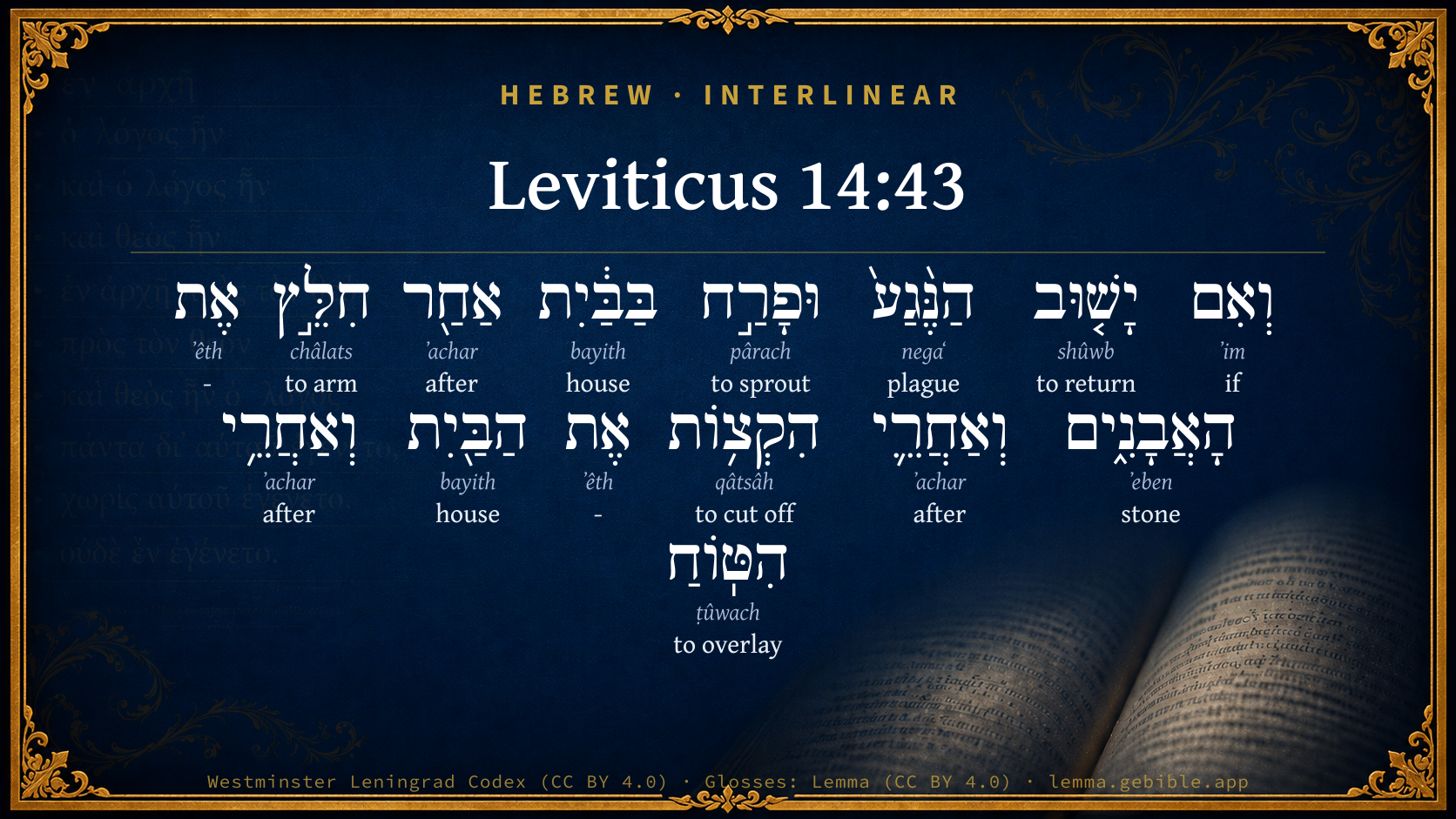
  1. וְאִם ʼim H518 “and · if” Conjunction + Conjunction
  2. יָשׁ֤וּב shûwb H7725 “to return” Verb, Qal, Imperfect, 3rd Person, Masculine, Singular
  3. הַנֶּ֨גַע֙ negaʻ H5061 “the · plague” Particle, Definite Article + Noun, Common, Masculine, Singular, Absolute
  4. וּפָרַ֣ח pârach H6524 “and · to sprout” Conjunction + Verb, Qal, Sequential Perfect, 3rd Person, Masculine, Singular
  5. בַּבַּ֔יִת bayith H1004 “in/at the · house” Preposition, Determined + Noun, Common, Masculine, Singular, Absolute
  6. אַחַ֖ר ʼachar H310 “after” Preposition
  7. חִלֵּ֣ץ châlats H2502 “to arm” Verb, Piel, Perfect, 3rd Person, Masculine, Singular
  8. אֶת ʼêth H853 “-” Particle, Direct Object
  9. הָאֲבָנִ֑ים ʼeben H68 “the · stones” Particle, Definite Article + Noun, Common, Feminine, Plural, Absolute
  10. וְאַחֲרֵ֛י ʼachar H310 “and · after” Conjunction + Preposition
  11. אֶת ʼêth H853 “-” Particle, Direct Object
  12. הַבַּ֖יִת bayith H1004 “the · house” Particle, Definite Article + Noun, Common, Masculine, Singular, Absolute
  13. וְאַחֲרֵ֥י ʼachar H310 “and · after” Conjunction + Preposition
  14. הִטּֽוֹחַ ṭûwach H2902 “to overlay” Verb, Niphal, Infinitive Construct

About this verse

These counts appear in no published source. They are computed here, from the morphology-tagged text and Lemma’s own curated glosses. What Lemma adds →

15
words
11
distinct lemmas
Pentateuch
section

Notable vocabulary

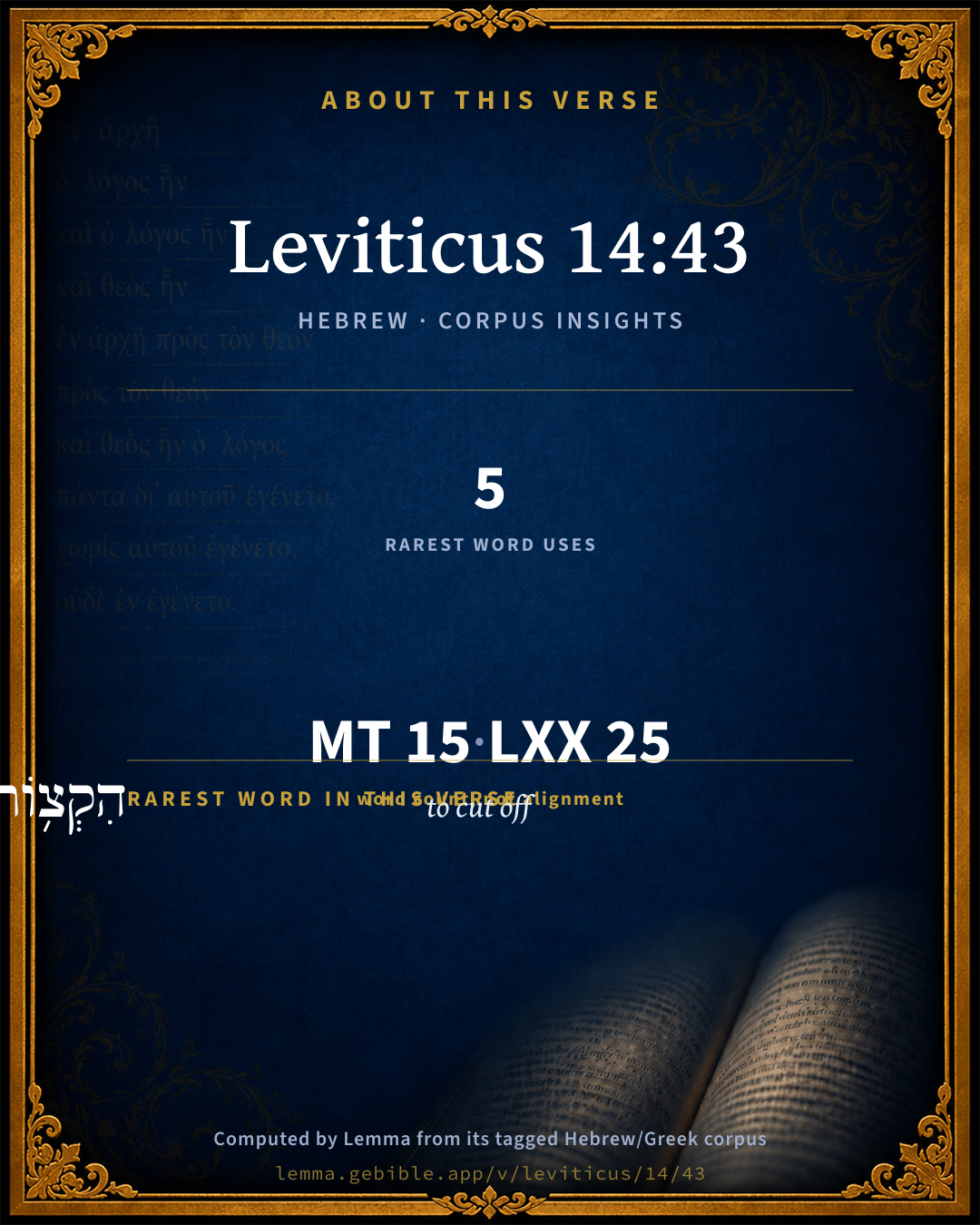
The rarest word here is הִקְצ֥וֹת to cut off H7096 — appearing just 5 times in the whole Hebrew Bible.

Shared distinctive vocabulary

הִקְצ֥וֹת to cut off H7096 occurs in 5 verses of the Hebrew Bible. Also found in:

Grammatical profile

  • 5 verbs
  • 4 nouns
  • 3 prepositions
  • 1 conjunction
  • 2 particles

Verb forms

  • יָשׁ֤וּב Qal · Imperfect
  • וּפָרַ֣ח Qal · Sequential Perfect
  • חִלֵּ֣ץ Piel · Perfect
  • הִקְצ֥וֹת Hiphil · Infinitive Construct
  • הִטּֽוֹחַ Niphal · Infinitive Construct

Repetition

Words recur within this verse — often emphatic in Hebrew:

  • אַחַ֖ר after H310 ×3
  • בַּבַּ֔יִת house H1004 ×2

Hebrew & Septuagint length

In English translation the verse runs 30 words from the Hebrew and 32 from the Septuagint (LXX English) — closely comparable.

A rough comparison of the two English renderings, which tokenize alike — not a word-level alignment.

Word counts can differ between the Hebrew and the Greek without any difference in meaning — e.g. the Hebrew direct-object marker אֵת has no separate Greek word, and Greek often adds the article ὁ.

In the original languages it is 15 Hebrew tokens and 25 Greek tokens — but the two are counted differently (Hebrew bundles its prefixes and suffixes into one token; the Greek is in lemma form), so that isn’t a like-for-like length.

Cross-references

6

Topical passages linked to Leviticus 14:43 in the Treasury of Scripture Knowledge — connected by theme and wording, ordered by reader-vote popularity; previews shown in the World English Bible.

  • Jeremiah 6:28–30 They are all grievous rebels, going about with slanders; they are brass and iron: they all of them deal corruptly.
  • Ezekiel 24:13 In your filthiness is lewdness: because I have cleansed you and you weren't cleansed, you shall not be cleansed from your filthiness any more, until I have caused my wrath toward you to rest.
  • Hebrews 6:4–8 For concerning those who were once enlightened and tasted of the heavenly gift, and were made partakers of the Holy Spirit,
  • 2 Peter 2:20 For if, after they have escaped the defilement of the world through the knowledge of the Lord and Savior Jesus Christ, they are again entangled therein and overcome, the last state has become worse with them than the first.
  • 2 Peter 2:22 But it has happened to them according to the true proverb, "The dog turns to his own vomit again," and "the sow that had washed to wallowing in the mire."
  • Jude 1:12 These are hidden rocky reefs in your love feasts when they feast with you, shepherds who without fear feed themselves; clouds without water, carried along by winds; autumn leaves without fruit, twice dead, plucked up by the roots;

Cross-references courtesy of OpenBible.info (CC BY 4.0).

Hebrew and Greek witnesses Masoretic Hebrew ↔ Greek Septuagint

The same verse in the two great witnesses to the Old Testament, shown verse-for-verse.

These are two independent witnesses, not word-aligned to each other, and the Septuagint is shown in lemma (dictionary) form.

Hebrew Leviticus 14:43 Masoretic · Westminster Leningrad Codex

וְאִם יָשׁ֤וּב הַנֶּ֨גַע֙ וּפָרַ֣ח בַּבַּ֔יִת אַחַ֖ר חִלֵּ֣ץ אֶת הָאֲבָנִ֑ים וְאַחֲרֵ֛י הִקְצ֥וֹת אֶת הַבַּ֖יִת וְאַחֲרֵ֥י הִטּֽוֹחַ

"If the plague comes again, and breaks out in the house, after he has taken out the stones, and after he has scraped the house, and after it was plastered;

World English Bible · Public Domain

Greek LXX Leviticus 14:43 Septuagint · lemma form

ἐάν δέ ἐπιἔρχομαι πάλιν ἁφή καί ἀνατέλλω ἐν ὁ οἰκία μετά ὁ ἐκαἱρέω ὁ λίθος καί μετά ὁ ἀποξύω ὁ οἰκία καί μετά ὁ ἐκἀλείφω

And if the plague should return again, and break out in the house after they have taken away the stones and after the house is scraped, and after it has been plastered,

LXX2012 (modern English Septuagint) · Public Domain

Hebrew: Westminster Leningrad Codex (CC BY 4.0). Greek: Septuagint (public domain); English from LXX2012 (modern English Septuagint) (Public Domain). How the Septuagint differs from the Hebrew →

Targum (Aramaic paraphrase)

2

The Targum is the ancient Jewish Aramaic paraphrase of the Hebrew Scriptures — an interpretive translation, not the Hebrew text itself. Onkelos (literal) and Pseudo-Jonathan (expansive) render the Torah, and Jonathan the Prophets. Coverage is partial: where no permissively-licensed English translation exists for a verse, only the Aramaic is shown. This is verse-level text, not a word-by-word alignment to the Hebrew.

  1. Targum Onkelos Torah (Genesis–Deuteronomy)
    וְאִם יְתוּב מַכְתָּשָׁא וְיִסְגֵי בְּבֵיתָא בָּתַר דְשַׁלִיפוּ יָת אַבְנַיָא וּבָתַר דְקַלִיפוּ יָת בֵּיתָא וּבָתַּר דְאִתְּשָׁע

    (no public-domain English translation for this verse)

    Targum Onkelos — Aramaic: “Onkelos Genesis” (public domain); “Onkelos Exodus” (public domain); “Onkelos Leviticus” (public domain); “Onkelos Numbers” (public domain); “Onkelos Deuteronomy” (public domain). English: “Sefaria Community Translation” (CC0 1.0 (public-domain dedication)); “J.W. Etheridge. The Targums of Onkelos and Jonathan Ben Uzziel on the Pentateuch. London: Longmans, Green, 1862” (public domain). Text via Sefaria.

  2. Targum Pseudo-Jonathan Torah (Genesis–Deuteronomy)
    וְאִין יְתוּב מַכְתְּשָׁא וְיַסְגֵי בְּבֵיתָא מִן בָּתַר דִשְׁמִיטַן יַת אַבְנַיָא וּמִן בָּתַר דְקַלִיפוּ יַת בֵּיתָא וּמִן בָּתַר דְאִיתְטַשׁ

    But if the plague return and increase in the house, after the stones have been broken out, and after the house hath been scraped, and after that it hath been replastered,

    Targum Pseudo-Jonathan — Aramaic: “Targum Jonathan on Genesis” (public domain); “Targum Jonathan on Exodus” (public domain); “Targum Jonathan on Leviticus” (public domain); “Targum Jonathan on Numbers” (public domain); “Targum Jonathan on Deuteronomy” (public domain). English: “The Targum of Jonathan ben Uzziel, trans. J. W. Etheridge, London, 1862” (public domain). Text via Sefaria.

Commentary

Notes on Leviticus 14:43 from classic Christian and Jewish commentators (each source and its license shown beneath its notes). The classic Christian expositions comment on the surrounding passage and are grouped to its opening verse, so a note may address several verses; the Jewish commentaries on the Tanakh (Rashi and others) are per-verse, so they appear only where the commentator wrote on this verse.

Lemma curates 59 commentaries, every one of them public domain or Creative Commons licensed, each selected and text-cleaned for this edition rather than reprinted as found. About our sources →

Ellicott's Commentary for English Readers

(43, 45) And if the plague come again.—If after these alterations and precautions the symptoms reappear, the house must be pulled down, just as the garment was destroyed under similar circumstances (see Lev_13:51), and the materials deposited in the unclean receptacle outside the city, since its re-appearance shows that it is an incurable leprosy. From the fact that the materials of the house here spoken of are stones, earth, and wood, the ancient canons enacted that no dwelling is exposed to the laws of leprosy unless it has four walls, and is built of stone, earth, and wood. Houses of brick and marble, therefore, do not come within these laws.

A Bible Commentary for English Readers, edited by Charles John Ellicott (1878–1897) — public domain. Text from a community e-Sword module.

John Gill's Exposition

And he that lieth in the house shall wash his clothes,.... Which is more than bare entrance into it, and might be supposed the more to be infected by it, and therefore obliged to the washing of himself, and his garments:

and he that eateth in the house shall wash his clothes; if he stayed no longer than while he ate half a piece of wheaten bread he was clean, but not if he stayed so long as to eat a like quantity of barley bread, and sat down and ate it with food (r).

(r) Misn. Negaim, c. 13. sect. 8, 9.

John Gill's Exposition of the Whole Bible (1746–1763) — public domain (CC PDM 1.0). Text via the HelloAO Bible API.

Keil & Delitzsch

C. F. Keil & F. Delitzsch

If the mole broke out again after this had taken place, it was a malicious leprosy, and the house was to be pulled down as unclean, whilst the stones, the wood, and the mortar were to be taken to an unclean place outside the town.

Keil & Delitzsch — Biblical Commentary on the Old Testament (1861–1891) — public domain (CC PDM 1.0). Text via the HelloAO Bible API. (Old Testament only.)

unfoldingWord translationNotes

Door43 World Missions Community

in the house ... then replastered

This can be translated in active form. AT: "in the house after the owner takes away the stones, scrapes the walls, and covers the new stones with clay" (See: Active or Passive)

the house is unclean

A house that is unfit for people to occupy is spoken of as if it were physically unclean. (See: Metaphor)

translationWords

priest

clean

unfoldingWord translationNotes — © Distant Shores Media and the Door43 World Missions Community, licensed CC BY-SA 4.0. Source: git.door43.org/Door43/en_tn.

Rashi

Rabbi Shlomo Yitzchaki (Rashi)

הִקְצוֹת — The grammatical form expresses the idea of something “having been done” (passive) and so, also, is the word הִטּוֹחַ (both are Niphal construct infinitive), but in חִלֵּץ את האבנים the expression refers to the man who removes them (i. e. it is active, the subject having to be supplied. The translation is: “after he has removed the stones”, whilst the following words denote: after the house has been scraped at its edges and after it has been plastered), it (the word חִלֵּץ) being of the heavy conjugation (Piel), just as כִּפֵּר and דִּבֵּר‎.

‎ ישוב מגע ‎ואם‎ AND IF THE PLAGUE RETURN [AND BREAK OUT IN THE HOUSE] — One might think that this means: if it returns on the self-same day it shall be unclean as it stated in v. 44. It, however, says, (v. 39) ושב הכהן “when the priest returns [on the seventh day]”, and here, also, it says, ואם ישוב, “and if it (the plague) return”. What is the case of “return” mentioned there? It is at the end of a week! Similarly, too, “return” mentioned here means at the end of a week (Sifra, Metzora, Section 7 6).

Rashi on the Tanakh — English translations: “The Judaica Press complete Tanach with Rashi, translated by A. J. Rosenberg” (CC BY 4.0); “Pentateuch with Rashi's commentary by M. Rosenbaum and A.M. Silbermann, 1929-1934” (public domain); “The Metsudah Tanach series, Lakewood, N.J” (CC BY 4.0); and “The Book of Joshua, Metsudah Publications, 1997” (CC BY 4.0). Text via Sefaria.

Ramban (Nachmanides)

Rabbi Moshe ben Nachman (Ramban / Nachmanides)

AND IF THE PLAGUE RETURN AND BREAK OUT IN THE HOUSE. Now this plague which came in the other stones and in the other mortar [which replaced the original ones], is not identical with the first plague which was there, [but is a different outbreak]. It is thus unlike the “breaking out” of the leprosy mentioned in the case of a person and the spreading thereof, which mean that the plague returned to its former natural place, since the pus many times hides under the skin and retreats into the interior of the body, and afterwards it returns and spreads to the skin on its outside. Rather, the matter [of leprosy in a house] is as I have written in Seder Ishah Ki Thazria, that it is a plague and Divine intervention implying that the evil spirit from G-d is in that place. And in the Torath Kohanim the Rabbis have said: 7:1. “And if the plague come again, and break out in the house. This is like saying, ‘That person has returned to his place.’” The meaning of the Sages is to state that the expression ‘u’parach’ (and it break out) mentioned here [in connection with leprosy in a house], does not mean “spreading out” as it does in the verse [dealing with leprosy of a man], And if the leprosy ‘paro’ach tiphrach’ (break out abroad) in the skin, but here it denotes a [fresh] outbreak in that place just like the expression, the rod of Aaron ‘parach’ (was budded). The comparison that the Rabbis drew [i.e., that this is like saying, “That person has returned to his place”], is to allude to the matter we have stated, namely, that this is not a plague which comes into existence and spreads out [as in the case of leprosy of man], but is one outbreak after another, just like a man who left his place and then came back to sit in his former place, on a different chair which was prepared for him there. I have already explained the meaning of this “breaking out” [of leprosy in a house], as well as of the “breaking out” of leprosy in garments. Now Scripture does not state here, “and if the plague comes back, and breaks out ‘in those stones’” [but instead it says, and breaks out ‘in the house’], for even if it broke out in another place of the house, and even if it was of another color, unlike that of the first plague, it is considered a recurring plague [i.e., one that recurs after removal of the stones, scraping and replastering, which necessitates the demolition of the house], and is not considered a plague appearing for the first time in the house. This is the sense of the expression in the house [and if the plague come again, and break out ‘in the house’], meaning that wherever it recurs in the house, it is governed by that law [which requires the demolition of the house]. The reason for this is that the evil spirit will not depart from that house, but will always be in one of the places in that house, to frighten its owners. So also the Rabbis have said in the Torath Kohanim: 7:1; 3. “I know only that [the house is to be demolished] if the plague returns to its former place. Whence do I know to include a return to any place in the house? Scripture therefore says, in the house. I know only that this rule applies if the plague recurs in its original color. Whence do I know that even if it recurs in a different color [it is governed by the same rule]? Scripture therefore says, and it break out [meaning, in its original color or a different one].”Now the meaning of these verses according to the interpretation [of the Torath Kohanim] is as follows. And if the plague come again on the seventh day and returns in the house, after that the stones have been taken out, and after the house hath been scraped, and after it is plastered, or of Verse 44, which is generally translated “‘and’ the priest shall come,” Ramban interprets to mean “‘or’ the priest shall come.” See further, Note 95, on the significance of this interpretation. the priest shall come a second time and see, and, behold, that now the plague has recurred, which is generally translated as “spread.” But Ramban has already explained above that in this section dealing with leprosy of a house, the term means “recur” and not “spread.” See Note 95. in the house as it was at first, it is malignant leprosy … and he shall break down the house, the two verses thus explaining that whether the plague recurred at the end of the first week or at the end of the second week, they are governed by one law [which requires the demolition of the house].. This is followed by Verse 45 which states: And he shall break down the house etc. Now Rashi, who interpreted the word pasah here in Verse 44 in the same way as in leprosy of man, meaning that “it spread out,” found this difficulty: since the Rabbis have said that every plague that recurs in a house after the removal of stones, scraping and replastering, is a sign of impurity, and requires the whole house to be demolished, why then does the verse state here pasah, since the same law applies even if the plague did not spread out? Accordingly Rashi transposed the order of the verses, placing Verse 45 [And he shall break down the house …] after Verse 43 [And if the plague come again …], and Verse 44 [And the priest shall come …] after Verses 46 and 47 [and he that eateth in the house …]. Ramban later remarks that this transposition of the verses is like “cutting the verses with a knife.” Ramban on the other hand explained the verses on these two premises: (a) the term pasah in this section on leprosy of a house, means “recur,” and not “spread.” (b) ‘u’va hakohein’ in Verse 44 does not mean “then the priest shall come,” or “and the priest shall come,” but rather “or the priest shall come.” Thus Verse 43 speaks of the recurrence of the plague at the end of the first week [after the removal of the stones etc.], and Verse 44 speaks of the case when it recurred at the end of the second week. In each of these cases the law is as stated in Verse 45: And he shall break down the house … Thus according to Ramban all the verses are in order. The text of Ramban which follows sets forth this exposition in more detail. Scripture did not need to say [in Verse 44] “and the priest shall come and see, if the plague be ‘pasah’ (have recurred) in the house — he shall then command that they take out the stones” etc., [as Rashi would have it], as “spreading,” he was also forced — besides transposing Verse 44 [And the priest shall come and see …] to follow after Verse 47 as mentioned above — to explain that if at the end of the second week after the house was shut up, the priest found that the plague has spread then Verse 40 (!) reapplies: then the priest shall command that they take out the stones … and he gives it another week. If it returns, he demolishes the house, and if it does not return, it is pure. [[illegible]] It is this re-introduction of Verse 40 here in the order of the verses that Ramban finds unnecessary, as explained in the text. for this verse [and the priest shall come …] is connected with the verse [43] immediately preceding it, stating, if the plague come again … after that the stones have been taken out at the end of the first week or the second week, when the priest comes, and he sees its recurrence, it is a malignant leprosy. Then Scripture further states, And if the priest shall come in, that is, at the end of the second week mentioned above [in Verse 44], and see it, and, behold, the plague hath not recurred, which Rashi would explain as “spread” or “extended” [and it is so rendered in most translations], but Ramban explains it as meaning “recur.” in the house, after that the house was plastered; then the priest shall pronounce the house clean, since it is healed of the plague, that is to say, it did not recur. Thus we now derive the principle that if a plague remained as it was during the first week and the second week, he removes the stones, scrapes away and replasters, and gives it another week, and if the plague returns, he demolishes the house. This is the correct interpretation of the verses in accordance with the [Rabbinical] interpretation thereof, for it is impossible to cut them, so to say, with a knife placing later verses first and earlier verses later, in a manner which is not all their meaning.It is further possible that we say as a correct interpretation of the verses on this subject, that the term pasah in this section [which deals with leprosy in a house], is like parach, both of them being an expression of “sprouting.” Where a plague exists already, the term pasah denotes its growth and extension, and where there is no plague, it means its [original] sprouting and [subsequent] recurrence, since it is all a matter of growth. Onkelos also has rendered all [expressions of pasah] as oseiph (adding), and the term tosepheth (addition) is used of a growing thing which is added to another, such as in the expressions: ‘v’nosaph gam hu’ (they be added also) to our enemies; ‘v’nosphah nachalathan’ (then will their inheritance be added), and it may also be used of a matter which “returns,” such as: the Eternal ‘yosiph’ (will set again) His hand; and they prophesied ‘v’lo yasaphu’ (but they did so no more), meaning that [Eldad and Meidad] did not prophesy any more. Thus the meaning of the term pasah is that the plague “returned.” Now after the removing of the stones, [scraping and replastering], when Scripture speaks of pisayon [as it does in Verse 44 and 48], the meaning thereof is “sprouting,” as I have mentioned in connection with the term prichah. If so, Scripture is stating: and if the plague came again and ‘sprouted’ in the house, after that the stones have been taken out … and the priest shall come and see, and, behold the plague has ‘sprouted’ in the house … then he shall break down the house, for every plague that returns is a sign of confirmed impurity. And if the priest shall come in, and see that the plague has not ‘sprouted’ at all in the house, after the house was plastered, he shall pronounce it pure, because the plague has been healed by the removal of the stones, [scraping] and replastering.Thus the law of a house wherein the plague recurs at the end of the first week has been explained here, that he removes the stones, scrapes and replasters, and gives it another week. If the plague returns the house is impure [and is to be demolished], and if it does not return it is pure. But where it remained at the end of the first week as it was [when he first saw it], and it recurred at the end of the second week, the law thereof was not explained in the Torah, but we derive it by means of a gzeirah shavah as follows: [the expression, and behold if the plague recur is found both in Verse 44: and the priest shall come, and in Verse 39: and the priest shall return, thus establishing that] “coming [in Verse 44] and returning [in Verse 39] are identical in regard to their law,” meaning that the law of “coming” which is stated at the end of the second week, is like the law of “returning” stated at the end of the first week, i.e., that in both cases if the plague recurred, he removes the stones, scrapes and replasters and gives it another week. Similarly, if the plague remained as it was [at the end of] the first and second weeks, and recurred [at the end of] the third week, the law thereof is not mentioned in the Torah, but it is derived by means of another gzeirah shavah: ‘v’im bo yavo hakohein’ (and if the priest shall come in), thus establishing that the priest’s third coming is identical in law to his coming the second time. (coming) together with the verb yavo (he will come) suggest two “comings” — thus making the priest’s coming into the house to examine the status of the plague at the end of the third week, comparable in its law to that of his second visit, as explained in the text. Thus the verses are explained in line with their simple meaning, while the [Rabbinical] interpretations were derived by a gzeirah shavah taught to Moses on Sinai. And that which the Rabbis said in the Torath Kohanim: 7:7. “What does Scripture refer to? etc.” [from which you might think that these interpretations were originally established by the Rabbis, and not based on the gzeirah shavah taught to Moses on Sinai], is merely a Rabbinical support, since they wanted to find a basis in the Scriptural text for that principle which they had received by tradition established by the gzeirah shavah. Similarly, what the Rabbis said there:, 6. “If we are eventually to include a plague which recurred, even though it did not extend [in the law requiring the removal of the stones etc.], why then does Scripture say, And the priest shall come and see, and behold, if the plague be ‘pasah’ (extended)? Leave it.” as meaning “spreading” or “extending.” The phrase in the Torath Kohanim hanach lo (“Leave it”) is therefore interpreted as explained above [on the basis of the Rabad’s commentary there, which follows Rashi’s interpretation]. Ramban who has explained the term differently, as explained above in the text, is therefore bound to give a different interpretation of the expression in the Torath Kohanim, which now follows in the text: “That is to say, that we are to leave etc.” That is to say, we are to leave here the plain meaning of the verse and follow the interpretation, but not that we are to uproot the verse from its place and explain it as referring to another place. This is what appears to me to be correct in the meaning of this Scriptural section, so that the words of the Sages be upheld, and it is a fitting and appealing interpretation.

Ramban (Nachmanides) on the Tanakh — English translation: “Commentary on the Torah by Ramban (Nachmanides). Translated and annotated by Charles B. Chavel. New York, Shilo Pub. House, 1971-1976” (CC BY 4.0). Text via Sefaria.

Lesson kit

Teaching starters — assembled from the data on this page, not authored interpretation. Every prompt links to the verse data it draws on. Edit before teaching.

Leviticus, in the Pentateuch, opens this verse with 15 words (11 distinct Hebrew lemmas). Its most distinctive word is qâtsâh (“to cut off”). A historical commentator’s framing appears above. Read the whole chapter for the surrounding context.

Discussion questions

  1. What does “to cut off” (qâtsâh) contribute to the verse as a whole?
  2. Leviticus 14:41 shares the word «to cut off» with this verse. How do the two illuminate each other?
  3. “after” occurs 3× in this one verse. What is the effect of the repetition?
  4. These translations render this verse differently; the difference is in the English rendering, not the original. What questions does that raise?
  5. The verb «יָשׁ֤וּב» is Qal Imperfect. How does its form color the action?
  6. Reading how Ellicott's Commentary for English Readers and John Gill's Exposition read this verse, where do the two commentators agree and where do they part?

Things to notice

Reading settings

Reading text

Shown beneath each verse's original-language words.

Old Testament
Old Testament edition

Read the OT as the Masoretic Hebrew (MT) or the Greek Septuagint (LXX).

English shown for the Greek Septuagint (in the Hebrew ↔ Greek comparison).

Comparing translations? Open the Compare panel on any verse page to stack up to four side by side.