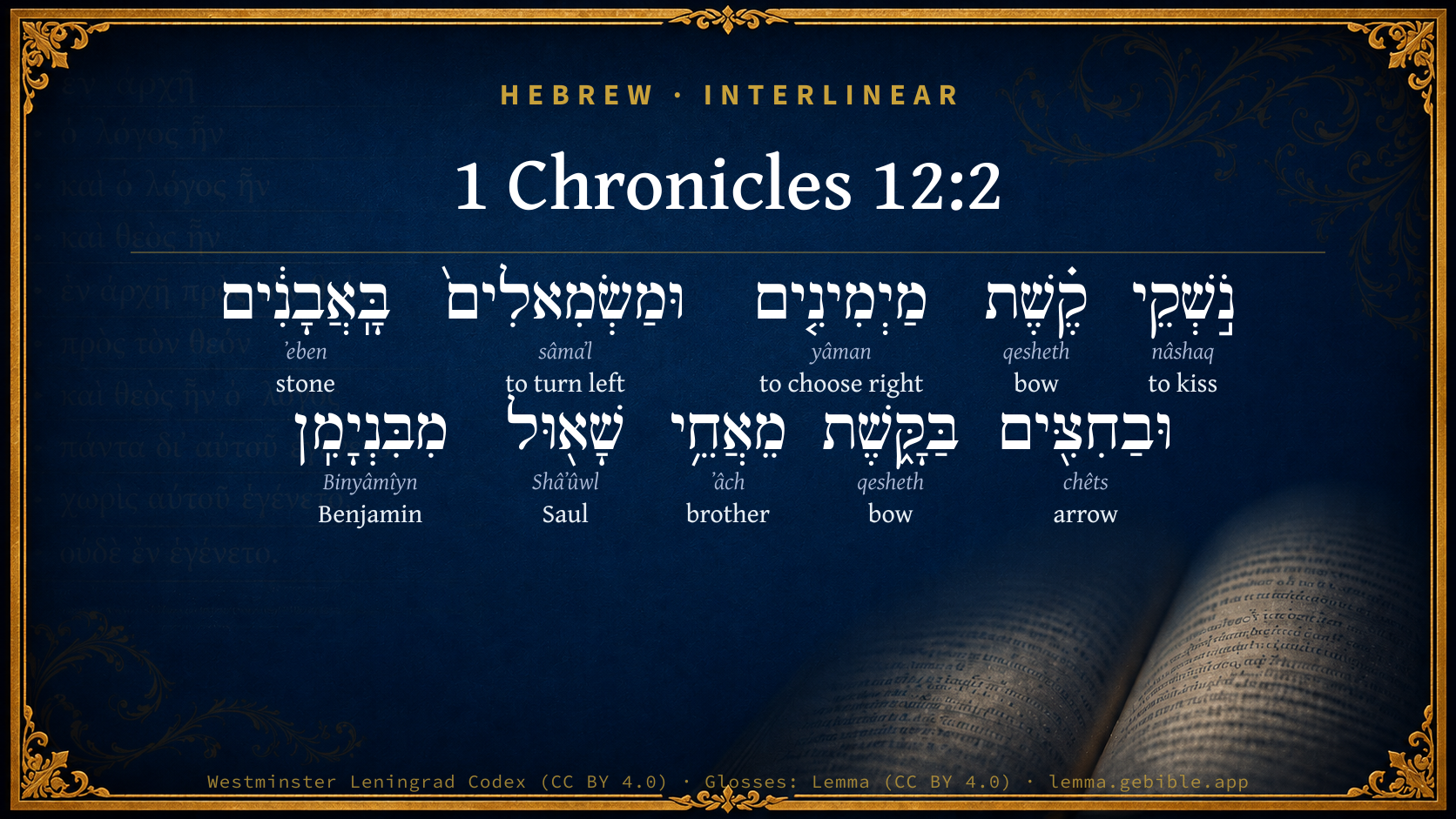
1 Chronicles 12:2

Hebrew (Westminster Leningrad Codex) 1 Chronicles 12:2 appears in the Hebrew Old Testament. The text above is from the Westminster Leningrad Codex. Each word links to its Strong’s number, a concise gloss, and parsing drawn from the Open Scriptures Hebrew Bible morphology. Click any word for its full Brown-Driver-Briggs (BDB) entry.
Download image
Cite this verse

1 Chronicles 12:2 (World English Bible). Public Domain. Lemma interlinear Bible study tool, https://lemma.gebible.app/v/1-chronicles/12/2.

Show BibTeX & RIS
BibTeX
RIS
English Translation
They were armed with bows, and could use both the right hand and the left in slinging stones and in shooting arrows from the bow: they were of Saul's brothers of Benjamin.
World English Bible · Public Domain
Download a study sheet

One document with this verse’s original text, its word-by-word gloss line, the meaning frame, cross-references with their text, attributed commentary, and full source and license credits — printable, and it pastes into notes with its structure intact.

This verse Autodidact and up

Study sheet (.html) Plain text (.txt)

A passage Seminary Student

Up to 50 verses in one chapter. A passage sheet keeps up to 6 commentary sources and 12 cross-references per verse, in the order this page ranks them, and says so on the sheet whenever that leaves anything out. Ask for a single verse and you get the Autodidact verse sheet above.

Everything on this page stays free to read, with no account — the sheet is a download of what is already on screen, not access to it.

Want to remove ads? Support Godless Engineer
Compare translations 3

The same verse in 3 English versions, stacked beneath the original-language interlinear above. Click any original word for its lexicon entry.

Each is an independent rendering of the whole verse — the interlinear is not word-aligned to these translations.

Highlighted words mark where these versions differ — a whole-verse word diff, not a word-by-word alignment.

  • World English Bible Public Domain
    They were armed with bows, and could use both the right hand and the left in slinging stones and in shooting arrows from the bow: they were of Saul's brothers of Benjamin.
  • King James Version Public Domain
    They were armed with bows, and could use both the right hand and the left in hurling stones and shooting arrows out of a bow, even of Saul's brethren of Benjamin.
  • unfoldingWord Literal Text CC BY-SA 4.0
    Kissers of the bow, being right-handed and being left-handed with stones, and with arrows with the bow, from the brothers of Saul, from Benjamin:

unfoldingWord Literal Text — © unfoldingWord, licensed CC BY-SA 4.0. Word-aligned USFM3 via Door43 (git.door43.org/unfoldingWord/en_ult).

Versions to compare (up to 4)

3 of 4 selected

Show all 18 translations

Every available English version of this verse, each an independent rendering of the whole verse.

  • World English Bible Public Domain
    They were armed with bows, and could use both the right hand and the left in slinging stones and in shooting arrows from the bow: they were of Saul's brothers of Benjamin.
  • Berean Standard Bible Public Domain
    they were archers using both the right and left hands to sling stones and shoot arrows; and they were Saul’s kinsmen from Benjamin):
  • Majority Standard Bible Public Domain
    they were archers using both the right and left hands to sling stones and shoot arrows; and they were Saul’s kinsmen from Benjamin):
  • King James Version Public Domain
    They were armed with bows, and could use both the right hand and the left in hurling stones and shooting arrows out of a bow, even of Saul's brethren of Benjamin.
  • American Standard Version (1901) Public Domain
    They were armed with bows, and could use both the right hand and the left in slinging stones and in shooting arrows from the bow: they were of Saul's brethren of Benjamin.
  • Revised Version (1885) Public Domain
    They were armed with bows, and could use both the right hand and the left in slinging stones and in shooting arrows from the bow; they were of Saul’s brethren of Benjamin.
  • Geneva Bible (1599) Public Domain
    They were weaponed with bowes, and could vse the right and the left hand with stones and with arrowes and with bowes, and were of Sauls brethren, euen of Beniamin.
  • Douay-Rheims (1899) Public Domain
    Bending the bow, and using either hand in hurling stones with slings, and shooting arrows: of the brethren of Saul of Benjamin.
  • Young's Literal Translation Public Domain
    armed with bow, right and left handed, with stones, and with arrows, with bows, of the brethren of Saul, of Benjamin.
  • Literal Standard Version CC BY-SA 4.0
    armed with bow, right and left handed, with stones, and with arrows, with bows, of the brothers of Saul, of Benjamin.
  • Unlocked Literal Bible CC BY-SA 4.0
    They were armed with bows and could use both the right hand and the left in slinging stones and in shooting arrows from the bow. They were Benjamites, Saul's fellow tribesmen.
  • unfoldingWord Literal Text CC BY-SA 4.0
    Kissers of the bow, being right-handed and being left-handed with stones, and with arrows with the bow, from the brothers of Saul, from Benjamin:
  • Darby Bible Public Domain
    armed with bows, using both the right hand and the left with stones and with arrows on the bow; [they were] of Saul's brethren of Benjamin:
  • World Messianic Bible Public Domain
    They were armed with bows, and could use both the right hand and the left in slinging stones and in shooting arrows from the bow. They were of Saul’s relatives of the tribe of Benjamin.
  • Webster's Bible Public Domain
    They were armed with bows, and could use both the right hand and the left in hurling stones, and shooting arrows from a bow, even of Saul's brethren of Benjamin.
  • Free Bible Version CC BY-SA 4.0
    They were all skilled archers, and could shoot arrows or slingshots with their right or their left hands. They were relatives of Saul from the tribe of Benjamin.
  • Bible in Basic English Public Domain
    They were armed with bows, and were able to send stones, and arrows from the bow, with right hand or left: they were Saul's brothers, of Benjamin.
  • JPS Tanakh (1917) Public Domain
    They were armed with bows, and could use both the right hand and the left in slinging stones and in shooting arrows from the bow; they were of Saul's brethren of Benjamin.

Literal Standard Version (2020), Covenant Press — licensed CC BY-SA 4.0. Text via the HelloAO Bible API (eBible.org). Unlocked Literal Bible (unfoldingWord) — licensed CC BY-SA 4.0. Text via the HelloAO Bible API (eBible.org). unfoldingWord Literal Text — © unfoldingWord, licensed CC BY-SA 4.0. Word-aligned USFM3 via Door43 (git.door43.org/unfoldingWord/en_ult). Free Bible Version, Dr. Jonathan Gallagher — licensed CC BY-SA 4.0. Text via the HelloAO Bible API (eBible.org).

Word by word

More ways to search: Search by grammar → Find every occurrence → Compare this word →

Practice this passage: Drill this verse → Learn its vocabulary →

מַיְמִינִ֤ים
yâman
H3231
“choosing right”
Verb, Hiphil, Participle Active, Masculine, Plural, Absolute
Part of Speech
Verb
Stem
Hiphil
Form
Participle Active
Gender
Masculine
Number
Plural
State
Absolute
Full BDB Definition

Origin: a primitive root

TWOT: 872c

(Hiphil) to choose the right, go to the right, use the right hand, be right handed
  1. נֹ֣שְׁקֵי nâshaq H5401 “kissing” Verb, Qal, Participle Active, Masculine, Plural, Construct
  2. קֶ֗שֶׁת qesheth H7198 “bow” Noun, Common, Feminine, Singular, Absolute
  3. וּמַשְׂמִאלִים֙ sâmaʼl H8041 “and · turning left” Conjunction + Verb, Hiphil, Participle Active, Masculine, Plural, Absolute
  4. בָּֽאֲבָנִ֔ים ʼeben H68 “in/at the · stones” Preposition, Determined + Noun, Common, Feminine, Plural, Absolute
  5. וּבַחִצִּ֖ים chêts H2671 “and · in/at the · arrows” Conjunction + Preposition, Determined + Noun, Common, Masculine, Plural, Absolute
  6. בַּקָּ֑שֶׁת qesheth H7198 “in/at the · bow” Preposition, Determined + Noun, Common, Feminine, Singular, Absolute
  7. מֵאֲחֵ֥י ʼâch H251 “from · brothers of” Preposition + Noun, Common, Masculine, Plural, Construct
  8. שָׁא֖וּל Shâʼûwl H7586 “Saul” Noun, Proper
  9. מִבִּנְיָמִֽן Binyâmîyn H1144 “from · Benjamin” Preposition + Noun, Proper

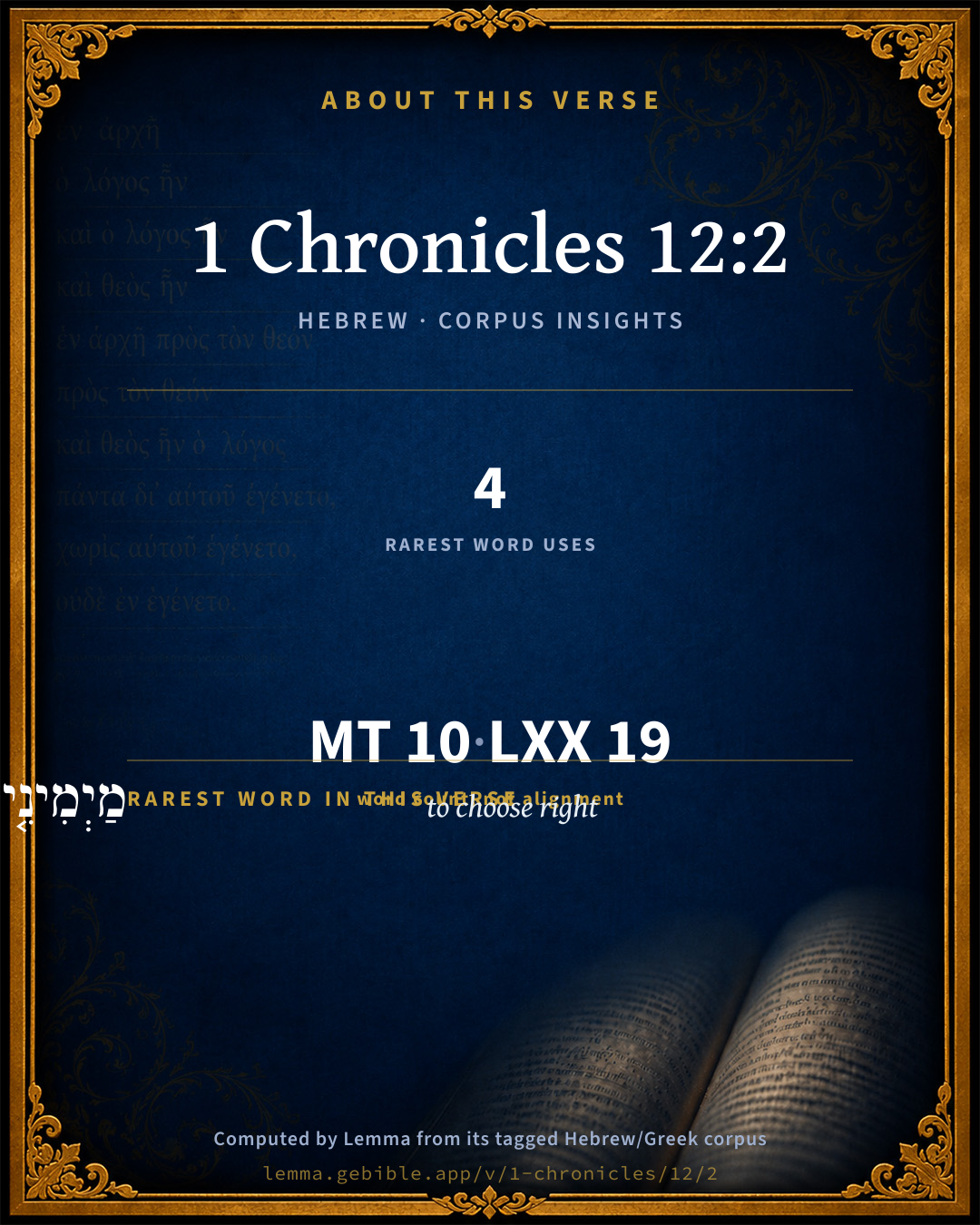
About this verse

These counts appear in no published source. They are computed here, from the morphology-tagged text and Lemma’s own curated glosses. What Lemma adds →

10
words
9
distinct lemmas
Historical
section

Notable vocabulary

The rarest word here is מַיְמִינִ֤ים to choose right H3231 — appearing just 4 times in the whole Hebrew Bible.

Shared distinctive vocabulary

מַיְמִינִ֤ים to choose right H3231 occurs in 4 verses of the Hebrew Bible. Also found in:

Grammatical profile

  • 3 verbs
  • 7 nouns

Verb forms

  • נֹ֣שְׁקֵי Qal · Participle Active
  • מַיְמִינִ֤ים Hiphil · Participle Active
  • וּמַשְׂמִאלִים֙ Hiphil · Participle Active

Repetition

A word recurs within this verse — often emphatic in Hebrew:

  • קֶ֗שֶׁת bow H7198 ×2

Hebrew & Septuagint length

In English translation the verse runs 32 words from the Hebrew and 27 from the Septuagint (LXX English) — closely comparable.

A rough comparison of the two English renderings, which tokenize alike — not a word-level alignment.

Word counts can differ between the Hebrew and the Greek without any difference in meaning — e.g. the Hebrew direct-object marker אֵת has no separate Greek word, and Greek often adds the article ὁ.

In the original languages it is 10 Hebrew tokens and 19 Greek tokens — but the two are counted differently (Hebrew bundles its prefixes and suffixes into one token; the Greek is in lemma form), so that isn’t a like-for-like length.

Cross-references

4

Topical passages linked to 1 Chronicles 12:2 in the Treasury of Scripture Knowledge — connected by theme and wording, ordered by reader-vote popularity; previews shown in the World English Bible.

  • Judges 3:15 But when the children of Israel cried to Yahweh, Yahweh raised them up a savior, Ehud the son of Gera, the Benjamite, a man left-handed. The children of Israel sent tribute by him to Eglon the king of Moab.
  • Judges 20:16 Among all this people there were seven hundred chosen men left-handed; everyone could sling stones at a hair-breadth, and not miss.
  • 1 Samuel 17:49 David put his hand in his bag, and took there a stone, and slang it, and struck the Philistine in his forehead; and the stone sank into his forehead, and he fell on his face to the earth.
  • 1 Chronicles 12:29 Of the children of Benjamin, the brothers of Saul, three thousand: for hitherto the greatest part of them had kept their allegiance to the house of Saul.

Cross-references courtesy of OpenBible.info (CC BY 4.0).

Hebrew and Greek witnesses Masoretic Hebrew ↔ Greek Septuagint

The same verse in the two great witnesses to the Old Testament, shown verse-for-verse.

These are two independent witnesses, not word-aligned to each other, and the Septuagint is shown in lemma (dictionary) form.

Hebrew 1 Chronicles 12:2 Masoretic · Westminster Leningrad Codex

נֹ֣שְׁקֵי קֶ֗שֶׁת מַיְמִינִ֤ים וּמַשְׂמִאלִים֙ בָּֽאֲבָנִ֔ים וּבַחִצִּ֖ים בַּקָּ֑שֶׁת מֵאֲחֵ֥י שָׁא֖וּל מִבִּנְיָמִֽן

They were armed with bows, and could use both the right hand and the left in slinging stones and in shooting arrows from the bow: they were of Saul's brothers of Benjamin.

World English Bible · Public Domain

Greek LXX 1 Chronicles 12:2 Septuagint · lemma form

καί τόξον ἐκ δεξιός καί ἐκ ἀριστερός καί σφενδονήτης ἐν λίθος καί τόξον ἐκ ὁ ἀδελφός σαούλ ἐκ βενιαμίν

and using the bow with the right hand and with the left, and slingers with stones, and shooters with bows. Of the brethren of Saul of Benjamin,

LXX2012 (modern English Septuagint) · Public Domain

Hebrew: Westminster Leningrad Codex (CC BY 4.0). Greek: Septuagint (public domain); English from LXX2012 (modern English Septuagint) (Public Domain). How the Septuagint differs from the Hebrew →

Commentary

Notes on 1 Chronicles 12:2 from classic Christian and Jewish commentators (each source and its license shown beneath its notes). The classic Christian expositions comment on the surrounding passage and are grouped to its opening verse, so a note may address several verses; the Jewish commentaries on the Tanakh (Rashi and others) are per-verse, so they appear only where the commentator wrote on this verse.

Lemma curates 59 commentaries, every one of them public domain or Creative Commons licensed, each selected and text-cleaned for this edition rather than reprinted as found. About our sources →

Trapp's Complete Commentary

John Trapp

1Ch 12:2 [They were] armed with bows, and could use both the right hand and the left in [hurling] stones and [shooting] arrows out of a bow, [even] of Saul’s brethren of Benjamin.

Ver. 2. Even of Saul’s brethren of Benjamin.] Mirum hoc fuit et quasi miraculum. It is God who worketh men’s hearts, and fashioneth their opinions. Paul had friends in Nero’s court, and Luther in the Pope’s.

John Trapp, A Commentary or Exposition upon All the Books of the Old and New Testament (1647–1656) — public domain. Text from a community e-Sword module.

Joseph Benson's Commentary

1Ch 12:2. Could use both the right hand and the left — With like nimbleness and certainty: compare Jdg 3:15; and Jdg 20:16. Saul’s brethren of Benjamin — Of Saul’s own tribe: who were moved hereto by God’s Spirit, by the conscience of their duty to David, and by their observation of God’s departure from Saul, and of his special presence with David.

Joseph Benson's Commentary on the Old and New Testaments (1811–1818) — public domain. Text from a community e-Sword module.

Geneva Bible (1599)

Geneva Bible translators

That is, of the tribe of Benjamin, whereof Saul was, and wherein were excellent throwers with slings, Judg. 20:16.

Geneva Bible (1599) marginal notes — public domain. Text via Bolls.life.

Jamieson, Fausset & Brown

Robert Jamieson, A. R. Fausset & David Brown

of Saul's brethren of Benjamin--that is, of the tribe of Benjamin (compare Ch1 12:29), but some of them might be relatives of the king. This movement to which the parties were led, doubtless by the secret impulse of the Spirit, was of vast importance to the cause of David, as it must have been founded on their observation of the evident withdrawal of God's blessing from Saul, and His favoring presence with David, to whom it was universally known the Divine King of Israel had given the crown in reversion. The accession of the Benjamites who came first and their resolution to share his fortunes must have been particularly grateful to David. It was a public and emphatic testimony by those who had enjoyed the best means of information to the unblemished excellence of his character, as well as a decided protest against the grievous wrong inflicted by causelessly outlawing a man who had rendered such eminent services to his country.

Jamieson, Fausset & Brown — Commentary Critical and Explanatory on the Whole Bible (1871) — public domain (CC PDM 1.0). Text via the HelloAO Bible API.

Ellicott's Commentary for English Readers

(2) Armed with bows.—Literally, drawers of the bow (2Ch_17:17).

And could use.—They were ambidextrous “with stones, and with arrows on the bow.” The left-handed slingers of Benjamin were famous from of old. (Comp. Jdg_20:16, and also 1Ch_3:15.)

Of Saul’s brethren—i.e., his fellow-tribesmen.

Of Benjamin is added to make it clear that Saul’s immediate kinsmen are not intended. (Comp. 1Ch_12:29.)

A Bible Commentary for English Readers, edited by Charles John Ellicott (1878–1897) — public domain. Text from a community e-Sword module.

The Cambridge Bible for Schools and Colleges

gen. ed. J. J. S. Perowne

2. both the right hand and the left] On the occasion described in Judges 20 the Benjamites are said to have had seven hundred men lefthanded who could sling stones at a hair and not miss (ib. Jdg_20:16). Cp. Jdg_3:15.

even of Saul’s brethren of Benjamin] R.V. they were of Saul’s brethren of Benjamin. Brother is used in Heb. and Arabic for fellow-tribesman; cp. 2Sa_19:12.

The Cambridge Bible for Schools and Colleges (gen. ed. J. J. S. Perowne; Cambridge University Press, 1878–1918) — public domain. Text from a community e-Sword module.

John Gill's Exposition

They were armed with bows,.... Much used in war in those times:

and could use both the right hand and the left, in hurling stones, and shooting arrows out of a bow; they were ambidextrous; who could sling stones, or shoot arrows, with either, which was no small advantage to them:

even of Saul's brethren of Benjamin; they were of the tribe of Benjamin, of which Saul was, and so his brethren; and they might be, at least some of them, his relations and kinsmen; who observing the unreasonableness of Saul's enmity to David, and detesting his cruelty, and sensible of the innocence of David, and of the service he had done his country; and perhaps not being ignorant of his divine right and title to the kingdom, went over to him, to comfort, strengthen, and assist him.

John Gill's Exposition of the Whole Bible (1746–1763) — public domain (CC PDM 1.0). Text via the HelloAO Bible API.

Albert Barnes' Notes on the Bible

The skill of the Benjamites as archers is noted in 1Ch 8:40, and 2Ch 14:8. Their proficiency in using the left hand appears in the narrative of Judges (Jdg 3:15, and marginal reference) where their special excellency as slingers is also noticed.

Even of Saul’s brethren - Compare 1Ch 12:29. Even of Saul’s own tribe there were some who separated themselves from his cause, and threw in their lot with David.

Albert Barnes' Notes on the Bible (1834–1885) — public domain. Text from a community e-Sword/MySword module.

Haydock's Catholic Bible Commentary

Hand, like Aod, Judges iii. 15. (Menochius) --- Brethren, of the same tribe. The opinion which they entertained of David, must have been very great, to make them expose themselves to such dangers. In adversity, true friendship and virtue shine the most. (Calmet) --- The hand of providence is here conspicuous. (Tirinus)

George Leo Haydock (1774–1849), Haydock's Catholic Family Bible and Commentary, 1859 edition — public domain. Excludes Psalms (Douay-Rheims chapter numbering differs from Protestant) and Deuterocanonical books (Catholic canon only).

Matthew Poole's English Annotations

Could use both the right hand and the left, with like nimbleness and certainty. Compare Jdg 3:15; 20:16.

Of Saul’s brethren of Benjamin, i.e. of Saul’s own tribe; who were moved hereunto by God’s Spirit, and by the conscience of their duty to David, to whom God had given the crown in reversion; and by their observation of God’s departure from Saul, and of his special presence with David, and his gracious providence for him.

Matthew Poole's English Annotations on the Holy Bible (1683–1685) — public domain. Text from a community e-Sword/MySword module.

Whedon's Commentary on the Bible

Daniel D. Whedon

2. Could use both the right hand and the left — Hence their skill had been acquired by long and careful practice. See Jdg_3:15; Jdg_20:16, notes.

Even of Saul’s brethren — That is, who were members of his own tribe. Even these revolted from Saul, and cast in their lot with David.

Daniel D. Whedon (gen. ed.), Commentary on the Old and New Testaments (1874–1909) — public domain. Text from a community e-Sword module.

The Pulpit Commentary

Of Saul"s brethren of Benjamin. It would be better to read these words as the commencement of the next verse. Prominence is given to the fact that this set of helpers of David, counting in all twenty-three, comprised Benjamites men of the same tribe with Saul (ver. 29). They had seen and been impressed by the wrongness and cruelty of Saul, and found themselves unable to keep in sympathy with him. Of such were Eleazar, Ilai, and Ithai, mentioned in the preceding chapter. (1Ch_11:12, 1Ch_11:29, 1Ch_11:31, respectively) The Benjamites were noted both for their use of the bow, and of their own left hand (Jud_1:3:15, 21 20:15, 16; 1Ch_8:39, 1Ch_8:40; 2Ch_14:8)

The Pulpit Commentary (1880–1919), ed. H.D.M. Spence-Jones & Joseph S. Exell — public domain. Text from a community e-Sword module.

John Wesley's Explanatory Notes

Even - Of Saul's own tribe: who were moved hereto by God's spirit, by the conscience of their duty to David; and by their observation of God's departure from Saul, and of his special presence with David.

John Wesley, Explanatory Notes Upon the Whole Bible (1754–1765) — public domain. Text via the GEBible commentary corpus.

Keil & Delitzsch

C. F. Keil & F. Delitzsch

They were armed with bows,.... Much used in war in those times:

and could use both the right hand and the left, in hurling stones, and shooting arrows out of a bow; they were ambidextrous; who could sling stones, or shoot arrows, with either, which was no small advantage to them:

even of Saul's brethren of Benjamin; they were of the tribe of Benjamin, of which Saul was, and so his brethren; and they might be, at least some of them, his relations and kinsmen; who observing the unreasonableness of Saul's enmity to David, and detesting his cruelty, and sensible of the innocence of David, and of the service he had done his country; and perhaps not being ignorant of his divine right and title to the kingdom, went over to him, to comfort, strengthen, and assist him.

Keil & Delitzsch — Biblical Commentary on the Old Testament (1861–1891) — public domain (CC PDM 1.0). Text via the HelloAO Bible API. (Old Testament only.)

Rashi

Rabbi Shlomo Yitzchaki (Rashi)

Armed with bows armed with a bow and with arrows and shooting in front of them and behind them. And they would even place stones on the bowstring and shoot. I personally saw many like these.

of Saul’s brethren of Benjamin Since they were all descended from one man, from Benjamin, they are all called brethren, and in honor of David’s greatness, the Chronicler says, “of Saul’s brethren,” [saying] that even Saul’s brethren came to him while Saul was still living.

Rashi on the Tanakh — English translations: “The Judaica Press complete Tanach with Rashi, translated by A. J. Rosenberg” (CC BY 4.0); “Pentateuch with Rashi's commentary by M. Rosenbaum and A.M. Silbermann, 1929-1934” (public domain); “The Metsudah Tanach series, Lakewood, N.J” (CC BY 4.0); and “The Book of Joshua, Metsudah Publications, 1997” (CC BY 4.0). Text via Sefaria.

Lesson kit

Teaching starters — assembled from the data on this page, not authored interpretation. Every prompt links to the verse data it draws on. Edit before teaching.

1 Chronicles, in the Historical, opens this verse with 10 words (9 distinct Hebrew lemmas). Its most distinctive word is yâman (“to choose right”). A historical commentator’s framing appears above. Read the whole chapter for the surrounding context.

Discussion questions

  1. The word yâman carries the sense “to choose right.” How does it shape the verse?
  2. Genesis 13:9 shares the word «to choose right» with this verse. How do the two illuminate each other?
  3. “bow” occurs 2× in this one verse. What is the effect of the repetition?
  4. These translations render this verse differently; the difference is in the English rendering, not the original. What questions does that raise?
  5. The verb «נֹ֣שְׁקֵי» is Qal Participle Active. How does its form color the action?
  6. Reading how Trapp's Complete Commentary and Joseph Benson's Commentary read this verse, where do the two commentators agree and where do they part?

Things to notice

Reading settings

Reading text

Shown beneath each verse's original-language words.

Old Testament
Old Testament edition

Read the OT as the Masoretic Hebrew (MT) or the Greek Septuagint (LXX).

English shown for the Greek Septuagint (in the Hebrew ↔ Greek comparison).

Comparing translations? Open the Compare panel on any verse page to stack up to four side by side.