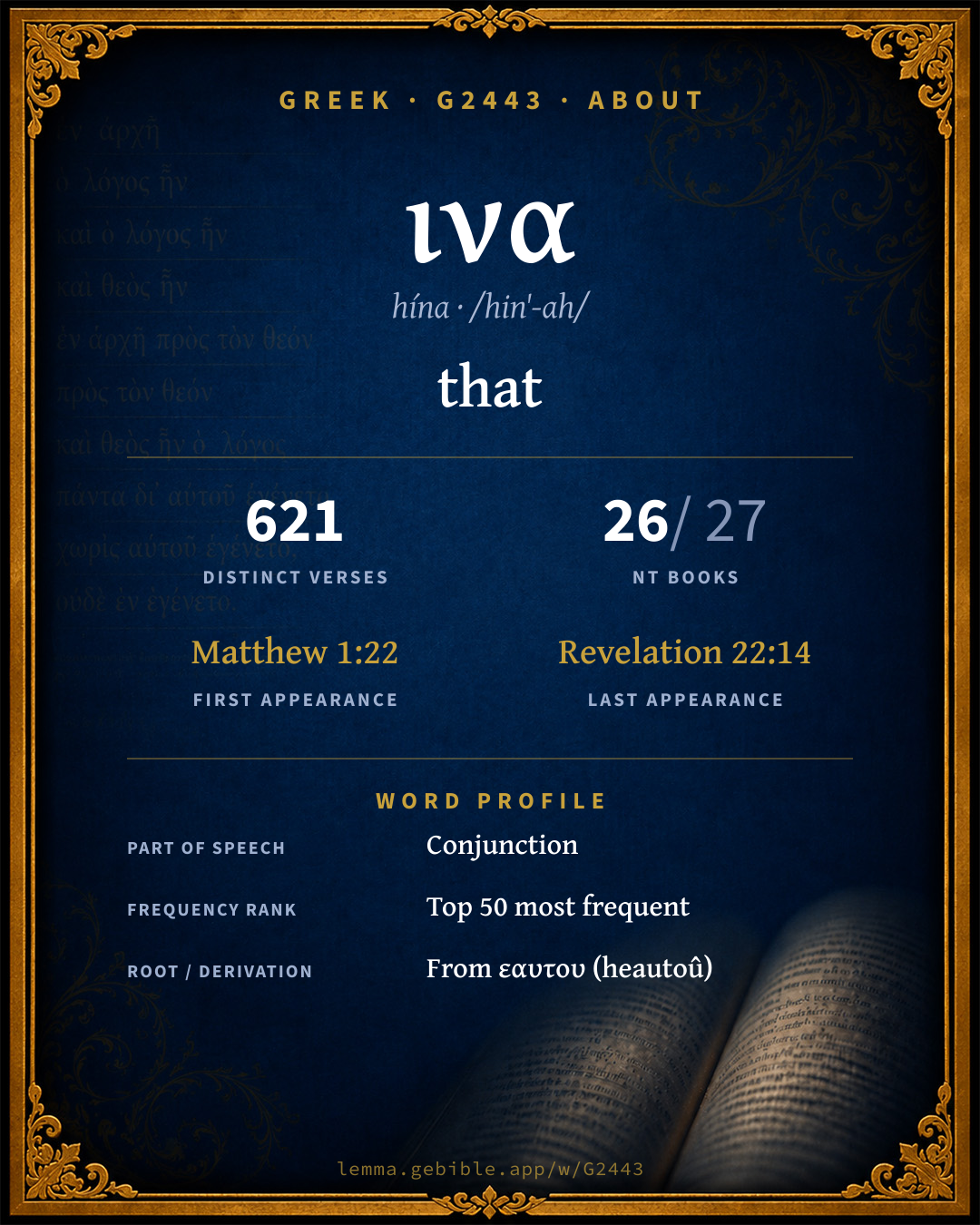
ἵνα
that
Full lexicon entry — Thayer's Greek Lexicon
From Thayer's Greek Lexicon
Where this word appears
Grammar key — what these labels mean
Part of speech
- Conjunction
- A joining word linking words or clauses.
Every verse where G2443 appears in the Book of Mark — 59 distinct verses. Click any verse to open its interlinear word-by-word view. Verse text shown in the World English Bible for context — . Each verse’s Greek form is shown with its reference; the English is not keyword-highlighted, since the data carries no word-level English alignment. Use “Compare translations” on any verse to read it across multiple English versions. This concordance covers the Greek New Testament; Septuagint (Greek Old Testament) occurrences of this word are not indexed here.
Mark
- Mark 1:38 ἵνα conj He said to them, "Let's go elsewhere into the next towns, that I may preach there also, because for this reason I came forth."
- Mark 2:10 ἵνα conj But that you may know that the Son of Man has authority on earth to forgive sins"--he said to the paralytic--
- Mark 3:2 ἵνα conj They watched him, whether he would heal him on the Sabbath day, that they might accuse him.
- Mark 3:9 ἵνα ἵνα conj conj He spoke to his disciples that a little boat should stay near him because of the crowd, so that they wouldn't press on him.
- Mark 3:10 ἵνα conj For he had healed many, so that as many as had diseases pressed on him that they might touch him.
- Mark 3:12 ἵνα conj He sternly warned them that they should not make him known.
- Mark 3:14 ἵνα ἵνα conj conj He appointed twelve, that they might be with him, and that he might send them out to preach,
- Mark 4:12 ἵνα conj that 'seeing they may see, and not perceive; and hearing they may hear, and not understand; lest perhaps they should turn again, and their sins should be forgiven them.'"
- Mark 4:21 ἵνα ἵνα conj conj He said to them, "Is the lamp brought to be put under a basket or under a bed? Isn't it put on a lampstand?
- Mark 4:22 ἵνα ἵνα conj conj For there is nothing hidden, except that it should be made known; neither was anything made secret, but that it should come to light.
- Mark 5:10 ἵνα conj He begged him much that he would not send them away out of the country.
- Mark 5:12 ἵνα conj All the demons begged him, saying, "Send us into the pigs, that we may enter into them."
- Mark 5:18 ἵνα conj As he was entering into the boat, he who had been possessed by demons begged him that he might be with him.
- Mark 5:23 ἵνα ἵνα conj conj and begged him much, saying, "My little daughter is at the point of death. Please come and lay your hands on her, that she may be made healthy, and live."
- Mark 5:43 ἵνα conj He strictly ordered them that no one should know this, and commanded that something should be given to her to eat.
- Mark 6:8 ἵνα conj He charged them that they should take nothing for their journey, except a staff only: no bread, no wallet, no money in their purse,
- Mark 6:12 ἵνα conj They went out and preached that people should repent.
- Mark 6:25 ἵνα conj She came in immediately with haste to the king, and asked, "I want you to give me right now the head of John the Baptizer on a platter."
- Mark 6:36 ἵνα conj Send them away, that they may go into the surrounding country and villages, and buy themselves bread, for they have nothing to eat."
- Mark 6:41 ἵνα conj He took the five loaves and the two fish, and looking up to heaven, he blessed and broke the loaves, and he gave to his disciples to set before them, and he divided the two fish among them all.
- Mark 6:56 ἵνα conj Wherever he entered, into villages, or into cities, or into the country, they laid the sick in the marketplaces, and begged him that they might touch just the fringe of his garment; and as many as touched him were made well.
- Mark 7:9 ἵνα conj He said to them, "Full well do you reject the commandment of God, that you may keep your tradition.
- Mark 7:26 ἵνα conj Now the woman was a Greek, a Syrophoenician by race. She begged him that he would cast the demon out of her daughter.
- Mark 7:32 ἵνα conj They brought to him one who was deaf and had an impediment in his speech. They begged him to lay his hand on him.
- Mark 7:36 ἵνα conj He commanded them that they should tell no one, but the more he commanded them, so much the more widely they proclaimed it.
- Mark 8:6 ἵνα conj He commanded the multitude to sit down on the ground, and he took the seven loaves. Having given thanks, he broke them, and gave them to his disciples to serve, and they served the multitude.
- Mark 8:22 ἵνα conj He came to Bethsaida. They brought a blind man to him, and begged him to touch him.
- Mark 8:30 ἵνα conj He charged them that they should tell no one about him.
- Mark 9:9 ἵνα conj As they were coming down from the mountain, he charged them that they should tell no one what things they had seen, until after the Son of Man had risen from the dead.
- Mark 9:12 ἵνα conj He said to them, "Elijah indeed comes first, and restores all things. How is it written about the Son of Man, that he should suffer many things and be despised?
- Mark 9:18 ἵνα conj and wherever it seizes him, it throws him down, and he foams at the mouth, and grinds his teeth, and wastes away. I asked your disciples to cast it out, and they weren't able."
- Mark 9:22 ἵνα conj Often it has cast him both into the fire and into the water, to destroy him. But if you can do anything, have compassion on us, and help us."
- Mark 9:30 ἵνα conj They went out from there, and passed through Galilee. He didn't want anyone to know it.
- Mark 10:13 ἵνα conj They were bringing to him little children, that he should touch them, but the disciples rebuked those who were bringing them.
- Mark 10:17 ἵνα conj As he was going out into the way, one ran to him, knelt before him, and asked him, "Good Teacher, what shall I do that I may inherit eternal life?"
- Mark 10:35 ἵνα conj James and John, the sons of Zebedee, came near to him, saying, "Teacher, we want you to do for us whatever we will ask."
- Mark 10:37 ἵνα conj They said to him, "Grant to us that we may sit, one at your right hand, and one at your left hand, in your glory."
- Mark 10:48 ἵνα conj Many rebuked him, that he should be quiet, but he cried out much more, "You son of David, have mercy on me!"
- Mark 10:51 ἵνα conj Jesus asked him, "What do you want me to do for you?" The blind man said to him, "Rhabboni, that I may see again."
- Mark 11:16 ἵνα conj He would not allow anyone to carry a container through the temple.
- Mark 11:25 ἵνα conj Whenever you stand praying, forgive, if you have anything against anyone; so that your Father, who is in heaven, may also forgive you your transgressions.
- Mark 11:28 ἵνα conj and they began saying to him, "By what authority do you do these things? Or who gave you this authority to do these things?"
- Mark 12:2 ἵνα conj When it was time, he sent a servant to the farmer to get from the farmer his share of the fruit of the vineyard.
- Mark 12:13 ἵνα conj They sent some of the Pharisees and of the Herodians to him, that they might trap him with words.
- Mark 12:15 ἵνα conj Shall we give, or shall we not give?" But he, knowing their hypocrisy, said to them, "Why do you test me? Bring me a denarius, that I may see it."
- Mark 12:19 ἵνα conj "Teacher, Moses wrote to us, 'If a man's brother dies, and leaves a wife behind him, and leaves no children, that his brother should take his wife, and raise up offspring for his brother.'
- Mark 13:18 ἵνα conj Pray that your flight won't be in the winter.
- Mark 13:34 ἵνα conj "It is like a man, traveling to another country, having left his house, and given authority to his servants, and to each one his work, and also commanded the doorkeeper to keep watch.
- Mark 14:10 ἵνα conj Judas Iscariot, who was one of the twelve, went away to the chief priests, that he might deliver him to them.
- Mark 14:12 ἵνα conj On the first day of unleavened bread, when they sacrificed the Passover, his disciples asked him, "Where do you want us to go and make ready that you may eat the Passover?"
- Mark 14:35 ἵνα conj He went forward a little, and fell on the ground, and prayed that, if it were possible, the hour might pass away from him.
- Mark 14:38 ἵνα conj Watch and pray, that you may not enter into temptation. The spirit indeed is willing, but the flesh is weak."
- Mark 14:49 ἵνα conj I was daily with you in the temple teaching, and you didn't arrest me. But this is so that the Scriptures might be fulfilled."
- Mark 15:11 ἵνα conj But the chief priests stirred up the multitude, that he should release Barabbas to them instead.
- Mark 15:15 ἵνα conj Pilate, wishing to please the multitude, released Barabbas to them, and handed over Jesus, when he had flogged him, to be crucified.
- Mark 15:20 ἵνα conj When they had mocked him, they took the purple off of him, and put his own garments on him. They led him out to crucify him.
- Mark 15:21 ἵνα conj They compelled one passing by, coming from the country, Simon of Cyrene, the father of Alexander and Rufus, to go with them, that he might bear his cross.
- Mark 15:32 ἵνα conj Let the Christ, the King of Israel, now come down from the cross, that we may see and believe him." Those who were crucified with him insulted him.
- Mark 16:1 ἵνα conj When the Sabbath was past, Mary Magdalene, and Mary the mother of James, and Salome, bought spices, that they might come and anoint him.
About this entry
At a glance — auto-summarized from this page’s data, not written by a person. Every figure links to its source below. This summary describes the numbers; it doesn’t interpret them.
At its core, ινα (hína) means “that.” It first appears in Matthew 1:22. Spanning 621 verses in 26 books, it ranks among the most common words of the Greek New Testament. Sharing its root, it stands alongside εαυτου, αυτου and ινατι. Each statement above links to its evidence; the full detail follows below.
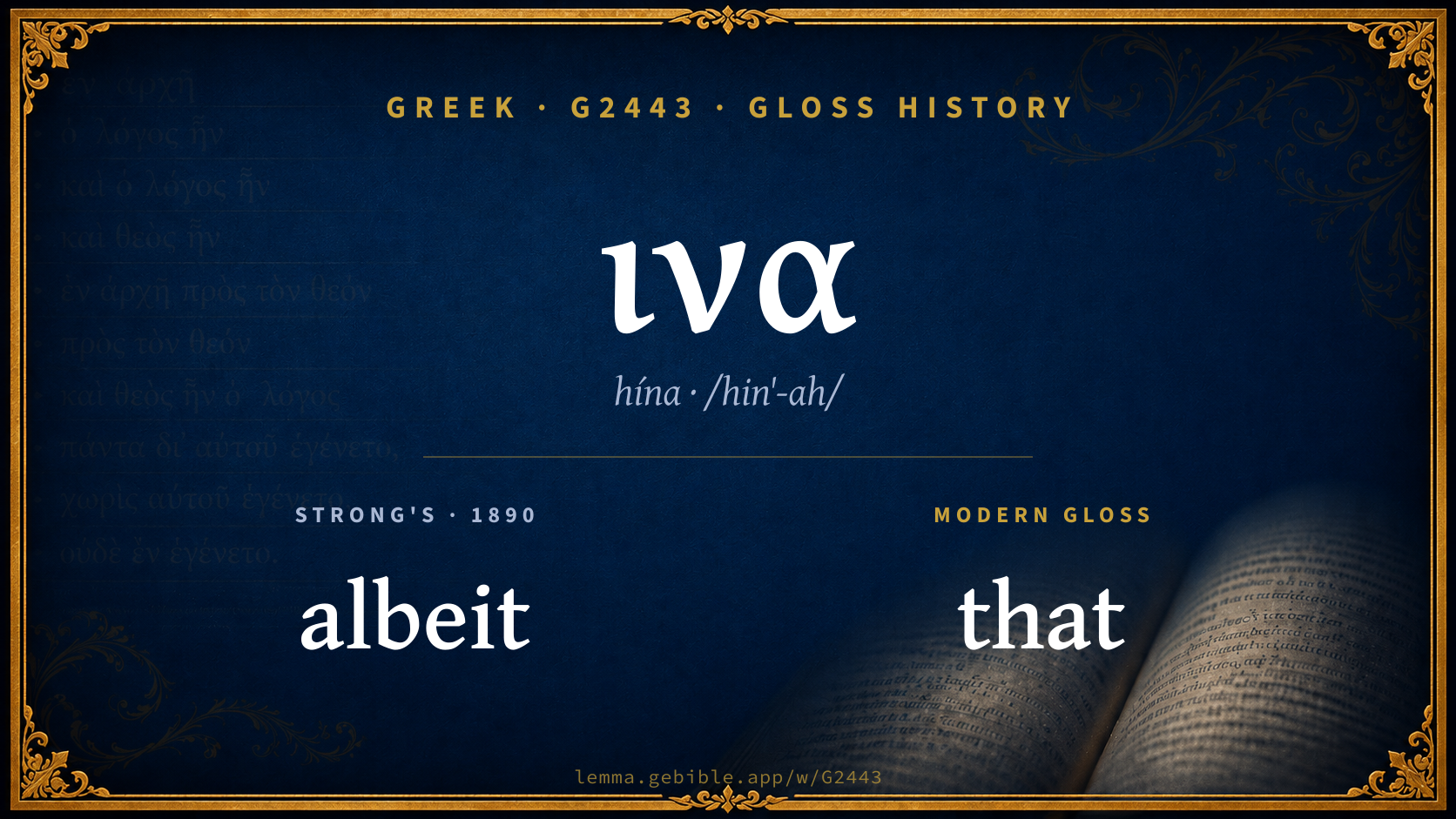
Gloss history
Strong's 1890 vs modern scholarship
About this word
Strong's G2443 catalogs a Greek word from the Greek New Testament.
These counts are not copied from any lexicon or concordance. They are computed here, from the morphology-tagged Greek New Testament. What Lemma adds →
- 621
- distinct verses
- The word appears in 621 distinct verses.
- 26 / 27
- NT books
- The word appears in 26 of 27 New Testament books.
- #29
- by frequency
- Top 50 most frequent Greek words (rank 29 of 5,347 Greek words by occurrence).
View all 621 occurrences in the concordance →
Most concentrated in
- John 132 verses 21%
- Mark 59 verses 10%
- 1 Corinthians 50 verses 8%
By section of the New Testament
By traditional corpus
Conventional, traditional groupings — biblical authorship is debated, so this is a traditional corpus grouping, not an authorship claim. Some books belong to more than one corpus (Luke is in both the Gospels and the Lukan corpus, and so on), so these shares overlap and need not total 100%. Each figure is a share of the word’s 621 distinct verses.
- Gospels 276 verses · 44%
- Pauline corpus 228 verses · 37%
- Johannine 194 verses · 31%
- Lukan (Luke–Acts) 62 verses · 10%
- General (Catholic) Epistles 44 verses · 7%
- Revelation 37 verses · 6%
- Hebrews 20 verses · 3%
How translations render this word
Counts come from each version’s own published word-to-Strong’s tagging or interlinear alignment — an approximate guide to how each version renders this word, not a word-level alignment the data otherwise carries. Because each total is that version’s own tagged count, the per-version totals vary from one another and need not match the appearance or distinct-verse counts above. These counts may also differ from a printed concordance because Lemma counts each distinctly tagged rendering and does not collapse phrase taggings into a single head-word total. This is a fixed set of word-tagged versions (KJV, ASV, BSB, ULT) and does not change with the reading translation you choose elsewhere. Each version’s license is shown beside its name below (and on Sources).
- King James Version: That 478×, To 72×, See that 2×
- American Standard Version: That 510×, To 54×, Him 3×
- Berean Standard Bible: That 321×, To 163×, So 16×
- unfoldingWord Literal Text: That 597×, Order that 35×, Order 7×
King James Version Public Domain
Renders G2443 across 570 tagged occurrences — most commonly:
Plus 18 renderings that appear only once — usually multi-word phrases or single function words the recovered tagging swept in, not distinct renderings.
American Standard Version Public Domain
Renders G2443 across 641 tagged occurrences — most commonly:
Plus 55 renderings that appear only once — usually multi-word phrases or single function words the recovered tagging swept in, not distinct renderings. Not rendered by a distinct English word in 2 further occurrences.
Berean Standard Bible Public Domain
Renders G2443 across 585 tagged occurrences — most commonly:
Plus other, less common renderings. Plus 21 renderings that appear only once — usually multi-word phrases or single function words the recovered tagging swept in, not distinct renderings. Not rendered by a distinct English word in 74 further occurrences.
unfoldingWord Literal Text CC BY-SA 4.0
Renders G2443 across 670 tagged occurrences — most commonly:
Plus 10 renderings that appear only once — usually multi-word phrases or single function words the recovered tagging swept in, not distinct renderings.
Senses in Thayer's
The 1 sense Thayer's distinguishes for this word, in lexicon order (not ranked by frequency or importance). The full entry — with sub-senses — is in the Lexicon Entry tab.
- that…
Word origin
Derived from εαυτου (heautoû) (G1438) — himself.
Forms in the corpus
The 2 distinct written forms G2443 takes in the Greek New Testament, most frequent first — each parse links to that case’s occurrences in the concordance.
| Form | Parsing | Example | Uses |
|---|---|---|---|
| ἵνα hína | Conjunction | Matthew 1:22 | 663 |
| Ἵνα Hína | Conjunction | Ephesians 6:21 | 1 |
Same root — word family
Other Thayer's entries built from the same root as G2443, grouped by Strong’s listed origin. These share a root / origin per the lexicon — not necessarily a shared meaning. Each links to that word’s own entry.
Derives from
Shares the same root
Derived from this word
Compare all same-root words → Showing 4 of 5 — not the complete family. They share a root, not necessarily a meaning.
Septuagint usage
The same Greek word ινα appears 451 times in the Greek Old Testament (Septuagint), across 422 verses in 29 books.
- 451
- LXX occurrences
- Tagged occurrences of this Greek word in the Septuagint.
- 422
- verses
- Distinct Septuagint verses containing this word.
- 29 / 39
- OT books
- The word appears in 29 of the 39 Old Testament books.
Sample Septuagint occurrences
- Genesis 3:3 ἵνα
- Exodus 1:11 ἵνα
- Leviticus 8:35 ἵνα
- Numbers 4:15 ἵνα
- Deuteronomy 2:30 ἵνα
- Joshua 1:7 ἵνα
- Judges 19:22 ἵνα
- Ruth 1:11 ἵνα
- 1 Samuel 1:8 ἵνα
- 2 Samuel 2:22 ἵνα
- 1 Kings 2:3 ἵνα
- 2 Kings 5:8 ἵνα
Septuagint occurrences (same lexeme)
Every verse where the same Strong’s number (G2443) appears in the Greek Septuagint — showing the first 50 of 422. Verse text shown in the World English Bible for context; the Greek form is the matched word — the English is not keyword-highlighted.
- Genesis 3:3 ἵνα but of the fruit of the tree which is in the midst of the garden, God has said, 'You shall not eat of it, neither shall you touch it, lest you die.'"
- Genesis 4:6 ἵνα Yahweh said to Cain, "Why are you angry? Why has the expression of your face fallen?
- Genesis 6:19 ἵνα Of every living thing of all flesh, you shall bring two of every sort into the ark, to keep them alive with you. They shall be male and female.
- Genesis 11:7 ἵνα Come, let's go down, and there confuse their language, that they may not understand one another's speech."
- Genesis 12:19 ἵνα Why did you say, 'She is my sister,' so that I took her to be my wife? Now therefore, see your wife, take her, and go your way."
- Genesis 14:23 ἵνα that I will not take a thread nor a shoe-latchet nor anything that is yours, lest you should say, 'I have made Abram rich.'
- Genesis 16:2 ἵνα Sarai said to Abram," See now, Yahweh has restrained me from bearing. Please go in to my handmaid. It may be that I will obtain children by her." Abram listened to the voice of Sarai.
- Genesis 18:21 ἵνα I will go down now, and see whether they have done altogether according to the cry of it, which is come to me. If not, I will know."
- Genesis 19:5 ἵνα They called to Lot, and said to him, "Where are the men who came in to you this night? Bring them out to us, that we may have sex with them."
- Genesis 19:15 ἵνα When the morning arose, then the angels hurried Lot, saying, "Arise, take your wife, and your two daughters who are here, lest you be consumed in the iniquity of the city."
- Genesis 21:30 ἵνα He said, "You shall take these seven ewe lambs from my hand, that it may be a witness to me, that I have dug this well."
- Genesis 22:14 ἵνα Abraham called the name of that place Yahweh-Jireh. As it is said to this day, "In Yahweh's mountain it will be provided.
- Genesis 24:3 ἵνα I will make you swear by Yahweh, the God of heaven and the God of the earth, that you shall not take a wife for my son of the daughters of the Canaanites, among whom I live.
- Genesis 24:14 ἵνα Let it happen, that the young lady to whom I will say, 'Please let down your pitcher, that I may drink.' She will say, 'Drink, and I will also give your camels a drink.' Let the same be she who you have appointed for your servant Isaac. Thereby will I know that you have shown kindness to my master."
- Genesis 24:31 ἵνα He said, "Come in, you blessed of Yahweh. Why do you stand outside? For I have prepared the house, and room for the camels."
- Genesis 24:49 ἵνα Now if you will deal kindly and truly with my master, tell me. If not, tell me. That I may turn to the right hand, or to the left."
- Genesis 24:54 ἵνα They ate and drank, he and the men who were with him, and stayed all night. They rose up in the morning, and he said, "Send me away to my master."
- Genesis 24:56 ἵνα He said to them, "Don't hinder me, seeing Yahweh has prospered my way. Send me away that I may go to my master."
- Genesis 25:22 ἵνα The children struggled together within her. She said, "If it be so, why do I live?" She went to inquire of Yahweh.
- Genesis 25:32 ἵνα Esau said, "Behold, I am about to die. What good is the birthright to me?"
- Genesis 26:27 ἵνα Isaac said to them, "Why have you come to me, since you hate me, and have sent me away from you?"
- Genesis 27:4 ἵνα Make me savory food, such as I love, and bring it to me, that I may eat, and that my soul may bless you before I die."
- Genesis 27:25 ἵνα He said, "Bring it near to me, and I will eat of my son's venison, that my soul may bless you." He brought it near to him, and he ate. He brought him wine, and he drank.
- Genesis 27:41 ἵνα Esau hated Jacob because of the blessing with which his father blessed him. Esau said in his heart, "The days of mourning for my father are at hand. Then I will kill my brother Jacob."
- Genesis 27:46 ἵνα Rebekah said to Isaac, "I am weary of my life because of the daughters of Heth. If Jacob takes a wife of the daughters of Heth, such as these, of the daughters of the land, what good will my life do me?"
- Genesis 29:25 ἵνα It happened in the morning that, behold, it was Leah. He said to Laban, "What is this you have done to me? Didn't I serve with you for Rachel? Why then have you deceived me?"
- Genesis 30:25 ἵνα It happened, when Rachel had borne Joseph, that Jacob said to Laban, "Send me away, that I may go to my own place, and to my country.
- Genesis 30:26 ἵνα Give me my wives and my children for whom I have served you, and let me go: for you know my service with which I have served you."
- Genesis 30:38 ἵνα He set the rods which he had peeled opposite the flocks in the gutters in the watering-troughs where the flocks came to drink. They conceived when they came to drink.
- Genesis 31:26 ἵνα Laban said to Jacob, "What have you done, that you have deceived me, and carried away my daughters like captives of the sword?
- Genesis 31:30 ἵνα Now, you want to be gone, because you sore longed after your father's house, but why have you stolen my gods?"
- Genesis 32:6 ἵνα The messengers returned to Jacob, saying, "We came to your brother Esau. Not only that, but he comes to meet you, and four hundred men with him."
- Genesis 32:30 ἵνα Jacob called the name of the place Peniel: for, he said, "I have seen God face to face, and my life is preserved."
- Genesis 33:8 ἵνα Esau said, "What do you mean by all this company which I met?" Jacob said, "To find favor in the sight of my lord."
- Genesis 33:15 ἵνα Esau said, "Let me now leave with you some of the folk who are with me." He said, "Why? Let me find favor in the sight of my lord."
- Genesis 42:1 ἵνα Now Jacob saw that there was grain in Egypt, and Jacob said to his sons, "Why do you look at one another?"
- Genesis 42:2 ἵνα He said, "Behold, I have heard that there is grain in Egypt. Go down there, and buy for us from there, so that we may live, and not die."
- Genesis 43:8 ἵνα Judah said to Israel, his father, "Send the boy with me, and we will arise and go, so that we may live, and not die, both we, and you, and also our little ones.
- Genesis 44:5 ἵνα Isn't this that from which my lord drinks, and by which he indeed divines? You have done evil in so doing.'"
- Genesis 44:7 ἵνα They said to him, "Why does my lord speak such words as these? Far be it from your servants that they should do such a thing!
- Genesis 44:34 ἵνα For how will I go up to my father, if the boy isn't with me? Lest I see the evil that will come on my father."
- Genesis 45:11 ἵνα There I will nourish you; for there are yet five years of famine; lest you come to poverty, you, and your household, and all that you have."'
- Genesis 46:34 ἵνα that you shall say, 'Your servants have been keepers of cattle from our youth even until now, both we, and our fathers:' that you may dwell in the land of Goshen; for every shepherd is an abomination to the Egyptians."
- Genesis 47:15 ἵνα When the money was all spent in the land of Egypt, and in the land of Canaan, all the Egyptians came to Joseph, and said, "Give us bread, for why should we die in your presence? For our money fails."
- Genesis 47:19 ἵνα Why should we die before your eyes, both we and our land? Buy us and our land for bread, and we and our land will be servants to Pharaoh. Give us seed, that we may live, and not die, and that the land won't be desolate."
- Genesis 48:9 ἵνα Joseph said to his father, "They are my sons, whom God has given me here." He said, "Please bring them to me, and I will bless them."
- Genesis 49:1 ἵνα Jacob called to his sons, and said: "Gather yourselves together, that I may tell you that which will happen to you in the days to come.
- Genesis 50:20 ἵνα As for you, you meant evil against me, but God meant it for good, to bring to pass, as it is this day, to save many people alive.
- Exodus 1:11 ἵνα Therefore they set taskmasters over them to afflict them with their burdens. They built storage cities for Pharaoh: Pithom and Raamses.
- Exodus 2:20 ἵνα He said to his daughters, "Where is he? Why is it that you have left the man? Call him, that he may eat bread."
These are occurrences of the same Greek lexeme (G2443) in the Septuagint — not a translation of any one Hebrew word. The store carries no word-level Hebrew↔Greek alignment, so no Hebrew original is asserted here. Counts come from the recovered LXX Strong's tagging — high-frequency vocabulary is well covered, while rare or late forms may be untagged — so they reflect tagged occurrences and may slightly undercount.